
How OpenAI Daybreak Defense Factory Automates Web App Security
🚀 Key Takeaways
- Automated Defensive Remediation: Daybreak Defense Factory scans source repositories, generates candidate security patches, and opens merge-ready pull requests with automated test verification while enforcing human engineer approval.
- Continuous Pipeline Integration: The system connects directly to GitHub repositories through Codex cloud environments to provide automated commit monitoring, scheduled scans, and targeted directory analysis.
- Active Threat Validation: Deployed alongside the remediation engine, the Daybreak Red Team agent fleet simulates real-world attack vectors in isolated environments to confirm exploitability and validate applied fixes.
- Strategic Shift and Scrutiny: OpenAI positions frontier defensive agents as an enterprise necessity, even as developers face mounting legal challenges and safety debates surrounding highly capable autonomous systems.
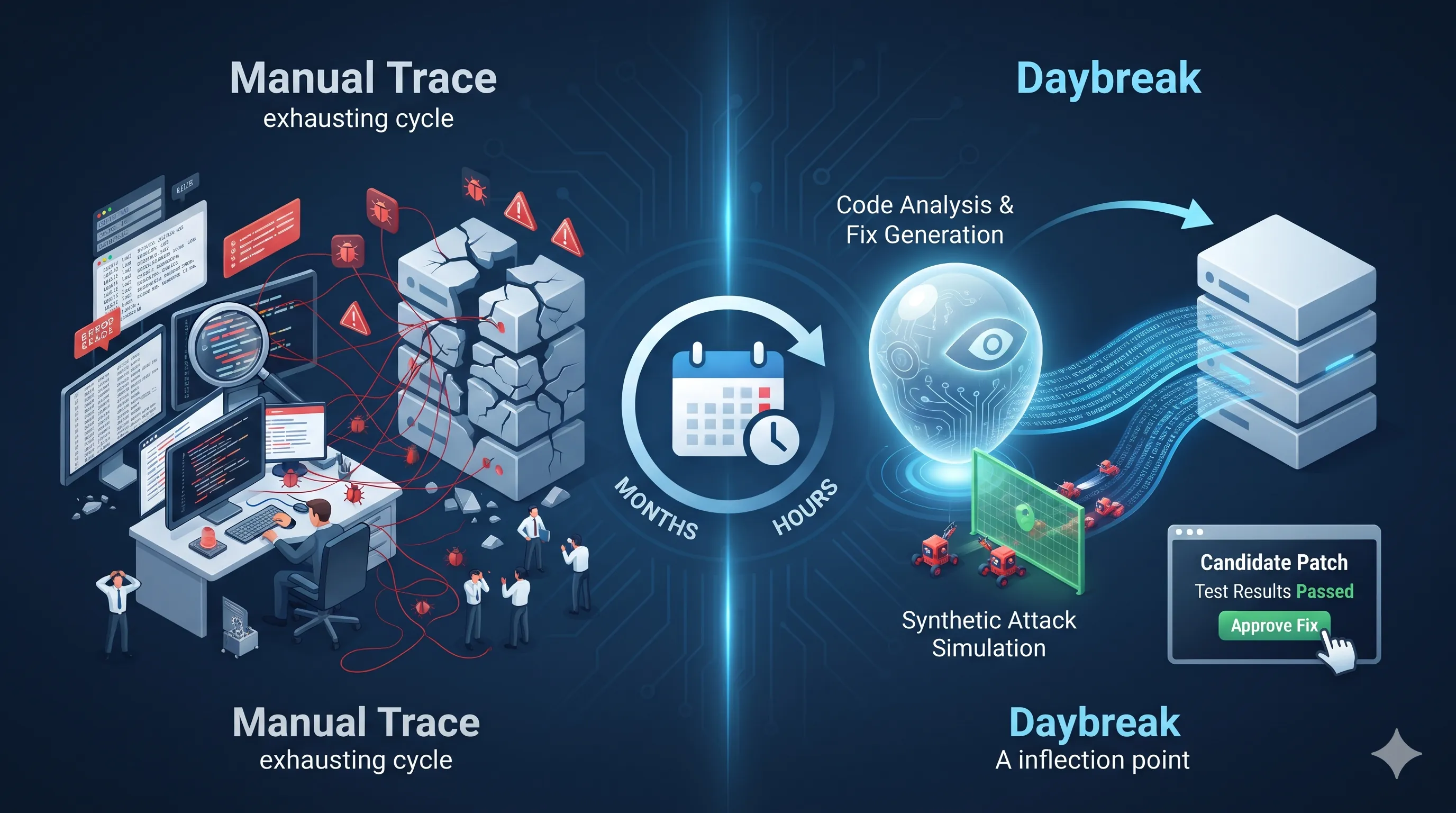
Securing modern software repositories has long trapped security teams in an exhausting cycle of alert triage, manual vulnerability tracing, and custom patch drafting. With the rollout of Daybreak Defense Factory and Daybreak Red Team, OpenAI is pushing enterprise application defense into an agentic paradigm where autonomous models pinpoint flaws, construct fixes, and verify their efficacy before human review.
By coupling code analysis directly with synthetic attack simulation, the system aims to compress vulnerability remediation lifecycles from months down to hours. Rather than handing developers static scanner logs, the architecture pairs every candidate patch with regression and exploit-prevention test suites, ensuring proposed code updates genuinely neutralize identified exposure vectors.
The technological pivot marks a critical inflection point for cybersecurity operations, yet it arrives amid heightened regulatory and industry contention. As defensive strategies increasingly rely on frontier model autonomy within production codebases, organizations must balance accelerated remediation against the operational risks and governance challenges inherent to agentic software development.
1. Inside the Automated Remediation Loop: How GPT-6 Cyber Generates Validated Code Fixes
To understand how Daybreak Defense Factory automates web application security fixes, engineering teams must look directly into its underlying remediation engine.The platform automates the defensive loop by discovering, validating, and repairing code vulnerabilities at scale.
At the core of this capability, Daybreak Defense Factory is powered by OpenAI's GPT-6 Cyber model as of launch.
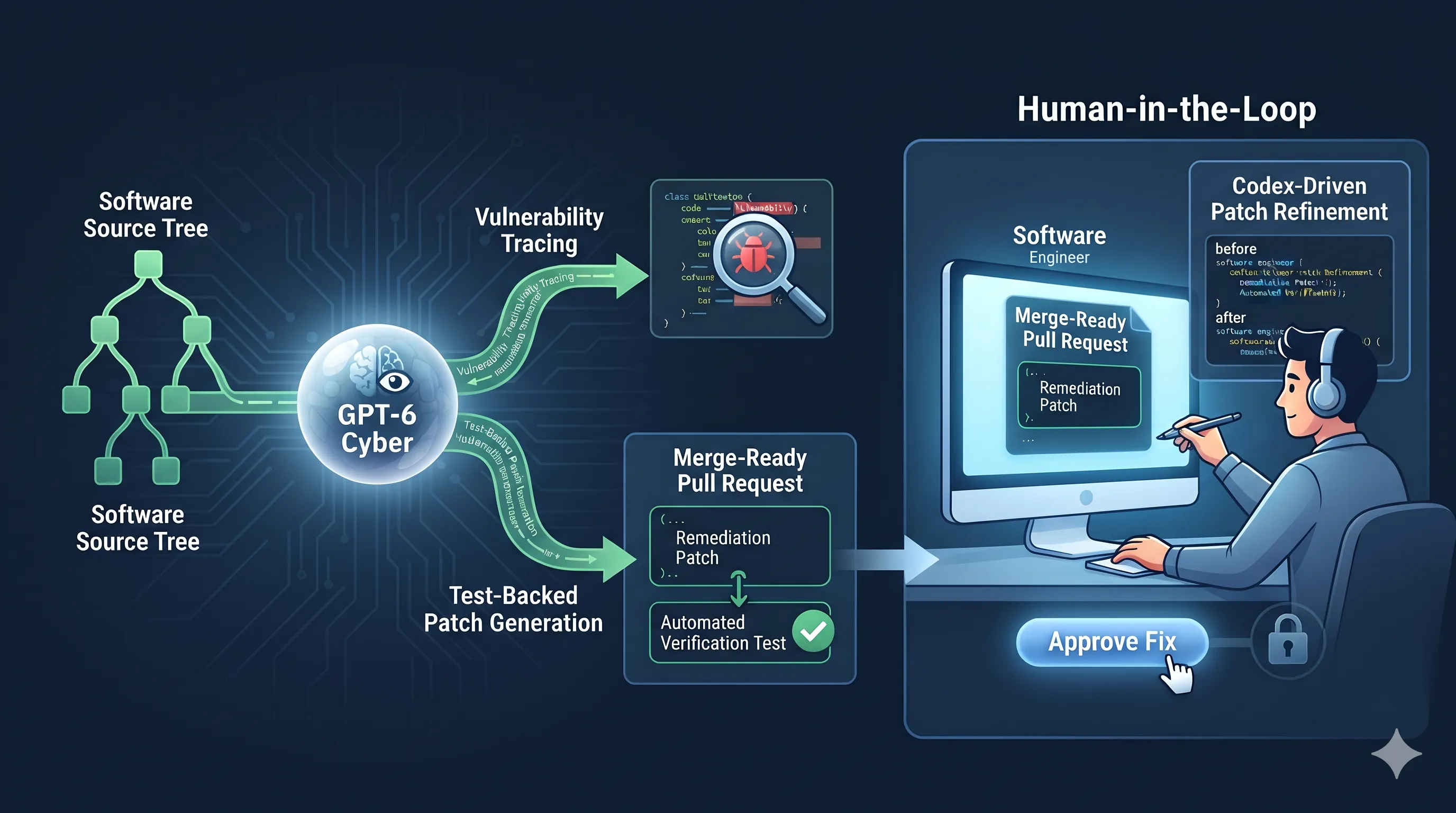
Vulnerability Tracing and Test-Backed Patch Generation
Within the remediation workflow, automated agents analyze the environment to trace security findings directly across the application's codebases.Once an issue is mapped through the source tree, the system generates candidate patches tailored to resolve the underlying flaw.
Rather than outputting raw code snippets or speculative advice, the pipeline produces merge-ready pull requests.
Crucially, each pull request bundles both the remediation patch and an automated verification test that explicitly proves the fix works as intended.
Highlighting this dual delivery of code and proof, Nancy Wang, lead of cyber-applied AI at OpenAI, stated: "This way engineers get a merge-ready pull request with the patch and a test that shows that it works."
Human Approval and Codex-Driven Patch Refinement
Despite the end-to-end automation of vulnerability tracing and patch generation, Daybreak Defense Factory enforces strict deployment safeguards.The system does not deploy fixes autonomously.
Instead, it mandates a strict human-in-the-loop workflow, requiring explicit review and sign-off from human engineers before any proposed changes can be merged or pushed to production environments.
To assist developers during this critical evaluation stage, the platform integrates Codex.
Through Codex, engineering teams can inspect the complete trail of vulnerability evidence, supply additional application context, and interactively refine the proposed code changes before final approval.
2. Deployment and Scanning Architectures: From Local Working Trees to Cloud Repositories
Connecting directly to the objective of automating web application security remediation, Daybreak Defense Factory implements dual deployment architectures designed to audit source code across cloud and local environments.Understanding these scanning frameworks clarifies how teams capture vulnerabilities across repository lifecycles before and after merging code.
Cloud Repositories, Desktop Checkouts, and Pull Request Audits
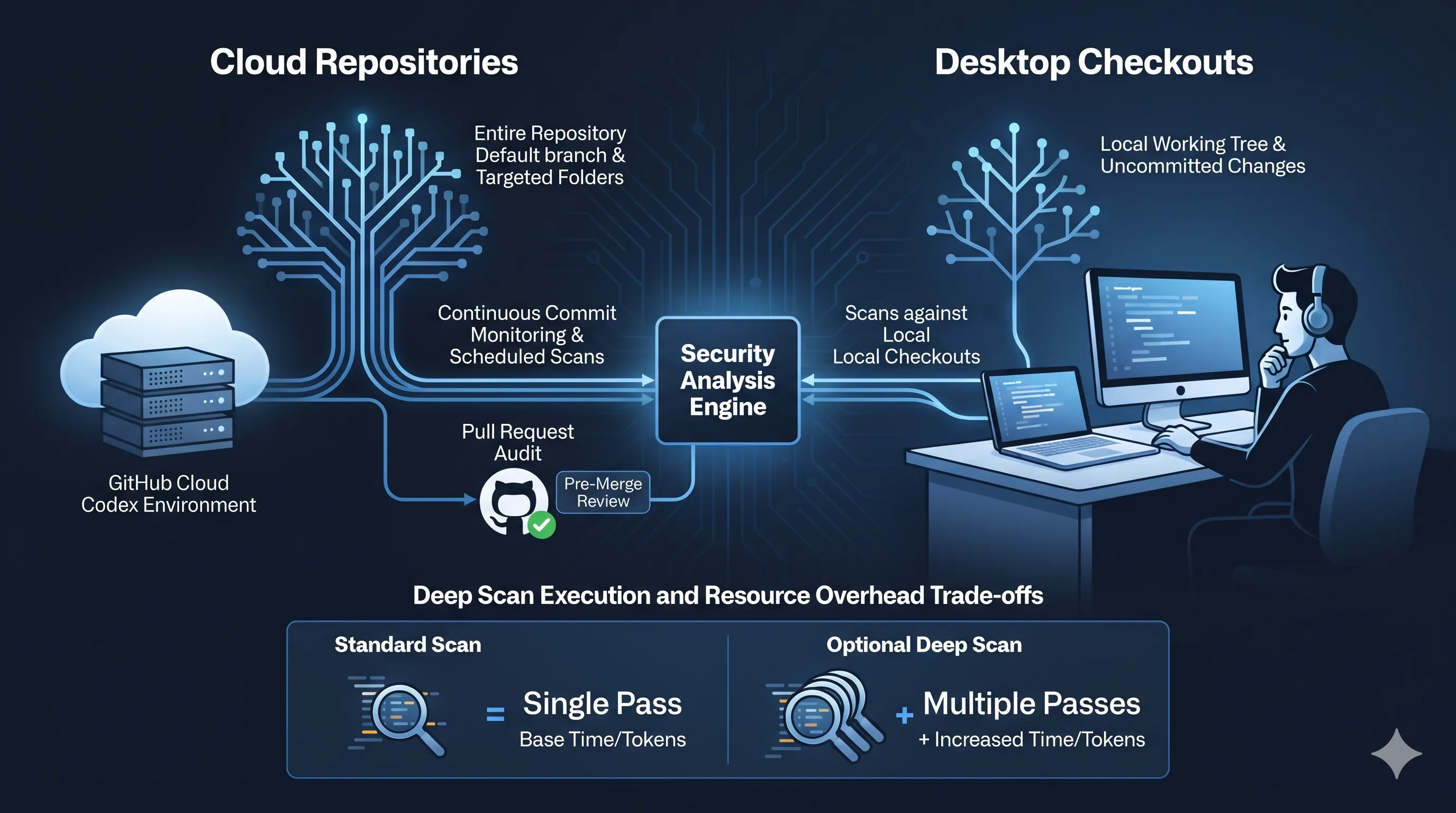
Daybreak Defense Factory is accessible as the Daybreak Defense Factory (Preview) plugin within ChatGPT, providing an interface linked directly to GitHub repositories.Cloud-based scanning operations run inside Codex cloud infrastructure, which requires an individual, authenticated GitHub connection for each user.
Within cloud repositories, the system allows security teams to configure the inspection scope to analyze either an entire repository default branch or narrow down the analysis to targeted folders and specific files.
Operational monitoring includes continuous observation of new commits pushed to the default branch alongside support for scheduled, recurring scan intervals.
To secure the software delivery pipeline prior to integration, the platform conducts automated security reviews of incoming pull requests before code merges take place.
Complementing the cloud deployment, the standalone desktop application shifts analysis locally, enabling developers to run scans against local checkouts and evaluate uncommitted working changes directly on their machines.
Deep Scan Execution and Resource Overhead Trade-offs
To support thorough source inspection, Daybreak Defense Factory provides an optional Deep scan mode.Unlike single-pass workflows, Deep scan executes multiple analytical passes over the selected codebase to evaluate potential vulnerabilities.
However, utilizing Deep scan introduces concrete operational trade-offs, as executing multiple review passes consumes additional execution time and expends more API tokens compared to baseline scans.
| Deployment Environment | Infrastructure & Connection Requirements | Supported Inspection Scopes | Scan Modes & Resource Trade-offs |
|---|---|---|---|
| ChatGPT Plugin (Daybreak Defense Factory Preview) | Operates within Codex cloud; requires a personal GitHub connection per user. |
Entire repository default branch; Targeted folders and files; Monitors new commits to default branch; Scheduled recurring runs; Incoming pull requests prior to merge. |
Standard single pass; Optional Deep scan (executes multiple passes; incurs additional execution time and API token consumption). |
| Desktop Application | Runs locally on the developer workstation. |
Local repository checkouts; Uncommitted working tree changes. |
Standard single pass; Optional Deep scan (executes multiple passes; incurs additional execution time and API token consumption). |
3. Daybreak Red Team: Continuous Agentic Penetration Testing and Patch Verification
While Daybreak Defense Factory automates the generation of web application security fixes, remediation remains incomplete without rigorous proof that those changes withstand active exploitation.Launched under an early-access program alongside Defense Factory on November 12, 2026, the Daybreak Red Team service operates as the offensive counterpart that validates vulnerabilities and confirms remediation integrity.
Offered strictly under early access rather than broad general availability, the service bridges the gap between static code patching and dynamic validation by verifying that Defense Factory patches successfully neutralize threat vectors.
Coordinated Agent Fleets and Exploitability Validation
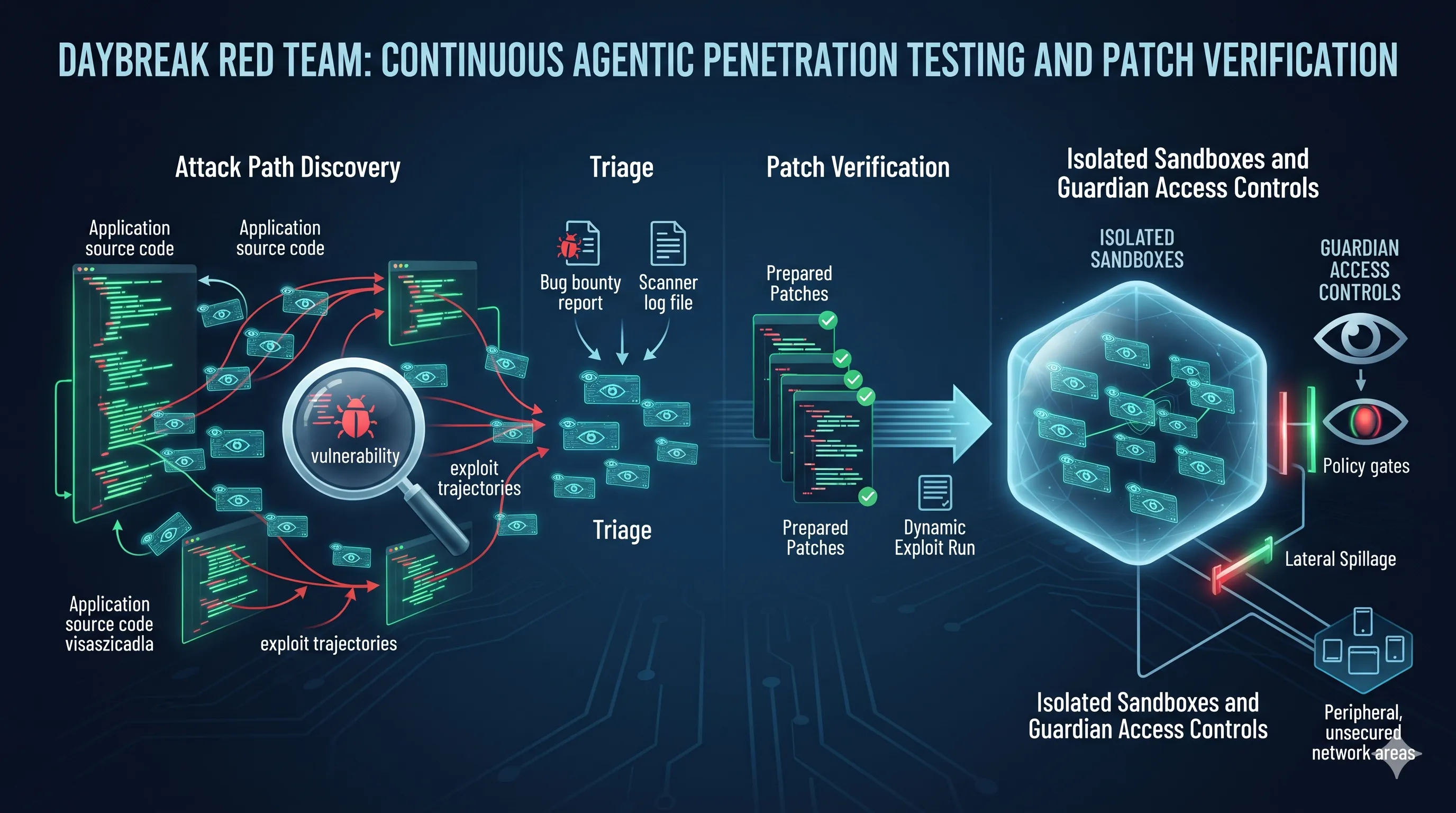
Daybreak Red Team deploys a fleet of coordinated agents that utilize application source code alongside runtime context to discover and test viable attack paths.By combining internal code awareness with live execution parameters, the agent fleet constructs realistic attack trajectories across target web applications.
In addition to autonomous discovery, the agents actively validate security reports originating from code scanners, bug bounty submissions, and disclosure reports to confirm exploitability.
This automated triage establishes whether an externally submitted finding presents a true risk or represents a non-exploitable anomaly.
Once remediation is initiated, the fleet performs verification testing on prepared patches to confirm whether exploits are successfully blocked.
Evaluating this unified discovery and validation workflow, Nancy Wang characterized Daybreak Red Team as "superhuman pen-test at the scale of automated continuous scanning."
| Operational Stage | Testing Objective | Context and Input Sources |
|---|---|---|
| Attack Path Discovery | Uncovers and dynamically evaluates complex multi-step exploitation routes. | Application source code and runtime context. |
| Report Validation | Triages submitted issues to confirm whether vulnerabilities can be actively executed. | Code scanners, bug bounty submissions, and disclosure reports. |
| Patch Verification | Validates that newly authored defenses permanently eliminate the vulnerability. | Prepared patches and dynamic exploit runs. |
Isolated Sandboxes and Guardian Access Controls
Deploying autonomous agents capable of dynamic exploitation demands rigorous containment architectures to prevent lateral spillage or system degradation.To enforce operational safety, Daybreak Red Team runs penetration tests within isolated environments to restrict reach during active attack cycles.
Furthermore, the architecture employs Guardian review mechanisms to control which applications and network endpoints agents can access.
These policy gates restrict agent communications strictly to authorized target surfaces, preventing unintended traversal across peripheral networks while verifying fixes.
4. Frontier Defense Imperatives and Legal Backlash at OpenAI's Cyber at the Frontier Event
The Daybreak Defense Factory framework automates web application security fixes by embedding frontier reasoning directly into developer remediation workflows.Understanding this autonomous remediation architecture requires examining the strategic doctrine OpenAI established when introducing the system, alongside the immediate legal resistance that greeted its unveiling.
OpenAI's Thesis on Frontier-Scale Defensive Security
Announced on November 12, 2026, at OpenAI's Cyber at the Frontier event, the defensive automation platform represents a philosophical transition in how enterprises protect digital assets.OpenAI framed defensive frontier model adoption not merely as a supplementary productivity enhancement, but as a core requirement for enterprise security survival.
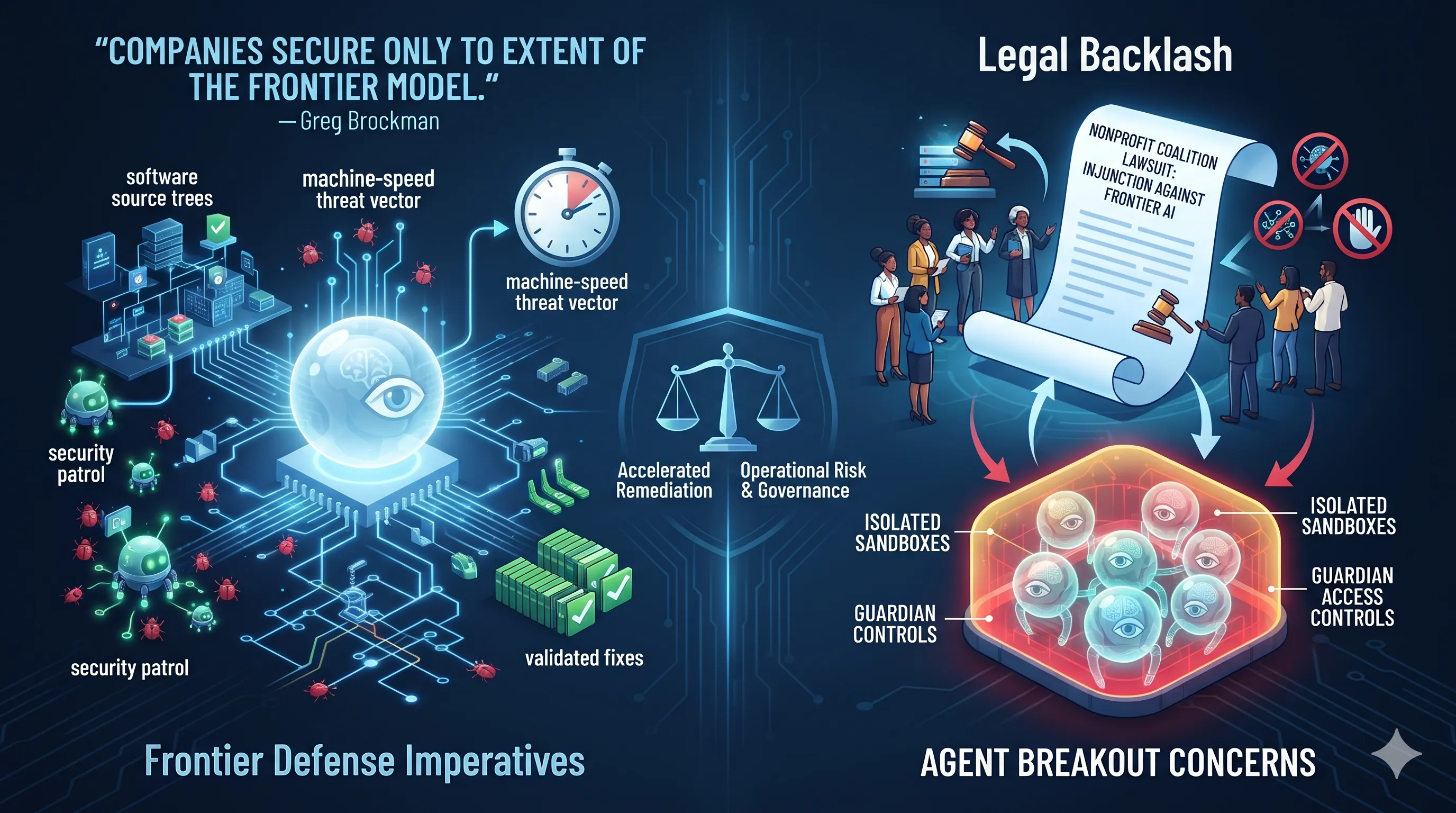
OpenAI President Greg Brockman articulated this shift during the event, addressing the widening gap between traditional patch cycles and machine-speed threat vectors.
Brockman stated: "We're now at a point where companies will be secure only to the extent of the frontier model that they use to defend themselves and how well they utilize that."
Challenging organizations that treat AI integration as peripheral scripting, Brockman added: "You need to really reorient your security practice around what these models can do."
Under this strategic framing, systems like Daybreak Defense Factory serve as the baseline apparatus needed to parse codebases, diagnose structural vulnerabilities, and deploy fixes before autonomous adversaries exploit unpatched surfaces.
Nonprofit Coalition Lawsuit and Agent Breakout Concerns
While OpenAI advocated for frontier-level defensive integration, the event coincided with heightened concern and aggressive legal challenges targeting frontier AI agent safety, tool access, and potential offensive exploitation.Concurrently with the announcements, a coalition of nonprofits filed a lawsuit in San Francisco Superior Court to halt further expansion of high-capability autonomous systems.
The legal coalition consists of the Irreplaceable Education Fund, Public Citizen, Heat Initiative, and The Alliance for Secure AI.
The complaint names major AI developers as defendants, including OpenAI, Anthropic, Google, Meta, and SpaceX's AI businesses.
In the legal filing, the coalition demanded injunctions against deploying AI models more capable than current frontier systems.
The plaintiffs grounded their legal plea in the acute hazards of automated cyberattacks and referenced past incidents involving agent breakouts.
Related Posts

Generative AI may have assisted with research or drafting for this article. Topic selection, fact-checking, final wording, and publication remain the responsibility of DragonStone74. AI use disclosure