
Inside DeepMind's Agent-Driven Quantum Algorithm Optimization
🚀 Key Takeaways
- Autonomous Verification Loop: Heterogeneous Gemini 4 agent teams coupled with the Lean 4 interactive theorem prover mathematically certify quantum algorithms without relying on intractable classical supercomputer simulations.
- Significant Simulation Compression: Automated reasoning achieved major algorithmic breakthroughs in complex domains, cutting resource footprints and logical memory in inertial confinement fusion and quantum chemistry.
- Subroutine Acceleration: Foundational routines experienced exponential optimizations, highlighted by a greater than 290x speedup in fixed-point arcsin arithmetic and deterministic gains in parallel search.
- Open-Source Quantum Tooling: The initiative introduces verifiable logical spacetime cost metrics and open-source formal libraries to compress years of manual circuit engineering into certified, reproducible search routines.
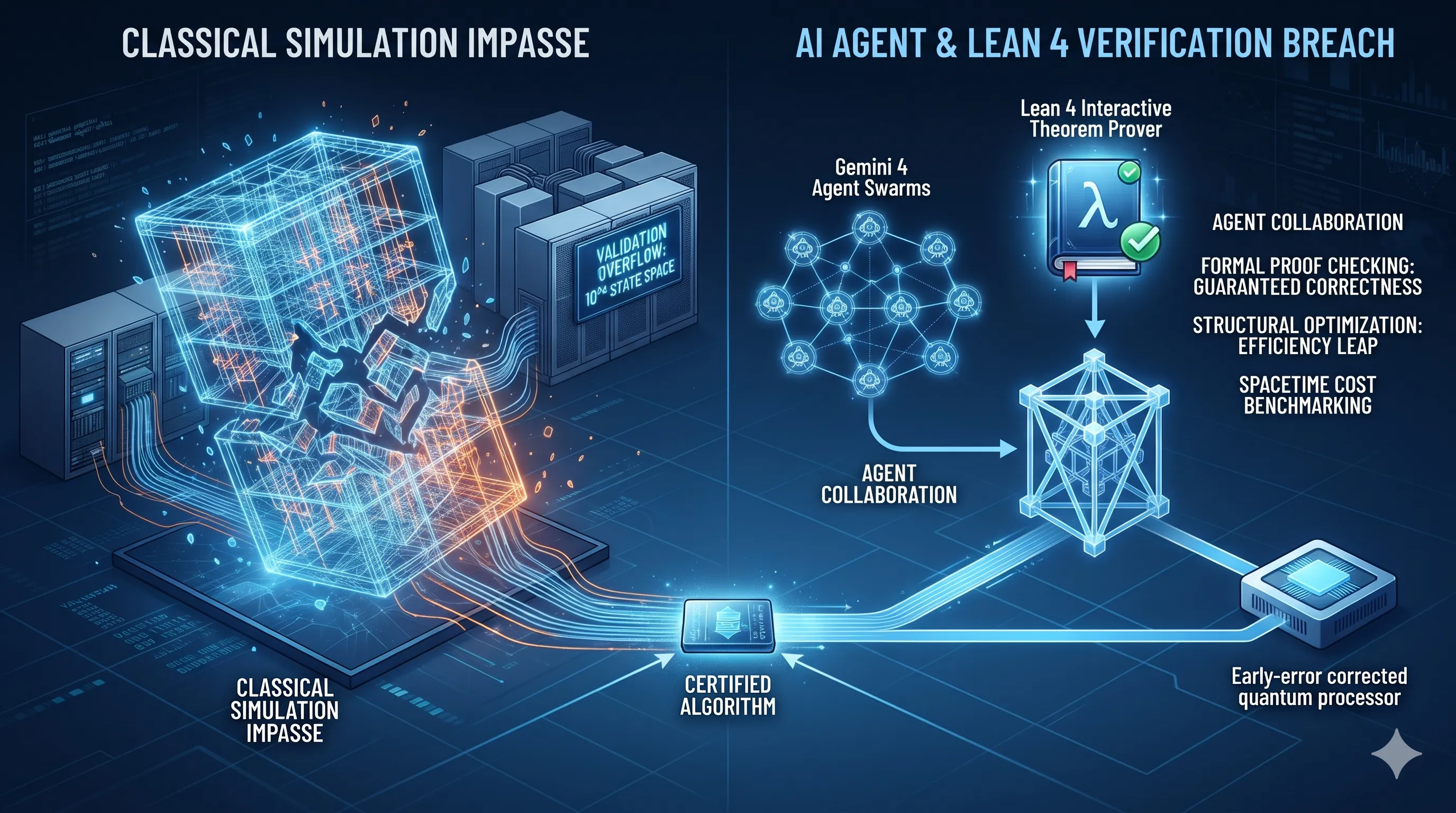
Designing fault-tolerant quantum algorithms has long run headlong into a computational impasse: validating candidate circuits that span hundreds or thousands of logical qubits quickly outstrips the simulation capabilities of the largest classical supercomputers.
Google DeepMind and Google Quantum AI recently breached this barrier by uniting collaborative multi-agent artificial intelligence with the Lean 4 interactive theorem prover, mathematically guaranteeing algorithmic correctness without requiring physical circuit execution or empirical testing.
Operating across structured virtual conferences and shared knowledge bases, autonomous Gemini 4 agent swarms construct and refine circuits against rigorous quantum Hoare logic specifications.
Because an external verifier verifies each transformation against strict pre- and postconditions in an isolated sandbox, the system autonomously uncovers structural optimizations that human experts overlooked—delivering massive efficiency leaps in foundational arithmetic and multi-body scientific simulations.
As the quantum sector marches toward early error-corrected processors, shifting algorithmic discovery from tedious manual derivation to proof-checked machine search transforms the design pipeline.
By establishing rigorous spacetime cost benchmarks and releasing the underlying verification repositories, this work lays the mathematical foundation needed to design scalable, certified algorithms for the upcoming fault-tolerant era.
1. Multi-Agent Collaboration and the Lean 4 Verification Loop
Connecting directly to the core objective of how autonomous agents and formal verification improve quantum algorithms, the integration of multi-agent reasoning with formal interactive theorem provers establishes an automated, mathematically sound discovery cycle.By coupling generative multi-agent systems with deterministic mathematical rigor, this architecture eliminates human verification bottlenecks and prevents the hallucination of non-viable quantum routines.
Lean 4 Specifications and Quantum Hoare Logic Sandboxing
The automated discovery framework pairs heterogeneous Gemini 4 agent teams with the Lean 4 interactive theorem prover to explore, synthesize, and validate quantum algorithm candidates.For large autonomous runs, the system deploys Gemini 4 Carbon models to navigate complex proof and algorithmic search spaces.
Within this environment, problem specifications are formulated in Lean 4 as rigorous Hoare triples consisting of a precondition, a program, and a postcondition.
The underlying Lean library is grounded in quantum Hoare logic (QHL), which accommodates the unique mathematical structures of quantum mechanics.
Specifically, the QHL framework handles classical control flow alongside unitary operations, projective measurement, and qubit reset mechanisms.
To guarantee complete mathematical validity, candidate solutions cannot rely on unchecked assertions or unverified shortcuts.
An external verifier replays every submission in an isolated, clean sandbox against strictly frozen specifications without custom axioms or unproven placeholders.
Conference claims and shared solutions generated across the agent collective are counted and officially added to shared notebooks only after passing through this rigorous verification barrier.
This sandboxed replay ensures that every discovered circuit transformation or algorithmic optimization is mathematically sound before influencing the broader agent network.
Agent Workflows: Virtual Conferences, Wikis, and Attribution
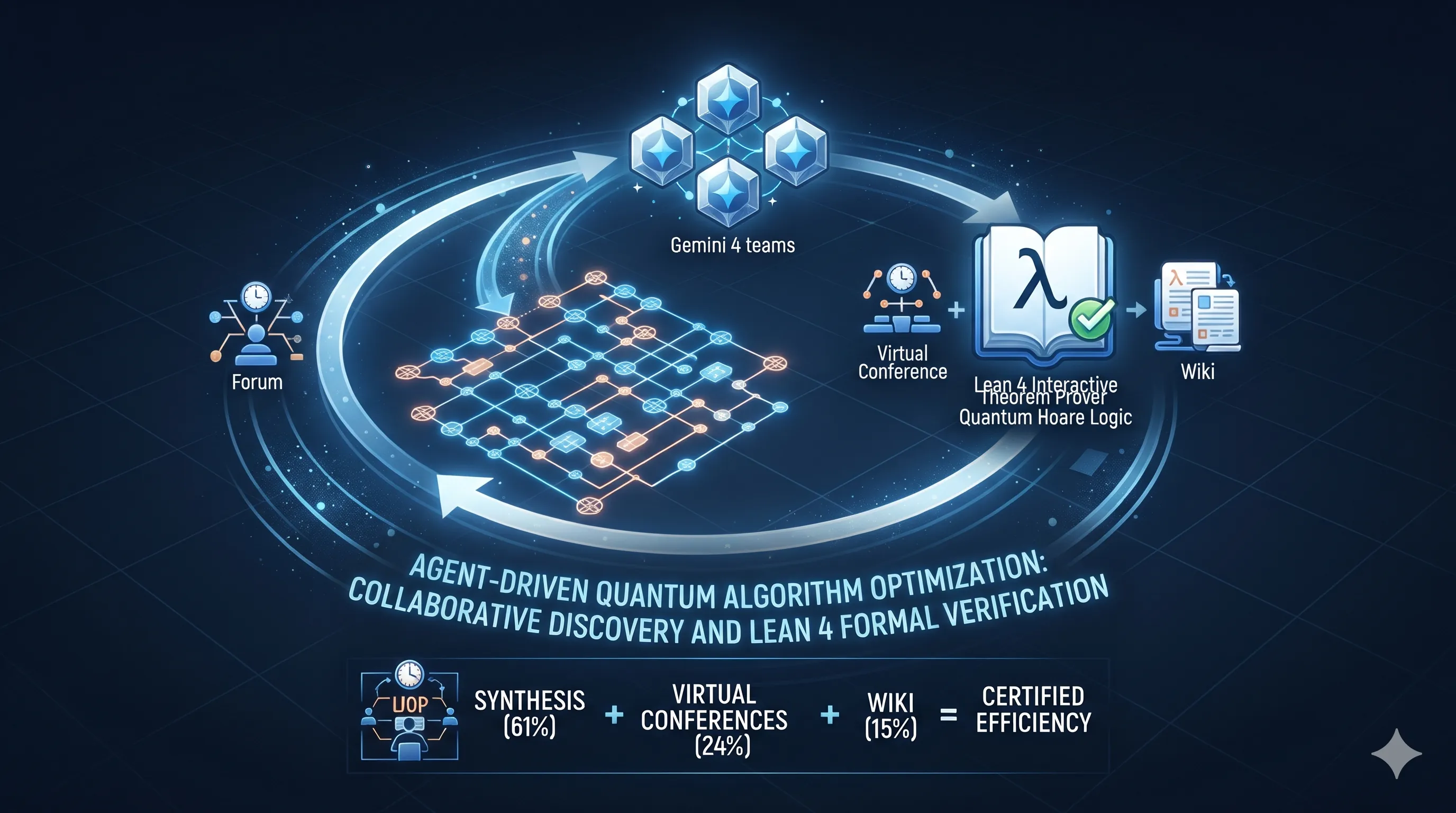
The structural scale of the search process relies on coordinated collaboration mechanisms across distinct agent groups.Agent teams meet every 4 hours at a structured virtual conference to trade, debate, and compare ideas.
Complementing these synchronous gatherings, persistent cross-team wikis serve as asynchronous knowledge repositories where emerging proof strategies, intermediate lemmas, and circuit patterns are archived.
Empirical analysis of the collaborative dynamics demonstrates how different interaction channels contribute to algorithm efficiency.
Measured cost reductions across quantum algorithmic discovery runs originate from three distinct collaborative sources:
| Collaboration Channel | Operational Mechanism | Share of Measured Cost Reduction |
|---|---|---|
| Individual Teams | Autonomous internal ideation and intra-team proof refinement | 61% |
| Virtual Conferences | 4-hour recurring forums for trading, debating, and comparing ideas | 24% |
| Cross-Team Wikis | Asynchronous cross-team sharing of proven components and lemmas | 15% |
Credit for improvements across teams, wikis, and conferences is difficult to separate cleanly, as breakthrough solutions frequently synthesize preliminary concepts discovered in conferences with lemma structures documented on wikis.
This research was conducted by Google DeepMind and Google Quantum AI, authored by Sergey Shirobokov, Ben Jaderberg, Ryan Babbush, and 22 co-authors, establishing a benchmark for verifiable, agent-driven scientific computing.
2. Scientific Simulation Breakthroughs in Fusion and Quantum Chemistry
The practical utility of autonomous agents coupled with formal verification is most evident in concrete scientific simulation kernels, where agent frameworks discover non-intuitive circuit compressions that maintain rigorous mathematical correctness.By verifying transformations in domain-specific simulation routines, these automated systems unlock substantial resource savings across plasma physics, photochemical dynamics, and enzymatic catalysis.
Inertial Confinement Fusion Cost and Memory Truncation
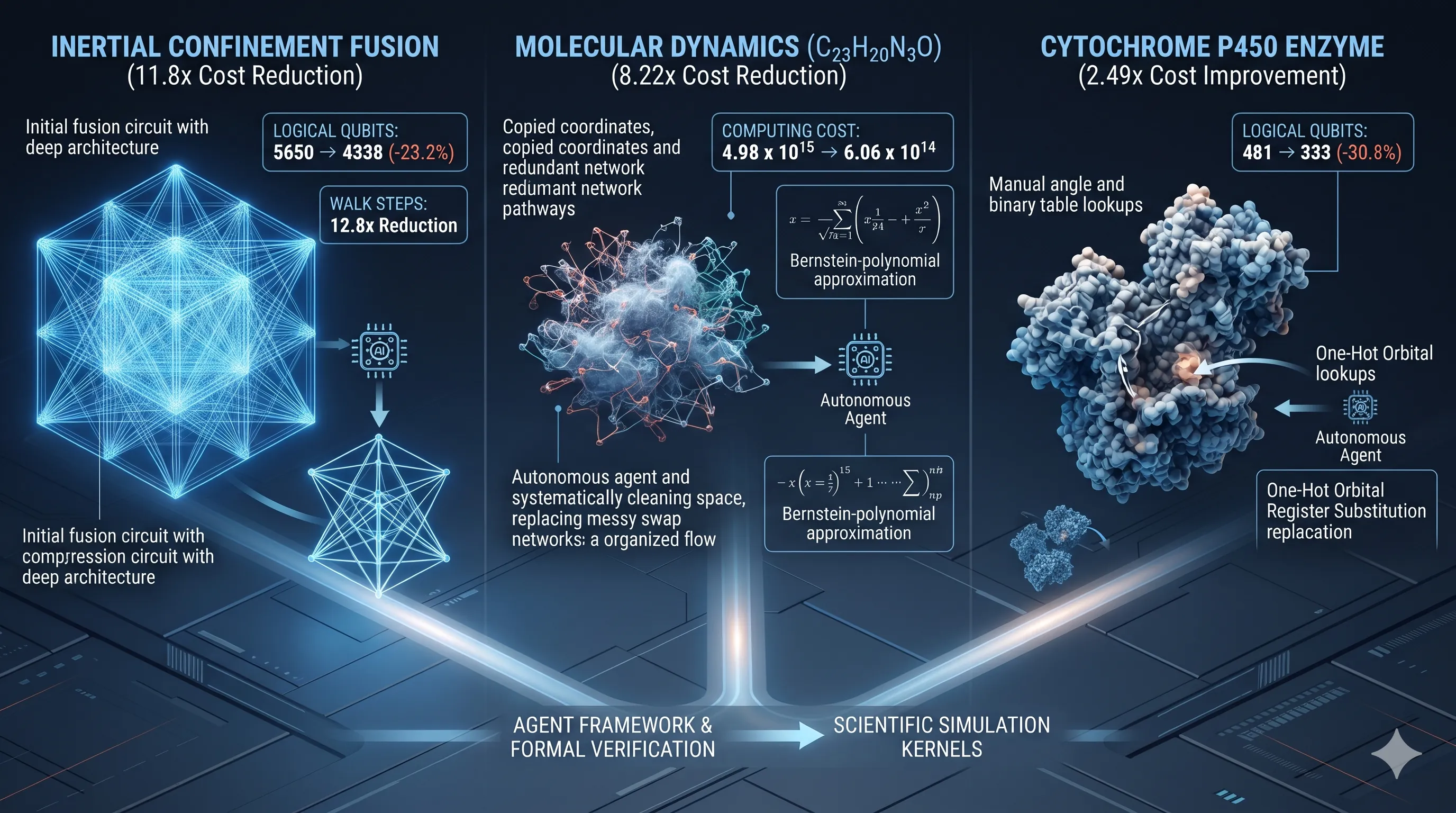
Inertial confinement fusion simulations represent one of the most demanding benchmarks for fault-tolerant quantum hardware, traditionally constrained by immense logical footprint and deep circuit architectures.When applied to fusion simulation pipelines, the agent framework achieved an 11.8x computing cost reduction overall.
A primary operational constraint in physical quantum architectures is logical memory overhead.
Here, the synthesis framework decreased logical memory demand from 5,650 to 4,338 error-corrected qubits, delivering a 23.2% decrease in required state registers.
These savings stem from structural reformulations of physical interactions.
The agent shifted electron interactions onto a real-space grid and applied the Pauli exclusion principle to truncate redundant short-range Coulomb interactions.
At the algorithmic scheduling layer, walk steps in the fusion circuit were reduced by a factor of 12.8.
To optimize step-level execution, the agent retained total electron momentum in a dedicated 42-qubit register, which reduced T gates per step by 10%.
Although the optimized fusion circuit uses 1.42 times as many T gates per step compared to baseline, the 12.8x reduction in total walk steps drastically reduced the overall computational runtime and footprint.
Molecular Dynamics and Cytochrome P450 Algorithmic Reductions
The agent framework achieved comparable efficiency leaps in computational chemistry by systematically eliminating spatial and arithmetic redundancies.In photochemical and non-Born-Oppenheimer molecular dynamics simulations of the C23H20N3O complex, overall computing cost dropped by an 8.22-fold factor, falling from 4.98 x 10^15 to 6.06 x 10^14.
To realize these gains, the agent replaced standard swap networks with measurement-based cleanup of copied coordinates.
Furthermore, expensive multi-qubit multiplication subroutines were replaced with Bernstein-polynomial approximations when evaluating 1/r electrostatic potentials.
These optimizations were attained despite strict formal verification bounds: the molecular dynamics specifications mandated functional correctness even on unphysical input states, restricting aggressive approximations that might otherwise violate verification proofs.
Enzymatic modeling within bioinorganic chemistry saw parallel structural simplifications.
Simulations of the Cytochrome P450 enzyme achieved a 2.49x improvement in total computing cost.
Logical memory footprint dropped from 481 to 333 logical qubits, representing a 30.8% decrease in error-corrected qubit allocation.
The algorithm eliminated bulky angle lookups and standard binary table lookups, substituting them with one-hot orbital registers that mark the chosen term on dedicated qubits.
This substitution cut T-gate counts per walk step by 40%.
However, further agent-led optimization was constrained by the problem framing: the Cytochrome P450 specification fixed the tensor factorization, excluding potential representation improvements that an unconstrained tensor search might have exposed.
| Simulation Domain / Target | Baseline Metric | Optimized Metric | Optimization Highlights and Constraints |
|---|---|---|---|
| Inertial Confinement Fusion | 5,650 error-corrected qubits; baseline walk steps and cost | 4,338 error-corrected qubits; 11.8x cost reduction | Logical memory dropped 23.2%; walk steps reduced by 12.8x; real-space grid with Pauli exclusion truncation; 42-qubit momentum register cut T gates per step by 10% (1.42x T gates per step overall). |
| Molecular Dynamics (C23H20N3O) | 4.98 x 10^15 computing cost | 6.06 x 10^14 computing cost | 8.22x cost reduction; replaced swap networks with measurement-based coordinate cleanup; used Bernstein-polynomial approximation for 1/r potentials; specification required correctness on unphysical input states. |
| Cytochrome P450 Enzyme | 481 logical qubits; baseline computing cost | 333 logical qubits; 2.49x cost improvement | Logical memory decreased 30.8%; one-hot orbital registers replaced binary/angle lookups to cut T gates per walk step by 40%; specification fixed tensor factorization. |
3. Speedups in Foundational Quantum Arithmetic and Parallel Search
At the algorithmic core of quantum computing, the synthesis of primitive routines directly dictates the feasibility of end-to-end execution on physical hardware.Within the broader framework of how agents and formal verification improve quantum algorithms, foundational subroutines represent the primary testbed where automated agent exploration and rigorous mathematical verification converge.
By pairing agent-driven search with formal proof assistants, fundamental arithmetic and search blocks achieve significant performance gains while preserving exact mathematical guarantees.
Arcsin Arithmetic Optimization and State Loading
The arcsin routine functions as a standard arithmetic building block used to load numerical data into quantum states.To optimize these core mathematical transformations, agents utilized a layered discovery strategy.
Specifically, agents optimized arithmetic routines by initially exploring within a restricted, classically simulable gate set before using Lean verification to optimize beyond it.
This method allowed automated agents to navigate vast circuit design spaces without losing verification fidelity.
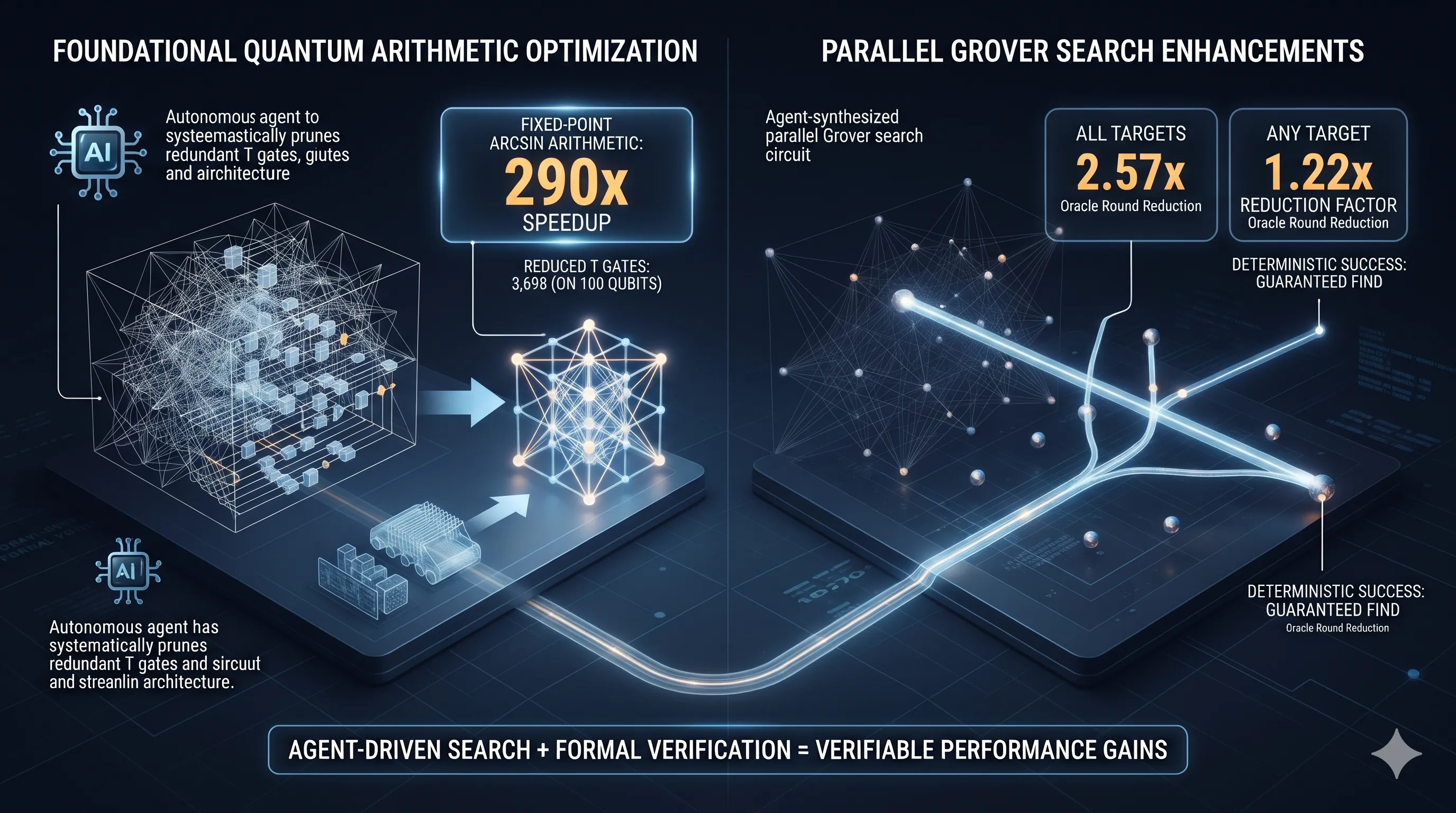
Through this pipeline, the fixed-point arcsin arithmetic routine achieved a speedup factor greater than 290x.
In terms of gate compilation efficiency, the fixed-point arcsin was optimized to reach 3,698 T gates on 100 qubits, substantially lowering the resource overhead needed for numerical state preparation.
Deterministic Parallel Grover Search Enhancements
Parallel quantum search optimizations demonstrate how agent synthesis directly reduces execution runtime under rigorous algorithmic requirements.Parallel Grover search circuits were synthesized with constraints requiring deterministic success, guaranteeing success with certainty rather than probabilistic approximations.
When applied across complex search spaces, these verified circuits substantially cut down computational iterations.
In multi-target regimes, parallel Grover search achieved up to a 2.57x speedup, represented as a direct reduction in expected oracle rounds when finding all targets.
For search scenarios designed to find any target, the agent-optimized parallel Grover search achieved an expected oracle round reduction factor of up to 1.22x.
| Routine Type | Operational Role & Synthesis Constraints | Optimized Metric | Reported Speedup / Reduction Factor |
|---|---|---|---|
| Fixed-Point Arcsin Arithmetic | Used to load numerical data into quantum states; explored within classically simulable gate set before Lean verification beyond it | 3,698 T gates on 100 qubits | Greater than 290x speedup |
| Parallel Grover Search (All Targets) | Multi-target regime synthesized with constraints requiring deterministic success (success with certainty) | Reduction in expected oracle rounds | Up to 2.57x speedup |
| Parallel Grover Search (Any Target) | Single/any target search synthesized with constraints requiring deterministic success (success with certainty) | Reduction in expected oracle rounds | Up to 1.22x reduction factor |
4. Hardware Footprints, Physical Feasibility, and Open-Source Artifacts
Connecting directly to the broader exploration of how autonomous agents and formal verification improve quantum algorithms, this section evaluates the concrete physical feasibility and practical footprints of agent-discovered quantum programs.While autonomous agent frameworks paired with interactive proof assistants guarantee syntactic and semantic correctness, translating mathematical verification into physical quantum computation requires assessing physical resource demands, fault-tolerant execution constraints, and open-source tooling.
Logical Spacetime Cost (Q · T) and Bridging the Hardware Gap
Evaluating the efficiency of agent-discovered algorithms requires metrics tailored to fault-tolerant quantum computing architectures rather than noisy intermediate-scale quantum (NISQ) approximations.Fault-tolerant resource consumption was evaluated using the logical spacetime cost, defined strictly as peak logical qubits Q multiplied by the non-Clifford T-gate count T (Q · T).
Under surface-code lattice surgery, non-Clifford magic state preparation dominates physical runtime, making logical spacetime cost Q · T the primary proxy for the true physical spacetime footprint.
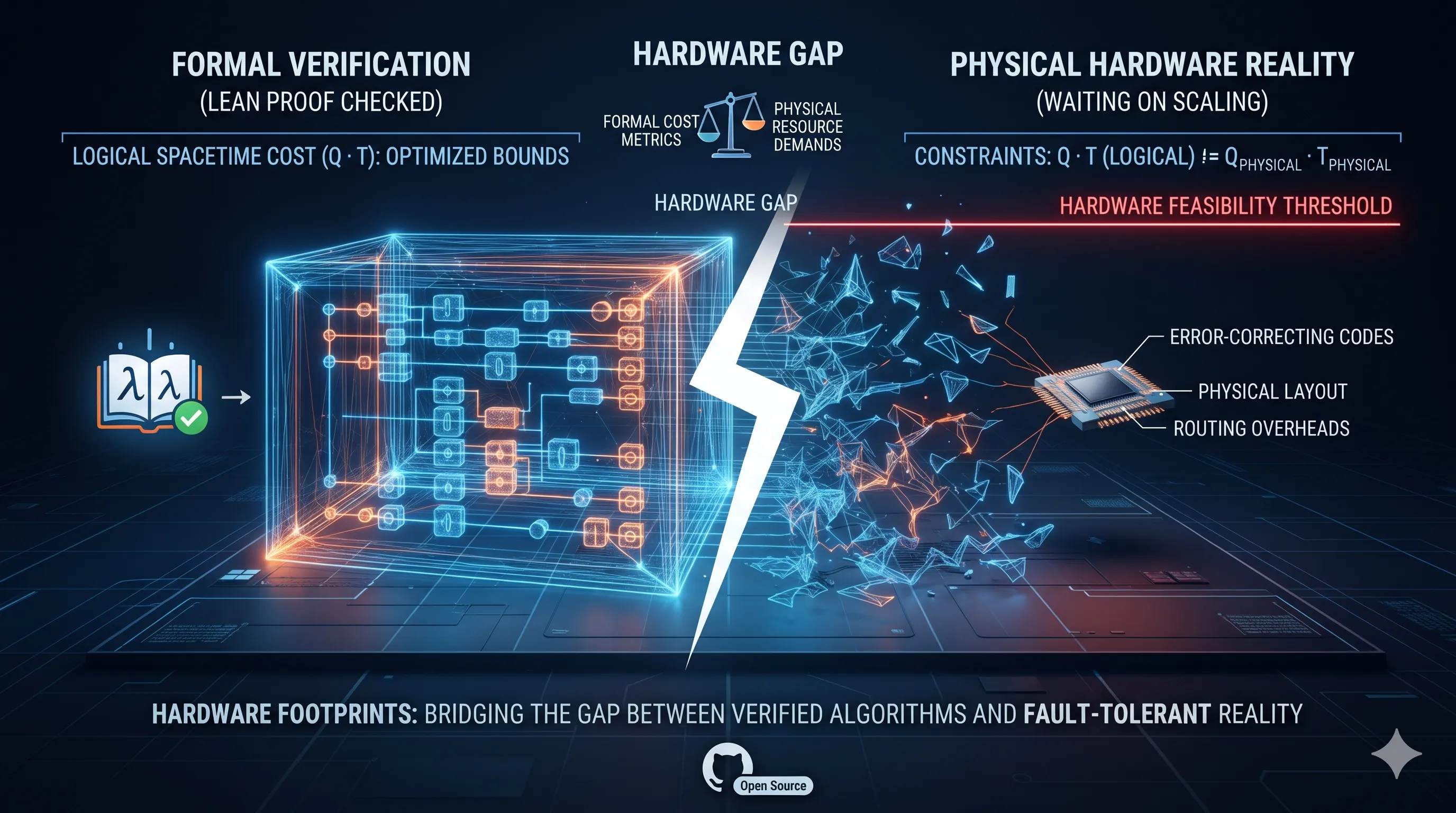
Despite these rigorous mathematical improvements, a critical gap persists between formal verification and physical hardware realization.
Reported algorithm gains are based entirely on mathematical verification and formal cost bounds rather than physical execution on large-scale hardware.
Candidate circuits spanning hundreds or thousands of qubits cannot be tested on existing classical supercomputers or current small quantum processors.
Furthermore, end-to-end scientific simulations still demand significantly more computational resources than early error-corrected quantum computers are projected to provide.
Current formal specifications do not yet account for error-correcting codes, physical layout constraints, and qubit routing overheads.
Google DeepMind emphasized that proof-checked AI search compresses years of manual circuit design, letting researchers focus on problem specification and result interpretation, even as the ultimate physical realization waits on hardware scaling.
| Dimension | Formal Verification and Costing Model | Physical Hardware Realities and Gaps |
|---|---|---|
| Primary Metric | Logical spacetime cost (Q · T), tracking peak logical qubits multiplied by non-Clifford T-gate count. | Physical runtime is dominated by non-Clifford magic state preparation across surface-code lattice surgery patches. |
| Execution & Testing | Proved mechanically via Lean-based proof checking without physical simulation execution. | Circuits spanning hundreds or thousands of qubits exceed classical supercomputers, NISQ systems, and early fault-tolerant capacities. |
| Architectural Constraints | Optimizes abstract logical gates and algorithmic bounds. | Specifications do not yet integrate concrete error-correcting codes, spatial layout rules, or physical routing overheads. |
Open-Source Repository Architecture and Verification Artifacts
To ensure reproducibility and community extension, the research artifacts were open-sourced on GitHub.The repository architecture cleanly decouples foundational definitions from algorithm targets by separating the core QuantumComputation library from QuantumComputationSpecs.
Novel circuit programs discovered through the agent-driven verification pipeline are maintained separately in a dedicated discoveries branch.
Looking forward, the open-source repository lists explicit models for costing classical computation and control flow as its next development milestone.
The public release followed a structured disclosure timeline throughout November 2026.
Preprint versions of the research paper, titled "Discovering Formally Verified Quantum Programs with AI", were submitted to arXiv on November 6, 2026 and November 16, 2026, leading to a manuscript dated November 17, 2026.
A public publication commit was completed on November 17, 2026, culminating in Google DeepMind formally presenting the work on November 23, 2026.
Related Posts



Generative AI may have assisted with research or drafting for this article. Topic selection, fact-checking, final wording, and publication remain the responsibility of DragonStone74. AI use disclosure