
XNU Linux Brings macOS GUI to Arm64 Linux Without Hypervisors
🚀 Key Takeaways
- Hypervisor-Free Co-Kernel Model: The project compiles Apple's open-source XNU kernel into a loadable module, executing macOS processes alongside standard Linux tasks on bare-metal arm64 hardware.
- Interactive Graphical Desktop: Custom virtualized kernel extensions route display, input, and storage subsystems to render a functional macOS desktop environment directly on a Linux host.
- Near-Native Execution Speed: Desktop boot speeds rival or surpass traditional virtualization environments while leveraging accelerated GPU rendering pipelines.
- Strict License Isolation: Linux GPL code and XNU APSL components are separated across a specialized interface boundary to maintain architectural segregation.
- Clean Upstream Lineage: Rooted in foundations from UniXNU and macOS-DroidVM, the implementation builds entirely against genuine Apple installation media without distributing proprietary binaries.
Bridging the architectural divide between macOS and Linux has traditionally required cumbersome hypervisors, hardware emulation layers, or complex container shims. The introduction of xnulinux fundamentally alters that dynamic by embedding Apple’s open-source XNU core directly into an unmodified arm64 Linux kernel as a loadable module, allowing genuine macOS environments to run concurrently with standard Linux workloads on the same physical CPU.
By bypassing conventional hypervisor translation layers, this co-kernel approach grants the hosted macOS environment direct control over memory management and core processing tasks. Custom-built drivers and synthetic device extensions facilitate display pipelines, keyboard and pointer input, and storage access, transforming an experimental kernel bridge into a fully interactive graphical desktop experience.
This breakthrough marks a significant milestone in cross-platform systems engineering. As arm64 architectures expand across modern computing ecosystems, the ability to co-locate macOS graphical sessions natively on Linux host systems opens powerful new possibilities for cross-OS research, system integration, and developer tooling.
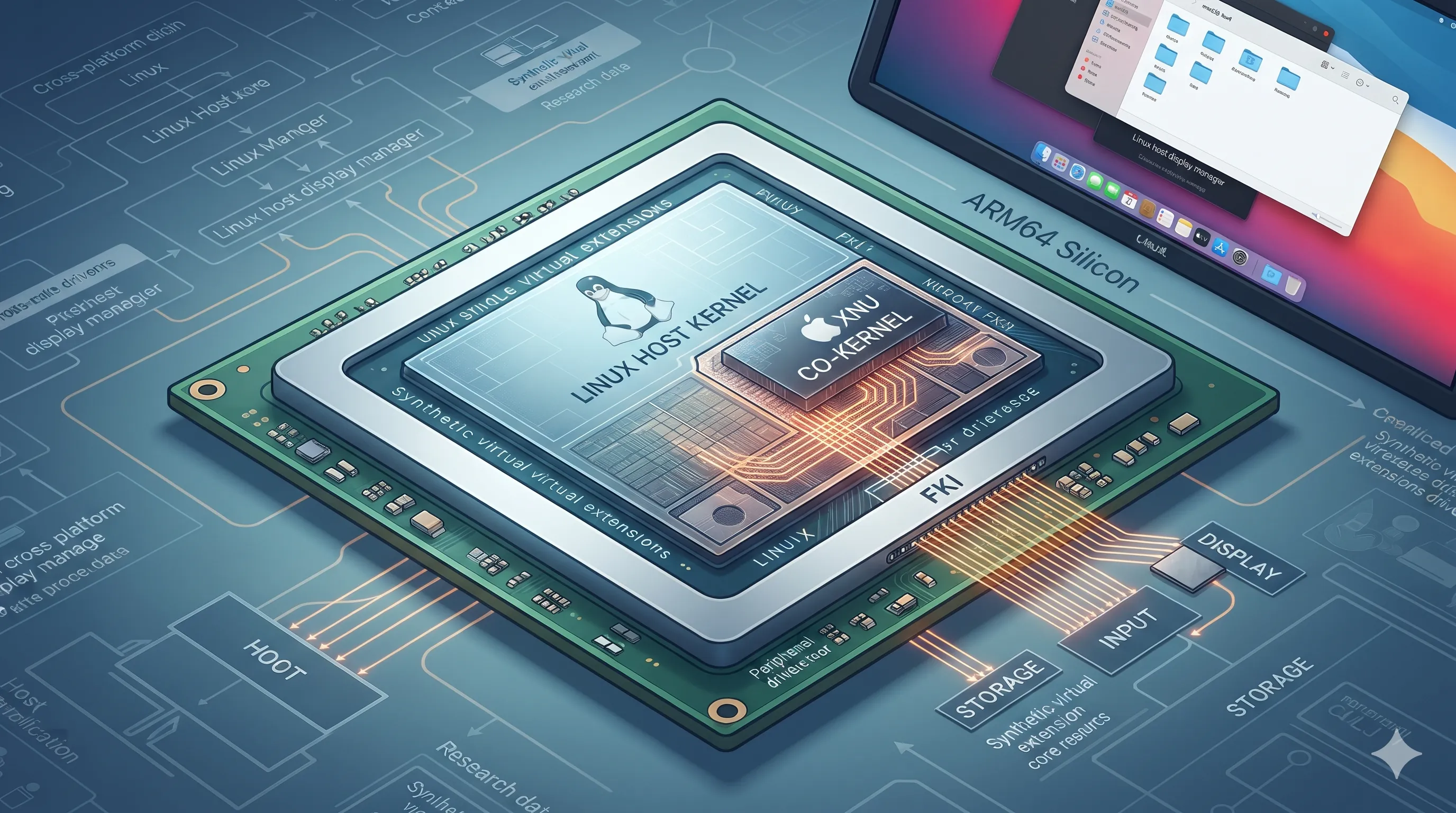
1. Co-Kernel Architecture: Running XNU Directly on Arm64 Linux Without Hypervisors
Understanding how the xnulinux project brings the native OS X GUI to Linux requires examining its co-kernel execution model.Created by Heyang Zhou and contributors, xnulinux avoids the performance penalties and abstraction layers of conventional hypervisors by running Apple's XNU kernel alongside the host operating system.
Loadable Module Architecture and the fki.ko Interface
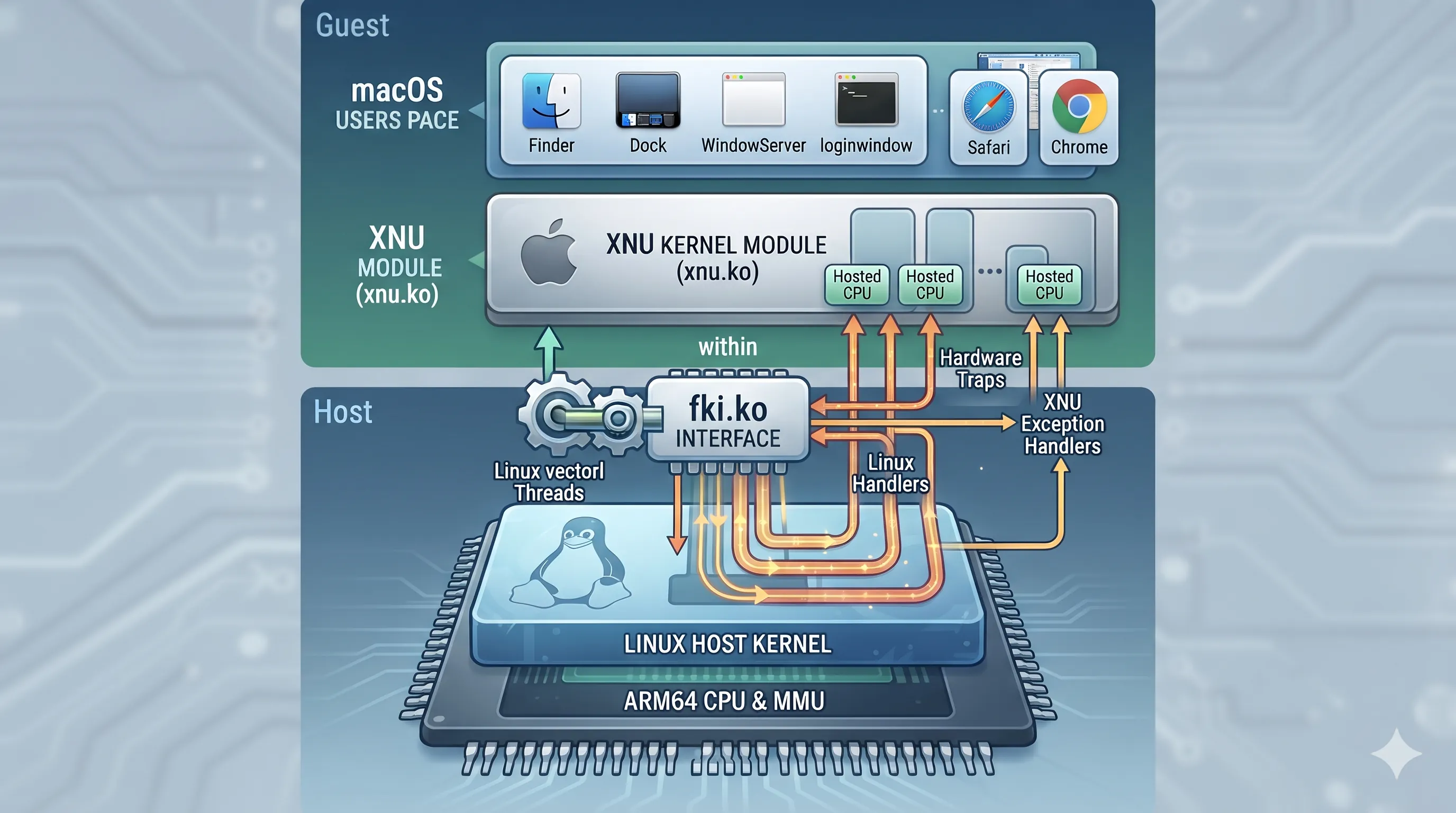
The technical foundation of xnulinux relies on compiling Apple's open-source XNU kernel into a loadable kernel module named xnu.ko.Rather than executing inside a virtual machine, the compiled xnu.ko module runs directly inside an unmodified arm64 Linux kernel without any hypervisor overhead.
To mediate interaction between the host kernel and the Apple kernel subsystem, the architecture introduces a dedicated interface module designated as fki.ko.
Communication and resource sharing between Linux and XNU are handled by this fki.ko interface module, enabling both systems to cooperate seamlessly at ring 0.
To load the macOS XNU kernel module into the running Linux kernel, execute the module insertion utility:
insmod xnu.ko| Module / Component | Architectural Role | Execution Context |
|---|---|---|
| xnu.ko | Compiled open-source Apple XNU kernel | Executes inside an unmodified arm64 Linux kernel without hypervisor overhead, directly driving the CPU and MMU. |
| fki.ko | Interface module | Coordinates communication, manages resource sharing, and routes faults and user exceptions to XNU handlers while Linux vectors remain active. |
| Linux Kernel Threads | Hosted CPU execution units | Each hosted CPU is pinned to an individual Linux CPU core to execute macOS processes alongside Linux processes on identical physical cores. |
Direct Hardware Execution and Exception Handling
Rather than relying on emulated hardware devices, the hosted XNU kernel directly drives the physical CPU and the Memory Management Unit (MMU).Under this co-execution model, macOS processes execute natively alongside standard Linux processes on identical physical CPUs.
To schedule CPU time efficiently, each hosted CPU corresponds to a Linux kernel thread pinned to an individual Linux CPU core.
Hardware traps and low-level faults are coordinated systematically between the two kernels.
The standard Linux exception vectors remain active throughout execution, while fki.ko intercepts and forwards faults and user exceptions directly to XNU handlers.
Booting the macOS Graphical User Space
Through this direct hardware access and exception dispatch mechanism, an unmodified operating environment can reach full initialization.A stock Ubuntu kernel loading xnu.ko successfully boots to a complete macOS desktop environment.
The running system establishes the entire graphics and windowing pipeline, hosting critical macOS desktop components including loginwindow, WindowServer, Dock, and Finder.
Furthermore, end-user applications execute directly within this environment, running complex graphical software such as Safari and Chrome natively on top of the co-kernel foundation.
2. Memory Architecture, Virtualized Kexts, and the Metal-to-Vulkan Pipeline
To achieve the goal of running the OS X GUI directly atop a Linux kernel in XNU Linux, the platform must bridge fundamental differences in kernel memory models, device drivers, and display stacks.This section details how XNU Linux manages physical memory through Linux primitives, provisions essential peripheral hardware via custom kernel extensions, and translates proprietary macOS graphics calls into standard Linux rendering streams.
Contiguous Memory Allocation and 4K Page Architecture
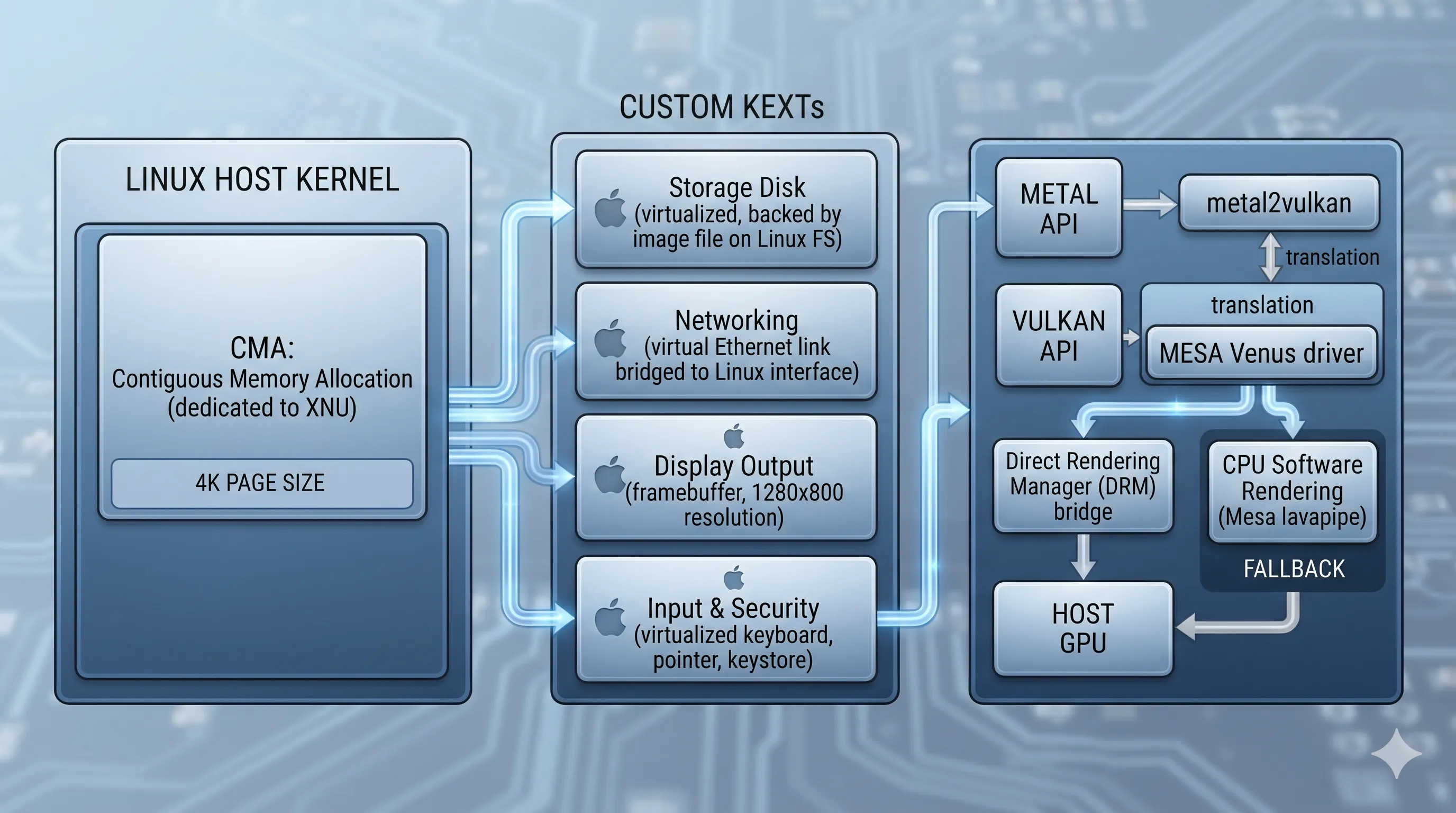
At the base of the memory architecture, the host Linux kernel allocates a single physically contiguous memory block using Contiguous Memory Allocation (CMA) dedicated entirely to XNU.Once allocated, this physical memory space is governed directly by XNU's internal pmap management system.
The runtime operates a shared user address space configured specifically with 4K page sizes.
Because native Apple silicon environments typically operate on 16K pages, running with 4K pages incurs an architectural trade-off.
Specifically, memory access speeds in XNU Linux are slower than native virtualization due to running 4K pages instead of 16K pages.
Custom Kexts for Storage, Networking, and Display
Rather than relying on proprietary Apple platform controllers, hardware virtualization is achieved through custom kernel extensions residing in the kexts/ directory.These custom extensions emulate critical platform devices, provisioning storage, display, keyboard, pointer, Ethernet, and keystore services.
The storage subsystem exposes a virtual disk backed directly by an image file residing on the Linux file system.
System network connectivity is established through a virtual Ethernet link bridged to an existing Linux network interface.
Visual output is driven through a display framebuffer that is read directly by Linux, supporting a tested desktop framebuffer resolution of 1280x800.
| Subsystem / Device | Provisioning Mechanism | Implementation & Backing Details |
|---|---|---|
| Storage Disk | Custom kexts in kexts/ |
Backed by an image file residing on the Linux file system |
| Networking | Custom kexts in kexts/ |
Ethernet link bridged directly to a Linux network interface |
| Display Output | Custom kexts in kexts/ |
Framebuffer read directly by Linux; tested desktop resolution of 1280x800 |
| Input & Security | Custom kexts in kexts/ |
Virtualized keyboard, pointer, and keystore hardware interfaces |
Translating Metal to Vulkan via Mesa Venus
Rendering the graphical interface of OS X requires accommodating frameworks deeply integrated with Apple's Metal API.XNU Linux handles this by dispatching Metal API calls through a metal2vulkan translation layer over Vulkan via gpu/xnu-cpu-metal.
To transfer these graphics commands to hardware, Vulkan commands reach the host GPU using Mesa's Venus driver through a Direct Rendering Manager (DRM) bridge.
This pipeline paths commands from the guest kernel extension kexts/XnuDrm into the userspace daemon gpu/xnu-drm/xnudrmd, which submits the work to the host Linux render node.
In environments where no host GPU is present, the pipeline maintains graphical output by falling back to CPU software rendering using Mesa lavapipe.
3. Hardware Requirements, Boot Performance, and System Constraints
To evaluate how effectively XNU Linux brings the OS X GUI to Linux environments, the underlying infrastructure must be analyzed through its physical hardware prerequisites, operational throughput, and host-level boundary constraints.Host Requirements and Resource Allocations
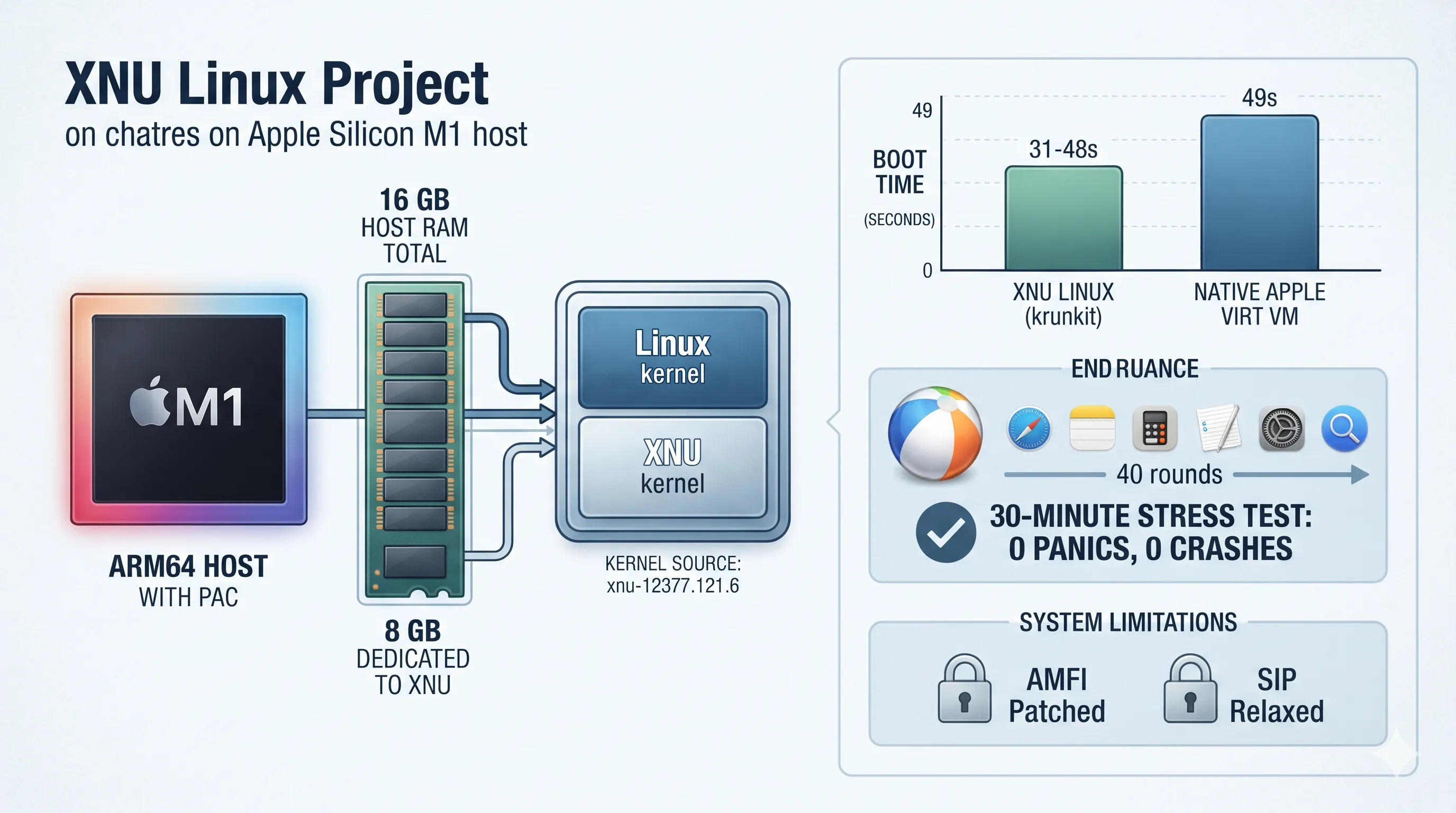
Running macOS version 27.2.1 on Linux 7.0 demands specific hardware architectural features and structured resource partitions.The platform strictly mandates an arm64 host equipped with hardware Pointer Authentication Code (PAC) support, restricting baseline deployment to Apple Silicon M1 or later processors.
Host system memory must total at least 16 GB of RAM, with an explicit 8 GB reserved specifically for the hosted XNU kernel to ensure memory isolation and workspace headroom.
The project toolchain builds directly against the XNU version source tree xnu-12377.121.6 to construct the kernel components.
For graphical acceleration, host GPU passthrough includes support to auto-detect Virtio-GPU Venus (evaluated on Apple M5 Max hardware) whenever an operational render node is available using the GPU=auto flag.
At the service orchestration level, the entire stack executes as a background systemd unit structured to provide fault resilience by automatically restarting following any unexpected hosted-kernel panic.
Boot Benchmarks and Application Stress Testing
Performance evaluations across varied multi-core topologies highlight the execution efficiency of the hosted kernel stack.Testing across configurations scaling between 1 and 6 hosted CPUs demonstrates that XNU Linux boots to desktop with auto-login enabled within 31 to 48 seconds on Apple Silicon via krunkit.
By comparison, a standard native Apple Virtualization macOS virtual machine running on the exact same host hardware reaches the desktop in 49 seconds.
Runtime endurance was assessed using an intensive 30-minute application stress run comprising 40 automated rounds.
This stress suite repeatedly launched and cycled through Safari, Notes, Calculator, TextEdit, System Settings, and Spotlight, alongside concurrent disk operations.
Throughout the full duration of all 40 test iterations, the system logged zero panics and generated zero crash reports.
| Category | Specification Parameter | Runtime Specification / Observed Metric |
|---|---|---|
| Base Platform | Operating System Stack | macOS version 27.2.1 running on Linux 7.0 |
| Source Toolchain | Kernel Build Tree | xnu-12377.121.6 |
| Hardware Architecture | Host CPU Requirements | arm64 host with Pointer Authentication Code (PAC) (Apple Silicon M1 or later) |
| Memory Architecture | RAM Capacity Allocation | 16 GB total host RAM (8 GB dedicated exclusively to hosted XNU) |
| Compute Allocation | Hosted CPU Configurations | Tested across 1 to 6 hosted CPUs |
| Boot Performance | krunkit Desktop Auto-Login | 31 to 48 seconds |
| Boot Performance | Native Apple Virtualization VM | 49 seconds |
| Graphics Pipeline | GPU Passthrough Mechanism | Virtio-GPU Venus auto-detection (GPU=auto; validated on Apple M5 Max) |
| System Reliability | 30-Minute Stress Test (40 Rounds) | Zero panics or crash reports across 6 core GUI apps and disk I/O |
| Process Management | Service Resilience | Background systemd unit with automated restart upon hosted-kernel panic |
System Limitations and Security Relaxations
Achieving a functioning graphical desktop outside of standard Apple hardware virtualization requires targeted modifications to macOS security and root filesystem structures.As a temporary stopgap measure, the OS cryptex is merged directly into the system volume to allow correct component resolution during initialization.
Additionally, foundational platform security policies must be bypassed: Apple Mobile File Integrity (AMFI) must be patched, and System Integrity Protection (SIP) must be relaxed to permit hosted operation under Linux 7.0.
4. Build Pipeline, Disk Preparation, and Service Deployment
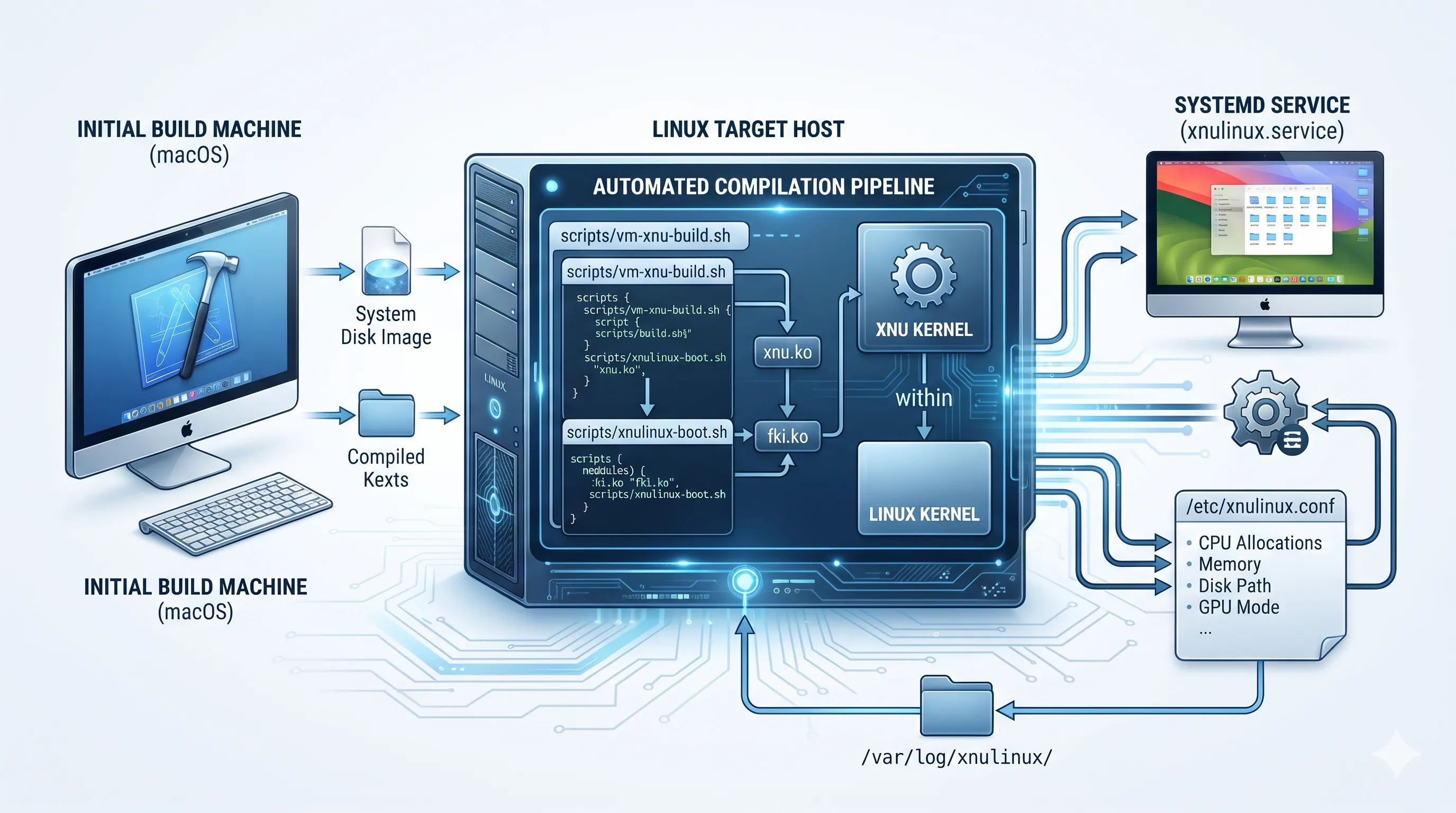
Realizing the goal where XNU Linux brings the OS X GUI to Linux requires an automated compilation pipeline and precise disk image staging.Because the underlying architecture interacts deeply with host kernel interfaces while running a macOS environment, building the platform necessitates strict adherence to deployment scripts and local hardware workflows.
Prerequisites and Disk Image Assembly
Deploying the environment starts with assembling the target root filesystem without redistributing proprietary binaries.To maintain legal integrity, the project requires macOS system installation media created directly using Apple's official installer.
No proprietary Apple binaries are bundled or redistributed within the XNU Linux software tree.
Consequently, a physical Mac workstation running Xcode is required as an initial build machine.
This host Mac is used to generate the system disk image and compile the platform-specific GPU driver components.
The repository provides automated scripts to handle packaging kext collections alongside these generated disk images before transferring the assets to the host Linux machine.
Automated Toolchain Compilation and System Boot
Once system media and driver components are prepared, environment compilation takes place directly on the Linux target host through dedicated shell tooling.The platform includes automated scripts for establishing the build environment, compiling the kernel, and loading drivers.
To compile the native XNU kernel inside the arm64 Linux VM, execute the following build routine:
scripts/vm-xnu-build.shAfter generating the kernel binary, you must compile runtime modules, configure networking, and boot the hosted system:
scripts/xnulinux-boot.shDaemon Configuration and Systemd Integration
To manage the hosted graphical stack reliably in production or daily workstation workflows, the platform can be registered as an autonomous daemon.To install and manage xnulinux as a standard Linux system service, run the automated installation script:
scripts/install-service.shRuntime behavior and resource quotas for xnulinux.service are managed through a central configuration file, while runtime diagnostics are routed to a standard log directory.
| Setting / Target | Location | Description |
|---|---|---|
| CPU Allocations | /etc/xnulinux.conf | Configures the CPU count provisioned to the hosted environment. |
| Allocated Memory | /etc/xnulinux.conf | Specifies the RAM size allocated for the running instance. |
| Disk Image Path | /etc/xnulinux.conf | Designates the filesystem path pointing to the prepared macOS disk image. |
| GPU Mode | /etc/xnulinux.conf | Defines the graphics execution mode and GPU bridge behavior. |
| Operational Logs | /var/log/xnulinux/ | Stores runtime logs and diagnostics generated by the hosted environment. |
5. Licensing Isolation and Lineage from macOS-DroidVM and UniXNU
Enabling the broader goal of XNU Linux Brings OS X GUI to Linux requires co-locating two fundamentally different kernel architectures within the same memory space without precipitating legal conflicts or architectural instability.
Achieving this depends entirely on a strictly isolated licensing architecture and technical heritage borrowed from earlier ARM64 and hypervisor porting efforts.
Licensing Isolation Across the Fast Kernel Interface
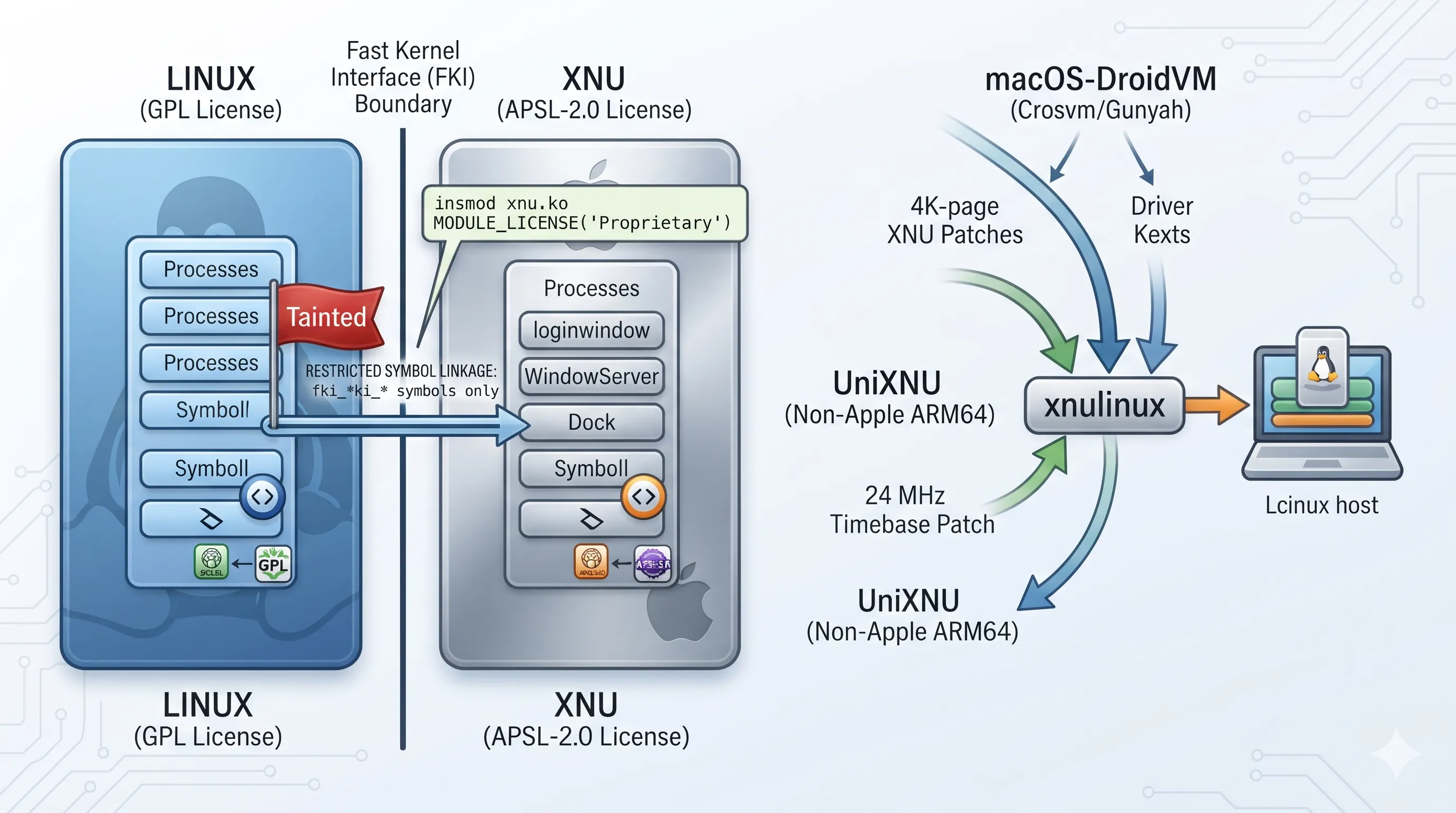
The Linux kernel operates under the GNU General Public License (GPL), whereas Apple distributes the source code for the XNU kernel under the Apple Public Source License (APSL-2.0).
Because these two open-source licenses impose conflicting redistribution and derivative-work obligations, Linux GPL components and XNU APSL components are separated strictly at the Fast Kernel Interface (FKI) boundary.
Within this operational paradigm, the compiled Mach/BSD subsystem encapsulated inside xnu.ko remains licensed under APSL-2.0.
To enforce clean legal and technical decoupling, xnu.ko is loaded with MODULE_LICENSE("Proprietary") rather than a GPL-compatible identifier, deliberately isolating XNU from the host Linux kernel's GPL-restricted infrastructure.
Kernel Tainting and Restricted Symbol Linkage
Declaring a non-GPL module identifier activates hard restrictions within the Linux kernel linker.
Loading xnu.ko taints the Linux kernel due to its non-GPL proprietary module declaration.
This taint flag serves as an architectural firewall: it strictly enforces symbol access limits at the binary boundary.
As a direct consequence, xnu.ko is restricted from calling Linux kernel functions other than exported fki_* symbols.
By precluding access to general kernel primitives and standard EXPORT_SYMBOL_GPL endpoints, the architecture guarantees that the APSL-licensed XNU core cannot bind directly to Linux internal mechanisms, restricting all control transfers solely to dedicated FKI mediation hooks.
Lineage and Contributions from macOS-DroidVM and UniXNU
The architectural foundation of xnulinux builds directly upon established virtualization and hardware enablement efforts.
The project derives its 4K-page XNU patches, Linux toolchain adaptations, and core display, input, and network kexts directly from macOS-DroidVM and UniXNU.
macOS-DroidVM originally provided support for hosting macOS guest environments under crosvm and Gunyah hypervisors.
In parallel, the UniXNU project enables running XNU kernels across non-Apple ARM64 hardware utilizing UEFI environments.
A critical technical requirement for running on standard ARM64 platforms was overcoming Apple's proprietary hardware timer expectations; to achieve this, the UniXNU port utilizes a 24 MHz timebase patch for arm64 hardware adaptation.
By synthesizing macOS-DroidVM's device kexts and toolchain with UniXNU's boot and timing modifications, xnulinux bridges the OS X graphics stack onto host Linux systems.
| Project Lineage | Target Environment & Architecture | Key Technical Contributions |
|---|---|---|
| macOS-DroidVM | macOS guest environments under crosvm and Gunyah hypervisors | 4K-page XNU patches, Linux toolchain adaptations, and core display, input, and network kexts. |
| UniXNU | Non-Apple ARM64 hardware utilizing UEFI environments | 24 MHz timebase patch for arm64 hardware adaptation, 4K-page XNU patches, and toolchain adaptations. |
| xnulinux | Linux host operating system across the Fast Kernel Interface (FKI) | APSL-2.0 isolation via MODULE_LICENSE("Proprietary"), fki_* symbol restriction, and unified kext runtime. |
Related Posts


Generative AI may have assisted with research or drafting for this article. Topic selection, fact-checking, final wording, and publication remain the responsibility of DragonStone74. AI use disclosure