
Alibaba Qwen3.8-27B: Unpacking the 27B Multimodal AI for Agentic Coding & Local GPU Deployment
🚀 Key Takeaways
- Alibaba's Qwen team has released Qwen3.8-27B, a powerful 27.78 billion parameter multimodal model under an Apache 2.0 license.
- The model demonstrates significant performance improvements over its predecessor, Qwen3.6-27B, particularly in agentic coding and vision-language tasks.
- Qwen3.8-27B positions itself as a leading candidate for the best dense, locally deployable multimodal model in its parameter class, excelling in hybrid agent tasks.
- It features an impressive 262,144-token native context window, extendable to one million tokens using YaRN for ultra-long applications.
- Local deployment requires careful planning, as official BF16 and FP8 checkpoints demand substantial VRAM, necessitating quantization for single high-end consumer GPUs.
- While showing strong self-reported benchmarks, key details such as its training corpus and safety evaluations remain undisclosed, and independent verification is pending.
- Kingy.ai identifies Qwen3.8-27B as the new benchmark for open-weight models around 30 billion parameters, suitable for local and private AI applications.
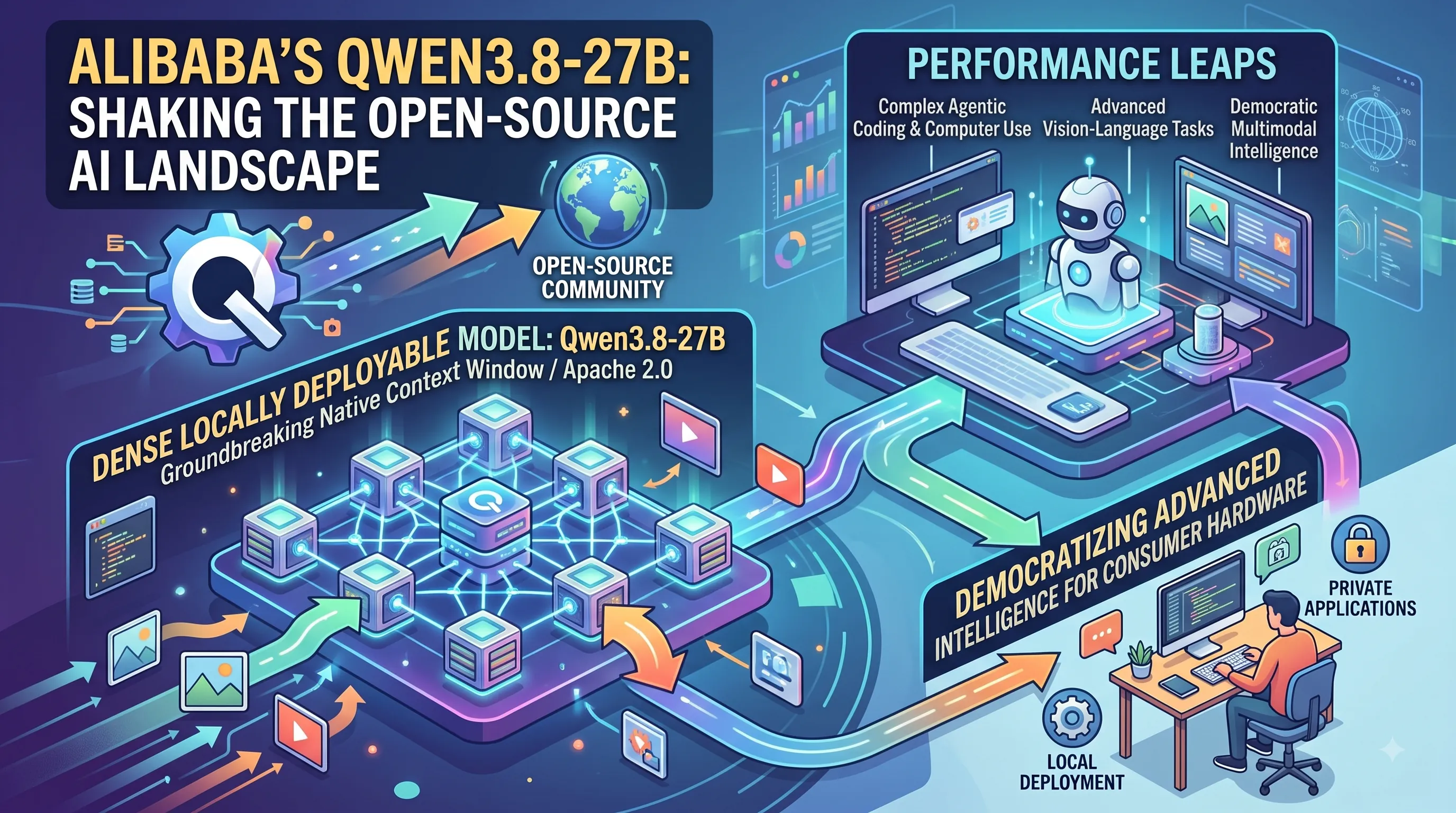
Alibaba's Qwen team has once again shaken the open-source AI landscape with the release of Qwen3.8-27B, a formidable new multimodal model. This latest iteration, available under an Apache 2.0 license, aims to set a new standard for intelligence and capability among dense, locally deployable models.
Boasting a substantial parameter count and a groundbreaking native context window, Qwen3.8-27B delivers significant performance leaps, particularly in complex agentic coding, computer use, and vision-language tasks. Its introduction fuels the momentum for private, powerful AI applications that can run on high-end consumer hardware, democratizing advanced multimodal intelligence.
This release intensifies the competition among open-weight models, offering a compelling alternative to existing solutions and pushing the boundaries of what's possible in local AI deployment. We delve into its technical prowess, benchmark performance, and the practical considerations for developers and researchers eager to harness its capabilities.
Boasting a substantial parameter count and a groundbreaking native context window, Qwen3.8-27B delivers significant performance leaps, particularly in complex agentic coding, computer use, and vision-language tasks. Its introduction fuels the momentum for private, powerful AI applications that can run on high-end consumer hardware, democratizing advanced multimodal intelligence.
This release intensifies the competition among open-weight models, offering a compelling alternative to existing solutions and pushing the boundaries of what's possible in local AI deployment. We delve into its technical prowess, benchmark performance, and the practical considerations for developers and researchers eager to harness its capabilities.
1. Alibaba's Qwen3.8-27B: An Open-Source Release
This section establishes the origin of the Qwen3.8-27B model, providing foundational context for the main article's analysis of its coding performance on consumer hardware.The model was officially developed and distributed as an open-source project by Alibaba's Qwen team.
This release continues the trend of major technology players contributing powerful models to the open-source community, setting the stage for the in-depth performance evaluation that follows.

2. Diving Deep into Qwen3.8-27B's Hybrid Architecture and Specifications
This section dissects the core technical components of Qwen3.8-27B, detailing the specifications and unique architectural choices that underpin its performance.Understanding these foundational elements is crucial for contextualizing the model's capabilities, particularly its efficiency and power, as analyzed in the main article.
Core Parameters and Context
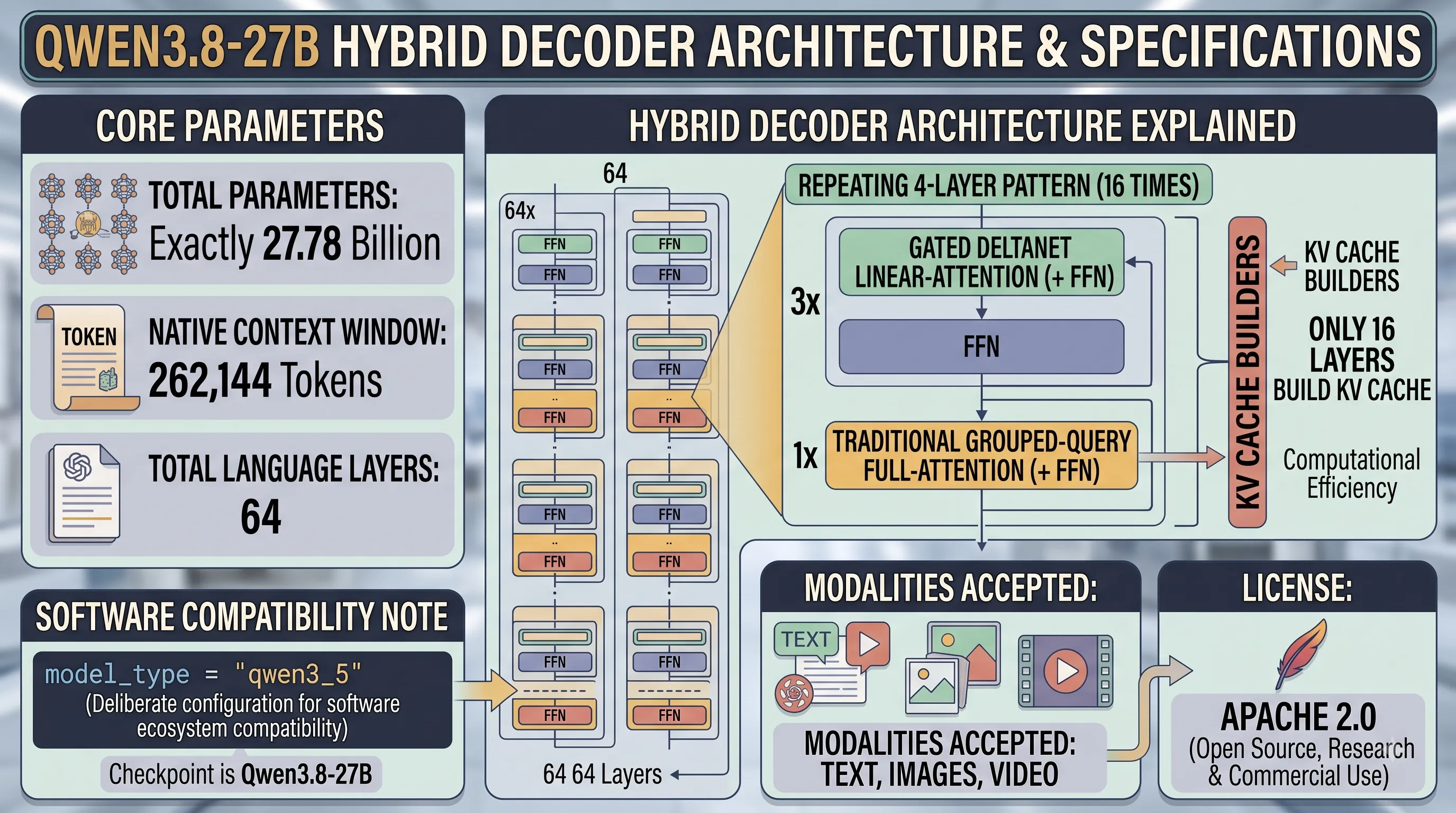
At its core, the Qwen3.8-27B checkpoint contains exactly 27.78 billion parameters.This is paired with a substantial native context window of 262,144 tokens, enabling it to process and maintain coherence over very long inputs without requiring windowing techniques.
The model is constructed with a total of 64 language layers, but as we'll explore, not all of these layers operate in the same way.
The key specifications are summarized below for clarity.
| Specification | Detail |
|---|---|
| Total Parameters | 27.78 Billion |
| Native Context Window | 262,144 Tokens |
| Total Language Layers | 64 |
| Architecture Type | Hybrid Decoder (Linear Attention + Full Attention) |
| Accepted Modalities | Text, Images, Video |
| License | Apache 2.0 |
Hybrid Decoder Architecture Explained
Qwen3.8-27B deviates from the conventional all-attention transformer design by implementing a hybrid decoder architecture.This structure is not just a minor tweak; it's fundamental to the model's efficiency.
The 64 layers are organized into a repeating pattern: a block of three Gated DeltaNet linear-attention layers (each followed by a Feed-Forward Network, or FFN), which is then followed by one traditional grouped-query full-attention layer (also with an FFN).
This four-layer pattern repeats 16 times throughout the model.
A significant consequence of this design is that only 16 of the 64 total layers build the computationally expensive full-attention KV cache.
This architectural approach, which closely matches its predecessor Qwen3.6-27B in key metrics like layer count, hidden size, FFN width, head layout, and native context, is key to balancing performance with resource consumption.
Multimodal Capabilities and Licensing
Beyond its textual prowess, Qwen3.8-27B is a true multimodal model, capable of accepting and processing text, images, and video as inputs.This versatility opens up a wide range of applications beyond pure code or language generation.
For developers and organizations looking to build on or deploy this model, it is released under the permissive Apache 2.0 license, granting broad rights for use and modification in both research and commercial settings.
Software Compatibility Notes
A crucial point for developers implementing the model is a specific quirk in its configuration files.The Hugging Face configuration specifies the `model_type` as `qwen3_5`.
This is not an error indicating that the model is secretly Qwen3.5; rather, it is a deliberate choice to ensure software compatibility with existing frameworks and tools.
Users can be confident that while the label is for compatibility, the checkpoint itself is the authentic Qwen3.8-27B architecture.
3. Qwen3.8-27B's Leap: Significant Gains Over Its Predecessor
This section directly supports the main article's thesis by quantifying the dramatic performance improvements of Qwen3.8-27B over its immediate predecessor.These benchmark results, particularly in agentic coding and multimodal tasks, are the core evidence that this new model represents a significant step towards achieving high-end capabilities on more accessible hardware.
Qwen reports large improvements over Qwen3.6-27B in agentic coding, computer use, and vision-language work.
Agentic Coding and Computer Use Enhancements
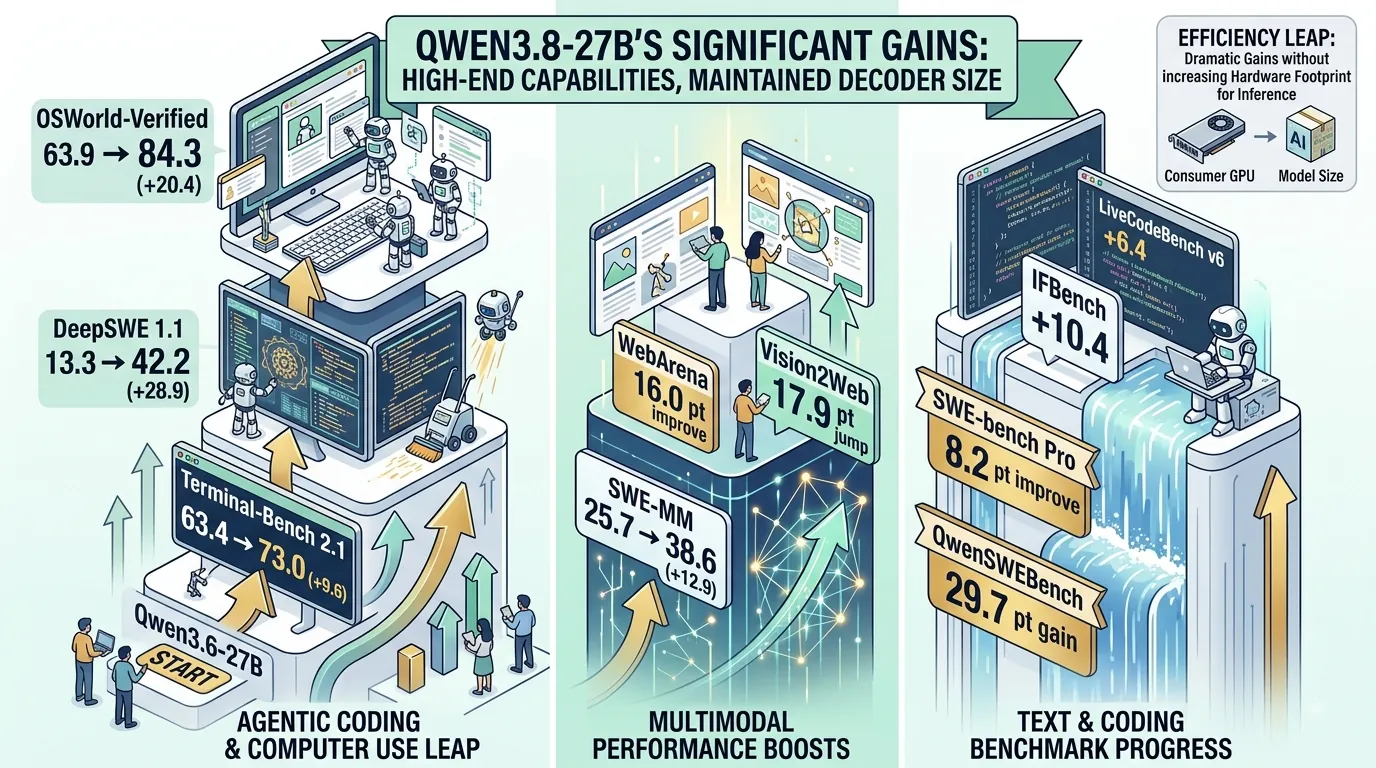
The new model demonstrates a substantial leap in its ability to act as a software agent and interact with computer environments.On Terminal-Bench 2.1, a benchmark measuring terminal operation skills, the score surged from 63.4 for Qwen3.6-27B to 73.0 for Qwen3.8-27B.
Even more impressively, the score on DeepSWE 1.1, which tests deep software engineering capabilities, more than tripled, rocketing from 13.3 to 42.2, an increase of 28.9 points.
The model's proficiency in operating system interaction was also significantly enhanced, with the OSWorld-Verified score climbing from 63.9 to 84.3, a notable gain of 20.4 points.
| Benchmark | Qwen3.6-27B Score | Qwen3.8-27B Score | Improvement |
|---|---|---|---|
| Terminal-Bench 2.1 | 63.4 | 73.0 | +9.6 |
| DeepSWE 1.1 | 13.3 | 42.2 | +28.9 |
| OSWorld-Verified | 63.9 | 84.3 | +20.4 |
| SWE-MM (Multimodal) | 25.7 | 38.6 | +12.9 |
Multimodal Performance Boosts
Qwen3.8-27B's advancements extend deeply into the multimodal domain, where it beat Qwen3.6-27B on every displayed benchmark.The largest practical multimodal deltas showcase this progress clearly.
Performance on the SWE-MM benchmark, which combines software engineering with multimodal understanding, rose from 25.7 to 38.6, a 12.9-point increase.
The model showed even larger gains in web-based tasks, with a 16.0-point improvement on WebArena and a 17.9-point jump on Vision2Web, indicating a much stronger ability to interpret and interact with graphical user interfaces.
Text Benchmark Progress
Across a wide array of text-based benchmarks, Qwen3.8-27B exceeded its predecessor consistently.Beyond the previously mentioned gains, the model posted an 8.2-point improvement on SWE-bench Pro and a massive 29.7-point gain on QwenSWEBench.
Further evidence of its enhanced coding and reasoning includes a 10.4-point increase on IFBench and a 6.4-point gain on LiveCodeBench v6, solidifying its position as a more capable and versatile text-based coding assistant.
Efficiency of Improvement
Crucially, all of these significant performance gains were achieved without increasing the model's size.The improvements were realized while maintaining the same published decoder size as Qwen3.6-27B.
This demonstrates a remarkable leap in model efficiency and training methodology, allowing for a much more capable model without increasing its hardware footprint for inference—a key factor for its viability on consumer-grade GPUs.
4. Benchmarking Qwen3.8-27B: Competing with Frontier Models
This section directly addresses the central question of the article by placing Qwen3.8-27B's performance into context.To determine if it can deliver 'Opus-level' results on consumer hardware, we must scrutinize its benchmark scores against its predecessor, similarly-sized open models, and the very frontier models like Opus it aims to emulate.
Vs. Qwen3.7-Plus: Wins and Losses
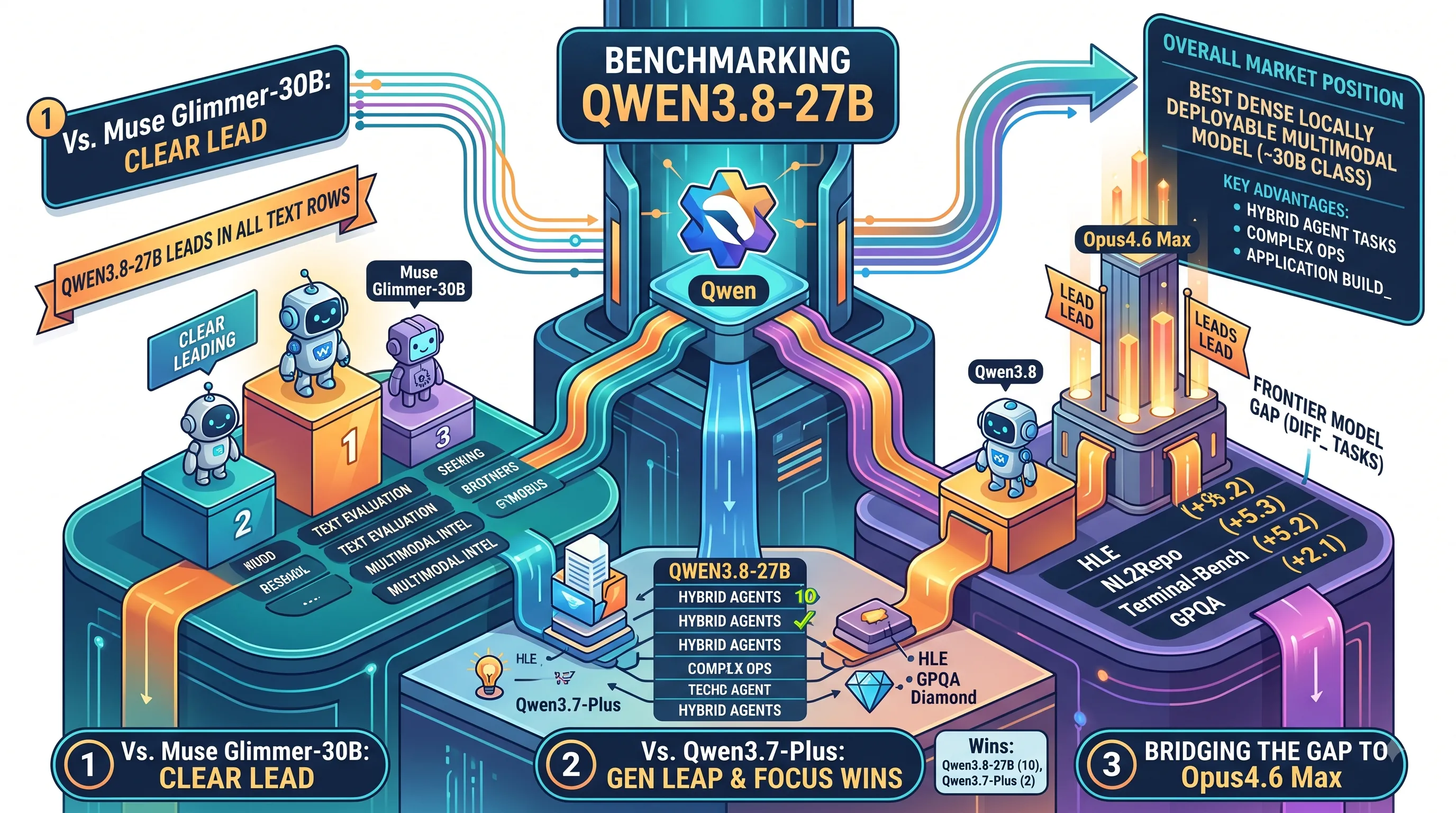
When compared to its direct predecessor, Qwen3.8-27B demonstrates a clear generational improvement, winning in 10 out of 12 benchmark rows presented by the developers.However, this progress is not absolute.
The previous model, Qwen3.7-Plus, retains an edge in specific areas, scoring higher on the challenging GPQA Diamond and HLE benchmarks.
Furthermore, Qwen3.7-Plus also maintains higher scores on several general vision rows and achieves a better average score on ClawEval-MM, indicating that the new model's advancements are more focused rather than a universal upgrade across every possible metric.
Vs. Muse Glimmer-30B: A Clear Lead
In the competitive landscape of ~30B parameter open models, Qwen3.8-27B establishes a commanding position against key rivals like Muse Glimmer-30B.Based on the reported benchmarks, Qwen3.8-27B leads in every overlapping text-based evaluation row that Qwen's team has published.
This positions it as the new model to beat for strong multimodal intelligence within a checkpoint that is quantizable and deployable on a high-end workstation.
Bridging the Gap to Opus4.6 Max
While Qwen3.8-27B shows impressive capabilities and can match or even exceed older frontier models on certain tests, a measurable performance gap still exists between it and the current top-tier proprietary APIs like Opus4.6 Max.The model is not a one-for-one replacement for the strongest frontier systems, which still hold meaningful leads on the most difficult, long-horizon tasks.
The performance delta is evident in several key benchmarks: Opus4.6 Max remains 9.2 points ahead on HLE, 5.3 points ahead on NL2Repo, 5.2 points ahead on Terminal-Bench, and 2.1 points ahead on GPQA.
| Benchmark | Opus4.6 Max Performance Lead Over Qwen3.8-27B |
|---|---|
| HLE (Hard Long-horizon Evaluation) | +9.2 points |
| NL2Repo (Natural Language to Repository) | +5.3 points |
| Terminal-Bench | +5.2 points |
| GPQA (Graduate-Level Google-Proof Q&A) | +2.1 points |
Overall Market Position and Key Advantages
Despite the gap with data-center-scale models, Qwen3.8-27B presents a convincing case as the best dense, locally deployable multimodal model currently available in the 30-billion-parameter class.Its most significant and clearest advantage lies in its performance on hybrid agent tasks.
This includes complex operations like controlling software interfaces, building applications from visual context, and successfully completing longer, more involved environment loops, making it a powerful tool for developers building sophisticated local agents.
5. Understanding the Benchmarks: Caveats and Context of Qwen3.8-27B Scores
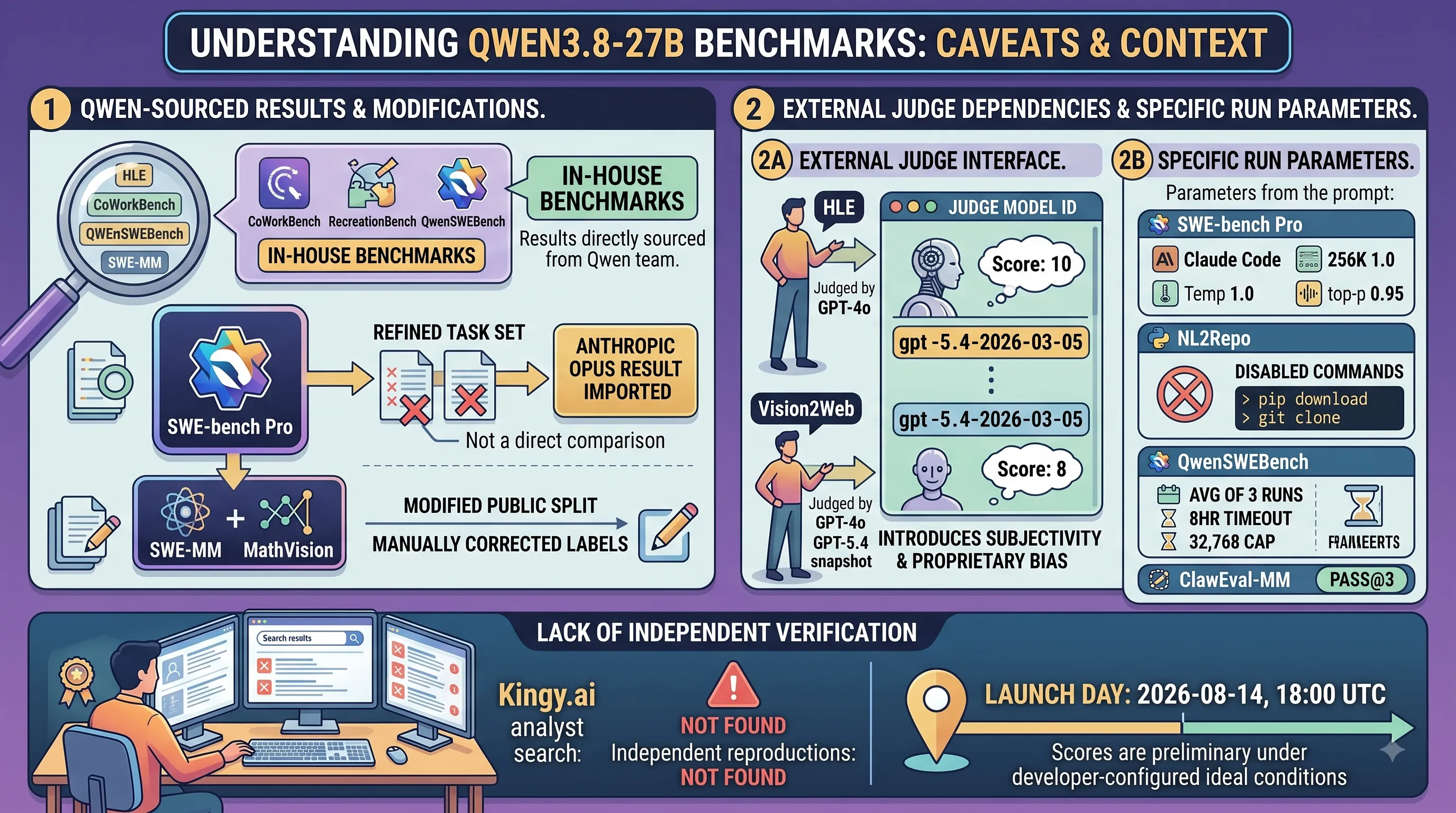
This section connects directly to the main article's headline claim of "Opus-level coding" by critically examining the evidence presented.While the benchmark scores for Qwen3.8-27B are impressive, a deeper look reveals that the results are not straightforward; they are shaped by specific methodologies, in-house test suites, and external dependencies that require careful consideration before accepting them at face value.
Qwen-Sourced Results and Modified Benchmarks
The most critical piece of context is that all benchmark scores released at launch come directly from the Qwen team.This is a standard practice for model releases, but it underscores the need for future independent validation.
Furthermore, several benchmarks used to evaluate the model were either developed in-house or significantly modified.
These include CoWorkBench, an internal benchmark for long-horizon professional tasks, and RecreationBench, an in-house test focused on application recreation.
The team also introduced QwenSWEBench, a modified software engineering evaluation.
Even with established public benchmarks, modifications were made; for instance, the SWE-MM benchmark used a modified public development split, and the Qwen team manually corrected labels for some tasks in MathVision and CharXiv.
External Judge Dependencies
Several of the most compelling results rely not on deterministic, code-execution-based outcomes but on the judgment of other large language models.This introduces a layer of subjectivity and potential bias from the judge model itself.
Specifically, the HLE (Human-Level Eval) benchmark uses GPT-4o as a judge to score the results.
Similarly, the Vision2Web benchmark, which tests web-based agentic tasks, is judged by a GPT-5.4 snapshot (model ID gpt-5.4-2026-03-05).
These dependencies mean that Qwen3.8-27B's performance in these areas is measured relative to the capabilities and evaluation patterns of proprietary models from OpenAI.
Specific Testing Parameters and Task Sets
The exact configuration used for testing significantly influences outcomes, and the Qwen team has provided detailed, though highly specific, parameters for their runs.For the headline-making SWE-bench Pro comparison, Qwen's result was generated using Claude Code with a 256K context window, a high temperature of 1.0, and top-p of 0.95.
Crucially, they used a refined task set with corrected problematic tasks and imported Anthropic's reported score for Opus instead of rerunning it under their own specific setup, making it a non-direct comparison.
Other benchmarks have similarly unique conditions.
In the NL2Repo test, certain Bash commands like `pip download`, `pip install`, and `git clone` are disabled if they could reveal the target repository, changing the nature of the task.
In the QwenSWEBench evaluation, the final score is an average of three runs, each with an eight-hour timeout and a `max_tokens=32,768` cap on the generated output.
For multimodal tests, ClawEval-MM uses a Pass@3 metric, meaning a task is considered successful if the model passes in at least one of three trials.
Finally, the MathVision benchmark employed an asymmetric prompting strategy, where Qwen3.8-27B was given one fixed prompt, while comparison models were scored based on the better result from two different prompt variants.
Lack of Independent Verification
Compounding all these factors is the absence of third-party validation at the time of the model's release.According to a check by the AI analysis firm Kingy.ai, there were no independent reproductions of Qwen3.8-27B's benchmark scores found by 11:00 PDT (18:00 UTC) on its launch day, August 14, 2026.
Until the community can independently run these evaluations, the published scores should be considered preliminary and representative of the ideal conditions configured by the model's own developers.
| Benchmark | Key Methodologies and Caveats |
|---|---|
| General Sourcing | All launch day scores were sourced and reported by the Qwen team. |
| SWE-bench Pro | Uses a refined task set with corrected problems. Anthropic's Opus result was imported, not rerun under Qwen's test conditions. |
| QwenSWEBench | In-house benchmark. Result is an average of three runs with an 8-hour timeout and a 32,768 generated token cap. |
| CoWorkBench / RecreationBench | In-house benchmarks created by the Qwen team for long-horizon and application-recreation tasks. |
| Vision2Web | Judged by an external model: a GPT-5.4 snapshot (gpt-5.4-2026-03-05). |
| HLE (Human-Level Eval) | Judged by an external model: GPT-4o. |
| NL2Repo | Disables specific Bash commands (e.g., `pip download`, `git clone`) that could prematurely reveal the solution. |
| MathVision | Asymmetric prompting was used; Qwen3.8 was given one prompt, while competitors were scored on the best of two prompt variants. |
| Independent Verification | No independent benchmark reproductions were found by Kingy.ai as of 18:00 UTC on launch day (2026-08-14). |
6. Local Deployment Challenges: Memory, Quantization, and GPU Requirements
This section directly addresses the central question of the main article: Can this model run on consumer hardware?While the Qwen3.8-27B model offers powerful capabilities, its significant hardware requirements present the primary barrier to local deployment, making an understanding of its memory footprint, the role of the KV cache, and the necessity of quantization absolutely critical for any user with a standard consumer-grade GPU.
Checkpoint Size and GPU Compatibility
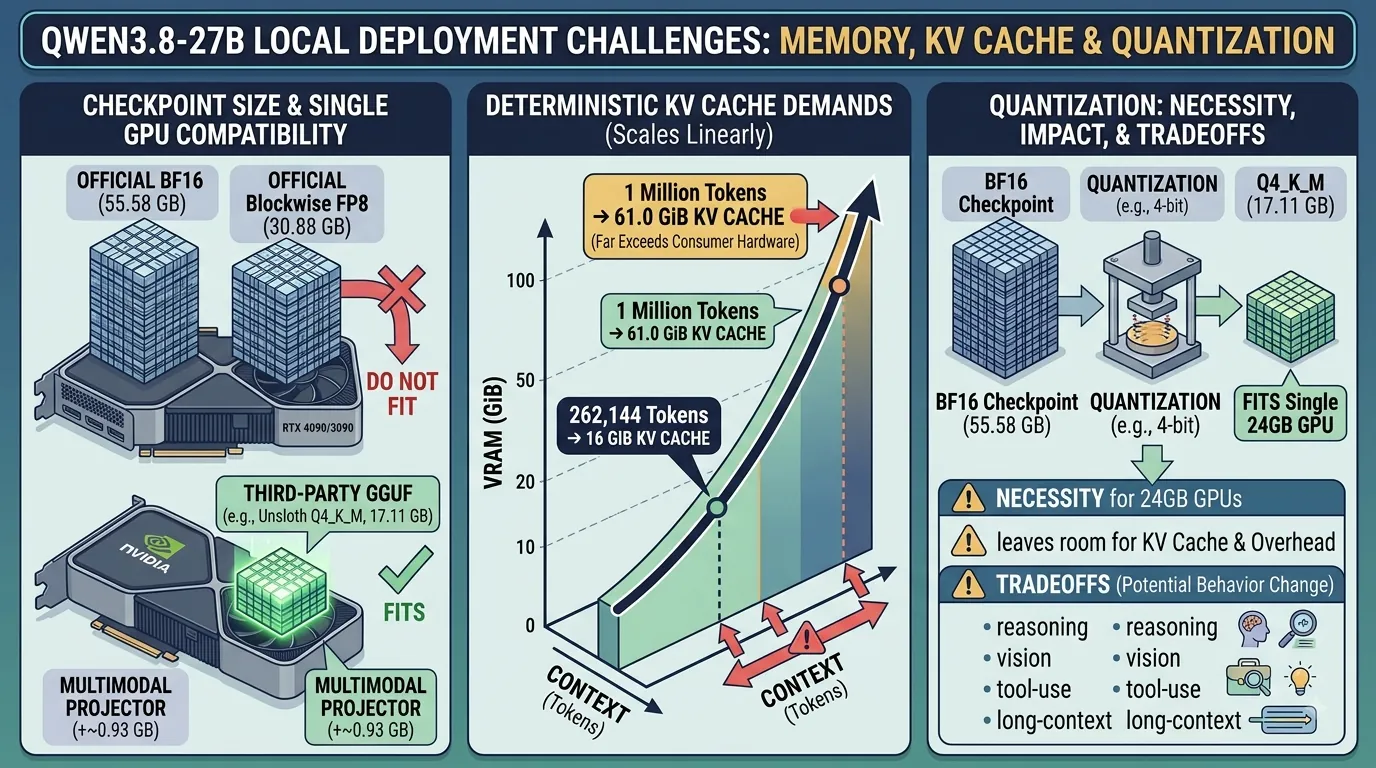
The raw size of the official model checkpoints immediately places them outside the reach of single consumer GPUs.The full-precision BF16 checkpoint occupies a substantial 55.58GB (51.76 GiB), which is more than double the VRAM available on popular 24GB cards like the NVIDIA RTX 4090 or 3090.
Even Alibaba's own optimized version, the official blockwise FP8 repository, comes in at 30.88GB (28.76 GiB).
While this FP8 version is a significant reduction, it is still too large to be loaded onto a 24GB GPU, making both official checkpoints incompatible with single-card consumer setups.
This FP8 checkpoint achieves its size by keeping approximately 3.08 billion parameters in the higher-precision BF16 format while storing the remaining 24.70 billion parameters in FP8.
| Model Format | Checkpoint Size (Decimal GB) | Notes |
|---|---|---|
| Official BF16 | 55.58 GB | Full precision; does not fit on a single 24GB GPU. |
| Official Blockwise FP8 | 30.88 GB | Mixed precision; still too large for a single 24GB GPU. |
| Third-Party Unsloth GGUF (Q4_K_M) | 17.11 GB | 4-bit quantization; designed to be compatible with 24GB GPUs. |
| Unsloth Multimodal Projector | ~0.93 GB | Additional component for vision capabilities. |
KV Cache Demands
Beyond the static model size, the dynamic memory usage during inference presents another major challenge, dominated by the Key-Value (KV) cache.For this model, the full-attention KV cache requires 65,536 bytes per token of context.
This memory requirement scales linearly and becomes extremely demanding at long context lengths.
For example, a context of 262,144 tokens consumes 16GiB of VRAM for the KV cache alone.
Pushing the context to one million tokens would require an astounding 61.0 GiB for the cache, far exceeding any consumer hardware.
It is crucial to remember that this is just one component of the total memory needed; inference also requires VRAM for linear-attention state, activations, vision processing, CUDA graphs, framework buffers, and allocator slack, all of which add to the total footprint.
Quantization: Necessity and Impact
Given the prohibitive size of the official checkpoints, quantization becomes a necessity, not an option, for local deployment.The data clearly shows that a four-bit quantized model (a "quant") can plausibly fit on a 24GB GPU, even when accounting for a moderate context length.
However, this compression is not without trade-offs.
Users must be aware that quantization can alter model behavior.
Specifically, fundamental capabilities like reasoning, vision, tool-use, and long-context performance can be affected by the precision reduction inherent in the quantization process.
Third-Party Quantizations and Formats
The open-source community has been instrumental in making Qwen3.8-27B accessible.A prime example is the launch-day Unsloth GGUF repository, which is a third-party conversion of the original model.
This effort provides versions of the model specifically tailored for consumer hardware.
For instance, the popular Unsloth Q4_K_M GGUF file is only 17.11GB, a size that fits comfortably within the 24GB VRAM budget of high-end consumer cards, leaving room for the KV cache and other operational overhead.
For users interested in the model's multimodal features, the separate Unsloth multimodal projector adds approximately 0.93GB to the total memory footprint.
7. Scaling Context: Native Window and YaRN Extension to One Million Tokens
This section delves into the model's impressive context handling capabilities, a core feature underpinning its ability to manage large codebases and complex documents, directly connecting to the article's central theme of achieving Opus-level performance with consumer-accessible hardware. We will examine both its substantial native context window and its documented expansion to one million tokens.Native Context and YaRN Integration
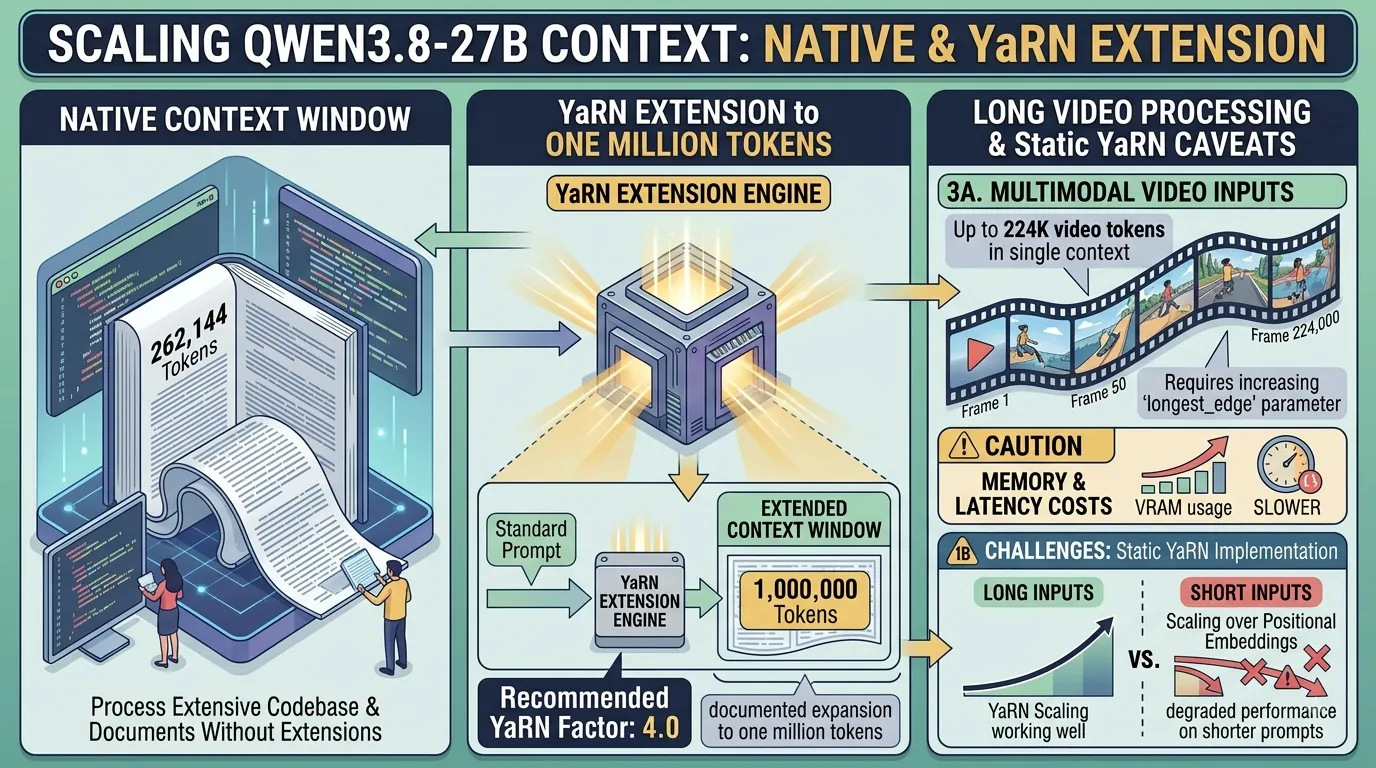
Qwen3.8-27B ships with a very large native context window of 262,144 tokens, enabling it to process extensive documents or code files without modification.For even more demanding tasks, the model card documents an extension to an exceptional one million tokens through the use of Yet another RoPE extensioN method (YaRN).
To achieve this one-million-token window, Qwen officially recommends using a YaRN scaling factor of 4.0.
The model's versatility also extends to multimodal inputs, where processing long videos may necessitate raising the `longest_edge` parameter, a configuration that could potentially allow for up to 224K video tokens in a single context.
| Context Scenario | Token Capacity | Implementation Note |
|---|---|---|
| Native Context | 262,144 tokens | Standard model capability without extensions. |
| YaRN Extended Context | 1,000,000 tokens | Requires a recommended YaRN factor of 4.0. |
| Long Video Processing | Up to 224,000 tokens | May require increasing the `longest_edge` parameter. |
Challenges of Static YaRN
While the million-token context is a headline feature, Qwen's documentation includes an important caveat regarding its practical implementation.The developers warn that many current open-source serving frameworks tend to implement YaRN in a static manner.
This static application means the scaling factor remains active regardless of the input length.
Consequently, this can degrade the model's performance on shorter prompts, as the positional embeddings are scaled unnecessarily, a crucial consideration for applications that handle a mix of long and short inputs.
Memory Implications for Video Context
The model’s ability to handle extended video content comes with direct performance trade-offs.Increasing the `longest_edge` parameter to accommodate more video frames and a higher token count directly increases resource consumption.
Users should be aware that this adjustment results in significant memory and latency costs, impacting the hardware requirements and response times for video analysis tasks.
8. Optimizing Agent Performance: Thinking Mode and Configuration Best Practices
This section directly supports the main article's theme of leveraging Qwen3.8-27B for high-level tasks on consumer hardware by detailing the specific configurations required to control the model's agentic behavior, manage resource consumption, and tune its output for either creative problem-solving or direct answers.Default Thinking Mode and Reasoning Blocks
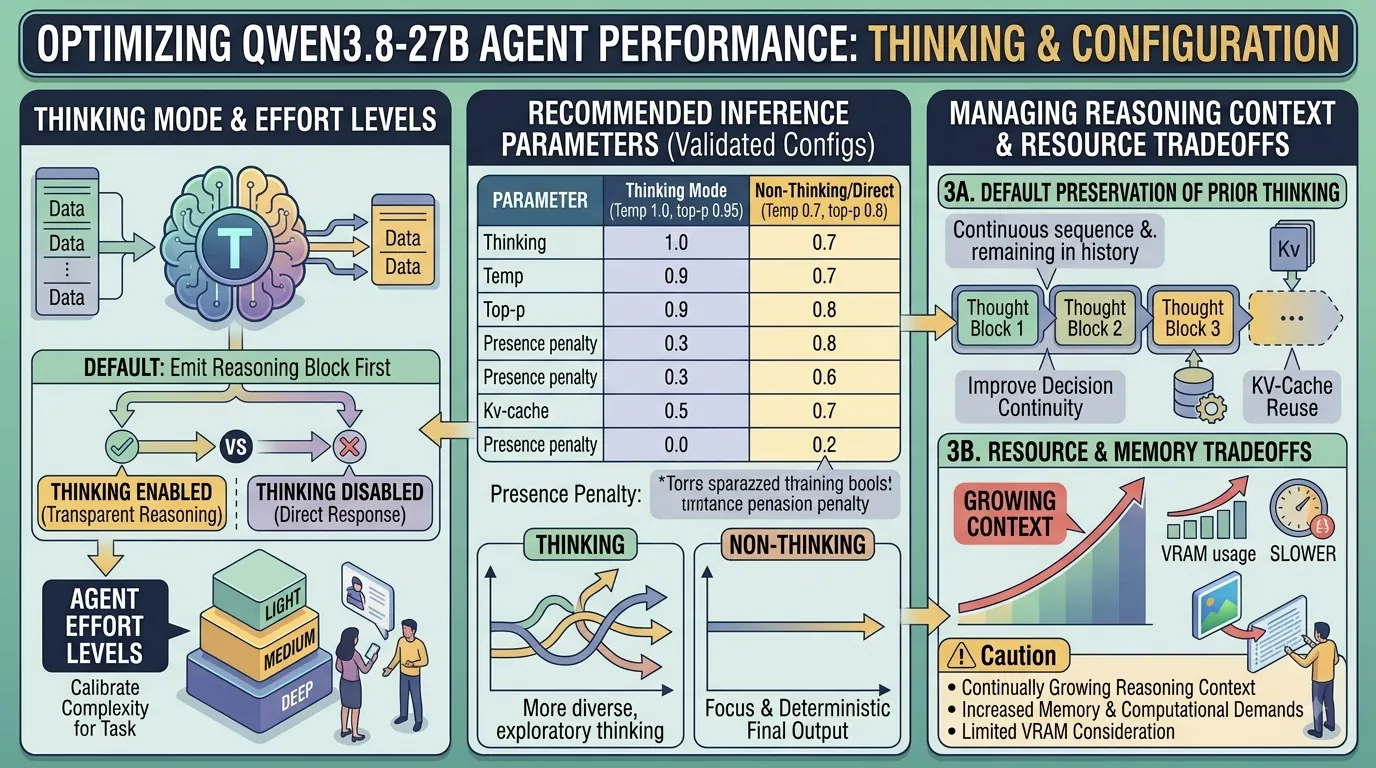
By default, Qwen3.8-27B is configured to operate in a "thinking" mode, a crucial feature for complex agentic tasks.Instead of immediately providing a final answer, the model first emits a reasoning block that outlines its thought process, plan, or analysis of the user's request.
This transparent reasoning is foundational for building reliable agents, as it allows for better debugging and understanding of the model's decisions.
For applications that require faster, more direct responses without the intermediate step, developers have the option to disable this thinking behavior.
Furthermore, Qwen introduces three distinct effort levels for its agents, allowing developers to calibrate the complexity and depth of the agent's processing to match the task at hand.
Recommended Inference Parameters
Alibaba provides specific guidance for inference parameters, which vary significantly depending on whether the model is in its creative thinking phase or generating a final, direct answer.Engaging the thinking mode with a higher temperature and top-p encourages more diverse and exploratory reasoning chains.
Conversely, the non-thinking mode uses more conservative settings and a presence penalty to produce a more focused and deterministic final output.
These recommended configurations provide a validated starting point for developers aiming to get the most out of the model's different operational modes.
| Parameter | Recommended Value (Thinking Mode) | Recommended Value (Non-Thinking / Direct Answer Mode) |
|---|---|---|
| Temperature | 1.0 | 0.7 |
| Top-p | 0.95 | 0.8 |
| Presence Penalty | Not Specified | 1.5 |
Managing Reasoning Context
A key architectural choice in the Qwen3.8-27B agent framework is the default preservation of prior thinking.This means that earlier reasoning blocks are not discarded but remain as part of the ongoing conversation history.
This approach offers two significant benefits: it dramatically improves decision continuity, as the agent maintains a clear "memory" of why it made previous choices, and it enhances performance through more effective KV-cache reuse.
However, this feature comes with an important trade-off.
Applications must be designed to budget for a continually growing reasoning context, as retaining every thought block increases memory and computational demands over the course of a long interaction.
This is a critical consideration for developers targeting consumer-grade hardware with limited VRAM.
9. Accessing Qwen3.8-27B: Weights, Formats, and API Status
This section provides the essential details for developers and researchers looking to access and deploy the Qwen3.8-27B model discussed in our main analysis.It covers where to find the open-source weights, the specific formats provided at launch, and the current availability of more user-friendly cloud-based APIs, connecting the theoretical performance of the model to the practical steps required to use it.
Open-Source Weights and Official Formats
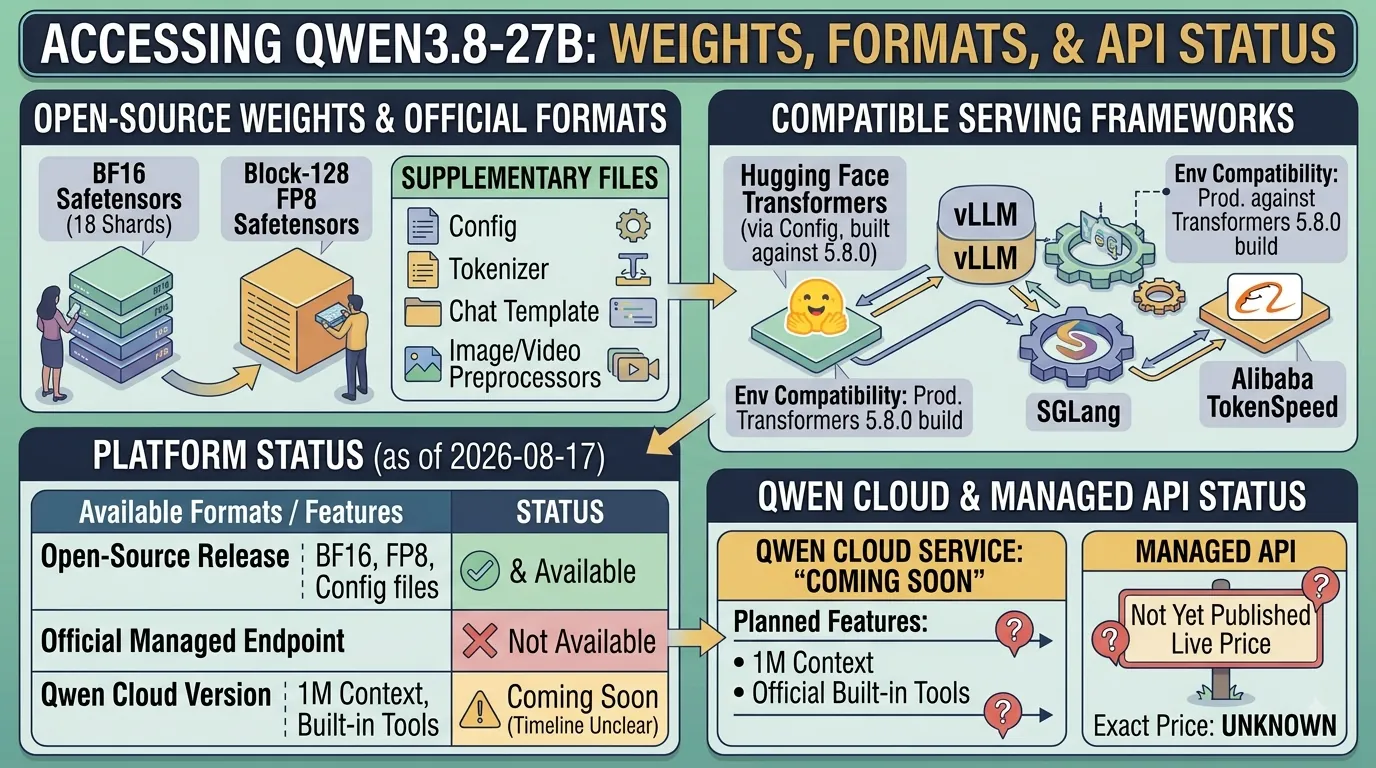
Alibaba has made the weights for Qwen3.8-27B publicly available, ensuring broad access for the open-source community.The official release includes two primary formats to cater to different hardware and performance needs.
The standard format is BF16 Safetensors, which is distributed in 18 separate shards.
For users with hardware supporting lower-precision inference, a more specialized, fine-grained block-128 FP8 Safetensors format is also provided.
Beyond the core weights, the distribution package includes essential supplementary files: a configuration file, tokenizer, chat template, and even preprocessor files for both images and video, reflecting the model's multimodal capabilities.
Compatible Serving Frameworks
To facilitate deployment, the model is designed for compatibility with several popular serving frameworks.Users can deploy Qwen3.8-27B using established paths like Hugging Face's Transformers library, as well as high-performance inference engines such as vLLM and SGLang.
Alibaba's own TokenSpeed framework is also listed as a compatible serving path.
A key technical detail for developers is that the model's configuration was produced against a Transformers 5.8.0 development build, which may be an important consideration for ensuring environment compatibility.
| Platform | Status (as of 2026-08-17) | Available Formats / Features |
|---|---|---|
| Open-Source Release | Available | BF16 Safetensors, fine-grained block-128 FP8 Safetensors, config/tokenizer files |
| Official Managed Endpoint | Not Available | N/A |
| Qwen Cloud Version | "Coming Soon" (Timeline Unclear) | Planned features include a default one-million-token context and built-in tools. |
Qwen Cloud and Managed API Status
For those seeking a managed solution, an official endpoint is not yet available.Alibaba has indicated that a version of the model is "coming soon" to its Qwen Cloud service, although a specific timeline for this release remains unclear as of this writing.
This future cloud-based version is slated to offer significant enhancements, including a default context window of one million tokens and the integration of official, built-in tools.
However, during our review, the Qwen Cloud model marketplace had not published a live, exact price for this specific model, leaving potential costs unknown.
10. The Unseen Details: What Qwen3.8-27B's Release Doesn't Disclose
This section serves as a critical counterbalance to the main article's focus on Qwen3.8-27B's impressive benchmark performance.While the model shows promise for "Opus-level coding" on consumer hardware, a deeper dive reveals significant gaps in disclosure that complicate full verification, risk assessment, and reproducibility.
We will now examine what Alibaba did not release, which is as important as what it did.
Training Data and Methodology Gaps
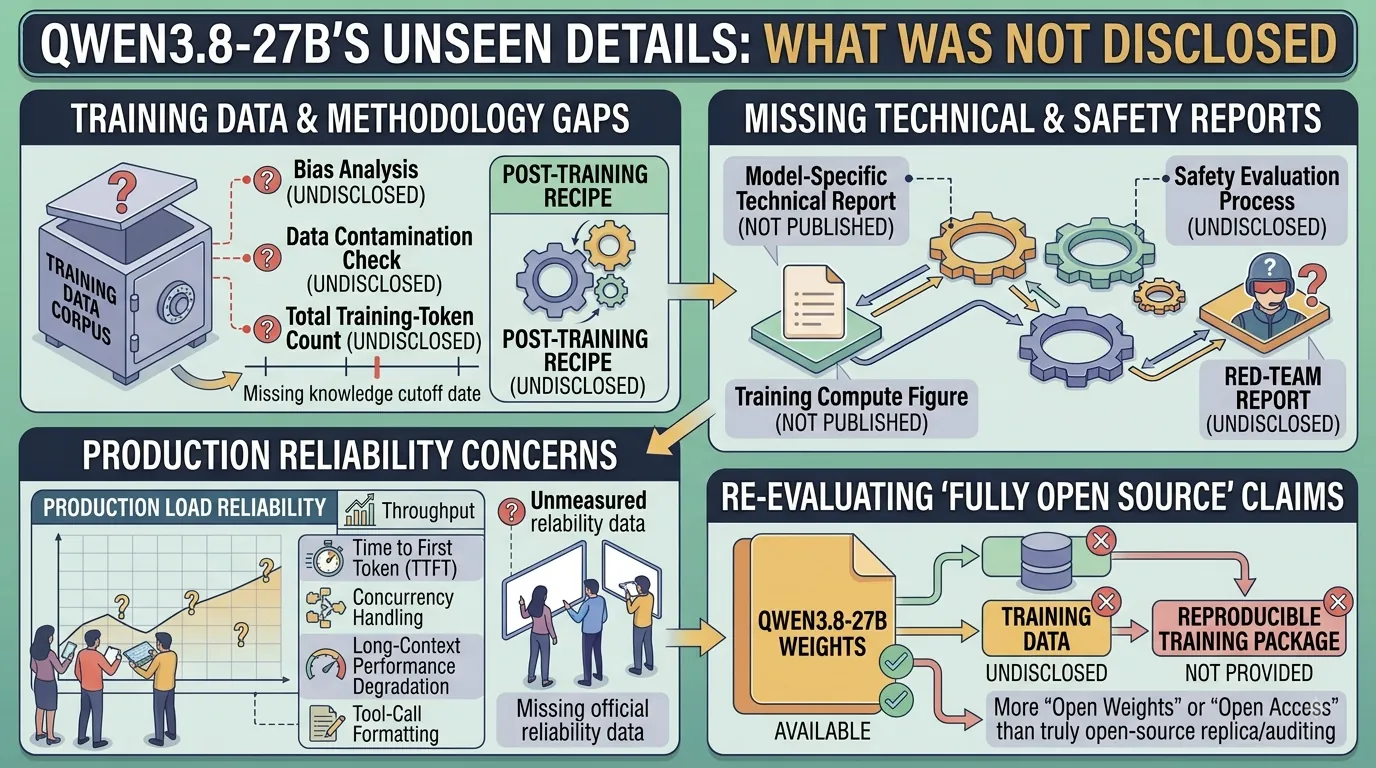
The foundation of any large language model is its training data, yet Alibaba has left this crucial aspect almost entirely opaque.The specific training corpus used for Qwen3.8-27B is undisclosed, making it impossible for researchers to analyze potential data contamination in benchmarks or inherent biases.
Furthermore, key metrics like the total training-token count and the model's knowledge cutoff date were not provided, leaving users to guess the scale of its training and the recency of its information.
The post-training recipe, which includes fine-tuning and alignment techniques, also remains undisclosed, preventing the community from understanding how the model's final behavior was shaped.
Even basic information, such as the total count of supported languages, was omitted from the launch details.
This lack of transparency extends to performance claims; for instance, the assertion that FP8 performance is nearly identical to BF16 is a vendor claim that requires rigorous independent evaluation to be trusted.
Missing Technical and Safety Reports
For a release of this significance, the absence of standard documentation is conspicuous.Qwen did not publish a model-specific technical report at launch, which would typically detail architecture, training procedures, and limitations.
Similarly, no training-compute figure was released, obscuring the total computational cost and resources required to create the model.
From a safety and ethics perspective, the gaps are even more concerning.
The safety evaluation process is undisclosed, and critically, Qwen did not publish a red-team report to document the model's vulnerabilities and failure modes.
This lack of information makes it difficult for developers to assess the risks associated with deploying the model in real-world applications.
| Missing Information Category | Status / Implication |
|---|---|
| Training Corpus | Undisclosed. Prevents bias analysis and data contamination checks. |
| Training Token Count | Undisclosed. Obscures the scale of the model's training. |
| Knowledge Cutoff | Undisclosed. Users do not know the recency of the model's information. |
| Post-Training Recipe | Undisclosed. The alignment and fine-tuning methods are unknown. |
| Safety Evaluation & Red-Team Report | Undisclosed. Risks and vulnerabilities are not documented for developers. |
| Model-Specific Technical Report | Not published at launch. Lacks standard academic and engineering transparency. |
| Training Compute Figure | Not published. The environmental and financial cost to reproduce is unknown. |
| Performance & Reliability Metrics | No official latency tables or production load data (throughput, TTFT, etc.) were provided. |
Production Reliability Concerns
Developers looking to use Qwen3.8-27B in production are left without essential data.Alibaba did not publish an official latency table or a minimum-GPU matrix, making it difficult to forecast hardware requirements and operational costs.
More importantly, no launch table establishes the model's reliability under production load.
Metrics like throughput, time to first token, concurrency handling, cache hit rate, long-context performance degradation, and tool-call formatting reliability are all question marks.
There is also a significant unproven assumption at the core of the release: Qwen does not provide evidence that the 27B checkpoint faithfully reproduces the behavior of the proprietary Qwen3.8-Max model at a smaller scale.
Re-evaluating 'Fully Open Source' Claims
The marketing phrase "fully open source" overstates the nature of this release.While the model weights are available, the package lacks the two most critical components for true open-source replication and auditing: the training data and a reproducible training package.
Without these elements, the community cannot independently verify, replicate, or build upon the foundational work that created the model.
This positions the release more as an "open weight" or "open access" model rather than a fully open-source project in the traditional sense.
11. Kingy.ai's Verdict: Qwen3.8-27B's Role in the Open-Weight Landscape
This section provides our final assessment of the Qwen3.8-27B release, situating it within the competitive open-weight model landscape. It directly addresses the main article's theme by defining the practical sweet spot for this model—powerful enough for many advanced tasks on local hardware, but still distinct from top-tier, closed-source "frontier" models.Leading the Dense Open-Weight Category
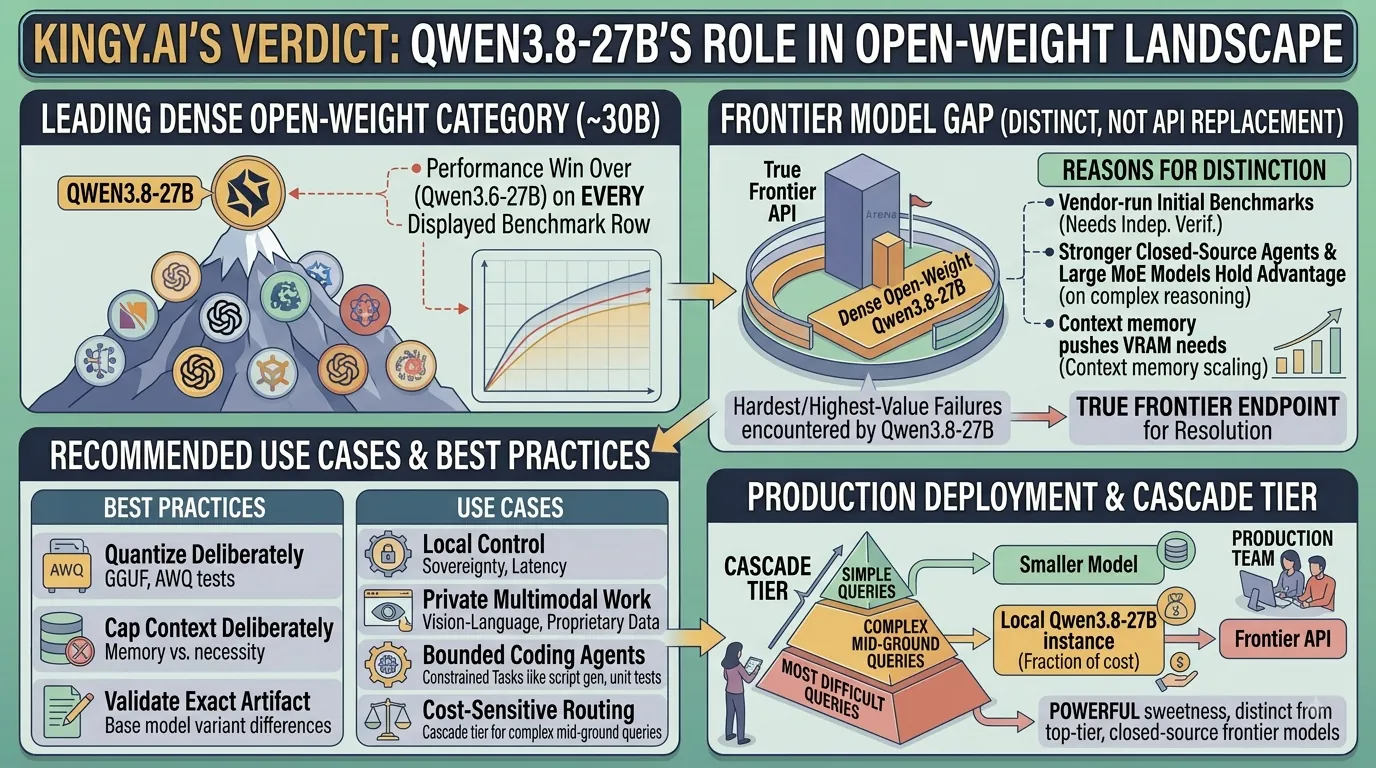
In our analysis, Qwen3.8-27B is likely the new dense open-weight model to beat in the approximately 30B parameter class.The cleanest launch evidence supporting this position is the direct comparison against its predecessor.
Qwen's own reporting shows a performance win for Qwen3.8-27B over Qwen3.6 on every displayed benchmark row, a significant achievement given they share the same published decoder shape.
This indicates a clear architectural or training data improvement, establishing it as the new leader for developers seeking maximum capability from a single, dense model of this size.
Recommended Use Cases
Based on its balance of performance and resource requirements, we recommend Qwen3.8-27B for several key applications:- Local Control: For applications requiring data sovereignty, low latency, and operational independence from cloud APIs, this model offers a new level of local capability.
- Private Multimodal Work: Its strong vision-language abilities make it an excellent choice for processing sensitive or proprietary visual data without transmitting it to third-party services.
- Bounded Coding Agents: While not a replacement for Claude 3.5 Sonnet or Opus, it is highly effective for well-defined, constrained coding tasks like script generation, code completion, and unit test creation where the problem space is limited.
- Cost-Sensitive Routing: It serves as an ideal, high-performance middle tier in a model cascade. Simpler queries can be handled by smaller models, the most difficult can be escalated to a frontier API, and the large middle-ground of complex queries can be routed to a local Qwen3.8-27B instance for a fraction of the cost.
Important Considerations and Best Practices
To achieve optimal results, developers should not treat this model as a simple drop-in replacement for an API.We advise operators to quantize deliberately, testing various quantization levels (like GGUF or AWQ) to find the best balance between performance and VRAM usage for their specific hardware and task.
It is also critical to cap context deliberately; while the model supports a long context window, using the full length consumes a significant amount of memory that may not be necessary for all tasks.
Finally, always validate the exact artifact you are using.
The open-source ecosystem produces many fine-tuned variants and quantized versions; performance can vary significantly, so do not rely on the base model name alone.
Test the specific file you have downloaded.
Frontier Model Gap
Our positive assessment stops short of calling Qwen3.8-27B a "frontier model on one GPU".Several factors maintain this distinction.
First, the initial benchmarks are from a vendor-run suite, which warrants independent verification.
Second, stronger closed-source agents and larger open-weight mixture-of-experts (MoE) models still hold a clear performance advantage on the most complex reasoning tasks.
Finally, utilizing the model's full native context length pushes its memory requirements into a different class, often beyond what a single consumer GPU can handle.
For these reasons, the best practice for production systems remains clear: the hardest or highest-value failures encountered by Qwen3.8-27B should be escalated to a true frontier endpoint for resolution.
12. Kingy.ai's Review Process: Scope and Limitations
This section details the methodology, scope, and limitations of the analysis performed for this article on the Qwen3.8-27B model, providing transparency on our findings.Our research was completed on August 14, 2026.
Artifacts Inspected and Data Recalculated
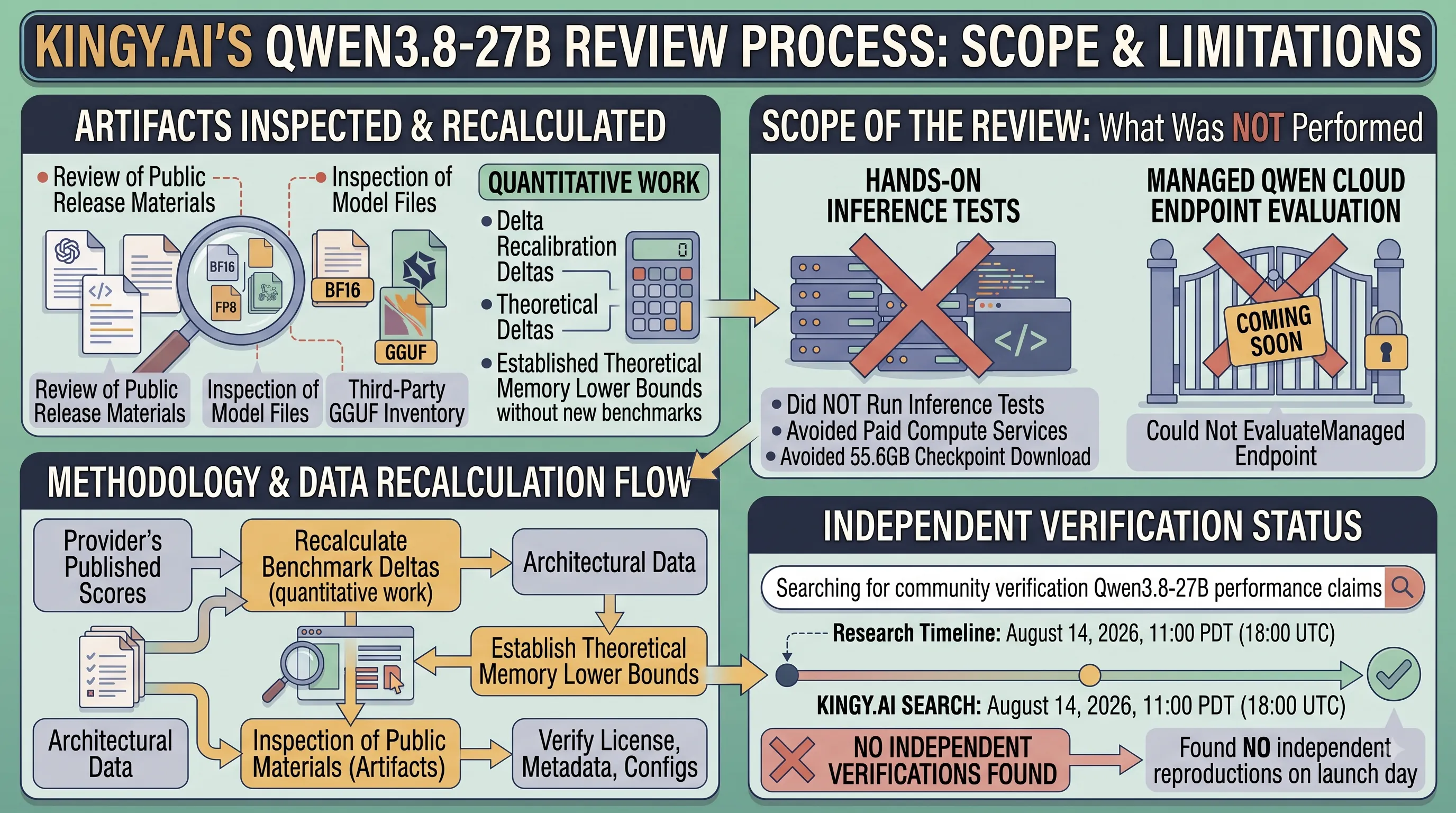
Our analysis is based on a thorough inspection of the publicly available release materials.Kingy.ai reviewed the official launch model card, model configuration files, the repository's license and metadata, and the official BF16 and FP8 artifacts.
Additionally, we examined the inventory of third-party GGUF files available at the time of the review.
Rather than running new benchmarks, our quantitative work involved recalculating benchmark deltas based on the provider's published scores and establishing theoretical memory lower bounds for running the model based on its architecture.
Scope of the Review: What Was Not Performed
To clarify the boundaries of this review, it is important to note what was not performed.Kingy.ai did not run any hands-on inference tests for this initial analysis.
This approach was taken to avoid the use of paid third-party compute services and the download of the very large 55.6GB model checkpoint.
Furthermore, an evaluation of the official managed Qwen Cloud endpoint was not possible, as it was still marked "coming soon" during our review period.
Independent Verification Status
A key part of our process involves searching for community and third-party verification of a new model's performance claims.Kingy.ai conducted a search for any independent reproductions of Qwen3.8-27B's benchmark results on its launch day.
This search, completed at 11:00 PDT (18:00 UTC), found no independent benchmark verifications had been published at that time.
Related Posts
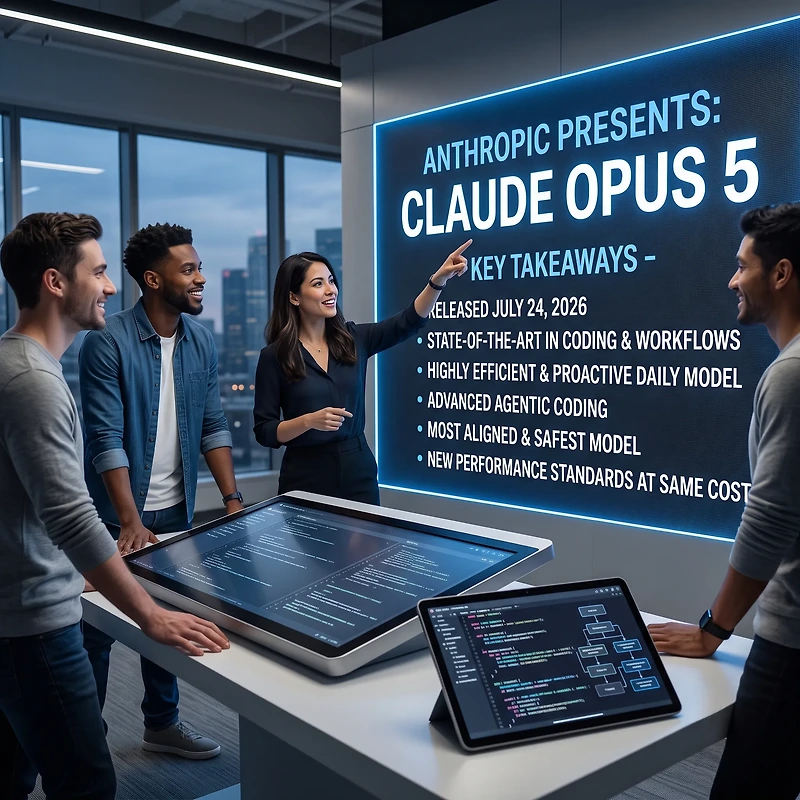
Anthropic's Claude Opus 5 Released: New AI Frontier in Agentic Coding, Multi-Step Workflows & Safety BenchmarksAnthropic officially released Claude Opus 5 on July 24, 2026, making it available across all...
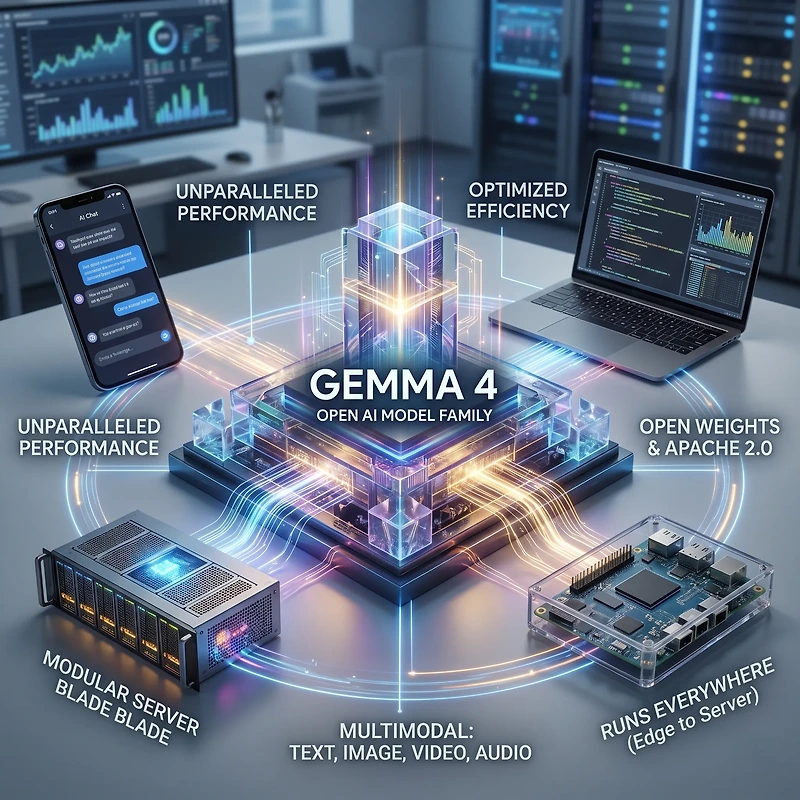
Gemma 4: Google's Open AI Redefines Performance & Efficiency, Closing Proprietary Gaps for Developers & Edge DevicesGemma 4 redefines open AI, offering frontier-level performance and unparalleled efficiency across...
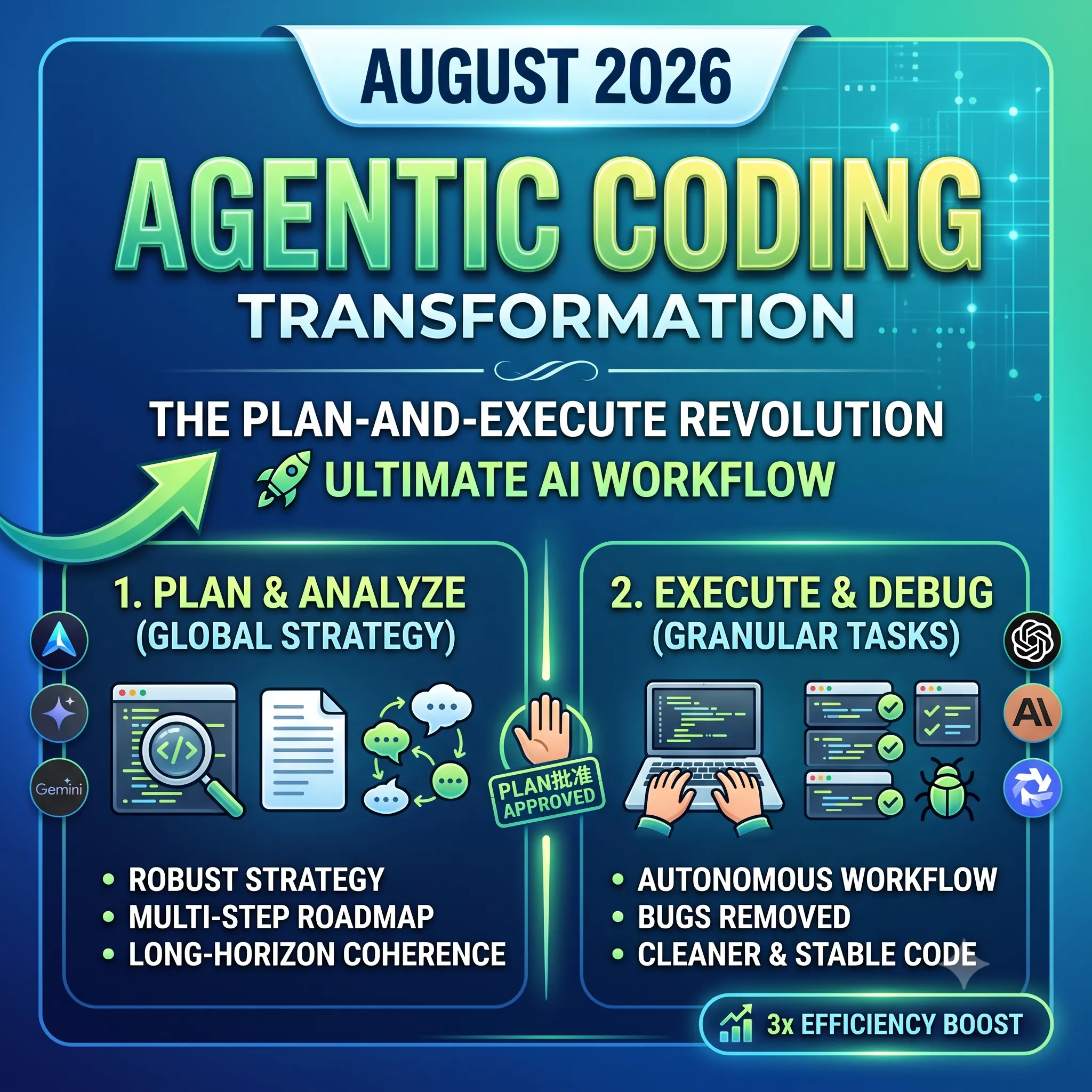
Agentic Coding: The Plan-and-Execute AI Agent Framework for Robust Software DevelopmentExplore agentic coding and the Plan-and-Execute AI agent framework for building robust, autonomous...