
Inside Darling's Q4 2026 Update: ARM64 Support and AI Rules
🚀 Key Takeaways
- Formal AI Contribution Guidelines: Darling adopted structured governance for AI-assisted code submissions, requiring human contributors to understand and remain accountable for all submitted code.
- Initial ARM64 Architecture Support: Foundational support for 64-bit ARM was integrated to align the compatibility layer with Apple Silicon's hardware dominance.
- Automated Fork Merging: Maintainers implemented agent-driven workflows to systematically reconcile and backport breakthroughs from fast-moving community forks into upstream Darling.
- Expanded Application Viability: External branch testing proved significant compatibility milestones, successfully launching demanding native macOS applications and gaming titles.
- AppKit and Native Tooling Roadmap: Future development focuses on stabilizing graphical desktop frameworks, paired with dedicated utilities for configuration and system log inspection.
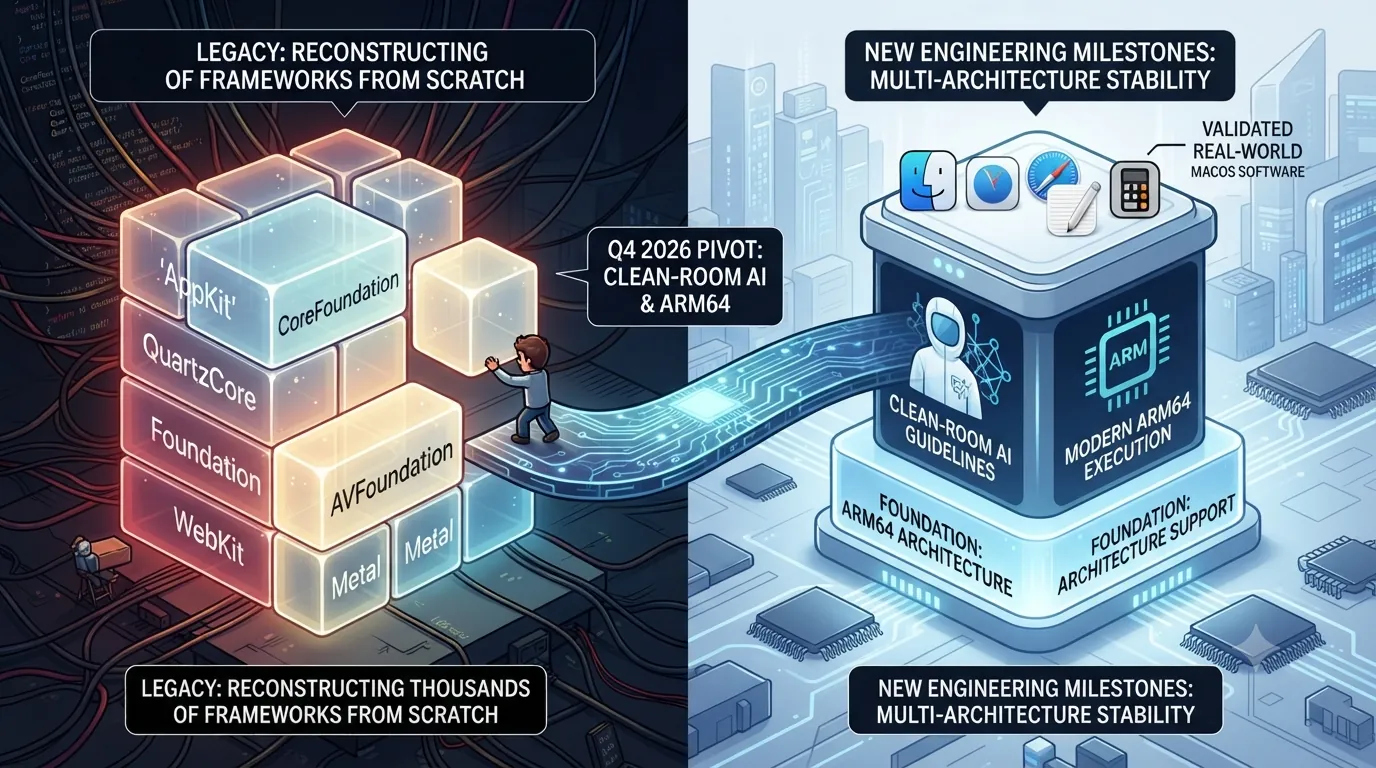
Replicating Apple’s proprietary software stack on Linux has historically stood among the most formidable undertakings in open-source systems engineering. Unlike environments that rely on redistributable vendor binaries, Darling must reconstruct thousands of internal and public frameworks from scratch, a scope that has expanded dramatically across successive operating system generations.
The Q4 2026 update signals a fundamental pivot in the project's development cadence and technical scope. By institutionalizing clean-room guidelines for AI-assisted development and laying the groundwork for modern ARM64 execution, Darling is directly addressing the scaling bottlenecks that previously constrained contributor throughput.
As community efforts actively validate real-world macOS software on experimental builds, these latest engineering milestones provide a structured pathway toward full desktop parity and multi-architecture stability on Linux hosts.
1. AI-Assisted Contribution Policy and Clean-Room Engineering Rules
As part of the key improvements in Darling’s Q4 2026 update, the project has established a formal framework governing AI-assisted development to protect the codebase legally and architecturally.Project leadership stated that refusing AI would have caused Darling to become insignificant and risk community fragmentation across fast-moving forks.
To mitigate these risks while embracing modern development tools, Darling adopted a formal policy governing AI-assisted code contributions.
Human Accountability and Verification Standards
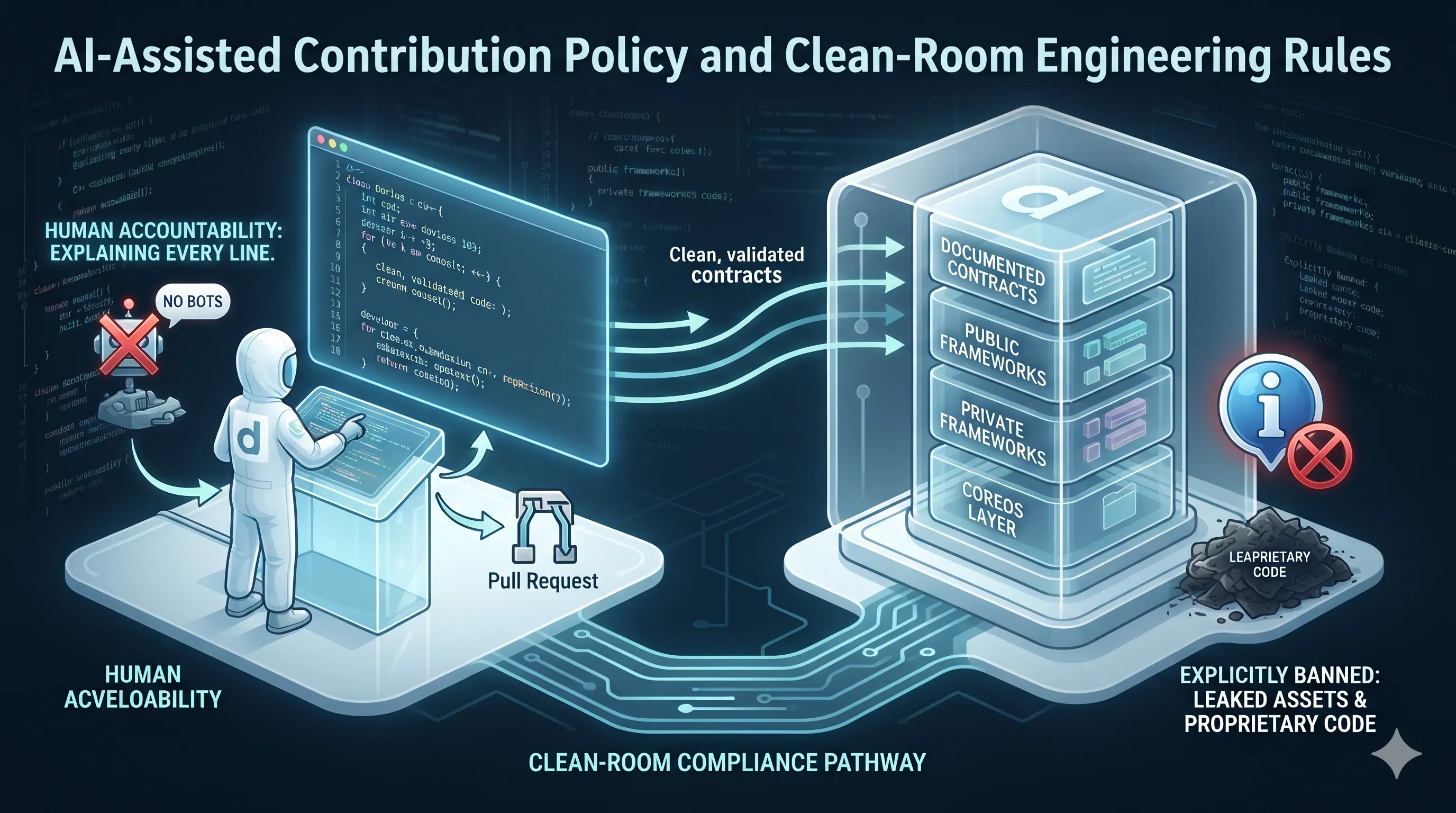
The newly instituted policy is structured as prompt instructions for AI agents, yet it legally and technically binds the human submitter.Darling places the entire burden of code integrity on the developer opening the pull request.
Contributors submitting pull requests are held responsible for every submitted line of code and must explain it in their own words.
Maintainer review questions must be answered by human contributors rather than bots, ensuring that the author genuinely understands the logic and implications of the proposed changes.
Strict Clean-Room Architecture and Asset Isolation
Clean-room engineering practices remain central to Darling's development model to preserve the project's legal standing and technical health.Clean-room engineering requires implementing documented contracts rather than application-specific hacks.
Furthermore, all contributions must strictly follow macOS layering architecture and isolate and label undocumented system quirks.
The policy explicitly bans using leaked assets or proprietary Apple source code such as corecrypto.
In addition, disassembly cannot be fed directly to code-generating agents; it may only inform high-level behavioral documentation in an isolated context.
| Policy Area | Mandated Engineering Standard | Explicit Restriction or Ban |
|---|---|---|
| Pull Request Verification | Human contributors must explain code in their own words and answer maintainer reviews. | Automated bot replies to review questions are strictly prohibited. |
| Proprietary Code and Assets | Implementations must adhere strictly to documented contracts and macOS layering. | Leaked assets and proprietary Apple source code (such as corecrypto) are explicitly banned. |
| Disassembly Handling | Disassembly may only inform high-level behavioral documentation in an isolated context. | Directly feeding disassembly to AI code-generating agents is strictly forbidden. |
| System Quirks & Hacks | Undocumented system quirks must be isolated and labeled properly. | Application-specific hacks outside documented contracts are disallowed. |
2. Initial ARM64 Architecture Implementation and Apple Silicon Alignment
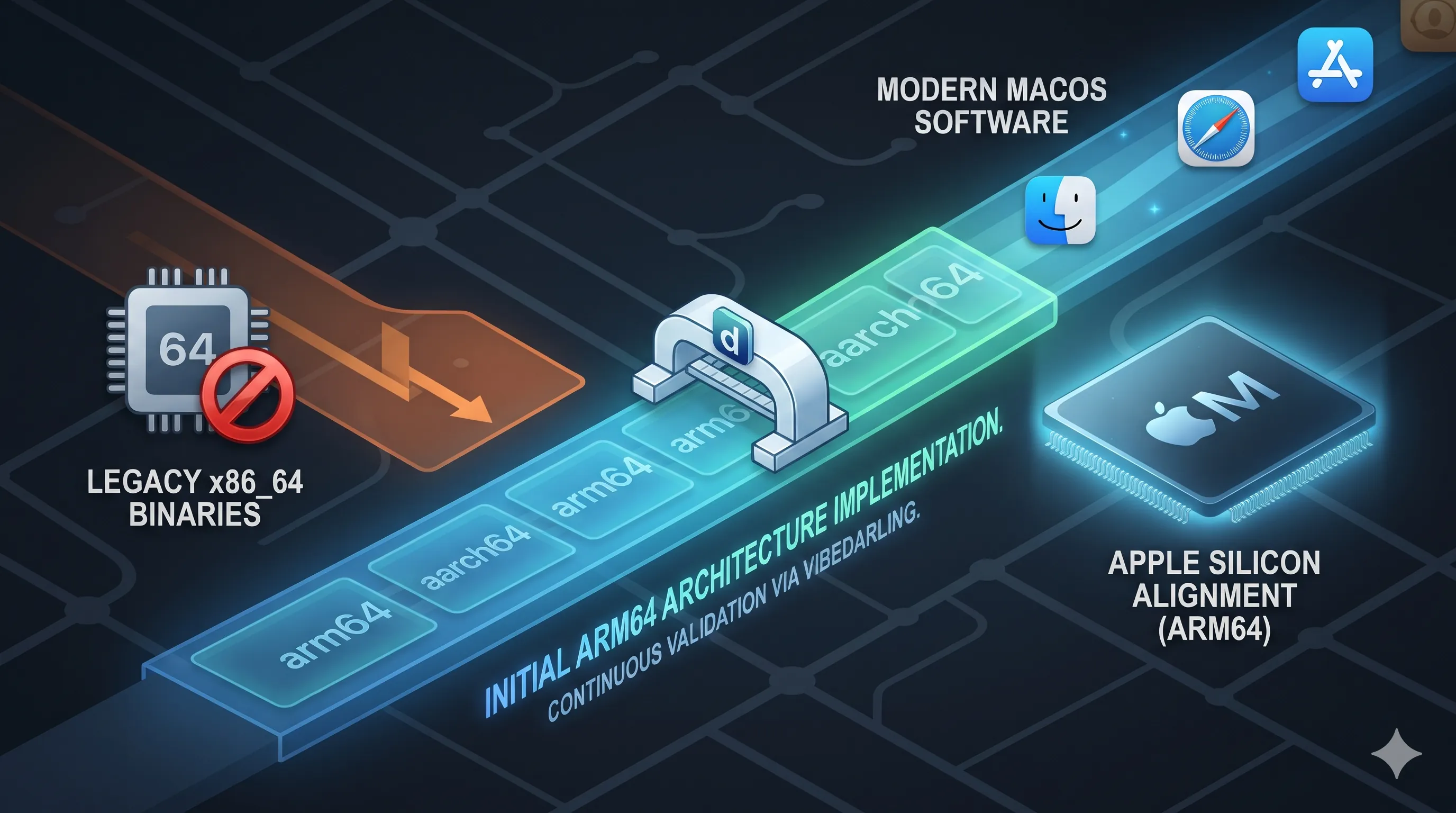
A pivotal pillar among the key improvements in Darling’s Q4 2026 update is the introduction of initial support for the ARM64 (aarch64) architecture.This integration directly addresses the evolving structural demands of macOS binary emulation by establishing foundational aarch64 runtime readiness within the translation layer.
Aligning Darling with the Apple Silicon Shift
Incorporating ARM64 architecture support fundamentally aligns Darling with the broader Apple ecosystem transition.Modern macOS software increasingly targets Apple silicon first or exclusively, shifting developer focus away from x86_64 binaries.
Without robust ARM64 capability, Darling would inevitably be restricted to legacy hardware architectures that Apple is phasing out.
By implementing initial aarch64 execution pathways, Darling ensures its compatibility framework remains viable for modern software environments rather than being trapped in an obsolescent computing paradigm.
Continuous ARM64 Integration via VibeDarling
Sustaining structural hardware architecture shifts requires rigorous, ongoing validation across runtime components.Within this development cycle, the newly added ARM64 code paths are tested continuously through active day-to-day development on the VibeDarling fork.
This ongoing testing cadence maintains the stability of the aarch64 implementation, validating foundational changes as they emerge and keeping Darling synchronized with modern architectural requirements.
3. Platform Scaling Challenges and Framework Growth Metrics
To fully grasp the significance of the key improvements in Darling’s Q4 2026 update, one must first examine the immense architectural scaling challenges the project has navigated since its inception.Project founder Luboš Doležel created Darling in 2012, setting out to build an open-source translation layer capable of running Darwin and macOS software natively on Linux.
However, tracking modern macOS releases has meant confronting an ever-widening gap in API breadth and framework complexity.
The Scaling Gap: macOS 10.14 vs. macOS 27 Frameworks
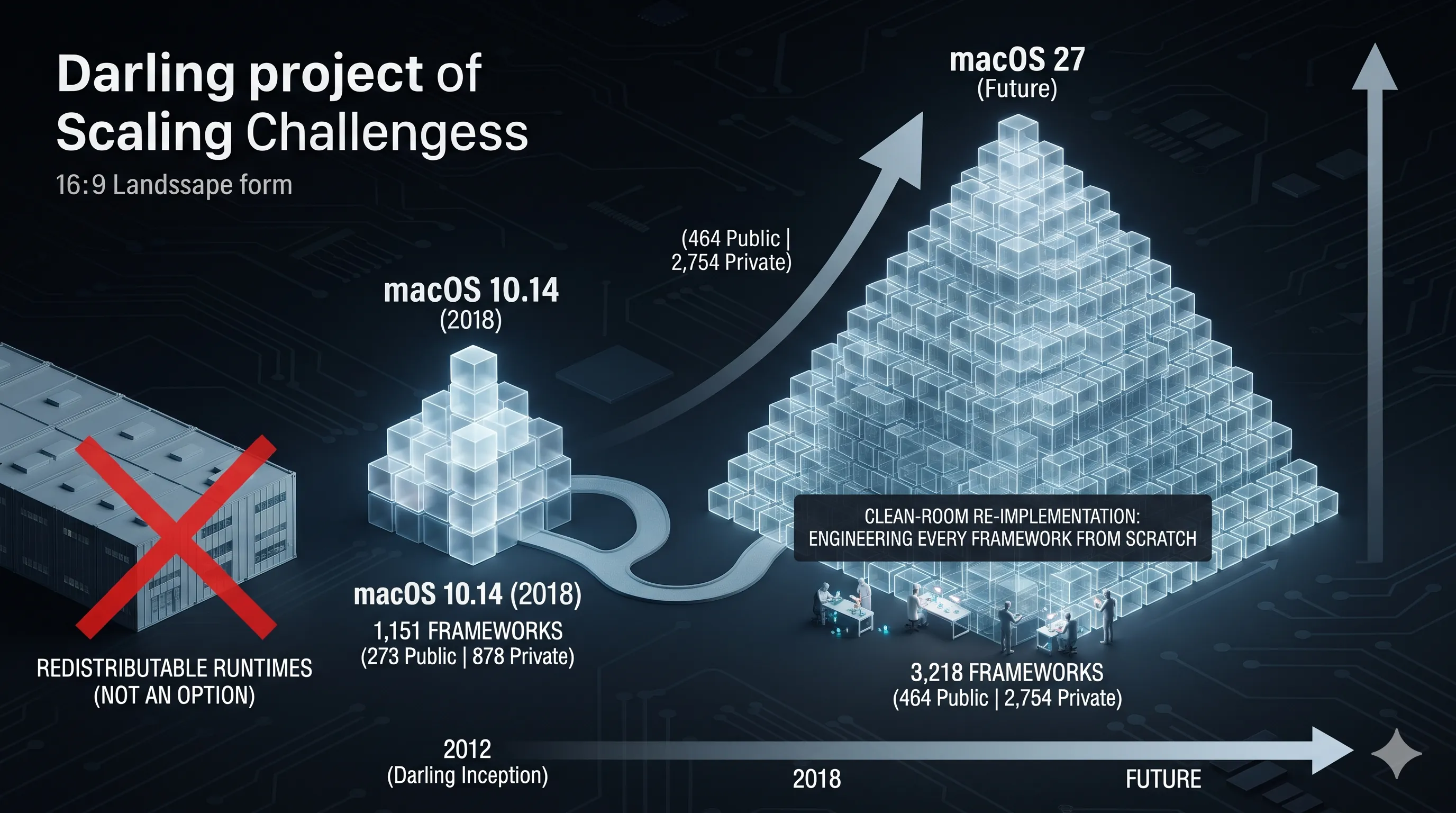
The sheer rate of framework proliferation across macOS releases illustrates the escalating burden placed on Darling's compatibility layer.Historical tracking reveals that macOS 10.14 previously contained 273 public frameworks and 878 private frameworks.
In contrast, macOS 27 contains 464 public frameworks according to project counts, alongside 2,754 private frameworks.
This rapid explosion in library targets explains why matching Apple's engineering output previously appeared to be an unsolvable challenge for an open-source volunteer team.
| macOS Version | Public Frameworks | Private Frameworks |
|---|---|---|
| macOS 10.14 | 273 | 878 |
| macOS 27 | 464 | 2,754 |
Clean-Room Framework Re-implementation vs. Redistributable Runtimes
The architectural burden of Darling diverges significantly from other compatibility environments such as Wine.Unlike Wine, Darling cannot utilize redistributable runtimes and must implement Apple frameworks from scratch.
Every system framework, foundational utility, and dynamic library must be engineered cleanly within the project's own codebase.
In addition to the strict technical demands of clean-room re-implementation, the smaller pool of developers familiar with macOS internals has historically hindered contributor recruitment and commercial backing.
These long-standing hurdles frame the systemic progress and framework coverage advances delivered in the Q4 2026 release.
4. Agent-Driven Fork Merging and the Tri-Architecture Roadmap
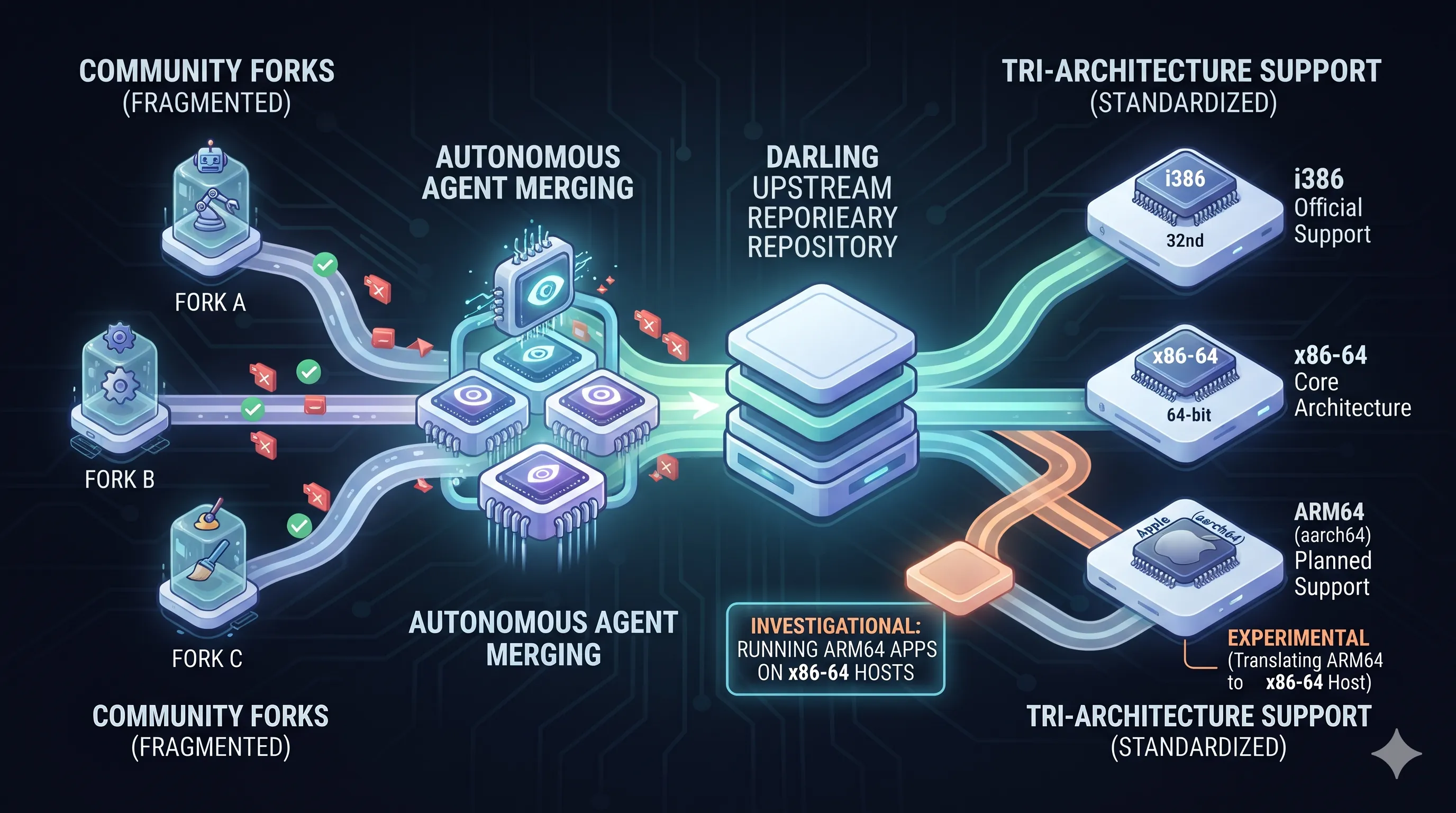
A pivotal component of the Key Improvements in Darling’s Q4 2026 Update centers on reconciling community developments with the upstream project and standardizing multi-architecture binary execution.To overcome fragmentation across third-party development efforts, Darling has instituted a structured initiative to assimilate independent improvements while simultaneously expanding architectural support across Linux hosts.
Autonomous Agent Merging and Defect Resolution
Darling is utilizing agent-driven merging logic to systematically fold community fork developments back into the main upstream repository.The near-term roadmap specifically targets merging this external fork code over the next 2 months.
This automated agent merge workflow does not merely combine disparate git commits; it has autonomously fixed bugs inside the fork codebases as well as resolving pre-existing defects within Darling itself.
The practical viability of these community contributions has already been demonstrated in real-world scenarios.
External AI-assisted forks have successfully run original macOS applications, including demanding macOS software titles such as League of Legends.
Integrating these advancements directly into the core project ensures that standalone compatibility fixes become part of Darling's permanent upstream foundation.
Tri-Architecture Targets and Experimental Dynarmic Translation
Darling's long-term compatibility design establishes an official roadmap to support 3 system architectures.These three target environments encompass legacy 32-bit computing, standard 64-bit platforms, and modern Apple silicon architectures.
| Architecture | Roadmap Support Level | Operational Notes & Tooling |
|---|---|---|
| i386 | Official Roadmap Target | One of the 3 system architectures planned for official support. |
| x86-64 | Official Roadmap Target | Core 64-bit architecture; host environment under investigation for cross-architecture translation. |
| ARM64 (aarch64) | Official Roadmap Target | Planned for official support; experimental translation targeting x86-64 hosts using Dynarmic. |
Dynarmic provides dynamic binary translation capabilities intended to bridge the instruction set architecture gap between modern ARM-compiled macOS software and traditional x86-64 PC environments.
However, the development team treats executing ARM64 applications on x86-64 host architectures via Dynarmic as an unverified long shot.
While cross-architecture emulation remains an unverified pursuit, the primary tri-architecture roadmap and the 2-month agent-driven fork assimilation represent Darling's core strategy for unifying upstream development.
5. Long-Term AppKit Stabilization and Native GUI Administration Tooling
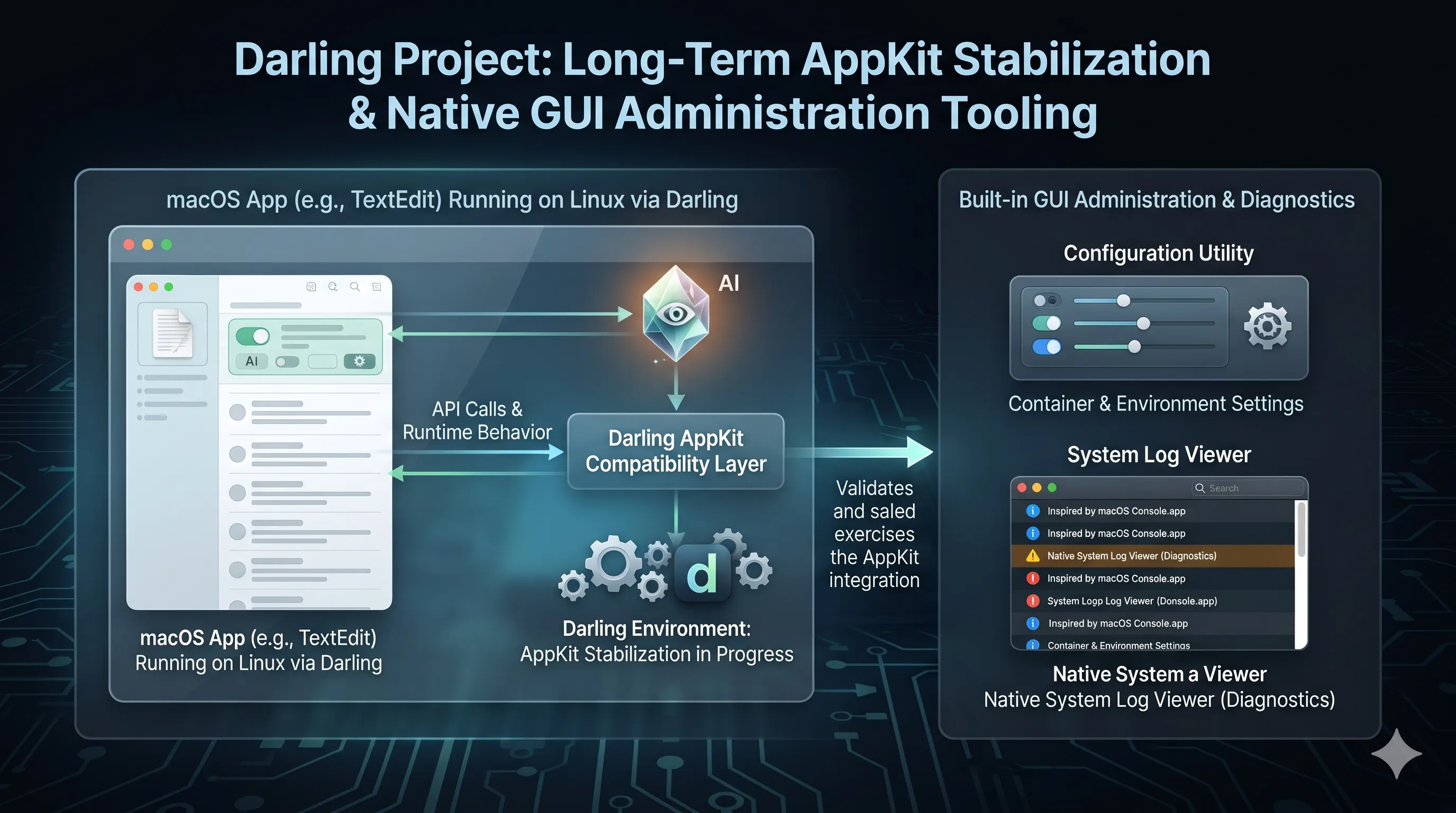
Within the broader scope of the Key Improvements in Darling’s Q4 2026 Update, establishing graphical framework parity represents one of the environment's most critical frontiers.While lower-level subsystem layers continue to mature, the project's roadmap emphasizes that AppKit stabilization and interface parity remain ongoing long-term goals rather than fully completed components.
Concrete API Modeling for AppKit Graphical Parity
Darling's long-term graphical strategy prioritizes stabilizing AppKit support and refining overall GUI presentation across the compatibility layer.Achieving fidelity across complex visual frameworks requires mapping intricate, often undocumented calling conventions and runtime lifecycle behaviors.
To address this complexity, development targets running selected open-source macOS applications directly within the Darling environment.
This targeted approach allows AI agents to observe and study concrete API expectations, providing a systematic mechanism to inspect how authentic software interacts with AppKit subsystems in real time.
Built-in Administration: Dedicated Configuration and Console Utilities
Alongside runtime observation strategies, Darling plans to implement built-in GUI administration tools directly on top of the emerging presentation stack.A core milestone in this administrative roadmap includes the introduction of a dedicated configuration utility designed to streamline container and environment settings natively.
Additionally, the project plans to develop a native system log viewer inspired by macOS Console.app.
This log viewer serves a dual purpose: providing an integrated diagnostic interface for users while functioning as an authentic internal test case to validate and exercise Darling’s AppKit integration.
Related Posts
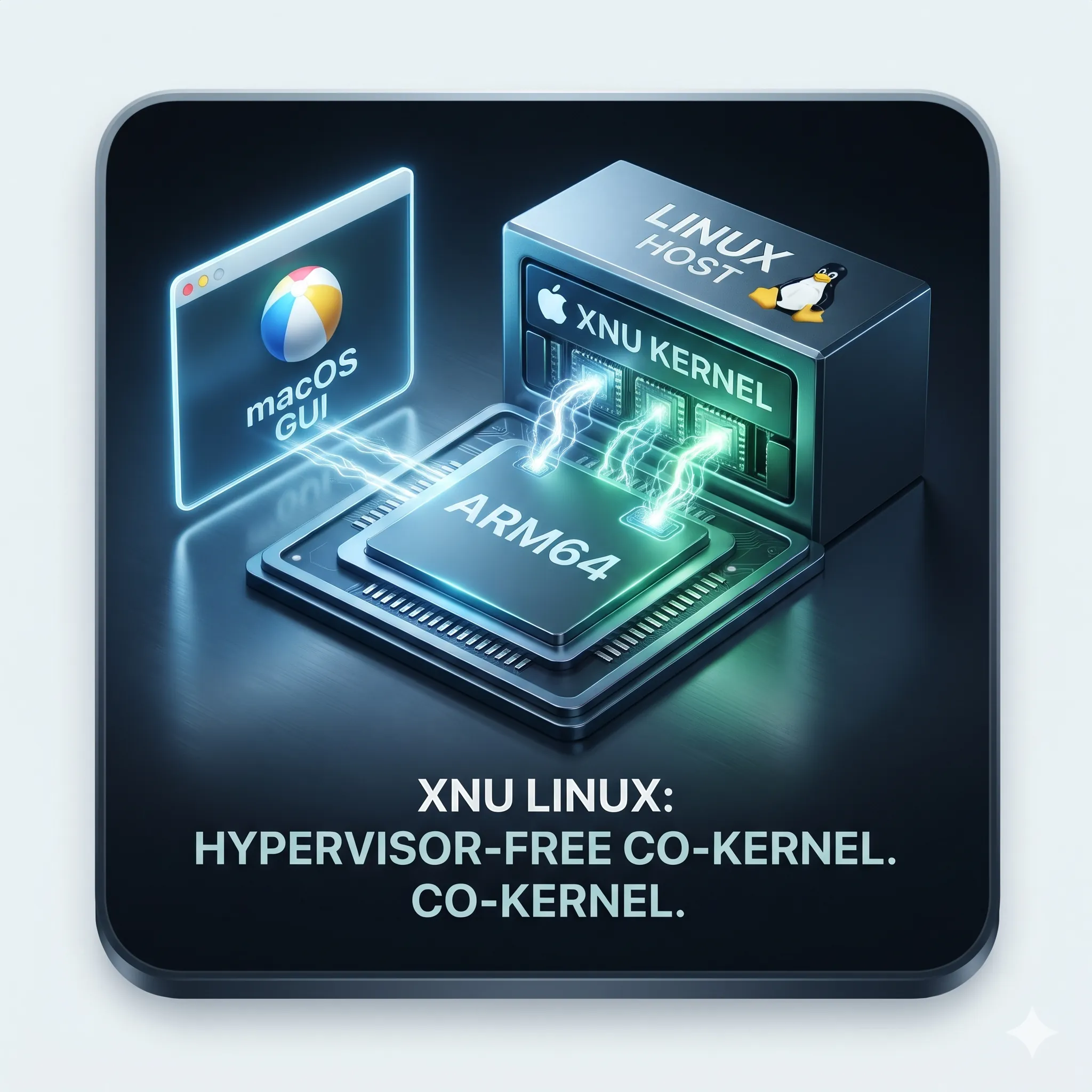
XNU Linux Brings macOS GUI to Arm64 Linux Without HypervisorsDiscover how XNU Linux runs Apple's XNU kernel and macOS desktop environment natively on arm64...
Kugelblitz: The Mac-Native Google Earth Alternative for Apple SiliconDiscover Kugelblitz, a Mac-native Google Earth alternative built for Apple silicon by Tim Pritlove,...
Tracking Linux System Calls Across 27 Architectures With API UpdatesExplore the updated Linux system call API featuring multi-architecture tracking across 27...
Generative AI may have assisted with research or drafting for this article. Topic selection, fact-checking, final wording, and publication remain the responsibility of DragonStone74. AI use disclosure