
Tracking Linux System Calls Across 27 Architectures With API Updates
🚀 Key Takeaways
- Broad Architecture Coverage: Modern kernel indexes catalog system calls across dozens of distinct architectures, tracking evolutions from early Linux 3.x baselines up through modern kernel releases.
- Programmatic API Tracking: Machine-readable tables and historical release filters make it possible to monitor when system call interfaces appear, mutate, or get deprecated over time.
- Hardware-Specific Register Mappings: Low-level invoking conventions rely on rigid architectural agreements, mapping call numbers and arguments directly to CPU registers during user-to-kernel transitions.
- Permanent Interface Lifecycle: Introducing a new system call permanently expands the kernel ABI, demanding strict scrutiny against alternative interfaces to avoid legacy debt.
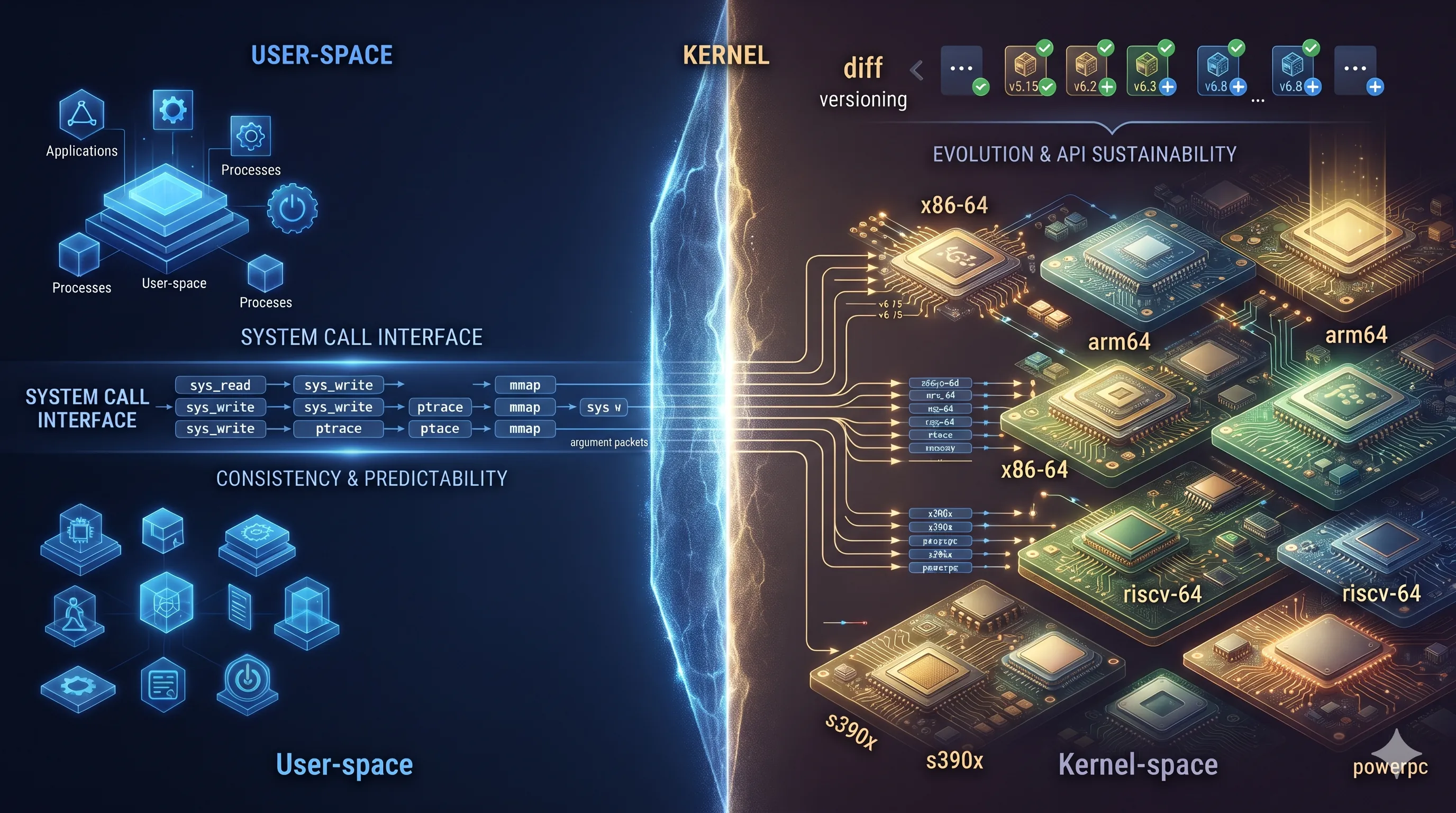
The Linux system call interface serves as the foundational boundary separating user-space applications from the core operating system kernel. As contemporary computing workloads span diverse hardware architectures—from embedded controllers to massive hyperscale servers—maintaining consistency, predictability, and efficiency across system-level entry points has become a paramount engineering challenge.
Over recent release cycles, the landscape of system call availability and documentation has shifted substantially. With modern reference catalogs tracking entry points across dozens of hardware targets, kernel developers and systems programmers now rely on structured schema tracking and automated diffing to understand precisely how register configurations and interfaces evolve across major releases.
Because any addition to the system call table represents an indelible commitment to long-term binary compatibility, evaluating new features requires a delicate balance between performance and API sustainability. Exploring these architectural calling conventions, inspection tooling, and interface lifecycle rules provides crucial insight into the mechanics governing modern Linux kernel development.
1. Multi-Architecture Scope: Tracking Linux System Calls Across 27 Architectures from Kernel 3.3 to 7.3
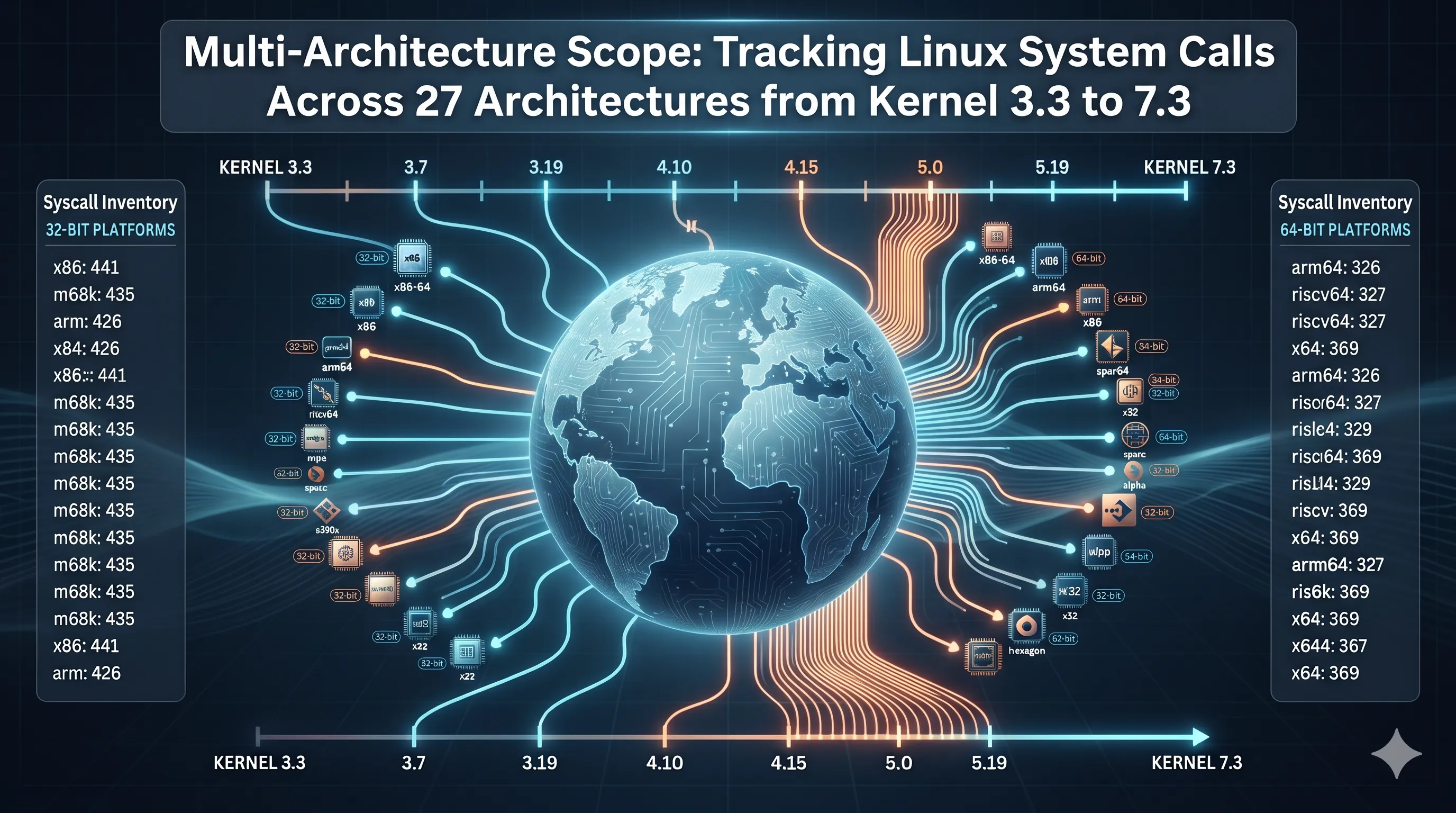
Understanding how new architectures and features are added to the Linux system call API requires a unified view of how individual system call tables diverge across processor targets.The catalog compiled at syscall.sh groups Linux system call tables across 27 distinct architectures and ABI variations into a single reference, documenting system call numbers, arguments, and argument-to-register mappings across a version timeline spanning Linux 3.3 to Linux 7.3.
Syscall Inventory Across 64-Bit, 32-Bit, and Compatibility ABIs
The Linux system call interface maintains unique system call counts and numbers across distinct processor architectures and compatibility runtime environments.Older 32-bit platforms exhibit higher overall system call counts due to historical system calls and multiple generations of multiplexed or width-adjusted interfaces.
For instance, x86 (i386, 32-bit x86) indexes 441 system calls, m68k (Motorola 68000) indexes 435, sparc (32-bit) indexes 434, sh (SuperH) indexes 433, arm (ARM EABI, 32-bit) indexes 426, ppc (PowerPC, 32-bit) indexes 425, and microblaze (Xilinx MicroBlaze) indexes 423.
Specialized and embedded 32-bit instruction sets also maintain customized tables, such as mipso32 (MIPS o32 ABI) with 413 system calls, arc (Synopsys ARC) with 350, csky (C-SKY) with 346, nios2 (Intel Nios II) with 346, openrisc (OpenRISC) with 346, and hexagon (Qualcomm Hexagon) with 345 system calls.
In contrast, newer 64-bit architectures utilize consolidated system call tables that eliminate legacy interfaces, resulting in lower system call counts.
loongarch64 (LoongArch, 64-bit) defines 323 system calls, arm64 (AArch64) defines 326, and riscv64 (RISC-V, 64-bit) defines 327.
Established 64-bit platforms maintain counts reflecting architectural longevity: mips64 (MIPS n64 ABI) contains 363 system calls, x64 (x86_64) contains 369, s390x (IBM Z) contains 378, ppc64 (PowerPC, 64-bit) contains 383, sparc64 (SPARC, 64-bit) contains 399, alpha (DEC Alpha) contains 403, and parisc (HP PA-RISC) contains 404.
Specialized processor configurations like xtensa (Tensilica Xtensa) define 388 system calls.
Compatibility ABIs running on 64-bit kernels maintain distinct tables to support legacy or alternative bit-width binaries.
The ia32 emulation layer (IA-32 compat on x86_64) defines 439 system calls, the mipsn32 ABI defines 387 system calls, and the x32 ABI on x86_64 defines 369 system calls.
| Architecture / ABI Name | Total Syscall Count | Initial Tracked Kernel Release |
|---|---|---|
| x64 (x86_64) | 369 | Linux 3.3 |
| x86 (i386, 32-bit x86) | 441 | Linux 3.3 |
| ia32 (IA-32 compat on x86_64) | 439 | Linux 3.3 |
| x32 (x32 ABI on x86_64) | 369 | Linux 3.4 |
| arm64 (AArch64) | 326 | Linux 3.7 |
| hexagon (Qualcomm Hexagon) | 345 | Linux 3.7 |
| openrisc (OpenRISC) | 346 | Linux 3.7 |
| arc (Synopsys ARC) | 350 | Linux 3.9 |
| nios2 (Intel Nios II) | 346 | Linux 3.19 |
| arm (ARM EABI, 32-bit) | 426 | Linux 4.10 |
| riscv64 (RISC-V, 64-bit) | 327 | Linux 4.15 |
| s390x (IBM Z) | 378 | Linux 4.16 |
| csky (C-SKY) | 346 | Linux 4.20 |
| alpha (DEC Alpha) | 403 | Linux 5.0 |
| m68k (Motorola 68000) | 435 | Linux 5.0 |
| microblaze (Xilinx MicroBlaze) | 423 | Linux 5.0 |
| mips64 (MIPS n64 ABI) | 363 | Linux 5.0 |
| mipsn32 (MIPS n32 ABI) | 387 | Linux 5.0 |
| mipso32 (MIPS o32 ABI) | 413 | Linux 5.0 |
| parisc (HP PA-RISC) | 404 | Linux 5.0 |
| ppc (PowerPC, 32-bit) | 425 | Linux 5.0 |
| ppc64 (PowerPC, 64-bit) | 383 | Linux 5.0 |
| sh (SuperH) | 433 | Linux 5.0 |
| sparc (SPARC, 32-bit) | 434 | Linux 5.0 |
| sparc64 (SPARC, 64-bit) | 399 | Linux 5.0 |
| xtensa (Tensilica Xtensa) | 388 | Linux 5.0 |
| loongarch64 (LoongArch, 64-bit) | 323 | Linux 5.19 |
Kernel Version Tracking from Linux 3.3 to Linux 7.3
The catalog tracks entries across kernel versions using an interactive kernel selector.This mechanism allows developers to inspect changes in system call availability, assigned numbers, argument signatures, and register usage from Linux 3.3 up through Linux 7.3.
Because scanning began at different stages across the kernel's development history, each architecture possesses a distinct initial scanned version baseline.
Initial tracking baselines range from Linux 3.3 for x64, x86, and ia32, to Linux 3.4 for x32, Linux 3.7 for arm64, hexagon, and openrisc, Linux 3.9 for arc, Linux 3.19 for nios2, Linux 4.10 for arm, Linux 4.15 for riscv64, Linux 4.16 for s390x, and Linux 4.20 for csky.
A large block of architectures was baselined at Linux 5.0, including alpha, m68k, microblaze, mips64, mipsn32, mipso32, parisc, ppc, ppc64, sh, sparc, sparc64, and xtensa.
The most recently baselined architecture in the dataset is loongarch64, starting at Linux 5.19.
A critical operational caveat applies when interpreting version provenance: a system call whose since value equals the first release scanned for its architecture may actually be much older.
For example, system calls marked as appearing in Linux 5.0 on m68k or Linux 3.3 on x86 often originated in early Linux 1.x or 2.x releases, but their indexed presence in the database reflects the boundary where systematic multi-architecture scanning began.
2. Syscall Table API and JSON Schema: Automated Kernel Introspection and Version Tracking
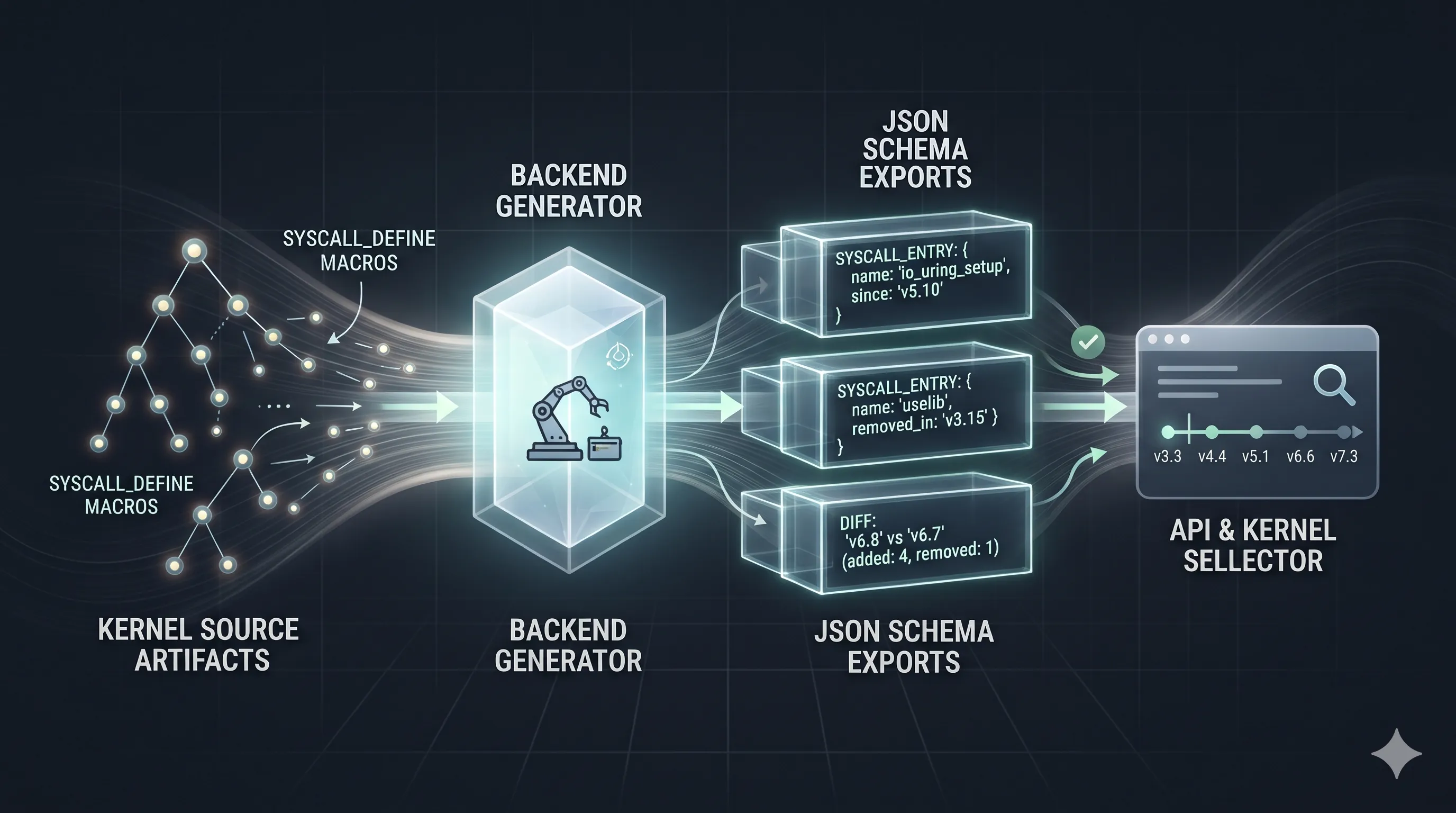
Programmatic visibility into new architectures and features added to the Linux system call API relies on machine-readable interfaces that map syscall numbers, entry points, and deprecation cycles across releases.Modern kernel introspection architectures expose this data through direct web endpoints, automated source table extraction, and cross-release comparison capabilities.
Machine-Readable Endpoints, Deprecation Metadata, and Release Diffs
To eliminate manual header audits when tracking system call additions across architectures, each architecture table is exported directly as a plain JSON file accessible via standard paths such as/<arch>/syscalls.json (for example, /x64/syscalls.json).These JSON schema exports maintain full lifecycle transparency by recording exactly when each entry first appeared via the
since field and when it was dropped via the removed_in field.Deprecations and historical interfaces remain completely observable rather than being silently purged.
Using an all, with removed filter inside the kernel selector, engineers can inspect dropped system calls, which are explicitly marked with the specific release that dropped them.
Beyond single-release lookups, the underlying API natively supports inspecting any mainline kernel release and generating automated diffs between releases to verify additions, shifts, and removals.
| Feature / Endpoint Element | Type / Target | Functional Role in Lifecycle Tracking |
|---|---|---|
/<arch>/syscalls.json |
Plain JSON Endpoint | Provides raw, machine-readable architecture syscall definitions (e.g., /x64/syscalls.json). |
since |
JSON Schema Field | Records the initial mainline kernel release where a specific syscall entry first appeared. |
removed_in |
JSON Schema Field | Identifies the exact kernel release that dropped the entry from the architecture's interface. |
| all, with removed | Kernel Selector Filter | Retains and highlights dropped syscalls alongside their terminating release versions. |
| Release Diff Engine | API Comparison Service | Generates programmatic differentials between any two scanned kernel releases. |
Source Introspection: SYSCALL_DEFINE Parsing and Automated Updates
Populating these architecture tables without introducing manual tracking errors requires direct parsing of upstream tree artifacts.The backend generator reads data directly from the kernel source by systematically walking the architecture syscall tables and extracting the corresponding
SYSCALL_DEFINE macros across every scanned mainline release.This direct source walk ensures that parameter names, types, and kernel entry definitions match the canonical implementation accurately.
To complement raw signature declarations with usage context, short descriptions are systematically derived from the Linux man-pages project, while specialized
io_uring descriptions are ingested directly from liburing.Whenever the underlying kernel data or upstream definition sets change, the website automatically rebuilds directly from the syscall API to reflect current mainline architecture states without manual intervention.
3. Syscall Calling Conventions: Register Mapping and the glibc Invocation Pipeline
As new architectures and features are added to the Linux system call API, understanding the underlying register conventions and invocation mechanics remains fundamental to interfacing user space with the Linux kernel.Low-level system call interfaces rely on strict contracts between user-space execution contexts and kernel entry points, establishing how call identifiers and runtime arguments transition across security boundaries.
Architecture Register Mappings and Kernel Mode Switches
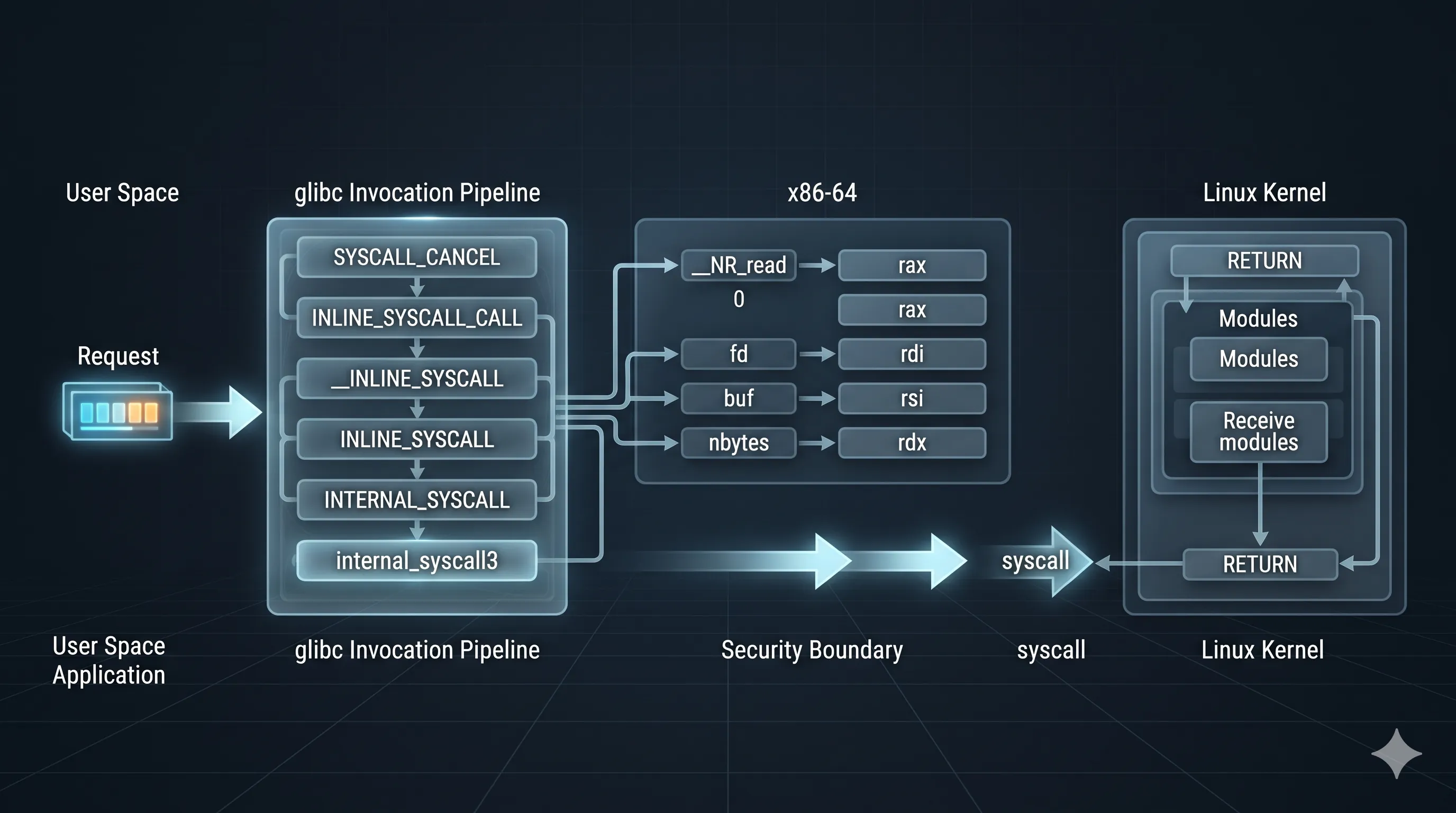
The standard calling convention documented on syscall.sh defines a uniform operational model: the system call number is placed in NR, input arguments are distributed across ARG0 through ARG5, the architecture-specific execution instruction is triggered, and the result is returned in RETURN.On Linux x86-64, this abstract sequence translates into concrete hardware register assignments.
User space sets the system call number in the rax register prior to invocation.
Arguments are sequentially loaded into dedicated general-purpose registers: rdi receives ARG0, rsi receives ARG1, rdx receives ARG2, r10 receives ARG3, r8 receives ARG4, and r9 receives ARG5.
Once the registers are populated, the user-space thread executes the syscall assembly instruction to switch into kernel mode and dispatch the requested operation.
| Calling Convention Role | Linux x86-64 Register / Instruction | Function and Assignment |
|---|---|---|
| NR | rax | Stores the architecture-specific system call number. |
| ARG0 | rdi | Holds the first system call argument. |
| ARG1 | rsi | Holds the second system call argument. |
| ARG2 | rdx | Holds the third system call argument. |
| ARG3 | r10 | Holds the fourth system call argument. |
| ARG4 | r8 | Holds the fifth system call argument. |
| ARG5 | r9 | Holds the sixth system call argument. |
| Instruction | syscall | Executes the transition from user mode to kernel mode. |
| RETURN | RETURN | Carries the execution result back to the calling context. |
This manual configuration poses a significant development burden, as any deviation in register selection or ordering prevents the kernel from properly interpreting arguments and handling execution.
Inside glibc: The Macro Expansion Chain from SYSCALL_CANCEL to Execution
The GNU C Library (glibc) abstracts raw hardware conventions through a structured internal pipeline.This macro expansion sequence demonstrates how glibc encapsulates cancellable and non-cancellable interfaces, converting high-level C signatures into inline assembly operations.
The following worked example illustrates the macro routing sequence glibc utilizes to expand a 3-argument system call such as
read:SYSCALL_CANCEL
-> INLINE_SYSCALL_CALL
-> __INLINE_SYSCALL
-> INLINE_SYSCALL
-> INTERNAL_SYSCALL
-> internal_syscallN (where N is the number of arguments)For an operation taking three arguments—such as the
read system call, which accepts fd, buf, and nbytes—the chain resolves to internal_syscall3.The macro pipeline maps the system call identifier defined as __NR_read, which is set to 0 in the glibc x86-64 header arch-syscall.h, into the rax register.
Simultaneously, the three parameters (
fd, buf, and nbytes) are placed into rdi, rsi, and rdx, satisfying the ARG0 through ARG2 register assignments.Once these register constraints are applied, the inline assembly block executes the syscall instruction, triggering the kernel context switch with all state correctly pre-loaded.
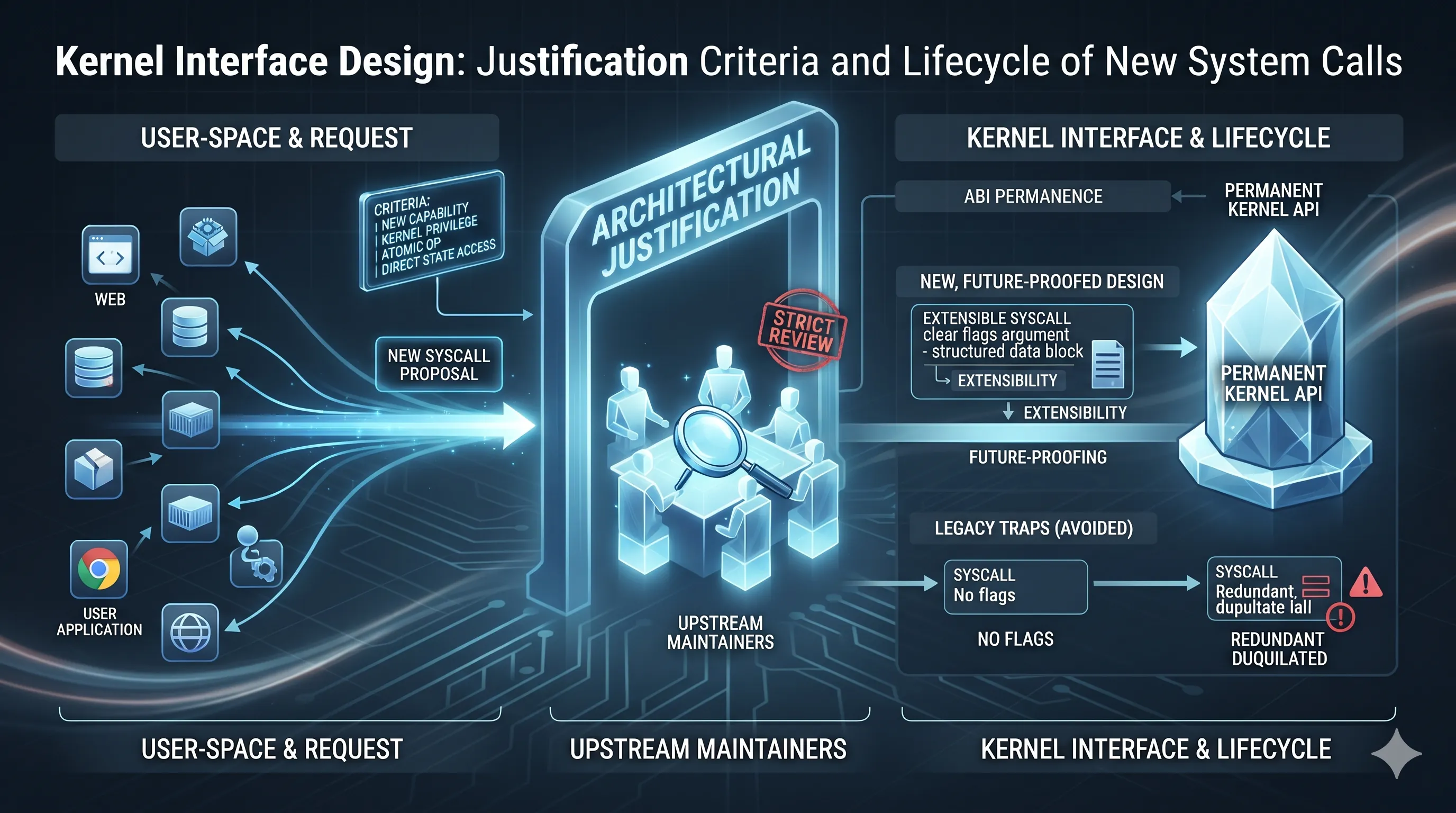
4. Kernel Interface Design: Justification Criteria and Lifecycle of New System Calls
As new architectures and features are added to the Linux system call API, understanding the structural review thresholds and lifecycle requirements governing the kernel interface is essential.Every addition to the system call table alters the core boundary between user space and the operating system, demanding strict architectural justification before any new entry point is introduced.
ABI Permanence and Upstream Thresholds for New Syscalls
A new system call forms part of the permanent kernel API and must be maintained indefinitely.Because the Linux kernel enforces an uncompromising commitment to user-space binary compatibility, an entry cannot be casually altered or removed once applications begin to rely on it.
To justify this permanent commitment, upstream maintainers require that proposed additions meet clear functional thresholds.
Specifically, system calls are suited for exposing new kernel capabilities, handling operations that necessitate kernel privilege, executing atomic operations, or providing direct access to kernel-internal state.
Where these specific criteria are not strictly required, kernel documentation recommends considering existing alternatives, such as using an ioctl on existing devices or files, before proposing a brand-new system call entry.
Extensibility Considerations and Mitigating Legacy Interface Pitfalls
The lifecycle design of modern system call interfaces places paramount importance on future-proofing.The syscall table contains historical examples where interfaces lacked future extension planning, requiring follow-up replacement system calls to rectify initial design constraints.
When early syscalls omitted dedicated flags arguments or extensible structure layouts, adding minor behavioral variations or modern capabilities necessitated introducing entirely separate system call numbers.
To prevent duplicating interfaces and accumulating legacy baggage, modern additions must account for these historical lessons, ensuring parameter structures and validation logic are built to accommodate future extensions without breaking the existing binary interface.
Related Posts
Inside Darling's Q4 2026 Update: ARM64 Support and AI RulesDiscover the Darling Q4 2026 update, featuring initial ARM64 support, strict AI contribution rules,...
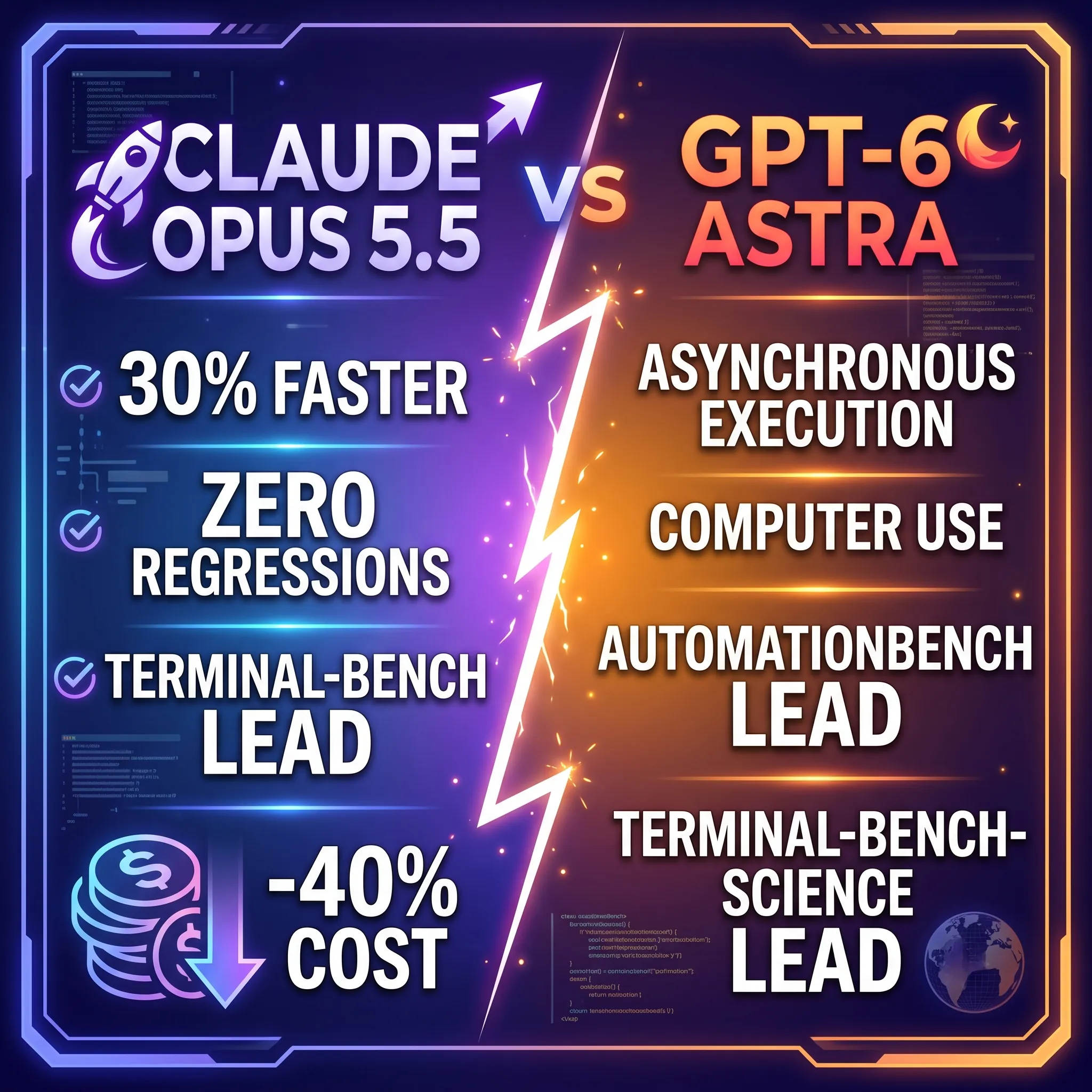
Anthropic Claude Opus 5.5: Architectural Updates, API Changes, and BenchmarksAnalysis of Anthropic's Claude Opus 5.5 release, covering architectural upgrades, API breaking...

Zhipu AI (Z.ai) Unleashed: GLM Model Pricing, Free Tiers, Coding Plan, IPO & Sovereign AI Strategy ExplainedDeep dive into Zhipu AI (Z.ai): GLM models, innovative pricing with free tiers, coding plans, IPO...
Generative AI may have assisted with research or drafting for this article. Topic selection, fact-checking, final wording, and publication remain the responsibility of DragonStone74. AI use disclosure