
Zhipu AI (Z.ai) Unleashed: GLM Model Pricing, Free Tiers, Coding Plan, IPO & Sovereign AI Strategy Explained
🚀 Key Takeaways
- Zhipu AI (Z.ai) is a leading Chinese foundation-model lab, spun out of Tsinghua University, and publicly listed in Hong Kong.
- It operates as one of China's "AI tigers," offering GLM models to developers, coders, and enterprises with a focus on sovereign AI.
- Zhipu's pricing strategy has evolved to offer free entry points while charging market rates for its premium GLM-5 models.
- Several GLM-Flash models are provided completely free across all usage, serving as a key customer acquisition channel.
- The company offers a flat-rate GLM Coding Plan subscription, strategically designed to compete with Western coding assistants.
- Zhipu AI made history with its IPO in January 2026, raising significant capital, followed by a substantial share sale in July 2026.
- Its strategic posture emphasizes competitive pricing and non-US, sovereign foundation-model status, despite being on the US Entity List.
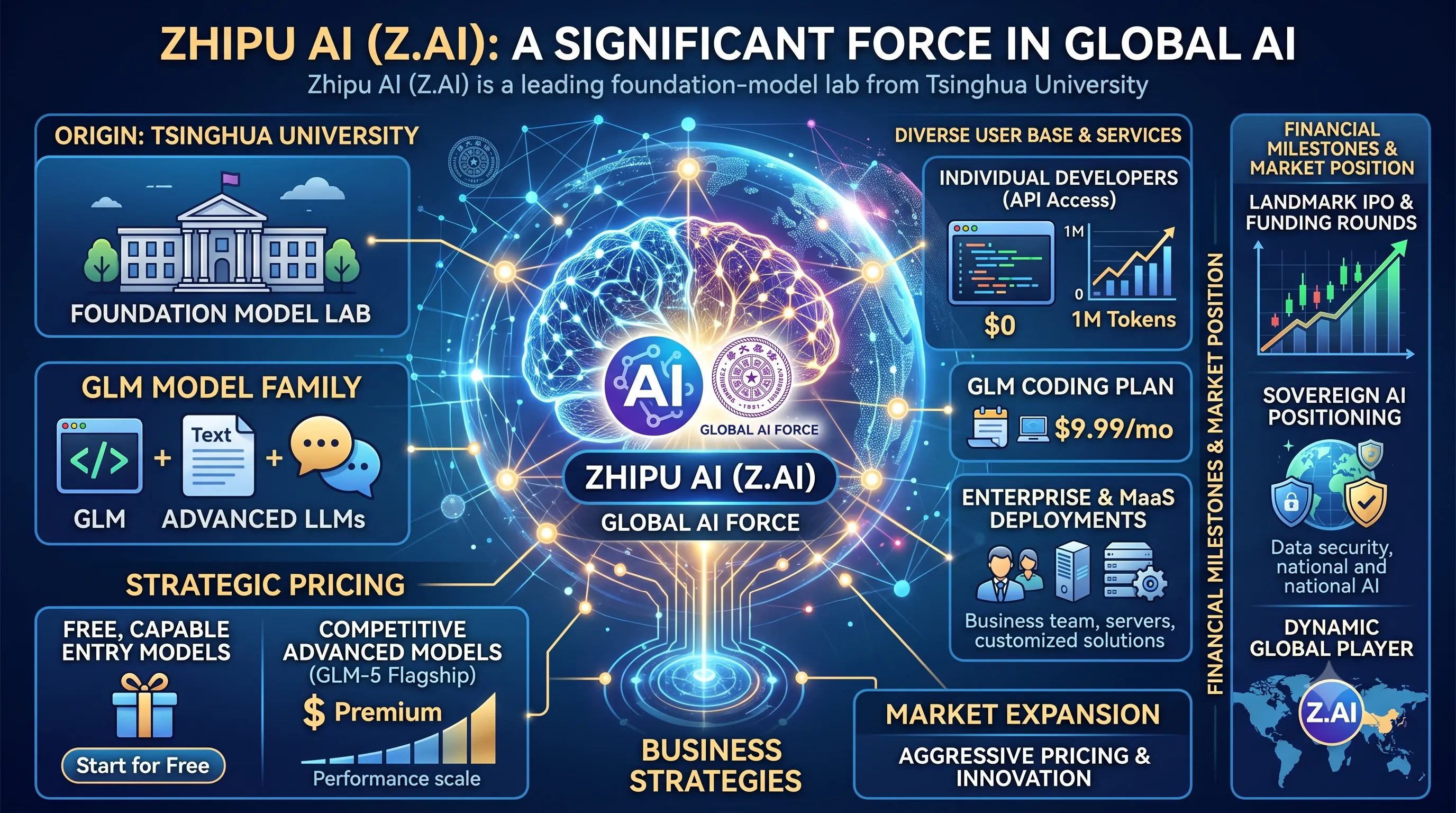
Zhipu AI, internationally recognized as Z.ai, has rapidly solidified its position as a significant force in the global artificial intelligence landscape.
As a prominent Chinese foundation-model lab originating from Tsinghua University, Zhipu AI stands out not only for its advanced GLM model family but also for its innovative and aggressive business strategies, including a unique approach to pricing and market expansion.
The company's offerings cater to a diverse user base, from individual developers utilizing its API to coders subscribing to its specialized GLM Coding Plan, alongside bespoke enterprise and Model-as-a-Service (MaaS) deployments.
Its pricing philosophy has notably shifted, strategically balancing entirely free, capable models at the entry level with competitive, market-rate pricing for its most advanced GLM-5 flagship models.
This detailed analysis delves into Zhipu AI's comprehensive pricing structure, including its per-token billing for API usage and the tiered subscription model for coders.
We will also explore the company's broader strategic initiatives, its significant financial milestones such as its landmark IPO and subsequent funding rounds, and its distinct positioning in the sovereign AI market, offering crucial insights into one of the most dynamic players in the AI industry.
As a prominent Chinese foundation-model lab originating from Tsinghua University, Zhipu AI stands out not only for its advanced GLM model family but also for its innovative and aggressive business strategies, including a unique approach to pricing and market expansion.
The company's offerings cater to a diverse user base, from individual developers utilizing its API to coders subscribing to its specialized GLM Coding Plan, alongside bespoke enterprise and Model-as-a-Service (MaaS) deployments.
Its pricing philosophy has notably shifted, strategically balancing entirely free, capable models at the entry level with competitive, market-rate pricing for its most advanced GLM-5 flagship models.
This detailed analysis delves into Zhipu AI's comprehensive pricing structure, including its per-token billing for API usage and the tiered subscription model for coders.
We will also explore the company's broader strategic initiatives, its significant financial milestones such as its landmark IPO and subsequent funding rounds, and its distinct positioning in the sovereign AI market, offering crucial insights into one of the most dynamic players in the AI industry.
1. Zhipu AI: Company Profile and Strategic Posture
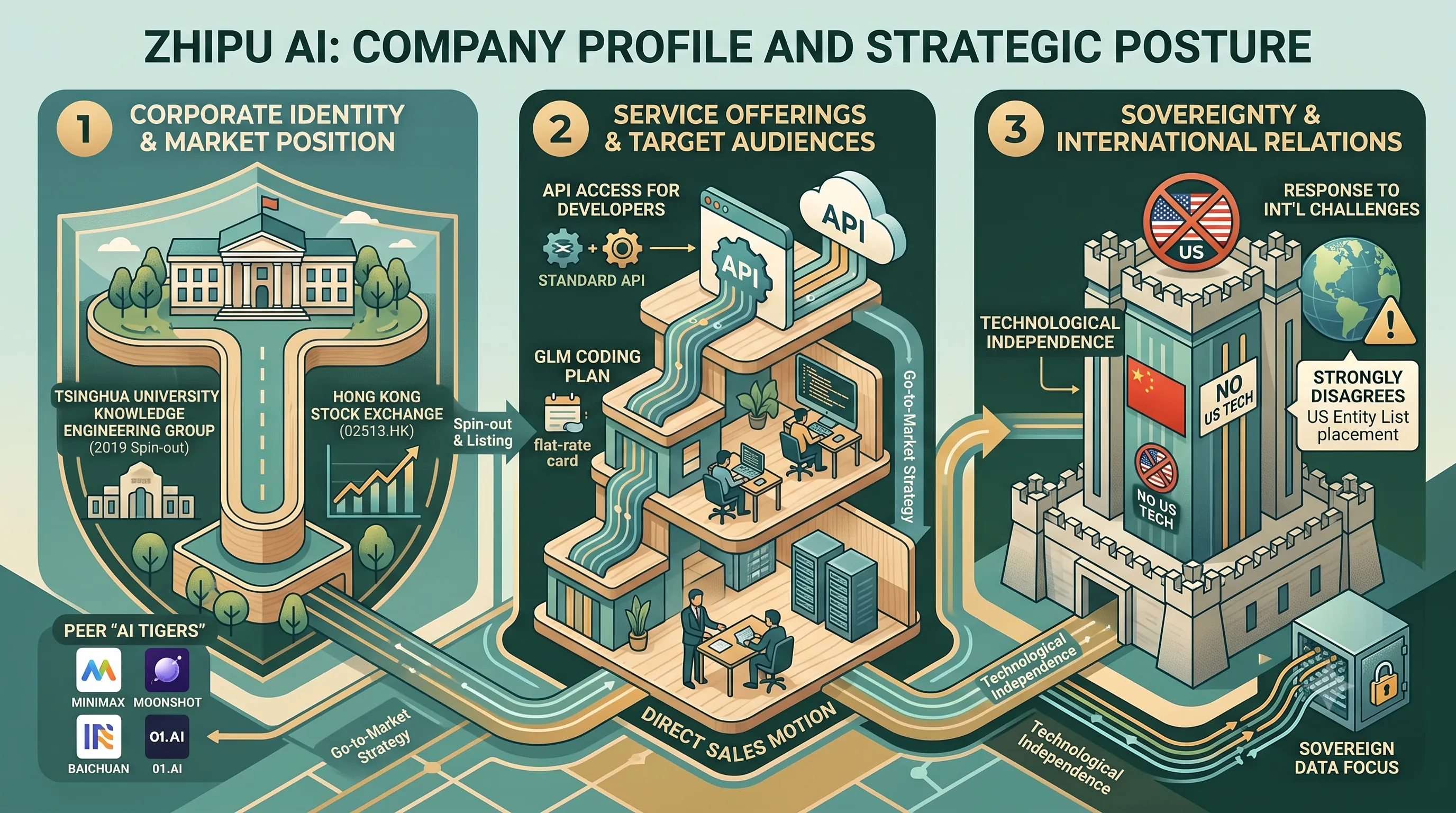
This section provides the corporate and strategic context for Zhipu AI, the creator of the GLM models discussed in this article.Understanding the company's origins, market position, and service models is crucial for evaluating the long-term viability and support structure behind its high-performance AI technologies.
Corporate Identity and Market Position
Zhipu AI is the Chinese foundation-model lab responsible for developing the GLM model family.The company, which markets itself internationally under the brand Z.ai, spun out of Tsinghua University’s prestigious Knowledge Engineering Group in 2019.
It is publicly traded on the Hong Kong Stock Exchange under the name Beijing Zhipu Huazhang Technology, with the ticker symbol 02513.HK.
Within the competitive domestic landscape, Zhipu AI is recognized as one of China’s formidable 'AI tigers', a group that also includes peers like Moonshot, MiniMax, Baichuan, and 01.AI.
Service Offerings and Target Audiences
Zhipu AI has structured its go-to-market strategy to cater to distinct user segments.For the broad developer community, the company provides access to its GLM models through a standard API.
Coders and software engineers are targeted with a specific subscription offering, the flat-rate GLM Coding Plan.
For larger-scale needs, Zhipu AI utilizes a direct sales motion to provide custom Enterprise and Model-as-a-Service (MaaS) deployments.
Sovereignty and International Relations
A core structural feature of Zhipu AI is its focus on sovereignty.This principle underpins its response to international regulatory challenges, most notably its placement on the US Entity List.
The company has publicly stated that it "strongly disagrees" with this designation.
In its official communications, Zhipu stresses that it depends on no large-model technology from the US, reinforcing its posture of technological independence.
2. GLM API Token Pricing for Paid Models
While the main article focuses on the significant performance gains from upgrading to the latest GLM models, a critical part of that decision is the cost.This section provides a detailed breakdown of Zhipu AI's pricing structure, allowing you to accurately assess the budget required to leverage the speed and power of the GLM series for tasks like real-time translation and large-scale data parsing.
Per-Million-Token Billing Breakdown
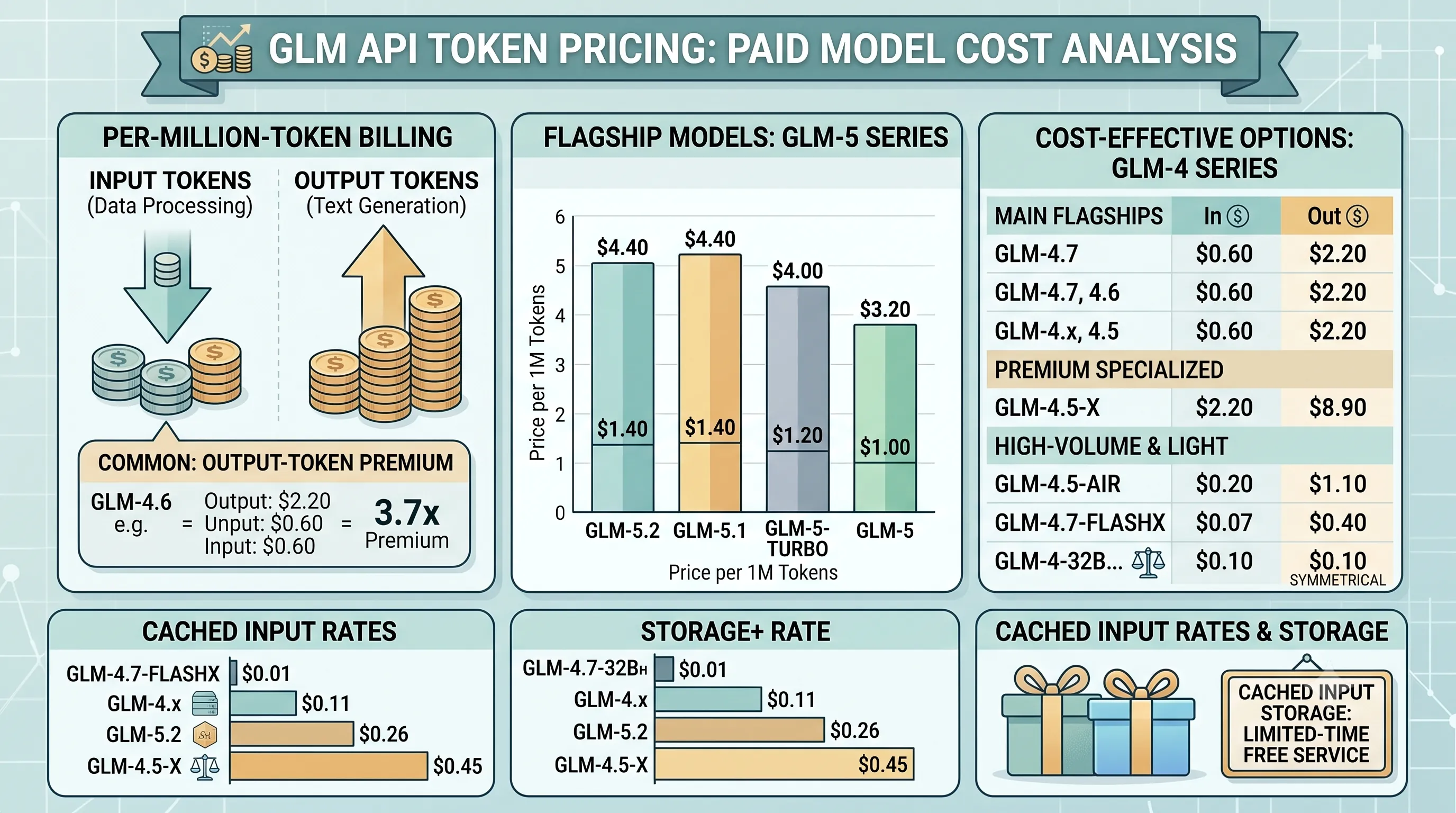
Zhipu AI adopts a straightforward billing model for its GLM API, charging developers on a per-million-token basis.This pricing structure distinguishes between input tokens (the data you send to the model) and output tokens (the text generated by the model).
A common feature across most models is an output-token premium, reflecting the higher computational cost of generation versus processing.
For instance, with the GLM-4.6 model, the output rate of $2.20 per million tokens is approximately 3.7 times higher than its input rate of $0.60.
This pricing difference is a key factor for developers to consider when designing applications, especially for use cases that involve generating lengthy responses.
Flagship Model Pricing: GLM-5 Series
The latest generation of flagship models, the GLM-5 series, is priced to reflect its advanced capabilities.The top-tier models, GLM-5.2 and GLM-5.1, share an identical pricing structure at $1.40 for input and $4.40 for output per million tokens.
The standard GLM-5 model is slightly more economical, priced at $1.00 for input and $3.20 for output.
Meanwhile, the GLM-5-Turbo, optimized for speed, is positioned between the standard and top-tier models at $1.20 for input and $4.00 for output.
GLM-4 Series Cost-Effectiveness
The GLM-4 series offers a diverse range of price points, enabling developers to find a model that fits their specific balance of performance and budget.The mainstream flagship models within this family, including GLM-4.7, GLM-4.6, and GLM-4.5, are all priced identically at $0.60 for input and $2.20 for output per million tokens.
For highly specialized or demanding tasks, the premium GLM-4.5-X model carries a higher cost of $2.20 for input and $8.90 for output.
Conversely, Zhipu AI provides several highly cost-effective options for lighter or high-volume tasks.
The GLM-4.5-Air is priced at just $0.20 for input and $1.10 for output.
The most affordable models are GLM-4.7-FlashX at $0.07 for input and $0.40 for output, and the GLM-4-32B-0414-128K model, which is uniquely priced at $0.10 for both input and output, making it ideal for symmetrical workloads.
| Model | Input Price (per 1M tokens) | Output Price (per 1M tokens) |
|---|---|---|
| GLM-5.2 | $1.40 | $4.40 |
| GLM-5.1 | $1.40 | $4.40 |
| GLM-5-Turbo | $1.20 | $4.00 |
| GLM-5 | $1.00 | $3.20 |
| GLM-4.5-X | $2.20 | $8.90 |
| GLM-4.7 | $0.60 | $2.20 |
| GLM-4.6 | $0.60 | $2.20 |
| GLM-4.5 | $0.60 | $2.20 |
| GLM-4.5-Air | $0.20 | $1.10 |
| GLM-4-32B-0414-128K | $0.10 | $0.10 |
| GLM-4.7-FlashX | $0.07 | $0.40 |
Cached Input Rates and Storage
For applications that repeatedly use the same input prompts, Zhipu AI offers a reduced rate for cached inputs, significantly lowering costs for specific workflows.The cached input rates vary by model, ranging from as low as $0.01 per million tokens for GLM-4.7-FlashX to $0.45 for the premium GLM-4.5-X model.
For the mainstream GLM-4.x flagship models, the cached input rate is a standardized $0.11 per million tokens.
The high-performance GLM-5.2 has a cached input rate of $0.26 per million tokens.
Notably, for models that support this feature, the associated Cached Input Storage is currently offered as a 'Limited-time Free' service, providing an additional cost-saving incentive.
3. Free Tier Strategy: GLM Flash Models and Token Grants
This section directly connects to the main article's theme of enhancing performance for real-time translation and large-volume parsing by examining how Zhipu AI removes the initial cost barrier for developers.By providing powerful, high-speed Flash models at no cost, the company allows users to validate the performance claims for themselves, making the decision to switch a matter of technical merit rather than financial risk.
Complimentary Flash Model Access
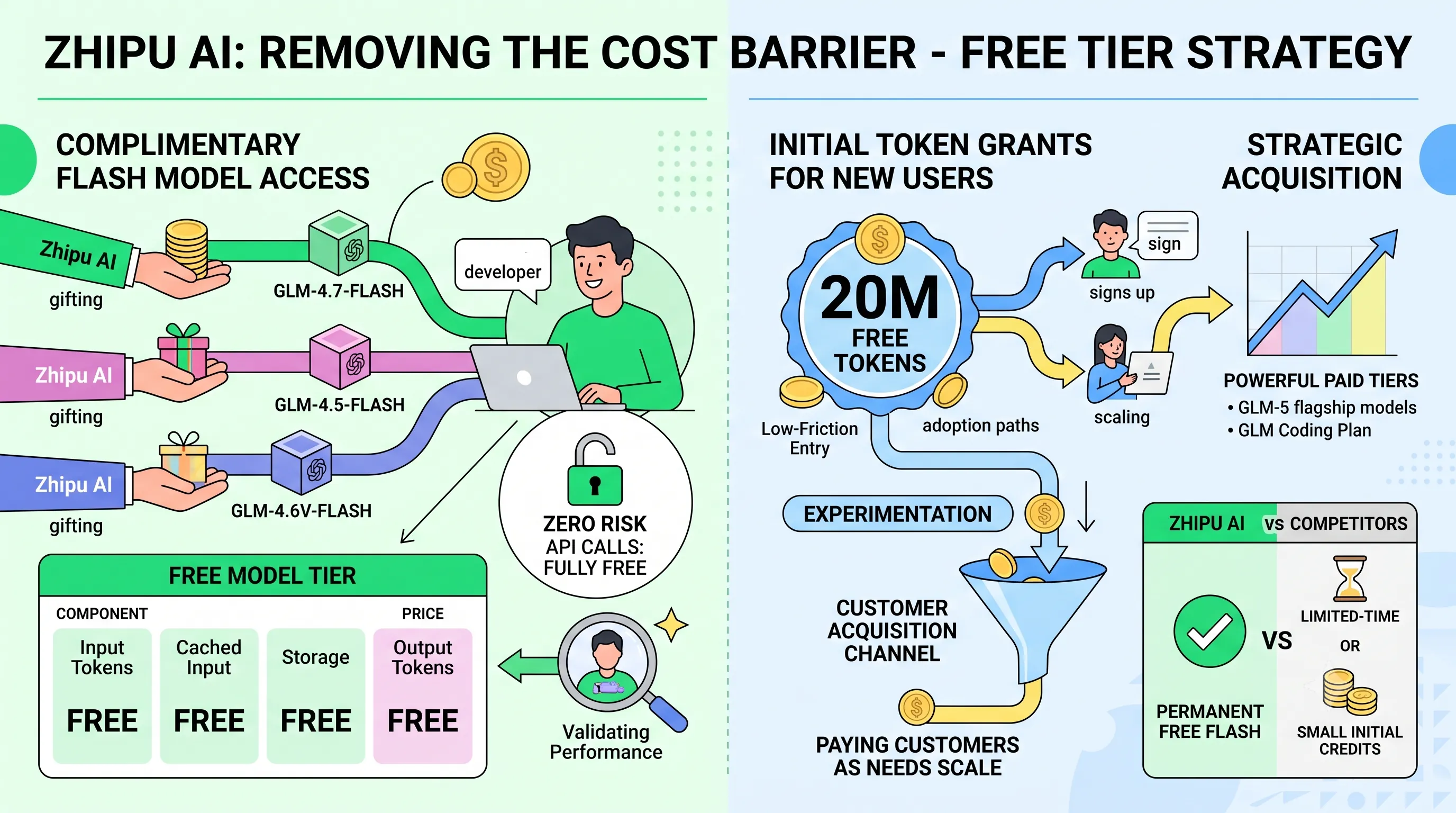
Zhipu AI provides developers with permanent, complimentary access to several of its flagship-class Flash models.The models included in this free tier are the GLM-4.7-Flash, GLM-4.5-Flash, and the multimodal GLM-4.6V-Flash.
This offering is exceptionally comprehensive, as the free access covers the entire cost structure associated with API calls.
Specifically, usage is free across all four potential billing components: input tokens, cached input tokens, storage for cached input, and output tokens.
This structure ensures that developers can build and test applications without incurring unexpected costs, fostering experimentation and integration.
| Free Model Tier | Cost Component | Price |
|---|---|---|
| GLM-4.7-Flash GLM-4.5-Flash GLM-4.6V-Flash |
Input Tokens | Free |
| Cached Input Tokens | Free | |
| Cached-Input Storage | Free | |
| Output Tokens | Free |
Initial Token Grants for New Users
Beyond the perpetually free Flash models, Zhipu AI further incentivizes adoption by providing a significant token grant to new users.Upon signing up for the platform, every new account is credited with a 20-million-token grant.
This grant can be used across the entire suite of GLM models, including the more powerful paid tiers, allowing developers to conduct initial performance benchmarks or run proof-of-concept projects on models beyond the free Flash versions without any upfront investment.
Strategic Customer Acquisition through Free Tiers
Zhipu AI's approach represents a deliberate and powerful customer acquisition strategy.By offering its capable and modern flagship-Flash models completely free, the company establishes a low-friction entry point for developers and businesses to build on its platform.
This strategy serves as a key customer acquisition channel, converting free-tier users into paying customers as their needs scale or require the capabilities of the most advanced models.
This model is a notable differentiator in the market, as few other frontier AI labs permanently offer an entire capable, current-generation model family with no usage cost.
Most competitors rely on limited-time trials or small initial credits, making Zhipu AI's permanent free tier a more sustainable and attractive option for long-term development.
4. GLM Coding Plan: Subscription Tiers, Discounts, and Quotas
This section details the specific subscription structure for the GLM Coding Plan, which provides developers with predictable, flat-rate access to the high-performance models discussed in this article.By converting a traditional token-based meter into a generous prompt quota, the plan is optimized for the intensive, high-speed workloads required for real-time translation and large-scale code parsing, offering a practical path for developers to upgrade their toolchain.
Tiered Subscription Pricing
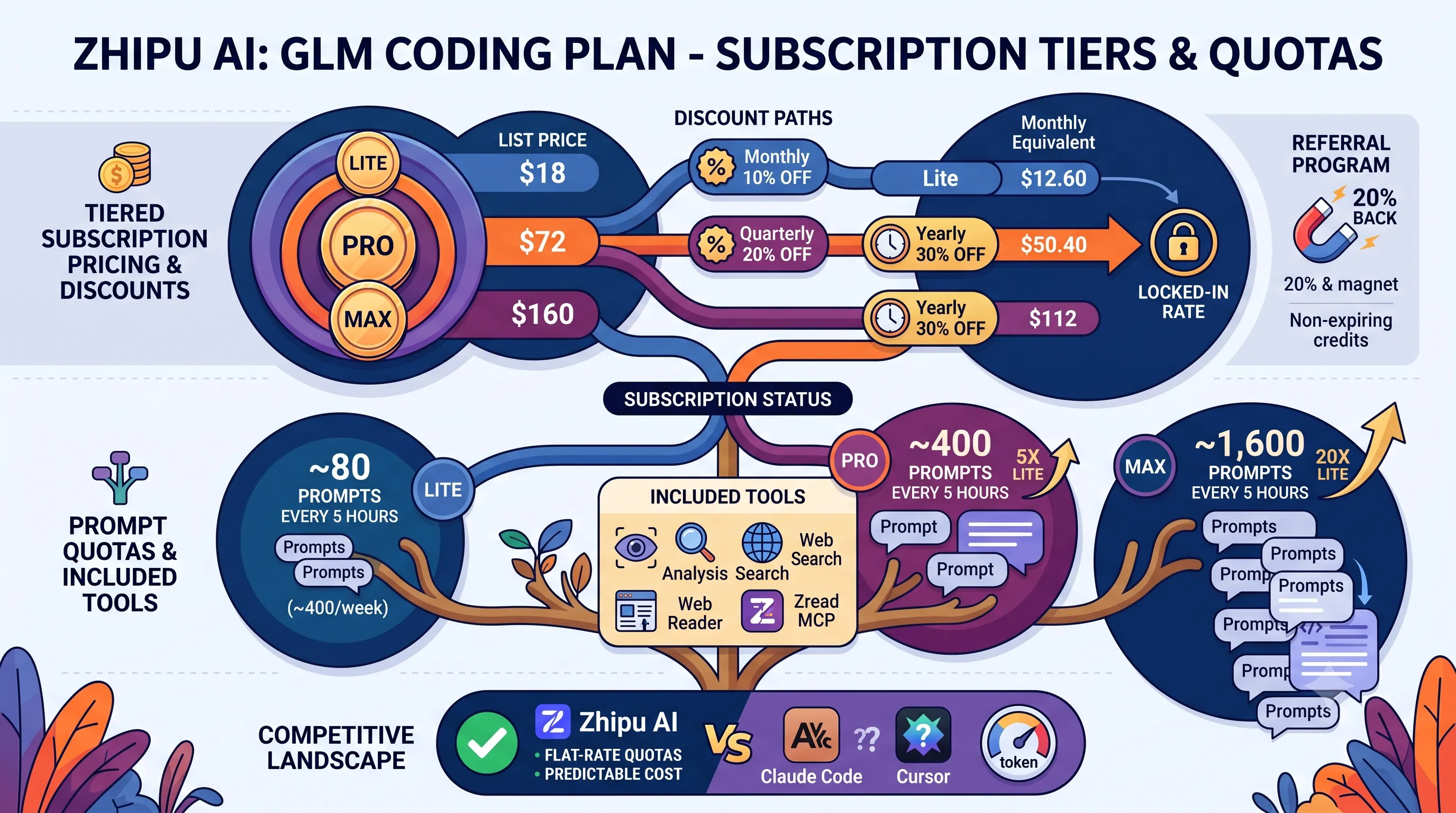
Zhipu AI offers three distinct tiers for its GLM Coding Plan, designed to accommodate different levels of development needs.The list prices for these subscriptions are set at $18 per month for the Lite plan, $72 per month for the Pro plan, and $160 per month for the Max plan.
This tiered structure provides a clear entry point for individual developers and scales up to support professional and enterprise-level usage.
Discounted Billing Options
To incentivize longer commitments, the GLM Coding Plan features significant discounts based on billing frequency.A monthly billing cycle offers a 10% discount, reducing the effective rates to $16.20 for Lite, $64.80 for Pro, and $144 for Max.
Opting for quarterly billing increases the discount to 20%, with monthly equivalent prices falling to $14.40 for Lite, $57.60 for Pro, and $128 for Max.
The most substantial savings come from the yearly billing option, which provides a 30% discount.
This brings the monthly costs down to $12.60 for Lite, $50.40 for Pro, and $112 for Max.
Importantly, this discounted rate is locked in and becomes the standard renewal price for continuous subscriptions, rewarding long-term users.
Additionally, a referral program is available, offering users the ability to earn up to 20% back on every purchase in the form of non-expiring credit.
Usage Quotas and Included Tools
The GLM Coding Plan replaces per-token costs with a straightforward prompt quota system.The Lite plan provides users with approximately ~80 prompts every 5 hours, which equates to a weekly allowance of around ~400 prompts.
The Pro plan significantly increases this capacity, offering ~400 prompts per 5 hours, representing a 5x increase in usage over the Lite tier.
For the most demanding users, the Max plan delivers a massive ~1,600 prompts per 5 hours, providing 20x the usage of the Lite plan.
Regardless of the chosen tier, all GLM Coding plans come fully featured, including access to Vision Analysis, Web Search, Web Reader, and the Zread MCP tools.
| Plan Tier | List Price (per month) | Monthly Rate (with Yearly 30% Discount) | Approximate 5-Hour Prompt Quota | Included Tools |
|---|---|---|---|---|
| Lite | $18 | $12.60 | ~80 prompts | Vision Analysis, Web Search, Web Reader, Zread MCP |
| Pro | $72 | $50.40 | ~400 prompts (5x Lite) | Vision Analysis, Web Search, Web Reader, Zread MCP |
| Max | $160 | $112 | ~1,600 prompts (20x Lite) | Vision Analysis, Web Search, Web Reader, Zread MCP |
Competitive Landscape for Coding Plans
Zhipu AI is explicitly positioning the GLM Coding Plan as a direct competitor in the specialized market for AI-powered development tools.The plan's flat-rate quota system and comprehensive feature set are designed to challenge established rivals such as Claude Code and Cursor, offering a compelling alternative for developers seeking predictable costs and powerful, integrated capabilities.
5. Ancillary AI Services: Web Search, Image/Video Generation, and Agents
While the core of our discussion revolves around the performance gains from Zhipu AI's latest GLM for text-based tasks like translation and parsing, understanding the pricing of its broader ecosystem is crucial for a complete cost-benefit analysis.This section details the costs associated with ancillary services, including web search, multimedia generation, and specialized agents, which complement the primary language models.
Web Search and Vision Services
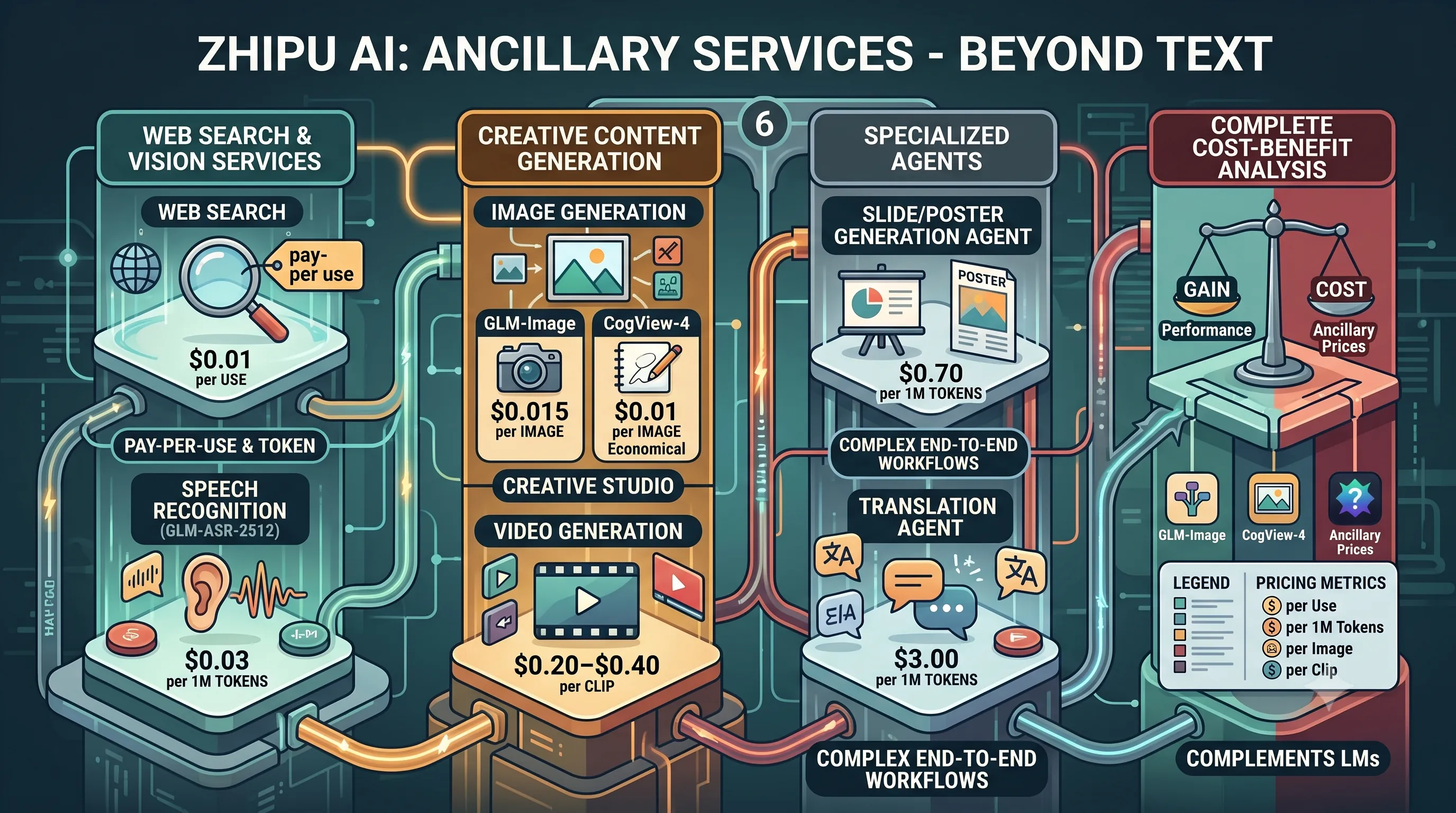
Zhipu AI extends its capabilities beyond text generation with tools for information retrieval and sensory data processing.The platform's integrated Web search functionality is metered on a simple pay-per-use basis, costing $0.01 per use.
For converting audio to text, the GLM-ASR-2512 model for speech recognition is available at a rate of $0.03 per one million tokens.
Creative Content Generation Costs
For visual content creation, Zhipu AI provides two distinct image generation models.The GLM-Image model is priced at $0.015 per image.
A more economical alternative, CogView-4, costs $0.01 per image.
In addition to static images, the platform supports dynamic content, with video generation costs ranging from $0.20 to $0.40 per clip.
Specialized Agent Pricing
Zhipu AI offers specialized agents designed for complex, end-to-end workflows, with pricing based on token consumption.The agent focused on creating presentations and marketing materials, such as slides and posters, costs $0.70 per one million tokens.
For more demanding linguistic tasks, the dedicated Translation agent is priced at $3 per one million tokens.
| Service Category | Specific Model/Task | Pricing Structure |
|---|---|---|
| Web Search | N/A | $0.01 per use |
| Image Generation | GLM-Image | $0.015 per image |
| CogView-4 | $0.01 per image | |
| Video Generation | N/A | $0.20–$0.40 per clip |
| Speech Recognition | GLM-ASR-2512 | $0.03 per 1M tokens |
| Agents | Slide/Poster Generation | $0.70 per 1M tokens |
| Translation | $3.00 per 1M tokens |
6. Zhipu AI's Journey: IPO, Funding, and Product Milestones
This section provides the corporate and product development timeline that underpins the performance advantages of Zhipu AI's latest models, as discussed in the main article.Understanding the rapid succession of funding, model releases, and strategic shifts contextualizes how the GLM series evolved to deliver the significant speed and capacity improvements central to this analysis.
Key Financial and Regulatory Milestones
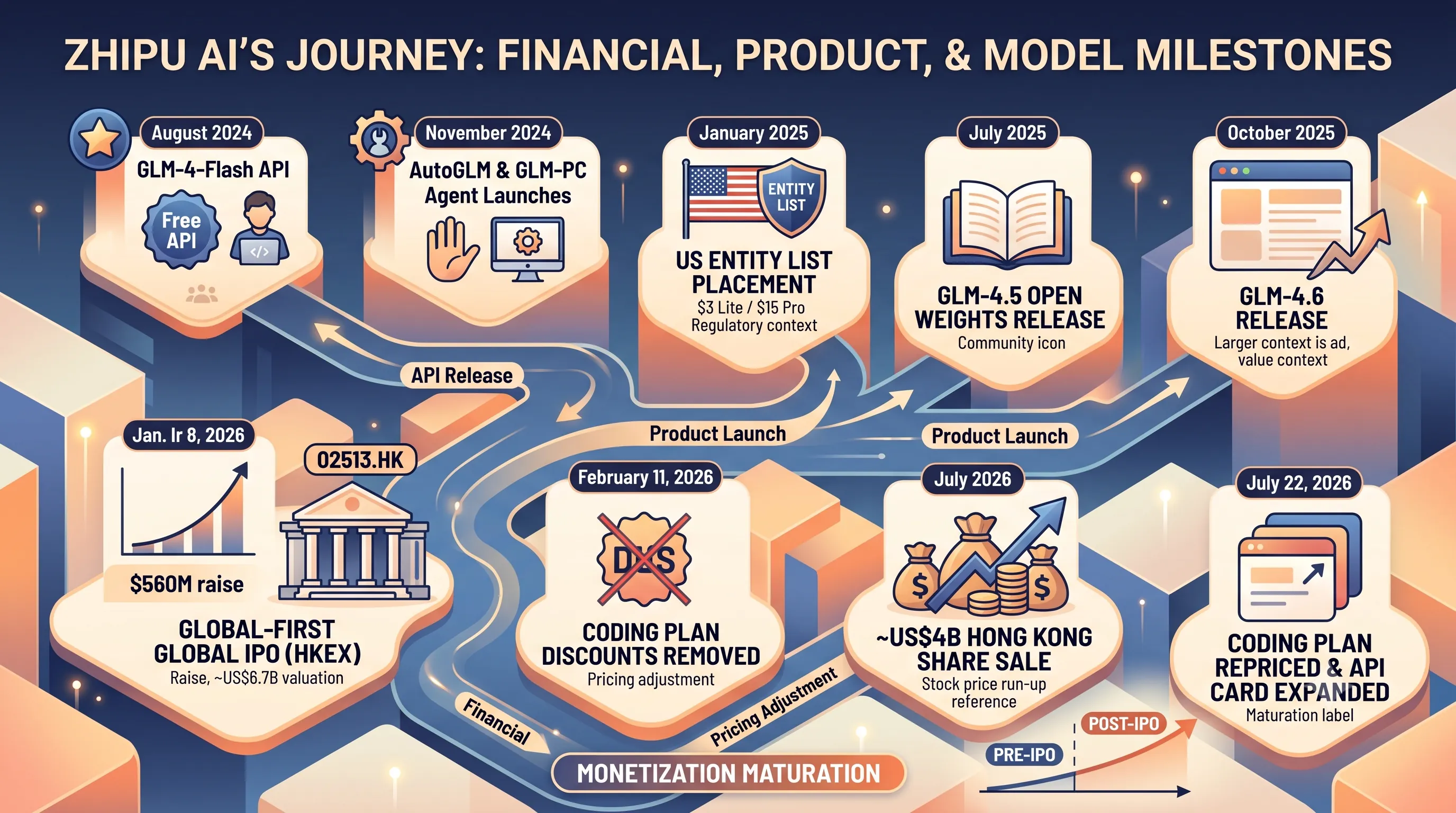
Zhipu AI's path has been marked by significant regulatory and financial events that shaped its trajectory.In January 2025, the company faced a notable challenge when it was added to the US Commerce Department’s Entity List.
Despite this, the company pushed forward with major financial milestones.
On January 8, 2026, Zhipu AI became the first foundation-model AI company to go public globally, debuting on the Hong Kong Stock Exchange under the ticker 02513.HK.
This initial public offering raised approximately US$560 million at a valuation of around US$6.7 billion.
The company's financial momentum continued into the summer.
Following a reported run-up in its stock price of approximately 1,500%, Zhipu AI raised a further ~US$4 billion in a Hong Kong share sale in July 2026.
| Date | Event Category | Milestone Detail |
|---|---|---|
| August 2024 | API Release | The GLM-4-Flash API was made available free to the public. |
| November 2024 | Product Launch | AutoGLM and GLM-PC agent products were launched. |
| January 2025 | Regulatory | The company was added to the US Commerce Department’s Entity List. |
| July 2025 | Model Release | GLM-4.5 was launched with open weights. |
| September 2025 | Plan Launch | The GLM Coding Plan launched with first-purchase promos ($3 Lite / $15 Pro). |
| October 2025 | Model Release | GLM-4.6 was released, offering a larger context window at the same rate as GLM-4.5. |
| January 8, 2026 | Financial | Completed its IPO on the Hong Kong Stock Exchange, raising ~US$560M. |
| February 11, 2026 | Pricing Adjustment | All first-purchase discounts for the Coding Plan were removed. |
| July 2026 | Financial | Raised an additional ~US$4B in a share sale. |
| July 22, 2026 | Pricing Adjustment | The Coding Plan was repriced and the main API price card was expanded. |
Evolution of GLM Models and APIs
The company maintained a rapid pace of innovation, releasing a series of powerful models and tools between 2024 and 2025.The product offensive began in August 2024, when the GLM-4-Flash API was made free to the public, lowering the barrier to entry for developers.
This was followed by the launch of the AutoGLM and GLM-PC agent products in November 2024, expanding the company's offerings beyond foundational models.
In July 2025, Zhipu AI released GLM-4.5, a significant update that was launched with open weights, catering to the open-source community.
Just a few months later, in October 2025, the company shipped GLM-4.6.
This model iteration delivered a key enhancement by providing a larger context window at the same price point as its predecessor, GLM-4.5, offering more value to users handling large-scale tasks.
Coding Plan Development and Pricing Adjustments
Alongside model development, Zhipu AI also refined its commercial offerings.The GLM Coding Plan was introduced in September 2025, initially featuring attractive first-purchase promotions of $3 for the Lite tier and $15 for the Pro tier.
However, this introductory offer was finite; on February 11, 2026, all first-purchase discounts for the Coding Plan were removed.
Further adjustments occurred in July 2026.
While the major share sale that month did not directly trigger pricing changes, a separate pricing overhaul took place shortly after.
On July 22, 2026, the Coding Plan was repriced, and the general API price card was expanded, reflecting a maturation of the company's monetization strategy.
7. The GLM Model Ecosystem: Flagships, Flash, Vision, and Agents
To achieve the performance gains in translation and parsing that the latest GLM models offer, it is essential to understand the full breadth of the Zhipu AI product catalog.Choosing the right tool for the job—whether it's a state-of-the-art flagship model, a cost-effective "Flash" variant, or a specialized vision API—is the first step in optimizing any AI-powered workflow.
This section provides a comprehensive overview of the entire GLM family, from foundational models to purpose-built agents, enabling developers to map their specific needs to the appropriate solution.
GLM-5 and GLM-4 Flagship Models
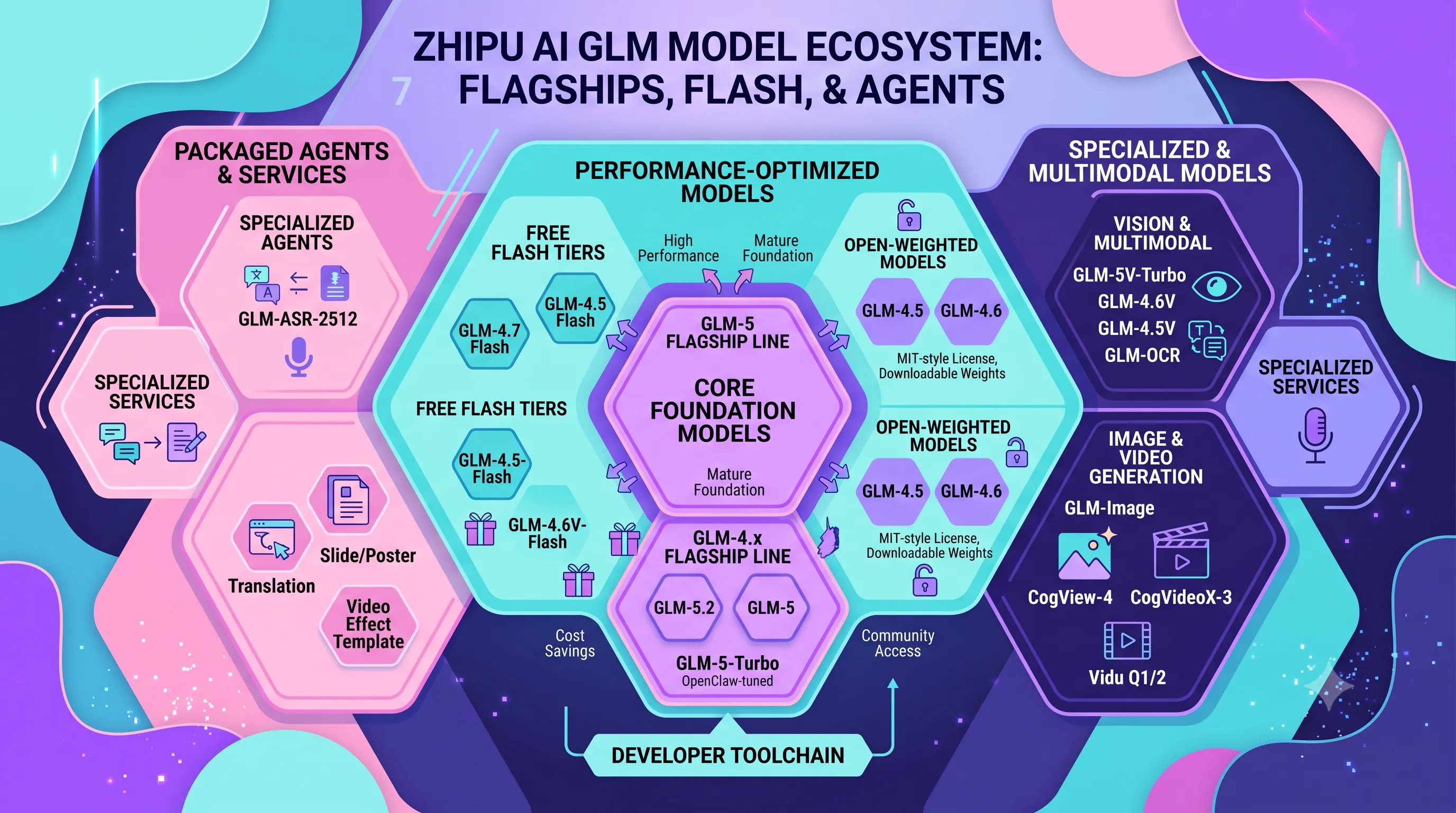
Zhipu AI's offerings are led by the GLM-5 flagship line, representing the pinnacle of their model capabilities.This series includes GLM-5.2, which is billed as the latest open-source flagship model and features a massive 1M-token context window.
Alongside it is GLM-5.1, a model stated to match the performance of competitors like Claude Opus 4.6.
The family is rounded out by the baseline GLM-5 and the specialized OpenClaw-tuned GLM-5-Turbo, which is optimized for agentic tasks.
Supporting these top-tier models is the mature and robust GLM-4.x line, which includes GLM-4.7, GLM-4.6, GLM-4.5, and the lightweight GLM-4.5-Air.
For developers prioritizing speed and cost-efficiency, Zhipu provides several free Flash tiers, including GLM-4.7-Flash and GLM-4.5-Flash for text-based tasks, and GLM-4.6V-Flash for vision-related applications.
| Model Category | Key Models | Primary Focus / Characteristics |
|---|---|---|
| GLM-5 Flagship Line | GLM-5.2, GLM-5.1, GLM-5, GLM-5-Turbo (OpenClaw-tuned) | Highest performance, large context (1M token), competitive with top industry models. |
| GLM-4.x Line | GLM-4.7, GLM-4.6, GLM-4.5, GLM-4.5-Air | Mature, high-capability models serving as a stable foundation for various applications. |
| Free Flash Tiers | GLM-4.7-Flash, GLM-4.5-Flash, GLM-4.6V-Flash | High-speed, cost-effective inference for less complex text and vision tasks. |
| Vision & Multimodal Line | GLM-5V-Turbo, GLM-4.6V, GLM-OCR, GLM-4.5V | Specialized models for image understanding, text extraction, and general multimodal tasks. |
| Image & Video Generation | GLM-Image, CogView-4, CogVideoX-3, Vidu Q1/2 | Generative models for creating novel images and video content from prompts. |
| Open-Weighted Models | GLM-4.5, GLM-4.6 | Models with downloadable weights under a permissive license for self-hosting and fine-tuning. |
| Specialized Services | GLM-ASR-2512, Translation Agent, Slide/Poster Agent | Packaged solutions for specific tasks like speech recognition and content creation. |
Specialized Vision and Multimodal Models
Beyond text-based intelligence, the GLM ecosystem features a strong portfolio of models designed to interpret and generate visual and audio data.The core vision line includes powerful options such as GLM-5V-Turbo, GLM-4.6V, and GLM-4.5V for general-purpose image understanding.
For targeted tasks, the dedicated GLM-OCR model is available for high-accuracy text extraction from images.
On the generative side, Zhipu offers GLM-Image and CogView-4 for still image creation, while its video generation capabilities are represented by CogVideoX-3 and the Vidu Q1/2 models.
The ecosystem's multimodal support is further extended to audio with the GLM-ASR-2512 model for speech recognition.
Open-Weighted Models and Their Availability
A key strategic element of the GLM ecosystem is its support for the open-source community through the release of open-weighted models.Specifically, GLM-4.5 and GLM-4.6 are available with their weights free to download.
These models are released under a permissive, MIT-style license, which grants developers significant freedom for commercial use, modification, and distribution.
While the weights are free, Zhipu monetizes these open models by offering hosted inference services charged per token, providing a convenient, managed option for businesses that prefer not to handle the infrastructure for deployment themselves.
Agent and Ancillary AI Products
To accelerate development and provide turnkey solutions, Zhipu offers a suite of packaged agents that leverage its foundational models.These are pre-built applications designed to handle complex, multi-step workflows.
The available agents include a specialized Translation agent, a Slide/Poster creation agent for automated document and presentation design, and a Video Effect Template agent to streamline video production tasks.
These products demonstrate how the core GLM technology can be packaged into user-friendly tools that solve specific business problems without requiring deep AI expertise from the end-user.
8. Zhipu AI's Evolving Pricing Strategy and Market Stance
This section connects to the main topic by providing a crucial non-technical reason for adopting the GLM platform: a highly competitive and strategically sophisticated pricing model.While the main article focuses on performance gains, this analysis shows how Zhipu AI makes that performance economically and geopolitically accessible, reinforcing the argument to switch.
Strategic Pricing Evolution
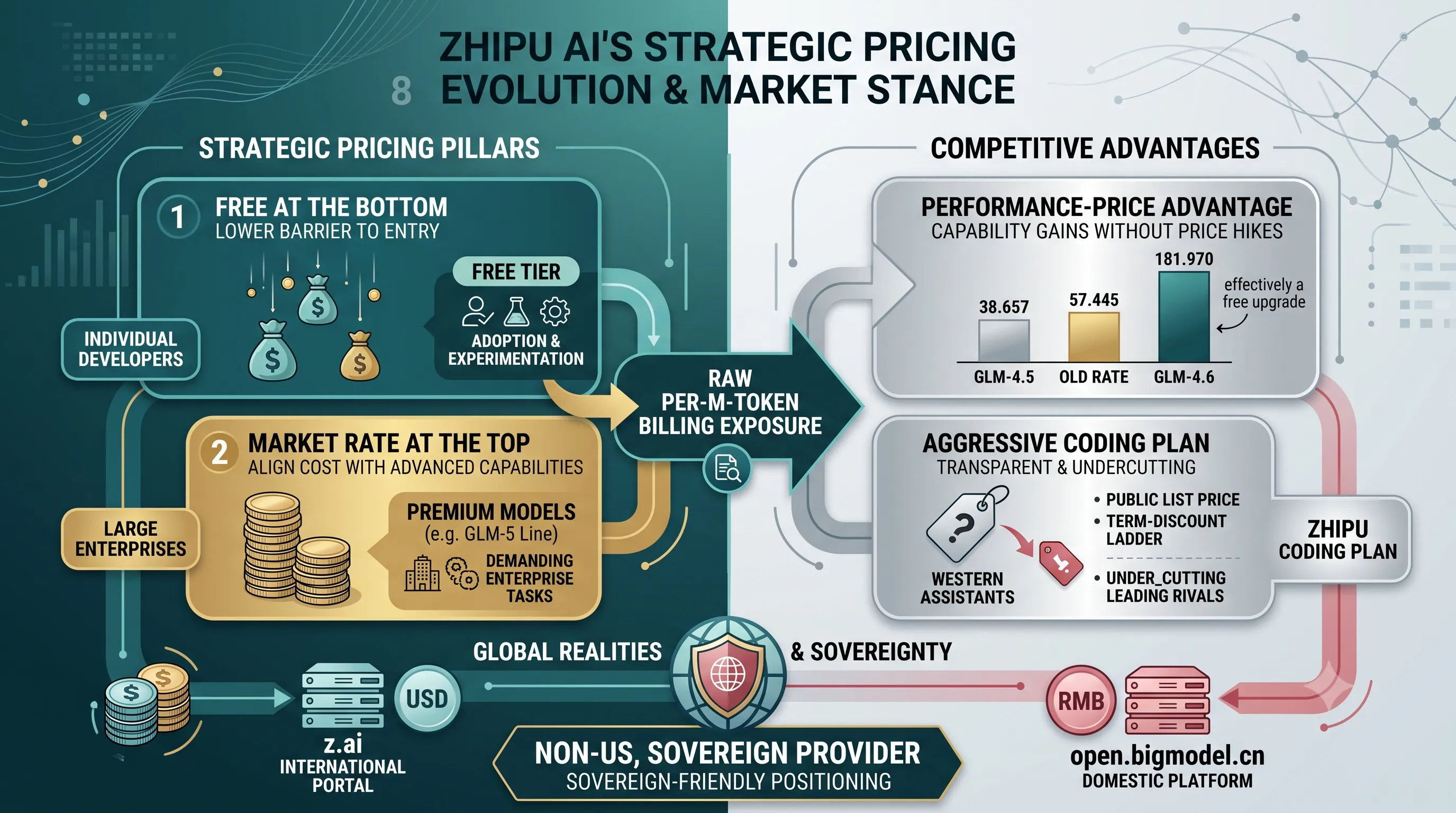
Price remains a core pillar of Zhipu AI's strategic posture in the global market.The company's approach to pricing has matured significantly, evolving from a simple 'undercut everything' model to a more sophisticated strategy described as 'free at the bottom, market rate at the top'.
This new framework allows Zhipu to capture a wide spectrum of users, from individual developers to large enterprises, by offering different value tiers.
A key part of their market communication includes publicly exposing raw per-million-token billing, providing transparency that builds user trust.
Free Tiers and Premium Models
Executing its 'free at the bottom' strategy, the company establishes a compelling entry point for users through its comprehensive free tier (detailed in the 'Free Tier Strategy' section), lowering the barrier to entry and encouraging widespread adoption and experimentation.At the other end of the spectrum, the company demonstrates its 'market rate at the top' philosophy with its premium models.
The high-performance GLM-5 line carries a premium per-token rate, aligning its cost with the advanced capabilities and value it delivers for demanding enterprise-level tasks.
Competitive Advantages in Pricing
Zhipu AI creates a strong value proposition by consistently delivering capability gains without corresponding price hikes.This was clearly demonstrated when the company shipped its GLM-4.6 model at the pre-existing rate of GLM-4.5, effectively giving users a performance upgrade for free.
For specialized products like its coding assistant, the pricing is structured to be both transparent and aggressive.
The coding subscription features a public list price and a term-discount ladder, rewarding longer commitments.
Furthermore, this flat subscription is deliberately priced to undercut leading Western coding assistants, making it a highly attractive alternative for price-sensitive development teams.
Dual-Currency and Sovereignty in Pricing
Zhipu AI's pricing structure is designed with global and geopolitical realities in mind.The company utilizes dual-currency and dual-sovereignty price cards to serve distinct markets.
Customers can transact in USD via the international z.ai portal or in RMB through the domestic open.bigmodel.cn platform.
This isn't just a matter of convenience; it is a core part of the value proposition for a specific customer segment.
For buyers wary of becoming dependent on US-centric technology stacks, Zhipu's status as a non-US, sovereign foundation-model provider is a significant strategic advantage, with its pricing structure reflecting this sovereign-friendly positioning.
9. Streamlined Billing and Developer Experience
While the performance gains from adopting the latest GLM models are the primary driver for migration, a platform’s operational efficiency is equally crucial.A convoluted billing system or a poor developer experience can negate the benefits of raw model speed by introducing friction and hidden costs.
Zhipu AI addresses this by providing a transparent, user-centric platform that simplifies cost management and accelerates development workflows, making the decision to switch a practical one, not just a technical one.
User-Friendly Billing Interface
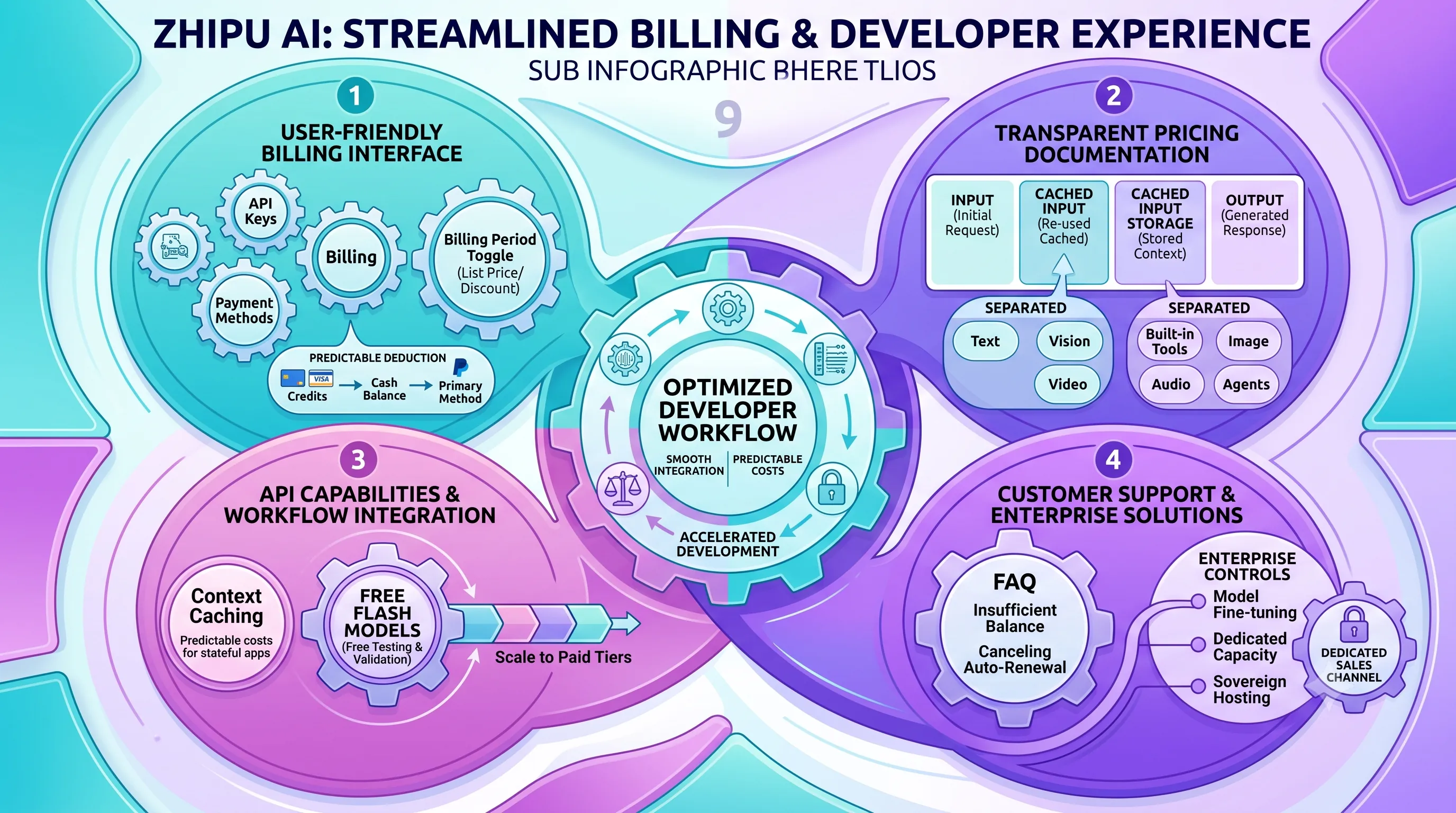
Zhipu AI prioritizes a straightforward user experience, ensuring that developers can manage their accounts with minimal effort.Key administrative sections like API Keys, Payment Method, and Billing are designed to be easily accessible directly from the main navigation, reducing time spent searching for essential functions.
On the GLM Coding Plan subscription page, a prominent billing-period toggle allows users to instantly see the financial benefits of longer-term commitments through clearly published discounts.
For international users, the z.ai platform offers flexible payment options, including standard credit card processing and PayPal.
The system also employs a clear and predictable payment deduction hierarchy, first using any available credits, then cash balance, and finally charging the primary payment method.
Transparent Pricing Documentation
Clarity in pricing is a cornerstone of the Zhipu AI developer platform, eliminating ambiguity about service costs.The developer documentation presents a unique four-column price card that breaks down costs with granular detail: Input, Cached Input, Cached Input Storage, and Output.
This structure gives developers a precise understanding of how different API usage patterns, especially those leveraging stateful features, will impact their final bill.
| Input | Cached Input | Cached Input Storage | Output |
|---|---|---|---|
| Cost for initial request tokens | Cost for re-used cached tokens | Cost for storing cached context | Cost for generated response tokens |
This separation for Text, Vision, Built-in Tools, Image, Video, Audio, and Agents ensures that developers can quickly find the exact pricing information for the specific modality they intend to use without wading through irrelevant data.
API Capabilities and Workflow Integration
The platform’s features are designed to integrate smoothly into developer workflows while optimizing costs.Context Caching is a formally documented API capability that directly corresponds to the specialized pricing columns, enabling developers to build more efficient, stateful applications with predictable costs.
To encourage experimentation and validation, Zhipu AI also provides free Flash models.
This allows new accounts to test and validate their workloads and integration patterns on capable models before committing to the paid, higher-performance tiers, significantly lowering the barrier to entry.
Customer Support and Enterprise Solutions
Zhipu AI provides accessible support resources to resolve common administrative issues.A dedicated FAQ on the subscription page proactively addresses potentially confusing scenarios, such as receiving an "Insufficient Balance" error even after purchasing a coding package.
The same resource provides clear instructions for common user queries, including how to verify that a coding package has been successfully applied to an account and the simple process for canceling auto-renewal.
For larger organizations, Zhipu AI offers a suite of enterprise controls managed through a dedicated sales channel.
These advanced capabilities include model fine-tuning, access to dedicated capacity for guaranteed performance, and options for sovereign hosting to meet specific data residency requirements.
10. Opportunities for Enhancing Zhipu AI's Pricing Transparency
While the performance gains from adopting the latest GLM models are compelling, as detailed in this article, the path to adoption can be hindered by a lack of clarity in pricing. For organizations to confidently invest in and scale with Zhipu AI's platform, addressing several key areas of pricing transparency is crucial. This would allow potential users to more accurately map the technical benefits of GLM's speed and capacity to tangible budget forecasts.Clarifying Coding Plan Quotas
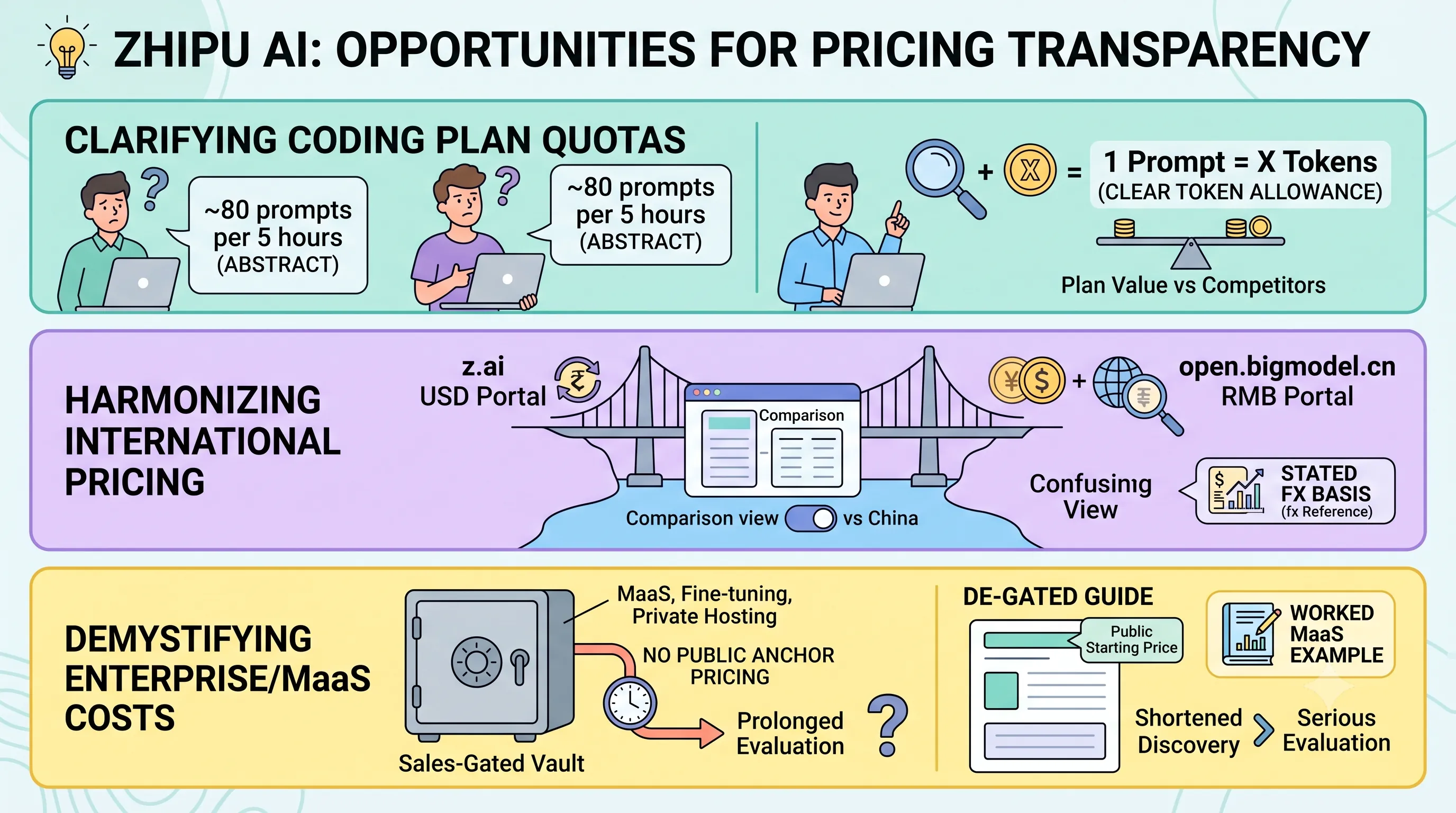
One of the primary friction points for developers evaluating the platform is the ambiguous nature of usage limits for specialized offerings like the GLM Coding Plan.Currently, quotas are expressed in abstract terms, such as allowing "~80 prompts per 5 hours", rather than in the industry-standard unit of tokens.
This makes it nearly impossible for developers to accurately estimate their consumption or compare the plan's value against token-based offerings from competitors.
To resolve this, a published token-equivalent for these Coding Plan quotas is needed.
Providing a clear token allowance would empower developers to properly assess their needs, forecast costs based on their application's logic, and confidently self-select the most appropriate tier without needing to engage in trial-and-error.
Harmonizing International Pricing
Zhipu AI's current go-to-market strategy presents different pricing structures on its separate USD (z.ai) and RMB (open.bigmodel.cn) portals.This bifurcation, which often includes different promotional offers, creates significant evaluation friction for international buyers.
Global teams are forced to perform manual, cross-currency comparisons that can be confusing and time-consuming, muddying the total cost of ownership calculation.
A more streamlined approach would be to introduce a single, unified pricing page that features a comparison view or an explicit 'international vs China' toggle.
Crucially, this tool should include a stated foreign exchange (FX) basis to provide a stable and transparent reference point, thereby reducing the overhead associated with cross-border procurement.
Demystifying Enterprise/MaaS Costs
For larger organizations considering deeper investments, the most advanced offerings—including private deployment, specialized fine-tuning, and sovereign hosting (Enterprise/MaaS)—are entirely opaque from a pricing perspective.These services are completely sales-gated, lacking any public anchor pricing or cost estimates.
This absence of information significantly prolongs the evaluation cycle, particularly for mid-market buyers who need to quickly determine budgetary feasibility before committing resources to a lengthy sales process.
Publishing a public starting price or a detailed worked MaaS example for a common deployment scenario would serve as an invaluable guide.
Such transparency would help potential customers self-qualify more efficiently and shorten the discovery phase, allowing them to move faster from initial interest to serious evaluation.
Related Posts
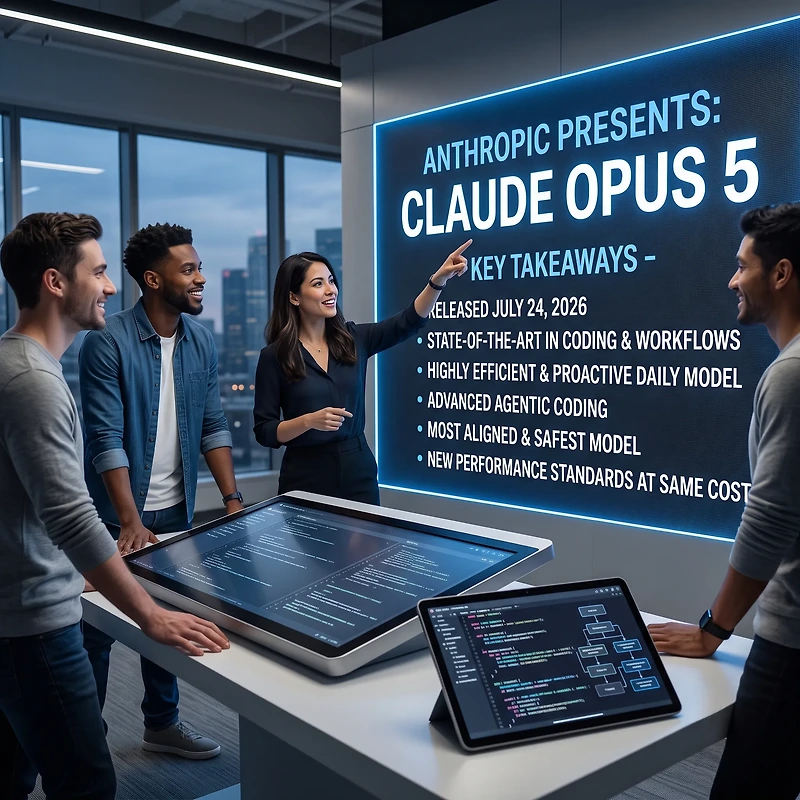
Anthropic's Claude Opus 5 Released: New AI Frontier in Agentic Coding, Multi-Step Workflows & Safety BenchmarksAnthropic officially released Claude Opus 5 on July 24, 2026, making it available across all...

Google Gemini 3.5 Live Translate: AI Breakthrough for Real-Time Speech-to-Speech Translation, 70+ Languages, Google Meet, & SynthID WatermarkGemini 3.5 Live Translate is a groundbreaking low-latency, audio-to-audio AI model for real-time...

GPT-5.5 Instant: OpenAI's Dramatic AI Upgrade | 52.5% Less Hallucinations, Personal Memory & 400K CodexGPT-5.5 Instant represents a massive leap in AI capability , offering drastically reduced...