
Inside Carbon-X: Hugging Face’s Open-Source DNA Language Model
🚀 Key Takeaways
- Unified Genetic Language Processing: Hugging Face and research partners have launched Carbon-X, an open-source model that natively reasons over raw DNA sequences and conversational text in a single decoder.
- Frontier-Class Biological Accuracy: The system matches closed frontier AI models across core DNA evaluation benchmarks while dramatically reducing per-problem compute and inference costs.
- Specialized Nucleotide Tokenization: A purpose-built hybrid tokenizer maps genetic 6-mers alongside standard text, allowing seamless comprehension of genomic sequences without separate external encoders.
- On-Premises Genomic Privacy: Designed for standard enterprise hardware, the model can run locally to ensure sensitive patient genomes and proprietary biological data remain strictly confidential.
- Safety-First Architecture: The training pipeline deliberately excluded viral sequences to safeguard against bioweapon misuse, targeting analytical variant explanation rather than synthetic genome synthesis.
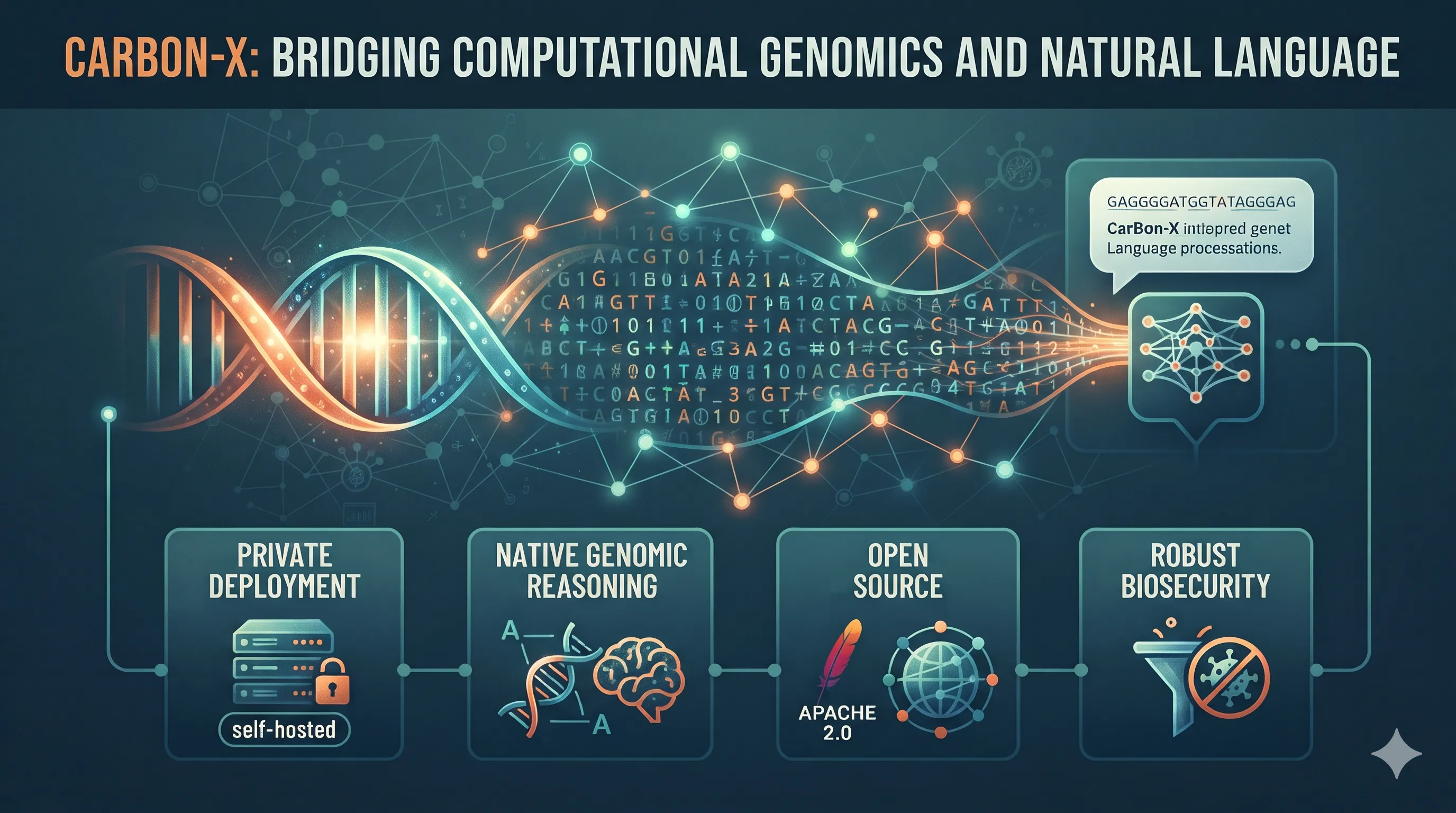
The longstanding divide between computational genomics and natural language processing is narrowing at an unprecedented pace. Until now, interrogating genetic data required fragmented pipelines that paired isolated biological embedding engines with external large language models to interpret findings. Hugging Face, alongside academic collaborators at Zhongguancun Academy and TIGEM, has bridged this gap with the introduction of Carbon-X, a breakthrough architecture engineered to converse fluently with raw genetic sequences.
Instead of converting DNA into cumbersome text representations or relying on complex cross-attention adapters, the model treats nucleotide sequences as a native computational dialect. Researchers and bioinformaticians can now submit genomic strands directly within a conversational prompt to analyze regulatory elements, inspect mutation impacts, and explore cellular mechanisms through direct dialogue or automated coding agents.
Crucially, this breakthrough has been made available under a fully open-source Apache 2.0 license, empowering research institutions to deploy high-grade biological intelligence entirely within private data centers. By combining frontier-level benchmark performance with robust biosecurity filtering and self-hosted privacy, Carbon-X marks a transformative shift toward accessible, secure AI-assisted life sciences.
1. Inside Carbon-X: Architecture Specs and Unified DNA-Language Design
Enabling users to chat with DNA using Hugging Face’s new AI biology tool requires a unified foundation capable of understanding both nucleotide sequences and natural-language prompts.Carbon-X serves as this underlying technical engine, bridging genomics and conversational AI without splitting processing across disconnected modalities.
Unified Decoder Architecture and Core Hyperparameters
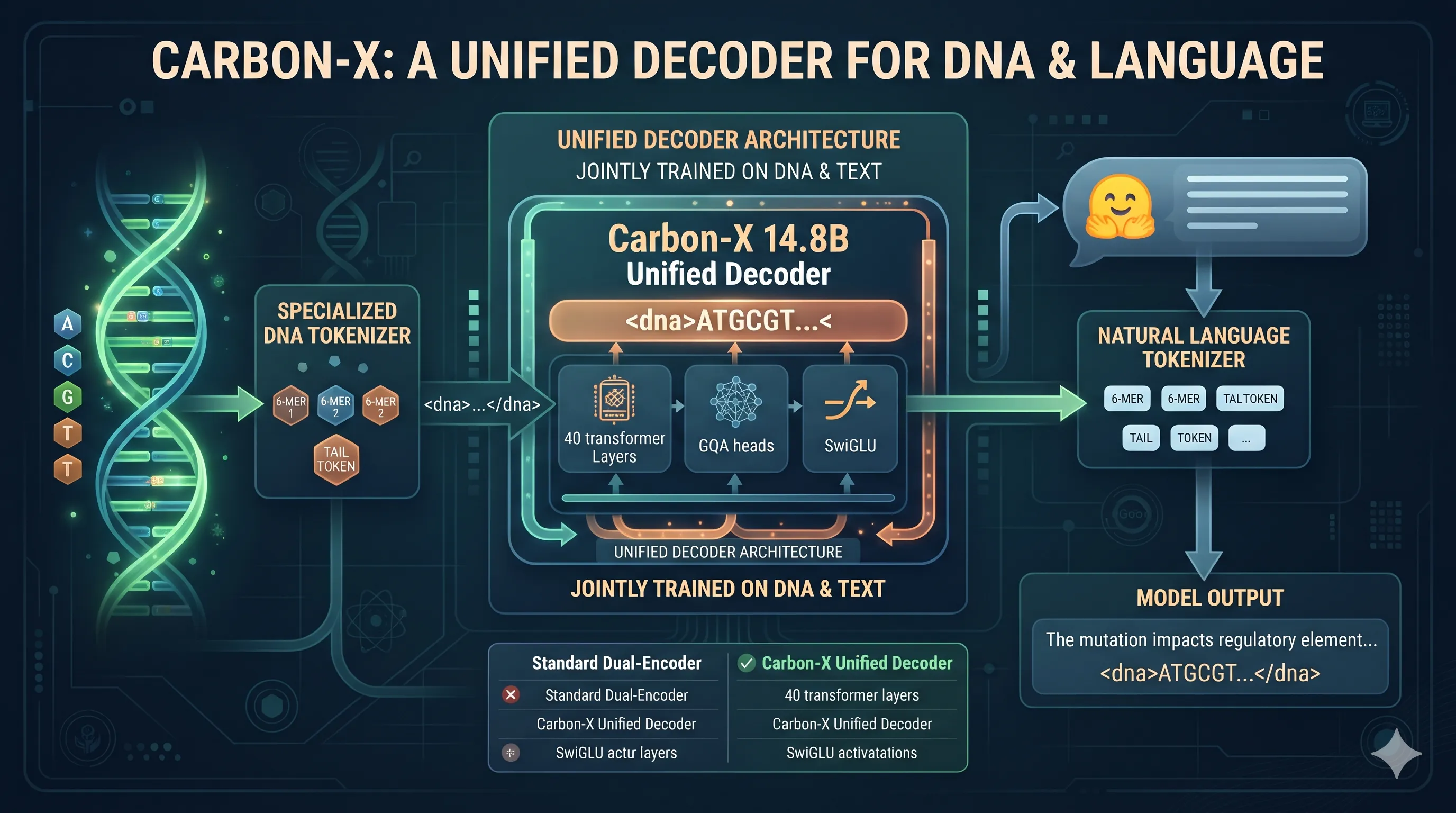
Carbon-X is a 14.8B-parameter decoder-only language model developed as a joint collaboration between Hugging Face, Zhongguancun Academy, and the Telethon Institute of Genetics and Medicine (TIGEM)/University of Naples Federico II.Initialized from Qwen3-14B and released under the permissive Apache 2.0 open-source license, the model bypasses standard dual-encoder biological designs.
Rather than relying on a separate DNA encoder connected via cross-attention or projection layers, Carbon-X is trained jointly on DNA sequences and natural-language text within a single autoregressive decoder.
The core neural execution framework is organized into 40 transformer layers.
It features a hidden size of 5120, a feed-forward network (FFN) dimension of 17408, and an attention head dimension of 128.
To optimize computational throughput during generation, the model incorporates Grouped Query Attention (GQA) utilizing 40 query heads and 8 key-value (KV) heads.
Internal activations are handled by SwiGLU, stabilized by Root Mean Square Normalization (RMSNorm) equipped with QK-norm.
To capture extended genomic context alongside multi-turn conversational dialogue, Carbon-X supports a context window of 40,960 tokens.
Long-range relative token positioning across this extended sequence length is managed by Rotary Position Embedding (RoPE) configured with a base theta of 1 × 10⁶.
Vocabulary Expansion and Single-GPU Memory Footprint
Operating across genomic code and human language requires an integrated tokenization scheme.Carbon-X employs an expanded dictionary containing a total vocabulary of 157,184 tokens, padded to a multiple of 128 for tensor optimization.
This structure allocates 151,669 tokens for standard Byte-Pair Encoding (BPE) natural-language vocabulary, accompanied by 5,515 dedicated DNA tokens.
The specialized DNA token vocabulary is partitioned into 4,096 distinct 6-mers, 1,364 tail tokens to capture non-hexamer sequence segments, and dedicated marker tokens including
<dna>, </dna>, and <oov>.These boundary tokens allow the single decoder to transition seamlessly between conversational instructions and genomic motifs within the same sequence stream.
In terms of hardware deployment, Carbon-X uses native bfloat16 precision.
This numerical format maintains numerical stability during inference and training while allowing the entire 14.8B parameter model weight set to fit comfortably within the memory capacity of a single 80 GB GPU.
| Architectural Parameter | Configuration Value | Functional Role |
|---|---|---|
| Base Architecture | 14.8B-parameter decoder-only (initialized from Qwen3-14B) | Joint multi-modal text and DNA reasoning in a unified decoder |
| Layer & Dimension Count | 40 layers, Hidden size 5120, FFN size 17408 | Core network capacity and non-linear feature transformation |
| Attention Mechanism | GQA (40 query heads, 8 KV heads, head dimension 128) | Memory-efficient multi-head attention processing |
| Activation & Norms | SwiGLU activations, RMSNorm with QK-norm | Training stability and representation gating |
| Context Window & RoPE | 40,960 tokens (RoPE base theta = 1 × 10⁶) | Long-range sequence and contextual genomic processing |
| Natural Language Vocab | 151,669 BPE tokens | Natural-language comprehension and instruction following |
| DNA Token Vocab | 5,515 tokens (4,096 6-mers, 1,364 tail tokens, markers) | Genomic representation with sequence markers (<dna>, </dna>, <oov>) |
| Total Vocabulary Size | 157,184 tokens | Combined vocabulary size padded to a multiple of 128 |
| Precision & Memory | bfloat16 precision | Fits entire model weight allocation onto a single 80 GB GPU |
| Licensing & Partners | Apache 2.0 (Hugging Face, Zhongguancun Academy, TIGEM) | Open-source access and collaborative institutional foundation |
2. Hybrid Tokenization: Bridging 6-Mer DNA Sequences and Natural Language
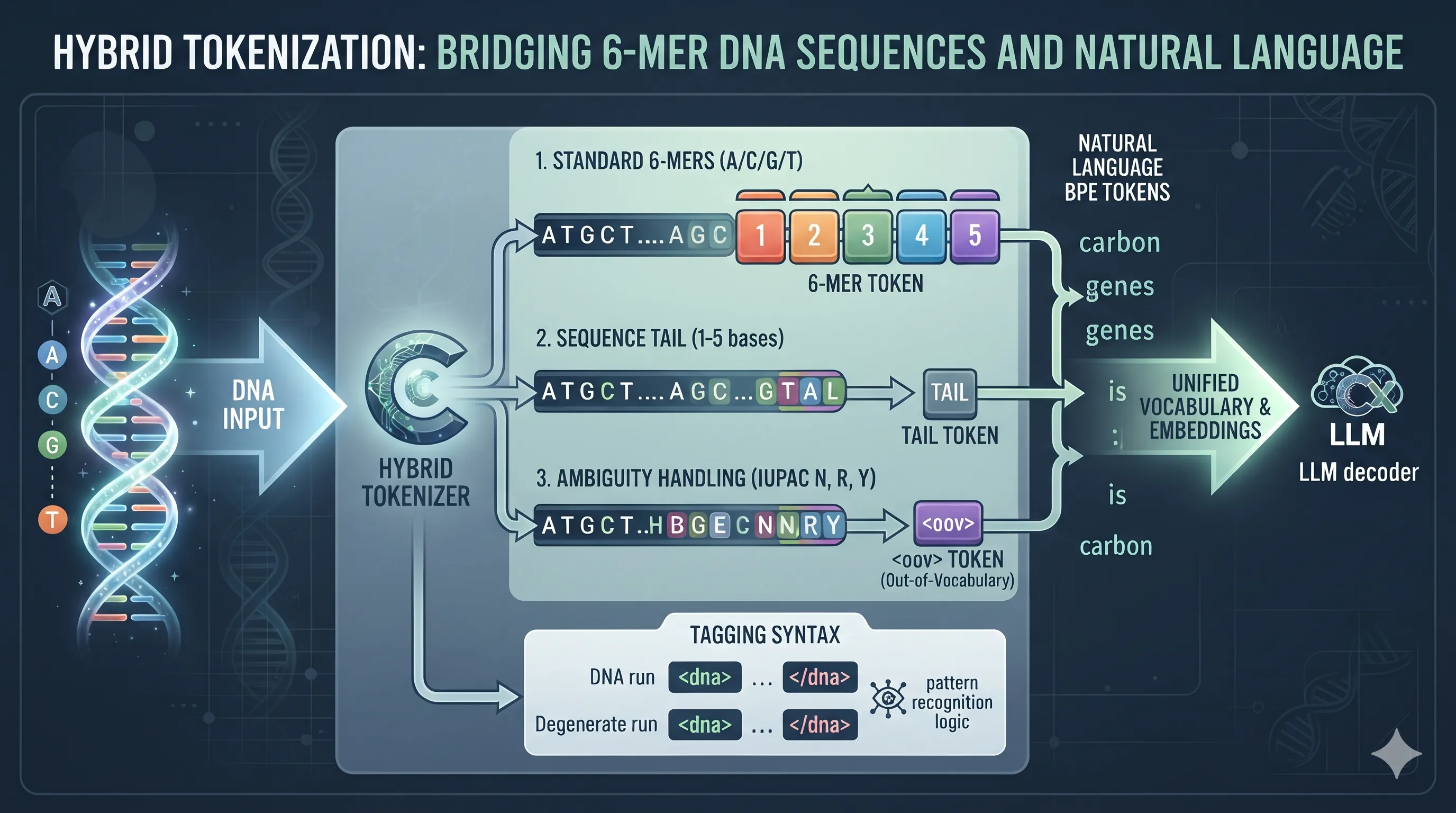
To enable conversational interaction within Hugging Face’s new AI biology tool and allow users to chat with DNA alongside standard natural language prompts, the architecture implements a specialized hybrid tokenizer.This system bridges biological sequences with textual comprehension by combining the Qwen3 BPE text vocabulary with DNA 6-mer tokens into a single unified framework.
Non-Overlapping 6-Mers and Ambiguity Handling
The core DNA representation relies on non-overlapping 6-mers, where each individual DNA token spans exactly 6 base pairs.Canonical nucleotides—adenine (A), cytosine (C), guanine (G), and thymine (T)—assemble directly into these 6-base tokens.
Because arbitrary nucleotide sequences frequently fail to divide evenly by six, sequences not divisible by 6 utilize dedicated tail tokens designed to encode the remaining 1 to 5 bases at the sequence boundary.
When reads contain non-standard or degenerate bases, specialized ambiguity logic takes effect.
While canonical A, C, G, and T bases construct standard 6-mers, any 6-mer containing IUPAC ambiguity characters (such as N, R, or Y) resolves directly into a single <oov> token.
| Sequence Input Type | Length and Composition Threshold | Tokenization and Handling Behavior |
|---|---|---|
| Canonical 6-mer | 6 base pairs of canonical A, C, G, and T bases | Encodes into a single non-overlapping DNA token. |
| Sequence Tail | Final 1 to 5 bases not divisible by 6 | Encodes via dedicated tail tokens. |
| Ambiguous 6-mer | Any 6-mer containing IUPAC ambiguity characters (N, R, Y, etc.) | Resolves into a single <oov> token. |
| Standard DNA Run | Runs of at least 6 canonical A/C/G/T bases | Automatically wrapped in <dna>...</dna> tags. |
| Degenerate DNA Run | Runs of at least 12 bases with up to 20% IUPAC ambiguity codes | Automatically wrapped in <dna>...</dna> tags. |
Tagging Syntax and Custom Execution Requirements
To distinguish genetic data from natural text during interactive sessions, the tokenizer incorporates automated pattern recognition and enclosure syntax.Automatic detection detects and wraps continuous runs of at least 6 A/C/G/T bases inside <dna>...</dna> delimiters.
The pattern matching also accounts for sequencing ambiguity, automatically tagging runs of at least 12 bases containing up to 20% IUPAC ambiguity codes such as N, R, and Y.
During generation, any DNA emitted in model responses is likewise enclosed within <dna>...</dna> markers.
To prevent user formatting variations from fragmenting tokens, input normalization steps automatically uppercase lowercase bases and join space-separated sequence blocks prior to token assignment.
These operational mechanics impose specific execution constraints in downstream workflows.
Because sequence parsing and wrapping are implemented through custom Python tokenizer code, loading the tokenizer requires passing trust_remote_code=True.
As a consequence of relying on custom Python routines, alternative runtimes including llama.cpp and GGUF are not supported, as they cannot execute the underlying Python tokenizer logic.
3. The Training Pipeline: Pretraining, Mid-Training, and Asynchronous GRPO
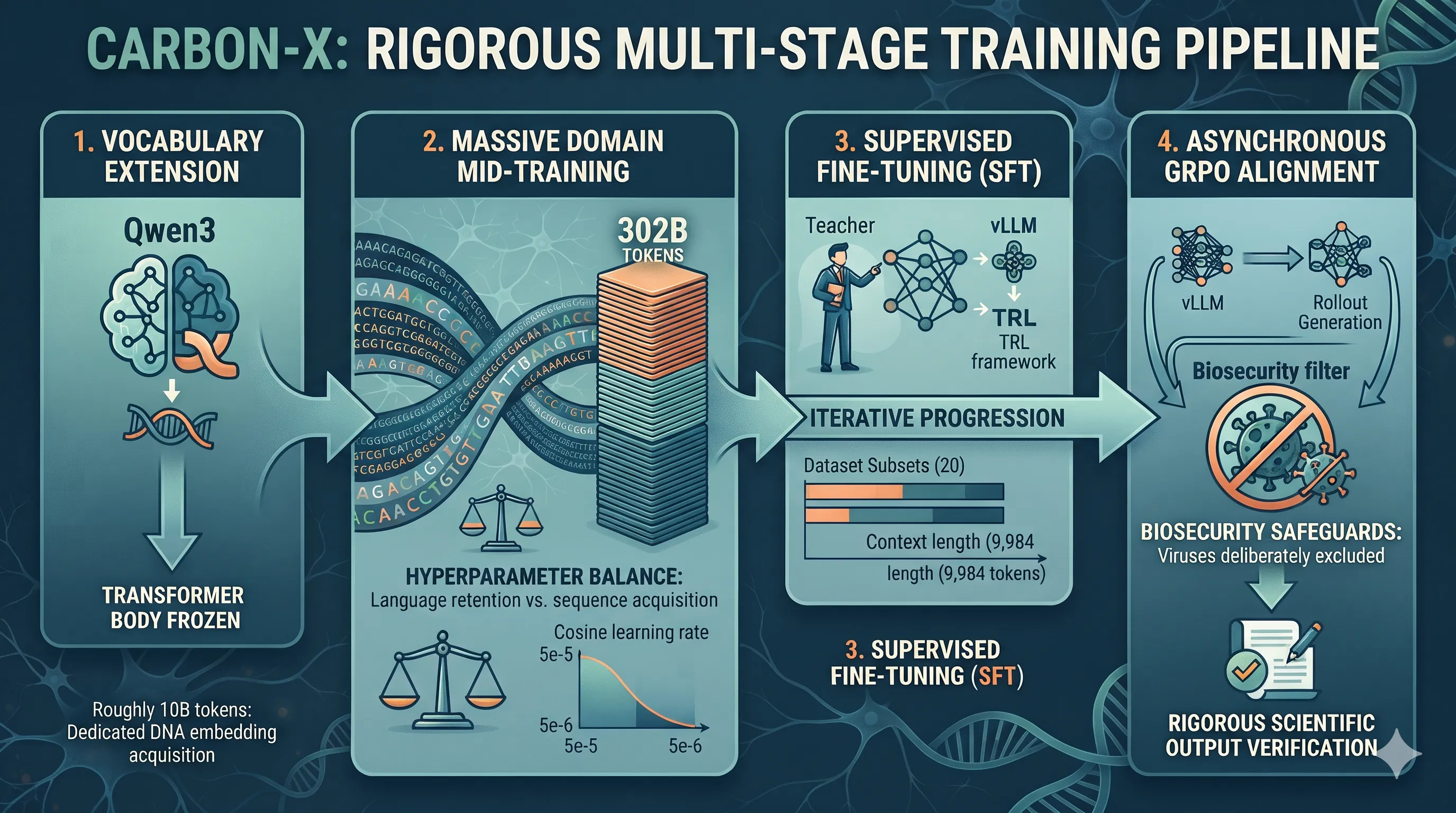
To empower users to chat with DNA using Hugging Face’s new AI biology tool, Carbon-X, the development team engineered a rigorous multi-stage training pipeline starting from the Qwen3 base architecture.Transforming a general-purpose language model into a native biological reasoning engine required interleaving genetic token representations with natural language across successive phases of vocabulary extension, massive domain mid-training, supervised fine-tuning, and asynchronous reinforcement learning.
Corpus Composition and Mid-Training Hyperparameter Balance
The adaptation began with an initial vocabulary extension stage, where the model was trained for roughly 10B tokens with the core transformer body frozen.This preliminary phase forced the model to establish dedicated DNA sequence embeddings without distorting the pre-existing language weights.
Following vocabulary integration, full-scale mid-training commenced across a curated dataset totaling 302B tokens.
The mid-training corpus drew from three primary biological sources: eukaryote genes from RefSeq, spliced mRNA transcripts from OpenGenome2, and prokaryote genomes retrieved from GTDB v220 and IMG/PR.
Within this distribution, prokaryote genomes accounted for approximately 10% of the Carbon Pretraining Corpus mixture.
Execution took place with an 8,192 sequence length and a global batch size of 512 sequences, translating to roughly 4.2M tokens per optimization step across 72,000 steps.
Balancing language retention with sequence acquisition presented a delicate optimization challenge.
Lewis Tunstall noted that the learning rate served as the dominant operational knob during mid-training: setting the rate too low left the model's DNA comprehension at chance levels, while setting it too high triggered catastrophic forgetting of English.
To resolve this tension, the team applied a cosine learning rate schedule transitioning from 5e-5 down to 5e-6 following an initial 2,000 warmup steps.
| Training Stage | Data Volume / Steps | Batch & Context Specifications | Key Optimization Parameters |
|---|---|---|---|
| Vocabulary Extension | Roughly 10B tokens | Standard context (transformer body frozen) | Dedicated DNA embedding acquisition |
| Mid-Training | 302B tokens (72,000 steps) | Global batch size 512 sequences (~4.2M tokens/step), 8,192 sequence length | Cosine schedule from 5e-5 to 5e-6, 2,000 warmup steps |
| Supervised Fine-Tuning (SFT) | 3 epochs across 20 dataset subsets | Global batch size 32, up to 9,984 token examples | TRL framework with vLLM rollout generation |
| Asynchronous GRPO (Round 1) | 98,433 prompts (150 steps) | 16 samples per prompt, completions up to 4,096 tokens | Learning rate 1e-6, asymmetric clipping (epsilon = 0.2 / 0.28), max grad norm 0.2 |
| Asynchronous GRPO (Round 2) | 58,249 prompts (~2.2 passes) | 16 samples per prompt, completions up to 4,096 tokens | Learning rate 1e-6, asymmetric clipping (epsilon = 0.2 / 0.28), max grad norm 0.2 |
Asynchronous GRPO Alignment and Biosecurity Safeguards
Post-training relied on a combination of Supervised Fine-Tuning (SFT) and Group Relative Policy Optimization (GRPO) implemented using the TRL framework, alongside vLLM to handle high-throughput rollout generation.The SFT phase spanned 3 epochs across 20 distinct dataset subsets, processing context examples up to 9,984 tokens with a global batch size of 32.
Once supervised adaptation converged, the model underwent two successive rounds of reinforcement learning using asynchronous GRPO.
Round 1 executed across 98,433 prompts for 150 steps, while Round 2 scaled across 58,249 prompts, yielding the released checkpoint after roughly 2.2 passes.
The reinforcement learning policy sampled 16 completions per prompt with a maximum completion length of 4,096 tokens.
Hyperparameters were locked to a learning rate of 1e-6, a maximum gradient norm of 0.2, and asymmetric clipping bounded at epsilon = 0.2 / 0.28.
To enforce rigorous scientific outputs, the reward mechanism utilized task-specific, code-checked verifiers evaluating variant effect prediction tasks.
These verifiers explicitly penalized ungrounded rationales, ensuring that the model did not generate speculative biological mechanisms.
Throughout both post-training and evaluation, operations ran with thinking mode disabled via
enable_thinking=False.Crucially, the entire pipeline incorporated stringent biosecurity safeguards.
Viruses were deliberately excluded from the pretraining and post-training data mixtures.
Lewis Tunstall stated that viral genomes were intentionally filtered out to mitigate dual-use hazards, preventing the model from assisting in bioweapon synthesis or dangerous biological applications.
4. Validation and Economics: DNA Analysis Accuracy and Low-Cost Inference
Connecting directly to the promise of conversational genomics in Hugging Face’s DNA-focused AI release, Carbon-X demonstrates that interacting with nucleotide sequences requires both verifiable biological accuracy and viable computational economics.To establish trust in automated sequence interpretation, the model was subjected to evaluation pipelines spanning sequence prediction, variant impact scoring, and prompt instruction compliance.
Genomic Verification and Benchmark Task Breakdown
To ensure that test metrics reflect genuine biological reasoning rather than memorization, all Carbon-X training data underwent thorough decontamination protocols.This verification removed potential overlaps using whole-span DNA overlap, text n-gram overlap, and sequence homology search against all target evaluation sets.
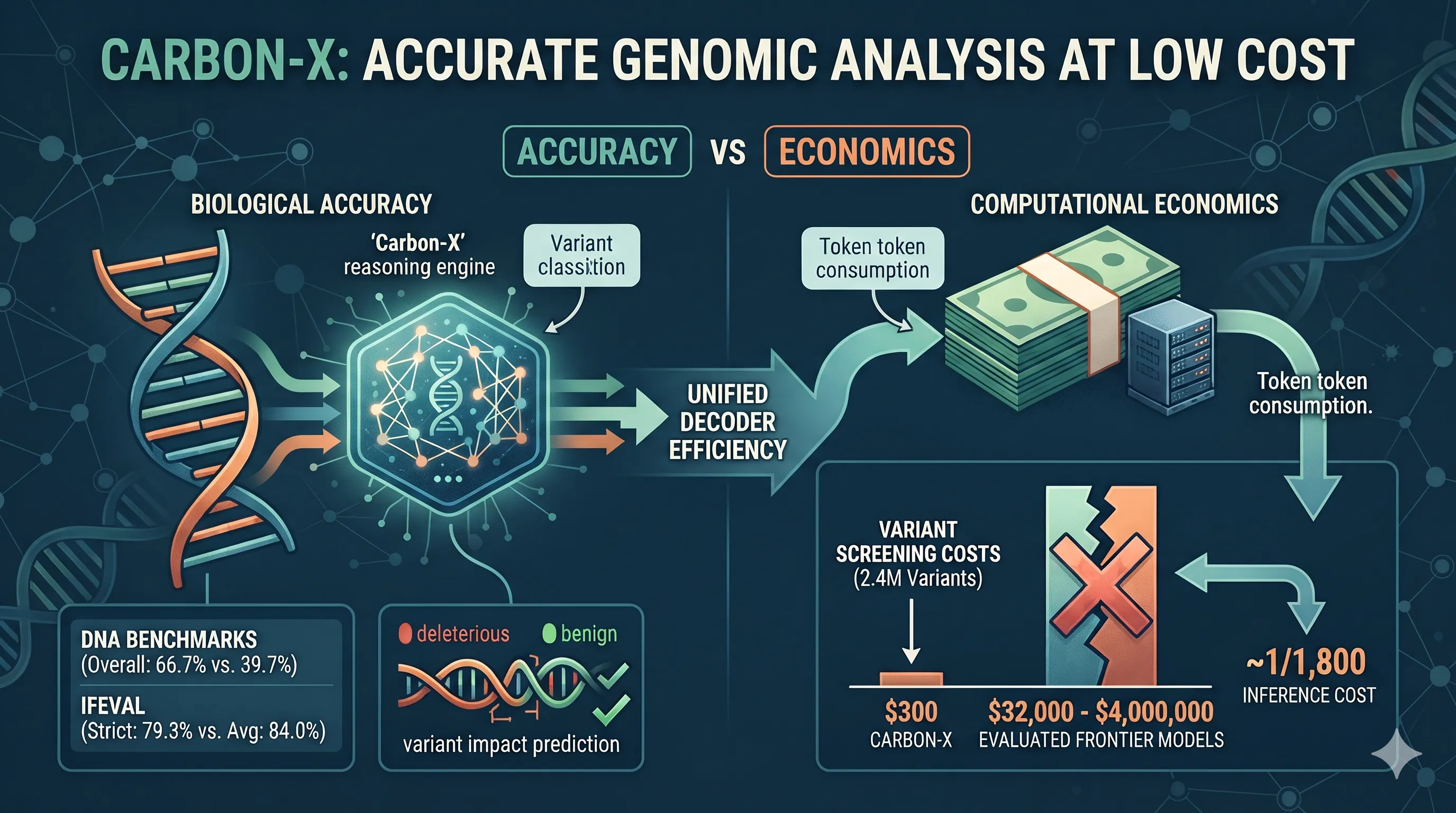
In general conversational instruction following, Carbon-X secured an IFEval prompt-level strict accuracy of 79.3%, while maintaining an 84.0% average across four distinct IFEval metrics.
Across five dedicated DNA benchmarks, Carbon-X achieved an overall average score of 66.7% with thinking disabled.
This performance places the architecture 27 percentage points above Qwen3-14B across the same suite of DNA benchmarks.
The evaluation suite probed multiple specific biological domains:
- BioReason Coding: Examined 1,018 variants evaluated specifically on balanced accuracy.
- BioReason Non-SNV: Benchmarked variant impact across 873 complex, non-single-nucleotide variants.
- NextBase: Evaluated next DNA base prediction capabilities over 600 biological sequences.
- FrontierVEP: Tested variant effect prediction across 1,000 variants divided evenly into 500 benign and 500 pathogenic mutations, accommodating sequence context windows up to 8,192 bases.
- GenomeQA: Assessed sequence comprehension through 2,600 multiple-choice questions spanning six distinct biological sequence tasks.
On GenomeQA, Carbon-X scored lower on specific sub-tasks, recording 29.8% accuracy on splice-site detection and 34.6% on histone mark identification.
Direct-Answer Inference Economics and Variant Screening Costs
In high-throughput genomic screening, computational budget often dictates diagnostic feasibility.Carbon-X optimizes inference costs by providing direct answers without generating extended output reasoning tokens, which drastically reduces per-problem token consumption.
Through this architecture, Carbon-X reaches an accuracy tier of 66.7% that closely rivals GPT-6.1 Sol (67.5%), while operating at roughly 1/1,800 of the inference cost per problem.
This structural efficiency fundamentally reshapes the budget needed for population-scale genomic interpretation.
Analyzing the 2.4 million variants of uncertain significance cataloged in ClinVar is estimated to cost approximately $300 with Carbon-X.
By contrast, conducting the identical large-scale screening pipeline using evaluated frontier models requires an estimated expenditure ranging between $32,000 and $4,000,000.
| Evaluation Dimension / Benchmark | Dataset Scope & Target Metric | Carbon-X Performance Profile | Comparative Baseline / Economic Metric |
|---|---|---|---|
| Overall DNA Benchmarks | Five specialized biological sequence benchmarks | 66.7% average accuracy (thinking disabled) | +27 percentage points over Qwen3-14B; comparable to GPT-6.1 Sol (67.5%) |
| IFEval Instruction Following | Prompt-level strict & multi-metric evaluations | 79.3% prompt-level strict accuracy; 84.0% average across 4 metrics | Evaluated after rigorous text and whole-span sequence decontamination |
| BioReason Coding & Non-SNV | 1,018 coding variants (balanced accuracy); 873 non-SNV variants | Validated on single-nucleotide and complex variant reasoning | Decontaminated via homology search and whole-span overlap |
| FrontierVEP | 1,000 variants (500 benign, 500 pathogenic) | Evaluated with sequence contexts up to 8,192 bases | Direct variant effect classification |
| NextBase | 600 biological sequences | Direct next DNA base prediction | Zero-reasoning-token direct inference output |
| GenomeQA Weak Areas | 2,600 multiple-choice questions across 6 sequence tasks | 29.8% on splice-site detection; 34.6% on histone marks | Identified sequence-level functional limitation |
| ClinVar Screening (2.4M Variants) | 2.4 million variants of uncertain significance | ~$300 total estimated inference screening cost | $32,000 to $4,000,000 with evaluated frontier models (~1/1,800 cost vs. GPT-6.1 Sol) |
5. Deployment and Agent Integration: Running Carbon-X Locally and in Agentic Workflows
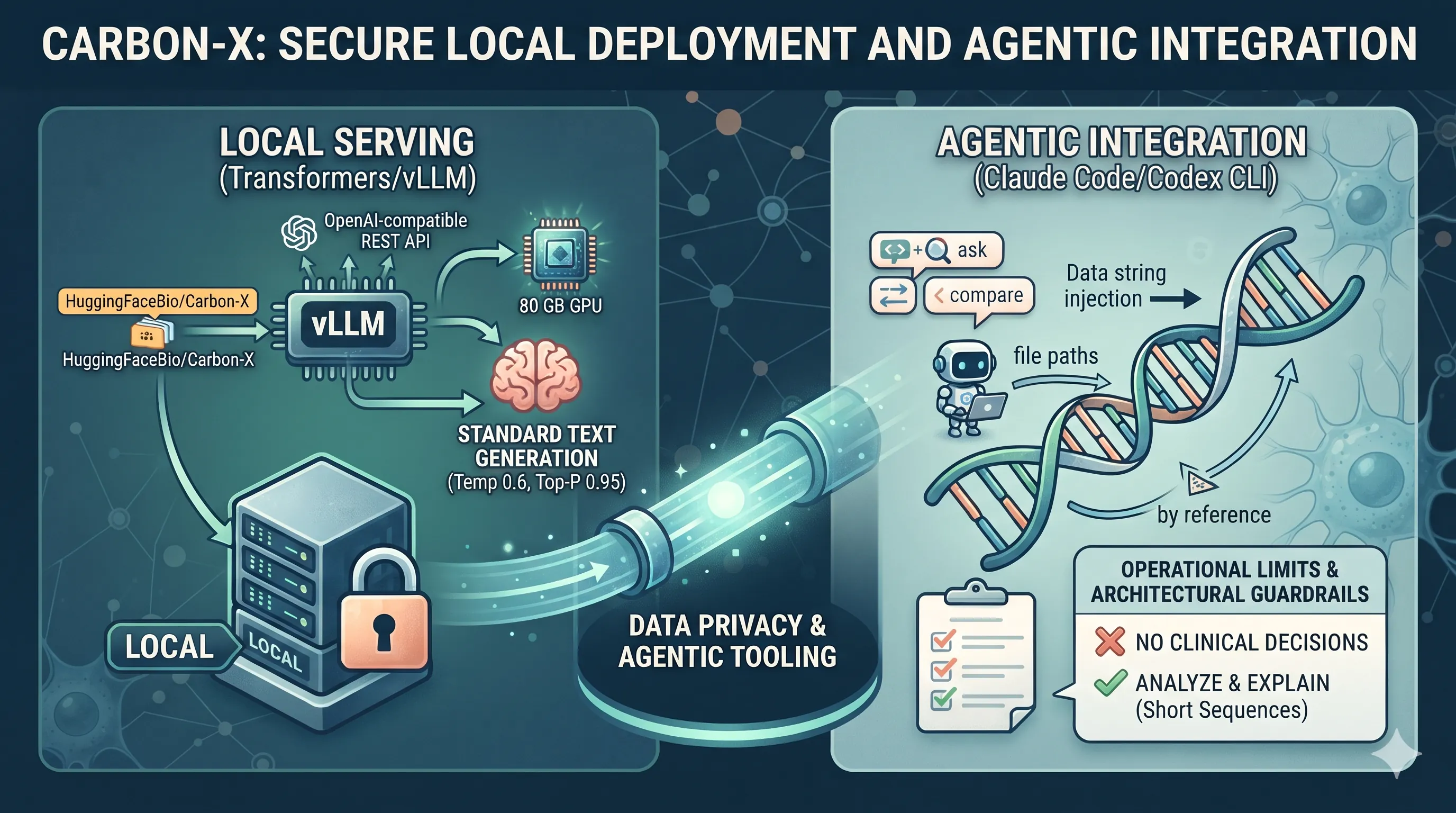
Connecting directly to the core initiative of enabling researchers to chat with DNA using Hugging Face’s new AI biology tool, successfully running Carbon-X requires operationalizing the model within secure, scalable local environments.Deploying Carbon-X on local hardware guarantees data privacy for sensitive biological workflows while unlocking agentic tooling for genomic analysis.
As Lewis Tunstall emphasized, local deployment prevents biology researchers from having to share sensitive patient genomic data with external proprietary AI providers.
Local Serving with Transformers and vLLM
Carbon-X requires Transformers version 5 or later.The model can be served locally on a single 80 GB GPU using inference runtimes such as vLLM or SGLang, both providing OpenAI-compatible REST API endpoints.
Standard text generation defaults to specific sampling parameters: a temperature of 0.6, top-p of 0.95, and top-k of 20.
To load and run direct inference with HuggingFaceBio/Carbon-X using the Transformers library, developers can apply the standard chat templating pipeline:
from transformers import AutoTokenizer, AutoModelForCausalLM

tokenizer = AutoTokenizer.from_pretrained("HuggingFaceBio/Carbon-X")
model = AutoModelForCausalLM.from_pretrained("HuggingFaceBio/Carbon-X", device_map="auto")
messages = [
    {"role": "user", "content": "Who are you?"},
]
inputs = tokenizer.apply_chat_template(
	messages,
	add_generation_prompt=True,
	tokenize=True,
	return_dict=True,
	return_tensors="pt",
).to(model.device)

outputs = model.generate(**inputs, max_new_tokens=256)
print(tokenizer.decode(outputs[0][inputs["input_ids"].shape[-1]:]))For higher-throughput serving and integration across software pipelines, engineers can serve Carbon-X locally with vLLM and query it through an OpenAI-compatible REST API:
# Install vLLM from pip:
pip install vllm
# Start the vLLM server:
vllm serve "HuggingFaceBio/Carbon-X"
# Call the server using curl (OpenAI-compatible API):
curl -X POST "http://localhost:8000/v1/chat/completions" \
	-H "Content-Type: application/json" \
	--data '{
		"model": "HuggingFaceBio/Carbon-X",
		"messages": [
			{
				"role": "user",
				"content": "What is the capital of France?"
			}
		]
}'Agentic Integration via Claude Code and Codex CLI
Beyond manual prompts, Carbon-X provides an agent skill located inskills/carbon-dna/ for command-line environments like Claude Code and Codex CLI.This integration supports dedicated ask and compare commands for evaluating genomic constructs.
To avoid context bloat and syntax truncation, agents can pass DNA sequences by reference or files rather than raw text, actively preventing copying errors.
To install the Carbon-X coding agent skill for Claude Code or Codex CLI, execute the following setup sequence:
vllm serve HuggingFaceBio/Carbon-X --trust-remote-code              # one 80 GB GPU
hf download HuggingFaceBio/Carbon-X --include "skills/*" --local-dir carbon-x
cp -r carbon-x/skills/carbon-dna ~/.claude/skills/                  # Codex CLI: ~/.codex/skills/
export CARBON_BASE_URL=http://localhost:8000/v1 # or the address of your vLLM serverOperational Limits and Clinical Disclaimers
Deploying Carbon-X in research environments requires strict adherence to its technical and physical boundaries.The model lacks clinical validation and must not be used to make medical decisions.
Furthermore, model predictions have not yet been confirmed by wet-lab experiments.
| Operational Domain | Guideline / Boundary | Recommended Architecture Practice |
|---|---|---|
| Sequence Operations | Exact sequence operations like base counting, coordinate tracking, and edits can be error-prone. | Delegate deterministic tasks to deterministic code rather than LLM token generation. |
| Sequence Length | Quality degrades when generating long DNA sequences; Carbon-X is trained to analyze and explain, not design whole new genomes. | Limit generation to biological analysis, interpretations, and short sequences. |
| Data Transmission | Raw string injection of genomic sequences risks copy and token manipulation errors. | Pass DNA sequences by reference or via file paths inside agent workflows. |
| Validation Status | Predictions are not verified by wet-lab testing and lack clinical clearance. | Treat all outputs as exploratory computational hypotheses. |
Related Posts


Generative AI may have assisted with research or drafting for this article. Topic selection, fact-checking, final wording, and publication remain the responsibility of DragonStone74. AI use disclosure