
How PHP's Emergency Patches Affect Developers and Infrastructure Security
🚀 Key Takeaways
- Dual Critical RCE Flaws: Upstream maintainers released emergency patches for two critical remote code execution vulnerabilities deep in PHP core, both rated CVSS 9.2.
- Massive Ecosystem Exposure: The leaked PHP2Shell exploit tool threatens millions of Internet-facing installations across CMS platforms, e-commerce stores, and enterprise appliances.
- Infrastructure-Level Remediation: Fixes require direct runtime upgrades, as application-level changes cannot neutralize flaws embedded within the PHP engine itself.
- Upstream Support Limits: Official releases cover only supported modern branches, leaving older legacy versions dependent on distribution backports or network-level isolation.
- Immediate Defense Strategies: Development and operations teams must rely on temporary request filtering, edge firewalls, and runtime child-process inspection to combat incoming exploits.
Web development teams and infrastructure engineers face an immediate operational crisis as maintainers release out-of-band updates to neutralize critical vulnerabilities embedded within the foundational PHP engine. The premature disclosure of exploit automation under the moniker PHP2Shell broke normal coordination windows, thrusting production environments worldwide into zero-day defense mode. With active scan activity hitting servers across the globe today, developers must pivot away from feature delivery to secure their deployment pipelines.
Because these underlying weaknesses reside deep inside the language runtime rather than within application code, conventional framework validations and software patches offer no protection. From high-volume e-commerce storefronts to mission-critical web applications, the burden of defense falls entirely on updating server packages, establishing edge filtering, and monitoring system processes. Understanding how these emergency interventions alter deployment strategies, package management, and operational workflows is critical for safeguarding live infrastructure.

1. Emergency Vulnerabilities and Accelerated Release Timelines
Understanding the sudden collapse of disclosure embargos is vital to analyzing how PHP's emergency patches affect developers and infrastructure operations.When vulnerabilities strike the underlying language runtime, production teams lose the luxury of standard deployment windows and must immediately pivot to incident response.
Critical Core RCE Flaws: CVE-2026-109618 and CVE-2026-109619
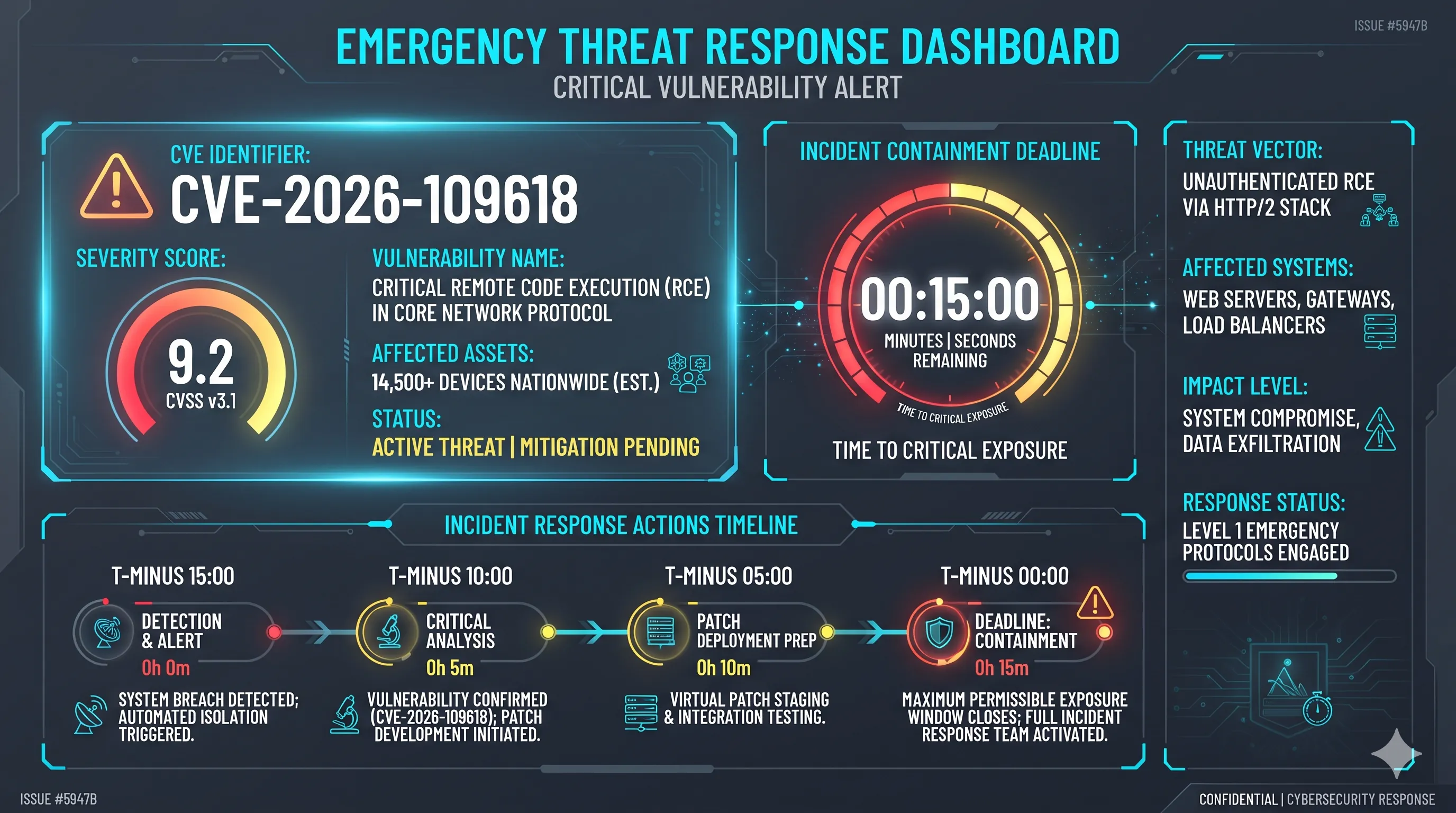
The security advisory centers on two critical security vulnerabilities tracked as CVE-2026-109618 and CVE-2026-109619.Both flaws carry a critical severity rating of CVSS v4.0 9.2.
Security researchers at AhnLab (ASEC) independently confirmed the two remote code execution (RCE) vulnerabilities and their associated CVSS 9.2 severity metrics.
Architecturally, these flaws are remote code execution vulnerabilities residing deep in PHP's core engine, giving unauthorized actors potential control over target environments.
According to project maintainers, full technical details, precise lists of affected versions, and official patch builds are slated for publication directly alongside the emergency security release.
Coordinated Embargo Collapse and Accelerated Release Schedule
The timeline for patch distribution was dramatically condensed when critical information regarding the embargoed vulnerabilities leaked on October 20, 2026, ahead of the coordinated disclosure date.The coordinated embargo release had originally been planned for Thursday at 11:00 AM ET before being abruptly moved up.
To counter the leak, the official security release was rescheduled for Wednesday, 21 October 2026 at 14:00 UTC (10:00 EDT / 16:00 CEST / 23:00 KST).
PHP maintainers explicitly reserved the right to publish fixes even earlier if in-depth technical details become public or if active exploitation appears in the wild.
Emphasizing the urgency for engineering teams worldwide, the official PHP advisory stated: "All PHP users are encouraged to prepare now so they can upgrade as soon as the release is available."
Early Attack Waves and Exploit Reproduction
Threat intelligence and security telemetry quickly confirmed that threat actors were attempting to capitalize on the leaked intelligence ahead of the release.Security firm watchTowr confirmed the vulnerabilities are real and stated they successfully reproduced CVE-2026-109618.
Telemetry from Cloudflare reported early attacks targeting PHP sites starting at 07:43 UTC on October 21.
The impending patch availability brings extreme time pressure, as Sansec researchers warned that they expect mass attacks to start within 15 minutes of the release.
For developers maintaining PHP infrastructure, this minimal 15-minute gap turns the patch rollout into a zero-tolerance race against automated scanning engines.
2. Blast Radius: The PHP2Shell Leak and Ecosystem-Wide Exposure
Understanding how PHP's emergency patches affect developers requires analyzing the systemic blast radius created when the underlying engine itself is compromised.Because PHP serves as an underlying runtime across the global web, vulnerabilities located directly within PHP core immediately cascade into all applications built on top of it.
PHP2Shell Exploit Leak and Universal Version Claims
The urgency surrounding the remediation effort escalated when an exploit tool dubbed PHP2Shell surfaced, accompanied by a video demonstrating remote code execution against web applications running on PHP.According to a security researcher, an estimated 1.3 million Internet-connected hosts are likely affected by the vulnerability.
The leaked PHP2Shell banner claims to work against every PHP release from 5.4.0 onward.
Furthermore, an unconfirmed report claimed that the flaw affects every PHP version from PHP 5, originally released in 2004, onward.
This expansive backward reach means legacy deployments and modern architectures alike share the same foundational vulnerability.
Impact Across Frameworks, CMSs, and E-Commerce Platforms
Because PHP core executes beneath application logic, developers face exposure regardless of the security measures implemented inside custom code.Huntress highlighted this architectural reality, stating: "When a critical bug lands in PHP itself, rather than in one app built on top of it, the number of places you have to go looking to identify vulnerable PHP versions gets very big, very fast."
The leaked demonstration video illustrated this widespread vulnerability by executing attacks across diverse frameworks, content management systems, and enterprise web solutions.
High-value e-commerce platforms such as Magento, Shopware, and WooCommerce stores are directly exposed to the exploit vector.
| Software / Platform | Demonstrated Target Version in Leak | Ecosystem Classification |
|---|---|---|
| WordPress | 7.1.3 | Content Management System |
| MediaWiki | 1.46.2 | Content Management System |
| phpBB | 3.3.17 | Community Forum Software |
| Magento | 2.4.9 | E-Commerce Platform |
| Joomla | 6.2.0 | Content Management System |
| Laravel | 13.36.0 | Application Framework |
| Laravel | 8.83.29 | Application Framework |
| Symphony | 8.1.9 | Application Framework |
| Drupal | 11.4.10 | Content Management System |
| WHMCS | 9.0.9 | Web Hosting Management and Billing |
Control Panels and Bundled Runtime Vulnerabilities
The blast radius of the PHP2Shell exploit extends beyond public web roots and standalone application servers.Vendor appliances and popular control panels, including cPanel and Plesk, also contain exposure due to their operational dependencies.
Additionally, Windows software bundling standalone executables such as php.exe or php-cgi.exe introduces risk directly into management layers and host environments.
Developers and system administrators must consequently track down runtime installations embedded within administrative utilities and secondary services, significantly expanding the scope of emergency patching.

3. Infrastructure Patching Bottlenecks and Upstream Support Limits
Understanding how PHP's emergency patches affect developers requires examining where remediation must actually take place across the software stack.Remediation cannot follow the routine path of pushing hotfixes to application repositories or applying framework-level filters.
Infrastructure-Level Patching vs Application Code
The vulnerability cannot be patched at the application or store codebase level; it requires updating PHP at the infrastructure level.PHP core developer Gina Peter Banyard stated that patching PHP is the only true mitigation.
Because standard application-layer defenses and store-level code modifications cannot neutralize the underlying flaw, engineering teams must intervene directly on the underlying server runtime and operating system components.
End-of-Life Versions (PHP 8.1 and Below) Without Upstream Fixes
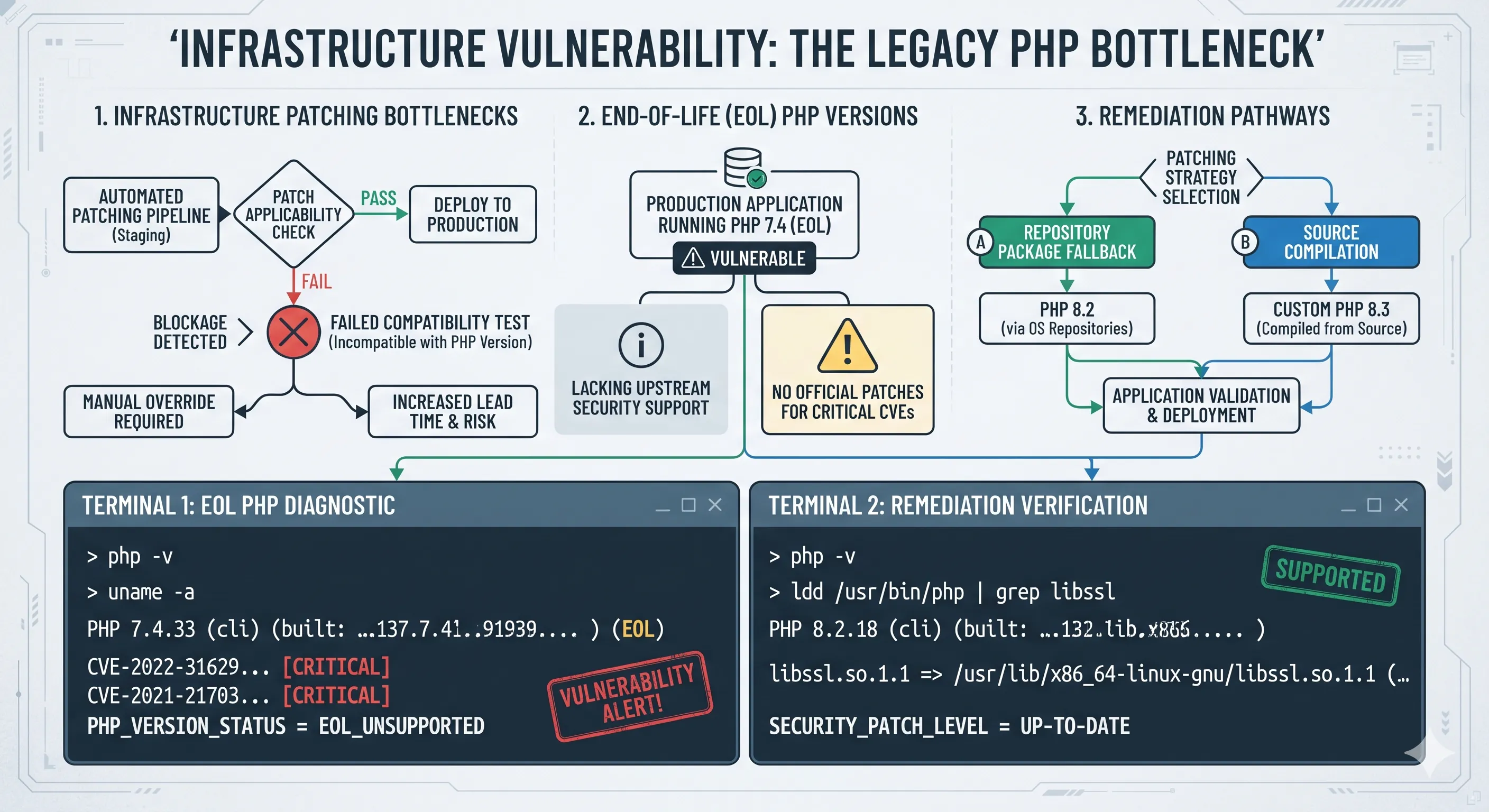
Official upstream PHP support is limited to version 8.2 and later branches.Servers running PHP 8.1 or older are end-of-life and will not receive an official fix from upstream PHP.
Consequently, organizations running legacy or end-of-life PHP installations—including 5.x, 7.x, 8.0, and 8.1—must seek backported patches from distributions or hosting providers, or isolate their environments.
Remi Repository Availability and Source Compilation Demands
Package delivery channels present an immediate bottleneck for operational deployment.Volunteers maintaining Remi's repository (rpms.remirepo.net), common on RHEL-based servers, will not publish updates on October 21.
The PHP Foundation confirmed that the volunteer-run Remi repository will not publish updates on October 21.
As an immediate result, organizations using Remi's repo must switch to native distribution PHP packages or compile PHP from source.
4. Interim Mitigations, Configuration Workarounds, and Planned Downtime
While software teams coordinate the deployment of vendor updates, understanding emergency defensive postures is essential to evaluating how PHP's emergency patches affect developers and operational workflows.Before official patches can be compiled, tested, and rolled out across production fleets, systems teams must deploy interim containment strategies at the network, web server, and runtime layers to neutralize attack vectors without introducing catastrophic downtime.
Blocking Multipart Requests and Web Server Hardening
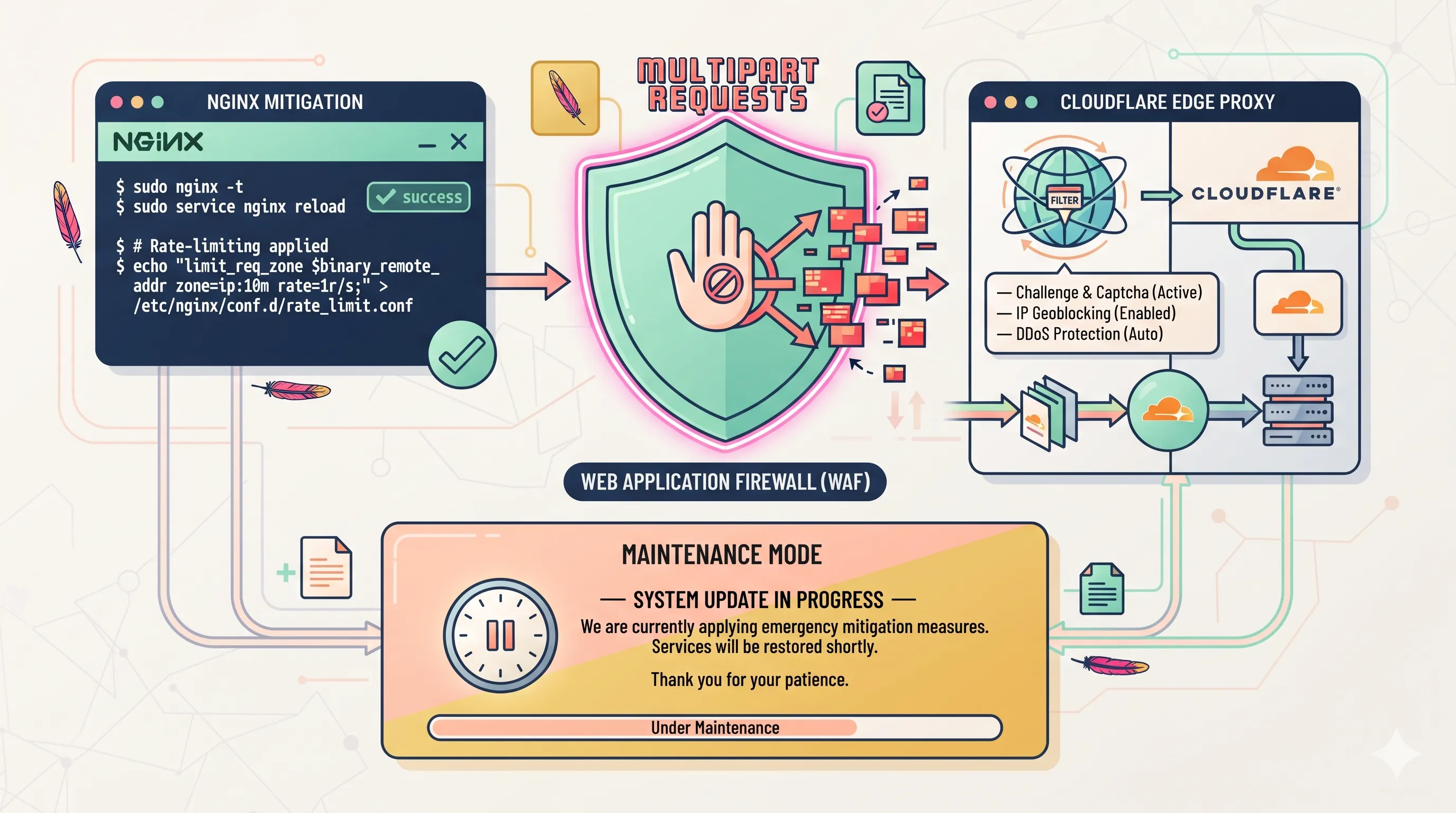
Frontline defense relies on stopping malicious payloads before the underlying PHP binary receives and parses the request stream.Web servers can be configured to block multipart/form-data request bodies before PHP parses file upload formats.
This interception prevents exploit payloads from reaching PHP's internal file handling routines entirely.
However, applying this rule carries operational trade-offs, as blocking multipart/form-data disables application file uploads, such as admin media libraries or product image updates.
For applications that cannot tolerate partial functional loss in standard interactive flows, setting servers to read-only by rejecting request methods other than GET and HEAD prevents form submission while permitting catalog browsing.
This method-level restriction safeguards the backend while keeping read-heavy endpoints accessible to end users.
To enforce these request-filtering directives, administrators must validate and apply the web server configuration changes safely.
Administrators must reload web server configuration after applying multipart/form-data blocking rules in Nginx to ensure syntax validity before execution.
nginx -t && systemctl reload nginxCloudflare WAF Defenses and Origin IP Restrictions
Edge security layers provide critical perimeter buffering while teams evaluate backend patch schedules.Cloudflare deployed WAF rules for customers across all plans, including the free tier, acting as a stopgap.
Despite this broad edge rollout, Cloudflare CTO Dane Knecht called the WAF rules a stopgap.
WAF filtering alone remains incomplete if threat actors can discover and query host infrastructure directly.
Cloudflare WAF protection requires the origin server firewall to accept HTTP and HTTPS connections strictly from Cloudflare IP ranges.
Without strict firewall ingress rules restricting traffic exclusively to those designated edge proxy addresses, attackers can circumvent edge protections entirely by addressing the origin IP address directly.
Session Setting Limits and Full Server Downtime Measures
Runtime configurations within the PHP environment provide supplementary barriers, but their defensive capabilities are strictly bounded.Adjusting PHP settings to disable session upload progress and enforce strict session mode provides additional non-guaranteed hardening.
Engineers must recognize that disabling session.upload_progress.enabled alone is insufficient and is not a guaranteed mitigation.
Furthermore, on stores keeping sessions in Redis or databases, strict session mode has no effect because PHP's handler does not implement the ID check.
When hardening these runtime pools, developers must apply changes directly to the process manager.
Operators must reload PHP-FPM workers after applying pool configuration hardening.
systemctl reload php8.3-fpm| Interim Mitigation Strategy | Operational Mechanism | Known Limitations and Side Effects |
|---|---|---|
| Blocking Multipart Requests | Web servers block multipart/form-data bodies before PHP parses file uploads. | Disables critical features including admin media libraries and product image updates. |
| Read-Only HTTP Methods | Rejects all HTTP request methods other than GET and HEAD. | Blocks all form submissions and interactive updates while allowing read-only catalog browsing. |
| Edge WAF Deployment | Filters traffic at the edge across all service tiers. | Serves strictly as a stopgap; requires origin firewalls to restrict ingress strictly to edge IP ranges. |
| Session Configuration Hardening | Disables session upload progress and enables strict session mode. | Not guaranteed; has no effect on stores storing sessions in Redis or external databases. |
| Static Maintenance / Server Isolation | Takes PHP server offline and routes requests to static fallback pages. | Results in planned site downtime; application-level maintenance flags fail to protect the runtime. |
Crucially, built-in maintenance flags inside Magento or WordPress do not mitigate attacks because PHP parses requests before the application runs.
Because the interpreter handles incoming request structures prior to loading framework logic, application-tier switches leave the server completely exposed.
Taking PHP servers offline or serving a static maintenance page is an effective interim measure.
PHP core developer Gina Peter Banyard called taking a PHP server offline for a day the most sensible option if affordable.
Demonstrating the necessity of isolation when patches cannot be instantly applied, Sansec reported Dutch entities including Tweakers, Tweede Kamer, NCSC, and Security.NL took sites offline as a precaution on October 21.
5. Runtime Threat Detection and Post-Exploitation Incident Response
Applying emergency patches to the core PHP engine resolves severe vulnerabilities at the interpreter level, but patching alone does not account for systems compromised prior to remediation.
For developers and infrastructure administrators, understanding how emergency patches impact operations extends directly to post-exploitation visibility and threat detection.
When an emergency patch is issued for remote code execution (RCE) flaws, host environments must be evaluated to verify that attackers did not exploit the gap before updates were finalized.
Monitoring Anomalous Child Processes Spawned by PHP Workers
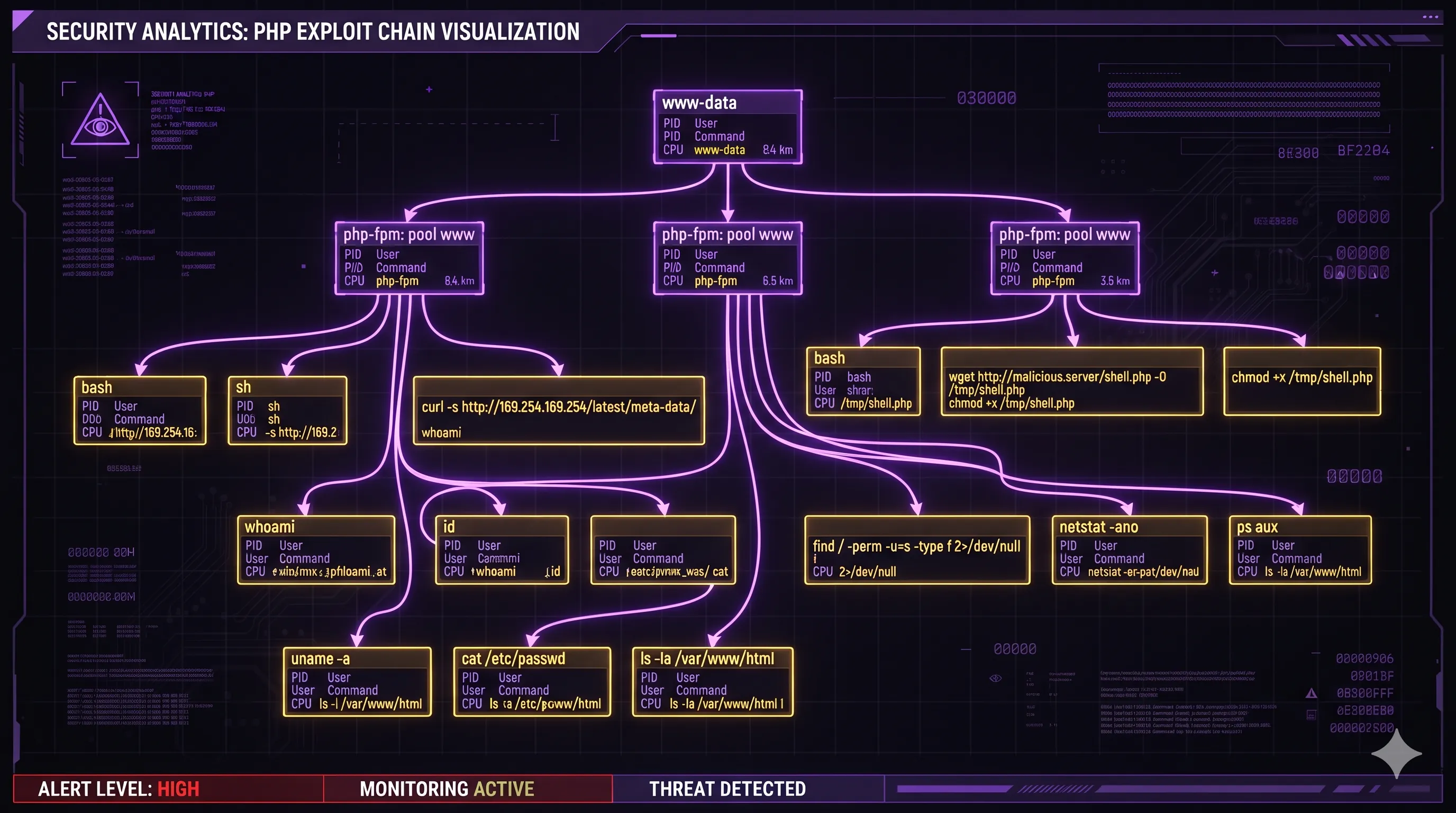
Exploitation of core PHP RCE flaws is expected to manifest primarily as abnormal child processes spawned by PHP worker runtimes, including php-fpm, php-cgi, httpd, and apache2.
Security analysis from Huntress highlighted Florian Roth's recommendation that exploitation will most likely show up as suspicious child processes spawned by PHP.
Under typical production workloads, standard PHP worker processes should rarely spawn interactive shells or command-line execution binaries directly.
Attackers executing arbitrary code via PHP workers routinely drop into interactive environments, call scripting interpreters, or fetch external tools.
A major operational blind spot is that Internet-facing Linux PHP servers and shared hosting environments often lack endpoint detection, allowing silent exploitation.
Runtime detection must specifically monitor for the invocation of shells such as sh, bash, cmd.exe, and powershell.exe.
Similarly, secondary execution patterns involving scripting interpreters like python and perl, alongside utility binaries such as curl, wget, nc, and certutil.exe, represent critical indicators of compromise when originating from web server worker processes.
| Category | Observed Binaries and Indicators | Parent Context and Execution Role |
|---|---|---|
| Interactive Shells | sh, bash, cmd.exe, powershell.exe |
Spawned as abnormal child processes by php-fpm, php-cgi, httpd, or apache2 to execute system-level commands. |
| Script Interpreters | python, perl |
Spawned by PHP workers to execute inline scripts, payloads, or automated secondary staging logic. |
| Download & Network Utilities | curl, wget, nc, certutil.exe |
Used to retrieve remote payloads, transfer tools, or establish network callbacks from the web runtime. |
| Reconnaissance Commands | whoami, id, uname -a, ipconfig |
Executed by threat actors immediately following successful exploitation to determine privileges and host specifications. |
| Reverse Shell Syntaxes | /dev/tcp/, fsockopen, mkfifo |
Network redirection mechanisms leveraged to route interactive control back to adversary infrastructure. |
Command-Line Reverse Shell and Reconnaissance Signatures
Once arbitrary code execution succeeds within a PHP worker runtime, adversaries typically generate recognizable command-line indicators.
Reverse shell syntaxes are commonly leveraged to establish persistent communication channels back to attacker-controlled infrastructure.
Security teams must monitor command-line arguments and process arguments for redirection strings such as /dev/tcp/, raw socket connections utilizing PHP's fsockopen, and named pipe mechanisms like mkfifo.
Immediate reconnaissance follows successful runtime intrusion as threat actors map the target environment.
Commands such as whoami and id are executed to confirm web server user context and privilege levels.
Simultaneously, commands including uname -a on Linux systems and ipconfig on Windows hosts are spawned to extract architecture parameters, kernel information, and network configuration details.
Identifying these commands running with a web server process as the parent provides direct confirmation of an active intrusion.
Runtime Process Watchers and Post-Incident Remediation
Because many internet-facing PHP installations operate without commercial endpoint detection and response (EDR) solutions, lightweight open-source alternatives are vital for detection.
Florian Roth's open-source Linux process-watcher tool provides runtime process visibility in observe mode on unmonitored servers.
Deploying process-watcher in observe mode enables administrators to capture ephemeral execution events, child process spawning, and command arguments from PHP workers without causing operational disruptions.
When abnormal process activity or reverse shell indicators are detected, teams must initiate post-exploitation incident response procedures immediately.
The first requirement is isolating compromised hosts from the production network to prevent lateral movement.
Incident responders must ensure the preservation of server and PHP logs, preventing attackers from wiping access trails.
Finally, responders must triage the filesystem by inspecting web roots for uploaded webshells, auditing system scheduler directories for unauthorized cron jobs, and scanning user databases for rogue accounts created to maintain persistence.
Related Posts


Generative AI may have assisted with research or drafting for this article. Topic selection, fact-checking, final wording, and publication remain the responsibility of DragonStone74. AI use disclosure