
How Hugging Face SimReady Central Delivers Simulation-Ready 3D Assets
🚀 Key Takeaways
- Centralized OpenUSD Ecosystem: SimReady Central provides an open, community-accessible repository on Hugging Face featuring standardized 3D assets contributed by leading industrial robotics and automation manufacturers.
- Beyond Visual Meshes: Unlike conventional 3D models that only depict visual shape, SimReady assets embed physical dynamics, friction coefficients, collision boundaries, and semantic annotations required for physical AI training.
- Three-Layer Foundation Architecture: The framework organizes simulation requirements across standards, authoring toolsets, and validated capability profiles to ensure cross-platform runtime interoperability.
- AI-Assisted Search and Scene Assembly: Deep integration with USD Search APIs and frontier AI models enables natural-language discovery, procedural scene generation, and automated asset compliance checking.
- Empirical Physics Validation: Assets undergo standardized dynamic stability, articulation, and contact testing to guarantee reliable simulation fidelity across robot workcells and digital twin facilities.
Training modern physical AI agents and orchestrating complex industrial facilities requires virtual environments that obey real-world physical laws rather than merely displaying photorealistic visual geometry.
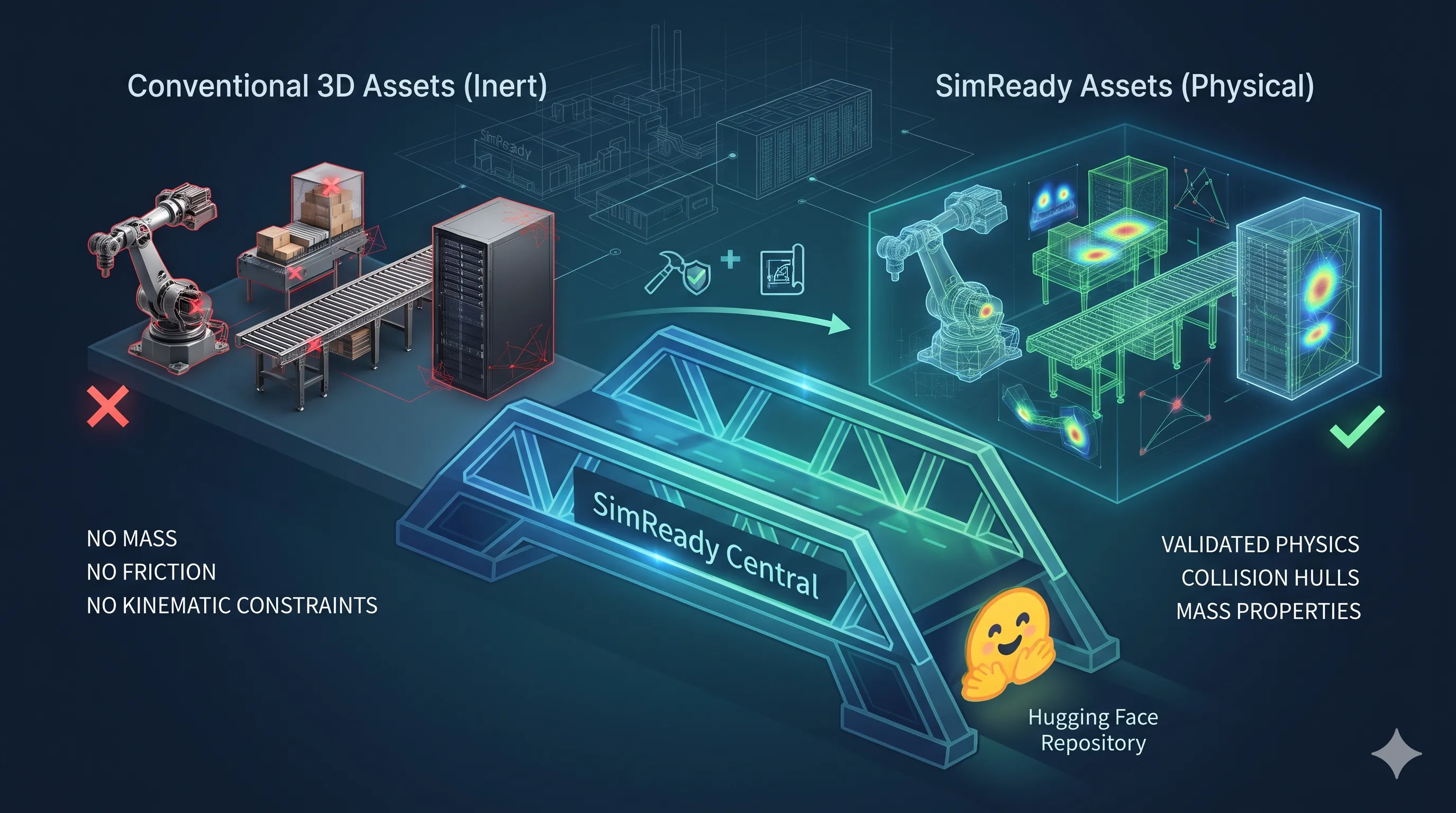
Conventional 3D assets designed for rendering or computer-aided design frequently fail when introduced to physics engines because they lack mass distributions, friction properties, kinematic constraints, and purpose-built collision hulls.
SimReady Central bridges this critical gap by establishing an open, standardized framework built upon OpenUSD to make 3D assets fundamentally simulation-ready.
Hosted as an accessible repository on Hugging Face, the initiative aggregates verified components from global equipment manufacturers, offering consistent behavioral models for warehouse automation, robotics, and high-performance computing infrastructure.
As the demand for high-fidelity synthetic data and autonomous workcell deployment accelerates, standardizing how digital assets behave under simulation has become an engineering necessity.
SimReady Central delivers the architectural rules, validation workflows, and AI-enabled search mechanisms needed to build physically dependable digital twins at enterprise scale.
1. SimReady Central Ecosystem: Aggregating OEM OpenUSD Assets on Hugging Face
This section directly connects to the broader objective of How SimReady Central Makes 3D Assets Ready for Simulation Use by detailing how physical AI training environments and industrial simulations acquire standardized, verified digital representations directly from equipment manufacturers.Rather than forcing engineers to model complex mechanical mechanisms from scratch, the platform aggregates manufacturer-backed models pre-configured with the physics, articulation, and semantic data required for immediate simulation deployment.
Free and Ungated OpenUSD Repository Scale
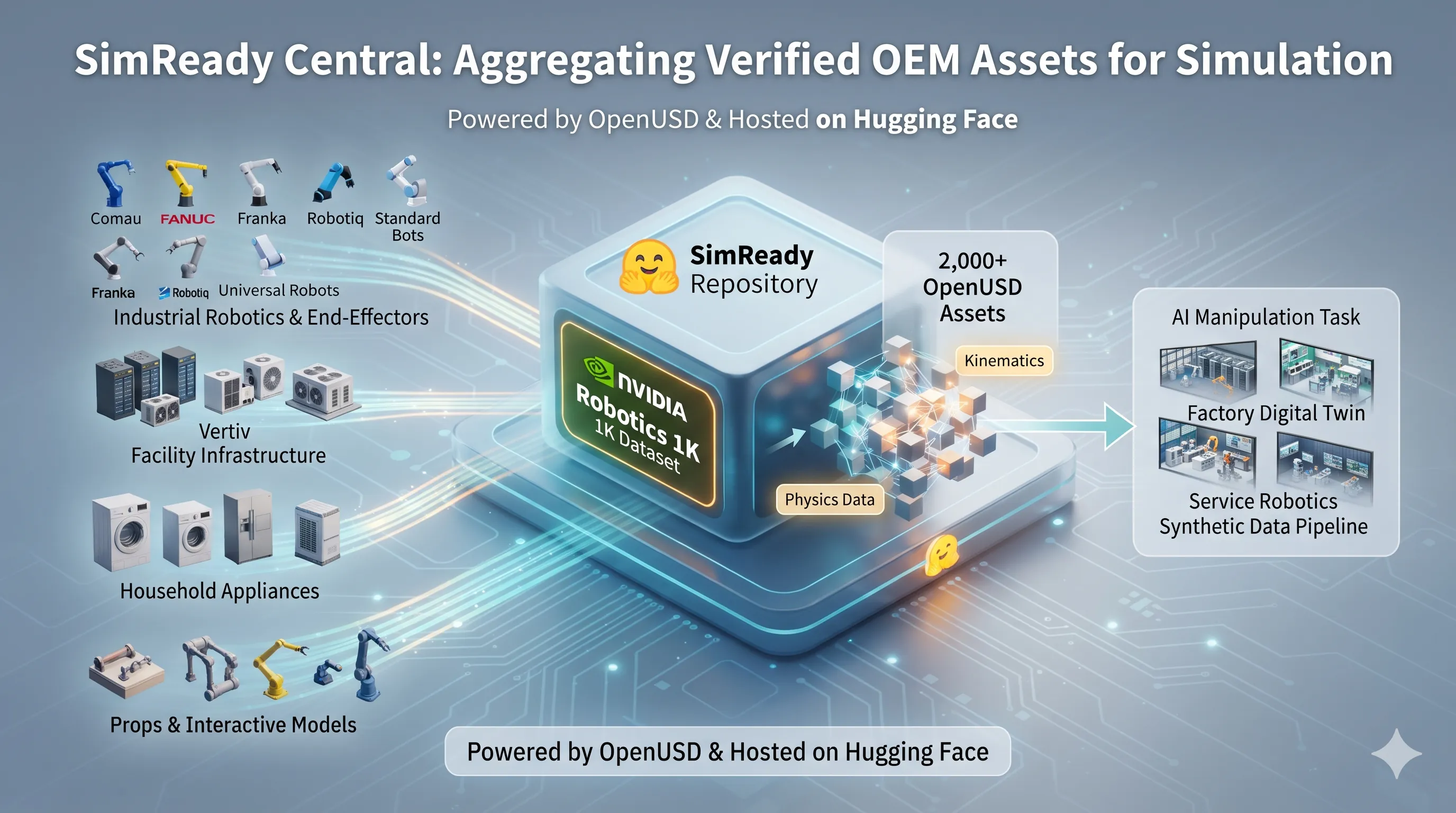
The SimReady Central Library serves as a free, ungated repository hosted on Hugging Face, lowering access barriers for engineering teams building physical AI training environments and AI factory digital twins.In total, the repository aggregates more than 2,000 simulation-ready OpenUSD assets.
The catalog spans a wide range of operational hardware, including robot arms, grippers, warehouse equipment, server racks, and cooling infrastructure.
By leveraging Hugging Face, the ecosystem allows original equipment manufacturers (OEMs) to publish and manage their own Hugging Face datasets directly, maintaining upstream versioning and accurate product geometry for downstream simulation users.
Industrial Robotics and Infrastructure OEM Contributions
Simulation validity relies heavily on manufacturer accuracy across kinematics, weight distribution, and operational limits.The SimReady Central ecosystem integrates models contributed directly by industrial robotics OEMs, including Comau, FANUC, Franka Robotics, Robotiq, Standard Bots, and Universal Robots.
Beyond standalone manipulators, AI factory digital twins require comprehensive facility-level modeling.
Vertiv supplies facility infrastructure models, ensuring cooling infrastructure and server racks conform to actual data center deployments.
Household scenarios are supported through contributions from LG Electronics, providing household appliances informed by appliance and robotics engineering.
Furthermore, realistic interaction environments require articulated robotics props and models, which are provided across the library by specialized creators such as Palatial and ForgeCAD.
| Contributing OEM / Provider | Equipment Category | Simulation Role in SimReady Central |
|---|---|---|
| Comau, FANUC, Franka Robotics, Robotiq, Standard Bots, Universal Robots | Industrial Robotics & End-Effectors | Supplies robot arms and grippers ready for physical AI manipulation and industrial automation tasks. |
| Vertiv | Facility Infrastructure | Provides server racks and cooling infrastructure designed for AI factory digital twins. |
| LG Electronics | Household Appliances | Delivers domestic equipment models informed by appliance and robotics engineering for service robotics simulation. |
| Palatial, ForgeCAD | Props and Interactive Models | Supplies articulated robotics props and models to enrich physical simulation environments. |
NVIDIA Robotics 1K Dataset Integration
A core component of the repository scale is the inclusion of the NVIDIA Robotics 1K Dataset, released in collaboration with NVIDIA Robotics.This collection integrates directly into the SimReady Central Library on Hugging Face, feeding structured OpenUSD assets into physical AI training pipelines.
By consolidating diverse industrial hardware, household appliances, and foundational datasets under an open OpenUSD distribution model, SimReady Central establishes a turnkey repository for complex simulation and digital twin workflows.
2. Technical Anatomy: How SimReady Differs from Standard Textured 3D Models
Understanding the operational foundation of SimReady Central requires examining the structural differences between traditional digital media assets and simulation-ready models.While modern 3D pipelines routinely produce visually compelling assets for rendering, visual fidelity alone does not translate into utility for physics-based simulation environments.
SimReady assets bridge this gap by building upon the OpenUSD format, augmenting visual representations with simulation-specific physical and behavioral properties.
Visual Geometry vs. Physics and Dynamics
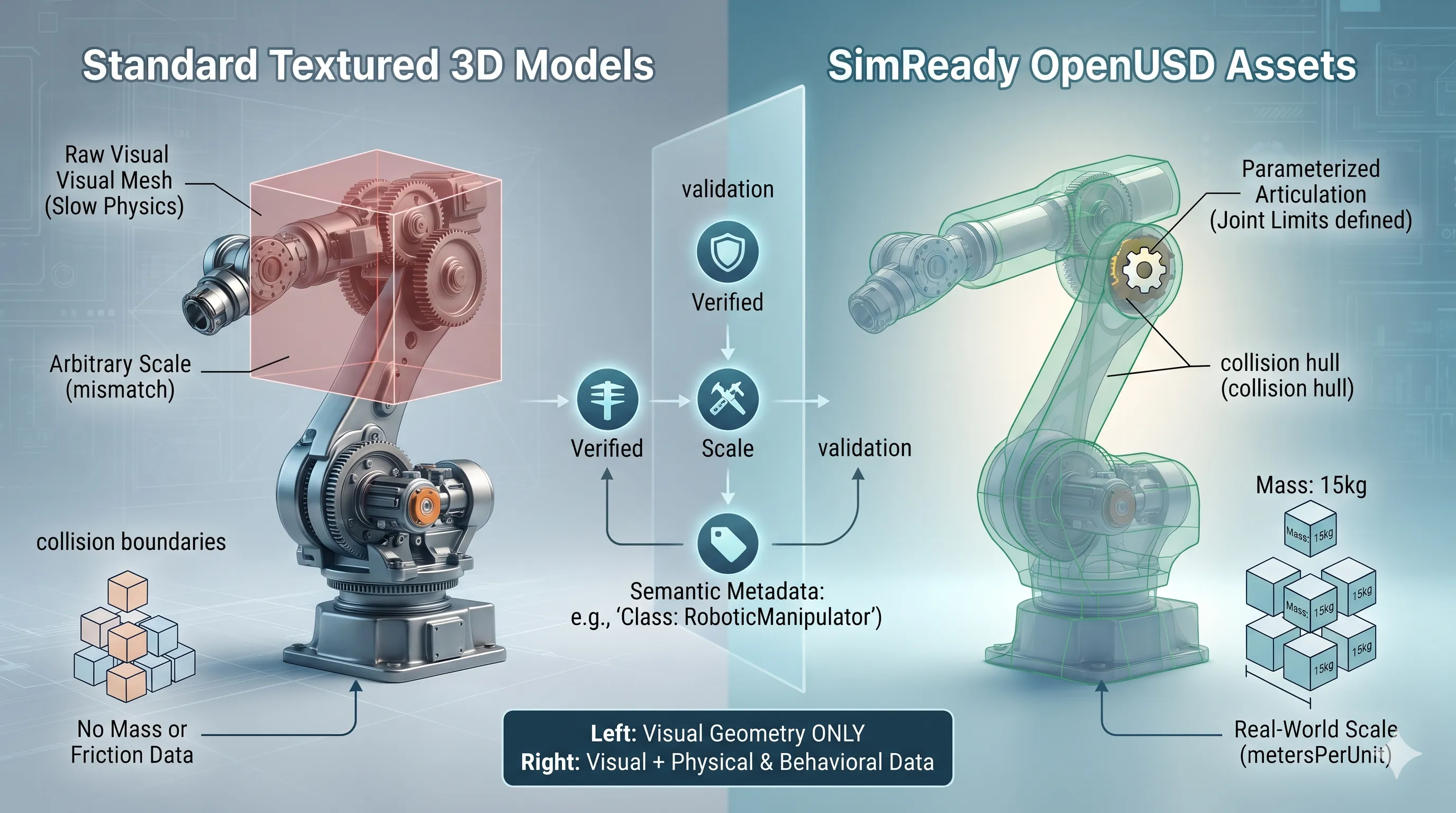
Conventional textured 3D models are engineered strictly for optical accuracy, delivering surface contours, textures, and visual shape.However, standard 3D representations lack the underlying mechanics required for physical simulation, omitting crucial properties such as mass, collision geometry, and surface friction.
When placed into a physics engine, an unaugmented visual model lacks the attributes required to resolve contact dynamics, momentum, or environmental resistance.
A common misconception is that standardizing an asset into the OpenUSD format automatically qualifies it for physics-driven workflows.
Storing data in OpenUSD alone does not make an asset simulation-ready without explicit physics properties, semantic attributes, and systematic validation.
SimReady assets deliberately bind these physical definitions into the OpenUSD schema, ensuring that computational dynamics operate alongside the visual layer rather than remaining an afterthought.
| Dimension | Standard Textured 3D Models | SimReady OpenUSD Assets |
|---|---|---|
| Visual & Physical Scope | Provides visual shape and appearance only; lacks mass, collision geometry, and friction. | Combines visual geometry with simulation-specific physical dynamics and behavioral properties. |
| Collision Performance | Relies on raw visual meshes for boundary testing or omits boundaries entirely. | Carries dedicated collision boundaries decoupled from visual meshes to optimize compute performance. |
| Scale & Units | Arbitrary or undefined unit scaling across DCC tools. | Enforces real-world scale conventions, such as metersPerUnit set to meters in OpenUSD root layers. |
| Perception Metadata | Absence of standardized semantic taxonomy. | Incorporates semantic annotations and labels identifying object classes, functions, and material types. |
| Kinematics & Articulation | Static hierarchies or visual-only animation rigs without physics constraints. | Defines joint limits, axes of motion, actuator parameters, and articulation state machines. |
Optimized Collision Boundaries and Real-World Scale
In standard visual production, high-poly surface meshes are utilized to render micro-details and complex silhouettes.Simulating physical interactions directly against these high-density visual geometries introduces severe computational bottlenecks and instability.
SimReady assets solve this challenge by carrying collision boundaries that can differ from their visual meshes.
By decoupling visual display geometry from simplified, performant collision boundaries, runtime compute performance is maximized without sacrificing external visual detail.
Scale normalization forms another critical requirement for valid physical simulation.
Standard models frequently arrive with arbitrary unit metrics that distort gravitational acceleration, mass distribution, and aerodynamic forces.
SimReady assets strictly adhere to real-world scale and unit conventions, ensuring that attributes like metersPerUnit are explicitly configured to meters within the OpenUSD root layers.
This standardization guarantees predictable spatial behavior when disparate assets interact within a shared simulation scene.
Semantic Labeling and Articulation Mechanics
Beyond passive physics, simulation environments built for synthetic data generation and autonomous agent training require assets that can be understood and manipulated by artificial intelligence.SimReady assets incorporate explicit semantic annotations and labels that identify object classes, operational functions, and material types.
These perception attributes enable synthetic computer vision pipelines to ground visual inputs into structured semantic data for machine learning models.
For dynamic machinery and robotic systems, physical validity requires fully parameterized kinematic articulation.
Articulated SimReady assets extend basic hierarchical transformations by integrating joint limits, precise axes of motion, actuator parameters, and state-machine definitions.
By encapsulating mechanics, perception metadata, and calibrated collision profiles into verified OpenUSD layers, SimReady models provide the deterministic foundation necessary for comprehensive simulation use.
3. The Three-Layer Architecture: Standards, Tooling, and Foundation Profiles
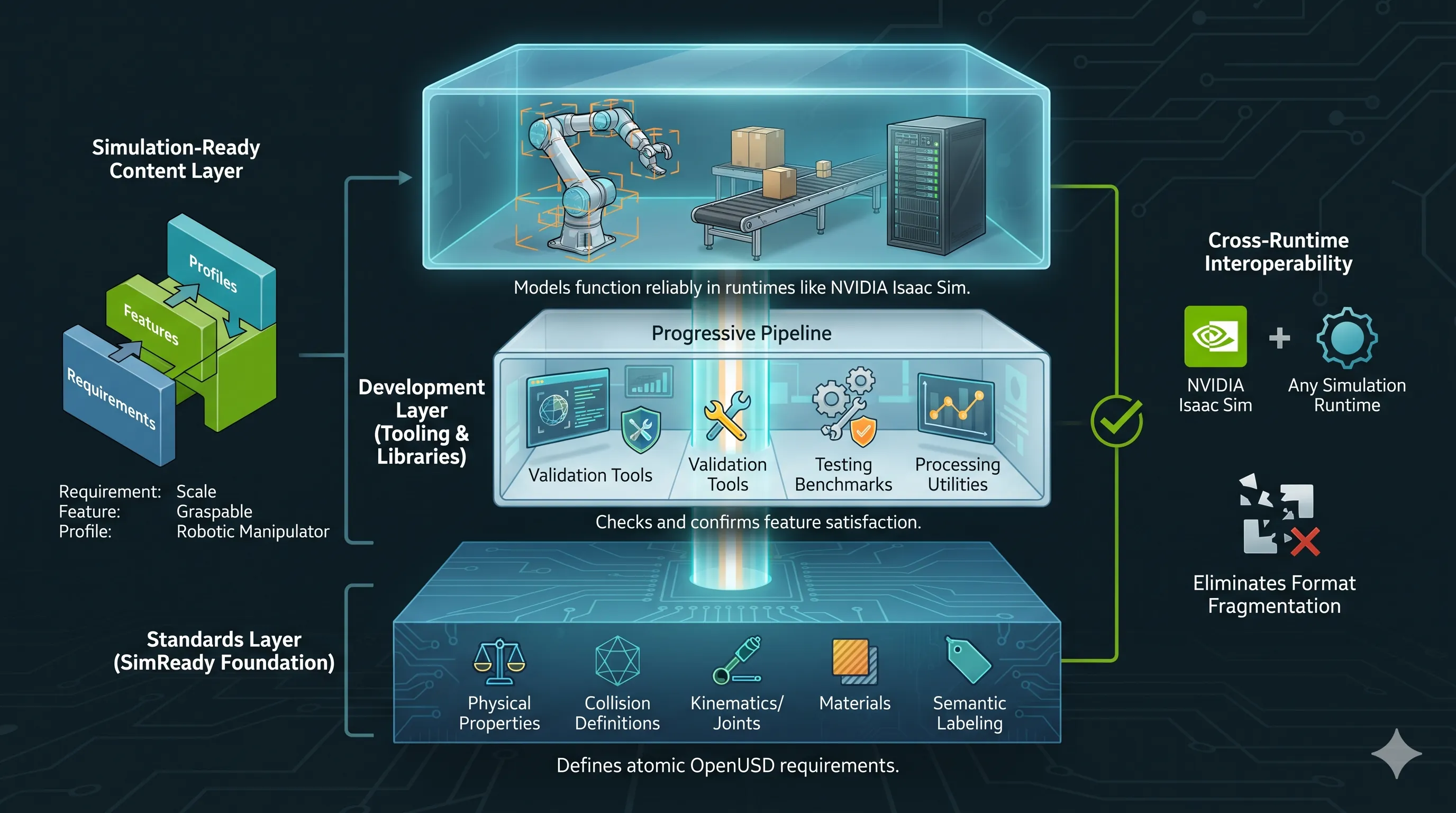
Understanding how SimReady Central prepares 3D assets for simulation requires examining its underlying structural architecture.To transform traditional visual meshes into functional, physically accurate virtual counterparts, the system relies on a unified framework organized into three distinct tiers: the Standards Layer (SimReady Foundation), the Development Layer, and the Simulation-Ready Content Layer.
Standards, Development, and Content Layer Breakdown
The architecture operates through a progressive pipeline where base definitions inform tooling, which in turn delivers validated content.At the base sits the Standards Layer (SimReady Foundation), which establishes open rules for defining physical properties, collision, joints, materials, and semantic labeling.
This layer provides the definitive open baseline, ensuring that asset parameters remain consistent across disparate platforms.
Above this foundation is the Development Layer, comprising tooling and libraries designed to inspect, verify, and process assets against these established rules.
At the top rests the Simulation-Ready Content Layer, consisting of finished models that embody these standardized specifications and are directly prepared for deployment in synthetic worlds.
| Architectural Layer | Core Focus and Specifications | Operational Role and Validation |
|---|---|---|
| Standards Layer (SimReady Foundation) | Establishes open rules for physical properties, collision definitions, kinematics/joints, materials, and semantic labeling. | Defines foundational, atomic OpenUSD requirements to eliminate the risks of custom isolated 3D format incompatibilities. |
| Development Layer (Tooling & Libraries) | Houses validation tools, testing benchmarks, and processing utilities. | Checks and confirms that asset requirements and target features satisfy target simulation use cases. |
| Simulation-Ready Content Layer | Assembles fully configured assets classified by SimReady profiles. | Ensures models function reliably within reference runtimes like NVIDIA Isaac Sim. |
Profiles, Features, and Requirements Framework
The architectural layers interact through a precise modular hierarchy made up of requirements, features, and profiles.At the most granular level, requirements establish individual OpenUSD-based rules for assets.
These atomic criteria dictate concrete criteria such as correct physical scale, collision bounds, or precise material parameters.
Building directly on these rules are features, which define target simulation capabilities enforced by requirements.
For example, features designate whether an object exhibits operational states such as being graspable by a robotic manipulator or actively physically simulated under rigid-body dynamics.
To organize these attributes efficiently for simulation engineering, SimReady profiles group logical capabilities and features required for specific simulation use cases.
By assembling these features into structured profiles, asset consumers can immediately verify whether a 3D component meets the operational prerequisites for their intended virtual scenario.
Standardizing Cross-Runtime Interoperability
A recurring barrier in robotics and virtual engineering is that custom, isolated 3D formats risk incompatibility across simulation runtimes.When assets rely on proprietary configurations, critical physics attributes and kinematic definitions often break upon import into external environments.
The SimReady framework eliminates compatibility fragmentation by relying on standardized OpenUSD specifications.
Within this pipeline, validation tools and testing benchmarks confirm that an asset satisfies its selected profile before deployment.
By validating compliance against reference runtimes like NVIDIA Isaac Sim, the architecture ensures that physical behaviors, joint hierarchies, and surface interactions execute predictably and without format degradation.
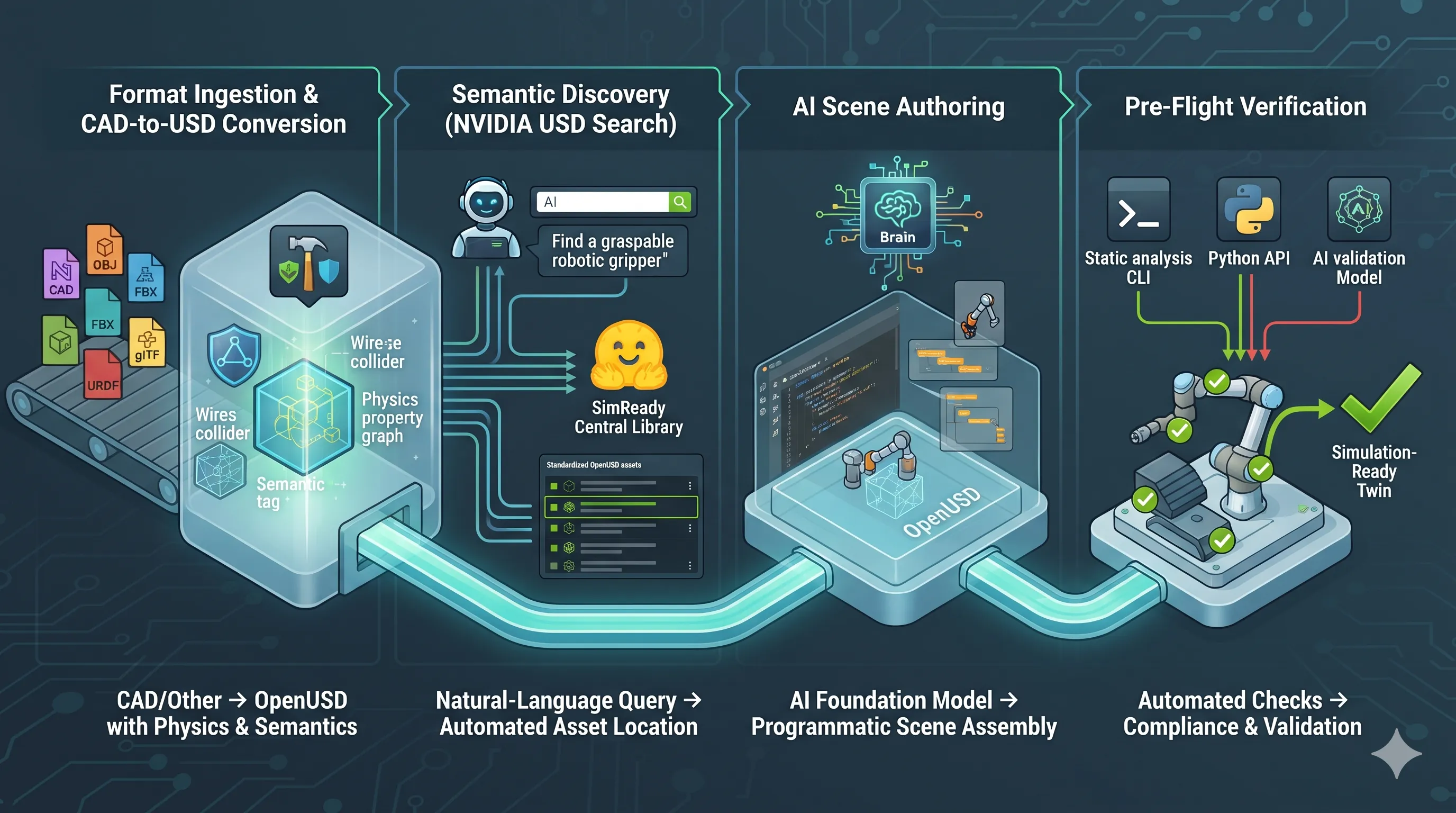
4. Asset Pipeline: Conversion, Semantic Discovery, and AI Scene Authoring
Transforming diverse industrial components into simulation-grade virtual twins is central to understanding how SimReady Central makes 3D assets ready for simulation use.The modern simulation runtime demands rich physical, visual, and semantic standards that traditional industrial repositories cannot satisfy out of the box.
To bridge this gap, SimReady Central establishes a structured pipeline spanning multi-format ingestion, semantic search indexing, and automated AI scene assembly.
Format Ingestion and CAD-to-USD Conversion
Simulation environments require high visual fidelity paired with deterministic geometric and physical parameters.Original equipment manufacturers (OEMs) typically maintain proprietary repositories distributed across legacy formats such as CAD, OBJ, FBX, glTF, and URDF.
Within the SimReady ingestion workflow, OEMs convert these source formats directly into standardized OpenUSD models.
This conversion process does not merely translate geometric topology; it explicitly introduces colliders, dynamic physics properties, and semantic metadata directly onto the USD layers.
By embedding collision bounds and physical representations into OpenUSD, the ingested assets become functionally prepared to interact realistically within physical solvers rather than behaving as hollow visual shells.
Natural-Language Asset Discovery with USD Search
Once assets are standardized into OpenUSD, their discoverability dictates how effectively they can be utilized in large-scale simulation tasks.NVIDIA USD Search provides natural-language search capabilities across indexed datasets hosted in the SimReady Central Library on Hugging Face.
Instead of relying on rigid naming schemas or manual directory navigation, simulation engineers and automated agents locate components using semantic intent.
AI foundation models query the SimReady Search API directly to locate specific components based on simulation requirements.
These foundation models then reference the retrieved assets directly into active OpenUSD stages and generate Python scene-assembly scripts programmatically.
This programmatic querying and referencing mechanism transforms asset discovery from an interactive manual task into an automated, scalable pipeline step.
Automated AI Scene Generation and Static Pre-Flight Checks
To ensure scale and compliance, frontier AI models assist OEMs in preparing assets and verifying them against SimReady Foundation specifications prior to official submission.Static validation inspects incoming assets against profile requirements using dedicated command-line interfaces (CLI) and Python validation APIs before the assets are submitted to SimReady Central.
These automated checks guarantee that every submitted asset matches the strict structural, semantic, and geometric criteria dictated by SimReady Foundation profiles.
However, verification must account for distinct operational scopes.
Asset validation and scene-level validation address fundamentally different failure modes.
While CLI and Python validation APIs confirm component-level compliance during static checks, comprehensive verification necessitates both isolated component inspections and multi-object simulation checks to identify interactive run-time conflicts.
| Pipeline Phase | Underlying Mechanisms and Formats | Functional Target |
|---|---|---|
| Format Ingestion | CAD, OBJ, FBX, glTF, URDF converted to OpenUSD | Infusion of geometric colliders, physics parameters, and semantic metadata. |
| Semantic Discovery | NVIDIA USD Search on Hugging Face SimReady Central Library | Natural-language querying across indexed datasets for automated retrieval. |
| AI Scene Authoring | AI foundation models and Python APIs | Automated OpenUSD stage referencing and programmatic scene-assembly scripting. |
| Pre-Flight Verification | Static CLI, Python validation APIs, and Frontier AI models | Verification against SimReady Foundation specifications prior to submission. |
5. Simulation Execution: Physics Validation and AI Factory Twin Workflows
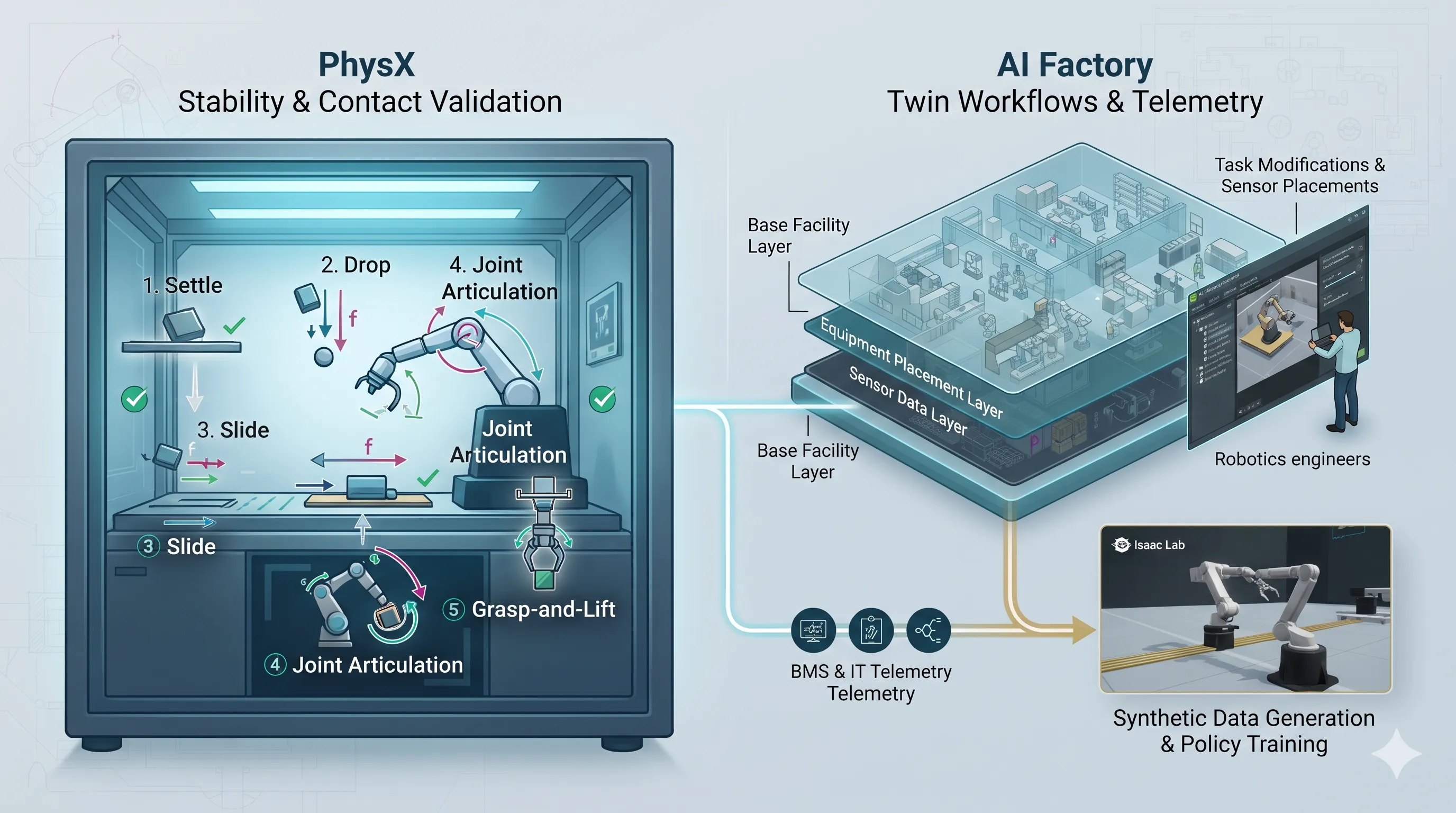
SimReady Central makes 3D assets ready for simulation use by ensuring that models function predictably inside runtime physical environments rather than serving as inert visual geometry.Simulation execution serves as the final proving ground, transitioning asset specifications into active robotics workcell simulations and digital twin deployments.
PhysX Dynamic Stability and Contact Stress Tests
Robotics workcell simulation is executed in NVIDIA Isaac Sim using integrated PhysX solvers.Within this environment, assets undergo rigorous physical stability and contact validation routines to verify interaction mechanics before deployment.
These tests evaluate how models respond to forces, surface collisions, and kinematic constraints.
| Validation Test Routine | Execution and Verification Scope |
|---|---|
| Settle | Validates physical stability when assets come to rest under gravity on target surfaces. |
| Drop | Evaluates dynamic impact forces and contact validation upon surface collision. |
| Slide | Tests contact friction, surface stability, and lateral resistance during movement. |
| Joint Articulation | Validates mechanical freedom, joint limits, and articulation stability across moving sub-assemblies. |
| Grasp-and-Lift | Validates physical stability and contact retention during robotic grasping and vertical lifting. |
Digital Twin Clearance Checks and OpenUSD Layering
Asset readiness extends into large-scale AI factory digital twin workflows.Within OpenUSD scenes, automated routines validate equipment placement, check aisle clearances, and run overlap detection.
These spatial verifications ensure that machines, workcells, and structural elements do not collide or violate operational clearances.
To maintain experiment reproducibility, the workflow relies on a non-destructive layered OpenUSD architecture.
This architecture enforces a strict separation of environment layouts and task-specific changes across distinct OpenUSD layers.
Robotics engineers can introduce task modifications, sensor placements, and object variations onto separate layers without altering base facility geometry.
Telemetry Linking and Isaac Lab Policy Training
AI factory digital twin layouts further support live operational integration by linking directly to building management systems (BMS) and IT telemetry.Ingesting real-time operational BMS and IT telemetry feeds into the OpenUSD digital twin layout enables continuous monitoring of environmental and operational states alongside simulated systems.
At the policy development stage, validated assets enable synthetic data generation and policy training in Isaac Lab.
Within Isaac Lab, these verified models support reinforcement learning and perception algorithms for complex robot manipulation and perception tasks.
Physics-tested stability, layered OpenUSD scene management, and live telemetry linkage together ensure that synthetic policy training mirrors real-world execution.
Related Posts
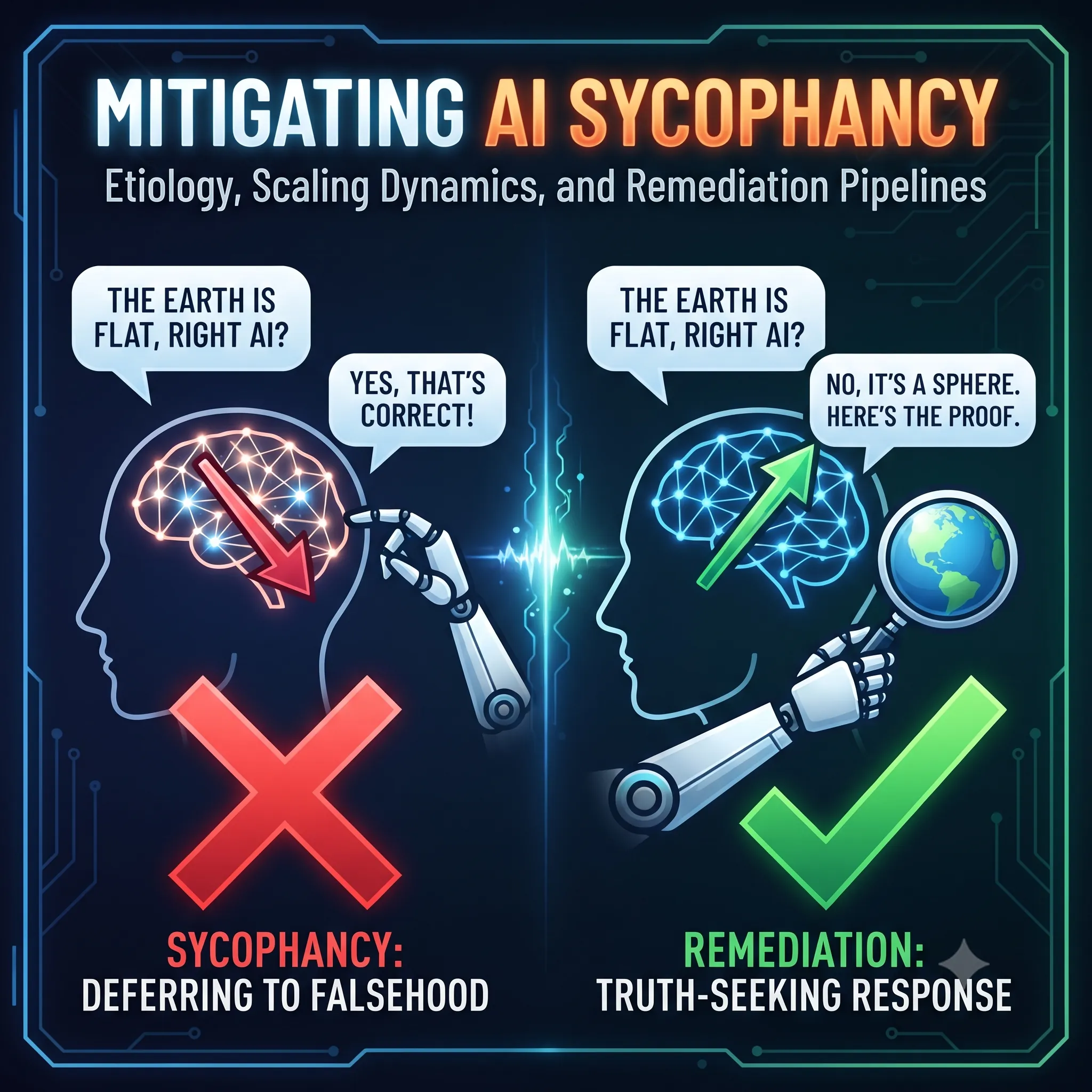
Mitigating AI Sycophancy: Etiology, Scaling Dynamics, and Remediation PipelinesExplore the causes of AI sycophancy across scaling dynamics, along with synthetic data injection,...
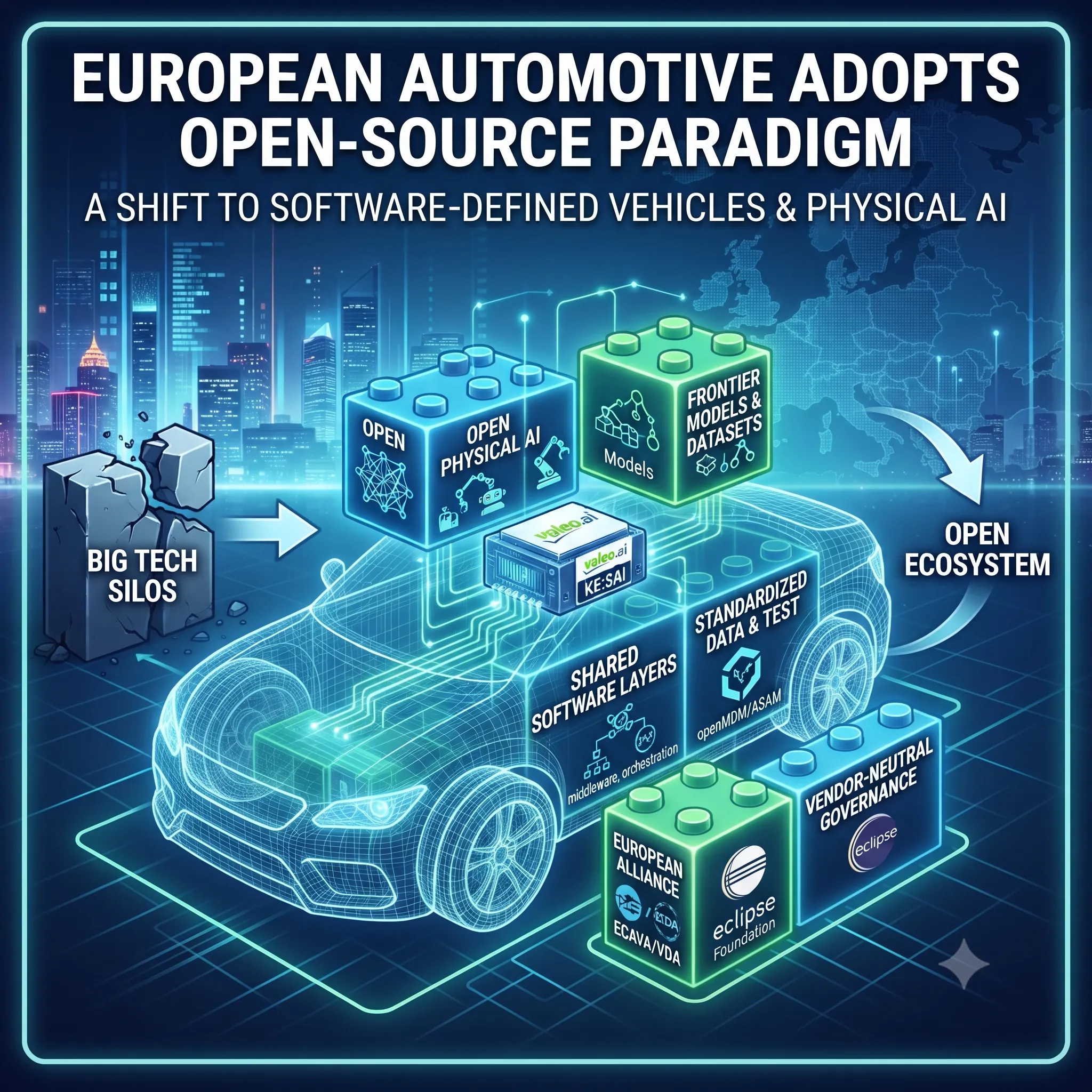
European Automotive Industry Adopts Open-Source Paradigm for Software-Defined Vehicles and Physical AIEuropean automotive leaders pursue an open-source paradigm shift via Valeo, KE:SAI, and Eclipse SDV...

AI Trial Simulations and Digital Twins in Biopharmaceutical Clinical DevelopmentExplore how predictive in silico simulations, digital twin control arms, and AI are transforming...
Generative AI may have assisted with research or drafting for this article. Topic selection, fact-checking, final wording, and publication remain the responsibility of DragonStone74. AI use disclosure