
European Automotive Industry Adopts Open-Source Paradigm for Software-Defined Vehicles and Physical AI
🚀 Key Takeaways
- European industrial leaders and research labs are pursuing an open-source paradigm shift to prevent Big Tech monopolies from dominating autonomous vehicle platforms.
- Initiatives like Eclipse SDV deliver vendor-neutral, code-first architectures that unify core middleware and vehicle orchestration frameworks.
- Strategic research collaborations, including Valeo and KE:SAI, aim to democratize frontier physical AI by releasing models, weights, and datasets publicly.
- Backed by the German VDA and the European Commission's ECAVA, cross-industry alliances are co-developing non-differentiating software layers to drastically reduce R&D overhead.
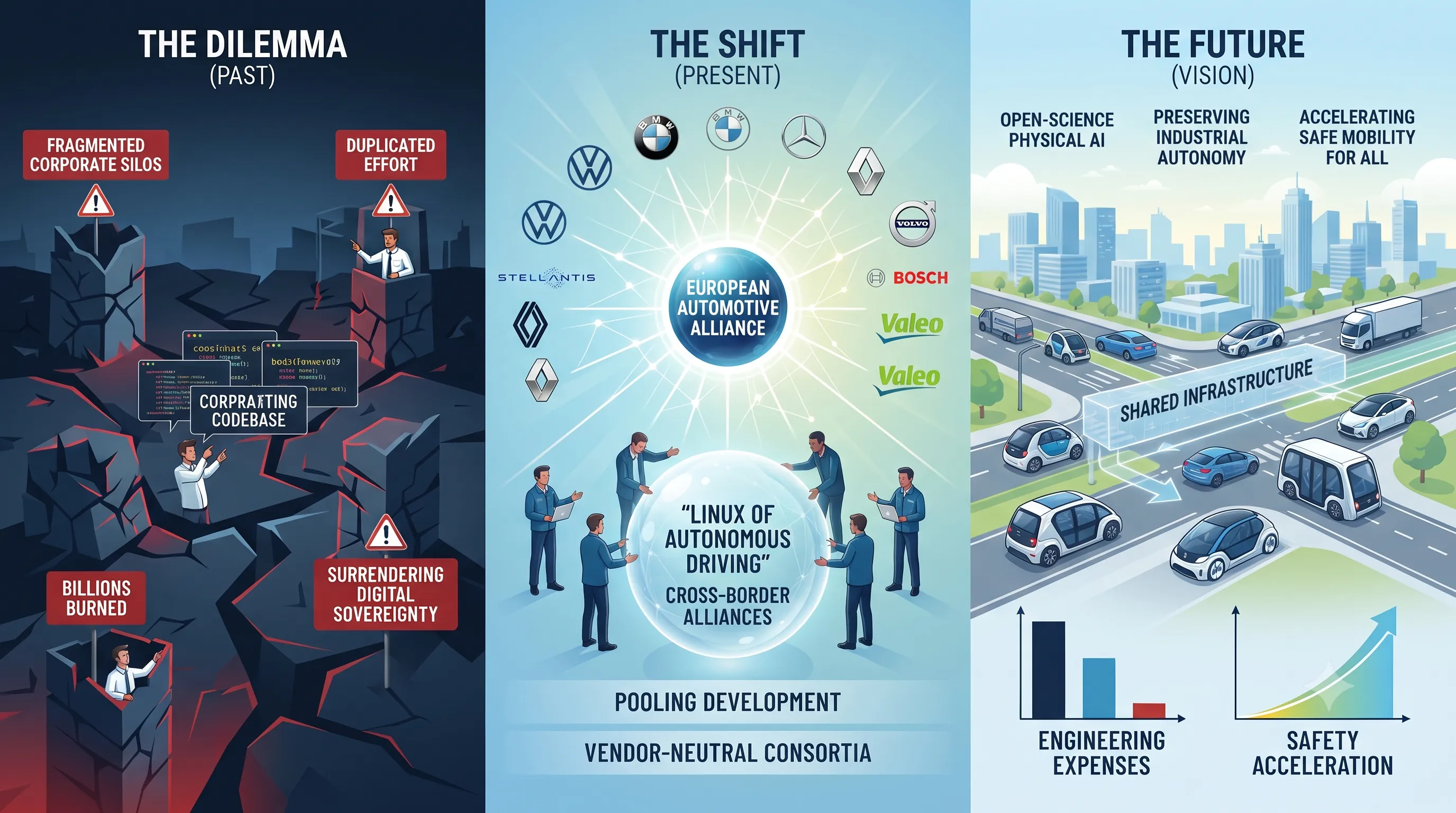
For years, legacy automakers faced an existential dilemma: risk surrendering digital sovereignty to proprietary Big Tech ecosystems or burn billions duplicating foundational software in fragmented corporate silos. As software-defined vehicles (SDVs) rewrite the competitive landscape of the automotive industry, European manufacturers and suppliers are executing a decisive counter-strategy rooted in the proven playbook of enterprise computing.
Rather than building closed, isolated codebases, Europe's automotive ecosystem is forging cross-border alliances to construct the "Linux of autonomous driving." By pooling development across vendor-neutral consortia and championing open-science physical AI, industry stakeholders are establishing shared infrastructure that preserves industrial autonomy, slashes redundant engineering expenses, and accelerates safe mobility for all.
Rather than building closed, isolated codebases, Europe's automotive ecosystem is forging cross-border alliances to construct the "Linux of autonomous driving." By pooling development across vendor-neutral consortia and championing open-science physical AI, industry stakeholders are establishing shared infrastructure that preserves industrial autonomy, slashes redundant engineering expenses, and accelerates safe mobility for all.
1. The Valeo and KE:SAI Initiative: Building an Open Foundation for Physical AI in Autonomous Driving
The European automotive industry's push to build an open, shared architecture—effectively creating an open-source Linux for autonomous mobility to counter closed Big Tech monopolies—is anchored by the collaboration between Tier-1 supplier Valeo and open science research lab KE:SAI.By moving away from siloed software development, the initiative directly challenges the proprietary physical AI stacks developed by technology conglomerates.
Democratizing Physical AI: Bridging the Gap with Open Science
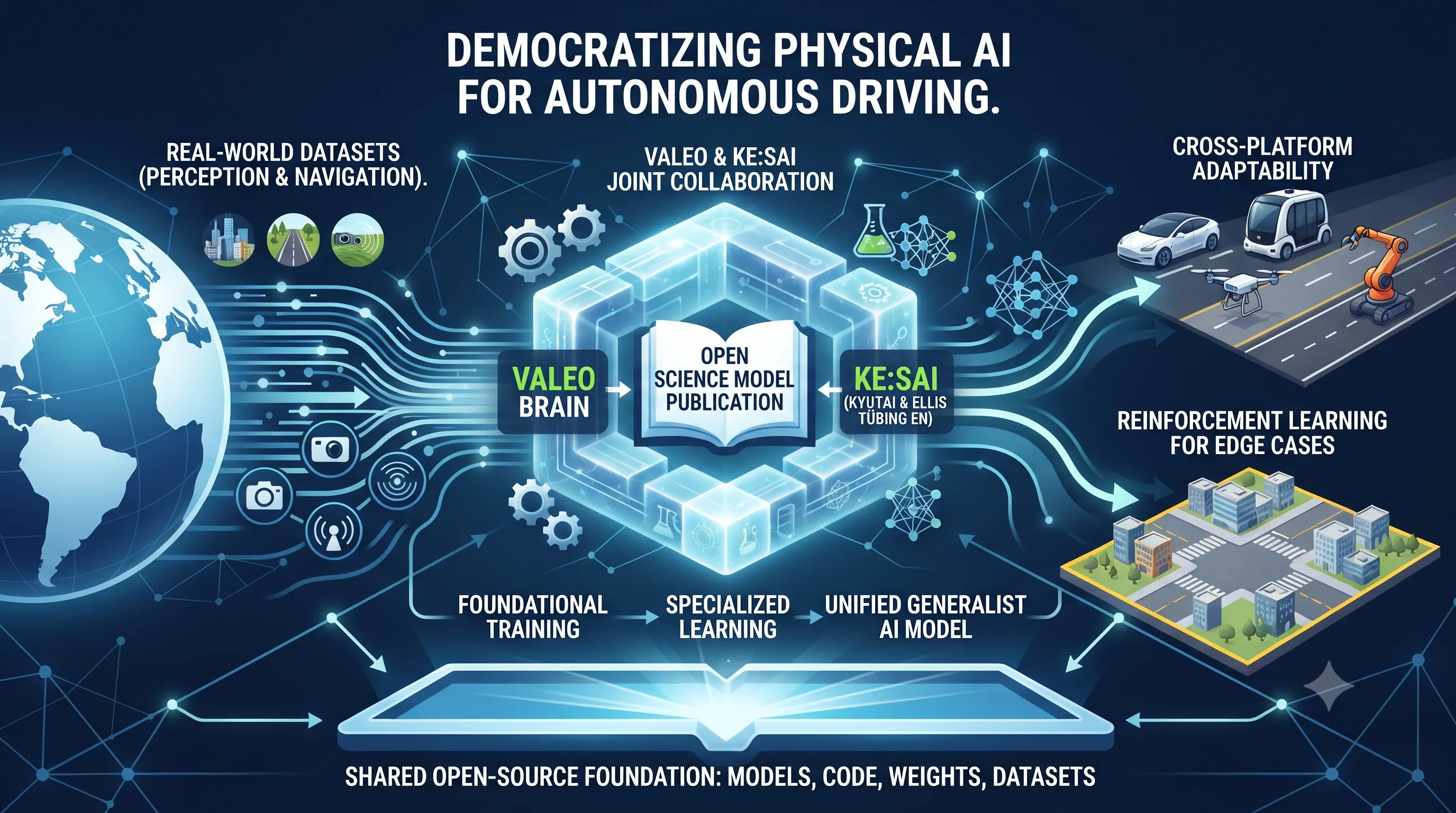
While open-source collaboration dramatically accelerated foundational natural language processing, frontier physical AI for robotics and autonomous driving has remained largely closed.To resolve this imbalance, Valeo and KE:SAI launched a joint research collaboration to develop a generalist AI driving system for autonomous vehicles.
The partnership bridges industrial engineering and institutional research, uniting teams from valeo.ai in Paris with KE:SAI in Tübingen, Germany.
KE:SAI itself provides deep scientific backing, having been co-founded by the open-science research organization Kyutai and the ELLIS Institute Tübingen.
To eliminate closed ecosystems in physical autonomy, the collaboration is structured around a commitment to publish the resulting models, code, weights, and datasets as accessible open-source resources.
Marc Vrecko, CEO of Valeo Brain, articulated the industrial objective behind the project: "This open-science collaboration with KE:SAI marks a strategic milestone for Valeo and the broader European automotive ecosystem. By combining our deep industrial and technological expertise in autonomous driving with world-class open-source research, we are establishing a shared foundation to accelerate the development of physical AI and democratize next-generation self-driving technologies."
Andreas Geiger, CEO of KE:SAI, emphasized the necessity of open science in frontier robotics: "For language models, open source compressed years of progress into months, yet frontier physical AI is still largely closed. Valeo shares our belief that open foundations create more innovation than any closed system ever could. Everything we develop will be open. Every step forward is a step forward for everyone."
Cross-Platform Architecture: From Real-World Datasets to Simulation Reinforcement
The technical objective of the Valeo and KE:SAI initiative centers on training a unified AI model capable of operating reliably across heterogeneous vehicle platforms, distinct sensor configurations, and diverse geographic environments.Rather than constraining the autonomous stack to a single proprietary hardware layout, the system is engineered from the ground up for cross-platform adaptability.
To realize this generalist capability, the initiative deploys a dual-stage development methodology.
Initial model training leverages large-scale real-world driving data to establish foundational perception and navigation representations.
Following this baseline training, the pipeline integrates reinforcement learning conducted within simulated environments specifically targeting edge cases and rare driving scenarios that are difficult or unsafe to collect in real-world road tests.
By openly distributing this complete pipeline, Valeo and KE:SAI intend to provide automakers, component suppliers, and academic laboratories with a standardized reference system for autonomous driving research and development.
2. Inside valeo.ai: Bridging Academic AI Research and Industrial Autonomous Mobility
Connecting directly to the broader mission of creating an open, collaborative foundation for autonomous mobility against proprietary Big Tech stacks, valeo.ai functions as a core scientific pillar.Core Research Agenda: Advanced Computer Vision and Autonomous AI
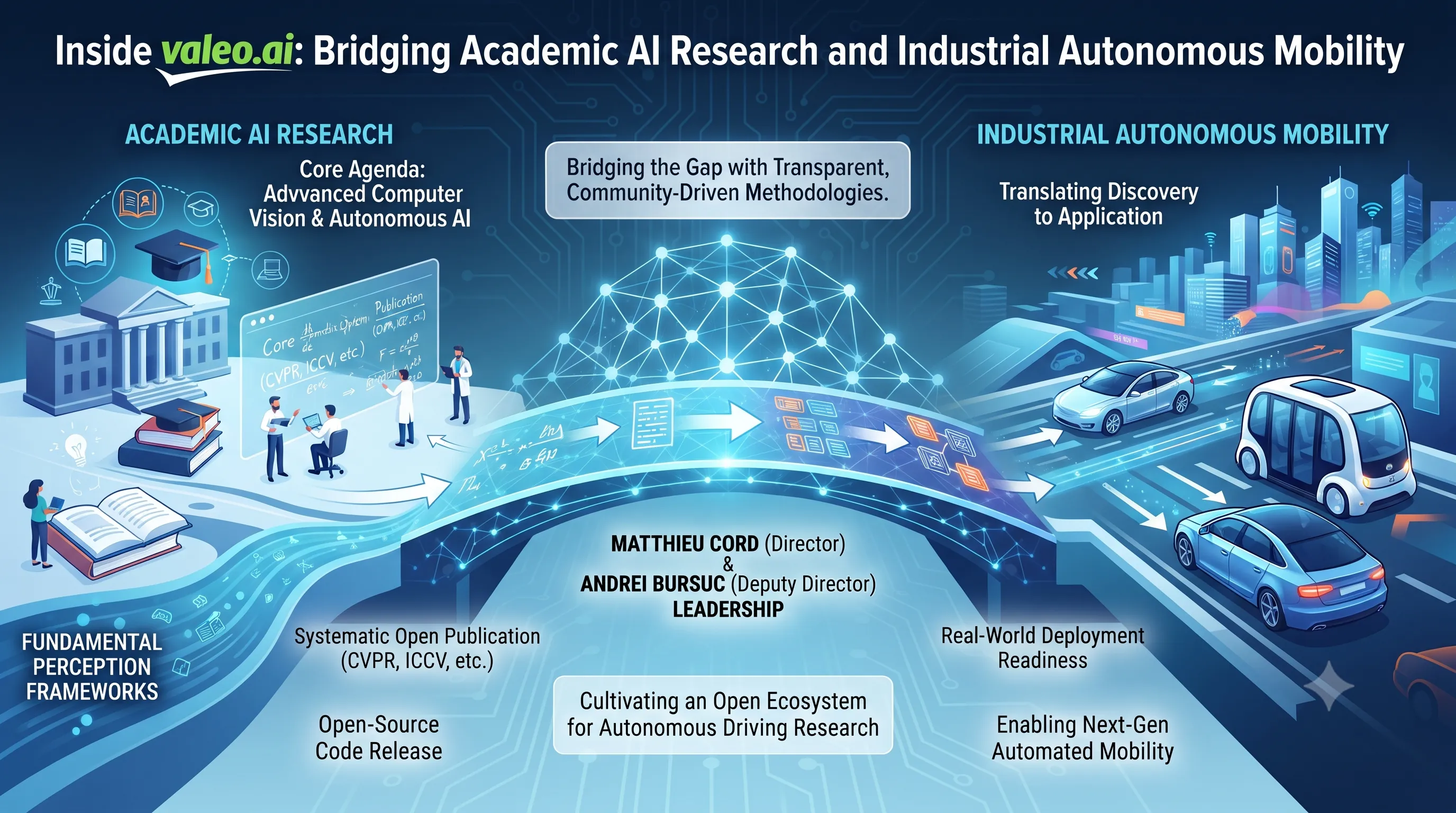
valeo.ai operates as an international research team based in Paris.The laboratory focuses its core scientific agenda directly at the intersection of computer vision, artificial intelligence, and autonomous driving.
By operating at this specific crossroads, the team advances the foundational perceptual and algorithmic frameworks essential for next-generation automated mobility.
Open-Science Leadership Under Matthieu Cord and Andrei Bursuc
The leadership and scientific trajectory of valeo.ai are guided by Director Matthieu Cord and Deputy Director Andrei Bursuc.Under this direction, the research team actively bridges academic discovery and industrial application through transparent, community-driven methodologies.
The lab systematically publishes papers at top academic venues, releases open-source code, and collaborates extensively with academic labs.
This systematic dissemination of open-source software and open academic partnership provides the scientific underpinnings necessary to cultivate an open ecosystem across autonomous driving research.
3. Pan-European Alliances and the Shift to Shared Non-Differentiating SDV Layers
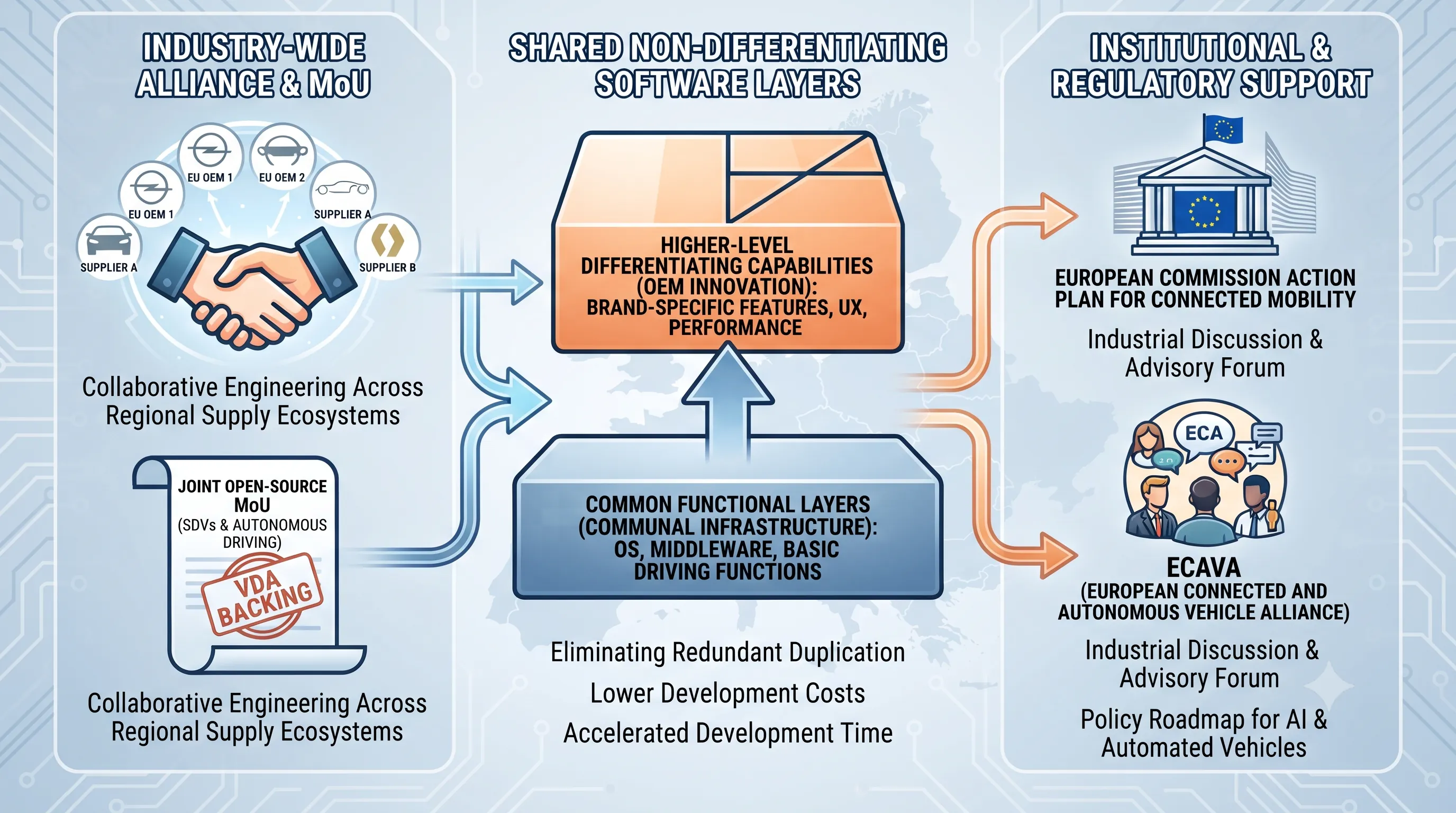
European automotive companies have mobilized to counter Big Tech centralization by laying a collaborative foundation analogous to an open-source operating system for autonomous mobility.To establish this unified baseline, European automotive companies entered into a joint open-source initiative via a memorandum of understanding (MoU) to develop software-defined vehicles (SDVs), including autonomous driving components.
Industry-Wide MoUs and VDA Backing for Shared Software Layers
This pan-European alliance effort is backed by the German Association of the Automotive Industry (VDA), marking an institutional commitment to collaborative engineering across regional supply ecosystems.Through the joint MoU framework, the collaboration enables OEMs and suppliers to co-develop non-differentiating software layers.
Eliminating the redundant duplication of underlying software components across competing vehicle programs serves directly to lower development costs.
At the same time, sharing maintenance and development burdens across the broader value chain substantially accelerates development time for software-defined vehicles.
By standardizing common functional layers as communal infrastructure, automotive manufacturers can focus their engineering resources on higher-level differentiating capabilities without ceding control to closed platform ecosystems.
ECAVA and the European Commission Action Plan for Connected Mobility
Institutional backing for an open software paradigm extends into broader European regulatory and policy structures.The European Commission established the European Connected and Autonomous Vehicle Alliance (ECAVA) to serve as an industrial discussion and advisory forum operating across the entire automotive value chain.
Operating alongside this alliance forum, the EC Action Plan proposes an active push in shared software and digital hardware for autonomous driving.
This policy roadmap aims specifically to support the transition to AI-powered, connected, and automated vehicles across member states.
By aligning cross-industry MoUs with public-sector advisory mechanisms, European automotive stakeholders combine institutional coordination and open-source architecture to sustain technological autonomy in autonomous and connected vehicle ecosystems.
4. Eclipse SDV and Vendor-Neutral Toolchains: Standardizing Vehicle Software and Test Data
Building an open-source ecosystem for autonomous driving requires replacing closed, proprietary software silos with open, collaborative infrastructure.Standardizing core software stacks and tooling under neutral governance provides the baseline needed to prevent platform lock-in and foster collaborative automotive innovation.
Vendor-Neutral Architecture and Framework Integration with Eclipse Leda
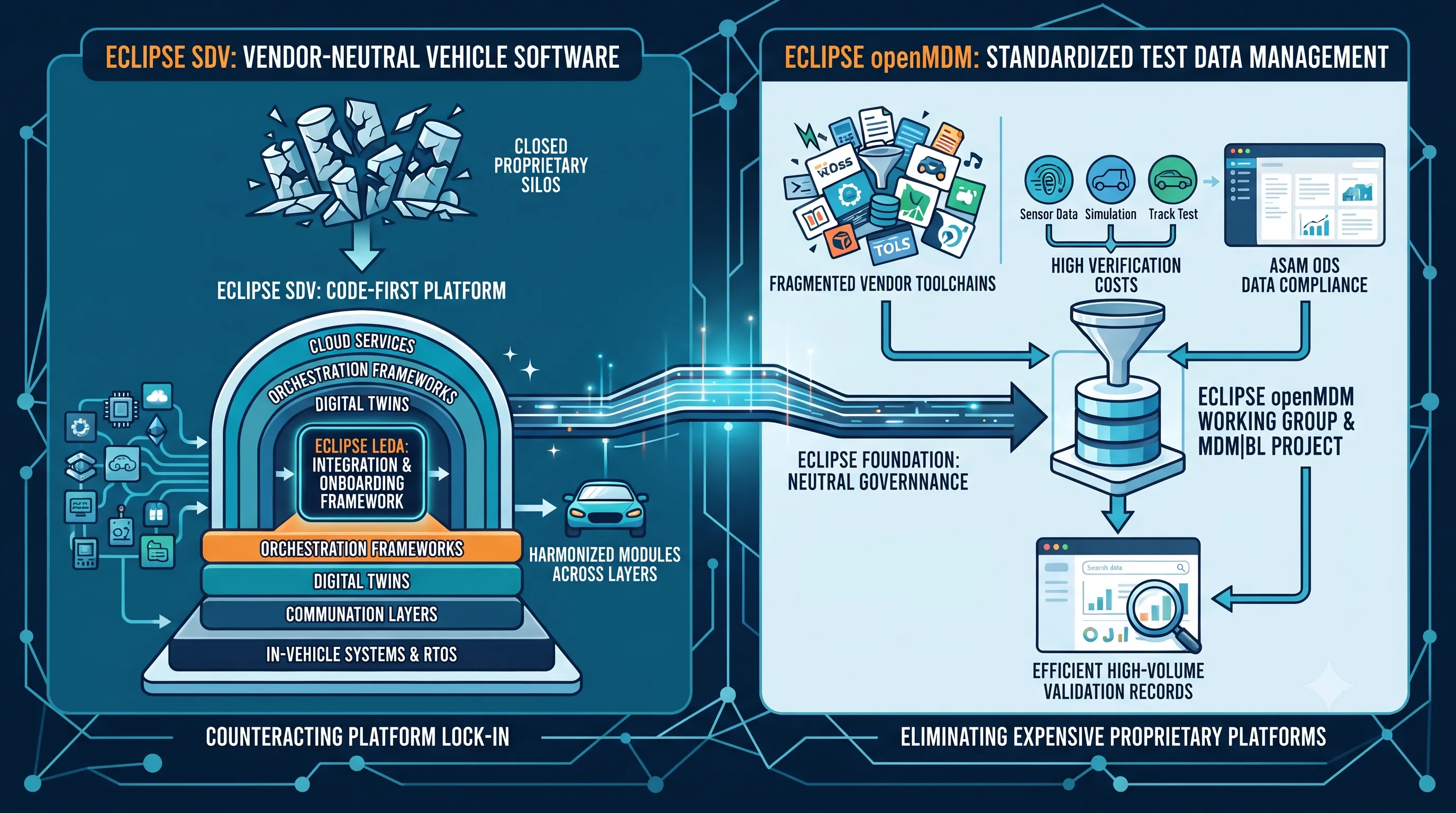
Hosted by the Eclipse Foundation, Eclipse SDV provides a vendor-neutral, code-first platform for modular vehicle software architectures.The comprehensive Eclipse SDV portfolio spans in-vehicle systems, cloud services, digital twins, communication layers, orchestration frameworks, and real-time operating systems.
To streamline the adoption of these distributed components, Eclipse Leda serves as an integration point and onboarding framework for SDV-related projects within the Eclipse SDV working group.
Through this unified onboarding environment, engineering teams can harmonize diverse software modules across both in-vehicle and cloud-native layers.
Overcoming Verification Costs: Eclipse openMDM and ASAM ODS Data Compliance
Test systems and verification procedures in the automotive sector generate high volume and diversity of test data and are expensive to implement and operate.Managing non-standardized test results across fragmented vendor toolchains escalates verification overhead throughout the vehicle development lifecycle.
To resolve these data complexities, the Eclipse openMDM Working Group drives the Eclipse MDM|BL project.
The Eclipse MDM|BL project enables standardized measurement test data management compliant with the ASAM ODS standard.
Through vendor-neutral, standardized data interfaces, automotive teams can manage high-volume validation records efficiently without incurring the costs of proprietary data management platforms.
Related Posts

How Hugging Face SimReady Central Delivers Simulation-Ready 3D AssetsDiscover how Hugging Face SimReady Central provides an open OpenUSD repository of physical AI and...
Alibaba Qwen3.8-27B: Unpacking the 27B Multimodal AI for Agentic Coding & Local GPU DeploymentAlibaba's Qwen3.8-27B: A 27B multimodal AI excelling in agentic coding. Explore its architecture,...

NVIDIA SIGGRAPH 2026: AI Redefines Virtual Worlds, Creative Workflows, and Media Integrity with Neural Rendering, MCP & DetectionNVIDIA showcased significant advancements in neural rendering , generative AI , and physical AI at...
Generative AI may have assisted with research or drafting for this article. Topic selection, fact-checking, final wording, and publication remain the responsibility of DragonStone74. AI use disclosure