
Stop Rewriting Benchmarks: How Google's EnvHarness Evolves Agents via Non-Invasive Wrappers
🚀 Key Takeaways
- Non-Invasive Wrapper Architecture: EnvHarness dynamically modifies task difficulty through modular plug-ins while preserving original simulator logic and gold-standard benchmark verifiers.
- Closed-Loop Diagnostic Co-Evolution: The autonomous EnvRigger designer analyzes interaction trajectories to synthesize, validate, and execute targeted Python rules addressing agent failure modes.
- Cross-Model Performance Acceleration: Adapting interactive training curricula delivers consistent success-rate improvements across frontier models while reducing unnecessary interaction steps.
- Standardized Actionable Interface: Benchmarks connect via an extensible state-aware contract that enables seamless stacking of multiple harness layers across leading LLM providers.
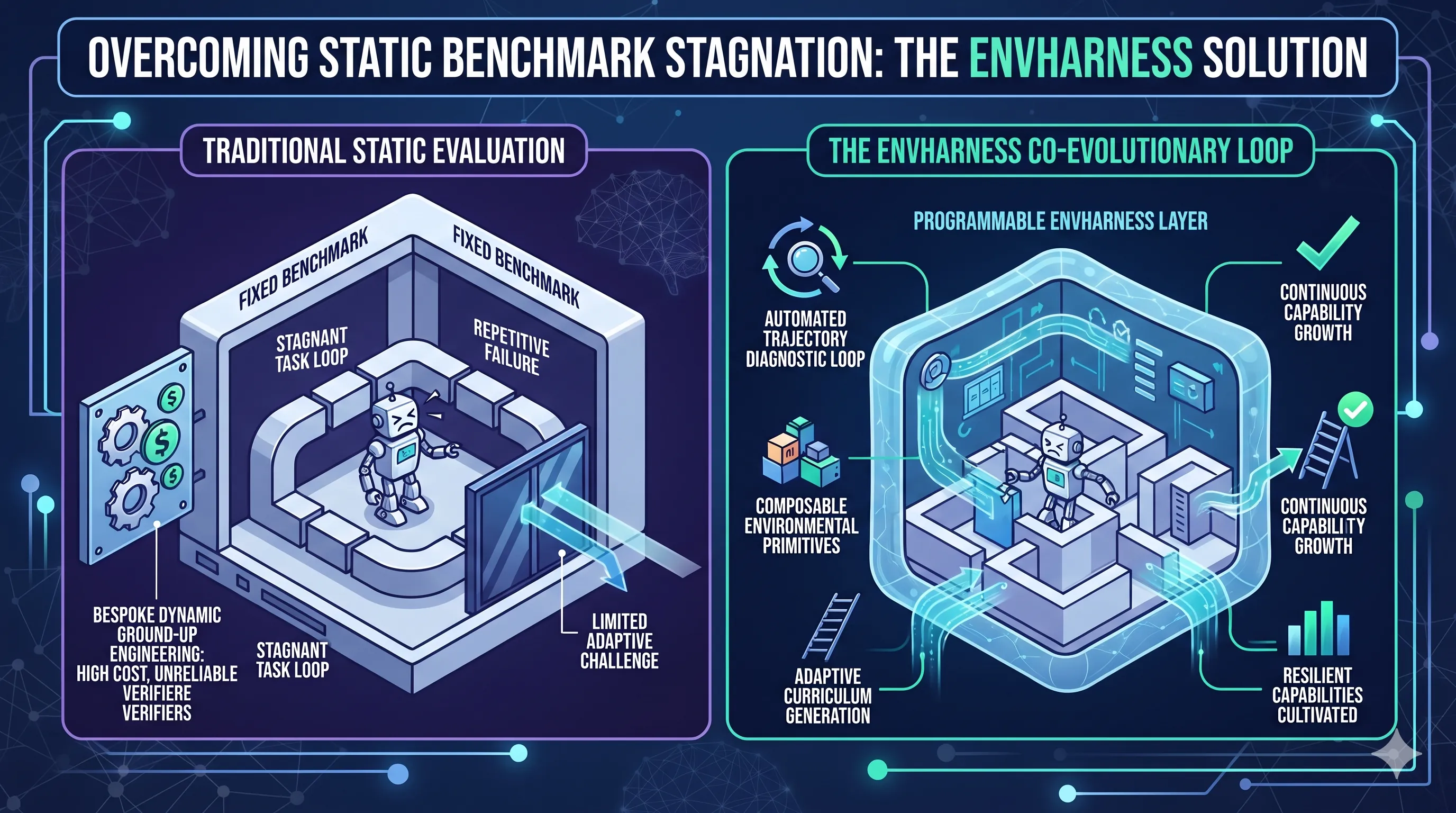
Training autonomous AI agents has long faced a fundamental obstacle: static benchmark stagnation.
Traditional simulation environments remain rigid, offering little adaptive challenge once an agent either masters a task or settles into stubborn, repetitive failure patterns.
Simultaneously, building bespoke, dynamic training grounds from scratch requires labor-intensive engineering and frequently introduces unreliable custom reward verifiers that undermine benchmark integrity.
EnvHarness resolves this trade-off by establishing a programmable, non-invasive wrapper layer around existing agent benchmarks.
By pairing composable environmental primitives with an automated trajectory-diagnostic loop, the platform dynamically tailors interactive scenarios to an agent's specific behavioral vulnerabilities.
This automated co-evolution allows developers to expose model weaknesses and cultivate resilient capabilities without rewriting underlying simulators.
As agentic workflows transition toward autonomous reinforcement learning and complex multi-step reasoning, adaptive curriculum generation has become essential.
EnvHarness bridges the gap between static evaluation and self-directed agent evolution, enabling continuous capability growth across frontier models without sacrificing evaluation rigor.
1. Programmable Wrapper Architecture: Preserving Core Simulators via Setup, Rule, and Link
In exploring how EnvHarness adapts training environments for agents, the primary technical challenge lies in overhauling static simulators without losing established evaluation baselines.Static environments do not adapt to an agent's individual weaknesses and stop teaching once tasks are solved.
Conversely, rebuilding environments from scratch requires expensive domain-specific pipelines and often relies on unreliable verifiers.
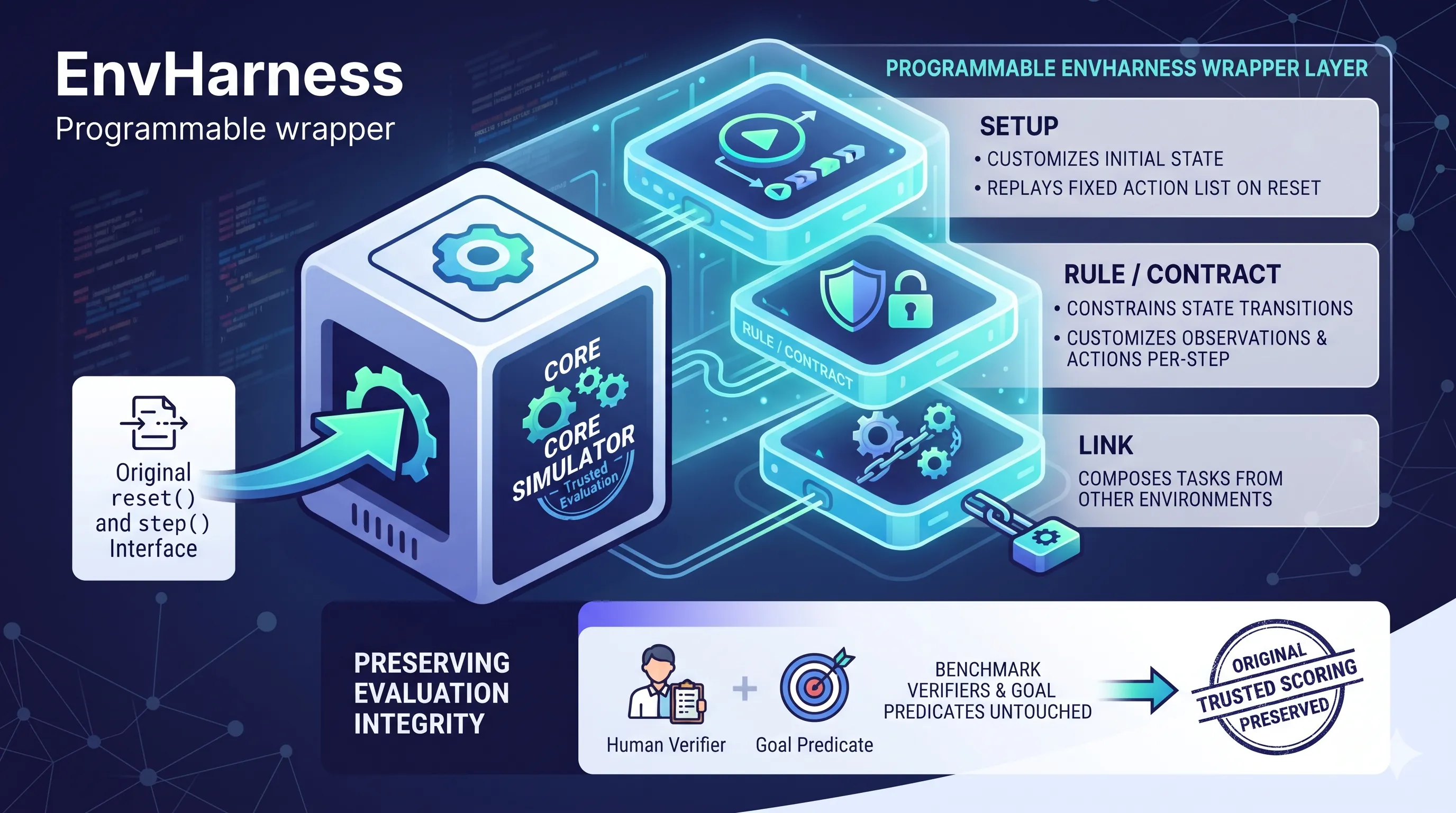
EnvHarness addresses this dilemma by operating as a programmable wrapper layer around static agent-training environments without modifying their underlying simulator logic or evaluation systems.
The Core Tripartite Structure: Setup, Rule, and Link
The architecture of EnvHarness comprises three composable plug-in components: Setup, Rule, and Link.Each component targets a specific phase of the environment's lifecycle while keeping the original simulator intact.
Setup customizes the initial state by replaying a fixed action list on every reset.
Rule (also referenced as Contract) constrains state transitions and customizes what the agent observes and is permitted to do via per-step hooks.
Link composes tasks from another environment into the episode, allowing broader task variation across training runs.
DevOps engineer Aniket Kumar highlighted that Stage (setup), Contract (rule), and Chain provide a clean abstraction preserving benchmark verifiers.
| Plug-in Component | Operational Hook | Architectural Role |
|---|---|---|
| Setup | Environment reset | Customizes the initial state by replaying a fixed action list on every reset. |
| Rule (Contract) | Per-step hooks | Constrains state transitions and customizes what the agent observes and is permitted to do. |
| Link | Episode composition | Composes tasks from another environment into the episode. |
Preserving Benchmark Verifiers via Standard Step and Reset Interfaces
To maintain full compatibility with existing systems, the EnvHarness wrapper interfaces strictly via standardreset() and step() methods.Because the wrapper operates non-invasively at this standard boundary, benchmark verifiers and goal predicates are left untouched, preserving original trusted human-built scoring.
Asif Razzaq noted that EnvHarness wraps an existing environment through the standard reset/step interface, keeping original tasks and human-built verifiers in place.
By eliminating the need to construct bespoke simulation pipelines or depend on questionable validation heuristics, the wrapper maintains evaluation integrity while extending the training utility of static benchmarks.
2. EnvRigger Diagnostic Loop: Automated Weakness Diagnosis and Component Co-Evolution
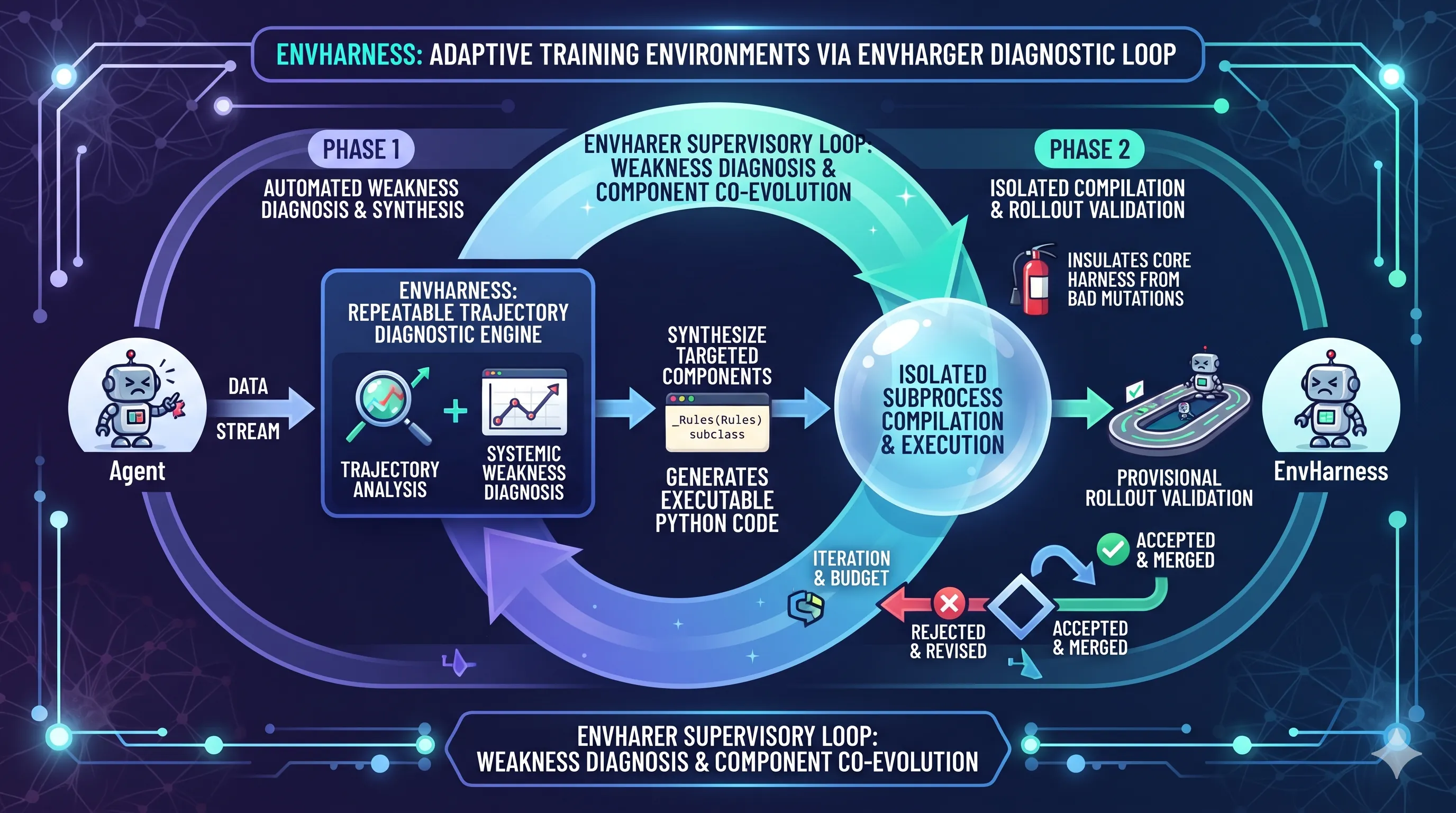
Within the broader framework of how EnvHarness adapts training environments for agents, the system relies on an automated supervisory loop to detect and correct behavioral limitations dynamically.Rather than manually handcrafting scenario variants, EnvHarness employs EnvRigger to autonomously construct curriculum adjustments tailored directly to an agent's current developmental stage.
Trajectory Analysis and Targeted Component Synthesis
EnvRigger operates as an automated LLM designer agent that treats the agent's policy model as a black box.Instead of inspecting internal neural network weights or gradients, it inspects execution trajectories, systematically analyzing both successes and failures.
Through this trajectory review, EnvRigger diagnoses systemic weaknesses that hinder agent performance across complex problem spaces.
To remediate these diagnosed weaknesses, EnvRigger synthesizes targeted EnvHarness components specifically aimed at cultivating missing capabilities.
During this synthesis phase, the designer generates executable Python code structured as a _Rules(Rules) subclass to modify the operational mechanics of the environment.
Isolated Subprocess Compilation and Rollout Validation
Deploying raw model-synthesized code directly into training runs introduces execution risks and software regressions.To prevent infrastructure crashes, the synthesized _Rules(Rules) subclass is compiled and executed within an isolated subprocess, insulating the core harness from bad mutations.
Once safely instantiated, these candidate components are provisionally tested and validated through fresh interaction rollouts with the agent.
The validation framework requires candidate components to cultivate the target capability while keeping tasks solvable.
If candidate components do not cultivate the target capability or fail to keep tasks solvable, they are rejected and revised until the designated iteration budget runs out.
When components pass rollout criteria, they merge into the active harness, allowing the diagnostic loop to repeat continuously and co-evolve the agent and the environment over multiple rounds.
3. Empirical Adaptation Efficacy: Multi-Domain Benchmarking and Trajectory Efficiency
Evaluating how EnvHarness adapts training environments for autonomous agents requires analyzing empirical performance across varied task domains.By reconfiguring environment state spaces and feedback mechanisms, EnvHarness enables agents to generalize far more effectively than they do inside static, unadapted environments.
Cross-Domain Generalization and Execution Step Reductions
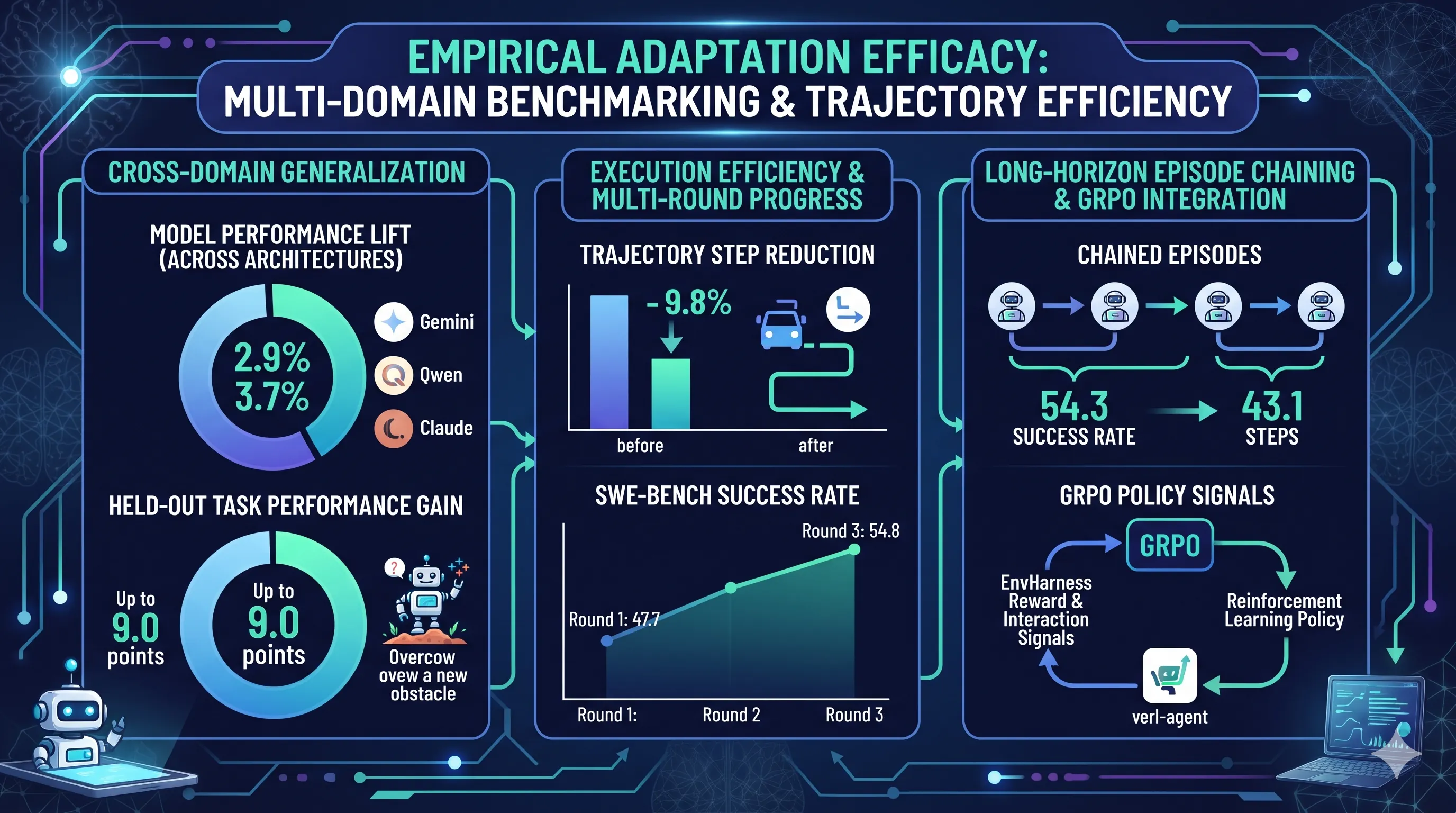
The empirical adaptation efficacy of EnvHarness has been systematically verified across five benchmarks spanning four distinct operational domains: ALFWorld, WebArena, SWE-bench Verified, OfficeQA, and SpreadsheetBench.Across diverse model architectures—including Gemini 3.1 Flash-Lite, Qwen3.6 27B, Gemini 3.5 Flash, and Claude Sonnet 4.6—adaptation yields consistent performance lifts ranging between 2.9 and 3.7 percentage points over default setups.
On held-out tasks designed to test out-of-distribution resilience, EnvHarness achieves improvements of up to 9.0 points.
Crucially, these performance gains do not come at the expense of computational overhead or prolonged trial-and-error sequences.
EnvHarness reduces agent execution and interaction steps by approximately 9.8%, enforcing tighter, more direct problem-solving trajectories.
Skills induced directly inside EnvHarness environments systematically outperform both no-skill baselines (which display baseline success rates spanning from 30.7 to 67.2 across benchmarks) and skills induced from original unadapted environments.
| Evaluation Metric / Dimension | Baseline / Reference Scope | EnvHarness Result / Progress |
|---|---|---|
| Evaluation Coverage | Standard execution suites | 5 benchmarks across 4 domains (ALFWorld, WebArena, SWE-bench Verified, OfficeQA, SpreadsheetBench) |
| Model Performance Gain | Unadapted baseline workflows | 2.9 to 3.7 percentage point lift across Gemini 3.1 Flash-Lite, Qwen3.6 27B, Gemini 3.5 Flash, and Claude Sonnet 4.6 |
| Held-Out Task Performance | Out-of-distribution environments | Up to 9.0-point improvement |
| Trajectory Step Efficiency | Full interaction traces | Execution and interaction steps reduced by approximately 9.8% |
| No-Skill Baseline Range | Default unassisted execution | Success rates spanning from 30.7 to 67.2 |
| SWE-bench Multi-Round Progress | Initial co-evolution round: 47.7 | 54.8 success rate over three rounds of co-evolution |
| Long-Horizon Episode Chaining | Extended sequential tasks | 54.3 success rate at 43.1 steps |
Iterative Co-Evolution Milestones and GRPO Policy Signals
The adaptation mechanism behind EnvHarness demonstrates compounding utility when environments and agent behaviors co-evolve across multiple iterations.On SWE-bench, agent performance progressed from an initial 47.7 to 54.8 across three consecutive rounds of co-evolution, demonstrating that sequential adaptations progressively expose and correct agent reasoning bottlenecks.
When applied to chained results on long-horizon episodes, the co-evolutionary framework attained a 54.3 success rate while stabilizing interaction length at 43.1 steps.
Beyond static benchmark evaluation, EnvHarness provides direct optimization signals for reinforcement learning policies trained with Group Relative Policy Optimization (GRPO) via verl-agent.
This integration ensures that reward and interaction signals generated within adapted environments directly refine reinforcement learning policies, grounding post-training adaptation in verified trajectory efficiencies.
4. ActionableEnv Integration Contract and LLM Provider Runtime Setup
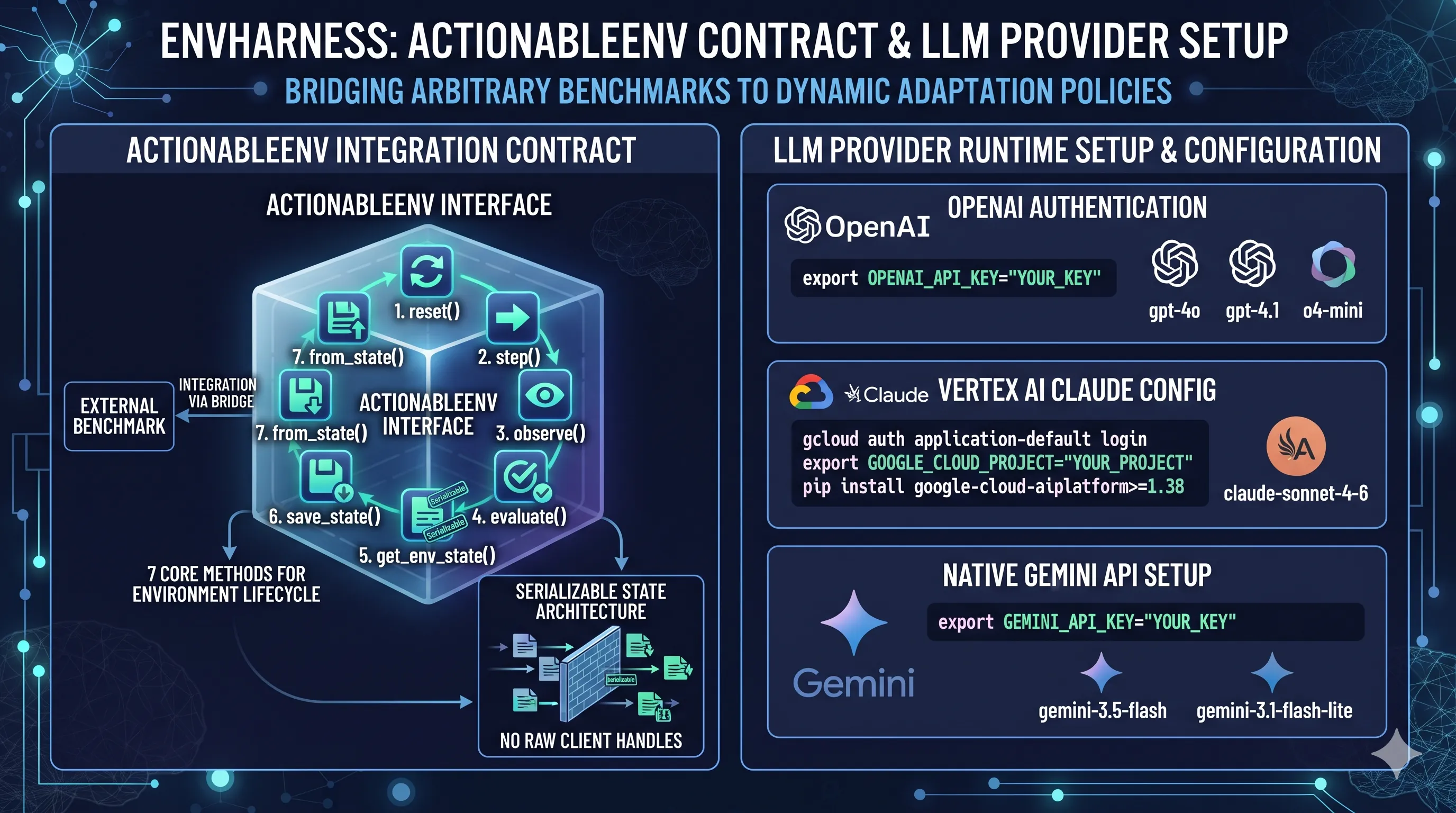
Within the broader architecture of how EnvHarness adapts training environments for agents, the foundational bridge between arbitrary benchmarks and dynamic adaptation policies is the ActionableEnv interface.To transform static evaluation sets into reactive training sandboxes, EnvHarness formalizes all environment interaction, state extraction, and model orchestration through a standardized programmatic contract.
The ActionableEnv Lifecycle and Serializable State Architecture
External benchmarks integrate into EnvHarness via a Bridge that subclasses the base ActionableEnv interface.This integration requires implementing exactly 7 core methods to control the environment lifecycle: reset, step, observe, evaluate, get_env_state, save_state, and from_state.
Through these methods, harness layers can stack arbitrarily, operating as recursive ActionableEnv instances wrapping inner ActionableEnv instances.
| Method Name | Role in ActionableEnv Contract |
|---|---|
| reset | Initializes or resets the environment to its starting state. |
| step | Applies agent actions and advances the simulation lifecycle. |
| observe | Extracts the perceptual observation surface available to the agent. |
| evaluate | Computes task performance, completion metrics, and reward signals. |
| get_env_state | Returns pure serializable data rather than raw client handles across subprocess boundaries. |
| save_state | Captures the active state representation for checkpointing or rollback. |
| from_state | Restores an environment instance directly from a previously serialized state. |
To facilitate dynamic scenario synthesis, the env_state_schema method is injected directly into the designer agent's prompt, establishing the explicit schema of allowed state fields.
When persisting complex hierarchies, a dedicated persistence walker serializes the layer stack in order from innermost to outermost, guaranteeing deterministic rehydration across execution environments.
Provider Configuration Workflows: OpenAI, Vertex AI, and Gemini
EnvHarness supports 3 primary LLM provider families for running adaptation, evaluation, and policy models: OpenAI/GPT, Claude on Vertex AI, and Gemini.Configuring these runtimes requires establishing explicit authentication and environment variables for each provider's underlying infrastructure.
To authenticate and configure OpenAI provider models, developers export their assigned access credential:
export OPENAI_API_KEY="your-openai-api-key"For enterprise cloud-managed workloads deploying Claude models on Google Cloud Vertex AI, multi-step cloud authentication and SDK installation are required:
gcloud auth application-default login
export GOOGLE_CLOUD_PROJECT="your-project-id"
pip install "google-cloud-aiplatform>=1.38"To configure Gemini models directly via the native Gemini API, export the provider access key:
export GEMINI_API_KEY="your-gemini-api-key"A strict operational limitation governs these provider integrations: embedding models cannot be changed mid-stream without completely rebuilding the vector bank.
Because downstream indexing depends on fixed vector width requirements, any model switch invalidates previously calculated embeddings and breaks persistent retrieval layers.
Related Posts

Generative AI may have assisted with research or drafting for this article. Topic selection, fact-checking, final wording, and publication remain the responsibility of DragonStone74. AI use disclosure