
Datadog’s Scout AI Brings Continuous SRE Incident Triage to Production
🚀 Key Takeaways
- Purpose-Built Diagnostic Model: Scout is Datadog's specialized AI model, post-trained via reinforcement learning to autonomously investigate alerts and identify root causes across production environments.
- Frugal Inference Economics: Scout delivers diagnostic benchmark performance rivaling leading frontier models while operating at substantially reduced inference costs, enabling continuous analysis for every alert.
- Parallel Telemetry Exploration: Operating within Bits Investigation, the engine simultaneously tests multiple causal hypotheses across logs, traces, and metrics the moment an incident fires.
- Human-in-the-Loop Remediation: While Scout formulates verified root-cause summaries and suggested code fixes, human site reliability engineers retain decisive control over applying production system changes.
Modern distributed architectures generate an relentless flood of telemetry, frequently trapping site reliability engineers in high-friction alert fatigue and protracted triage sessions.
While traditional observability platforms excel at signaling when a threshold breaks, determining the precise underlying failure across tangled microservices has historically demanded exhaustive human investigation.
The rollout of Datadog's Scout represents a major shift toward autonomous incident triage directly embedded in operational toolchains.
By moving away from expensive, generalized frontier models toward an architecture specifically fine-tuned for causal reasoning over logs and traces, Datadog aims to make continuous, alert-by-alert automated investigation economically viable.
Operating through the Bits Investigation framework, Scout bridges the gap between synthetic incident detection and active remediation.
Understanding how this specialized intelligence operates—and where its diagnostic guardrails lie—is vital for engineering teams modernizing their on-call operations and reducing mean time to resolution.
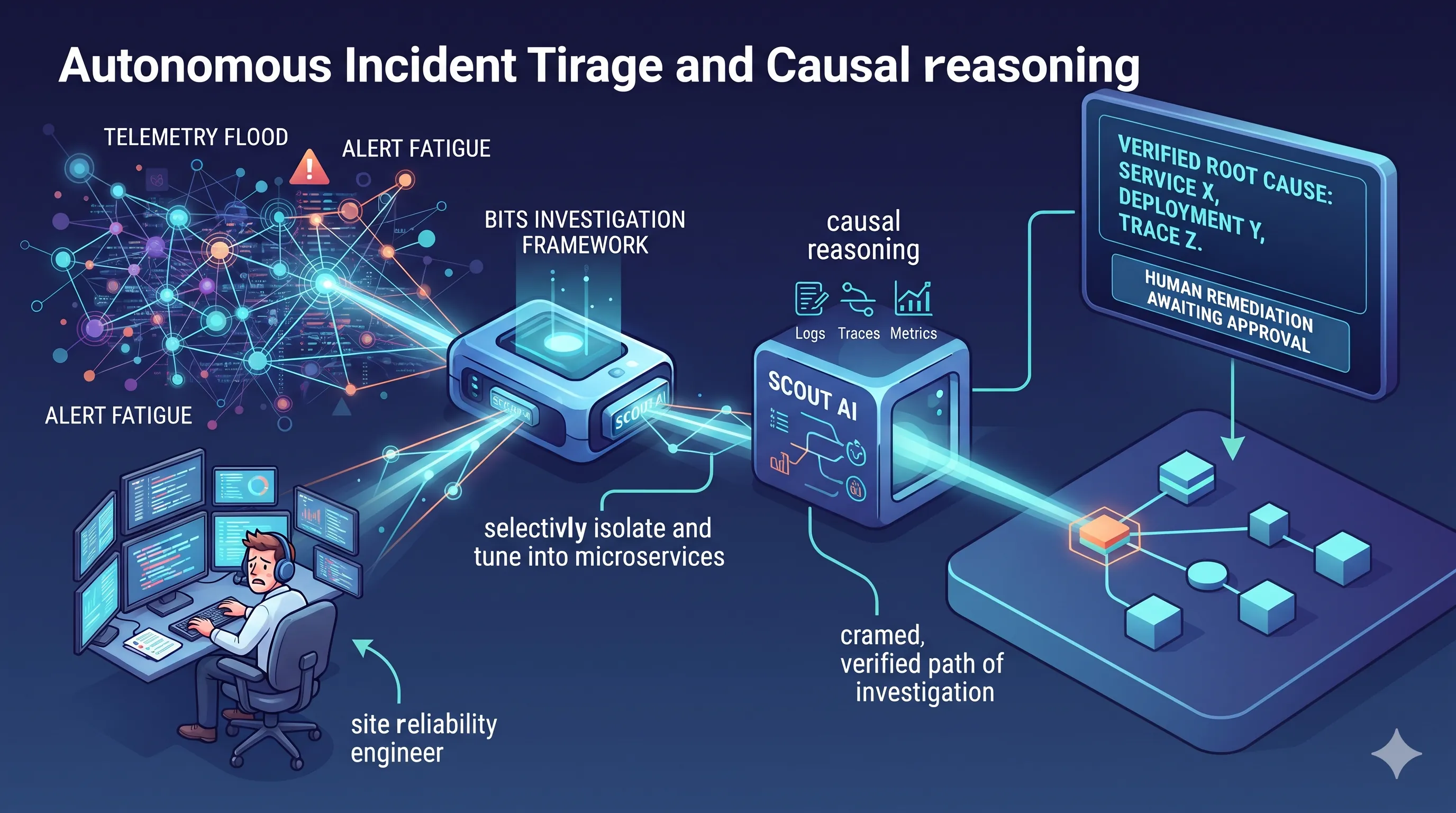
1. Architecture and Reinforcement Learning: How Scout 1.0 Investigates Incidents
Understanding the foundational mechanics of Datadog's Scout AI directly illuminates how the system enhances site reliability engineering (SRE) investigations across production environments.Rather than relying on generic, off-the-shelf text completion, Datadog tailored the system to the rigorous demands of troubleshooting complex distributed infrastructure.
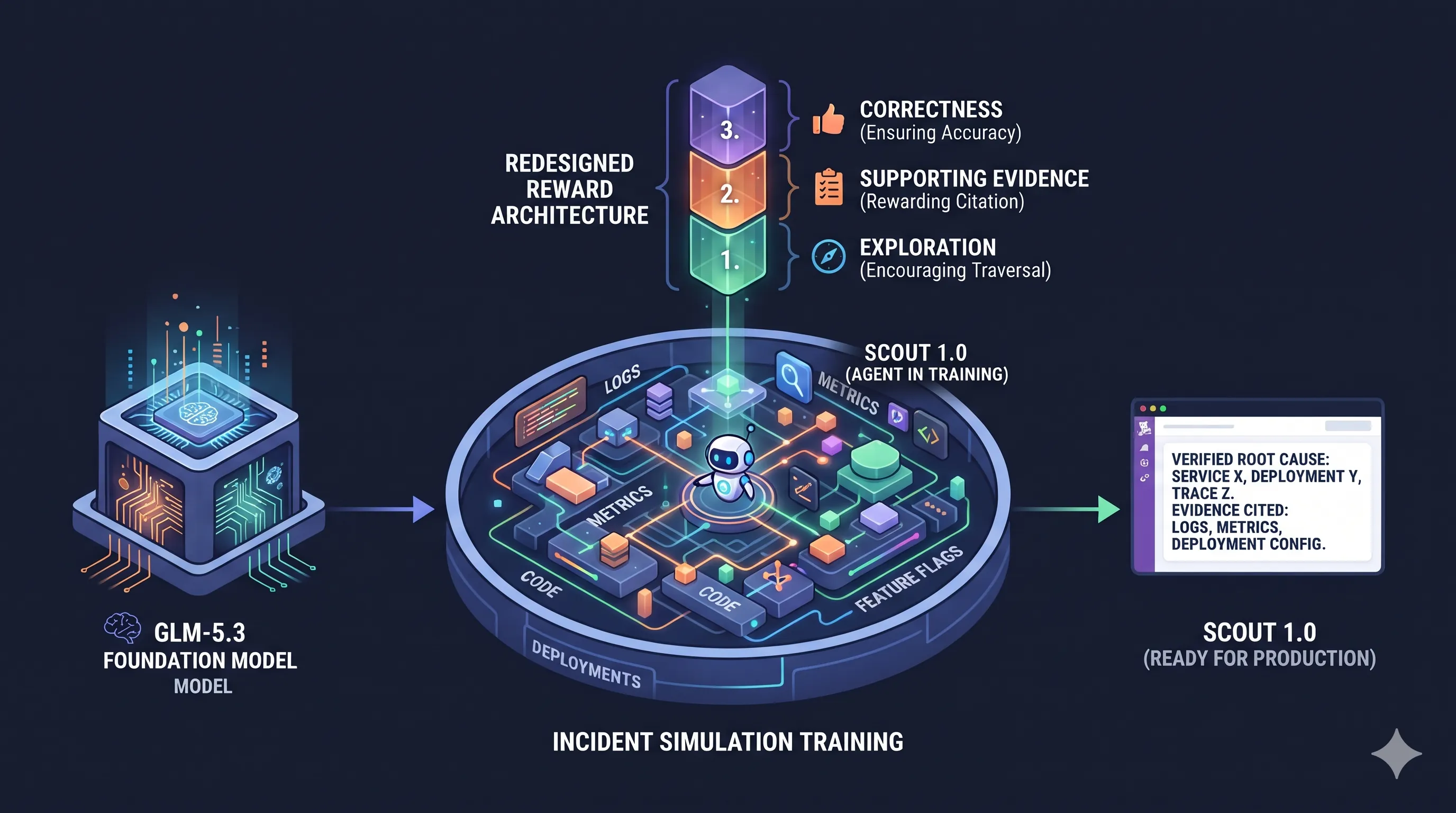
GLM-5.3 Flash Foundation and Incident Simulation Training
Scout, designated specifically as Scout 1.0, is built on the GLM-5.3 Flash foundation model.It serves as Datadog's specialized AI model created deliberately to investigate production incidents, operating directly inside Bits Investigation, Datadog's AI SRE product.
As reported by InfoQ, Scout runs inside Bits Investigation to automatically ingest alerts, inspect telemetry across distributed systems, and suggest probable root causes.
To prepare Scout 1.0 for high-stakes operational environments, Datadog post-trained the model using reinforcement learning (RL).
This RL training framework utilized extensive incident simulations constructed from historical problem patterns containing real-world alert profiles, queryable telemetry, and verified root causes.
Datadog stated that these training simulations did not incorporate customer data, ensuring model behavior was refined on synthetic patterns rather than proprietary user records.
During these simulated runs, Scout trained using specialized tooling modeled directly on Bits capabilities.
These tools allow the agent to execute targeted queries across six key observability and operational domains: logs, metrics, traces, code, deployments, and feature flags.
Redesigning Exploration Rewards to Prevent Premature Conclusions
Training an autonomous agent for production incident response revealed critical challenges in reward mechanics.Datadog observed that when the reinforcement learning reward function was tied strictly to final answers, it produced counterproductive behavior: Scout began making fewer claims and terminating investigations prematurely to evade penalty risks associated with incorrect assertions.
To overcome this avoidance behavior and ensure thorough incident analysis, Datadog redesigned the reward architecture.
The updated reward system balances three key objectives:
- Correctness: Rewarding accuracy in identifying verified underlying faults.
- Exploration: Incentivizing the traversal of telemetry and contextual system state.
- Supporting Evidence: Encouraging the discovery and citation of concrete validation before delivering a diagnostic conclusion.
This approach trains Scout 1.0 to formulate flexible, evidence-backed hypotheses even under tight operational constraints, strengthening how Bits Investigation handles unpredictable system outages.
2. Continuous Alert Coverage: Diagnostic Accuracy and Inference Cost Economics
Evaluating how Datadog's Scout AI enhances SRE investigations requires analyzing the direct interplay between diagnostic precision and operational execution costs.To make autonomous investigation practical across complex distributed architectures, an observability model must deliver deep causal insight without generating prohibitive API expenses for routine incidents.
Inference Cost Multiples and Continuous Alert Triage
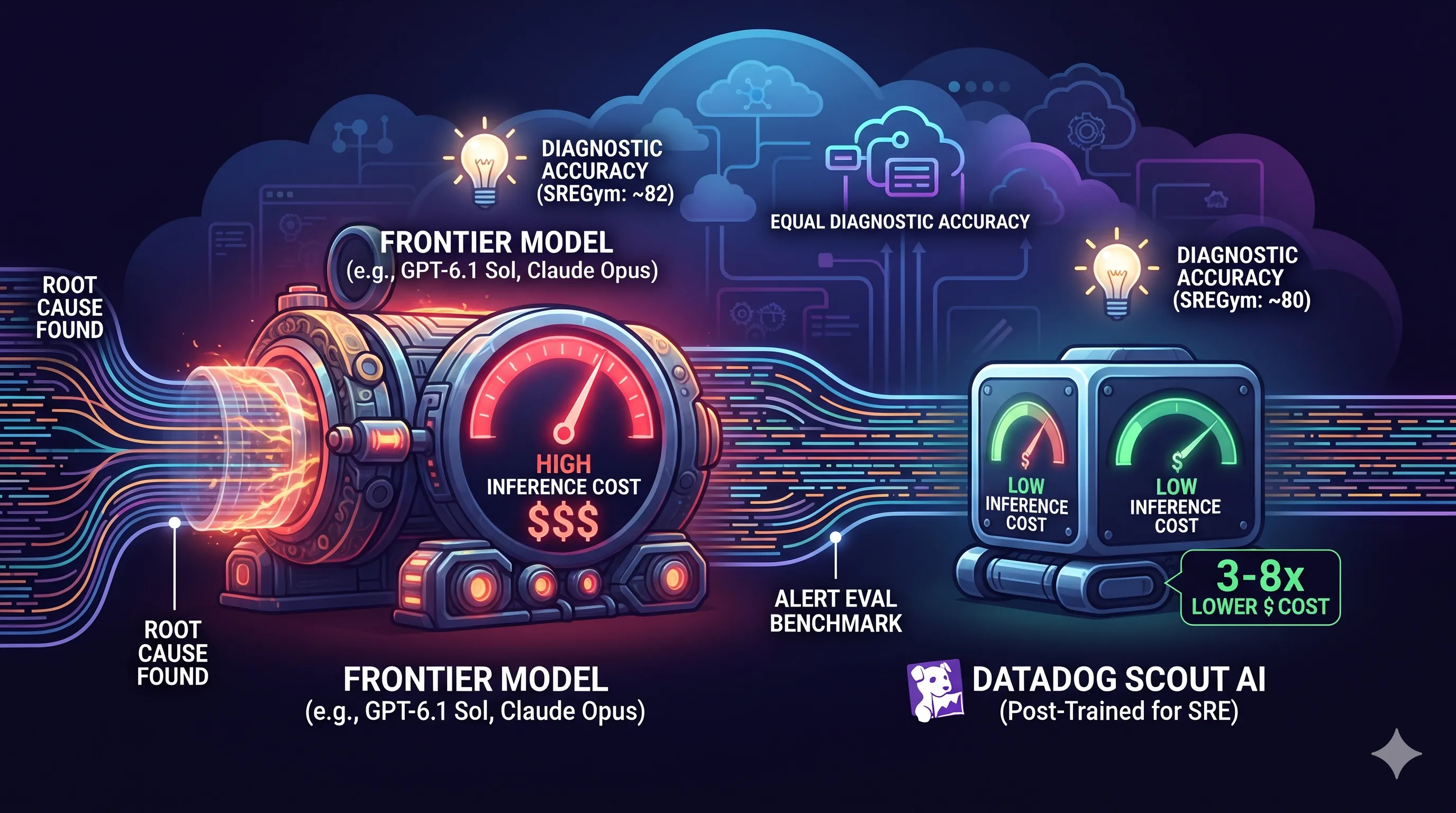
Datadog specifically designed Scout to provide lower inference costs so investigations can run continuously on every alert rather than sparingly.Conventional deployment of frontier models often limits automated incident root-cause analysis to top-tier outages because high token costs make comprehensive triage financially unsustainable.
Datadog stated that Scout medium's inference cost was between three and eight times lower than frontier alternatives.
Specifically, on the AlertEval benchmark, Scout medium matched the score of GPT-6.1 Sol high and Claude Opus 5.5 high while its estimated inference cost remained between 3 and 8 times lower than those comparable frontier models.
At maximum reasoning capacity, Scout xhigh matched Claude Fable 5.1 xhigh for one-fourth (1/4) of the inference cost.
These reduced cost multiples transform how reliability teams manage inbound telemetry, allowing continuous automated deep-dives on every incoming signal.
| Model & Effort Tier | SREGym Faults Resolved (Out of 90) | AlertEval Score Equivalence | Relative Inference Cost Multiple |
|---|---|---|---|
| Scout (Medium) | 71 | Matched GPT-6.1 Sol (High) & Claude Opus 5.5 (High) | 3 to 8 times lower than comparable frontier models |
| Scout (High) | 79 | — | — |
| Scout (xhigh) | 80 | Matched Claude Fable 5.1 (xhigh) | One-fourth (1/4) the cost of Claude Fable 5.1 (xhigh) |
| Claude Opus 5.5 (High) | — | Matched by Scout (Medium) | 3 to 8 times higher than Scout (Medium) |
| Claude Fable 5.1 (xhigh) | — | Matched by Scout (xhigh) | 4 times higher than Scout (xhigh) |
| GPT-6.1 Sol (High) | — | Matched by Scout (Medium) | 3 to 8 times higher than Scout (Medium) |
| GPT-6.1 Sol (xhigh) | 82 | — | Frontier baseline tier |
Evaluating Fault Resolution Across AlertEval and SREGym
The diagnostic accuracy supporting continuous triage is evidenced across both synthetic fault injection environments and real-world alert archives.On SREGym, a public benchmark of 90 faults, Scout resolved 71 cases at medium effort.
Scaling inference compute increased fault resolution: Scout resolved 79 cases at high effort and 80 cases at xhigh effort on SREGym.
By comparison, the larger frontier model GPT-6.1 Sol xhigh resolved 82 cases on the SREGym suite.
To measure diagnostic reasoning on operational telemetry, Datadog evaluated the models using AlertEval.
AlertEval is an LLM-judged evaluation using real alerts, archived telemetry, and engineer-written expert accounts.
The AlertEval methodology rewards model explanations matching expert accounts at both immediate and underlying cause levels.
Conversely, AlertEval deducts points for factual contradictions and claims lacking evidence.
AlertEval benchmark scores run on a scale from 0 to 100.
Important caveats govern the interpretation of these evaluation results.
Datadog clarified that the AlertEval 0 to 100 score does not represent a percentage of incidents solved.
Furthermore, AlertEval benchmark results were conducted internally by Datadog and have not been validated independently.
Independent AI news account AGTP noted that AlertEval has not been independently verified.
3. Bits Investigation in Production: Autonomous Telemetry Triage and Enterprise Controls
Connecting directly to how Datadog's Scout AI enhances SRE investigations, Bits Investigation operationalizes underlying models to automate incident response workflows the moment an anomaly is detected.Rather than requiring on-call engineers to manually query disparate telemetry streams during high-severity events, Bits Investigation functions as an automated first responder within production monitoring environments.
Concurrent Multi-Signal Telemetry Exploration
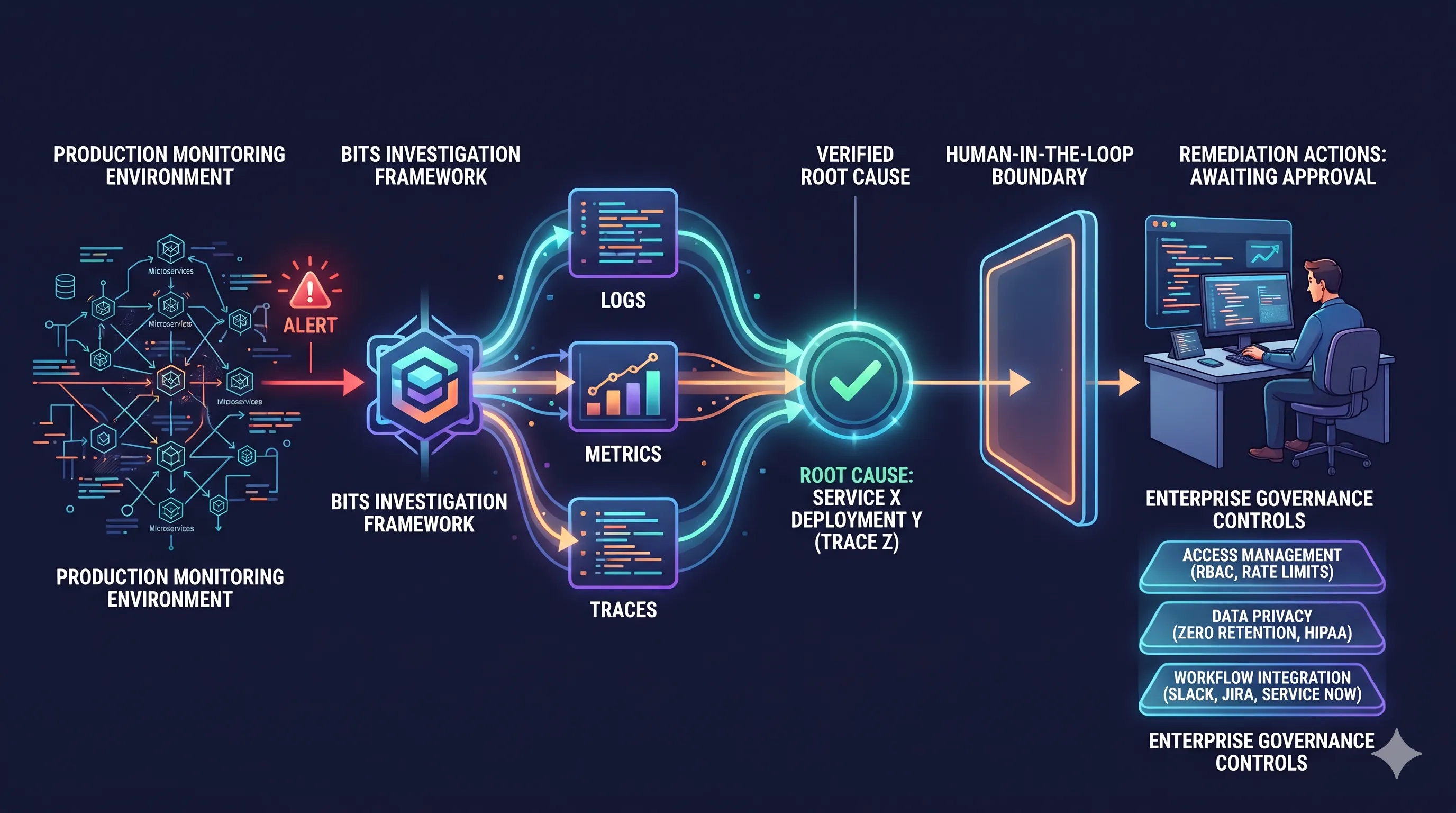
The core operational value of Bits Investigation lies in its ability to autonomously initiate alert investigations immediately upon alert triggering.When an alert fires, the system does not wait for engineer intervention to begin triage.
Instead, it explores multiple root causes concurrently in parallel across telemetry signals, analyzing logs, metrics, and traces simultaneously to deliver verified root cause analyses, as highlighted in Datadog documentation.
By assessing competing failure hypotheses in parallel rather than sequentially, the tool reduces diagnostic latency across complex distributed microservices.
Beyond autonomous telemetry correlation, Bits Investigation embeds directly into established engineering workflows through native integration with collaboration and workflow tools, including Slack, Jira, ServiceNow, and GitHub.
Engineers can interact with the system using natural-language conversational chat to interrogate system state and drill down into diagnostic findings.
To streamline the transition from triage to remediation, Bits delivers suggested code fixes and recovery actions directly alongside its analytical findings, pointing teams toward targeted mitigations without requiring context switching between tools.
Enterprise Governance and Human-in-the-Loop Boundaries
Deploying autonomous analytical agents inside production environments requires strict security, budget, and compliance guardrails.Bits Investigation incorporates comprehensive enterprise management controls designed to mitigate risk across infrastructure boundaries.
| Control Category | Enterprise Feature | Operational Purpose |
|---|---|---|
| Access & Consumption Management | Role-Based Access Control (RBAC), Rate Limits, Cost Controls | Enforces granular operator permissions, prevents API over-utilization, and caps overall operational expenses. |
| Data Privacy & Compliance | Zero Data Retention Policies, Built-In HIPAA Compliance Support | Guarantees that third-party AI providers retain no telemetry data while meeting healthcare regulatory standards. |
| Workflow Integration | Slack, Jira, ServiceNow, GitHub Integrations | Synchronizes autonomous diagnostic output, chat threads, and remediation tickets with primary enterprise platforms. |
In its current closed preview, Scout diagnoses issues and proposes recovery steps, but human engineers retain responsibility for applying production changes.
This human-in-the-loop requirement ensures that suggested code fixes, service restarts, or infrastructure changes are reviewed and executed by verified operators rather than executed autonomously.
As of October 2026, Datadog has not published a general availability (GA) date for the feature, keeping deployment strictly within controlled preview environments while platform capabilities continue to mature.
4. The AI SRE Landscape: Comparing Autonomous Incident Investigation Patterns
Understanding how Datadog's Scout AI enhances SRE investigations requires examining the broader ecosystem of autonomous incident response platforms.As engineering teams adopt autonomous diagnostic agents, distinct design patterns have emerged across industry observability architectures.
Comparative Architectures Across Observability Platforms
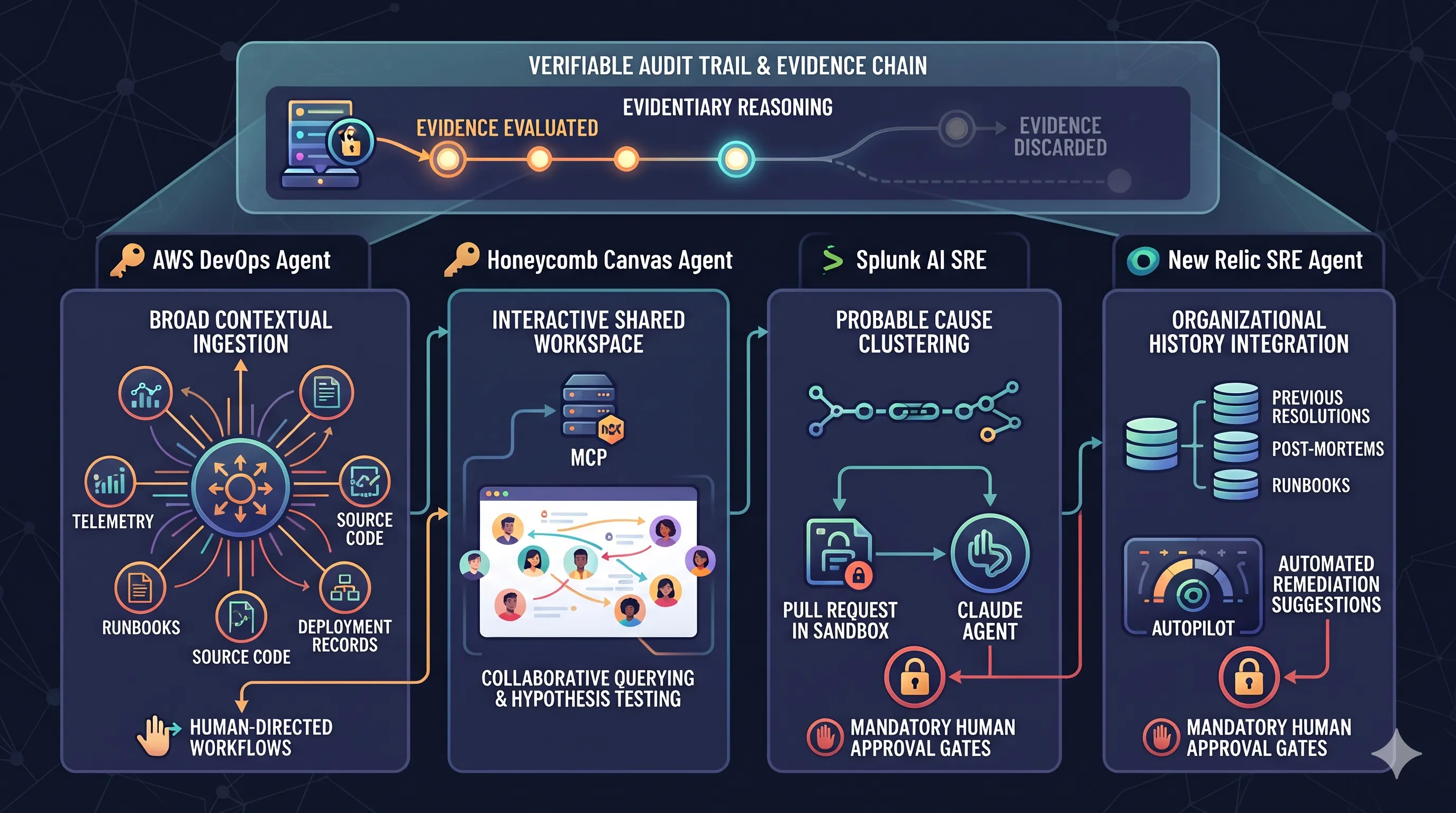
The current tooling ecosystem reflects contrasting approaches to context integration, hypothesis validation, and mitigation execution.AWS DevOps Agent focuses on broad contextual ingestion, integrating telemetry across multiple observability tools with runbooks, source code, and deployment records.
In contrast, Honeycomb Canvas Agent emphasizes collaborative querying by operating an interactive shared workspace designed to execute queries, test hypotheses, and maintain a Model Context Protocol (MCP) server for third-party agents.
Splunk AI SRE concentrates on clustering alerts into probable causes supported by an evidence chain, connecting with Claude agents to create pull requests in sandboxes.
New Relic SRE Agent integrates organizational history into diagnostics by incorporating previous resolutions, post-mortems, and runbooks, while deploying Autopilot for remediation suggestions.
To maintain system safety, both Splunk and New Relic retain mandatory human approval gates before any production mitigations are executed.
| Platform | Telemetry & Integration Architecture | Investigation & Remediation Mechanisms | Approval & Governance Model |
|---|---|---|---|
| AWS DevOps Agent | Integrates telemetry across multiple observability tools alongside source code, runbooks, and deployment records | Cross-source context synthesis across deployments and repositories | Human-directed operational workflows |
| Honeycomb Canvas Agent | Interactive shared workspace maintaining an MCP server for third-party agents | Executes investigative queries and tests hypotheses dynamically | Collaborative canvas environment |
| Splunk AI SRE | Clusters alerts into probable causes backed by an evidence chain | Connects with Claude agents to generate pull requests inside sandboxes | Mandatory human approval gates before executing production mitigations |
| New Relic SRE Agent | Diagnostic ingestion of previous resolutions, post-mortems, and runbooks | Uses Autopilot to surface automated remediation suggestions | Mandatory human approval gates before executing production mitigations |
Auditability and Verifiable Evidence Chains in Automated Triage
As autonomous agents assume deeper operational roles, diagnostic transparency has become a primary requirement for production adoption.Industry observers emphasize the critical need for verifiable audit trails that explicitly show which evidence an AI model evaluated versus which data points it discarded during incident investigations.
AGTP highlighted that engineers require visibility into how an investigation model reached its diagnosis rather than simply receiving a concise answer.
Without verifiable visibility into an agent's evidentiary reasoning, SRE teams cannot validate triage reliability or safely authorize automated production interventions.
Related Posts
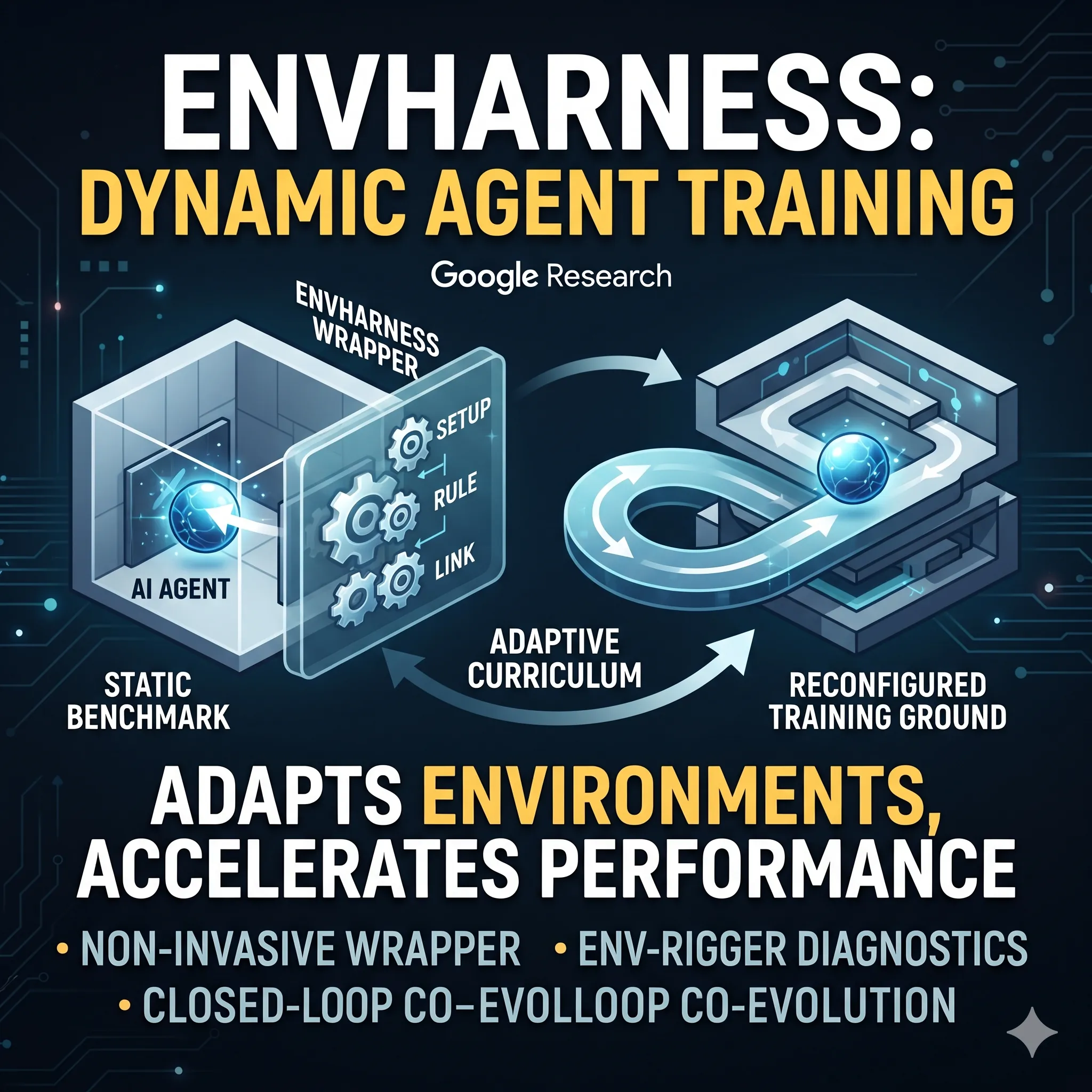
Stop Rewriting Benchmarks: How Google's EnvHarness Evolves Agents via Non-Invasive WrappersDiscover how Google's open-source EnvHarness uses a non-invasive wrapper and automated EnvRigger...

How Frontier AI Models Are Rewriting Theoretical PhysicsExplore how frontier AI models and autonomous agents are transforming theoretical physics,...
OpenAI GPT-6.2 Billing Fix: Astra Hits Limits 40% FasterOpenAI fixes a GPT-6.2 launch billing bug, causing Astra limits to hit 40% faster and Sol 25%...
Generative AI may have assisted with research or drafting for this article. Topic selection, fact-checking, final wording, and publication remain the responsibility of DragonStone74. AI use disclosure