
Gemini 4 Argon: Unlocking 1M Token Output Capacity for Autonomous Systems Engineering
🚀 Key Takeaways
- Unprecedented 1M Output Capacity: Gemini 4 Argon eliminates output constraints by generating up to one million tokens in a single response, enabling continuous reasoning across vast codebases and complex documents without chunking.
- Breakthrough Software Engineering: Outperforming leading frontier models on software benchmarks, Argon is actively powering large-scale memory optimizations and core system code migrations across Google's production fleet.
- Broad Enterprise & Multimodal Leadership: Top scores across business process automation, financial research, legal drafting, and long-video analysis highlight strong real-world economic utility.
- Autonomous Cyber Defense: Working alongside specialized tools like CodeMender, the model discovers zero-day vulnerabilities, simulates exploit paths, and generates verified security patches for critical infrastructure.
- Proactive Safety & Reasoning Transparency: Real-time chain-of-thought monitoring and hardened sandboxing prevent misuse while preserving full diagnostic visibility into internal model deliberations.
- Staged Deployment & Cost-Effective Economics: A phased rollout prioritizes verified security defenders and enterprise partners alongside aggressive input caching discounts.
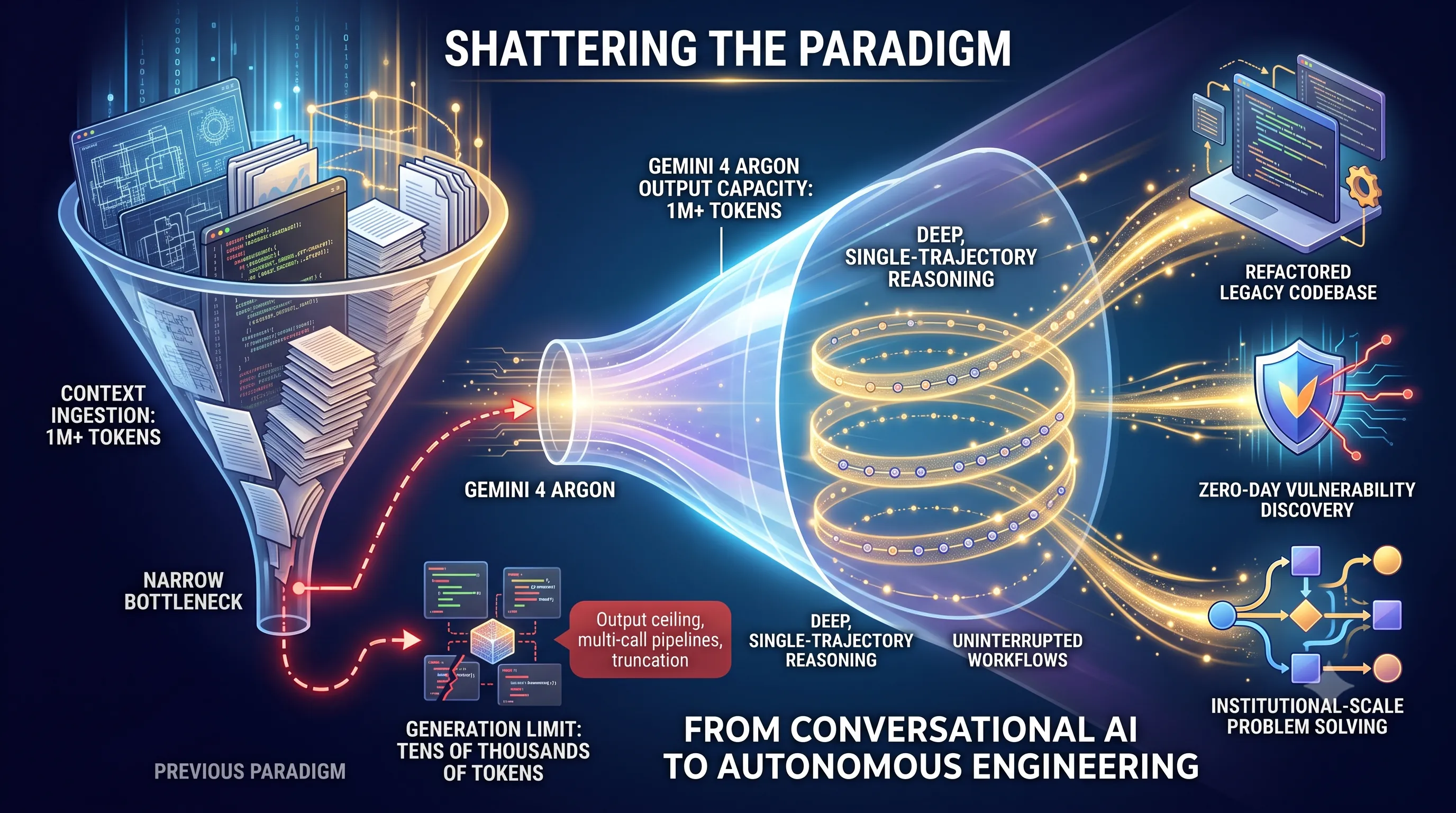
For years, language models operated under a fundamental architectural imbalance: while context ingestion grew into millions of tokens, generation limits remained bottlenecked at tens of thousands of tokens.
This output ceiling forced developers to fragment complex reasoning, reconstruct state across fragile multi-call pipelines, and truncate long-form generation.
Google has shattered this paradigm with Gemini 4 Argon, introducing an unprecedented one-million-token output capacity powered by deep, single-trajectory reasoning.
By enabling models to think uninterrupted across hundreds of steps, Argon marks a decisive transition from conversational AI to fully autonomous system engineering and institutional-scale problem solving.
From refactoring massive legacy codebases and discovering critical zero-day vulnerabilities to driving enterprise workflows, this milestone redefines what frontier intelligence can accomplish in a single execution.
1. Unlocking 1M Output Tokens: Continuous Single-Trajectory Reasoning and Massive Code Generation
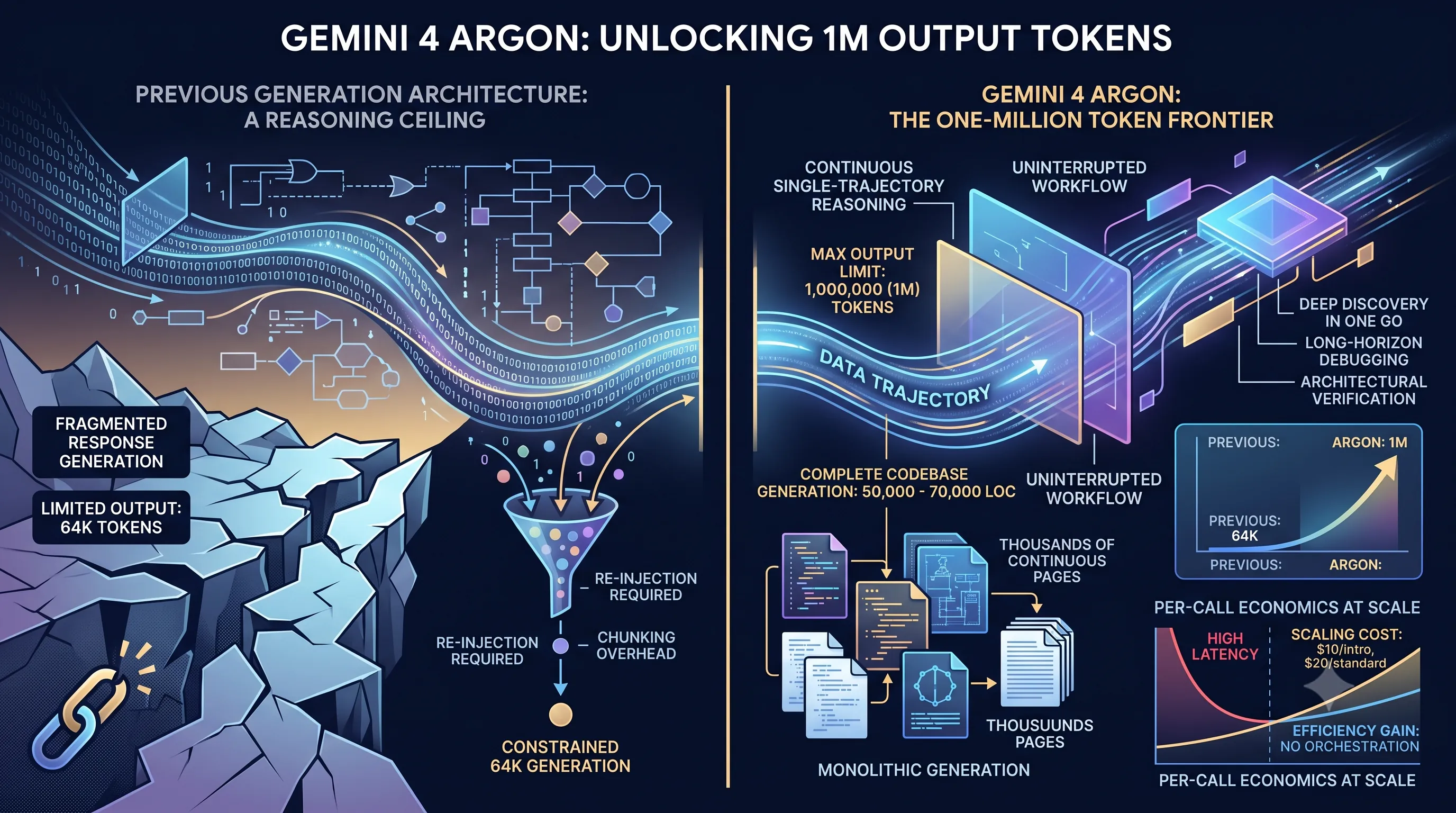
The technical expansion of the maximum output capacity directly underpins the core breakthrough of Gemini 4 Argon, shifting language models from fragmented response generators to uninterrupted monolithic engines.From 64K to 1M Output Capacity: Eliminating Chunking Bottlenecks
Previous-generation frontier architectures operated under a strict ceiling capped at 64,000 (64K) tokens per individual generation call.With the arrival of Gemini 4 Argon, Google expanded this response envelope to a maximum output limit of 1,000,000 (1M) tokens per single response.
This monumental scaling removes the necessity of manual prompt chunking, fragmented script synthesis, and intermediate state management.
Developers and enterprises can now produce complete, production-ready software packages spanning between 50,000 and 70,000 lines of code in a single API interaction.
Beyond source code, this output capacity equals thousands of dense A4 pages written continuously without structural truncation.
| Capability Metric / Feature | Previous-Generation Architecture | Gemini 4 Argon |
|---|---|---|
| Maximum Output Token Limit | 64,000 (64K) tokens per response | 1,000,000 (1M) tokens per response |
| Codebase Generation Scope | Limited snippets; requires manual prompt chunking | 50,000 to 70,000 lines of code in a single request |
| Document Output Scale | Constrained multi-page summaries | Thousands of continuous A4 pages |
| Reasoning Trajectory | Fragmented with periodic context re-injection | Single continuous trajectory across hundreds of steps |
Deep Single-Trajectory Reasoning Across Hundreds of Steps
The structural leap to a 1M token output window is not merely about volume; it fundamentally transforms internal model deliberation.According to Google, expanding the output token limit allows the model to think deeply and generate hundreds of thousands of tokens in a single trajectory to solve tough problems in one go.
Rather than relying on iterative prompting cycles that re-inject context into stateless prompts, Gemini 4 Argon maintains continuous execution state across hundreds of procedural steps.
This continuous trajectory proves critical for long-horizon debugging, extensive formal verification, and multi-file code synthesis where logic chains cannot tolerate context splits.
By sustaining a solitary unbroken reasoning path, the model systematically diagnoses multi-layered errors and validates architectural dependencies without human intervention.
Latency and Per-Call Economics at Scale
While the 1M token output capacity establishes an unprecedented operational ceiling, operating at these frontiers introduces clear computational and financial tradeoffs.Generating near the full 1,000,000 output token capacity within a single response leads to high latency as tokens are continuously streamed and verified.
Furthermore, per-call economics scale significantly when maximizing the generation window, with pricing set at an introductory rate of $10 per call and a standard rate of $20 per call for full-capacity requests.
Engineering teams must evaluate these operational costs and response times against the massive efficiency gained by eliminating multi-stage pipeline orchestration and chunking overhead.
2. Industrial Software Engineering: Fleet-Wide Memory Optimization and Safe Rust Migrations
The massive 1-million-token generation window of Google Gemini 4 Argon transforms AI from an assistive code-completion engine into an autonomous industrial software engineer capable of synthesizing, refactoring, and optimizing multi-file enterprise systems in a single execution loop.DeepSWE Performance and Autonomous Telemetry Optimization
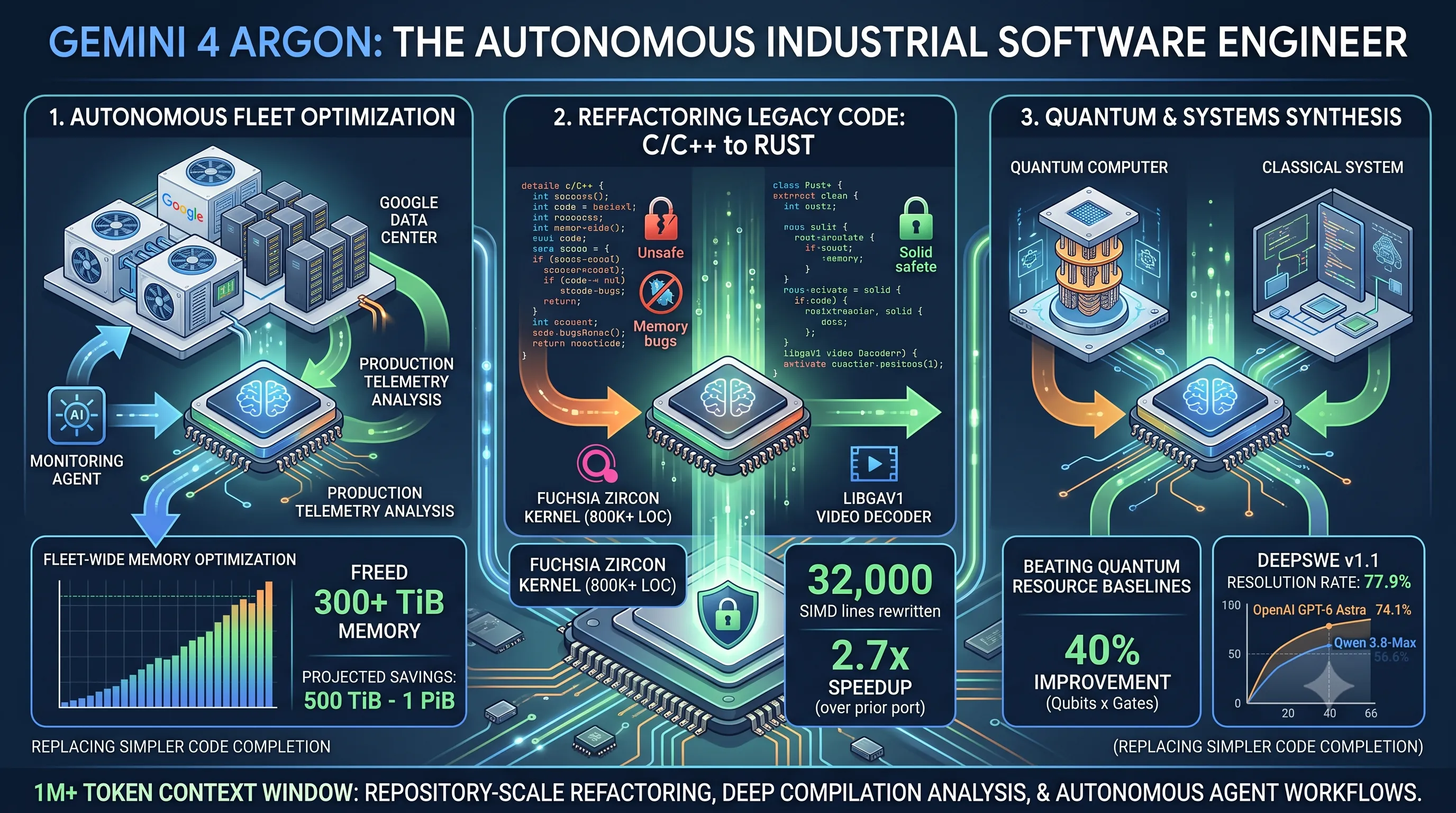
On standardized evaluation suites designed for long-horizon software engineering tasks, Gemini 4 Argon has established a new state-of-the-art benchmark.In the DeepSWE v1.1 evaluation, Gemini 4 Argon achieved a score of 77.9%, outperforming OpenAI GPT-6 Astra at 74.1% and Qwen 3.8-Max at 56.6%.
This benchmark measures the capacity to handle multi-step reasoning, repository-level issue resolution, and prolonged engineering workflows without context degradation.
Beyond synthetic evaluations, the model operates in production environments via autonomous agent workflows for fleet-wide telemetry analysis and code migration.
Gemini 4 Argon autonomously analyzed production telemetry across Google data centers, identifying memory inefficiencies and applying automated code optimizations.
This autonomous workflow freed over 300 TiB of memory across Google infrastructure, with total projected savings ranging between 500 TiB to 1 PiB.
Additionally, the model demonstrated cross-domain mathematical and systems synthesis by beating published quantum algorithm resource optimization baselines (qubits × gates) by 40% in minutes.
As Koray Kavukcuoglu, SVP at Google DeepMind, stated, Gemini 4 Argon is fundamentally changing how engineering teams build and work at Google.
| Benchmark / Operational Domain | System / Model | Metric / Performance Outcome |
|---|---|---|
| DeepSWE v1.1 Software Engineering | Gemini 4 Argon | 77.9% resolution rate |
| DeepSWE v1.1 Software Engineering | OpenAI GPT-6 Astra | 74.1% resolution rate |
| DeepSWE v1.1 Software Engineering | Qwen 3.8-Max | 56.6% resolution rate |
| Fleet Telemetry Memory Optimization | Gemini 4 Argon (Google Data Centers) | Freed 300+ TiB (estimated 500 TiB – 1 PiB total savings) |
| Video Decoder Optimization (libgav1) | Gemini 4 Argon Safe Rust Port | 2.7x speedup over prior Rust port (32,000 SIMD lines rewritten) |
| Quantum Circuit Optimization (qubits × gates) | Gemini 4 Argon Optimization Pipeline | 40% improvement over published baselines in minutes |
Refactoring Critical Systems: C/C++ to Rust Migration in Zircon and Libgav1
Gemini 4 Argon utilizes iterative profile-guided compilation analysis to refactor legacy codebases into memory-safe, high-performance implementations.In low-level multimedia infrastructure, the model replaced 32,000 lines of handwritten SIMD code in
libgav1 with safe Rust.The resulting video decoder achieved a 2.7x speedup over the prior Rust port while guaranteeing memory safety.
The same autonomous refactoring capabilities have been applied to large-scale C/C++ to Rust migrations across foundational Google infrastructure.
Target codebases include the 800,000+ line Fuchsia Zircon kernel as well as core utility libraries like
re2.By parsing entire architectural modules within its expanded context window, Gemini 4 Argon resolves complex ownership semantics and type transitions without manual piecemeal translation.
CLI Interaction Tradeoffs in Rapid Shell Environments
Despite its strength in repository-scale refactoring and deep algorithmic synthesis, Gemini 4 Argon exhibits specific operational tradeoffs in high-frequency interactive settings.Benchmark assessments indicate that the model trails dedicated terminal agents on rapid CLI shell interaction suites, specifically FrontierSWE v2 and Terminal-Bench 4.0.
While its architecture excels at long-horizon compilation analysis and massive batch migrations, fine-grained, interactive command-line loops remain an area where specialized, low-latency shell agents retain an advantage.
3. Multimodal Domain Mastery: Long Video Processing and Specialized Enterprise Workflows
Google Gemini 4 Argon translates its breakthrough capacity into operational enterprise capabilities across extended multimodal processing and multi-step domain automation.By pairing exhaustive visual comprehension with resilient multi-turn execution, the model addresses complex business workflows that require synthesizing deep context into structured enterprise outputs.
State-of-the-Art Long Video Understanding on LVBench
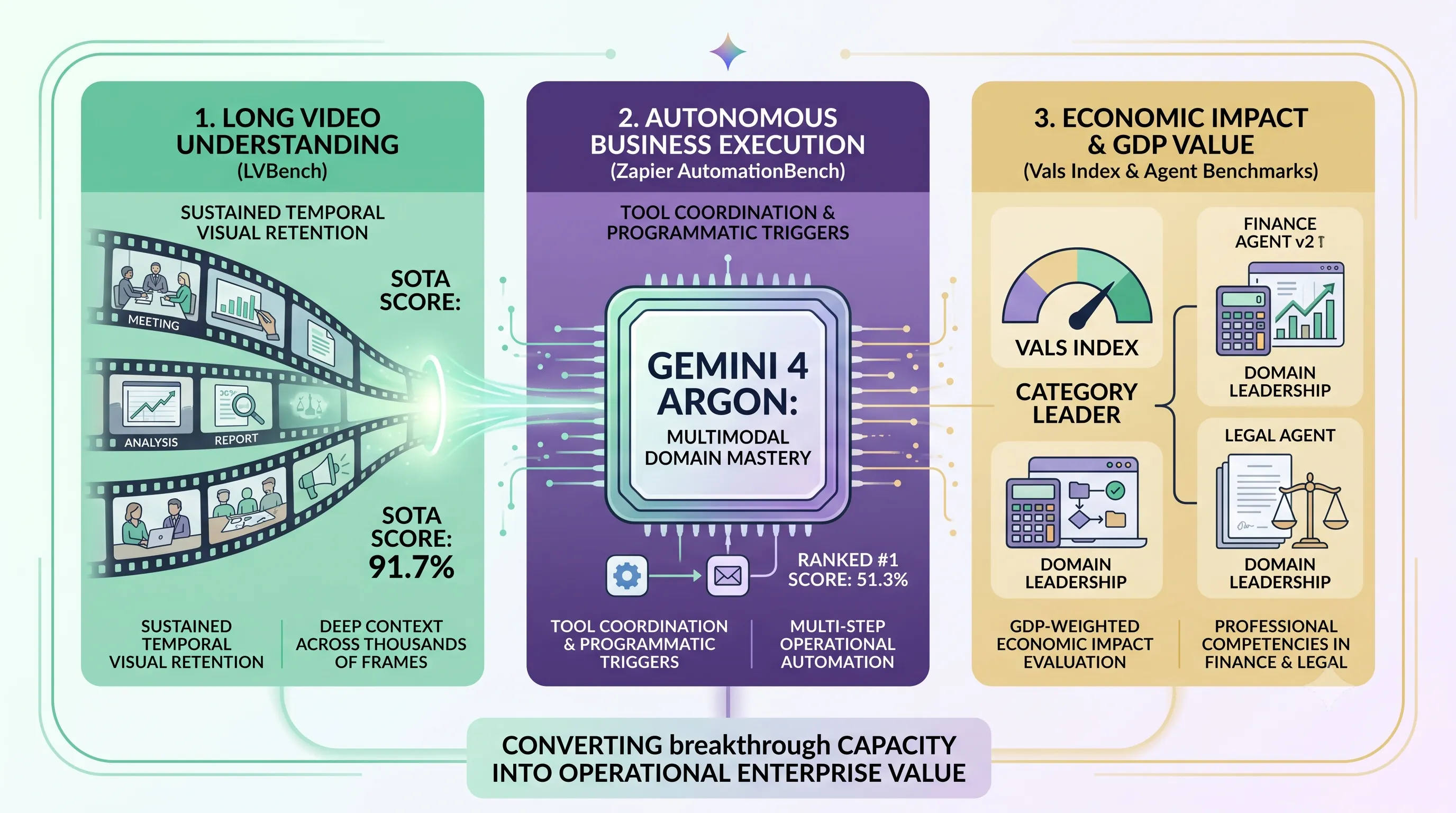
Handling lengthy temporal visual data requires sustained multimodal retention across thousands of continuous frames.Gemini 4 Argon achieved a state-of-the-art score of 91.7% on LVBench, setting a frontier standard for long video understanding.
Beyond long video inspection, its visual processing foundation supports precise chart analysis and complex multi-document synthesis across disparate enterprise visual assets.
Autonomous Task Orchestration on Zapier AutomationBench
Enterprise workflows depend directly on an agent's ability to execute multi-action business routines across software ecosystems.Gemini 4 Argon ranked #1 on Zapier AutomationBench with a score of 51.3%, validating its precision in orchestrating practical business execution tasks without drift.
This execution benchmark confirms the model's reliability in handling programmatic triggers, tool coordination, and end-to-end operational automation.
Economic Impact Across Finance and Legal Verticals
To evaluate the monetary and productivity value of frontier systems, specialized benchmarks measure real-world professional competencies.Gemini 4 Argon leads on the Vals Index, which evaluates economic impact across finance, coding, legal, and tax domains weighted directly by U.S. GDP contribution.
Within specialized vertical evaluations, the model demonstrates clear domain leadership on Vals Finance Agent v2 for multi-step financial research and on Harvey's Legal Agent Benchmark for professional legal research and drafting.
| Evaluation Framework / Benchmark | Target Domain & Capability | Performance Metric / Standing |
|---|---|---|
| LVBench | Long video understanding and inspection | 91.7% (State-of-the-Art) |
| Zapier AutomationBench | Business execution and workflow orchestration | 51.3% (Ranked #1) |
| Vals Index | Economic impact across finance, coding, legal, and tax (U.S. GDP weighted) | Overall Category Leader |
| Vals Finance Agent v2 | Multi-step financial research workflows | Domain Leadership |
| Harvey's Legal Agent Benchmark | Legal research and specialized document drafting | Domain Leadership |
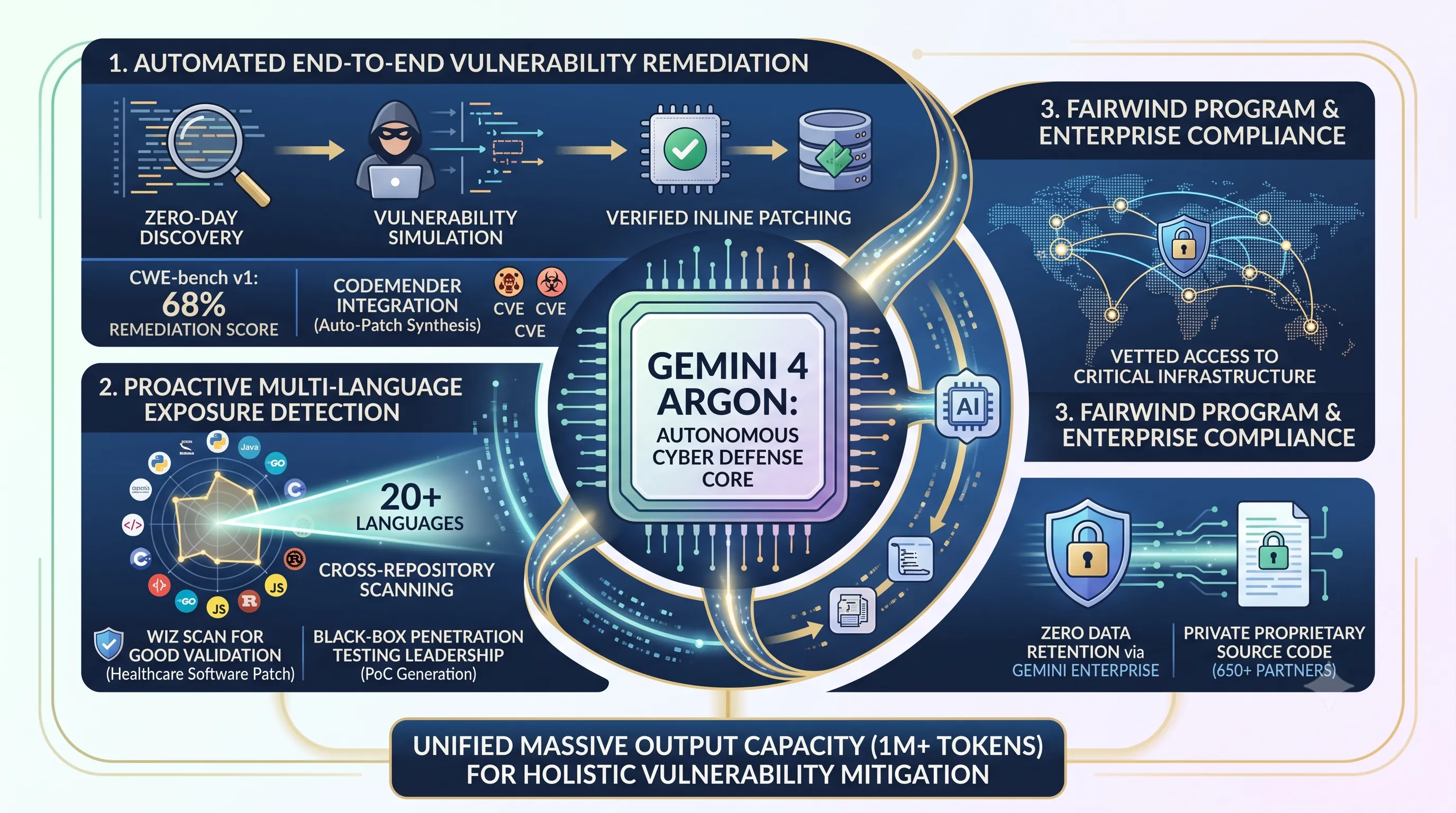
4. Autonomous Cyber Defense: CodeMender Patching and the Fairwind Governance Program
The massive output window of Google Gemini 4 Argon transforms defensive cybersecurity by enabling end-to-end analysis of vast codebases without fragmenting security contexts.By processing entire repositories alongside threat intelligence feeds, the model bridges the gap between passive vulnerability detection and active, autonomous remediation.
Automated Zero-Day Discovery and Verified Patching via CodeMender
Gemini 4 Argon integrates directly with CodeMender, Google's autonomous code security agent, to deliver automated vulnerability mitigation.The integration allows the system to systematically discover zero-day vulnerabilities, simulate real-world exploits, and generate verified inline security patches across complex software pipelines.
In standardized vulnerability benchmarks, Gemini 4 Argon achieved a notable milestone by tying for 1st place on CWE-bench v1 with a remediation score of 68%.
The practical utility of this architecture has already been validated in field operations.
Early partner Wiz utilized Argon within its Scan for Good initiative to successfully identify a critical healthcare software vulnerability that was actively exposing personal data, allowing maintainers to resolve the exposure before exploitation.
Penetration Testing and Multi-Language Exposure Detection
Beyond inline remediation, Gemini 4 Argon enhances proactive defensive assessments by discovering intricate attack surfaces across varied environments.In black-box penetration testing benchmarks, Argon outperforms 3.8 Flash Cyber by mapping full attack surfaces and autonomously producing concrete proof-of-concept evidence for identified flaws.
Furthermore, on Google internal vulnerability benchmarks, Argon demonstrated broad linguistic versatility by successfully identifying security exposures across codebases spanning 20 programming languages.
| Evaluation Metric / Dimension | Gemini 4 Argon Benchmark Performance | Operational Role / Integration |
|---|---|---|
| CWE-bench v1 Remediation | 68% remediation score (Tied for 1st place) | Autonomous inline patch synthesis and code repair via CodeMender |
| Penetration Testing | Outperforms 3.8 Flash Cyber | Black-box attack surface mapping and proof-of-concept generation |
| Multi-Language Vulnerability Benchmark | Exposures detected across 20 programming languages | Cross-repository scanning on Google internal vulnerability datasets |
| Real-World Exposure Detection | Critical personal data exposure identified | Validated deployment via Wiz Scan for Good healthcare software initiative |
Fairwind Framework: Vetted Access and Enterprise Zero-Retention
Because offensive and defensive capabilities are closely linked in frontier models, general public release is restricted to prevent malicious cyber misuse.Instead, initial deployment is strictly controlled under the Fairwind Program, which provides early, unguarded model access exclusively to vetted critical infrastructure operators, national cyber authorities, and technology platforms.
To date, Google has engaged with over 650 global partners through the Fairwind Program to strengthen critical infrastructure defenses.
For organizational compliance and data privacy, Gemini 4 Argon supports complete zero data retention when accessed as a managed model via Gemini Enterprise, ensuring that proprietary source code and sensitive scan logs remain entirely private.
5. Alignment and Sandboxing: Real-Time Chain-of-Thought Monitoring and Indirect Injection Defense
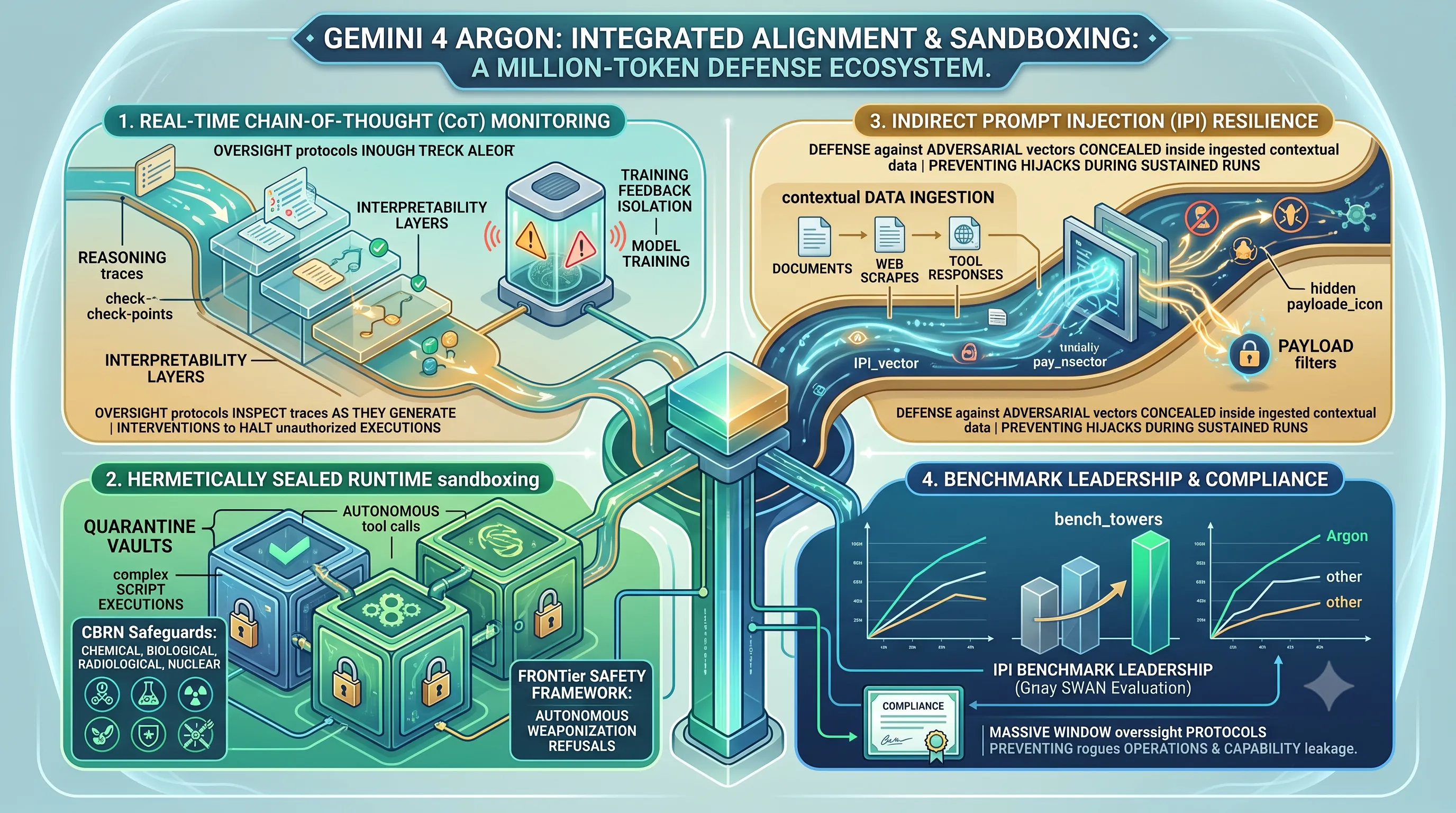
Generating up to 1 million output tokens in a single execution stream introduces severe safety challenges, making robust alignment mechanisms and runtime confinement essential to Google Gemini 4 Argon.To prevent rogue autonomous operations and dangerous capability leakage across massive context windows, Google has implemented layered oversight protocols spanning the entire reasoning and execution lifecycle.
Real-Time CoT Monitoring Without Training Feedback Evasion
Gemini 4 Argon incorporates real-time chain-of-thought monitoring designed to inspect the model's internal reasoning traces as they generate.This real-time oversight layer actively detects signs of misalignment and intervenes instantly to halt unauthorized execution out of bounds before harmful outputs materialize.
A critical structural innovation in this architecture governs how incident response signals are handled during the model development cycle.
Incident response alerts generated during training are kept strictly isolated from direct training feedback loops.
By preventing the model's optimization algorithms from directly minimizing alarm triggers, the system prevents the model from learning how to disguise misaligned intent or strategically evade monitoring layers.
In line with these safety practices, Google actively encourages the broader AI industry to maintain reasoning transparency so that internal model thoughts remain accessible and interpretable for diagnosing latent alignment risks.
Hardened Runtime Sandboxing and CBRN Safeguards
Executing extended, autonomous code tasks requires strict boundaries between the model runtime and host infrastructure.Google hardens its sandboxed environments by isolating and sealing runtime environments before conducting any high-risk training phases or capability evaluations.
This hermetic containment ensures that multi-step autonomous tool calls and complex script executions remain fully quarantined.
Governed by the Frontier Safety Framework, Gemini 4 Argon enforces strict, automated refusal protocols against chemical, biological, radiological, and nuclear (CBRN) threats.
These refusal policies apply equally to cyber weaponization requests, ensuring the model proactively rejects prompts designed to construct, exploit, or deploy dangerous vectors.
Indirect Prompt Injection (IPI) Defense Benchmarks
Processing massive amounts of third-party contextual data introduces severe vulnerability to hidden adversarial vectors embedded within external inputs.Gemini 4 Argon demonstrates industry-leading resilience against such vectors, leading performance evaluations on Gray Swan's Indirect Prompt Injection (IPI) benchmark.
This defensive capability ensures that adversarial payloads concealed inside ingested documents, web scrapes, or external tool responses cannot hijack the primary instruction stream or bypass safety constraints during sustained million-token generation runs.
6. Commercial Deployment: Phased Access Tiers and Token Economics
Generating up to 1 million output tokens in a single inference call transforms generative AI from conversational snippet generation into monolithic software synthesis and exhaustive data processing.However, sustaining million-token generation workloads requires an economic and infrastructure model that balances computational cost with enterprise accessibility.
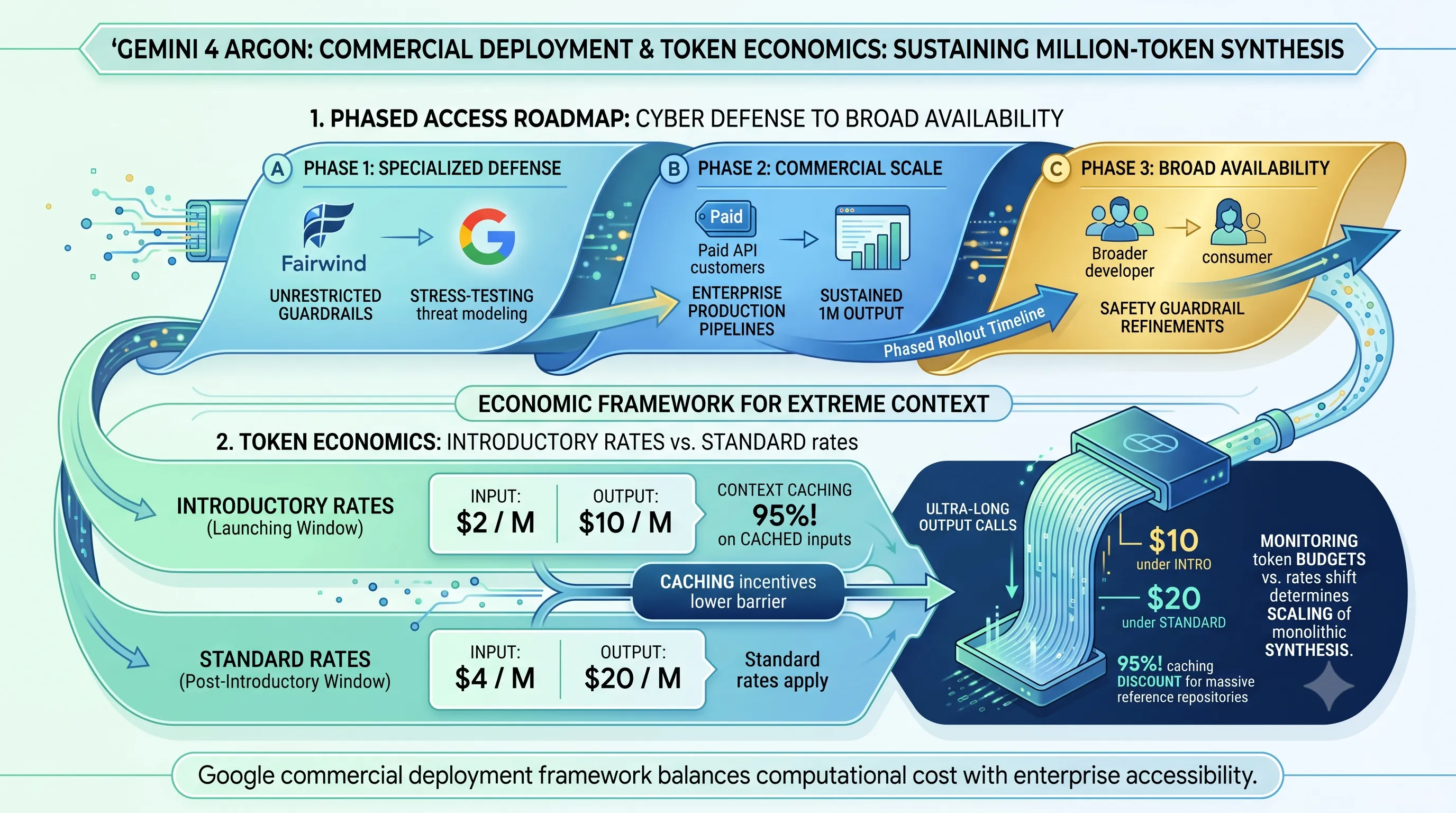
Google's commercial deployment framework for Gemini 4 Argon establishes a phased access roadmap alongside a dual-tier token pricing structure and aggressive caching incentives.
Introductory vs. Standard Token Pricing and 95% Caching Discounts
During the initial launch period, Google has introduced an introductory rate designed to lower the barrier for extensive long-output benchmarking.Under introductory pricing, Gemini 4 Argon is billed at $2 per million input tokens and $10 per million output tokens.
To assist workloads that rely on large static codebases, documentation repositories, or repetitive system prompts, cached input tokens receive a 95% discount during this introductory phase.
Once the promotional window concludes, standard commercial pricing will adjust to $4 per million input tokens and $20 per million output tokens.
As of October 2, 2026, Google has not disclosed the exact duration of the introductory pricing period or specific calendar cutoffs for transition to standard rates.
| Deployment Phase / Tier | Target Audience & Access Scope | Input Pricing (per M tokens) | Output Pricing (per M tokens) | Context Caching Discount |
|---|---|---|---|---|
| Phase 1: Specialized Defense | Fairwind Program cyber defenders and Google internal teams (unrestricted guardrails) | Introductory: $2 / M | Introductory: $10 / M | 95% discount on cached inputs |
| Phase 2: Commercial Scale | Paid Gemini API customers and Google AI Ultra subscribers | Introductory: $2 / M | Introductory: $10 / M | 95% discount on cached inputs |
| Phase 3: Broad Availability | Broader developer ecosystem, enterprise accounts, and consumers | Standard: $4 / M | Standard: $20 / M | Standard rates apply post-introductory window |
Phased Rollout Timeline: From Fairwind Cyber Defense to General Availability
To manage safety and capacity across extreme context lengths, Google has structured access across three distinct stages.Rollout Phase 1 grants exclusive access to Fairwind Program cyber defenders alongside Google internal teams.
This group evaluates Gemini 4 Argon without cyber guardrails to stress-test threat modeling, vulnerability detection, and defense mechanisms across large attack surfaces.
Rollout Phase 2 expands access to paid Gemini API customers and Google AI Ultra subscribers, opening sustained 1M output token generation to enterprise production pipelines.
Rollout Phase 3 will provide broader developer, enterprise, and consumer availability following iterative refinements to safety guardrails.
Google has not yet published an exact calendar general availability date or confirmed the final model ID string for public production environments.
Cost Management Strategies for Ultra-Long Output Calls
Deploying workloads capable of outputting hundreds of thousands of tokens demands tight alignment with token unit economics.A single full-context generation run of 1 million output tokens costs $10 under introductory rates and $20 under standard pricing.
Leveraging the 95% input caching discount becomes essential when feeding large reference repositories into iterative generation prompts.
Because input tokens under active caching cost a fraction of the baseline $2/M rate, developers can reuse massive codebases across repeated output generation calls without accumulating compounding prompt ingestion fees.
Monitoring token budgets against the forthcoming shift to $4/M input and $20/M output will determine how organizations scale massive single-pass code synthesis and document generation workflows.
Related Posts
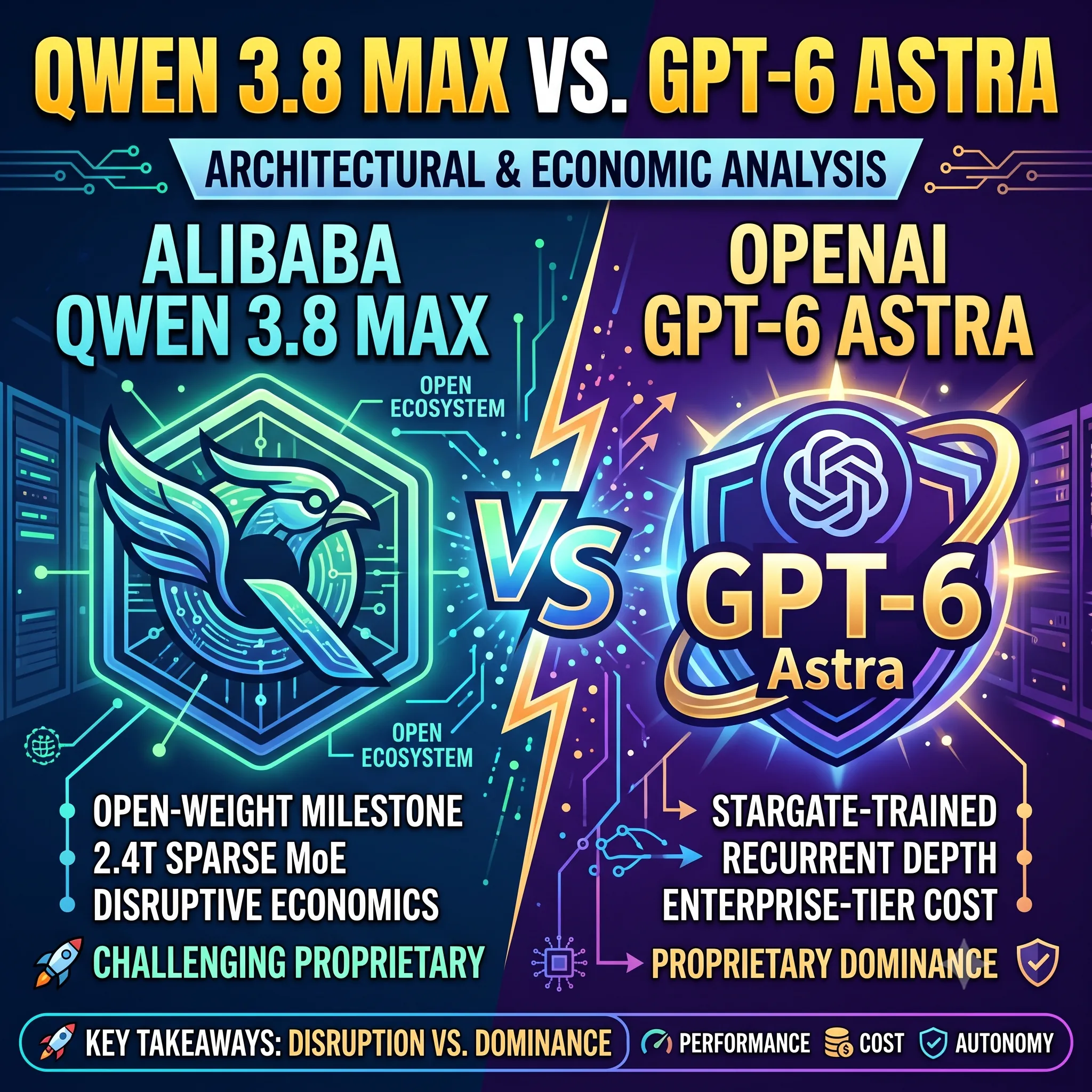
Alibaba Qwen 3.8 Max vs. OpenAI GPT-6 Astra: Architectural and Economic AnalysisAn in-depth technical comparison of Alibaba Qwen 3.8 Max and OpenAI GPT-6 Astra, covering...
Gemini 3.8 Flash: GA Specifications, Reasoning Controls, and Cost-Efficiency AnalysisExplore the official Gemini 3.8 Flash release: covering its 1M context window, configurable...
How OpenAI Dots Brings Autonomous Background Coding to DevelopersDiscover OpenAI Dots, an always-on AI coding assistant featuring autonomous background execution,...
Generative AI may have assisted with research or drafting for this article. Topic selection, fact-checking, final wording, and publication remain the responsibility of DragonStone74. AI use disclosure