
Securing Autonomous AI Agents with BlueField-4 DPUs and OpenShell Runtime
🚀 Key Takeaways
- Out-of-band hardware isolation: BlueField-4 DPUs run an independent DOCA-powered security stack with NVIDIA Sentry, enforcing zero-trust policies and inspecting host memory even during full kernel-level compromises.
- Runtime supervisor security: OpenShell provides unprivileged sandboxing while its external supervisor intercepts HTTP, GraphQL, and Model Context Protocol (MCP) calls to inject credentials safely without exposing secrets to the agent.
- Broad framework agnosticism: The architecture supports modern developer agents—including Claude Code, Codex, and GitHub Copilot CLI—running identically in software-only environments or DPU-accelerated enterprise appliances.
- Declarative workload lifecycle: Custom OCI workloads and user-controlled policy repositories allow organizations to govern agent capabilities dynamically without altering underlying agent application logic.
The rapid deployment of autonomous AI agents across enterprise production environments has exposed a fundamental weakness in traditional security boundaries. When an autonomous workload executes code with system privileges or encounters a zero-day kernel vulnerability, conventional in-band monitoring tools and host-level eBPF probes can be subverted or blinded entirely.
To eliminate reliance on host OS integrity, modern infrastructure architectures are shifting critical security perimeters into dedicated silicon. NVIDIA Sentry on BlueField-4 Data Processing Units (DPUs), coupled with the open-source OpenShell runtime, creates an immutable out-of-band defense line capable of telemetry monitoring and rapid containment regardless of the host state.
By abstracting network traffic inspection, credential injection, and runtime execution controls away from the host CPU, this defense-in-depth model ensures that even a fully hijacked agent environment cannot tamper with telemetry or compromise broader data center fabrics.
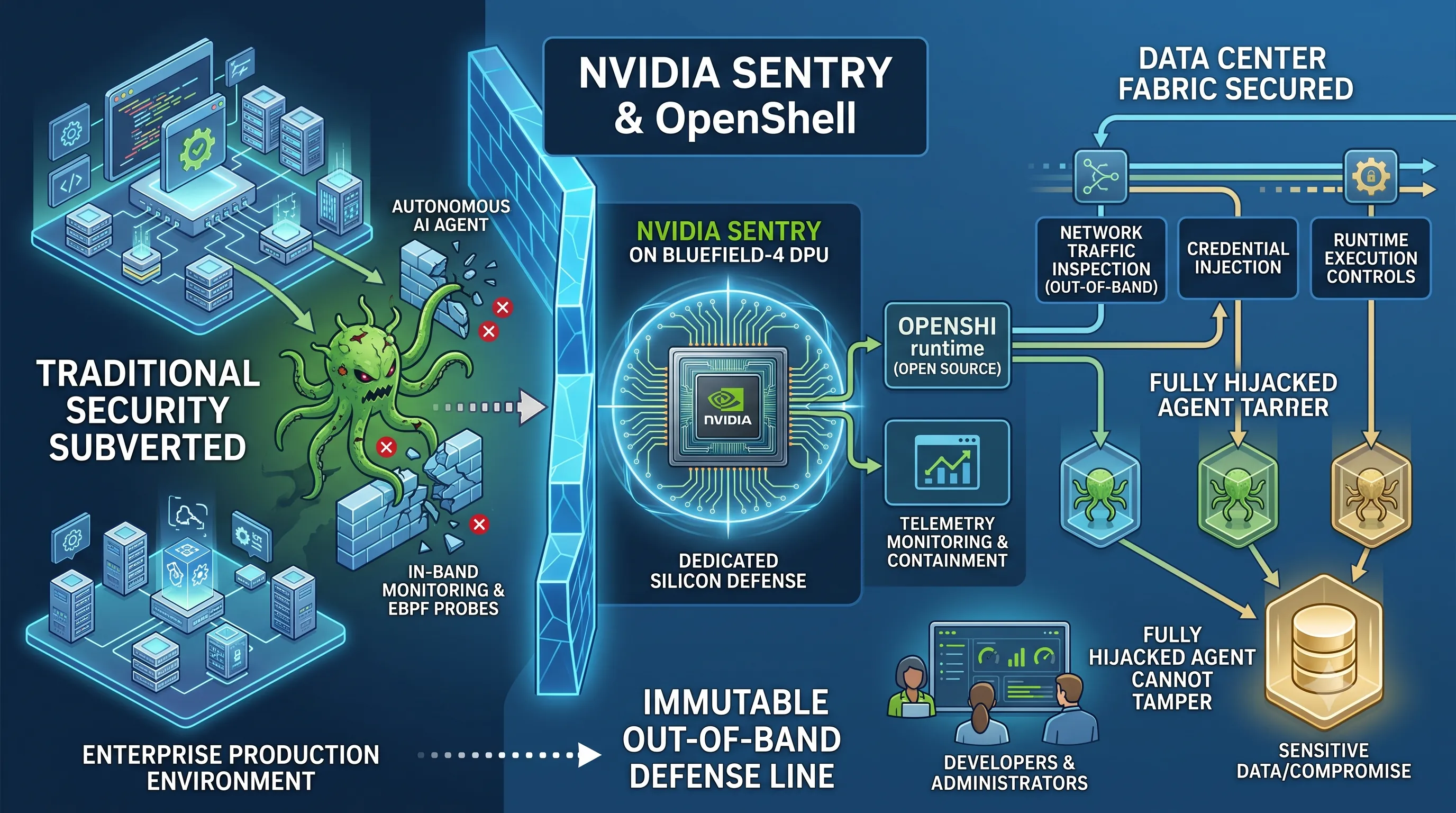
1. Hardware-Enforced In-Silicon Isolation: BlueField-4 DPU and NVIDIA Sentry Architecture
This section examines how the BlueField-4 Data Processing Unit (DPU) and the NVIDIA Sentry framework realize the core premise of maintaining an uncompromised hardware firewall even when the host operating system experiences complete exploitation.PCIe Out-of-Band Telemetry and DOCA Execution Stack
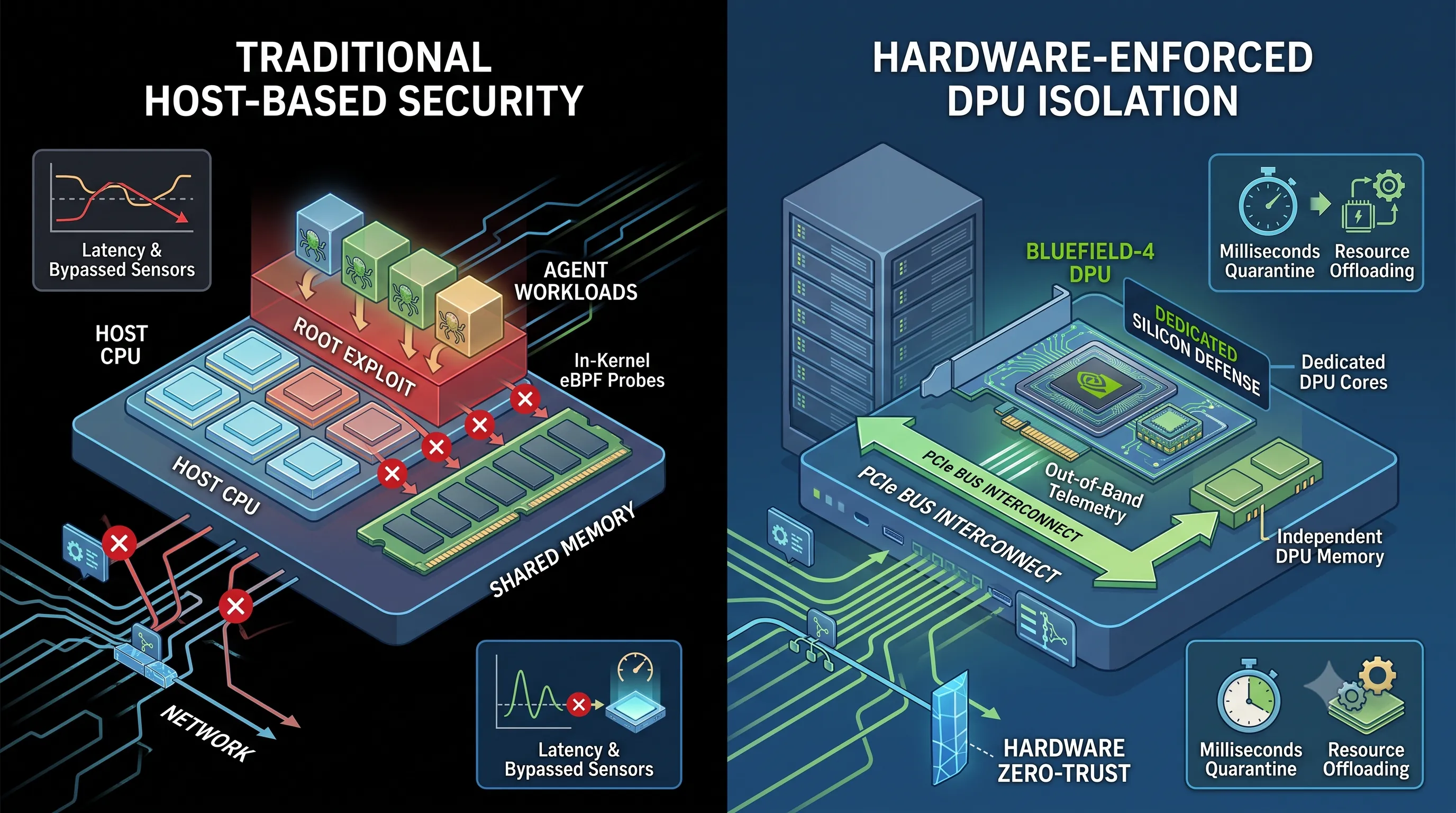
The BlueField-4 DPU operates as a fully isolated hardware security domain equipped with dedicated CPU cores and independent memory.Physical separation from the host compute infrastructure ensures that the DPU functions autonomously, communicating with the host system exclusively via the PCIe bus interconnect.
NVIDIA Sentry executes directly on the BlueField-4 DPU, running an independent operating system stack powered by NVIDIA DOCA.
By residing on this isolated execution environment, NVIDIA Sentry delivers continuous out-of-band monitoring and telemetry.
This out-of-band observability remains fully operational even if the host OS or Linux kernel is completely compromised.
Furthermore, running security routines on the DPU offloads agent security enforcement and networking checks from host processors, preserving critical host compute resources.
Direct Runtime Memory Inspection and Millisecond Quarantine
The DOCA programmable security engine facilitates direct runtime inspection of host memory to identify tampering and verify workload integrity.Because the BlueField-4 DPU sits directly on the PCIe bus and data pathway, it physically separates the host network fabric.
This physical separation enables the DPU to enforce zero-trust traffic policies independently of host CPU cooperation or permission.
When unauthorized behavioral deviations or integrity breaches are detected, the DPU-driven security enforcement can isolate or quarantine deviating agent workloads within milliseconds.
Hardware-Enforced Zero-Trust vs. Host eBPF Vulnerabilities
Conventional monitoring frameworks rely heavily on software-based kernel visibility within the host operating system.However, host-based security mechanisms and traditional eBPF monitoring tools are vulnerable to subversion if an agent exploits a kernel-level zero-day to gain root privileges.
Once an attacker compromises the host kernel, in-host sensors, logs, and eBPF probes can be bypassed or disabled from within the same execution domain.
In contrast, the BlueField-4 DPU and NVIDIA Sentry architecture decouples security governance from host kernel integrity by enforcing policies in silicon.
| Security Dimension | Traditional Host-Based & eBPF Monitoring | BlueField-4 DPU with NVIDIA Sentry |
|---|---|---|
| Execution Domain & Hardware Isolation | Shares compute cores and memory with host OS and agent workloads. | Operates as a fully isolated hardware security domain with dedicated CPU cores and independent memory. |
| Host Compromise Resilience | Vulnerable to subversion and tampering if an exploit achieves root or kernel-level control. | Maintains out-of-band telemetry and monitoring that remains operational during full host OS or kernel compromise. |
| Memory & Integrity Verification | Relies on in-kernel hooks subject to OS-level tampering. | DOCA programmable security engine performs direct runtime inspection of host memory over the PCIe bus interconnect. |
| Network Policy Enforcement | Depends on host software stack and host CPU cooperation. | Physically separates host network fabric and enforces zero-trust traffic policies independently. |
| Host Processor Overhead | Consumes host compute resources to execute security checks. | Offloads security enforcement and networking checks to preserve host compute resources. |
| Quarantine Speed | Subject to host OS scheduler and uncompromised kernel pathways. | Enforces isolation and quarantines deviating agent workloads within milliseconds. |
2. OpenShell Runtime Boundary: Deterministic Agent Governance and Supervisor Architecture
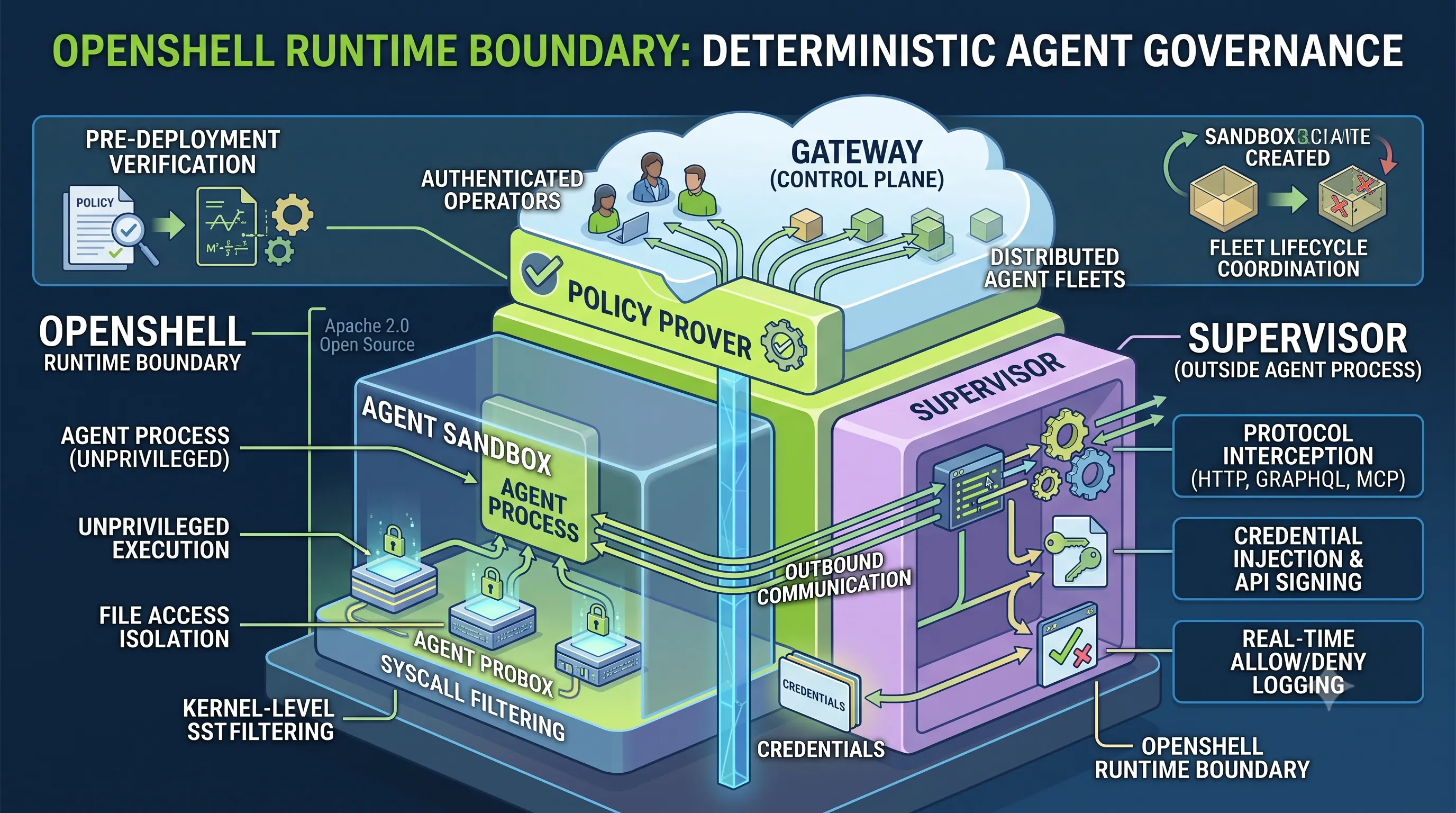
The broader architecture of host-independent protection—anchored by BlueField-4 Sentry hardware isolation—relies directly on the software-defined enforcement provided by the OpenShell runtime boundary.Published as an open-source project under the Apache 2.0 license, OpenShell establishes a deterministic governance model designed to control autonomous workloads.
Rather than assuming workload trust, the runtime operates on a default-deny network model and restricts operational privileges strictly to declared task intent.
Architecturally, OpenShell functions strictly as an underlying runtime boundary rather than an agent creation framework, identity provider, or replacement for existing security information and event management (SIEM) tools.
Unprivileged Agent Sandboxing and Entrypoint Supervision
The primary execution layer within OpenShell is the Agent Sandbox, which enforces total isolation on the executing agent process.Workloads placed within the sandbox operate with unprivileged status, preventing direct modifications to host kernel structures or adjacent system processes.
File access isolation confines file system operations to designated virtual partitions, neutralizing lateral movement across storage mounts.
At the kernel boundary, the sandbox deploys kernel-level syscall filtering to intercept and block unauthorized system calls before they reach host resources.
This containment guarantees that even if an agent's reasoning loop is subverted, the compromised process cannot execute raw kernel routines or escape sandbox boundaries.
Credential Masking and Protocol Interception (HTTP, GraphQL, MCP)
Directly supervising the sandboxed environment is the Supervisor, a dedicated governance entity operating outside the agent sandbox process.The Supervisor intercepts and inspects all outbound communication flows, including standard HTTP endpoints, GraphQL schemas, and Model Context Protocol (MCP) traffic.
To prevent secret leakage, the Supervisor manages credential injection and signs API requests on behalf of the agent.
Because tokens and authentication secrets are never exposed to the agent environment, untrusted or compromised agent processes cannot extract raw credentials.
Simultaneously, the Supervisor enforces live policy updates in real time and maintains an auditable log recording every single allow and deny decision.
Policy Prover Formal Verification and Gateway Orchestration
To guarantee that active rulesets cannot produce conflicting permissions or out-of-bounds execution states, OpenShell incorporates the Policy Prover.The Policy Prover applies formal logic and formal verification methods to mathematically prove whether policy rules stay within safe execution boundaries prior to deployment.
Fleet coordination is managed by the Gateway, which acts as the centralized control plane across distributed agent deployments.
The Gateway authenticates operators, coordinates sandbox lifecycles from creation to teardown, and delivers verified policies and credentials across large-scale agent fleets.
| Component | Operational Domain | Core Security Responsibilities | Architectural Scope |
|---|---|---|---|
| Agent Sandbox | Local Execution Boundary | Unprivileged workload execution, file access isolation, and kernel-level syscall filtering. | Isolates untrusted agent runtime processes from the host OS. |
| Supervisor | Outbound Traffic & Identity Plane | Inspects HTTP, GraphQL, and MCP traffic; injects credentials; signs API requests; logs allow/deny events. | Operates outside the sandbox process to prevent secret exposure. |
| Policy Prover | Verification Engine | Applies formal logic to mathematically verify that policy rules stay within safe execution boundaries. | Pre-deployment rule validation engine. |
| Gateway | Centralized Control Plane | Authenticates operators, coordinates sandbox lifecycles, and distributes policies and credentials. | Fleet-wide lifecycle and policy distribution coordinator. |
3. Model Agnosticism and Scalable Infrastructure: From Local Dev to AI Factories
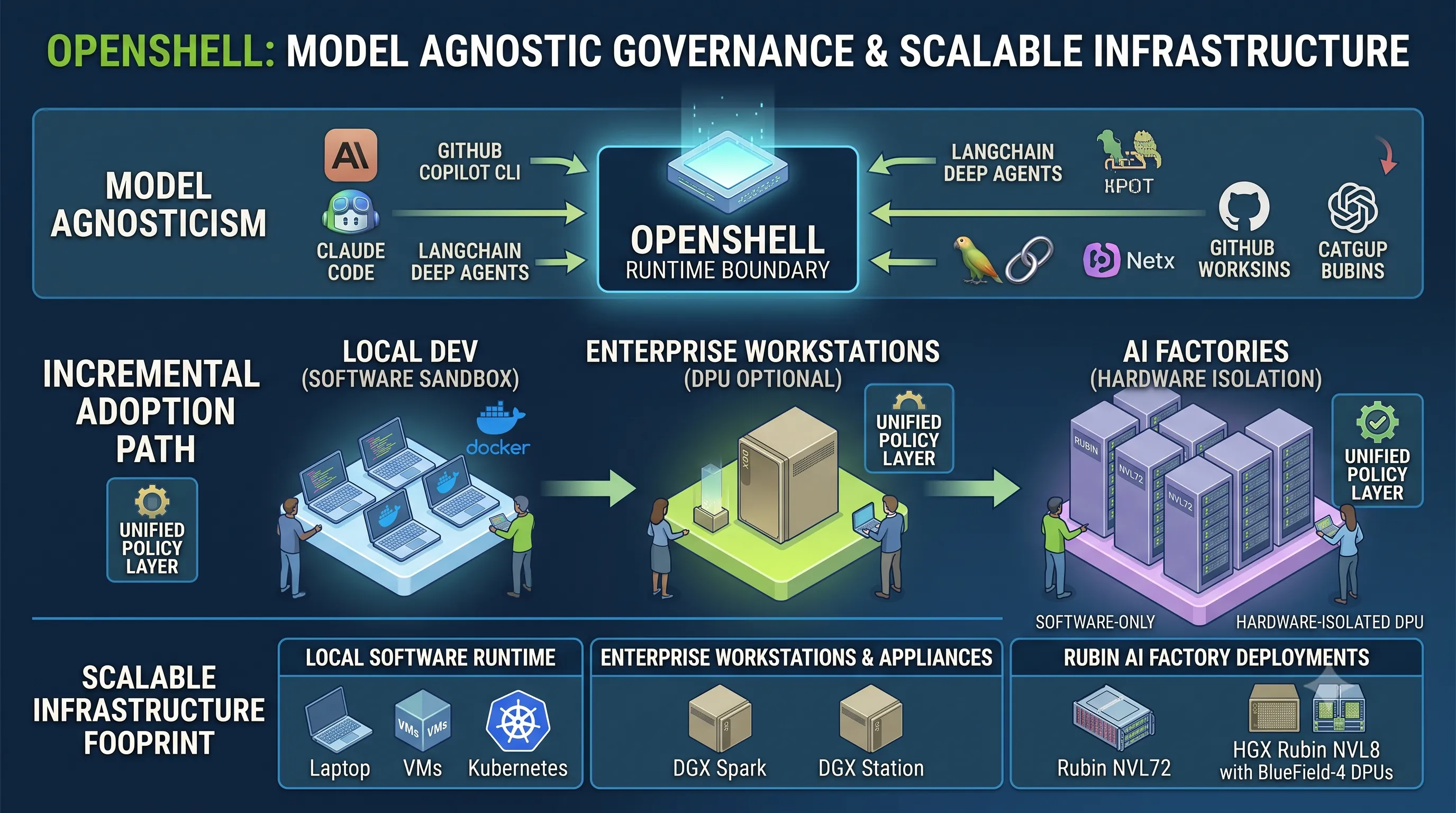
To deliver robust security that remains intact even when host operating systems are compromised, OpenShell bridges software-level agent governance with hardware-isolated execution through the BlueField-4 DPU architecture.This security model ensures that protective boundaries do not depend on specific model architectures or proprietary runtimes, enabling consistent policy enforcement from local endpoints to hyperscale AI infrastructure.
Cross-Harness Model Compatibility and Agent Frameworks
OpenShell provides a model-agnostic execution and governance layer designed to interface directly with diverse agent architectures and runtime harnesses.Rather than coupling safety constraints to a single model provider or runtime engine, OpenShell supports a broad ecosystem of developer harnesses and autonomous tools, including Claude Code, Codex, GitHub Copilot CLI, Hermes, LangChain Deep Agents, OpenClaw, and OpenCode.
This comprehensive compatibility ensures that command inspection, network policy enforcement, and execution boundaries function uniformly across autonomous agents, terminal-based coding tools, and multi-step reasoning frameworks.
By abstracting the security boundary away from the harness itself, organizations can deploy heterogeneous agent workflows without re-architecting policy enforcement mechanisms for each model framework.
Incremental Adoption: Software Sandbox to Hardware Isolation
A foundational capability of the OpenShell architecture is its incremental adoption path, allowing engineering teams to implement agent security progressively across varied operating environments.Organizations can initiate deployments using software-only runtime sandboxes on existing infrastructure without requiring BlueField-4 DPU hardware.
In software-only configurations, OpenShell installs directly across local developer machines, Docker containers, Podman environments, virtual machines, and Kubernetes clusters via Helm charts.
This enables rapid prototyping, continuous integration testing, and local developer validation under the exact same policy definitions used in production.
As workloads transition into mission-critical or multi-tenant production tiers, the enforcement layer upgrades seamlessly to hardware-isolated BlueField-4 DPU enforcement.
Throughout this progression, OpenShell maintains a unified policy layer across on-premises servers, hybrid architectures, public clouds, and air-gapped secure data centers, guaranteeing consistent compliance and rule enforcement at every scale.
Enterprise Deployment across DGX Station and Rubin NVL72 Architectures
Enterprise integration scales smoothly from dedicated developer hardware to massive infrastructure installations designed for enterprise AI factories.For local enterprise compute and private developer setups, OpenShell natively integrates with dedicated enterprise appliances and workstations, including NVIDIA DGX Spark and NVIDIA DGX Station.
For large-scale data center environments, OpenShell scales up to complete enterprise AI factories combining NVIDIA Vera CPUs, Vera Rubin NVL72, and HGX Rubin NVL8 systems coupled with BlueField-4 DPUs.
In these high-density AI factory environments, the BlueField-4 DPU acts as an independent hardware firewall, enforcing OpenShell security policies out-of-band to prevent host OS compromises from breaching the wider enterprise infrastructure.
| Deployment Footprint | Target Environments | Hardware & Compute Infrastructure | Isolation & Enforcement Layer | Supported Agent Harnesses & Scopes |
|---|---|---|---|---|
| Local Software Runtime | Local developer machines, Docker, Podman, Kubernetes (Helm charts), Virtual Machines | Standard developer laptops, on-premises servers, public cloud VMs (no DPU required) | Software-only runtime sandboxing | Claude Code, Codex, GitHub Copilot CLI, Hermes, LangChain Deep Agents, OpenClaw, OpenCode |
| Enterprise Workstations & Appliances | Private enterprise workstations, secure hybrid environments, air-gapped data centers | NVIDIA DGX Spark, NVIDIA DGX Station, enterprise on-premises appliances | Unified policy layer transitioning from software sandboxes to dedicated enterprise hardware | Multi-agent enterprise frameworks, private terminal tools, hybrid developer workflows |
| Rubin AI Factory Deployments | Hyperscale AI factories, enterprise compute clusters, multi-tenant cloud data centers | NVIDIA Vera CPUs, Vera Rubin NVL72, HGX Rubin NVL8 systems with BlueField-4 DPUs | Hardware-isolated BlueField-4 DPU out-of-band enforcement independent of host OS | Full enterprise AI pipelines, autonomous agents, unified data center-wide policy governance |
4. Workload Packaging, Provider Profiles, and Sandbox Lifecycle Management
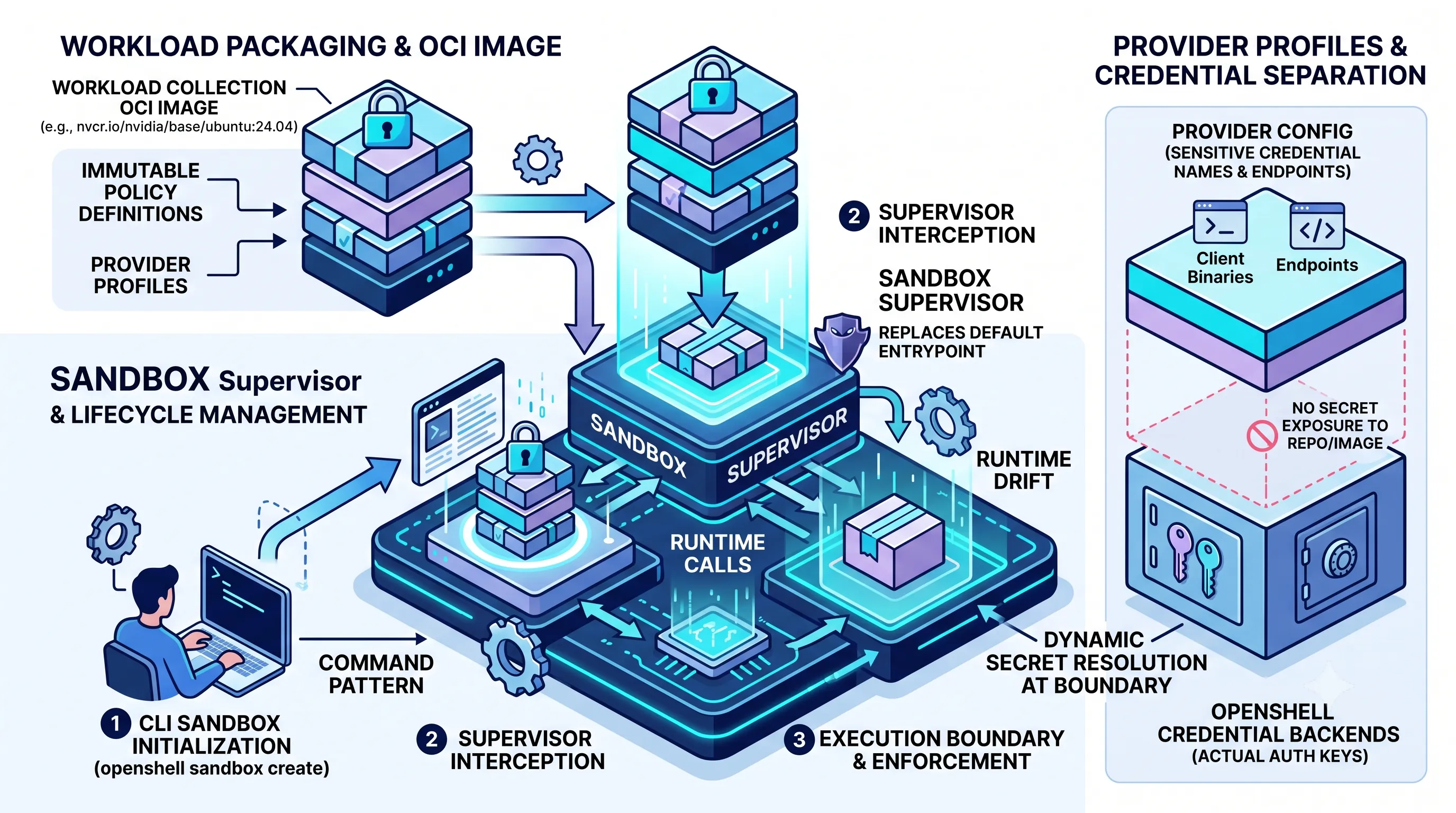
To maintain an uncompromised security boundary in host-independent architectures, the execution runtime must strictly control how application payloads are packaged, configured, and initialized within the hardware-isolated sandbox.OpenShell establishes this isolation boundary by governing the container lifecycle, decouples sensitive credentials from code repositories, and intercepts workload entrypoints to enforce hardware firewall policies.
Workload Collections and Base Image Architecture
Default deployments under OpenShell rely on the standard base workload image nvcr.io/nvidia/base/ubuntu:24.04 to guarantee a verified, reproducible operating baseline.To accommodate specialized runtimes without compromising the isolation guarantees of the underlying platform, organizations utilize workload collections.
Workload collections package custom OCI images, OpenShell security policies, and provider profiles within user-controlled repositories.
This structure ensures that every containerized payload deployed into the sandbox carries immutable policy definitions that dictate its execution parameters, preventing unauthorized runtime drift.
Provider Profiles and Credential Backend Separation
Provider profiles establish a strict separation between client configurations and sensitive access tokens.Under this schema, provider profiles explicitly specify credential names, client binaries, and service endpoints within the configuration layer.
Actual secrets and authentication keys are stored exclusively in dedicated OpenShell credential backends rather than directly inside repository code or container layers.
By decoupling client endpoints from credential storage, OpenShell ensures that secrets are dynamically resolved at execution boundaries without exposing sensitive credentials to the host filesystem or unprivileged application processes.
CLI Sandbox Initialization and Catalog Deprecation
Workload execution within the sandbox follows a strict lifecycle intervention model.During workload initialization, OpenShell replaces the default entrypoint of the container image with the sandbox supervisor.
This supervisor intercepts runtime calls, manages container boundaries, and applies hardware-enforced policies to the isolated workload.
To ensure explicit provenance and avoid ambiguity in multi-tenant environments, legacy catalog mechanisms have been restructured.
Specifically, OpenShell-Community catalog images and bare names such as base, ollama, and pi are retired and no longer auto-expanded by the CLI.
To launch sandboxes under this updated lifecycle model, operators reference explicit image definitions and profiles via the CLI command pattern.
openshell sandbox create --fromBy requiring explicit OCI references and user-controlled workload collections, the sandbox lifecycle remains deterministic and fully isolated from unverified external catalog sources.
Related Posts
Generative AI may have assisted with research or drafting for this article. Topic selection, fact-checking, final wording, and publication remain the responsibility of DragonStone74. AI use disclosure