
Optimizing LangGraph Agent Workflows with Node-Level Caching
🚀 Key Takeaways
- Redundant Call Elimination: Node-level caching stores previous execution outputs to bypass repetitive LLM invocations, drastically cutting API costs and response latency.
- Granular Cache Policies: LangGraph supports per-node cache rules, allowing configurable time-to-live settings and custom key functions to normalize inputs.
- Flexible Backend Architecture: Systems can leverage diverse storage layers—including in-memory, SQLite, and Redis—paired with programmatic cache invalidation controls.
- Seamless Runtime Integration: Caching operates harmoniously alongside core state graph primitives, tool-calling nodes, retry logic, and execution checkpointing.
As multi-step agentic workflows expand in complexity, repetitive LLM queries and redundant tool executions rapidly inflate operational expenses. When autonomous agents evaluate deterministic sub-tasks or re-encounter identical graph inputs, unoptimized calls create significant bottlenecks in both budget and end-to-end responsiveness.
LangGraph addresses this efficiency challenge through native node-level caching embedded directly within its stateful orchestration runtime. By decoupling static computations from active model inference, graph architectures can intelligently reuse prior outputs and only process novel context segments.
Mastering cache configurations, expiration strategies, and storage backends allows developers to engineer high-throughput agent systems that slash recurring infrastructure charges while preserving execution precision.
LangGraph addresses this efficiency challenge through native node-level caching embedded directly within its stateful orchestration runtime. By decoupling static computations from active model inference, graph architectures can intelligently reuse prior outputs and only process novel context segments.
Mastering cache configurations, expiration strategies, and storage backends allows developers to engineer high-throughput agent systems that slash recurring infrastructure charges while preserving execution precision.
1. LangGraph Core Architecture and Stateful Runtime Primitives
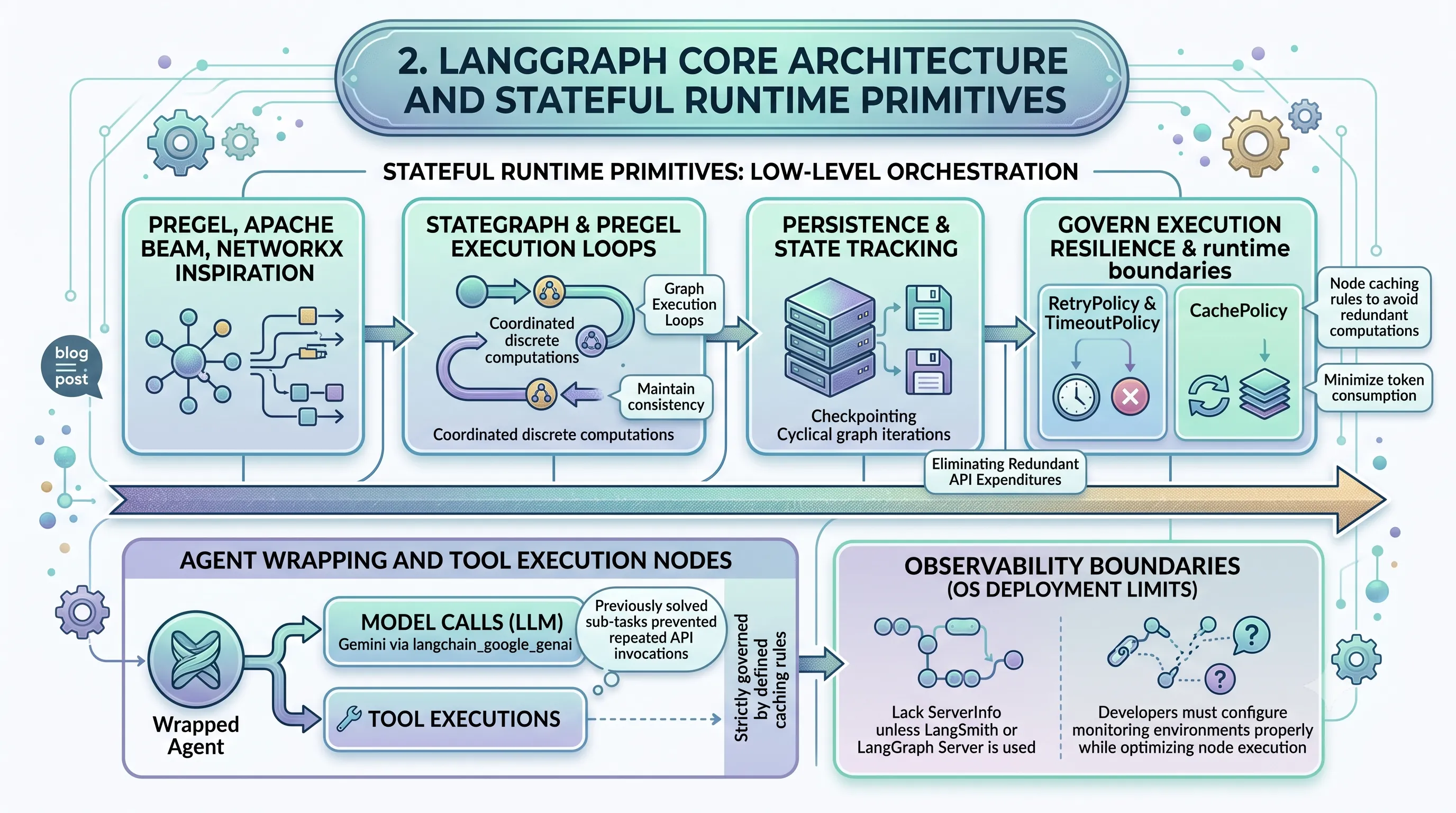
LangGraph serves as a low-level orchestration framework inspired by Pregel, Apache Beam, and NetworkX for stateful, long-running agent workflows.Understanding these foundational runtime primitives is vital for optimizing agent performance and eliminating redundant API expenditures through structured node execution.
Graph Execution Loops and Resilience Policies
The execution model in LangGraph relies on core runtime primitives designed to manage cyclical flows, fault tolerance, and execution boundaries.At the foundation of this setup is StateGraph, which structures state progression across coordinated steps.
Execution cycles are orchestrated through Pregel execution loops, coordinating discrete node computations while maintaining consistency across transitions.
To secure resilience and state preservation during multi-step runs, developers configure Checkpointing alongside targeted operational policies.
These operational primitives include RetryPolicy to manage transient errors, TimeoutPolicy to restrict unbounded executions, and CachePolicy to control state caching behaviors directly at the node level.
| Runtime Primitive | Architectural Role in LangGraph |
|---|---|
| StateGraph & Pregel Execution Loops | Provide low-level graph orchestration for stateful, long-running agent workflows inspired by Pregel, Apache Beam, and NetworkX. |
| Checkpointing | Maintains persistence and tracks state across cyclical graph iterations. |
| RetryPolicy & TimeoutPolicy | Govern execution resilience, error recovery, and runtime boundaries during graph execution. |
| CachePolicy | Enforces node caching rules to avoid redundant re-computations and minimize token consumption. |
Agent Wrapping and Tool Execution Nodes
LangGraph supports agent wrapping patterns where external integrations and actions execute inside dedicated graph nodes.Tool calls and LLM integrations, such as Gemini configured via
langchain_google_genai, run within these nodes and remain strictly governed by defined caching rules.Encapsulating model calls and tool executions within cached nodes prevents repeated API invocations for previously solved sub-tasks.
However, open-source LangGraph deployments have specific observability boundaries: execution metadata lacks ServerInfo unless the application is deployed directly on LangSmith or LangGraph Server.
Recognizing this architectural limitation ensures developers properly configure their monitoring environments while optimizing node-level execution.
2. Fundamentals of Node-Level Caching for API Cost and Latency Reduction
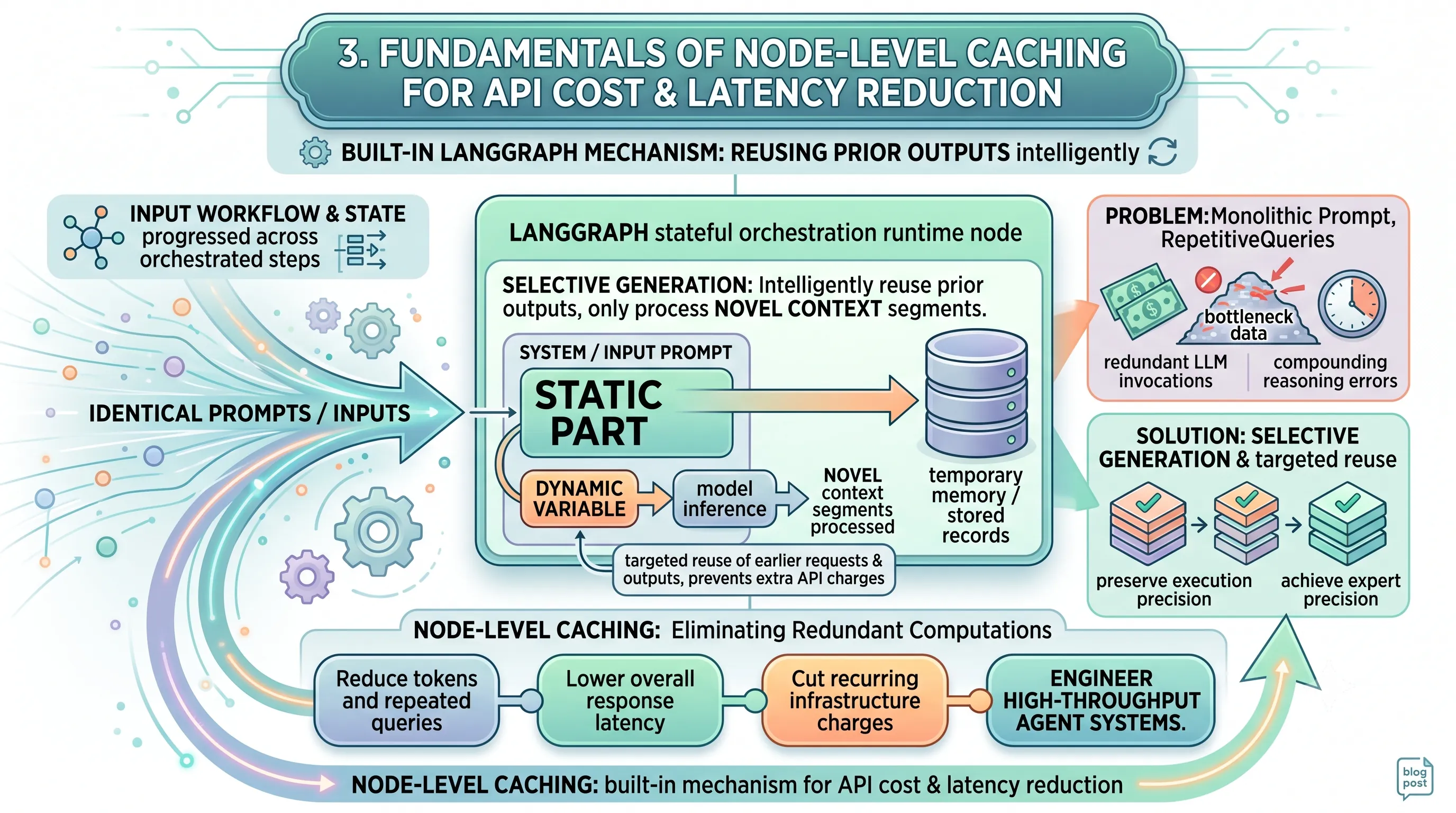
LangGraph provides a built-in node-level caching mechanism designed to optimize execution across graph-based agent workflows.At its core, node-level caching operates by storing earlier requests and node outputs directly in temporary memory.
When identical prompts or inputs are sent through the system, it reuses these stored records instead of executing the node from scratch.
Eliminating Redundant LLM Invocations
Reusing cached responses effectively eliminates redundant LLM calls and unnecessary computations.By preventing repeated model queries for known states, this mechanism directly prevents extra API charges and lowers overall response latency.
LangGraph’s built-in node-level caching provides a simple yet powerful way to reduce latency and computation by reusing previous results.
Selective Generation for Dynamic Prompt Segments
In structured agent execution, substantial portions of an input or system prompt often remain static while only specific variables change.When parts of a prompt remain unchanged, reusing previous outputs ensures the system only generates responses for additional or new segments.
This targeted reuse prevents the overhead of reprocessing identical context, streamlining computation across graph nodes.
3. Configuring CachePolicy: Fine-Tuning TTL and Custom Cache Keys
Fine-tuning the CachePolicy configuration on a per-node basis directly optimizes execution efficiency and eliminates redundant model invocations across LangGraph agent workflows.By establishing granular caching rules for each discrete node, developers maintain strict control over execution lifecycles and cache evaluation logic.
Managing Node TTL and Expiration Intervals
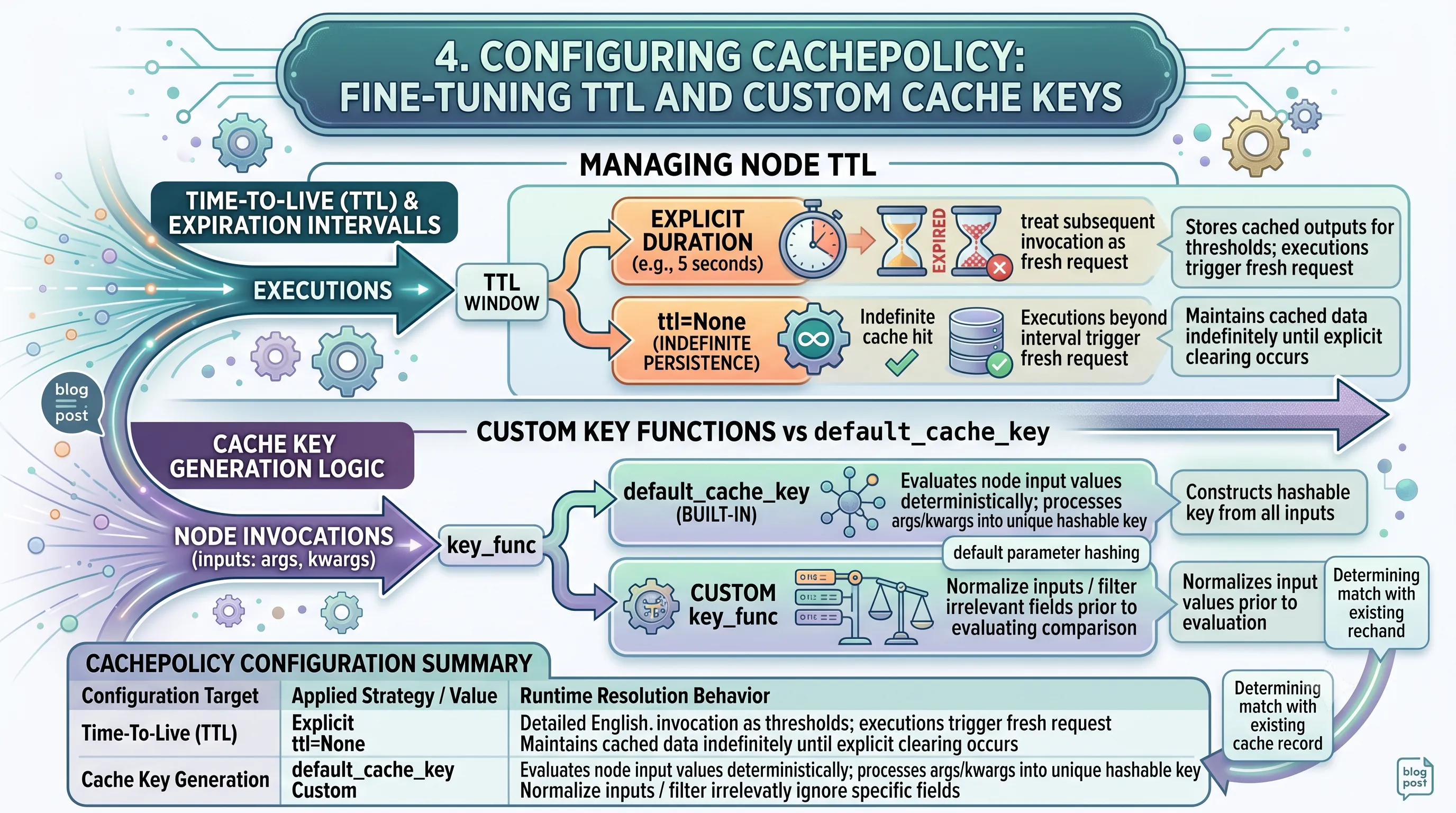
Each node within a LangGraph execution graph can be configured with its own dedicated CachePolicy containing an explicit Time-To-Live (ttl) value.The framework supports setting the TTL to concrete durations specified in seconds, such as 5 seconds in demonstration setups, or configuring ttl=None.
When ttl=None is assigned, cached node outputs persist in memory indefinitely until they are explicitly cleared.
If the elapsed duration between executions exceeds the established TTL window, the runtime invalidates the stored state and treats the subsequent invocation as a fresh request instead of producing a cache hit.
Custom Key Functions vs. default_cache_key Hashing
Determining whether an incoming node invocation matches an existing cache record is handled via the key_func parameter.By default, LangGraph utilizes the built-in default_cache_key function, which evaluates node input values by processing positional arguments and keyword arguments into a deterministic, hashable key.
When default parameter hashing is insufficient, developers can implement custom key functions and assign them to key_func.
These custom key functions can normalize varying input representations or selectively ignore specific non-deterministic fields before generating the final cache key for comparison.
| Configuration Target | Applied Strategy / Value | Runtime Resolution Behavior |
|---|---|---|
| Time-To-Live (TTL) | Explicit duration (e.g., 5 seconds) | Stores cached outputs for the configured second threshold; executions beyond this interval trigger a fresh request. |
| Time-To-Live (TTL) | ttl=None |
Maintains cached data in memory indefinitely until explicit clearing occurs. |
| Cache Key Generation | default_cache_key |
Constructs a unique hashable key directly from all input arguments and keyword arguments. |
| Cache Key Generation | Custom key_func |
Normalizes input values or filters out irrelevant fields prior to evaluating cache comparison. |
4. Cache Storage Backends and Lifecycle Invalidation Management
To maximize API cost reductions and minimize execution latency in LangGraph architectures, selecting the appropriate cache storage backend and managing cache lifecycle states are critical steps.Implementing the right backend storage mechanism determines how cached node responses persist across runs, directly impacting both infrastructure overhead and downstream agent execution efficiency.
Selecting Storage Backends: InMemory, SQLite, and Redis
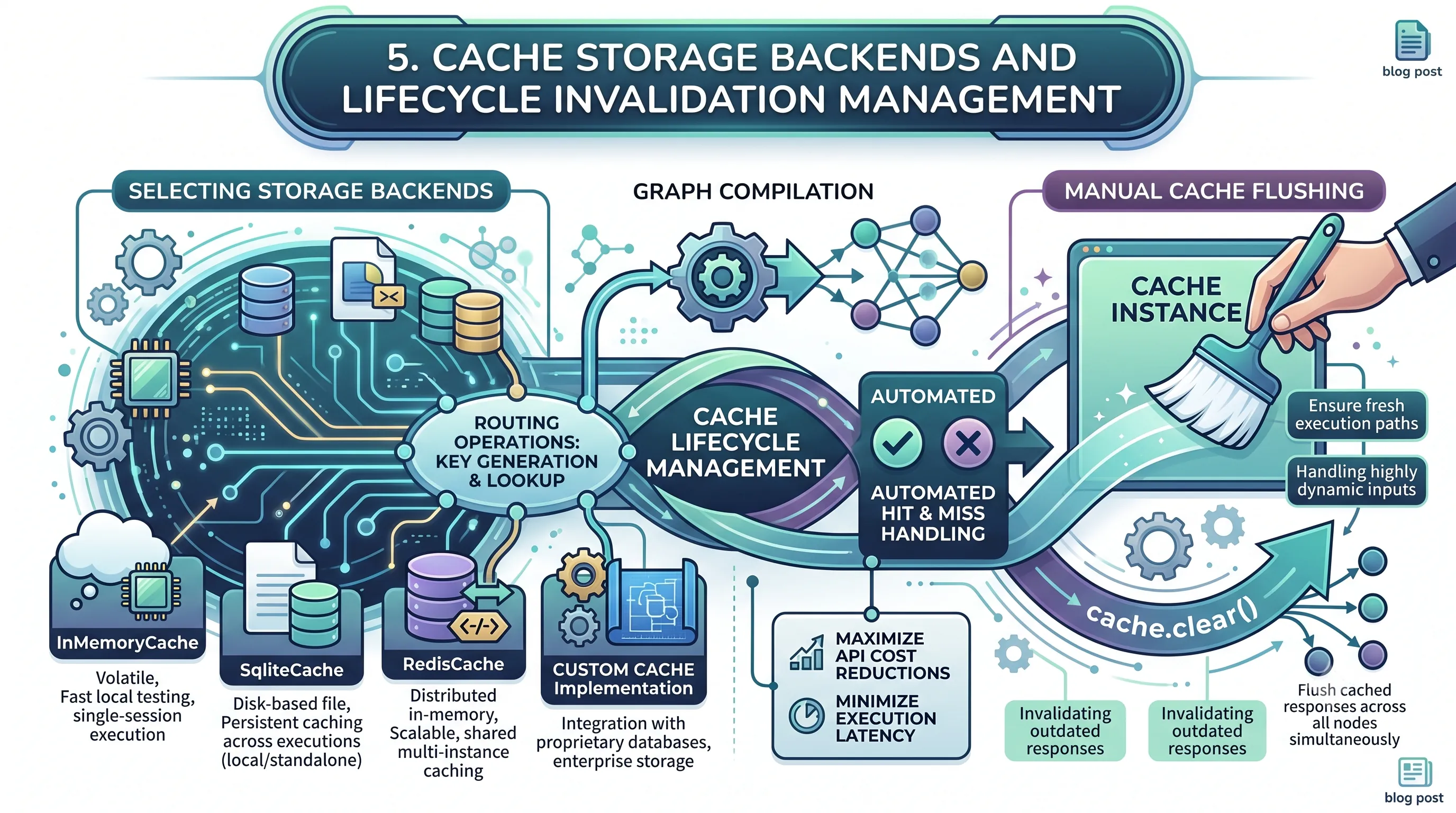
LangGraph supports several cache storage backends to fit different deployment needs, development environments, and persistence requirements.Developers can choose between InMemoryCache, SqliteCache, RedisCache, or create custom cache implementations tailored to specialized infrastructure setups.
| Backend Option | Storage Mechanism | Primary Application |
|---|---|---|
| InMemoryCache | Volatile in-memory store | Fast local testing and single-session execution without external storage overhead. |
| SqliteCache | Disk-based SQLite database file | File-based persistent caching across graph executions on local environments or standalone servers. |
| RedisCache | Distributed in-memory key-value store | Scalable, shared multi-instance caching across distributed graph workloads. |
| Custom Cache Implementation | User-defined backend interface | Integration with proprietary databases, custom key-value stores, or specific enterprise storage layers. |
Graph Compilation and Manual Cache Flushing
When setting up graph caching, a cache instance must be explicitly specified when compiling the graph.Binding the cache backend during compilation ensures that every node configured for caching can route its key generation and lookup operations through the designated storage system.
Beyond automated hit and miss handling, developers have direct control over cache lifecycle management via the cache.clear() method.
Invoking cache.clear() flushes cached responses across all nodes simultaneously.
This manual clearing capability is particularly helpful during debugging sessions to ensure fresh execution paths, when handling highly dynamic inputs that require a reset of stored outputs, or when invalidating outdated responses across the entire graph workflow.
Related Posts

Microsoft Agent Framework vs. LangGraph 1.x: A Technical Comparison for Enterprise AIA technical comparison of Microsoft Agent Framework 1.0 and LangGraph 1.x, focusing on...

DeepSeek-V4-Flash: Revolutionizing AI with 284B MoE, 1M Context & Unprecedented Efficiency on DeepInfraDeepSeek-V4-Flash: The 284B MoE LLM revolutionizing AI with 1M context, extreme efficiency, speed,...

Google DiffusionGemma Unveiled: Open-Source LLM Achieves 4x Faster Text Generation via Novel Diffusion & MoE Architecture for Real-Time AIGoogle has released DiffusionGemma , an experimental open-source LLM introducing a novel text...