
Microsoft Agent Framework vs. LangGraph 1.x: A Technical Comparison for Enterprise AI
🚀 Key Takeaways
- Ecosystem Evolution: Microsoft Agent Framework 1.0 represents the enterprise-grade successor to AutoGen, which has transitioned into maintenance mode.
- Semantic Kernel Alignment: Integrating AutoGen patterns with Semantic Kernel bridges modular process automation, enterprise security, and native .NET/Python runtimes.
- Graph-Driven Orchestration: LangGraph 1.x delivers deterministic, cyclical state machine execution equipped with built-in persistence and fine-grained human-in-the-loop controls.
- Architectural Paradigms: Choosing between the two platforms centers on asynchronous actor-based message passing versus explicit node-and-edge state graphs.
The generative AI engineering landscape has transitioned decisively from isolated prompt engineering toward sophisticated multi-agent systems designed to execute complex, multi-step workflows.
As organizations move beyond experimental sandboxes into mission-critical enterprise production, selecting the right underlying orchestration framework has become a pivotal technical decision.
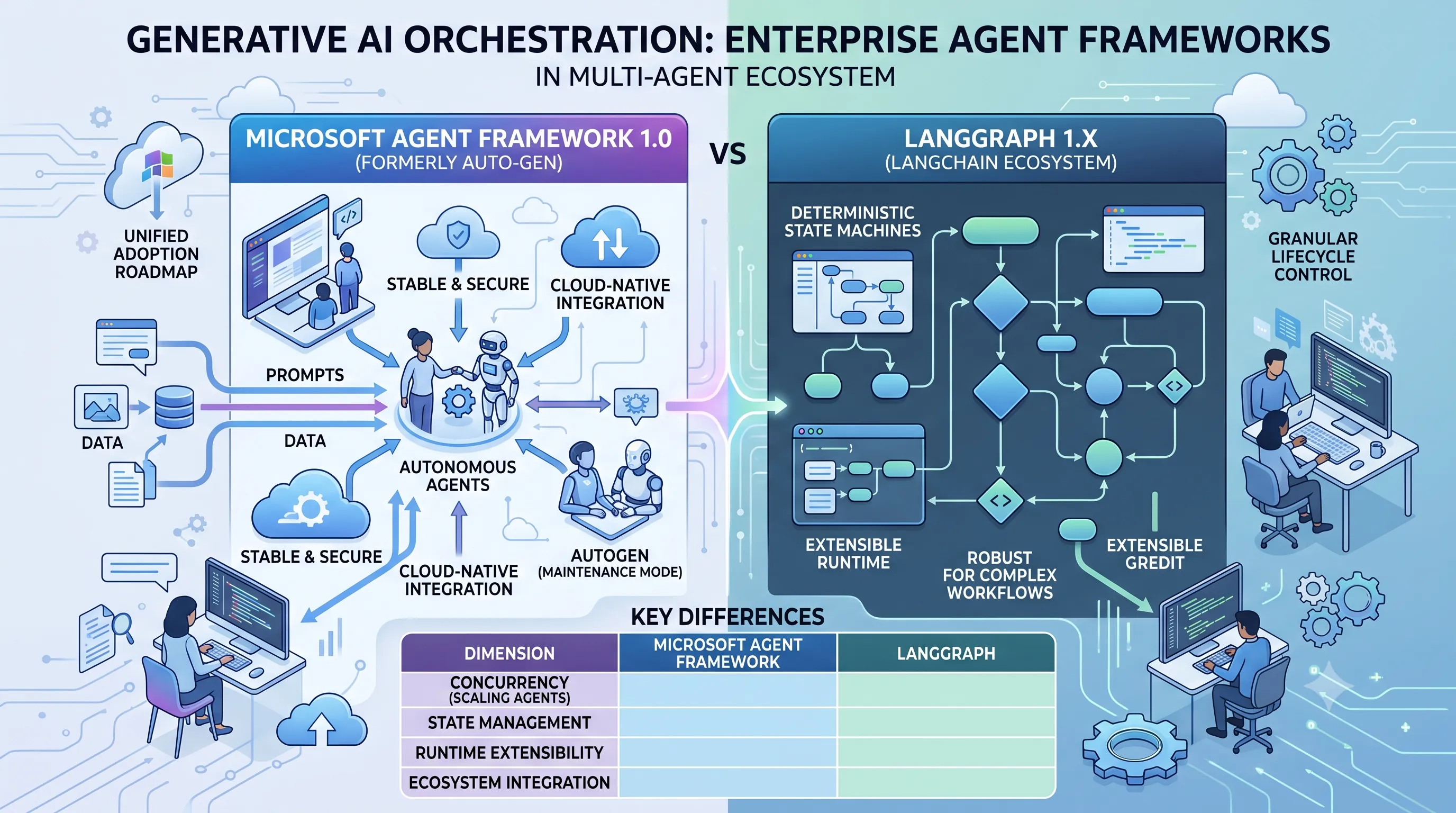
Microsoft has unified its autonomous agent roadmap by stabilizing Semantic Kernel and introducing Microsoft Agent Framework 1.0, shifting AutoGen into maintenance mode.
At the same time, LangGraph 1.x has gained widespread adoption as a robust runtime for developers who require deterministic state machines and granular lifecycle control.
Understanding how these frameworks differ in concurrency, state management, runtime extensibility, and ecosystem integration is vital for building maintainable agentic applications.
This practical comparison examines Microsoft Agent Framework 1.0 and LangGraph 1.x across real-world architectural dimensions to guide your enterprise implementation strategy.
As organizations move beyond experimental sandboxes into mission-critical enterprise production, selecting the right underlying orchestration framework has become a pivotal technical decision.
Microsoft has unified its autonomous agent roadmap by stabilizing Semantic Kernel and introducing Microsoft Agent Framework 1.0, shifting AutoGen into maintenance mode.
At the same time, LangGraph 1.x has gained widespread adoption as a robust runtime for developers who require deterministic state machines and granular lifecycle control.
Understanding how these frameworks differ in concurrency, state management, runtime extensibility, and ecosystem integration is vital for building maintainable agentic applications.
This practical comparison examines Microsoft Agent Framework 1.0 and LangGraph 1.x across real-world architectural dimensions to guide your enterprise implementation strategy.
1. AutoGen Transition to Maintenance and the Rise of Microsoft Agent Framework 1.0
Understanding the migration from AutoGen to Microsoft Agent Framework 1.0 provides essential context for comparing Microsoft's unified agent architecture against LangGraph 1.x in enterprise production environments.AutoGen Maintenance Status and Official Migration Notice
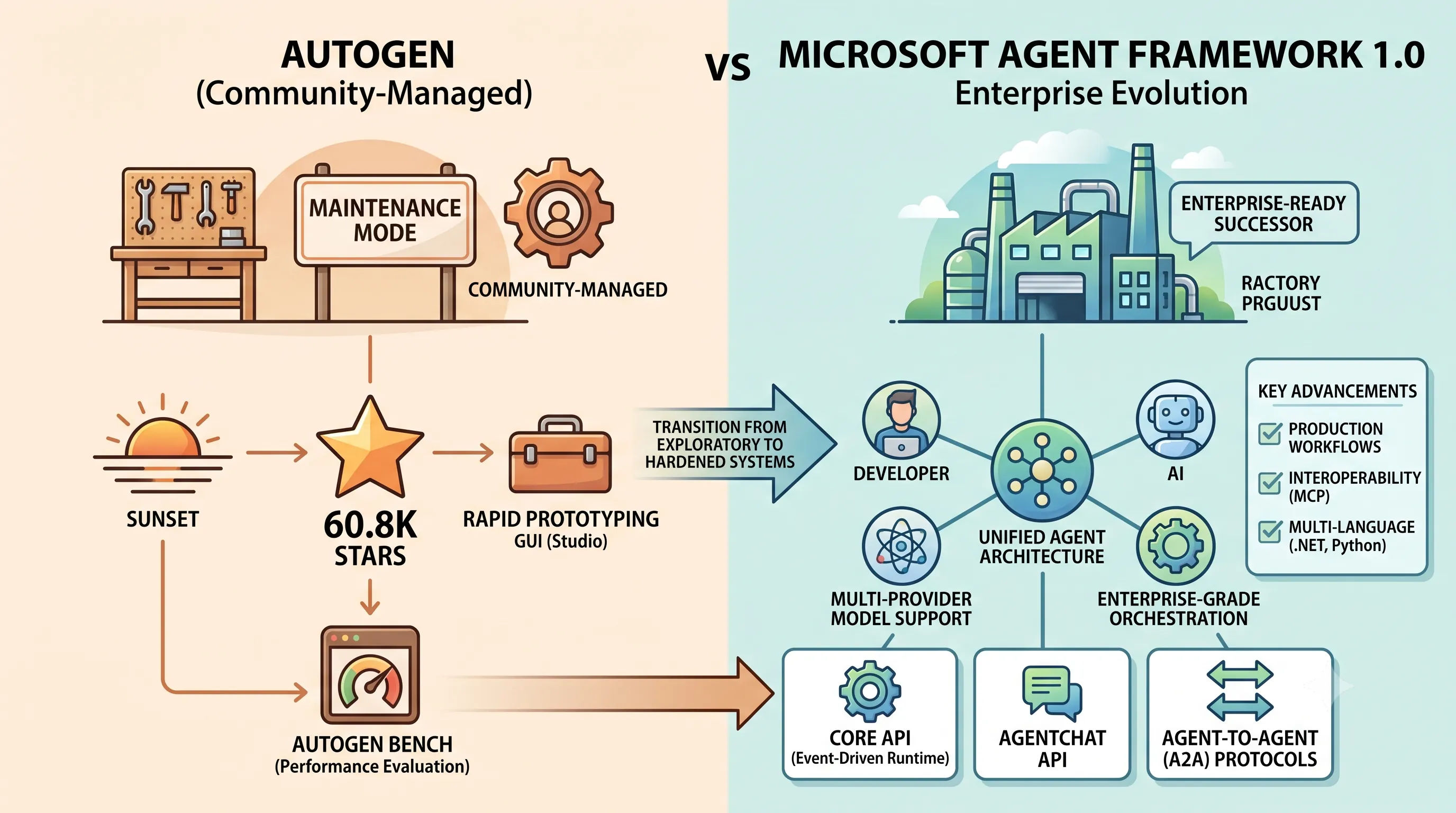
AutoGen has officially transitioned into maintenance mode and operates as a community-managed project.Under this status, AutoGen will not receive new features or enhancements.
Across its active development lifecycle, the official AutoGen repository recorded 60.8k stars, 9.2k forks, 550 issues, and 480 pull requests while requiring Python 3.10 or later.
Microsoft formally designated the migration path in its official GitHub README, stating: "AutoGen is now in maintenance mode. New users should start with Microsoft Agent Framework."
Within the legacy ecosystem, AutoGen Studio provided a no-code GUI interface designed specifically for rapid prototyping, though it was not intended to be a production-ready application.
For performance assessment, the ecosystem supplied AutoGen Bench to handle agent performance evaluation across benchmark scenarios.
Core API Architecture and Cross-Language Runtime Support
AutoGen's structural design is partitioned into three functional tiers: the Core API, the AgentChat API, and the Extensions API.The Core API serves as the underlying backbone, providing an event-driven runtime driven by message passing mechanisms.
Engineered for flexible deployment, the Core API supports both local and distributed runtimes along with cross-language support spanning .NET and Python.
The higher-level AgentChat API is configured for rapid prototyping of conversational agent behaviors.
Leveraging both the AgentChat API and Extensions API, the reference system Magentic-One demonstrated complex multi-agent execution targeting web browsing, code execution, and file handling capabilities.
Enterprise Orchestration in Microsoft Agent Framework 1.0
Microsoft Agent Framework 1.0 represents the enterprise-ready successor to AutoGen, shifting development from exploratory multi-agent patterns to hardened production workflows.The framework incorporates enterprise-grade multi-agent orchestration alongside multi-provider model support to integrate diverse foundation models.
To facilitate seamless integration across modern enterprise infrastructures, Microsoft Agent Framework 1.0 establishes cross-runtime interoperability via Agent-to-Agent (A2A) protocols and the Model Context Protocol (MCP).
| Architectural Dimension | AutoGen Specification | Microsoft Agent Framework 1.0 Evolution |
|---|---|---|
| Lifecycle Status | Maintenance mode; community-managed without new features or enhancements (Python 3.10+ required) | Enterprise-ready official successor platform |
| Core Architecture | Core API (event-driven runtime, message passing), AgentChat API (rapid prototyping), and Extensions API | Enterprise-grade multi-agent orchestration layer |
| Language & Runtime | Local and distributed runtimes supporting .NET and Python | Multi-provider model support with cross-language compatibility |
| Interoperability & Protocols | Magentic-One reference workflows for web browsing, code execution, and file handling | Native cross-runtime interoperability powered by A2A and MCP |
| Tooling & Evaluation | AutoGen Studio (no-code prototyping GUI, non-production) and AutoGen Bench (performance evaluation) | Standardized enterprise multi-agent foundation and tooling |
2. Semantic Kernel Agent Framework: Modular AI and Enterprise Process Orchestration
In evaluating the integration of AutoGen and Semantic Kernel within Microsoft Agent Framework 1.0 against LangGraph 1.x, the Semantic Kernel Agent Framework provides the foundational infrastructure for enterprise-grade modular orchestration.Modular Multi-Agent Collaboration and Task Specialization
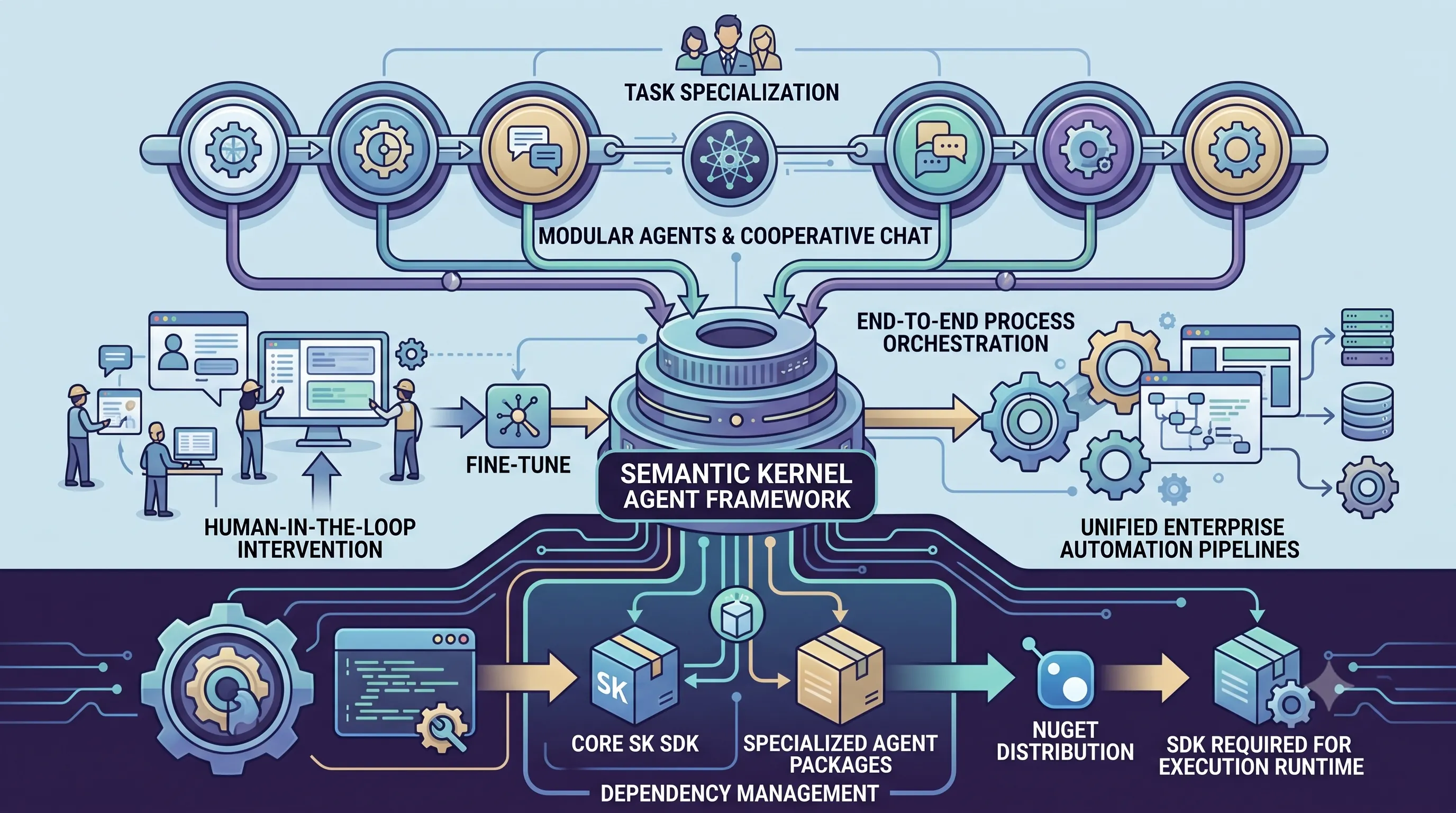
The framework enables the structured creation of modular AI components alongside autonomous and semi-autonomous agents natively within the Semantic Kernel ecosystem.Multi-agent collaboration allows architectures to delegate distinct stages of execution to specialized agents tailored for discrete operational boundaries.
These specialized agents interact systematically to execute targeted responsibilities, including data collection, analysis, and autonomous decision-making.
Human-in-the-Loop Integration and End-to-End Automation
Enterprise workflow reliability is reinforced through integrated human-agent collaboration mechanisms, supporting human-in-the-loop patterns to review, intervene, and fine-tune agent decisions.In parallel, the framework delivers unified process orchestration across underlying systems, connected tools, and external APIs.
This integration coordinates discrete agent tasks into complete, end-to-end enterprise automation pipelines.
Semantic Kernel SDK and NuGet Distribution Dependencies
Distribution of the framework is delivered via official .NET SDK NuGet packages.According to technical documentation updated on 2025-05-06, dependency management requires the installation of the core Semantic Kernel SDK in addition to any specialized agent packages.
The core Semantic Kernel SDK remains strictly required to provide the execution runtime, connector plumbing, and context hosting needed for agent operations.
3. LangGraph 1.x Architecture: Stateful Graph Orchestration and LangSmith Integration
In the architectural evaluation of enterprise agent orchestrators, LangGraph 1.x delivers an execution runtime built explicitly around stateful cyclical graph coordination.To understand how it contrasts with unified frameworks like Microsoft Agent Framework 1.0, developers must analyze its dual-API surface, fine-grained state persistence, and native telemetry integration.
Cyclical Graph Execution and Hybrid Workflow Control
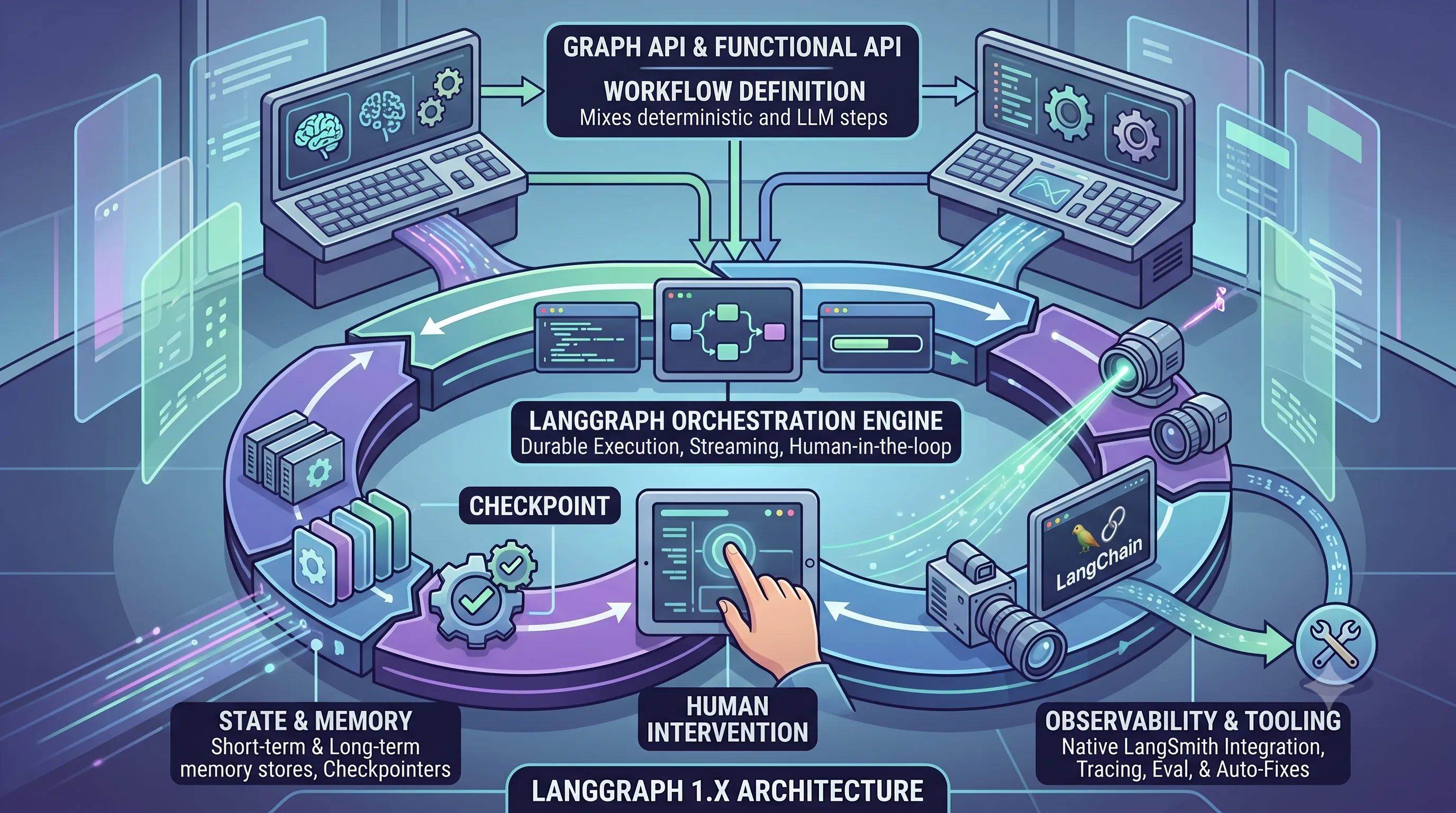
LangGraph operates as an orchestration runtime designed to provide durable execution, streaming capabilities, human-in-the-loop inspection, and structural persistence.Rather than forcing systems into purely rigid DAGs or entirely unconstrained autonomous loops, the framework allows developers to mix deterministic hand-coded steps with LLM-driven agentic decision steps within a single graph structure.
To accommodate distinct developer workflows, LangGraph offers both a Graph API and a Functional API for defining cyclical workflows and modular subgraphs.
This dual-API design enables teams to structure complex agentic topologies using graph-based primitives while seamlessly embedding functional code blocks where explicit programmatic control is required.
State Management with Checkpointers and Memory Stores
State persistence in LangGraph 1.x is decoupled into specialized runtime primitives that manage both execution state and data retention across boundaries.The runtime natively supports stateful agents equipped with short-term working memory during active execution cycles as well as long-term memory preserved across disparate sessions.
Short-term operational memory and runtime state snapshots are governed by checkpointers, which maintain execution integrity and facilitate human-in-the-loop inspection at arbitrary graph nodes.
For multi-session persistence, dedicated memory stores maintain contextual knowledge across extended interactions, ensuring durable state retention across distinct execution threads.
Observability and Automated Fixes via LangSmith
Deep observability within the LangGraph architecture is achieved through native integration with the LangSmith platform.LangSmith captures execution paths and state transitions across every graph node and edge, providing full visibility into dynamic agent routing and state modifications.
Beyond standard execution path tracing, the platform supports systematic evaluation pipelines for multi-step agent behaviors.
Furthermore, automated issue fixes are facilitated directly through the LangSmith Engine, allowing development teams to isolate runtime anomalies and remediate state transition failures systematically.
| Architectural Layer | Runtime Primitives & Tooling | Core Functional Capability |
|---|---|---|
| Workflow Definition | Graph API & Functional API | Defines workflows and subgraphs mixing deterministic code with LLM decision steps. |
| Execution Runtime | LangGraph Orchestration Engine | Provides durable execution, real-time streaming, and human-in-the-loop inspection. |
| State & Memory | Checkpointers & Memory Stores | Manages short-term working memory, state persistence, and cross-session long-term memory. |
| Observability & Tooling | LangSmith & LangSmith Engine | Delivers execution path tracing, state transition capture, evaluation, and automated issue fixes. |
4. Architectural Comparison: Actor-Based Microsoft Agent Framework vs Cyclical LangGraph
Understanding the foundational architecture of the Microsoft Agent Framework compared to LangGraph provides crucial context for evaluating multi-agent orchestration engines.The structural divide between these two frameworks dictates how state transitions occur, how agents communicate, and how production infrastructure scales.
Actor Model Asynchronous Messaging vs Cyclical State Graphs
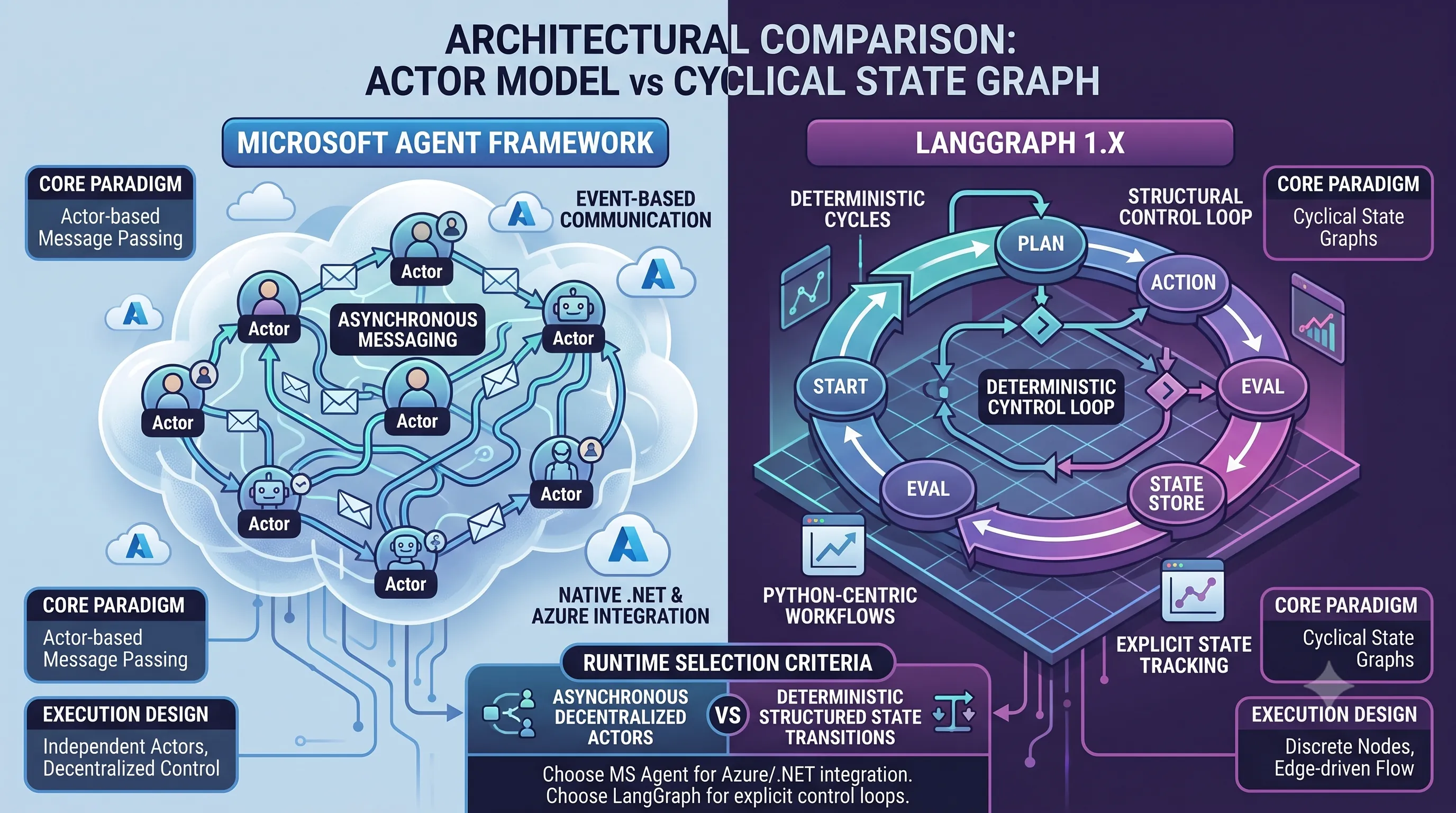
The Microsoft Agent Framework is built upon an Actor-based message passing paradigm.Within this architecture, multi-agent systems coordinate via asynchronous event messaging between independent agents.
Each agent functions as an actor that processes incoming messages and dispatches events independently without requiring a rigid, centralized control loop.
In contrast, LangGraph manages complex orchestration workflows through deterministic cyclical graphs.
Execution in LangGraph is structured around discrete nodes—such as Plan, Action, and Eval—connected by branching edges.
This design ensures structured flow control where graph cycles determine state transitions and feedback loops across node boundaries.
| Architectural Dimension | Microsoft Agent Framework | LangGraph |
|---|---|---|
| Core Paradigm | Actor-based message passing paradigm | Deterministic cyclical graphs |
| Communication & Execution Design | Asynchronous event messaging between agents | Discrete nodes (e.g., Plan, Action, Eval) connected by branching edges |
| Ecosystem Alignment | Native C#/.NET enterprise development and Azure ecosystem integration | Graph-driven node and edge workflow architecture |
Enterprise .NET Azure Ecosystem vs Python-Centric Graph Workflows
Ecosystem alignment represents another major differentiator between these architectures.The Microsoft Agent Framework natively aligns with C#/.NET enterprise development standards and provides deep Azure ecosystem integration.
This native integration allows engineering teams already invested in Microsoft enterprise stacks to embed agentic routines directly into their existing cloud and backend architectures.
LangGraph operates through its cyclical graph system where nodes represent discrete operational phases and branching edges dictate routing.
Its design emphasizes explicit state flow tracking across graph cycles, making deterministic execution loops the primary foundation for multi-agent coordination.
Practical Runtime Selection Criteria for Production Systems
Selecting between the Microsoft Agent Framework and LangGraph depends primarily on the required execution topology and hosting environment.Systems that demand decentralized, asynchronous event messaging between autonomous actors benefit directly from the Microsoft Agent Framework, especially when deployed within C#/.NET and Azure environments.
Conversely, applications requiring deterministic cycles where every state transition traverses discrete Plan, Action, and Eval nodes connected by branching edges align naturally with LangGraph.
Related Posts
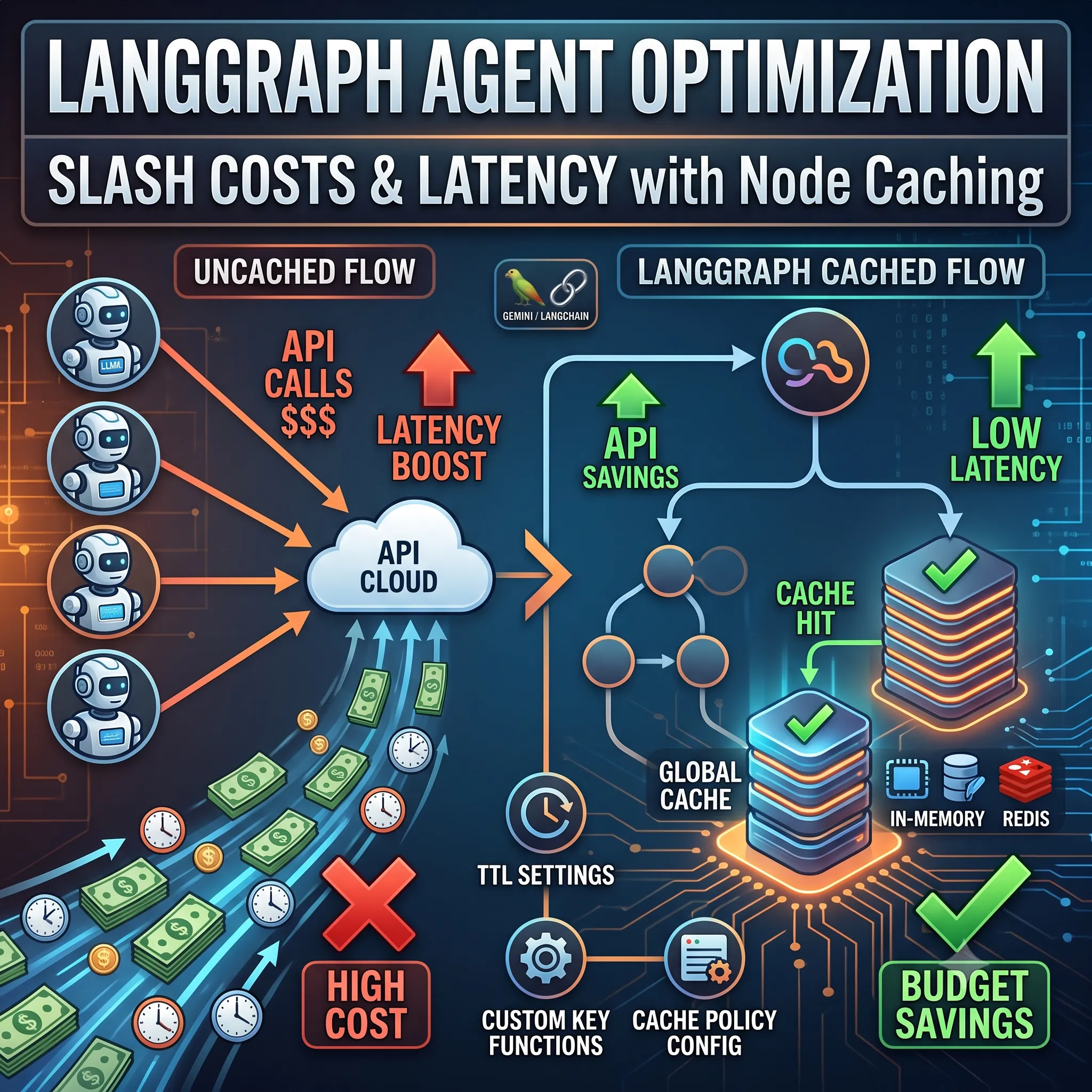
Optimizing LangGraph Agent Workflows with Node-Level CachingLearn how to optimize LangGraph agent performance by implementing node-level caching, custom...
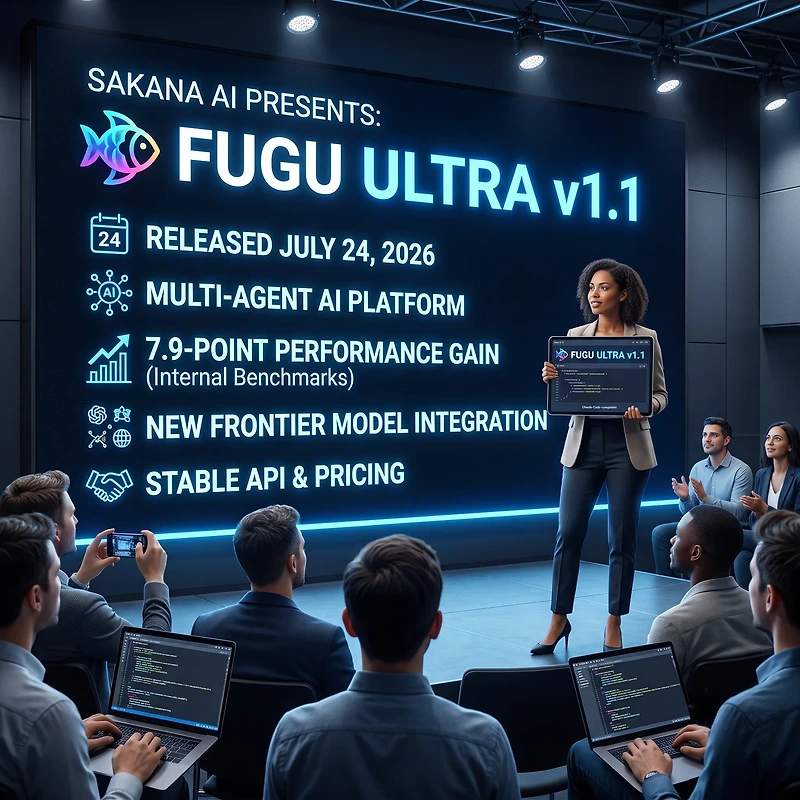
Sakana AI Fugu Ultra v1.1 Unleashed: Multi-Agent AI Orchestration for Enhanced Reasoning, Coding & Seamless IntegrationSakana AI released Fugu Ultra v1.1 on July 24, 2026, a rapid update to its multi-agent AI platform...
Microsoft Scout Unveiled: Autonomous AI Agent Revolutionizes Enterprise Productivity with Self-Managing OS & 365 IntegrationMicrosoft Scout is an always-on, autonomous AI agent designed to independently manage and execute...