
Inside NVIDIA DAQIRI: GPU-Native Ingestion for Scientific Instruments
🚀 Key Takeaways
- GPU-native data acquisition: The open-source NVIDIA DAQIRI library streams raw detector packets straight into GPU memory, completely bypassing operating system storage bottlenecks.
- Hardware-accelerated network processing: Offloading sequence parsing and packet reordering to modern smart network interfaces cuts application latency down to single-digit microseconds while doubling per-core throughput.
- Revolutionary electron microscopy: Implementations at Lawrence Berkeley National Laboratory capture massive multi-hundred-gigabit streams in a single exposure, simultaneously imaging both faint and intense electron signals.
- Intelligent particle physics triggers: Particle accelerators such as CERN apply real-time deep learning to incoming collision streams, recovering rare events that legacy trigger architectures traditionally discard.
- Ecosystem convergence with test hardware: Collaborations with instrumentation leaders like NI integrate software-defined measurement hardware directly into GPU pipelines for gigahertz-scale wideband signal processing.
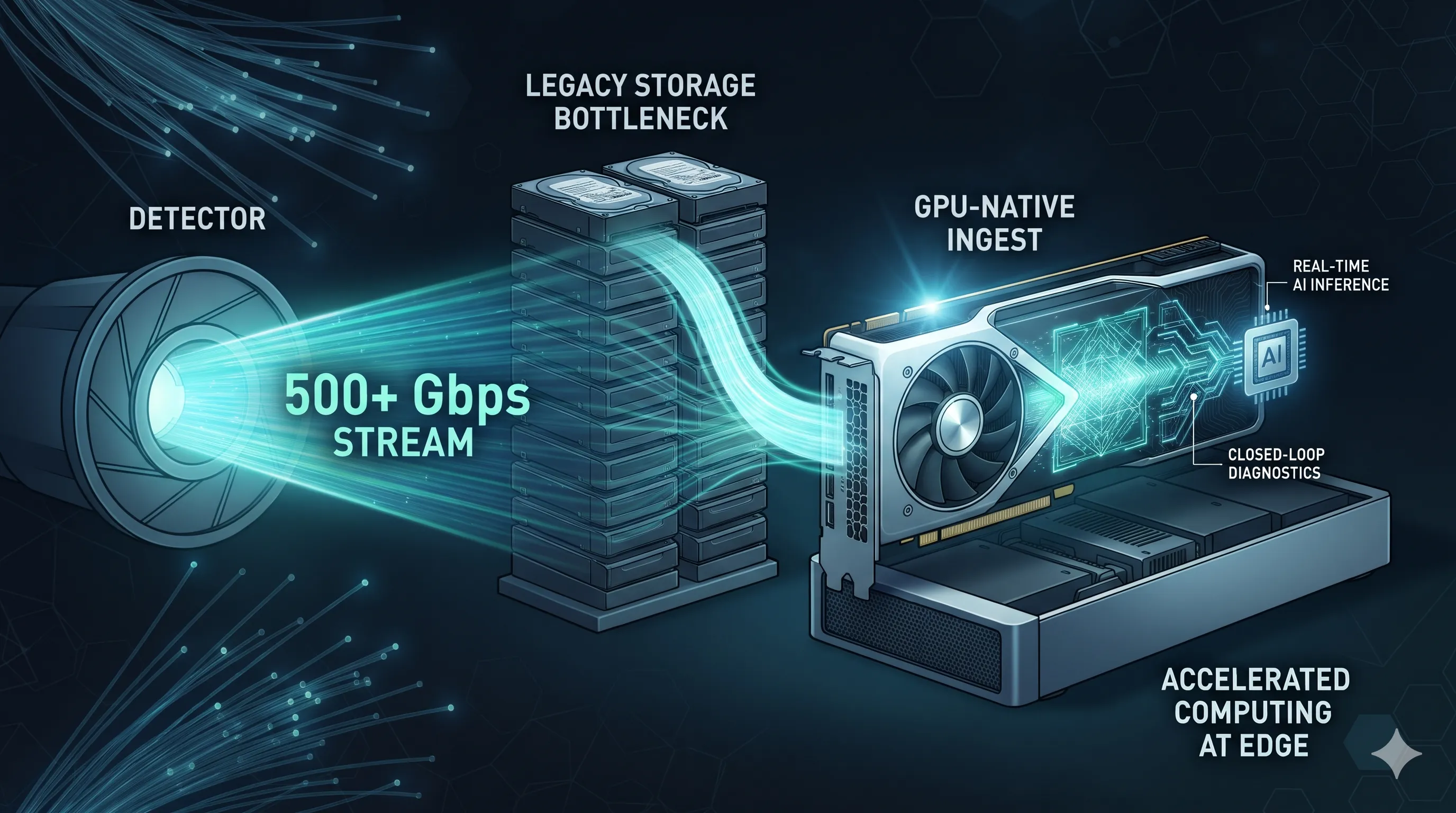
For decades, experimental science has operated under an increasingly strained compromise: record massive sensor outputs to storage first, and analyze the resulting data files offline hours or days later. However, next-generation instruments—ranging from synchrotron light sources to advanced electron microscopes—now generate continuous data streams measuring hundreds of gigabits per second. Under this torrent of information, conventional storage fabrics and CPU networking stacks become severe bottlenecks, preventing scientists from steering live experiments or spotting transient anomalies before specimens degrade.
To resolve this architectural gridlock, accelerated computing is moving directly to the instrument edge through platforms like NVIDIA Holoscan and the open-source DAQIRI framework. By transferring network packet parsing and reordering directly to intelligent network hardware and piping sensor payloads straight into GPU memory without operating system intervention, modern instruments can perform immediate compute passes on live data.
This shift transforms complex research hardware from passive observation devices into autonomous, closed-loop diagnostic engines. From classifying subatomic collisions at CERN to processing ultra-wideband radio signals with microsecond response times, real-time AI data streaming is fundamentally reshaping the operational limits of modern scientific discovery.
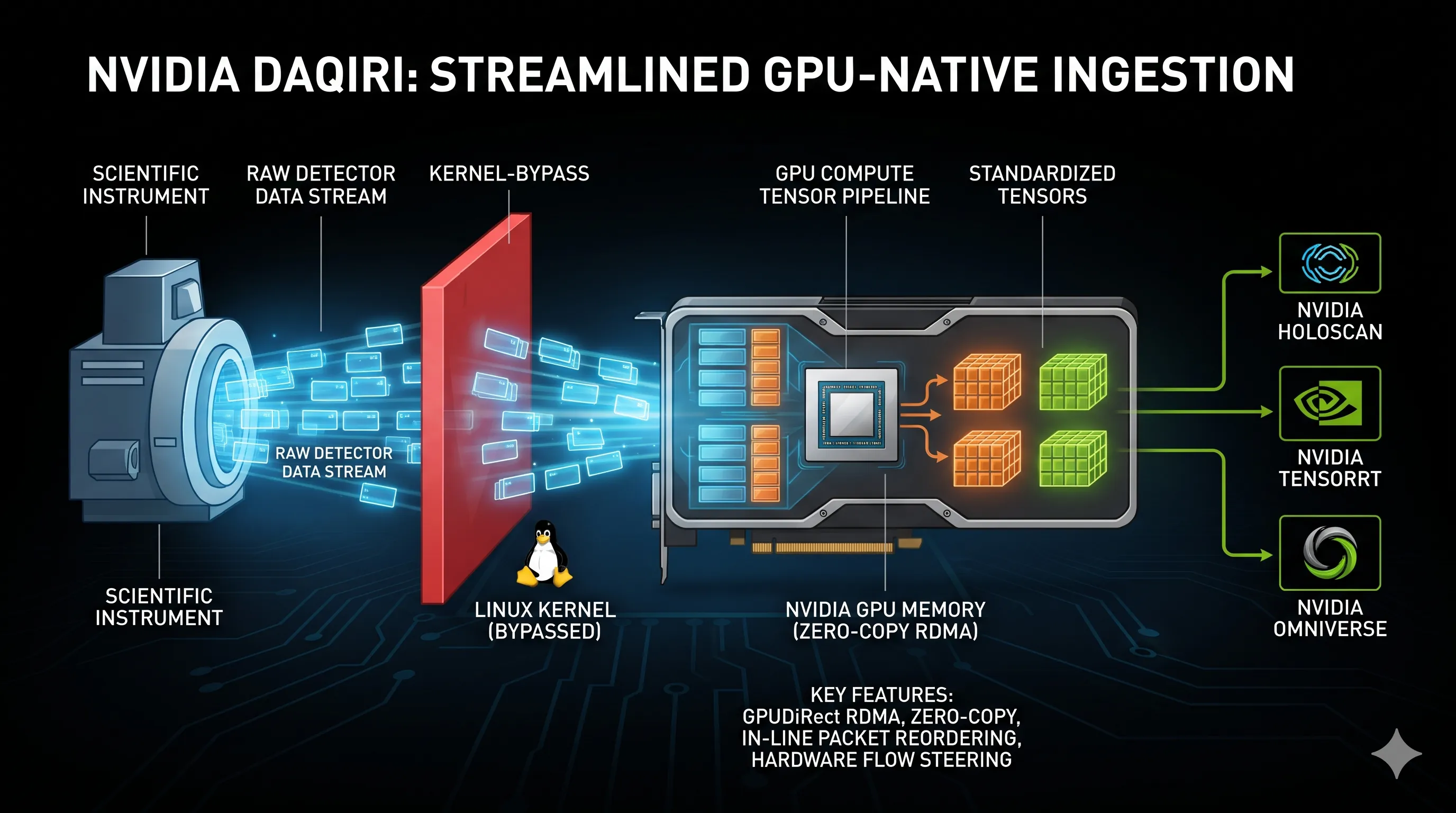
1. NVIDIA DAQIRI Architecture: Streamlined GPU-Native Data Ingestion for Scientific Instruments
To realize the overarching mission where NVIDIA enables real-time AI in scientific instruments, data intake pipelines must eliminate the latency inherent to legacy storage-bound architectures.Traditional scientific workflows rely on store-first, analyze-later patterns that force detector telemetry through host file systems before processing can occur.
These storage-bound patterns create severe bottlenecks where high-bandwidth insights arrive far too late for active experiment steering.
NVIDIA DAQIRI, which stands for Data Acquisition for Integrated Real-time Instruments, addresses this latency gap as a software-defined data acquisition library and GPU-ready data layer within the NVIDIA Holoscan platform.
By moving data acquisition directly onto the accelerated computing tier, DAQIRI delivers the low-latency streaming foundation necessary for closed-loop instrument automation.
Kernel-Bypass and Zero-Copy GPUDirect RDMA Ingestion
DAQIRI bypasses the Linux kernel entirely to stream raw detector and sensor packets directly into GPU memory without writing to disk first.This direct transport mechanism enables data ingestion at line rates reaching hundreds of Gbps.
The architecture interfaces across modern network fabrics, supporting raw Ethernet, UDP, TCP, RoCE v2, and InfiniBand via libibverbs.
To maximize network utilization while avoiding host overhead, DAQIRI provides zero-copy receive paths using GPUDirect RDMA.
These paths operate through two primary ingestion modes: Header-Data Split mode and Batched GPU mode.
Header-Data Split separates transport headers for rapid routing while placing raw payload structures straight into allocated GPU buffers.
Batched GPU mode gathers raw packet batches straight across the bus into GPU memory, optimizing PCIe transaction density.
To maintain these kernel-bypass and GPUDirect paths, the environment requires NVIDIA ConnectX-6 Dx or newer network interface cards.
System building and execution additionally mandate Linux kernel 5.15 or higher alongside CUDA Toolkit 12.2 or higher.
| Component / Specification | Technical Requirement / Supported Feature |
|---|---|
| Linux Kernel | Version 5.15 or higher |
| CUDA Toolkit | Version 12.2 or higher |
| Network Interface Cards (NICs) | NVIDIA ConnectX-6 Dx or newer |
| Network Protocols | Raw Ethernet, UDP, TCP, RoCE v2, InfiniBand (via libibverbs) |
| Zero-Copy RDMA Modes | Header-Data Split, Batched GPU |
| Licensing & Releases | Apache 2.0 open-source license; quarterly releases using calendar versioning |
Configuration Workflow and Tensor Pipeline Integration
Operational configuration in DAQIRI is managed through readable YAML files alongside unified C++ and Python APIs.This dual-API structure allows developers to script ingestion flows or configure high-performance C++ pipelines using identical operational logic.
Once packet streams enter the network hardware, DAQIRI employs hardware flow steering to direct specific sensor traffic directly into target ring buffers.
In-line packet reordering is executed directly on the data stream to resolve out-of-order delivery issues without incurring CPU interruptions.
Once payloads reside in GPU memory, DAQIRI carries out automatic data type conversions on the GPU, such as transforming int4 sensor readings into fp16 representations.
These on-GPU conversion passes assemble standardized numerical structures, preparing tensors directly for downstream consumption.
Because transformation occurs in place, the resulting tensors pass immediately to downstream frameworks including NVIDIA Holoscan, TensorRT, and Omniverse.
Released under an Apache 2.0 open-source license, DAQIRI receives formal quarterly releases using calendar versioning, providing a transparent and continuously updated foundation for real-time scientific AI applications.
2. Hardware Packet Reordering and the ibverbs Engine: Microsecond Latency and Direct Polling
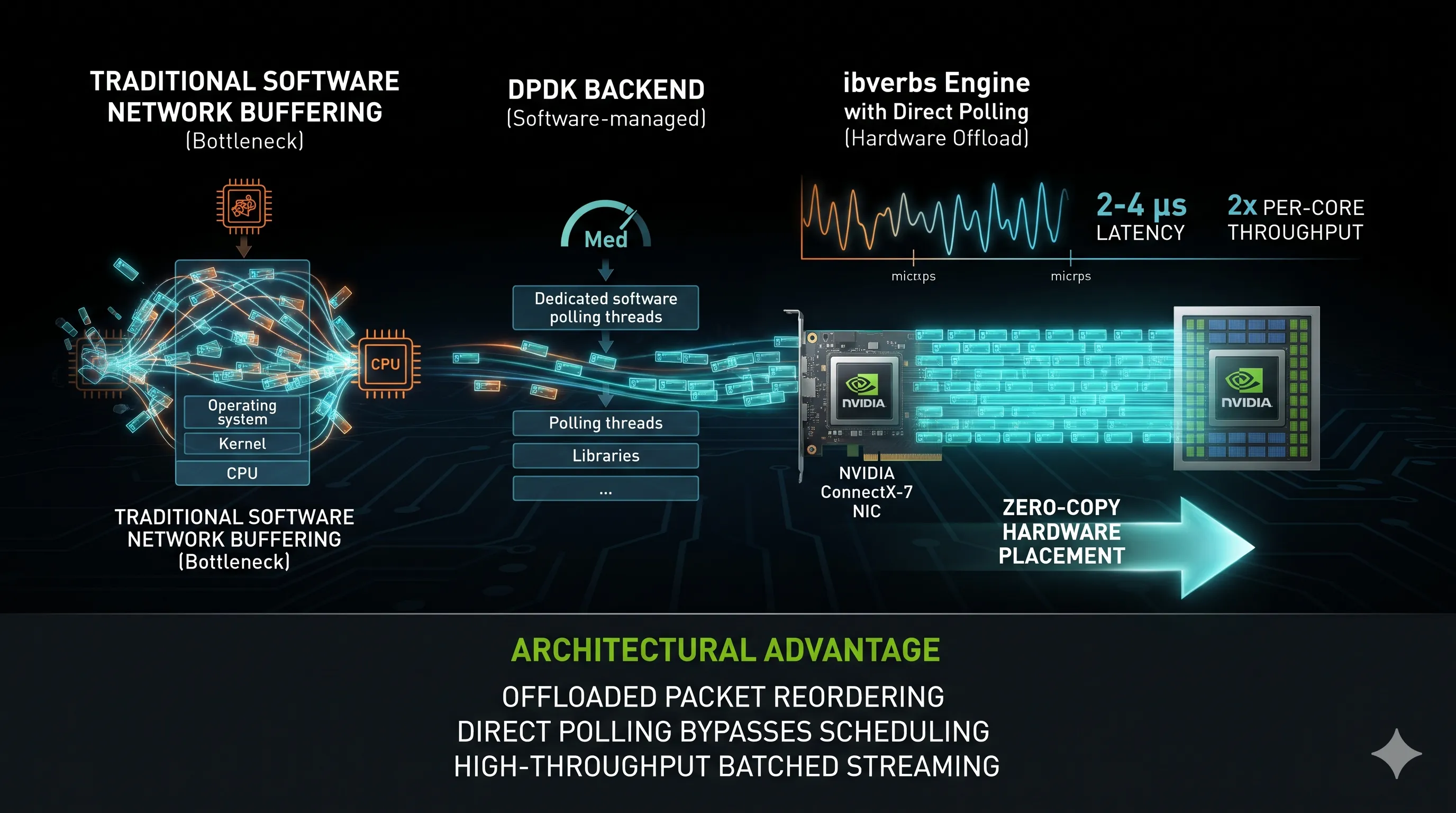
To enable real-time AI in scientific instruments, data acquisition pipelines require deterministic, high-throughput network ingestion directly into compute memory.Traditional software network buffering and protocol stacks introduce severe CPU overhead and latency, particularly during out-of-order packet arrival at line-rate speeds.
To overcome these processing bottlenecks, real-time ingestion pipelines leverage hardware-level offloading and specialized user-space transport engines.
ConnectX-7 Hardware Packet Reordering and libibverbs Engine
Sequence parsing and packet reordering are offloaded directly to NVIDIA ConnectX-7 or newer NIC hardware.By moving sequence handling to the physical network interface, NIC hardware reordering places incoming payloads directly into ordered memory positions without intermediate software copy passes.
This zero-copy hardware placement circumvents the CPU overhead and jitter typical of standard operating system network stacks.
Underpinning this direct data path is the ibverbs engine, which is built on libibverbs and NVIDIA DevX.
The ibverbs engine is enabled by default for raw Ethernet streams, delivering a native, low-overhead transport foundation specifically tuned for scientific data streaming.
Direct Polling Latency and High-Throughput Batched Streaming
Operating alongside hardware reordering, the engine features a direct polling mode that allows application threads to submit and receive packets directly.This mechanism bypasses the scheduling delays and context switches caused by dedicated I/O worker thread handoffs.
In cabled loopback benchmark tests, direct polling mode demonstrates an application send-to-receive latency of 2 to 4 microseconds.
For bulk ingestion, the default polling queue batches 1024 packets at a time with an automatic 2 ms flush threshold.
Under high-load workloads, the ibverbs engine delivers approximately 2x per-core throughput compared to the DPDK backend at packet sizes up to 1024 bytes and data rates above 200 Gbps.
Furthermore, architectures can simultaneously combine direct polling on low-latency control queues with batched processing on high-throughput data streams, ensuring scientific instruments maintain deterministic control alongside massive sensor payload ingestion.
| Architecture / Metric | ibverbs Engine with Direct Polling | DPDK Backend | Traditional Software Network Buffering |
|---|---|---|---|
| Packet Reordering & Payload Placement | Offloaded to NVIDIA ConnectX-7 or newer NIC hardware; payloads placed directly into ordered memory without software copy passes | Software-managed packet processing and queue management | Host protocol stack handling introduces CPU overhead and latency during out-of-order arrival |
| Thread Architecture | Direct polling mode allows application threads to submit and receive packets directly, bypassing dedicated I/O worker thread handoffs | Relies on dedicated worker polling threads for ingress and egress handling | Operating system interrupt handling, software protocol stacks, and kernel-space handoffs |
| Throughput Performance | Delivers approximately 2x per-core throughput over DPDK at packet sizes up to 1024 bytes at data rates above 200 Gbps | Baseline per-core throughput at packet sizes up to 1024 bytes above 200 Gbps | Constrained per-core throughput due to software copy passes and kernel overhead |
| Latency & Ingestion Controls | 2 to 4 microseconds application send-to-receive latency in cabled loopback; batches 1024 packets with 2 ms flush threshold; supports mixed low-latency and batched streams | Queue-dependent batching and polling configurations | Variable latency driven by software buffering delays and operating system scheduling jitter |
| Software Stack Foundation | Built on libibverbs and NVIDIA DevX; enabled by default for raw Ethernet streams | DPDK libraries and Poll Mode Drivers (PMD) | Standard OS kernel network socket layers and protocol buffers |
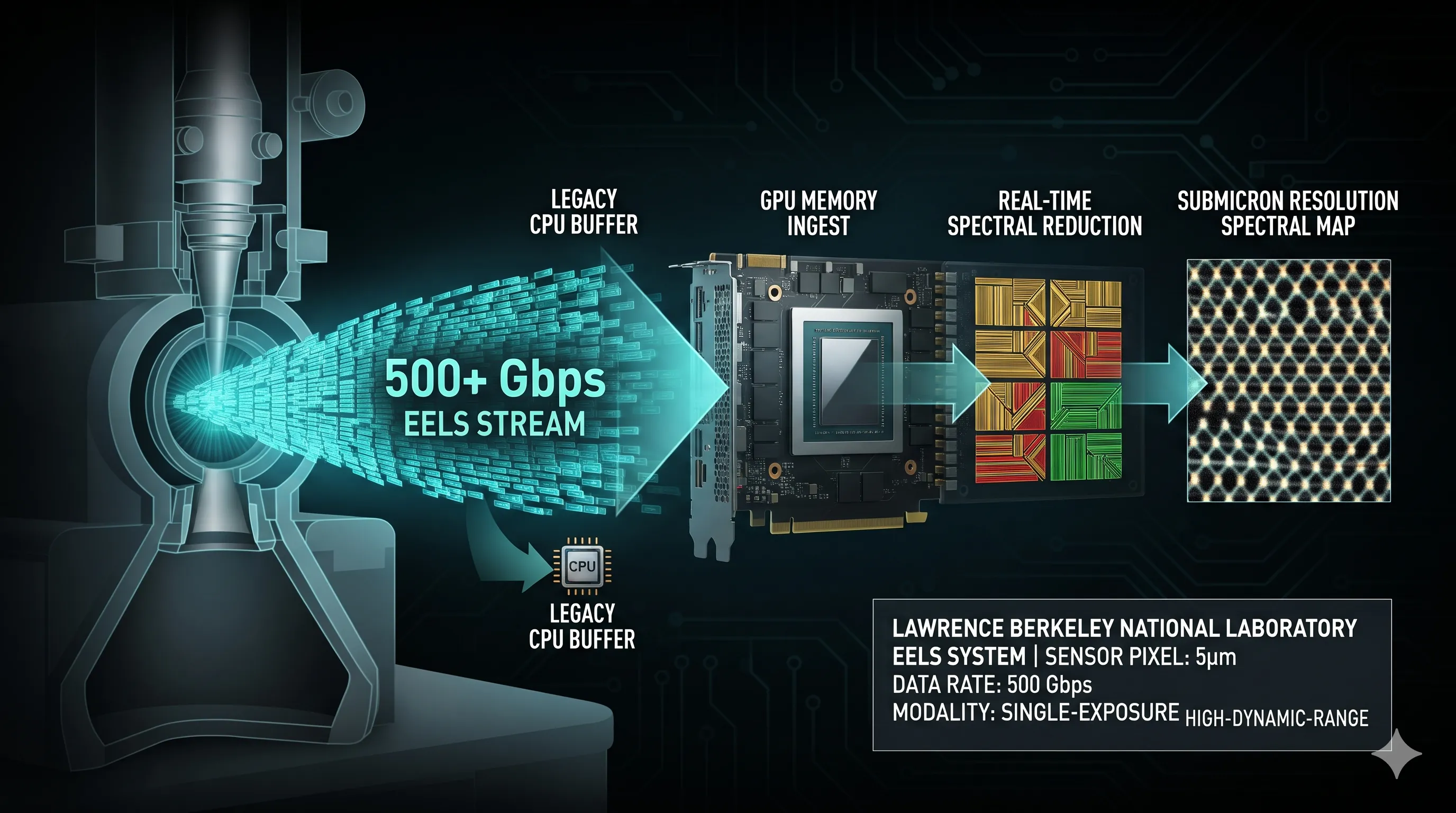
3. Real-Time 500 Gbps Electron Microscopy: Dynamic EELS at Lawrence Berkeley National Laboratory
High-throughput instrumentation in modern electron microscopy exemplifies how GPU-native workflows transform experimental science, linking directly to broader efforts where NVIDIA enables real-time AI in scientific instruments.At Lawrence Berkeley National Laboratory's Molecular Foundry, researchers developed an advanced Electron Energy-Loss Spectroscopy (EELS) capability that fundamentally alters how streaming analytical data is captured and interpreted.
Single-Exposure Dynamic Range and FPGA Readout Architecture
The physical detector architecture at the Molecular Foundry employs sensor pixels that measure 5 micrometers across.During active imaging, this specialized camera generates over 500 Gbps of streaming detector data.
This data generation rate is over 500x faster than conventional Electron Energy-Loss Spectroscopy streams.
Capturing over 500 Gbps creates extreme data rates that require immediate processing to prevent buffer overflow or information loss.
Operating at this scale, the instrument simultaneously captures both strong and faint electron signals in a single acquisition.
This high-dynamic-range capability replaces the conventional requirement for two separate, coordinated exposure processes and subsequent alignment steps.
To handle the initial transmission load, the instrument's readout electronics use FPGAs to transmit raw detector packets over Ethernet.
| System Parameter | Technical Specification |
|---|---|
| Sensor Pixel Size | 5 micrometers across |
| Streaming Data Rate | Over 500 Gbps |
| Throughput Multiplier | Over 500x faster than conventional EELS streams |
| Acquisition Modality | Single acquisition (capturing strong and faint signals without dual-exposure alignment) |
| Transmission Interface | FPGA readout transmitting raw packets over Ethernet |
| Target Spatial Resolution | Submicron spatial resolution via GPU-accelerated processing |
Real-Time GPU Spectral Reduction and Live Experiment Steering
To cope with incoming line-rate packet streams, the pipeline uses DAQIRI to ingest packets straight into GPU memory for real-time frame assembly, correction, and spectral reduction during ongoing experiments.Bypassing host-side intermediate bottlenecks allows the system to achieve submicron spatial resolution through GPU-accelerated computational processing.
Because frames are assembled and reduced inline, the workflow mitigates the risk of buffer overflows and catastrophic information loss.
Crucially, processing data immediately inside GPU memory enables live inspection and dynamic adjustment of acquisition parameters and regions of interest.
Rather than relying on post-acquisition diagnostics after a sample has degraded or shifted, microscopists maintain active control over instrument telemetry while observing materials phenomena at submicron resolution.
4. High-Energy Physics Deployments: Real-Time Particle Triggers at CERN HL-LHC and LCLS-II
In high-energy physics installations, real-time AI integration directly addresses catastrophic data volume challenges where traditional data acquisition bottlenecks compromise scientific discovery.Modern scientific instruments produce data streams at scales that exceed standard storage architectures and downstream compute pipelines.
For example, the Linac Coherent Light Source II (LCLS-II) generates photon pulses at a 1 MHz repetition rate.
Simultaneously, the CERN High-Luminosity Large Hadron Collider (HL-LHC) increases luminosity by a factor of 10 over the original design.
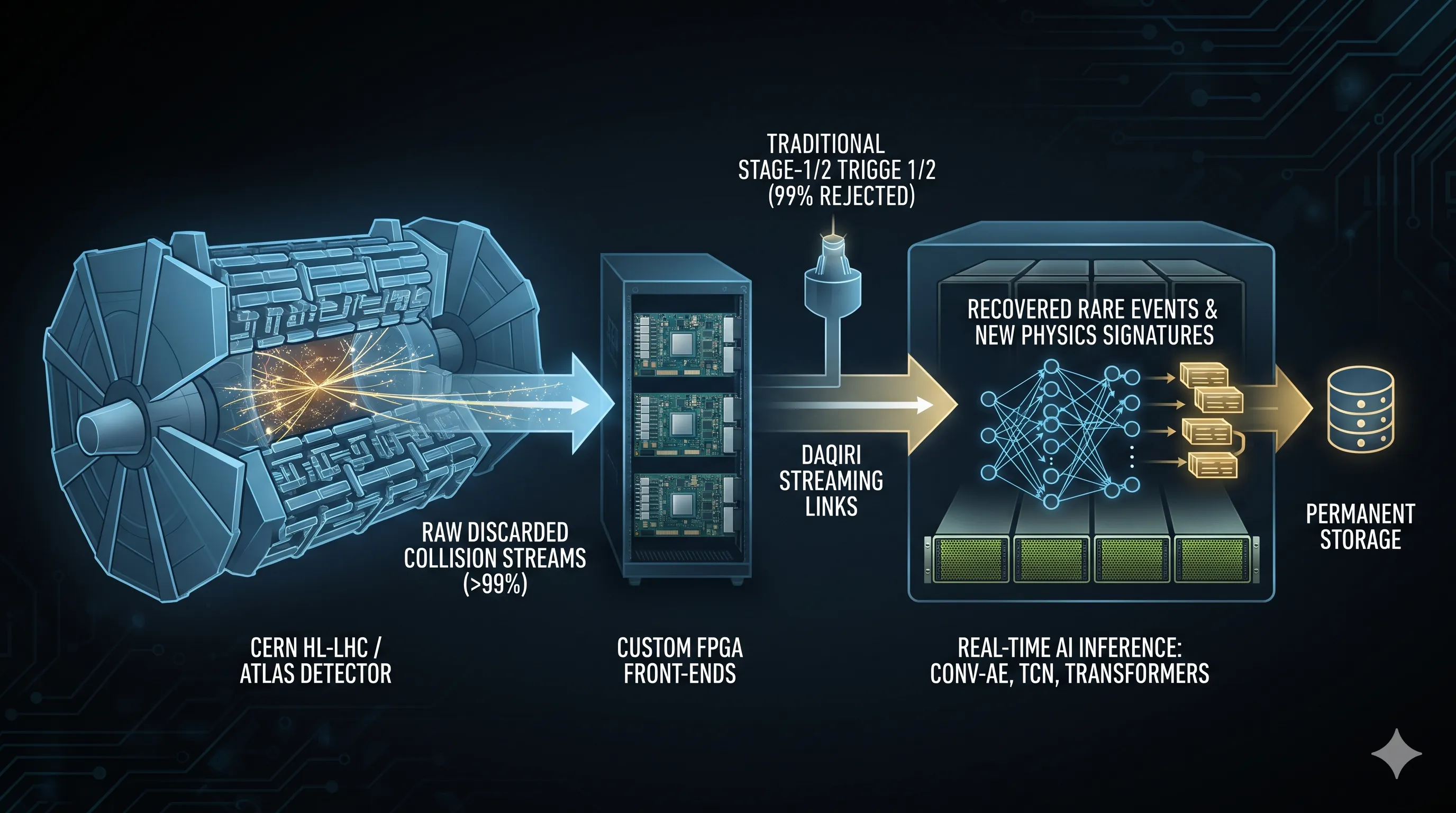
Because of extreme throughput limits, traditional multi-stage trigger systems discard over 99% of raw physics collision data.
Under standard operating conditions, the nominal HL-LHC online selection system rejects more than 99% of all collision events.
Even with the ATLAS detector upgrade, which increases selected event bandwidth to 1 MHz after stage one and up to 10 kHz after stage two, vast amounts of unrecorded interactions never reach permanent storage.
Addressing these throughput restrictions requires moving GPU-accelerated intelligence directly into the instrument acquisition stream.
| Facility or Instrument Pipeline | Throughput and Selection Specification |
|---|---|
| Linac Coherent Light Source II (LCLS-II) | Photon pulses generated at a 1 MHz repetition rate |
| CERN High-Luminosity Large Hadron Collider (HL-LHC) | 10x luminosity increase over original design baseline |
| ATLAS Detector Upgrade (Stage One) | Selected event bandwidth increased to 1 MHz |
| ATLAS Detector Upgrade (Stage Two) | Selected event bandwidth scaled up to 10 kHz |
| Nominal HL-LHC Online Selection Pipeline | Rejects more than 99% of all raw collision events |
The A-GHOST Project and Recovering Discarded Collision Streams
To reclaim scientifically valuable signatures from the rejected data, the A-GHOST project at CERN applies AI models directly to the data streams discarded by the nominal selection pipeline.Developed through a collaboration involving CERN Openlab, University of Chicago, and UCL scientists, A-GHOST intercepts events that would otherwise be discarded permanently.
The architectural foundation of this initiative relies on DAQIRI streaming links operating between custom FPGA boards and a dedicated GPU processing farm.
By coupling custom FPGA detector front-ends directly to GPU resources via DAQIRI streaming links, the pipeline bypasses traditional multi-stage buffering bottlenecks.
This link structure facilitates zero-loss ingestion directly into memory spaces where deep learning models evaluate real-time particle signatures as collisions occur.
Edge Supercomputing Targets and Deep Learning Trigger Models
The A-GHOST architecture deploys sophisticated neural topologies capable of handling complex temporal and spatial detector signals under strict real-time deadlines.The system enables real-time inference using Convolutional Auto-Encoders, temporal Convolutional Neural Networks, and transformer architectures.
These models parse unstructured, high-dimensional detector readouts to identify rare anomalies and potential new physics before data packets leave memory buffers.
Execution occurs on high-throughput compute nodes positioned at the instrumentation edge.
Supported edge supercomputing hardware targets include NVIDIA DGX Spark, NVIDIA IGX Thor, and NVIDIA RTX PRO Server platforms.
Utilizing these dedicated hardware targets ensures that the processing farm delivers the low-latency throughput necessary to sustain real-time evaluation across the unselected particle collision streams.
5. Edge RF Signal Processing: Wideband Instrumentation Collaboration with NI
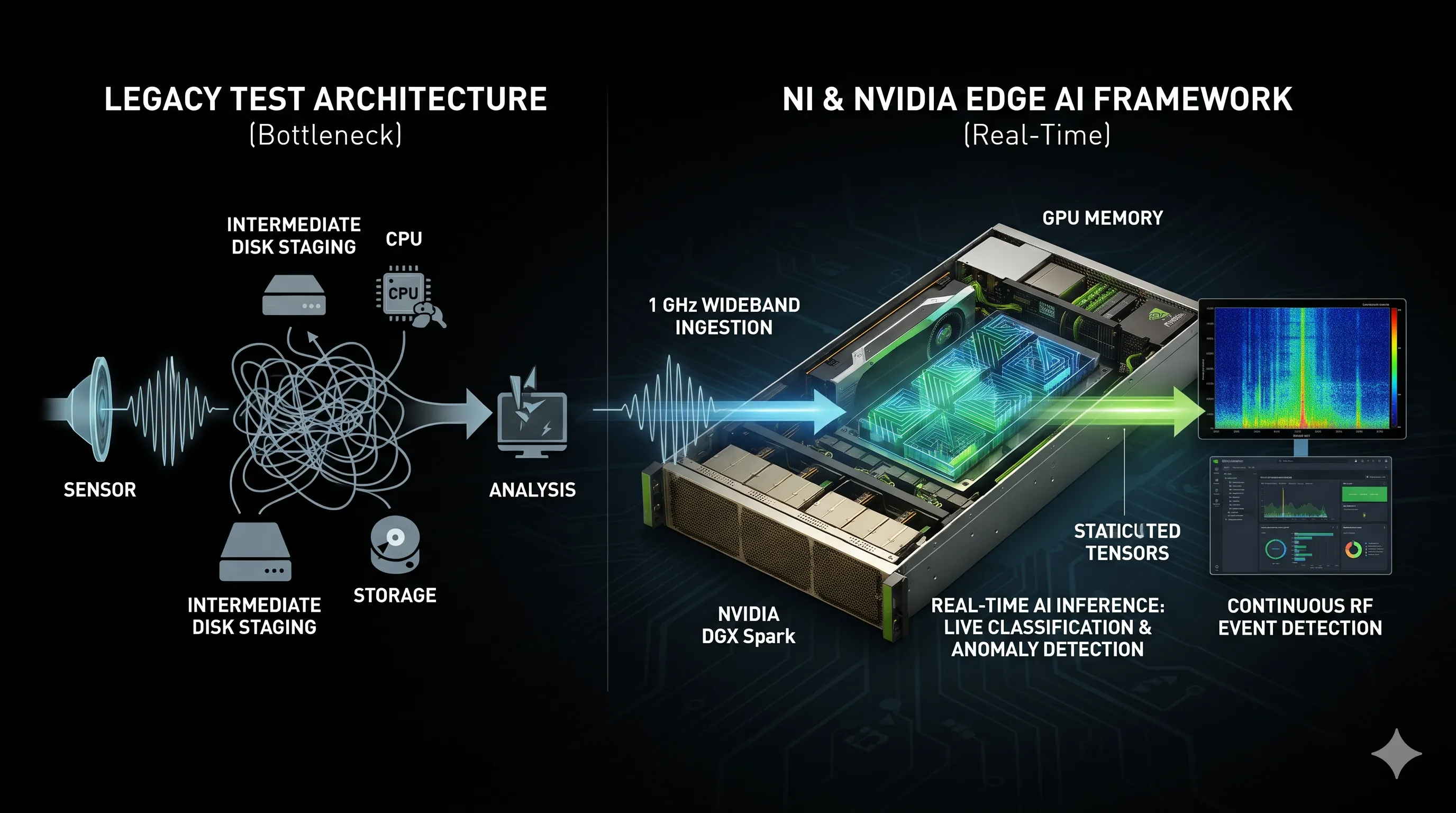
As NVIDIA enables real-time AI in scientific instruments, radio frequency (RF) measurement frameworks require immediate transition away from legacy data acquisition pipelines.Traditional test architectures route data from sensor to storage before CPU analysis, creating latency bottlenecks for millisecond-scale events.
To bypass these operational delays, a collaboration between NI and NVIDIA integrates measurement hardware with GPU computing for real-time edge processing.
This framework combines NI instrumentation hardware with NVIDIA Holoscan and DAQIRI software layers, establishing an architecture where streaming RF measurement feeds directly into GPU memory without intermediate disk staging.
Modular NI Operators and 1 GHz Bandwidth Ingestion
To interface scientific instruments directly with accelerated computing frameworks, NI develops modular operators that configure measurement hardware and stream data directly into Holoscan pipelines.These modular operators allow the software stack to negotiate physical acquisition parameters while linking instrumentation hardware directly to GPU execution paths.
By coupling DAQIRI and Holoscan execution pipelines, the joint architecture processes wideband RF signals across up to 1 GHz of bandwidth in real time.
Streaming wideband telemetry straight to the GPU eliminates the bottlenecks imposed by routing multi-gigabyte data flows through storage subsystems and host CPUs.
Software-Defined Radio Testbeds and Live Signal Classification
Applying this architecture to high-throughput wireless experimentation, a University of Texas at Austin research team built a wireless testbed combining NI Ettus USRP X410 software-defined radios with NVIDIA DGX Spark.The hardware configuration pairs the wideband signal reception of the NI Ettus USRP X410 software-defined radios with the accelerated computing capabilities of NVIDIA DGX Spark.
This integration enables live signal classification, adaptive testing, and embedded anomaly detection without downsampling or post-processing delays.
Scientific instruments deployed in this manner detect millisecond-scale RF events continuously, processing full-fidelity spectrum data as it arrives at the receiver.
Related Posts

How Frontier AI Models Are Rewriting Theoretical PhysicsExplore how frontier AI models and autonomous agents are transforming theoretical physics,...
OpenAI GPT-6.2 Billing Fix: Astra Hits Limits 40% FasterOpenAI fixes a GPT-6.2 launch billing bug, causing Astra limits to hit 40% faster and Sol 25%...
How GPT-6 Achieves Intrinsic Protein Design Without Specialized AIDiscover how GPT-6 models achieve intrinsic protein design and de novo minibinder generation using...
Generative AI may have assisted with research or drafting for this article. Topic selection, fact-checking, final wording, and publication remain the responsibility of DragonStone74. AI use disclosure