
How GPT-6 Achieves Intrinsic Protein Design Without Specialized AI
🚀 Key Takeaways
- Intrinsic Biological Reasoning: GPT-6 models generate novel protein folds and amino acid sequences using general reasoning and code execution without invoking specialized generative biology engines.
- Prompt-Driven Programmability: Molecular design objectives are steered dynamically through natural language prompts, bypassing the need for specialized architectural retraining or software refactoring.
- Empirical Wet-Lab Confirmation: Experimental assays conducted with Onava validate that foundation-model-designed backbones physically bind to intended human disease targets.
- Generalization Beyond Training Data: Sequence generation for unpublished structural scaffolds demonstrates significant sequence divergence, confirming genuine molecular design rather than database memorization.
- Broad Molecular Engineering Scope: The model successfully performs antibody loop redesign, de novo motif scaffolding, and small-molecule ligand docking natively via text and code contexts.
- Persistent Hybrid Workflows: While generative design is intrinsic, full end-to-end pipelines still depend on specialized structural tools for down-selection filtering and folding verification.
A major shift occurred when OpenAI unveiled findings showing that frontier foundation models can design functional biological macromolecules natively through interdisciplinary deduction, mathematical reasoning, and automated code execution.
Rather than treating biological engineering as an isolated computational problem requiring bespoke tools, this approach translates structural biology into an accessible natural-language workflow.
Researchers can now guide complex 3D backbone synthesis and affinity optimization directly through conversational interfaces, leveraging fundamental physical and chemical principles embedded within general intelligence.
With laboratory binding assays confirming activity across diverse therapeutic targets, the implications for drug discovery and synthetic biology are immediate.
Exploring how general foundation models achieve these structural feats—and identifying the critical filtering steps that still anchor them—reveals the emerging roadmap for AI-driven biotechnology.

1. Intrinsic Protein Design Through General Reasoning and Executable Code
Understanding how GPT-6 achieves de novo protein generation without specialized biological fine-tuning requires examining its native reasoning capabilities.Rather than relying on task-specific neural networks trained exclusively on macromolecular structures, the model approaches structural biology through general-purpose deduction and dynamic execution.
Prompt-Driven Molecular Architecture Without Retraining
On November 24, 2026, OpenAI released a preprint titled 'GPT-6 as a Universal Foundation Model for Protein Biology: Beyond Specialized Models'.The publication documented an inflection point in computational biology: GPT-6 models can design novel protein shapes and amino acid sequences without retraining or calling specialized biology models to generate them.
As OpenAI announced, "Our models can design new protein shapes and sequences using reasoning and code, without calling specialized biology models to generate them."
Under this operational paradigm, researchers no longer need to fine-tune weights on bespoke structural datasets or reconfigure specialized software pipelines.
Instead, scientists can control and direct molecular design tasks dynamically through standard natural language prompts.
Applying Fundamental Physical Principles via Code Execution
The underlying architecture operates by synthesizing cross-disciplinary knowledge rather than relying on domain-restricted heuristics.GPT-6 draws upon integrated foundational principles across mathematics, physics, chemistry, and biology to deduce molecular interactions from first principles.
To arrange 3D macromolecular structures and resolve spatial constraints, the model leverages dynamic coding tools and general reasoning environments.
By writing, executing, and evaluating programmatic code on the fly, the model calculates physical constraints and spatial configurations directly.
This integration of prompt-based logical inference and executable verification replaces traditional generative pipelines with an autonomous reasoning workflow.

2. Wet-Lab Validation: Generating De Novo Minibinders with Onava
Direct physical testing provides the ultimate benchmark for computational structural biology, directly establishing how GPT-6 enables protein design without training on specialized generative protein architectures.To determine whether an autoregressive frontier model could produce biochemically functional molecules without dedicated generative protein tools, physical wet-lab validation was conducted in partnership with research partner Onava.
Experimental Protocol with Onava and SolubleMPNN
The experimental pipeline decoupled spatial structure generation from sequence assignment.GPT-6.2 generated 3D backbone designs for potential minibinders targeting specified binding sites without dedicated generative protein tools.
Once these 3D backbones were established, SolubleMPNN was used downstream to suggest amino acid sequences corresponding to GPT-6.2's 3D backbones.
To maximize physical laboratory efficiency, specialized models were used to filter and select candidates predicted to fold and bind properly before synthesis.
Hit Rates Across PD-L1, VEGF-A, and Cytokine Targets
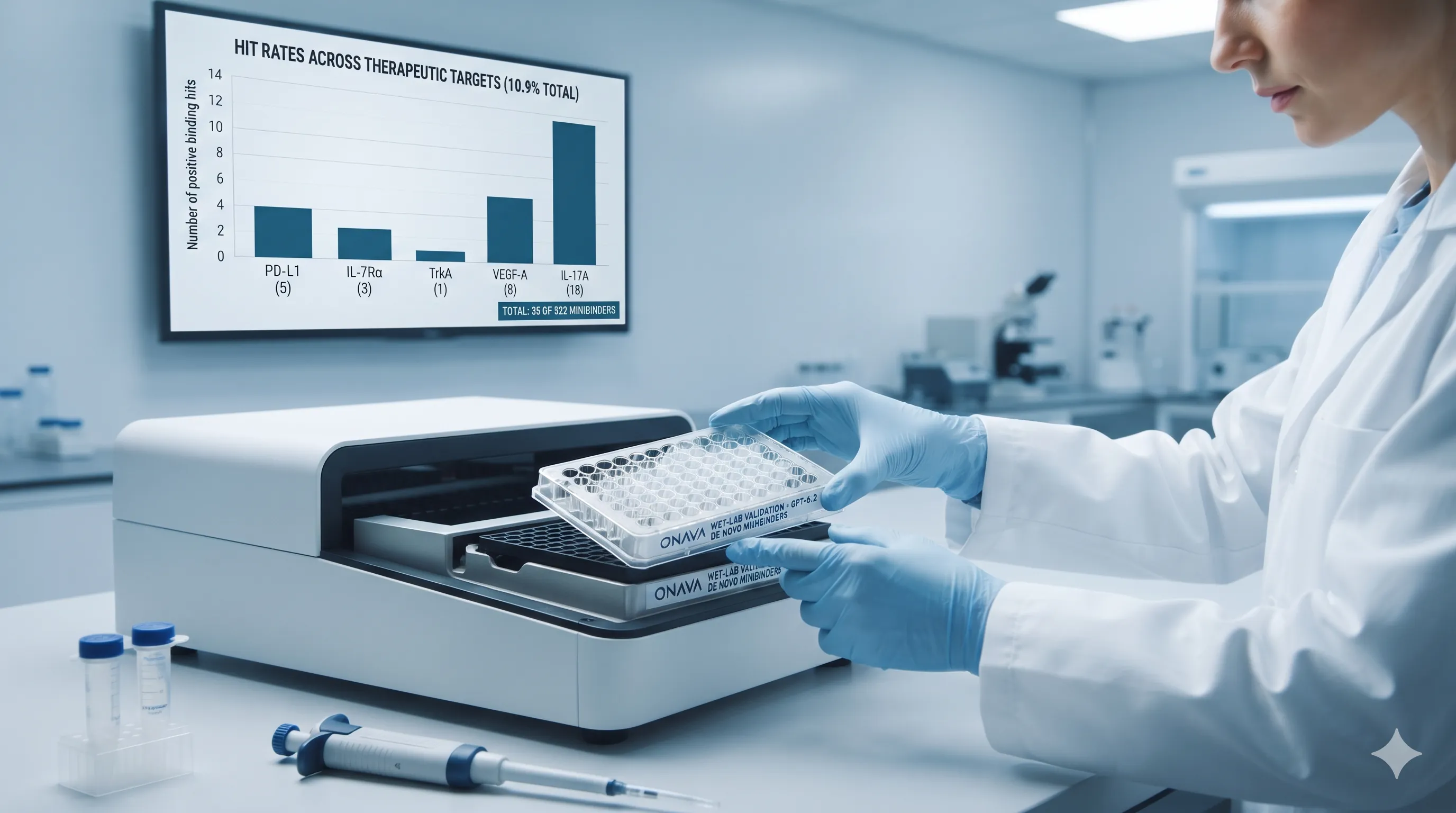
A total of 322 minibinders were tested in the laboratory across 5 target proteins.From this cohort, 35 of 322 minibinders (10.9%) tested positive for binding to their intended target.
The verified binding hit distribution across the panel included 5 hits for PD-L1, 3 for IL-7Rα, 1 for TrkA, 8 for VEGF-A, and 18 for IL-17A.
When contextualized against dedicated biomolecular diffusion architectures, RFdiffusion reported higher hit rates in its original study, though comparisons depend on candidate filtering criteria and binding definitions.
| Target Protein | Confirmed Positive Binding Hits | Validation Scope & Context |
|---|---|---|
| PD-L1 | 5 | Immune checkpoint target evaluated in Onava wet-lab testing. |
| IL-7Rα | 3 | Cytokine receptor target evaluated in Onava wet-lab testing. |
| TrkA | 1 | Receptor tyrosine kinase target evaluated in Onava wet-lab testing. |
| VEGF-A | 8 | Angiogenic growth factor target evaluated in Onava wet-lab testing. |
| IL-17A | 18 | Pro-inflammatory cytokine target evaluated in Onava wet-lab testing. |
| Total Overall Performance | 35 positive hits (10.9%) | 35 of 322 minibinders tested positive across all 5 target proteins. |
3. Direct Sequence Generation and Structural Novelty Beyond Memorization
A foundational question in understanding how GPT-6 enables protein design without training is whether the model merely recalls existing sequences from its dataset or intrinsically understands sequence-structure relationships.Direct sequence generation provides concrete proof of the latter, establishing that general multimodal intelligence can design novel, functional amino acid sequences directly onto structural scaffolds without task-specific retraining.
Sequence Design for Withheld 3D Complexes
GPT-6.2 demonstrated the ability to generate viable amino acid sequences when provided with 3D complex structures where the original sequences were completely withheld.In initial experimental screens, the model achieved high rates of functional binding across diverse therapeutic targets.
For MDM2, initial screens showed successful binding in 75 of 88 designs, representing an 85% success rate.
For VEGF-A, 26 of 42 generated designs bound to the target, achieving a 62% binding rate.
For PD-1, 8 of 59 designs demonstrated confirmed binding, yielding a 14% success rate.
Crucially, the functional sequences generated by GPT-6.2 did not simply replicate the templates from which the sequences were withheld.
The median amino acid sequence difference from the original minibinders reached 50% for VEGF-A, 43% for MDM2, and 15% for PD-1.
These metrics illustrate substantial sequence remodeling while preserving target affinity.
| Target Complex | Laboratory Binding Count | Initial Binding Rate (%) | Median Sequence Difference vs. Original (%) |
|---|---|---|---|
| MDM2 | 75 of 88 designs | 85% | 43% |
| VEGF-A | 26 of 42 designs | 62% | 50% |
| PD-1 | 8 of 59 designs | 14% | 15% |
Divergence Metrics Confirming Novelty on Unpublished Backbones
To rigorously test structural novelty and rule out data leakage, GPT-6.2 was tasked with designing functional sequences for unpublished minibinder shapes previously generated by the model.Because these geometric backbones were entirely absent from public repositories and pretraining corpuses, success could not rely on rote memorization.
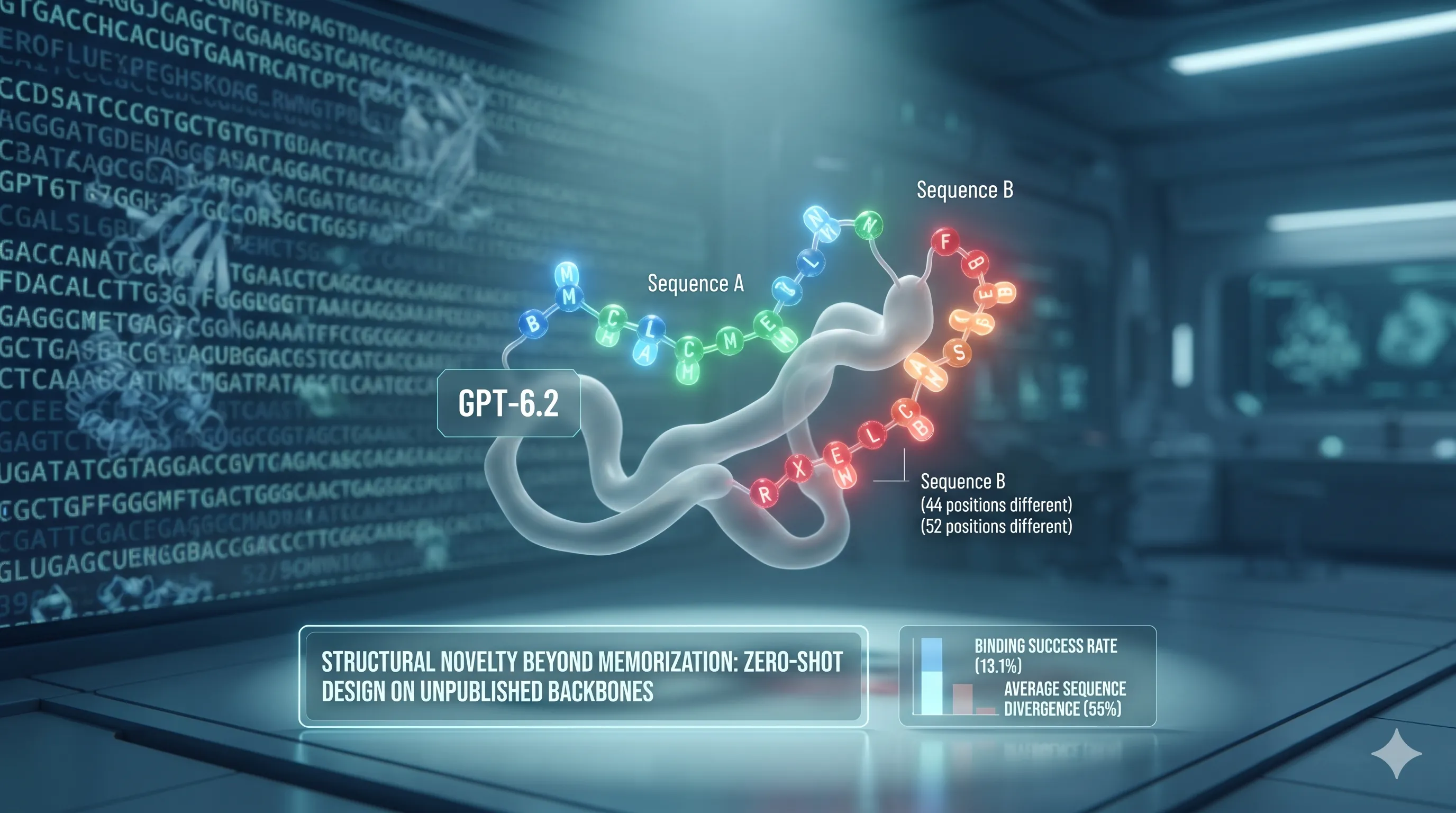
Out of 107 proteins generated from GPT-6.2 sequences designed for these unpublished backbones, 14 (13.1%) showed validated binding in the laboratory.
The structural divergence observed within individual targets further demonstrates novel generative capacity.
For an unpublished PD-L1 backbone, two GPT-6.2 sequences differed from the original in 52 and 58 out of 90 amino acids, respectively.
In addition to diverging significantly from the original scaffold, the two generated sequences differed from each other at 44 positions.
OpenAI stated that sequence divergence on unpublished structures indicates capabilities extend beyond memorization, confirming that zero-shot protein sequence generation stems from genuine generalizable structural comprehension.
4. Targeted Antibody Loop Redesign and Affinity Maturation
Directly exemplifying how GPT-6 enables protein design without training, targeted sequence manipulation highlights the model's capacity to bypass specialized pipeline software entirely.GPT-6.2 performed loop sequence redesign for affinity maturation and selectivity without needing bespoke protein engineering toolchains.
Rather than relying on computationally heavy structural physics engines or custom fine-tuning runs, the model altered binding loops while preserving the remaining sequence framework intact.
Framework Preservation in VHH Nanobody Maturation
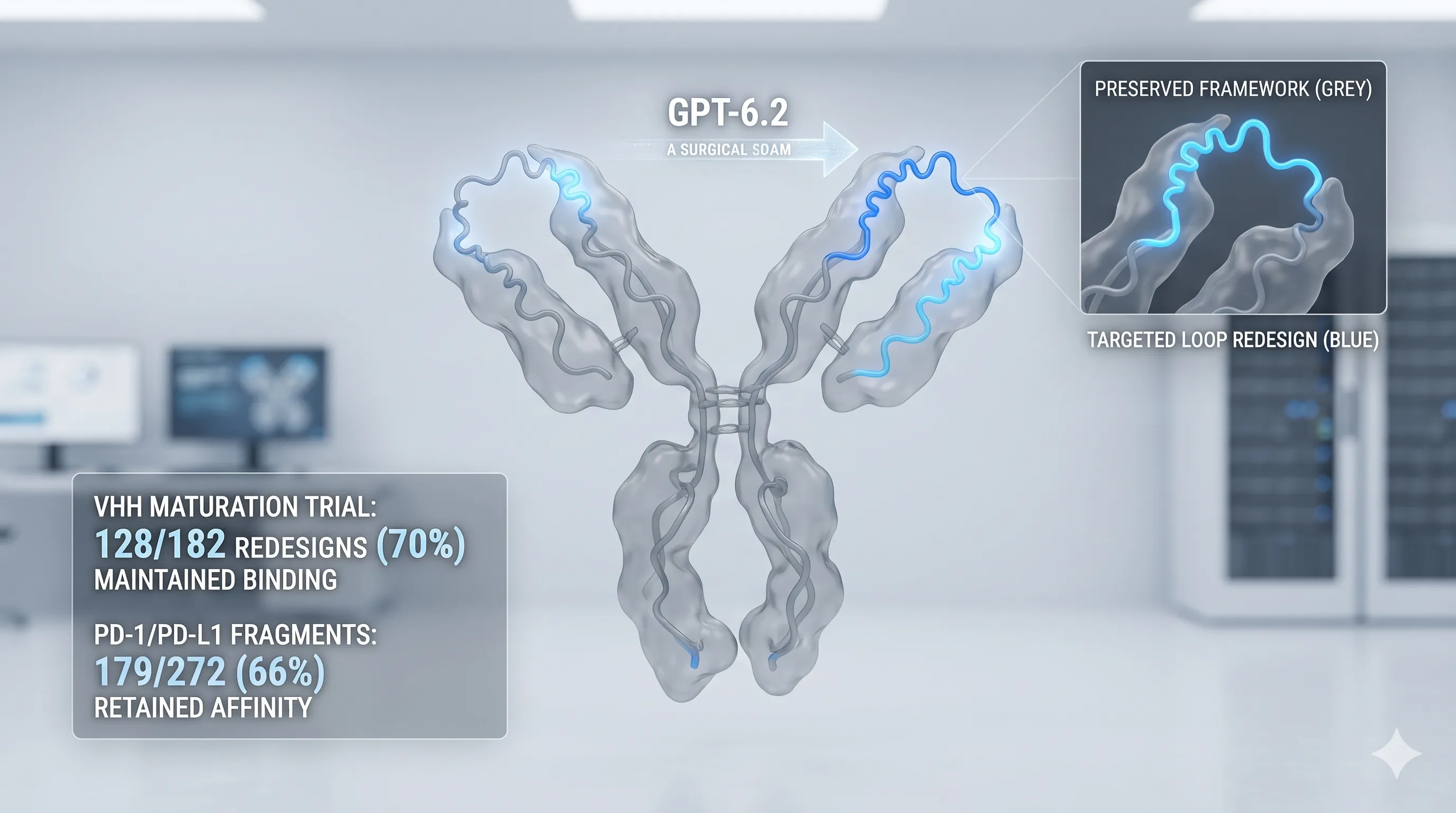
During nanobody optimization trials, GPT-6.2 demonstrated precise surgical edits within the antigen-binding regions.Specifically, 128 out of 182 redesigns (70%) of binding loops across six small antibodies (VHHs) maintained binding to IL-4Rα.
By keeping the structural scaffolding unchanged while selectively mutating the functional loops, the model maintained high binding viability across the targeted candidate pool without dedicated structural modeling pipelines.
Extensive Loop Mutagenesis on PD-1 and PD-L1 Fragments
The model's zero-shot capability extends to deep combinatorial modifications across therapeutic antibody formats.In rigorous evaluations, 179 out of 272 antibody fragments (66%) based on five therapeutic antibodies retained binding to PD-1 or PD-L1 after mutating roughly half the residues in three binding loops.
GPT-6.2 achieved this high rate of functional binding retention despite high-density mutations across multiple loops, validating its intrinsic grasp of sequence compatibility, affinity maturation, and selectivity.
5. Scaffolding, Fold Generation, and Direct Contextual Docking Implementation
A central pillar of how GPT-6 enables protein design without training is its ability to bypass external diffusion pipelines and dedicated force-field scoring functions.By parsing structural representations, residue geometries, and atomic topologies as tokenized sequences, the architecture handles structural scaffolding, de novo fold generation, and small-molecule complex resolution natively within a single prompt window.
Prompt-Specified Secondary Structure Scaffolding
Structural scaffolding in GPT-6 operates through direct sequence steering without task-specific weights or architectural retuning.Prompts allow specifying secondary structure classes such as all helices, all strands, or combinations, along with target coil counts.
This steerability translates to robust functional backbone design across established architectural benchmarks.
On 30 MotifBench challenges, an internal research model achieved a 43.7% scaffolding success rate, outperforming the specialized diffusion architecture RFdiffusion, which scored 27.8%.
When evaluated across 200 CATH fold challenges, the internal model attained an 18.9% success rate, exceeding Proteina's 17.1%.
Furthermore, this architectural generalization reflects an advancing comprehension of thermodynamic stability.
In stability rank correlation across 265 datasets, model performance progressed systematically from 0.41 in GPT-5.6 to 0.52 in GPT-6, 0.57 in GPT-6.2, and 0.66 in the internal research model.
Direct Context Ligand Docking and DockQ Progression
Rather than relying on iterative spatial grids or external physical docking programs, small-molecule docking was conducted by inputting protein coordinates and ligand SMILES strings directly into the model context.The context window resolves complex binding constraints solely from sequence-level structural descriptions.
In PoseBusters blind docking tests, GPT-6.2 reached a 93% match, while the latest internal model reached 96%, compared to DiffDock-L, which reached 50%.
For complex bonding interfaces across 179 Scarpino covalent complexes with known bonding atoms specified in the prompt, GPT-6.2 reached 92%, the internal model reached 97%, and DiffDock reached 60%.
Macromolecular interaction quality displays a parallel generational leap.
Antibody docking DockQ scores improved from 0.05 in GPT-5.6 to 0.28 in GPT-6, 0.57 in GPT-6.2, and 0.81 in the internal research model.
| Benchmark / Challenge Scope | Evaluated Metric | GPT-5.6 | GPT-6 | GPT-6.2 | Internal Research Model | Specialized Baseline |
|---|---|---|---|---|---|---|
| 30 MotifBench Challenges | Scaffolding Success Rate | — | — | — | 43.7% | 27.8% (RFdiffusion) |
| 200 CATH Fold Challenges | Fold Generation Success Rate | — | — | — | 18.9% | 17.1% (Proteina) |
| PoseBusters Blind Docking | Docking Match Rate | — | — | 93% | 96% | 50% (DiffDock-L) |
| 179 Scarpino Covalent Complexes | Specified Covalent Match Rate | — | — | 92% | 97% | 60% (DiffDock) |
| Antibody Docking | DockQ Score | 0.05 | 0.28 | 0.57 | 0.81 | — |
| 265 Stability Datasets | Stability Rank Correlation | 0.41 | 0.52 | 0.57 | 0.66 | — |

6. Current Workflow Dependencies, Structural Limitations, and Future Horizons
Understanding how GPT-6 enables protein design without explicit domain-specific training requires a clear view of its architectural boundaries and operational realities.
While general autoregressive architectures exhibit surprising zero-shot emergent capabilities in generating protein backbones and redesigning sequences, they do not operate in complete isolation.
Evaluating GPT-6's true impact on biological engineering demands analyzing the computational tools it relies upon, the persistent bottlenecks in its structural predictions, and the safety measures guiding its trajectory.
Specialized Model Filtering and the Structure Prediction Gap
GPT models demonstrate intrinsic capability primarily at the backbone generation and sequence redesign stages of biomolecular design.
However, GPT models do not yet establish end-to-end de novo binder generation in an isolated zero-shot setting without specialized filtering models.
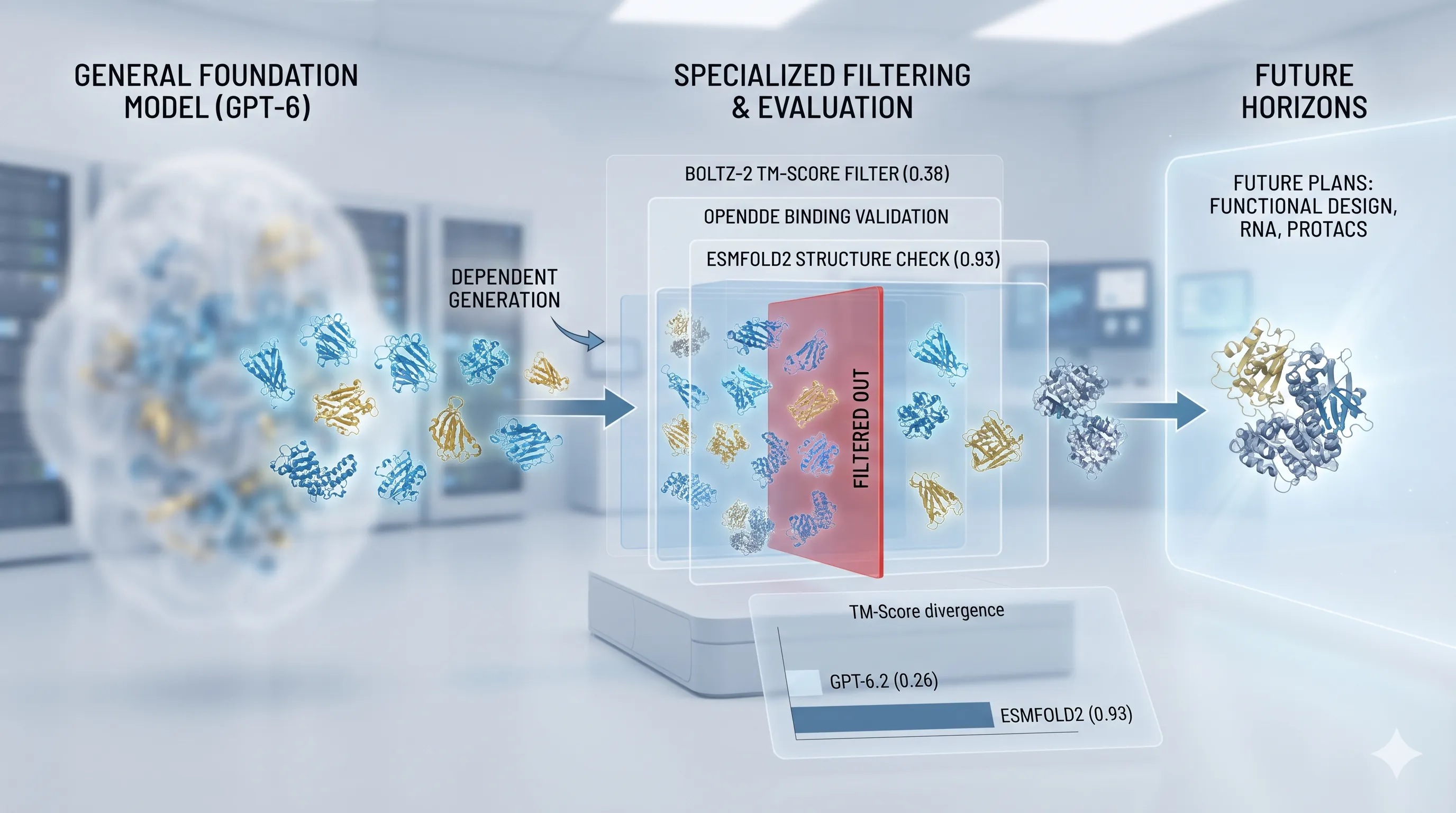
Instead, practical campaigns rely on an ensemble workflow where specialized downstream models—specifically Boltz-2, OpenDDE, and ESMFold2—evaluate, rank, and filter candidates generated by the foundation model.
The primary technical reason for this pipeline dependency is that full de novo structure prediction from sequence remains a major weakness for foundation language models when benchmarked against specialized structural architectures.
Evaluating structural fidelity via template modeling scores (TM-scores) reveals a persistent performance divergence across model iterations.
| Model Architecture | Model Type | Full De Novo Structure Prediction (Average TM-Score) |
|---|---|---|
| GPT-5.6 | General Foundation Model | 0.16 |
| GPT-6.2 | General Foundation Model | 0.26 |
| Latest Internal Model | General Foundation Model | 0.38 |
| ESMFold2 | Specialized Structural Prediction Model | 0.93 |
Although intrinsic predictive fidelity has scaled from 0.16 in GPT-5.6 to 0.26 in GPT-6.2 and reaches 0.38 in the latest internal model, general foundation models lag far behind ESMFold2's benchmark score of 0.93.
Because the foundation model cannot autonomously verify its own folding geometry with high structural confidence, specialized scoring tools like Boltz-2, OpenDDE, and ESMFold2 remain vital filters for selecting workable candidates.
Biosecurity Oversight and Expansion into Complex Biomolecules
Moving from computational candidate selection to laboratory synthesis exposes additional functional divides.
Successful in vitro binding demonstrates physical attachment between a designed protein and its intended target, but physical binding alone does not establish downstream efficacy, selectivity, stability, or therapeutic safety.
Translating raw binding ability into functional therapeutic solutions demands extensive iterative optimization that current raw generative checkpoints cannot unilaterally guarantee.
Because these intrinsic biology capabilities lower the operational threshold for generating complex macromolecules, potential biological risks must be continuously managed.
OpenAI applies its Preparedness Framework to rigorously evaluate biosecurity risks associated with emerging biological capabilities within foundation models, ensuring safety protocols scale alongside generative aptitude.
Looking ahead, future development plans aim to transcend simple binder design by expanding the generative envelope into harder targets and functional biochemical interactions.
These roadmap horizons encompass downstream biological function design, non-coding RNA structures, and targeted protein degradation platforms such as PROTACs (proteolysis targeting chimeras).
Related Posts


Generative AI may have assisted with research or drafting for this article. Topic selection, fact-checking, final wording, and publication remain the responsibility of DragonStone74. AI use disclosure