
Inside Cloudflare Workers KV Instant: Quicksilver v2 at the Edge
🚀 Key Takeaways
- Internal Engine Unlocked: Cloudflare has introduced KV Instant in private beta, granting external developers direct access to Quicksilver v2, the core infrastructure store powering configuration across its global edge network.
- Sub-2ms Edge Reads: By proactively pushing updates across more than 300 points of presence, Instant mode eliminates cold-read penalties and achieves a 1.62 ms p99 read latency—over 100 times faster than classic Workers KV.
- Config-Oriented Architectural Limits: Instant namespaces enforce intentional distributed constraints, including a 1 MB total storage ceiling, a 10,000-key cap, and serialized write limits restricted to one update per second.
- Inverted Workload Economics: Read operations in Instant mode are discounted by 60% compared to classic KV ($0.20 per million), balanced by premium-tier pricing ($0.10 each) on write and delete operations.
- Seamless API Compatibility: Developers can provision Instant namespaces via Wrangler or CLI flags without rewriting application logic, preserving standard
get(),put(),list(), anddelete()method signatures.
For years, Cloudflare’s global edge network has run on an internal, battle-tested data store known as Quicksilver—a system responsible for evaluating configuration rules, security settings, and routing instructions on virtually every incoming HTTP request. Announced during Birthday Week 2026, Cloudflare has officially opened this underlying technology to developers through KV Instant, a specialized Workers KV mode currently available in private beta.
The emergence of autonomous AI agents, dynamic edge routing, and real-time feature flag evaluation has exposed the performance bottlenecks inherent to traditional eventual-consistency stores. Classic Workers KV relies on cache pulls and time-to-live expirations, which can lead to high-latency cold starts across edge datacenters. In contrast, Quicksilver v2 proactively pushes state mutations straight to memory across Cloudflare’s distributed footprint, delivering near-instant global read accessibility on the exact same runtime API.
Harnessing this level of speed requires adhering to strict architectural boundaries. Because writing a key triggers immediate replication to hundreds of physical edge nodes, Cloudflare has engineered Instant mode specifically for compact, read-heavy datasets. By pairing radically reduced read costs with tightly bounded storage and write throughput ceilings, this release provides systems architects with a dedicated tier designed specifically for microsecond-critical configuration paths.

1. Quicksilver v2 and the Evolution of Workers KV into Instant Mode
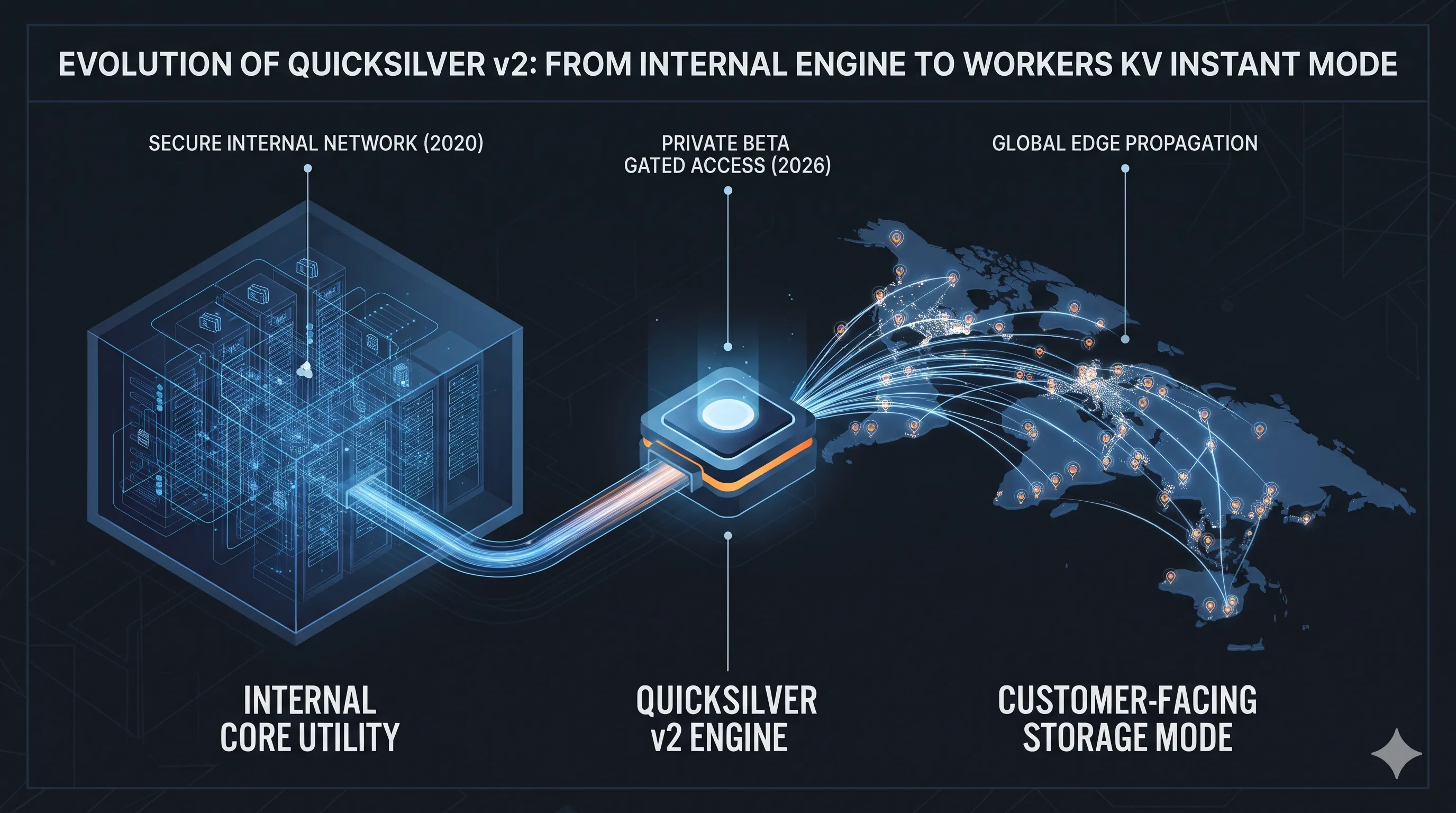
This section examines Cloudflare's transition of Quicksilver into an external product offering, establishing how the core architecture behind the "Cloudflare Launches Quicksilver as Workers KV Mode in Private Beta" announcement evolved from a critical internal utility into a user-facing storage mode.From Internal Core Service to Customer-Facing Engine
The architectural lineage of distributed key-value storage at Cloudflare dates back to 2018, when Workers KV originally launched during Cloudflare Birthday Week.Two years later, Quicksilver was internally introduced at Cloudflare in 2020 to serve as the company's high-speed internal configuration store.
The scale and criticality of this engine are central to Cloudflare's platform operations.
As Rob Sutter wrote, "Nearly every request to Cloudflare looks up at least one key in Quicksilver."
Because nearly every incoming request to Cloudflare looks up at least one key in Quicksilver, the system was engineered to handle high-concurrency configuration distribution across the entire edge.
During Birthday Week 2026, Cloudflare announced Workers KV Instant, marking the first time Quicksilver has been made accessible to external customers.
Rather than introducing a separate, disjointed API, Cloudflare exposed this capability as a dedicated Workers KV mode named KV Instant, which is powered by Quicksilver v2.
Highlighting both customer demand and the underlying design philosophy, Brendan Irvine-Broque stated: "we have this crazy key-value store at Cloudflare called Quicksilver instantly updates keys across our whole network. microsecond reads from every location. stupid fast our customers have asked us for years to make it available we finally did – in a way we think is quite simple - as a new mode for Workers KV."
| Year | Milestone | Architectural Role and Details |
|---|---|---|
| 2018 | Workers KV Launch | Originally launched during Cloudflare Birthday Week to provide distributed key-value storage. |
| 2020 | Quicksilver Introduction | Internally introduced at Cloudflare as an internal configuration store queried by nearly every request. |
| 2026 | Workers KV Instant Announcement | Announced during Birthday Week 2026, delivering Quicksilver v2 to customers as a new Workers KV mode. |
Private Beta Rollout and Access Prerequisites
Despite the public announcement of the technology during Birthday Week 2026, the rollout remains tightly gated.KV Instant is currently available in private beta via an enrollment sign-up form.
Under this phased deployment model, customer access is limited to approved private beta participants.
Teams seeking to leverage Quicksilver v2 must submit their details through the designated sign-up form and await manual verification.
Furthermore, Cloudflare has not announced a general availability (GA) date for KV Instant.
The mode remains an approval-only release as Cloudflare validates the exposure of its internal configuration layer to outside developer workloads.
2. Sub-2ms Reads and Instant Global Replication: Performance Benchmarks
The private beta release of Quicksilver as Cloudflare Workers KV Instant mode directly addresses the distributed storage trade-offs that have historically constrained edge-first applications.By integrating Cloudflare's core replication engine into Workers KV, Instant mode replaces traditional tiered caching with direct, continuous propagation across over 300 edge locations.
This shift converts what was once an eventual-consistency key-value store with variable cache warm-up delays into an ultra-low-latency distributed data plane.
Microsecond Read Performance Across Edge Locations
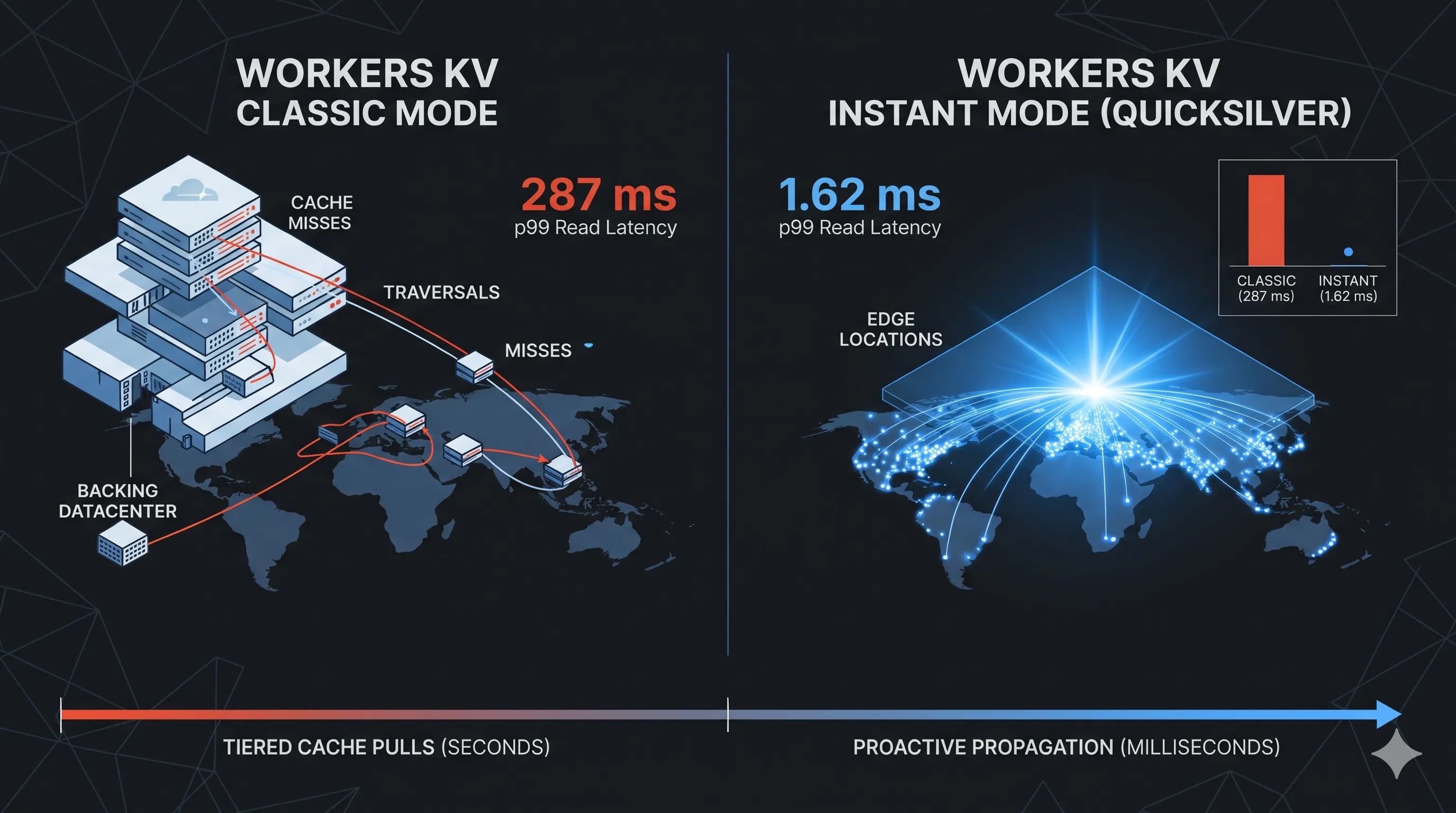
The divergence in read latency between classic Workers KV and Instant mode highlights the operational cost of legacy cache hierarchies.In classic Workers KV mode, the all-reads p99 latency reaches 287 ms, driven by cache misses and tiered cache traversals that query backing datacenters.
Even when isolating cached reads, classic mode registers a p99 read latency of 160 ms.
Instant mode alters this profile entirely, clocking an all-reads p99 latency of 1.62 ms globally across more than 300 edge locations.
At the p99 threshold, reads in Instant mode resolve over 100 times faster than classic mode.
Further down the distribution, p95 read times in Instant mode drop into the microsecond range, providing deterministic retrieval speeds directly at the edge.
Because data resides locally across the entire footprint, Instant mode completely eliminates cold-read penalties on configuration reads, making cached read metrics non-applicable (N/A) since every lookup hits local storage without tiered cache lookups.
Sub-Second Global Write Propagation and Zero Cache TTLs
Write distribution presents a similar leap in throughput and synchronization velocity.In classic Workers KV, p99 write replication across storage backends takes 4.38 seconds, while median and p95 replication metrics are bounded at under 1 second because sub-second fidelity is unavailable for measuring replication lag in classic mode.
Instant mode achieves true sub-second global convergence.
Median write replication across edge locations in Instant mode is 107 ms, p95 write replication settles at 181 ms, and p99 write replication is recorded at 256 ms.
Writes push to edge locations over 20 times faster in Instant mode than classic mode.
Under this model, updates are proactively propagated across Cloudflare's network without waiting for cache TTL expiration.
This predictable synchronization window unlocks real-time configuration coordination.
Highlighting the utility for distributed orchestration, Benjie Malinao stated on X: "This is the config store agents actually need. Sub-2ms p99 reads and global writes landing in about a quarter second at p99, on the same KV API."
| Metric / Dimension | Workers KV Instant Mode | Workers KV Classic Mode |
|---|---|---|
| p95 Read Latency | Measured in microseconds | Bounded by cache hit/miss status |
| p99 Read Latency (All Reads) | 1.62 ms (over 100x faster) | 287 ms |
| p99 Read Latency (Cached) | N/A (eliminates cold-read penalties) | 160 ms |
| Median Write Replication | 107 ms | Bounded under 1 second (sub-second fidelity unavailable) |
| p95 Write Replication | 181 ms | Bounded under 1 second (sub-second fidelity unavailable) |
| p99 Write Replication | 256 ms (over 20x faster) | 4.38 seconds |
| Propagation Mechanism | Proactive network propagation without waiting for TTL expiration | Cache TTL expiration and tiered caching backends |
3. Namespace Constraints, Capacity Quotas, and API Behavioral Divergences
As Cloudflare launches Quicksilver as Workers KV Instant mode in private beta, adopting this operational profile introduces structural architectural boundaries that diverge sharply from standard distributed stores.Understanding these technical boundaries is essential for evaluating whether an edge workload fits within the tight resource envelope required to guarantee rapid propagation across the Cloudflare edge network.
Capacity Ceilings and Serialized Namespace Write Rates
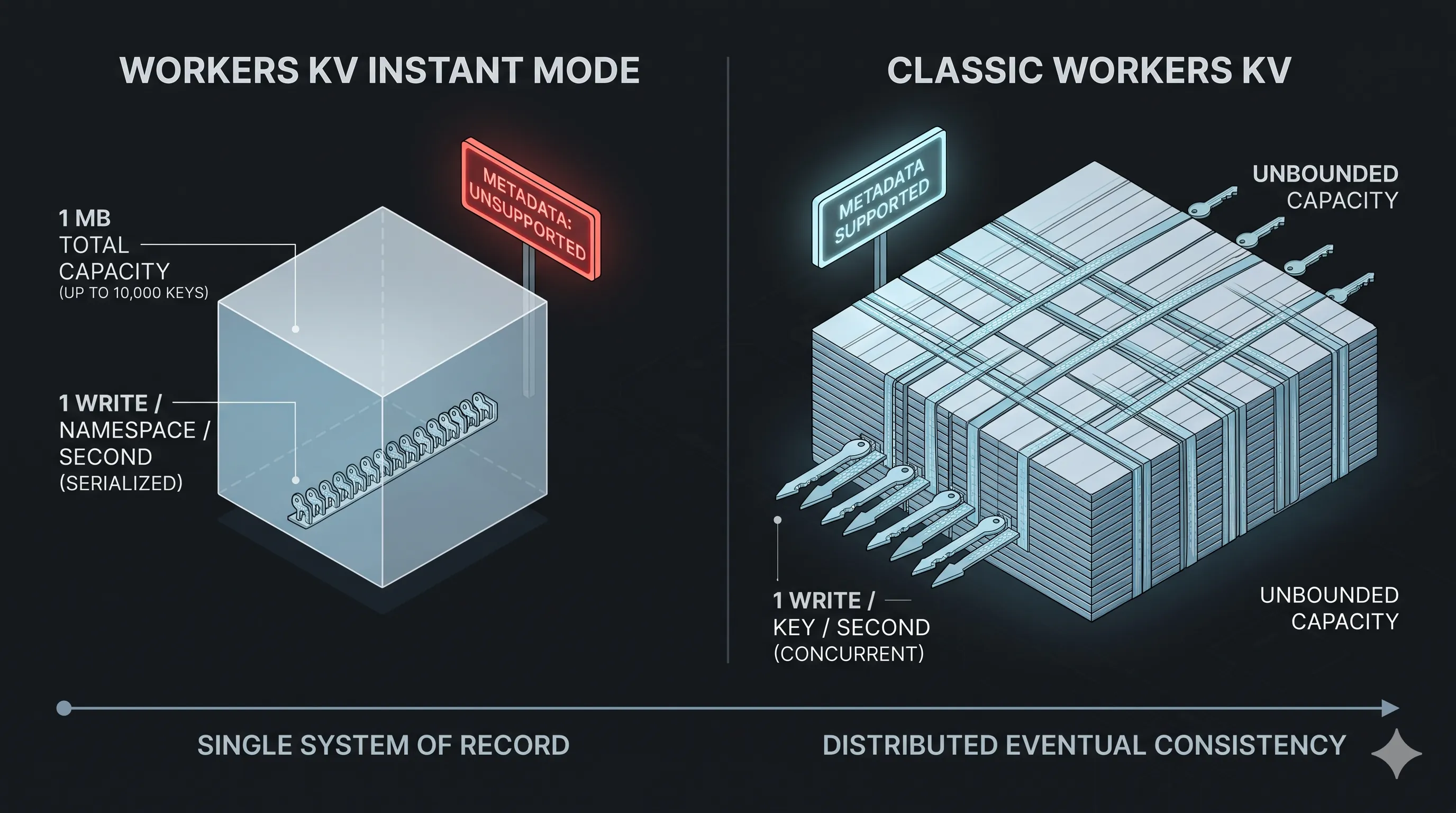
A KV Instant namespace operates under rigid structural constraints designed for micro-scale, high-velocity datasets.Specifically, a KV Instant namespace holds a maximum total storage capacity of 1 megabyte across all stored entries.
Values must not cause the namespace to exceed this total 1 megabyte ceiling, requiring teams to maintain compact payloads.
In addition to the volumetric ceiling, a KV Instant namespace contains up to 10,000 key-value pairs in total.
Individual keys are limited to a maximum size of 300 bytes, establishing strict parameters for hierarchical or segmented key naming schemes.
Beyond storage quotas, the write pipeline in Instant mode functions under fundamentally different throughput rules than classic storage.
Write frequency is capped strictly at 1 write per namespace per second.
This contrasts directly with classic Workers KV, which restricts writes to 1 write per key per second.
Consequently, concurrent multi-key write workloads permitted in classic KV are serialized into a single queue under the 1 write per second namespace ceiling.
Cloudflare enforces a single system of record on writes to simplify reasoning about application update order.
Addressing this architectural tradeoff, Cloudflare notes that restricting writes to one per namespace per second "makes it easier for you to reason about update order in your application."
API Differences: Metadata Restrictions and Non-Paginated Lists
At the interface level, Instant mode integrates directly into the standard Workers KV developer workflow by supporting standard API methods includingget(), put(), list(), and delete().However, subtle behavioral divergences require modifications to client handling code.
First, the operational profile is immutable; the mode must be defined at namespace creation with
'mode': 'instant' and cannot be modified later.Existing classic namespaces cannot be transitioned dynamically into Instant mode.
Second, custom metadata is completely unsupported.
In Instant mode,
put() does not accept metadata, and invocations of getWithMetadata() always return null.Third, key enumeration is fundamentally streamlined.
Because the dataset is bounded by the 10,000-key limit, the
list() operation in Instant mode returns all matching keys in a single response without pagination, eliminating cursor iteration loops required in classic namespaces.The following comparison summarizes the operational limits and API distinctions between Workers KV Instant mode and classic Workers KV:
| Dimension | Workers KV Instant Mode | Classic Workers KV |
|---|---|---|
| Total Namespace Capacity | 1 megabyte | Multi-gigabyte / unbounded standard capacity |
| Maximum Key Count | Up to 10,000 key-value pairs | Unbounded key capacity |
| Maximum Key Size | 300 bytes | Standard KV key size rules |
| Write Rate Limit | 1 write per namespace per second (serialized single queue) | 1 write per key per second (concurrent multi-key writes) |
| Write Ordering Model | Single system of record enforced | Distributed eventual consistency |
| Metadata Support | Unsupported (put rejects metadata; getWithMetadata returns null) |
Supported arbitrary JSON metadata |
| List Operation Pagination | Non-paginated (returns all matching keys in a single response) | Paginated via cursor tokens |
| Namespace Creation Mode | Configured at creation with 'mode': 'instant' (immutable) |
Default standard mode |
4. Workload Economics and Pricing Models: Read-Heavy vs. Classic KV
Understanding the underlying economics of Workers KV Instant mode is essential as Cloudflare launches Quicksilver as a Workers KV mode in private beta.The new tier fundamentally restructures operational costs, establishing a financial model optimized for high-throughput reads while imposing strict premiums on writes and capacity.
Cost Breakdown: Micro-Priced Reads vs. Premium Write Operations
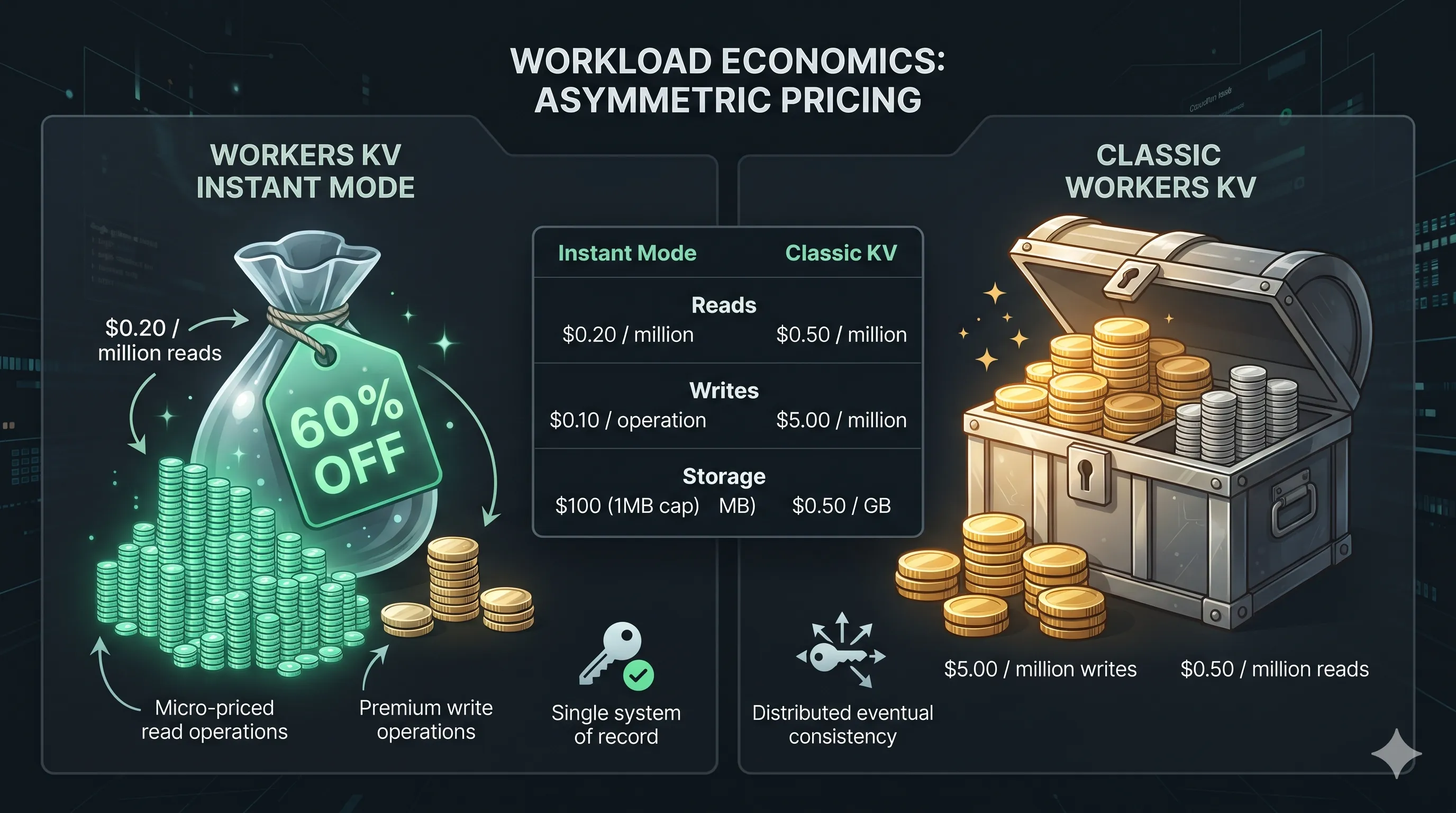
Workers KV Instant mode introduces an aggressive price reduction on data retrieval paired with a substantial premium on mutation operations.Class B read operations in Instant mode cost $0.20 per million keys requested, representing a 60% reduction compared to the $0.50 per million rate charged in classic Workers KV mode.
For retrieval mechanics, multi-key reads executed within a single get operation are billed per key as individual Class B operations.
Conversely, Class A operations—encompassing put, delete, and list requests—are priced at a premium rate of $0.10 per operation in Instant mode.
This contrasts sharply with classic Workers KV, where Class A operations cost $5.00 per million.
Under Instant mode billing rules, each key written or deleted counts as one individual Class A operation.
A single list operation is billed as one Class A operation regardless of how many keys are returned.
Storage economics exhibit a similar divergence.
Storage in Instant mode costs $100 per megabyte per month, compared to $0.50 per gigabyte per month in classic Workers KV mode.
However, the maximum monthly storage cost per Instant namespace is capped at $100 due to the 1 megabyte ceiling enforced on the mode.
| Metric / Operation Type | Instant Mode | Classic Workers KV |
|---|---|---|
| Class B Operations (Reads) | $0.20 per million keys requested | $0.50 per million |
| Class A Operations (Put, Delete, List) | $0.10 per operation | $5.00 per million |
| Storage Cost | $100 per megabyte per month | $0.50 per gigabyte per month |
| Storage Ceiling / Maximum Cost | Capped at $100 per month (1 MB limit) | Variable based on gigabyte volume |
Addressing the write economics, Irvine-Broque noted: "Writes cost what they cost... because writing a key replicates it to hundreds of locations. This is a store priced so that you read from it constantly and write to it rarely."
Target Use Cases: Configuration Distribution vs. Incompatible Write Paths
The pricing economics of Instant mode are deliberately structured for read-heavy, low-frequency write workloads.Because reads are 60% cheaper than classic KV, architectural workloads that require rapid, continuous access across edge locations benefit substantially from the cost reduction.
Primary workloads suited for this profile include feature flags, routing tables, and agent settings, where small configurations must be read at immense scale while mutations occur infrequently.
Conversely, the elevated cost of Class A operations and high per-megabyte storage pricing make Instant mode incompatible with high-churn data pipelines.
Instant mode is not suited for session state, user records, or frequent write paths, where continuous put or delete executions would rapidly escalate operational billing.
For these write-intensive architectures, classic Workers KV remains the appropriate baseline storage solution.
5. Provisioning Workflows and Worker Runtime Integration
Deploying Cloudflare's Quicksilver-backed storage in the private beta release requires explicit configuration during resource setup.Because the underlying engine characteristics are established when resources are allocated, developers must specify the Instant mode flag during initial namespace creation.
Namespace Initialization via CLI and REST API
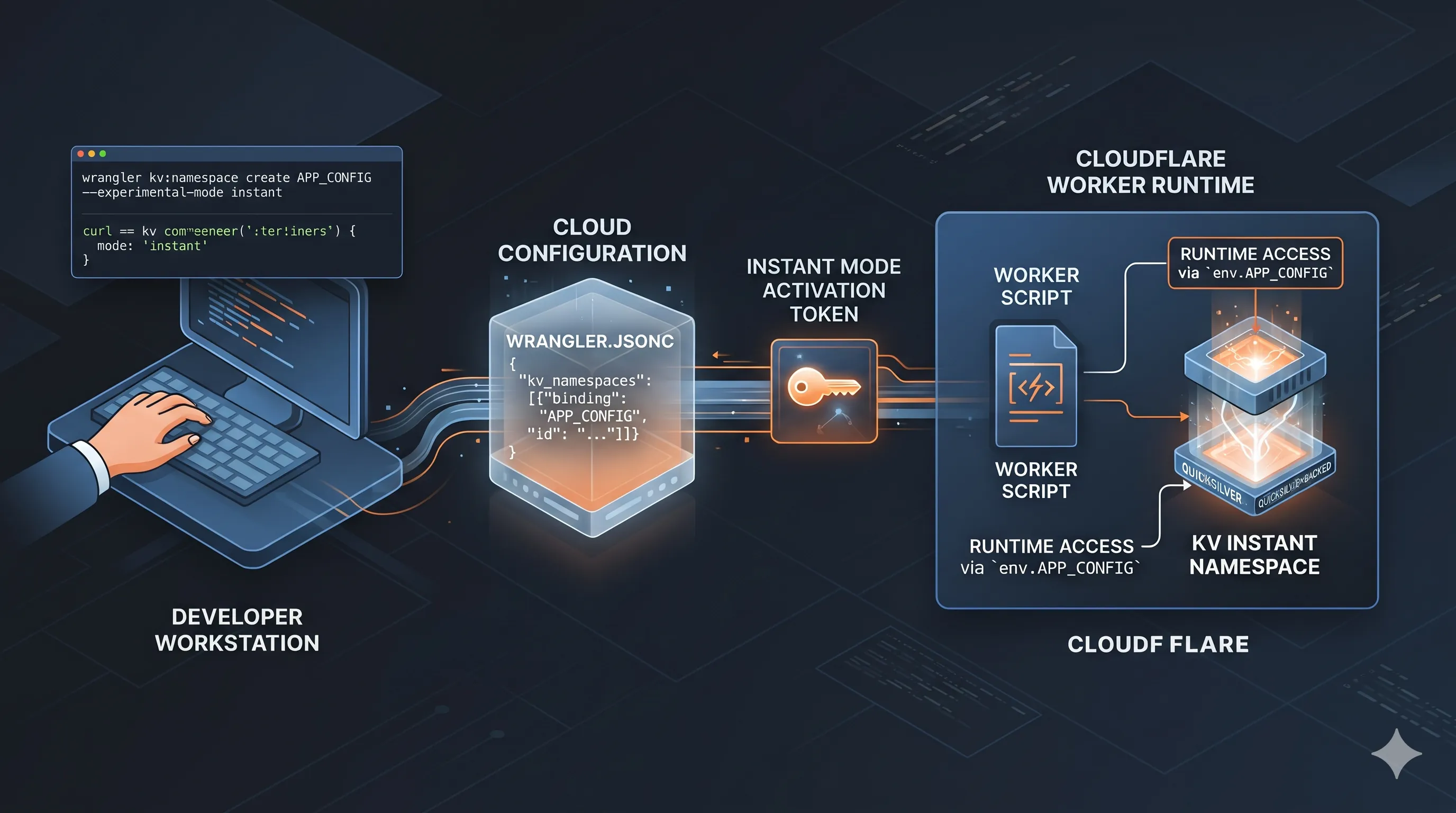
To create a KV Instant namespace named APP_CONFIG using Wrangler CLI, developers pass the specialized operational parameter at initialization time.--experimental-mode instantPlatform operators working outside Wrangler can provision environments using alternative CLI tools.
To create a KV Instant namespace using Cloudflare CLI, operators target the equivalent namespace mode argument.
--namespaceMode instantProgrammatic setups can bypass command-line tools by communicating directly with the platform endpoints.
KV Instant namespaces can be created through the API using the attribute mode: 'instant'.
When executing these automated requests, provisioning an Instant namespace via API requires the Workers KV Storage Write permission token to successfully register the Quicksilver-backed namespace.
Configuring Worker Bindings in wrangler.jsonc
Workers bind to KV namespaces via configuration files (wrangler.jsonc) and interact with bindings at env.<BINDING_NAME>.To declare a KV namespace binding in a Worker configuration file, configuration manifests map logical names to allocated identifiers.
{
	"kv_namespaces": [
		{
			"binding": "USERS_NOTIFICATION_CONFIG",
			"id": "<BINDING_ID>"
		}
	]
}At execution time, the Worker script accesses the operational methods of the provisioned Instant mode namespace through the environment object using env.<BINDING_NAME>.
Related Posts
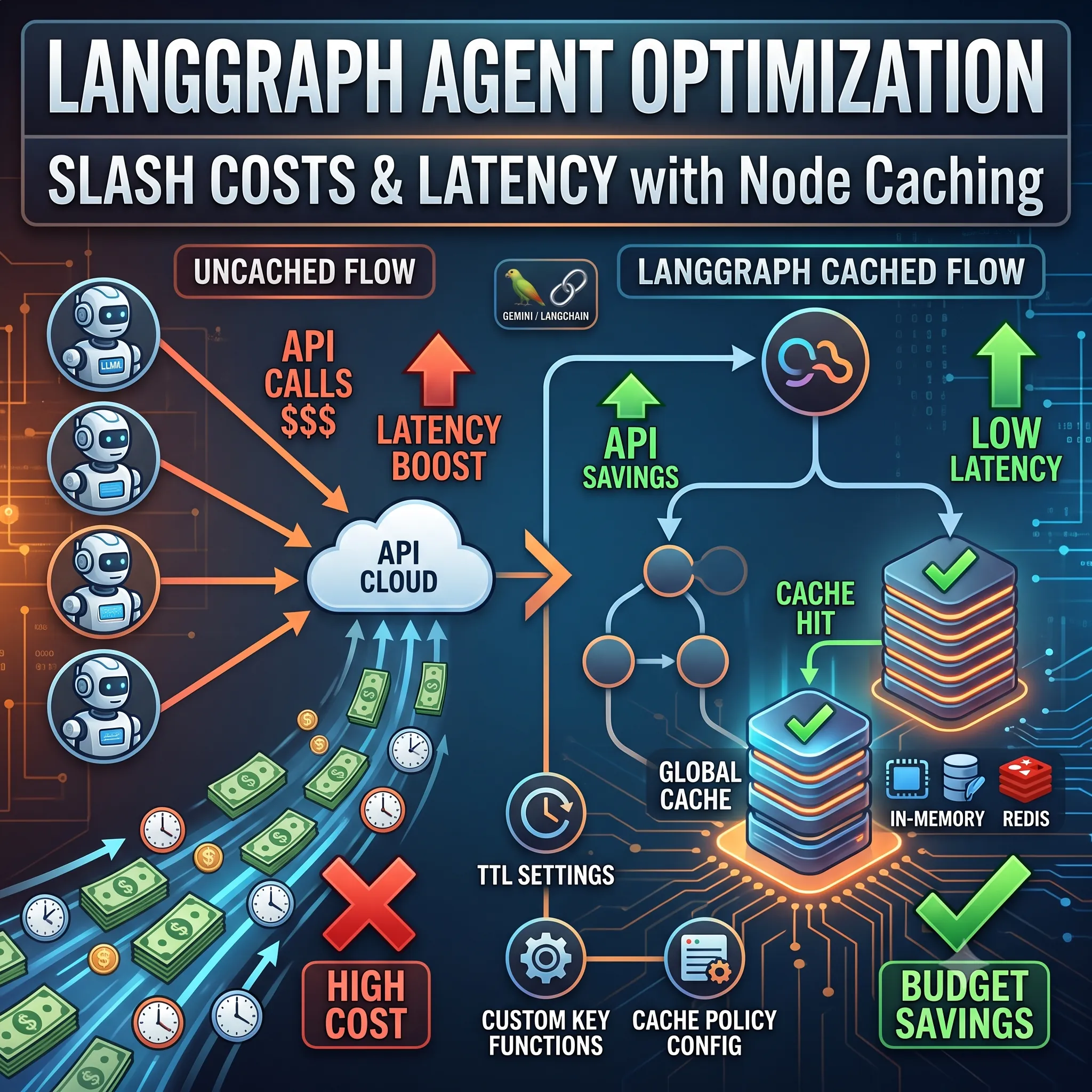
Optimizing LangGraph Agent Workflows with Node-Level CachingLearn how to optimize LangGraph agent performance by implementing node-level caching, custom...

The Definitive Google Photos Guide for 2026: Master Your Memoriesfor Modern Google Photos Management Proactive Curation & AI Integration: Google Photos in 2026 is...
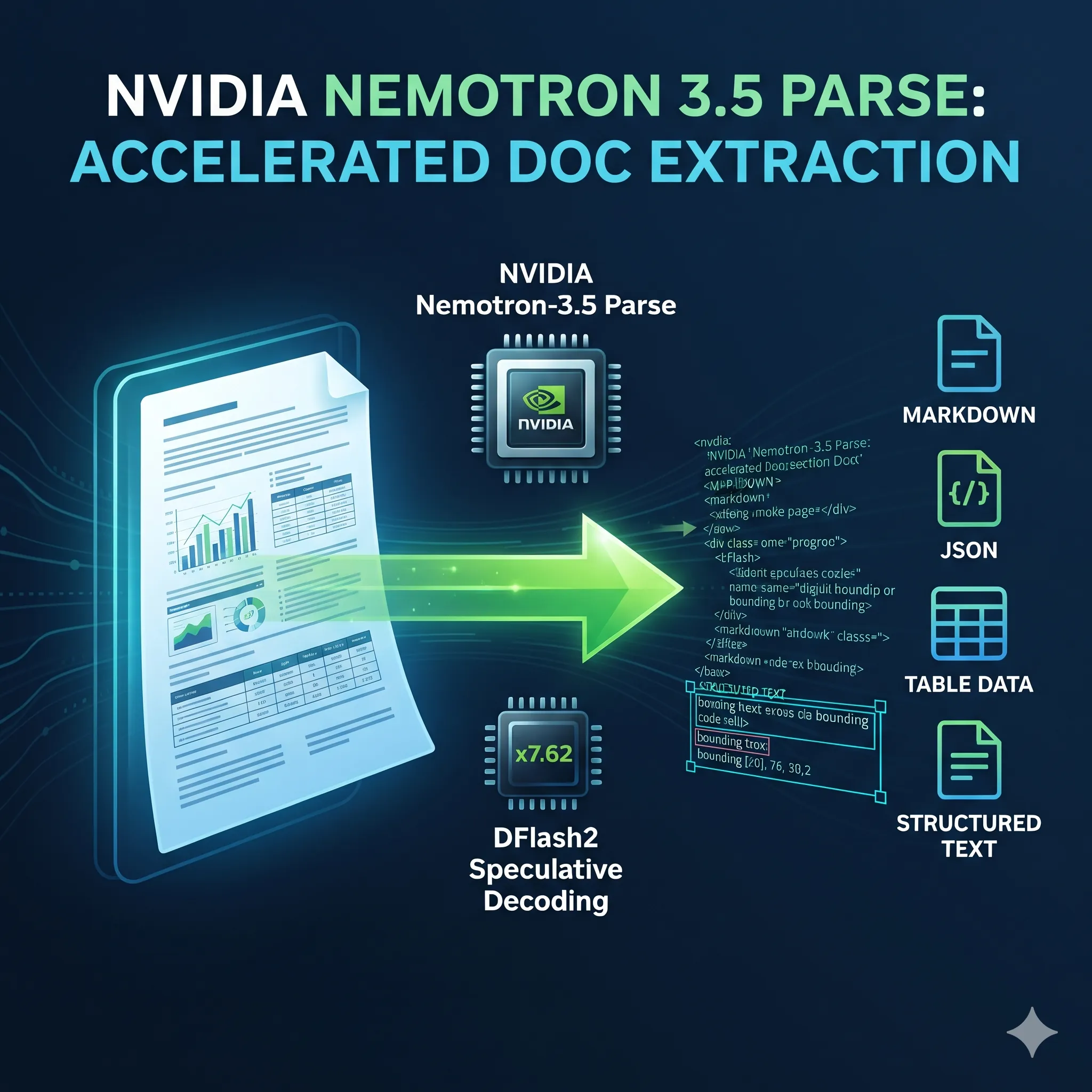
How Nemotron 3.5 Parse Accelerates Vision-Language Document ExtractionDiscover how NVIDIA's Nemotron 3.5 Parse boosts inference speed and document extraction efficiency...
Generative AI may have assisted with research or drafting for this article. Topic selection, fact-checking, final wording, and publication remain the responsibility of DragonStone74. AI use disclosure