
Hybrid Reasoning Agents: How Latent Space Thinking Cuts LLM Costs
🚀 Key Takeaways
- Dual-Mode Agent Architecture: Hybrid reasoning agents bridge unconstrained continuous latent thinking with structured text interaction in an integrated generative process.
- Dynamic Latent Switching: The lightweight HybridLink adapter dynamically shifts LLMs into latent mode for fast internal reasoning and exits back to natural text for tool invocation and outputs.
- Specialized Post-Training: A unified training pipeline pairs phased supervised fine-tuning with outcome-based reinforcement learning to align latent representations without degrading text mastery.
- Superior Efficiency and Performance: Shifting intermediate thoughts out of tokenized text slashes token overhead and inference costs while boosting accuracy across reasoning benchmarks.
- Preserved Auditability: Built-in inspection mechanisms translate continuous latent representations into readable pseudo-text, maintaining agent accountability for critical operations.
Modern autonomous LLM agents have long faced an inescapable trade-off between deliberation depth and runtime cost. Traditional reasoning frameworks force foundation models to articulate every nuance of internal reflection as discrete, autoregressive text tokens. While this keeps the agent's chain of thought legible, it introduces substantial latency, inflates context windows, and incurs prohibitive compute overhead when orchestrating multi-step plans or operating complex software tools.
To dismantle this computational bottleneck, researchers from Stanford University, Together AI, UIUC, and Meta have introduced Hybrid Reasoning Agents (HybridAgents). This framework introduces a unified generation process where models deliberate internally through high-dimensional continuous latent space and transition seamlessly back into natural language to execute tool calls, return final responses, and engage external environments.
By blending latent cognitive flexibility with the strict structure of conversational interfaces, hybrid reasoning points toward a more practical and sustainable future for autonomous AI. As enterprise workloads demand higher autonomy and tighter operational budgets, decoupling internal problem-solving from rigid token generation represents a vital leap forward in scalable agent engineering.
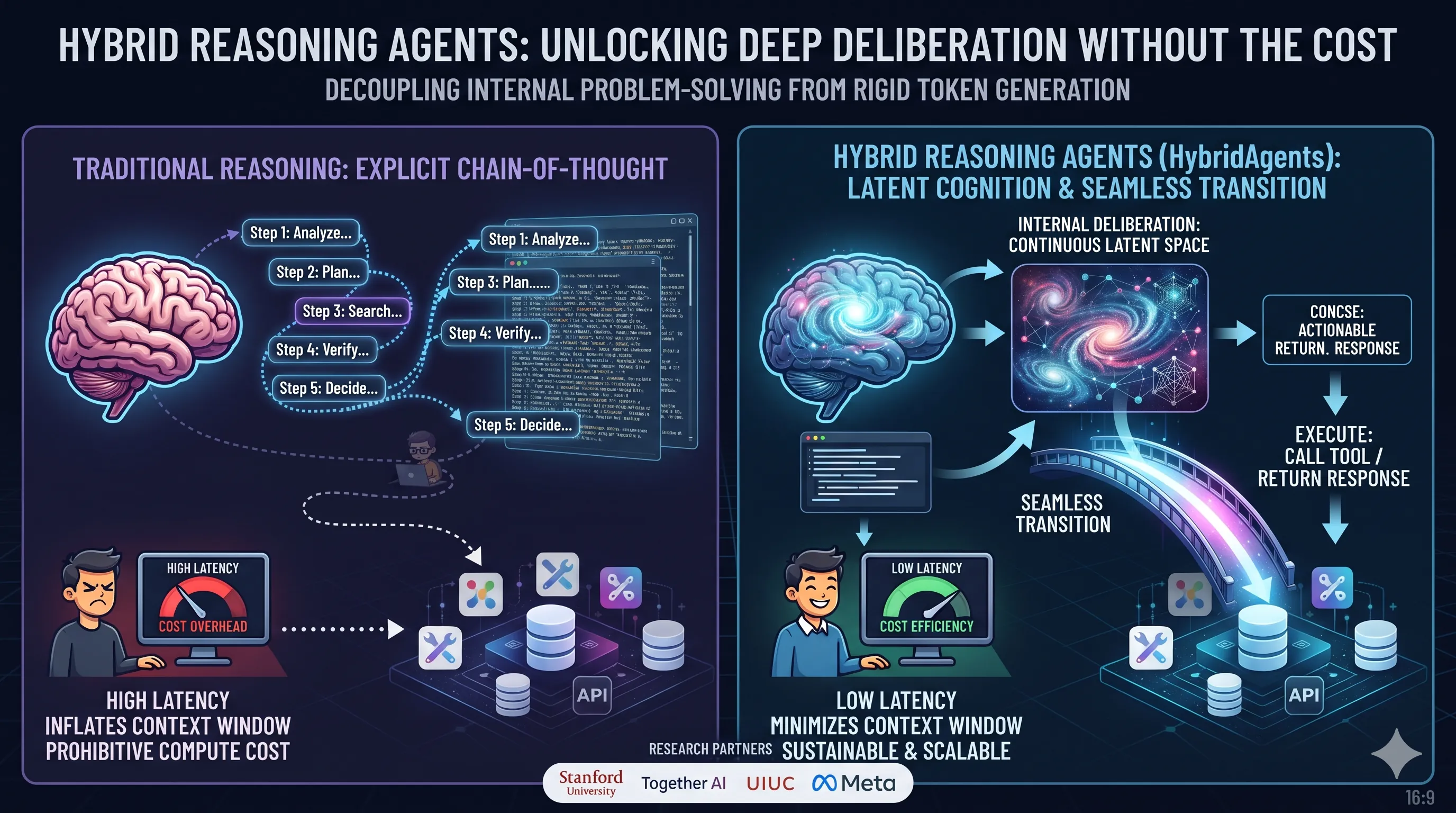
1. Foundational Concept: Unifying Latent Thought and Discrete Interaction in HybridAgents
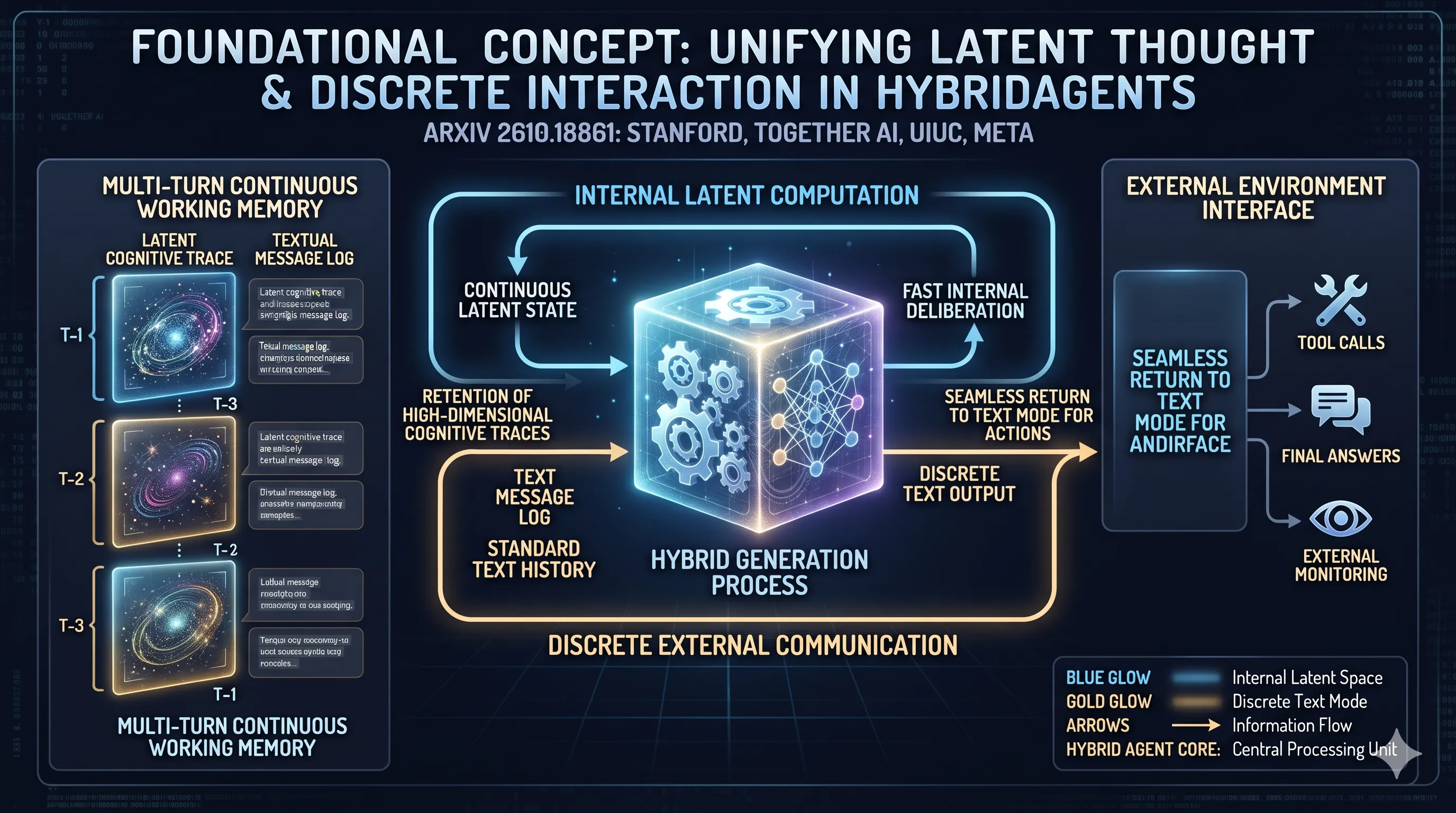
The paradigm of how hybrid reasoning agents combine LLMs with latent space thinking represents a shift from purely token-based execution toward integrated representational computation.Submitted under arXiv ID 2610.18861 on October 13, 2026, the foundational research introduces Hybrid Reasoning Agents (HybridAgents) to unify continuous internal computation with discrete external communication.
Authored by Jiaru Zou, Yunzhe Qi, Sirui Chen, Federico Bianchi, Shang Zhu, Pan Lu, Jingrui He, and James Zou, the collaborative study was conducted across Stanford University, Together AI, UIUC, and Meta.
The core architecture establishes an environment where continuous latent reasoning and discrete text-based interaction operate cohesively within a single generation process.
Dual-Mode Generation Framework
Traditional agent frameworks rely exclusively on discrete auto-regressive text strings for both deliberate reasoning and external communication.In contrast, HybridAgents bridge continuous latent reasoning directly with discrete text interactions during one end-to-end inference pass.
This setup enables the LLM agent to conduct fast, inspectable inner thinking within continuous latent space without emitting intermediate surface tokens.
When environmental actions or outputs are required, the model returns seamlessly to text mode to issue tool calls, output final answers, and support external monitoring.
By alternating between internal representation manipulation and textual outputs, the framework avoids the overhead of verbalized chain-of-thought tokens while retaining total transparency for external system hooks.
Multi-Turn Continuous Working Memory
Maintaining coherence across sequential interactions typically forces models to compress previous reasoning steps into flat text history.HybridAgents address this operational bottleneck by maintaining a complete hybrid context across multiple turns via continuous working memory.
By retaining continuous latent states alongside standard textual message logs, the architecture preserves high-dimensional cognitive traces from prior steps.
This integration ensures that fast internal deliberations remain anchored across extended dialogues, providing a unified substrate for ongoing tool interaction, monitoring, and problem solving.
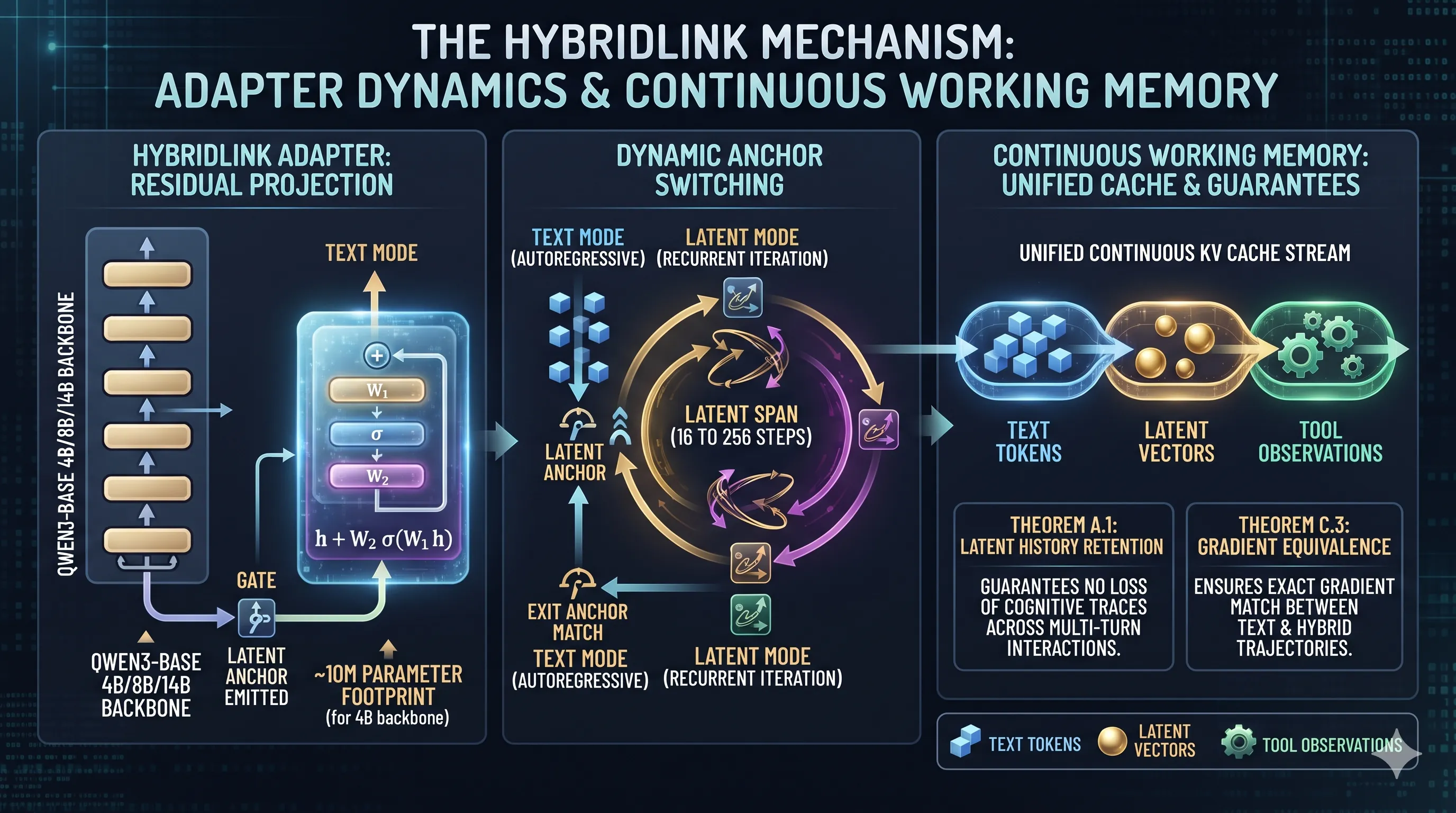
2. The HybridLink Mechanism: Adapter Dynamics and Continuous Working Memory
Hybrid reasoning agents combine LLMs with latent space thinking by decoupling internal cognitive compute from surface-level token emission.At the center of this paradigm is the HybridLink mechanism, a compact bridge enabling continuous latent exploration while preserving foundational language capabilities.
Residual Projection and Dynamic Anchor Switching
The HybridLink adapter operates without replacing the model's native hidden states, ensuring that foundation weights remain undisturbed and preserving standard language processing when deactivated.Architecturally, HybridLink is structured as a two-layer residual connection that takes last-layer hidden states and maps them directly back into the input embedding space through the transformation h + W2 σ(W1 h).
This formulation permits recurrent latent iteration without forcing the network through external projection bottlenecks or full token decoding passes.
In implementation, the HybridLink adapter contains roughly 10M parameters for a 4B backbone model, offering an extremely lightweight footprint relative to the host network.
The adapter architecture has been evaluated across three open foundation backbone scales: Qwen3-Base 4B, Qwen3-Base 8B, and Qwen3-Base 14B.
Transitioning between textual discourse and continuous latent computation is governed dynamically by discrete structural anchors.
Generation enters latent mode when the model emits a dedicated latent anchor, immediately bypassing standard autoregressive token decoding.
During this phase, hidden representations evolve directly through the adapter's residual mapping.
The model exits latent mode back to text mode dynamically when the nearest token in embedding space matches an exit anchor.
Experimental validation established a latent span constraint capped between 16 and 256 steps.
Consequently, exit-anchor behavior across longer continuous trajectories remains unverified under current experimental bounds.
| Backbone Scale | Adapter Parameter Footprint | Experimental Latent Span | Architectural Properties & Anchor Dynamics |
|---|---|---|---|
| Qwen3-Base 4B | Roughly 10M parameters | 16 to 256 steps | Two-layer residual mapping h + W2 σ(W1 h); enters via latent anchor, exits via nearest-token exit anchor match. |
| Qwen3-Base 8B | Evaluated backbone scale | 16 to 256 steps | Leaves native hidden states intact; switches seamlessly between latent mode and autoregressive text mode. |
| Qwen3-Base 14B | Evaluated backbone scale | 16 to 256 steps | Interleaved text-latent-tool state tracking supported by formal analytical guarantees. |
Continuous KV Cache Stream and Replay Guarantees
Multi-turn reasoning demands persistent tracking across heterogeneous data types without state degradation.The Continuous Working Memory architecture achieves this by maintaining an extended key-value (KV) cache stream that interleaves text tokens, latent vector embeddings, and tool observations into an unbroken context chain.
Because latent states are retained directly inside the continuous KV cache, the system eliminates the lossy overhead of forced text verbalization between reasoning iterations.
This unified memory construct is substantiated by rigorous mathematical foundations.
Under Theorem A.1, the continuous KV cache is guaranteed to retain latent history across multi-turn interactions without requiring conversion into discrete textual representations.
Furthermore, optimization fidelity is protected by Theorem C.3, which guarantees that the text gradient equals the full hybrid trajectory likelihood gradient under exact replay conditions.
These theoretical guarantees validate that interleaved latent-space thought trajectories maintain exact gradient equivalence and memory continuity throughout complex reasoning steps.
3. Post-Training Regimen: Staged Optimization via HybridSFT and HybridRL
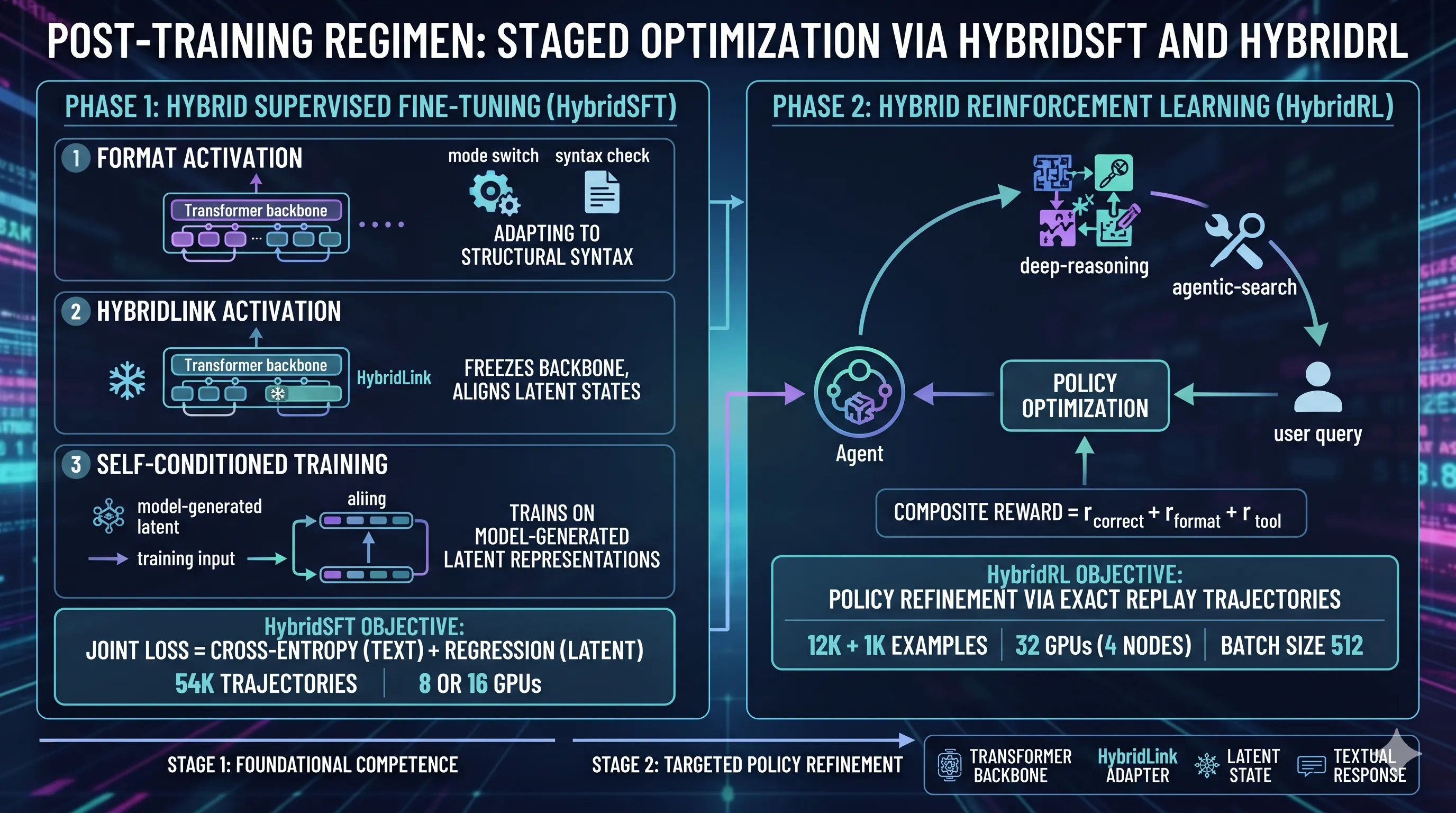
Executing the vision where hybrid reasoning agents combine LLMs with latent space thinking requires a structured, multi-stage post-training pipeline.Rather than relying on unstructured continuous representations or brute-force token generation, the model transitions into continuous latent reasoning through a staged sequence consisting of Hybrid Supervised Fine-Tuning (HybridSFT) followed by Hybrid Reinforcement Learning (HybridRL).
Three-Phase Supervised Fine-Tuning and Self-Conditioning
The initial post-training stage, HybridSFT, establishes foundational competence across continuous latent steps and discrete language generation.HybridSFT utilizes 54K auto-annotated hybrid trajectories filtered from text-agentic data.
The recommended hardware configuration for executing HybridSFT is 8 or 16 GPUs.
The optimization process executes sequentially in three distinct phases: format activation, HybridLink activation, and self-conditioned two-pass training.
During the initial format activation phase, the architecture adapts to the structural syntax required for switching between modes.
In the subsequent HybridLink activation phase, the training routine freezes the transformer backbone to align latent hidden states directly with target embeddings.
To resolve operational discrepancies, self-conditioned training addresses train-inference input distribution mismatch by training on model-generated latent representations rather than purely ground-truth teacher-forced inputs.
Across these phases, the optimization objective relies on a joint loss formulation: HybridSFT loss applies cross-entropy at text positions and regression at latent positions.
Reinforcement Learning with Exact Replay Trajectories
Following supervised alignment, the agent undergoes targeted policy refinement through the HybridRL framework.The default recommended training launcher hardware for HybridRL is 32 GPUs organized across 4 nodes x 8 GPUs.
The reinforcement learning regimen runs on 12K deep-reasoning plus 1K agentic-search examples.
Rollouts operate with a total batch size of 512 (64x8), scheduled across 8 minibatches during optimization updates.
Policy guidance is governed by a composite reward function formulated as r_correct + r_format + r_tool.
This formulation directly rewards correctness, syntactic formatting, and multi-tool use without applying an explicit reward for latent mode usage, allowing the agent to discover autonomously when continuous thinking provides an advantage.
During HybridRL optimization, the HybridLink module is held fixed, the latent context is replayed exactly as generated, and likelihood ratios are calculated only over sampled text positions.
| Optimization Dimension | HybridSFT | HybridRL |
|---|---|---|
| Recommended Hardware | 8 or 16 GPUs | 32 GPUs (4 nodes x 8) |
| Dataset Scale & Scope | 54K auto-annotated hybrid trajectories filtered from text-agentic data | 12K deep-reasoning plus 1K agentic-search examples |
| Batch Sizing | Staged multi-phase batches across 8 or 16 GPUs | Rollout batch size of 512 (64x8) with 8 minibatches |
| Optimization Objective / Reward | Cross-entropy loss at text positions; regression loss at latent positions | Composite reward: r_correct + r_format + r_tool (no explicit reward for latent mode usage) |
| Adapter & Latent Handling | HybridLink activation freezes backbone to align latent hidden states; self-conditioned two-pass training | HybridLink held fixed; latent context replayed exactly; gradients calculated only over sampled text positions |
4. Computational Efficiency Gains and Empirical Task Throughput
Evaluating the computational profile of hybrid reasoning agents directly connects to the foundational promise of combining LLMs with latent space thinking: bypassing the verbosity of autoregressive text generation to achieve faster, cheaper, and more accurate multi-step execution.
By shifting intermediate reasoning loops into continuous hidden vectors rather than forcing token-by-token textual emission, HybridAgent fundamentally restructures inference economics while elevating performance across complex environments.
Token Suppression and Hardware Cost Reductions
The immediate operational impact of hybrid reasoning manifests in the aggressive suppression of exposed tokens.
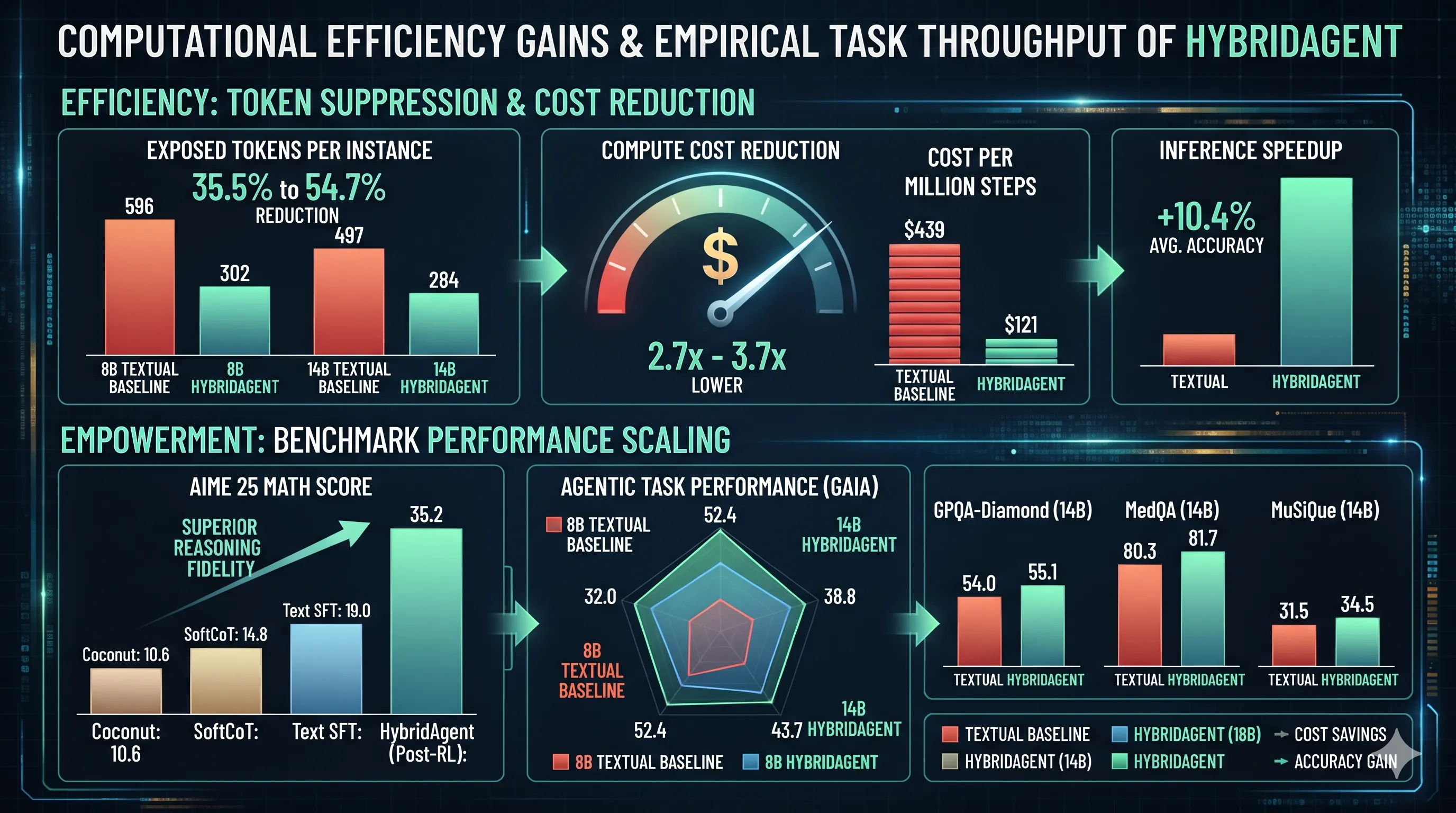
Across evaluated workloads, exposed tokens are reduced by 35.5% to 54.7% compared to traditional textual reasoning baselines.
For the 8B model, per-instance exposed tokens plunge from 596 tokens in the textual baseline down to 302 tokens in HybridAgent.
Similarly, the 14B model achieves an exposed token footprint of only 284 tokens per instance, compared to 497 tokens for its textual baseline counterpart.
This substantial reduction in token emission translates into systemic latency and throughput gains.
HybridAgent achieves an inference speedup of 1.8x to 2.6x overall, clocking in at 2.1x specifically when measured against standard textual agent baselines.
Hardware compute reductions range from 62.5% to 72.9%, yielding an overall cost reduction between 2.7x and 3.7x across model parameter tiers.
Under an operational cost model charging per step based on the backbone forward pass, text vocabulary projection, and the HybridLink adapter cost (while excluding prompt prefill and external tool execution), economic savings at an evaluation baseline of $2.50 per H100-hour are substantial:
For the 4B parameter model, total compute cost drops from $359 to $98, representing a 3.7x reduction.
For the 8B backbone, compute expenses drop from $439 down to $121, delivering a 3.6x cost efficiency multiplier.
For the 14B parameter configuration, the expenditure decreases from $470 to $176, marking a 2.7x cost reduction.
| Model / Configuration | Exposed Tokens / Instance | Compute Cost ($2.50 / H100-hr) | GAIA Average | AIME 25 Score |
|---|---|---|---|---|
| 4B Backbone (Coconut) | — | — | — | 10.6 |
| 4B Backbone (SoftCoT) | — | — | — | 14.8 |
| 4B Backbone (Standard Text SFT) | — | $359 (Text Baseline) | — | 19.0 |
| 4B HybridAgent (Post-RL) | — | $98 | — | 35.2 |
| 8B Textual Baseline | 596 tokens | $439 | — | — |
| 8B GRPO Baseline | — | — | 32.0 | — |
| 8B ARPO Baseline | — | — | 38.8 | — |
| 8B HybridAgent | 302 tokens | $121 | 43.7 | — |
| 14B Textual Baseline | 497 tokens | $470 | — | — |
| 14B GRPO Baseline | — | — | 36.9 | — |
| 14B ARPO Baseline | — | — | 43.7 | — |
| 14B HybridAgent | 284 tokens | $176 | 52.4 | — |
Empirical Reasoning and Agentic Task Scaling
The architectural compression of thought into latent vectors does not compromise reasoning fidelity; instead, it markedly enhances problem-solving capacity.
Evaluated across 11 diverse benchmark domains spanning mathematics (AIME 25, AIME 26, MATH500), science, knowledge, and medicine (GPQA-Diamond, MedQA, MuSiQue), and agentic reasoning (GAIA, HLE, WebWalker, SealQA, DSQA), HybridAgent delivers an average 10.4% accuracy improvement over textual agent baselines.
On challenging mathematical reasoning tasks, the 4B backbone demonstrates the potency of latent trajectory learning.
On AIME 25, Coconut attained a score of 10.6, SoftCoT reached 14.8, and standard text SFT recorded 19.0.
In contrast, HybridAgent post-RL achieves an AIME 25 score of 35.2, exceeding the textual baseline by over 16 percentage points.
In agentic decision-making on GAIA, the 8B HybridAgent reaches an overall score of 43.7, clearly outperforming the GRPO baseline of 32.0 and the ARPO baseline of 38.8.
Scaling to the 14B HybridAgent pushes GAIA performance to a 52.4 average—substantially higher than GRPO (36.9) and ARPO (43.7).
A breakdown across GAIA complexity tiers reveals Level 1 performance at 53.8, Level 2 at 55.8, and Level 3 at 33.3.
Across broader autonomous agent benchmarks, the 8B configuration registers 42.5 on WebWalker, 14.4 on HLE, 22.5 / 35.8 on SealQA (S-0/Hard), and 20.0 accuracy with a 40.7 F1 score on DSQA.
The 14B model advances these metrics further, recording 49.5 on WebWalker, 16.0 on HLE, 24.3 / 37.8 on SealQA (S-0/Hard), and 21.7 accuracy with a 46.8 F1 score on DSQA.
Finally, on specialized knowledge and domain reasoning suites, the 14B HybridAgent maintains a consistent edge over strong reinforcement-learning baselines.
It posts 55.1 on GPQA-Diamond compared to ARPO's 54.0, reaches 81.7 on MedQA compared to ARPO's 80.3, and achieves 34.5 on MuSiQue against ARPO's 31.5.
These empirical results confirm that blending LLM architectures with latent space thinking simultaneously minimizes runtime compute requirements while establishing superior execution fidelity across complex reasoning domains.
5. Inspection Tooling, Open-Source Artifacts, and Operational Boundaries
Deploying systems where hybrid reasoning agents combine LLMs with latent space thinking requires clear inspection mechanisms, accessible artifacts, and defined runtime boundaries.To facilitate practical adoption and auditing, the architecture pairs continuous-state computation with open-source tools designed to expose hidden vector trajectories without breaking external execution contracts.
Interpretable Latent Inspection and Compliance Auditability
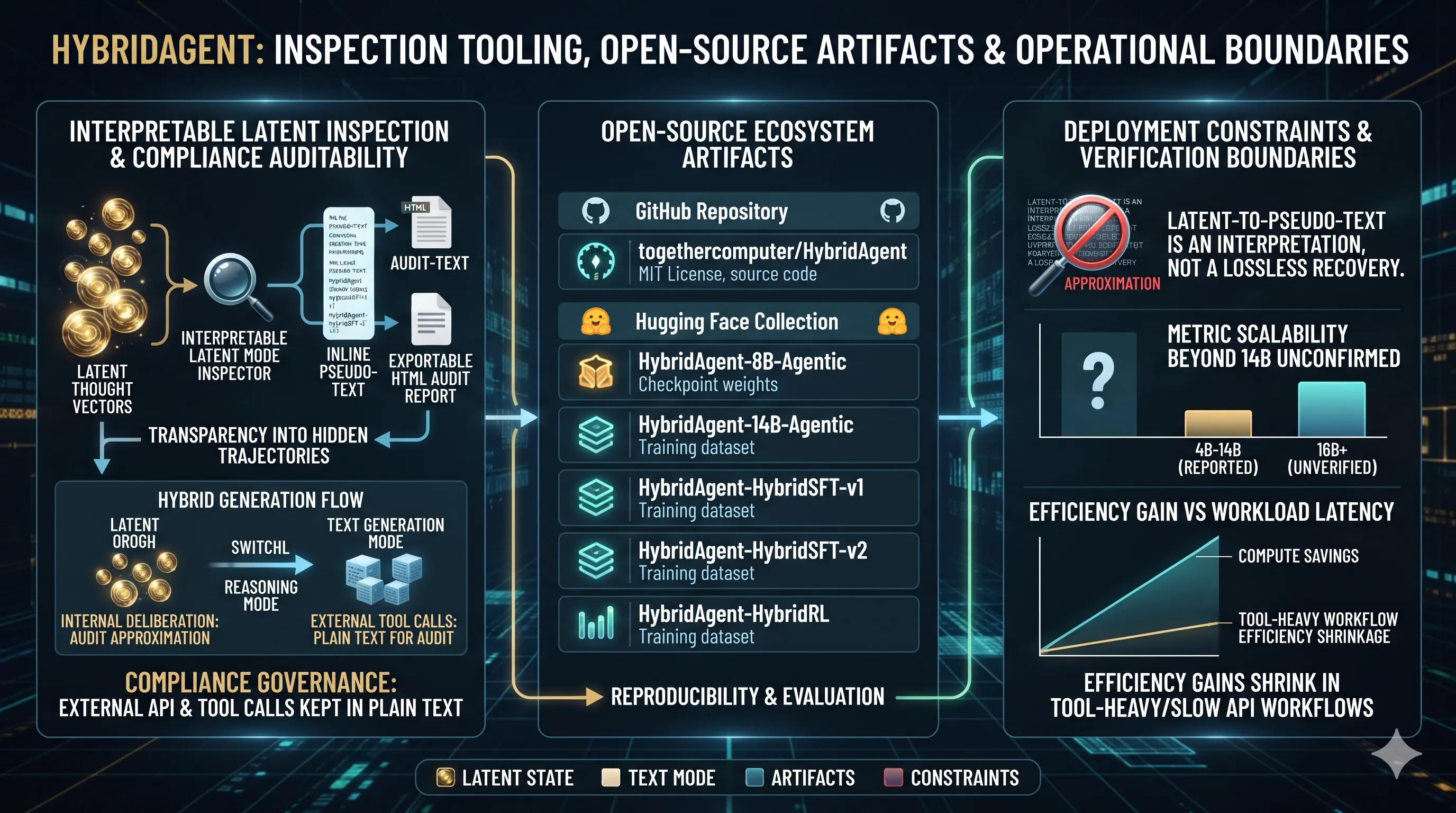
The implementation ecosystem is accessible through the togethercomputer/HybridAgent codebase, which is published under the open-source MIT license on GitHub.Complementing the core code, the official Hugging Face collection distributes model checkpoints alongside the foundational supervised and reinforcement learning corpora.
These assets enable engineering teams to inspect, evaluate, and reproduce hybrid agent pipelines across discrete text generation and latent reasoning modes.
| Artifact Identifier | Artifact Type | Ecosystem Platform | Distribution Details |
|---|---|---|---|
| togethercomputer/HybridAgent | Source Code Repository | GitHub | Published under the MIT license |
| HybridAgent-8B-Agentic | Adapter Checkpoint | Hugging Face | Model weights for 8B scale deployment |
| HybridAgent-14B-Agentic | Adapter Checkpoint | Hugging Face | Model weights for 14B scale deployment |
| HybridAgent-HybridSFT-v1 | Training Dataset | Hugging Face | Initial supervised fine-tuning data |
| HybridAgent-HybridSFT-v2 | Training Dataset | Hugging Face | Iterative supervised fine-tuning data |
| HybridAgent-HybridRL | Training Dataset | Hugging Face | Reinforcement learning alignment data |
This diagnostic component decodes latent thought vectors into inline pseudo-text and generates exportable HTML reports for compliance auditing.
To preserve strict governance standards, compliance-critical steps and external tool calls are kept in plain text format.
By retaining explicit text sequences for API payloads and environmental interactions, the framework ensures operational actions remain fully auditable within existing enterprise logging systems.
Deployment Constraints and Verification Boundaries
While the continuous reasoning paradigm optimizes internal deliberation, several concrete engineering constraints govern its production deployment.First, the pseudo-text decoding provided by the Interpretable Latent Mode inspector serves strictly as an interpretation rather than an exact mathematical recovery of the underlying continuous reasoning state.
Because the latent representations inhabit a high-dimensional vector space, projecting them into discrete vocabulary tokens introduces an interpretative approximation rather than a lossless trace of the model's computation.
Furthermore, the reported performance metrics and efficiency claims remain author-reported on models spanning the 4B to 14B parameter range.
Independent enterprise verification on larger frontier models has not yet been established, leaving scalability dynamics beyond 14B architectures unconfirmed.
Finally, the computational and token savings delivered by latent-space processing are workload-dependent.
In tool-heavy agentic workflows dominated by external network round-trips or slow API execution latency, the efficiency gains realized from bypassing autoregressive token decoding shrink significantly relative to overall pipeline runtime.
Related Posts

Generative AI may have assisted with research or drafting for this article. Topic selection, fact-checking, final wording, and publication remain the responsibility of DragonStone74. AI use disclosure