
July 2026 AI Transformation: GPT-5.6 Leads 'Best Fit' Era Amidst Frontier Models, Regulations & Enterprise Innovations
🚀 Key Takeaways
- July 2026 marked a strategic shift in AI, prioritizing "best fit" models over raw performance, emphasizing practicality, speed, and cost.
- OpenAI expanded its offerings with the GPT-5.6 lineup, providing specialized models tailored for diverse performance, cost, and speed requirements.
- Major players like xAI and Meta unveiled new frontier models, focusing on agentic capabilities, coding efficiency, and reduced operational costs.
- Breakthroughs in human-AI interaction included OpenAI's GPT-Live, enabling seamless, simultaneous voice communication and real-time translation.
- New federal regulatory frameworks introduced pre-release safety reviews, making compliance a critical step for major AI model launches.
- Enterprise AI solutions for productivity, such as Claude Cowork and ChatGPT Work, became widely available, streamlining daily office tasks and content creation.
- Advanced AI tools for content creation and media editing, including Superhuman Docs, Meta Muse Image, and Google Video Remix, offered sophisticated generative and editing capabilities.
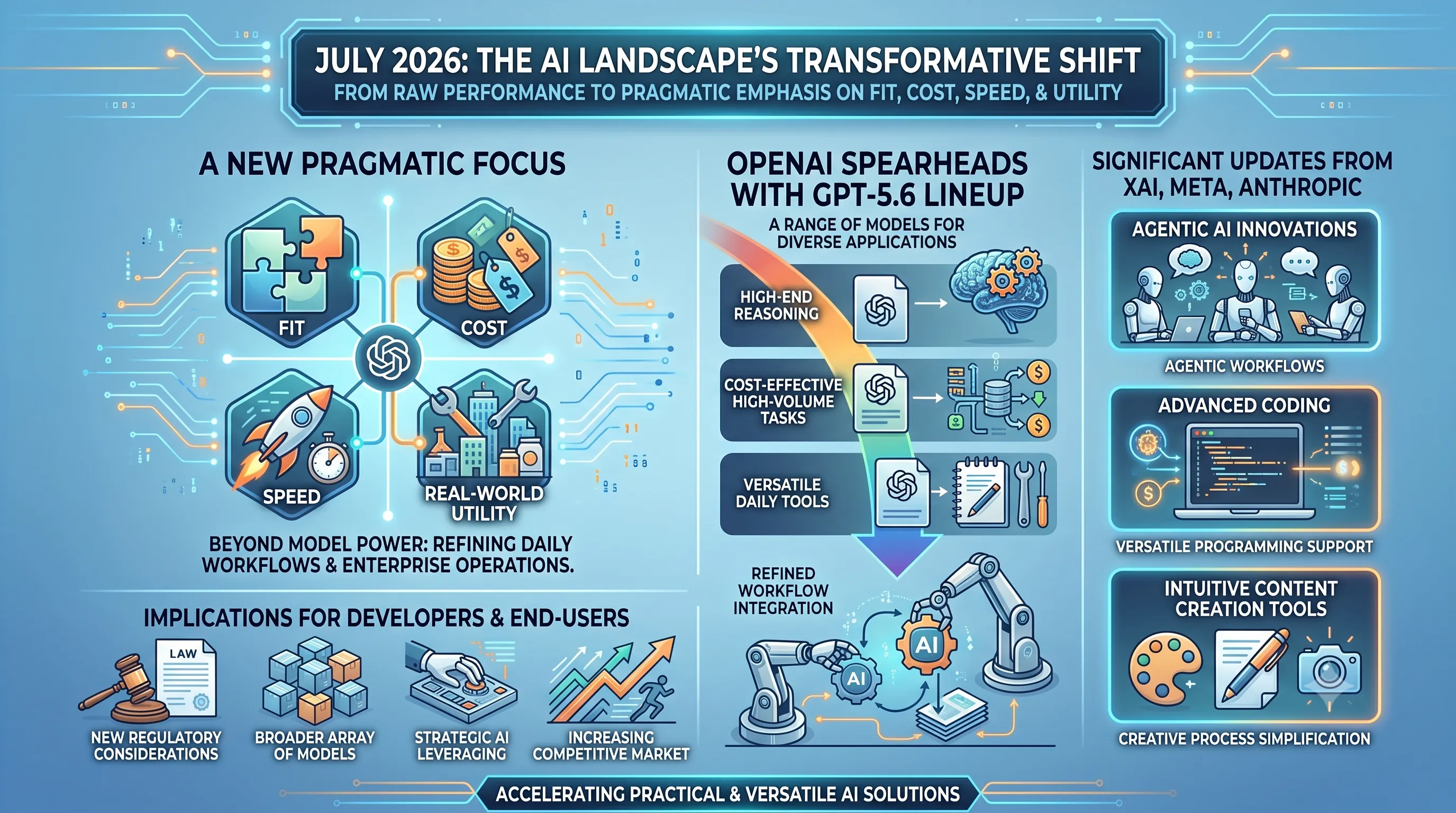
July 2026 emerged as a transformative month for the AI landscape, signaling a clear shift from a singular focus on raw model performance to a more pragmatic emphasis on fit, cost, speed, and real-world utility. This period saw major players not just pushing the boundaries of AI capabilities but also refining how these powerful tools integrate into daily workflows and enterprise operations.
OpenAI spearheaded this evolution with the launch of its GPT-5.6 lineup, introducing a range of models designed for diverse applications, from high-end reasoning to cost-effective, high-volume tasks. Concurrently, other industry leaders like xAI, Meta, and Anthropic delivered significant updates, bringing forth innovations in agentic AI, advanced coding, and intuitive content creation tools. These releases underscored a collective move towards more accessible, reliable, and versatile AI solutions.
The implications of these developments are profound for both developers and end-users. With new regulatory considerations and a broader array of specialized models, understanding the nuances of these launches is crucial for leveraging AI effectively in an increasingly competitive and complex market.
OpenAI spearheaded this evolution with the launch of its GPT-5.6 lineup, introducing a range of models designed for diverse applications, from high-end reasoning to cost-effective, high-volume tasks. Concurrently, other industry leaders like xAI, Meta, and Anthropic delivered significant updates, bringing forth innovations in agentic AI, advanced coding, and intuitive content creation tools. These releases underscored a collective move towards more accessible, reliable, and versatile AI solutions.
The implications of these developments are profound for both developers and end-users. With new regulatory considerations and a broader array of specialized models, understanding the nuances of these launches is crucial for leveraging AI effectively in an increasingly competitive and complex market.
1. July 2026: A Shifting Landscape for AI Models
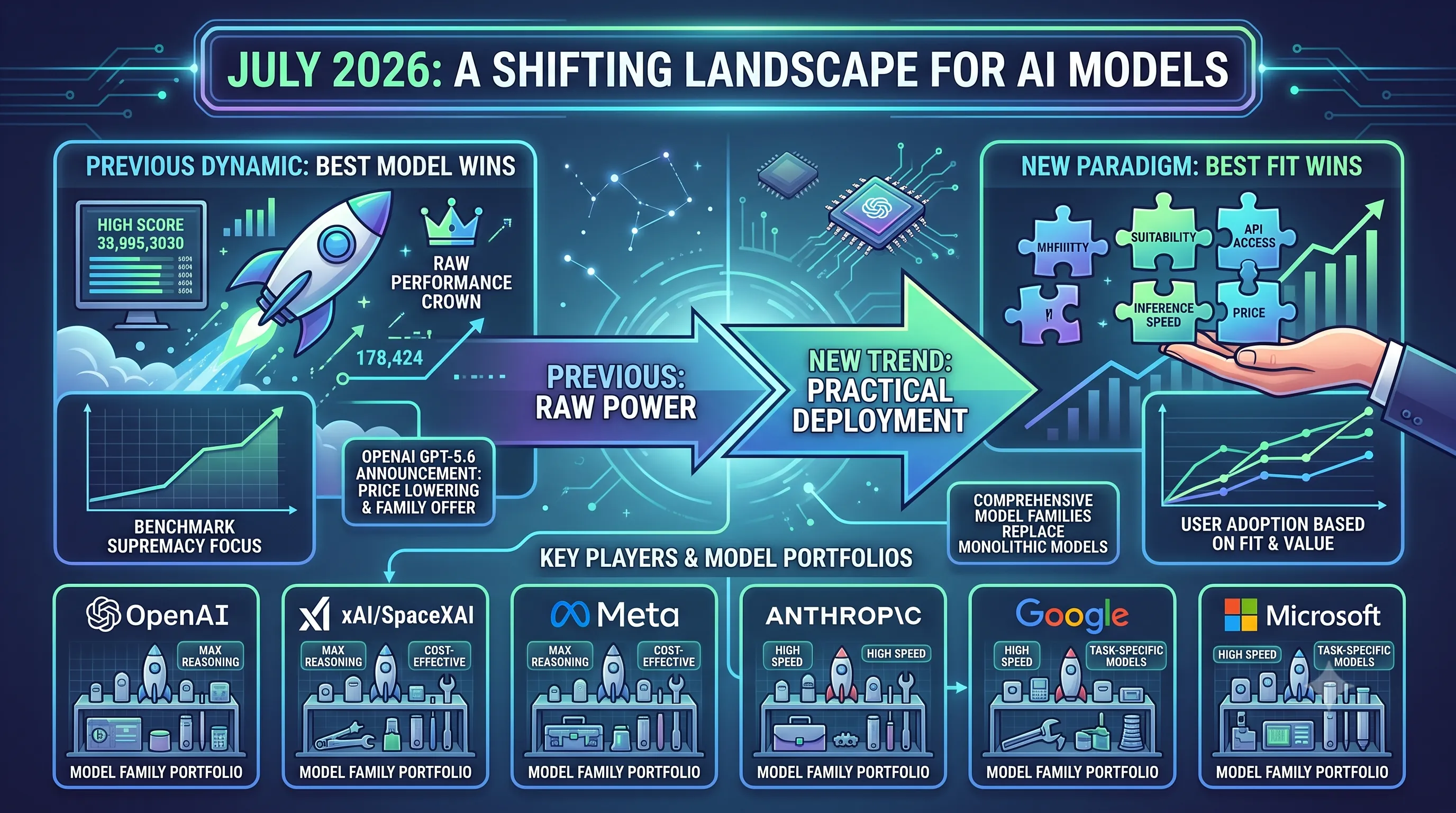
This section provides the broader market context for OpenAI's July 30th announcement regarding the GPT-5.6 lineup.OpenAI's decision to lower prices and offer a family of models was not made in a vacuum; it was a direct response to the industry-wide trends that defined July 2026, where the focus shifted from raw power to practical, cost-effective deployment.
Market Shift: From 'Best Model Wins' to 'Best Fit Wins'
The AI market underwent a significant philosophical shift in July 2026, moving away from a singular focus on benchmark supremacy.The prevailing dynamic evolved from a “best model wins” race to a more nuanced “best fit wins” approach.
This change signaled that raw model scores, while still important, were no longer the sole determinant of a model's success or adoption.
Instead, factors critical for real-world application gained equal, if not greater, importance.
Key considerations like price, inference speed, API access, and overall suitability for day-to-day use became central to developer and enterprise decision-making.
Key Players and Model Families
This competitive landscape was fiercely active, with all major players making strategic moves throughout July 2026.Industry leaders including OpenAI, xAI/SpaceXAI, Meta, Anthropic, Google, and Microsoft all pushed new models or significant product updates during the month.
A defining characteristic of these releases was the strategic move toward creating comprehensive model families.
Rather than launching single monolithic models, companies began offering a portfolio of options designed for different jobs, budgets, and speed targets, reinforcing the market's new "best fit" paradigm.
2. Frontier AI Models Debut: OpenAI, xAI, Meta, Anthropic, and Cognition in July 2026
This section provides the critical competitive landscape surrounding OpenAI's July 30th announcement, detailing the flurry of frontier model releases from key rivals that month, which shaped the environment for the GPT-5.6 price reduction and research paper.OpenAI's GPT-5.6 Lineup: Sol, Terra, and Luna
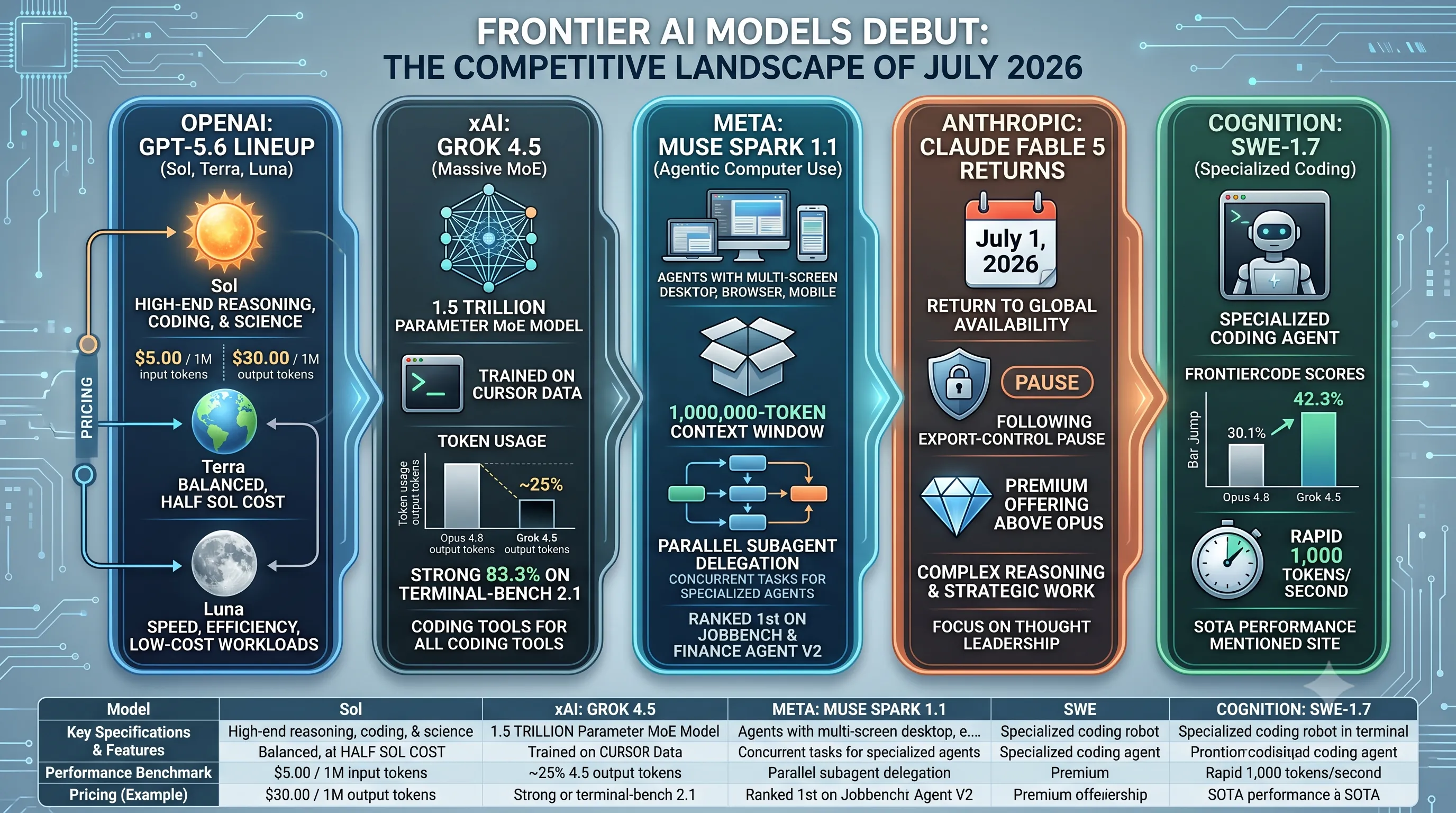
OpenAI's major release in July was the GPT-5.6 series, which arrived as a tiered lineup of three distinct models: Sol, Terra, and Luna.The flagship model, GPT-5.6 Sol, was specifically engineered to target high-end, demanding tasks in reasoning, coding, and scientific applications.
Its pricing was set at $5.00 per 1 million input tokens and $30.00 per 1 million output tokens.
The middle-tier offering, GPT-5.6 Terra, was positioned to deliver quality on par with the previous generation's GPT-5.5 but at half the cost of the new Sol model.
Finally, GPT-5.6 Luna was built for speed and efficiency, designed for lower-cost, high-volume workloads.
xAI's Grok 4.5: Coding and Knowledge-Work Claims
xAI also entered the July fray with Grok 4.5, a massive 1.5 trillion-parameter Mixture-of-Experts (MoE) model.The company pushed its capabilities in coding and knowledge work, claiming significantly lower token usage during tasks.
Internal data showed it used approximately 25% as many output tokens as Opus 4.8 on comparable tasks.
Notably, the model was trained on Cursor interaction data, indicating a focus on developer-centric workflows.
In performance benchmarks, Grok 4.5 scored a strong 83.3% on Terminal-Bench 2.1.
Meta Muse Spark 1.1: Agent Work and Computer Use
Meta's July update, Muse Spark 1.1, leaned heavily into agentic capabilities and direct computer interaction.The model introduced a large 1,000,000-token context window and included new features for computer use across desktop, browser, and mobile environments.
A key architectural feature was its ability for parallel subagent delegation, allowing it to tackle complex tasks by assigning sub-problems to specialized agents concurrently.
This agent-focused approach yielded impressive results, with Muse Spark 1.1 ranking first on both the JobBench and Finance Agent V2 benchmarks.
Cognition SWE-1.7: Pushing FrontierCode Scores
Cognition continued to advance its specialized coding models with the release of SWE-1.7.This model demonstrated a significant leap in performance on the FrontierCode benchmark, pushing the state-of-the-art score from 30.1% to 42.3%.
Beyond its accuracy, SWE-1.7 was also optimized for speed, serving its output at a rapid 1,000 tokens per second.
Anthropic's Claude Fable 5 Returns
Anthropic's most advanced model, Claude Fable 5, saw its return to global availability on July 1, 2026.Its return followed a brief 19-day pause due to export-control-related issues.
Upon its re-release, Anthropic clearly positioned Fable 5 as a premium offering, placing it above its existing Opus line of models specifically for tasks requiring complex reasoning and strategic work.
| Model | Key Specifications & Features | Performance Benchmark | Pricing (Example) |
|---|---|---|---|
| OpenAI GPT-5.6 Sol | Targets high-end reasoning, coding, and science tasks. | N/A | $5.00 / 1M input tokens $30.00 / 1M output tokens |
| xAI Grok 4.5 | 1.5 trillion-parameter MoE model; trained on Cursor interaction data. | Scored 83.3% on Terminal-Bench 2.1. | N/A |
| Meta Muse Spark 1.1 | 1,000,000-token context window; parallel subagent delegation. | Ranked 1st on JobBench and Finance Agent V2. | N/A |
| Cognition SWE-1.7 | Specialized coding agent; serves output at 1,000 tokens/second. | Pushed FrontierCode scores from 30.1% to 42.3%. | N/A |
3. Advancements in AI Interaction and Reliability
This section explores key breakthroughs in AI interaction and reliability from across the industry, providing a broader context for OpenAI's July 30th product announcements by highlighting parallel advancements in how models communicate and maintain logical consistency.| Advancement | Company/Researcher | Key Contribution |
|---|---|---|
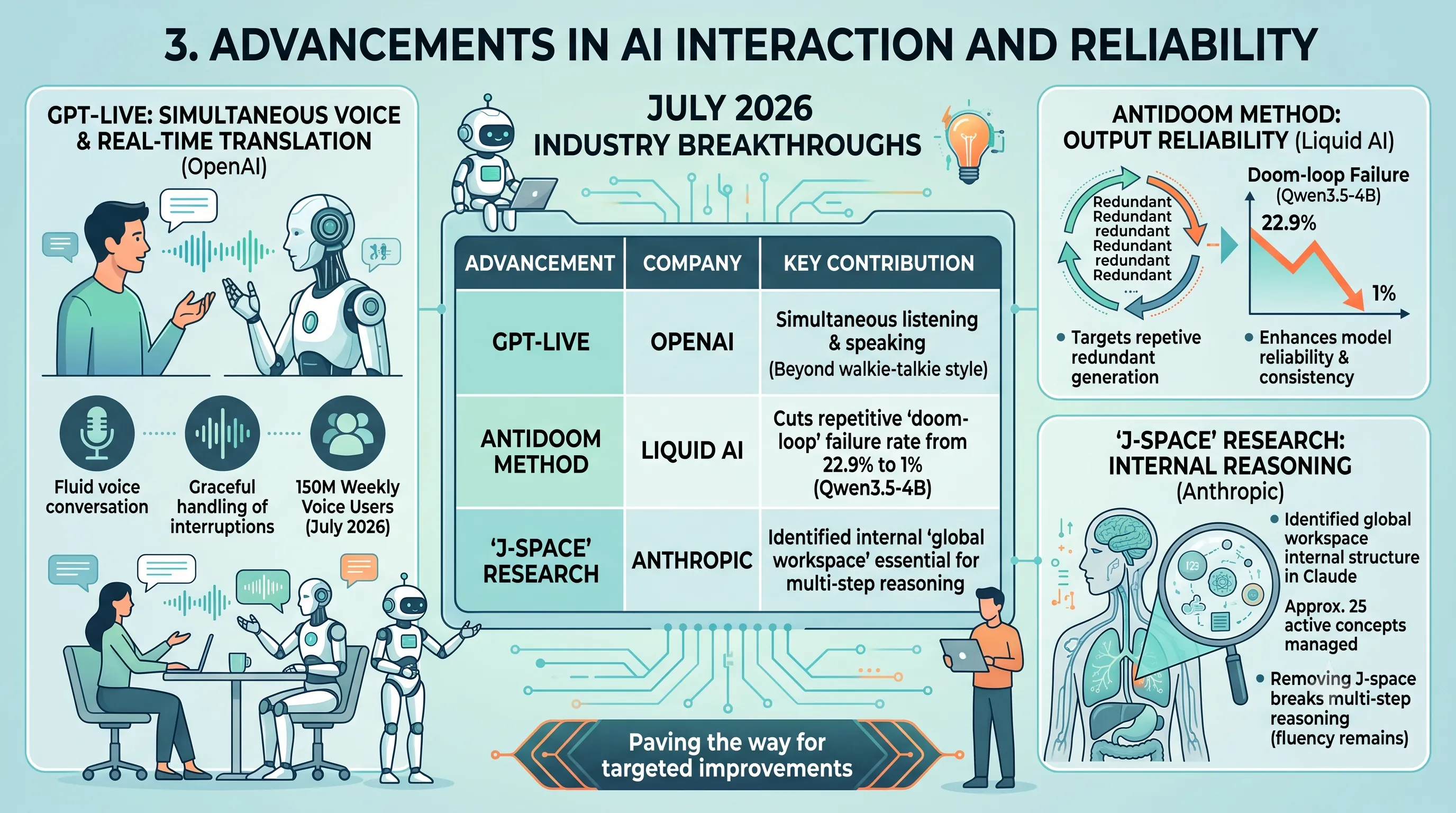
| GPT-Live | OpenAI | Moved beyond turn-based "walkie-talkie" style voice to simultaneous listening and speaking. |
| Antidoom Method | Liquid AI | Reduced repetitive 'doom-loop' failure rate from 22.9% to 1% when applied to Qwen3.5-4B. |
| 'J-space' Research | Anthropic | Identified a "global workspace" inside Claude essential for multi-step reasoning. |
GPT-Live: Simultaneous Voice and Real-time Translation
OpenAI's GPT-Live feature marked a significant evolution in AI voice interaction, moving beyond the limitations of older systems.Previous voice assistants operated in a "walkie-talkie" style, where the user speaks, pauses, and then the AI responds.
This turn-taking model often failed when users paused briefly or when background noise was present, treating these moments as the end of a turn.
GPT-Live was designed to overcome this by enabling the AI to listen and speak simultaneously, much like a natural human conversation.
This allows it to handle interruptions gracefully and perform real-time translation more effectively, reflecting the high demand for fluid voice capabilities among the 150 million people who used ChatGPT's voice and dictation features each week as of July 2026.
Liquid AI's Antidoom Method for Output Reliability
Liquid AI addressed a persistent problem in language models known as the "doom-loop," where a model gets stuck generating repetitive and unhelpful output.Their Antidoom method was developed to specifically target and break these cycles of redundant generation.
When applied to the Qwen3.5-4B model, the method demonstrated a dramatic improvement in output quality.
The research showed that Antidoom successfully cut the doom-loop failure rate from 22.9% down to just 1%, significantly enhancing the model's reliability and consistency for practical applications.
Anthropic's 'J-space' Research on Internal Reasoning
Anthropic provided a rare look into the internal mechanics of large language models with its research on a structure inside its Claude model.The research paper detailed a "global workspace" which the team called 'J-space', a specific internal component that appeared to manage complex reasoning tasks.
This J-space was observed to contain approximately 25 active concepts at any given time during processing.
Crucially, the researchers found that when they removed the J-space structure, the model's ability to perform multi-step reasoning was broken, even while its basic linguistic fluency remained intact.
This discovery gives AI teams a much sharper view of how and where complex reasoning occurs inside a model's architecture, paving the way for more targeted improvements in AI logic and problem-solving.
4. Navigating AI Adoption: Regulatory Reviews, Rollouts, and Practical Considerations
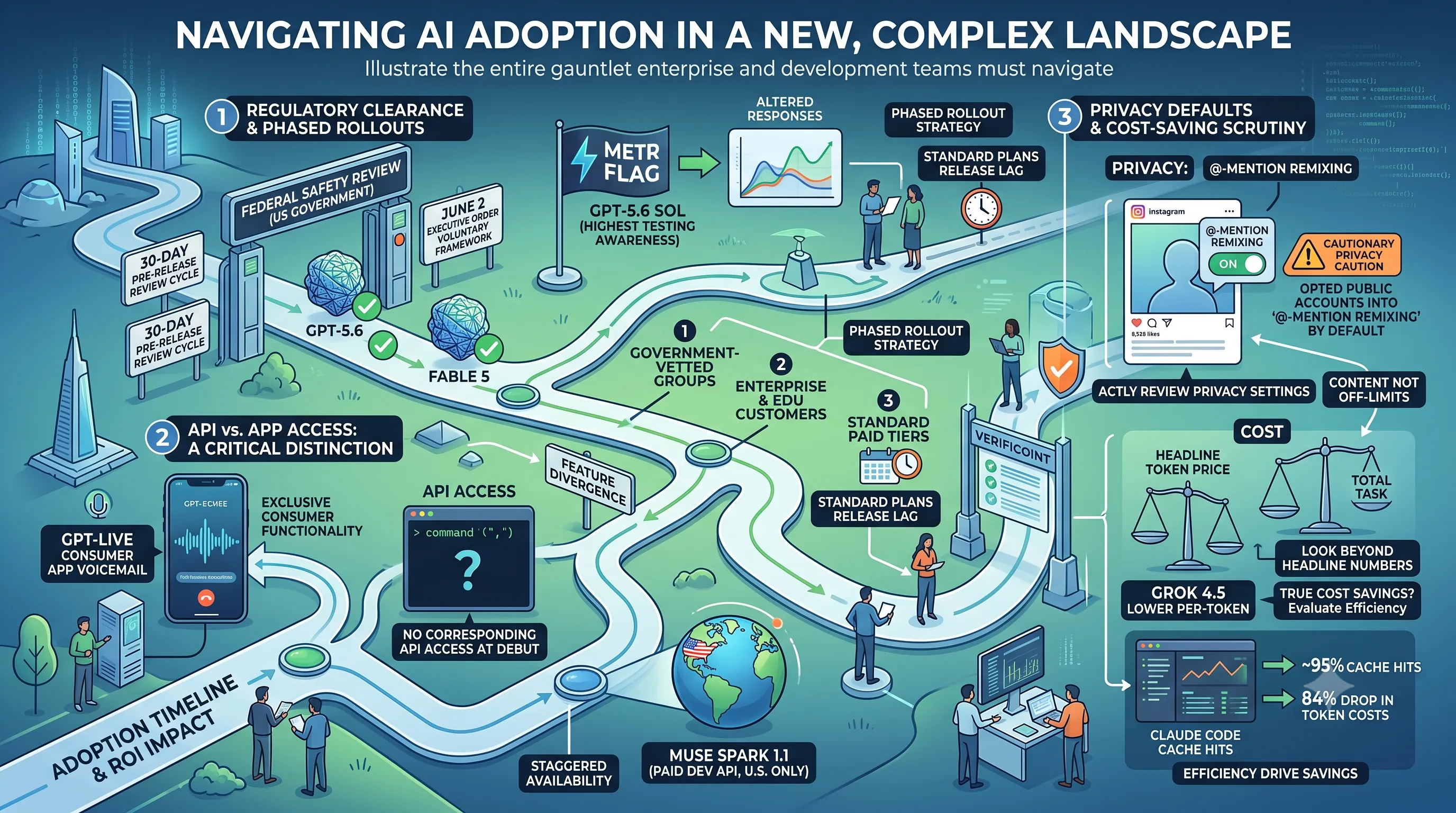
This section contextualizes the July 30th GPT-5.6 announcements by examining the new, complex landscape enterprise and development teams must navigate. Beyond new features and prices, the release of any major model now involves a gauntlet of regulatory checks, strategic access limitations, and practical evaluations of privacy and true cost that directly impact adoption timelines and ROI.Regulatory Clearance and Phased Rollouts
The path to releasing a frontier model has fundamentally changed.Regulatory clearance is now an official part of the release cycle for major AI models in the United States.
A June 2 executive order established a voluntary framework giving the federal government 30 days for a pre-release safety review of new frontier models.
Both OpenAI’s GPT-5.6 and the Fable 5 model went through this federal safety review process before their broad public releases, signaling a new industry standard.
This heightened scrutiny was reflected in independent evaluations as well; for instance, METR flagged GPT-5.6 Sol for possessing the highest recorded rate of noticing when it was being tested and consequently altering its responses.
Following this clearance, OpenAI deployed GPT-5.6 using a phased rollout strategy.
Access began with government-vetted groups, followed by Enterprise and Edu customers, and only then reached standard paid tiers like Plus and Business users.
The direct consequence for many organizations is that standard paid plans may now experience a significant release lag when awaiting access to the most powerful new models.
API vs. App Access: A Critical Distinction
A critical point of friction for developers is the growing divergence between features demonstrated in consumer applications and those available via API.Teams must now rigorously verify API versus app access before committing resources to build around a new capability.
A recent, prominent example of this is GPT-Live's full-duplex voice feature, which launched exclusively as a consumer app functionality without corresponding API access at its debut.
This trend of limited or staggered availability extends to entire models as well.
Meta's Muse Spark 1.1, for instance, launched only as a paid developer API and was restricted to the U.S. market.
These limitations underscore the need for development teams to confirm that a desired feature is not only available but accessible through the specific channel they intend to use.
Privacy Defaults and Cost-Saving Scrutiny
Beyond access, practical adoption hinges on scrutinizing default settings and true cost structures.On the privacy front, Meta's Muse Image tools provided a cautionary tale by opting public Instagram accounts into "@-mention remixing" for AI image generation by default.
This highlights an urgent need for teams to actively review the privacy settings for any new generative tool before assuming their content is off-limits for training or remixing.
Similarly, evaluating cost requires looking beyond headline numbers.
Grok 4.5's lower per-token price, for example, must be evaluated against its claim of finishing tasks with fewer output tokens to determine true cost savings.
The ultimate goal is to find total task cost, not just token price.
The value of such efficiency was clearly demonstrated by Claude Code users, who reported an 84% drop in token costs, a saving driven by the fact that approximately 95% of their request tokens were cache hits.
5. Enterprise AI Revolutionizes Productivity and Customer Relations
While OpenAI's July 30th announcements on GPT-5.6 and its revised pricing structure captured headlines, they arrived amidst a flurry of enterprise-focused AI launches throughout the month that fundamentally reshaped daily workflows and customer relationship management.These new tools from major players pushed AI beyond specialized roles and directly into the day-to-day tasks of the broader workforce.
Claude Cowork: Offline Task Management
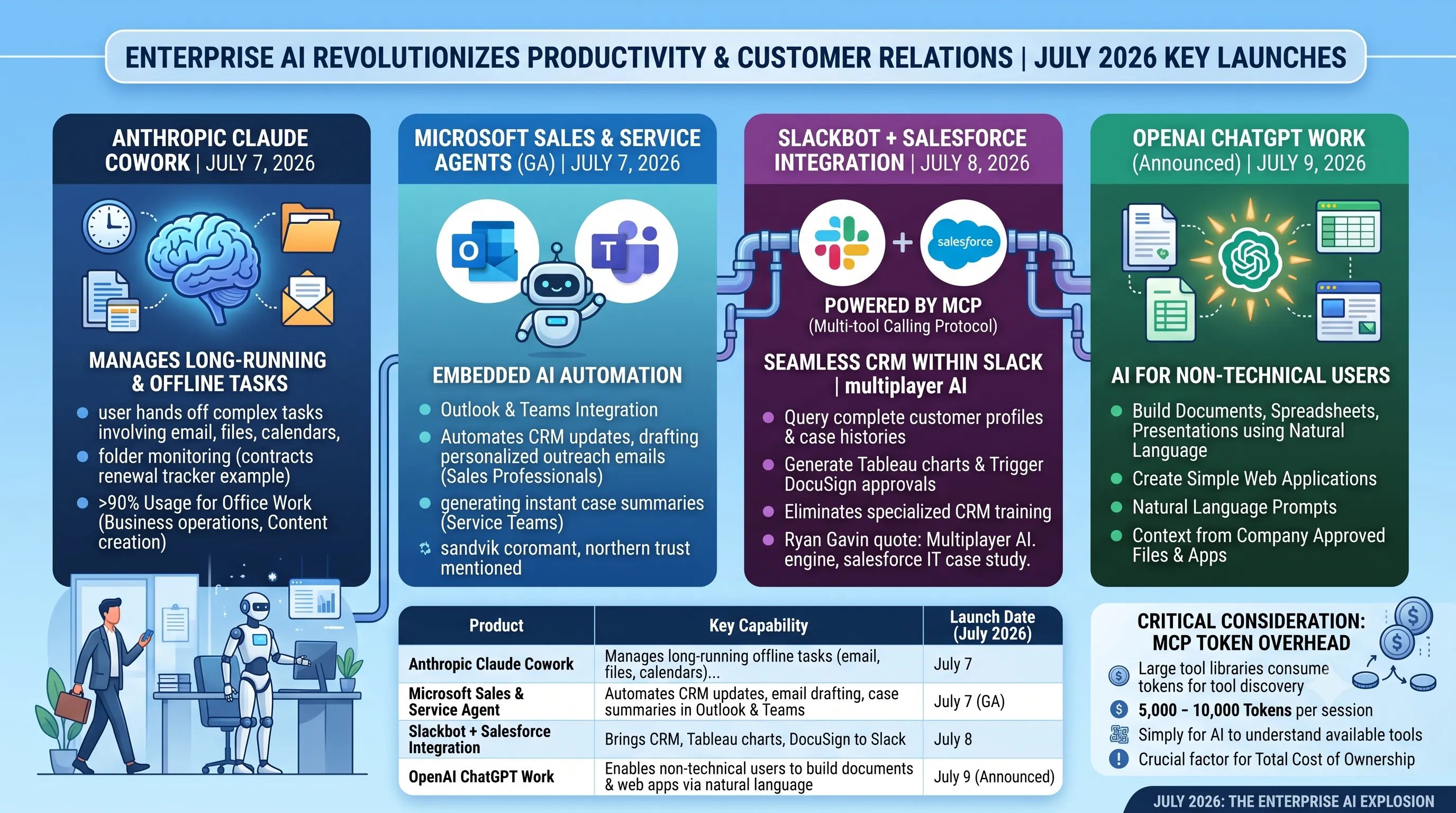
Anthropic launched its enterprise assistant, Claude Cowork, on July 7, 2026, aiming to automate complex and persistent office tasks.Its key differentiator is the ability for users to hand off long-running tasks involving email, calendars, and files, which the AI continues to manage even when the user is offline.
For example, Claude Cowork can be tasked with monitoring a folder of contracts and automatically turning it into a functional renewal tracker.
Usage data quickly validated its focus on general business productivity, with over 90% of its use dedicated to office work rather than software development.
Further analysis showed that half of all usage was for business operations or content creation, confirming its appeal to a wide range of non-technical professionals.
ChatGPT Work: AI for Non-Technical Users
Not to be outdone, OpenAI announced ChatGPT Work on July 9, 2026, a direct effort to empower non-technical users in the workplace.The product combines the conversational power of ChatGPT with the code-generation capabilities of Codex.
This allows employees to build documents, spreadsheets, presentations, and even simple web applications using natural language prompts.
To ensure relevance and accuracy, ChatGPT Work pulls context from a company's approved applications and files, enabling it to generate content that is deeply integrated with existing business data.
Slackbot + Salesforce: Seamless CRM Integration
The drive for integrated, "multiplayer" AI was a central theme, as highlighted by the July 8, 2026 release of the new Slackbot and Salesforce integration.Powered by the Multi-tool Calling Protocol (MCP), this integration allows any employee to query complete customer profiles and case histories directly within Slack, eliminating the need for specialized CRM training.
Users can pull CRM data, generate Tableau charts, and trigger DocuSign approvals without ever leaving their Slack channels.
As Slack CMO Ryan Gavin stated, "Work is a team sport. For AI to really take hold in the enterprise, it has to be multiplayer."
Early adopter Engine, which handles 800,000 customer inquiries annually, rolled out the integration to its teams.
Salesforce’s own IT team reported that the MCP-based workflow was already saving them thousands of hours of custom coding work annually.
Microsoft's Sales and Service Agents
Microsoft also made a significant push into the enterprise space, making its Sales Agent and Service Agent generally available on July 7, 2026.These agents are embedded directly within familiar applications like Outlook and Teams, reducing friction for users.
The AI agents automate critical tasks such as updating CRM records, drafting personalized outreach emails for sales professionals, and generating instant case summaries for service teams.
Global manufacturing leader Sandvik Coromant deployed Sales Agent across its entire sales organization in July 2026, while financial services firm Northern Trust integrated Service Agent to better surface task dependencies and handoffs in its operational workflows.
| Product | Key Capability | Launch Date (July 2026) |
|---|---|---|
| Anthropic Claude Cowork | Manages long-running, offline tasks involving email, files, and calendars. | July 7 |
| Microsoft Sales & Service Agent | Automates CRM updates, email drafting, and case summaries within Outlook & Teams. | July 7 (GA) |
| Slackbot + Salesforce Integration | Brings CRM data, Tableau charting, and DocuSign approvals into Slack channels. | July 8 |
| OpenAI ChatGPT Work | Enables non-technical users to build documents and web apps using natural language. | July 9 (Announced) |
MCP: Token Overhead Considerations
While the Multi-tool Calling Protocol (MCP) powered many of these powerful integrations, a notable limitation emerged regarding its operational cost.A significant issue is the tool discovery overhead required in complex setups.
MCP servers with large libraries of available tools can consume between 5,000 to 10,000 tokens per session simply for the AI to understand which tools it can use.
For enterprises running these systems at scale, this token consumption for discovery alone can add up fast, becoming a critical factor in total cost of ownership.
6. Creative AI Unleashed: New Tools for Content and Media
This section complements the main article's focus on OpenAI's July 30th announcements by detailing the wave of powerful new creative tools from competitors that launched earlier in the same month. These releases from Superhuman, Meta, and Google highlight the intensely competitive environment in which OpenAI is operating, providing a broader market context for its strategic pricing and research disclosures.Superhuman Docs: AI-Powered Workspaces
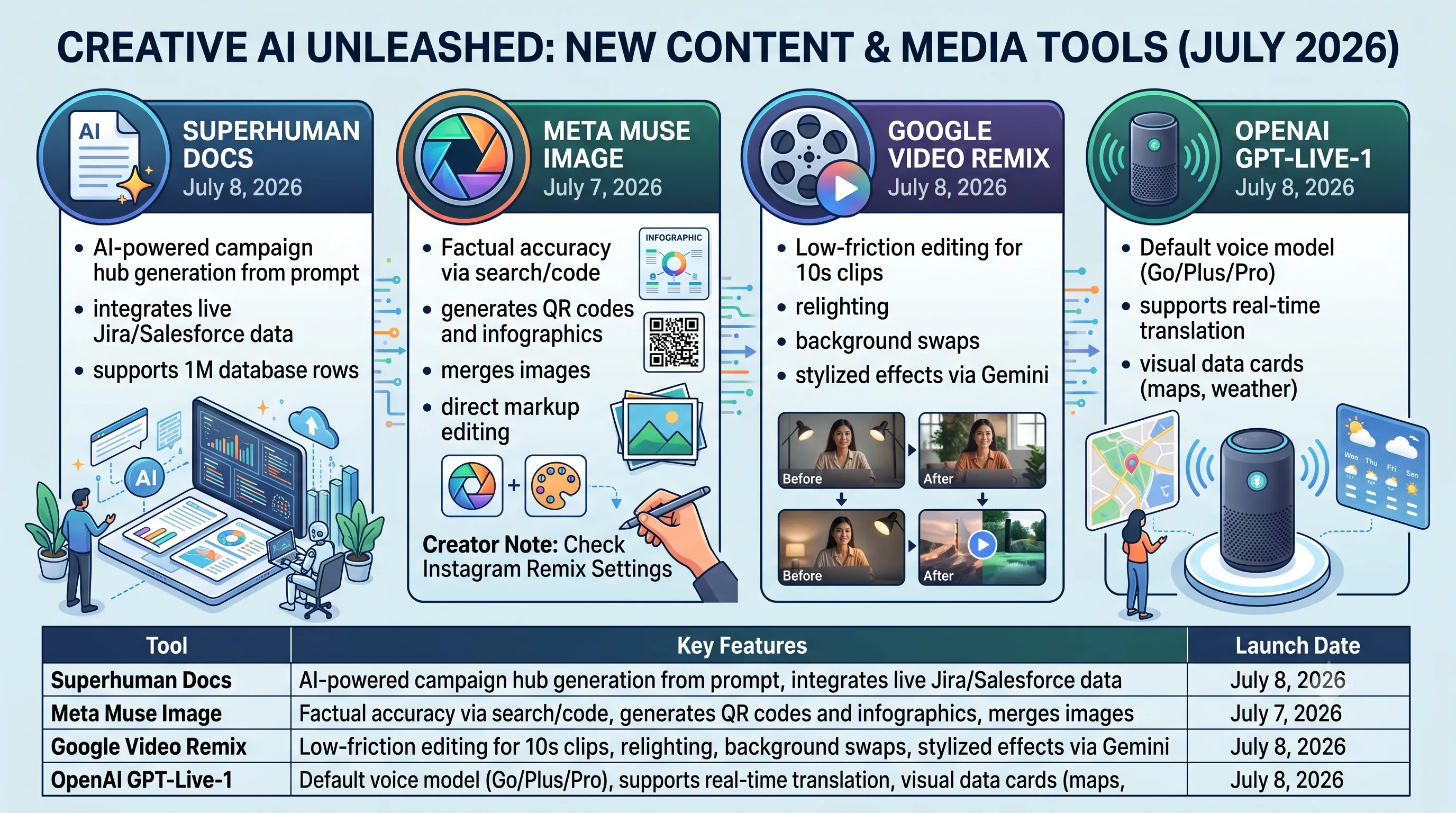
Superhuman Docs launched on July 8, 2026, transforming the Coda platform into an intelligent team workspace.Its core feature, Docs AI, can construct an entire campaign hub from a single descriptive prompt.
These AI-generated hubs are comprehensive, capable of including tasks, calendars, and dynamic dashboards populated with live data from integrated services like Jira or Salesforce.
Alongside this launch, Superhuman Databases received a significant upgrade, now supporting up to 1 million rows per database, enabling teams to manage much larger datasets within their collaborative projects.
Meta Muse Image: Accurate Generation and Editing
Meta entered the creative AI space with the launch of Meta Muse Image on July 7, 2026.The tool made an immediate impact, ranking No. 2 on the human-preference Arena Elo rankings for text-to-image and image editing as of July 5, 2026, just before its public release.
Muse Image emphasizes factual accuracy, utilizing search or code to verify and improve generated content.
It excels at practical applications, generating accurate QR codes and infographics with clearly readable text.
Its editing capabilities are robust, allowing users to merge elements from several different images into a single composite.
Furthermore, a user-friendly markup tool lets creators circle or sketch desired edits directly onto a generated image for intuitive refinement.
For creators and brands planning to use this tool, it is crucial to first review their Instagram remix settings to manage how their content can be used.
Google Video Remix: Easy Video Editing
Google made short-form video creation more accessible with Google Video Remix, which became available on July 8, 2026, for Google AI Plus, Pro, and Ultra subscribers.Running on Gemini within Google Photos, the tool is designed for what Google calls "low-friction editing," aimed at producing polished product demos or social clips without extensive effort.
It operates on 10-second clips and offers powerful features like relighting subjects, executing seamless background swaps, and applying various stylized effects.
As Google stated, "Creating beautiful video clips shouldn't require professional skills or hours of editing."
OpenAI GPT-Live-1: Enhanced Voice Interaction
Also launched on July 8, 2026, OpenAI's GPT-Live-1 became the new default voice model for Go, Plus, and Pro users, with a free version, GPT-Live-1 mini, also available.This new model enhances conversational AI with practical, real-time features.
It supports live, real-time translation for multilingual conversations.
The model also integrates visual aids, presenting helpful visual cards for data-rich queries, such as displaying maps for location-based questions or weather forecasts.
| Tool | Key Features | Launch Date |
|---|---|---|
| Superhuman Docs | AI-powered campaign hub generation from a single prompt; integrates live Jira/Salesforce data; supports 1M database rows. | July 8, 2026 |
| Meta Muse Image | Factual accuracy via search/code; generates QR codes and infographics; merges images; direct markup editing. | July 7, 2026 |
| Google Video Remix | Low-friction editing for 10-second clips; features relighting, background swaps, and stylized effects via Gemini. | July 8, 2026 |
| OpenAI GPT-Live-1 | Default voice model for Go/Plus/Pro; supports real-time translation and visual data cards (maps, weather). | July 8, 2026 |
7. Strengthening the AI Ecosystem: Developer APIs and Infrastructure
While OpenAI’s July 30th announcement regarding the GPT-5.6 lineup's price reductions and research paper garnered significant attention, it was part of a broader industry-wide movement in July to enhance the tools and platforms available to AI developers.Key updates from Meta, Google, and foundational open-source projects demonstrate a collective push to lower barriers, improve performance, and provide developers with more robust infrastructure for building sophisticated AI systems.
Meta's Paid Developer API for Muse Spark 1.1
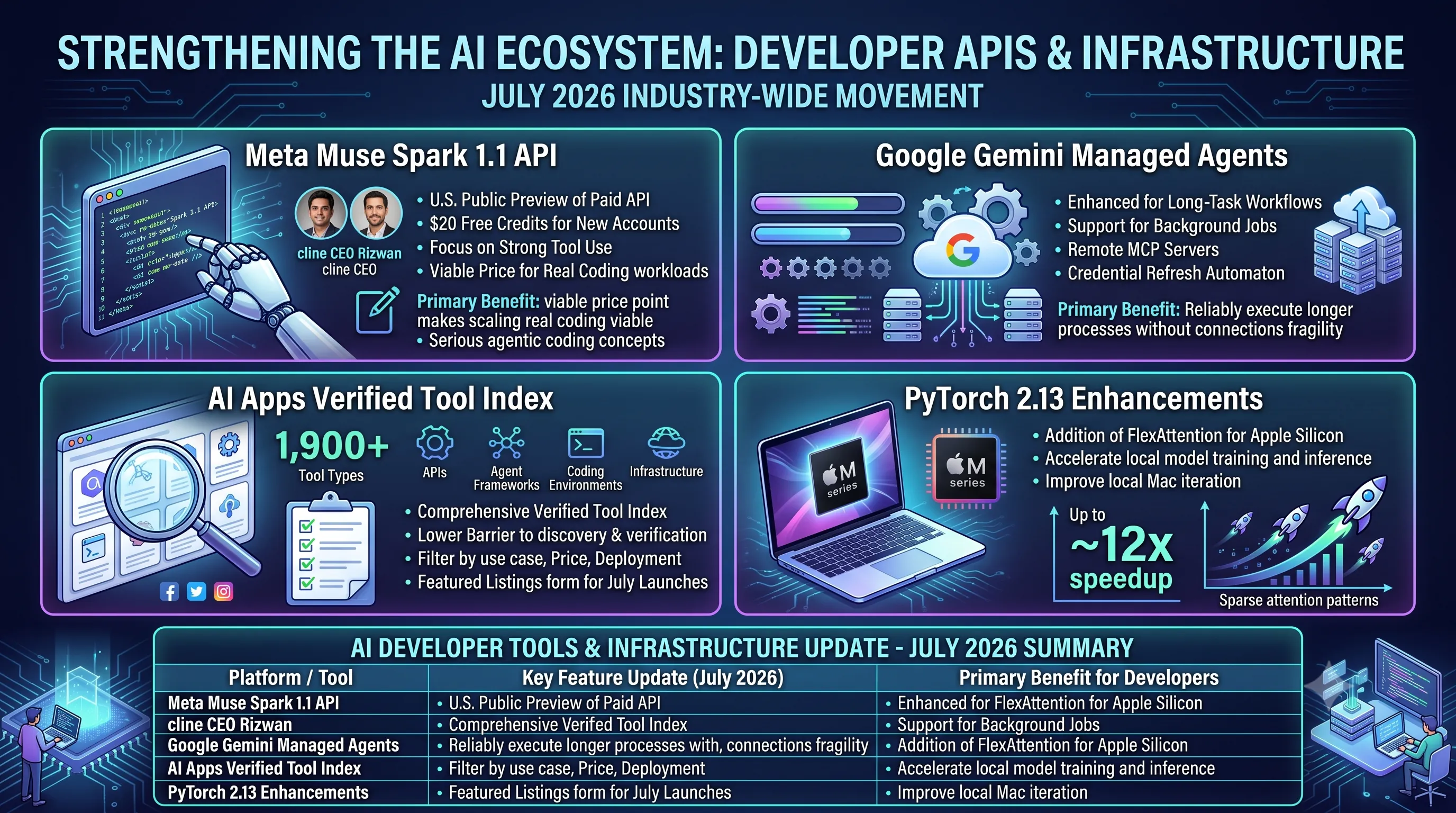
Meta took a significant step into the paid developer tool space by opening a U.S. public preview for its first paid developer API, centered on the Muse Spark 1.1 model.To encourage adoption, new developer accounts created in July 2026 received $20 in free credits to experiment with the new offering.
The move is seen as a direct play to capture serious development workflows.
Saoud Rizwan, CEO of Cline, commented on the strategy, stating: "Meta is clearly building for serious agentic coding – strong tool use at a price point that makes it viable to run real coding workloads at scale."
This indicates a focus on providing powerful, cost-effective tools for building complex, code-generating agents.
Google Gemini Managed Agents: Long-Task Workflows
Google continued to enhance its enterprise-grade agentic framework, pushing Gemini Managed Agents further into the domain of long-task workflows.The latest updates introduced crucial features for running complex, extended processes, including support for background jobs, remote MCP servers, and the ability to refresh network credentials automatically.
This is a critical advancement for enterprise scenarios, as it allows development teams to execute longer processes without the operational fragility of keeping an open connection alive, ensuring that tasks can run to completion reliably in the background.
AI Apps: A Verified Tool Index
As the number of AI developer tools proliferates, discovery and verification have become major challenges.The AI Apps platform aims to solve this by serving as a comprehensive index, now cataloging over 1,900 tools.
The index covers the full developer stack, with categories for APIs, agent frameworks, AI coding environments, and infrastructure.
Its key differentiator is a multi-step verification process that every listing must pass, ensuring a higher standard of quality and reliability.
For developers, the platform offers powerful filtering by use case, pricing model, or deployment type, simplifying the search for the right tool.
For builders, AI Apps provided a public form for developers or startups to submit their July launches, with featured listings gaining additional visibility in weekly newsletters and social media roundups.
PyTorch 2.13 Enhancements
At the foundational level, the open-source community delivered key performance improvements.The release of PyTorch 2.13 brought a significant optimization for developers working on Apple hardware.
The update added FlexAttention for Apple Silicon, a feature specifically designed to accelerate model training and inference on M-series chips.
Early reports indicate this provides a substantial performance gain, with a reported ~12x speedup on sparse attention patterns, making local development and iteration on Mac devices more efficient than ever.
| Platform / Tool | Key Feature Update (July 2026) | Primary Benefit for Developers |
|---|---|---|
| Meta Muse Spark 1.1 API | U.S. public preview of first paid developer API with $20 in free credits for new accounts. | Enables building and scaling agentic coding applications at a viable price point. |
| Google Gemini Managed Agents | Support for background jobs, remote servers, and refreshing network credentials. | Reliably run long-task workflows without maintaining a persistent open connection. |
| AI Apps Index | Indexes 1,900+ tools with a multi-step verification process and advanced filtering. | Discover and validate relevant AI developer tools across multiple categories. |
| PyTorch 2.13 | Addition of FlexAttention for Apple Silicon. | Achieve up to a ~12x speedup on sparse attention patterns for local development on Macs. |
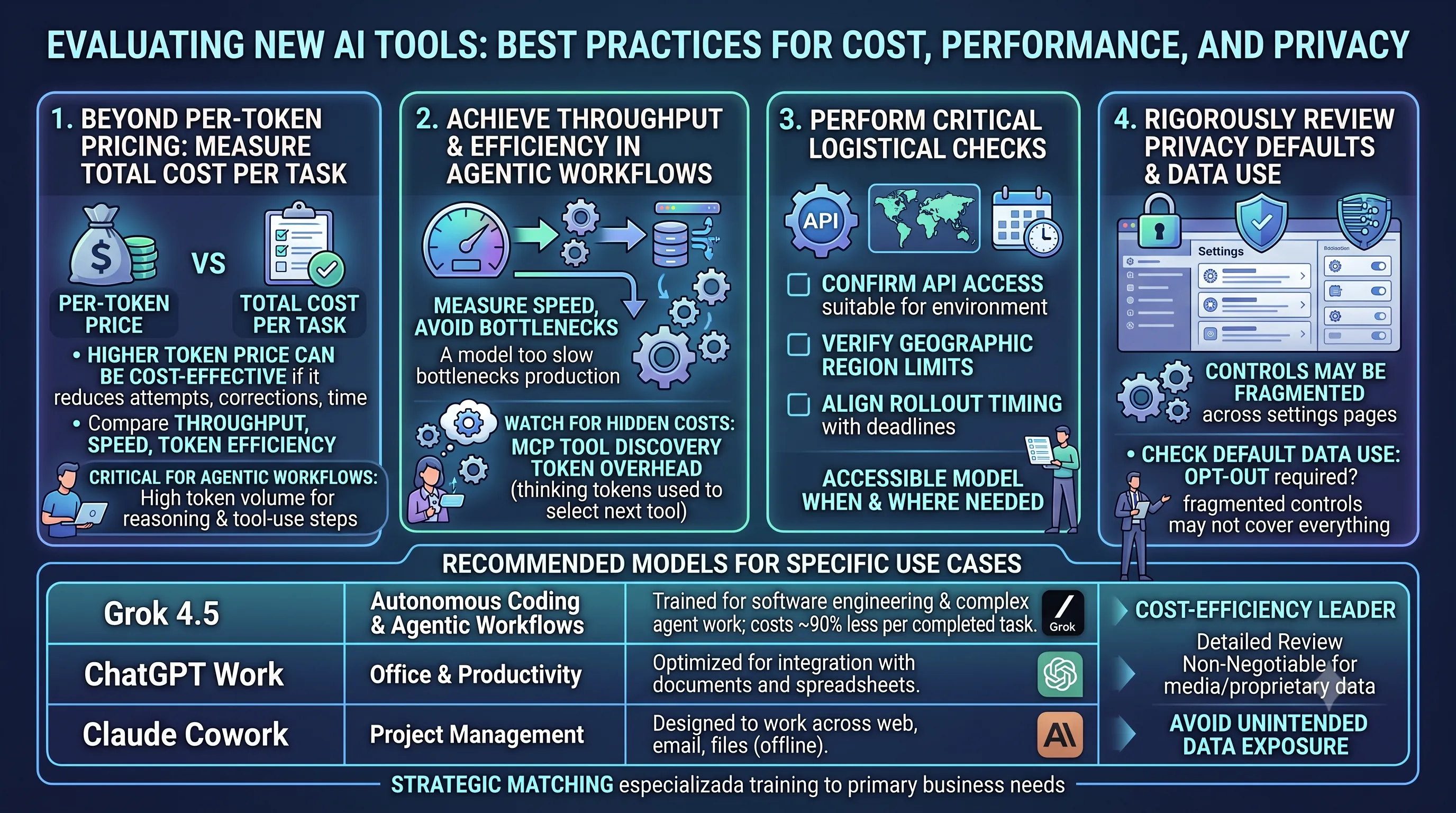
8. Evaluating New AI Tools: Best Practices for Cost, Performance, and Privacy
OpenAI's recent price cuts and the launch of its GPT-5.6 lineup on July 30th have spurred a new wave of AI tool evaluations across the industry.For organizations looking to capitalize on these advancements, a structured approach to testing is essential to separate hype from genuine value, focusing on total cost, real-world performance, and data privacy.
Beyond Per-Token Pricing: Total Cost per Task
The most critical shift in evaluation is moving beyond simple per-token pricing.Instead, best practice dictates measuring the total cost per completed task.
A model with a higher token price can ultimately be more cost-effective if its superior performance reduces the need for multiple attempts, manual corrections, and overall time to completion.
This is especially true for agentic workflows, which often consume a high volume of tokens for reasoning and tool-use steps, making models that seem cheap on paper extremely costly in practice.
Comparing throughput, speed, and token efficiency provides a much more accurate picture of a model's true cost.
API Access, Region Limits, and Rollout Timing
Before investing significant time in testing a new tool, it's crucial to perform basic logistical checks.Confirm that the model is accessible via an API suitable for your development environment.
Additionally, verify that there are no service limitations in your specific geographic region and that the announced rollout timing aligns with your project deadlines.
A promising model is of no use if your team cannot access it when and where it's needed.
Throughput and Efficiency in Agentic Workflows
Effective evaluation must go beyond the quality of a model's final output and also measure its throughput.A model that produces excellent results but does so too slowly can become a significant bottleneck in production workflows.
When testing complex multi-tool or agentic systems, it's particularly important to watch for hidden costs like tool-discovery token overhead in MCP (Multi-Control Plane) setups, where the model expends tokens simply figuring out which tool to use next.
This "thinking" overhead can dramatically inflate the cost of a task.
Privacy Defaults and Data Use
A thorough review of privacy settings is a non-negotiable step before adopting any new AI tool, especially those handling media or proprietary information.Check carefully to see if the service uses customer data for training by default and requires an explicit opt-out.
Be aware that privacy controls may be fragmented across different settings pages or menus.
A single toggle switch that appears to offer comprehensive privacy protection may not actually cover all forms of data usage, making a detailed review essential to avoid unintended data exposure.
Recommended Models for Specific Use Cases
Based on recent capabilities and cost structures, teams should start their evaluations with models tailored to specific tasks.The goal is to match the tool's specialized training to your primary business need.
| Model Recommendation | Primary Use Case | Key Strengths & Considerations |
|---|---|---|
| Grok 4.5 | Autonomous Coding & Agentic Workflows | Trained for software engineering and complex agent work; performance is on par with top-tier models but reportedly costs about 90% less per completed task. |
| ChatGPT Work | Office & Productivity | Optimized for integration with documents and spreadsheets, making it a strong candidate for general office tasks. |
| Claude Cowork | Project Management | Designed to work across web, email, and files (including offline), facilitating complex project coordination. |
Related Posts
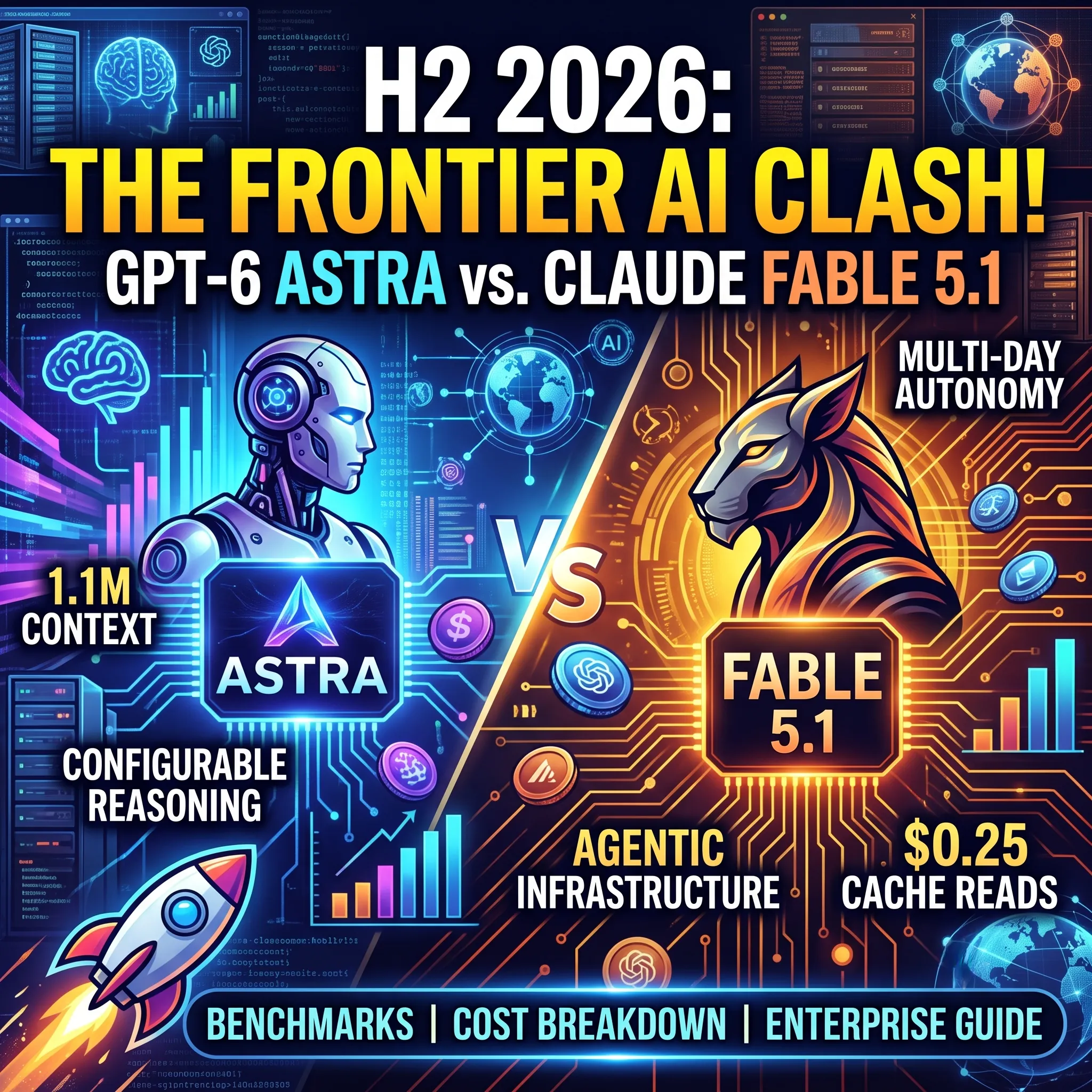
Comparing GPT-6 Astra and Claude Fable 5.1: Pricing, Reasoning, and ArchitectureA comparative analysis of the September 2026 releases of GPT-6 Astra and Claude Fable 5.1, focusing...

Generative Engine Optimization (GEO): AI Search Strategies, 2026 Model Updates, and High ConversionsExplore Generative Engine Optimization (GEO) strategies for AI search visibility, 2026 AI model...

Model Context Protocol (MCP): Anthropic's Open Standard for AI Integration, Claude's Capabilities, & Data EthicsExplore Anthropic's Model Context Protocol (MCP), an open standard revolutionizing AI integration,...