
How .NET 11 Unifies MAUI and Boosts CLI Speed with Native AOT
🚀 Key Takeaways
- Standard Term Support Release: .NET 11 delivers a two-year STS cadence alongside the formal retirement of older releases like .NET 8 and .NET 9.
- Native AOT CLI Host: The SDK introduces a precompiled native entry point that executes routine queries out-of-process without invoking the managed runtime.
- CoreCLR Unification in MAUI: .NET MAUI transitions from Mono to CoreCLR as its default engine across target platforms, harmonizing client and server behavior.
- C# 15 Language Evolution: The compiler adds first-class discriminated union types, closed class hierarchies, and collection expression enhancements.
- Runtime-Managed Async: State machine handling moves deep into the execution engine to improve throughput, memory layout, and call-stack observability.
- Modernized Core Libraries: Native support arrives for Zstandard compression, zero-copy stream abstractions, and full outer joins directly in LINQ.
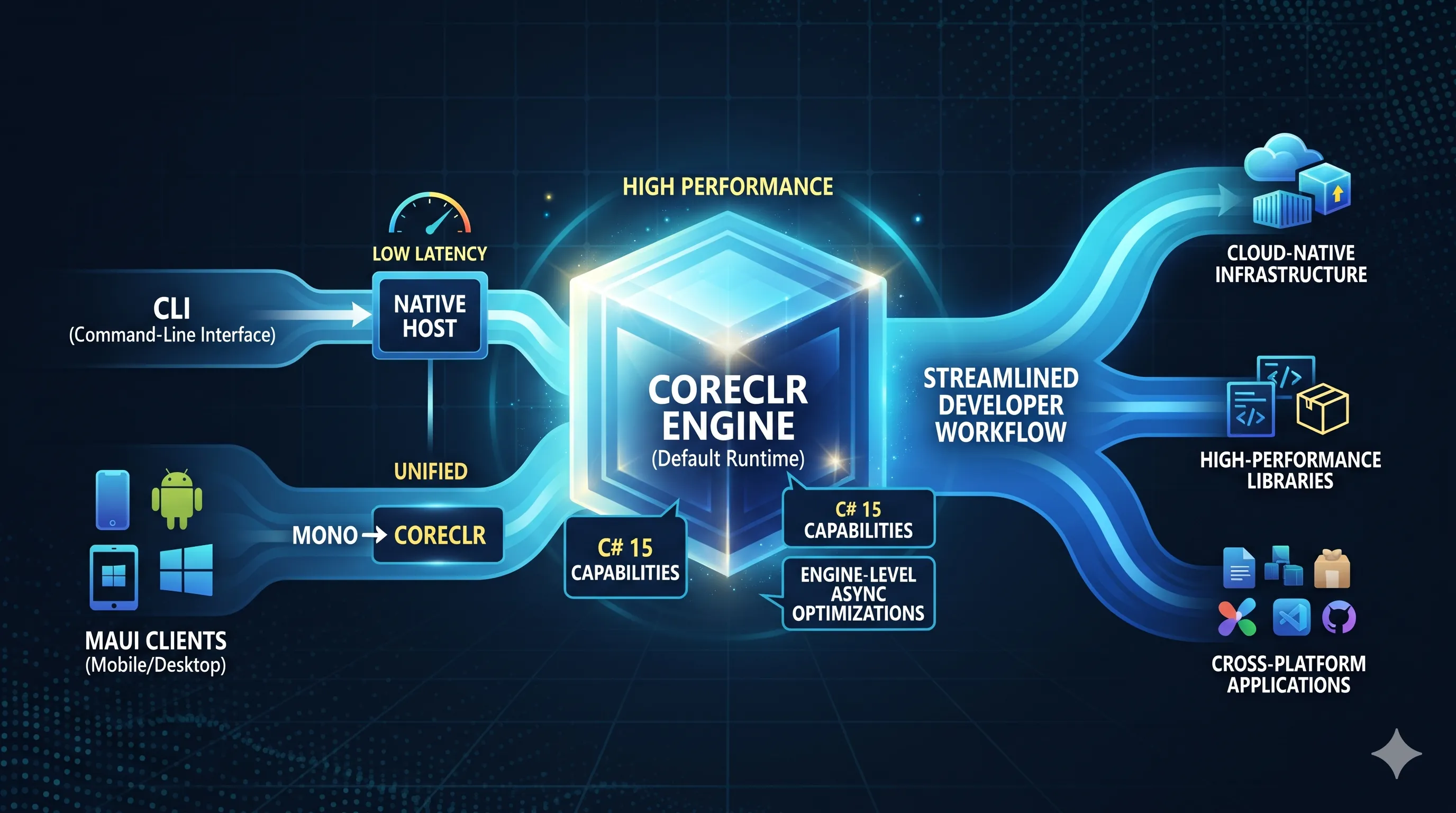
The general availability of .NET 11 delivers a foundational realignment for Microsoft’s cross-platform ecosystem, placing execution density and low-latency interaction at the center of the developer workflow.
Unveiled as a Standard Term Support release, this milestone modernizes everyday command-line interactions by embedding a native-compiled host into the SDK, immediately cutting the managed boot latency that previously accompanied basic terminal invocations.
At the application layer, the update eliminates historical architectural fragmentation by positioning CoreCLR as the single default runtime engine for .NET MAUI.
By superseding the traditional Mono baseline across mobile operating environments, .NET 11 bridges long-standing throughput disparities between client platforms and high-throughput server backends.
Coupled with functional capabilities introduced in C# 15 and engine-level asynchronous optimizations, .NET 11 establishes a unified, high-performance foundation designed to streamline cloud-native infrastructure, client applications, and cross-platform libraries alike.
1. .NET 11 Release Dynamics, Support Cadence, and Ecosystem Scale
The general availability of .NET 11 establishes the operational and support foundation for transformative runtime features across the ecosystem, including the introduction of the Native AOT CLI host and the integration of CoreCLR in .NET MAUI.Understanding the servicing timeline and scale of this unified launch provides essential context for engineering teams planning adoption schedules and infrastructure lifecycles.
STS Support Cadence and Coinciding End-of-Life Milestones
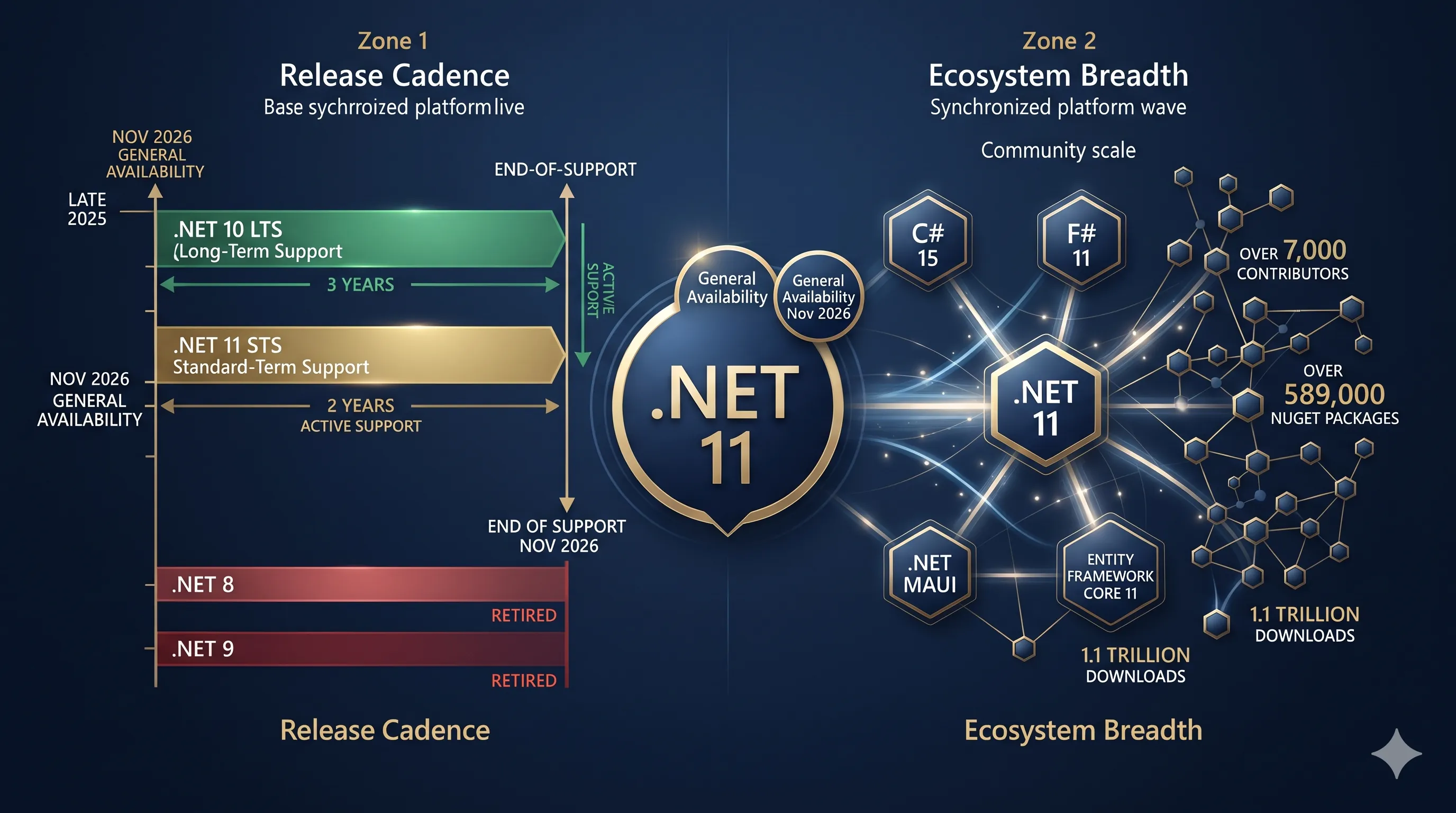
Announced via InfoQ and Microsoft DevBlogs during .NET Conf 2026, which took place from November 10 to November 13, 2026, .NET 11 arrived as a Standard Term Support (STS) offering.Under Microsoft’s established release governance, .NET 11 provides a 2-year support lifecycle.
Concurrently, .NET 10 remains the actively supported Long Term Support (LTS) release for organizations prioritizing extended operational continuity.
This release cadence has sparked focused discussions across the developer community, as developers note that .NET 11 and .NET 10 share the exact same end-of-support date.
Because .NET 10 carries a three-year LTS lifecycle starting from late 2025 and .NET 11 carries a two-year STS lifecycle starting from November 2026, both versions will reach retirement at the same future milestone.
Furthermore, the arrival of .NET 11 coincided with critical platform expirations, as both .NET 8 and .NET 9 reached their official end of support on November 10, 2026.
This simultaneous phase-out places immediate pressure on teams running legacy LTS (.NET 8) or previous STS (.NET 9) workloads to upgrade into active servicing streams.
| Release Version | Support Classification | Lifecycle Duration | Support Status (as of November 2026) |
|---|---|---|---|
| .NET 8 | Long Term Support (LTS) | 3 Years | Reached End of Support on November 10, 2026 |
| .NET 9 | Standard Term Support (STS) | 18–24 Months | Reached End of Support on November 10, 2026 |
| .NET 10 | Long Term Support (LTS) | 3 Years | Active LTS release (shares end-of-support horizon with .NET 11) |
| .NET 11 | Standard Term Support (STS) | 2 Years | Active STS release (General Availability announced November 2026) |
Ecosystem Breadth and Release Coordination Across Workloads
The deployment of .NET 11 represents a synchronized platform wave delivered across language compilers, web runtimes, client frameworks, and data access layers.Microsoft released .NET 11 alongside C# 15, F# 11, ASP.NET Core 11, .NET MAUI, and Entity Framework Core 11.
This unified coordination ensures that architectural shifts—such as CoreCLR adoption inside .NET MAUI mobile targets and ahead-of-time compilation mechanics—remain fully compatible with language enhancements in C# 15 and server-side primitives in ASP.NET Core 11.
The engineering breadth underpinning the release highlights significant collaboration between Microsoft and the broader open-source community.
.NET 11 is the work of over 7,000 contributors whose commits span the runtime, libraries, tooling, and framework SDKs.
This community momentum is mirrored in the NuGet package distribution pipeline, where the ecosystem has expanded to encompass more than 589,000 unique packages and accumulated over 1.1 trillion downloads.
This scale ensures that runtime innovations across .NET 11 are supported by a deep, hardened network of third-party dependencies and enterprise packages.
2. Default Native AOT CLI Host and SDK Tooling Modernization
Within the broader scope of .NET 11 introducing a Native AOT CLI host and CoreCLR in MAUI, the command-line developer experience receives an architectural overhaul that directly targets shell startup latency and toolchain efficiency.This section examines how the toolchain transitions to an ahead-of-time compiled CLI entry point, upgrades the underlying MSBuild process architecture, and refines day-to-day developer workflows across development, test, and container publishing environments.
Native AOT Entry Point and Out-of-Process Command Handling
The .NET SDK enables a Native AOT CLI entry point by default across Windows, macOS, and Linux.Historically, command-line invocations required initializing the managed runtime execution pipeline even for trivial queries, introducing measurable cold-start overhead.
Under the new architecture in .NET 11 (tested during the Preview 7 SDK cycle under version 11.0.100-preview.7.26381.103), the Native AOT host handles built-in metadata queries out-of-process without starting the managed CLI.
Commands such as help requests and version queries execute directly inside the precompiled native entry point.
Whenever a user invokes unsupported commands or operations that require full managed runtime facilities, execution transparently falls back to the standard managed CLI path.
To accelerate subsequent build cycles, the MSBuild server now stays warm between CLI invocations by default, eliminating redundant process spin-up costs.
Observability infrastructure also modernizes: the internal CLI telemetry exporter transitions from Application Insights to OpenTelemetry.
Underpinning these software updates are modified baseline requirements: the hardware baseline moves to x86-64-v2, and updated minimum hardware requirements apply to both x86/x64 and Arm64 architectures.
| Command / Query Type | Default Execution Host | Runtime Overhead Characteristics |
|---|---|---|
| Metadata Queries (e.g., help, version) | Native AOT CLI Host | Executes out-of-process natively; bypasses managed runtime startup entirely. |
| Managed / Unsupported CLI Commands | Managed CLI Fallback Path | Falls back to standard managed CLI path; utilizes warm MSBuild server by default across invocations. |
CLI Workflow Enhancements, Test Orchestration, and Container Reproducibility
Alongside host-level latency reductions, .NET 11 delivers extensive functional additions to command-line workflows.For rapid scripting and lightweight development, file-based applications support
#:include to split code across multiple files and directly reference compiled DLLs.Solution management expands through the CLI, introducing native capabilities to create and edit solution filters (
.slnf) via dotnet sln.Application configuration at launch is streamlined via a new
dotnet run -e option, allowing engineers to pass environment variables directly from the command line without mutating shell profiles or launch settings.Inner-loop developer tooling receives updates through
dotnet watch, which incorporates Aspire app-host integration, automatic crash recovery, and interactive mobile device selection.Test workflows gain deterministic run controls through
dotnet test, which adds run-level options including --timeout, --maximum-failed-tests, and dedicated per-module results directories.Deployment and package governance workflows introduce tighter supply-chain and delivery controls.
Built-in container publishing introduces reproducible image digests by honoring the
SOURCE_DATE_EPOCH specification and skips redundant layer uploads to economize registry bandwidth.In package dependency resolution, NuGet introduces a
--min-publish-age-hours setting, allowing teams to intentionally delay the consumption of newly published package versions until a configured aging threshold has elapsed.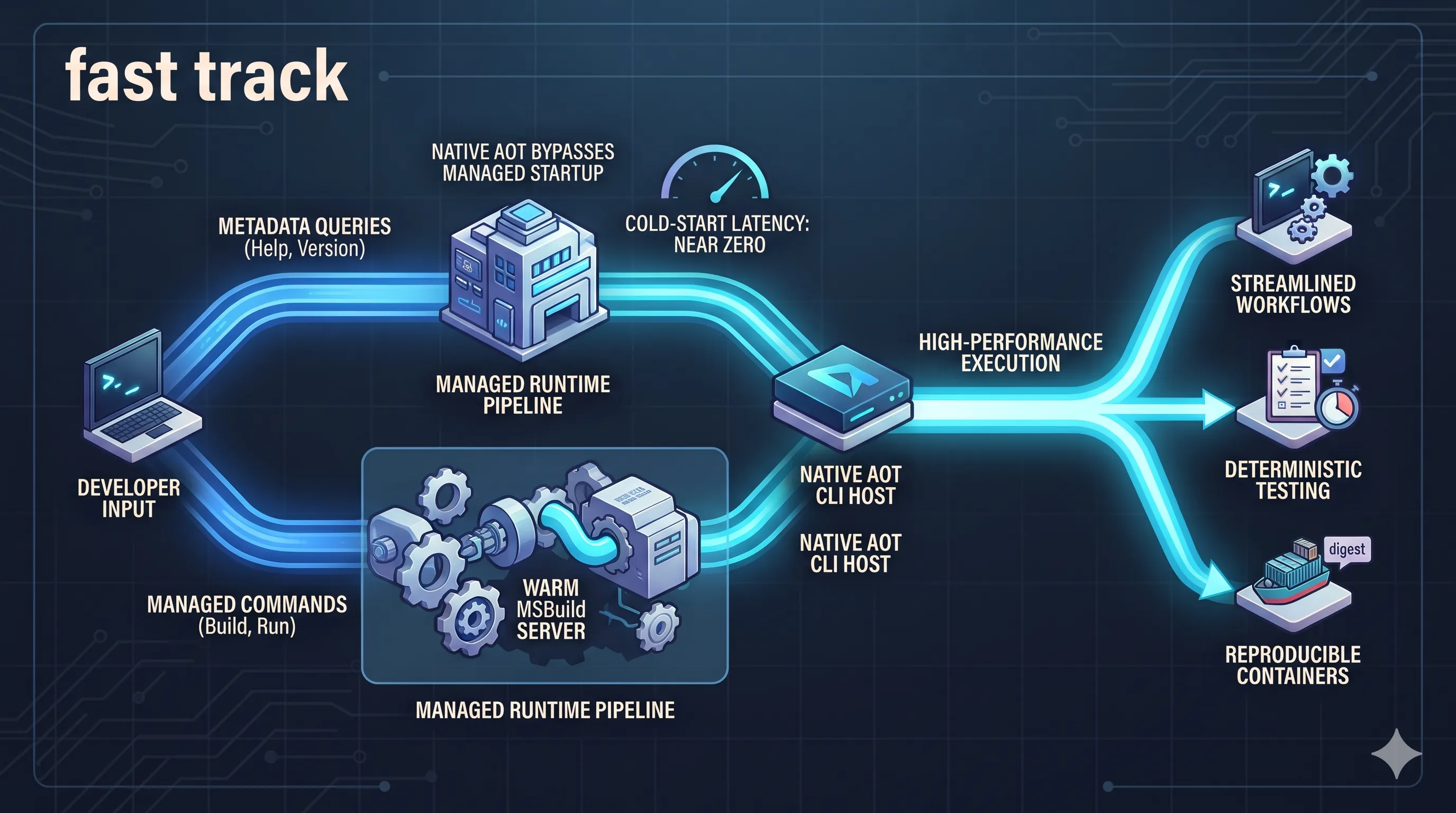
3. .NET MAUI Unification: CoreCLR Transition and Desktop-Mobile Enhancements
Directly anchoring the broader vision of .NET 11 Introduces Native AOT CLI Host and CoreCLR in MAUI, the client framework undergoes a major architectural consolidation.This section examines how the migration of .NET MAUI to CoreCLR standardizes the runtime tier across mobile and desktop environments while overhauling client controls and developer workflows.
CoreCLR Adoption and Multi-Platform Execution Models
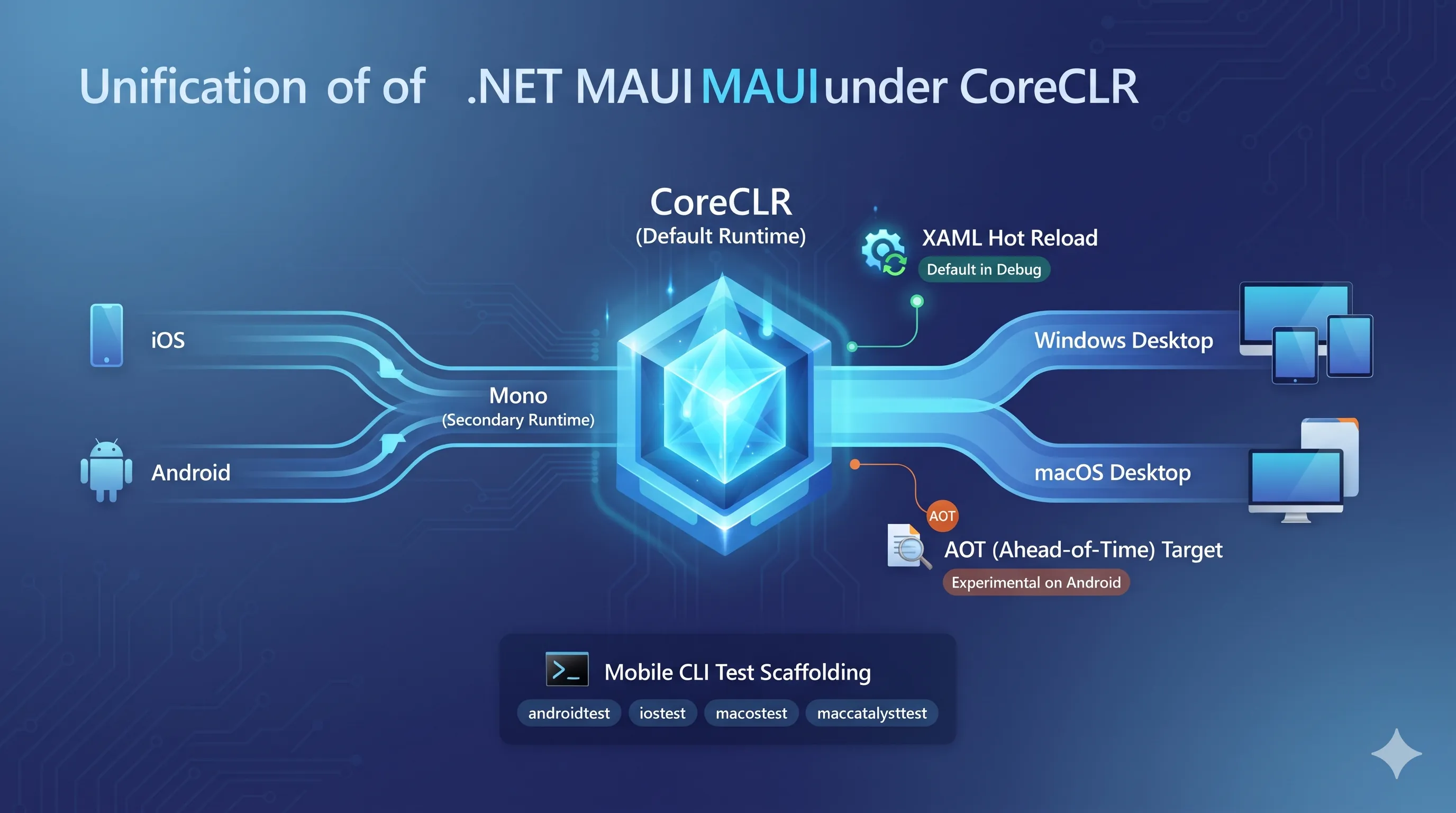
.NET MAUI adopts CoreCLR as its default runtime across platforms, establishing a unified execution model spanning mobile and desktop targets.Historically separated runtime environments converge under this transition, creating operational consistency across supported operating systems.
Platform-specific security parameters necessitate tailored execution models under CoreCLR.
On Apple platforms that enforce strict runtime constraints against just-in-time (JIT) compilation, CoreCLR operates by utilizing precompiled code in combination with an interpreter.
While CoreCLR assumes the default position across targets, Mono remains available to developers as a secondary runtime option.
Beyond standard execution, .NET MAUI introduces Native AOT as an opt-in publishing target.
This model facilitates ahead-of-time compilation for applications requiring optimized startup footprints, though Native AOT deployment on Android remains experimental in .NET 11.
| Runtime / Compilation Target | Platform Execution Mechanics | Status and Availability in .NET 11 |
|---|---|---|
| CoreCLR | Executes via precompiled code and an interpreter on Apple platforms with JIT restrictions; standard execution on non-restricted environments. | Default runtime unifying mobile and desktop execution. |
| Mono | Alternative cross-platform runtime engine. | Maintained as a secondary runtime option. |
| Native AOT | Direct native binary compilation ahead of time. | Available as an opt-in publishing target; experimental on Android. |
XAML Hot Reload, Handler Migrations, and Mobile CLI Testing
Client interface developer inner loops and framework rendering components receive targeted structural updates in this release.In Debug builds, XAML Incremental Hot Reload is enabled by default, reducing iteration cycle times when adjusting visual layouts.
Framework markup verbosity is further streamlined, as XAML root files now support implicit namespace declarations.
Control architecture continues its migration away from legacy renderer paradigms.
Android Shell moves to a modern handler-based architecture, bringing it into alignment with the standard .NET MAUI handler pipeline.
On desktop systems, Windows adopts the CollectionView2 handler by default.
This UI handler evolution introduces breaking changes and active platform considerations.
The legacy Microsoft.Maui.Controls.Compatibility package no longer ships with .NET 11, requiring apps to fully decouple from obsolete compatibility renderers.
Additionally, developer feedback indicates unresolved layout issues when using GridItemLayout within CollectionView on Windows under the new CollectionView2 implementation.
Command-line test automation for multi-platform targets is formalized in the tooling layer.
The CLI adds dedicated test project templates across mobile and desktop environments, providing standard scaffolding via androidtest, iostest, macostest, and maccatalysttest.
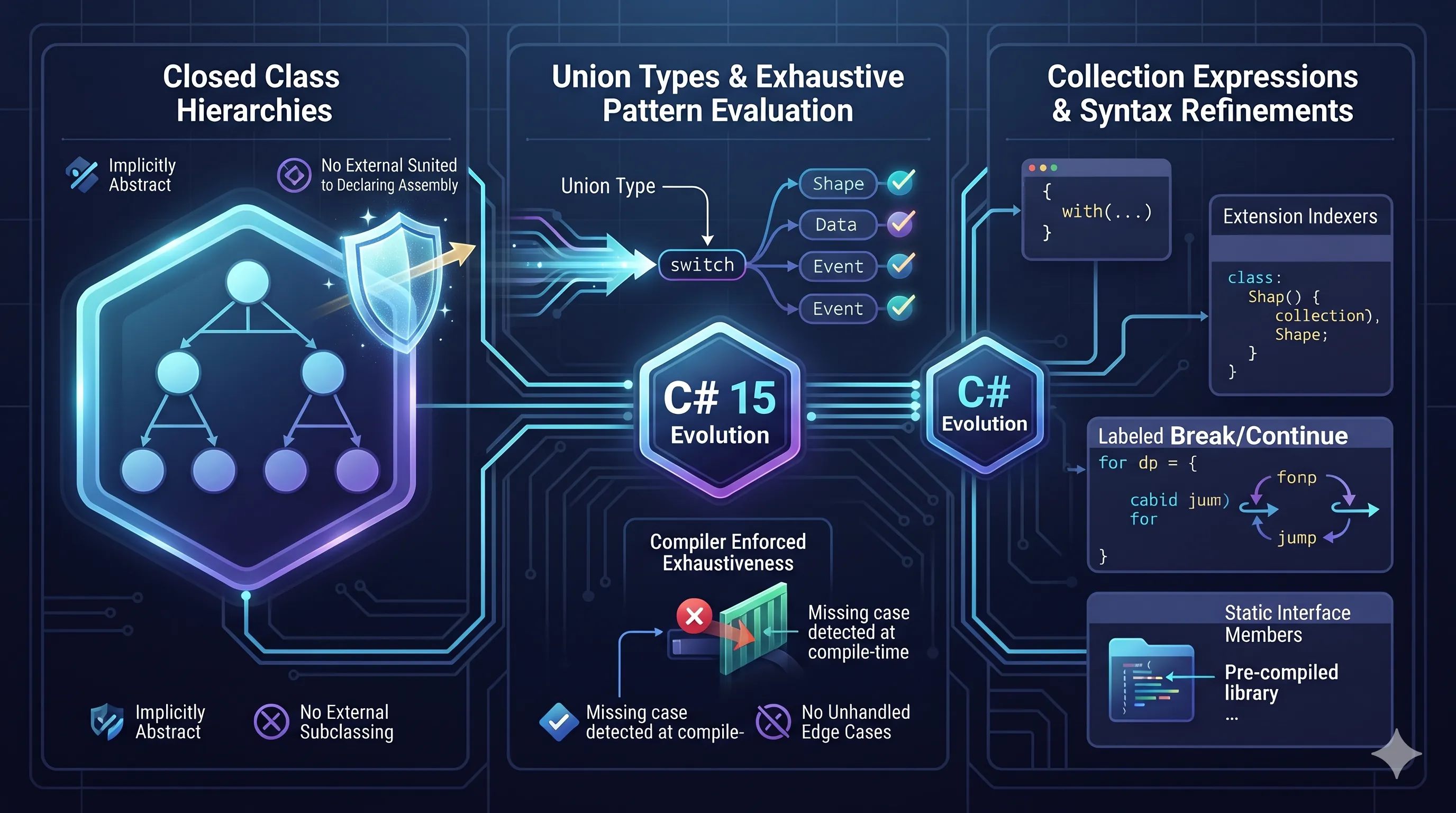
4. C# 15 Language Evolution: Discriminated Unions and Type System Refinements
As projects adopt .NET 11 alongside architectural enhancements like the Native AOT CLI host and CoreCLR runtime updates in MAUI, language-level ergonomics advance simultaneously.C# 15 ships as the default language version for projects targeting .NET 11, introducing long-requested type system capabilities designed to strengthen domain modeling and compiler-enforced safety.
Union Types and Exhaustive Pattern Evaluation
C# 15 introduces first-class union types defined via the union keyword.This feature allows developers to model a fixed set of alternative data shapes directly in type definitions.
When consuming union types within switch expressions, the compiler enforces exhaustiveness checking.
If a case in the evaluation pattern is omitted, the compiler reports an error, eliminating unhandled edge cases at compile time without relying on runtime default branch fallbacks.
Closed Hierarchies, Collection Expressions, and Syntax Additions
Beyond union types, C# 15 provides closed class hierarchies through the closed contextual keyword.Applying closed limits direct subclassing strictly to the declaring assembly, preventing unexpected downstream derived classes across external assembly boundaries.
A closed class is implicitly abstract and cannot be combined with sealed, static, or explicit abstract modifiers.
| Pattern / Mechanism | Inheritance & Scope Constraints | Compiler Modifiers Allowed | Compiler-Enforced Exhaustiveness |
|---|---|---|---|
| Traditional Class Inheritance | Open to arbitrary external subclassing unless explicitly restricted. | Can use abstract, sealed, or standard class modifiers. | No compile-time check requiring all potential subclasses to be handled in pattern matching. |
| Closed Class Hierarchies (C# 15) | Direct subclassing is limited strictly to the declaring assembly via the closed contextual keyword. | Implicitly abstract; cannot be combined with sealed, static, or explicit abstract modifiers. | Restricts assembly-level variants for controlled domain hierarchies. |
| Union Types (C# 15) | Discrete, explicit variants defined using the union keyword. | Defined directly via the union type specification. | Enforces compiler-checked exhaustiveness in switch expressions. |
Developers can now supply collection expression arguments using the with(...) parameter syntax.
This enables passing collection capacities, custom comparers, or constructor arguments directly during expression initialization.
Additional syntax refinements streamline complex control flows and API construction:
First, extension blocks now support extension indexers, permitting indexer declarations directly inside extension syntax.
Second, labeled break and continue statements are introduced, providing targeted exits or iteration steps out of deeply nested outer loops and switch blocks.
Third, non-virtual static interface members can now be declared when targeting older runtimes, expanding interface authoring flexibility across backward-compatible targets.
Finally, while type system refinements are fully integrated, the new memory safety model remains in preview and requires explicit feature flags alongside the preview language version for evaluation.
5. Runtime and JIT Optimizations: Runtime Async and Hardware Intrinsics
The performance foundational enhancements in .NET 11 directly support the broader evolution seen across Native AOT CLI host deployments and CoreCLR integrations in MAUI.By redesigning fundamental execution mechanics at the JIT and runtime layers, .NET 11 delivers lower memory overhead, compact binaries, and streamlined execution profiles for both compiled native tools and cross-platform mobile targets.
Runtime Async State Handling and Native AOT Dispatch Helpers
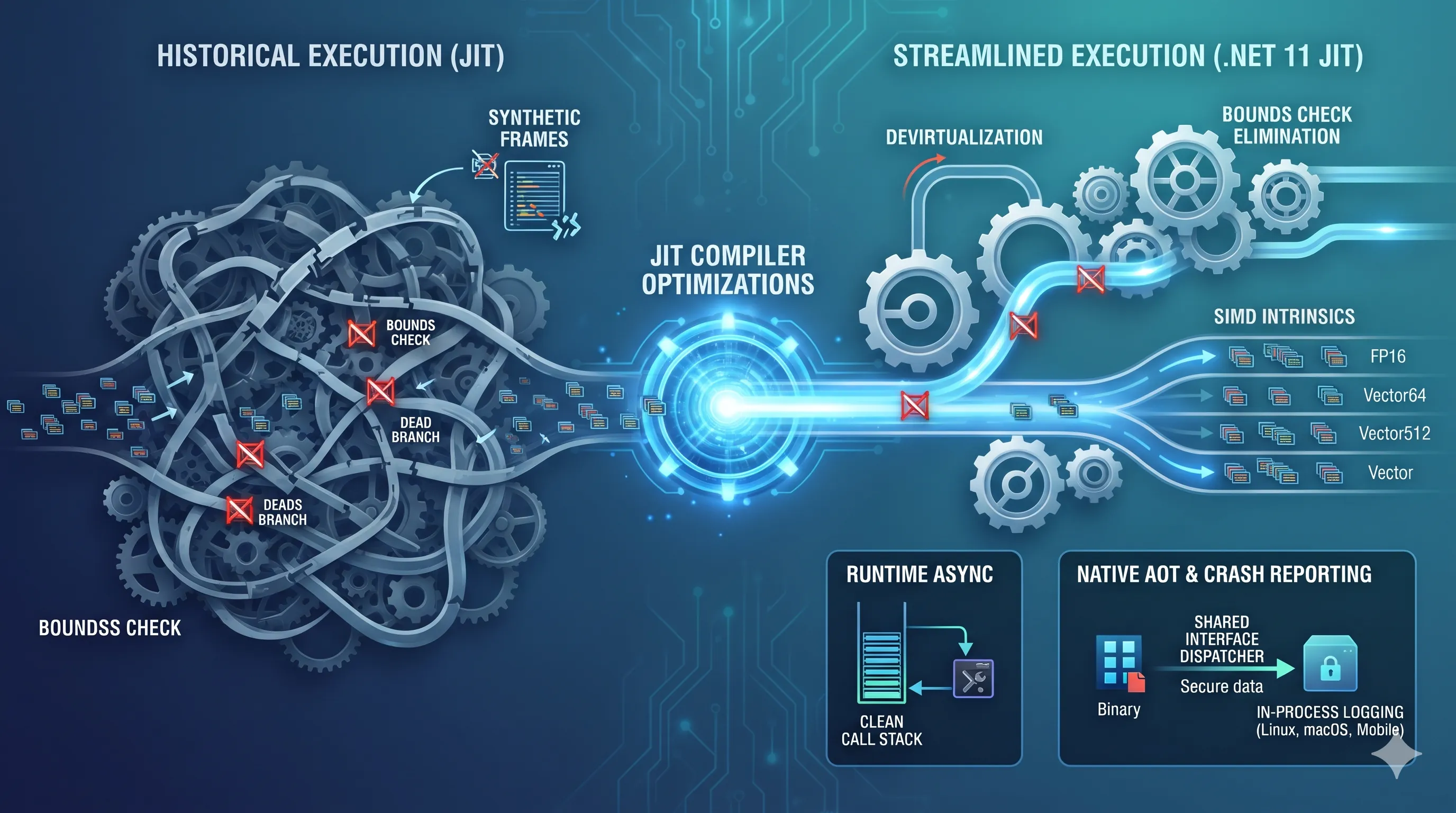
A major architectural shift in .NET 11 is Runtime Async, which moves asynchronous state machine handling directly into the runtime.Historically, async methods relied on compiler-generated struct state machines, which often cluttered diagnostics with synthetic frames.
Offloading state machine mechanics into the runtime produces significantly clearer call stacks in debuggers and profilers.
The .NET runtime libraries are precompiled with runtime-async enabled out of the box.
However, Runtime Async remains an opt-in preview feature for user application code.
Alongside Runtime Async, Native AOT compilation incorporates a shared interface dispatch helper.
This shared helper reduces binary size at call sites while simultaneously boosting dispatch throughput, preventing the code bloat traditionally associated with aggressive interface devirtualization and stub generation in ahead-of-time compiled binaries.
Diagnostic resilience is also upgraded through in-process crash reporting.
This capability logs managed stack traces and critical runtime state directly during catastrophic failures across Linux, macOS, and mobile platforms.
JIT Devirtualization, Bounds Check Elimination, and SIMD Intrinsics
The .NET 11 JIT compiler incorporates deep analytical improvements that streamline low-level execution.JIT optimizations systematically eliminate redundant bounds checks and dead branches throughout loops and indexing paths.
Devirtualization routines have been expanded, allowing the compiler to convert indirect interface and virtual invocations into direct method calls.
Additionally, the JIT now performs constant-folding on SequenceEqual operations when operating against known sequences.
Low-level scalar arithmetic also gains tailored code generation improvements.
Specifically, Math.BigMul on x64 hardware now emits a single MUL instruction, optimizing full-width integer multiplication into the most compact instruction form possible.
Hardware-accelerated mathematics and vectorization have received substantial updates across both x64 and Arm64 architectures.
Hardware acceleration now includes native FP16 instructions for Half floating-point operations on supported x64 and Arm64 hardware.
Furthermore, SIMD capabilities are extended with dedicated lane construction and composition APIs.
These vector composition primitives are implemented across Vector64, Vector128, Vector256, Vector512, and the variable-length Vector types, giving developers direct control over SIMD vector assembly.
| Optimization / Feature | Technical Mechanism | Platform Availability & Scope |
|---|---|---|
| Runtime Async | Moves state machine management into the runtime for cleaner debugger and profiler call stacks. | Precompiled into .NET runtime libraries; opt-in preview for application code. |
| Shared Interface Dispatch Helpers | Employs shared dispatch helpers to decrease call site footprint and raise invocation throughput. | Native AOT compilation targets. |
| JIT Compiler Optimizations | Eliminates redundant bounds checks and branches; improves devirtualization; constant-folds SequenceEqual. | Cross-platform JIT execution. |
| Math.BigMul Code Generation | Directly emits a single MUL instruction for full-width multiplication. | x64 architecture. |
| FP16 Half Acceleration | Hardware-accelerated instruction support for 16-bit floating-point (Half) types. | Supported x64 and Arm64 hardware. |
| SIMD Lane Construction APIs | Lane construction and composition interfaces across Vector64, Vector128, Vector256, Vector512, and Vector. | Cross-platform hardware intrinsic surface. |
| In-Process Crash Reporting | Directly captures and logs managed stack traces and runtime execution state upon failure. | Linux, macOS, and mobile platforms. |
6. Modernized Libraries and Workloads: ASP.NET Core, EF Core 11, and AI Tooling
While the headline architectural shifts in .NET 11 center on the Native AOT CLI host and the transition of MAUI to CoreCLR, the higher-level application stacks and core runtime primitives have undergone an equally rigorous modernization.These workload improvements span ASP.NET Core 11, Entity Framework Core 11, base stream primitives, and agentic artificial intelligence tooling, directly reinforcing the performance and cloud-native footprint established by the low-level runtime updates.
ASP.NET Core 11 Protocol Updates, Blazor Optimizations, and EF Core Enhancements
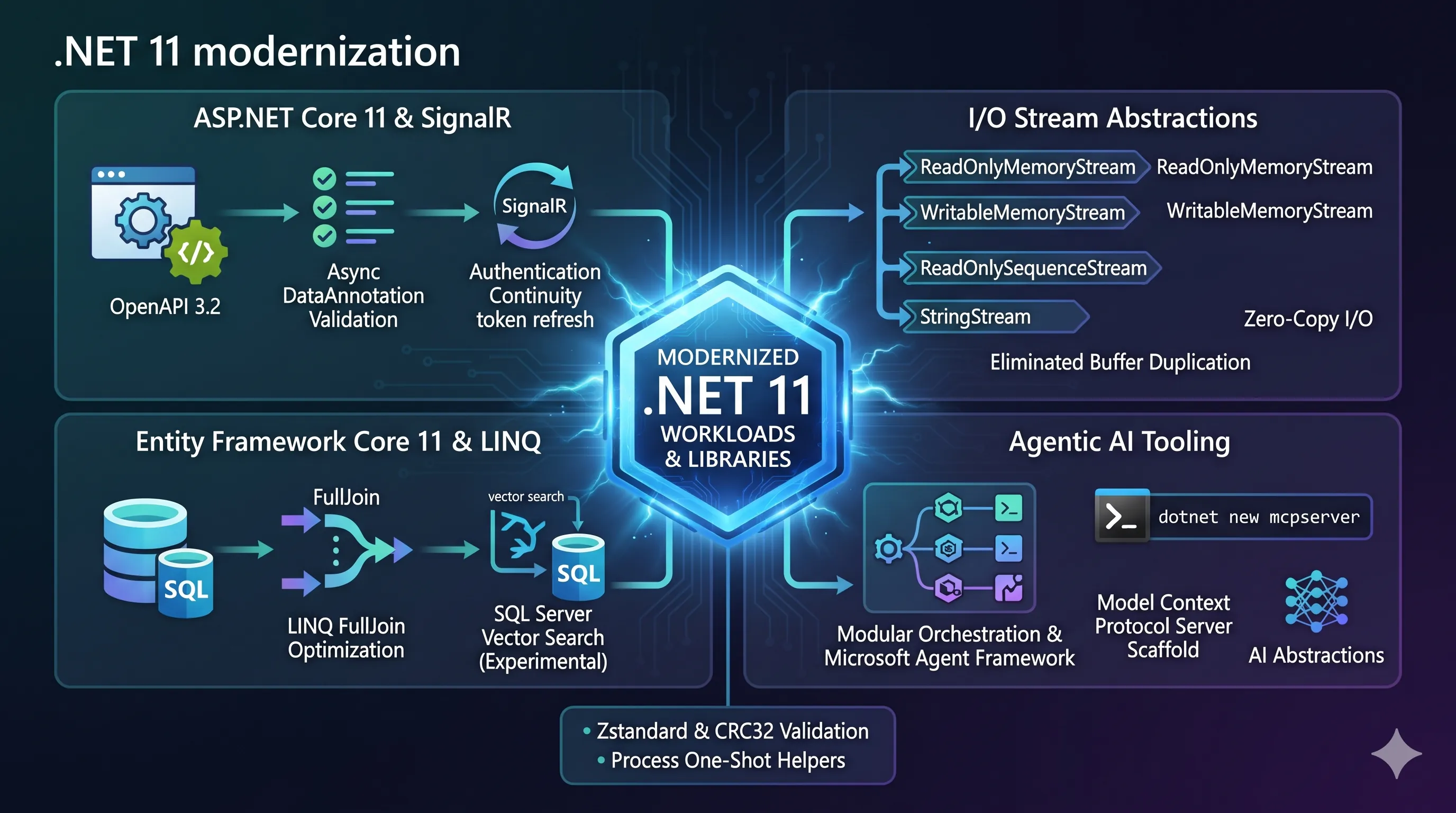
Web and distributed workload stacks receive targeted enhancements across metadata generation, authentication continuity, and server-side component lifecycle management.ASP.NET Core 11 now generates OpenAPI 3.2 documents by default.
This shift enables teams to use the latest specification capabilities out of the box, though it represents a breaking change for downstream consumer toolchains that still require earlier OpenAPI specification versions.
Model binding and validation pipelines are also modernized, as ASP.NET Core adds asynchronous validation support for DataAnnotations, removing historical blocking constraints when evaluating rules that rely on remote I/O or database lookups.
For real-time interactions, SignalR now supports authentication token refreshes without terminating or reconnecting the client connection, eliminating transient state loss and disconnect churn during credential renewal cycles.
Blazor workloads benefit from rendering and resource-management enhancements.
A new CacheView component provides static server-side rendering (SSR) caching mechanisms, allowing servers to avoid redundant rendering passes for static markup regions.
In addition, Blazor introduces opt-in circuit pausing for inactive browser tabs, drastically lowering server memory pressure and active thread dispatching when users navigate away from active client sessions.
In the data access tier, Entity Framework Core 11 aligns closely with broader LINQ updates across the platform.
LINQ introduces the FullJoin operator across Enumerable, Queryable, and AsyncEnumerable.
EF Core 11 translates this new LINQ FullJoin directly into database queries, while also enhancing query compilation to eliminate unnecessary joins generated in complex object-relational mappings.
For emerging retrieval-augmented scenarios, EF Core 11 incorporates experimental vector search support specifically tailored for SQL Server.
Engineers migrating to this data tier must note that Entity Framework Core 11 strictly requires .NET 11, precluding its adoption on older runtime targets.
Serialization boundaries also see specific language-level additions, though with distinct operational constraints.
System.Text.Json adds support for F# unions; however, this implementation relies entirely on reflection and currently lacks support for source generation, assembly trimming, or Native AOT targets.
| API Primitive / Feature | Functional Domain | Operational Capability |
|---|---|---|
| ReadOnlyMemoryStream | System.IO Stream Abstractions | Wraps read-only memory buffers into a stream without memory allocations or data copying. |
| WritableMemoryStream | System.IO Stream Abstractions | Provides a zero-copy stream wrapper over mutable memory targets. |
| ReadOnlySequenceStream | System.IO Stream Abstractions | Adapts non-contiguous, segmented memory sequences into a unified stream interface without payload copying. |
| StringStream | System.IO Stream Abstractions | Exposes string character payloads as byte/char streams directly without intermediary allocations. |
| Process One-Shot Helpers | System.Diagnostics | Executes external processes and synchronously or asynchronously collects exit codes and console output in a single call. |
| Zstandard & CRC32 Validation | System.IO.Compression | Integrates native Zstandard compression routines and adds automated CRC32 verification during ZIP archive reads. |
| LINQ FullJoin | System.Linq / EF Core 11 | Performs full outer join operations across in-memory collections, async streams, and translated SQL queries. |
Stream Adapters, Process Primitives, and Agentic AI Architecture
Underlying platform I/O pipelines receive critical zero-copy abstractions and improved compression handling in .NET 11.System.IO.Compression integrates native Zstandard compression, expanding algorithm options for high-throughput data transfer while introducing integrated CRC32 validation checks when reading ZIP archive contents.
To bypass allocation overheads across memory and network boundaries, four new zero-copy stream adapters wrap memory structures without copying bytes: ReadOnlyMemoryStream, WritableMemoryStream, ReadOnlySequenceStream, and StringStream.
These adapters eliminate buffer duplication bottlenecks when interacting with legacy APIs that expect standard Stream instances.
Operating system process invocation is streamlined through new one-shot execution helpers in the Process APIs, allowing developers to spawn child processes, capture console output, and evaluate exit status codes through concise method invocations.
Tooling and artificial intelligence ecosystems are systematically expanded to support modular orchestration and localized SDK maintenance.
A new command template,
dotnet new mcpserver, generates turnkey scaffolding for Model Context Protocol servers directly from the .NET CLI.Developers constructing intelligent workflows can leverage the standardized Microsoft.Extensions.AI abstractions along with the higher-level orchestration features provided by the Microsoft Agent Framework.
Related Posts
Generative AI may have assisted with research or drafting for this article. Topic selection, fact-checking, final wording, and publication remain the responsibility of DragonStone74. AI use disclosure