
Entire Launches Agent-First Git Forge to Replace Pull Requests
🚀 Key Takeaways
- Agent-first source control arrives: Entire launches a dedicated Git forge founded by former GitHub CEO Thomas Dohmke to support autonomous coding agents working alongside humans.
- High-throughput distributed hosting: Modern object-store architectures dramatically accelerate Git push speeds to handle high-frequency, multi-agent commit bursts.
- Trails replace traditional pull requests: Diff-heavy timelines give way to heads-up evaluation dashboards that evaluate code quality, security posture, and intent drift in sandboxed environments.
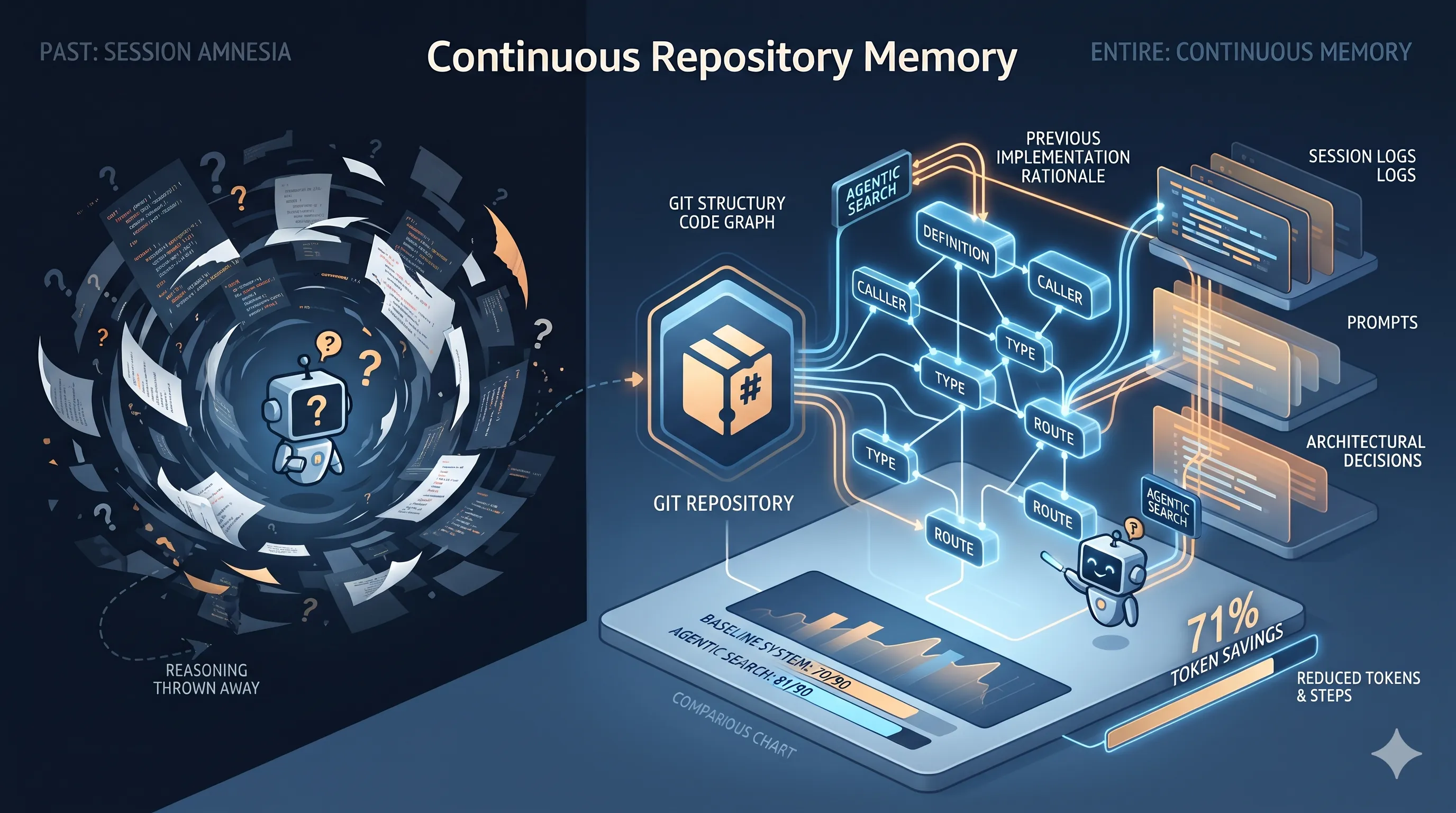
- Persistent repository memory: Continuous memory frameworks index structural maps and developer prompts directly in the repo, eliminating repeated context losses between agent runs.
- Frictionless CI and repo migration: Native compatibility with platforms like Buildkite and Depot pairs with live GitHub mirroring to prevent lock-in and workflow disruptions.
- Hybrid open-core licensing: Developer CLI utilities and structural graph parsers are open-sourced under permissive licenses, backed by token-metered cloud verification sandboxes.
- The rise of agentic version control: An emerging ecosystem of specialized source control platforms is fundamentally rethinking collaboration models to eliminate multi-agent merge bottlenecks.
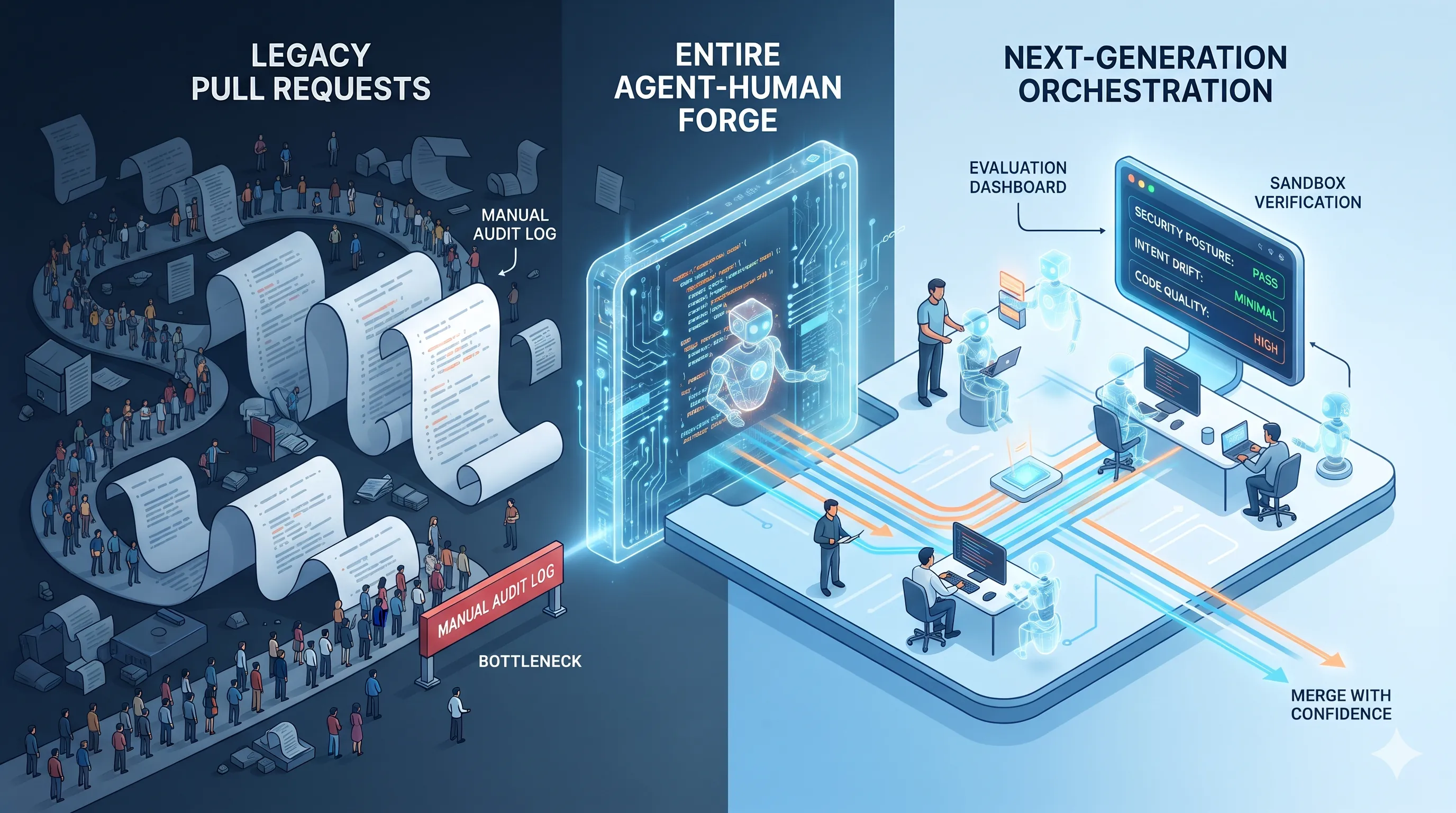
For nearly two decades, the pull request has reigned as the universal bedrock of software engineering collaboration, purposefully built for humans writing syntax and peers reading line-by-line diffs. However, the rise of autonomous coding agents capable of generating sweeping, multi-file codebases in seconds has pushed traditional source control to its breaking point. Legacy review queues have quickly degraded into unmanageable audit logs, shifting the engineering bottleneck from code production to orchestrating, validating, and auditing machine-authored changes.
The recent launch of Entire, an independent Git forge engineered specifically for agent-human collaboration, crystallizes a fundamental shift in the developer toolchain. Spearheaded by former GitHub CEO Thomas Dohmke, the platform rethinks every layer of the forge—replacing diff reviews with sandbox-backed evaluation dashboards, pairing high-concurrency distributed Git storage with repo-native memory, and turning agent reasoning traces into first-class review artifacts.
As software teams transition from manual coding to supervising autonomous agents, the race is underway to redefine how software is versioned, verified, and merged. Understanding how next-generation forges rethink the core mechanics of Git provides a vital roadmap for teams scaling AI-driven development without sacrificing code quality or security.
1. The Origins and Vision of Entire: Rethinking Source Control for Autonomous Agents
The evolution of developer platforms has reached a critical juncture as software creation shifts toward autonomous execution, requiring a Git forge that redefines Git workflows for AI coding agents.To address the structural limitations of platforms designed solely for human engineers, Entire emerged to build a dedicated control plane for agent-driven engineering.
Founding Leadership and the $60 Million Seed Round
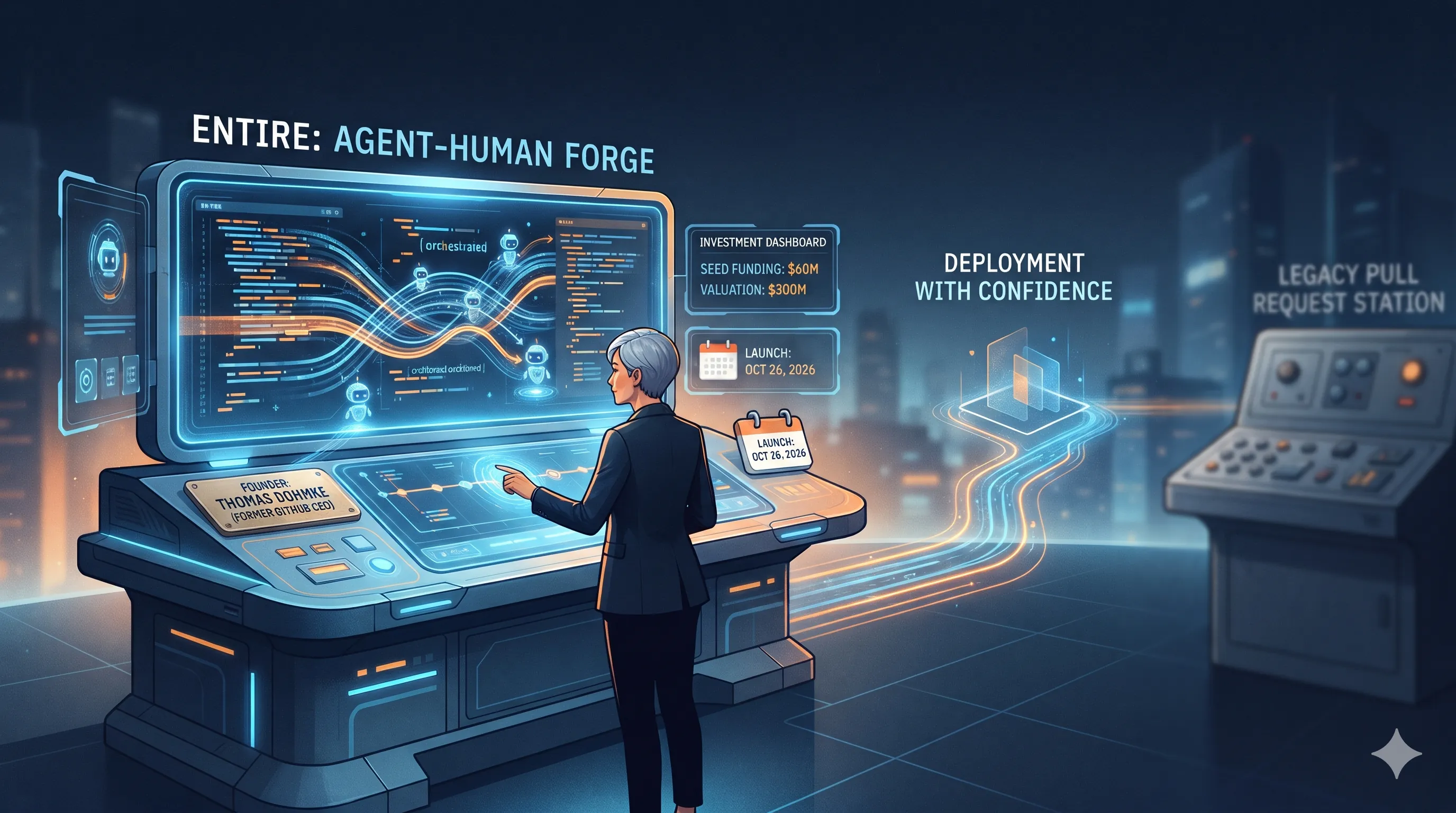
Entire was founded by former GitHub CEO Thomas Dohmke, bringing executive-level source control leadership to the challenge of machine-scale code generation.On February 10, 2026, the company raised a $60 million seed round at a valuation of $300 million.
The capital injection was backed by institutional venture firms including Felicis, Madrona, M12, Basis Set, 20VC, Cherry Ventures, Picus Capital, and Global Founders Capital.
Prominent industry figures also participated as angel investors, including Gergely Orosz and Theo Browne.
Operating with a global team of 50 people, Entire developed its architecture under strict real-world conditions.
Demonstrating conviction in its design principles, Entire built its platform using Entire itself, dogfooding the forge throughout its internal development cycle.
| Attribute | Details |
|---|---|
| Founder | Thomas Dohmke (Former GitHub CEO) |
| Forge Launch Date | October 26, 2026 |
| Seed Funding & Valuation | $60 million raised on February 10, 2026; $300 million valuation |
| Institutional Investors | Felicis, Madrona, M12, Basis Set, 20VC, Cherry Ventures, Picus Capital, Global Founders Capital |
| Angel Investors | Gergely Orosz, Theo Browne |
| Team Size & Operations | 50-person global team; platform built using Entire itself |
The Paradigm Shift: From Pull Requests to Agent Orchestration
Entire officially launched its Git forge on October 26, 2026, presenting a structural rethinking of software repositories.For over two decades, developer workflows were mediated by the pull request model, an abstraction engineered specifically for human reading speeds and manual reviews.
Thomas Dohmke observed that this approach no longer aligns with the realities of autonomous code generation: "The Pull Request revolutionized first open-source and later enterprise software development... But agents now write almost all of it, faster and more complex than ever before."
Because autonomous systems produce code at velocities and volumes that overwhelm manual review queues, the underlying forge must adapt its operational primitives.
Dohmke highlighted this distinction in Entire's operational vision: "GitHub and GitLab transformed human-to-human collaboration by centering it around asynchronous code reviews and version control. A multi-agent forge, by contrast, centers around the asynchronous orchestration, versioning, and auditing of AI agents working alongside humans."
By redesigning the repository around agent orchestration, verifiable auditing, and version tracking, Entire establishes an environment where synthetic agents and human engineers collaborate without the structural friction of legacy workflows.
2. Distributed Git Architecture and High-Throughput Push Performance
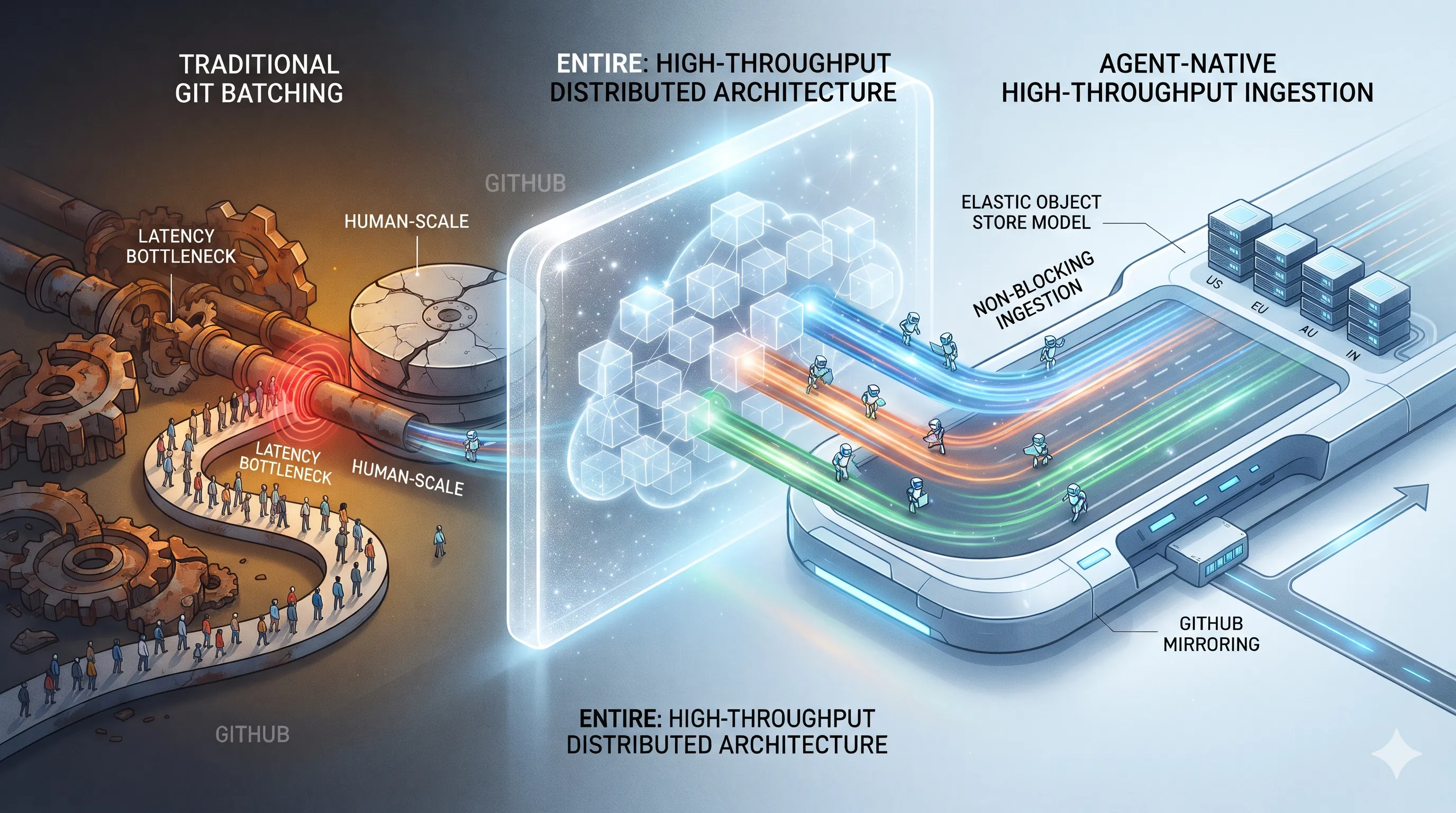
As autonomous software agents generate and commit code at machine speed, underlying repository infrastructure must evolve from human-scale batching to continuous, non-blocking ingestion.This performance shift directly underpins the broader movement where Git forges redefine traditional version control workflows to accommodate high-velocity AI coding agents.
Object-Store Infrastructure and 89x Push Acceleration
Traditional forge infrastructures encounter significant latency bottlenecks when handling simultaneous, bursty branch operations triggered by autonomous agents.Entire resolves this scalability barrier by implementing a distributed Git-compatible server built entirely on an object store architecture.
By replacing monolithic disk storage with an elastic object store model, repository operations bypass traditional file system lock contention during concurrent write states.
Performance benchmarks demonstrate the direct advantages of this decoupling.
Based on the ForgeMark benchmark, Entire enables Git pushes up to 89 times faster than GitHub.
When measured against agent-native competitors, Entire achieves push speeds 6 times faster than Cursor Origin.
However, it is critical to contextualize these performance gains.
Push throughput benchmarks primarily reflect high-concurrency multi-agent workloads rather than standard low-volume human team workflows.
| Platform / Environment | Core Architecture | ForgeMark Push Benchmark Relative Speed | Targeted Workload Profile |
|---|---|---|---|
| Entire | Distributed Git-compatible server with an object store architecture | 89x faster than GitHub; 6x faster than Cursor Origin | High-concurrency multi-agent workloads |
| GitHub | Traditional Git hosting architecture | Baseline benchmark reference (1x) | Standard low-volume human team workflows |
| Cursor Origin | Alternative coding agent forge architecture | Benchmarked at 1/6th the push speed of Entire | Agent-assisted code sync workloads |
Multi-Region Replication, GitHub Mirroring, and Migration Tools
To eliminate geographical latency and address data sovereignty requirements, Entire provides native hosting across four primary regions: the United States, European Union, Australia, and India.Developers can select a primary hosting region for their repositories while actively replicating data across any of the other supported regions to optimize distributed agent access.
Recognizing that enterprise ecosystems rely deeply on incumbent platforms, Entire incorporates bi-directional GitHub mirroring rather than demanding an immediate cutover.
Thomas Dohmke captured this non-exclusive approach, stating: "You don't need to leave, you can have both, we even offer GitHub mirroring."
Under this setup, repositories retain GitHub as their canonical source of truth while running automated Trails on pull requests within Entire.
This architecture also delivers operational fault tolerance.
If GitHub experiences unexpected downtime, Entire continues serving clones without interruption and allows development agents to push to unmirrored branches.
When organizations decide to transition completely off legacy hosts, Entire offers definitive repository migration paths.
Teams can permanently relocate repositories using the entire-migrate plugin, or execute an instant transition via a dedicated Detach control available for US-hosted mirrors.
3. Replacing Pull Requests with Trails: Evaluation Dashboards and Sandbox Verification
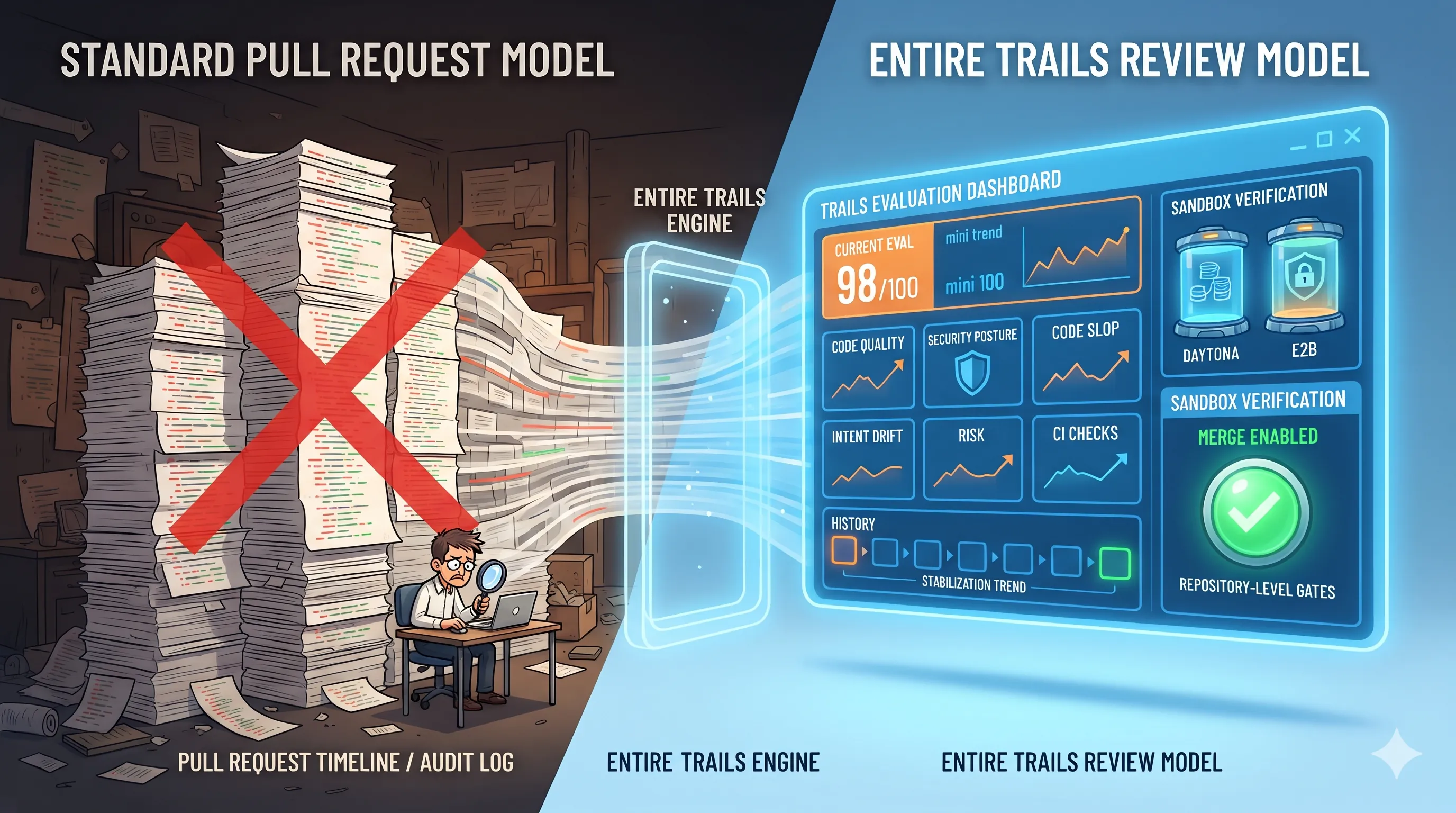
As Git platforms adapt to autonomous software generation, the industry focus within the topic "Git Forge Redefines Git Workflows for AI Coding Agents" shifts decisively from manual line-by-line inspection to high-level verification systems.Traditional code review mechanisms were engineered for human pacing, but the influx of synthetic commits renders line diffs increasingly unmanageable.
Thomas Dohmke observed this structural failure, noting: "The pull request [timeline] has become an audit log that only the agent reads. It does not provide the information for the developer to decide whether they can merge with confidence."
To resolve this limitation, the Trails review model replaces standard diff-based pull request timelines with a heads-up evaluation dashboard.
Thomas Dohmke explained the philosophy behind this paradigm shift: "With Trails, Entire treats the idea, the agent trace, and the outcome of a developer’s sessions as first-class artifacts for review alongside the code."
The Trails Dashboard and Multi-Repository Evaluation Runs
A Trail can initiate from a bug report, a feature request, or an agent push, dynamically adapting to the operational trigger.Unlike isolated pull requests bounded by single repositories, a Trail can span multiple Git repositories to track complex, distributed changes orchestrated by AI agents.
The Trail interface displays eval scores for the current run and the previous 5 evaluation runs, enabling developers to monitor stabilization trends over time.
This visual history directly addresses generation volatility: one-shot generation loops frequently miss critical defects, requiring iterative loops to stabilize eval scores before code reaches production readiness.
| Dimension | Standard Pull Request Model | Entire Trails Review Model |
|---|---|---|
| Review Surface | Diff-centric timeline of commits and manual comments | Heads-up evaluation dashboard tracking current and previous 5 evaluation runs |
| Repository Scope | Limited to a single repository branch comparison | Spans single or multiple Git repositories from one bug report, feature request, or agent push |
| Execution Environment | Static diff viewer with standard continuous integration pipelines | Review agents executing inside isolated cloud sandboxes, including Daytona and E2B |
| Audit Scope | Manual human diff review and unit test assertions | Automated evaluation of code quality, security posture, code slop, risk, and intent drift |
| Merge Preconditions | Manual peer approvals and passing CI status checks | Repository-level Gates requiring green eval scores, cleared or resolved findings, and passing CI checks |
Automated Review Sandboxes, Code Slop Detection, and Merge Gates
To audit incoming changes thoroughly, review agents execute in cloud sandboxes (including Daytona and E2B) powered by models like Claude Code and Codex.Developers configure evaluation agents via Entire's UI or repository-level JSON configuration files, tailoring review criteria to the project's exact operational requirements.
A $100 starter credit is provided at launch for review-agent tokens to support initial sandbox executions.
Within these sandboxed runtimes, automated evals assess code quality, security posture, code slop, risk, and intent drift.
When deviations or vulnerabilities occur, review agents generate findings with exact code locations, severities, and suggested fixes, allowing agents or human collaborators to patch issues directly at the source.
Strict repository-level Gates enforce compliance prior to merging, requiring green eval scores, cleared or resolved findings, and passing CI checks before any Trail is integrated.
4. Continuous Repository Memory: Structural Code Graphs and Session Indexing
In the evolving landscape where a modern Git forge redefines Git workflows for AI coding agents, continuous repository memory addresses a foundational deficiency in automated software engineering.Without continuous memory, coding agents start each development session completely from scratch and repeatedly make prior architectural mistakes.
As Haimantika observed regarding this historical context, "...the reasoning gets thrown away between the person and the artifact. Commit messages were always bad, docs always rotted, "why is this here" was always answered by whoever remembered. Agents just made that acute, because now there's no one who remembers."
To bridge this gap, continuous memory architectures capture agent session logs, prompts, and architectural decisions directly within the repository itself.
As Thomas Dohmke stated, "Session logs are now the second most important artifact in software development, and they belong in the repo."
Local Tree-Sitter Parsing with entire-graph and entire-brain
The continuous repository memory pipeline is driven by specialized open-source tooling designed to map and index software state without external dependencies.The open-source entire-graph tool parses repositories locally using tree-sitter to build structural maps of definitions, callers, types, and routes without making any network calls.
By executing strictly on the local machine, entire-graph extracts precise language semantics and relational references while maintaining full data isolation.
Complementing the structural parser, the open-source entire-brain tool indexes recorded agent sessions directly against this structural codebase map.
Session capture is handled at the operational level by the Entire CLI, which records terminal-based agent sessions and integrates seamlessly across tools such as Claude Code, Codex, Gemini CLI, Cursor, and Grok Build.
To maintain strict repository security and prevent credential leakage, the session capture pipeline automatically detects and redacts secrets before any data is written to storage.
| Component / Workflow | Operational Role | Core Mechanism & Integrations |
|---|---|---|
| entire-graph | Structural Codebase Mapping | Local tree-sitter parsing of definitions, callers, types, and routes without network calls. |
| entire-brain | Session Memory Indexing | Indexes recorded agent sessions against the structural codebase map. |
| Entire CLI | Session Ingestion & Toolchain Hook | Captures terminal sessions across Claude Code, Codex, Gemini CLI, Cursor, and Grok Build with automated secret redaction. |
| Agentic Search | Cross-Artifact Context Retrieval | Combines exact symbol-aware search with semantic search across code, commits, and session logs. |
Persistent Agentic Search and Contextual Token Optimization
Persisting agent reasoning alongside the codebase enables advanced retrieval workflows that fundamentally change agent efficiency.The system supports agentic search across code, commits, and sessions by uniting exact symbol-aware search with semantic search.
Rather than inundating model contexts with raw source dumps or incomplete diff histories, agents query the indexed session logs and structural maps to retrieve the precise historical rationale behind previous implementation choices.
In benchmark evaluations, continuous memory achieves up to 71% token savings in Entire's benchmark testing.
Furthermore, in evaluations assessing contextual codebase history, agents utilizing agentic search successfully answered 81 out of 90 codebase history questions, compared to 70 answered correctly by baseline systems.
This superior query resolution was achieved while consuming under half the tokens and steps required by standard baseline systems, illustrating that structured in-repo session memory is critical for reliable agent operations.
5. Native CI Orchestration and GitHub Actions Migration Pathways
As the Git forge redefines Git workflows for AI coding agents, continuous integration must adapt to rapid, automated agent commits without introducing verification bottlenecks.Entire addresses this by pairing its repository layer directly with specialized CI orchestration platforms, ensuring automated agent outputs undergo immediate validation.
External CI Integration with Buildkite and Depot
Entire integrates natively with external CI platforms Buildkite and Depot to handle high-frequency agent workloads.Under this orchestration architecture, CI builds trigger on every agent push, and build/test status reports directly into the Trails dashboard.
This setup eliminates human polling and surfaces execution health alongside agent progress.
Kevin Gounden emphasized the capability of this infrastructure: "Entire already runs its own CI on Buildkite, and now every team on Entire has access to the CI orchestration platform frontier AI labs rely on..."
Addressing the pipeline latency created by automated code generation, Kyle Galbraith noted: "The bottleneck has shifted from writing code to everything after it, and Depot CI gives developers and agents fast, reliable CI that runs the GitHub Actions workflows they already have."
| CI Platform | Entire Integration Role | Migration Utility | Target Configuration |
|---|---|---|---|
| Buildkite | Triggers on every agent push; reports build/test status directly into the Trails dashboard | bk pipeline convert |
Buildkite pipeline definitions |
| Depot | Triggers on every agent push; reports build/test status directly into the Trails dashboard | depot ci migrate |
Depot CI platform configurations |
Command-Line Workflow Migration: Converting GitHub Actions
To prevent disruption when moving from legacy stacks, both supported CI platforms provide dedicated command-line conversion tools.Teams convert existing GitHub Actions workflows for execution on Buildkite CI with Entire to retain existing test logic across agent-driven branches.
bk pipeline convertSimilarly, development teams migrate GitHub Actions workflows to Depot CI for native execution on Entire.
depot ci migrate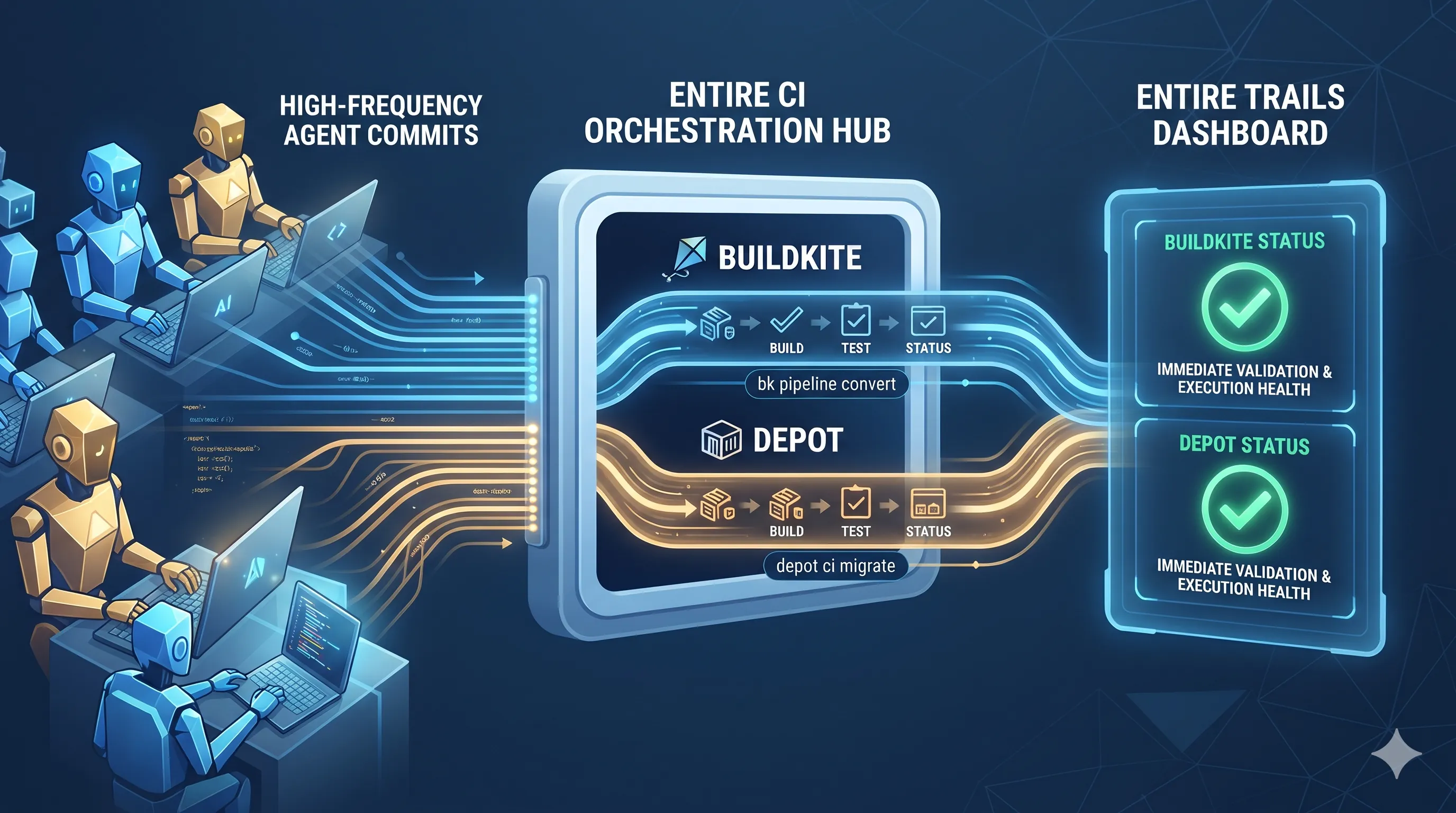
6. Licensing Structure, Token Consumption Pricing, and Product Roadmap
As autonomous developers shift from experimental scripts into production pipelines, the operational economics and governance of the forge dictate adoption.Understanding Entire's commercial architecture reveals how this Git forge redefines Git workflows for AI coding agents, establishing a clear line between local tooling transparency and managed cloud intelligence.
Hybrid Open-Source Licensing and Token-Based Metering
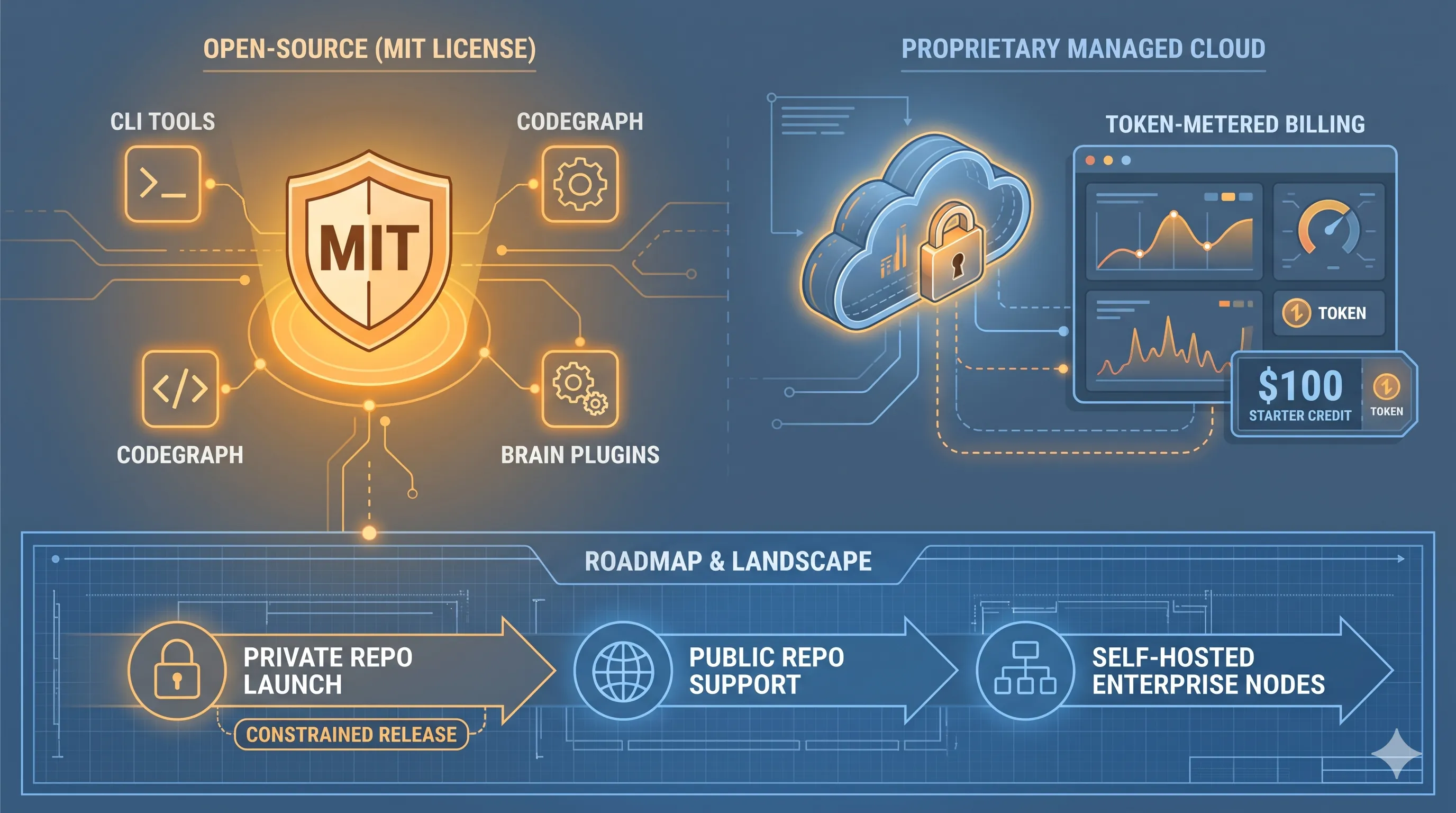
Entire establishes a hybrid distribution strategy that divides client-side execution utilities from central review systems.The platform releases its core developer-facing components—specifically the Entire CLI, entire-graph, and entire-brain plugins—as open source under the MIT license.
Conversely, the centralized infrastructure running the hosted Git forge and the Trails dashboard remains closed source.
This separation allows teams to audit and integrate local agent tools freely while relying on proprietary managed environments for state observation.
Instead of publishing fixed tiered pricing plans, Entire aligns operating expenses directly with model utilization.
Teams receive a $100 starter credit for evaluation tokens at launch to validate agent workflows.
Once those initial credits are exhausted, billing is calculated directly on review-agent token consumption at prevailing market rates.
Because no fixed subscription tiers exist beyond this token-consumption model, resource expenditure scales in direct proportion to the volume of automated agent review activity.
| Platform Component / Feature | Licensing Model | Launch Availability & Commercial Terms |
|---|---|---|
| Entire CLI | Open Source (MIT) | Available at launch; client-side tool |
| entire-graph | Open Source (MIT) | Available at launch; dependency graphing plugin |
| entire-brain | Open Source (MIT) | Available at launch; context management plugin |
| Hosted Git Forge & Trails Dashboard | Proprietary (Closed Source) | Managed hosted service; $100 starter evaluation credit |
| Review-Agent Execution | Proprietary Metering | Billed at market rates per token consumed; no fixed tiers |
Launch Scope Limitations and the Platform Expansion Roadmap
While the core architecture supports autonomous agent interaction, the launch platform operates under specific structural constraints.At launch, Entire exclusively supports private Git repositories.
Organizations cannot host public open-source projects on the platform at initial deployment, nor does Entire offer self-hosted deployment nodes for on-premises infrastructure.
Teams adopting the forge must operate entirely within the managed private repository boundary.
The engineering roadmap directly addresses these deployment constraints with several scheduled milestones.
Planned roadmap features include native support for public repositories to accommodate open-source agent ecosystems.
Additionally, the platform roadmap commits to delivering self-hosted Git nodes, enabling enterprises to maintain data sovereignty behind internal firewalls.
Future platform releases also plan to introduce live-streamed sessions, extending visibility into live coding workflows as autonomous agents execute tasks.
7. The Emerging Agentic SCM Landscape: Concurrency and Isolation Challenges
As autonomous software engineering evolves, the emergence of Entire and specialized git forge architectures directly addresses the fundamental friction between standard version control systems and autonomous coding agents.Understanding this shift requires analyzing Entire alongside a growing ecosystem of agent-centric source code management platforms and tooling architectures.
Competitive Dynamics: Cursor Origin, Zed DeltaDB, and Scion
Multiple new source code management platforms and specialized tools have emerged targeting AI agent collaboration, creating a distinct category of agent-centric developer infrastructure.Within this landscape, platforms such as Cursor Origin, Zed DeltaDB, Anthropic Scion, East River Source Control, and Radicle approach agent workflows with tailored collaborative mechanisms.
Specifically, Cursor Origin provides Git-compatible code hosting engineered directly for high-concurrency agent reviews and automated merges.
These solutions highlight an industry-wide pivot away from human-paced pull requests toward systems engineered for rapid, machine-driven iteration.
| Platform / Tool | Focus and Architectural Capabilities |
|---|---|
| Cursor Origin | Git-compatible code hosting designed for high-concurrency agent reviews and merges. |
| Zed DeltaDB | Source code management platform targeting AI agent collaboration. |
| Anthropic Scion | Tooling architecture oriented toward AI agent collaboration workflows. |
| East River Source Control | Platform targeting AI agent collaboration and source code management. |
| Radicle | Source code management platform supporting AI agent collaborative environments. |
| Forge (ForgeAILab) | Workflow tooling implementing isolated worktrees and continuous integration (CI) gates for multi-agent execution. |
Resolving Multi-Agent Branch Collisions and Workspace Concurrency
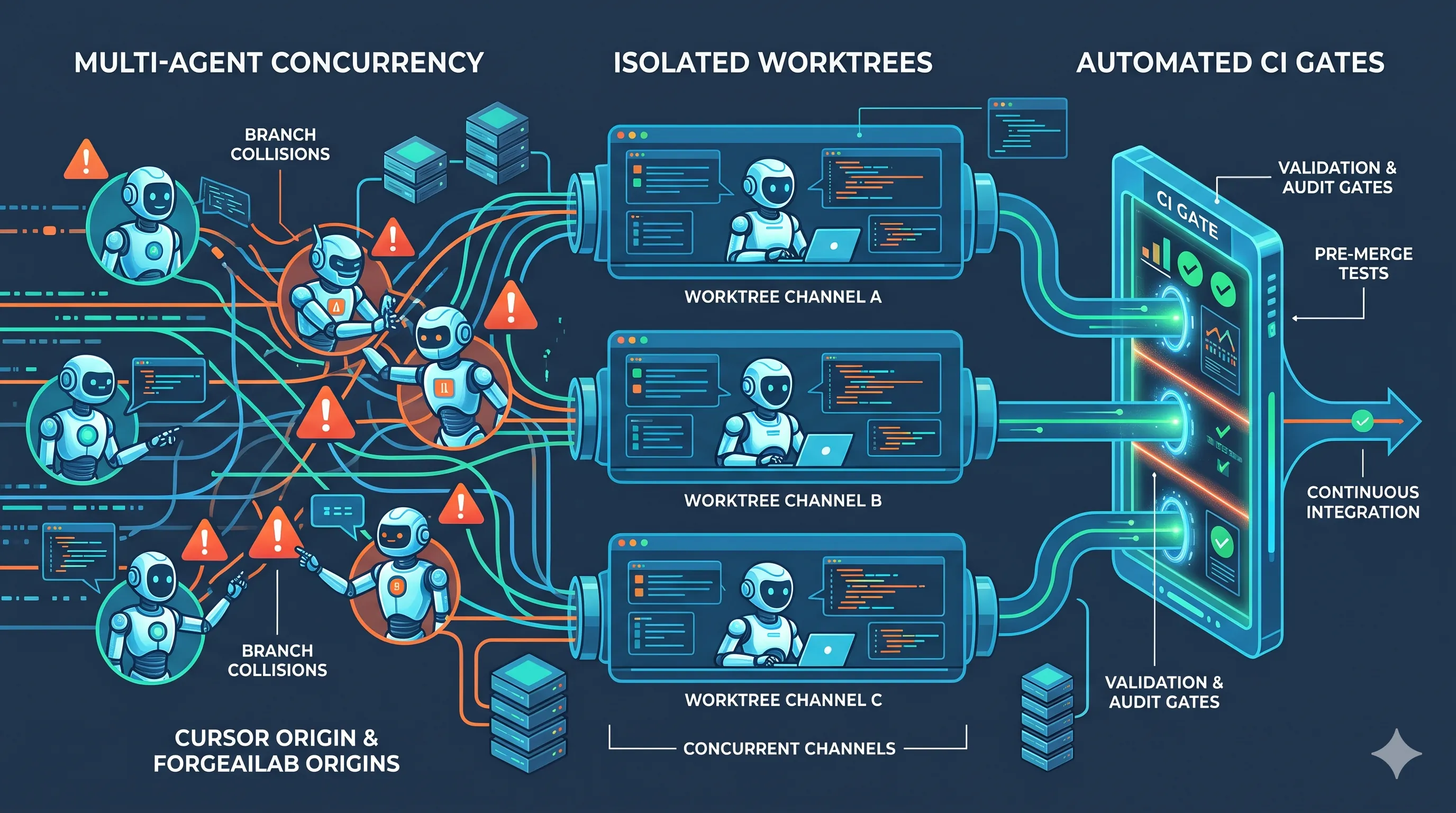
The principal challenge across all multi-agent architectures lies in workspace contention.Running multiple coding agents simultaneously often results in diff collisions or branch conflicts when interacting with shared code trees.
When multiple agents attempt concurrent updates against identical repository paths, standard branching strategies rapidly deteriorate into overlapping changesets and merge stalls.
To resolve these bottlenecks, alternative agent workflow tools like Forge (ForgeAILab) implement isolated worktrees paired with automated CI gates for multi-agent execution.
By isolating each agent's execution inside an independent worktree, the system prevents mutual file locks and intermediate diff overlap.
Enforcing structured CI validation gates prior to code integration ensures that concurrent agent tasks proceed without destabilizing the shared source tree.
Related Posts

How Frontier AI Models Are Rewriting Theoretical PhysicsExplore how frontier AI models and autonomous agents are transforming theoretical physics,...
OpenAI GPT-6.2 Billing Fix: Astra Hits Limits 40% FasterOpenAI fixes a GPT-6.2 launch billing bug, causing Astra limits to hit 40% faster and Sol 25%...
How GPT-6 Achieves Intrinsic Protein Design Without Specialized AIDiscover how GPT-6 models achieve intrinsic protein design and de novo minibinder generation using...
Generative AI may have assisted with research or drafting for this article. Topic selection, fact-checking, final wording, and publication remain the responsibility of DragonStone74. AI use disclosure