
BitNet b1.58 Ternary Quantization: CPU-Native Inference and Hardware Efficiency
🚀 Key Takeaways
- Radical Architectural Shift: Native 1.58-bit models replace floating-point matrix multiplications with simple integer addition and subtraction, shrinking memory requirements by up to tenfold.
- Severing Cloud GPU Dependencies: Highly optimized ternary execution enables enterprise workloads to run directly on commodity CPUs and consumer hardware without requiring discrete accelerators.
- Over 90% Cost Evaporation: Shifting recurring token workloads from cloud GPU clusters to local CPU environments eliminates massive monthly cloud bills and shortens infrastructure break-even cycles.
- Preserved Algorithmic Accuracy: Quantization-aware training ensures ternary architectures maintain reasoning and comprehension parity comparable to standard full-precision baselines.
- High-Speed On-Device Intelligence: Consumer laptops and smartphones can now run multi-billion-parameter edge models locally at over a hundred tokens per second with total data sovereignty.
- Specialized Kernel Prerequisite: Capturing these performance and thermal gains requires purpose-built ternary execution runtimes rather than legacy deep learning framework stacks.
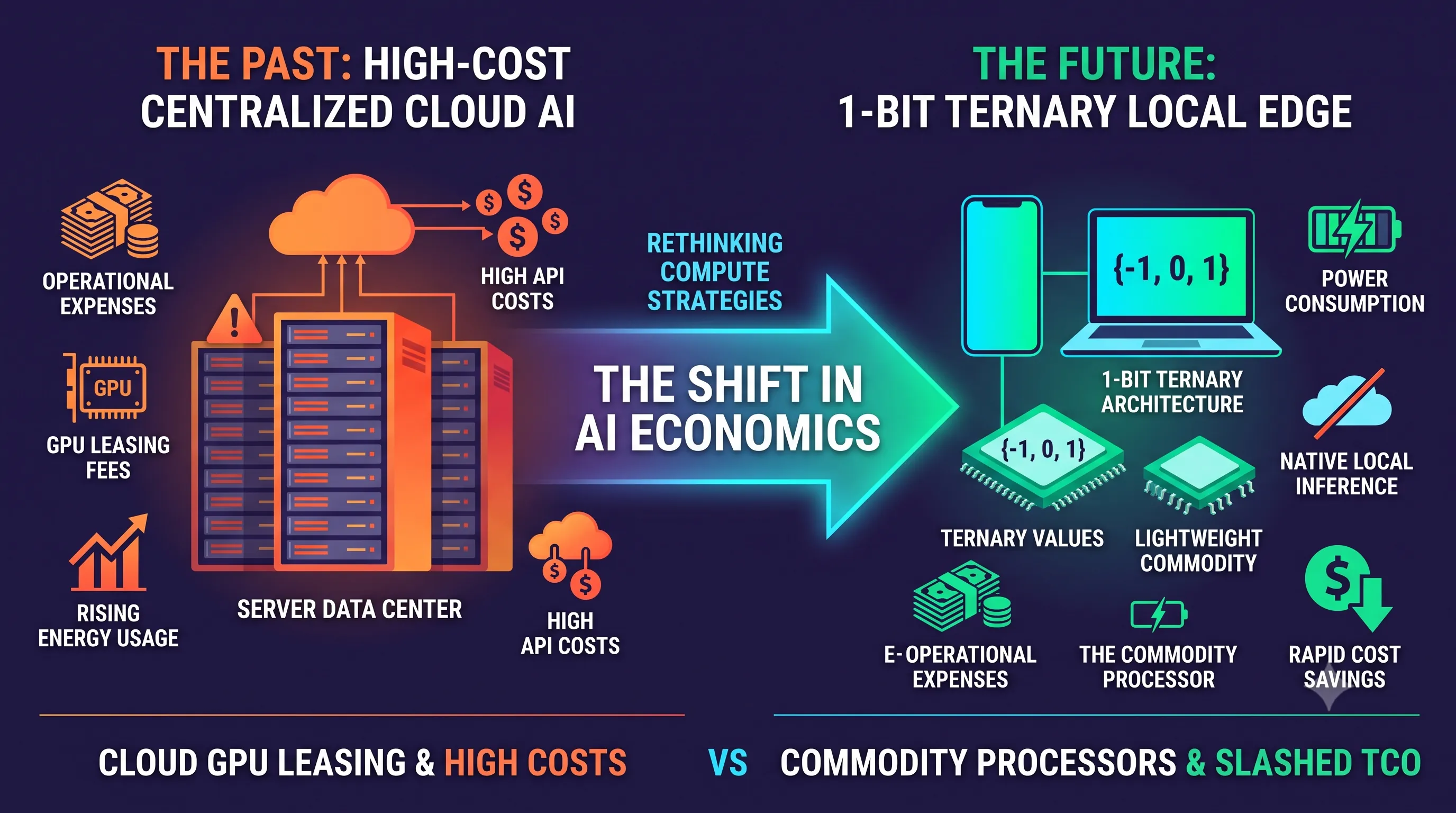
The unsustainable operational expense of hosting generative AI inference has triggered a fundamental reassessment of enterprise compute strategies.
For years, organizations accepted high recurring cloud GPU leasing fees, elongated hardware procurement timelines, and compounding API costs as the inevitable price of running capable language models.
The emergence of native 1-bit ternary architectures has disrupted this economic reality by proving that high-accuracy language processing does not require energy-intensive floating-point arithmetic.
By restructuring weights around ternary values, these models enable commodity processors and mobile system-on-chips to execute generative tasks with exceptional throughput, slashing power consumption and operational expenditures.
As local edge deployments match the functional capabilities of traditional server-side workloads, the locus of AI economics has decisively shifted from centralized data centers to client-side silicon.
Engineering leaders and systems architects must now evaluate how ternary model pipelines can eliminate infrastructure bottlenecks, protect sensitive user data, and redefine total cost of ownership.
1. Architectural Foundations: The Ternary Quantization Mechanics of BitNet b1.58
The sudden collapse of edge inference infrastructure costs stems directly from replacing standard matrix arithmetic with low-bit architectures.By fundamentally altering the parameter representations inside the transformer block, BitNet b1.58 reshapes the economic feasibility of hosting powerful models on local devices.
BitLinear Layer Architecture and Ternary Weight Constraints
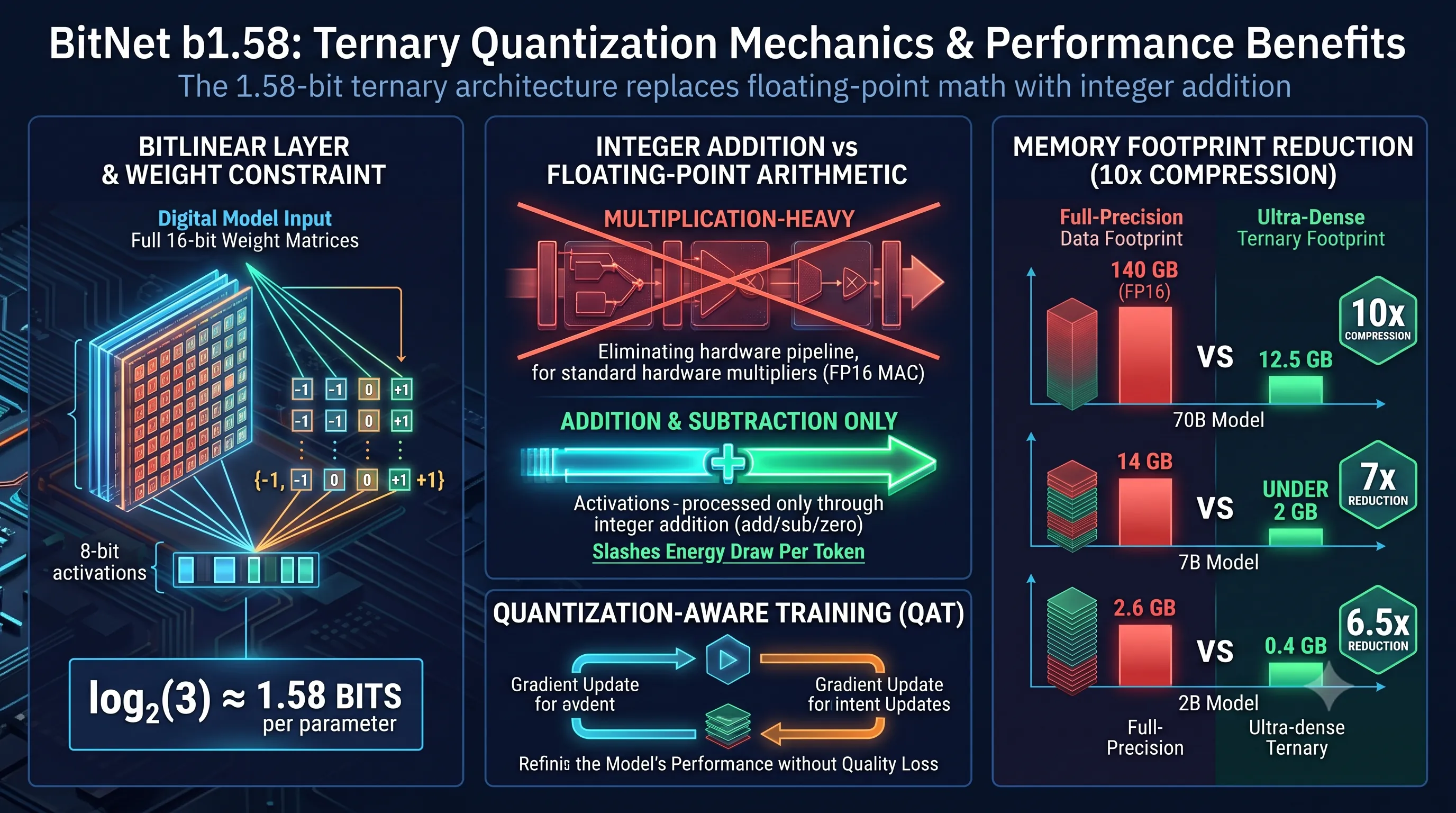
As defined by Ma et al. (2024), the BitNet b1.58 architecture constrains weight parameters exclusively to ternary values: {-1, 0, +1}.From an information-theoretic standpoint, storing three discrete states requires log2(3), which resolves mathematically to approximately 1.58 bits per parameter.
To operationalize this representation, BitLinear layers replace standard transformer linear layers by swapping floating-point weight matrices with ternary matrices.
Across layer boundaries, BitNet b1.58 pairs these 1.58-bit ternary weights with 8-bit precision activations.
This hybrid arrangement preserves the dynamic range required for intermediate activations while stripping parameter representations down to three fundamental states.
Integer Addition Mechanics vs. Floating-Point Arithmetic
Conventional transformer architectures demand high-power hardware multipliers to execute continuous floating-point matrix multiplications.Inside BitLinear layers, floating-point matrix multiplications are substituted with integer additions and subtractions.
Because every weight element is restricted to {-1, 0, +1}, the core linear projection simplifies into selecting, negating, or zeroing the incoming 8-bit activations.
Eliminating floating-point multiply-accumulate (MAC) pipelines removes the primary computational bottleneck of autoregressive inference on edge silicon.
Device processors can execute tensor operations purely via addition and subtraction accumulators, dramatically lowering energy draw per generated token.
Quantization-Aware Training and Memory Footprint Reduction
Achieving viable perplexity at 1.58 bits requires a fundamental departure from legacy model compression routines.Standard post-training quantization cannot produce true native 1-bit model efficiency and accuracy.
To bypass the severe fidelity losses typical of post-training rounding, models are trained from scratch using quantization-aware training (QAT) to preserve representational fidelity within ternary constraints.
Through QAT, gradient updates guide weights to settle into optimal ternary states throughout the optimization process.
This radical reduction in parameter precision slashes working memory footprints across model scales.
A 70-billion-parameter 1.58-bit model requires 12.5 GB of weight storage compared to 140 GB in FP16 precision, representing a 10x compression.
A 7-billion-parameter model in standard 16-bit format occupies 14 GB of memory, shrinking to under 2 GB in 1-bit format.
At the smaller end of the spectrum, Microsoft's 2-billion-parameter BitNet model operates in 0.4 GB of memory compared to 2.6 GB for equivalent full-precision models.
| Model Scale (Parameters) | Full-Precision / Baseline Memory | 1.58-Bit / 1-Bit Memory Footprint | Compression Metric |
|---|---|---|---|
| 70 Billion (70B) | 140 GB (FP16) | 12.5 GB | 10x compression |
| 7 Billion (7B) | 14 GB (16-bit) | Under 2 GB | Over 7x reduction |
| 2 Billion (2B, Microsoft) | 2.6 GB (Full-precision) | 0.4 GB | 6.5x reduction |
2. Hardware Execution: CPU-Native Inference and Silicon Efficiency Benchmarks
The core thesis of collapsing inference infrastructure expenses rests on eliminating the dependency on discrete GPUs and transferring generative workloads directly to pervasive CPU architectures.By replacing floating-point tensor arithmetic with ternary integer addition and subtraction, 1-bit models enable local client and commodity server hardware to handle generation cycles that previously demanded dedicated accelerator clusters.
Commodity CPU Execution on x86 and ARM Architectures
Inference executes entirely on commodity CPUs and edge devices without requiring discrete GPUs.Standard server and desktop processors demonstrate substantial throughput gains when processing 1.58-bit ternary structures compared to traditional floating-point or quantized baselines.
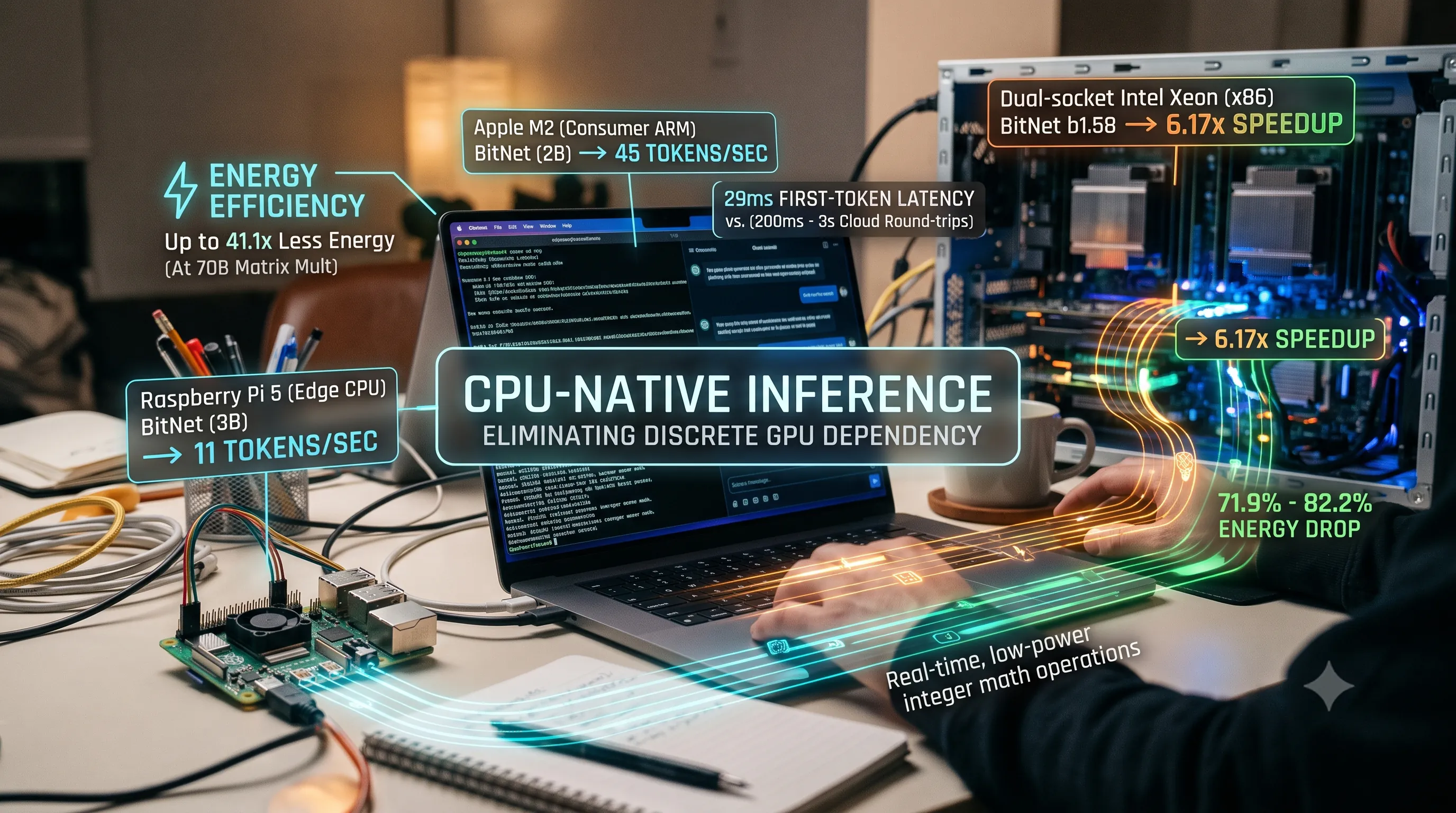
On x86 CPU architectures, BitNet inference runs 2.37x to 6.17x faster while consuming 71.9% to 82.2% less energy.
At the server tier, BitNet deployed on a dual-socket Intel Xeon achieves a 6.17x speedup over an INT4-quantized baseline running on llama.cpp.
At the 3.9B scale, BitNet achieves 1.57x faster inference compared to FP16 Llama baselines on identical hardware setups.
ARM CPU architectures display an analogous efficiency trajectory, registering 1.37x to 5.07x faster generation alongside a 55% to 70% energy reduction.
When evaluated on high-end ARM silicon, BitNet b1.58 on an Apple M2 Ultra registers a 5.07x faster inference rate than llama.cpp executing an INT4-quantized baseline.
| Hardware Platform / Silicon Tier | Model Architecture / Scale | Baseline Comparison | Throughput / Latency Metric | Energy Consumption Delta |
|---|---|---|---|---|
| Dual-socket Intel Xeon (x86) | BitNet b1.58 | llama.cpp (INT4 quantization) | 6.17x speedup | 71.9% to 82.2% energy drop (x86 range) |
| Apple M2 Ultra (ARM) | BitNet b1.58 | llama.cpp (INT4 quantization) | 5.07x speedup | 55% to 70% energy drop (ARM range) |
| Identical Hardware Benchmark | BitNet (3.9B) | Llama baseline (FP16) | 1.57x speedup | Not specified |
| Apple M2 | BitNet (2B) | Discrete GPU standard requirement | 45 tokens per second | 55% to 70% energy drop (ARM range) |
| Raspberry Pi 5 | BitNet (3B) | Edge CPU baseline | 11 tokens per second | Low-power embedded envelope |
| Commodity / Consumer CPU | BitNet b1.58 (100B) | Multi-GPU cluster requirement | 5 to 7 tokens per second | Native CPU power profile |
| Modern Commodity CPU | BitNet (2B) | Cloud round-trips (200ms to 3s) | 29ms first-token latency | Sub-50ms local response loop |
Edge Device Generation Rates from Raspberry Pi to Apple Silicon
The hardware requirements for real-time generative execution shift downward into consumer and maker-grade hardware.A 3-billion-parameter BitNet model achieves 11 tokens per second on a Raspberry Pi 5, demonstrating functional text generation on low-cost single-board computers without coprocessor support.
Scaling upward to integrated personal computing silicon, a 2-billion-parameter BitNet model generates 45 tokens per second on an Apple M2 chip.
At the highest parameter boundaries, execution realities reflect compute tradeoffs.
A 100-billion-parameter 1.58-bit model executes at 5 to 7 tokens per second on a single commodity/consumer CPU.
Large models running at 100B parameters on commodity CPUs achieve 5 to 7 tokens per second, which is suitable for non-real-time workloads rather than high-throughput serving.
Energy Multipliers and First-Token Latency Profiles
Silicon-level efficiency stems from the elimination of power-hungry floating-point multiply-accumulate operations.Integer operations on 7nm silicon reduce energy per arithmetic operation by a factor greater than 70.
At extreme model scales, BitNet b1.58 at 70B parameters consumes 41.1x less energy during matrix multiplication compared to FP16 baselines.
Beyond aggregate throughput and power conservation, ternary integer calculations permit sub-50-millisecond response loops directly on local client hardware.
On-device local inference for a 2B model reaches 29ms first-token latency on modern CPUs versus 200ms to 3s cloud round-trips.
This deterministic 29ms initial response bypasses network variability entirely, establishing local CPU execution as an operationally viable model for interactive on-device computing.
3. Verification and Representational Fidelity: Preserving Reasoning in Native 1-Bit Pre-Training
The core driver behind the economic transformation of local AI devices—where inference infrastructure overhead evaporates—rests on whether radical weight quantization can preserve complex cognitive performance.Achieving massive computational and cost savings is only viable if low-bit representations maintain full fidelity across rigorous analytical tasks.
Algorithmic Validation on 4-Trillion-Token Pre-Trained Weights
Conventional post-training quantization methods frequently suffer from severe fidelity degradation, especially when compressing weights down to extreme low-bit precisions.In contrast, native ternary architectures bypass post-training quantization drops by training the network from scratch directly with extreme low-bit constraints.
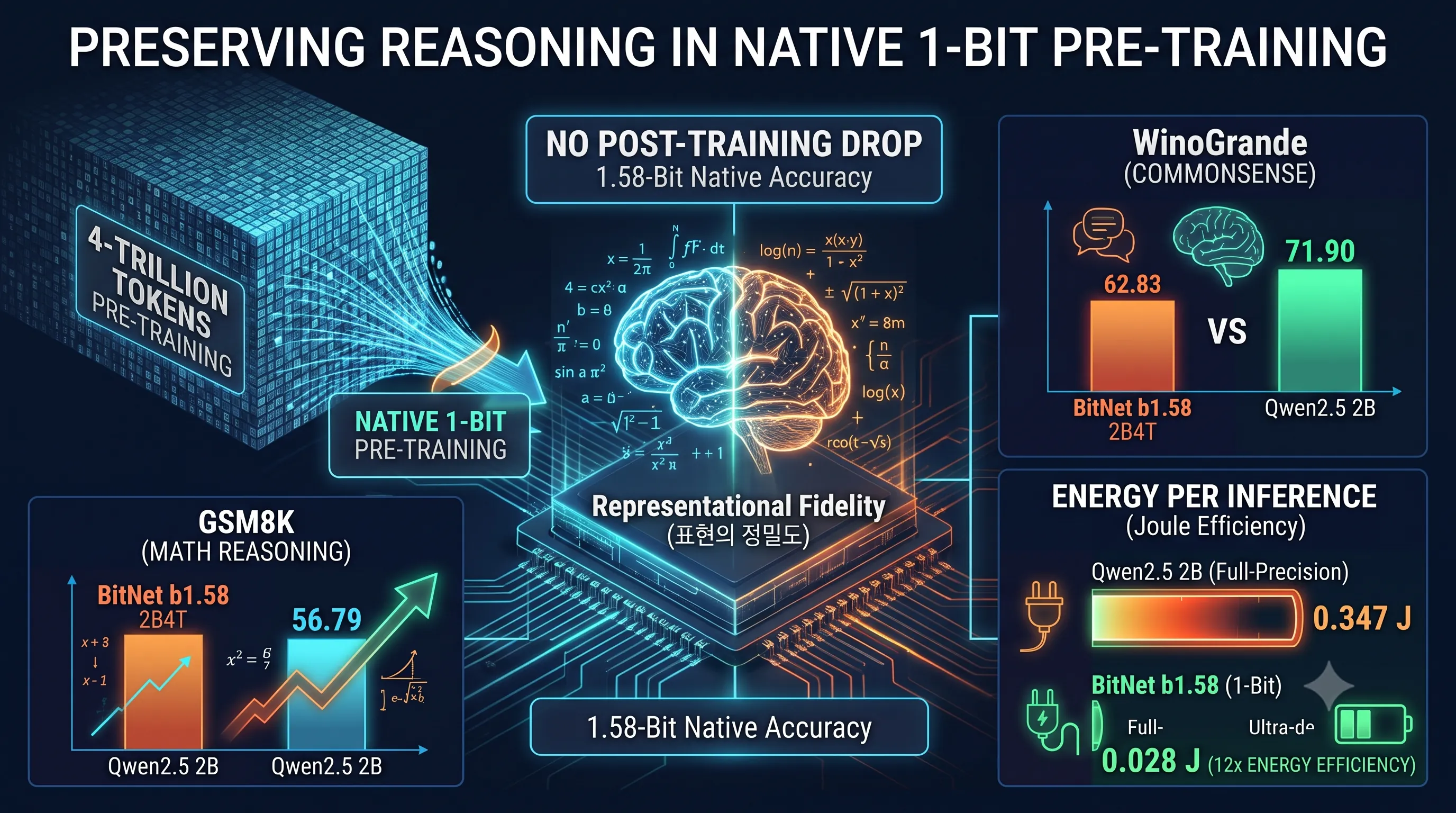
A prime manifestation of this paradigm is BitNet b1.58 2B4T, which was pre-trained from scratch on 4 trillion tokens.
Through native 1-bit pre-training, the model constructs stable internal representations during the initial optimization phase rather than attempting to recover lost parameters after convergence.
Consequently, native 1-bit models preserve mathematical reasoning and language comprehension without post-training accuracy drops, proving that low-bit weights can natively support sophisticated algorithmic processing.
Mathematical and Commonsense Reasoning Benchmarks
Empirical validation across standardized benchmarks confirms that native ternary pre-training rivals and even surpasses full-precision baselines of comparable scale.On the GSM8K mathematical reasoning benchmark, BitNet b1.58 2B4T achieves a score of 58.38, outperforming Qwen2.5 2B, which scores 56.79.
In commonsense linguistic evaluation, the model demonstrates even greater separation: on WinoGrande, BitNet b1.58 2B4T reaches 71.90, compared to 62.83 recorded by Qwen2.5 2B.
Across broader evaluations, BitNet b1.58 2B4T exhibits an overall benchmark average within approximately 1 point of comparable full-precision models.
This retention of representational fidelity scales across parameter classes as well; BitNet b1.58 at 3B parameters scores within 1.5% of full-precision Llama-2 3B on the Winogrande benchmark.
| Model Architecture | GSM8K (Math Reasoning) | WinoGrande (Commonsense) | Benchmark Parity Delta | Energy per Inference (Joules) |
|---|---|---|---|---|
| BitNet b1.58 2B4T (4T Pre-Trained Tokens) | 58.38 | 71.90 | Within approx. 1 point of full-precision average | 0.028 J |
| Qwen2.5 2B (Full-Precision Baseline) | 56.79 | 62.83 | Baseline reference | 0.347 J |
| BitNet b1.58 3B | — | Within 1.5% of Llama-2 3B | Within 1.5% of Llama-2 3B | — |
Energy Parity: Per-Inference Joule Efficiency
The retention of reasoning capability is accompanied by an unprecedented reduction in operational energy draw, directly altering the economics of on-device inference.During active execution, BitNet b1.58 consumes only 0.028 joules per inference, whereas Qwen2.5 requires 0.347 joules for the equivalent task.
This delivers roughly a 12x energy efficiency advantage in runtime power consumption.
By eliminating memory-bandwidth-heavy floating-point operations while preserving mathematical and commonsense reasoning scores, native ternary pre-training validates that high-order cognitive tasks can run locally on constrained power budgets without compromising precision.
4. Infrastructure Economics: Eradicating Enterprise GPU Capital and Operating Costs
The transition to 1-bit and 1.58-bit model architectures establishes the economic foundation for local AI device economics, directly dismantling the multi-billion-dollar operational barrier of enterprise inference infrastructure.By eliminating excessive memory bandwidth and high-precision floating-point arithmetic demands, 1-bit quantization evaporates up to 90% or more of recurring inference hosting expenditure, shifting high-performance generation from centralized hyperscaler server racks onto localized hardware.
Cloud GPU Opex vs. On-Premise CPU Cluster Economics
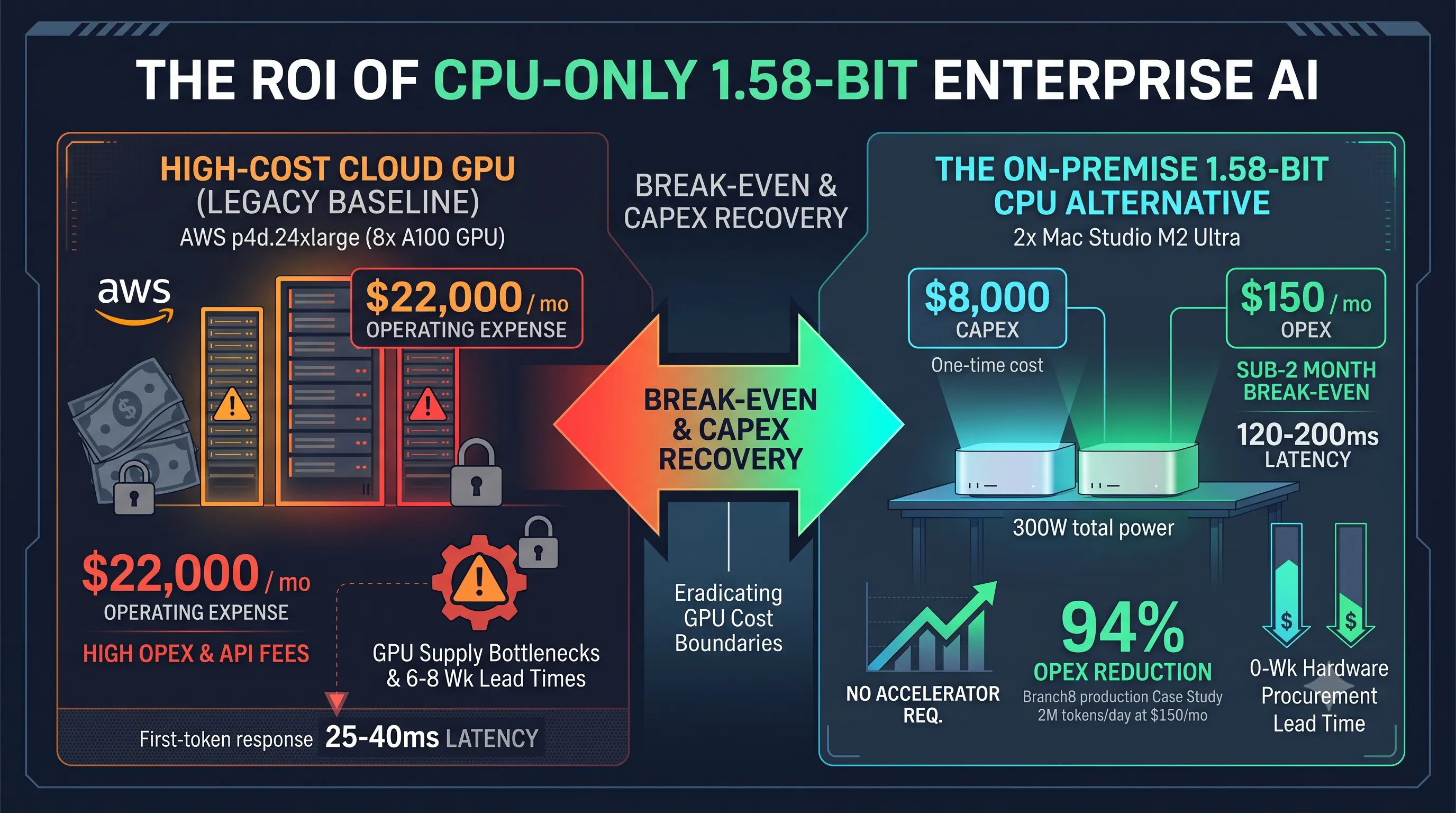
Sustaining production-grade large language models within enterprise cloud environments creates compounding operating costs.Running FP16 inference for Llama 2 70B on cloud GPU infrastructure such as an AWS p4d.24xlarge instance (equipped with 8x NVIDIA A100 GPUs) costs approximately US$22,000 per month to maintain a sustained throughput of 500,000 tokens per day.
To avoid recurring cloud fees, enterprises historically evaluated on-premise INT4 GPU setups.
An on-premise INT4 configuration using 2x NVIDIA A6000 48GB GPUs requires an initial capital expenditure of US$9,000 and incurs US$800 in monthly operating costs, delivering a break-even threshold of 5 months relative to the cloud baseline.
In contrast, an on-premise 1.58-bit CPU cluster entirely circumvents discrete accelerator hardware.
A dual-unit cluster comprising 2x Mac Studio M2 Ultra devices requires an initial capex of US$8,000 while drawing merely 300W of total power, which translates to a monthly operating cost of US$150.
This setup achieves a full break-even return on capital in under 2 months against the AWS p4d.24xlarge baseline.
The structural trade-off for adopting this low-power CPU architecture lies in response responsiveness: on-premise CPU 1-bit clusters register a first-token latency between 120ms and 200ms, whereas dedicated cloud GPU clusters deliver first-token latency between 25ms and 40ms.
| Deployment Architecture | Hardware Specification | Initial Capex | Monthly Opex | Break-Even vs. Cloud | First-Token Latency |
|---|---|---|---|---|---|
| Cloud GPU Baseline | AWS p4d.24xlarge (8x NVIDIA A100) | US$0 | US$22,000 | Baseline | 25–40ms |
| On-Premise INT4 GPU | 2x NVIDIA A6000 (48GB) | US$9,000 | US$800 | 5 months | Not specified |
| On-Premise 1.58-bit CPU | 2x Mac Studio M2 Ultra (300W total power draw) | US$8,000 | US$150 | Sub-2 months | 120–200ms |
Branch8 Production Case Study: 94% Cost Elimination
Real-world production data confirms the scale of this operational transformation.Branch8 implemented a CPU-only 1.58-bit deployment that yielded a 94% monthly inference cost reduction compared to their traditional cloud GPU baseline.
In a deployment for a retail client, Branch8 scaled real-time workloads up to 2 million tokens per day while holding steady at an operating cost of just US$150 per month.
This flat-rate hardware utilization disrupts standard commercial API consumption models.
Commercial providers charge enterprise cloud AI inference fees spanning from US$0.50 to US$30 per million tokens.
At scale, enterprise applications generating 10 million user queries per month spend between US$5,000 and US$300,000 each month strictly on token inference API fees.
By deploying 1-bit models directly to client hardware or localized CPU clusters, organizations transition continuous, variable token meter billing into a one-time client download expenditure, isolating corporate budgets from rising volume-based fees.
GPU Supply Bottlenecks, Lead Times, and Capex Recovery
Hardware scarcity and procurement backlogs have reinforced cloud dependency.A single enterprise NVIDIA H100 GPU commands a purchase price between US$25,000 and US$40,000.
Market access has been heavily restricted; SemiAnalysis reported that over 60% of all NVIDIA H100 shipments in 2024 were allocated directly to US hyperscalers.
Consequently, private enterprise buyers faced severe acquisition delays, with GPU procurement lead times averaging 6 to 8 weeks across the APAC region in late 2024.
This capital intensity and supply concentration directly influenced executive strategy.
McKinsey's 2025 Technology Trends Report identified AI infrastructure cost as the primary concern among Chief Technology Officers.
Deploying 1-bit architectures on local commodity CPU systems decouples enterprise roadmaps from hyperscaler GPU allocations, bypassing multi-week hardware supply chains and delivering full capex recovery within weeks instead of quarters.
5. Edge Commercialization: Production Deployments of Prism ML Bonsai Architectures
The commercialization of extreme quantization directly underpins the macroeconomic thesis of evaporating 90% of cloud inference infrastructure costs through local device economics.By shifting computational loads entirely from centralized server racks to endpoint silicon, the Prism ML Bonsai architecture demonstrates that 1-bit model deployments are no longer theoretical demonstrations, but high-throughput production realities.
Prism ML Bonsai Model Specifications and Edge Footprint
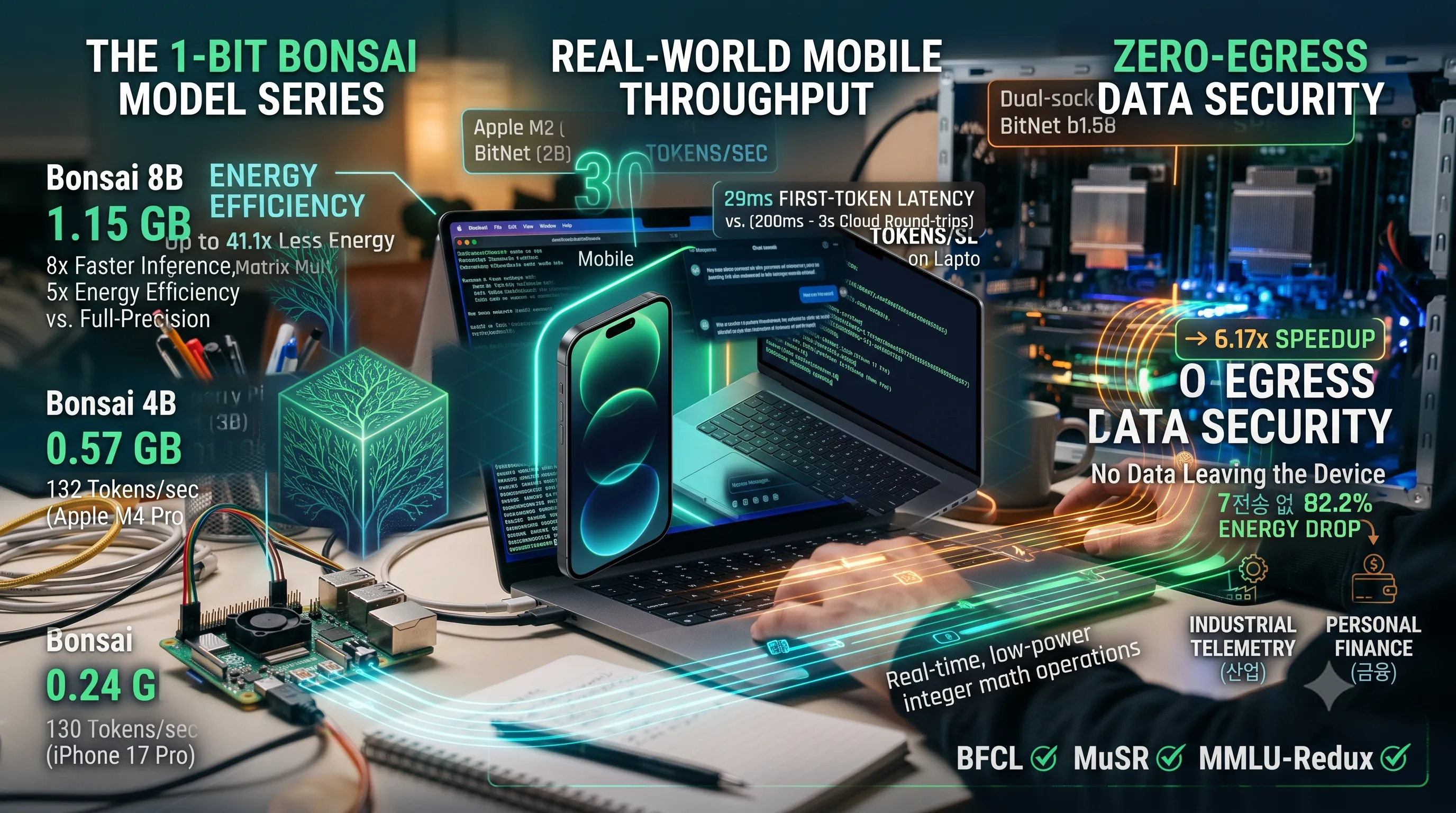
Prism ML has introduced the 1-bit Bonsai model series, engineered to compress full-scale generative intelligence into memory profiles suitable for consumer and edge hardware.The flagship edge model, 1-bit Bonsai 8B, operates with a compact 1.15 GB memory footprint.
Compared to full-precision implementations, the Bonsai 8B delivers 8x faster inference alongside 5x higher energy efficiency, dramatically lowering thermal throttling and battery consumption constraints on edge machinery.
Scaling down the footprint further, the 1-bit Bonsai 4B requires only 0.57 GB of system memory, allowing dense parameter weights to reside comfortably in shared unified memory caches.
For ultra-constrained form factors, the 1-bit Bonsai 1.7B cuts the memory profile down to 0.24 GB, making native on-device integration viable across lightweight hardware configurations.
| Model Architecture | Memory Footprint | Hardware Target / Throughput | Efficiency & Benchmark Profile |
|---|---|---|---|
| 1-bit Bonsai 8B | 1.15 GB | Edge compute devices | 8x faster inference, 5x higher energy efficiency vs. full-precision models |
| 1-bit Bonsai 4B | 0.57 GB | 132 tokens per second (Apple M4 Pro) | Parity across IFEval, GSM8K, HumanEval+, BFCL, MuSR, and MMLU-Redux |
| 1-bit Bonsai 1.7B | 0.24 GB | 130 tokens per second (iPhone 17 Pro Max) | Enables high-speed generative text without active internet connectivity |
Mobile Generation Benchmarks on Apple Silicon
Real-world throughput metrics validate the commercial performance profile of the Bonsai architecture on consumer chipsets.When deployed on an Apple M4 Pro processor, the 1-bit Bonsai 4B model reaches generation speeds of 132 tokens per second.
On mobile form factors, the 1-bit Bonsai 1.7B generates 130 tokens per second on an iPhone 17 Pro Max.
These operational speeds provide responsive, high-speed generative text capabilities directly inside consumer smartphones without requiring an active internet connection.
Critically, these aggressive compression profiles do not compromise functional intelligence.
The Bonsai models maintain benchmark parity across standard technical and reasoning evaluations, including IFEval, GSM8K, HumanEval+, BFCL, MuSR, and MMLU-Redux.
Zero-Egress Data Security for Regulated On-Device Workloads
The architectural shift toward self-contained local execution delivers critical operational advantages for compliance-driven industries.Because models like the Bonsai 1.7B, 4B, and 8B execute fully offline within local memory spaces, they completely eliminate data egress.
This zero-egress architecture provides native compliance for regulated workloads across mobile healthcare, industrial telemetry, and personal finance.
Sensitive patient telemetry, operational plant readings, and private financial logs remain confined to on-device memory, removing the recurring data transfer fees, transmission latency, and third-party cloud vulnerabilities inherent to centralized API routing.
6. Tooling Ecosystem and Execution Boundaries: The bitnet.cpp Runtime
The economic viability of eliminating 90% of local inference infrastructure costs hinges entirely on specialized runtime software.Without an execution engine optimized for ternary operations, the efficiency promises of 1-bit weight architectures cannot translate into hardware-level energy and computational savings on client devices.
bitnet.cpp Runtime Architecture and Custom Kernel Execution
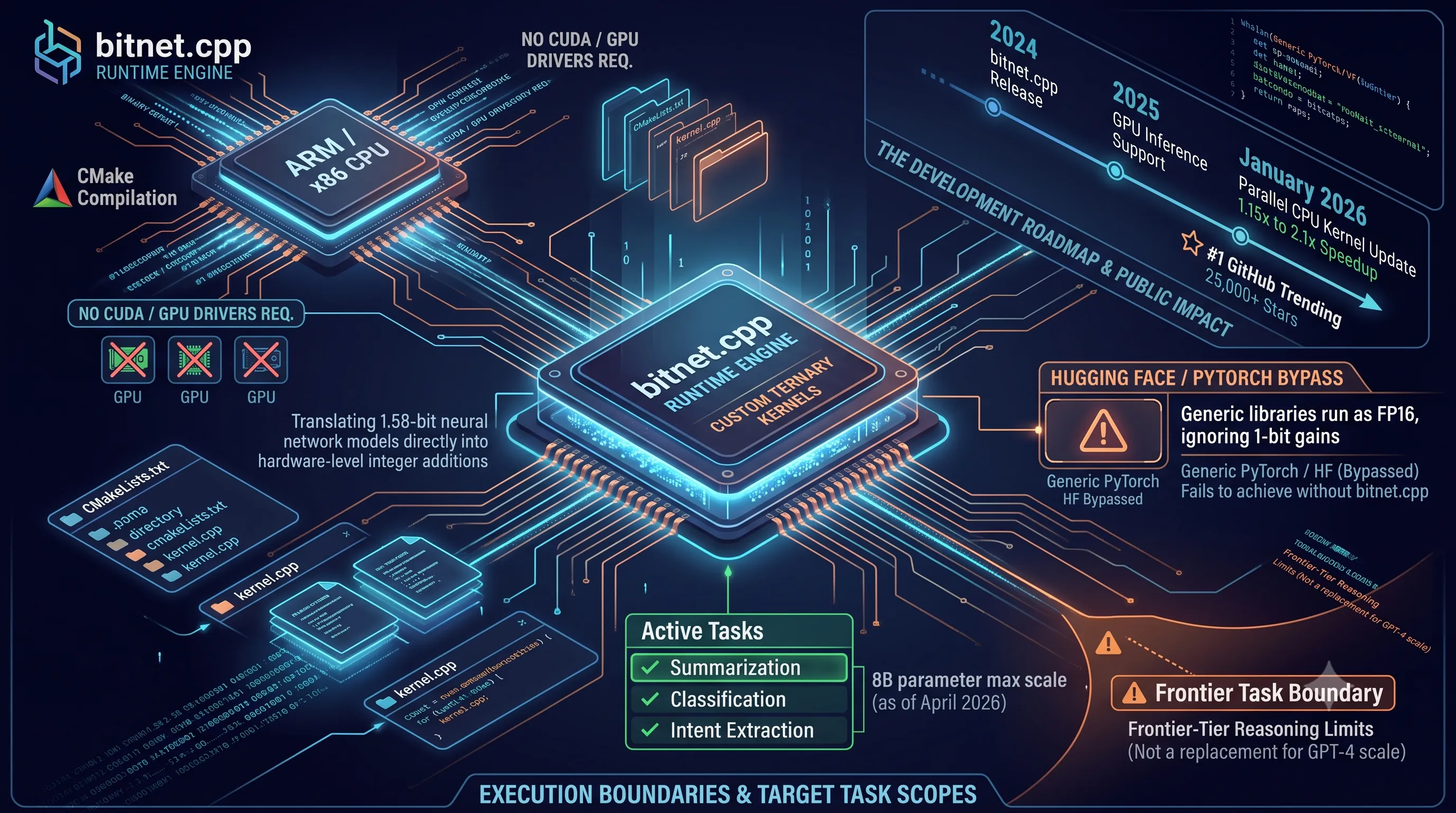
Microsoft open-sourced the bitnet.cpp inference framework between September and October 2024 to provide dedicated low-level runtime support for 1-bit model architectures.Unlike conventional machine learning engines designed around continuous floating-point matrix multiplications, the framework incorporates custom computational kernels executing native ternary arithmetic.
By replacing general-purpose floating-point math with low-bit operations, the runtime eliminates heavy computational overhead directly at the processor level.
A foundational deployment advantage of bitnet.cpp is its complete decoupling from specialized hardware toolchains.
The framework compiles directly via CMake across both ARM and x86 architectures without requiring the CUDA toolkit or proprietary GPU drivers.
Subsequent updates extended the runtime's footprint, adding GPU inference support for bitnet.cpp in May 2025.
In January 2026, a major CPU optimization update introduced parallel kernels that delivered an additional 1.15x to 2.1x speedup.
Driven by these developments, the BitNet GitHub project reached the #1 trending position in January 2026, gaining over 25,000 stars.
| Milestone / Feature | Release Date | Technical Specification / Impact |
|---|---|---|
| bitnet.cpp Open-Source Release | September/October 2024 | CMake compilation across ARM and x86 architectures without CUDA toolkit or GPU drivers |
| GPU Inference Support | May 2025 | Expanded execution runtime beyond pure CPU hardware environments |
| Parallel CPU Kernel Update | January 2026 | Introduced parallel CPU kernels providing a 1.15x to 2.1x speedup; project trended #1 with over 25,000 stars |
| Public Model Parameter Scale | April 2026 | Largest publicly available native 1-bit LLMs reached 8 billion parameters |
Framework Dependency Constraints Beyond Standard PyTorch
The architectural economics of 1-bit LLMs cannot be realized through drop-in replacements in standard machine learning pipelines.Theoretical efficiency and latency gains do not materialize when running BitNet models through standard libraries like Hugging Face Transformers or generic PyTorch without bitnet.cpp kernels.
Because generic deep learning frameworks execute tensors using standardized floating-point primitives, they bypass the underlying additions and subtractions that define ternary efficiency.
Realizing hardware-level cost and throughput advantages introduces specific operational constraints.
Deploying bitnet.cpp requires platform-specific compilation and specialized kernel tuning across varied CPU microarchitectures.
Local device runtimes must be explicitly calibrated to target processors to engage the custom parallel kernels effectively.
Task Scope and Boundary Limits vs. Frontier Models
While bitnet.cpp establishes dramatic compute and cost reductions for local device deployments, native 1-bit architectures operate within clear functional boundaries.As of April 2026, the largest publicly available native 1-bit LLMs reached 8 billion parameters.
Due to these scale boundaries, native 1-bit LLMs do not replace frontier-tier reasoning, such as GPT-4 class models.
Instead, current deployment profiles are constrained to structured operational tasks, including summarization, classification, and intent extraction.
For these targeted edge-workloads, the pairing of 8B-scale ternary weights with tuned bitnet.cpp runtime kernels delivers the targeted efficiency gains essential for local device economics.
Related Posts

How Frontier AI Models Are Rewriting Theoretical PhysicsExplore how frontier AI models and autonomous agents are transforming theoretical physics,...
OpenAI GPT-6.2 Billing Fix: Astra Hits Limits 40% FasterOpenAI fixes a GPT-6.2 launch billing bug, causing Astra limits to hit 40% faster and Sol 25%...
How GPT-6 Achieves Intrinsic Protein Design Without Specialized AIDiscover how GPT-6 models achieve intrinsic protein design and de novo minibinder generation using...
Generative AI may have assisted with research or drafting for this article. Topic selection, fact-checking, final wording, and publication remain the responsibility of DragonStone74. AI use disclosure