
Beyond Prompt Engineering: Mastering Context Control Planes in Agentic AI
🚀 Key Takeaways
- From Prompting to Context Control Planes: Engineering priorities have decisively shifted from wording static prompts to building orchestration engines that dynamically curate, compress, and structure model working state.
- Multi-Tiered Memory Infrastructure: Resilient autonomous agents rely on decoupled memory architectures—separating ephemeral working context from durable episodic, semantic, and procedural stores to maintain longitudinal continuity.
- Systematic Context Lifecycles: Developers must enforce strict protocols across writing, targeted retrieval, automated compaction, and scheduled expiration to prevent context poisoning, confusion, and state drift.
- Token Economics Over Brute Force: Despite million-token windows, optimizing prompt attention real estate is vital to curb escalating inferencing costs, mitigate latency bottlenecks, and avoid attention degradation.
- Observability and Memory Hygiene: Modern agent stacks integrate thread-scoped checkpointing, state validation, and operational tracing to safeguard against silent retrieval failures, stale data loops, and data compliance violations.
The era of treating large language models as simple stateless endpoints has come to a decisive close.
As software organizations deploy sophisticated multi-agent architectures into production environments, engineering teams are discovering that system performance is governed far less by prompt syntax than by context architecture.
In modern autonomous workflows, the primary operational challenge is no longer basic information retrieval, but methodically governing what an agent perceives, retains, and discards throughout its operational lifecycle.
Treating the model context window as analogous to operating system RAM reveals why unmanaged prompt construction fails at scale.
Pouring unfiltered repositories or raw database dumps into expanded context boundaries triggers severe real-world penalties: explosive token bills, sluggish Time-to-First-Token latencies, and reasoning failures caused by attention degradation and context poisoning.
Relying on probabilistic weights to fill context vacuums inevitably forces models into compounding hallucinations.
Mastering context management as a centralized control plane has consequently emerged as a foundational engineering discipline.
By operationalizing multi-tiered memory systems, dynamic compression routines, and strict memory hygiene patterns, developers can transform brittle probabilistic interfaces into resilient, deterministic state machines ready for enterprise scale.
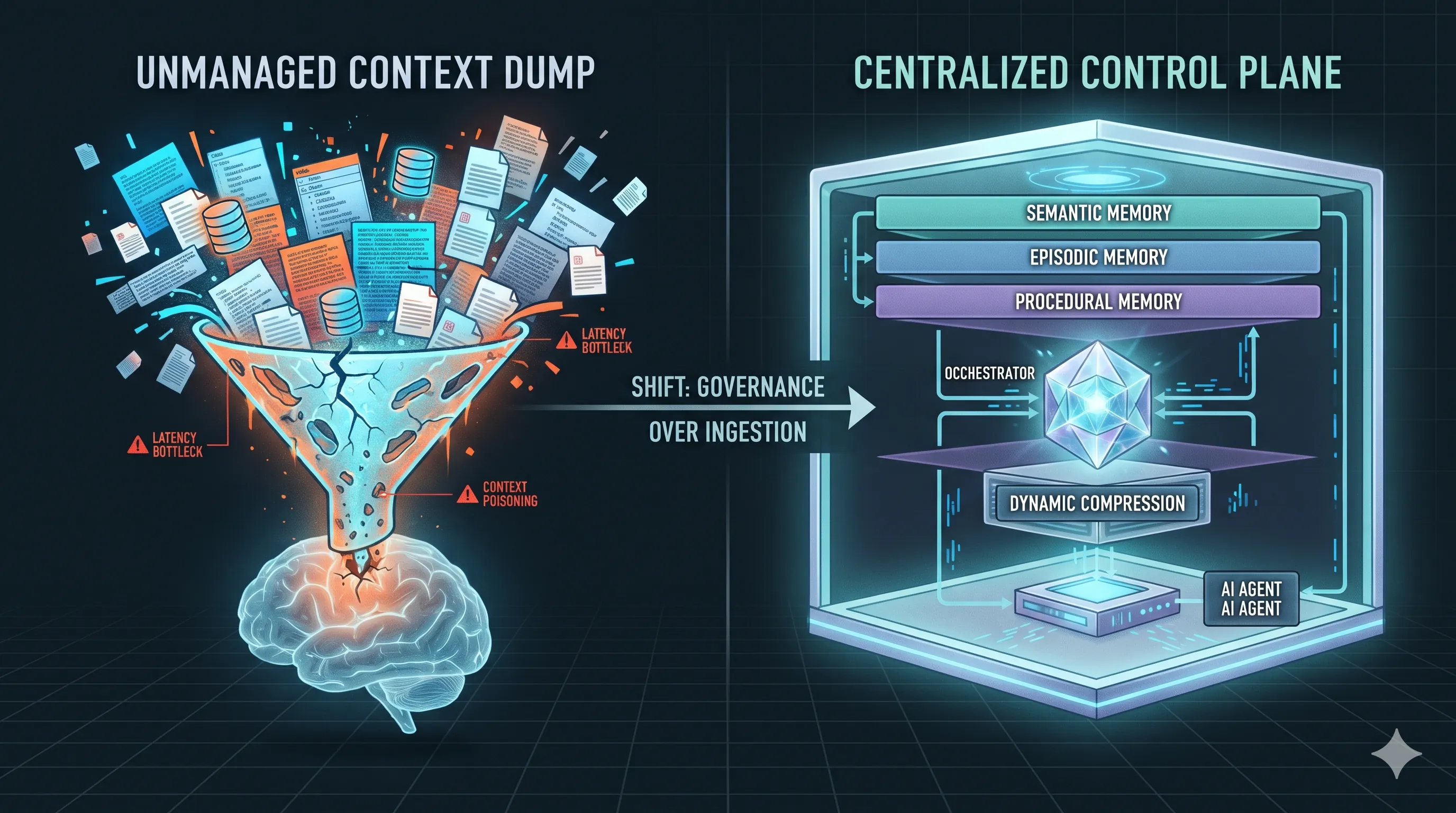
1. Architectural Shift: From Prompt Engineering to Centralized Context Control Planes
The evolution of context management has fundamentally restructured day-to-day AI developer practices, redirecting engineering attention from superficial phrasing tricks toward resilient data delivery systems.In autonomous agent development, the primary bottleneck has shifted away from basic data retrieval toward governing what an agent knows, retains, and forgets.
As industry expert Adi Polak noted, context engineering beats prompt engineering because the system that builds context matters more than the prompt itself.
Rather than hardcoding transient state into downstream models or isolated microservices, modern architectures treat context as a centralized control plane that functions as the governing operational layer for entire AI systems.
The Context Engine as an Orchestration Compiler
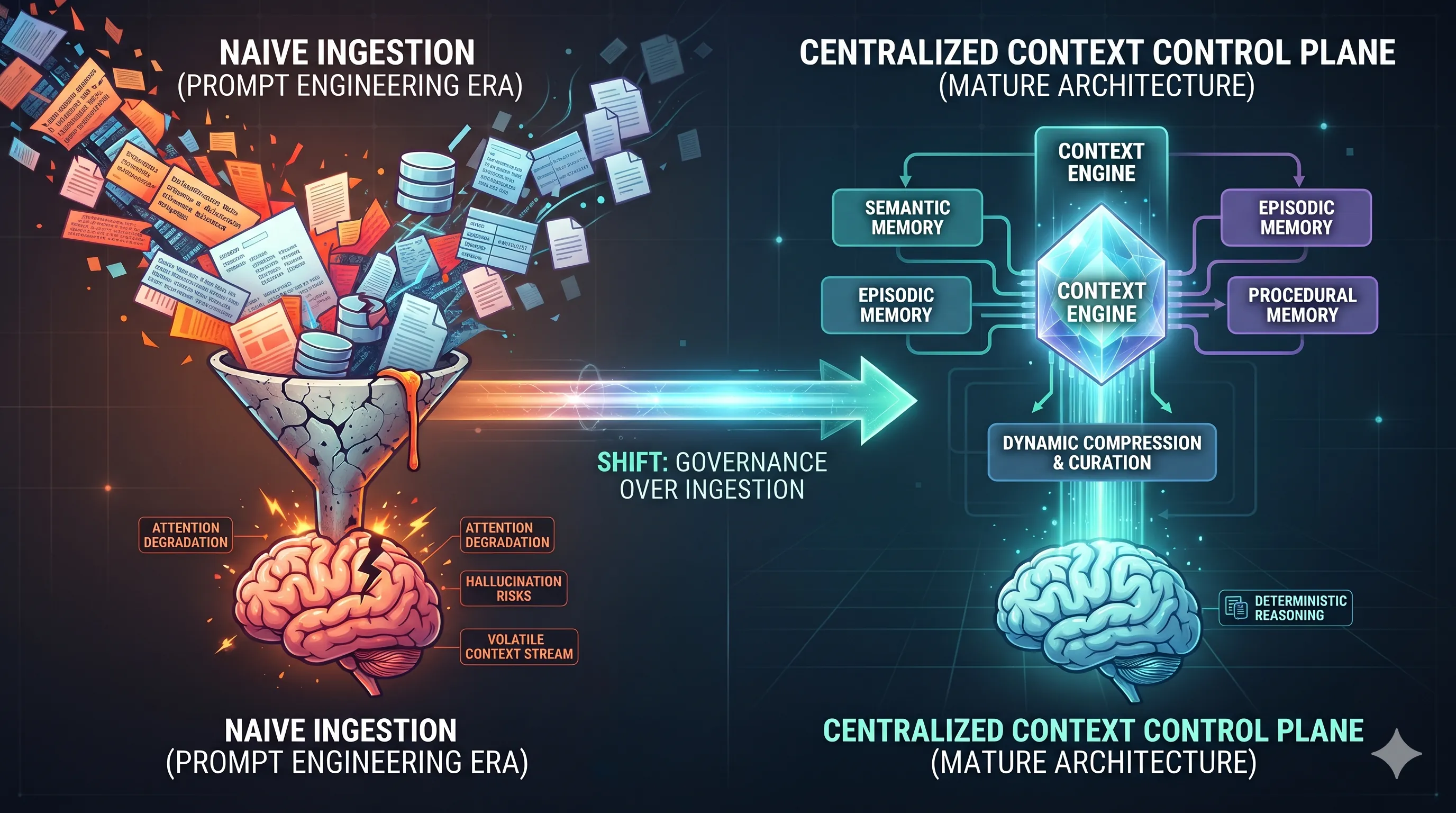
Within this centralized control plane, the context engine operates as a sophisticated orchestrator that selects, filters, ranks, structures, compresses, safeguards, and delivers information directly before model inference occurs.This mechanism functions analogously to a traditional software compiler by transforming unstructured, multi-source raw inputs into a deterministic, reasoning-ready state machine.
Under this paradigm, the developer's core engineering objective shifts entirely to constructing a dynamic substrate.
This dynamic substrate programmatically identifies, filters, and assembles the minimal, highest-value context required for immediate reasoning, ensuring that the model receives only dense, mission-critical information at the point of execution.
Overcoming Unmanaged Context Windows and Raw Data Dumping
Early developer practices often relied on naive ingestion strategies that treated the model window as an open-ended sink.Operating under semantic SQL SELECT * patterns—where high-volume raw text is dumped directly into prompts—severely degrades model reasoning performance.
When applications present models with unmanaged and impoverished context windows, probabilistic systems are forced to fill information gaps by guessing based on latent training weights, which directly causes hallucinations.
To circumvent these degradation hazards, mature context architectures deploy rigorous curation mechanisms.
Curating raw databases within these control planes can involve automated pipelines distilling one million raw entries into a single structured summary entry every 12 hours.
By standardizing on continuous synthesis and rigorous context compilation, developers ensure models navigate curated, verifiable state planes rather than volatile raw data streams.
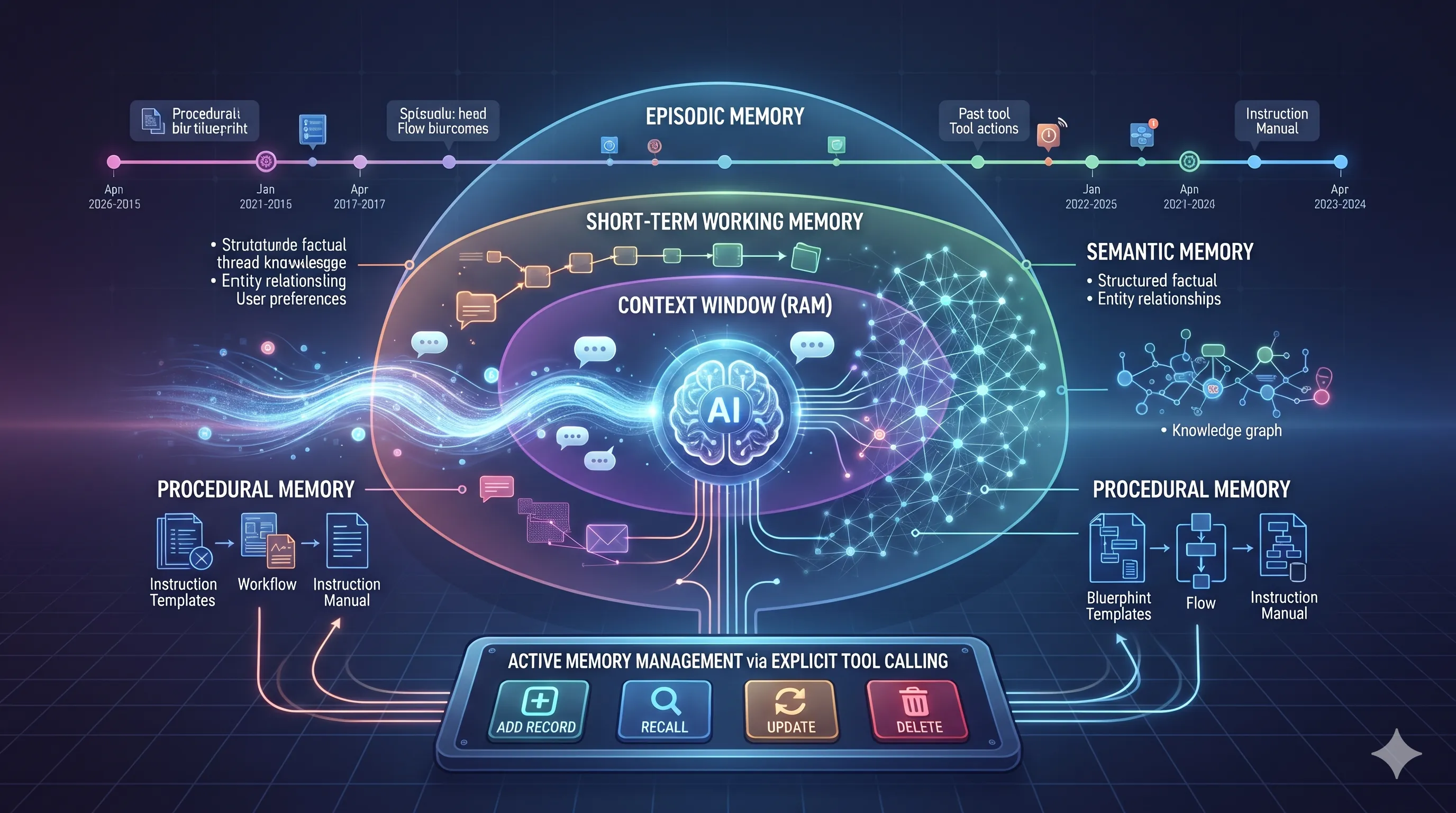
2. Multi-Tiered Memory Classification: Structuring State in Agentic Systems
The transition from simple prompt engineering to complex agentic architecture reshapes developer practices, shifting context management from static prompt concatenation to systematic state management.As engineering teams build persistent, autonomous systems, structuring state into distinct functional tiers ensures models maintain operational integrity across prolonged, non-deterministic workflows.
Deconstructing the Five Operational Memory Tiers
As Yoshinari Fujinuma reviewed, agentic memory enables AI agents to maintain continuity, personalize responses, and learn from past experiences across interactions.To achieve this, agentic memory encompasses five key operational types: context, short-term working memory, semantic memory, episodic memory, and procedural memory.
Each tier performs a specialized function in isolating transient reasoning from durable knowledge.
First, immediate context represents active, ephemeral information residing directly within the model working context window, functioning analogously to computer RAM.
Second, short-term working memory manages within-session context, intermediate reasoning steps, and tool execution traces using thread-scoped checkpoints.
Third, semantic memory stores structured factual knowledge, entity relationships, and user preferences through vector embeddings or knowledge graphs.
Fourth, episodic memory logs timestamped records of past events, tool actions, and outcomes, which facilitates case-based reasoning derived from prior experiences.
Fifth, procedural memory encodes learned behavioral patterns, instruction rules, and workflow templates, allowing agents to execute complex tasks repeatedly without re-deriving baseline logic.
| Memory Tier | Retention Scope | Storage Implementation | Developer Usage Pattern |
|---|---|---|---|
| Context Window (RAM) | Ephemeral, active invocation cycle | Model working context window | Supplying immediate tokens for active inference and real-time generation. |
| Short-Term Working Memory | Within-session context | Thread-scoped checkpoints | Tracking intermediate reasoning steps and recording tool execution traces. |
| Semantic Memory | Persistent across sessions | Vector embeddings or knowledge graphs | Querying structured factual knowledge, entity relationships, and user preferences. |
| Episodic Memory | Persistent historical records | Timestamped event and outcome logs | Referencing past tool actions and execution outcomes for case-based reasoning. |
| Procedural Memory | Durable operational rules | Instruction rules and workflow templates | Executing structured workflows and behavioral patterns without re-deriving logic. |
Active Memory Management via Explicit Tool Calling
Stateless LLM invocations fail across multi-turn workflows without explicit state passing, repeatedly forcing user re-identification across session boundaries.Furthermore, short-term context resets when sessions end, losing critical intermediate reasoning states unless captured by checkpointing systems.
To resolve these limitations, modern agentic memory systems expose memory management as active tool calls.
Rather than relying on passive context injection, architectures permit models to explicitly add, recall, update, and delete persistent records across interactions.
This explicit mutation pattern transforms memory from a static context-window overhead into an on-demand, queryable operational asset.
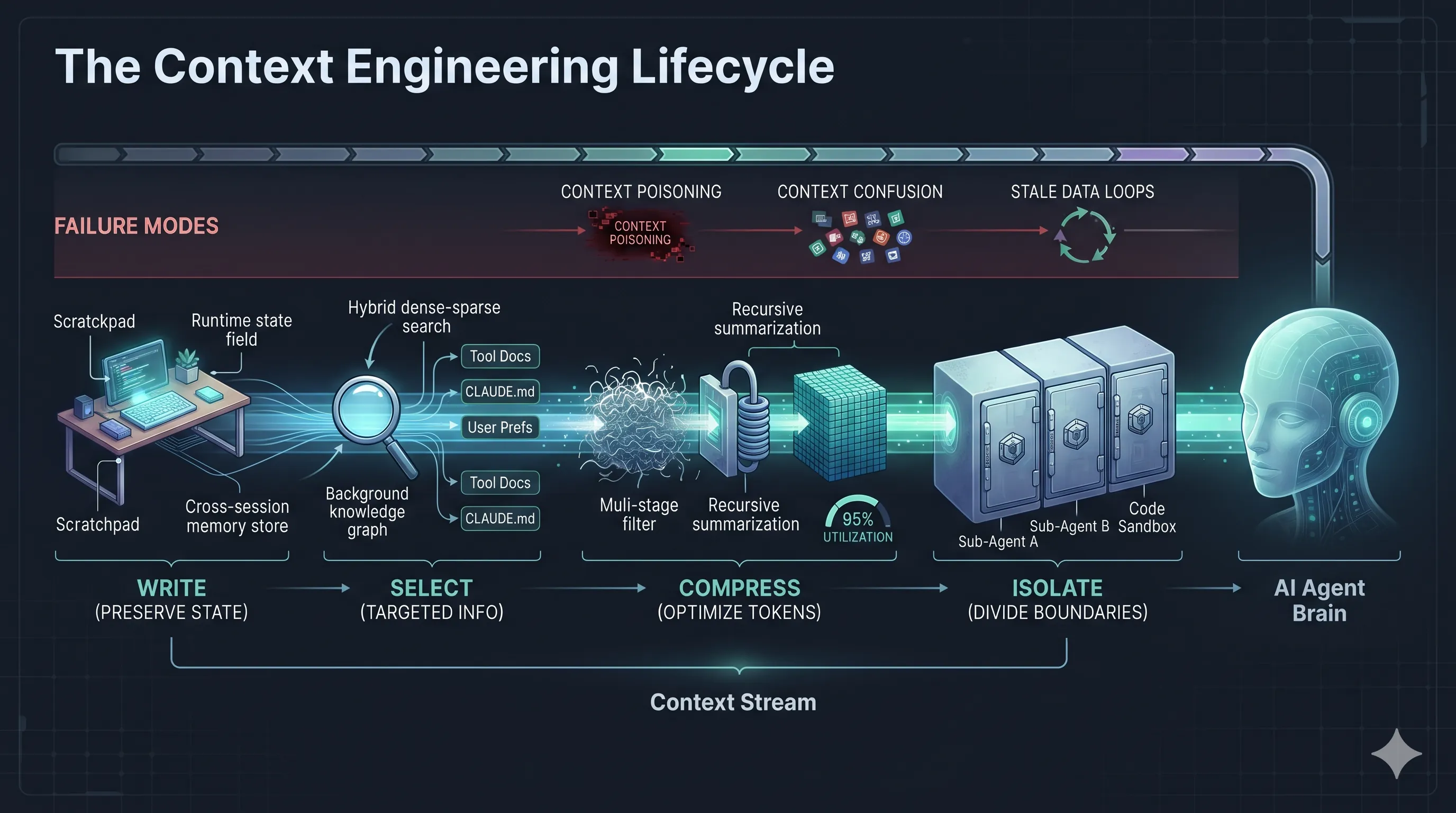
3. The Context Engineering Lifecycle: Write, Select, Compress, and Isolate
Context engineering reshapes software workflows by transforming how agents structure, maintain, and discard dynamic state.Within the broader impact of context management on AI developer practices, teams must transition from brute-force token stuffing to a disciplined lifecycle that balances prompt efficiency with execution reliability.
Four-Phase Context Lifecycle Mechanics
Andrej Karpathy conceptualized LLMs as a new operating system where the LLM functions as the CPU and the context window functions as RAM.Under this operational model, developer practices center on managing context like volatile memory across four core phases: Selection, Injection, Compression, and Expiration and Refresh.
Writing context preserves working state outside the prompt window using scratchpads, runtime state fields, or cross-session memory stores.
Selecting context brings targeted information into prompts via hybrid dense-sparse search, knowledge graph traversal, or specialized files like CLAUDE.md and rules files.
Tool retrieval plays a critical role in selection; applying retrieval-augmented generation to tool descriptions improves tool selection accuracy by 3-fold.
Compressing context limits token consumption using iterative recursive summarization, fine-tuned compression models, or deterministic trimming heuristics.
For example, Claude Code initiates auto-compact compression routines after context utilization exceeds 95% of the total context window.
Isolating context divides state across specialized sub-agents, structured state schemas, or sandboxed execution environments like code sandboxes.
| Engineering Phase | Primary Mechanism | Implementation Pattern |
|---|---|---|
| Write | Preserving working state outside the prompt window | Scratchpads, runtime state fields, and cross-session memory stores |
| Select | Bringing targeted information into prompts | Hybrid dense-sparse search, knowledge graph traversal, and files like CLAUDE.md |
| Compress | Limiting token consumption and active utilization | Recursive summarization, deterministic trimming, or auto-compact at 95% utilization |
| Isolate | Dividing execution state across boundaries | Specialized sub-agents, structured state schemas, and code sandboxes |
Failure Modes: Context Poisoning, Confusion, and Stale Loops
Long-context architectures introduce operational vulnerabilities when uncurated data enters the context stream.Drew Breunig categorized long-context performance failure modes into context poisoning, distraction, confusion, and clash.
Context poisoning occurs when an undetected model hallucination gets committed into persistent context stores.
Once poisoned, persistent stores repeatedly reinject flawed premises back into subsequent execution loops.
Context confusion arises when superfluous tool descriptions or irrelevant memories steer model reasoning away from intended objectives.
Developers encounter stale data loops when expiring or contradictory facts remain stored alongside newly updated information.
Addressing these degradation paths requires disciplined enforcement of the context lifecycle through continuous expiration and clean state isolation.
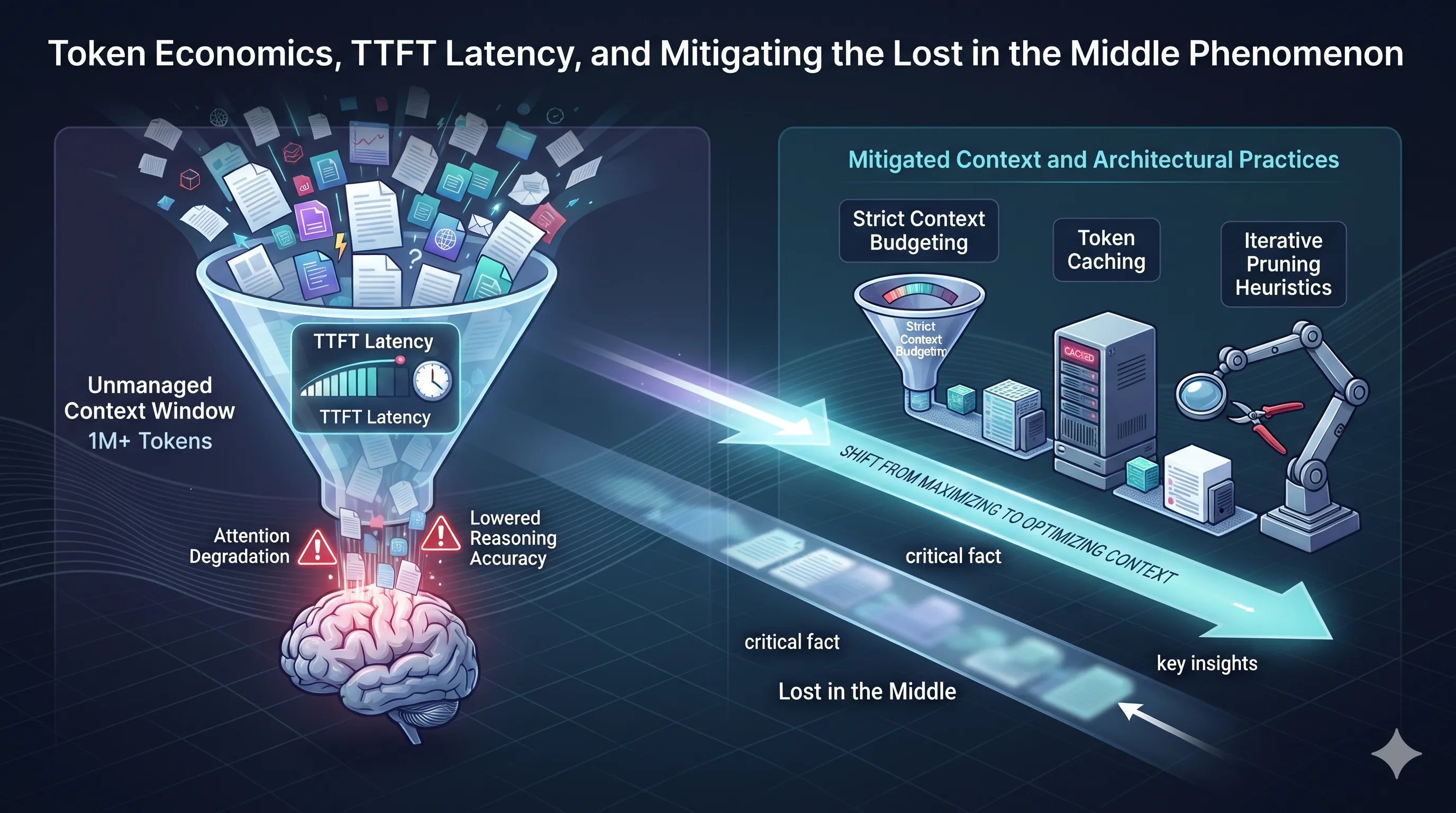
4. Token Economics, TTFT Latency, and Mitigating the Lost in the Middle Phenomenon
In the broader analysis of the Impact of Context Management on AI Developer Practices, managing token utilization serves as the core operational discipline bridging model capabilities with production viability.Developer workflows have shifted from treating prompts as simple text wrappers to treating them as precious, constrained compute environments where every added token impacts latency, accuracy, and operational expense.
The Realities of 1M+ Context Windows and Multi-Agent Token Bloat
Modern expanded model context windows support token boundaries ranging from 128k to 1M+ tokens.However, this massive context capacity introduces critical trade-offs between capacity and resource consumption.
Token economics requires developers to optimize prompt attention real estate against compute latency and direct API billing costs.
Large context window capacity frequently tempts engineering teams into unmanaged prompt dumping, increasing token expenditure while reducing reasoning accuracy.
Addressing this tendency, Adi Polak emphasized that just because an architecture can inject 100,000 tokens does not mean it should, arguing that optimizing context outperforms maximizing it.
These economic strains intensify rapidly within distributed systems.
Multi-agent context isolation designs can consume up to 15x more tokens than single chat workflows as reported by Anthropic.
When independent agents maintain isolated states and repeatedly exchange operational context, cumulative token burn accelerates, demanding rigorous oversight from developers.
| Context Pattern / Phenomenon | Operational Impact | Required Architectural Practice |
|---|---|---|
| Multi-Agent Context Isolation | Consumes up to 15x more tokens than single chat workflows as reported by Anthropic. |
Strict context budgeting. |
| Full Repository / Document Dumping (128k to 1M+ tokens) | Elevates Time-to-First-Token (TTFT) latency and direct API billing costs while reducing reasoning accuracy. |
Token caching. |
| Center-Placed Information in Broad Context Windows | Degraded retrieval accuracy relative to edge positions (Lost in the Middle phenomenon). |
Iterative pruning heuristics. |
Navigating Attention Degradation and TTFT Latency
Dumping full repositories or broad document collections into large context windows elevates Time-to-First-Token (TTFT) latency, significantly delaying the start of response generation.Beyond latency, processing extensive prompt volumes impairs extraction precision.
Stanford researchers Nelson F. Liu et al. published the 'Lost in the Middle' study in 2023, formalizing this structural vulnerability.
The 'Lost in the Middle' effect demonstrates that LLMs experience degraded retrieval accuracy for facts placed in the center of broad context windows compared to edge positions.
Architectural challenges also arise from memory allocation strategies across temporal dimensions.
Over-indexing on historical episodic data makes agents stale, while over-indexing on real-time sensory feeds causes agents to become reactive and forgetful.
To counteract these performance regressions, strict context budgeting, iterative pruning heuristics, and token caching serve as required architectural practices for scalable deployments.
5. Developer Tooling, Observability, and Memory Hygiene Governance
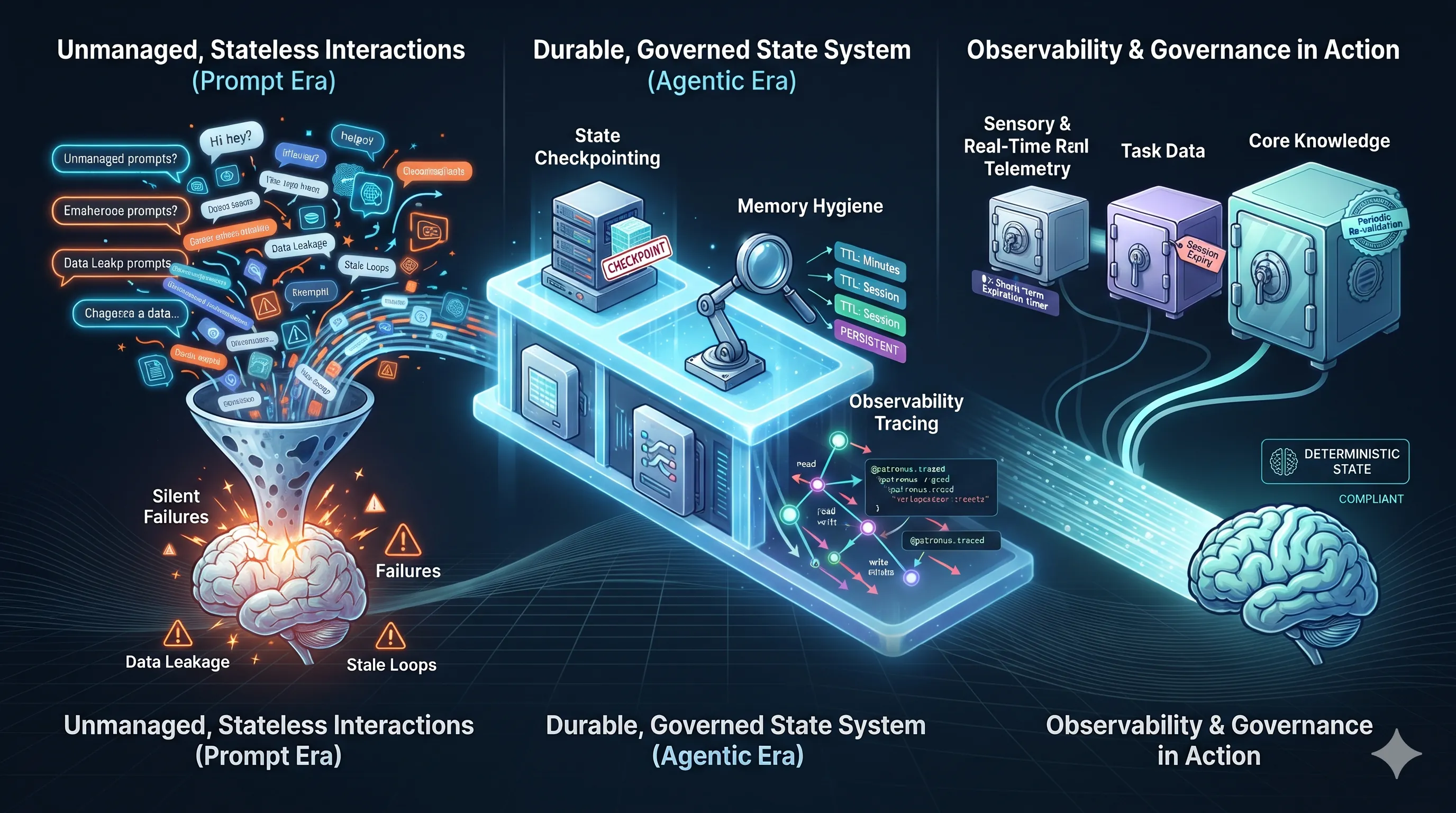
The operational impact of context management on AI developer practices centers on transforming transient model interactions into durable, governed state systems.
Engineering production agents requires moving beyond stateless prompts to enforce state continuity, memory hygiene lifecycles, and diagnostic tracing across runtime architectures.
Framework State Checkpointing and Memory Hygiene TTLs
Modern agent frameworks like LangGraph implement short-term thread continuity via state checkpointers such as MemorySaver and cross-session persistence via key-value stores like InMemoryStore.
These storage mechanisms establish the technical baseline for maintaining conversational coherence and state awareness across distinct user interactions.
Operating persistent state requires structured memory hygiene policies that enforce user and namespace isolation, contradiction resolution through key overwrites, and category-specific time-to-live (TTL) expiration rules.
Without governance, unmanaged persistent memory stores risk retaining personally identifiable information (PII) or proprietary internal data without access control compliance.
Furthermore, unmanaged state allows agents to fail silently by writing duplicate keys or retaining superseded contradictory facts across execution cycles.
| Context Category | Hygiene and Expiration Policy |
|---|---|
| Sensory and Real-Time Telemetry | Assigned TTLs spanning minutes to hours. |
| Task Data | Configured to expire automatically at session termination. |
| Core Knowledge | Retained persistently and undergoes periodic re-validation. |
Observability and Tracing Memory Tool Chains
Dedicated agent observability tools like LangSmith and Patronus AI trace memory read, write, update, and deletion operations across complex tool-calling chains.
These diagnostic platforms track retrieval precision and agent internal decisions to detect silent failures caused by uncalled memory tools or outdated facts, preventing runtime breakdowns where agents fail to invoke initial lookup calls.
Developers implement tracing to debug memory retrieval and tool invocation decisions within agent execution loops.
@patronus.traced("your-trace-id")
def run_agent(query: str, thread_id: str):
    ...
This implementation applies a tracing decorator from the Patronus library to inspect memory operations and retrieval steps within an agent workflow function.
Related Posts


Generative AI may have assisted with research or drafting for this article. Topic selection, fact-checking, final wording, and publication remain the responsibility of DragonStone74. AI use disclosure