
Automated Audiovisual Synthesis: Integrating FoleyCrafter, Meta AudioCraft, and Demucs v4
🚀 Key Takeaways
- Automated Foley Synthesis: Frameworks like FoleyCrafter translate silent visual frames into realistic, temporally aligned sound effects driven directly by video motion cues.
- Unified Generative Audio: Meta's AudioCraft suite integrates foundational models such as MusicGen and AudioGen to produce tailored background scores and contextual acoustic elements.
- Hybrid Transformer Separation: Modern source separation engines like Demucs utilize dual-domain transformer encoders to isolate drums, bass, vocals, and instruments with minimal acoustic bleed.
- Flexible Inference Configurations: Optimized processing parameters allow stem extraction pipelines to scale from lightweight local GPU setups to high-throughput post-production batch rendering.
- Temporal Latent Dynamics: Advanced video diffusion architectures provide the visual temporal stability required for downstream acoustic feature mapping and sound matching.
- Cross-Modal Lip and Motion Sync: Multimodal alignment pipelines leverage symmetric attention and landmark conditioning to achieve tight synchronization between speech, environmental audio, and video frames.
- Modern Audio Architecture Migration: Industry workflows have shifted away from legacy convolutional splitters toward hybrid spectrogram-waveform transformers embedded directly in production environments.
The rapid evolution of generative video diffusion models has made it possible to synthesize breathtaking visual sequences from simple text prompts, yet most generated outputs remain eerily silent. Bridging this sensory divide requires moving beyond isolated visual rendering toward intelligent, multi-layered audio synthesis that reacts dynamically to on-screen motion, pacing, and scene context.
Modern audiovisual post-production pipelines overcome the silent video bottleneck by orchestrating automated foley generation, algorithmic music scoring, and precision stem separation. By combining visual cue analysis with advanced neural audio synthesis, these automated workflows dynamically construct rich acoustic environments that match every frame's narrative intent.
Integrating deep learning separation engines alongside cross-modal synchronization tools allows creators to isolate dialogue, balance environmental textures, and route multi-track audio directly into digital editing suites. This technical guide explores how to construct an automated pipeline that brings silent AI video to life through frame-accurate synchronization and multitrack stem processing.
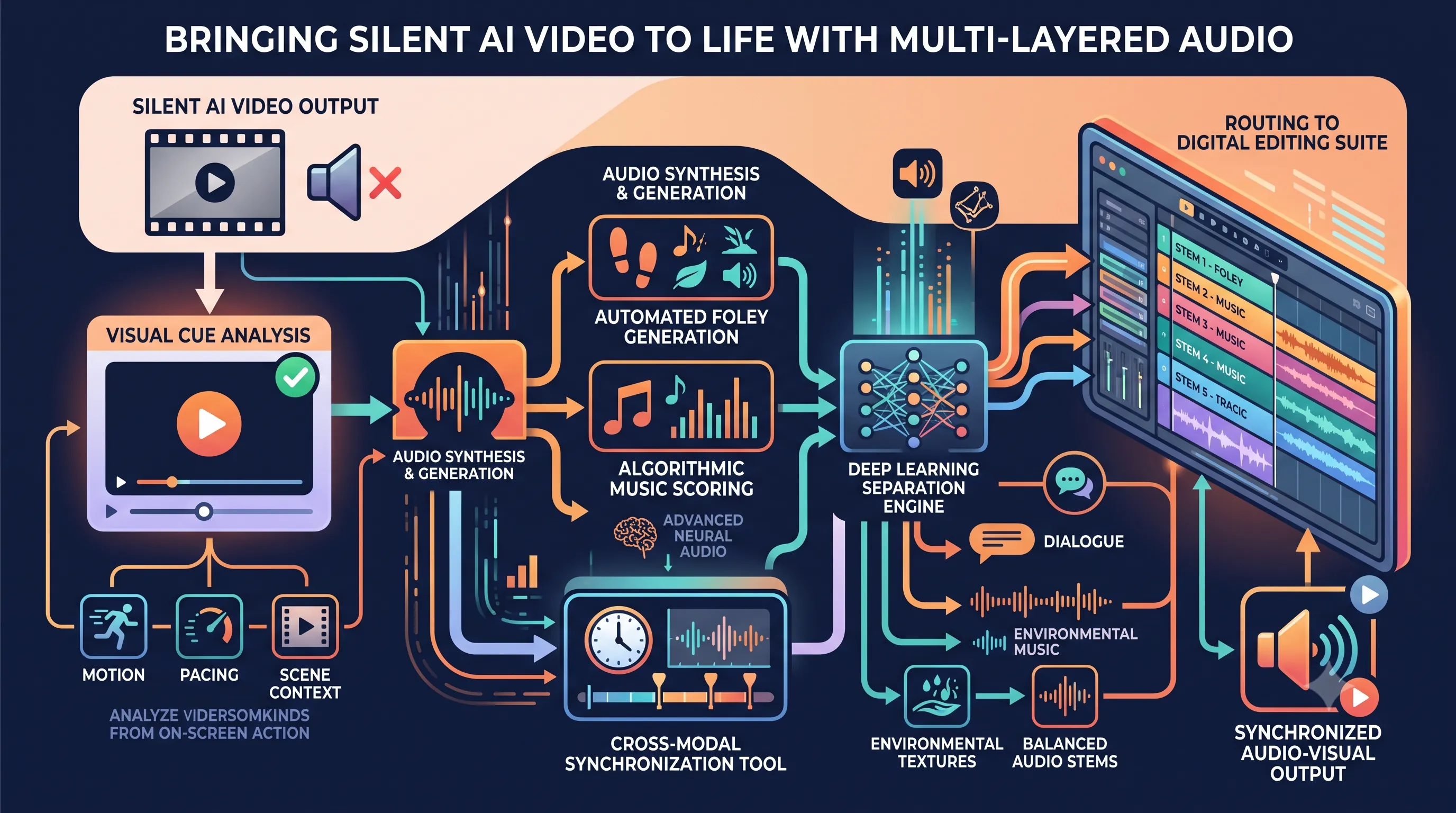
1. Video-to-Audio Foley Synthesis via the FoleyCrafter Framework
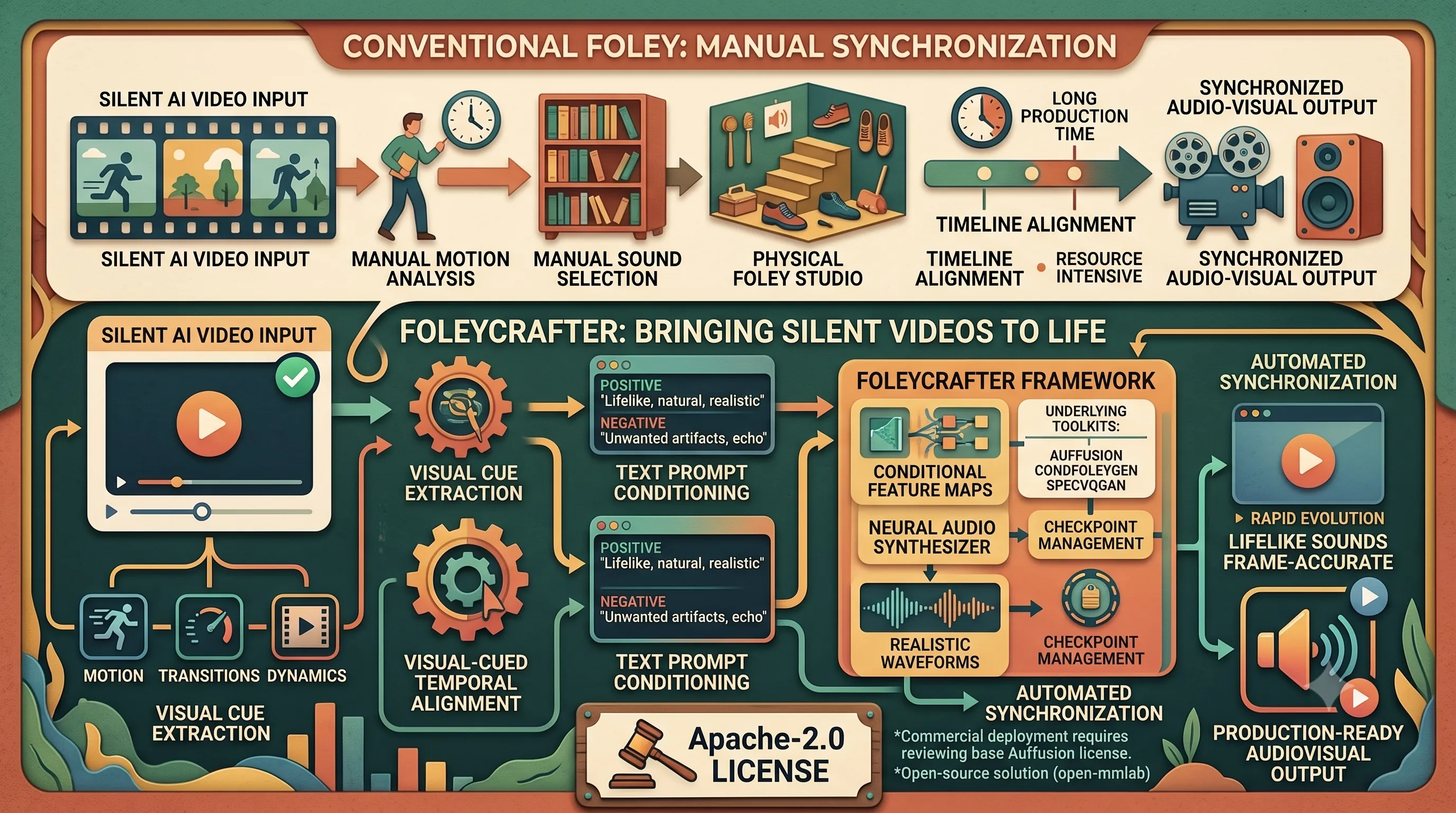
Establishing an automated video-to-sound synchronization pipeline is the core requirement for eliminating silent AI-generated video and achieving production-ready audiovisual coherence.The FoleyCrafter framework, published in IJCV 2026 under the title "FoleyCrafter: Bring Silent Videos to Life with Lifelike and Synchronized Sounds", provides an open-source solution designed to synthesize realistic sound effects that match visual dynamics directly from silent video inputs.
Visual-Cued Temporal Alignment and Prompt Conditioning
FoleyCrafter operates as a video-to-audio generation framework that directly resolves synchronization discrepancies in synthetic video playback.It utilizes visual cues extracted from input silent video streams to enforce temporal alignment across generated audio waveforms.
This mechanism ensures that transient acoustic events match on-screen physical motions and visual transitions without manual timeline adjustments.
In addition to visual cue conditioning, the system supports text-based video-to-audio generation guided by dual text prompts.
Engineers can steer the sonic output using both positive and negative text prompts, allowing fine-grained control over desired Foley attributes while suppressing unwanted acoustic artifacts.
Toolkit Integration and Checkpoint Management
The underlying architecture of FoleyCrafter is built on top of the Auffusion, CondFoleyGen, and SpecVQGAN toolkits to manage feature extraction, conditioning, and audio synthesis.Deploying the pipeline requires managing model checkpoints across these constituent components.
Weights for both Auffusion and FoleyCrafter can be resolved via automatic download routines within the provided inference script or fetched manually for offline serving environments.
| Framework Component / Specification | Details and Architectural Role |
|---|---|
| Core Publication & Upstream Origin | IJCV 2026 (open-mmlab/FoleyCrafter) |
| Underlying Toolkits | Built on Auffusion, CondFoleyGen, and SpecVQGAN |
| Primary License | Apache-2.0 License |
| Commercial Licensing Requirement | Base text-to-audio layer requires checking the Auffusion license for commercial use |
| Checkpoint Acquisition | Automatic download via inference script or manual fetching for Auffusion and FoleyCrafter weights |
However, commercial deployment requires careful review of upstream dependencies, specifically verifying the licensing terms of the base Auffusion text-to-audio model before commercial integration.
2. Controllable Generative Audio Infrastructure Using Meta AudioCraft
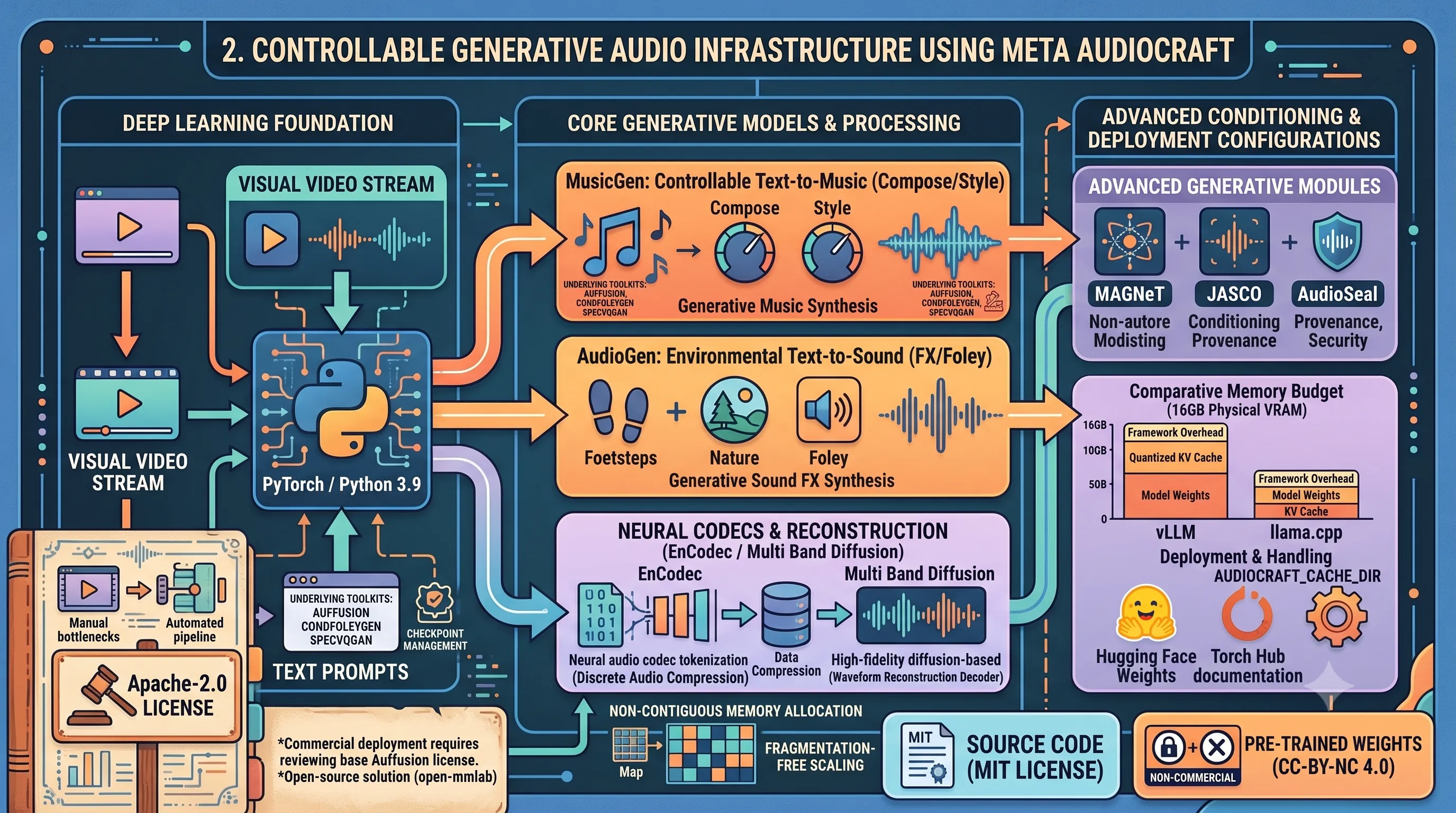
Constructing an automated video-to-sound synchronization and multitrack stem extraction pipeline requires a reliable deep learning foundation to synthesize dynamic soundtracks and acoustic effects.Meta AI Research developed AudioCraft as a dedicated PyTorch library providing comprehensive training and inference code for generative audio research.
Core Generative Models: MusicGen, AudioGen, and Neural Codecs
AudioCraft provides a unified deep learning framework engineered specifically in Python 3.9 and PyTorch 2.1.0.The architecture incorporates specialized foundational models designed to synthesize distinct acoustic layers for video accompaniment.
MusicGen functions as a controllable text-to-music language model capable of generating structured musical compositions.
AudioGen operates as an environmental text-to-sound model tailored for targeted sound effects and Foley generation.
To process high-dimensional audio signals efficiently, AudioCraft integrates the EnCodec neural audio codec alongside a Multi Band Diffusion decoder, facilitating discrete acoustic tokenization and high-fidelity waveform reconstruction.
| Component / Module | Core Functionality | Architectural Role |
|---|---|---|
| MusicGen | Controllable text-to-music language modeling | Generative Music Synthesis |
| AudioGen | Text-to-sound effect generation | Generative Sound FX Synthesis |
| EnCodec | Neural audio codec tokenization | Discrete Audio Compression |
| Multi Band Diffusion | High-fidelity diffusion-based decoding | Waveform Reconstruction Decoder |
| MAGNeT | Non-autoregressive generative modeling | Fast Parallel Audio Generation |
| JASCO | Conditioning on chords, melodies, and drums | Structured Audio Control |
| AudioSeal | Audio watermarking | Provenance and Security |
| MusicGen Style | Style-conditioned musical generation | Acoustic Style Transfer |
Advanced Conditioning Modules and Deployment Configurations
Beyond autoregressive baseline models, AudioCraft incorporates advanced generative and conditioning modules.MAGNeT introduces non-autoregressive audio generation to streamline sampling throughput.
JASCO expands compositional control by conditioning generation directly on musical chords, melodic contours, and drum patterns.
MusicGen Style enables style-conditioned music synthesis, while AudioSeal delivers integrated audio watermarking capabilities.
System deployments require specific directory and dependency handling.
Developers can override default Hugging Face model download paths by setting the
AUDIOCRAFT_CACHE_DIR environment variable.Furthermore, models within the pipeline relying on Demucs require proper configuration via Torch Hub documentation.
From a compliance and deployment standpoint, AudioCraft source code is released under the permissive MIT license, whereas pre-trained model weights are distributed under CC-BY-NC 4.0 non-commercial licensing restrictions.
3. Hybrid Transformer Architecture for Multitrack Stem Separation in Demucs v4
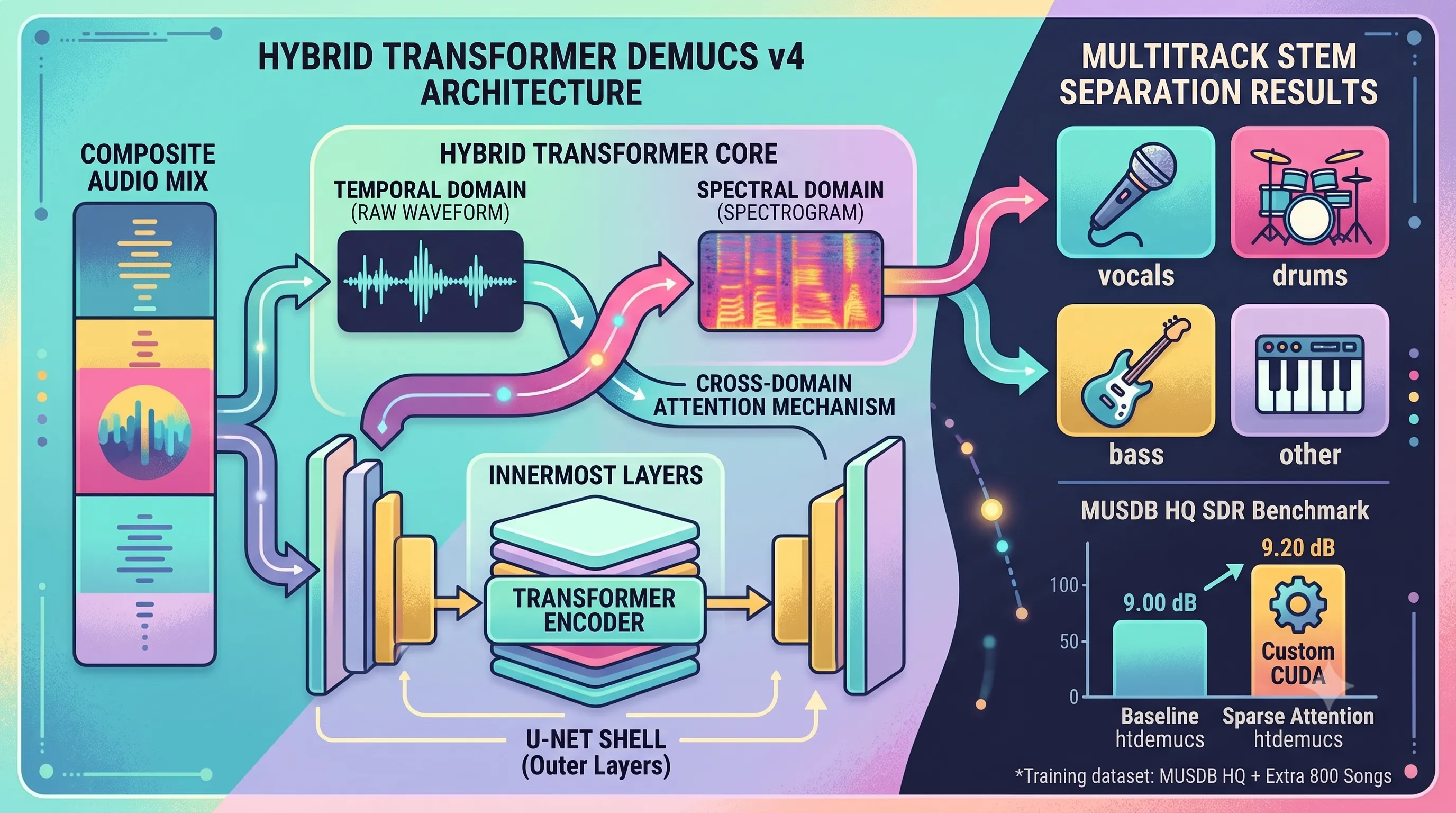
To transition generated video beyond silent visuals and build an automated video-sound synchronization and multitrack stem extraction pipeline, isolating clean individual acoustic components from composite audio mixes is essential.Demucs v4 introduces Hybrid Transformer Demucs (htdemucs), establishing an architectural shift for multitrack stem separation by operating simultaneously in the temporal and spectral domains.
Cross-Domain Spectrogram and Waveform Attention Mechanism
Demucs v4 refactors the traditional dual U-Net architecture by replacing the innermost layers with a cross-domain Transformer Encoder.This design processes both time-domain waveforms and frequency-domain spectrograms simultaneously, allowing the network to leverage the high-precision phase information of raw audio alongside the structural frequency representations of spectrograms.
The Transformer Encoder applies self-attention independently within the spectrogram and waveform domains, while executing cross-attention across domains to transfer representations between time and frequency representations.
The model is trained on the MUSDB HQ dataset augmented with an extra training dataset of 800 songs.
To manage memory consumption and temporal continuity during separation, Hybrid Transformer models support a default split segment length configured to a maximum of 7.8 seconds.
The system requires at least Python 3.8 for deployment.
Model Variants, SDR Metrics, and Source Bleed Trade-offs
The standard Demucs v4 pipeline separates audio into 4 primary stems: drums, bass, vocals, and other accompaniment.On the MUSDB HQ test set, the baseline Hybrid Transformer Demucs achieves a 9.00 dB Signal-to-Distortion Ratio (SDR).
When utilizing sparse attention kernels alongside per-source fine-tuning, the architecture reaches 9.20 dB SDR on the MUSDB HQ benchmark.
However, utilizing this sparse Hybrid Transformer implementation requires custom CUDA code that is not provided in standard releases.
For extended use cases, Demucs v4 offers an experimental 6-source model variant (htdemucs_6s) designed to isolate drums, bass, vocals, other accompaniment, guitar, and piano.
Despite this expanded separation capability, the 6-source model exhibits bleeding and artifacts specifically on the extracted piano source.
In addition, Demucs v4 provides a fine-tuned model variant (htdemucs_ft) and supports MDX challenge models including mdx, mdx_extra, and mdx_q.
Operating the htdemucs_ft fine-tuned model incurs a significant compute overhead, requiring 4 times longer separation time compared to default htdemucs.
| Model Variant | Target Stems | MUSDB HQ SDR | Operational Notes & Compute Profile |
|---|---|---|---|
| htdemucs (Baseline) | 4 Stems: Drums, Bass, Vocals, Other | 9.00 dB | Standard Hybrid Transformer architecture replacing innermost U-Net layers with cross-domain attention. |
| Sparse Attention htdemucs | 4 Stems: Drums, Bass, Vocals, Other | 9.20 dB | Employs per-source fine-tuning and sparse attention kernels; requires custom CUDA code not provided in standard releases. |
| htdemucs_ft | 4 Stems: Drums, Bass, Vocals, Other | Higher fine-tuned benchmark | Fine-tuned variant taking 4 times longer separation time compared to default htdemucs. |
| htdemucs_6s | 6 Stems: Drums, Bass, Vocals, Other, Guitar, Piano | Experimental profile | Experimental 6-source model; exhibits source bleeding and artifacts on the extracted piano stem. |
| mdx / mdx_extra / mdx_q | 4 Stems: Drums, Bass, Vocals, Other | MDX challenge baseline | Architectural models supported for MDX competition evaluations. |
4. Demucs Execution Parameters, Memory Optimization, and Export Configurations
Building an automated video-sound synchronization and multitrack stem extraction pipeline requires fine-grained control over neural audio separation workflows.Demucs serves as an essential engine in breaking silent AI video constraints by extracting distinct stems, yet operational success depends on tuning execution parameters, memory overhead, and export fidelities to match deployment environments.
VRAM Tuning, Window Overlaps, and Shift Averaging
Demucs requires approximately 7GB of GPU RAM when processing audio using default arguments.For resource-constrained infrastructure, memory consumption can be mitigated by reducing the segment size, lowering the operational requirement to at least 3GB of GPU RAM.
Engineers can further suppress peak GPU allocations by setting the environment variable
PYTORCH_NO_CUDA_MEMORY_CACHING=1, which disables PyTorch CUDA caching allocators to prevent memory fragmentation.When executing on hosts lacking dedicated accelerators, Demucs supports full CPU fallback using the
-d cpu flag.Under CPU execution, processing time takes approximately 1.5 times the total duration of the input audio track.
Parallel execution across multiple threads or jobs is controlled via the
-j flag to optimize resource distribution across available cores.Continuous audio prediction is managed across sliding windows.
The default overlap ratio between adjacent prediction windows is 0.25 (25%), ensuring seamless transitions and mitigating boundary artifacts.
To enhance separation fidelity on GPU devices, Demucs supports a shifting trick via the
--shifts parameter.This technique averages predictions over random time shifts across the audio stream, improving output quality at the cost of processing speed.
Specifically, configuring
--shifts scales the prediction time proportionally, slowing runtime by a factor directly equal to the designated number of shifts.| Configuration Parameter / Metric | Specification / Default Setting | Operational Characteristic & Impact |
|---|---|---|
| Default GPU Memory Requirement | ~7GB GPU RAM | Standard execution overhead with default segmentation parameters. |
| Tuned GPU Memory Floor | 3GB GPU RAM | Minimum hardware threshold achieved by reducing processing segment size. |
| Memory Caching Control | PYTORCH_NO_CUDA_MEMORY_CACHING=1 |
Disables PyTorch CUDA caching allocator to minimize GPU memory footprint. |
| Prediction Window Overlap | 0.25 (25%) | Default overlap ratio between temporal prediction segments. |
Shift Averaging (--shifts) |
User-defined integer | Averages predictions over random time shifts; increases execution time by shift factor. |
CPU Processing Fallback (-d cpu) |
~1.5x Track Duration | Execution runtime relative to source track duration when running on CPU. |
Default MP3 Bitrate (--mp3) |
320 kbps | High-bitrate compressed output export setting. |
Audio Formatting, Bit Depth, and Dynamic Range Clipping Controls
Demucs exports audio by default as stereo WAV files sampled at a standard 44.1 kHz sampling rate.The default bit depth for WAV exports is
int16, with configurable support for uncompressed float32 or high-resolution int24 formats to accommodate downstream mastering workflows.If lossy compressed storage is preferred for intermediate storage or lightweight delivery, enabling the
--mp3 flag encodes the stems directly at a default bitrate of 320 kbps.Targeted stem isolation is supported via the
--two-stems argument.This parameter isolates vocals from the remainder of the mix (or generates dedicated karaoke backings), separating the source into a vocal track and a combined instrumental track instead of four separate stems.
Dynamic range management is critical during stem reconstruction to prevent digital distortion.
Demucs applies an automatic output stem rescaling algorithm designed to prevent clipping artifacts when recombined or played at full volume.
For pipelines requiring strict hard clipping without global gain modifications, the
--clip-mode clamp flag forces sample clamping directly to the operational dynamic boundaries.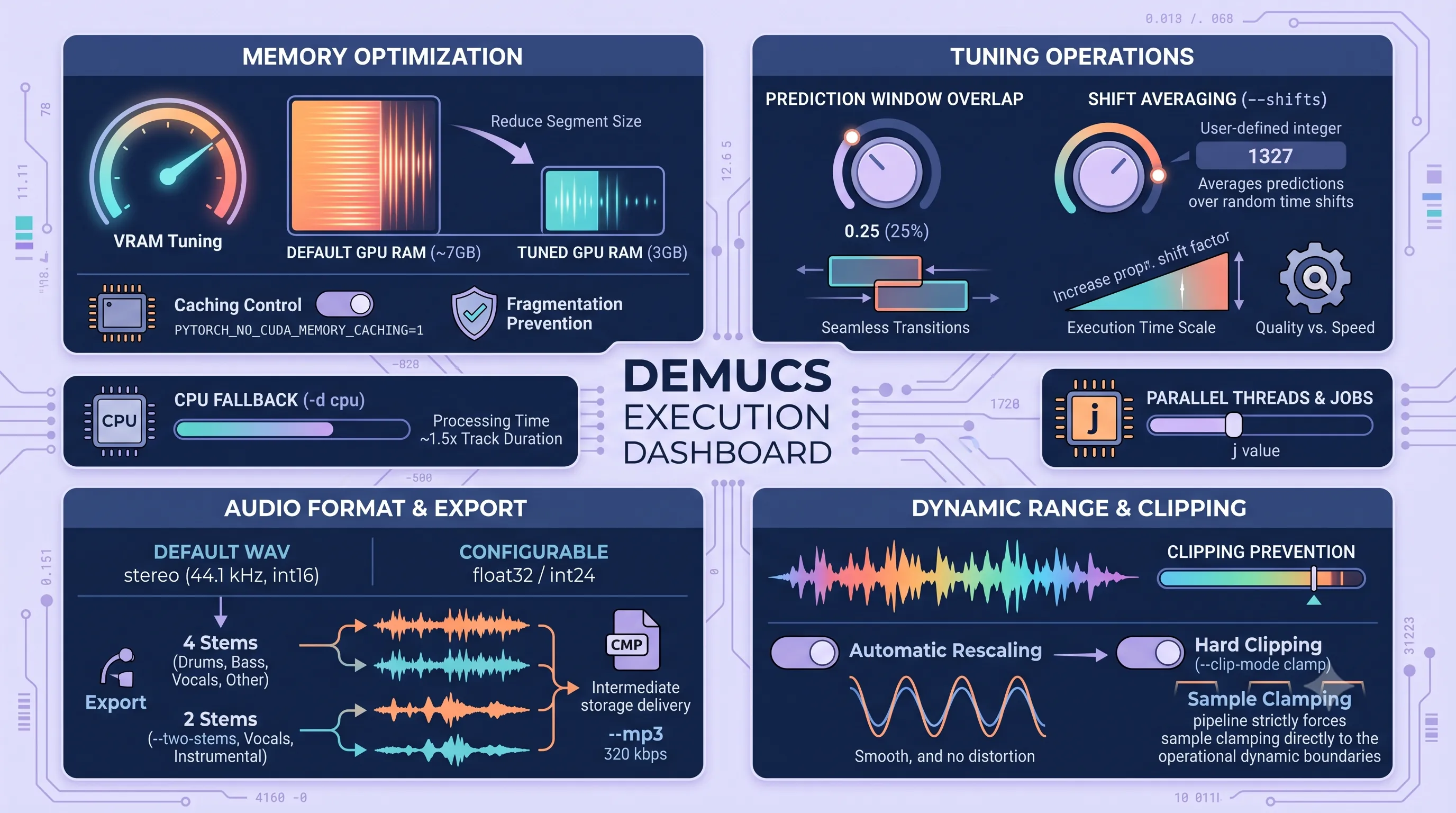
5. Multistage Latent Video Diffusion Modeling with Stable Video Diffusion
Constructing an automated video-to-sound synchronization and multitrack stem extraction pipeline requires a robust, motion-coherent visual foundation.Without precise temporal continuity in synthesized video frames, downstream audio alignment models fail to lock acoustic transients to visual action cues.
Stable Video Diffusion resolves this challenge by introducing temporal dynamics directly into latent representations, scaling 2D foundational models into temporal video generators.
Three-Stage Video Latent Pretraining and Fine-Tuning Pipeline
The Stable Video Diffusion architecture builds directly upon Stable Diffusion 2.1 by integrating temporal convolution and temporal attention layers immediately after spatial layers.This design inserts 656M temporal parameters into the original base, resulting in a model with 1521M total parameters.
To govern noise dynamics across variable dimensions, the architecture implements a continuous-time EDM diffusion framework where the noise schedule is shifted toward higher noise levels for higher-resolution generation.
Data curation relies on cascaded cut detection executed across three distinct frame rates to prevent scene transition artifacts from contaminating training clips.
The model trains systematically through a three-stage regime, utilizing the initial Large Video Dataset (LVD) comprising 580M annotated video clip pairs totaling 212 years of visual content, which is pruned via cascaded curation into the filtered pretraining dataset (LVD-F) containing 152M examples.
This multistage strategy yields a zero-shot text-to-video Fréchet Video Distance (FVD) of 242.02 on the UCF-101 benchmark.
| Training Stage | Target Resolution | Frame Count | Iterations & Batch Size | Dataset Scale |
|---|---|---|---|---|
| Stage I: 2D Image Pretraining | Variable 2D Latent Resolutions | 1 Frame (Static) | Standard SD 2.1 Initialization | Pretrained Image Distribution |
| Stage II: Large-Scale Video Pretraining (Initial) | 256x384 | 14 Frames | 150k Iterations (Batch Size 1536) | LVD-F (152M Filtered Examples from 580M LVD Base) |
| Stage II: Large-Scale Video Pretraining (Intermediate) | 320x576 | 14 Frames | 100k Iterations (Batch Size 768) | LVD-F (152M Filtered Examples) |
| Stage III: High-Resolution Fine-Tuning | 576x1024 | 14+ Frames | 50k Iterations | ~1M High-Quality Video Samples |
The unified temporal attention and convolution operations require substantial VRAM and compute overhead during both training and sampling.
Additionally, the pipeline can encounter edge-case failure modes characterized by insufficient motion dynamics or protracted diffusion sampling steps.
Linear Classifier-Free Guidance Scaling Across Frame Latents
Applying a uniform classifier-free guidance (CFG) scale across all temporal positions frequently causes visual over-saturation and temporal drift as the frame sequence progresses.To resolve this instability, the CFG scale is adjusted linearly across the temporal frame axis to anchor early latents firmly while preserving natural motion variation in later frames.
class LinearPredictionGuider:
    def __init__(self, max_scale: float, num_frames: int, min_scale: float = 1.0):
        self.min_scale = min_scale
        self.max_scale = max_scale
        self.num_frames = num_frames
        self.scale = torch.linspace(min_scale, max_scale, num_frames).unsqueeze(0)

    def __call__(self, x: torch.Tensor, sigma: float) -> torch.Tensor:
        x_u, x_c = x.chunk(2)
        x_u = rearrange(x_u, "(b t) ... -> b t ...", t=self.num_frames)
        x_c = rearrange(x_c, "(b t) ... -> b t ...", t=self.num_frames)
        scale = repeat(self.scale, "1 t -> b t", b=x_u.shape[0])
        scale = append_dims(scale, x_u.ndim).to(x_u.device)
return rearrange(x_u + scale * (x_c - x_u), "b t ... -> (b t) ...")x contains concatenated unconditional (x_u) and conditional (x_c) model evaluations.The module reshapes both predictions from flattened spatial-temporal batches into explicit
(b, t, ...) layouts matching the sequence length self.num_frames.A 1D guidance vector generated by
torch.linspace is broadcast across the batch and feature dimensions, scaling the residual term (x_c - x_u) progressively along the frame index before repacking the latents into the target output shape.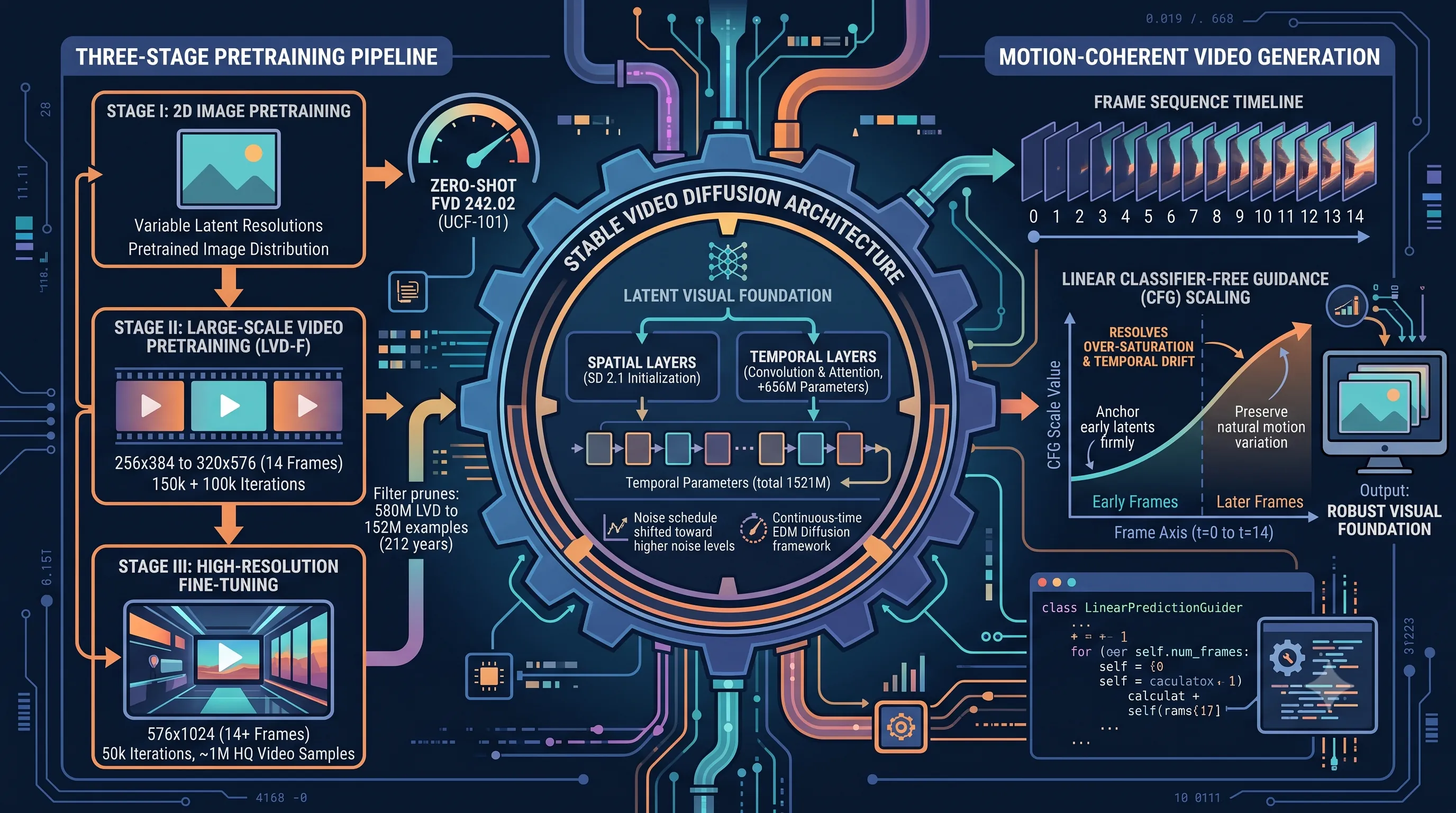
6. Cross-Modal Audio-Visual Synchronization and Cascaded Lip-Sync Architectures
Transitioning silent generative video into coherent audiovisual media requires robust architectures capable of aligning acoustic dynamics with visual events.Achieving precise temporal synchronization bridges the gap between synthetic motion and sound, anchoring vocal streams and environmental acoustics directly to on-screen actions.
Joint Multimodal Synthesis and Cascaded Alignment Pipelines
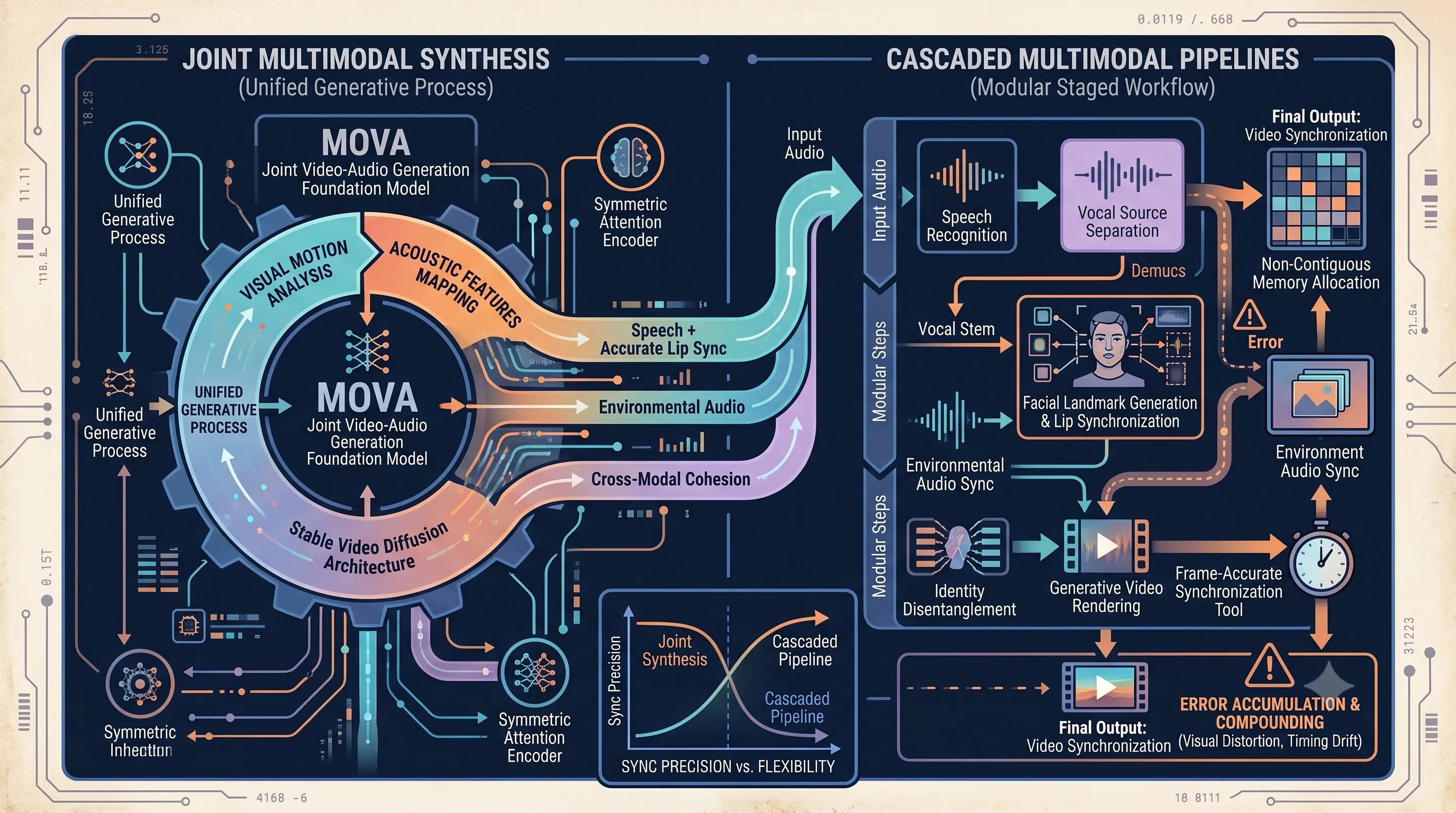
Multimodal synchronization architectures diverge into joint foundation frameworks and staged cascaded pipelines.Joint video-audio generation foundation models, such as MOVA, synthesize speech paired with accurate lip synchronization alongside synchronized environmental audio within a unified generative process.
These integrated models map acoustic features and visual motion concurrently to preserve cross-modal cohesion.
In contrast, cascaded multimodal pipelines structure the workflow into modular stages.
These modular workflows convert input audio to text, isolate vocal stems using dedicated source separation models, and drive facial landmarks to achieve video synchronization.
To facilitate zero-shot in-the-wild generalization across unseen target subjects, architectures integrate identity disentanglement modules.
These modules explicitly separate identity-specific visual features from underlying audio representations, ensuring that acoustic-driven motion does not distort facial structure or subject appearance.
Symmetric Attention Encoders and Synchronization Error Compounding
Establishing tight temporal correspondence between visual cues and multitrack sound layers relies heavily on audio-visual cross-modal alignment architectures.These systems deploy cross-modal encoders equipped with symmetric attention mechanisms to map reciprocal relationships between audio representations and visual frames.
Symmetric cross-modal attention ensures that transient visual events properly anchor sound tracks along a shared temporal axis.
However, structural bottlenecks remain prevalent across cascaded synchronization paradigms.
Because cascaded pipelines depend on sequential processing, they frequently suffer from error accumulation across speech recognition, audio separation, and generative video rendering stages.
Any misaligned phoneme or imperfectly isolated vocal artifact in early stages propagates downstream, compounding visual distortion or timing drift in the final output.
Furthermore, achieving frame-accurate synchronization across diverse and complex environmental sound effects remains a persistent challenge within automated generative workflows.
7. Modern Stem Separation Pipelines and Digital Audio Workstation Workflows
Building robust post-production pipelines for AI-generated video requires deconstructing composite soundtracks into discrete, workable audio layers to achieve tight audiovisual alignment and dynamic mix control.Modern stem separation directly serves this multitrack pipeline by extracting mixed audio tracks from raw video containers and isolating them into independent components suitable for downstream synchronization, transcription, and sound design.
Evolution from ConvNet Baselines to Hybrid Transformer Workflows
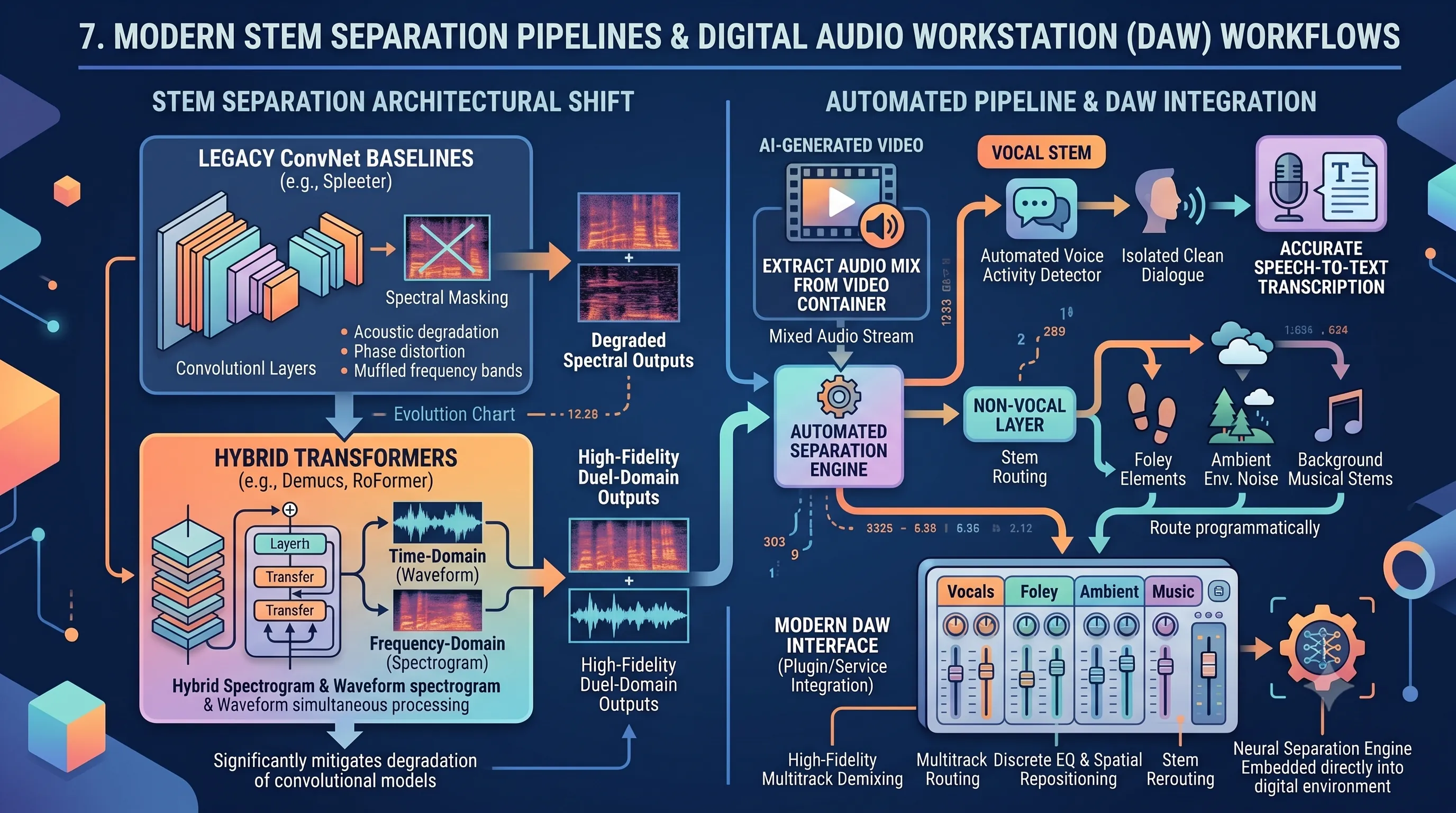
Source separation architectures have undergone a significant architectural shift in post-production environments.Legacy systems historically relied on ConvNet baselines, such as Spleeter, to perform spectral masking across standard frequency bins.
However, older generation separation models frequently suffer from noticeable acoustic degradation, phase distortion, and muffled frequency bands when processing dense mixes.
Current production pipelines have largely migrated from these legacy ConvNet structures to Hybrid Transformers, exemplified by Demucs, as well as RoFormer variants.
These modern architectures utilize hybrid spectrogram and waveform transformer approaches that simultaneously process time-domain and frequency-domain representations.
By combining dual-domain analysis, hybrid transformer models significantly mitigate the acoustic degradation that plagued earlier convolutional models.
Despite these architectural advancements, challenges remain when handling complex instrumental mixing and dense acoustic bleed, which can still introduce residual artifacts into isolated stem outputs.
Automated Dialogue Isolation, Stem Routing, and DAW Integration
End-to-end post-production workflows leverage automated separation engines to ingest mixed audio streams extracted directly from video containers.Once ingested, the pipeline splits composite audio into isolated vocal and background stems while integrating automated voice activity detectors to identify speech segments.
This automated workflow isolates clean dialogue tracks specifically conditioned for accurate speech-to-text transcription engines.
Concurrently, non-vocal layers—such as foley elements, ambient environmental noise, and background musical stems—are programmatically routed to distinct digital mixing channels for discrete equalization, spatial repositioning, and dynamic re-mixing.
To facilitate direct studio adoption, AI separation engines are no longer confined to standalone command-line scripts.
Modern implementations embed these neural separation engines directly into digital audio editing environments through specialized DAW integration plugins and browser-based services.
This direct integration enables audio engineers to execute high-fidelity multitrack demixing, clean speech extraction, and stem rerouting directly inside familiar digital audio workstations.
Related Posts

How Frontier AI Models Are Rewriting Theoretical PhysicsExplore how frontier AI models and autonomous agents are transforming theoretical physics,...

OpenAI GPT-6.2 Billing Fix: Astra Hits Limits 40% FasterOpenAI fixes a GPT-6.2 launch billing bug, causing Astra limits to hit 40% faster and Sol 25%...
How GPT-6 Achieves Intrinsic Protein Design Without Specialized AIDiscover how GPT-6 models achieve intrinsic protein design and de novo minibinder generation using...
Generative AI may have assisted with research or drafting for this article. Topic selection, fact-checking, final wording, and publication remain the responsibility of DragonStone74. AI use disclosure