
Why a July Gateway Update Triggered the 24-Hour Microsoft 365 Outage
🚀 Key Takeaways
- Protracted Cloud Disruption: A nearly day-long global outage severely crippled Microsoft 365 and Exchange Online, leaving the vast majority of core network gateway infrastructure unresponsive at its height.
- Dormant Gateway Defect: The root cause traced back to a latent Windows-level flaw deployed months earlier in July 2026, which escaped detection due to pre-deployment load tests conducted on lower-core hardware.
- Compounding Cascading Triggers: Unplanned capacity losses, scheduled internal traffic shifts, and automated failover routing converged during peak usage hours to trigger severe lock contention across surviving nodes.
- Manual Recovery Required: Automated self-healing protocols were overwhelmed by accumulated traffic backlogs, forcing engineering teams to manually deploy a dedicated code reversion to restore gateway stability.
- Contractual SLA Compensation: Enterprise customers facing prolonged webmail downtime across public and private sectors are eligible to claim substantial monthly service credits under updated SLA agreements.
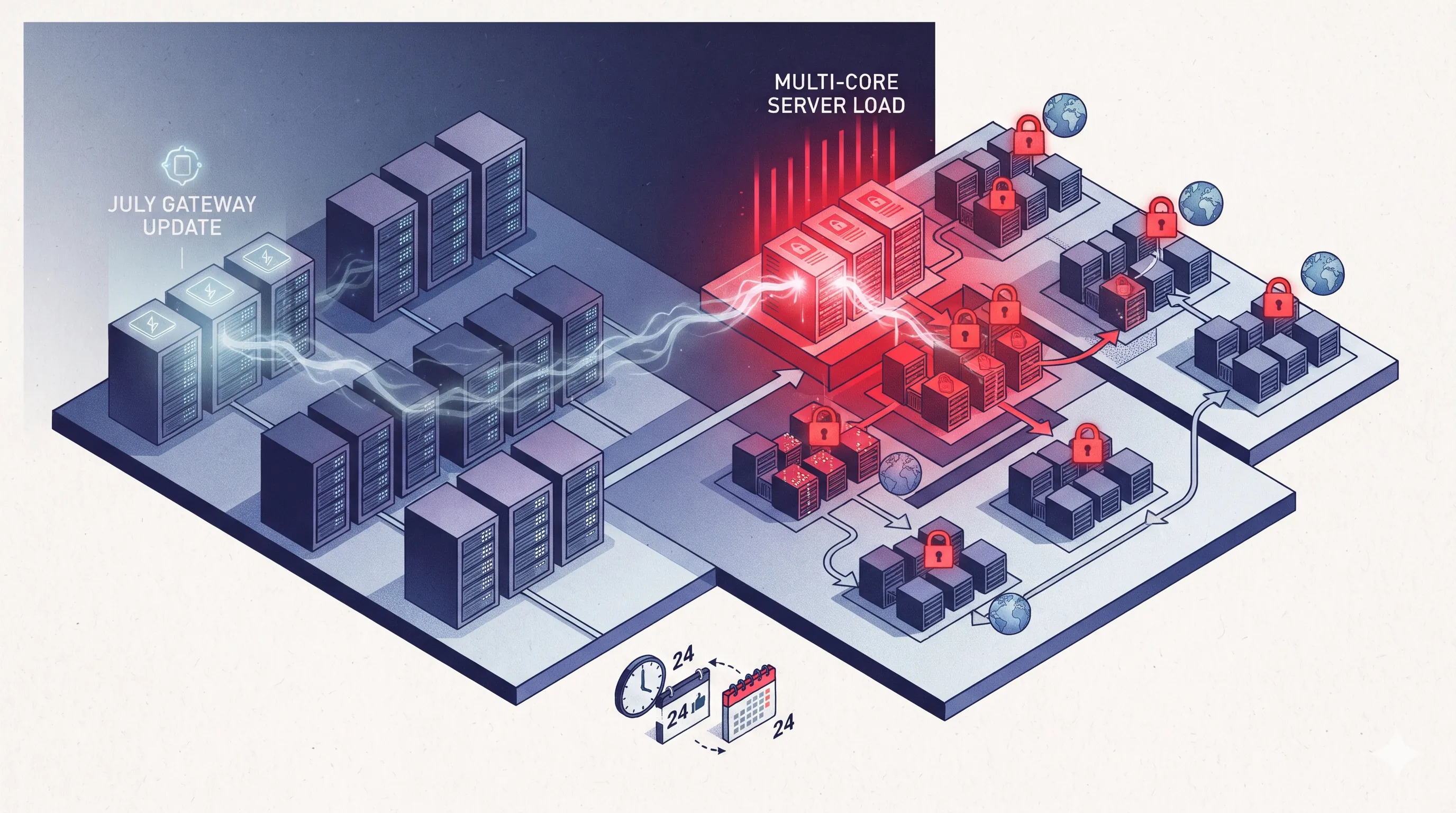
Microsoft’s preliminary investigation revealed a sobering architecture vulnerability: a dormant code defect quietly delivered during a routine mid-year gateway update had operated harmlessly in production for months before catastrophic lock contention was provoked under heavy multicore server demand. When combined with sudden internal traffic rebalancing and diminished capacity, the event triggered a rapid, multi-region cascade that defeated standard automated containment mechanisms.
As organizations work through operational backlogs and submit formal compensation claims under updated service level terms, the breakdown casts a spotlight on the challenges of modern cloud resilience and high-core hardware testing. With a comprehensive technical review scheduled for publication later this week, IT leaders worldwide are taking a closer look at the critical failover dependencies powering their day-to-day enterprise operations.
1. Global Scope of the 24-Hour Exchange Online and Microsoft 365 Disruption
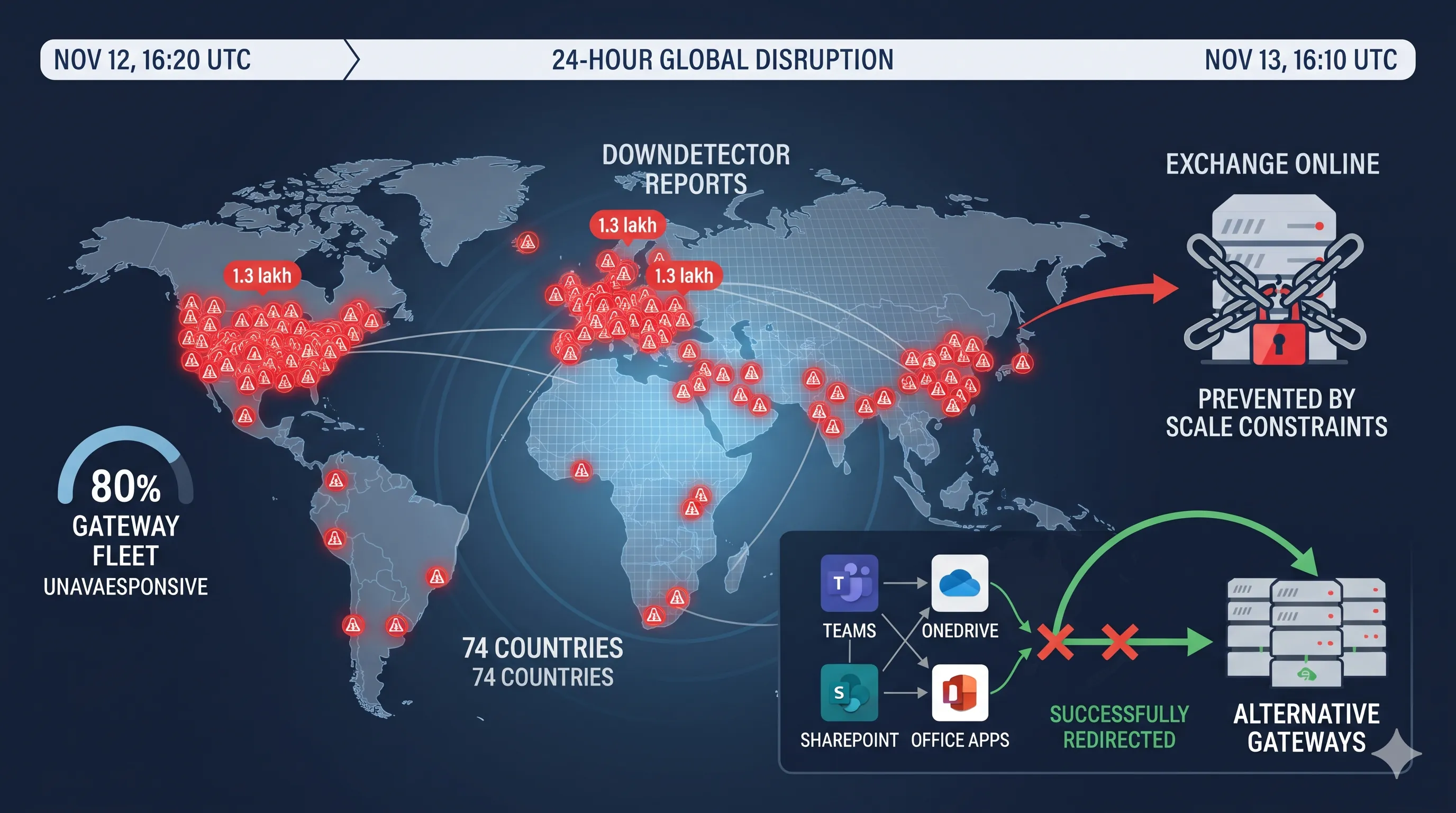
As Microsoft investigates the major Microsoft 365 and Exchange outage linked to a July 2026 network gateway update defect, examining the operational footprint reveals the immense reach and severity of the event.The disruption lasted nearly 24 hours, officially beginning at approximately 16:20 UTC on November 12, 2026, and running through roughly 16:10 UTC on November 13, 2026.
During this window, enterprise communications ground to an abrupt halt as core routing infrastructure collapsed across global availability zones.
Unresponsive Gateway Fleet and Downdetector Surge Across 74 Countries
At the lowest point of the outage, telemetry showed that over 80 percent of gateway servers were unresponsive.The catastrophic reduction in gateway capacity triggered an unprecedented spike in user reports as administrators and end users discovered their environments were completely unreachable.
Public telemetry platforms reflected the immediate global impact, with the incident generating over 1.3 lakh reports on Downdetector spanning across 72 to 74 countries.
The systemic failure primarily crippled Exchange Online and webmail access via Outlook, preventing organizations from sending or receiving essential corporate email.
In its tracking consoles, Microsoft tracked the event across two distinct operational tracks: incident identifier EX1550543 was assigned to Exchange Online, while MO1550821 covered the broader suite impacts across Microsoft 365.
Acknowledging the severe operational consequences of the prolonged gateway failure, Microsoft issued a formal customer apology, stating it was "deeply sorry for the impact to all our customers and recognise the impact that this has on their normal business and operations."
Architectural Scale Limits: Why Exchange Online Remained Stuck on Crippled Gateways
While the gateway failure degraded connectivity across multiple workloads, the recovery path diverged sharply between individual cloud services.Exchange Online could not be failed out of the affected network gateway to alternative infrastructure due to critical scale constraints.
The sheer volume of persistent mailbox connections and data throughput tied to Exchange Online meant that secondary routing paths could not absorb the massive routing shift without cascading failures.
In contrast, other core collaboration workloads possessed the elasticity to bypass the compromised routing layer.
Services such as Microsoft Teams, OneDrive, SharePoint, and Office apps were able to fail out to alternative gateways and were restored significantly sooner than Exchange Online.
| Service / Workload | Incident Tracking ID | Alternative Gateway Failout Status | Operational Impact Profile |
|---|---|---|---|
| Exchange Online (including Outlook Webmail) | EX1550543 | Failed out: No (prevented by scale constraints) | Primarily crippled; remained impaired across the nearly 24-hour disruption. |
| Microsoft Teams | MO1550821 | Failed out: Yes (successfully redirected to alternative gateways) | Traffic rerouted to alternative infrastructure; restored sooner. |
| SharePoint & OneDrive | MO1550821 | Failed out: Yes (successfully redirected to alternative gateways) | Traffic rerouted to alternative infrastructure; restored sooner. |
| Office Apps | MO1550821 | Failed out: Yes (successfully redirected to alternative gateways) | Traffic rerouted to alternative infrastructure; restored sooner. |
2. The July 2026 Code Defect and Flawed Multi-Core Load Testing Assumptions
Understanding the mechanics of the November 2026 Exchange and Microsoft 365 incident requires a direct technical examination of the July 2026 gateway update defect, which serves as the core trigger of the widespread service collapse currently under investigation.A Three-Month Dormant Defect in Windows Network Gateway Software
The foundational root cause behind the service outage traces back to a software update originally deployed in July 2026.This specific software build was tailored exclusively for Windows-based Microsoft 365 network gateway servers and did not affect broader Windows deployments across client devices or standard enterprise installations.
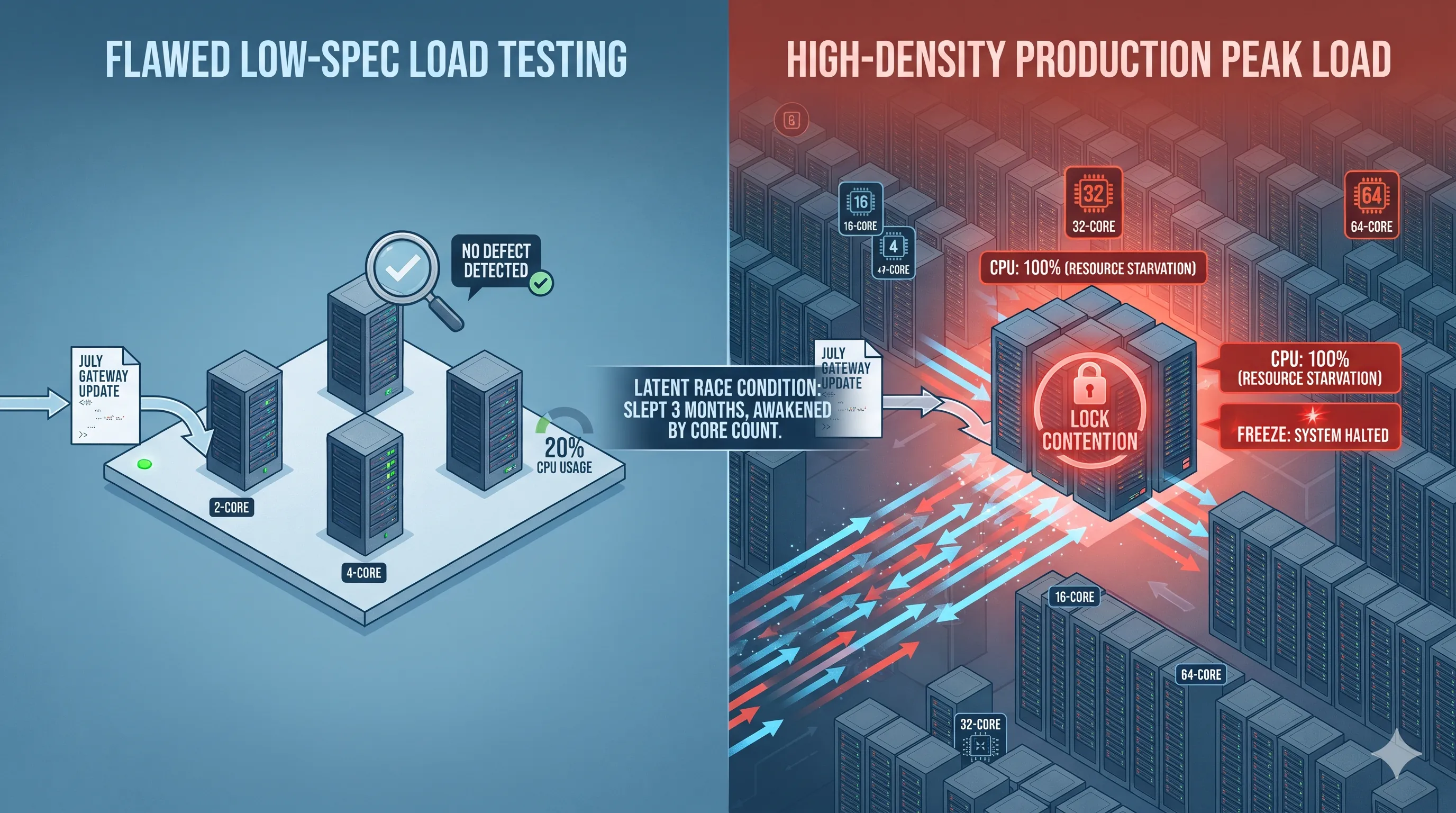
Following its initial deployment, the defective code ran in production worldwide for more than 3 months without triggering an operational impact.
The flaw remained benign until gateway traffic generated a specific set of load conditions that exposed a latent race condition.
Once those runtime conditions were met, the defect triggered severe lock contention inside an internal Windows process.
This internal lock contention rapidly exhausted critical machine resources, specifically CPU and memory, causing the network gateway servers to freeze and cease processing ingress and egress traffic.
Core Count Sensitivity and the Flaws of Low-Spec Load Testing
The failure to intercept this critical bug prior to global release stemmed from flawed architectural assumptions during internal evaluation cycles.Microsoft's pre-deployment load testing failed to catch the defect because verification tests focused on weaker hardware with fewer cores.
In its preliminary findings regarding the collapse, Microsoft admitted: "Our load testing tended to focus on weaker hardware with fewer cores."
Because synchronization overhead scales non-linearly with thread parallelism, the lock contention flaw worsened specifically on newer server hardware equipped with higher core counts.
Consequently, running simulated stress tests against lower-tier, low-core testing environments completely obscured the resource starvation that surfaced immediately once high-density, multi-core production server infrastructure encountered peak load volumes.
3. The Perfect Storm: Cascading Failures and Collapsed Regional Isolation
This section examines how the latent software defect introduced during the July 2026 network gateway update was activated by an operational convergence, escalating into the widespread Microsoft 365 and Exchange outage currently under investigation.While the underlying code defect had remained dormant inside the network gateway architecture, an extraordinary alignment of routine and anomalous infrastructure events pushed the system past its operational thresholds.
Three Operational Triggers: Traffic Shifting, Capacity Loss, and Peak Demand
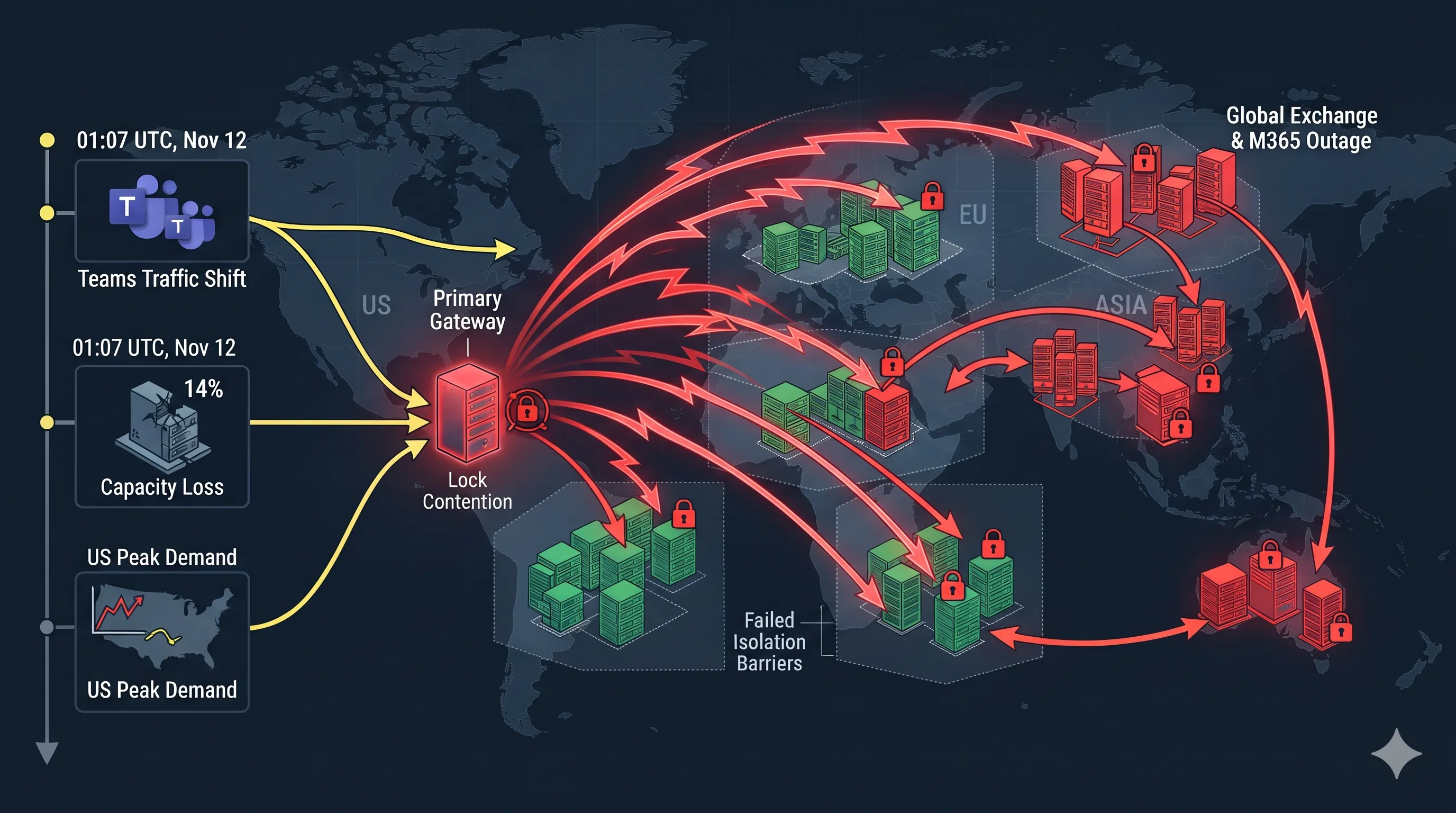
According to official findings, three independent operational factors coincided to trigger the outage across Microsoft's core communication services.Executive Vice President Charles Lamanna stated that "three main factors together caused a global outage for the networking gateway that fronts many Microsoft 365 services."
The first trigger unfolded when Teams traffic was shifted to the primary gateway at 01:07 UTC on November 12, 2026, roughly 15 hours before major failure detection.
The second trigger involved an unrelated infrastructure disruption from the previous day, which left almost 14 percent of the networking gateway's server capacity offline.
The third trigger occurred as enterprise user activity accelerated during peak traffic hours in the United States, driving elevated load directly into an already depleted server footprint.
The convergence of elevated load, reduced server capacity, and the latent July 2026 defect transformed standard operational conditions into an acute systemic crisis.
| Triggering Operational Factor | Timing | Immediate Systemic Impact |
|---|---|---|
| Teams Traffic Gateway Shift | 01:07 UTC on November 12, 2026 (roughly 15 hours before major failure detection) | Redirected enterprise Teams communication streams onto the primary networking gateway, increasing baseline processing volume. |
| Pre-Existing Capacity Deficit | Unrelated issue originating the previous day | Rendered almost 14 percent of the networking gateway's server capacity offline before the surge commenced. |
| United States Peak Traffic Demand | Concurrently during United States peak operational hours | Delivered heavy concurrent user request volumes into a capacity-constrained gateway pool. |
The Fleet Cascade: Rerouting Overload and Regional Boundary Collapse
As the combination of the Teams traffic failover and 14 percent diminished capacity hit during peak traffic hours in the United States, initial server nodes began to falter.In response to degrading nodes, automated traffic management mechanisms intervened to preserve availability.
Traffic management mechanisms automatically rerouted requests from unresponsive servers to surviving healthy nodes across the infrastructure.
This automated mitigation directly exacerbated the failure, as automatic rerouting funneled identical high-volume traffic into surviving servers, triggering the lock contention defect across adjacent nodes.
Instead of isolating the failure domain, the rerouting mechanism propagated the unhandled lock contention exponentially.
As a consequence of this feedback loop, the defect cascaded across Microsoft's fleet in less than 2 hours once server failures began.
Under designed operational safeguards, the impact should have been halted at regional boundaries; however, regional isolation barriers between gateway units failed to contain the cascade due to a separate secondary issue.
With regional isolation boundaries disabled by this secondary issue, the cascading lock contention swept across the networking gateway fleet that fronts Exchange and Microsoft 365 services worldwide.
4. Mitigation Breakdown: Overwhelmed Automated Recovery and Code Path Rollback
This operational breakdown connects directly to Microsoft's investigation into the major Microsoft 365 and Exchange outage linked to the July 2026 network gateway update defect, detailing how infrastructure engineers isolated the fault and overcame cascading recovery failures.Timeline of Diagnosis from Connection Negotiation Alerts to Code Reversion
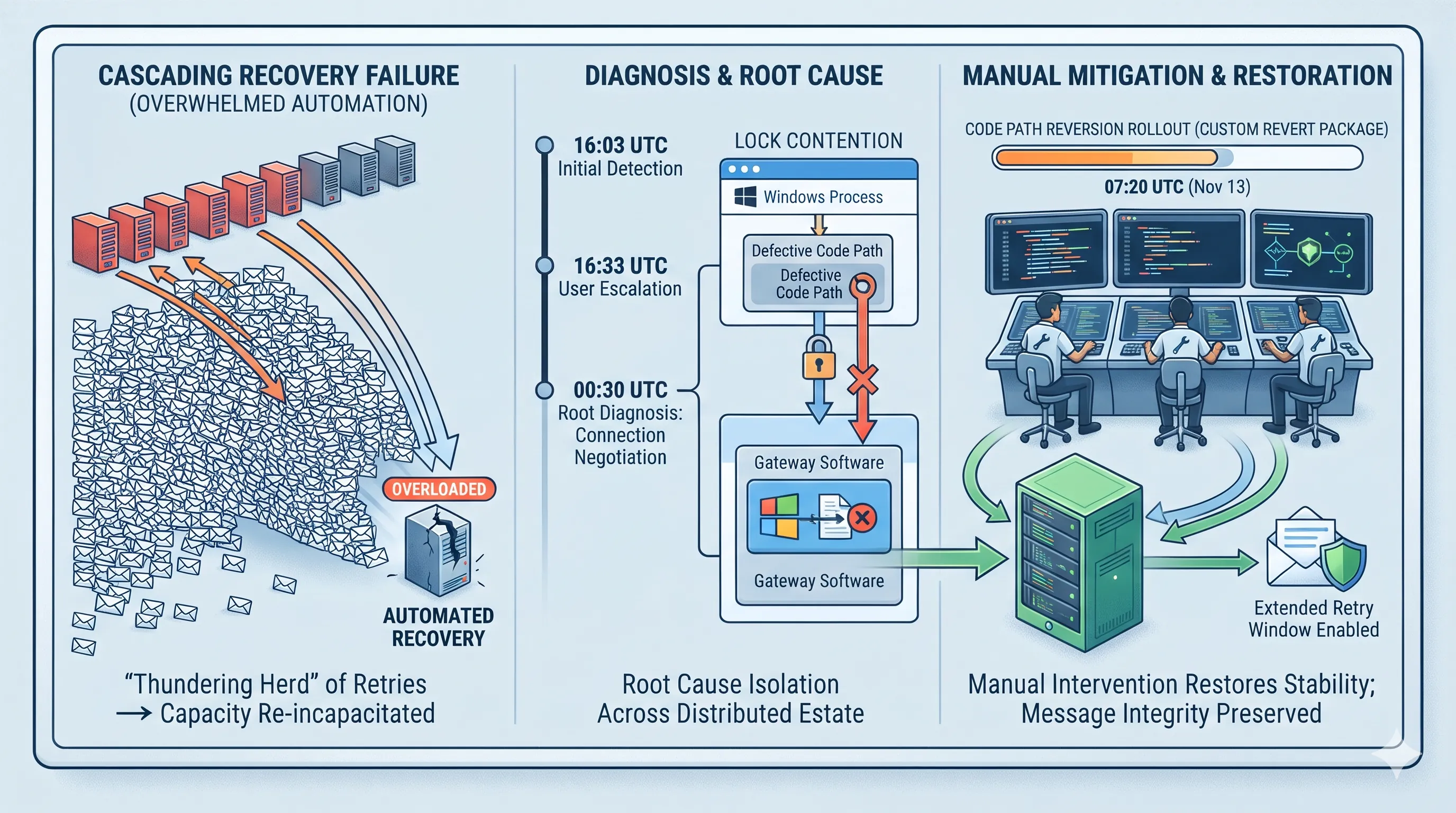
The incident unfolded through a protracted diagnosis window as telemetry systems and support channels registered widespread service degradation.Connectivity anomaly detection first flagged system issues at 16:03 UTC on November 12, which was followed thirty minutes later by the first support case logged at 16:33 UTC.
Isolating the root cause within the transport infrastructure required several hours of deep inspection across the distributed estate.
At 00:30 UTC on November 13, connection negotiation was officially diagnosed as the primary failure point across affected endpoints.
Engineers subsequently developed a corrective update that reverted the specific defective Windows code path to its previous stable state.
However, remediation could not be executed via automated toggles because standard rapid rollback tooling was unavailable due to the defective code having been merged months prior.
Following validation of the custom revert package, rollout of the mitigation update commenced at 07:20 UTC on November 13.
A final comprehensive post-incident review is scheduled for publication on November 20, 2026 to provide an exhaustive technical post-mortem.
| Timestamp | Phase / Milestone | Operational Action & Status |
|---|---|---|
| 16:03 UTC (Nov 12) | Initial Detection | Connectivity anomaly detection flagged underlying transport issues. |
| 16:33 UTC (Nov 12) | User Escalation | First external support case filed regarding Exchange access failures. |
| 00:30 UTC (Nov 13) | Root Diagnosis | Connection negotiation diagnosed as the primary failure point. |
| 07:20 UTC (Nov 13) | Mitigation Deployment | Rollout of the corrective code path reversion update commenced. |
| November 20, 2026 | Comprehensive Review | Scheduled publication date for the final post-incident review. |
Why Automated Recovery Failed Against Historic Email Backlogs
Restoration efforts were hindered by cascading effects across the messaging topology once nodes dropped offline.Automated recovery systems failed because servers reintroduced to service were immediately overwhelmed by backlogged traffic.
The sheer volume of accumulated retries generated a thundering herd dynamic that continuously incapacitated recovered capacity.
Regarding this systemic collapse, Microsoft noted: "Our normally automated recovery processes were not designed to restore service from this broad unresponsive state."
To mitigate data loss while engineers worked through the manual server restorations, protective adjustments were enacted at the edge.
Microsoft extended its email delivery retry window so queued inbound emails would not bounce back to senders during the sustained gateway outage.
This protective queue extension preserved message integrity until the targeted code regression patch stabilized connectivity across the fleet.
5. Enterprise Blast Radius and Microsoft SLA Credit Claim Guidelines
The enterprise operational fallout from the July 2026 network gateway update defect extended deeply into mission-critical public administration and commercial transport infrastructure.
As Microsoft investigated the major Microsoft 365 and Exchange outage, the resulting downtime translated into immediate administrative friction and external communication failures worldwide.
Aviation and Public Sector Disruption Across Global Hubs
The breakdown in Exchange infrastructure impacted municipal and national governance services.
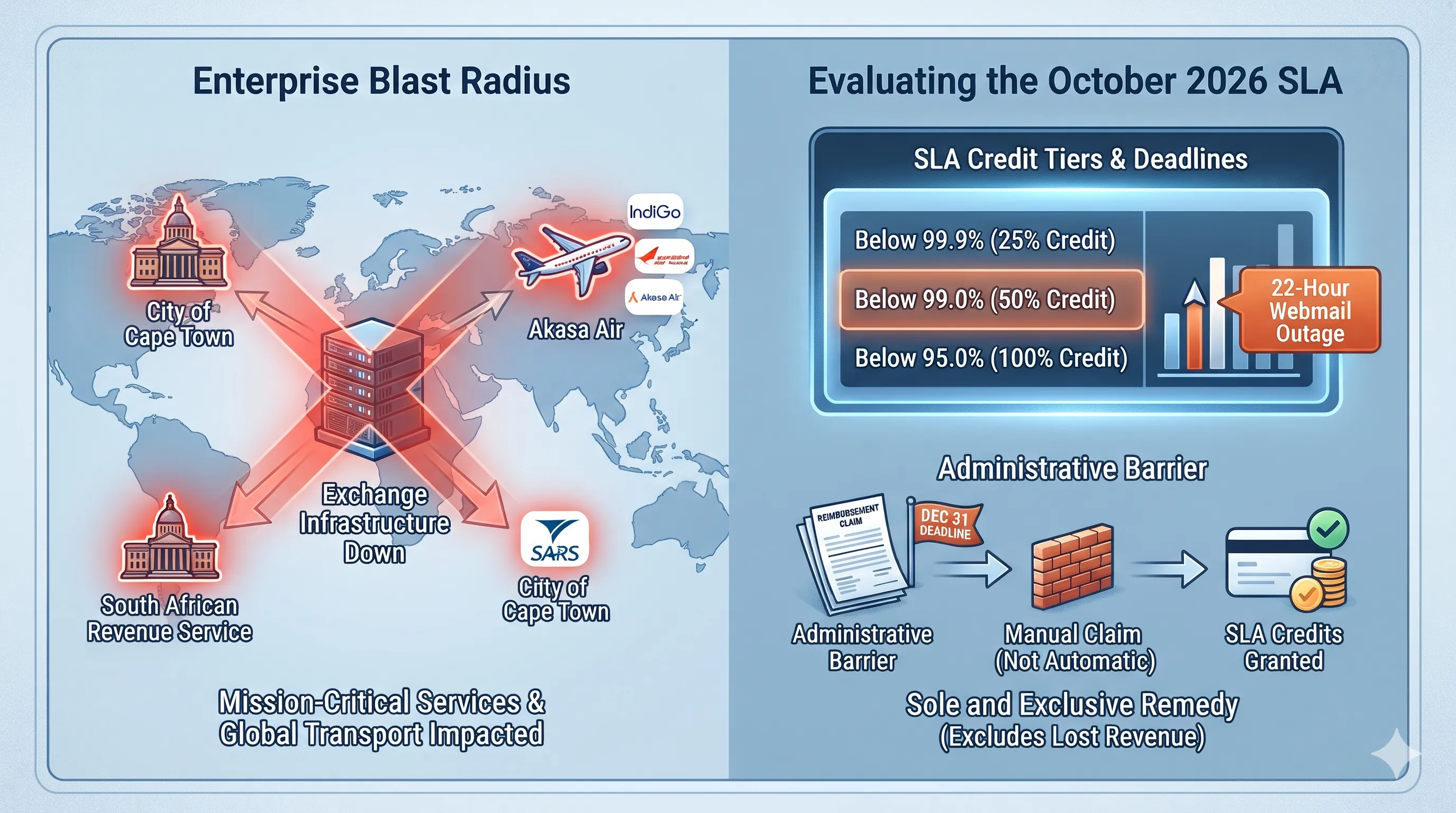
Public sector bodies including the City of Cape Town and the South African Revenue Service faced operational disruptions when staff access to core email functions was severed.
Commercial transport sectors encountered similar operational hurdles.
Indian commercial airlines IndiGo, Air India, and Akasa Air suffered customer support email communication disruptions throughout the incident.
For these carriers, the inability to interact with passengers through established enterprise email endpoints stalled ticketing resolutions and customer service inquiries.
Under Microsoft's evaluation criteria, SLA uptime measurements specifically evaluate a customer's inability to send or receive email via Outlook on the web.
Evaluating the October 2026 SLA: 50 Percent Credit Thresholds and the December 31 Deadline
Under the October 2026 Service Level Agreement (SLA), customer financial compensation is determined strictly by tiered monthly uptime availability.
A 22-hour webmail outage qualifies affected customers for a 50 percent monthly service credit.
More broadly, uptime dipping below 99.9 percent earns a 25 percent credit, uptime below 99 percent earns a 50 percent credit, and uptime below 95 percent earns a 100 percent credit.
Furthermore, all service credits are capped at 100 percent of the monthly service fee for the impacted product.
| Monthly Uptime Tier | Outage Duration / Qualification Threshold | Monthly Service Credit Percentage |
|---|---|---|
| Below 99.9% | Outage exceeding 99.9% uptime threshold | 25% |
| Below 99.0% | 22-hour webmail outage threshold | 50% |
| Below 95.0% | Outage exceeding 95.0% uptime threshold | 100% (Maximum cap) |
To obtain compensation, organizations must navigate an administrative barrier.
Customers must lodge reimbursement claims manually with Microsoft support by December 31, 2026.
These credits are not applied automatically to tenant accounts.
Even when granted, enterprise recovery remains limited in scope.
The service level terms explicitly state that service credits serve as customers' "sole and exclusive remedy" and exclude lost revenue.
As defined in the contract, service credits represent the sole and exclusive remedy under the SLA and do not cover secondary financial or operational losses sustained during the outage.
Related Posts



Generative AI may have assisted with research or drafting for this article. Topic selection, fact-checking, final wording, and publication remain the responsibility of DragonStone74. AI use disclosure