
Suno AI Copyright Ruling Collides with EU AI Act's Full Enforcement: New Era for Generative AI, GPAI Transparency & Risk Regulation
🚀 Key Takeaways
- A German court ruled on July 31, 2026, that AI music platform Suno infringed copyrights by training its models on unlicensed music.
- The EU AI Act, the world's first comprehensive legal framework for AI, became generally applicable on August 2, 2026, establishing broad regulations.
- The Act introduces specific rules for General-Purpose AI (GPAI) models, including key transparency and copyright-related obligations for providers.
- The ruling against Suno underscores the immediate legal implications for AI developers regarding intellectual property rights and data licensing for model training.
- The AI Act employs a risk-based approach, classifying AI systems into categories from unacceptable (banned) to minimal, with corresponding compliance requirements.
- Recent amendments via the 'AI Omnibus', effective July 27, 2026, clarified implementation timelines and strengthened governance for the AI Act.
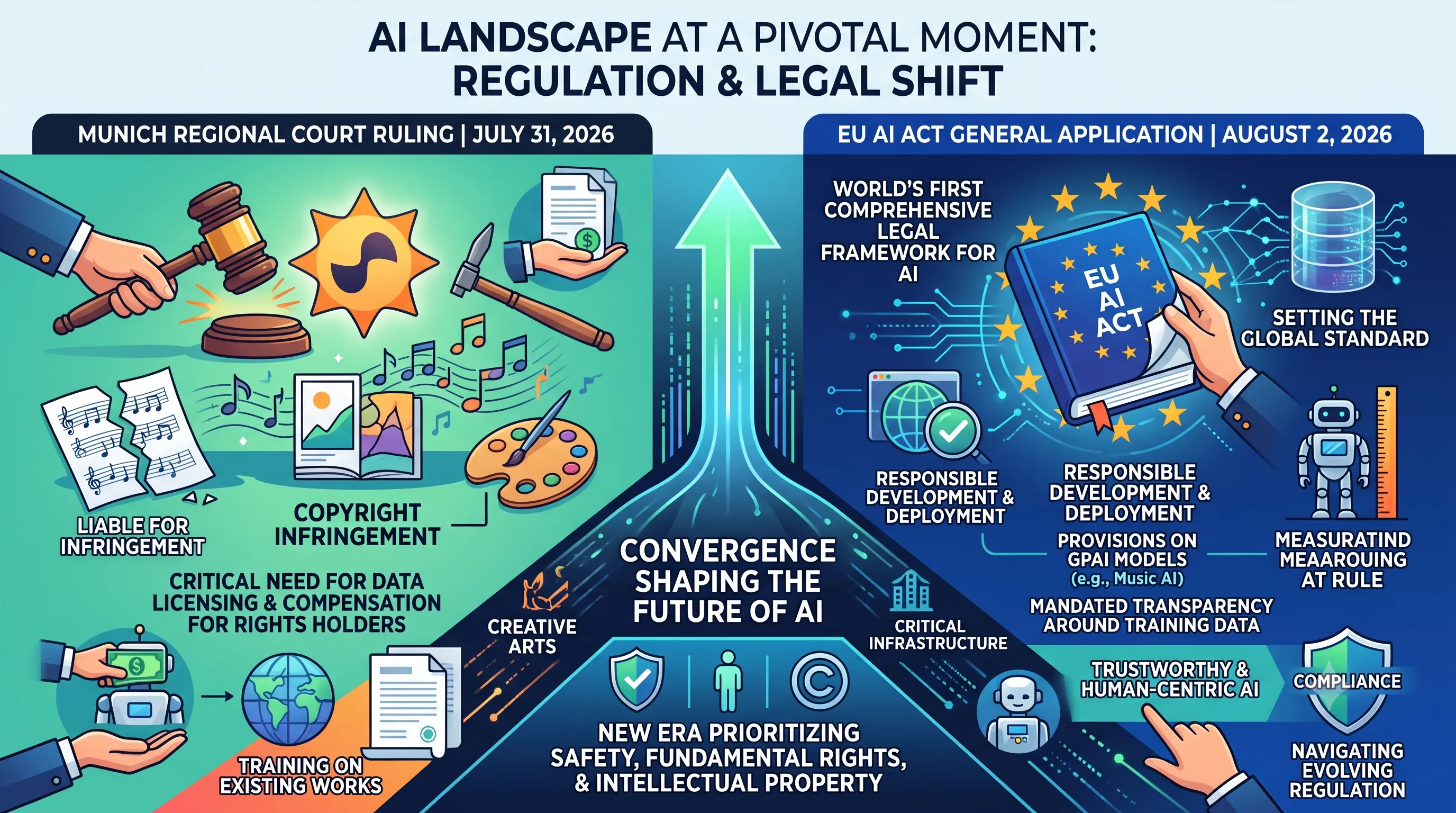
The landscape of artificial intelligence is experiencing a pivotal moment, marked by both rapid technological advancement and swift regulatory responses. On July 31, 2026, the Munich Regional Court issued a landmark ruling against the US-based AI music generator Suno, finding it liable for copyright infringement. This decision sends a clear message to AI developers globally, emphasizing the critical need for proper data licensing and compensation for rights holders when training AI models on existing creative works.
This significant legal precedent arrives just as the European Union's pioneering AI Act became generally applicable on August 2, 2026. As the world's first comprehensive legal framework for AI, the Act is now setting the global standard for the responsible development and deployment of artificial intelligence. Its provisions, especially those concerning General-Purpose AI (GPAI) models like Suno and the mandated transparency around training data, directly address the very issues at the heart of the German court's ruling.
The convergence of this consequential court verdict and the full activation of the EU AI Act highlights a new era where legal and ethical considerations are rapidly shaping the future of AI. Industries, from creative arts to critical infrastructure, must navigate an evolving regulatory environment that prioritizes safety, fundamental rights, and intellectual property in the pursuit of trustworthy and human-centric AI.
This significant legal precedent arrives just as the European Union's pioneering AI Act became generally applicable on August 2, 2026. As the world's first comprehensive legal framework for AI, the Act is now setting the global standard for the responsible development and deployment of artificial intelligence. Its provisions, especially those concerning General-Purpose AI (GPAI) models like Suno and the mandated transparency around training data, directly address the very issues at the heart of the German court's ruling.
The convergence of this consequential court verdict and the full activation of the EU AI Act highlights a new era where legal and ethical considerations are rapidly shaping the future of AI. Industries, from creative arts to critical infrastructure, must navigate an evolving regulatory environment that prioritizes safety, fundamental rights, and intellectual property in the pursuit of trustworthy and human-centric AI.
1. The EU AI Act: Pioneering Global AI Regulation
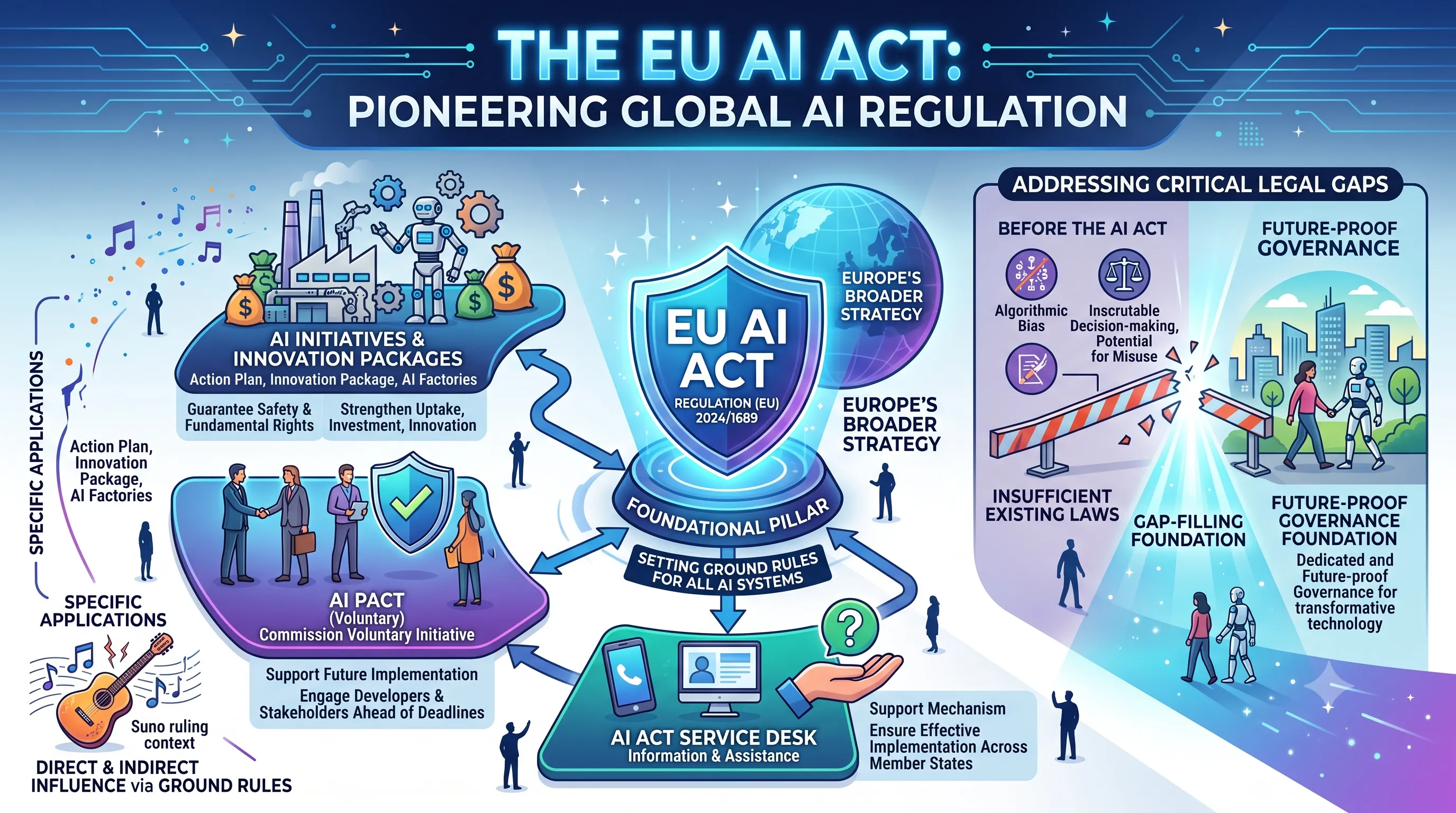
While the German court's ruling on Suno addresses a specific application of copyright law to generative AI, it unfolds within the broader context of Europe's comprehensive strategy for artificial intelligence. The foundational pillar of this strategy is the EU AI Act, a landmark regulation that sets the ground rules for all AI systems operating within the Union, establishing a legal environment that directly and indirectly influences cases like the one involving Suno.Europe's Ambitious Framework for Trustworthy AI
The AI Act, officially known as Regulation (EU) 2024/1689, stands as the world's first comprehensive legal framework dedicated to artificial intelligence.Its primary objective is to foster the development and uptake of trustworthy AI across Europe, ensuring that citizens can have confidence in the AI technologies they interact with.
The legislation is designed to address the risks associated with AI systems through a carefully structured set of risk-based rules that apply to both developers and deployers.
By establishing these clear guidelines, the EU aims to position itself as a global leader in secure, rights-respecting, and human-centric AI innovation.
However, the AI Act does not operate in isolation.
It is a central component of a much broader package of policy measures intended to create a holistic ecosystem for AI excellence and trust.
These interconnected initiatives work together to guarantee safety and fundamental rights while simultaneously strengthening investment and innovation throughout the EU.
To support businesses and stakeholders in aligning with the regulation, the European Commission also launched the AI Pact, a voluntary initiative to engage the AI community and smooth the path toward implementation.
Furthermore, an AI Act Service Desk has been established to provide information and support, facilitating effective adoption across the member states.
| Initiative | Purpose & Contribution |
|---|---|
| AI Continent Action Plan, AI Innovation Package, and AI Factories | A suite of measures that collectively work with the AI Act to guarantee safety and fundamental rights. They also focus on strengthening the uptake, investment, and innovation in AI across the EU. |
| The AI Pact | A voluntary initiative launched by the Commission to support the future implementation of the AI Act by engaging with AI developers and other stakeholders ahead of deadlines. |
| AI Act Service Desk | A support mechanism providing information and assistance to ensure effective implementation of the regulation across the European Union. |
Addressing the Gaps in Existing Legislation
The creation of such a sweeping regulatory framework was deemed necessary because prior laws were simply not equipped for the novel challenges introduced by artificial intelligence.The EU recognized that existing legislation was insufficient to address the specific and complex issues that advanced AI systems could bring, from algorithmic bias to inscrutable decision-making and the potential for misuse.
The AI Act was therefore crafted to fill these critical legal gaps, providing a dedicated and future-proof foundation for governing this transformative technology.
2. Navigating AI Risks: Categorizations and Prohibited Practices Under the AI Act
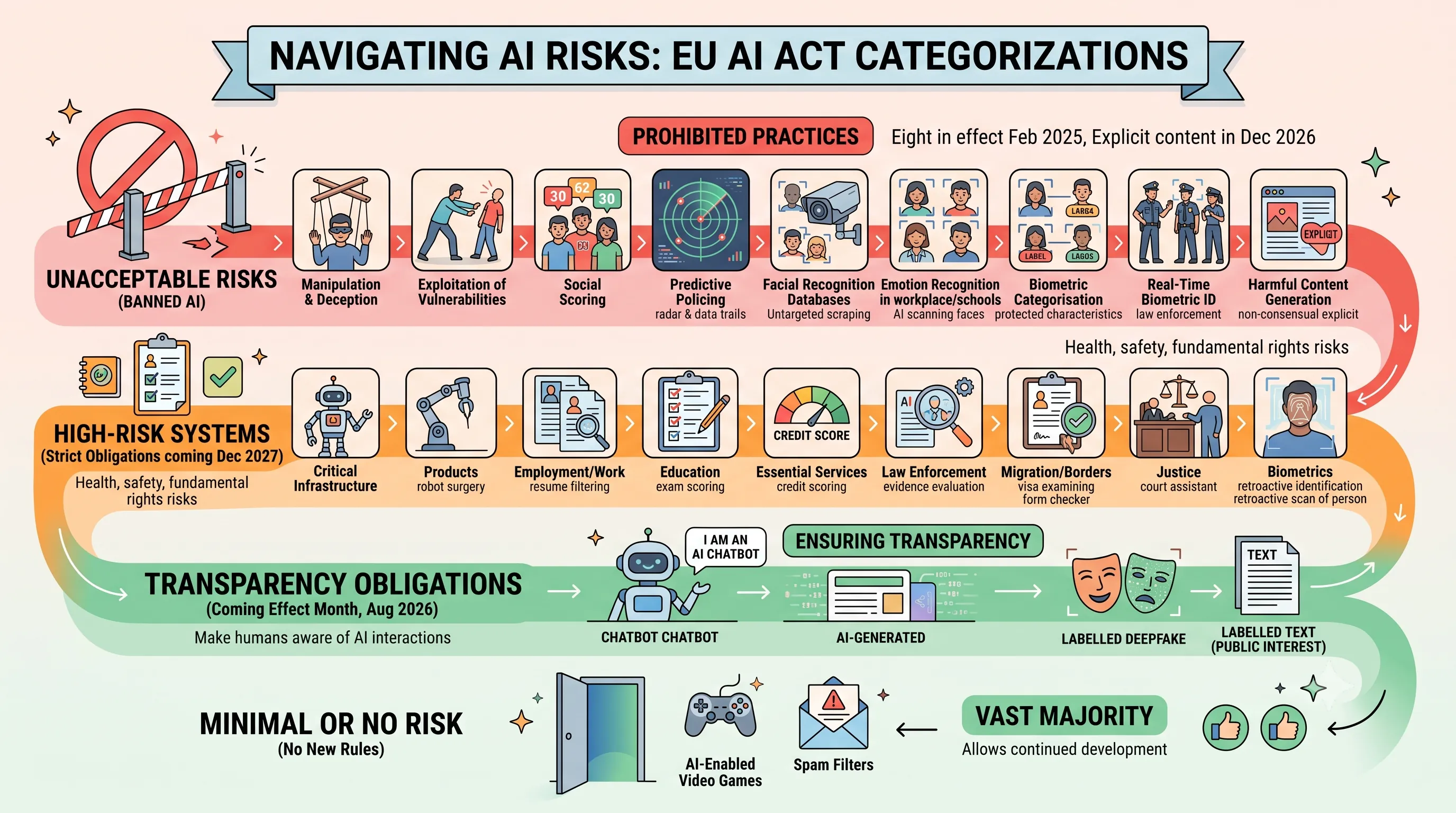
While the recent German court ruling against Suno applies existing copyright law to generative AI, the European Union is simultaneously implementing a far broader, forward-looking framework to govern artificial intelligence: the EU AI Act.This legislation categorizes AI systems by risk, establishing a comprehensive set of rules that go beyond intellectual property to address fundamental rights, safety, and societal well-being.
Banned AI: Unacceptable Risks
The AI Act's most stringent classification is for unacceptable risk, covering AI systems considered a clear threat to the safety, livelihoods, and rights of people.These systems are outright banned.
As detailed in guidelines published by the Commission, the legislation identifies nine specific prohibited practices.
Eight of these prohibitions became effective in February 2025, while the ninth, concerning non-consensual explicit content, will come into effect in December 2026.
| Prohibited Practice Area | Description of Banned AI System |
|---|---|
| Manipulation & Deception | AI systems that use harmful manipulation or deception. |
| Exploitation of Vulnerabilities | AI that exploits the vulnerabilities of specific groups of persons. |
| Social Scoring | AI systems used for social scoring by public authorities. |
| Predictive Policing | Systems used for individual criminal offence risk assessment or prediction. |
| Facial Recognition Databases | Untargeted scraping of the internet or CCTV to create or expand facial recognition databases. |
| Emotion Recognition | Emotion recognition systems used in workplaces and educational institutions. |
| Biometric Categorisation | Systems that use biometric data to deduce protected characteristics like political opinions or race. |
| Real-Time Biometric ID | Real-time remote biometric identification by law enforcement in publicly accessible spaces. |
| Harmful Content Generation | AI that generates non-consensual sexually explicit content or child sexual abuse material (CSAM). |
High-Risk Systems and Their Strict Obligations
The next tier, high-risk, includes AI applications that can pose serious risks to health, safety, or fundamental rights.These systems are not banned but will be subject to strict obligations starting on 2 December 2027.
Examples of high-risk applications span numerous critical sectors:
- Critical Infrastructure: AI safety components used in transport systems.
- Products: AI-based safety components in devices like those for robot-assisted surgery.
- Employment and Worker Management: AI tools for sorting CVs or managing workers.
- Education: AI solutions that may determine access to education, such as automated exam scoring.
- Essential Services: AI systems used to grant access to public and private services, like credit scoring algorithms.
- Law Enforcement: AI use-cases that may interfere with fundamental rights, such as evaluating the reliability of evidence.
- Migration and Border Control: Systems like those used for the automated examination of visa applications.
- Justice: AI solutions used in the administration of justice, for example, to assist in preparing court rulings.
- Biometrics: Systems used for remote biometric identification or emotion recognition, such as retroactively identifying a shoplifter.
Ensuring Transparency for AI Interactions
For AI systems that present a transparency risk, the AI Act introduces specific disclosure obligations.These rules are coming into effect this month, in August 2026.
The core principle is that humans must be made aware when they are interacting with an AI system, such as a chatbot.
Providers of generative AI models must ensure that content created by their systems is identifiable as AI-generated.
Furthermore, certain types of AI-generated content, specifically deepfakes and text published for matters of public interest, must be clearly and visibly labelled.
Minimal and No-Risk AI Applications
Finally, the AI Act acknowledges a category for minimal or no risk applications.The vast majority of AI systems currently used in the EU, such as AI-enabled video games or spam filters, fall into this group.
The AI Act does not introduce any new rules for these systems, allowing for their continued development and use without additional regulatory burdens.
3. Implementing Trustworthy AI: Governance and Key Milestones of the AI Act
While the German court's copyright ruling against 'Suno' offers a specific legal precedent, it unfolds within the broader, now active, regulatory landscape of the EU's AI Act.This framework establishes a comprehensive governance structure and a multi-year implementation plan designed to manage the risks and opportunities of artificial intelligence across the Union.
Phased Rollout: Key Dates and Deadlines
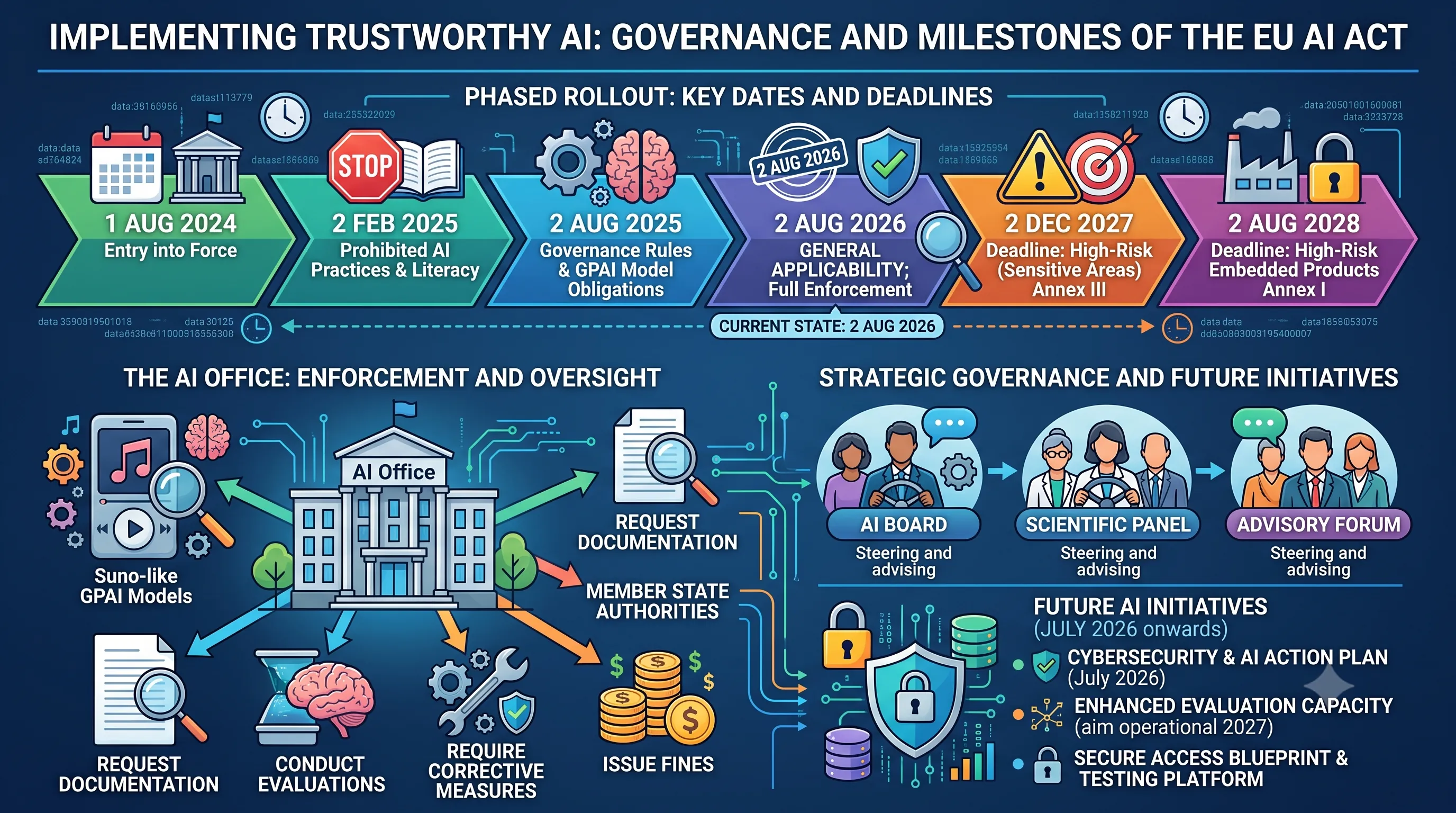
The AI Act's application has been a carefully staged process, which began with its entry into force on 1 August 2024 and culminated in its general applicability just yesterday, on 2 August 2026.This phased approach allowed for gradual adaptation, with different rules becoming active over a two-year period.
Obligations related to prohibited AI practices and the promotion of AI literacy came into effect early, on 2 February 2025, followed by the activation of governance rules and specific obligations for General-Purpose AI (GPAI) models on 2 August 2025.
Certain high-risk AI systems have been granted extended transition periods to ensure compliance, with rules for those listed in Annex III (sensitive areas) applying from 2 December 2027 and those in Annex I (embedded in regulated products) from 2 August 2028.
| Date of Application | Milestone and Applicable Rules |
|---|---|
| 1 August 2024 | AI Act enters into force. |
| 2 February 2025 | Rules on prohibited AI practices and AI literacy obligations apply. |
| 2 August 2025 | Governance rules and obligations for General-Purpose AI (GPAI) models apply. |
| 2 August 2026 | General applicability of the AI Act; full enforcement by AI Office and Member State authorities begins. |
| 2 December 2027 | Deadline for compliance with rules for high-risk use cases in sensitive areas (Annex III). |
| 2 August 2028 | Deadline for compliance with rules for high-risk AI systems embedded into regulated products (Annex I). |
The AI Office: Enforcement and Oversight
As of 2 August 2026, the primary responsibility for implementing, supervising, and enforcing the AI Act rests with the newly established AI Office and the relevant authorities within each Member State.The AI Office holds a unique and critical central role, with direct enforcement powers specifically over GPAI models—the foundational technology behind platforms like Suno.
This authority empowers the AI Office to take several concrete actions to ensure compliance.
It can request full technical documentation from model providers, conduct its own evaluations to assess model capabilities and risks, and require companies to implement corrective measures if violations are found.
Crucially, the AI Office is also authorized to issue significant fines for non-compliance, providing a strong incentive for developers to adhere to the Act's provisions.
Strategic Governance and Future Initiatives
The AI Act's governance is not limited to enforcement alone; it includes strategic bodies to guide its implementation.The AI Board, the Scientific Panel, and the Advisory Forum are now active in steering and advising on the consistent application of the regulation across the EU.
Looking forward, the European Commission is already building upon this foundation.
An action plan on Cybersecurity and AI was set out last month in July 2026, outlining a coordinated approach to these interconnected fields.
As part of this plan, the Commission has launched a call to significantly increase the EU's capacity for evaluating AI models, with the goal of having this enhanced capability operational by 2027.
Furthermore, the Commission and ENISA are developing a blueprint to secure access to advanced AI systems for cybersecurity purposes and will establish a secure testing platform for critical sectors.
4. General-Purpose AI: Addressing Systemic Risks and Copyright Obligations
This section examines the broader regulatory framework established by the EU AI Act for General-Purpose AI (GPAI) models, which form the foundational technology for many specific applications like Suno.The recent German court ruling against Suno for copyright infringement highlights the exact legal and operational risks that the AI Act’s GPAI provisions, effective since August 2025, are designed to manage at a systemic level by imposing clear transparency and copyright-related obligations on model providers.
Defining and Regulating GPAI Models
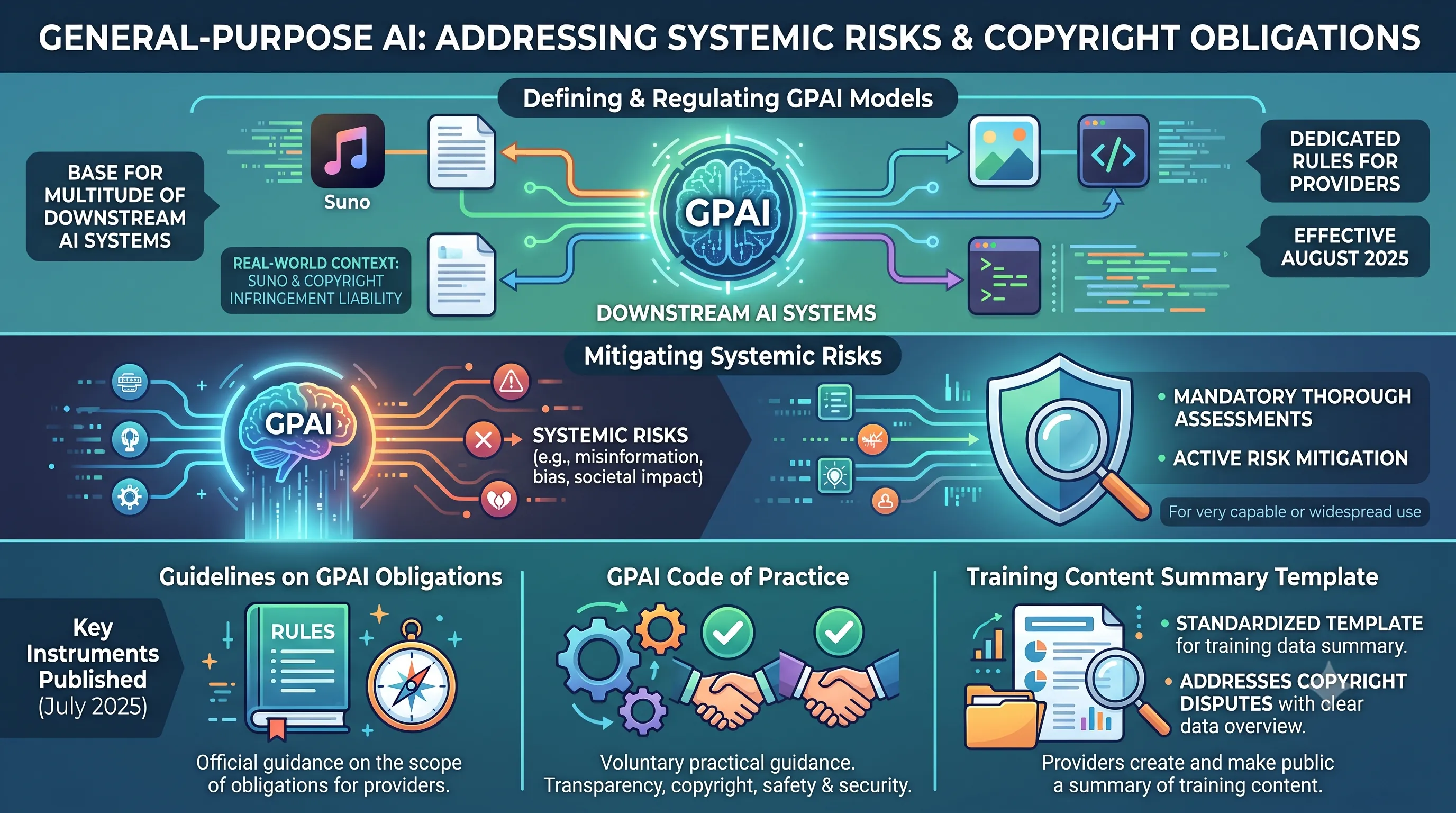
General-purpose AI (GPAI) models are distinguished by their ability to perform a wide range of tasks.Given their versatility, GPAI models are increasingly becoming the basis for a multitude of downstream AI systems deployed across the European Union.
In recognition of their foundational role, the EU AI Act put in place a specific set of rules for the providers of these models.
These dedicated rules for GPAI models officially became effective in August 2025.
Mitigating Systemic Risks
A key concern addressed by the AI Act is that some GPAI models could carry systemic risks, particularly if they are very capable or achieve widespread use.The regulation mandates that providers of GPAI models which may carry such systemic risks must conduct thorough assessments and take active steps to mitigate them.
Transparency and Copyright Requirements for Providers
The AI Act's rules for all GPAI providers center on crucial obligations related to transparency and copyright.To support compliance and the responsible development of these powerful technologies, the European Commission published three key instruments in July 2025.
These tools provide guidance and standardized formats to help GPAI providers meet their legal duties.
| Instrument Published (July 2025) | Purpose and Details |
|---|---|
| Guidelines on GPAI Obligations | Provides official guidance on the scope of the obligations for providers of GPAI models under the AI Act. |
| GPAI Code of Practice | A voluntary compliance tool offering practical guidance to providers. It specifically covers obligations related to transparency, copyright, and safety & security. |
| Training Content Summary Template | A standardized template that requires providers to create and make public a summary of the content used to train their models. This summary must give an overview of data sources and describe data processing aspects. |
5. AI Act Evolution: The 'AI Omnibus' for Simplified Implementation
While the German court's ruling against Suno addresses a specific copyright challenge posed by generative AI, it unfolds within the broader context of the European Union's rapidly evolving regulatory landscape. The recent solidification of the AI Act through a simplification package, known as the 'AI Omnibus', provides the overarching legal framework designed to govern the entire AI ecosystem, clarifying rules and timelines for all developers and deployers operating within the EU. This legislative update aims to create a more predictable and streamlined environment for addressing the very types of complex issues raised in cases like Suno's.Streamlining the AI Act: Key Amendments
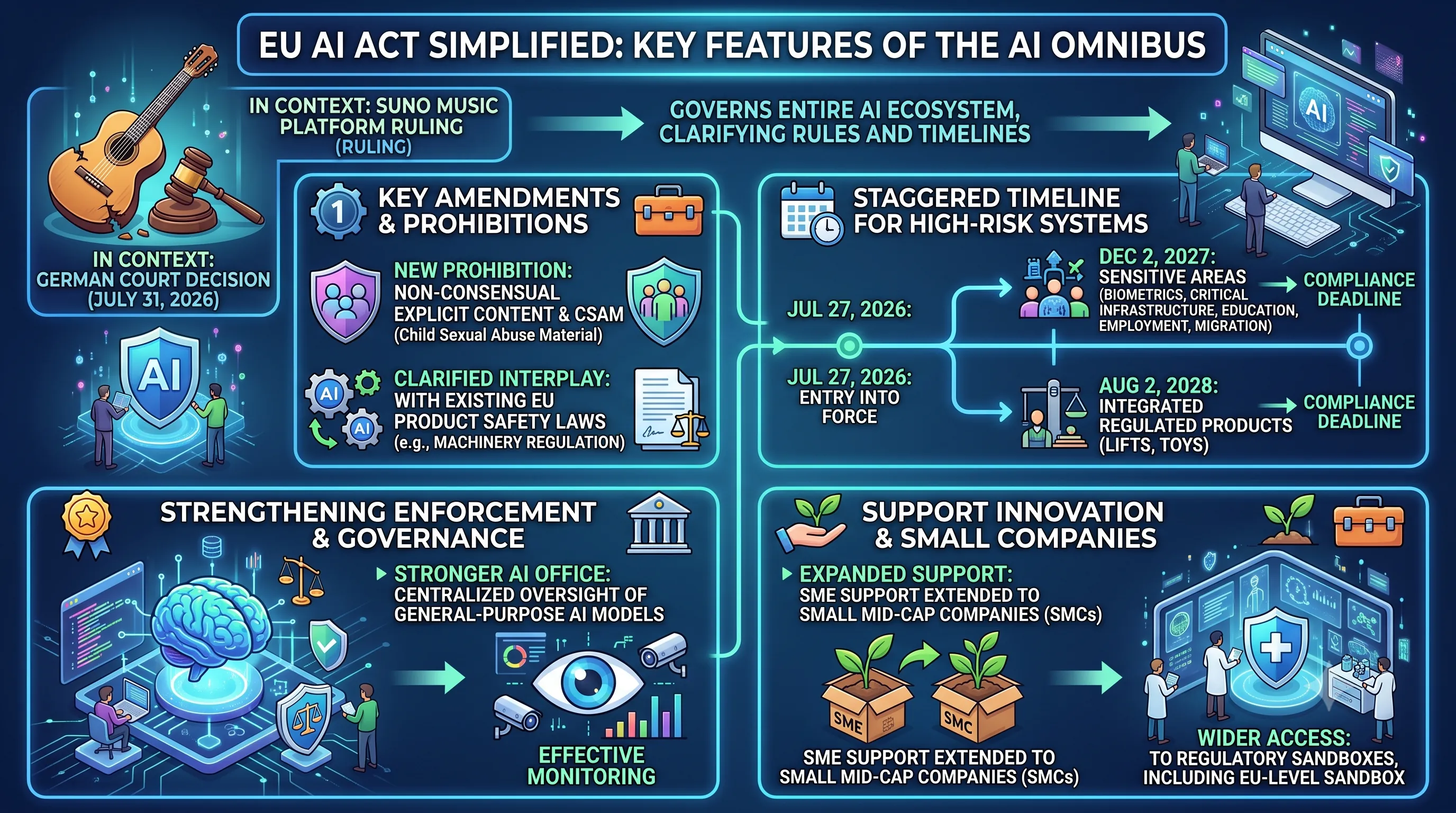
As part of a wider 'Digital Package on Simplification', the legislative proposal colloquially dubbed the 'AI Omnibus' was formally adopted on 19 November 2025. Following this, a political agreement was successfully reached on 7 May 2026, culminating in the package's entry into force just last month on 27 July 2026.One of the most significant amendments introduced by the Omnibus is a new prohibition against AI systems that generate non-consensual sexually explicit and intimate content or child sexual abuse material, directly addressing a critical area of potential AI misuse. Furthermore, the legislation clarified the interplay between the AI Act and existing EU product safety laws, particularly the Machinery Regulation, to ensure cohesive legal application.
Revised Timelines for High-Risk Systems
A key achievement of the AI Omnibus was the establishment of a clear and staggered implementation timeline for high-risk AI systems, providing much-needed certainty for developers and industries.The new rules specify distinct compliance deadlines based on the system's application:
In a move to foster innovation, the package also extended support for smaller companies. The simplified compliance requirements previously granted to small and medium-sized enterprises (SMEs) were expanded to also include small mid-cap companies (SMCs). Additionally, access to regulatory sandboxes has been widened for more innovators, and this now includes a dedicated EU-level sandbox designed to facilitate testing and development in a controlled environment.
This section provides a detailed report on the landmark July 31st ruling by a German court against the AI music platform Suno, the central event of this article.
The case, which found Suno guilty of copyright violation, was the culmination of a lawsuit initiated in January 2025 by GEMA, Germany's largest music rights licensing agency.
In her ruling, Judge Elke Schwager affirmed that Suno had directly infringed upon the rights of the songwriters and composers represented by GEMA, setting a significant legal precedent.
Specifically, the ruling confirmed that Suno used a vast catalog of music covered by GEMA's licenses to develop its generative AI capabilities.
This use occurred without obtaining the necessary licenses from the agency or providing any compensation to the rights holders whose creative work was foundational to the AI's output.
The court unequivocally found that this practice constituted a clear violation of existing copyright law.
The company is now legally obligated to disclose all illicit revenue generated as a result of the infringement and must pay damages to the rights holders represented by GEMA.
While the final amount for damages is still pending, the verdict establishes a clear financial liability.
More broadly, industry experts believe the ruling could fundamentally reshape AI training practices and the future of the music industry, signaling that AI developers cannot use copyrighted works for model training without explicit permission and fair compensation.
- Rules for high-risk systems in sensitive areas—including biometrics, critical infrastructure, education, employment, migration, asylum, and border control—will now apply from 2 December 2027.
- For high-risk AI systems that are integrated into regulated products, such as lifts or toys, the compliance deadline is set for 2 August 2028.
Strengthening Enforcement and Innovation
The AI Omnibus not only clarified rules but also reinforced the EU's governance structure for artificial intelligence. The powers of the central AI Office have been significantly strengthened, centralizing the oversight of AI systems built on general-purpose AI models.In a move to foster innovation, the package also extended support for smaller companies. The simplified compliance requirements previously granted to small and medium-sized enterprises (SMEs) were expanded to also include small mid-cap companies (SMCs). Additionally, access to regulatory sandboxes has been widened for more innovators, and this now includes a dedicated EU-level sandbox designed to facilitate testing and development in a controlled environment.
This section provides a detailed report on the landmark July 31st ruling by a German court against the AI music platform Suno, the central event of this article.
6. Landmark Ruling: German Court Finds Suno AI Guilty of Copyright Infringement
The Case Against Suno AI
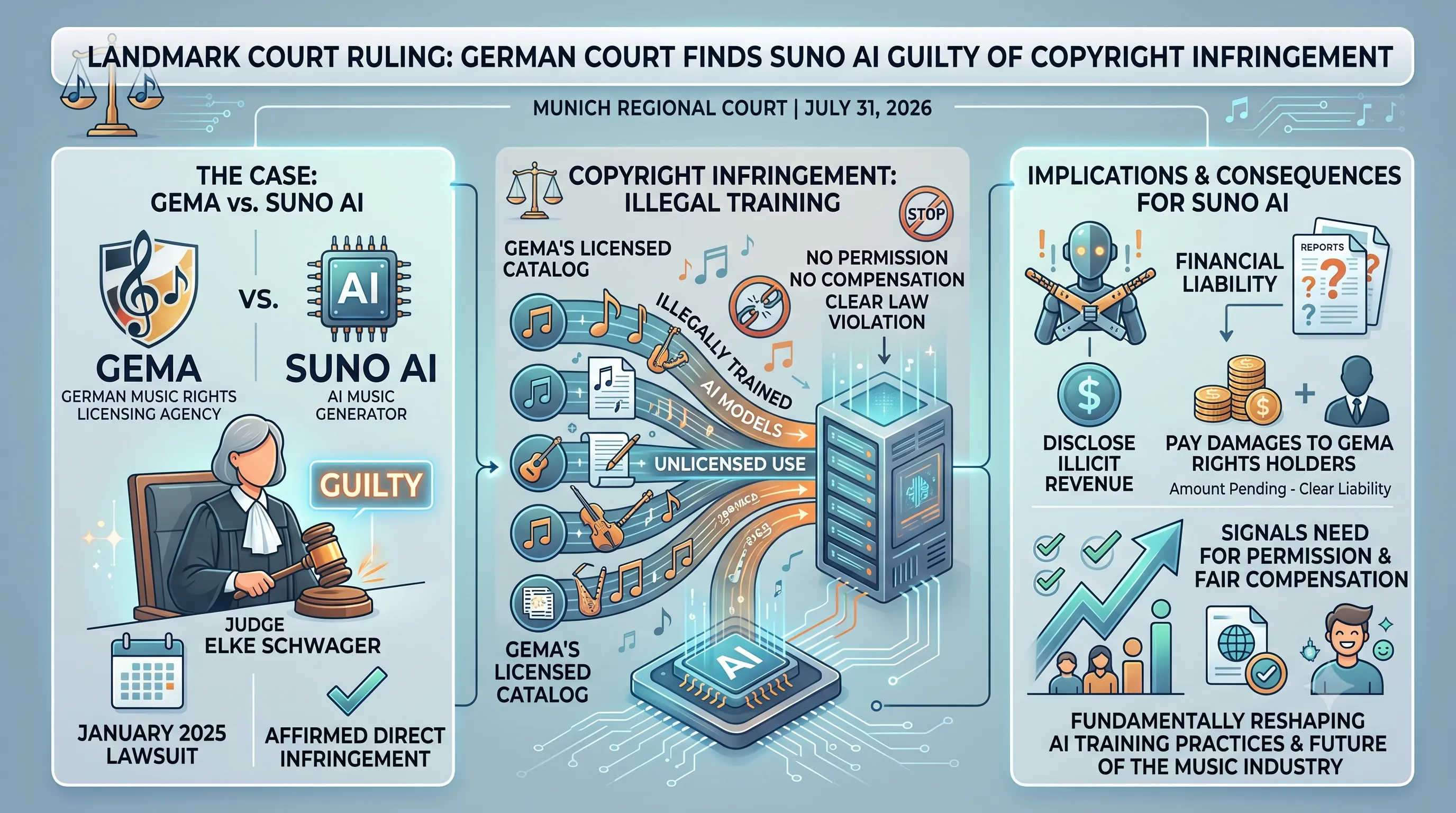
In a decisive legal development for the AI industry, the Munich Regional Court ruled against the US-based AI music generator Suno on July 31, 2026.The case, which found Suno guilty of copyright violation, was the culmination of a lawsuit initiated in January 2025 by GEMA, Germany's largest music rights licensing agency.
In her ruling, Judge Elke Schwager affirmed that Suno had directly infringed upon the rights of the songwriters and composers represented by GEMA, setting a significant legal precedent.
Copyright Infringement: Illegal Training and Unlicensed Use
The court's decision hinged on the finding that Suno illegally trained its AI models on copyrighted material.Specifically, the ruling confirmed that Suno used a vast catalog of music covered by GEMA's licenses to develop its generative AI capabilities.
This use occurred without obtaining the necessary licenses from the agency or providing any compensation to the rights holders whose creative work was foundational to the AI's output.
The court unequivocally found that this practice constituted a clear violation of existing copyright law.
Implications for AI Music and Creator Rights
The immediate consequences for Suno are significant.The company is now legally obligated to disclose all illicit revenue generated as a result of the infringement and must pay damages to the rights holders represented by GEMA.
While the final amount for damages is still pending, the verdict establishes a clear financial liability.
More broadly, industry experts believe the ruling could fundamentally reshape AI training practices and the future of the music industry, signaling that AI developers cannot use copyrighted works for model training without explicit permission and fair compensation.
Related Posts

Anthropic's Claude: Unveiling Invisible AI Watermarks, C2PA & EU AI Act ComplianceAnthropic's Claude now features invisible AI watermarks for text and C2PA content credentials for...

Liquid AI Unleashes LFM2.5-VL-3B: Open-Weight Vision-Language Model Redefines Edge AI with Advanced Screen Understanding & GroundingLiquid AI's LFM2.5-VL-3B, a 3.1B open-weight vision-language model, sets new benchmarks for edge AI...

Model Context Protocol (MCP): Anthropic's Open Standard for AI Integration, Claude's Capabilities, & Data EthicsExplore Anthropic's Model Context Protocol (MCP), an open standard revolutionizing AI integration,...