
Liquid AI Unleashes LFM2.5-VL-3B: Open-Weight Vision-Language Model Redefines Edge AI with Advanced Screen Understanding & Grounding
🚀 Key Takeaways
- Liquid AI has released LFM2.5-VL-3B, a new open-weight vision-language model.
- Designed for edge and on-device deployment, it features approximately 3.1 billion parameters.
- Key capabilities include advanced screen understanding, grounding, and tool use (function calling).
- Liquid AI reports impressive vendor benchmarks, with 87.9 on Grounding (RefCOCO) and 80.7 on Screen Understanding (ScreenSpot-v2).
- It demonstrates high inference speeds on edge devices, reaching 228 tokens/s on Apple M5 Max.
- Crucially, all reported performance figures are vendor-reported, with no independent benchmarks available yet.
- The model's potential impact hinges on the independent reproduction of its core claims, especially for disruptive edge applications.
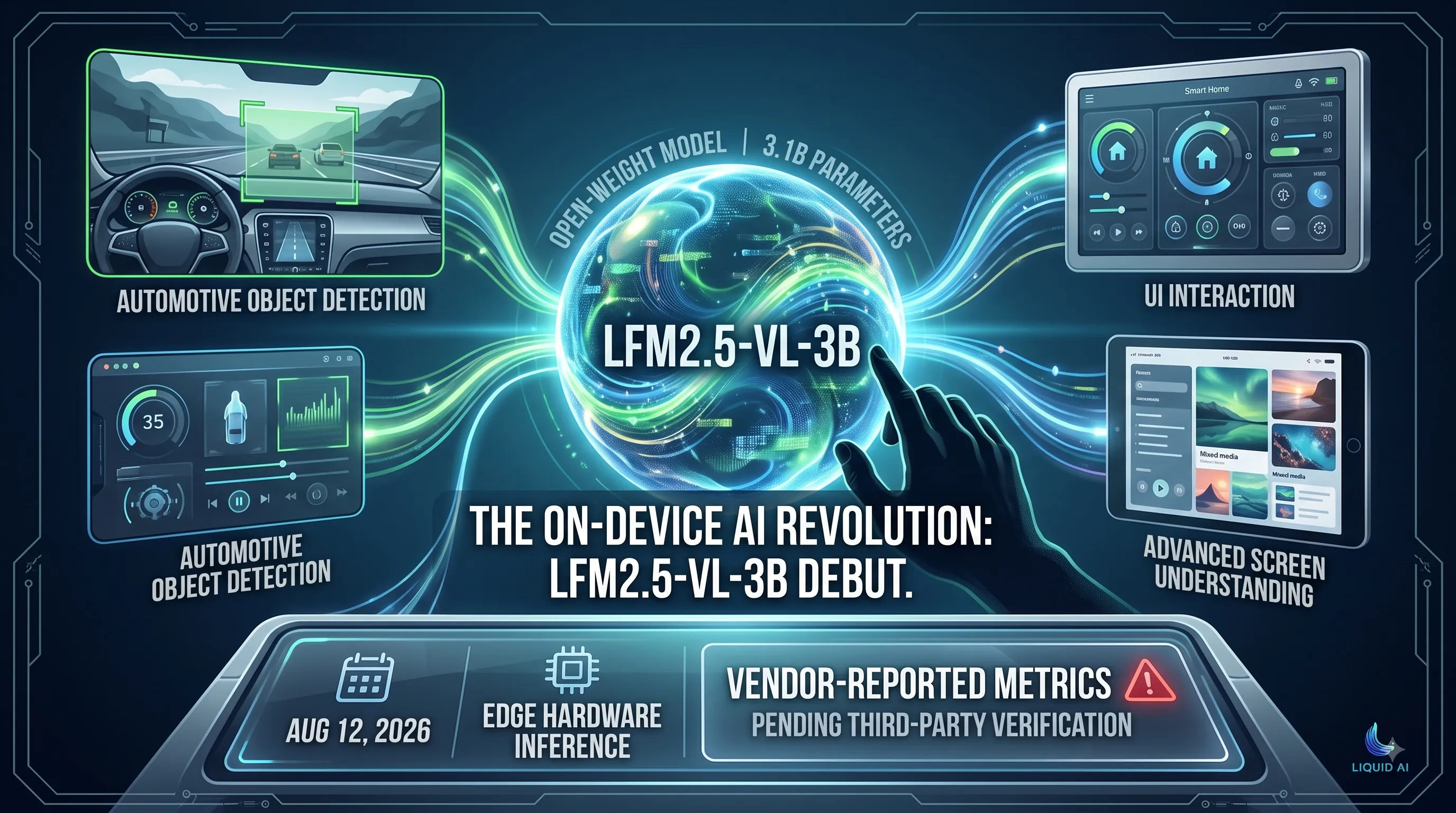
The landscape of vision-language models for edge devices just received a significant new entrant with the release of Liquid AI's LFM2.5-VL-3B.
This open-weight model, featuring roughly 3.1 billion parameters, aims to bring sophisticated multimodal AI capabilities directly to on-device applications.
Its debut on August 12, 2026, marks a pivotal moment for developers seeking powerful yet efficient solutions for a range of real-world use cases, from automotive object detection to advanced screen understanding.
What makes LFM2.5-VL-3B particularly noteworthy are Liquid AI's bold claims regarding its performance in areas like grounding and UI interaction, alongside impressive inference speeds on popular edge hardware.
As the AI community continually pushes for more capable models that can run efficiently away from the cloud, this release presents a compelling proposition for enhancing user experiences and enabling new applications on smartphones, laptops, and specialized embedded systems.
However, as with any major new AI launch, the true measure of LFM2.5-VL-3B's impact will lie in the independent verification of its vendor-reported benchmarks.
With all current performance metrics coming directly from Liquid AI, the industry awaits third-party evaluations to confirm its disruptive potential and solidify its place among the rapidly evolving roster of compact, powerful AI models now becoming available.
This open-weight model, featuring roughly 3.1 billion parameters, aims to bring sophisticated multimodal AI capabilities directly to on-device applications.
Its debut on August 12, 2026, marks a pivotal moment for developers seeking powerful yet efficient solutions for a range of real-world use cases, from automotive object detection to advanced screen understanding.
What makes LFM2.5-VL-3B particularly noteworthy are Liquid AI's bold claims regarding its performance in areas like grounding and UI interaction, alongside impressive inference speeds on popular edge hardware.
As the AI community continually pushes for more capable models that can run efficiently away from the cloud, this release presents a compelling proposition for enhancing user experiences and enabling new applications on smartphones, laptops, and specialized embedded systems.
However, as with any major new AI launch, the true measure of LFM2.5-VL-3B's impact will lie in the independent verification of its vendor-reported benchmarks.
With all current performance metrics coming directly from Liquid AI, the industry awaits third-party evaluations to confirm its disruptive potential and solidify its place among the rapidly evolving roster of compact, powerful AI models now becoming available.
1. The Competitive Landscape: Major AI Model Releases in July-August 2026
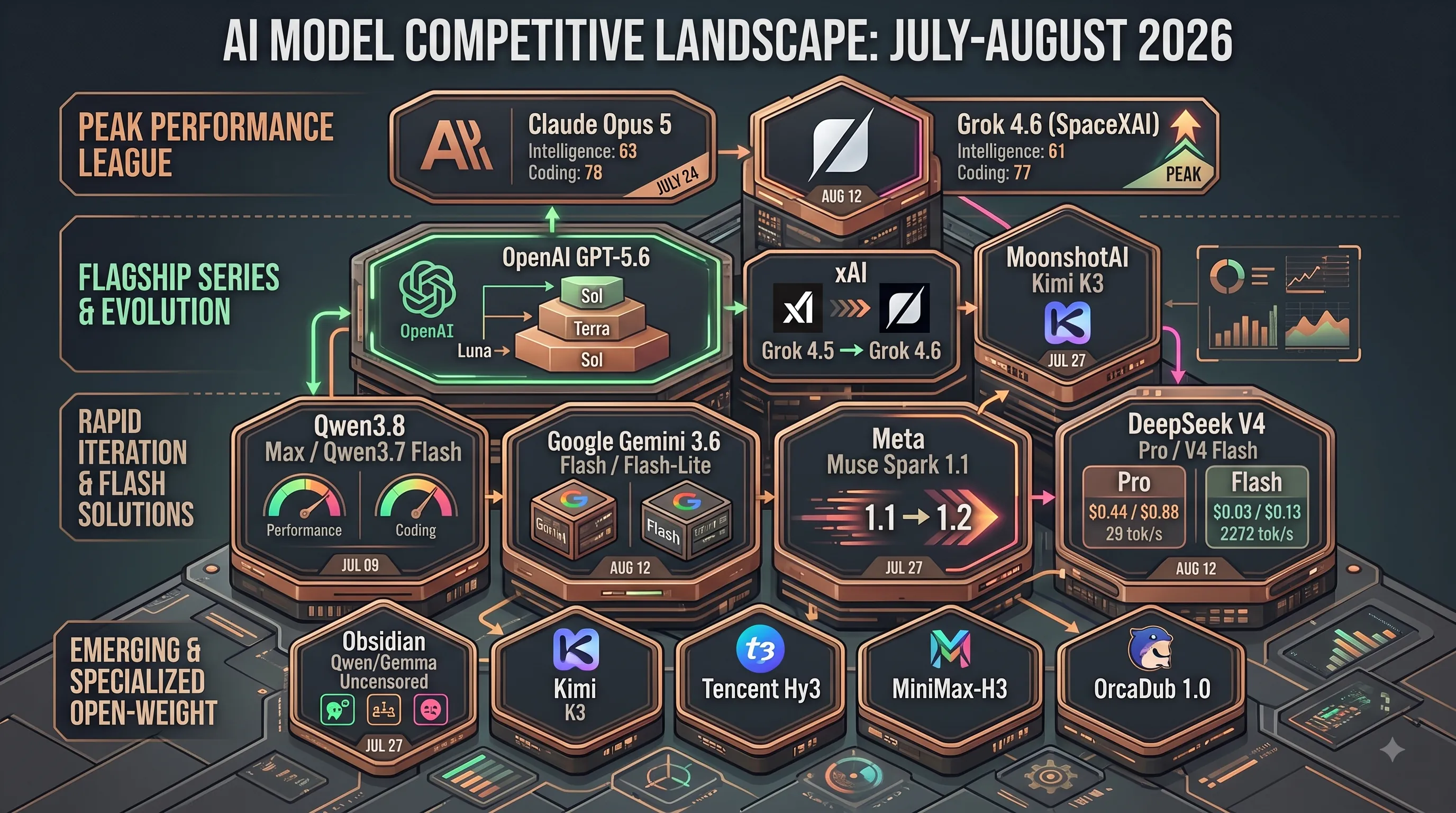
To fully appreciate the market positioning of Liquid AI's LFM2.5-VL-3B, it is crucial to understand the intensely competitive environment into which it was launched.The months of July and August 2026 were marked by a rapid succession of releases from every major AI lab, spanning high-performance flagship models, cost-effective flash variants, and specialized open-source offerings.
This section details the key models that shaped the landscape during this period, providing a benchmark against which LFM2.5-VL-3B's unique capabilities can be measured.
DeepSeek and Qwen's Latest Iterations
The period saw significant advancements from Chinese AI labs, particularly DeepSeek and Alibaba's Qwen.On August 12, DeepSeek launched its powerful DeepSeek V4 Pro, a premium model priced at $0.44 for input and $0.88 for output per million tokens, operating at a measured pace of 29 tok/s.
This followed their earlier release on July 31, DeepSeek V4 Flash 0731, a speed-focused model with respectable Intelligence and Coding scores of 52 and 69, respectively.
Similarly, Qwen introduced two distinct models.
Qwen Qwen3.8 Max arrived on August 3, boasting strong scores of 58 in Intelligence and 72 in Coding, positioning it as a capable high-end option.
In contrast, Qwen3.7 Flash, released on July 27, prioritized efficiency and speed above all else.
It offered an astonishing performance of 2272 tok/s at an extremely low cost of $0.03 for input and $0.13 for output per million tokens, catering to high-throughput, low-latency applications.
The OpenAI and Anthropic Offerings
The industry's established leaders also made significant moves.On July 9, OpenAI unveiled a trio of models under the GPT-5.6 banner: Luna, Terra, and Sol.
This tiered release strategy offered users a choice of capabilities, with Luna scoring 52 (Intelligence) and 71 (Coding), Terra elevating those to 57 and 77, and Sol topping the series at 61 and 77, respectively.
Anthropic responded on July 24 with Claude Opus 5, which immediately established itself as a top-tier contender.
With an Intelligence score of 63 and a Coding score of 78, it set a new high-water mark for performance among the summer releases, directly challenging OpenAI's most capable models.
xAI, Google, and Meta's Recent Updates
The major US tech firms continued their iterative release cycles.Elon Musk's AI ventures pushed out two updates, starting with xAI Grok 4.5 on July 8 (Intelligence 56, Coding 72).
This was quickly followed by SpaceXAI Grok 4.6 on August 12, which demonstrated a notable improvement with scores of 61 for Intelligence and 77 for Coding.
Google focused on its "Flash" lineup, releasing two models on July 21.
Google Gemini 3.6 Flash provided a solid mid-range option with scores of 52 (Intelligence) and 69 (Coding).
For less demanding tasks, Google also launched Gemini 3.5 Flash-Lite, a significantly more lightweight model with scores of 37 and 49.
Meta also showed rapid iteration with its Muse Spark series.
Meta Muse Spark 1.1 was released on July 16 with scores of 53 (Intelligence) and 71 (Coding).
Less than three weeks later, on August 5, it was superseded by Meta Muse Spark 1.2, which improved on its predecessor with scores of 57 and 72.
Emerging Models and Niche Releases
Beyond the largest players, the summer saw a diverse range of other releases.MoonshotAI's Kimi K3, launched on July 15, proved to be a formidable competitor with very high scores of 60 for Intelligence and 76 for Coding.
Tencent entered the field on July 6 with Tencent Hy3, a model with more moderate capabilities, scoring 42 in Intelligence and 59 in Coding.
Other notable releases included MiniMax-H3 (minimax/minimax-h3) and OrcaDub 1.0 (orca/dub), which appeared on July 31 and July 27, respectively.
The open-source community also saw new additions, particularly from Obsidian on July 2.
They released two uncensored models with distinct behavioral profiles: Obsidian Qwen3.6 35B A3B Uncensored (Aggressive), with scores of 32 (Intelligence) and 42 (Coding), and the more subdued Obsidian Gemma4 26B A4B Uncensored (Balanced), which scored 26 and 39.
| Model | Release Date | Intelligence Score | Coding Score | Cost (Input / Output per 1M tokens) | Performance (tok/s) |
|---|---|---|---|---|---|
| Anthropic Claude Opus 5 | 2026-07-24 | 63 | 78 | N/A | N/A |
| SpaceXAI Grok 4.6 | 2026-08-12 | 61 | 77 | N/A | N/A |
| OpenAI GPT-5.6 Sol | 2026-07-09 | 61 | 77 | N/A | N/A |
| MoonshotAI Kimi K3 | 2026-07-15 | 60 | 76 | N/A | N/A |
| Qwen Qwen3.8 Max | 2026-08-03 | 58 | 72 | N/A | N/A |
| OpenAI GPT-5.6 Terra | 2026-07-09 | 57 | 77 | N/A | N/A |
| Meta Muse Spark 1.2 | 2026-08-05 | 57 | 72 | N/A | N/A |
| xAI Grok 4.5 | 2026-07-08 | 56 | 72 | N/A | N/A |
| Meta Muse Spark 1.1 | 2026-07-16 | 53 | 71 | N/A | N/A |
| DeepSeek V4 Flash 0731 | 2026-07-31 | 52 | 69 | N/A | N/A |
| Google Gemini 3.6 Flash | 2026-07-21 | 52 | 69 | N/A | N/A |
| OpenAI GPT-5.6 Luna | 2026-07-09 | 52 | 71 | N/A | N/A |
| Tencent Hy3 | 2026-07-06 | 42 | 59 | N/A | N/A |
| Google Gemini 3.5 Flash-Lite | 2026-07-21 | 37 | 49 | N/A | N/A |
| Obsidian Qwen3.6 35B A3B Uncensored (Aggressive) | 2026-07-02 | 32 | 42 | N/A | N/A |
| Obsidian Gemma4 26B A4B Uncensored (Balanced) | 2026-07-02 | 26 | 39 | N/A | N/A |
| DeepSeek V4 Pro | 2026-08-12 | N/A | N/A | $0.44 / $0.88 | 29 |
| Qwen3.7 Flash | 2026-07-27 | N/A | N/A | $0.03 / $0.13 | 2272 |
| MiniMax-H3 | 2026-07-31 | N/A | N/A | N/A | N/A |
| OrcaDub 1.0 | 2026-07-27 | N/A | N/A | N/A | N/A |
2. The Unveiling: LFM2.5-VL-3B Overview and Release Details
This section provides the foundational details of LFM2.5-VL-3B's public debut, covering the timeline, key characteristics, and assets provided during its launch.Understanding this release process is essential context for the broader analysis of the model's capabilities and market impact discussed throughout this article.
LFM2.5-VL-3B's Entry into the Scene
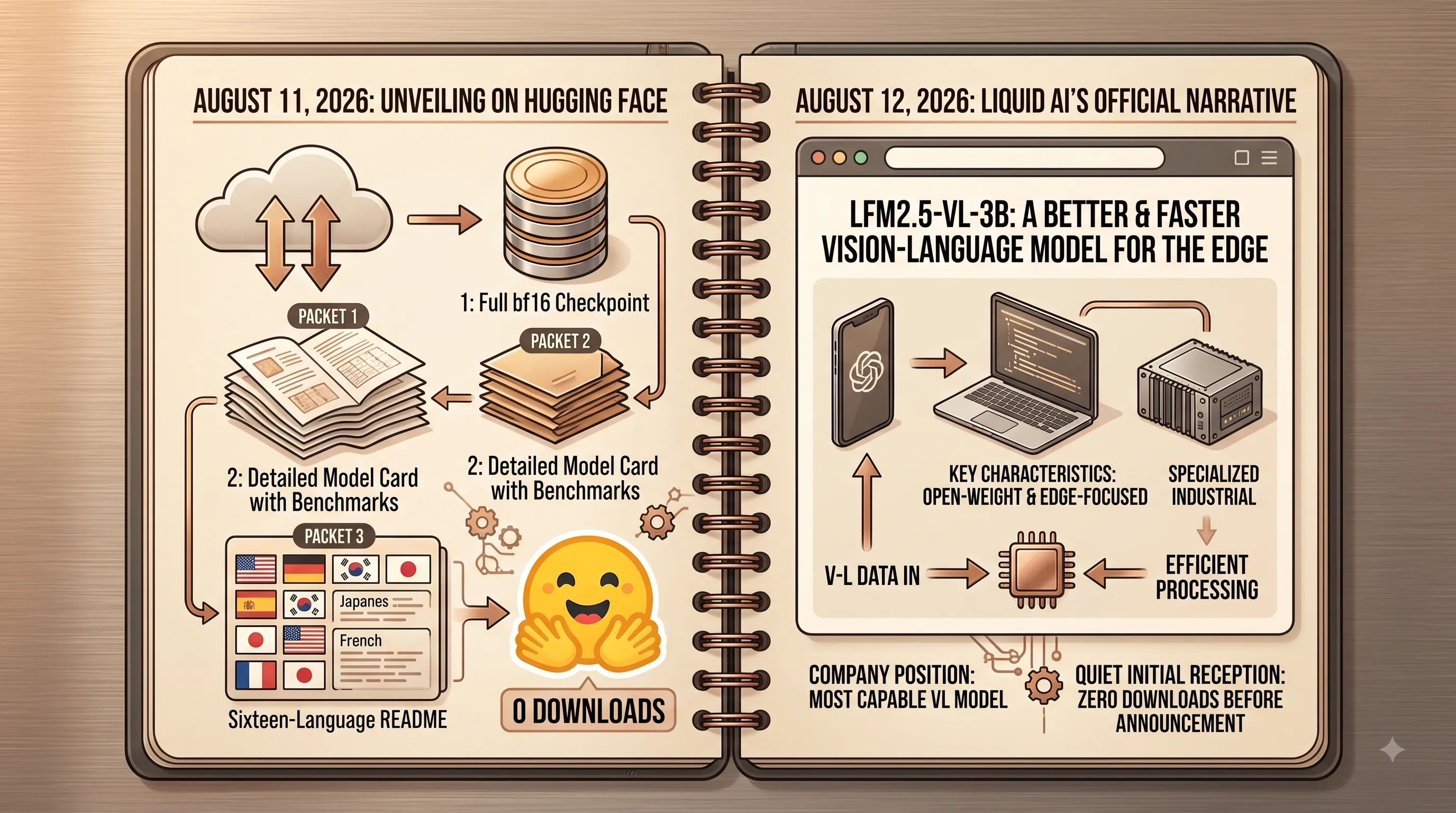
Liquid AI opted for a staggered release for its latest model, unfolding in what could be described as two half-steps.The initial appearance occurred on August 11, 2026, when the model's weights materialized on the Hugging Face platform.
This first step was not just a quiet code drop; it included a comprehensive package of assets designed to give developers immediate access and information.
The release included the full model weights as a bf16 checkpoint, a detailed model card complete with a benchmark table, and an impressively accessible README translated into sixteen languages.
| Initial Release Asset | Description |
|---|---|
| Full bf16 Checkpoint | The complete model weights, ready for download and implementation. |
| Model Card | Official documentation including a detailed benchmark performance table. |
| Sixteen-Language README | Documentation provided in multiple languages to support the global developer community. |
Key Characteristics: Open-Weight and Edge-Focused
At its core, LFM2.5-VL-3B is a vision-language model, designed to interpret and process both visual and textual information.Liquid AI has released it as an open-weight model, continuing the trend of providing greater access and transparency to the AI community.
A defining characteristic of this model is its specific design for edge/on-device applications.
This focus implies an architecture optimized for efficiency and performance on hardware with limited computational resources, a critical factor for mobile and IoT use cases.
Liquid AI's Official Announcement and Initial Impressions
The second step of the launch came on August 12, 2026, when Liquid AI published its official write-up.The article, titled "LFM2.5-VL-3B: A Better and Faster Vision-Language Model for the Edge," provided the company's narrative and technical context for the release.
In the post, the company positioned LFM2.5-VL-3B as its "most capable vision-language model" to date.
Despite the availability of the model and its assets, its initial debut was remarkably quiet.
The model card on Hugging Face showed zero downloads on August 11, indicating that the community had not yet discovered the repository ahead of the official blog post announcement.
3. Under the Hood: LFM2.5-VL-3B Architecture and Technical Specifications
This section delves into the core technical makeup of Liquid AI's LFM2.5-VL-3B, providing the architectural details and specifications that enable its advanced screen and UI comprehension capabilities discussed throughout this analysis.Core Components and Parameter Count
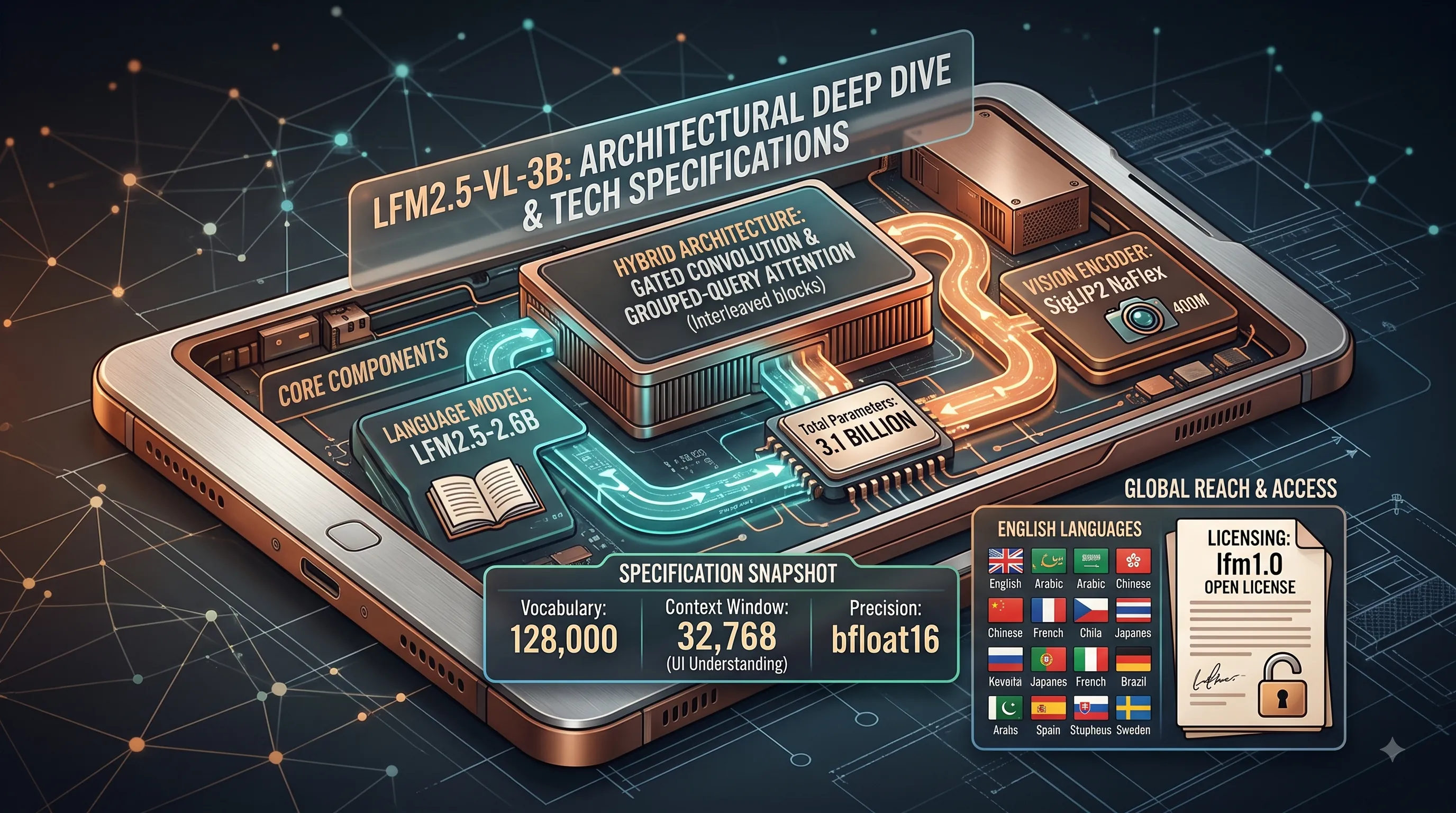
The LFM2.5-VL-3B is a formidable vision-language model with a total parameter count of approximately 3.1 billion.This scale is achieved by combining two primary components: a powerful LFM2.5-2.6B language model and a sophisticated SigLIP2 NaFlex 400M vision encoder.
The model operates with a large vocabulary of 128,000 tokens, allowing for nuanced and diverse text generation.
Critically for its UI analysis function, it features an expansive context window of 32,768 tokens, enabling it to process and understand large amounts of visual and textual information from a single screen capture in one pass.
| Specification | Detail |
|---|---|
| Total Parameters | Approximately 3.1 billion |
| Language Model Component | LFM2.5-2.6B |
| Vision Encoder Component | SigLIP2 NaFlex 400M |
| Vocabulary Size | 128,000 tokens |
| Context Window | 32,768 tokens |
| Precision | Ships in bfloat16 |
Hybrid Architecture and Training Foundation
LFM2.5-VL-3B is officially described as a multimodal variant of the LFM2.5 model series; it is not a new architecture built from scratch.Instead, it layers its advanced vision skills on top of an already pre-trained text model, specifically Liquid AI's LFM2.5 text backbone.
This foundation is exceptionally robust, having been pre-trained on a massive dataset of roughly 34 trillion tokens.
The model inherits its family's unique hybrid architecture, which effectively balances efficiency and performance by interleaving short-range gated convolution blocks with grouped-query attention mechanisms.
To optimize for modern hardware, the model ships in bfloat16 precision, offering a good balance between computational speed and numerical stability.
Multilingual Support and Licensing
Demonstrating its global applicability, the model provides robust support for sixteen languages.This list includes English, Arabic, Chinese, French, German, Hindi, Indonesian, Italian, Japanese, Korean, Polish, Portuguese, Russian, Spanish, Thai, and Vietnamese.
In a significant move for the open-source community, LFM2.5-VL-3B is licensed under Liquid AI's permissive lfm1.0 open license, encouraging broader adoption, research, and development.
4. Screen-Reading Prowess: Exploring LFM2.5-VL-3B's Key Capabilities
This section details the specific technical capabilities that enable the advanced screen and UI comprehension central to LFM2.5-VL-3B, directly supporting the article's main topic on how the model reads visual interfaces.Advanced Vision-Language Interaction
At its core, LFM2.5-VL-3B is a vision-language model, engineered to process a combination of image and text inputs to generate a coherent text output.This multimodal approach is fundamental to its ability to interpret and act upon visual information from screens and documents.
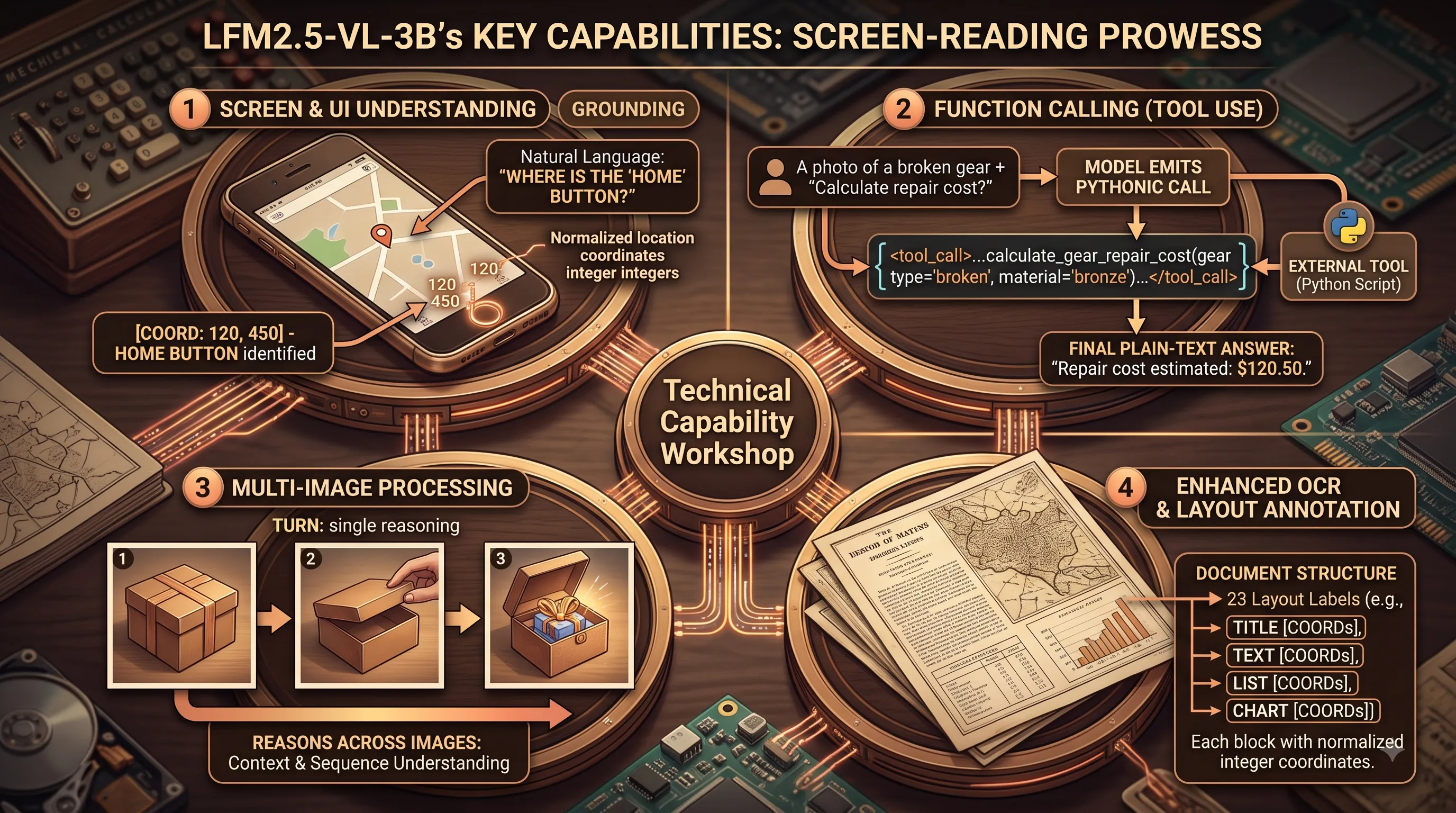
Liquid's own write-up specifies four primary improvements over its predecessor, LFM2-VL-3B: screen and UI understanding, function calling, grounding, and multi-image input.
These enhancements collectively empower the model to not just see, but to comprehend and interact with on-screen elements in a structured, actionable manner.
| Capability | Core Function |
|---|---|
| Screen and UI Understanding | Answers questions about on-screen content and the locations of specific elements. |
| Function Calling (Tool Use) | Executes external tools or functions based on visual and text input via a structured four-step flow, emitting Pythonic calls. |
| Grounding | Identifies and provides normalized location coordinates for on-screen objects based on natural language queries. |
| Multi-Image Input | Processes and reasons across several images within a single turn to understand context or sequence. |
Grounding and Screen Understanding Features
Two of the model's cornerstone features are grounding and screen understanding, which work together to connect language to specific visual data.The grounding capability allows a user to point at objects on a screen using natural-language queries, such as "What is this button for?".
In response, the model can identify the object and return its location as normalized coordinates, effectively "grounding" the textual query to a precise visual spot.
This is complemented by its broader screen understanding, which enables the model to answer more general questions about on-screen content and the relative locations of various UI elements, providing a comprehensive awareness of the visual interface.
Tool Use and Multi-Image Processing
LFM2.5-VL-3B moves beyond simple question-answering with its support for tool use, also known as function calling.This is implemented via a structured four-step flow that allows the model to interact with external systems.
Developers define available tools using JSON, and the model then emits Pythonic calls bracketed between special tool-call tokens to execute a required function.
After the tool execution, the model returns a final plain-text answer, integrating the tool's output into its response.
Further enhancing its contextual awareness, the model supports multi-image input.
This allows it to perform reasoning across several images in a single turn, making it possible to analyze sequences of events, compare different screens, or understand processes that unfold across multiple visual steps.
Enhanced OCR with Layout Annotation
The model includes a sophisticated Optical Character Recognition (OCR) function that is significantly enhanced with layout annotation.Instead of merely extracting raw text, it returns the complete document structure.
This process identifies and tags different content blocks with one of 23 distinct layout labels, providing rich structural context.
Key labels include common elements like text, title, list, and table, as well as more specialized ones such as table caption, chart, equation, code, and even structural markers like page headers and footers.
Each of these layout labels is provided with its corresponding location on the screen, expressed as normalized integer coordinates.
5. Vendor Claims: LFM2.5-VL-3B Performance Benchmarks Unpacked
This section provides the raw performance data for LFM2.5-VL-3B, as published by Liquid AI, which underpins the main article's analysis of the model's ability to natively understand and interact with screen-based user interfaces.It is critical to note that all figures in this section come from Liquid AI's own model card and blog post.
To date, none of the figures have been independently reproduced.
Grounding and Screen Understanding Performance
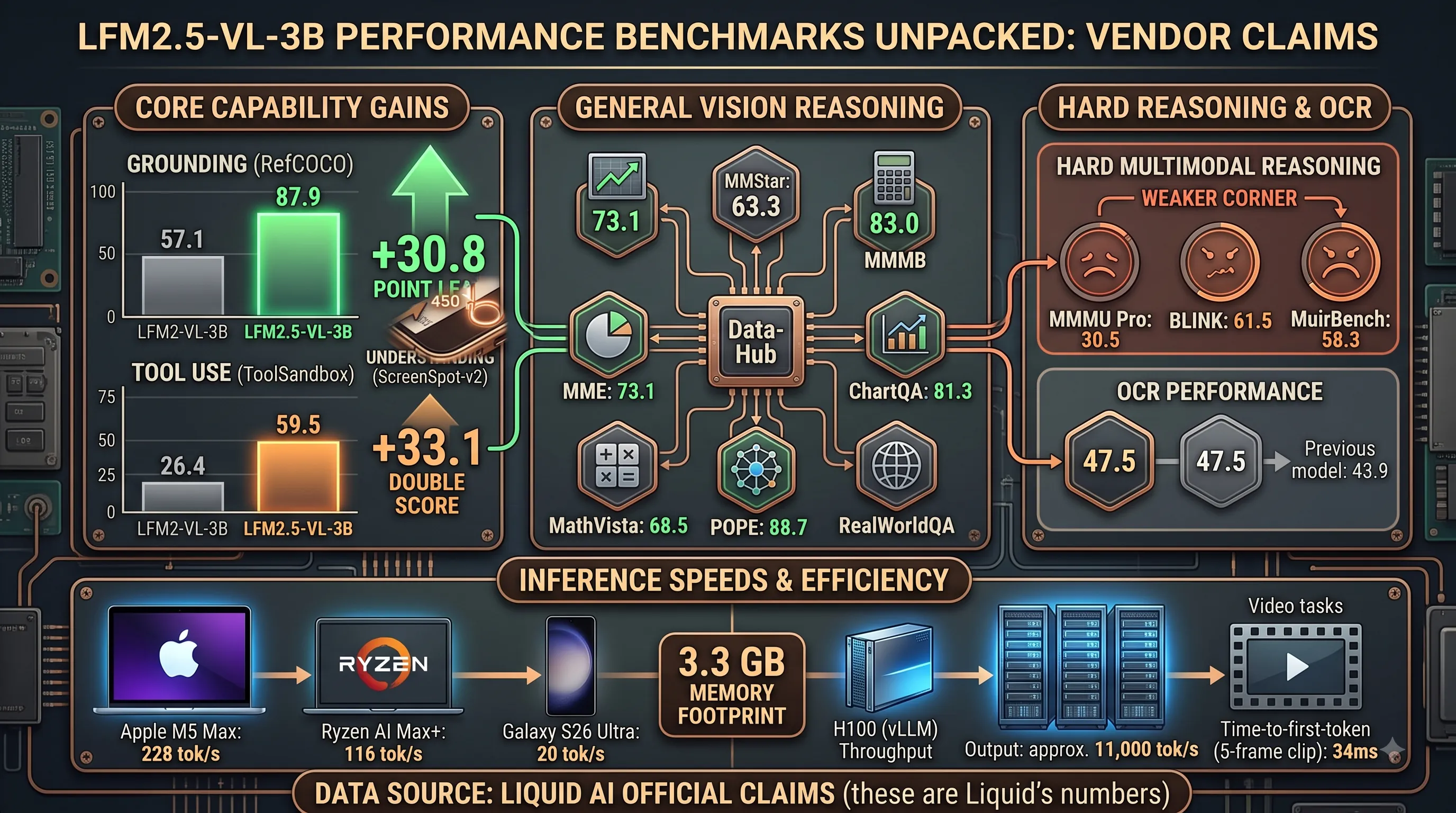
Liquid AI's published benchmarks highlight a significant leap in the model's grounding capabilities, a core function for linking language to specific visual elements.On the RefCOCO (macro precision@1) benchmark, LFM2.5-VL-3B achieves a score of 87.9.
This represents a dramatic improvement over the previous LFM2-VL-3B model, which scored 57.1.
Liquid credits this more than 30-point jump to its vision post-training methods.
For direct screen comprehension, the model scored 80.7 on the ScreenSpot-v2 average benchmark.
Liquid AI reports this score is ahead of the 78.5 they attribute to Qwen3.5-4B, positioning their 3B model competitively against a larger contemporary.
Tool Use and General Vision Benchmarks
The model's ability to use tools—a key aspect of interacting with digital interfaces—also shows substantial gains.On ToolSandbox, LFM2.5-VL-3B scored 59.5, more than doubling the 26.4 score of its predecessor.
Similarly, on the BFCLv4 benchmark, the new model reached 32.5, up from 20.5 for the prior version.
In general vision reasoning tasks, the model posted a broad set of scores across various
benchmarks:
On the OCRBenchv2 English subset, it scored 47.5, a slight increase from the previous model's 43.9.
Liquid AI's own reporting identifies hard multimodal reasoning as the "weaker corner" for a model of this size.
The scores in this category include 30.5 on MMMU Pro, 61.5 on BLINK, and 58.3 on MuirBench.
- MME: 73.1
- MMStar: 63.3
- RealWorldQA: 73.1
- MMMB: 83.0
- ChartQA: 81.3
- MathVista: 68.5
- POPE: 88.7
OCR and Hard Multimodal Reasoning Scores
While showing improvement, the model's performance in Optical Character Recognition (OCR) was more modest.On the OCRBenchv2 English subset, it scored 47.5, a slight increase from the previous model's 43.9.
Liquid AI's own reporting identifies hard multimodal reasoning as the "weaker corner" for a model of this size.
The scores in this category include 30.5 on MMMU Pro, 61.5 on BLINK, and 58.3 on MuirBench.
| Benchmark Category | Benchmark Name | LFM2.5-VL-3B Score | Previous Model (LFM2-VL-3B) Score |
|---|---|---|---|
| Grounding | RefCOCO (macro precision@1) | 87.9 | 57.1 |
| Screen Understanding | ScreenSpot-v2 (average) | 80.7 | N/A |
| Tool Use | ToolSandbox | 59.5 | 26.4 |
| BFCLv4 | 32.5 | 20.5 | |
| General Vision Reasoning | MME | 73.1 | N/A |
| MMStar | 63.3 | N/A | |
| RealWorldQA | 73.1 | N/A | |
| MMMB | 83.0 | N/A | |
| ChartQA | 81.3 | N/A | |
| MathVista | 68.5 | N/A | |
| POPE | 88.7 | N/A | |
| OCR | OCRBenchv2 (English subset) | 47.5 | 43.9 |
| Hard Multimodal Reasoning | MMMU Pro | 30.5 | N/A |
| BLINK | 61.5 | N/A | |
| MuirBench | 58.3 | N/A |
On-Device and H100 Inference Speeds
Liquid AI emphasizes the model's efficiency, reporting strong performance on consumer and prosumer-grade hardware within a memory footprint of roughly 3.3 GB.Reported on-device speeds are:
- Apple M5 Max: 228 tokens/s
- AMD Ryzen AI Max+ 395: 116 tokens/s
- Galaxy S26 Ultra: 20 tokens/s
Under high concurrency, it reportedly generates about 11,000 output tokens per second.
For tasks involving video, the time-to-first-token for a five-frame clip is roughly 34 ms.
Liquid attributes the H100 speed to the model's architecture, which allows it to answer directly instead of requiring a separate reasoning step.
As a final reminder of the data's origin, a footer on the model's own card states: "these are Liquid's numbers."
6. Use Cases and Limitations: Where LFM2.5-VL-3B Shines and Falls Short
This section directly examines the practical applications and clear boundaries of LFM2.5-VL-3B, building upon the main article's analysis of its architecture by defining where its unique capabilities should and should not be deployed.Optimal Scenarios for LFM2.5-VL-3B
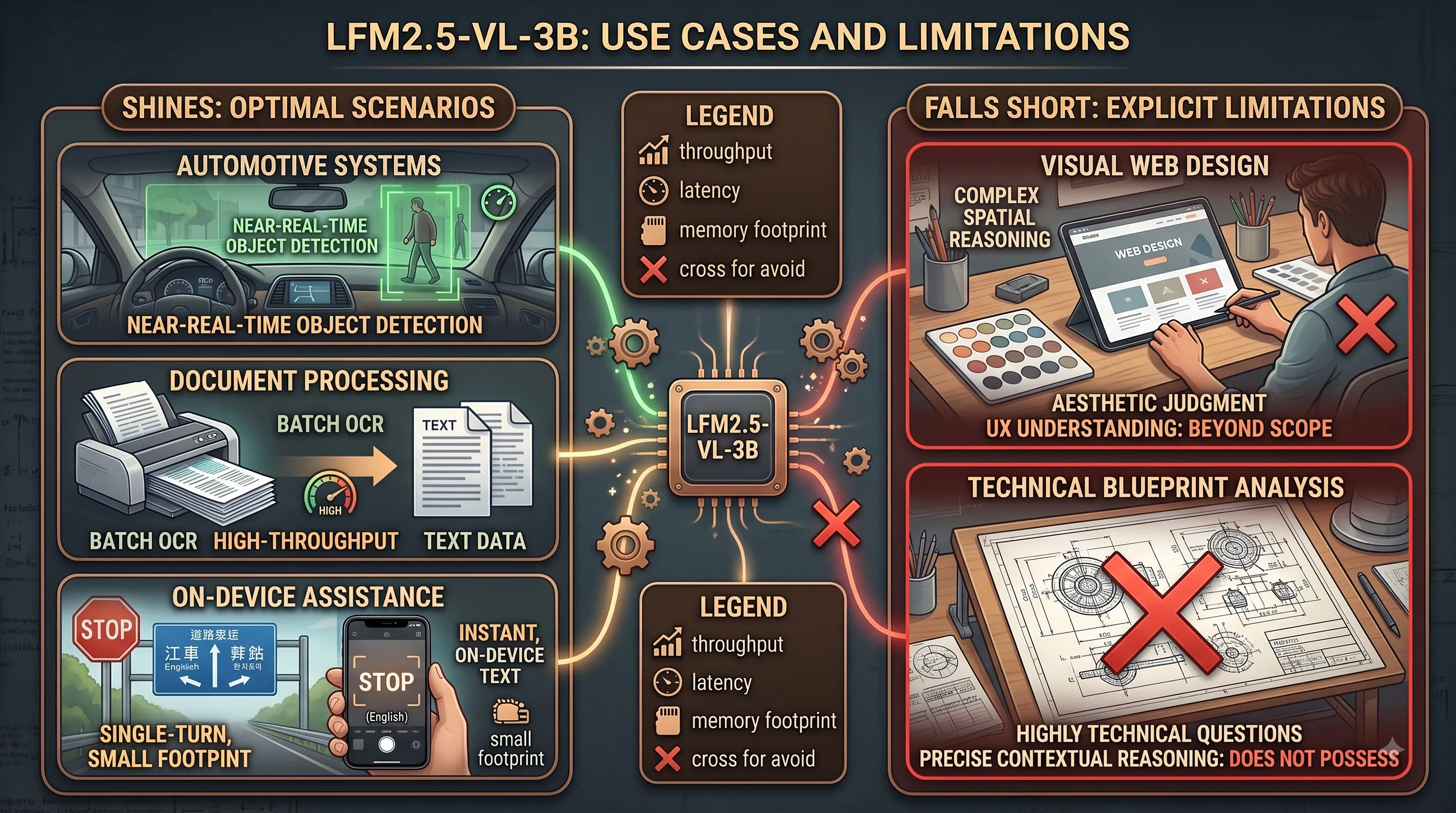
Liquid AI has positioned LFM2.5-VL-3B for specific environments where speed and efficiency are paramount.The model is highly recommended for tasks characterized as single-turn, high-throughput, and low-latency.
This makes it an ideal solution for applications that require rapid, self-contained visual analysis rather than extended dialogue or multi-step problem-solving.
Specific, recommended use cases include:
- Automotive Systems: The model is well-suited for near-real-time object detection in automotive settings.
Its low latency is critical for in-vehicle systems that need to identify and react to their surroundings quickly.
- Document Processing: It is recommended for the batch OCR of scanned documents.
Its high-throughput capability allows organizations to process large volumes of paperwork efficiently, converting images to text at scale.
- On-Device Assistance: The model is designed for on-device menu and road-sign translation.
This application leverages its small footprint and speed to deliver instant translations on mobile devices without relying on a constant cloud connection.
Avoid These Tasks: Explicit Limitations
Just as important as its strengths are the limitations that Liquid AI has explicitly communicated.The company's guidance clearly warns against using the model for tasks that fall outside its optimized design.
Fundamentally, users are warned against deploying it for long-context, reasoning-heavy work, as its architecture prioritizes speed over deep, multi-step cognitive processes.
Specific tasks to avoid include:
- Visual Web Design: The model is not suitable for creative or iterative tasks like visual web design.
This type of work requires complex spatial reasoning, aesthetic judgment, and an understanding of user experience that is beyond its scope.
- Technical Blueprint Analysis: Liquid's guidance explicitly warns against using the model for answering highly technical blueprint questions.
Interpreting complex engineering or architectural schematics demands a level of precise, contextual reasoning that the model does not possess.
7. The Untested Waters: Current Limitations and Unproven Aspects of LFM2.5-VL-3B
While the preceding sections detailed the promising capabilities of LFM2.5-VL-3B to comprehend entire user interfaces, this section grounds that potential by examining the significant gaps in its validation, ecosystem, and real-world performance data.Lack of Independent Verification and Ecosystem Support
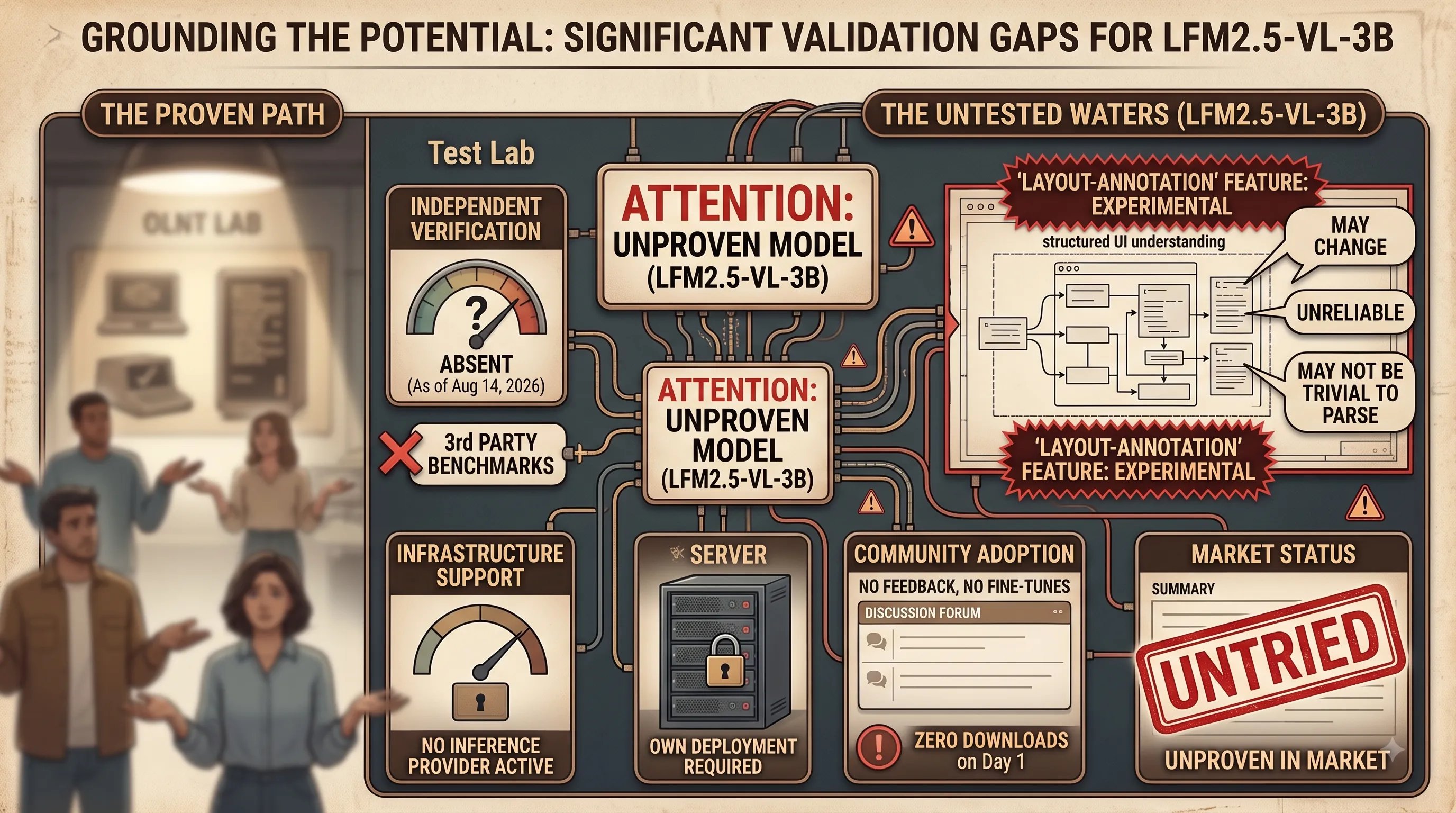
The primary challenge facing any potential adopter is the complete absence of independent verification for Liquid AI's performance claims.As of August 14, 2026, no independent benchmarks are available for LFM2.5-VL-3B. This means that every reported score is vendor-reported, originating directly from Liquid AI without third-party validation.
Furthermore, no deep independent tests have been conducted by the broader research or MLOps community.
Compounding this issue is the lack of infrastructure support; currently, no inference provider serves the model yet, forcing any interested party to manage their own deployment.
The view from the wider industry is similarly limited, as third-party coverage is thin and has so far consisted mostly of short news roundups rather than in-depth analysis.
Early Stage Adoption and Community Feedback
Beyond formal testing, there is a distinct lack of real-world usage signals or a community forming around the model.To date, no usage data is available, making it impossible to gauge its performance, efficiency, or popularity in practical scenarios.
This is directly reflected in the community ecosystem, where there is currently no community feedback or fine-tunes to learn from or build upon.
A particularly stark indicator of its initial reception is the fact that zero downloads occurred on its first day, underscoring the significant challenge it faces in gaining developer traction.
Experimental Features and Potential Parsing Challenges
Even features highlighted by Liquid AI come with explicit warnings that signal a lack of production-readiness.The model's crucial layout-annotation output is flagged as 'experimental' by Liquid itself.
The company's own documentation notes that this experimental output may change, be unreliable, and may not be trivial to parse.
This suggests that developers hoping to build stable applications on its structured UI understanding capabilities could face significant integration hurdles and future breaking changes.
Ultimately, these factors—a lack of verifiable data, a non-existent user base, and internal warnings on key features—combine to render the model's status as thoroughly unproven in the market.
8. Deployment Pathways: LFM2.5-VL-3B Availability and Integration
This section details the various formats and frameworks available for developers to access and integrate the LFM2.5-VL-3B model, bridging the gap from theoretical capabilities to practical application on diverse hardware.Diverse Format Support for Deployment
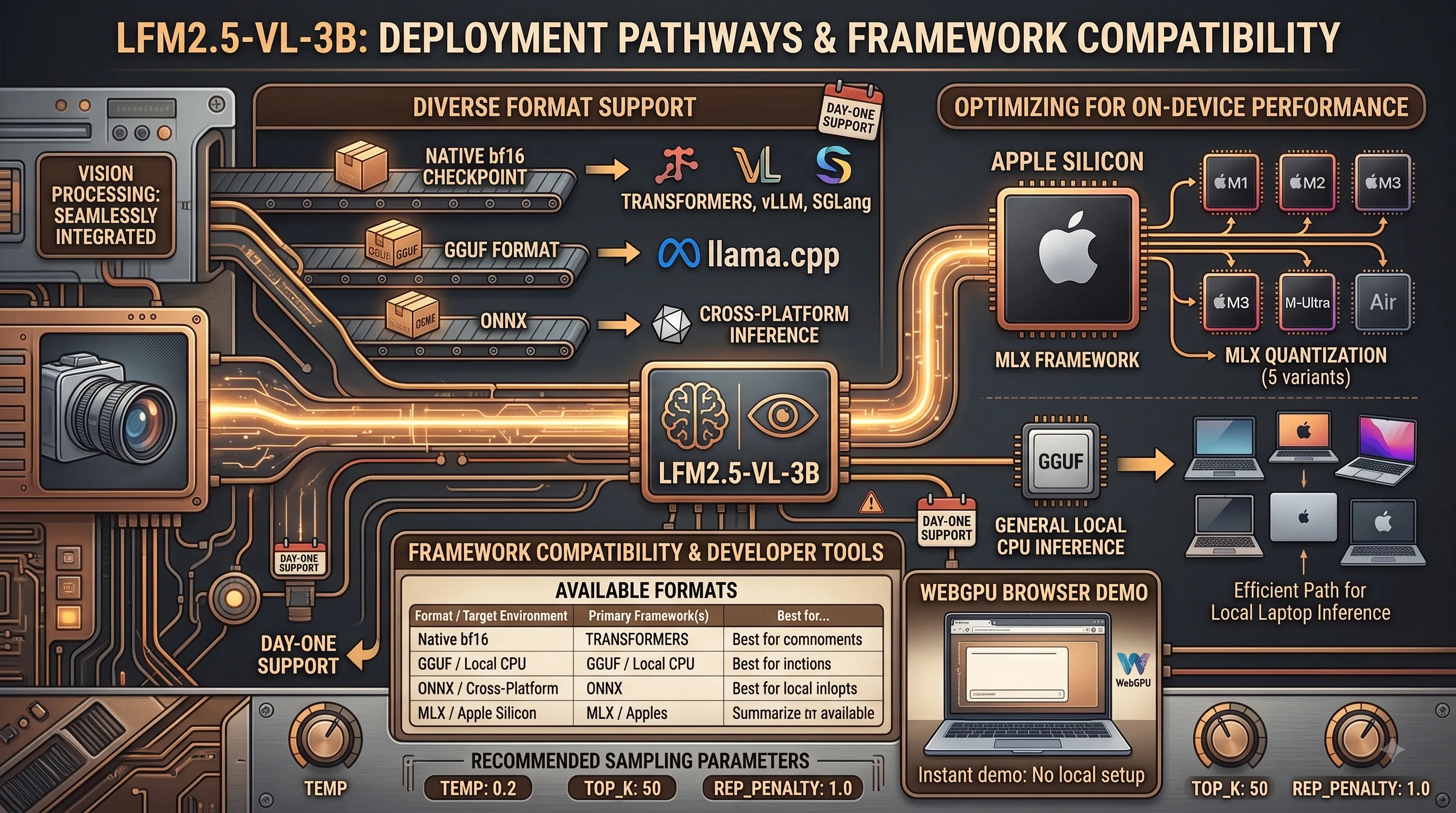
Liquid AI ensured broad accessibility from the moment of release by providing LFM2.5-VL-3B in several popular formats, a strategy that caters to different hardware targets and development environments.Significantly, all format variants were made available on the same day as the model weights, eliminating any waiting period for the developer community.
The core model is provided as a native bf16 checkpoint, which is the ideal starting point for high-performance inference servers using frameworks like Transformers, vLLM, and SGLang.
For developers focused on CPU-centric or more generalized local inference, a GGUF format is available, designed specifically for use with the popular llama.cpp framework.
To facilitate cross-platform deployment and leverage hardware acceleration across different ecosystems, an ONNX version is also provided.
The vision processing capability is seamlessly integrated, managed directly by the model's processor configuration, simplifying the setup for multimodal tasks.
| Model Format | Primary Framework(s) / Target Environment |
|---|---|
| Native bf16 Checkpoint | Transformers, vLLM, SGLang |
| GGUF | llama.cpp |
| ONNX | Cross-platform inference runtimes |
| MLX Quantizations (5 variants) | Apple Silicon devices via the MLX framework |
Framework Compatibility and Developer Tools
The immediate utility of LFM2.5-VL-3B is greatly enhanced by its extensive day-one support across a wide range of leading inference frameworks.Liquid AI officially lists compatibility with llama.cpp, MLX, vLLM, SGLang, and ONNX from the initial release, ensuring developers can integrate the model into existing pipelines with minimal friction.
This broad support underscores a commitment to the open-source ecosystem and allows for deployment in contexts ranging from high-throughput batch processing with vLLM to efficient single-instance execution with llama.cpp.
To further lower the barrier to entry and allow for quick experimentation, a WebGPU browser demo is available, showcasing the model's capabilities directly in a web client without requiring any local setup.
For developers looking to achieve optimal output quality, Liquid AI provides recommended sampling parameters: a temperature of 0.2, a top_k value of 50, and a repetition penalty of 1.0.
These settings are tuned to produce coherent and focused responses, particularly for the UI and screen-reading tasks the model excels at.
Optimizing for On-Device Performance
A key focus of the release is enabling powerful, on-device AI, particularly on consumer hardware like laptops.To this end, the release specifically includes five distinct MLX quantizations tailored for Apple Silicon.
This provides Mac users with a range of options to balance performance and resource consumption, from higher-precision models for M-series Ultra chips to more compressed versions suitable for MacBook Airs.
For the broader community of laptop users on various operating systems, the GGUF build offers a similarly efficient path.
Ultimately, Liquid AI positions the MLX or GGUF builds as the shortest path for any developer aiming to run the LFM2.5-VL-3B model locally on a laptop, making advanced vision-language capabilities more accessible than ever before.
9. Beyond Today: LFM2.5-VL-3B's Future Outlook and Potential Impact
This section shifts the focus from the model's current capabilities, as analyzed in the main article on its release, to the critical path ahead.We will examine the key factors that will determine whether LFM2.5-VL-3B becomes a niche curiosity or a cornerstone technology in vision-language understanding.
The Critical Role of Independent Verification
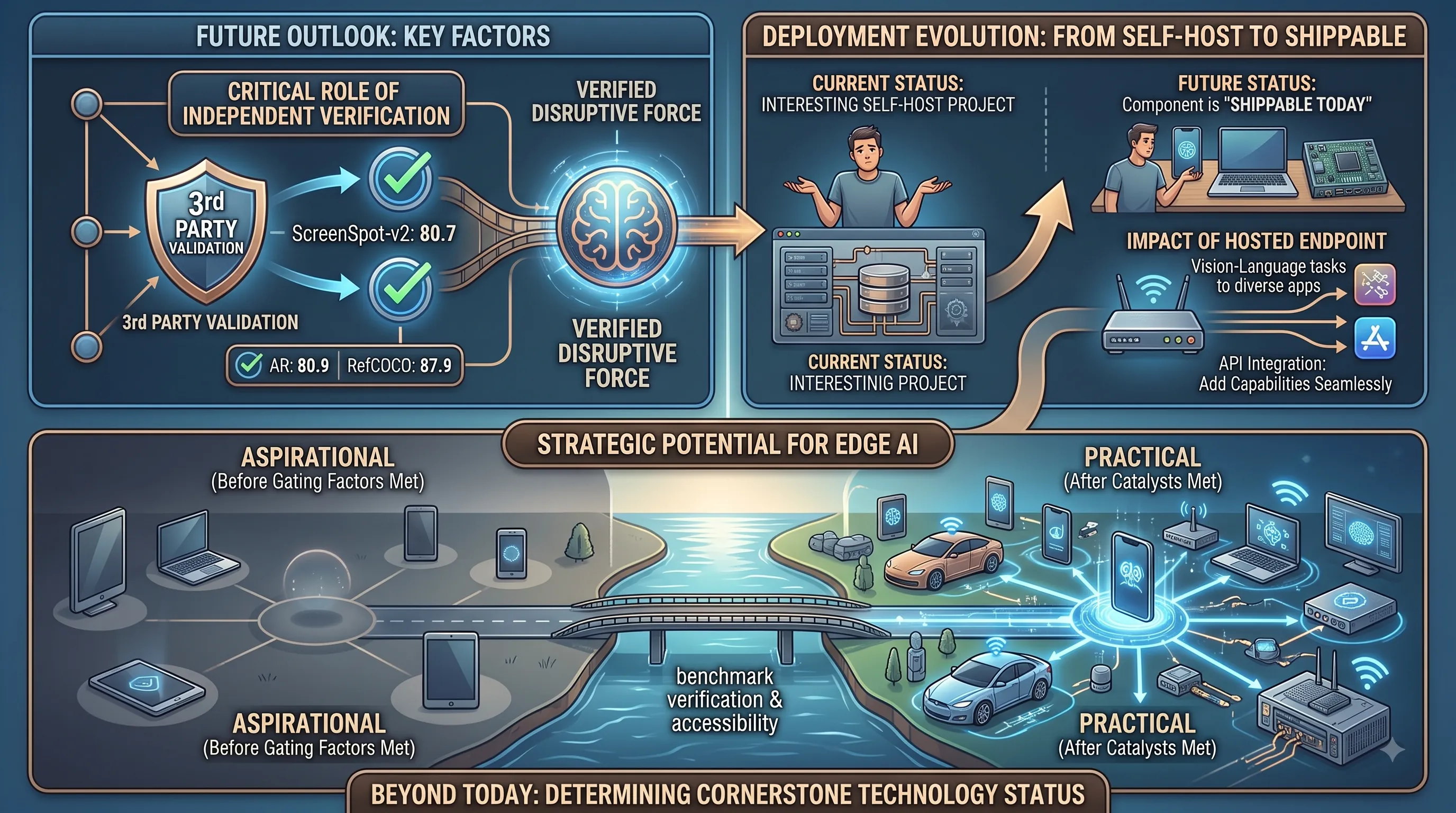
The ultimate importance of LFM2.5-VL-3B hinges entirely on whether its impressive grounding and screen-understanding performance numbers survive independent reproduction.In the world of AI models, vendor-published benchmarks are a starting point, but third-party validation is the true test of a model's robustness and generalizability.
Specifically, two key claims must be verified by the wider research and development community: its score of 80.7 on ScreenSpot-v2 and 87.9 on RefCOCO.
If these figures hold up under scrutiny, they confirm the model's potential to be a genuinely disruptive force, particularly for edge model applications where efficiency and accuracy are paramount.
From Self-Host to Shippable: The Impact of Hosted Endpoints
Currently, LFM2.5-VL-3B is what many in the industry would consider an interesting self-host project—powerful, but requiring significant DevOps and MLOps investment to deploy and maintain.The entire dynamic would change with the appearance of an official hosted endpoint.
Such a development would instantly transform the model's status from a project for dedicated teams to a component that is 'shippable today' for any developer with an API key.
Furthermore, the availability of an endpoint would enable seamless integration into existing systems.
A simple routing layer could be used to direct certain vision-language tasks to the LFM2.5-VL-3B API, allowing companies to add its capabilities to their products without deep, disruptive changes to their current integration stack.
Strategic Potential for Edge AI
The model's future is defined by these two gating factors: benchmark verification and accessibility.If its performance is confirmed and a hosted version becomes available, its strategic value skyrockets.
However, until those conditions are met, its role remains more aspirational than practical for the majority of businesses.
For now, it stands as a promising self-host story—a glimpse of what efficient, powerful on-device visual understanding could look like, awaiting the catalysts that will unlock its full potential for the broader market.
Related Posts
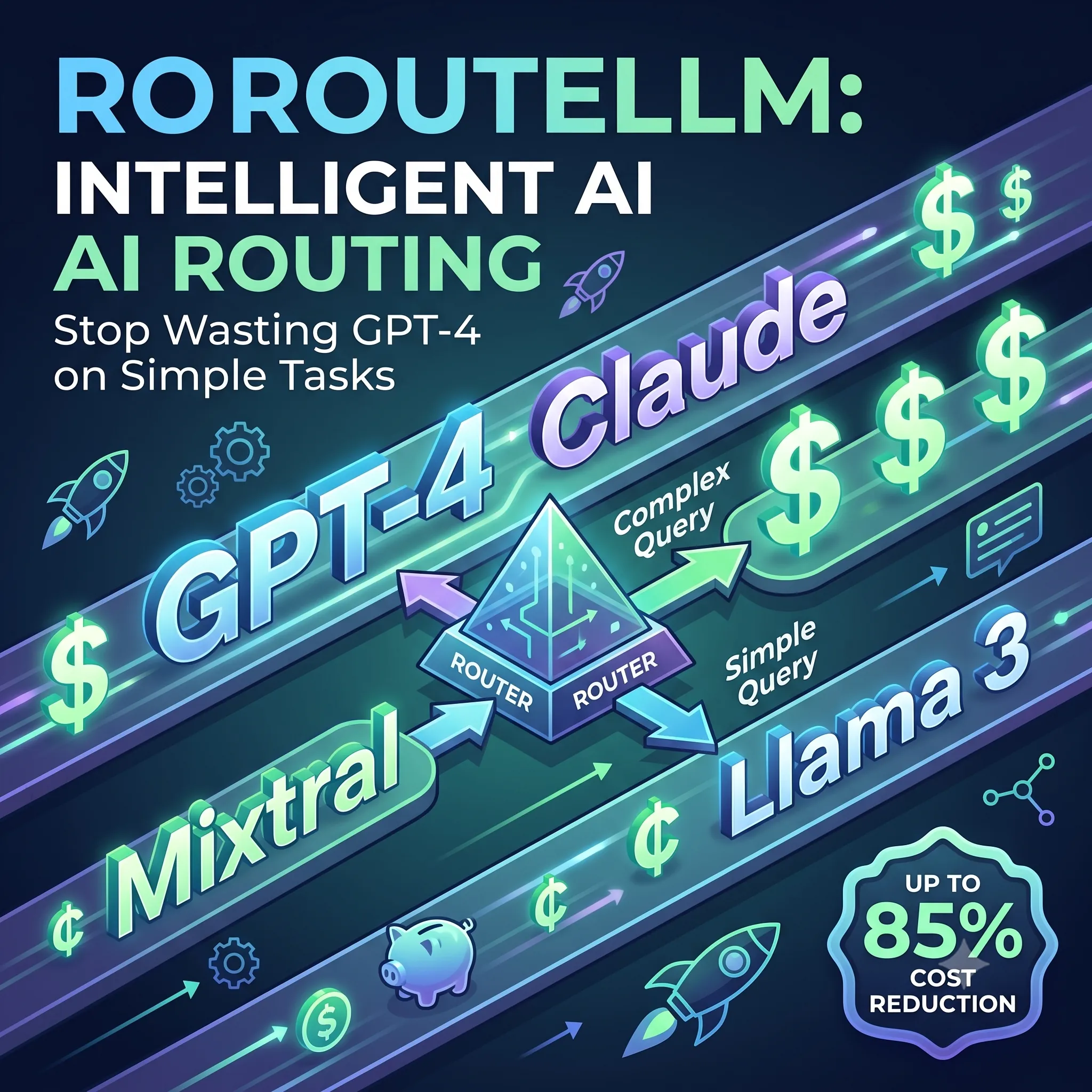
RouteLLM: Master LLM Costs with Intelligent Routing for 85% Savings, GPT-4 Performance, and Seamless IntegrationRouteLLM: Optimize LLM costs by 85% with intelligent routing. Maintain GPT-4 performance, integrate...

Model Context Protocol (MCP): Anthropic's Open Standard for AI Integration, Claude's Capabilities, & Data EthicsExplore Anthropic's Model Context Protocol (MCP), an open standard revolutionizing AI integration,...
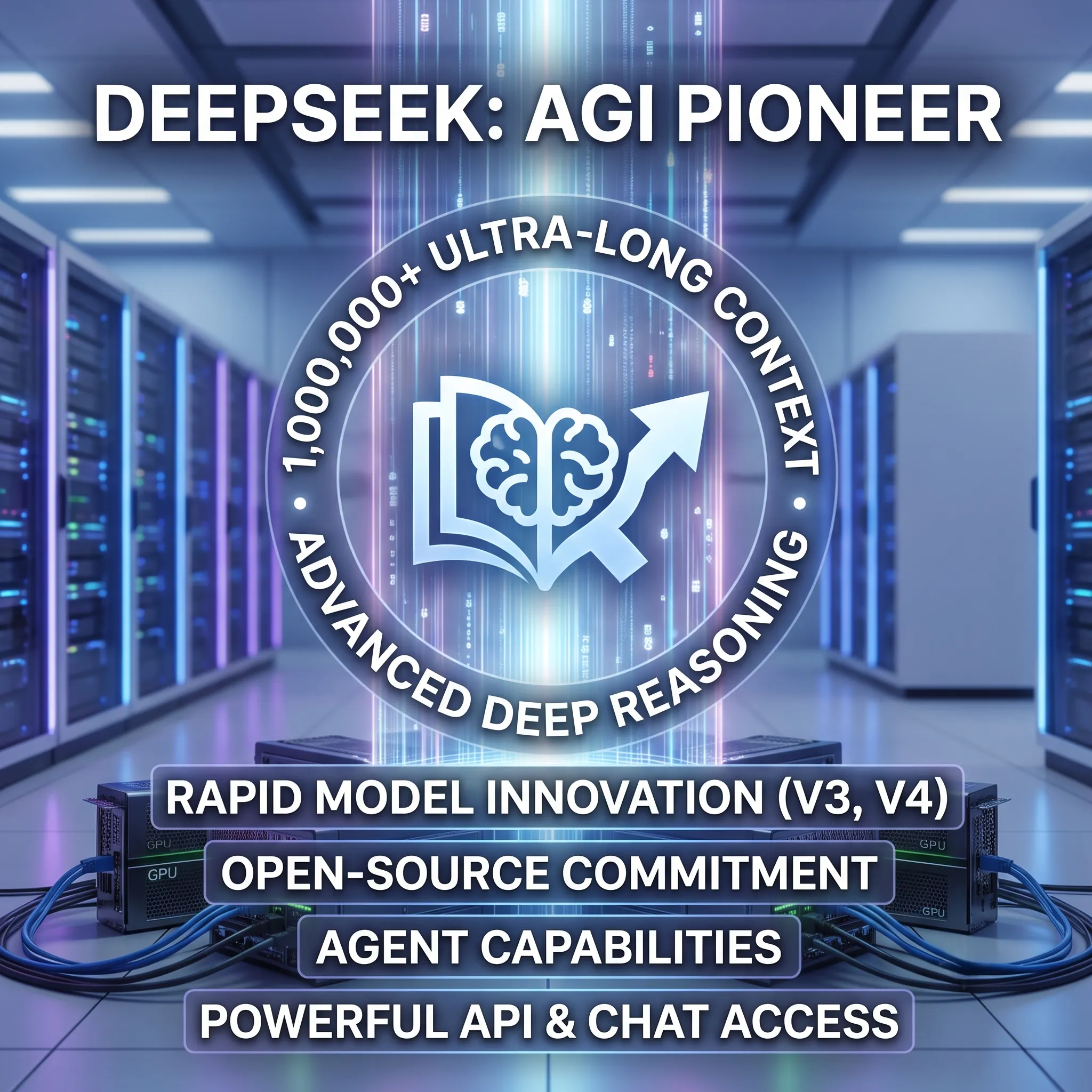
DeepSeek AI: Pioneering AGI with Flagship DeepSeek-V4, Ultra-Long Context & Agent CapabilitiesDeepSeek AI rapidly advances AGI with flagship DeepSeek-V4, offering million-character ultra-long...