RouteLLM: Master LLM Costs with Intelligent Routing for 85% Savings, GPT-4 Performance, and Seamless Integration
🚀 Key Takeaways
- RouteLLM is a framework designed to optimize LLM costs by intelligently routing queries to the most appropriate model without sacrificing quality.
- It provides a seamless integration experience, acting as a drop-in replacement for OpenAI clients and allowing easy extension with new routing models.
- The framework's trained routers can significantly reduce costs, often by up to 85%, while maintaining high performance on key benchmarks.
- RouteLLM supports flexible model configurations, allowing users to define their strong and weak LLM pairs, including OpenAI-compatible endpoints.
- It provides five pre-built routing algorithms, including the recommended `mf` (matrix factorization) router, which are generally adaptable to different model pairs.
- The architecture is designed for extensibility and community contribution, allowing developers to easily add new routing algorithms and evaluation benchmarks.
- RouteLLM addresses the broader challenge of LLM inference optimization, aiming to maximize efficiency and cost-effectiveness in AI deployments.
However, relying solely on state-of-the-art models like GPT-4 or Claude for every single request can quickly lead to prohibitive operational costs.
Organizations are increasingly grappling with the challenge of balancing powerful AI performance with sustainable economic efficiency in their deployments.
This is precisely where the RouteLLM: LLM Routing Framework becomes indispensable.
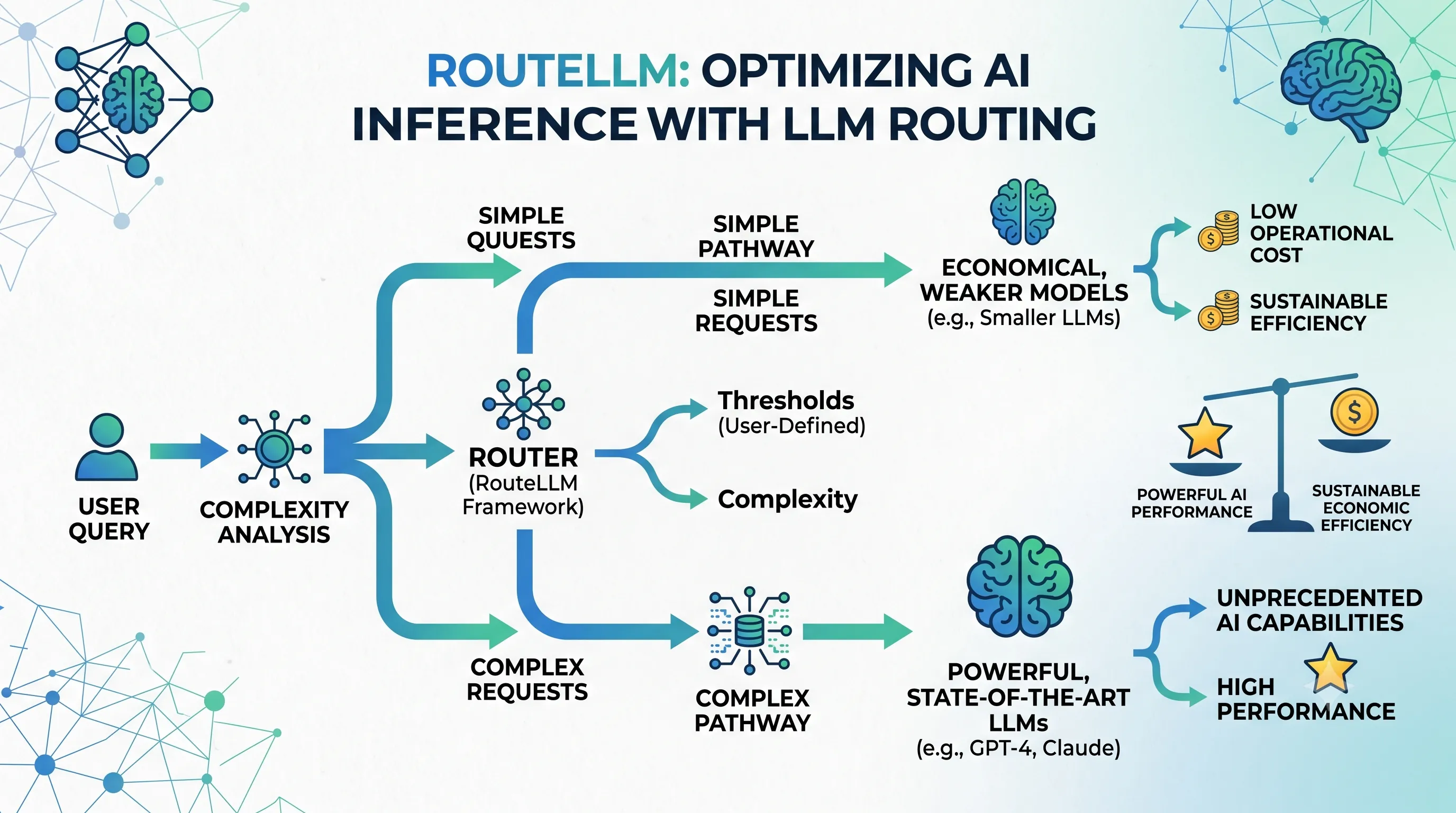
Designed to intelligently direct queries to the most suitable LLM based on complexity and user-defined thresholds, RouteLLM enables a dynamic and cost-effective approach to AI inference.
By automatically routing simpler requests to more economical, weaker models and reserving powerful LLMs for truly complex tasks, it offers a pragmatic solution to optimize resource allocation.
1. RouteLLM: The Intelligent Way to Cut LLM Costs
This section directly addresses the core theme of our article—building a cost-effective LLM routing pipeline—by examining RouteLLM, a purpose-built framework that implements this very concept.By providing a concrete tool for intelligently directing queries, RouteLLM serves as a practical case study for organizations looking to optimize their AI expenditure.
Optimizing LLM Spend with Smart Routing
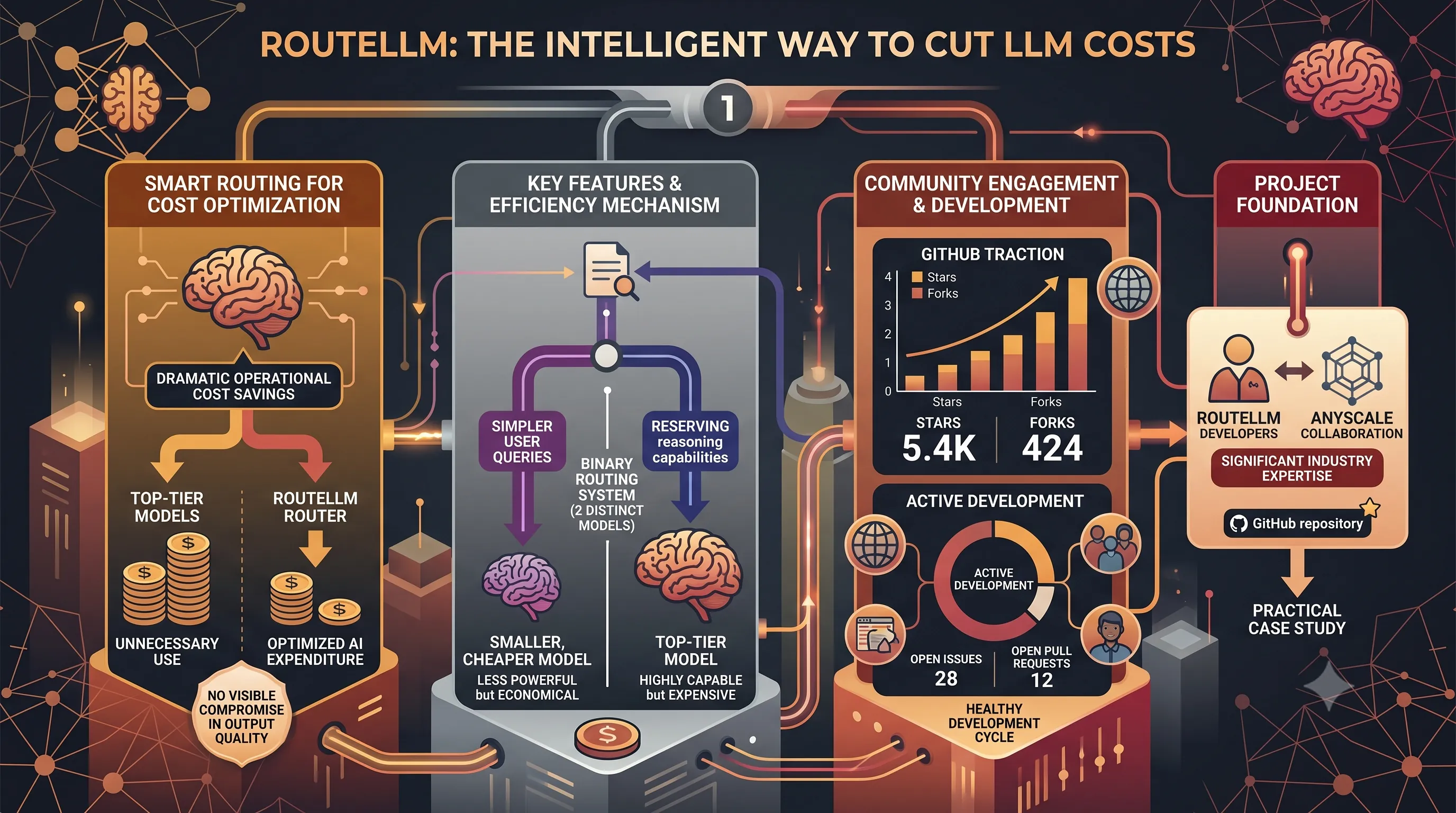
RouteLLM is a specialized framework designed for the express purpose of serving and evaluating LLM routers.Its fundamental goal is to dramatically save on LLM operational costs without a noticeable compromise in output quality, a critical challenge for businesses scaling their AI applications.
The research and development encapsulated in its repository were conducted in collaboration with Anyscale, lending significant industry expertise to the project's foundation.
Key Features and Cost Efficiency
The core mechanism of RouteLLM is elegant in its simplicity: it routes simpler user queries to smaller, and therefore cheaper, language models.This prevents the unnecessary and expensive use of top-tier models for tasks that do not require their full reasoning capabilities.
The framework specifically focuses on a binary routing system, making decisions between two distinct models: a highly capable but expensive "stronger" model and a less powerful but more economical "weaker" model.
This two-tiered approach provides a clear and manageable path to significant cost reduction.
Community Engagement and Development Status
The project has garnered substantial interest from the developer community, indicating a strong demand for solutions in LLM cost optimization.Its GitHub repository reflects a healthy level of engagement and an active development cycle.
The key metrics show a project with significant traction and ongoing contributions from the open-source community, as detailed in the table below.
| GitHub Metric | Current Count |
|---|---|
| Stars | 5.4k |
| Forks | 424 |
| Open Issues | 28 |
| Open Pull Requests | 12 |
Furthermore, the presence of 28 open issues and 12 open pull requests suggests that the project is actively being maintained and improved upon.
2. How RouteLLM Integrates: A Seamless OpenAI Client Replacement
This section delves into the technical mechanics of RouteLLM, providing the "how-to" for the cost-saving strategy discussed in our main article, "No need to use GPT/Claude for every request: Building an LLM auto-routing pipeline by difficulty".By understanding its architecture as a drop-in replacement and its dynamic routing controls, developers can see how to practically implement an intelligent, multi-model LLM pipeline within their existing infrastructure.
Seamless Integration and Server Compatibility
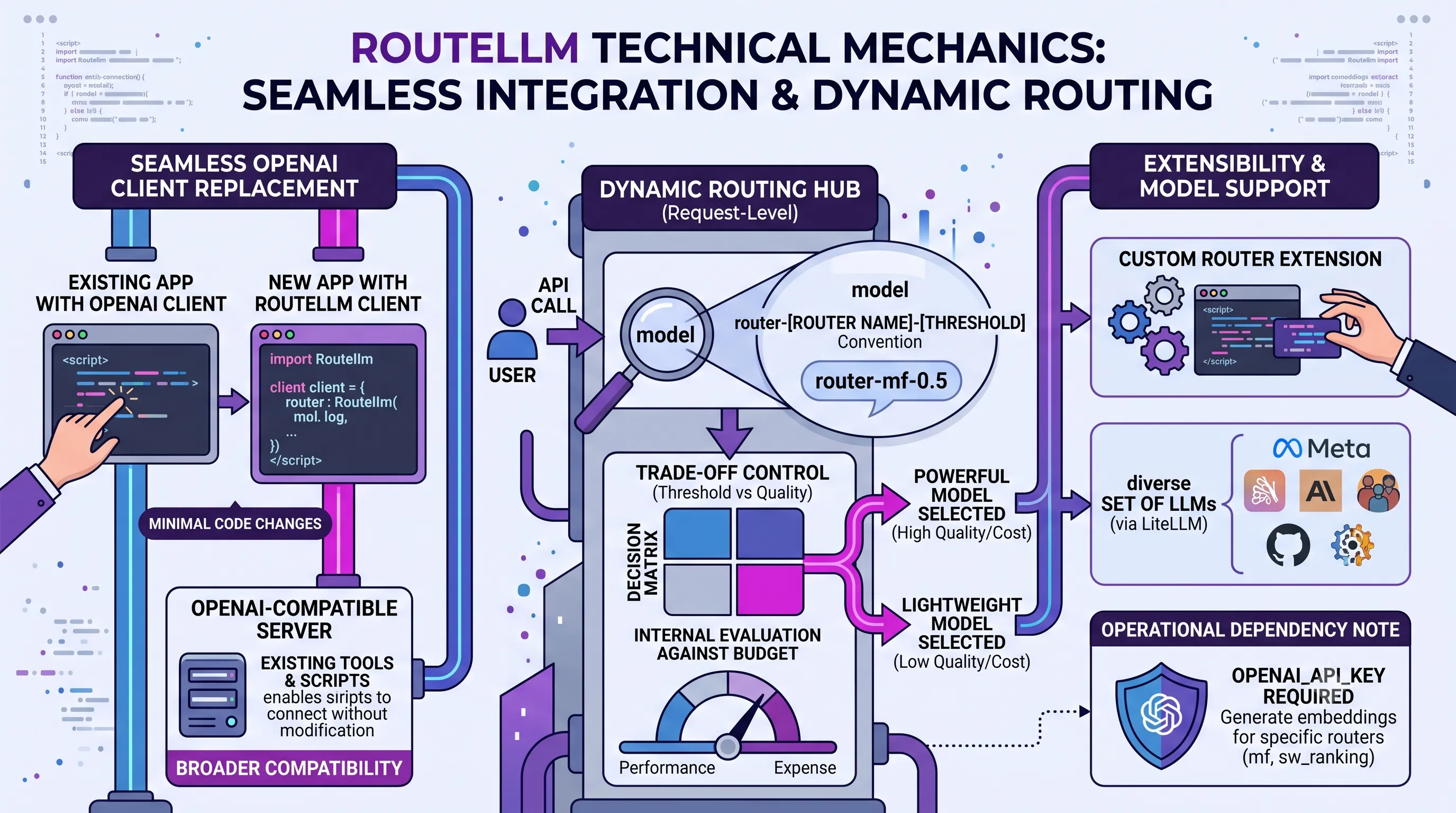
RouteLLM is engineered for minimal friction during adoption, primarily by functioning as a drop-in replacement for OpenAI's client.This design means that developers can integrate advanced routing capabilities into their applications with minimal code changes, often just by changing the import statement and client initialization.
Furthermore, the framework can launch its own OpenAI-compatible server.
This feature is crucial for broader ecosystem compatibility, as it allows any existing tool, application, or script that is already configured to communicate with the OpenAI API to work seamlessly with RouteLLM's routing logic without any modification.
Dynamic Routing with Cost Thresholds
The core of RouteLLM's intelligence lies in its request-level routing decisions.Each routing request utilizes a cost threshold to precisely control the trade-off between performance quality and operational expense.
Clients specify their desired routing strategy directly within the model parameter of the API call.
The string follows a specific convention: `router-[ROUTER NAME]-[THRESHOLD]`.
For example, a call using `router-mf-0.5` would instruct RouteLLM to use the 'mf' (model-free) router with a cost threshold of 0.5, allowing the system to dynamically select either a powerful or a lightweight model based on its internal evaluation against this budget.
Extensibility and Model Support
RouteLLM is designed not just for immediate use but also for future customization.The framework allows developers to easily extend it to include new, custom routers, enabling the implementation of bespoke logic tailored to specific use cases.
To ensure broad applicability, RouteLLM leverages LiteLLM to support chat completions from various open-source and closed models, breaking vendor lock-in and providing access to a diverse set of LLMs.
For those developing or evaluating different routing strategies, the system also includes capabilities to compare router performance across multiple benchmarks.
However, there is a key operational dependency to note: an `OPENAI_API_KEY` is currently required to generate embeddings for the `mf` and `sw_ranking` routers.
This requirement persists regardless of the actual model pair being used for the chat completion itself, as the embedding generation for these specific routers relies on OpenAI's services.
3. Customizing Your Pipeline: RouteLLM's Flexible Configuration
While the main article discusses the strategic value of routing LLM requests based on complexity, this section provides the technical details for implementation. Here, we explore how to configure RouteLLM, from selecting your preferred models and endpoints to fine-tuning router behavior, enabling you to build a cost-effective and efficient pipeline tailored to your specific needs.
Tailoring Model Pairs and Endpoints
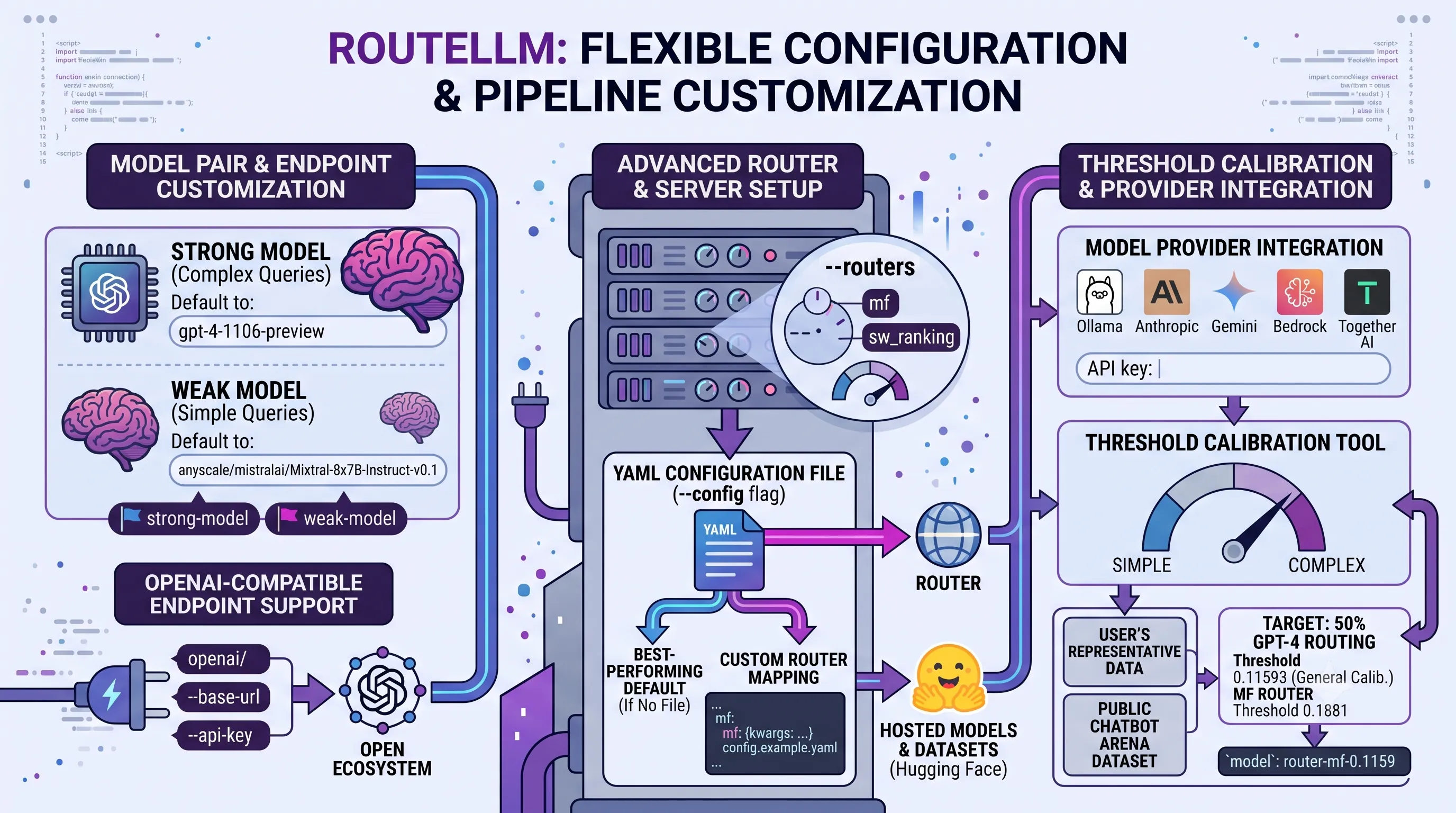
RouteLLM is designed for flexibility, allowing you to easily swap the models used for complex and simple queries. By default, the framework pairs a strong model, 'gpt-4-1106-preview', with a highly capable weak model, 'anyscale/mistralai/Mixtral-8x7B-Instruct-v0.1'.
Should your use case require a different combination, these defaults can be overridden using the `strong-model` and `weak-model` arguments or flags when launching the system.
This customization extends beyond a predefined list of models. RouteLLM supports any OpenAI-compatible endpoint.
To integrate one, you simply prefix the model name with `openai/` and provide the necessary credentials and location using the `--base-url` and `--api-key` flags, opening up a vast ecosystem of models for your routing pipeline.
Advanced Router and Server Configuration
Fine-tuning the routing logic itself is managed through server flags and configuration files. When starting the server, the `--routers` flag is used to specify which routing algorithms should be made available for use.
The behavior of these routers is defined in a configuration file, which is specified using the `--config` flag.
However, if you do not specify a configuration file with the `--config` flag, the server intelligently defaults to using the best-performing configuration available, providing a robust starting point out of the box.
The router configuration file uses a straightforward structure: it is a top-level mapping where each key is the name of a router, and the value consists of the keyword arguments needed for that router's initialization.
For a practical reference, an example configuration is provided in the `config.example.yaml` file.
Supporting this ecosystem, all the necessary models and datasets used by RouteLLM are conveniently hosted on Hugging Face under the official RouteLLM and LMSYS organizations.
Threshold Calibration and API Key Management
Integrating various model providers is a key aspect of building a versatile pipeline. RouteLLM provides clear instructions for setting up API keys for a wide range of popular services. This includes support for local models running via Ollama, as well as major cloud providers like Anthropic, Gemini (Google AI Studio), Amazon Bedrock, and Together AI.
Once your models are connected, the next step is to calibrate the router's sensitivity. The thresholds that determine whether a query is "simple" or "complex" can be tuned based on your specific data.
You can calibrate these thresholds using a representative sample of your own incoming queries or by leveraging the extensive public Chatbot Arena dataset for a more general baseline.
The goal is to find a balance that meets your performance and cost requirements. For instance, one example calibration performed using Chatbot Arena data suggested a threshold of 0.11593 to achieve a target of sending 50% of calls to GPT-4.
Different routers may require different thresholds for the same target. For the `mf` router, a separate analysis suggested a threshold of 0.1881 would be needed to route approximately 50% of calls to the strong model.
In practice, this calibration is applied directly in the configuration; to achieve the 50% target with the `mf` router, the model field would be set to `router-mf-0.1159`, embedding the threshold directly into the router's identifier.
4. Under the Hood: Understanding RouteLLM's Diverse Routing Algorithms
This section delves into the core mechanisms that power the intelligent prompt distribution discussed in our main article, "No need to use GPT/Claude for every request: Building an LLM auto-routing pipeline by difficulty".We will explore the specific algorithms, or "routers," that RouteLLM provides to determine which Large Language Model is best suited for a given query, forming the foundation of the cost-saving pipeline.
A Spectrum of Routing Strategies
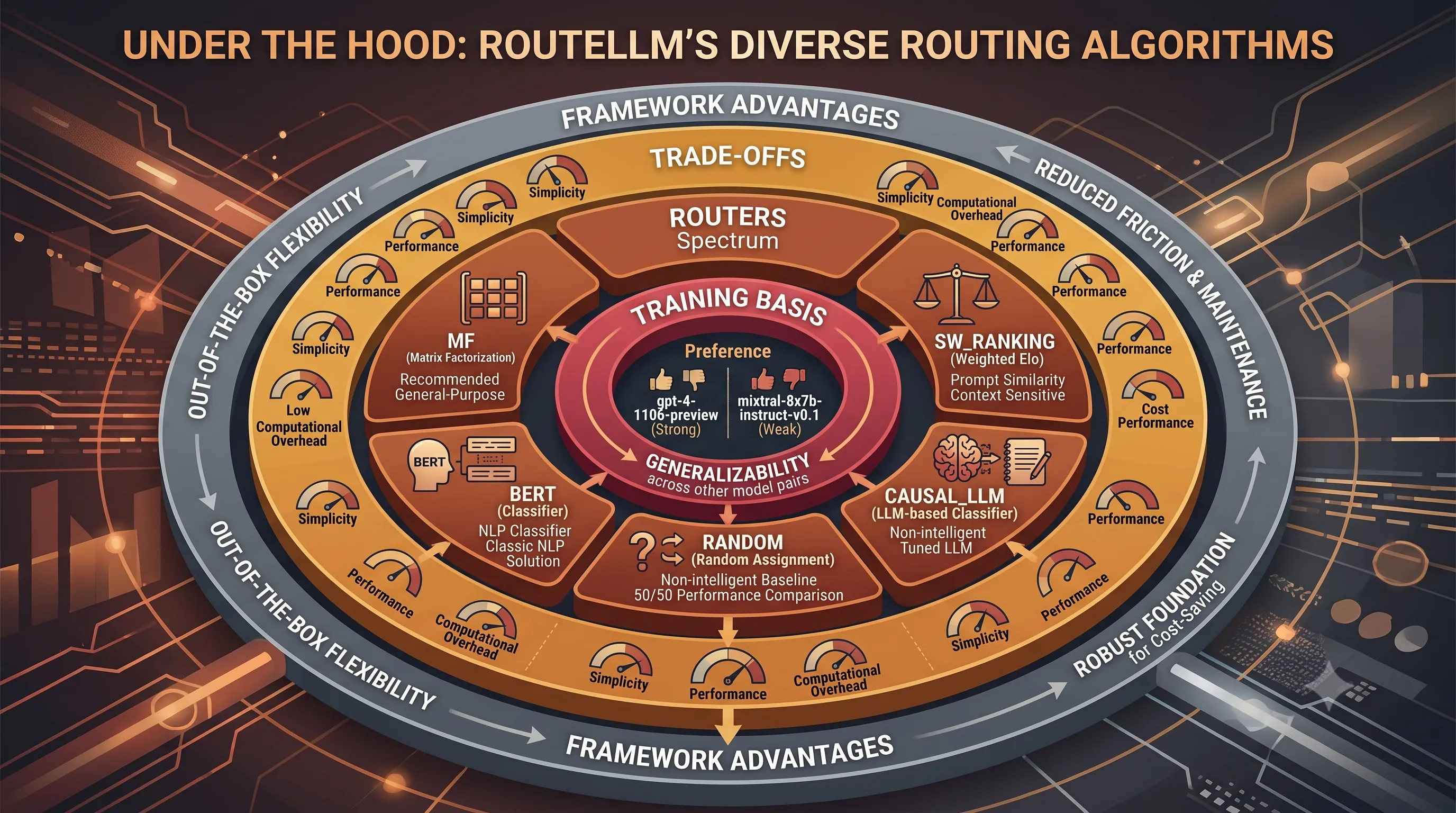
RouteLLM comes equipped with five distinct, pre-built routers to accommodate various implementation needs, including four intelligent models and one baseline randomizer.Each of these routers has been trained using a model pair consisting of gpt-4-1106-preview as the "strong" model and mixtral-8x7b-instruct-v0.1 as the "weak" model, providing a solid foundation for routing based on query complexity.
The different approaches offer a trade-off between simplicity, performance, and computational overhead, allowing developers to select the best fit for their specific use case.
| Router Name | Core Methodology | Training Basis | Key Characteristic |
|---|---|---|---|
mf |
Matrix Factorization | Preference Data | The recommended general-purpose router. |
sw_ranking |
Weighted Elo Calculation | Preference Data & Prompt Similarity | Weights routing decisions based on how similar a new prompt is to ones seen during training. |
bert |
BERT Classifier | Preference Data | Uses a classic transformer-based text classifier for routing. |
causal_llm |
LLM-based Classifier | Preference Data | A fine-tuned LLM determines the route for a given prompt. |
random |
Random Assignment | N/A | Provides a 50/50 baseline for performance comparison. |
Recommended and Specialized Routers
While all routers serve the same ultimate purpose, their internal workings are quite different.The
mf router is the recommended starting point, employing a matrix factorization model trained on preference data to efficiently predict which model will perform better.The
sw_ranking router takes a more dynamic approach, using a weighted Elo calculation where votes are weighted by the semantic similarity between the user's live prompt and the preference data, making it sensitive to query context.For teams familiar with classic NLP models, the
bert router offers a straightforward solution, functioning as a BERT classifier also trained on the collected preference data.Perhaps the most powerful and customizable option is the
causal_llm router, which is itself an LLM-based classifier tuned on preference data.For developers wishing to train their own version of this router, RouteLLM provides a notebook with detailed instructions.
Finally, the
random router serves as a crucial, non-intelligent baseline, simply routing requests randomly to either model, which is essential for measuring the actual value and accuracy of the other intelligent routers.Flexibility and Generalization Across Models
A significant advantage of the RouteLLM framework is the high degree of generalizability offered by its pre-trained routers.While they were trained on the gpt-4 and mixtral pair, these routers generally perform well when applied to other strong and weak model pairs.
This means that developers can replace the underlying LLMs—for instance, swapping in a new state-of-the-art model as the "strong" option and a smaller, faster open-source model as the "weak" one—without needing to retrain the routing models themselves.
This out-of-the-box flexibility dramatically reduces the friction and maintenance overhead involved in deploying and updating a sophisticated, cost-effective LLM pipeline.
5. Measuring Success: RouteLLM's Performance and Benchmarking Framework
A key component of the main article's topic—building an intelligent LLM routing pipeline—is the ability to concretely measure its effectiveness.A router that directs queries without a clear, quantifiable validation of its performance in terms of cost and quality is merely a black box.
This section delves into RouteLLM's dual strengths: its impressive, measurable performance metrics and the robust, built-in framework designed to benchmark and validate those results, ensuring your routing strategy is both cost-effective and powerful.
Achieving Cost Savings and Quality with RouteLLM
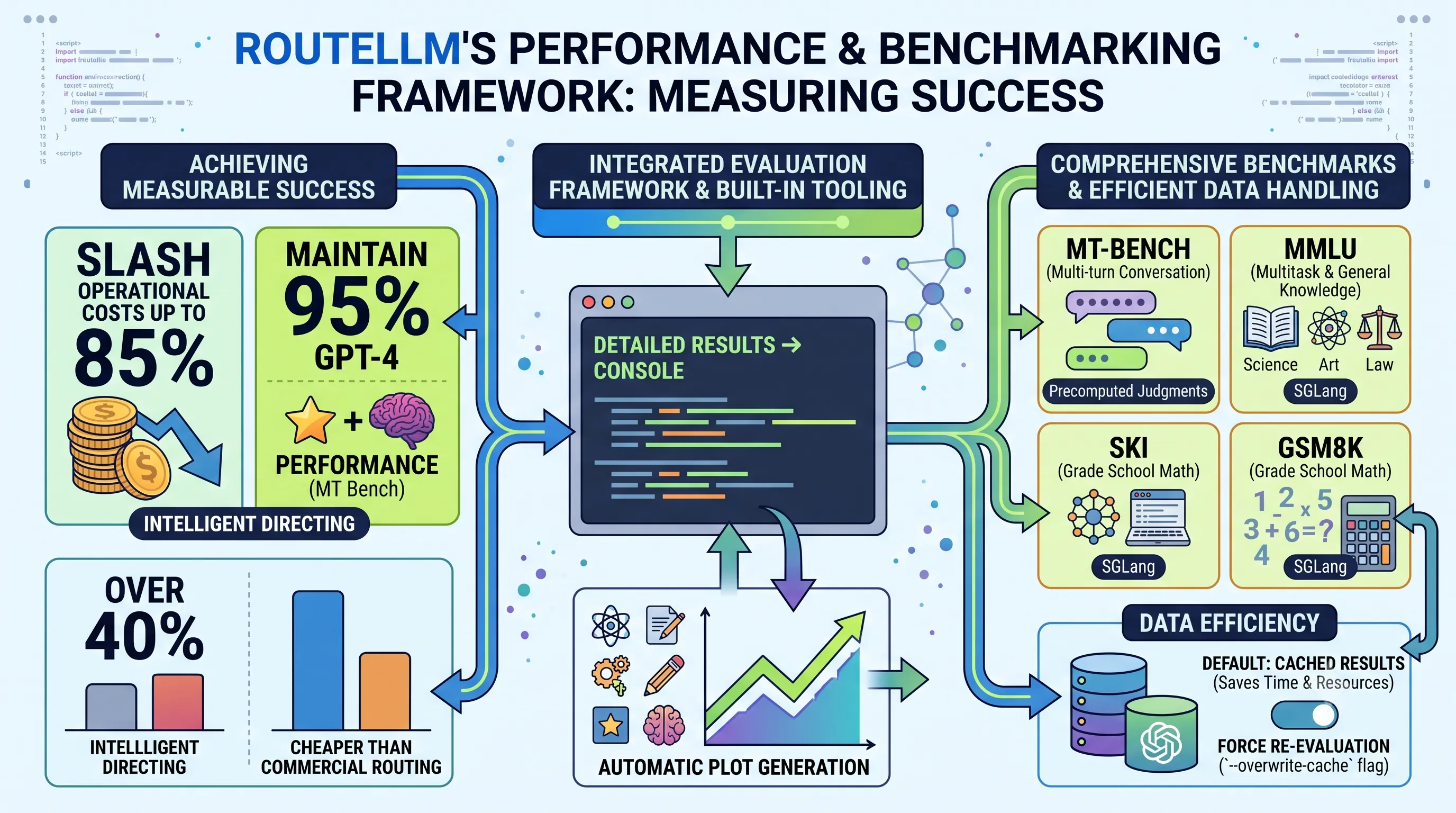
The primary motivation for implementing a routing system is to optimize the trade-off between cost and performance, and RouteLLM delivers exceptional results on both fronts.By intelligently directing requests to the most appropriate model, trained routers within the framework can slash operational costs by as much as 85%.
Critically, this dramatic cost reduction does not come with a significant sacrifice in quality.
Performance benchmarks show that RouteLLM's trained routers successfully maintain 95% of GPT-4's performance on complex evaluation suites like MT Bench.
When compared to existing commercial routing solutions, RouteLLM proves to be a highly competitive alternative, offering the same level of performance at a cost that is over 40% cheaper.
Comprehensive Evaluation Framework and Benchmarks
To substantiate these performance claims, RouteLLM includes an integrated evaluation framework that allows developers to rigorously measure a router's effectiveness against standardized benchmarks.This built-in tooling is essential for validating router configurations and understanding their behavior on different types of tasks.
The framework provides direct support for several well-regarded industry benchmarks, including MMLU (Massive Multitask Language Understanding), GSM8K (Grade School Math), and MT-Bench.
Upon running an evaluation, the framework provides immediate feedback by printing detailed results directly to the console.
For a more intuitive analysis, it also automatically generates a plot visualizing the router's performance, saved in the current directory, though this output path can be overridden for convenience.
| Supported Benchmark | Primary Focus | Evaluation Methodology Note |
|---|---|---|
| MT-Bench | Multi-turn Conversational Ability | Uses precomputed judgments for efficient and consistent scoring. |
| MMLU | Multitask Accuracy & General Knowledge | Results were computed for the desired model pairs using the SGLang framework. |
| GSM8K | Mathematical Reasoning | Results were computed for the desired model pairs using the SGLang framework. |
Efficient Data Handling for Benchmarking
Running extensive benchmarks can be computationally intensive, so RouteLLM's evaluation framework is designed with efficiency in mind.By default, evaluation results for a given router on a specific benchmark are cached.
This feature prevents redundant computation, saving significant time and resources when re-running tests or analyzing different aspects of the same router configuration.
For situations requiring a fresh run, such as after a model or data update, this behavior can be easily controlled.
Users can force a re-evaluation for specific routers by using the `--overwrite-cache` flag.
This streamlined workflow is further enhanced by leveraging technologies like SGLang, which was utilized to compute the MMLU and GSM8K results, and the use of precomputed judgments for MT Bench, ensuring the benchmarking process is as fast and repeatable as possible.
6. Expanding RouteLLM: Contribution Guidelines and Future Enhancements
This section connects directly to our main topic of building an LLM routing pipeline by providing a practical guide for developers who wish to extend the RouteLLM framework discussed in this article.Rather than simply using the tool, this guide details how to actively contribute to its development, enabling the community to build more sophisticated and specialized routing logic.
Joining the RouteLLM Community
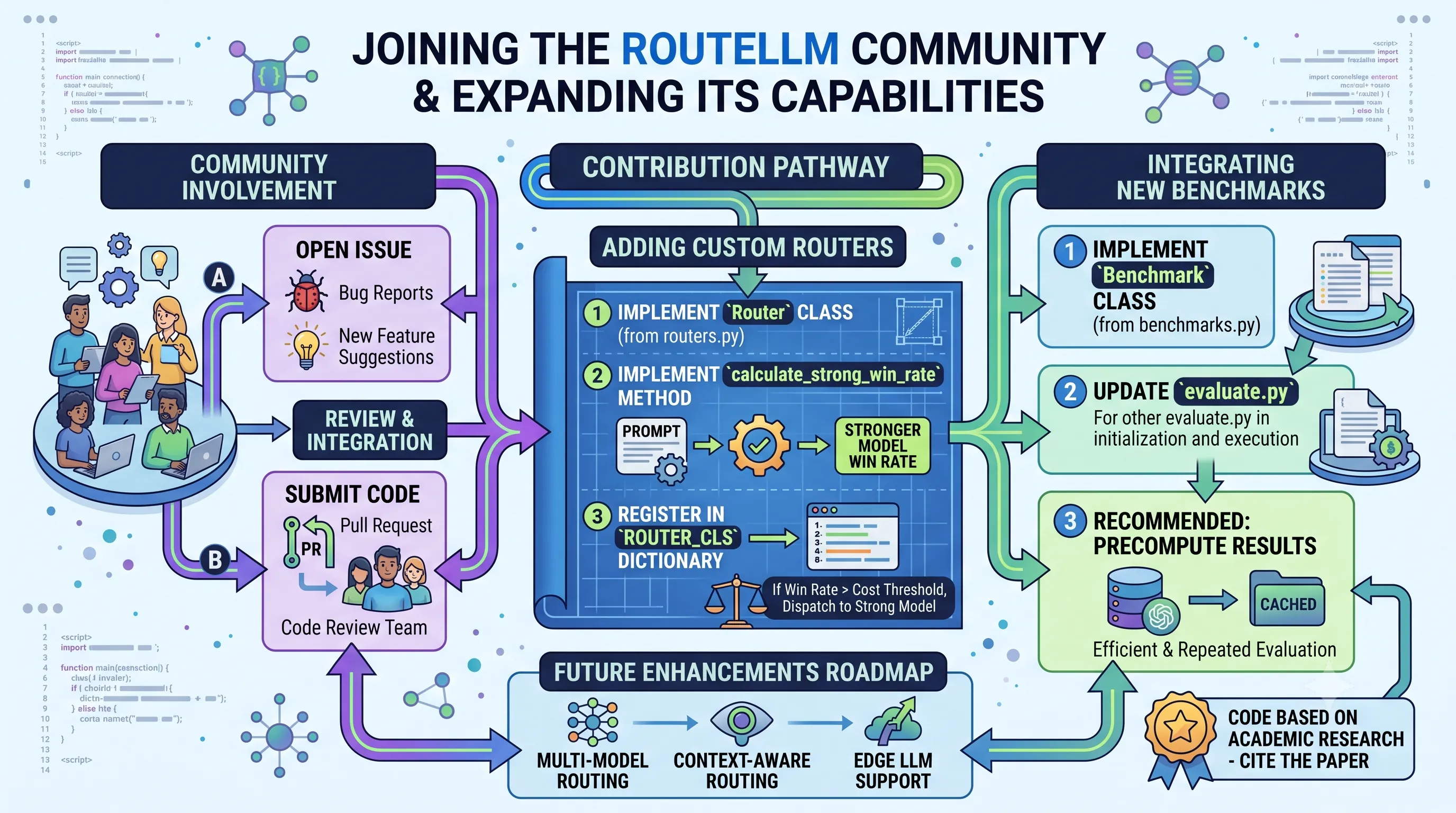
The RouteLLM project is open to community involvement and improvements.Contributions are actively welcomed from developers, who can participate by opening an issue on the repository to report bugs or suggest new features.
For those ready to submit code, the standard process is to create a pull request for review and potential integration.
Adding Custom Routers
One of the most powerful ways to extend RouteLLM is by creating a new, custom router tailored to specific needs.The process involves a few key steps:
First, a new router must implement the abstract `Router` class, which is defined in the `routers.py` file.
Within this new class, the core logic resides in the `calculate_strong_win_rate` method, which must be implemented.
This method's purpose is to analyze a user prompt and return a calculated win rate, representing the likelihood that the "strong" (and more expensive) LLM is required for a high-quality response.
The framework then uses this output; if the strong model's win rate surpasses a user-defined cost threshold, the request is dispatched to that strong model.
Finally, to make the new router available to the system, it must be registered by adding it to the `ROUTER_CLS` dictionary.
Integrating New Benchmarks
To ensure new routing strategies are effective, they must be evaluated against robust benchmarks.RouteLLM allows for the integration of new evaluation suites.
To add a new benchmark, developers must first implement the abstract `Benchmark` class located in the `benchmarks.py` file.
Once the new benchmark class is created, the `evaluate.py` module needs to be updated so that it can properly initialize and execute the new benchmark during evaluation runs.
As a best practice, the project recommends that benchmark results should be precomputed.
This step is crucial for efficiency, as it avoids the need to regenerate results from scratch every time an evaluation is run, saving significant time and computational resources.
The project's code is based on academic work, and contributors are reminded of its origins: The code in this repository is based on the research from the paper. Please cite if you find the repository helpful.
7. The Foundation: A Brief Look at Large Language Models (LLMs)
This section provides the essential background on Large Language Models (LLMs), defining what they are and tracing their recent history.Understanding this foundational technology is crucial before delving into the main article's topic: building an intelligent routing pipeline that selects the right LLM for a given task, as not every request requires the most powerful model available.
Defining LLMs: Evolution and Capabilities
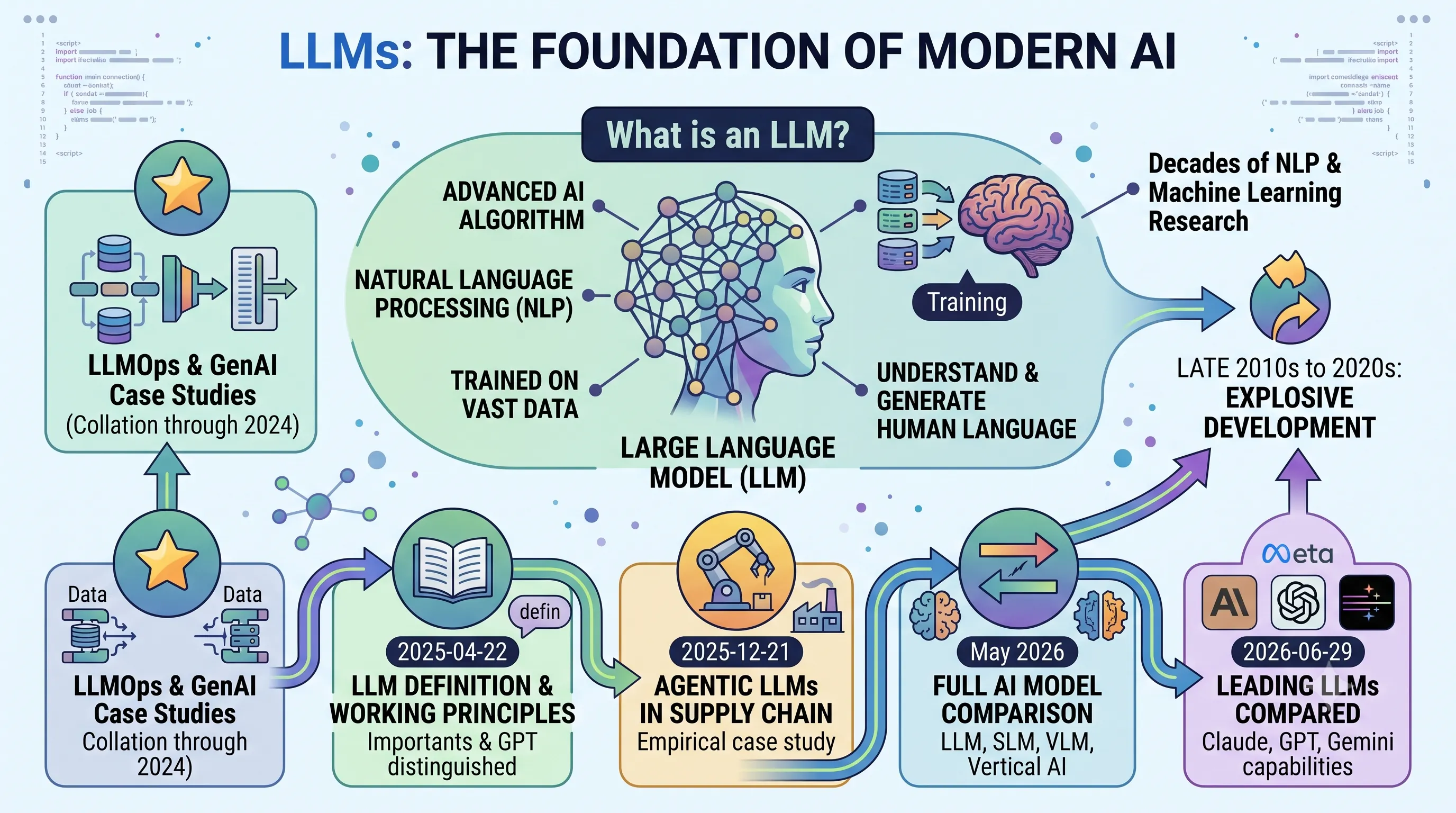
LLM stands for Large Language Model.These are highly advanced artificial intelligence algorithms specifically designed for natural language processing (NLP).
They function by being trained on vast amounts of data, which enables them to understand, generate, and interact with human language in a sophisticated manner.
LLMs represent the pinnacle of decades of research in both NLP and the broader field of machine learning.
The most significant surge in their development and mainstream adoption occurred during the late 2010s and throughout the 2020s, marking a transformative period for AI.
Milestones in LLM Research and Publication
The rapid evolution of LLMs has been documented and driven by continuous research, comparisons, and case studies.Throughout 2024, a comprehensive database of real-world LLMOps and GenAI case studies was collated, providing practical insights into their deployment.
Further foundational knowledge was established with a key article published on April 22, 2025, which discussed the core definition of an LLM, its working principles, and its distinction from specific instances like GPT.
The field's expansion into more autonomous applications was highlighted in an empirical case study on Agentic LLMs in the supply chain, published on December 21, 2025.
As the ecosystem matured, comparative analyses became critical.
In May 2026, a full comparison of various AI language models—including LLMs, SLMs, sLLMs, VLMs, and Vertical AI—was published.
This was followed by a focused article on June 29, 2026, which specifically compared the capabilities of the leading Claude, GPT, and Gemini models.
| Research Focus / Publication Topic | Date of Publication / Collation |
|---|---|
| Database of Real-World LLMOps and GenAI Case Studies | Throughout 2024 |
| LLM Definition, Importance, and Working Principles | 2025-04-22 |
| Empirical Case Study on Agentic LLMs in Supply Chain | 2025-12-21 |
| Full Comparison of AI Language Models (LLM, SLM, VLM, etc.) | May 2026 |
| Comparative Analysis of Claude, GPT, and Gemini LLMs | 2026-06-29 |
8. Maximizing Efficiency: The Role of LLM Inference Optimization
While the main focus of this article is on intelligently routing requests to the most appropriate LLM, that is only half of the efficiency equation.
Once a request arrives at a specific model endpoint, we must ensure it is processed with maximum speed and minimum cost.
This section delves into LLM inference optimization, a crucial layer that works in concert with a routing strategy to create a truly cost-effective and high-performance AI pipeline.
An intelligent router is of little use if the underlying models are slow and inefficient; therefore, optimizing the inference process itself is non-negotiable for any large-scale deployment.
Core Concepts of Inference Optimization
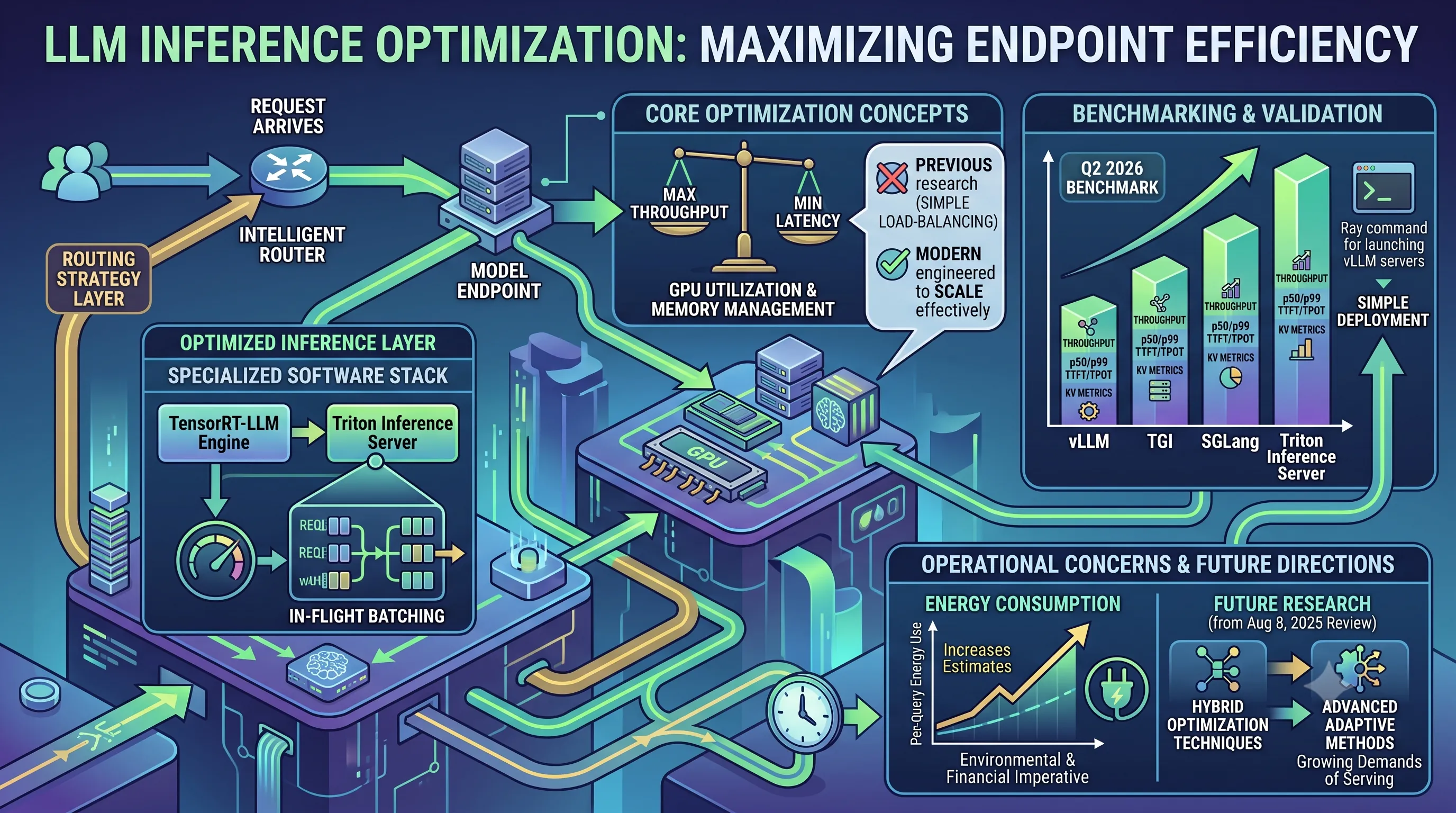
LLM inference optimization is a key technology specifically designed to achieve the maximum possible throughput and minimum latency using a finite amount of computational resources.
This goes far beyond traditional methods.
For instance, previous research and early strategies for LLM serving typically relied on a simple load-balancing strategy, distributing requests across servers without considering the unique computational patterns of generative AI.
Such an approach is insufficient today, as modern AI inference must be engineered to scale effectively to handle billions of queries, a reality that demands more sophisticated techniques to manage memory, batching, and GPU utilization.
Benchmarking and Deployment Strategies
Modern optimization involves specialized software stacks.
A common high-performance pattern is the deployment of a TensorRT-LLM engine behind a Triton Inference Server.
This combination is particularly effective because it allows for advanced features like in-flight batching, which groups incoming requests dynamically to maximize GPU throughput.
To validate such strategies, rigorous benchmarking is essential.
For example, a significant LLM inference benchmark was conducted in the second quarter of 2026.
This study provided a critical comparison of the leading inference servers at the time.
| Inference Framework | Key Metrics Compared in Q2 2026 Benchmark |
|---|---|
| vLLM | Throughput, p50/p99 TTFT/TPOT, and KV metrics |
| TGI (Text Generation Inference) | Throughput, p50/p99 TTFT/TPOT, and KV metrics |
| SGLang | Throughput, p50/p99 TTFT/TPOT, and KV metrics |
| Triton Inference Server | Throughput, p50/p99 TTFT/TPOT, and KV metrics |
Deployment has also become more accessible.
For engineers working with the vLLM framework, a new Ray command for launching vLLM servers simplified the process of spinning up and managing these optimized endpoints.
Addressing Energy Consumption and Future Directions
Beyond raw performance, operational cost remains a primary concern, and a significant component of this is power.
Recent analysis continues to show that the estimates of per-query energy use for AI inference are increasing, making efficiency not just a performance goal but an environmental and financial imperative.
The industry has been aware of this challenge for some time.
A research review published back on August 8, 2025, already highlighted promising future research directions to enhance inference efficiency.
The review pointed towards the development of hybrid optimization techniques and more advanced adaptive methods as critical areas of focus to tackle the growing demands of LLM serving.
9. Broader AI and Digital Ecosystems: From Transparency to Security
While the core of this article focuses on the technical implementation of an LLM routing pipeline, such a system does not exist in a vacuum. Its effectiveness, security, and utility are deeply connected to a broader ecosystem of platforms, data sources, and development tools. This section explores several key initiatives and platforms that provide the context and components—from transparent public data and foundational AI models to comprehensive developer environments and specialized knowledge bases—necessary for building and deploying sophisticated, responsible AI systems like an intelligent LLM router.
Public Information and Transparency
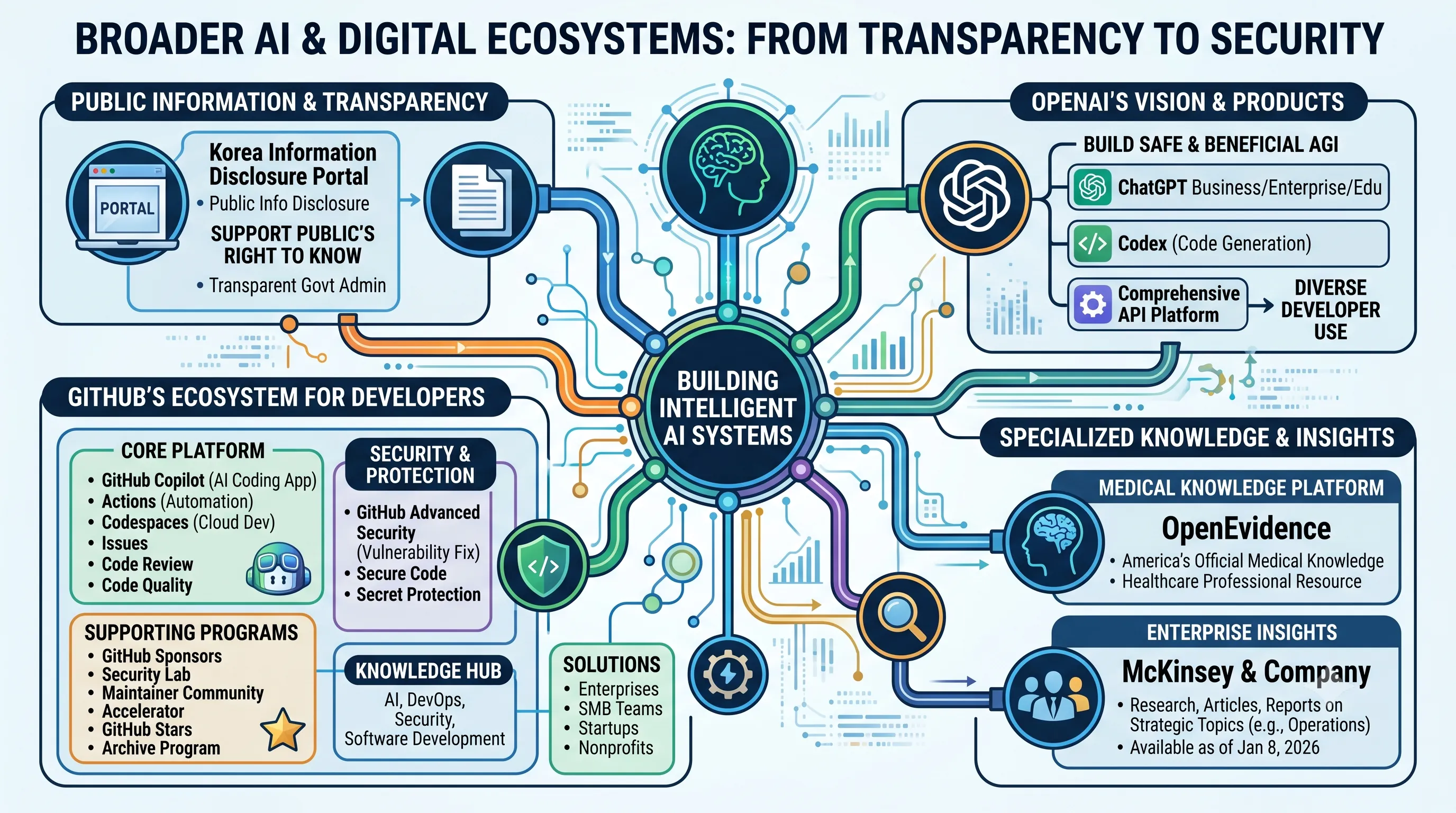
Access to reliable data is a cornerstone of any advanced information system. In the public sector, initiatives like the Korea Information Disclosure Portal serve as critical infrastructure for transparency. This platform is designed to facilitate public information disclosure, directly supporting the public's right to know and ensuring the transparent administration of government functions.
OpenAI's Vision and Products
At the forefront of the AI landscape, OpenAI operates with a stated mission to build safe and beneficial AGI (Artificial General Intelligence) capable of solving human-level problems. To support this vision and the broader developer community, the organization provides a suite of products and platforms. These offerings include ChatGPT Business, ChatGPT Enterprise, and ChatGPT for Education for tailored organizational use, as well as the Codex model for code generation and a comprehensive API platform that allows developers to integrate its powerful models into their own applications.
GitHub's Ecosystem for Developers
For the developers building complex systems like LLM routers, GitHub provides a comprehensive ecosystem that extends far beyond simple version control. Its features are designed to support the entire software development lifecycle. Core platform offerings include GitHub Copilot, which assists developers in writing better code with AI and is available as an application, alongside tools like GitHub Actions for automation, Codespaces for cloud-based development environments, and established workflows for Issues, Code Review, and ensuring Code Quality.
Security is a central component of this ecosystem. GitHub Advanced Security is a specific solution designed to help teams find and fix vulnerabilities, secure their code, and implement secret protection to prevent leaks.
The platform caters to a wide range of users with tailored solutions for enterprises, small and medium-sized teams, startups, and even nonprofits. It also serves as a knowledge hub, offering resources on key topics like AI, Software Development, DevOps, and Security.
To foster a vibrant open-source community, GitHub runs several key programs. GitHub Sponsors provides a direct channel to financially support open-source developers. Furthermore, its specialized programs include the Security Lab for collaborative security research, the Maintainer Community to support project leaders, the Accelerator to help fund promising projects, the GitHub Stars program to recognize influential community members, and the Archive Program to preserve important open-source code for the future.
Medical Knowledge and Enterprise Insights
Beyond general-purpose platforms, specialized knowledge bases are emerging to serve specific professional domains. OpenEvidence, for example, functions as America’s official medical knowledge platform, providing a dedicated resource for healthcare professionals.
In the business world, established research firms continue to provide critical analysis. McKinsey & Company publishes a wide range of research, articles, and reports on strategic topics, including Operations. As of early this year, its latest publications in that domain were available as of January 8, 2026, offering valuable insights for enterprises.
10. Enhancing User Engagement: Interactive Quiz Widgets
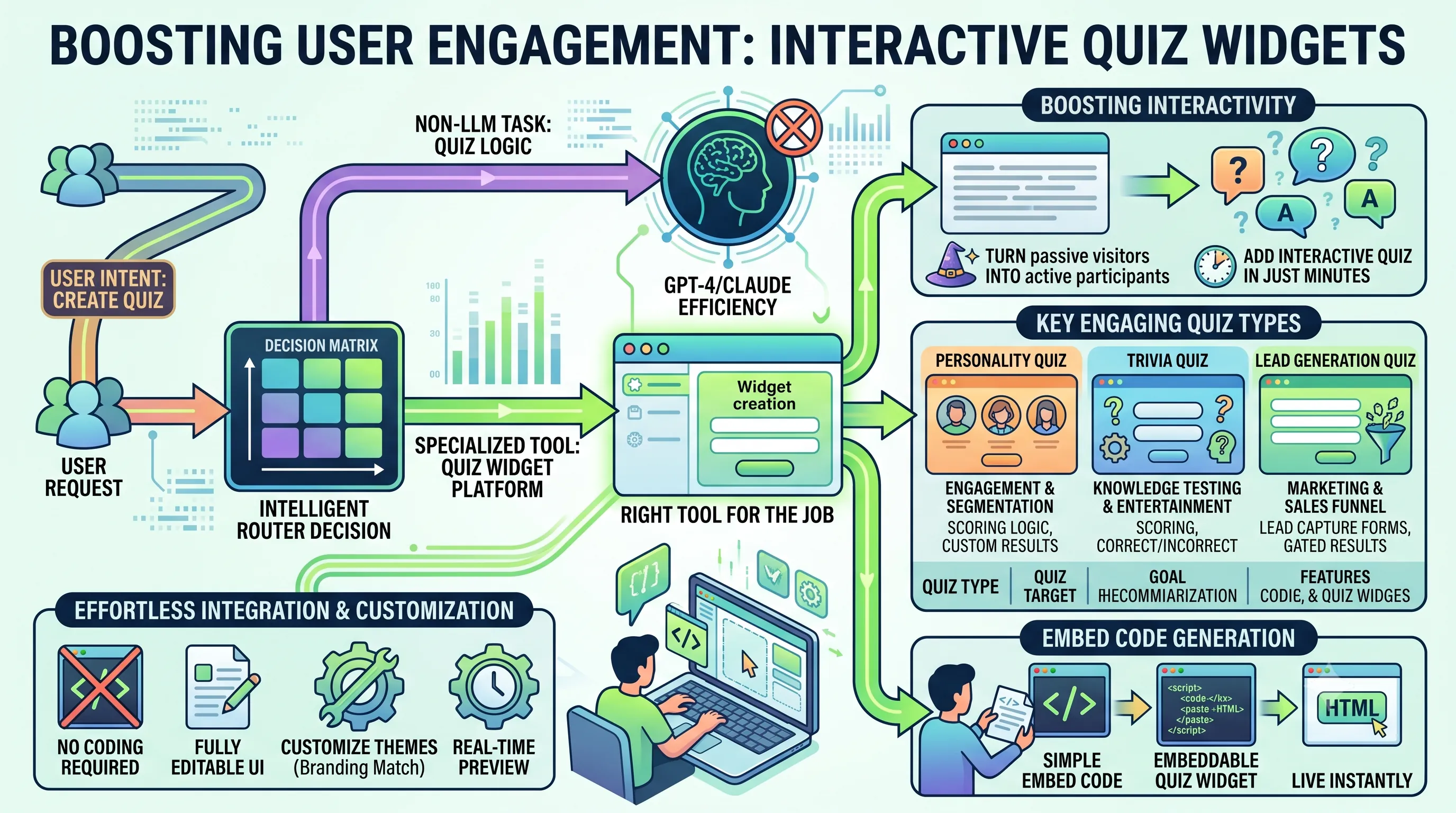
This section connects directly to our main theme of intelligent LLM routing by presenting a clear example of a task best suited for a specialized, non-LLM tool.While a powerful model could theoretically generate quiz logic, a dedicated quiz widget platform is vastly more efficient, cost-effective, and user-friendly for creating structured, interactive content.
An optimal routing pipeline would identify a user's intent to create a "quiz" and direct them to a tool like this, bypassing the unnecessary computational overhead of a general-purpose AI and demonstrating the core principle of using the right tool for the job.
Boosting Website Interactivity
Quiz widgets are a powerful tool for transforming static web pages into dynamic experiences.They are designed to make websites interactive, effectively turning passive visitors into active participants by inviting them to engage directly with the content.
This transition from passive consumption to active engagement can be achieved rapidly, as these tools can add a fully functional interactive quiz to a website in just minutes.
Features for Engaging Content Creation
The flexibility of these platforms allows for the creation of several distinct types of engaging content tailored to different goals.Quiz widgets enable the straightforward development of personality quizzes, knowledge-based trivia, and commercially-focused lead generation quizzes.
Functionally, they support all the necessary mechanics for these formats, including multiple-choice questions with integrated scoring, dynamic results pages based on user answers, and built-in lead capture forms to gather visitor information.
| Quiz Type | Primary Goal | Key Supported Features |
|---|---|---|
| Personality Quiz | User Engagement & Segmentation | Scoring Logic, Customized Results |
| Trivia | Knowledge Testing & Entertainment | Scoring, Correct/Incorrect Answers |
| Lead Generation Quiz | Marketing & Sales Funnel | Lead Capture Forms, Gated Results |
Effortless Integration and Customization
A key advantage of these widgets is their accessibility, as they require no coding knowledge to build or implement.The entire creation process is managed through a user-friendly interface where all elements are fully editable.
Users can customize themes to match their website's branding, with real-time previews available to see how changes will look before publishing.
Once the quiz is built, the integration process is exceptionally simple: embeddable quiz widgets can be created for websites in seconds.
The platform generates a simple embed code that can be copied and pasted directly into the website's HTML, making the quiz live instantly.
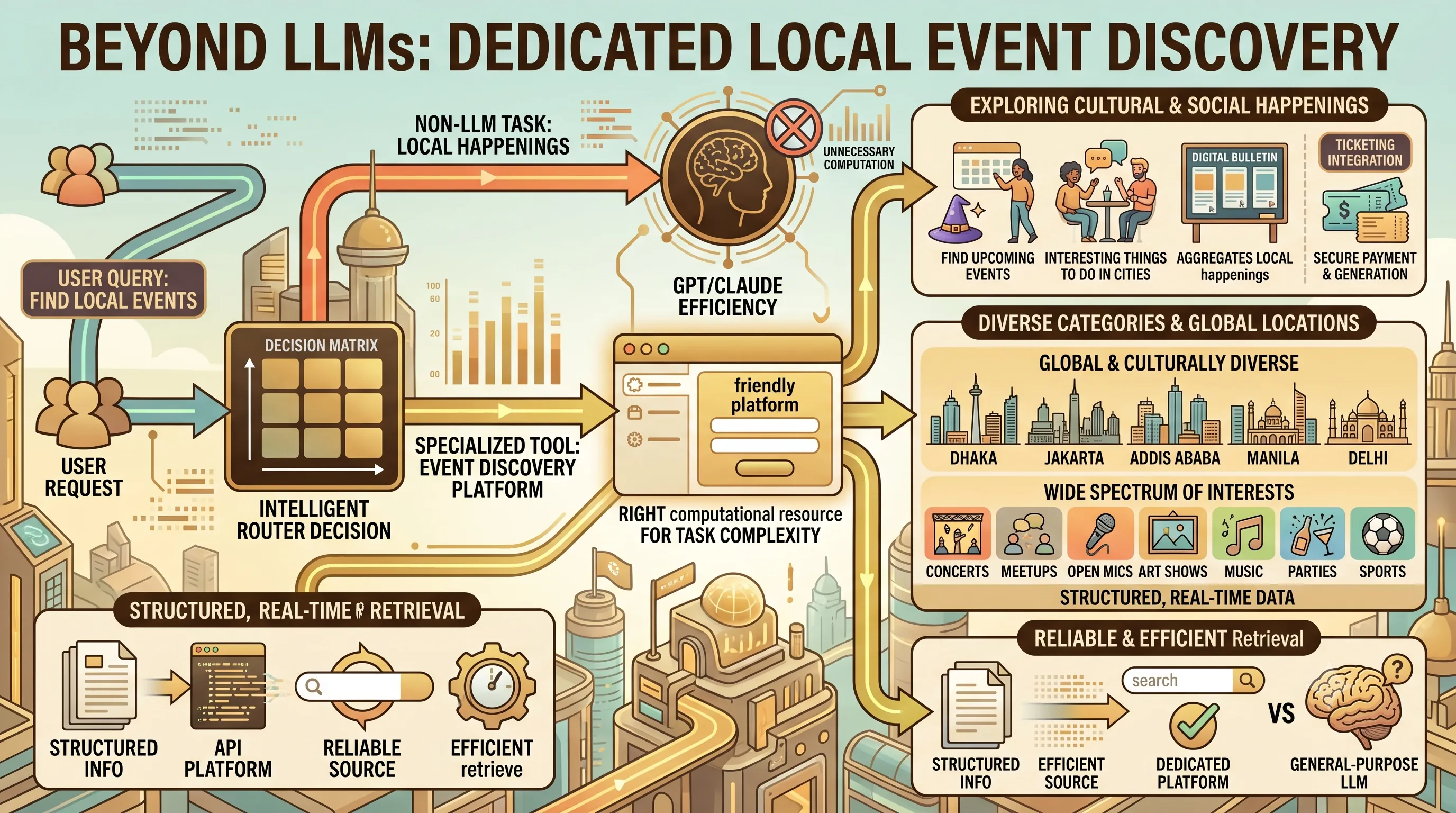
11. Beyond LLMs: Discovering Local Events and Activities
This section highlights a classic example of a user query that does not require the sophisticated reasoning of a large language model like GPT or Claude, making it a prime candidate for routing to a more specialized, cost-effective tool.While a user could ask an LLM about local happenings, a dedicated event discovery API or platform provides structured, real-time data more efficiently, demonstrating the core principle of our routing pipeline: matching task complexity with the right computational resource.
Exploring Local Cultural and Social Events
Beyond the realm of complex text generation, a significant number of user needs revolve around discovering real-world activities.Specialized platforms exist specifically to help users find upcoming events and interesting things to do in their cities.
These services act as digital bulletin boards, aggregating information for a wide array of local happenings.
Further simplifying the user journey, some of these platforms integrate ticketing services, allowing users to not only find information about an event but also to secure their attendance directly.
Diverse Event Categories and Locations
The scope of these event discovery platforms is often global and culturally diverse, catering to residents and travelers in a variety of major cities.For example, users can find local activities in urban centers such as Dhaka, Jakarta, Addis Ababa, Manila, and Delhi.
The types of events discoverable are equally varied, covering a wide spectrum of interests.
Available listings frequently include concerts, professional meetups, open mics, art shows, music events, parties, and sports matches.
This breadth of structured information makes dedicated platforms a far more reliable and efficient source than a general-purpose LLM for such specific retrieval tasks.
Related Posts