
OpenAirInterface vs. srsRAN: Putting Open-Source 5G RAN to the Test
🚀 Key Takeaways
- Architectural Maturity: OpenAirInterface provides extensive 3GPP release compliance and millimeter-wave support, whereas srsRAN emphasizes streamlined deployment and higher-order multi-antenna capability.
- Operational Usability: Setting up srsRAN involves substantially lower configuration friction, while OpenAirInterface demands deeper protocol expertise due to complex parameter structures.
- Signaling Performance: Both open-source stacks maintain comparable connection establishment latency during simultaneous multi-device radio access procedures.
- Bandwidth and Stability Dynamics: Each platform achieves strong spectral efficiency across software-defined radios, though advanced multi-antenna modes highlight physical-layer stability challenges.
- Interactive Workload Resilience: In latency-critical workloads such as live streaming and cloud gaming, srsRAN provides superior temporal consistency, while OpenAirInterface is more prone to jitter.
- Production Ecosystem Integration: Expanding hardware acceleration options and formal alignment under open networking consortia solidify open-source RAN as an enterprise-grade cellular framework.
The rapid evolution of disaggregated cellular architectures has fundamentally altered how enterprises, testbeds, and telecommunications researchers approach fifth-generation wireless infrastructure. By dismantling vendor lock-in, software-defined 5G Radio Access Network implementations offer unprecedented flexibility for private deployments and software experimentation.
Frontrunners such as OpenAirInterface (OAI) and srsRAN have transitioned from experimental prototypes to sophisticated software stacks capable of managing end-to-end Standalone 5G connectivity on commercial off-the-shelf hardware. However, deploying open-source base stations in production requires moving past theoretical feature lists to examine how these stacks handle concurrent multi-user scheduling, radio frequency calibration, and compute resource allocation.
Comprehensive comparative evaluations provide vital clarity by measuring real-world performance under realistic user traffic, from high-definition video streaming to jitter-sensitive cloud gaming. Assessing these benchmarks highlights the practical engineering trade-offs between architectural breadth and real-time operational reliability across modern open RAN platforms.

1. Architectural Comparison: OpenAirInterface vs. srsRAN Feature Matrices
Understanding how open-source 5G RAN platforms perform in practical deployments requires dissecting their underlying protocol implementations and radio capabilities.In the comparative evaluation conducted by Maria Barbosa, Iasmin Gomes, Vinícius Melo, and Kelvin Dias from Universidade Federal de Pernambuco (UFPE), the architectural trade-offs between OpenAirInterface (OAI) and srsRAN establish the operational ceiling for open radio access networks.
3GPP Release Alignment and Physical Layer Numerology
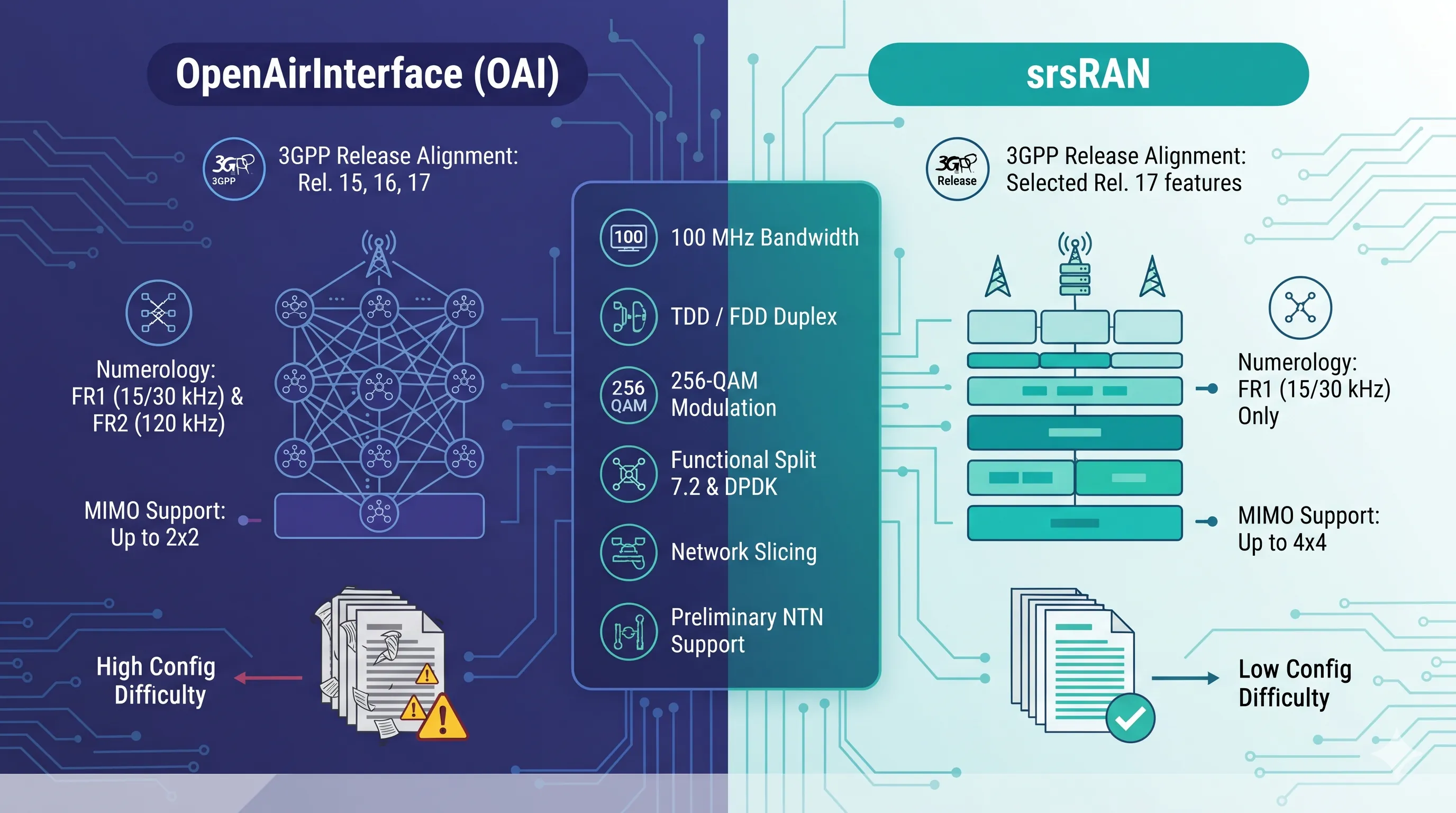
Compliance with evolving cellular standards defines the functional reach of open-source radio stacks.According to the UFPE evaluation, OAI complies comprehensively with 3GPP Release 15, Release 16, and Release 17 standards.
In contrast, srsRAN is architected around selected features of 3GPP Release 17.
These standard alignments directly translate to distinct physical layer profiles.
For carrier numerology, OAI provides wide-spectrum flexibility by supporting Sub-Carrier Spacing (SCS) of 15 kHz and 30 kHz across Frequency Range 1 (FR1), alongside 120 kHz SCS support for millimeter-wave operation in Frequency Range 2 (FR2).
Conversely, srsRAN restricts its current numerology profile to FR1, supporting 15 kHz and 30 kHz SCS.
Both platforms accommodate channel bandwidths up to 100 MHz, with srsRAN specifically evaluated on configurations up to 100 MHz in TDD and 50 MHz in FDD.
However, multi-antenna capacity separates the two stacks: OAI supports Multiple Input Multiple Output (MIMO) layers up to 2x2, whereas srsRAN scales up to 4x4 MIMO.
Both architectures natively sustain 256-QAM high-order modulation, operate across TDD and FDD duplexing modes, and support emerging preliminary Non-Terrestrial Networks (NTN) configurations.
Stack Modularization and Functional Split Architectures
The software engineering paradigms governing both platforms dictate their pipeline optimization and execution models.OAI is implemented primarily in C, relying on procedural routines for baseband handling.
srsRAN is implemented in C++, utilizing object-oriented modularity to organize radio pipeline abstractions.
Both platforms adhere to modern disaggregated principles by providing built-in support for 3GPP functional split 7.2.
To facilitate high-throughput packet transfers across user space without kernel bottlenecks, both OAI and srsRAN incorporate Data Plane Development Kit (DPDK) drivers.
Furthermore, both platforms provide native integration for end-to-end Network Slicing.
Architecturally, srsRAN structures a full L1, L2, and L3 protocol stack cleanly segmented into discrete network functions: Central Unit Control Plane (CU-CP), Central Unit User Plane (CU-UP), Distributed Unit High (DU-high), and Distributed Unit Low (DU-low).
OAI delivers robust topological versatility, natively supporting execution across bare-metal environments as well as containerized platforms and Kubernetes pods.
| Architectural Parameter | OpenAirInterface (OAI) | srsRAN |
|---|---|---|
| 3GPP Release Alignment | Release 15, 16, and 17 | Selected Release 17 features |
| Supported Subcarrier Spacing (SCS) | 15/30 kHz (FR1), 120 kHz (FR2) | 15/30 kHz (FR1) |
| Maximum MIMO Support | Up to 2x2 | Up to 4x4 |
| Channel Bandwidth | Up to 100 MHz | Up to 100 MHz (e.g., 100 MHz TDD, 50 MHz FDD) |
| Implementation Language | C | C++ |
| Functional Split 7.2 & DPDK | Supported | Supported |
| Duplexing & Modulation | TDD/FDD, 256-QAM | TDD/FDD, 256-QAM |
| Advanced Network Features | Network Slicing, preliminary NTN | Network Slicing, preliminary NTN |
| Internal Stack Partitioning | Bare-metal, containers, and Kubernetes pods | Modular CU-CP, CU-UP, DU-high, and DU-low |
| Configuration Difficulty | High (multiple complex configuration files) | Low (streamlined, though few examples provided) |
Configuration Overhead and Deployment Practicalities
While feature matrices highlight performance potential, configuration complexity dictates day-to-day maintainability.The UFPE study highlights a clear usability contrast between the two codebases during deployment setup.
OAI’s configuration difficulty is categorized as high.
Deploying an OAI node requires orchestrating multiple interconnected configuration files, where comprehending the underlying functionality of dense parameters remains challenging for operators.
In contrast, srsRAN is evaluated as having low configuration difficulty, presenting an organized interface for launching services.
However, researchers noted a tangible limitation: srsRAN provides comparatively few configuration examples, forcing engineers to derive specialized network setups independently.
2. Standalone 5G Testbed Architecture and SDR Hardware Parameters
Evaluating open-source 5G RAN platforms for real-world performance requires establishing a strictly controlled, reproducible standalone (SA) environment.To assess the baseline capabilities of open-source radio stacks under repeatable conditions, the testbed architecture pairs a dedicated computing host with virtualized core network services and software-defined radio (SDR) frontends.
Host Computing and Virtualized Core Infrastructure
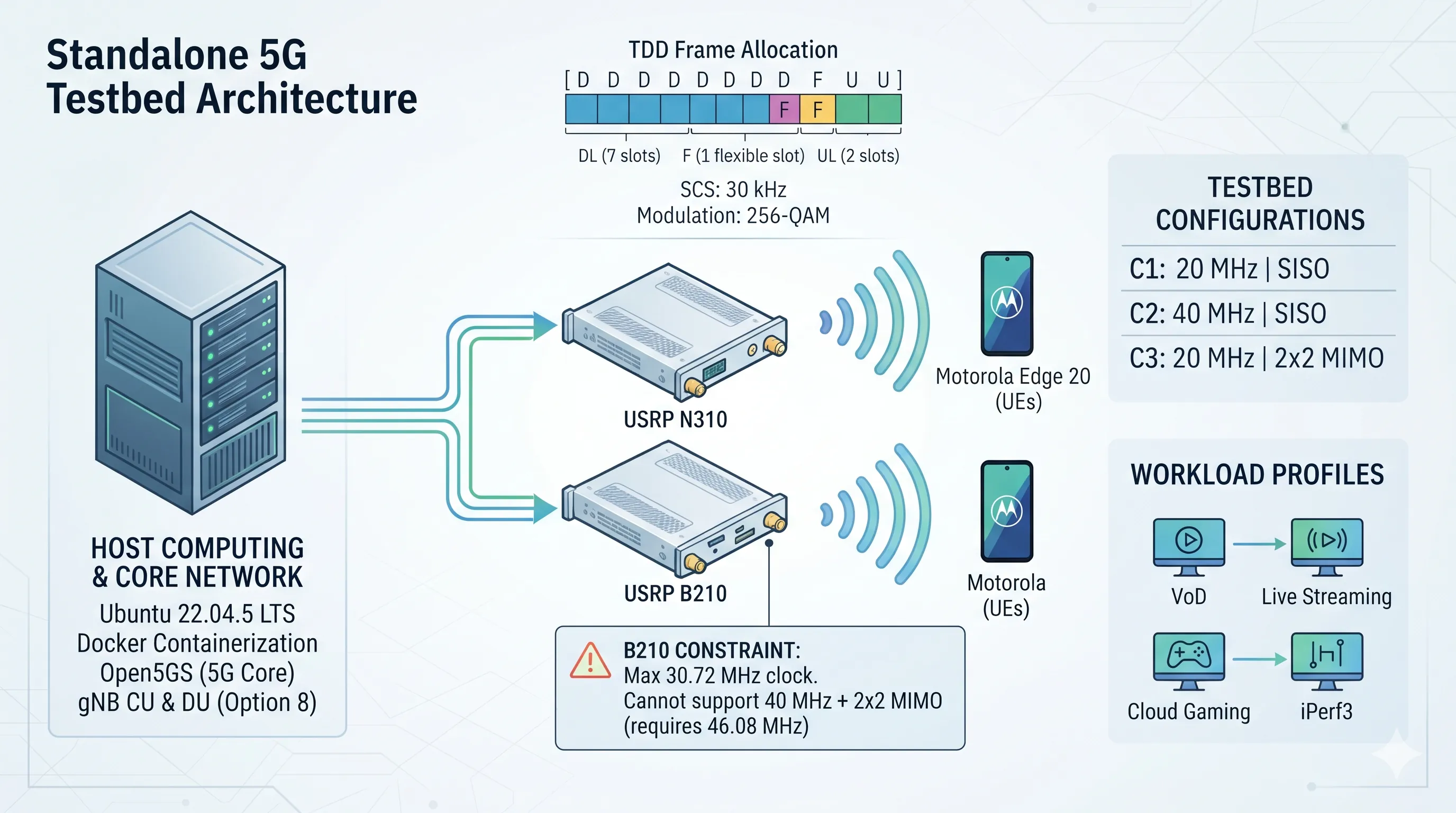
The physical processing foundation for the RAN evaluation relies on an enterprise host server powered by an Intel Xeon Gold 5215 processor paired with 96 GB RAM.The underlying operating system environment runs Ubuntu 22.04.5 LTS, which provides the real-time execution context required by both the radio unit drivers and the baseband processing pipelines.
Containerized services across the testbed are orchestrated through Docker 27.5.1 and Docker Compose 2.27.0.
The core network operations are handled by the Open5GS version v2.7.2 platform, running as a virtualized standalone 5G Core.
The RAN deployment implements a 3GPP functional split Option 8, running both the Centralized Unit (CU) and Distributed Unit (DU) on the host server.
At the service evaluation layer, the architecture delivers and measures real-time workload profiles, including Video on Demand (VoD), Live Streaming (LS), Cloud Gaming (CG), and synthetic iPerf3 traffic.
RF Frontend Configurations and Master Clock Constraints
Radio Frequency (RF) transmission and reception are driven by Ettus Research USRP B210 and USRP N310 SDRs.Interfacing between the host baseband stack and the radio hardware is managed by the UHD 4.1.0.0 driver.
Over-the-air communication links connect the SDR frontends to commercial user equipment consisting of Motorola Edge 20 smartphones fitted with Sysmocom S1J1 SIM cards, operating across ANT-5GWWS3-SMA antennas.
Physical hardware constraints directly dictate the limits of multi-antenna and bandwidth benchmarking.
Specifically, 2x2 MIMO cannot be combined with a 40 MHz channel bandwidth on the USRP B210.
Operating a 40 MHz channel across two spatial streams requires a 46.08 MHz master clock rate.
This requirement exceeds the 30.72 MHz maximum master clock supported by the USRP B210 when utilizing two transmit (TX) channels, thereby restricting 2x2 MIMO testing to narrower channel allocations.
TDD Frame Allocation and Channel Bandwidth Profiles
Across all operational profiles, the radio link uses a subcarrier spacing (SCS) of 30 kHz paired with 256-QAM digital modulation.The Time Division Duplexing (TDD) frame pattern is structured as [D D D D D D D F U U], dedicating seven slots to downlink transmission, one flexible slot, and two slots to uplink transmission.
Within the flexible slot, resource elements are subdivided to assign 8 symbols to downlink (DL) and 4 symbols to uplink (UL).
The empirical evaluation categorizes radio parameters into three distinct configurations (C1, C2, and C3) to isolate bandwidth scaling from spatial multiplexing performance.
| Configuration | Channel Bandwidth | Subcarrier Spacing (SCS) | Modulation | MIMO Layers |
|---|---|---|---|---|
| Configuration 1 (C1) | 20 MHz | 30 kHz | 256-QAM | 1 layer (SISO) |
| Configuration 2 (C2) | 40 MHz | 30 kHz | 256-QAM | 1 layer (SISO) |
| Configuration 3 (C3) | 20 MHz | 30 kHz | 256-QAM | 2 layers (2x2 MIMO) |
3. Multi-UE RRC Setup Latency and Connection Establishment Dynamics
Evaluating control-plane signaling latency under concurrent multi-device resource competition provides essential insight into the core topic of evaluating open-source 5G RAN platforms for real-world performance.In cellular deployments, the Radio Resource Control (RRC) setup procedure dictates how swiftly user equipment transitions from idle states to active network communication.
To determine how platforms like OpenAirInterface (OAI) and srsRAN manage contention, evaluating multi-UE connection dynamics reveals the signaling efficiency across distinct hardware frontends and operational bandwidth configurations.
Automated Multi-Device Contention Testing
To simulate deterministic and simultaneous multi-device resource competition, an automated test harness was deployed.A Python script automated the activation and deactivation of airplane mode to generate simultaneous multi-device resource competition across the air interface.
The evaluation involved four UEs simultaneously executing 10 connection and disconnection cycles, generating synchronized signaling bursts toward the gNodeB.
This stress-testing structure forced both OAI and srsRAN to handle concurrent random access and connection setup messages, capturing control-plane behavior under direct contention.
Signaling Latency Variances Across Bandwidths and SDR Frontends
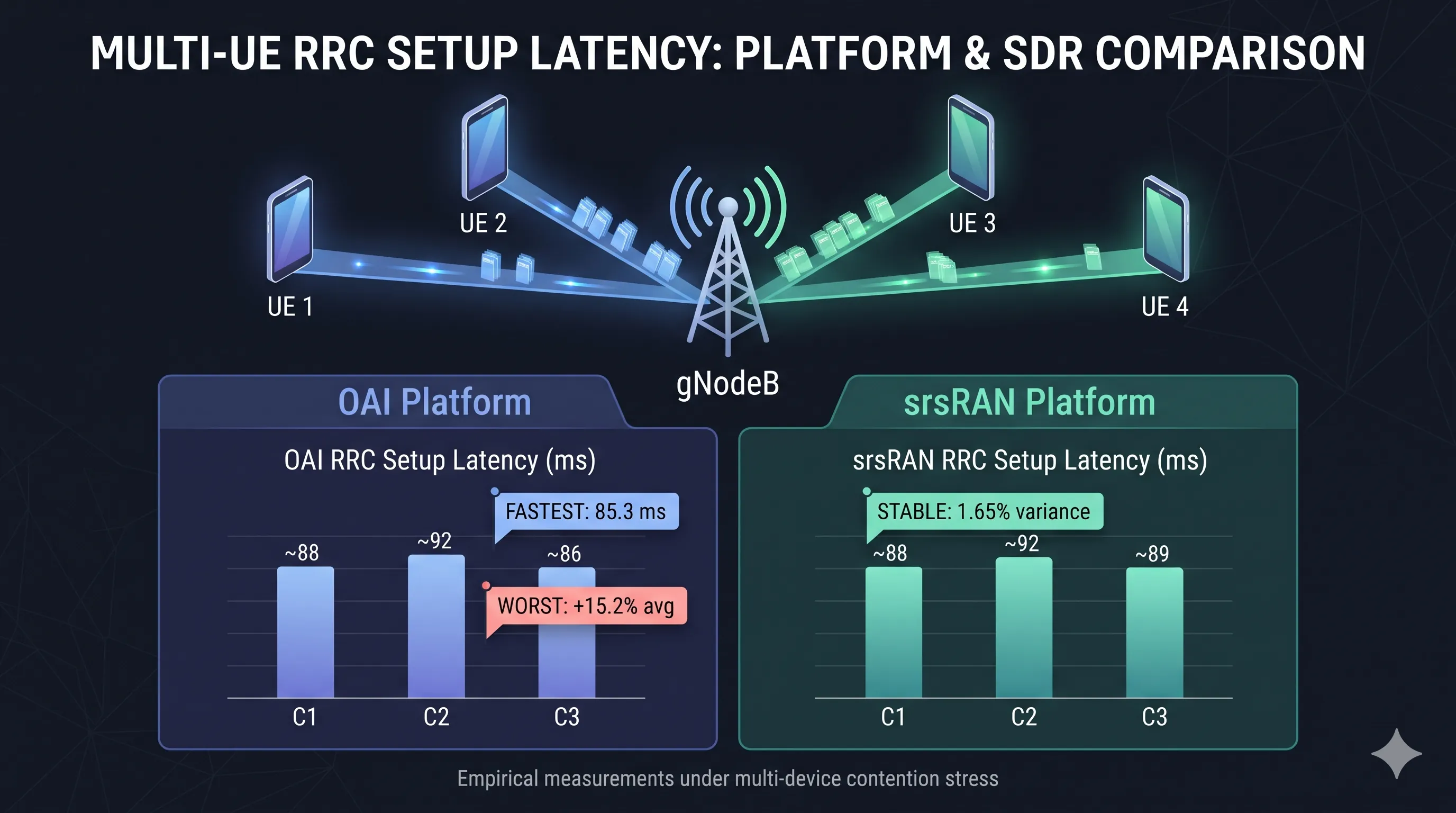
Across the tested deployment profiles, signaling performance exhibited distinct variations influenced by the underlying software stack, SDR hardware, and RF channel configurations.Across both srsRAN and OAI, Configuration C1 achieved an average RRC setup time of 87.7 ms.
Configuration C3 recorded an average RRC setup time of 88.5 ms, while Configuration C2 recorded an average RRC setup time of 91.9 ms.
Looking at isolated platform and frontend combinations, the fastest isolated RRC setup was achieved by OAI on the USRP B210 in C3 at 85.3 ms.
In comparison, srsRAN on the USRP N310 in C1 achieved an RRC setup time 1.65% higher than the best result.
The worst RRC setup performance was observed with OAI on the USRP N310 in C2, which averaged a 15.2% higher latency than the best result.
| Configuration / Test Metric | Hardware Frontend | Software Stack | Observed RRC Setup Latency / Variance |
|---|---|---|---|
| Configuration C1 (Overall Average) | USRP B210 / USRP N310 | OAI / srsRAN Combined | 87.7 ms |
| Configuration C3 (Overall Average) | USRP B210 / USRP N310 | OAI / srsRAN Combined | 88.5 ms |
| Configuration C2 (Overall Average) | USRP B210 / USRP N310 | OAI / srsRAN Combined | 91.9 ms |
| Configuration C3 (Fastest Isolated Setup) | USRP B210 | OAI | 85.3 ms |
| Configuration C1 (Relative Comparison) | USRP N310 | srsRAN | 1.65% higher latency than best result |
| Configuration C2 (Worst Performance) | USRP N310 | OAI | 15.2% higher latency than best result |
4. Data-Plane Throughput, Spectral Efficiency, and MIMO Scalability
Evaluating the transport capabilities of open-source 5G RAN platforms requires rigorous testing against physical layer constraints and channel bandwidths.To assess the performance of open-source 5G RAN platforms evaluated for performance, end-to-end data-plane benchmarks were conducted across downlink and uplink channels using iPerf3 with 100-second test runs and 1-second reporting intervals.
The evaluation spans three distinct radio configurations: C1 (20 MHz, 1 layer), C2 (40 MHz, 1 layer), and C3 (20 MHz, 2x2 MIMO) deployed on both USRP B210 and USRP N310 software-defined radios (SDRs).
Downlink Throughput and Spectral Efficiency Across Bandwidths
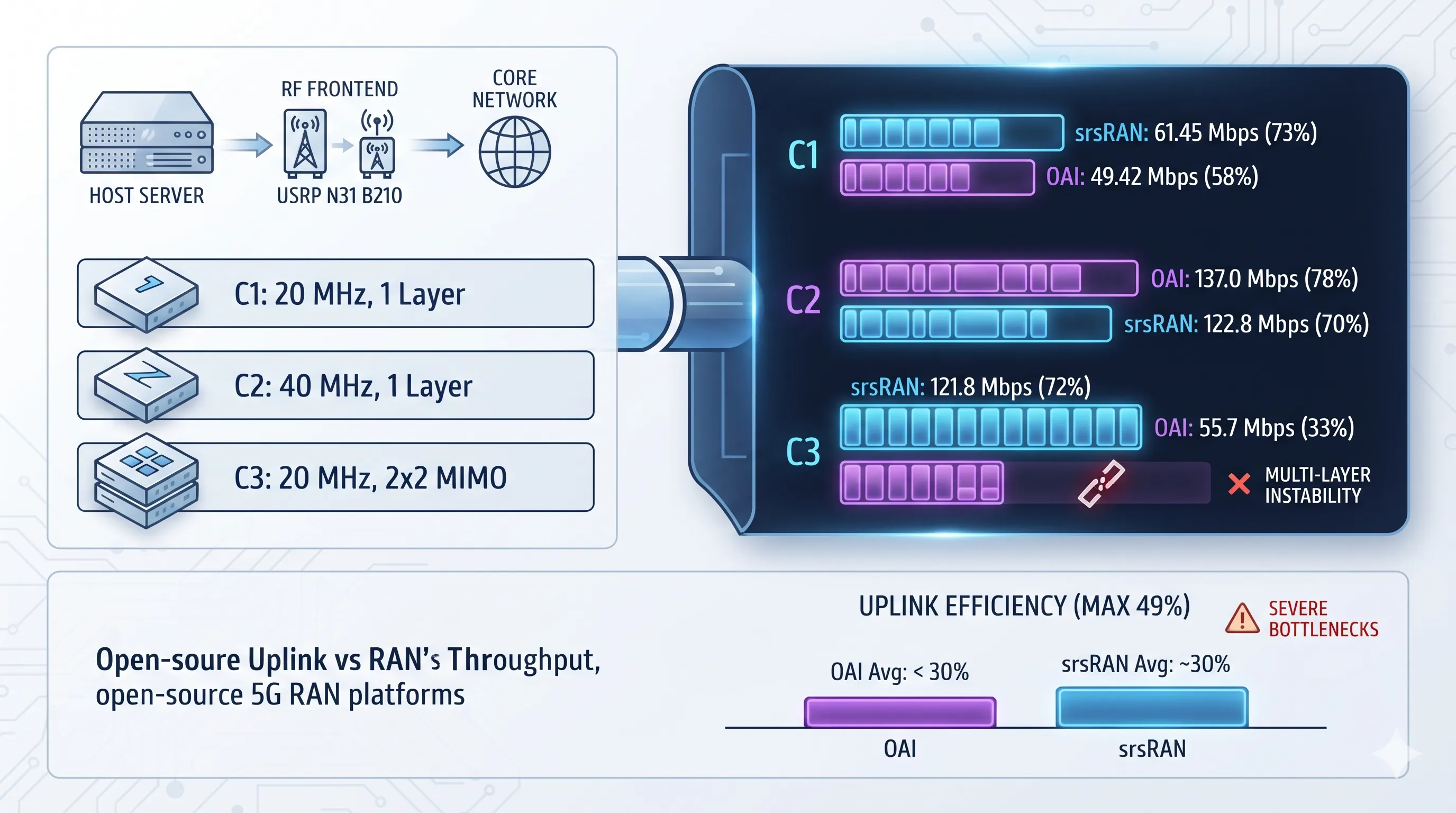
In the baseline C1 configuration (20 MHz, single-layer transmission), the theoretical downlink throughput limit was established at 84 Mbps.Under these conditions, srsRAN demonstrated consistent output across hardware targets, achieving 61.45 Mbps (73% efficiency, 3.1 bits/s/Hz) on the USRP B210 and 61.43 Mbps (73% efficiency, 3.1 bits/s/Hz) on the USRP N310.
OpenAirInterface (OAI) trailed behind in C1, recording 51.7 Mbps (61% efficiency, 2.59 bits/s/Hz) on the B210 and 49.42 Mbps (58% efficiency, 2.47 bits/s/Hz) on the N310.
Widening the carrier bandwidth to 40 MHz in C2 expanded theoretical downlink capacity to 175 Mbps.
In this wider channel configuration, OAI delivered its peak single-layer performance, reaching 137.0 Mbps (78% efficiency, 3.43 bits/s/Hz) on the N310, surpassing srsRAN's 122.8 Mbps (70% efficiency, 3.1 bits/s/Hz) on the same SDR.
However, when tested on the B210 in C2, srsRAN outperformed OAI by achieving 126.9 Mbps (72% efficiency, 3.2 bits/s/Hz), while OAI reached 118 Mbps (67% efficiency, 2.95 bits/s/Hz).
| Configuration | Theoretical DL (Mbps) | Platform | SDR Hardware | Achieved DL (Mbps) | Efficiency (%) | Spectral Efficiency (bits/s/Hz) |
|---|---|---|---|---|---|---|
| C1 (20 MHz, 1 Layer) |
84 Mbps | srsRAN | USRP B210 | 61.45 Mbps | 73% | 3.1 bits/s/Hz |
| srsRAN | USRP N310 | 61.43 Mbps | 73% | 3.1 bits/s/Hz | ||
| OAI | USRP B210 | 51.7 Mbps | 61% | 2.59 bits/s/Hz | ||
| OAI | USRP N310 | 49.42 Mbps | 58% | 2.47 bits/s/Hz | ||
| C2 (40 MHz, 1 Layer) |
175 Mbps | srsRAN | USRP B210 | 126.9 Mbps | 72% | 3.2 bits/s/Hz |
| srsRAN | USRP N310 | 122.8 Mbps | 70% | 3.1 bits/s/Hz | ||
| OAI | USRP B210 | 118.0 Mbps | 67% | 2.95 bits/s/Hz | ||
| OAI | USRP N310 | 137.0 Mbps | 78% | 3.43 bits/s/Hz | ||
| C3 (20 MHz, 2x2 MIMO) |
168 Mbps | srsRAN | USRP B210 | 121.8 Mbps | 72% | 6.1 bits/s/Hz |
| srsRAN | USRP N310 | 121.8 Mbps | 72% | 6.1 bits/s/Hz | ||
| OAI | USRP B210 | 55.7 Mbps | 33% | 2.79 bits/s/Hz | ||
| OAI | USRP N310 | 53.35 Mbps | 31% | 2.67 bits/s/Hz |
2x2 MIMO Scalability and Multi-Layer Instability
Configuration C3 introduced multi-layer spatial multiplexing via 2x2 MIMO over a 20 MHz carrier, elevating the theoretical downlink threshold to 168 Mbps.In this test, srsRAN demonstrated linear scalability across layers, posting identical throughputs of 121.8 Mbps (72% efficiency, 6.1 bits/s/Hz) on both the USRP B210 and USRP N310.
Conversely, OAI suffered sharp performance degradation in C3 due to instability issues during 2x2 MIMO operation.
Rather than scaling alongside the added spatial layer, OAI reached only 55.7 Mbps (33% efficiency, 2.79 bits/s/Hz) on the B210 and 53.35 Mbps (31% efficiency, 2.67 bits/s/Hz) on the N310.
These figures represented just 45.7% and 43.8% of srsRAN's throughput under equivalent conditions, highlighting significant software bottlenecks within OAI's multi-antenna processing pipeline.
Uplink Capacity Bottlenecks and SDR Stability Limits
While downlink throughput reached up to 78% of theoretical limits, uplink performance exposed severe capacity constraints across all evaluated scenarios.Across the board, measured uplink throughput reached only 5% to 49% of theoretical capacity.
Throughout the benchmark scenarios, srsRAN achieved approximately 30% of theoretical throughput in the uplink.
The platform recorded its highest uplink throughput in configuration C2 on the USRP N310, topping out at 25.95 Mbps (49% efficiency).
Hardware integration limits also impacted execution: srsRAN exhibited severe instability in C3 uplink on the USRP B210, which prevented the completion of the 100-second test run.
5. Application-Layer Workload Performance: VoD, Live Streaming, and Cloud Gaming
Evaluating open-source 5G RAN platforms requires moving beyond raw physical-layer telemetry to measure end-to-end user plane Quality of Experience (QoE) across real-world application profiles.In benchmark assessments of OpenAirInterface (OAI) and srsRAN, application-level workload performance demonstrates how lower-layer scheduling, baseband processing pipelines, and software-defined radio (SDR) interfaces directly govern real-time data delivery.
To assess real-world capabilities under multi-user stress, three distinct consumer traffic patterns were evaluated: buffered Video on Demand (VoD), throughput-intensive Live Streaming (LS), and ultra-low-latency interactive Cloud Gaming (CG).
Video on Demand Buffering and Chunk Fetch Latency
The Video on Demand test architecture evaluated chunk delivery behaviors across concurrent client requests.The test environment deployed a Flask-based Python web server transmitting the open-source animated film Big Buck Bunny to an Android Java client application running on physical user equipment (UE).
Under test conditions, four UEs simultaneously fetched 60 separate chunks of 1080p video encoded at 60 frames per second (FPS), with each chunk representing a 10-second media segment.
Under test configuration C1, chunk retrieval metrics highlighted clear differences in stack response times between the evaluated RAN platforms.
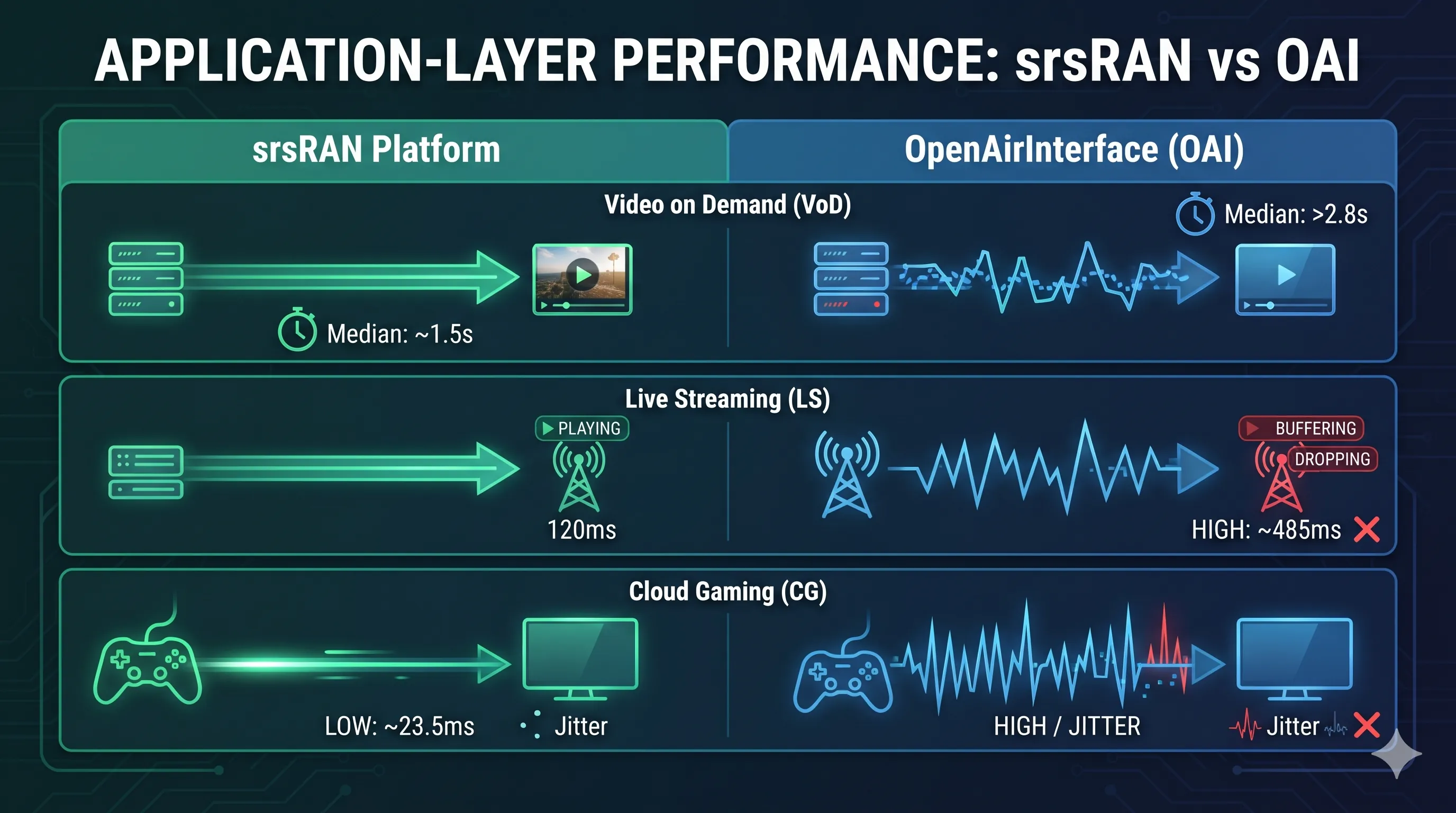
OAI required more than 2.8 seconds for 50% of the requested video chunks to load across the connected devices.
In contrast, srsRAN sustained a median loading time of approximately 1.5 seconds under identical concurrent demands.
This divergence in chunk fetch efficiency indicates differences in internal queue management and downlink scheduling responsiveness when handling bursty TCP traffic from multiple endpoints simultaneously.
Live Video Broadcast Latency and Stream Reliability
Live broadcasting demands sustained downlink throughput combined with predictable end-to-end packet delivery.The live streaming setup utilized OBS Studio pushing a continuous broadcast stream to an Owncast media server running on a Lenovo ThinkPad E14 G2 host.
The media stream was delivered at a steady 12 Mbps bitrate and 24 FPS to four concurrent UEs running a custom Kotlin-based Android application tasked with logging performance statistics to CSV files.
In configuration C1, OAI demonstrated significant performance deficits, recording 33.91% higher broadcast delivery latency than srsRAN.
Furthermore, OAI encountered operational instability during continuous live transmission, suffering connection loss when operating with the USRP B210 SDR.
Under this same C1 configuration utilizing the B210 SDR, srsRAN maintained an uninterrupted stream and delivered a mean latency of approximately 120 ms.
Performance disparities persisted when scaling hardware configurations.
In configuration C3 on the USRP N310 SDR, OAI averaged a broadcast latency of 485.09 ms across the concurrent UEs.
Conversely, srsRAN preserved tight latency boundaries across varying SDR hardware, posting an average latency of 113 ms on the B210 SDR and 119 ms on the N310 SDR.
Interactive Cloud Gaming Latency and Jitter Characteristics
Interactive cloud gaming represents the most demanding application profile, imposing strict constraints on end-to-end round-trip latency, frame delivery continuity, and jitter.The cloud gaming benchmark streamed the fast-paced multiplayer title Brawlhalla at 1080p resolution, 60 FPS, and a target bitrate of 20 Mbps simultaneously to three active UEs.
The hosting environment leveraged Sunshine paired with Steam Remote Play hosted on a Lenovo ThinkPad E14 G2, while the mobile clients decoded the stream via Moonlight.
Telemetry collection was conducted by capturing high-rate screen recordings of the client playback and parsing the visual on-screen latency counters using a Python pipeline integrated with the Gemini API.
Across all evaluated deployment configurations, srsRAN maintained reliable real-time performance, achieving an aggregate mean cloud gaming latency of 24.06 ms.
The optimal gaming result in the benchmark suite was recorded by srsRAN in configuration C2 paired with the USRP N310 SDR, attaining a mean latency of 23.54 ms alongside a tight mean jitter profile of 5.31 ms.
Conversely, OAI displayed severe instability under real-time gaming demands, characterized by elevated jitter profiles, multiple outlier latency spikes, and intermittent connection dropping when paired with the B210 SDR during real-time streaming tests.
A single exception occurred within configuration C2 on the B210 SDR, where OAI posted a mean latency that was 68.70% better than its worst-performing deployment configuration on the N310 SDR.
Remarkably, despite the presence of pronounced latency spikes and high jitter in certain OAI configurations, frame preservation remained robust, with client-measured frame drop rates remaining close to zero across both platforms.
| Application Workload | Benchmark Environment and Parameters | srsRAN Performance Metrics | OAI Performance Metrics |
|---|---|---|---|
| Video on Demand (VoD) | Flask Python server, Android Java client; 4 concurrent UEs; 60 chunks (1080p, 60 FPS, 10 s per chunk); Big Buck Bunny | Median chunk loading time: ~1.5 s (C1) | Median chunk loading time: >2.8 s for 50% of chunks (C1) |
| Live Streaming (LS) | OBS Studio to Owncast server on Lenovo ThinkPad E14 G2; 4 concurrent UEs (Kotlin CSV logger); 12 Mbps, 24 FPS | Mean latency: ~120 ms (C1 B210); 113 ms (B210) and 119 ms (N310 in C3) | 33.91% higher latency than srsRAN and dropped connection on B210 (C1); mean latency: 485.09 ms (C3 N310) |
| Cloud Gaming (CG) | Sunshine / Steam Remote Play on Lenovo ThinkPad E14 G2, Moonlight clients; 3 concurrent UEs; Brawlhalla at 1080p, 60 FPS, 20 Mbps; Python + Gemini API telemetry parsing | Mean latency across all configs: 24.06 ms; Best result: 23.54 ms mean latency and 5.31 ms mean jitter (C2 N310) | Unstable with high jitter and outlier spikes; C2 on B210 was 68.70% better than worst N310 config; frame drop rate remained close to zero |
6. Extended Ecosystem Roadmaps, Hardware Acceleration, and Simulation Stacks
Evaluating the performance of open-source 5G RAN platforms requires looking beyond basic single-cell deployments to explore their hardware acceleration offload pipelines, high-bandwidth configurations, and architectural interfaces.Both OpenAirInterface (OAI) and srsRAN provide extensible simulation stacks, modular interfaces, and specialized offload targets that expand the operational scope of open-source radio access networks across standard and accelerated hardware environments.
Layer-1 Hardware Offload and High-Bandwidth mmWave Support
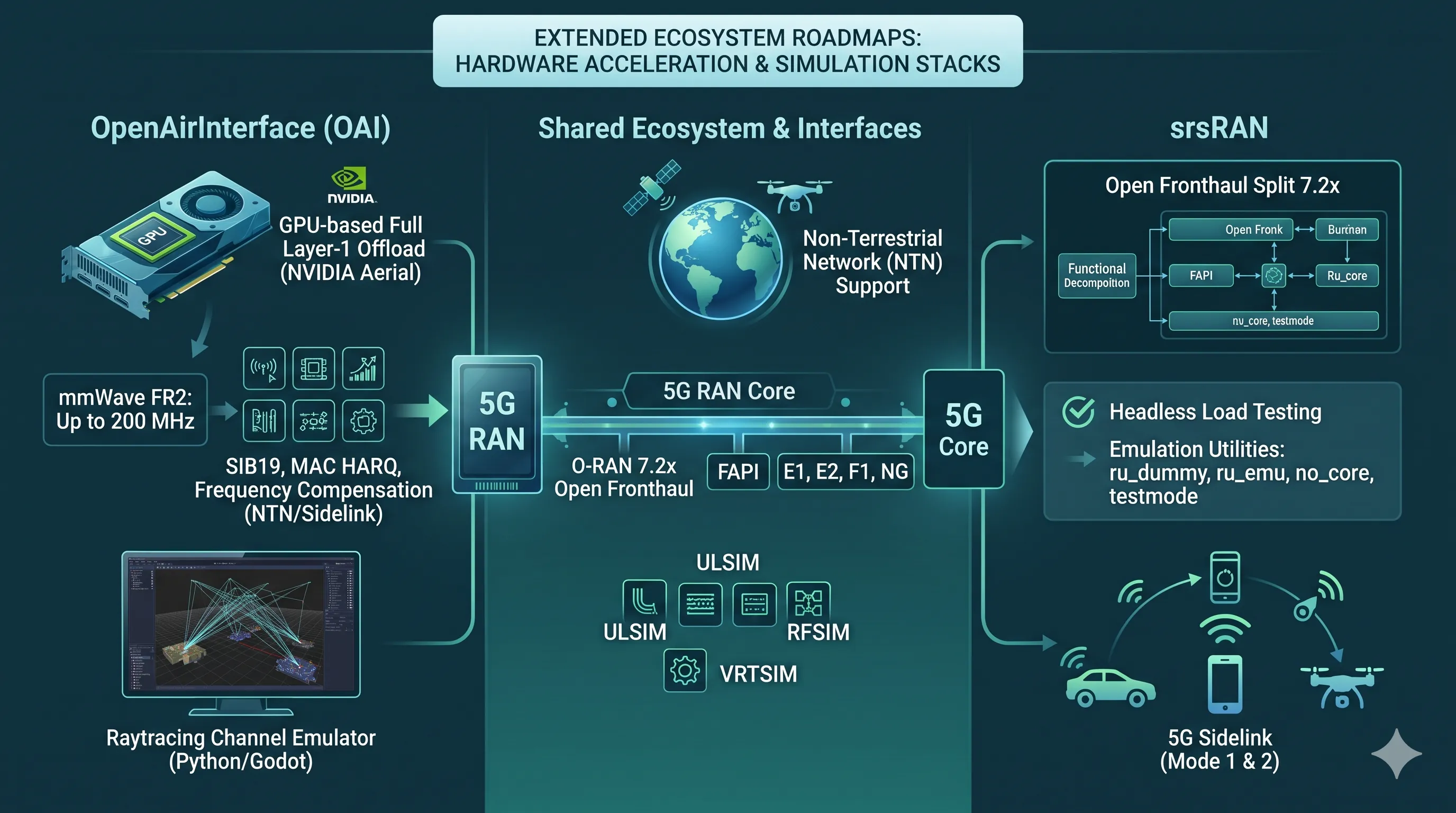
To achieve high data rates in empirical deployments, OAI supports peak throughput capabilities reaching up to 1.4 Gbps downlink and 400 Mbps uplink when serving commercial UEs.These throughput profiles are complemented by support for Frequency Range 2 (FR2) mmWave operations, handling channel bandwidths between 100 MHz and 200 MHz configured with 120 kHz subcarrier spacing numerology.
Sustaining these high-bandwidth configurations without exceeding CPU processing budgets demands dedicated physical-layer acceleration mechanisms.
OAI incorporates hardware acceleration offloading via NVIDIA Aerial to deliver GPU-based full Layer-1 offload pipelines.
Additionally, OAI supports baseband acceleration through the O-RAN Acceleration Abstraction Layer (O-RAN AAL), providing offload paths for specialized processing cards including the Intel ACC200 and the AMD Telco T2.
| Platform | Hardware Acceleration & Offload | Bandwidth / Throughput Capabilities | Simulation & Testing Tooling | Supported Architecture Interfaces |
|---|---|---|---|---|
| OpenAirInterface (OAI) | NVIDIA Aerial (GPU-based full Layer-1 offload), Intel ACC200, AMD Telco T2 via O-RAN AAL | Up to 1.4 Gbps DL / 400 Mbps UL; FR2 mmWave (100 MHz to 200 MHz at 120 kHz numerology) | Raytracing Channel Emulator (Python backend + Godot visualization), ULSIM, DLSIM, RFSIM, shared-memory VRTSIM | 5G Sidelink (Mode 1 and Mode 2 with dynamic MCS up to MCS 9) |
| srsRAN | Open Fronthaul (Split 7.2x) functional decomposition | Carrier bandwidth execution across standardized 3GPP splits | Headless load testing: ru_dummy, ru_emu, no_core, testmode | E1, E2, F1 (F1-C / F1-U), FAPI, NG (NG-C / NG-U), Open Fronthaul (Split 7.2x) |
Non-Terrestrial and Sidelink Communication Capabilities
Direct device-to-device communication within OAI is implemented through 5G Sidelink protocols.OAI 5G Sidelink supports both Mode 1, where radio resources are explicitly scheduled and managed by the gNB, and Mode 2, which relies on autonomous resource selection by the user equipment.
The sidelink implementation incorporates dynamic modulation and coding schemes that scale up to MCS 9.
For complex propagation scenarios without physical over-the-air links, OAI provides a modular Raytracing Channel Emulator (RCE) that pairs a Python backend with a Godot visualization engine.
Development and pre-silicon validation are further supported by a suite of software simulation modes that bypass physical RF equipment entirely.
These execution modes include unit-level physical layer simulators ULSIM and DLSIM, the network-level RF simulator RFSIM, and the shared-memory virtual radio test simulator VRTSIM.
Headless Testing Frameworks and Open Interface Integration
Standardized decomposition across multi-vendor disaggregated architectures is a core focus of modern open-source stacks.The srsRAN software architecture exposes fully specified interfaces across the control and user planes, supporting E1, E2, F1 (separated into F1-C and F1-U), FAPI, NG (covering NG-C and NG-U), and Open Fronthaul Split 7.2x.
To validate network stability and quantify software limits under synthetic traffic conditions, srsRAN integrates headless load-testing and emulation utilities.
These tools include ru_dummy and ru_emu for emulating radio units without RF front-ends, alongside no_core and testmode execution profiles for isolating gNB functional layers.
Wider ecosystem collaboration for open interfaces is anchored by the O-RAN Software Community, which was originally founded in 2018 in collaboration with the Linux Foundation and migrated under the Linux Foundation Networking umbrella during 2026.
Related Posts
How Nemotron 3.5 Parse Accelerates Vision-Language Document ExtractionDiscover how NVIDIA's Nemotron 3.5 Parse boosts inference speed and document extraction efficiency...
Microsoft Ignite 2026: Copilot Work OS and Agent 365 GovernanceDiscover how Microsoft Ignite 2026 redefines enterprise AI with Copilot as the Work OS, centralized...

Deploying NVIDIA Cosmos 3 Locally with Hugging Face DiffusersLearn how Hugging Face Diffusers enables local execution of the 16B NVIDIA Cosmos 3 model on...
Generative AI may have assisted with research or drafting for this article. Topic selection, fact-checking, final wording, and publication remain the responsibility of DragonStone74. AI use disclosure