
On-Device Deliberative Reasoning and Mobile Heterogeneous SoC Architecture
🚀 Key Takeaways
- Deliberative Reasoning at the Edge: Compact reasoning architectures bring multi-step, internal chain-of-thought deliberation directly to mobile devices without constant cloud reliance.
- Heterogeneous SoC Synergy: Modern mobile chipsets integrate specialized CPU, GPU, and NPU cores on a single die to handle intensive neural workloads within strict smartphone thermal budgets.
- Overcoming Memory Bandwidth Limits: Dedicated neural processing units leverage localized on-chip memory architectures to alleviate data transfer bottlenecks during token generation.
- Concurrent Multi-Model Partitioning: Complex edge assistants divide multi-modal pipelines across distinct hardware blocks to sustain concurrent perception and response workflows.
- Extreme Quantization Efficiency: Native hardware support for ultra-low integer precision dramatically compresses deep models while preserving operational accuracy on edge silicon.
The frontier of generative artificial intelligence has fundamentally transitioned from distant hyperscale data centers directly into the palm of the user's hand.
While initial mobile AI implementations operated merely as cloud-tethered frontends, compact reasoning architectures have unlocked native on-device deliberation, allowing mobile silicon to execute sophisticated problem-solving entirely offline.
Achieving this breakthrough requires a masterclass in hardware-software co-design within tight pocket-sized thermal envelopes.
Modern mobile system-on-chip platforms coordinate heterogeneous engines to prevent thermal throttling and battery exhaustion, ensuring that high-intensity neural execution remains sustainable over long interactive sessions.
As advanced algorithmic reasoning converges with specialized edge accelerators and low-precision compilation techniques, smartphones are transforming into autonomous personal thinking engines.
Exploring this hardware-algorithm symbiosis illustrates how next-generation mobile silicon sustains the future of private, instantaneous intelligence.

1. Architectural Shift: Test-Time Compute Scaling and Reasoning Chains in Compact Models
The transition toward running compact reasoning models directly on edge hardware represents a structural departure from conventional generation patterns.Rather than relying purely on pre-training scale to determine output quality, modern deliberative architectures shift resource allocation directly to the point of execution through test-time compute scaling.
Internal Deliberation: Chain-of-Thought and Thinking Tokens
Traditional compact language models rely on single-pass token generation, mapping inputs immediately to generated outputs in a linear sequence.In contrast, OpenAI's o-series reasoning model family employs test-time compute scaling paired with internal chain-of-thought processing prior to producing user-facing responses.
Under this paradigm, the system initiates a structured deliberation phase before any final output is emitted.
During this preliminary phase, the model constructs multi-step reasoning pathways internally to dissect complex problem structures.
However, this deliberative capability introduces unique computational characteristics.
Extended deliberation models require dedicated compute budgets allocated specifically for hidden thinking tokens, marking a significant divergence from traditional single-pass generation workflows.
Managing the overhead of these hidden tokens is an essential architectural consideration, as the compute budget expanded during the reasoning cycle directly dictates the processing burden sustained during inference.
Agentic Tool Integration in Deliberative Architectures
The deliberative capabilities of o-series models extend beyond standalone text synthesis by coupling extended reasoning directly with agentic tool environments.Rather than functioning in isolation, these architectures integrate internal chain-of-thought deliberation with interactive tools to validate and execute tasks.
Specifically, o-series models natively integrate extended reasoning with web browsing capabilities, Python code execution, and visual file analysis.
By embedding tools such as Python execution and visual file analysis directly into deliberative reasoning paths, the architecture can alternate between internal deduction, external verification, and multi-modal analytical processing before returning finalized responses.

2. Mobile Heterogeneous Computing: Workload Allocation Across Integrated SoCs
Running sophisticated generative reasoning models directly on a personal device requires rethinking how processing hardware is architected.To facilitate on-device inference within smartphones, modern silicon designs rely on heterogeneous computing to balance computational density against physical operating boundaries.
Unified Die Architecture vs Discrete Processing
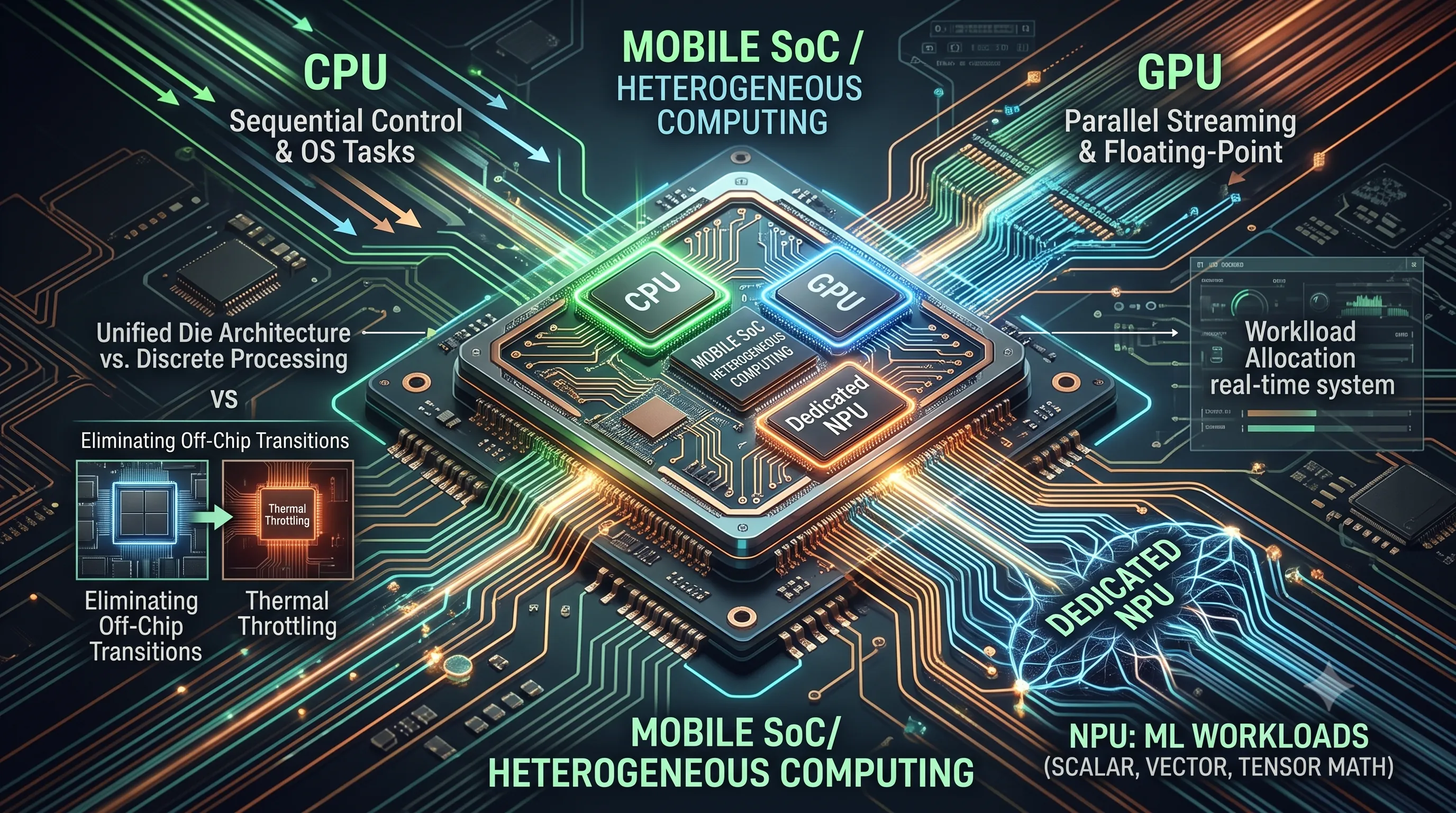
Mobile system-on-a-chip (SoC) designs integrate the central processing unit (CPU), graphics processing unit (GPU), and neural processing unit (NPU) onto a single silicon die rather than using discrete processors.Constrained smartphone form factors enforce strict thermal and battery limitations that prohibit power-heavy continuous execution.
Traditional discrete components require transferring data across external buses, which introduces significant electrical resistance and power draw.
Integrating compute engines onto a single die completely avoids peripheral pin transfers, conserving vital circuit board space inside the device.
Furthermore, eliminating these off-chip transitions reduces internal thermal strain, ensuring the device remains within safe operating temperatures during intensive processing cycles.
Role Specialization Across CPU, GPU, and Dedicated NPU
Sustained AI inference cannot simply be offloaded to standard compute blocks without destabilizing the device ecosystem.General-purpose CPUs and GPUs have primary platform duties that limit their available capacity for constant AI workloads.
To prevent system degradation, heterogeneous computing establishes a clear division of labor tailored to the mathematical nature of each task.
| Processor Core | Assigned Roles and Workload Types |
|---|---|
| CPU | Executes sequential control, operating system tasks, and low-compute workloads requiring immediate latency. |
| GPU | Handles parallel streaming data and high-precision floating-point formats. |
| Dedicated NPU | Executes core machine learning workloads composed of scalar, vector, and tensor math operations. |
The GPU contributes its architecture to parallel streaming computations and high-precision floating-point structures.
The dedicated NPU assumes responsibility for machine learning execution by isolating scalar, vector, and tensor math operations on optimized pathways.
This division offloads repetitive mathematical routines from general-purpose hardware, allowing the platform to run complex neural workloads within strict smartphone power envelopes.
3. Silicon Engine: Hexagon NPU Architecture and Hardware Memory Bandwidth
Executing dense reasoning models on mobile hardware demands specialized silicon architectures that balance extreme parallel computation with rigorous thermodynamic constraints.To understand how complex systems such as on-device reasoning pipelines operate within client hardware, evaluating the underlying system-on-chip (SoC) microarchitecture provides the physical baseline for all computational limits.
The Snapdragon 8 Gen 3 platform introduces fundamental re-architectures across its compute, memory, and auxiliary sensing engines to maximize computational density and energy efficiency.
| Subsystem / Metric | Hardware Specification & Performance Metric | Architectural Advantage |
|---|---|---|
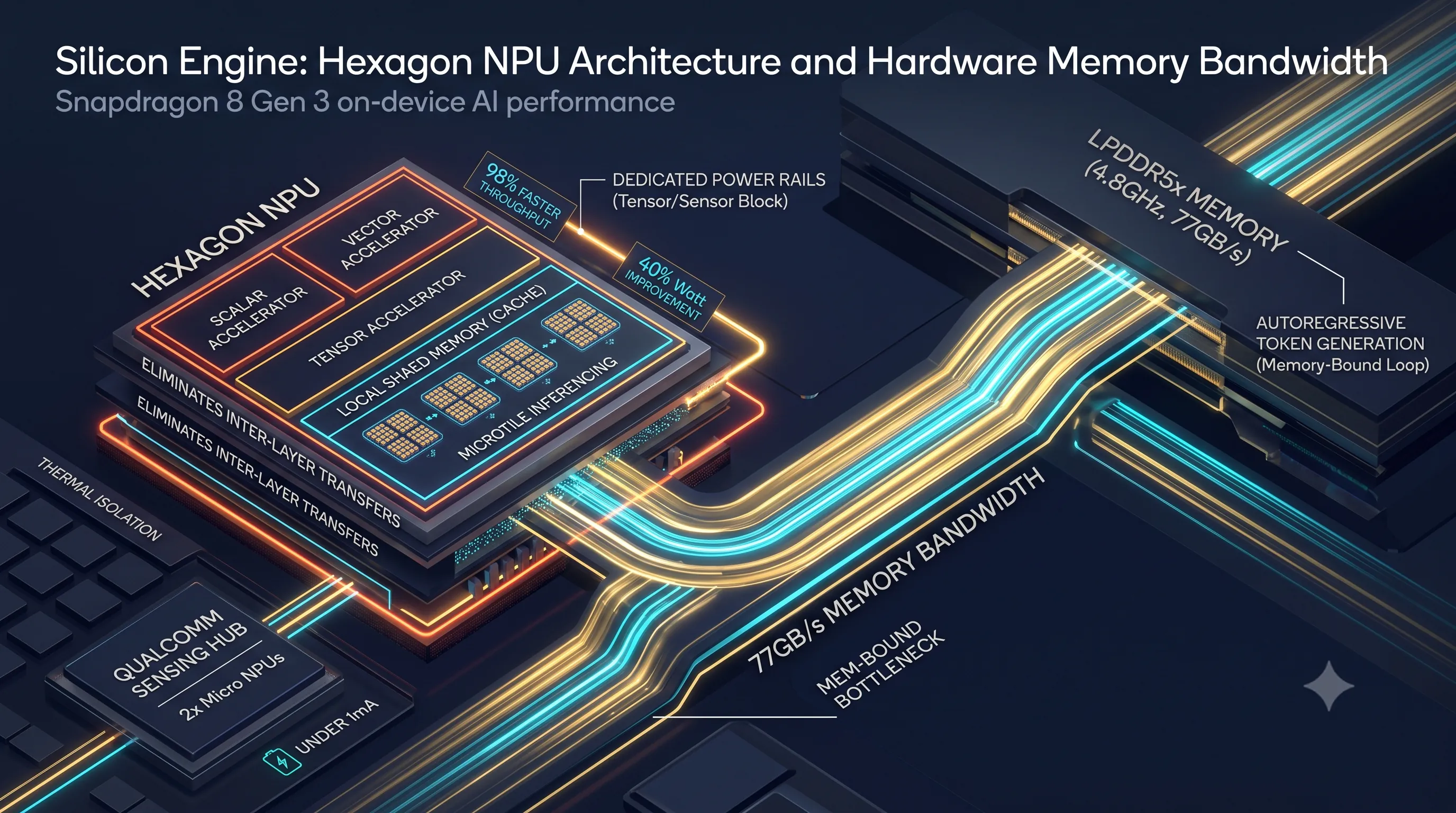
| Hexagon NPU Throughput | 98% faster performance than the previous generation | Accelerates complex neural layer transformations and execution loops. |
| Hexagon NPU Efficiency | 40% improvement in performance-per-watt | Enables sustained AI inferencing without exceeding device thermal thresholds. |
| Adreno GPU Efficiency | 25% improved power efficiency | Provides efficient offloading for heterogeneous graphics and parallel compute tasks. |
| Memory Subsystem | LPDDR5x operating at 4.8GHz, delivering 77GB/s bandwidth | Feeds high-bandwidth parameters directly to compute engines during generation cycles. |
| Qualcomm Sensing Hub | Two micro NPUs, 30% increase in memory, operates under 1mA | Maintains low-power continuous background contextual awareness on an isolated rail. |
| MLPerf Mobile V3.1 MobileBert | +17% vs Competitor A, +321% vs Competitor B | Demonstrates significant edge execution gains in standardized transformer workloads. |
Hexagon NPU Microtile Execution and Power Rail Engineering
The Hexagon NPU integrates dedicated scalar, vector, and tensor accelerators anchored by dedicated local shared memory.To overcome the physical penalties of shuttling weights between primary memory structures, the hardware leverages microtile inferencing.
This technique divides complex neural networks into discrete microtiles that execute entirely within local cache partitions.
By keeping execution pinned to on-die shared storage, microtile inferencing completely eliminates inter-layer memory transfers across 10 or more layers of the neural network graph.
Minimizing external bus transactions preserves energy and directly improves throughput during iterative transformer model operations.
This execution pipeline is reinforced by hardware-level power distribution design.
The platform incorporates dedicated power rails that adapt power delivery specifically for tensor and always-on sensor hardware blocks.
By isolating these voltage planes, the system modulates energy dynamically based on instantaneous execution demands without raising the baseline power draw of idling compute cores.
Complementing the primary accelerator, the Qualcomm Sensing Hub operates as an independent low-power domain.
Equipped with two micro NPUs and a 30% increase in memory, the Sensing Hub draws less than 1 milliamp (mA) of current.
Its isolated power rail allows background contextual operations to run continuously even while the primary SoC subsystem is powered down entirely.
LPDDR5x Bandwidth Limits in Token Generation Bottlenecks
While the Hexagon NPU provides massive parallel compute density across its vector and tensor arrays, practical throughput during autoregressive generation faces distinct physical limitations.Large language model token generation is primarily memory-bound rather than compute-bound, making memory bandwidth the definitive operational bottleneck.
During sequential autoregressive decoding, every newly generated token requires the platform to read the complete set of model weights and active attention states from memory.
Because each parameter must traverse the memory bus for every individual token step, compute units spend significant idle cycles waiting for data arrival.
The Snapdragon 8 Gen 3 addresses this physical constraint through its memory subsystem, supporting LPDDR5x memory operating at 4.8GHz to deliver up to 77GB/s of memory bandwidth.
While this 77GB/s bus represents a substantial pipeline for mobile architecture, the memory-bound nature of iterative token generation establishes a strict boundary on peak tokens per second.
Balancing memory transfer rates against local shared microtile execution remains the core engineering tradeoff governing sustained on-device reasoning throughput.
4. End-to-End Pipeline Partitioning for Concurrent Generative AI Workloads
The transition of advanced reasoning capabilities into mobile devices directly relies on efficient heterogeneous scheduling across system-on-chip silicon.To bring complex generative interactions onto personal hardware, mobile architectures must balance continuous multimodal streaming against tight power envelopes.
This balance is achieved by deconstructing monolithic models into discrete sub-tasks distributed across specialized processing units.
Throughput Metrics Across On-Demand and Sustained Tasks
Mobile generative workloads naturally segment into three distinct execution profiles: on-demand tasks, sustained tasks, and pervasive always-on background processes.Managing these diverse profiles requires targeting specific engines rather than relying on a single general-purpose compute block.
Runtime benchmarks on the Snapdragon 8 Gen 3 demonstrate how engine specialization shapes execution efficiency.
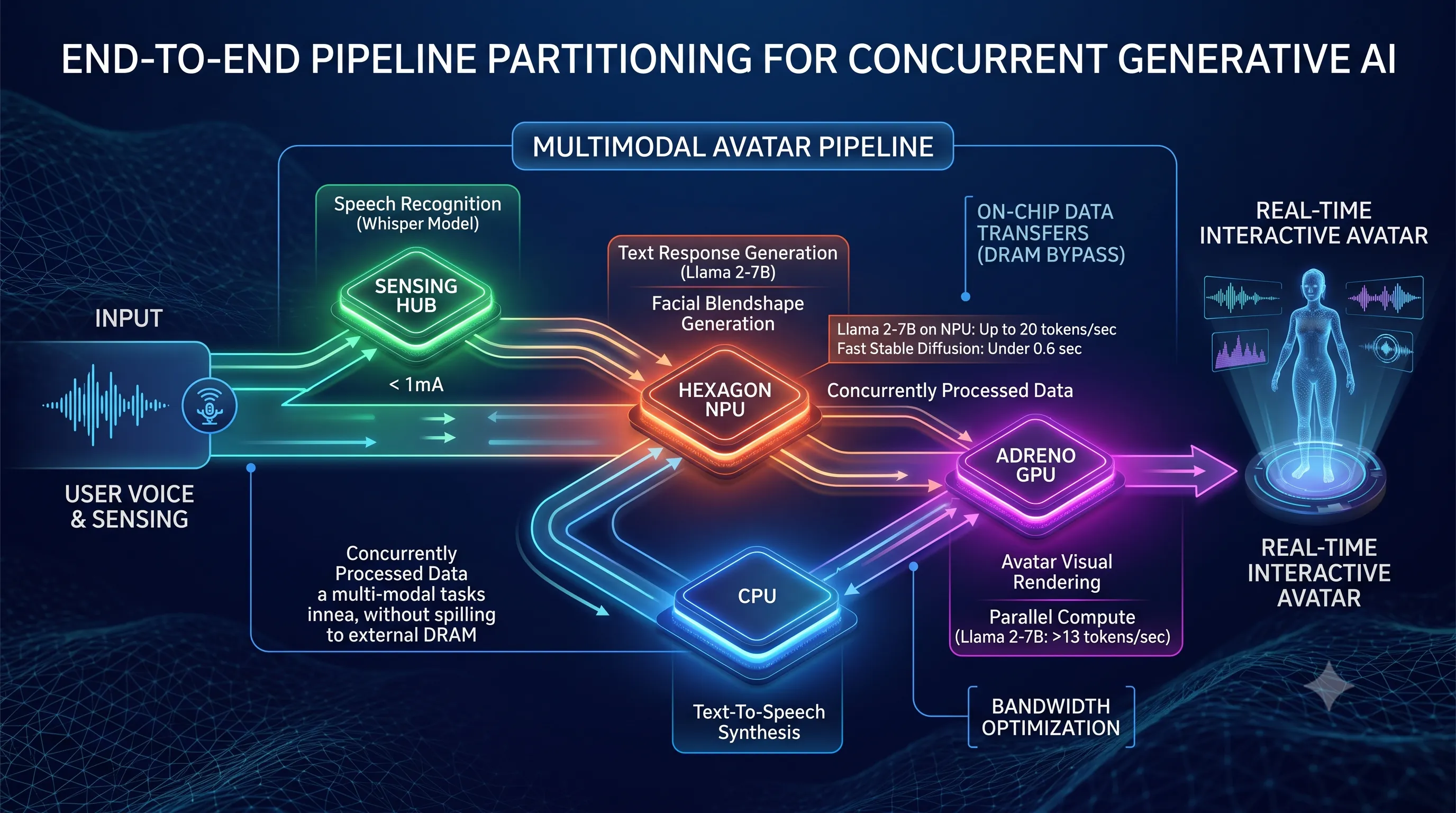
For language models, Llama 2-7B operates at up to 20 tokens per second on the Snapdragon 8 Gen 3 NPU, compared to more than 13 tokens per second when routed to the Adreno GPU.
For image generation, Fast Stable Diffusion produces a 512x512 image in under 0.6 seconds on the Snapdragon 8 Gen 3 platform.
| Workload / Model | Compute Target | Performance Metric |
|---|---|---|
| Llama 2-7B (Text Generation) | Hexagon NPU | Up to 20 tokens per second |
| Llama 2-7B (Text Generation) | Adreno GPU | More than 13 tokens per second |
| Fast Stable Diffusion (512x512 Image) | Snapdragon 8 Gen 3 SoC | Under 0.6 seconds |
Multimodal Avatar Pipeline: Sensing Hub, NPU, CPU, and GPU Mapping
Real-time interaction requires complex assistant pipelines that partition multiple sub-models across diverse SoC cores to enable concurrent execution.Qualcomm's interactive smartphone avatar demonstration illustrates this end-to-end workload division across dedicated compute blocks.
At the entry point of the pipeline, OpenAI's Whisper model executed on the low-power Sensing Hub to handle automated speech recognition.
Once speech was transcribed, the core text response generation model ran directly on the Hexagon NPU.
Downstream text-to-speech audio conversion executed on the CPU to synthesize the auditory reply.
To drive the visual component in lockstep with audio, facial expression blendshape generation ran on the NPU, while final avatar visual rendering executed on the Adreno GPU.
Maintaining this level of simultaneous execution creates severe bandwidth pressures.
Running multi-modal pipelines concurrently demands high on-chip shared data transfer without spilling to external memory, ensuring sub-models exchange intermediate representations without saturating DRAM.
5. Quantization and Runtime Optimization: Maximizing Mobile Tensor Efficiency
Achieving the promise of on-device reasoning and bringing high-parameter intelligence into consumer smartphones—the paradigm heralded by architectures like OpenAI o3-nano—requires aggressive compression and silicon-level runtime efficiency.Deploying advanced neural networks directly on edge silicon requires purpose-built numeric transformations and specialized compiler pipelines to fit within the thermal and memory constraints of a handheld form factor.
Native INT4 Acceleration and Transformer Memory Pressure
Memory bandwidth bottlenecks represent the primary obstacle when running generative networks on mobile application processors.During sequential token generation, transformer-based models benefit substantially from INT4 and INT8 quantization by reducing memory bandwidth pressure across the compute subsystem.
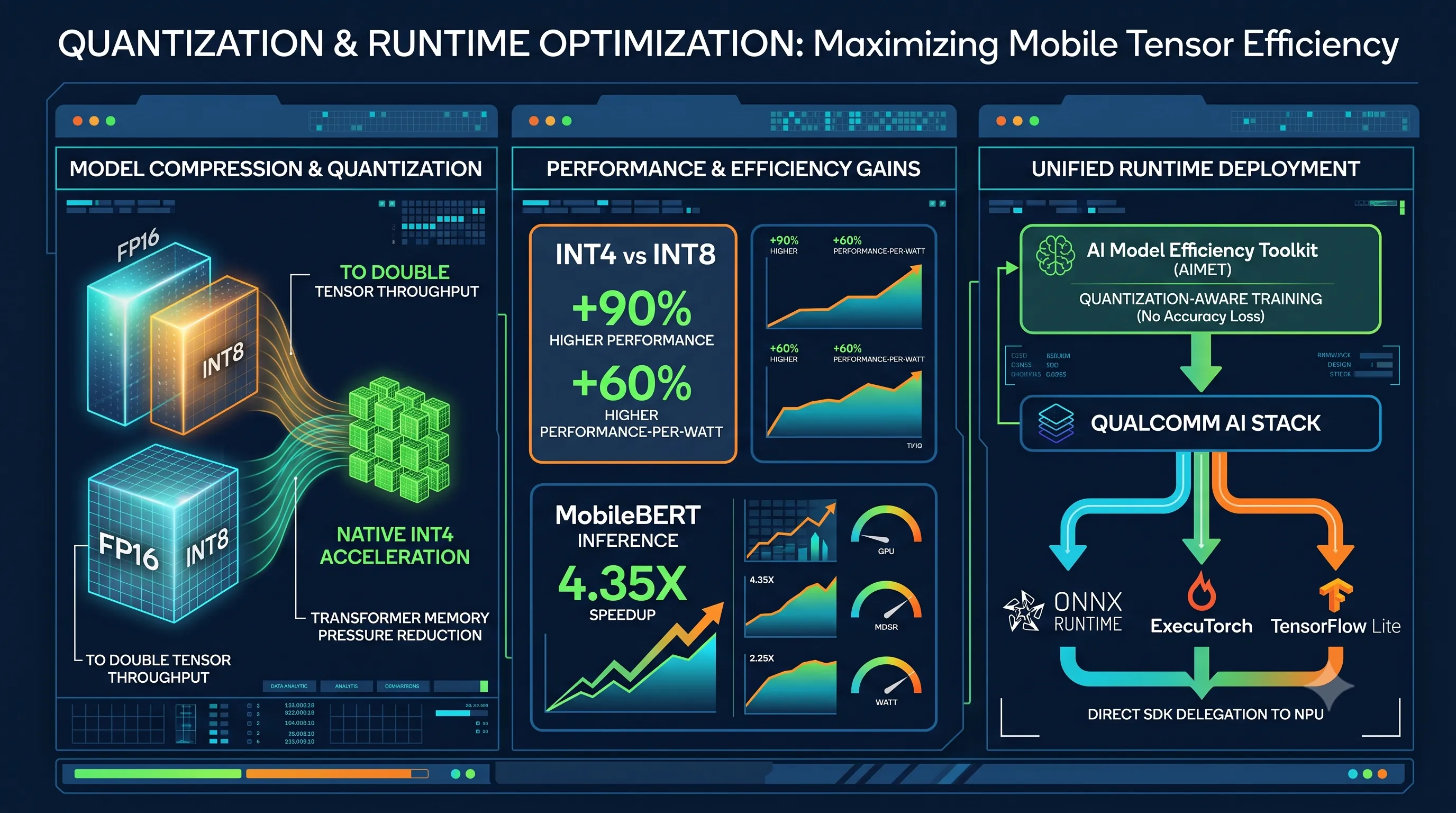
To bypass the memory ceiling, the Hexagon NPU includes native hardware acceleration for 4-bit integer (INT4) precision weights and activations.
This native INT4 hardware execution doubles tensor throughput compared to higher precisions.
When measured directly against standard 8-bit integer formats, INT4 execution delivers up to 90% higher performance compared to INT8.
Furthermore, moving from INT8 to native INT4 delivers up to 60% higher performance-per-watt, conserving vital battery capacity while maintaining low latency during intensive inference workloads.
These hardware-level transformer enhancements extend significant speedups to language models; for example, MobileBERT inference showed performance increases up to 4.35X with transformer acceleration enhancements.
| Optimization & Evaluation Metric | Baseline / Target Precision | Reported Hardware Gain |
|---|---|---|
| Tensor Throughput | INT4 vs. Higher Precisions | Doubles tensor throughput |
| Inference Performance | INT4 vs. INT8 | Up to 90% higher performance |
| Energy Efficiency | INT4 vs. INT8 | Up to 60% higher performance-per-watt |
| MobileBERT Inference | Transformer acceleration enhancements | Performance increases up to 4.35X |
Unified Runtime Deployment via Qualcomm AI Stack and AIMET
Transitioning compressed weights to edge hardware introduces accuracy risks if numeric scaling is applied naively.Unoptimized model compression can cause accuracy loss if quantization-aware techniques are not applied during the optimization cycle.
To preserve mathematical fidelity, the AI Model Efficiency Toolkit (AIMET) provides dedicated quantization tools to compress weights with minimal loss of accuracy.
Once quantized and structured through AIMET, models deploy directly into production software environments through standardized edge execution paths.
The Qualcomm AI Stack unifies runtimes including ONNX Runtime, ExecuTorch, and TensorFlow Lite with direct SDK delegation.
This unified runtime architecture ensures developer frameworks pass graph execution directly to the underlying NPU accelerators, realizing targeted INT4 and INT8 performance gains without custom, fragile target-specific codebases.
Related Posts

GPT-6 Astra: Cybersecurity Risks and Recurrent Depth Architecture AnalysisAn analysis of GPT-6 Astra's critical cybersecurity classification, its recurrent depth...

How Frontier AI Models Are Rewriting Theoretical PhysicsExplore how frontier AI models and autonomous agents are transforming theoretical physics,...
OpenAI GPT-6.2 Billing Fix: Astra Hits Limits 40% FasterOpenAI fixes a GPT-6.2 launch billing bug, causing Astra limits to hit 40% faster and Sol 25%...
Generative AI may have assisted with research or drafting for this article. Topic selection, fact-checking, final wording, and publication remain the responsibility of DragonStone74. AI use disclosure