
NVIDIA cuDSS 1.0 Brings GPU Acceleration to Engineering Sparse Solvers
🚀 Key Takeaways
- Substantial Multi-Phase Acceleration: Delivers dramatic throughput gains across symbolic analysis, numerical factorization, and triangular solve phases compared to traditional CPU-based sparse solvers.
- Enhanced Indefinite Stability: Integrates default Bunch-Kaufman pivoting and symmetry-preserving matching to solve ill-conditioned symmetric indefinite systems without numerical breakdown.
- Hybrid Memory Orchestration: Solves massive linear systems on a single GPU by intelligently offloading inactive factor data to host system DRAM.
- Extensible Pinned Memory Handling: Introduces user-configurable host memory handlers to eliminate memory registration latency and maximize host-to-device transfer bandwidth.
- Flexible Hybrid Execution: Combines optimized GPU symbolic routines with an optional host-execution mode to mitigate peak device memory consumption during the analysis phase.
- Refined Production API: Standardizes on native CUDA data types while introducing 64-bit row offset indexing to simplify integration within modern engineering toolchains.
Direct sparse linear solvers represent the computational core of engineering simulation, driving high-fidelity analysis in semiconductor TCAD, structural mechanics, fluid dynamics, and electromagnetic modeling. For decades, numerical analysts have grappled with the severe memory footprint and sequential bottlenecks of direct factorization algorithms, forcing engineering pipelines to rely on expensive compute clusters or compromise on mesh resolution.
The arrival of NVIDIA cuDSS 1.0 marks a fundamental milestone in computational engineering, bringing full-lifecycle GPU acceleration to complex sparse matrix equations. Rather than merely porting dense sub-operations to accelerator cores, cuDSS 1.0 re-architects core sparse factorization routines, indefinite pivot selection, and memory movement strategies to address the structural bottlenecks inherent to sparse linear systems.
By coupling intelligent CPU-GPU memory orchestration with rock-solid numerical stability algorithms, cuDSS 1.0 allows engineers to tackle multi-million-row linear problems directly on single-node GPU workstations and servers. This article explores the performance breakthroughs, memory tiering architectures, and modernized interfaces that make cuDSS 1.0 an essential foundation for next-generation scientific computing.

1. Accelerating Direct Sparse Solver Phases Across Multi-Physics Engineering Workflows
Understanding how cuDSS 1.0 accelerates sparse solvers in engineering requires dissecting the distinct computational stages that define direct linear equation solving.cuDSS 1.0 delivers production-ready GPU-accelerated sparse linear system solving for engineering and scientific simulations, targeting the structural bottlenecks inherent in traditional CPU-bound workflows.
Because direct solvers execute distinct computational kernels across their lifecycle, evaluating acceleration requires measuring each stage independently.
Three-Phase Direct Solver Acceleration Over Intel MKL
cuDSS accelerates three core linear direct solver phases: analysis, numerical factorization, and solve.Benchmarking against Intel MKL version 2026.1.0 demonstrates substantial performance scaling across all three stages on modern computing architectures.
For the analysis phase, which encompasses matrix reordering and symbolic factorization, cuDSS achieves a geometric-mean speedup of 2.5x over Intel MKL.
During numerical factorization, where matrix factor computation dominates runtime, cuDSS achieves a geometric-mean speedup of 5.9x over Intel MKL.
The most pronounced acceleration occurs in the triangular solve phase, where cuDSS delivers a geometric-mean speedup reaching 151x over Intel MKL.
These benchmark results reflect hardware configurations utilizing an NVIDIA B200 GPU equipped with 192 GB HBM3e alongside an Intel Xeon Platinum 8570 host CPU for cuDSS, compared against Intel MKL executed on an Intel Xeon 6776P processor.
A critical consideration for real-world engineering pipelines is that overall end-to-end speedup depends on the relative contribution of each phase within a given application.
| Solver Phase / Benchmark Metric | Geometric-Mean Speedup (cuDSS 1.0 vs. Intel MKL 2026.1.0) | Hardware and Test Specifications |
|---|---|---|
| Analysis Phase (Reordering & Symbolic Factorization) | 2.5x | cuDSS: NVIDIA B200 (192 GB HBM3e) + Intel Xeon Platinum 8570 Intel MKL: Intel Xeon 6776P |
| Numerical Factorization Phase | 5.9x | cuDSS: NVIDIA B200 (192 GB HBM3e) + Intel Xeon Platinum 8570 Intel MKL: Intel Xeon 6776P |
| Triangular Solve Phase | 151x | cuDSS: NVIDIA B200 (192 GB HBM3e) + Intel Xeon Platinum 8570 Intel MKL: Intel Xeon 6776P |
| Evaluation Matrix Scope | N/A (Comprehensive Benchmark) | 254 SuiteSparse matrices across engineering workflows |
Performance Evaluation Across SuiteSparse Engineering Domains
The computational viability of cuDSS 1.0 has been evaluated across a benchmark set of 254 SuiteSparse matrices spanning semiconductor design, manufacturing, and computer-aided engineering workflows.Direct linear solvers encounter vastly different sparsity patterns and condition numbers depending on the underlying physical equations.
The evaluated matrix workflows include circuit simulation, technology computer-aided design (TCAD), thermal simulation, structural analysis, electromagnetic simulation, and fluid dynamics.
In transient simulation regimes—such as semiconductor TCAD and circuit simulation—matrices frequently undergo repeated factorization and triangular solves with invariant sparsity patterns.
Conversely, structural and fluid dynamics models often stress numerical factorization throughput due to high matrix density and large degrees of freedom.
Because the overall end-to-end speedup depends on the relative contribution of each phase within a given application, workflows dominated by repeated solves gain disproportionate performance advantages from the 151x triangular solve speedup.
By accelerating analysis, numerical factorization, and triangular solve simultaneously across all 254 test cases, cuDSS 1.0 provides multi-physics simulations with consistent, production-grade acceleration over modern CPU implementations.

2. Enhancing Numerical Accuracy for Symmetric and Indefinite Systems
Accelerating direct sparse solvers across computational engineering workloads requires solving large linear systems without sacrificing numerical stability.In engineering simulations such as structural mechanics, fluid dynamics, and constrained optimization, linear formulations frequently produce symmetric indefinite and saddle-point systems.
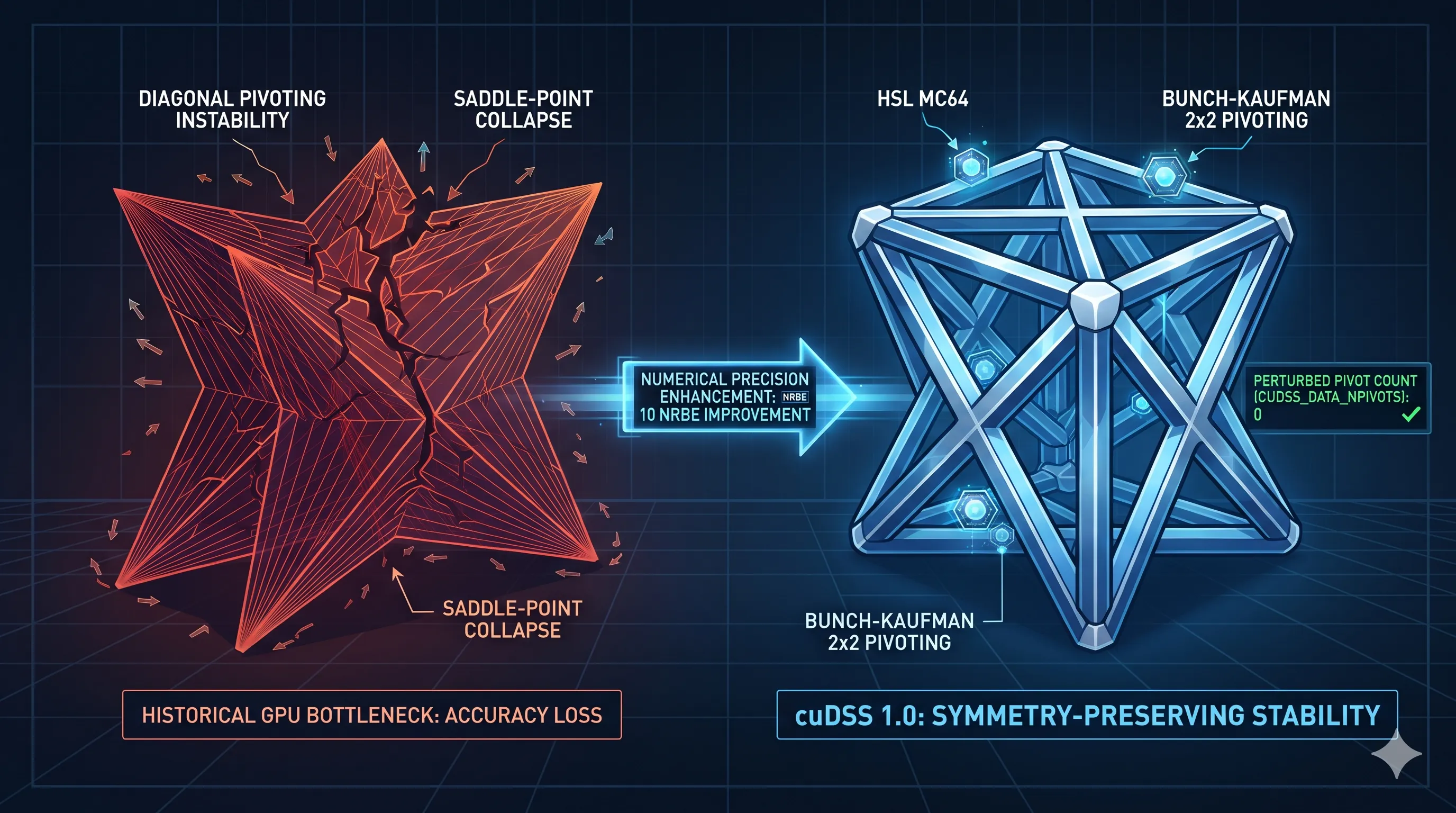
Historically, solving these systems on GPU architectures posed significant stability hurdles because diagonal pivoting combined with the perturbation of small pivots led to substantial accuracy loss on saddle-point matrices.
cuDSS 1.0 addresses this foundational bottleneck directly by incorporating symmetry-preserving preprocessing and robust indefinite pivoting algorithms designed to guarantee solution fidelity while accelerating runtime execution.
Symmetry-Preserving Matching and Scaling with HSL MC64
To maximize numerical precision from the outset, cuDSS 1.0 enables symmetry-preserving matching and scaling by default for symmetric systems using HSL MC64.Matching and scaling are also enabled by default for nonsymmetric matrices in cuDSS 1.0.
In symmetric workflows, the algorithm splits matching cycles into candidate 1x1 and 2x2 groups that reordering keeps adjacent to preserve fill-reducing order.
This technique ensures that the matrix profile remains balanced for factorization without disrupting the underlying structural symmetry.
Engineers should account for the trade-offs associated with these preprocessing steps.
Symmetry-preserving matching can add overhead during analysis and subsequent stages if it introduces additional fill-in.
Furthermore, matching with scaling can result in a loss of accuracy in a small number of cases.
To accommodate scenarios where default matching is suboptimal, cuDSS 1.0 provides explicit configuration controls.
Force nonsymmetric matching can be re-enabled via
CUDSS_CONFIG_FORCE_NONSYMMETRIC_MATCHING, or matching can be disabled entirely via CUDSS_MATCHING_ALG_NONE.Bunch-Kaufman 2x2 Pivoting and Backward Error Reduction
Beyond scaling and matching, direct factorization stability hinges on the pivoting strategy.Bunch-Kaufman pivoting (
CUDSS_PIVOT_BUNCH_KAUFMAN) is enabled by default for symmetric indefinite systems in cuDSS 1.0.Bunch-Kaufman pivoting allows 2x2 pivots to maintain stability while preserving matrix symmetry, eliminating the precision degradation seen in pure diagonal perturbation.
Through the configuration flag
CUDSS_PIVOT_AUTO, the solver automatically selects Bunch-Kaufman for supported symmetric and Hermitian indefinite matrices, falling back to diagonal pivoting when necessary.The algorithmic impact of these combined enhancements is measurable.
Across evaluated SuiteSparse matrices, normwise relative backward error (NRBE) improved by up to 10 orders of magnitude.
For diagnostic monitoring, developers can track factorization stability directly within their application pipelines.
The perturbed pivot count can be queried after factorization via
CUDSS_DATA_NPIVOTS, giving engineers visibility into numerical conditioning without manual inspection.| cuDSS 1.0 Flag / Diagnostic Identifier | Category | Algorithmic Functionality and Role |
|---|---|---|
| CUDSS_PIVOT_BUNCH_KAUFMAN | Pivoting Strategy | Enabled by default for symmetric indefinite systems; permits 2x2 pivots to maintain numerical stability while preserving matrix symmetry. |
| CUDSS_PIVOT_AUTO | Pivoting Strategy | Automatically selects Bunch-Kaufman for supported symmetric and Hermitian indefinite matrices, falling back to diagonal pivoting. |
| CUDSS_CONFIG_FORCE_NONSYMMETRIC_MATCHING | Matching Configuration | Re-enables force nonsymmetric matching when symmetry-preserving matching is not desired. |
| CUDSS_MATCHING_ALG_NONE | Matching Configuration | Disables the matching algorithm entirely when scaling or matching overhead must be bypassed. |
| CUDSS_DATA_NPIVOTS | Diagnostic Query | Enables querying the perturbed pivot count after factorization to evaluate numerical behavior. |
3. Scaling Massive Linear Systems via Hybrid Memory Orchestration
In large-scale computational engineering, direct sparse solvers frequently encounter a hard computational ceiling governed by GPU high-bandwidth memory (HBM) capacity.As part of understanding how cuDSS 1.0 accelerates sparse solvers in engineering workflows, the library's hybrid memory mode provides an architectural breakthrough that decouples matrix problem scale from raw physical on-chip GPU memory limits.
GPU HBM and CPU DRAM Memory Tiering
Direct sparse factorization generates substantial fill-in elements, making the storage of intermediate and completed factor data exceptionally memory intensive.To overcome device memory exhaustion, cuDSS 1.0 implements an intelligent memory orchestration architecture that splits allocations across the physical memory hierarchy.
Under this model, data that is not immediately needed is offloaded to CPU system DRAM, while compute-intensive numerical factorization and triangular solve kernels remain scheduled directly on ultra-fast GPU HBM.
In high-performance engineering systems, modern server nodes paired with 512 GB to 2 TB of DRAM can serve as an active extension of the GPU device capacity.
This hybrid tiering reduces minimum device memory requirements by an average of approximately 30% across large VLSI test cases.
Consequently, massive engineering problems that previously mandated complex multi-GPU domain partitioning can now execute seamlessly as a single linear system on individual GPUs, including NVIDIA H100, B200, or Vera Rubin accelerators.
Memory Bound Configuration and Estimation Metrics
Deploying cuDSS 1.0 in memory-constrained environments requires exact profiling and deterministic control over device memory bounds.The solver provides programmatic interfaces to query memory envelopes before execution and configure device usage within safe hardware operating margins.
| Parameter / API Identifier | Functional Type | Operational Description and Breakdown |
|---|---|---|
| CUDSS_DATA_HYBRID_DEVICE_MEMORY_MIN | Memory Query (via cudssDataGet()) |
Returns the absolute minimum device memory required to execute the solver in hybrid mode. Importantly, this value reflects the total device memory needed by cuDSS across all computational buffers, not exclusively matrix factors. |
| CUDSS_DATA_MEMORY_ESTIMATES | Memory Query (Diagnostic) | Provides a comprehensive memory breakdown for planning allocation footprints, detailing permanent device memory, peak device memory, minimum hybrid device memory, and maximum hybrid host memory. |
| CUDSS_CONFIG_HYBRID_DEVICE_MEMORY_LIMIT | Configuration Parameter | Allows developers to set custom GPU memory limits anywhere between the minimum required device memory threshold and the total available free device memory on the target accelerator. |
When surplus GPU memory exists, tuning CUDSS_CONFIG_HYBRID_DEVICE_MEMORY_LIMIT above the minimum threshold retains larger working sets on HBM, maximizing numerical throughput while strictly safeguarding against out-of-memory faults.

4. Minimizing Transfer Latency with Custom Pinned Memory Handlers
In computational engineering workflows, direct sparse solvers frequently rely on hybrid CPU-GPU execution to manage memory-intensive factorizations.Accelerating these solvers requires optimizing data movement between system RAM and GPU memory, where memory registration latency often creates significant transfer bottlenecks.
cuDSS 1.0 addresses this performance challenge by introducing an opt-in, user-configurable pinned memory handler via cudssSetPinnedMemHandler(), directly minimizing the latency and bandwidth overhead of host-to-device transfers.
Overcoming cudaHostRegister Latency Bottlenecks
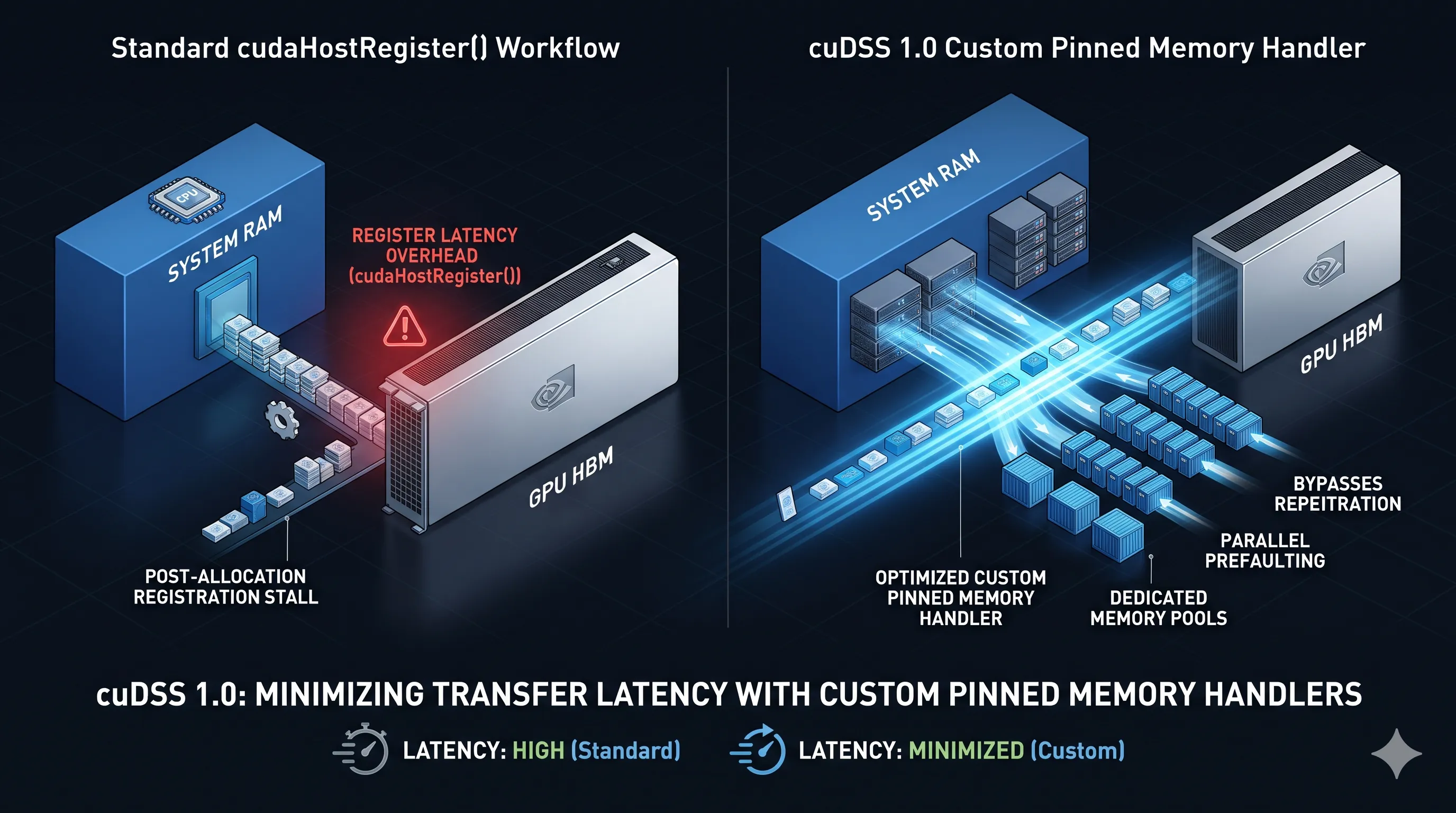
Standard hybrid CPU-GPU workflows require pinned (page-locked) host buffers to facilitate high-throughput direct memory access (DMA) transfers to the GPU.Conventionally, applications register previously allocated memory using the CUDA runtime function cudaHostRegister().
However, standard cudaHostRegister() post-allocation registration incurs noticeable latency overhead for large matrix factor buffers, stalling computation pipelines while operating system page tables are updated.
To control this behavior, cuDSS 1.0 provides explicit configuration options for host buffer registration.
The default host buffer registration behavior is equivalent to setting value = 1 if supported by the target device.
Conversely, setting value = 0 disables host buffer registration entirely.
Disabling registration with value = 0 allows developers to avoid registration overhead in workflows where host-buffer registration is unnecessary or handled outside standard registration pathways.
Implementing Custom Allocators and Memory Pools
Through cudssSetPinnedMemHandler(), cuDSS 1.0 allows developers to supply custom memory handlers that replace default host memory management.This custom handler reduces latency and bandwidth overhead for host-to-device transfers during hybrid CPU-GPU execution by bypassing repetitive runtime registration.
The interface allows developers to implement custom pinned memory pools and parallel prefaulting for large factor buffers.
By utilizing memory pools, applications can allocate pinned buffers ahead of time and reuse them across iterations, while parallel prefaulting maps memory pages concurrently across multiple CPU threads to eliminate page-fault penalties during data transfers.
When designing custom memory handlers, architectural implementation details dictate performance outcomes.
A minimal custom implementation providing only basic alloc and dealloc does not alter performance relative to cudaHostRegister().
Achieving optimal throughput requires developing dedicated pinned memory pools and parallel prefaulting architectures capable of amortizing memory allocation and registration costs throughout the solver pipeline.
5. Optimizing Symbolic Factorization and Host Execution Flexibility
Engineering simulations relying on sparse direct solvers spend substantial runtime in preprocessing and setup prior to numerical factorization.In cuDSS 1.0, the analysis phase undergoes major performance and structural refinements, directly driving end-to-end acceleration across complex engineering workloads.
GPU Symbolic Factorization Acceleration on Blackwell and Hopper
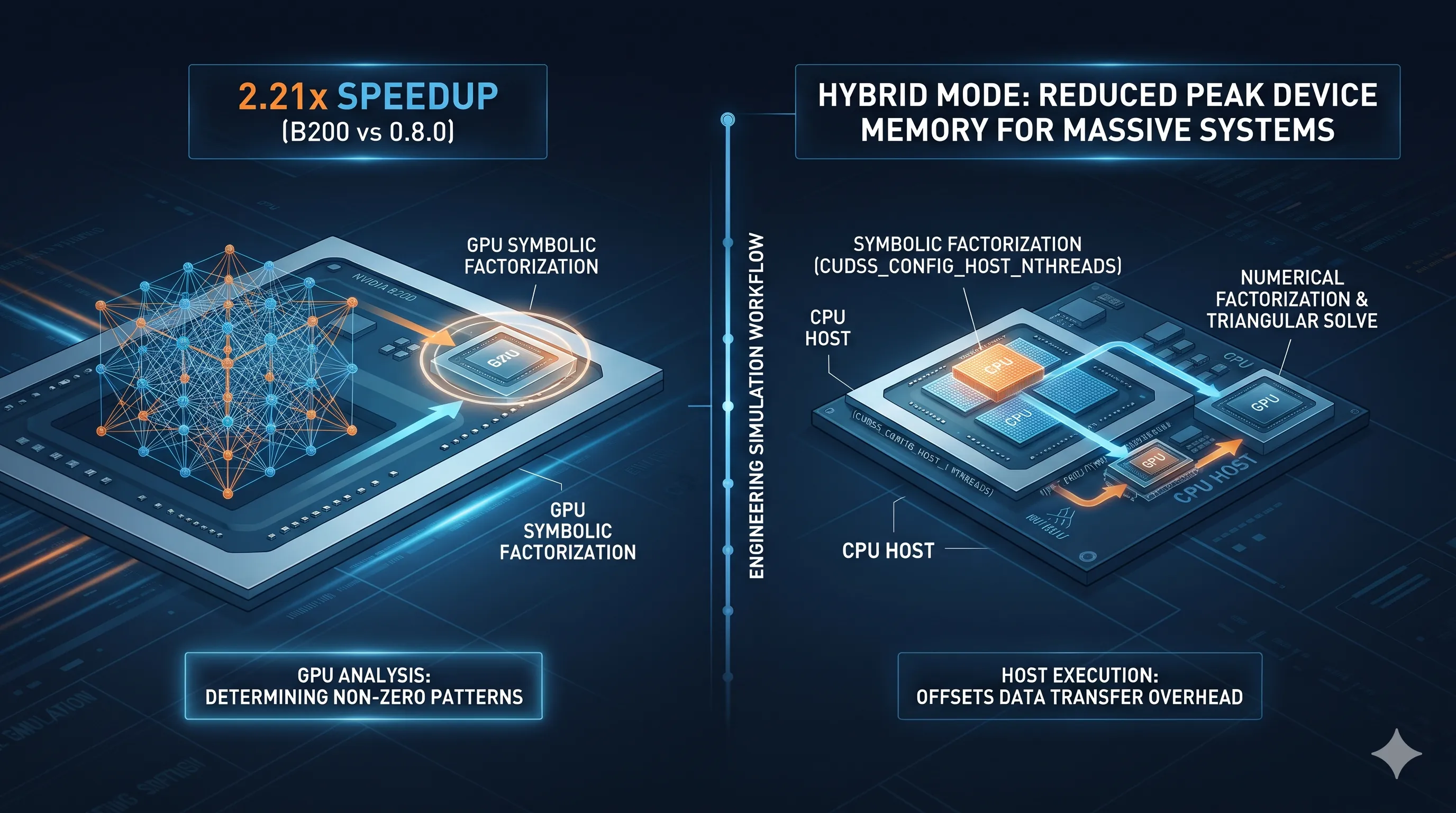
Direct sparse linear solvers require an accurate structural analysis to determine non-zero fill-in patterns before performing numerical factorization.In cuDSS 1.0, GPU-accelerated symbolic factorization delivers a 2.21x geometric-mean speedup compared to cuDSS 0.8.0 across NVIDIA B200 and H100 GPUs.
These benchmark evaluations spanned broad matrix dimensions, encompassing approximately 400 test cases with 80 to 130.3 million rows on the B200 GPU, and 250 test cases ranging from 120 to 22.9 million rows on the H100 GPU.
Because the symbolic phase constitutes a notable portion of overall runtime, isolating and replacing only the symbolic factorization stage yields estimated geometric-mean end-to-end solver speedups of 1.18x on B200 and 1.14x on H100 over cuDSS 0.8.0.
| Target Architecture | Benchmark Dataset Scope | Symbolic Factorization Speedup (vs. 0.8.0) | Estimated End-to-End Solver Speedup (vs. 0.8.0) |
|---|---|---|---|
| NVIDIA B200 | ~400 cases (80 to 130.3 million rows) | 2.21x (geometric mean) | 1.18x (geometric mean) |
| NVIDIA H100 | 250 cases (120 to 22.9 million rows) | 2.21x (geometric mean) | 1.14x (geometric mean) |
Hybrid Execute Mode and Peak Memory Reduction
To accommodate extreme problem sizes and diverse computational workflows, cuDSS 1.0 introduces hybrid execute mode.This feature allows symbolic factorization to run optionally on the CPU host while preserving numerical factorization and triangular solve on the GPU.
Executing symbolic factorization on the host provides distinct operational advantages across the problem spectrum.
For massive sparse systems, host-side execution significantly reduces peak device memory during the analysis phase, preserving high-bandwidth GPU memory for subsequent compute-intensive factorization steps.
Conversely, for smaller sparse matrices, processing symbolic factorization directly on the CPU eliminates unnecessary bus data-transfer overhead between host and device.
Resource allocation for host-side symbolic computation is governed explicitly by the user, as the CPU thread count is configurable via the CUDSS_CONFIG_HOST_NTHREADS setting.
Furthermore, hybrid execute mode can be co-enabled alongside hybrid memory mode in supported system configurations to unlock fine-grained resource balancing.
Regardless of whether hybrid execute mode or full GPU execution is selected, matrix reordering consistently executes on the CPU host.
6. Modernizing Solver Integration: API Upgrades and Migration to cuDSS 1.0
Migrating existing engineering simulation pipelines to cuDSS 1.0 is essential to unlocking the performance gains of GPU-accelerated sparse direct linear solvers.In large-scale finite element analysis, computational fluid dynamics, and mechanical modeling, integrating solver updates smoothly prevents interface bottlenecks and ensures computational correctness.
The transition to cuDSS 1.0 refines core abstractions across memory interfaces, precision declarations, algorithmic controls, and matrix constructors to streamline solver adoption.
Data Type Harmonization and Specialized Algorithmic Enums
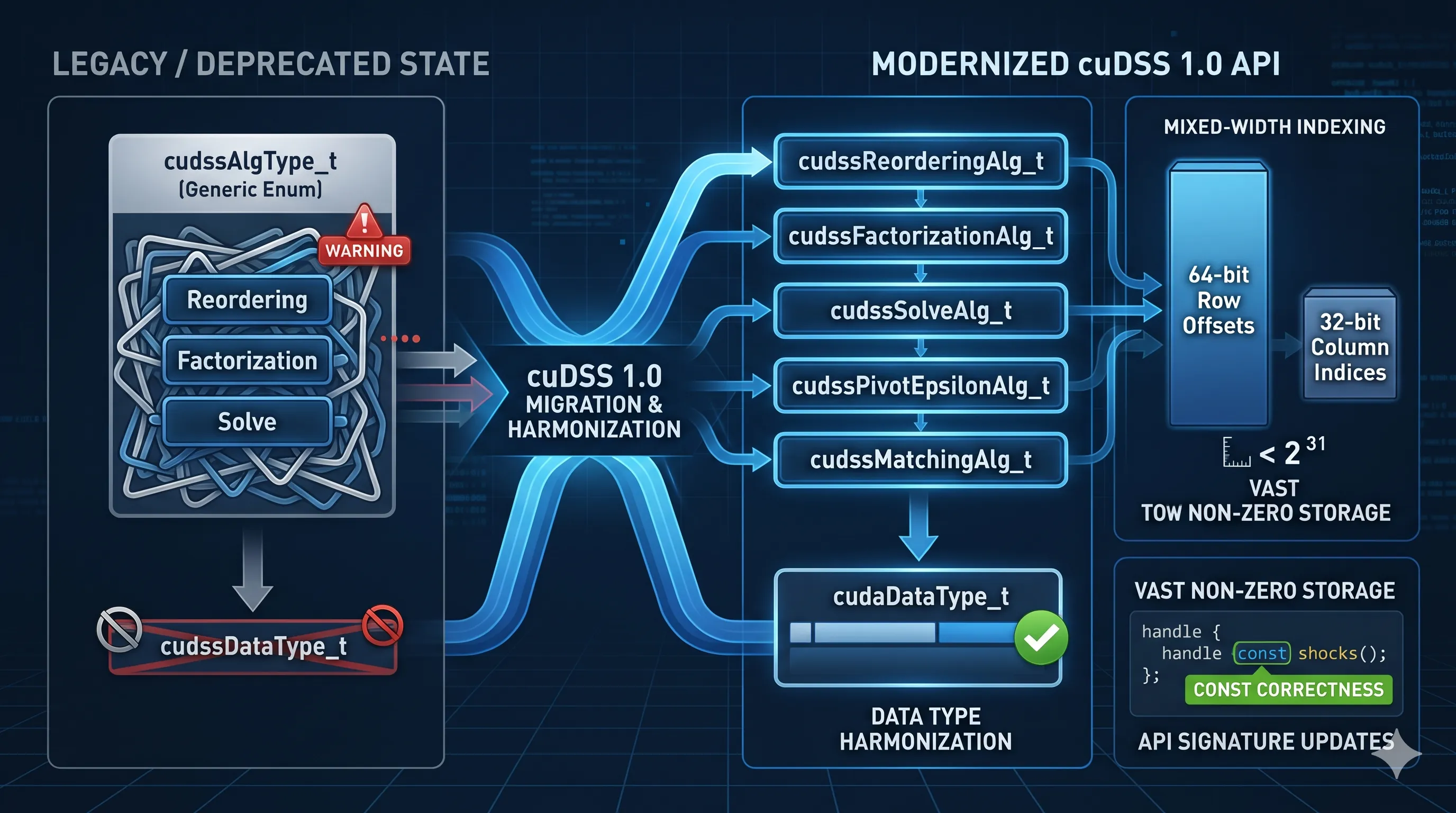
cuDSS 1.0 returns tocudaDataType_t for matrix creation, query functions, and cudssDistributedInterface_t callbacks to harmonize sparse operations with the broader CUDA ecosystem.While
cudssDataType_t remains supported as a deprecated alias of cudaDataType_t, using cudssDataType_t emits deprecation warnings and will be removed in a future release.Precision specifications for extended precision have also been clarified.
The double-double precision value type is named
CUDSS_R_64F_MP2, with CUDSS_R_64F_64F maintained as an alias for backward compatibility.Furthermore, the
cudss_fp64mp2_t struct is removed from public headers, meaning applications must define the value layout directly within their own codebase structures.Algorithmic execution controls have migrated away from a single overloaded enumeration.
The generic
cudssAlgType_t was replaced by specialized enums: cudssReorderingAlg_t, cudssFactorizationAlg_t, cudssSolveAlg_t, cudssPivotEpsilonAlg_t, and cudssMatchingAlg_t.This separation guarantees strong type checking across the solver lifecycle, preventing configuration mismatches between reordering, numerical factorization, and triangular solve stages.
| cuDSS 1.0 API Component | Updated Standard | Legacy / Deprecated Status |
|---|---|---|
| Data Type Interface | cudaDataType_t (matrix creation, queries, callbacks) |
cudssDataType_t emits deprecation warnings; removal scheduled in future release |
| Double-Double Value Type | CUDSS_R_64F_MP2 |
CUDSS_R_64F_64F maintained as an alias |
| Double-Double Layout Struct | User-defined application layout | cudss_fp64mp2_t struct removed from public headers |
| Algorithmic Configuration Enums | cudssReorderingAlg_t, cudssFactorizationAlg_t, cudssSolveAlg_t, cudssPivotEpsilonAlg_t, cudssMatchingAlg_t |
Generic cudssAlgType_t replaced and partitioned |
Mixed-Width Indexing and Signature Updates
Engineering models frequently exceed traditional 32-bit index limits in their overall non-zero counts while individual row and column dimensions remain within standard integer limits.To accommodate these matrix structures, CSR matrix functions take
offsetType before indexType to enable mixed-width indexing with 64-bit row offsets and 32-bit column indices.When deploying mixed-width indexing, row and column counts must be less than 2^31.
This ordering allows engineering workflows to allocate 64-bit pointers for vast non-zero storage arrays while avoiding unnecessary 64-bit memory overhead across local column index vectors.
API signature modernizations also enforce strict const correctness across all library boundaries.
Read-only handle and pointer parameters across public APIs are marked
const.As a consequence of strict type checking, C++ call sites passing
void** to batched matrix functions require explicit casts to const void *const *.Adopting these updated signatures ensures that solver invocations comply with modern compiler constraints while maximizing performance reliability in critical engineering simulations.
Related Posts
How Nemotron 3.5 Parse Accelerates Vision-Language Document ExtractionDiscover how NVIDIA's Nemotron 3.5 Parse boosts inference speed and document extraction efficiency...

Microsoft Ignite 2026: Copilot Work OS and Agent 365 GovernanceDiscover how Microsoft Ignite 2026 redefines enterprise AI with Copilot as the Work OS, centralized...

Deploying NVIDIA Cosmos 3 Locally with Hugging Face DiffusersLearn how Hugging Face Diffusers enables local execution of the 16B NVIDIA Cosmos 3 model on...
Generative AI may have assisted with research or drafting for this article. Topic selection, fact-checking, final wording, and publication remain the responsibility of DragonStone74. AI use disclosure