
JDK 28 Finalizes Structured Concurrency and ZGC Updates in October Java Roundup
🚀 Key Takeaways
- JDK 28 feature set expands: Structured Concurrency reaches finalization status alongside major ZGC enhancements targeting adaptive heap allocation and faster warmup times.
- Azul Payara releases critical updates: Maintenance builds deliver developer tooling like CDI DevMode while remediating high-impact remote code execution flaws across enterprise branches.
- Apache Camel patches mass vulnerabilities: The project addressed 38 security advisories across integration components, highlighting automated remediation via Project Glasswing.
- Gatherers4j advances stream analytics: Version 0.15.0 introduces moving and running statistical gatherers to enrich Java custom intermediate stream operations.
- Google ADK enhances workflow orchestration: Java and Kotlin agent development libraries rolled out graph-based structures and broader model endpoint support.
- Yupiik Fusion ships bug fixes and tweaks: The lightweight framework updated its CLI tooling generators and introduced template rendering adjustments in version 1.2.0.
The enterprise Java ecosystem continues to accelerate rapidly this October, bridging long-term platform evolution with urgent real-world production security needs.
At the core runtime layer, the OpenJDK community has marked crucial milestones toward modern multi-threaded execution and automated garbage collection tuning, moving key concurrency abstractions toward permanent status.
Simultaneously, enterprise servers, integration frameworks, and developer libraries have pushed critical updates—ranging from automated vulnerability remediations across widespread Apache Camel endpoints to graph-driven workflow capabilities inside cloud agent SDKs.

1. JDK 28 Early-Access Builds and Targeted JEPs (JEP 546, 545, and 543)
This section anchors the broader Java News Roundup—covering JEPs for JDK 28, Azul Payara, Gatherers4j, Google ADK, Yupiik, and Apache Camel CVEs—by examining the core platform developments forming the foundation of the next Java platform release.The steady progression of OpenJDK early-access milestones continues to establish the operational and memory management baseline for upcoming enterprise deployments.
ZGC Enhancements for Adaptive Sizing and Startup Optimization (JEP 545 & 546)
The evolution of the Z Garbage Collector (ZGC) represents a substantial portion of the recent JDK 28 development milestones.Both JEP 546 and JEP 545 advanced through the OpenJDK review pipeline, moving from Proposed to Target status to officially Targeted for JDK 28.
These enhancements specifically address memory elasticity and rapid readiness in cloud and containerized environments.
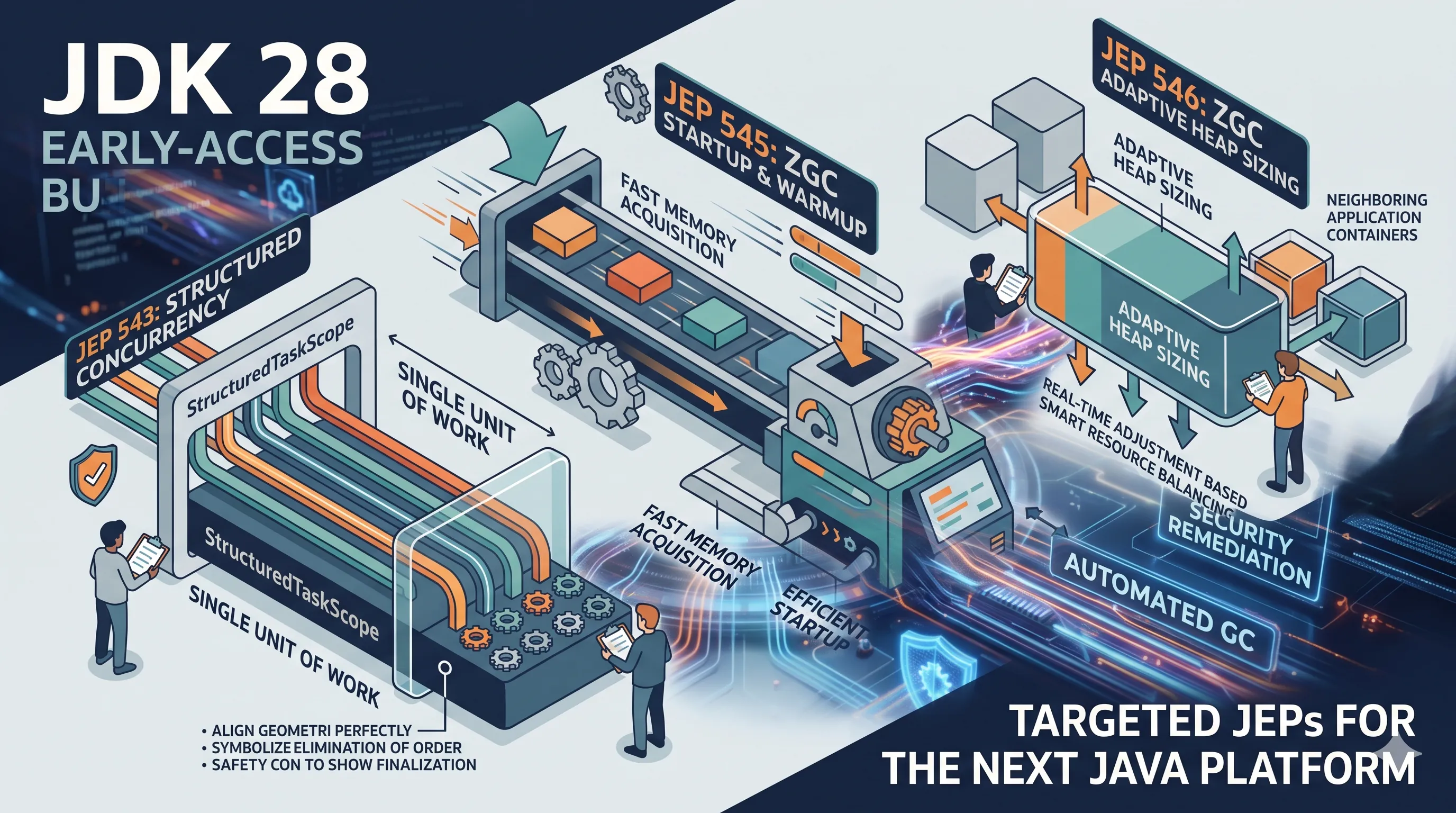
JEP 546 introduces adaptive heap sizing capabilities to ZGC.
InfoQ noted that JEP 546 proposes to "enhance the Z Garbage Collector to adaptively adjust the size of the heap based on the resources available, the application's needs, and the needs of neighboring applications contending for the same resources."
By assessing resource availability alongside direct application demand, ZGC can dynamically balance its footprint against other workloads running on the same host.
Complementing adaptive sizing, JEP 545 focuses on the initial execution phase.
InfoQ reported that JEP 545 proposes to "improve application startup and warmup by enhancing the Z Garbage Collector to acquire and prepare physical memory more swiftly and efficiently in response to application needs."
This optimization accelerates physical memory acquisition to cut down delays during application initialization and warmup periods.
Finalizing Structured Concurrency in JEP 543 and Build 20 Fixes
Alongside memory management improvements, JDK 28 brings long-tested concurrency features to full standardization.JEP 543 was elevated from Proposed to Target to Targeted for JDK 28.
This milestone follows an extensive feedback cycle: JEP 543 proposes finalization without change after seven preview rounds (JDK 21 through JDK 27) and two incubator rounds (JDK 19 and JDK 20).
The JEP standardizes Structured Concurrency to treat groups of related multi-threaded tasks as a single unit of work.
Central to this paradigm is StructuredTaskScope, which confines subtask lifetimes to lexical try-with-resources blocks.
This construct automates cancellation propagation and eliminates thread leaks across concurrent branches.
However, specific operational constraints remain integral to its execution model.
Structured concurrency does not replace ExecutorService or Future in java.util.concurrent.
Furthermore, subtasks that do not respond to thread interrupts can delay task scope closure indefinitely, requiring developers to write responsive interrupt-handling routines inside subtasks.
These feature progressions coincide with ongoing runtime stability updates.
Build 20 of JDK 28 early-access builds was released with targeted fixes updating Build 19, delivering iterative stability improvements to the platform.
| JEP Number | Feature Area | Primary Goal | State Transition |
|---|---|---|---|
| JEP 545 | ZGC Physical Memory Acquisition | Enhance physical memory acquisition to expedite application startup and warmup times. | Elevated from Proposed to Target to Targeted for JDK 28 |
| JEP 546 | ZGC Adaptive Heap Sizing | Adaptively adjust heap size based on resource availability, application workload, and competing neighboring applications. | Elevated from Proposed to Target to Targeted for JDK 28 |
| JEP 543 | Structured Concurrency | Standardize treating related multi-threaded tasks as a single unit of work via StructuredTaskScope without changes after seven previews and two incubator rounds. | Elevated from Proposed to Target to Targeted for JDK 28 |
2. Azul Payara October 2026 Maintenance Releases and Critical Security Patches
As part of this edition of the Java News Roundup covering JDK 28 JEPs, ecosystem libraries, and framework security advisories, enterprise runtime management takes center stage with the rollout of the October 2026 maintenance cycle for Azul Payara.This coordinated release spans multiple architecture generations, introducing the fifth monthly update since Payara 7 general availability alongside backported security fixes and ecosystem dependency upgrades.
Multi-Branch Specification Alignments and Runtime Modernization
Azul Payara 7.5.0 leads the rollout, shipping alongside Payara Community Edition 7.2026.10, Enterprise Edition 6.43.0, Enterprise Edition 5.92.0, and release line 4.1.2.191.60.Across these editions, Azul has aligned runtime APIs with their target enterprise profiles.
Payara Server 7.5.0 supports Jakarta EE 11 across the Full Platform, Web Profile, and Core Profile, running on MicroProfile 7.1.
Azul Payara Server 6.43.0 maintains production alignment with Jakarta EE 10 and MicroProfile 7.1.
For organizations maintaining legacy enterprise deployments, Azul Payara Server 5.92.0 preserves alignment with Jakarta EE 8 and MicroProfile 4.1 on the legacy javax.* namespace.
Core component upgrades accompany the line 7 updates, advancing EclipseLink to version 5.0.1 and updating Mojarra to version 4.1.16.
Administrative operations receive key configuration capabilities across the CLI, introducing the delete-jvm-option and delete-system-properties commands to streamline environment parameter cleanup.
Runtime behavior has also been hardened: the JNDI context behavior is updated to explicitly throw NameNotFoundException whenever a requested resource is missing.
Infrastructure communication patterns undergo notable modernizations in this cycle.
DCOM support was removed from the Payara 6 and Payara 5 release lines.
In its place, SSH provider functionality and native Windows SSH support have been ported to release lines 7, 6, and 5.
Additionally, Payara Community 7.2026.10 removed elevated permission requirements for SSH nodes, eliminating the need for privileged service escalation during remote node management.
| Release Line / Edition | Specification Profile Alignment | Key Runtime and Protocol Changes |
|---|---|---|
| Payara 7.5.0 / Community 7.2026.10 | Jakarta EE 11 (Full, Web, Core Profile), MicroProfile 7.1 | EclipseLink 5.0.1; Mojarra 4.1.16; CDI DevMode added; SSH node elevated permission requirement removed |
| Payara Enterprise 6.43.0 | Jakarta EE 10, MicroProfile 7.1 | DCOM removed; Windows SSH support ported; CDI DevMode added; CLI delete commands added |
| Payara Enterprise 5.92.0 | Jakarta EE 8 (javax.* namespace), MicroProfile 4.1 | DCOM removed; SSH provider and Windows SSH support ported; CLI delete commands added |
| Payara 4.1.2.191.60 | Legacy Branch Maintenance | Targeted security mitigation backports applied |
Mitigating Remote Code Execution Vulnerabilities and DevMode Tooling
Three security vulnerabilities were patched across all supported Payara branches back to version 4.The updates neutralize high-severity flaws within underlying console and templating subsystems.
CVE-2026-2586 addresses an RCE vulnerability in the Administration Console that permitted execution of arbitrary operating system commands under service user privileges.
CVE-2026-2587 resolves an RCE flaw in the server-side template rendering mechanism that risked host compromise.
Confirming the remediation scope, Azul reported: "CVE-2026-2587 and CVE-2026-2586, a remote code execution vulnerability in Eclipse GlassFish, remote code execution in JSFTemplating, and cross-site scripting in the Admin Console that allows full control are fixed on every supported Azul Payara branch."
Beyond administrative and security patches, release lines 7 and 6 introduce diagnostic capabilities through CDI DevMode.
This feature assists engineers during development by enabling active inspection of managed beans, injection points, interceptors, and circular dependencies before deployment artifacts reach staging pipelines.
To enable CDI DevMode inspection console in development environments on Payara 7 and 6 lines, the diagnostic subsystem is activated via the Payara system property:
payara.dev.consoleWhen configured as a JVM option, it surfaces an interface that analyzes registered bean archives, validates interceptor bindings, and isolates circular injection graphs during rapid application iteration.

3. Apache Camel Resolves 38 Vulnerabilities Across Active Enterprise Lines
Within this edition of the Java News Roundup—covering JEPs for JDK 28, Azul Payara, Gatherers4j, Google ADK, Yupiik, and enterprise security developments—the Apache Camel ecosystem experienced a massive coordinated vulnerability remediation.On October 15, 2026, the Apache Camel team resolved 38 CVE security advisories across multiple Camel components.
Project Glasswing Audit and Severity Breakdown
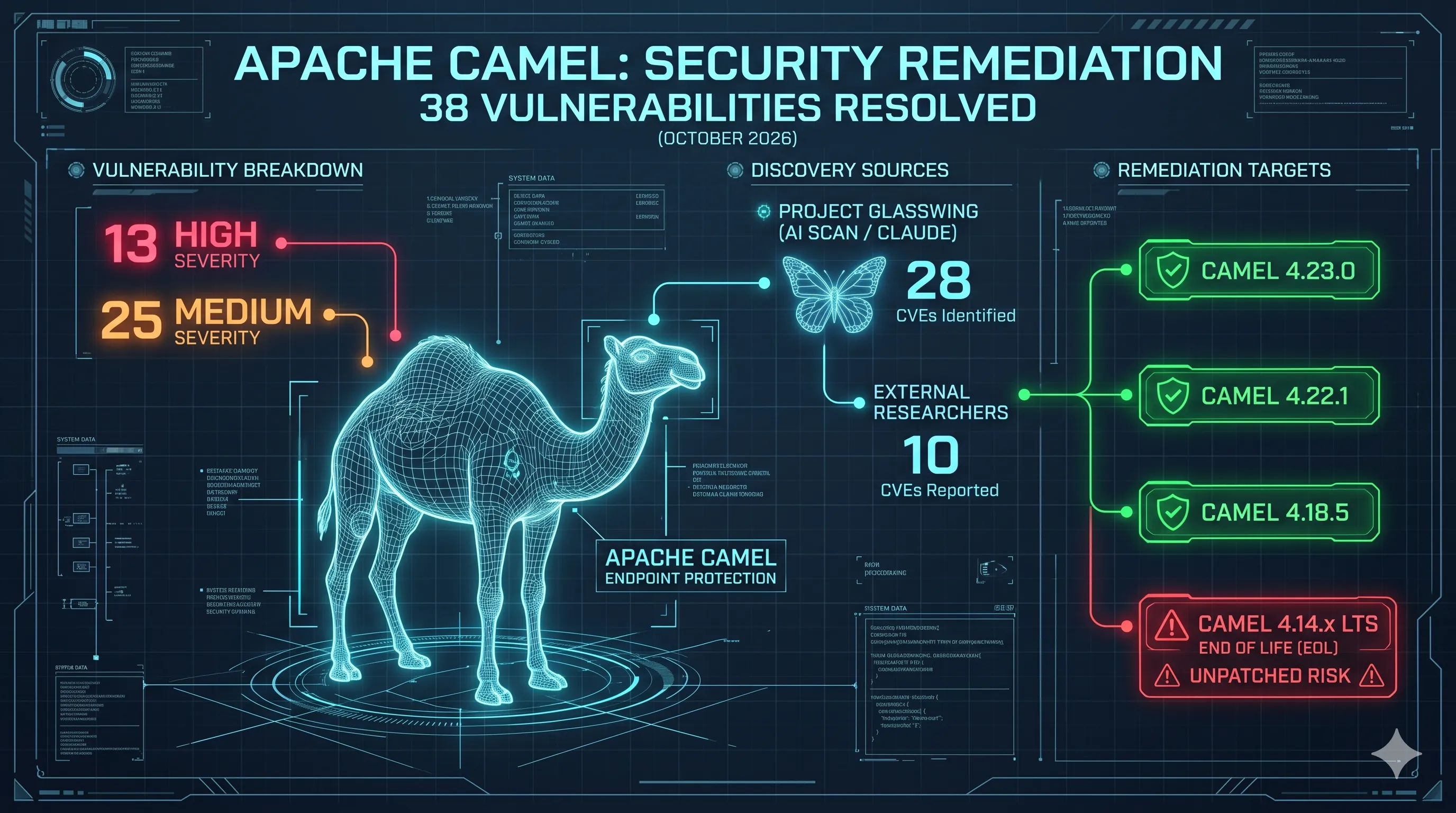
The vulnerability sweep addressed a total of 38 security advisories across enterprise integration endpoints.A total of 13 vulnerabilities are classified with a HIGH severity rating.
The remaining 25 vulnerabilities are classified with a MEDIUM severity rating.
The discovery effort was heavily driven by automated tooling under the Apache Software Foundation.
Specifically, 28 CVEs were identified by Claude via ASF's Project Glasswing initiative using the Claude Security Scan Tool.
An additional 10 CVEs were reported by external security researchers.
To neutralize these attack vectors, the security patches modify certain default runtime component behaviors to harden integration endpoints against unauthorized access and component misconfiguration.
| Metric / Classification | Count / Source Breakdown | Remediation Status / Target Release |
|---|---|---|
| High Severity Vulnerabilities | 13 CVE advisories (spanning Project Glasswing and external researcher findings) | Remediated in Camel 4.23.0, 4.22.1, and 4.18.5 |
| Medium Severity Vulnerabilities | 25 CVE advisories (spanning Project Glasswing and external researcher findings) | Remediated in Camel 4.23.0, 4.22.1, and 4.18.5 |
| ASF Project Glasswing Discoveries | 28 CVE advisories identified by Claude via the Claude Security Scan Tool | Remediated in Camel 4.23.0, 4.22.1, and 4.18.5 |
| External Researcher Discoveries | 10 CVE advisories reported by external security researchers | Remediated in Camel 4.23.0, 4.22.1, and 4.18.5 |
| Camel 4.14.x LTS Impact | 35 of the 38 advisories affected the Camel 4.14.x LTS line | No security patches provided; branch reached End of Life after 4.14.9 |
Remediation Release Targets and Camel 4.14.x LTS EOL Risks
Fixed releases were published across three active maintenance streams as Camel versions 4.23.0, 4.22.1, and 4.18.5.The Apache Camel security team announced: "All of them are fixed in 4.22.1, 4.18.5 and 4.23.0, and we recommend upgrading."
These updates introduce critical behavioral endpoint hardening, altering runtime defaults across affected components to prevent exploitation.
However, enterprise architectures maintaining legacy branches face significant vulnerability exposure.
A total of 35 of the 38 advisories affected the Camel 4.14.x LTS line.
The Camel 4.14.x LTS release line reached End of Life after 4.14.9 and will receive no security patches for these CVEs.
Deployments relying on Camel 4.14.x remain unpatched unless migrated directly to one of the supported remediation lines.
4. Gatherers4j 0.15.0: Advanced Statistical Operations for Java 25+ Streams
As part of the ongoing developments featured in this Java News Roundup alongside updates to JDK 28 JEPs, Azul Payara, Google ADK, Yupiik, and Apache Camel CVEs, the stream enhancement library Gatherers4j has officially released version 0.15.0.Targeting custom intermediate stream operations for Java 25+, this release provides built-in statistical evaluation capabilities for pipelines utilizing Stream Gatherers.
StatisticalSummary Accumulators and Weighted Moving Windows
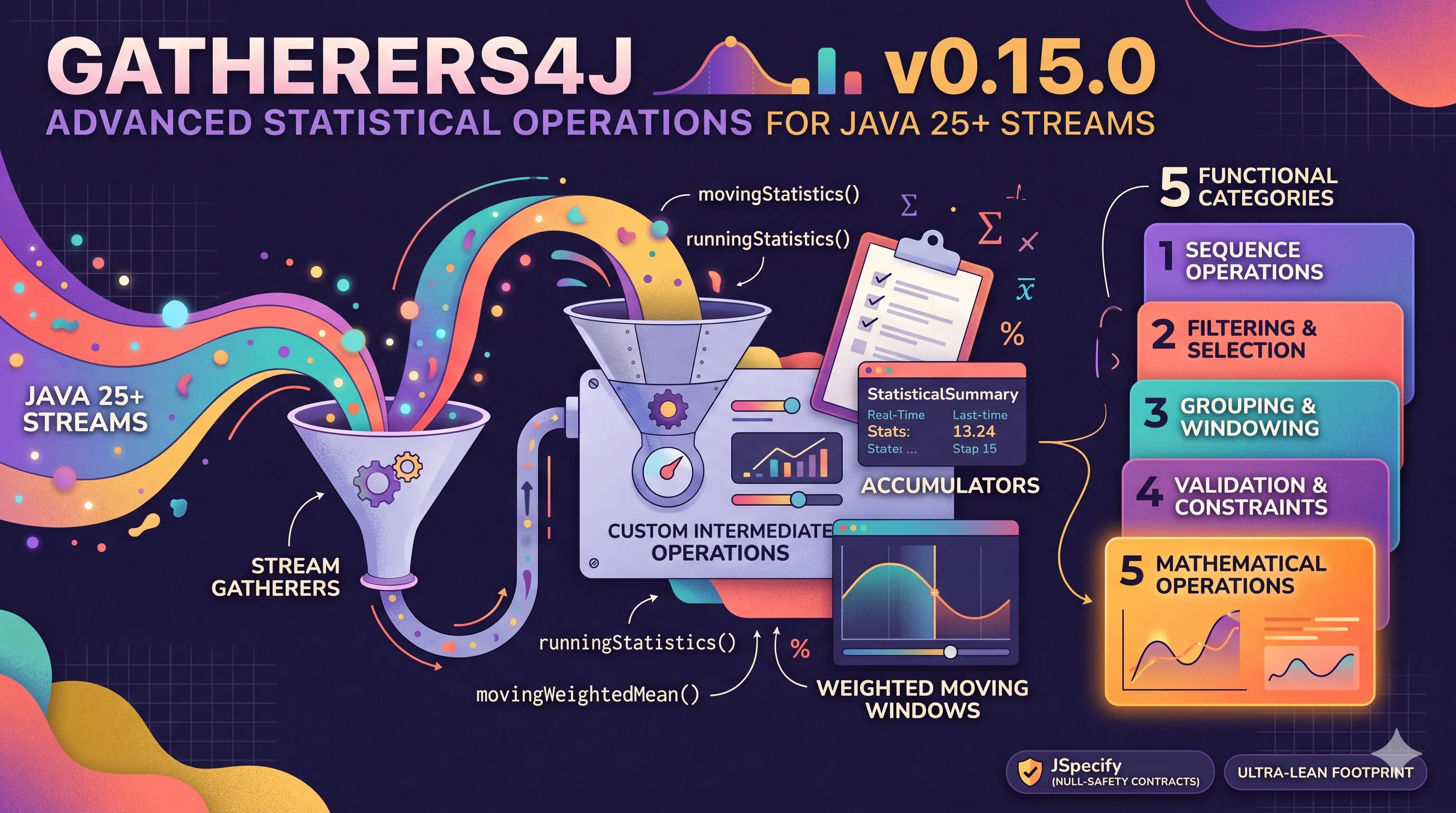
Version 0.15.0 introduces dedicated mathematical stream gatherers tailored for incremental data evaluation.The new statistical operations include movingStatistics(), movingStatisticsBy(), runningStatistics(), and runningStatisticsBy().
Each of these statistical gatherers processes pipeline items and emits an instance of the StatisticalSummary record for each individual stream element.
This setup allows developers to inspect statistical metrics continuously across sliding intervals or cumulative progressions without interrupting or terminating the stream.
In addition, the release introduces movingWeightedMean() and movingWeightedMeanBy().
These operations calculate moving averages using weights configured either through linear weighting schemas or through developer-provided custom weights ordered from oldest to newest.
Stream Gatherer Architecture and Dependency Model
To serve high-throughput Java 25+ runtimes, Gatherers4j maintains an ultra-lean footprint with only a single transitive dependency on JSpecify annotations.All stream operations across the library are organized across five specific functional categories.
| Functional Category | Scope within Gatherers4j |
|---|---|
| Sequence Operations | Sequential pipeline manipulations and element sequencing. |
| Filtering and Selection | Custom intermediate filtering and item selection mechanics. |
| Grouping and Windowing | Segmenting streams into batch buckets, chunks, and fixed or sliding windows. |
| Validation and Constraints | Asserting stream data invariants and boundary validation. |
| Mathematical Operations | Statistical calculation gatherers, running summaries, and weighted moving means. |
Integrating these new operations allows developers to execute streaming analytics natively on Java 25+ runtimes while maintaining null-safety contracts via JSpecify.
5. Google Agent Development Kit Updates: Java 1.12.0 and Kotlin 1.4.0
As highlighted in this edition of the Java News Roundup: JEPs for JDK 28, Azul Payara, Gatherers4j, Google ADK, Yupiik, Apache Camel CVEs, Google has expanded its enterprise AI toolchain with coordinated updates across the Google Agent Development Kit (ADK) ecosystem.Both the Java and Kotlin editions have gained structural enhancements targeting workflow orchestration and model connectivity.
| Component | Version | Key Architectural Updates | Modifications and Deprecations |
|---|---|---|---|
| Google ADK for Java | 1.12.0 | Introduced graph workflow structures: Node interface, BaseNode class, Start class, and Edge record. | Refactored ContextCacheConfig constructor to add cacheIntervals and createHttpOptions; deprecated maxInvocations. |
| Google ADK for Kotlin | 1.4.0 | Added the EdgesDsl class to provide a DSL for building agent workflow graphs. | Added the ChatCompletions class as a model backend for OpenAI Chat Completions API and compatible endpoints. |
Graph Workflow Architecture and Context Caching in Java ADK 1.12.0
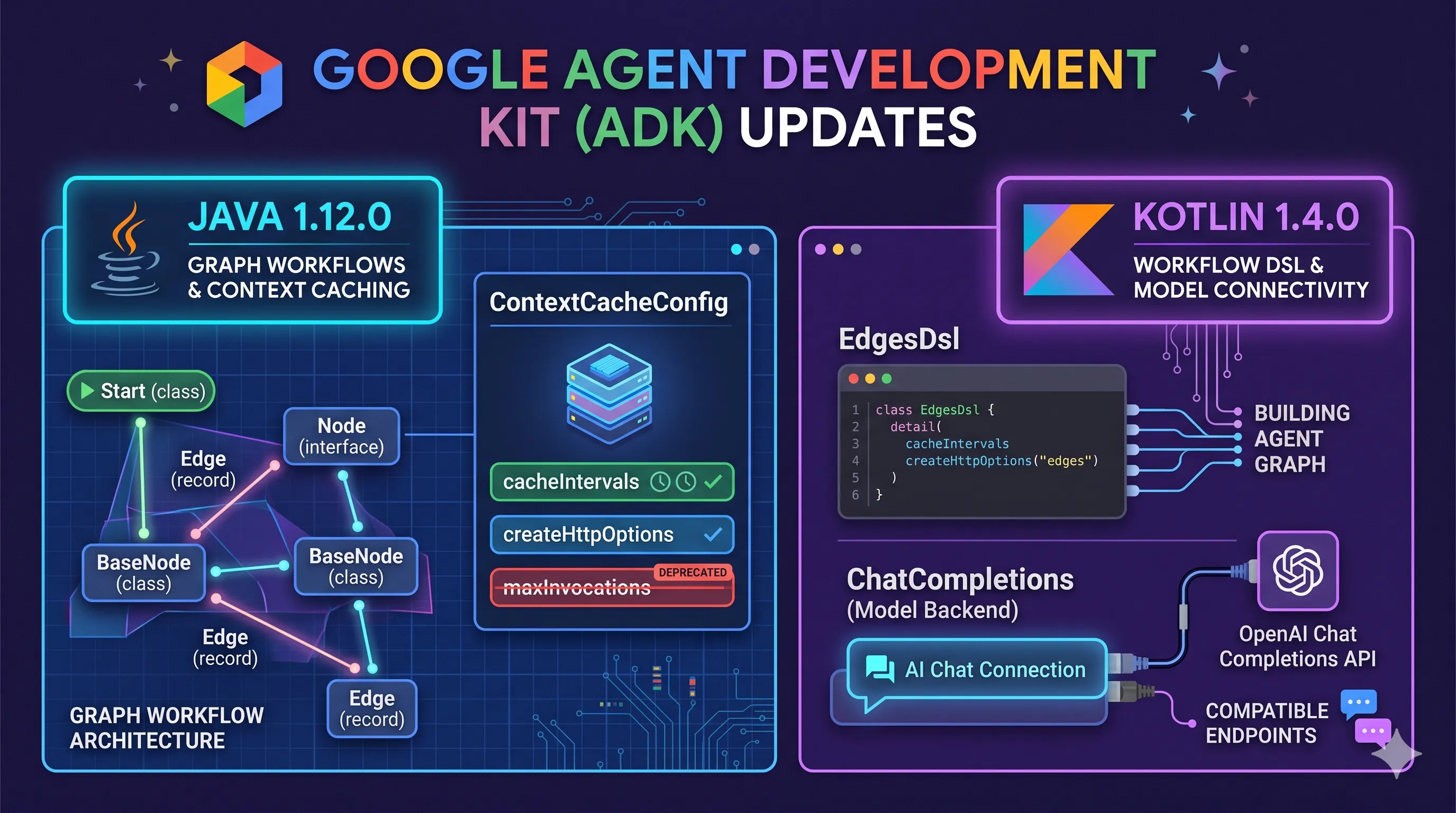
Google ADK for Java released version 1.12.0, establishing a formalized foundation for graph-based agent orchestration.The release introduced graph workflow structures comprising four core elements: the Node interface, the BaseNode class, the Start class, and the Edge record.
These primitives provide structured building blocks for defining discrete processing units and mapping the execution paths of complex agent workflows.
Alongside graph execution improvements, ADK for Java 1.12.0 refactored the ContextCacheConfig constructor.
The constructor now incorporates the cacheIntervals and createHttpOptions parameters to grant finer configuration over context caching schedules and underlying HTTP transport options.
As part of this refactoring, Google ADK for Java 1.12.0 deprecated the maxInvocations parameter in the ContextCacheConfig constructor.
Kotlin ADK 1.4.0 Workflow DSL and Chat Completions Integration
In parallel, Google ADK for Kotlin released version 1.4.0, delivering language-specific ergonomics for agent workflows and broader runtime connectivity.The release added the EdgesDsl class, which provides an idiomatic domain-specific language (DSL) designed for constructing agent workflow graphs cleanly.
In addition to workflow authoring improvements, ADK for Kotlin 1.4.0 added the ChatCompletions class.
The ChatCompletions class functions as a model backend supporting the OpenAI Chat Completions API as well as OpenAI-compatible endpoints, allowing applications built on the Kotlin ADK to connect directly to alternative model serving infrastructures.
6. Yupiik Fusion 1.2.0: CLI Tooling and Template Engine Enhancements
As part of the wider Java ecosystem updates covered in this Java News Roundup alongside JEP developments for JDK 28, Azul Payara, Gatherers4j, Google ADK, and Apache Camel CVEs, Yupiik Fusion released version 1.2.0.This release delivers targeted architectural adjustments for command-line interface generation, refines internal templating engine compliance, and addresses ecosystem maintenance.
Command-Line Generator Improvements via CliLauncher
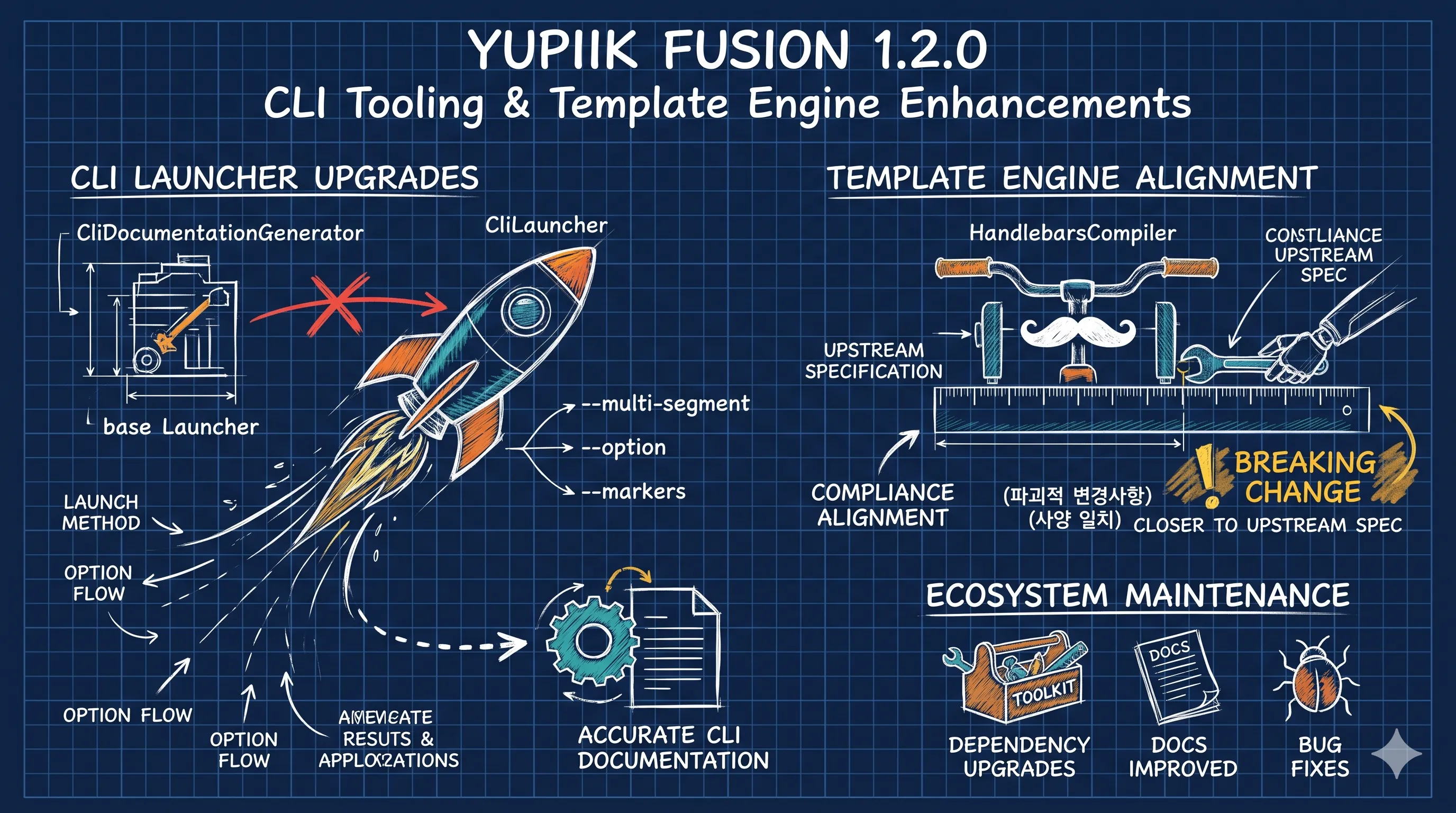
In Yupiik Fusion 1.2.0, the tooling for generating command-line documentation receives an architectural refinement.Specifically, the framework updated CliDocumentationGenerator to leverage CliLauncher instead of the base Launcher.
This transition specifically targets multi-segment command option markers, ensuring that command structures and option flags configured across multiple segments are accurately represented and processed during documentation generation.
HandlebarsCompiler Specification Alignment and Upgrades
Alongside the command-line updates, version 1.2.0 introduces an intentional breaking change within its templating support.The update introduced a breaking change in HandlebarsCompiler, extending implementation compliance closer to the upstream Handlebars specification.
Applications utilizing custom compiler behaviors or template expressions affected by this closer adherence will need to account for this updated compliance alignment.
In addition to these core adjustments, Yupiik Fusion 1.2.0 delivered dependency upgrades, documentation improvements, and general bug fixes across the framework.
Related Posts
How Nemotron 3.5 Parse Accelerates Vision-Language Document ExtractionDiscover how NVIDIA's Nemotron 3.5 Parse boosts inference speed and document extraction efficiency...
Microsoft Ignite 2026: Copilot Work OS and Agent 365 GovernanceDiscover how Microsoft Ignite 2026 redefines enterprise AI with Copilot as the Work OS, centralized...

Deploying NVIDIA Cosmos 3 Locally with Hugging Face DiffusersLearn how Hugging Face Diffusers enables local execution of the 16B NVIDIA Cosmos 3 model on...
Generative AI may have assisted with research or drafting for this article. Topic selection, fact-checking, final wording, and publication remain the responsibility of DragonStone74. AI use disclosure