
Inside Snap's New Specs: Lighter, More Comfortable, and Still Expensive
🚀 Key Takeaways
- Dramatic Ergonomic Overhaul: The redesigned chassis sheds nearly half the bulk of earlier developer prototypes, using Swiss TR90 polymer and flexible spring hinges for genuine wearable comfort.
- Dual Sizing and Cool Operation: Releasing in two tailored frame sizes resolves individual fit challenges while advanced thermal dissipation eliminates previous facial heating issues.
- Adaptive Electrochromic Optics: Waveguide displays providing a 51-degree field of view integrate transition lenses that adjust tint dynamically in seconds.
- Untethered Dual-Processor Architecture: Twin Qualcomm Snapdragon chips handle computer vision and spatial rendering natively without external compute pucks or phone cables.
- Frontier Multi-AI Software: Powered by an evolving Snap OS, the system natively pairs OpenAI and Google Gemini intelligence with interactive spatial hand-tracking.
- Enterprise and Pioneer Focus: Positioned at a premium $2,195 retail tier, the hardware prioritizes developers and creative professionals while establishing long-term spatial computing utility.
Snap's newly refined Specs signify a pivotal turning point in wearable hardware engineering. Built under the dedicated Specs Inc. subsidiary, the device achieves a remarkably lightweight, self-contained silhouette that operates completely untethered from phones or external processors. By pairing flexible Swiss polymer frames, onboard dual-chip computing, and electrochromic optics with dual frontier AI engines, the company has transformed a once-unwieldy developer experiment into a sleek, comfortable, and truly standalone see-through computer.
While the engineering breakthroughs solve the industry's longstanding comfort and thermal hurdles, substantial commercial challenges remain. Carrying an unapologetically premium price tag tailored to enterprise innovators and software pioneers, the hardware successfully proves that true AR glasses can feel great on the face—leaving the ecosystem to chart out the indispensable daily workflows that will drive mainstream adoption.
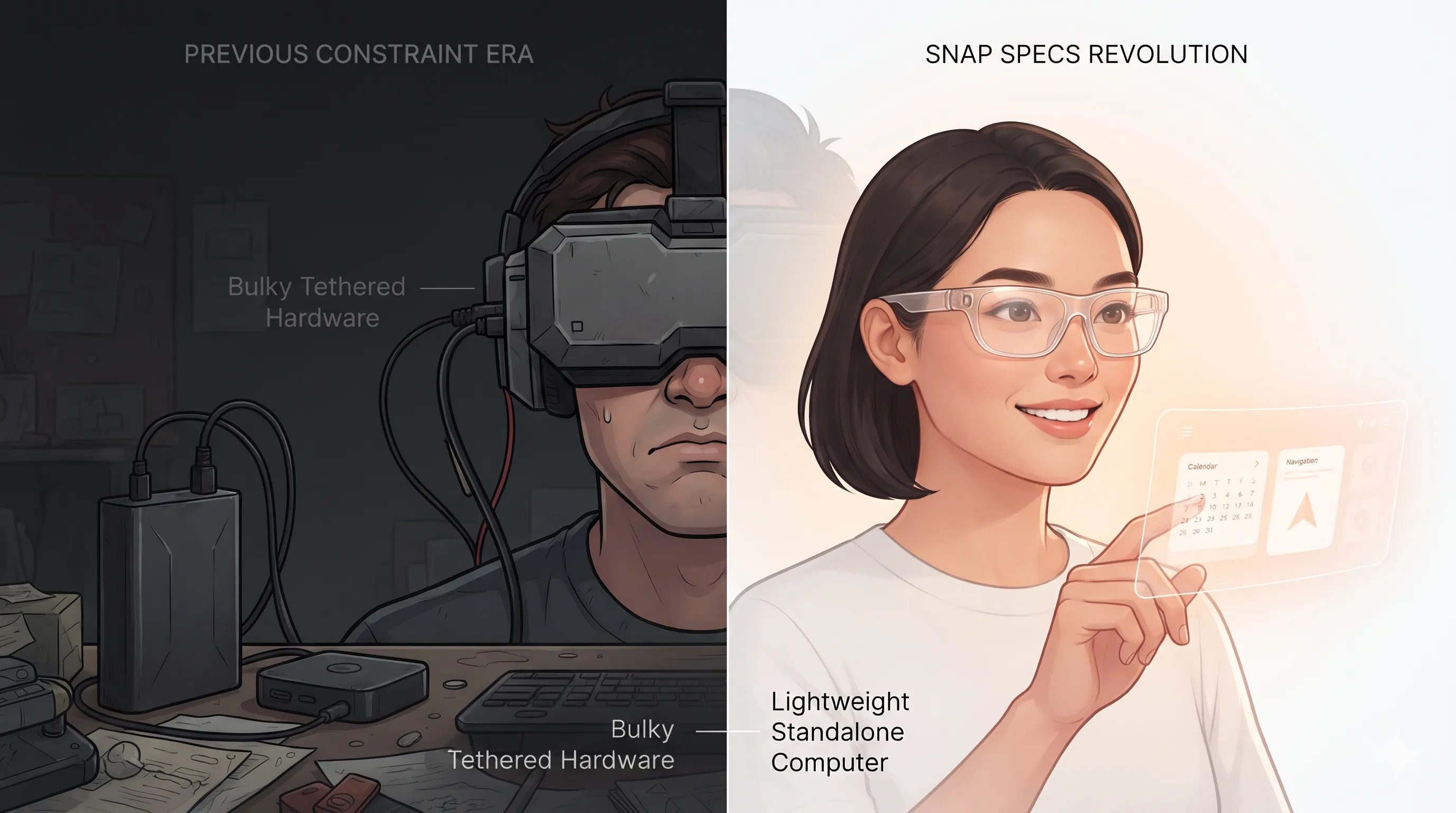
1. Ergonomic Overhaul: Halving the Weight with Swiss TR90 Polymer
The central foundation behind why Snap’s Specs are now more comfortable stems directly from an aggressive physical overhaul.By addressing core material density, temple articulation, and mass distribution, the latest hardware delivers an ergonomic experience that directly improves wearable comfort.
Swiss TR90 Polymer and Narrower Frame Geometry
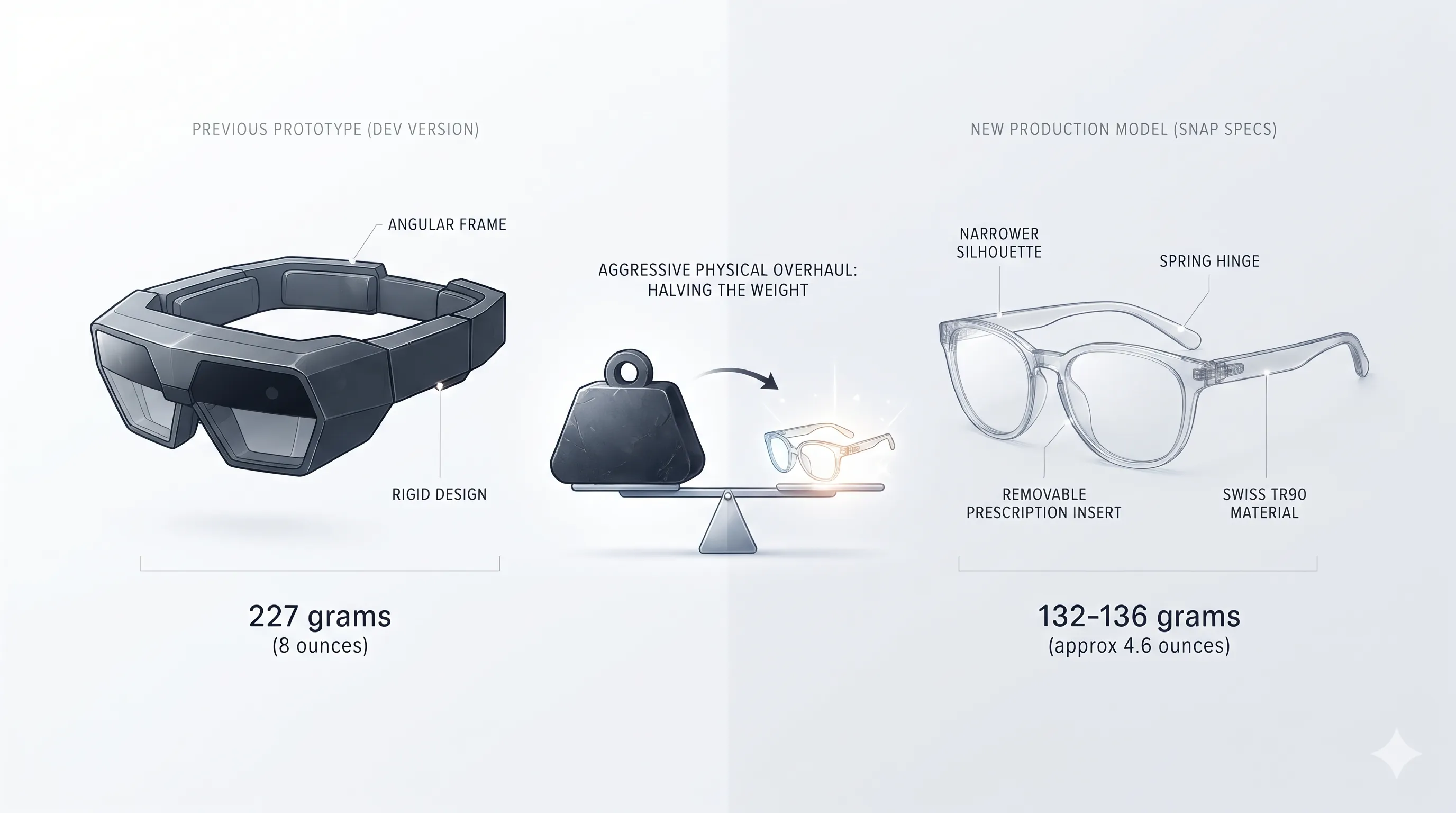
A major driver of the structural redesign is the shift in framing materials.The frames are manufactured from high-performance Swiss TR90 polymer, a material selected for its resilient, lightweight structural properties.
Moving away from earlier bulky iterations, the front frame silhouette is noticeably narrower and rounder compared to previous angular designs.
To enhance long-term wearability across diverse facial structures, the chassis is equipped with spring hinges designed to improve frame flexibility and fit.
Additionally, the frame includes removable inserts to accommodate a wide range of vision prescriptions, removing the friction of wearing secondary lenses underneath.
Assessing these adjustments, Engadget reported the physical build was much more refined than the 2024 developer version.
Weight Reductions Across 47mm and 52mm Models
Weight optimization represents the most dramatic physical alteration between generations.The earlier prototype weighed around 8 ounces (approx 227 grams), creating substantial downward pressure during extended sessions.
In contrast, the 47mm production model weighs 132 grams (approximately 4.6 ounces), nearly half the prototype's weight.
For users requiring broader sizing, the 52mm production model weighs 136 grams.
Evaluating this reduction, TechCrunch noted that Specs improved its form factor significantly, slimming down to nearly half of what the previous prototype did.
| Hardware Generation / Model | Weight | Frame Geometry & Material | Mechanical & Lens Features |
|---|---|---|---|
| Earlier Prototype (Developer Version) | Around 8 ounces (approx 227 grams) | Angular front frame design | Rigid frame construction |
| 47mm Production Model | 132 grams (approx 4.6 ounces) | High-performance Swiss TR90 polymer; narrower, rounder silhouette | Spring hinges; removable prescription inserts |
| 52mm Production Model | 136 grams | High-performance Swiss TR90 polymer; narrower, rounder silhouette | Spring hinges; removable prescription inserts |
Remaining Physical Constraints and Frame Arm Thickness
Despite significant weight shedding, physical trade-offs remain present in the hardware execution.The frame arms remain thick and project slightly past the wearer's head, preserving a visible industrial footprint along the temples.
Furthermore, while shedding mass was critical for daily wear, the resulting balance sits in an intermediate hardware category.
At 132 to 136 grams, the device is lighter than most over-ear headphones but heavier than standard eyewear.
2. Eliminating Facial Heat: Dual Sizing and Passive Thermal Control
Physical comfort stands at the core of Snap’s Specs advancements, directly targeting the mechanical and thermal pain points that historically undermined extended augmented reality usage.Achieving an ergonomic experience requires addressing both chassis dimensions and the thermal side effects of spatial computing architectures.
Dual Hardware Sizing for Diverse Head Dimensions
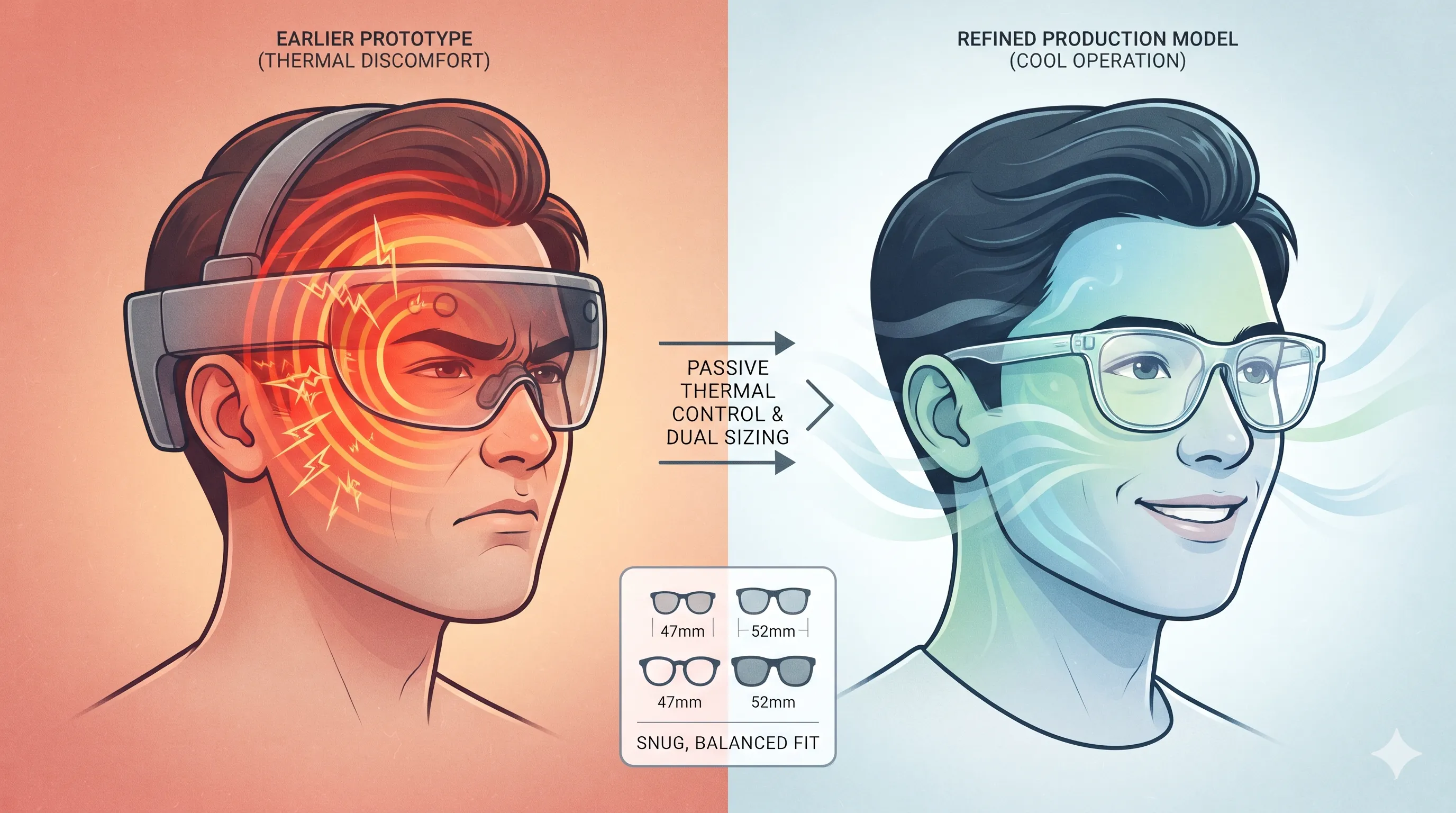
A foundational improvement in Snap's design approach is the departure from a one-size-fits-all hardware philosophy.The hardware is available in two distinct hardware sizes: 47mm and 52mm.
These two frame sizes are offered specifically to adapt to varied head dimensions and ensure a snug, balanced fit across different face profiles.
By matching frame geometry to user measurements, the dual-size offering stabilizes the device on the bridge of the nose and temples, mitigating pressure points and preventing hardware slippage during active wear.
Resolving Prototype Thermal Discomfort and Facial Tingling
Beyond physical frame fit, managing compute-driven heat dissipation represents a critical breakthrough in wearable comfort.Earlier prototypes produced notable facial heat and tingling sensations during operation, stemming from intensive on-device computing workloads that concentrated excess warmth directly against the wearer's skin.
The refined architecture systematically reduces facial warmth and tingling compared to those earlier builds.
In practical evaluation, TechCrunch reported that during an hour-long hands-on demonstration, the device did not heat up like the previous CES prototype.
The hardware demonstrated comfortable operation throughout the entire hour-long session without heating up, ensuring sustained usability during demanding spatial tasks.
3. Optical Architecture: 51-Degree FOV and Electrochromic Dimming Lenses
The visual engine of the refreshed hardware directly underpins the overarching theme that Snap’s Specs are now more comfortable to wear and use throughout the day.
By shifting to a compact optical light engine and responsive optical materials, the device eliminates the cumbersome, isolating bulk associated with traditional head-worn displays while reducing visual strain across variable environments.
LCoS Microdisplay and Nanostructured Waveguides
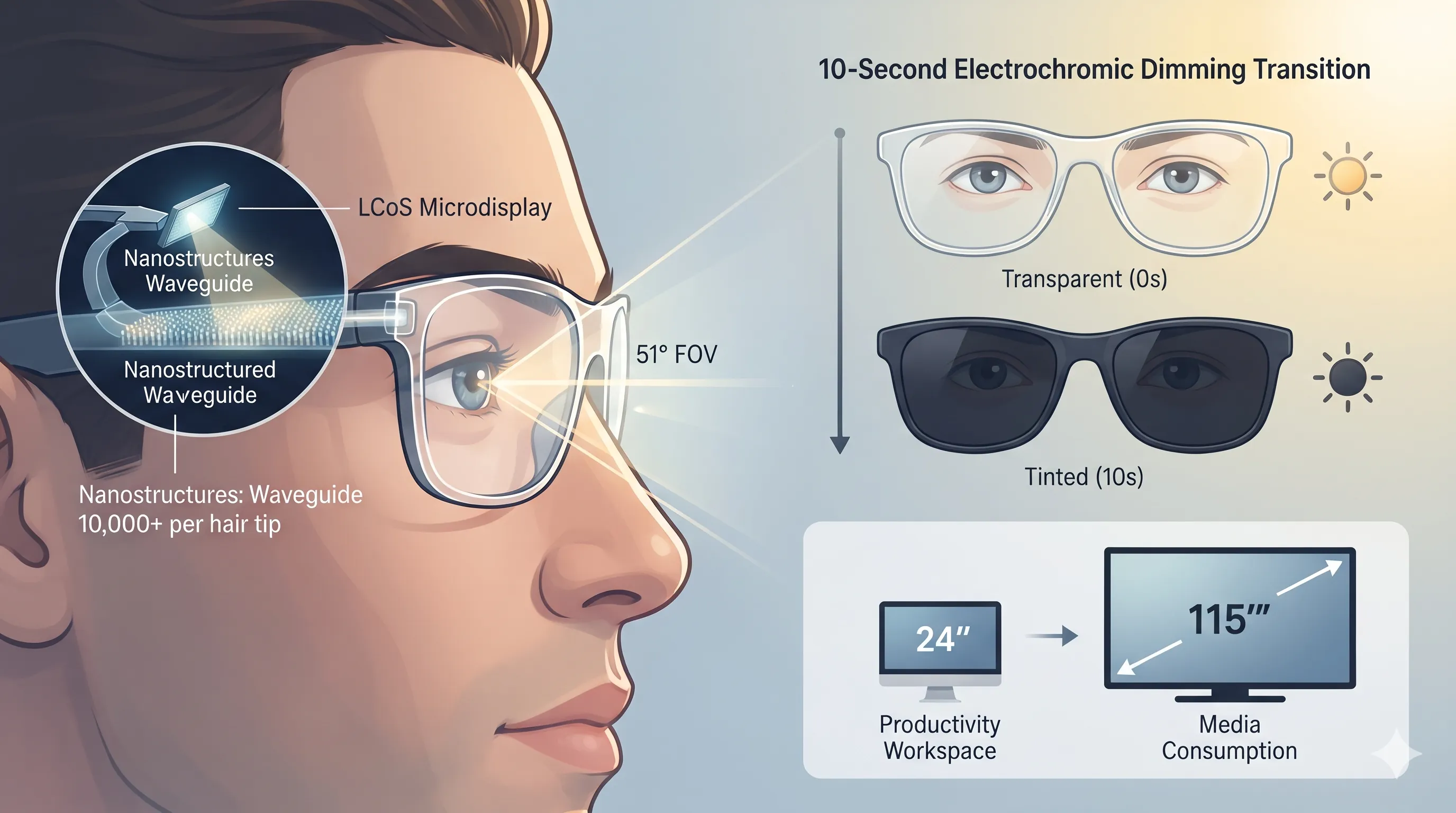
At the center of this visual pipeline is Snap’s proprietary liquid crystal on silicon (LCoS) display technology.
This system projects graphics across a 51-degree diagonal field of view while rendering up to 16 million colors.
To pipe imagery from the microdisplay directly to the user's retinas, the eyewear uses a redesigned waveguide architecture.
This waveguide integrates billions of nanostructures, engineered with such fine tolerance that over 10,000 nanostructures fit on a single hair tip.
Snap stated the redesigned waveguide creates a clearer and more seamless view of the surrounding world.
Crucially for interpersonal comfort, the see-through lenses allow wearers' eyes to remain visible from the outside during typical operation.
Dreamliner-Style 10-Second Electrochromic Dimming
Managing ambient light transitions without requiring clip-on shades or heavy physical shields is achieved through active electrochromic dimming technology.
The lenses employ electrochromic dimming technology identical to Boeing 787 Dreamliner passenger windows.
When triggered, the electrochromic lenses transition from completely transparent to deeply tinted in 10 seconds.
Engadget noted lenses appear fully blacked out like dark sunglasses when dimming is enabled.
This transition insulates the projected interface against strong sunlight, preserving visibility without forcing the optical engine to combat solar glare through raw, heat-generating illumination alone.
Visual Workspace Scale and Known Optical Limitations
The system scales dynamically depending on use-case demands.
Its visual output provides the perceived equivalent of a 24-inch desktop workspace monitor for productivity tasks, expanding up to a 115-inch cinema display from 10 feet away for media consumption.
Despite these advances, the optical assembly reveals distinct real-world limitations.
The embedded waveguides can produce rainbow-like reflections when wearers turn their heads under certain lighting conditions.
Furthermore, technical transparency remains partial; Snap did not disclose display resolution, nit brightness, or refresh rates for the hardware.
| Optical Specification / Attribute | System Metric / Implementation Detail |
|---|---|
| Display Engine | Proprietary liquid crystal on silicon (LCoS) |
| Field of View (FOV) | 51-degree diagonal |
| Color Capability | 16 million colors |
| Waveguide Density | Billions of nanostructures (over 10,000 per hair tip) |
| Electrochromic Dimming Speed | 10-second transition (transparent to tinted; Boeing 787 Dreamliner technology) |
| Virtual Scaling Perception | Equivalent of 24-inch workspace monitor up to 115-inch cinema display at 10 feet |
| External Lens Visibility | Eyes visible from outside when clear; appears like dark sunglasses when dimmed |
| Known Optical Artifacts | Rainbow-like reflections when turning head under certain lighting |
| Undisclosed Specifications | Display resolution, nit brightness, and refresh rate |
4. Untethered Computing: Dual Snapdragon Architecture and Ultra-Low Latency
Physical comfort in wearable augmented reality depends directly on eliminating cumbersome mechanical constraints.By completely shedding external processing pucks, smartphone cables, and wired harnesses, Snap’s Specs deliver a substantially more comfortable and natural user experience.
Achieving this degree of ergonomic freedom required Snap to build a fully standalone architecture from the silicon up, engineering an internal compute setup that functions without any tethered reliance.
Dual Snapdragon Processor Division of Labor
Snap avoided the tethered configurations common in earlier augmented reality hardware by engineering Specs around a fully standalone compute foundation.As highlighted by The Next Web, bypassing the external tethering pucks found in prior AR devices marks a distinct shift in wearable system design.
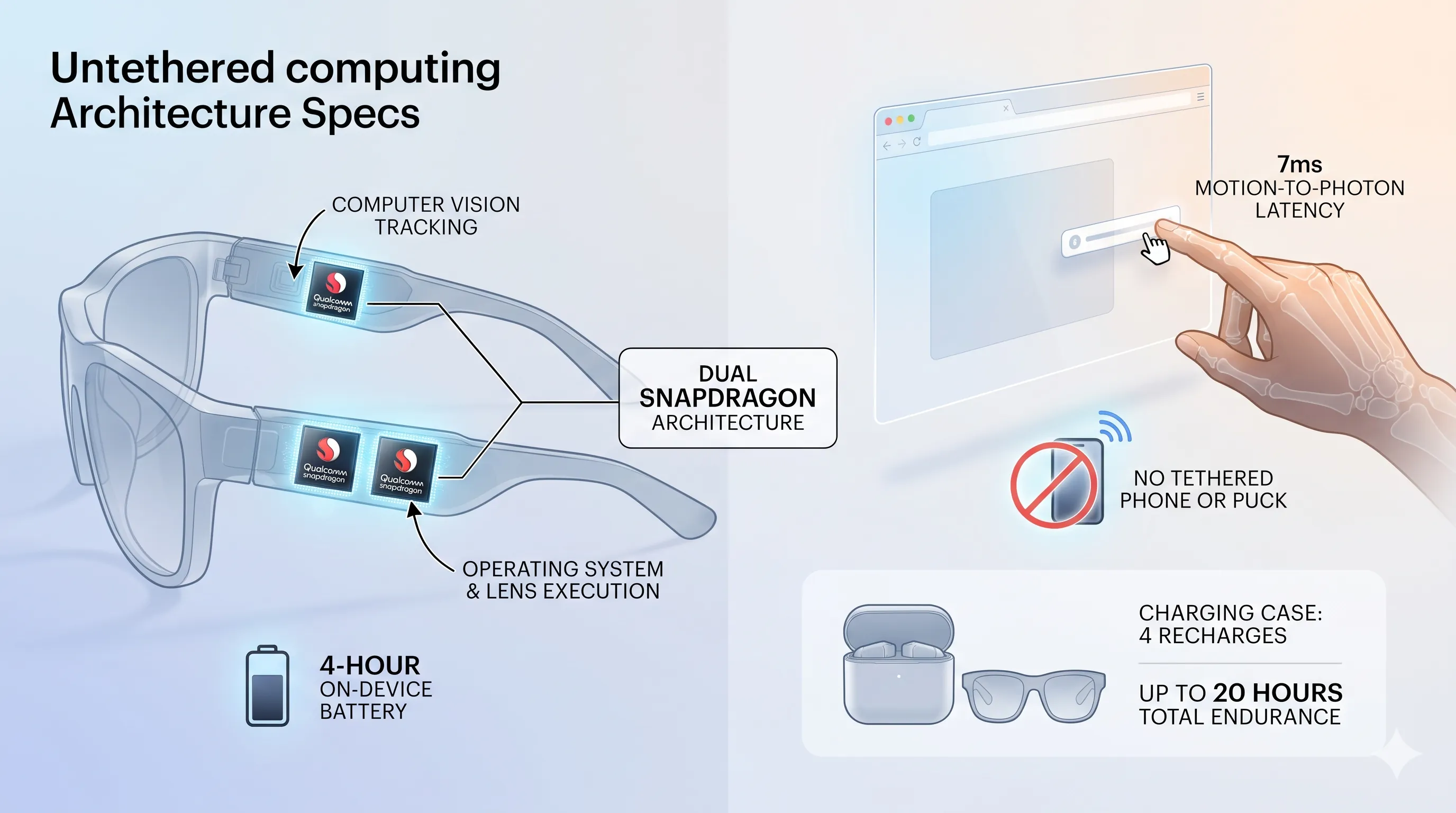
Snap emphasized that Specs operate as a self-contained platform requiring no cables, no smartphone link, and no separate compute accessories worn on the body.
At the core of this standalone framework is an architecture powered by 2 Qualcomm Snapdragon processors.
Rather than bottlenecking mixed workloads onto a single piece of silicon, Snap divided critical computational duties across the two chips.
One processor is dedicated exclusively to continuous computer vision tracking, while the second processor runs the operating system and drives Lens execution.
This dual-chip segregation isolates real-time perception tasks from general application workloads, preventing visual stutter and thermal hot-spotting.
Despite detailing this functional split, Snap has maintained strict confidentiality regarding lower-level hardware elements.
The company declined to disclose the specific Qualcomm Snapdragon chipset models utilized in the device.
Furthermore, Snap has not revealed the internal RAM capacity or the size of the built-in flash storage.
7-Millisecond Motion-to-Photon Latency and Tracking
The primary technical objective of delegating computer vision to an independent Snapdragon processor is reducing processing delays to near-zero levels.Specs achieve an ultra-low 7-millisecond motion-to-photon latency.
Minimizing this interval is vital for optical comfort, as perceptible lag between head motion and visual feedback is a primary cause of disorientation in optical see-through displays.
This low-latency pipeline directly powers the device's perception systems.
The dedicated vision processor sustains real-time hand tracking, allowing users to interact directly with digital interfaces using bare-hand gestures.
Additionally, the architecture maintains contextual anchoring, locking virtual assets firmly to physical surfaces in the environment without drifting or jittering as the wearer moves.
Battery Life Benchmarks and Charging Case Capacity
Managing dual independent processors alongside active optical tracking requires strict energy regulation within a lightweight glasses frame.On a single charge, Specs deliver up to 4 hours of mixed-use battery life.
This endurance allows wearers to conduct continuous interactive sessions untethered from external battery packs.
To support use away from fixed power outlets, the hardware ships with a dedicated charging case.
The included case supplies 4 extra recharges, expanding overall operational endurance to up to 20 total operating hours.
| System Dimension | Technical Specification / Implementation | Architectural Role and Operational Details |
|---|---|---|
| Processing Foundation | 2 Qualcomm Snapdragon processors | Segregated processing: one chip handles computer vision while the other powers the OS and Lens execution. |
| Motion-to-Photon Latency | 7 milliseconds | Ultra-low latency pipeline facilitating real-time hand tracking and contextual anchoring. |
| Physical Connectivity | Fully standalone | Operates with no cables, no tethered phone dependency, and no external compute puck. |
| On-Device Battery Life | Up to 4 hours | Continuous mixed-use operating endurance per standalone charge. |
| Charging Case Capacity | 4 recharges (up to 20 total hours) | Portable case provides 4 additional recharge cycles for extended deployment. |
| Undisclosed Specifications | RAM, storage, and exact chip models | Snap declined to disclose RAM size, internal storage capacity, and specific Snapdragon chipset models. |
5. Snap OS and Dual Frontier AI: Embedding OpenAI and Gemini Assistants
While Snap’s Specs achieve physical comfort through lighter chassis ergonomics, true wearable comfort requires reducing cognitive load and eliminating cumbersome inputs.Snap addresses this by transforming the device's operational layer, relying on an adaptable platform developed to minimize friction during prolonged spatial computing sessions.
Multi-AI Integration with OpenAI and Google Gemini
Snap CEO Evan Spiegel stated that Specs is positioned as a "new type of computer, a see-through computer" rather than a capture-only smart glass.To establish this computing tier, Snap shipped 10 Snap OS updates featuring over 40 APIs and features across an 18-month span.
This rapid operating system maturation is anchored by deep intellectual property, backed by more than 7,000 patents filed during the development of Specs.
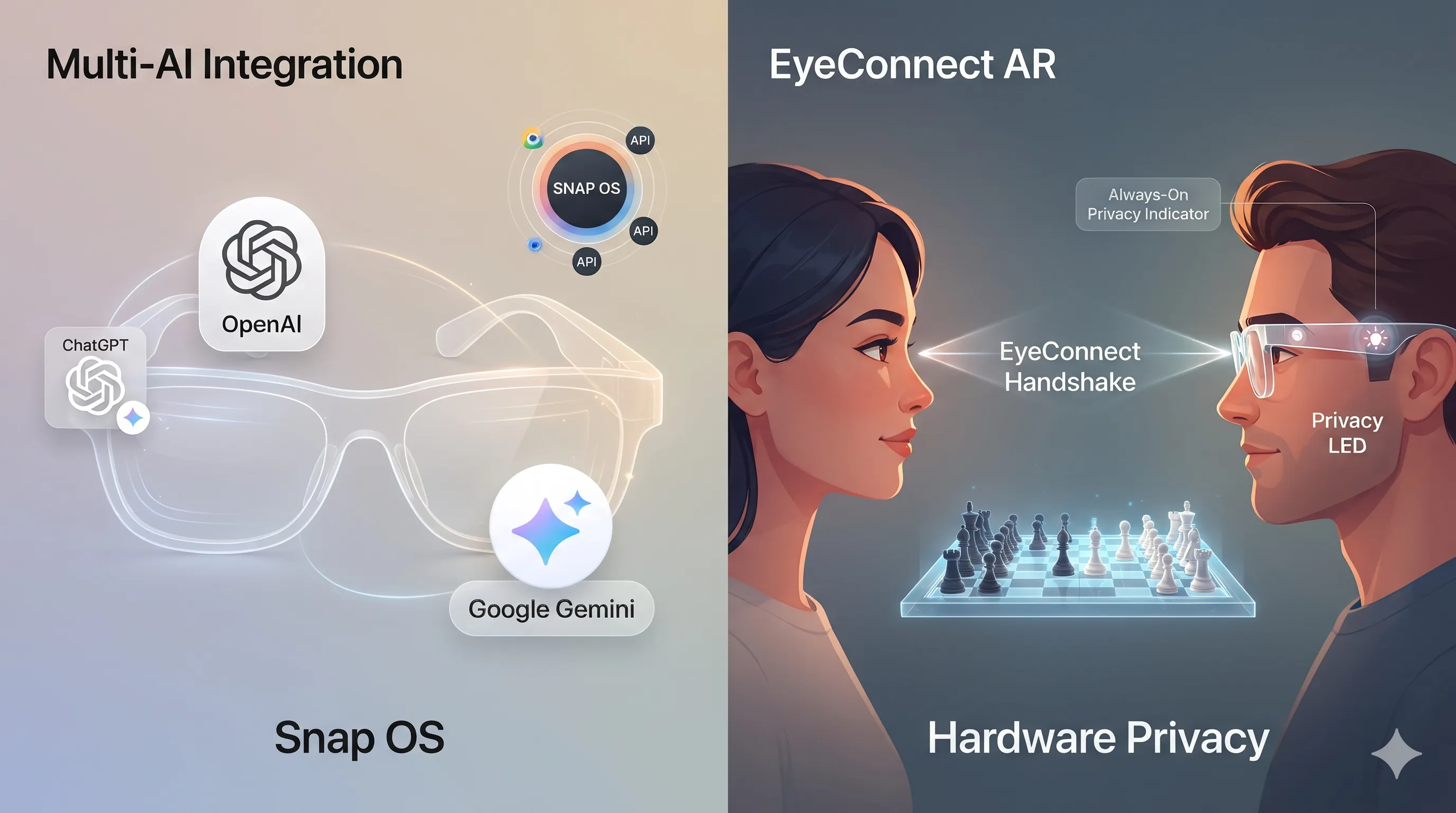
At the foundation of Snap OS is an open software architecture that natively embeds dual frontier AI assistants through partnerships with OpenAI and Google Gemini.
As industry analysis from AI Matters highlighted, Snap's open multi-AI architecture purposefully avoids single-vendor lock-in, enabling wearer interactions to leverage specialized model capabilities seamlessly within the display.
EyeConnect AR and Spatial Developer Frameworks
Beyond conversational intelligence, Snap OS integrates novel input and social interaction paradigms designed to keep visual computing intuitive.The operating system includes EyeConnect, a feature engineered to trigger shared AR multiplayer experiences immediately upon eye contact between wearers.
This hands-free handshake eliminates manual pairing hurdles, fostering immediate cooperative spatial interactions.
To support the creation and optimization of complex AR utilities, Snap equipped creators with dedicated developer tools across the ecosystem.
| Developer Tooling Component | Role in Snap OS Ecosystem |
|---|---|
| Lens Studio | Facilitates agentic development workflows for authoring spatial AR content and intelligent experiences. |
| Native Development Kit (NDK) | Empowers low-level software creation and custom application builds optimized directly for the device hardware. |
| Specs Spatial Benchmark | Enables standardized testing and performance profiling across spatial experiences to maintain fluid frame rates. |
Hardware Privacy Indicators and Lens Policy Boundaries
Sustained wearability in public environments requires strict boundaries protecting both wearers and bystanders.To establish explicit capture transparency, Specs includes an illuminating exterior privacy LED that activates whenever recording occurs.
However, user feedback and external assessments have noted practical challenges, as outside critics have questioned whether exterior recording LEDs remain sufficiently visible in daylight.
On the policy level, Snap enforces clear ethical limitations across its software surface.
Snap strictly bans facial recognition applications from its Lens ecosystem, blocking unauthorized biometric identification in real-world spaces.
Furthermore, the ecosystem incorporates safety safeguards for younger demographics, providing parental control toggles in the companion mobile app to restrict available Lenses for teenagers.
6. Market Viability: The $2,195 Price Tag, Enterprise Focus, and Daily Utility
While Snap’s Specs are now substantially more comfortable to wear, the commercial architecture surrounding the hardware reflects an intentional pivot toward high-end specialty tiers rather than immediate mass-market scale.Specs Inc. Spinout and $2,195 Commercial Pricing Structure
Snap executed a major organizational restructuring by spinning out its augmented reality hardware division into an independent subsidiary named Specs Inc.This spinout arrived in the wake of broader corporate workforce cuts of 16%, which eliminated approximately 1,000 employees across the parent organization.
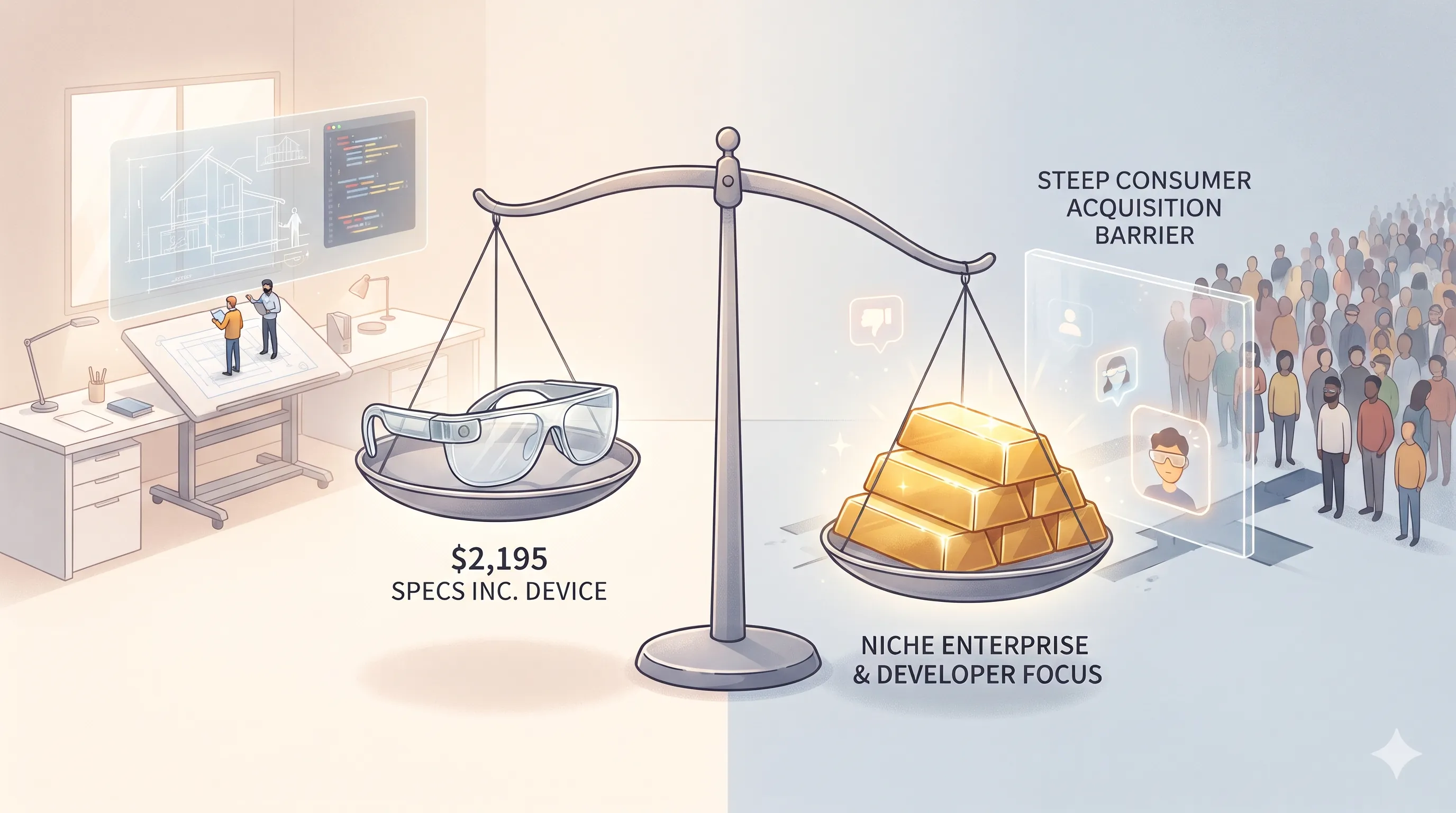
Operating under this restructured corporate vehicle, Specs Inc. established an official retail price of $2,195—commonly reported as approximately $2,200—requiring prospective buyers to submit a $200 refundable deposit to secure pre-orders.
Targeted initial commercial availability is limited to three regions: the United States, the United Kingdom, and France.
This commercial pricing structure places the hardware substantially higher than mass-market smart glasses and standard gaming consoles, establishing a steep barrier to consumer acquisition.
Addressing this valuation, Snap CEO Evan Spiegel acknowledged to Engadget that bringing the price point down over time remains a long-term goal for broader hardware accessibility.
Targeting Early Adopters, Developers, and Enterprise Creators
Given the premium cost profile, Specs Inc. has explicitly bypassed the mass consumer demographic.The hardware is commercially positioned for early adopters, developers, and enterprise creators who can justify the hardware expense for building spatial software or specialized workflows.
Despite this professional orientation, the platform incorporates entertainment and media integrations, featuring native support for streaming platforms such as HBO Max and YouTube.
Additionally, the system provides utility for focused document reading, attempting to bridge developer utility with passive digital media consumption.
| Commercial Dimension | Specs Inc. Strategic Profile | Commercial Adoption Factors |
|---|---|---|
| Target Audience | Early adopters, developers, and enterprise creators | Excludes mainstream consumer buyers to focus on specialized development and high-value workflows. |
| Retail Pricing | $2,195 retail (approx. $2,200); $200 refundable deposit | Stands substantially higher than mass-market smart glasses and standard gaming consoles. |
| Regional Availability | United States, United Kingdom, and France | Concentrates initial commercial deployment across three select Western markets. |
| Supported Applications | Focused document reading, HBO Max, and YouTube | Combines productivity document viewing with high-profile streaming entertainment integrations. |
| Corporate Structure | Dedicated subsidiary (Specs Inc.) post-restructuring | Followed broader parent corporate workforce reductions of 16% (approximately 1,000 employees). |
| Primary Usability Friction | Undefined daily productivity and public social stigma | Persistent friction surrounding hand gesture inputs and wearing large frames in public settings. |
Daily Utility Deficits and Public Social Stigma
Although the upgraded physical chassis ensures that Snap’s Specs are now more comfortable during wear, reviewers observed that physical refinement has not resolved fundamental software and functional ambiguity.TechCrunch reported that while the hardware form factor is dramatically improved, the device feels rudderless without a clear daily use case.
Reviewers consistently noted that the product lacks a defined everyday purpose, leaving widespread workplace productivity integration uncertain.
Compounding the undefined utility, external social dynamics present ongoing hurdles to regular usage.
Social stigma regarding wearing large glasses in public environments and relying on conspicuous hand gestures remains a distinct adoption barrier outside controlled studio or enterprise settings.
Related Posts


Generative AI may have assisted with research or drafting for this article. Topic selection, fact-checking, final wording, and publication remain the responsibility of DragonStone74. AI use disclosure