
Inside Google Cloud's Self-Managed Bare Metal VMware Architecture
🚀 Key Takeaways
- Full Root Governance: Organizations retain complete administrative control across ESXi, vCenter, and NSX Manager using portable Broadcom VCF software licenses.
- Dedicated Bare-Metal Compute: Workloads run on dedicated physical Compute Engine instances deployed directly inside consumer Google Cloud projects alongside native services.
- Advanced Underlay Networking: High-bandwidth host uplinks pair with Google's Andromeda network virtualization to dynamically emulate Layer 2 broadcast domains over Layer 3 VPCs.
- Scalable Edge Topologies: VMware NSX overlays connect seamlessly to Google Cloud networking fabrics through active-active BGP peering and Network Connectivity Center integration.
- Modern Hyperconverged Storage: Clusters utilize all-NVMe vSAN Express Storage Architecture supplemented by memory tiering and enterprise external datastores.
- Turnkey Automated Provisioning: Deployments are orchestrated rapidly via infrastructure-as-code toolkits with extensive operational support from global systems integration partners.
Enterprise infrastructure teams migrating mission-critical VMware environments have historically faced an uncomfortable compromise: accept the restricted administrative boundaries of managed cloud services, or endure the operational overhead of physical on-premises colocation. Google Cloud's bare-metal VMware architecture redefines this dynamic by providing dedicated, single-tenant physical servers that run self-managed VMware Cloud Foundation directly inside standard enterprise cloud projects.
This architectural approach matters now more than ever as organizations navigate shifting enterprise software licensing models and demand greater mobility for their existing virtualization investments. By pairing full hypervisor-level sovereignty with portable licensing, enterprises can preserve familiar operational playbooks, meet strict compliance mandates, and maintain end-to-end lifecycle control without rearchitecting foundational virtual machine workloads.
Beneath the surface, the solution brings together deep hardware-level orchestration and cloud-native software-defined networking. Examining how Google Cloud binds physical bare-metal hardware, Andromeda Layer 2 emulation, and software-defined storage fabrics reveals how enterprise virtualization can operate natively inside hyperscale cloud infrastructure.
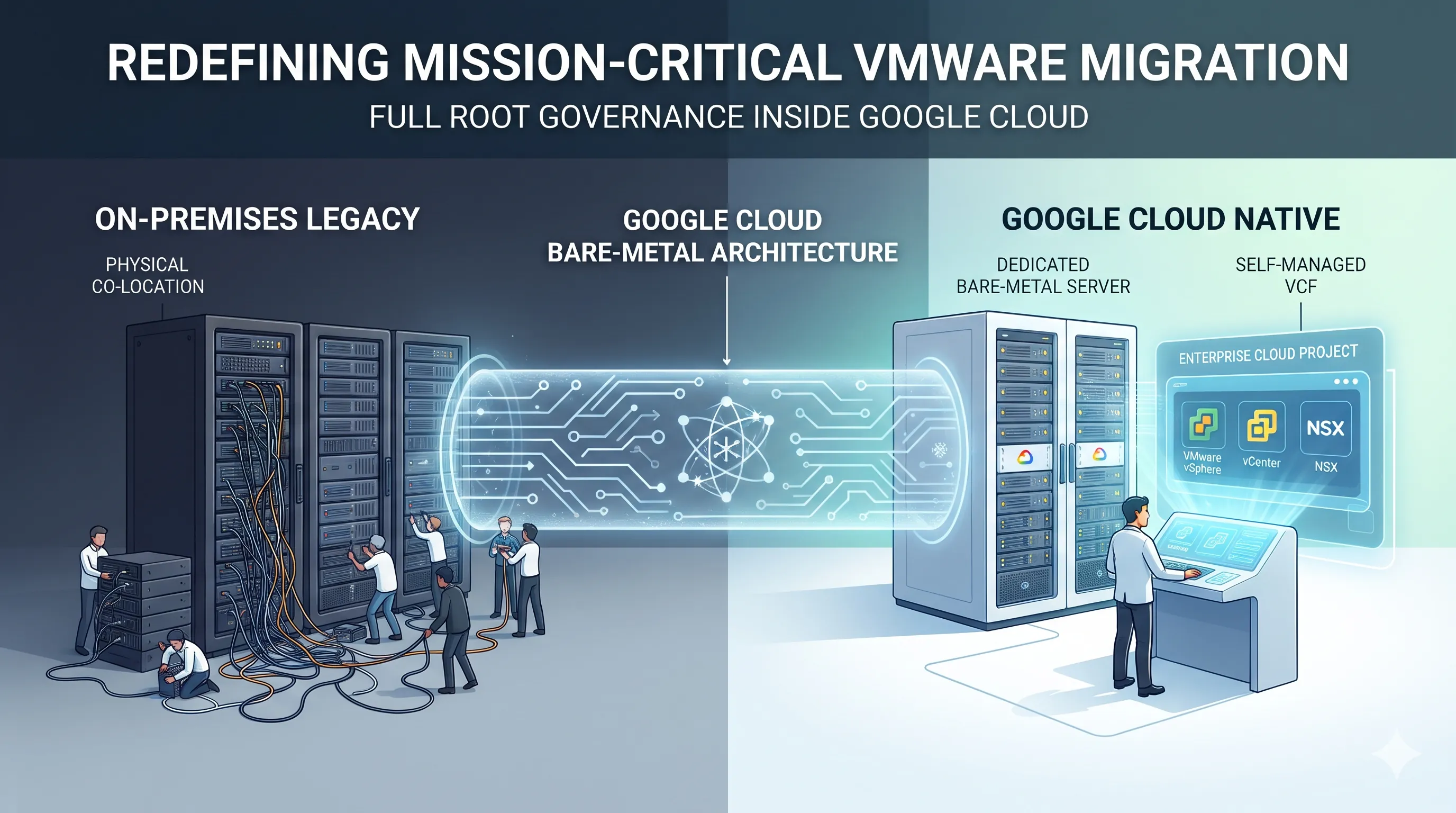
1. Operational Model and Control Separation: Bare Metal VCF 9.x vs. Managed GCVE
Understanding how Google Cloud's Bare Metal VMware works requires examining the fundamental shift in administrative boundaries and responsibility.By moving from a fully managed service to a self-managed bare-metal model, the architecture redefines how infrastructure control, licensing, and day-to-day operations are handled between Google Cloud and enterprise teams.
Full Root Privileges vs. Managed RBAC Constraints
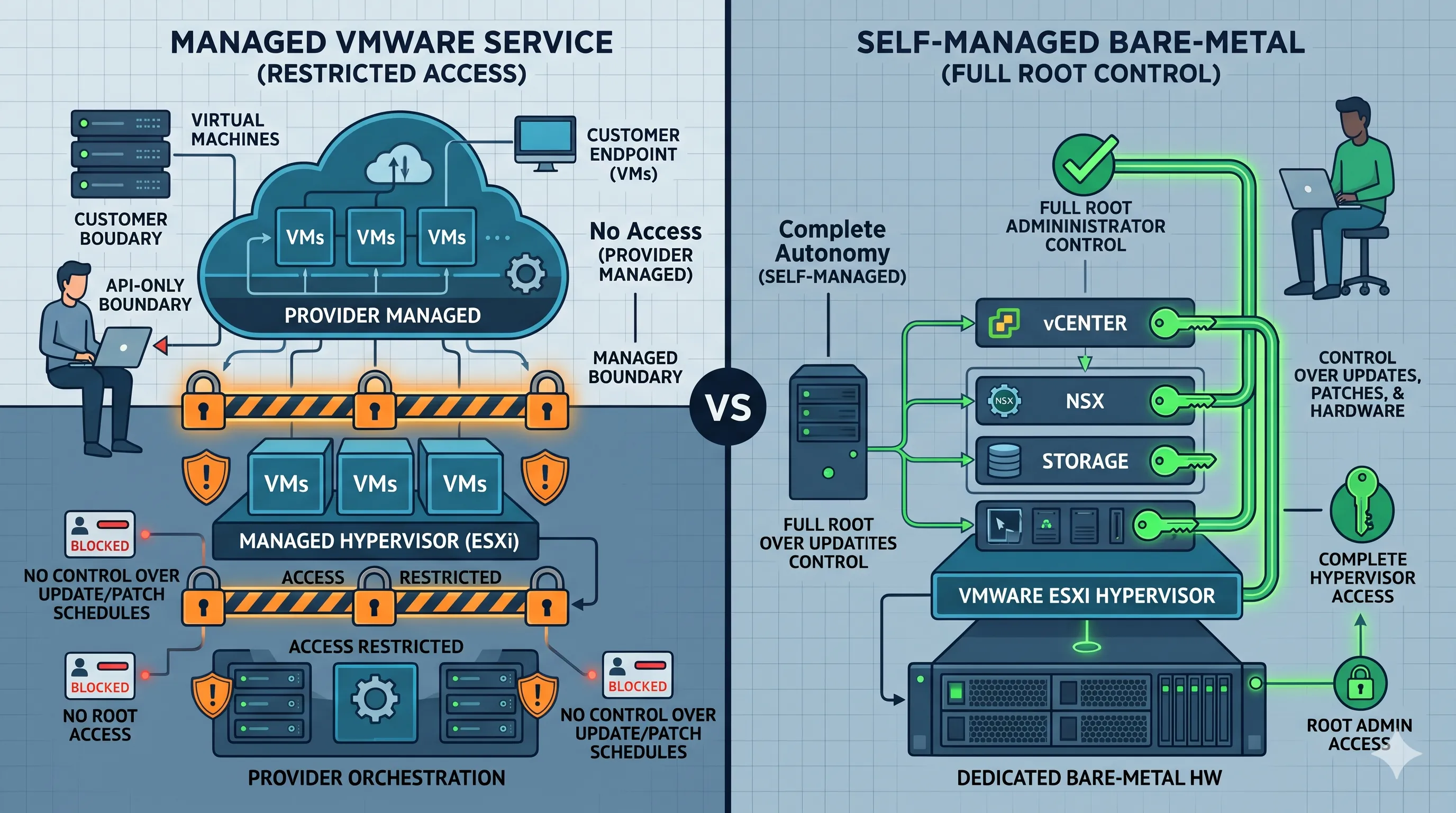
Under the managed Google Cloud VMware Engine (GCVE) framework, customer control is deliberately constrained.GCVE restricts customer control to role-based vCenter administrative privileges, preventing direct configuration access to lower-level hypervisors and core network managers.
This managed model runs VMware Cloud Foundation 5.2 on Google Cloud's ve1 and ve2 node families, where Google retains ownership of the underlying hypervisors.
In contrast, Google Cloud's dedicated bare-metal infrastructure inverts this operating structure.
Google provisions the physical bare-metal hardware and steps back from operating the virtualization stack entirely.
The bare-metal solution grants customers full root administrative access across ESXi, vCenter Server, and NSX Manager.
By holding root-level credentials, enterprise administrators gain complete sovereignty to customize configurations, modify hypervisor settings, and deploy software agents that were inaccessible under managed role-based access control constraints.
| Architectural Dimension | Managed Google Cloud VMware Engine (GCVE) | Bare Metal VMware Solution |
|---|---|---|
| Software Stack Version | VMware Cloud Foundation 5.2 | VMware Cloud Foundation (VCF) 9.x / 9.1 |
| Hardware / Node Families | ve1 and ve2 node families | Dedicated Google Cloud bare metal |
| Administrative Access Model | Restricted role-based vCenter administrative privileges | Full root administrative access across ESXi, vCenter Server, and NSX Manager |
| Stack Operations & Patching | Managed directly by Google Cloud | Customer- or partner-driven operations via VCF Operations tools; Google steps back from operating the virtualization stack |
| Licensing Structure | Integrated cloud-managed service licensing | Bring Your Own License (BYOL) portable Broadcom VCF subscriptions |
| Platform Upgrades & Migration | Standard managed lifecycle within GCVE | No automated migration tooling or native upgrade path from GCVE VCF 5.2 |
BYOL Portability and Broadcom VCF 9.x Lifecycle Ownership
The architectural shift to bare metal is closely tied to licensing changes introduced by Broadcom.Customers bring portable Broadcom VCF subscriptions (Bring Your Own License / BYOL) to run on dedicated bare metal.
Addressing this strategic alignment, Sunny Dua and Prashanth Bungale stated that Broadcom's launch of VCF 9.x was a key driver behind the self-managed offering.
Furthermore, Abhay Kumar noted that license portability allows customers to transfer existing subscriptions and run workloads unchanged.
Under this BYOL model, VMware Cloud Foundation (VCF) 9.x / 9.1 runs on dedicated Google Cloud bare metal.
Because Google provides the physical nodes without managing the software layer, operational authority transitions completely to the enterprise.
Lifecycle management, hypervisor patching, and software upgrades shift from Google to customer- or partner-driven operations via VCF Operations tools.
This puts version control, maintenance scheduling, and hypervisor-level operational cadence entirely into the hands of customer administrators or their certified integration partners.
Migration Hurdles from GCVE VCF 5.2
While the bare-metal operational model provides administrative freedom, it introduces architectural separation from existing cloud-managed estates.Google provides no automated migration tooling or native path to upgrade from GCVE VCF 5.2 to bare-metal VCF 9.x.
Organizations running environments on GCVE's ve1 and ve2 node families cannot execute an in-place automated upgrade to cross the boundary into self-managed VCF 9.x.
Because the control plane, hypervisor access model, and operational management systems differ fundamentally between the two offerings, transitioning workloads requires separate operational planning and execution.
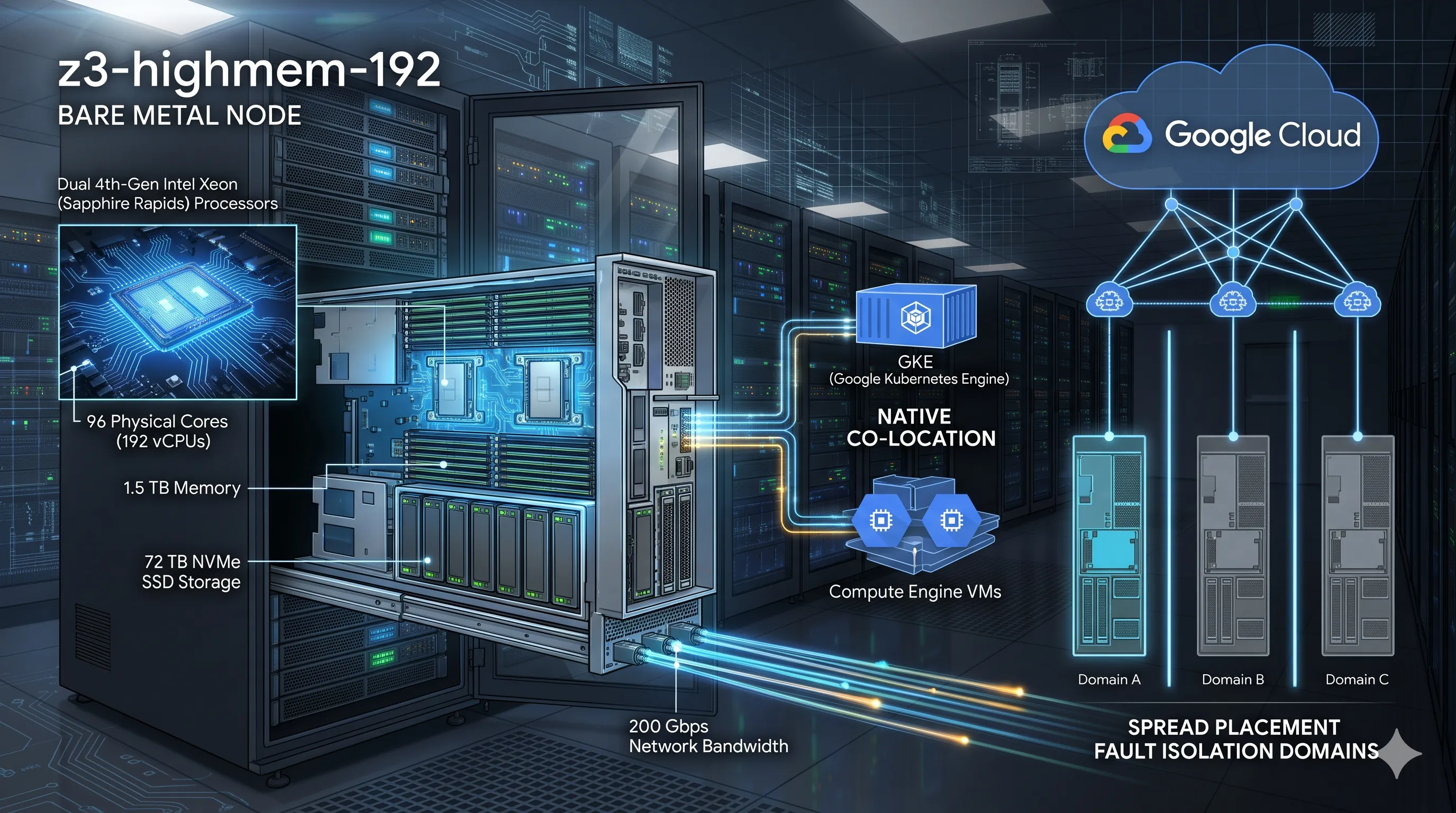
2. Physical Compute Architecture: Under the Hood of z3-highmem-192 Bare Metal Nodes
To understand how Google Cloud's Bare Metal VMware works, one must examine the physical compute layer that underpins the entire deployment model.Unlike nested virtualization or abstract virtualization layers, Google Cloud provisions raw hardware directly to hypervisors via dedicated Compute Engine z3-highmem-192-highlssd-metal instances.
This dedicated architecture establishes the baseline compute, memory, storage, and networking density required to host enterprise-grade VMware vSphere clusters without hypervisor-on-hypervisor performance penalties.
Sapphire Rapids Processing and Memory Density
At the core of each z3-highmem-192-highlssd-metal host are 2.2 GHz 4th-generation Intel Xeon Processors, known as Sapphire Rapids.Each bare-metal node delivers 96 physical cores and 192 hyper-threads, ensuring high execution capacity for consolidated virtual workloads.
Memory density is matched to these compute resources with 1.5 TB of memory per host node, accommodating memory-intensive enterprise databases and large virtual machine footprints.
Local high-speed persistence is achieved through 72 TB of directly attached all-flash local NVMe SSD storage built into each physical node.
To prevent interconnect contention during intense vSAN clustering and live migration traffic, each bare-metal host integrates a network interface rated at 200 Gbps of throughput.
| Hardware Specification Dimension | z3-highmem-192-highlssd-metal Resource Configuration |
|---|---|
| Processor Model | 2.2 GHz 4th-generation Intel Xeon Processors (Sapphire Rapids) |
| Physical Compute Density | 96 physical cores (192 hyper-threads) |
| Total Host Memory | 1.5 TB memory |
| Direct Local Storage | 72 TB directly attached all-flash local NVMe SSD storage |
| Networking Throughput | 200 Gbps per bare-metal host |
| Instance Platform Type | Dedicated Compute Engine bare-metal instance |
Native Project Co-location with GKE and Compute Engine
A foundational element of Google Cloud's bare metal VMware approach is project boundary integration.Rather than isolating VMware infrastructure in a separate managed tenant network or walled-off third-party enclave, these bare-metal instances operate natively within the consumer Google Cloud project.
This enables z3-highmem-192-highlssd-metal nodes to run alongside native Compute Engine instances and Google Kubernetes Engine (GKE) clusters within the same project construct.
Operating within the consumer project streamlines direct network topology, access policies, and resource management across bare-metal virtualization and containerized services.
Fault Isolation via Spread Placement Policies
To maintain high availability across underlying hardware pools, physical host distribution cannot be left to chance.Google Cloud utilizes Compute Engine spread placement policies for the bare-metal fleet.
These spread placement policies physically isolate instances across distinct failure domains within an availability zone.
By ensuring that member nodes of a vSphere cluster do not share common rack or enclosure components, spread placement policies protect clusters against localized hardware disruptions and rack-level outages.
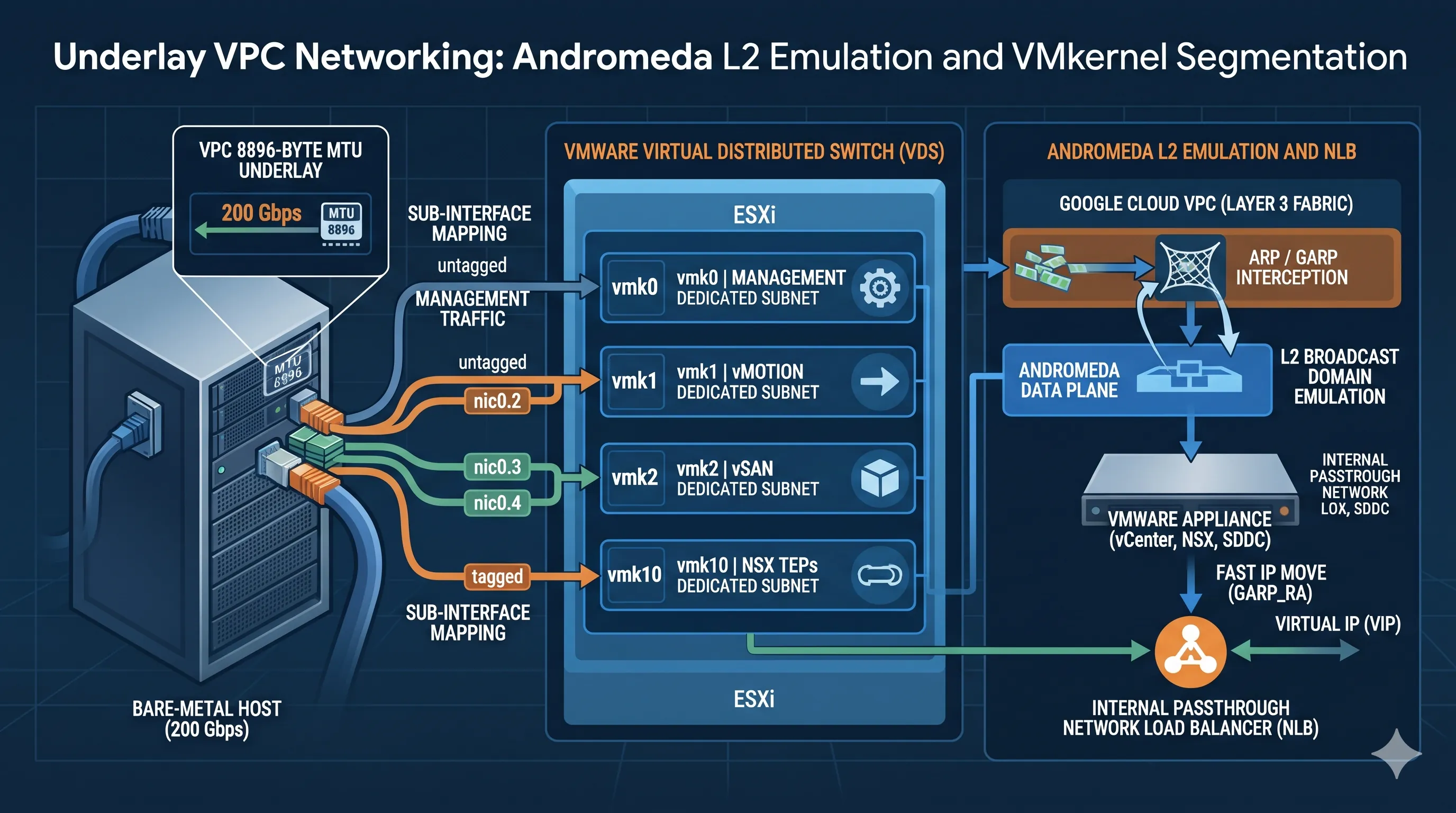
3. Underlay VPC Networking: Andromeda L2 Emulation and VMkernel Segmentation
To understand how Google Cloud's Bare Metal VMware works, it is essential to examine the underlying network architecture that links physical server hardware directly to Google Cloud Virtual Private Cloud (VPC) infrastructure.This layer provides the high-bandwidth physical fabric, traffic segmentation, and software-defined network emulation necessary to operate VMware vSphere environments natively within Google Cloud.
VPC 8896-Byte MTU Underlay and Sub-Interface Mapping
Bare-metal hosts connect to the network fabric using a 200 Gbps physical network interface.To accommodate the encapsulation overhead required by enterprise virtualization workloads, the VPC underlay network requires an 8896-byte maximum transmission unit (MTU).
Compute Engine exposes this physical fabric to the ESXi hypervisor by mapping the physical interface to ESXi as a primary virtual network interface named nic0, which is designated for untagged management traffic.
To segregate additional traffic classes over the same physical connection, dynamic sub-interfaces—specifically nic0.2, nic0.3, nic0.4, alongside additional VLAN interfaces—handle 802.1Q tagged traffic.
As an architectural prerequisite, the consumer Google Cloud project must have VLAN-based networking enabled prior to node provisioning.
VDS Segmentation across Management, vMotion, vSAN, and TEPs
Network traffic separation on the hypervisor is enforced using the VMware Virtual Distributed Switch (VDS).The VDS segments distinct VMkernel traffic streams into dedicated subnets across the host's physical and tagged sub-interfaces.
| VMkernel Interface | Traffic Function | Target Subnet Designation |
|---|---|---|
| vmk0 | Management | Dedicated management subnet |
| vmk1 | vMotion | Dedicated vMotion subnet |
| vmk2 | vSAN | Dedicated vSAN storage subnet |
| vmk3 or vmk10 | NSX Tunnel Endpoints (TEPs) | Dedicated overlay transport subnet |
Andromeda L2 Emulation and NLB Fast IP Move VIP Handling
Because Google Cloud VPC networks operate as routed Layer 3 fabrics, native broadcast domains do not exist in the physical underlay.To bridge this gap for VMware components requiring Layer 2 adjacencies, designated VPC subnets intercept Address Resolution Protocol (ARP) and Gratuitous ARP (GARP) frames.
This interception mechanism enables Google Cloud's Andromeda data plane to dynamically learn VMware MAC addresses and emulate Layer 2 broadcast domains across the underlying infrastructure.
Core management appliances—including vCenter Server, SDDC Manager, and NSX Manager—deploy directly onto Layer 3 VPC subnets.
To maintain high availability and preserve communication when these virtual appliances migrate between physical hosts, the architecture utilizes internal passthrough Network Load Balancers.
These load balancers employ Fast IP Move (GARP_RA) mechanisms to immediately re-steer Virtual IP (VIP) traffic to the appropriate host location following a migration event.
4. Overlay Topologies: NSX Edge Routing, Geneve Encapsulation, and Cloud Router Peering
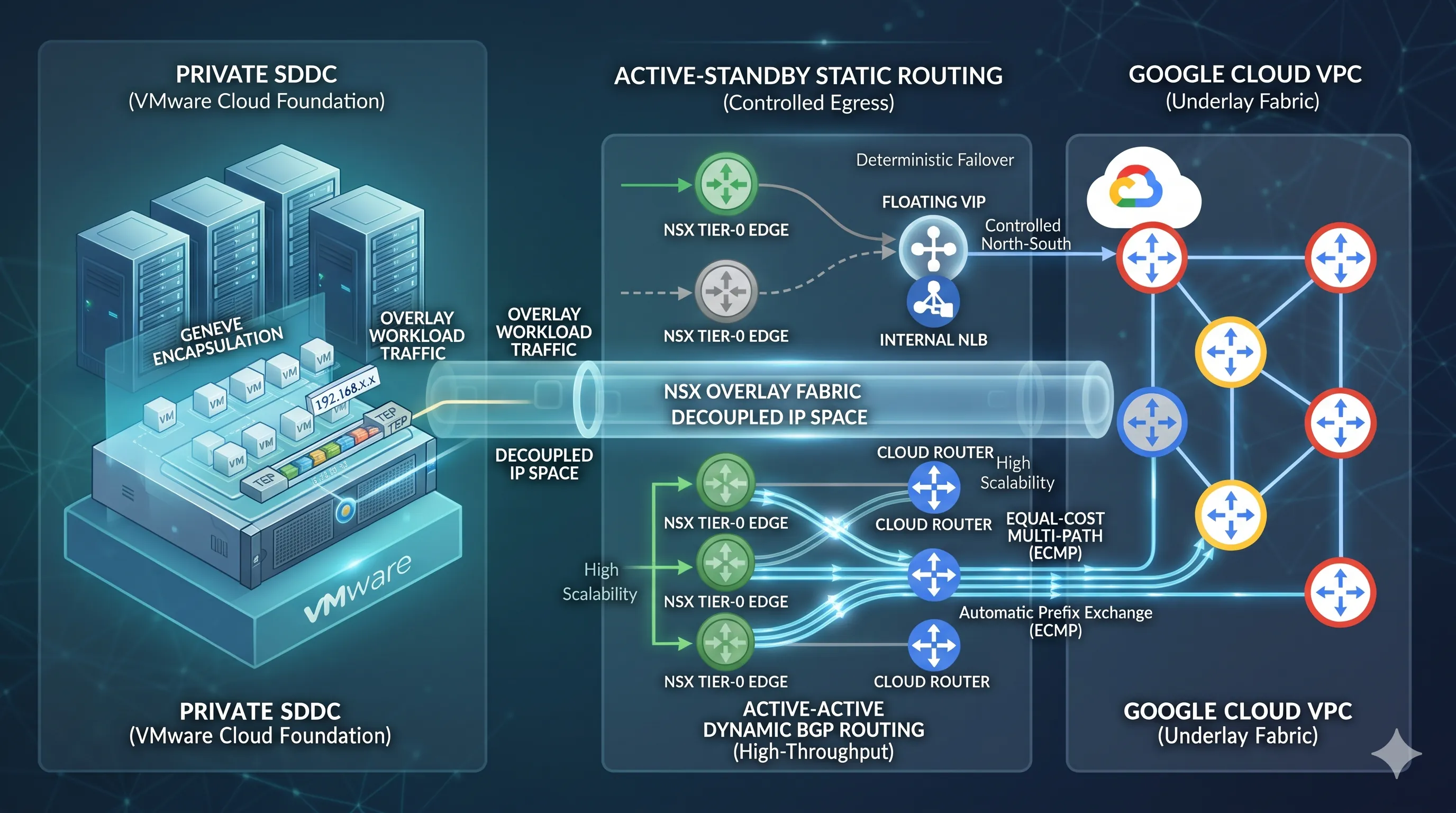
In Google Cloud's Bare Metal VMware architecture, network virtualization acts as the bridge connecting private software-defined data center environments directly to Google Cloud's hyper-scale network infrastructure.Decoupling underlying physical fabrics from tenant virtual machines requires a structured overlay model capable of supporting isolated workload addressing, deterministic egress patterns, and high-throughput edge connectivity.
Geneve Encapsulation and Overlay Workload Isolation
The foundation of overlay networking in Google Cloud's Bare Metal VMware environment relies on VMware NSX network virtualization.VMware NSX encapsulates guest workload traffic into Geneve (Generic Network Virtualization Encapsulation) frames exchanged directly between host Tunnel Endpoints (TEPs).
By encapsulating layer 2 and layer 3 packet headers within Geneve tunnels at the hypervisor level, the virtualization layer completely decouples virtual machine IP address spaces from the underlying Google Cloud Virtual Private Cloud (VPC) underlay.
This architectural separation allows enterprise workloads to retain existing, overlapping, or non-routable CIDRs inside the VMware environment without requiring address re-architecting across the broader VPC network.
Active-Standby Static Routing via Floating VIPs
Connecting NSX overlay networks to native VPC resources can be executed through a deterministic static routing model.Static VPC routing operates in an active-standby topology designed for controlled north-south egress and ingress traffic.
Under this deployment design, overlay CIDRs defined in VPC routing tables are steered toward a single floating Virtual IP (VIP).
This floating VIP is fronted by a Google Cloud regional internal passthrough Network Load Balancer (NLB), ensuring predictable health checking and traffic forwarding across the redundant edge tier to maintain reachability during failover events.
Multi-Edge Active-Active Dynamic Routing with NCC and eBGP
For higher scalability and dynamic path establishment, Google Cloud Bare Metal VMware supports dynamic BGP routing deployed in an active-active model.This topology establishes external BGP (eBGP) peering sessions between NSX Tier-0 Edge nodes and Google Cloud Router instances via Network Connectivity Center (NCC) Router Appliance.
Dynamic routing scales significantly beyond static routing limits, supporting up to 8 NSX Tier-0 Edge nodes operating concurrently in active-active topologies.
With multi-edge active-active peering enabled, the architecture leverages Equal-Cost Multi-Path (ECMP) routing across all available Tier-0 paths.
Furthermore, dynamic routing facilitates automatic prefix exchange across the cloud fabric, eliminating manual route management and maximizing north-south bandwidth utilization between VMware workloads and Google Cloud services.
| Routing Architecture | Operational Topology | Peering and Forwarding Mechanics | Edge Capacity and Multipathing |
|---|---|---|---|
| Static VPC Routing | Active-standby | Overlay CIDRs steered toward a floating VIP fronted by a regional internal passthrough Network Load Balancer | Deterministic single-path failover |
| Dynamic BGP Routing | Active-active | eBGP peering between NSX Tier-0 Edge nodes and Cloud Router instances via Network Connectivity Center (NCC) Router Appliance | Supports up to 8 NSX Tier-0 Edge nodes with Equal-Cost Multi-Path (ECMP) routing and automatic prefix exchange |
5. Hyperconverged Storage and Memory Tiering: vSAN ESA and NetApp Integrations
In analyzing how Google Cloud's Bare Metal VMware works, the physical architecture relies on a closely coupled data and memory layout to deliver performance and resilience.Storage and memory resource allocation directly define node economics and workload isolation across the bare-metal infrastructure.
vSAN ESA All-Flash Local Storage and Erasure Coding
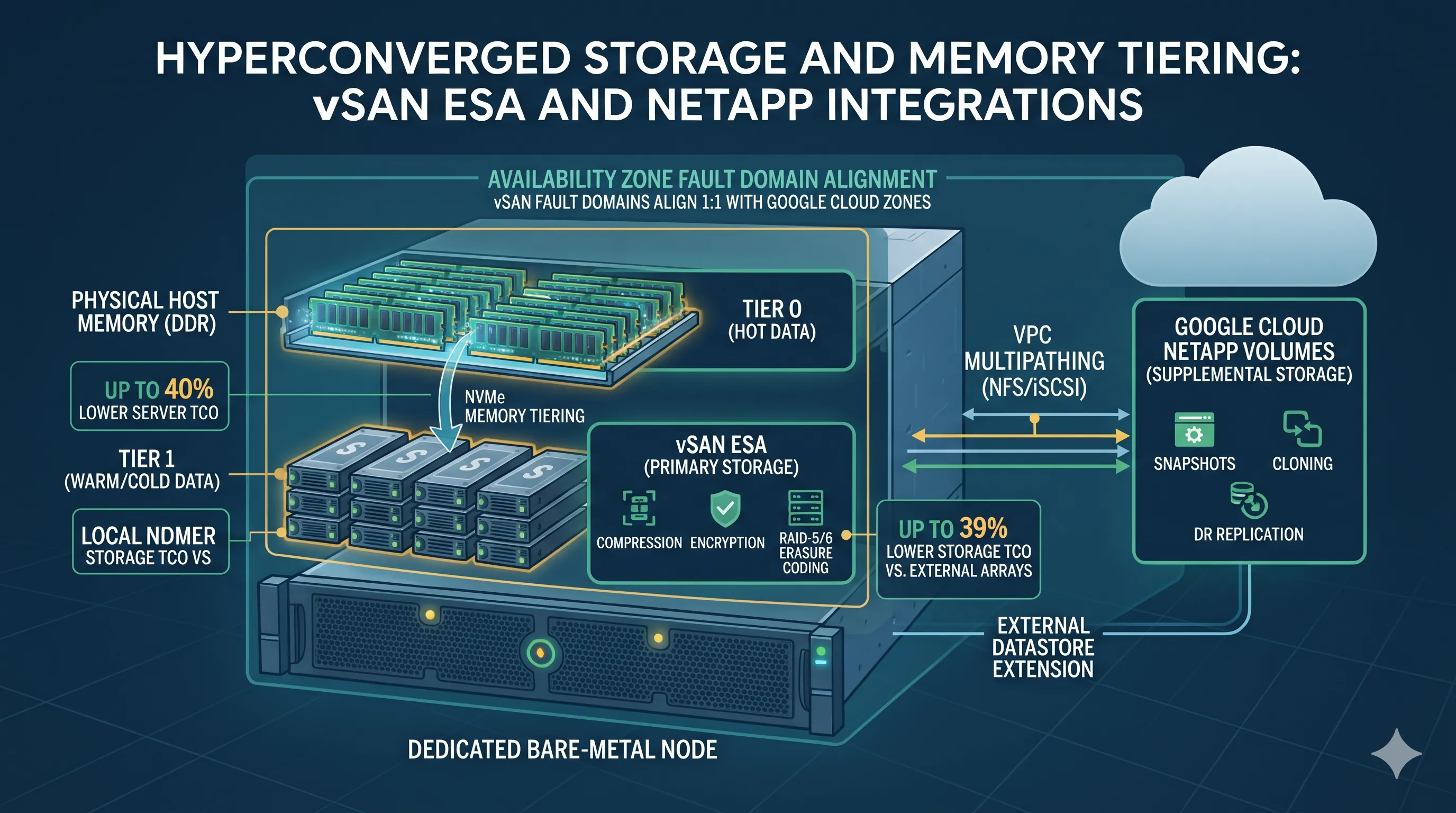
VMware vSAN Express Storage Architecture (ESA) serves as the primary hyperconverged storage tier in this bare-metal design.The architecture directly leverages local NVMe SSDs installed on physical host servers rather than relying on legacy disk pools.
Under vSAN ESA, enterprise storage efficiencies are enforced natively within the single storage tier, offering integrated compression and encryption.
For data protection and capacity optimization, the architecture utilizes RAID-5 and RAID-6 erasure coding directly across the NVMe drives, eliminating traditional write penalties while maintaining resilience against hardware failure.
Memory Tiering and Fault Domain Alignment
Physical host memory is extended beyond conventional system DRAM through a two-tiered memory architecture.This design establishes NVMe memory tiering partitioned between physical DDR memory operating as Tier 0 and local NVMe storage functioning as Tier 1.
By moving colder pages to local high-speed solid-state drives, the tiering architecture claims up to 40% lower server total cost of ownership (TCO).
Hardware-level resiliency links software clusters directly to cloud boundaries.
VMware vSAN fault domains align 1:1 with Google Cloud availability domains within the cluster placement policy.
This strict alignment ensures that physical host, rack, or underlying availability domain failures are isolated, maintaining quorum and preventing multi-node outages from crashing distributed vSAN storage groups.
| Storage / Memory Layer | Hardware Media & Protocols | Core Technical Capabilities | Reported TCO Metric |
|---|---|---|---|
| vSAN ESA (Primary Storage) | Local NVMe SSDs | Native compression, encryption, and RAID-5/RAID-6 erasure coding | Up to 39% lower storage TCO vs. external storage arrays |
| NVMe Memory Tiering | DDR memory (Tier 0) and Local NVMe (Tier 1) | Two-tier memory offloading between DDR and local high-speed NVMe | Up to 40% lower server TCO |
| Google Cloud NetApp Volumes (Supplemental Storage) | NFS and iSCSI protocols over VPC multipathing | Snapshots, cloning, and replication for external datastore extensions | Unspecified |
Supplemental NetApp Volumes and TCO Claim Analysis
Workloads requiring external datastore capacities beyond local hyperconverged pools rely on Google Cloud NetApp Volumes.NetApp Volumes functions as supplemental datastore storage delivered via Network File System (NFS) datastores, which include support for native snapshots, cloning, and disaster recovery replication.
For block-level requirements, NetApp Volumes also delivers iSCSI block storage accessed over Virtual Private Cloud (VPC) multipathing.
Pravjit Tiwana of NetApp highlighted the addition of NetApp Volumes as an external datastore target, expanding capacity scaling independent of compute nodes.
From an enterprise operational perspective, Scott Ronan of GXO Logistics stated an early assessment showed potential in separating hardware lifecycle from virtualization.
Despite strong positioning around infrastructure savings—specifically the claims of up to 39% lower storage TCO compared to external arrays and up to 40% lower server TCO from NVMe memory tiering—the figures face scrutiny.
Both the 40% server and 39% storage TCO reduction claims were published without baseline hardware configurations or specific evaluation methodologies disclosed.
Without clear baseline comparative data, enterprise architects must independently validate compute ratios, access latencies, and real-world endurance across their targeted hyperconverged workloads.
6. Automated Deployment Mechanics, Patching, and Day-2 Partner Ecosystem
To understand how Google Cloud's Bare Metal VMware works in production, it is essential to examine the orchestration layers that transition raw physical infrastructure into a running VMware Cloud Foundation (VCF) environment.While the underlying compute consists of dedicated physical servers, the operational lifecycle depends on automated provisioning toolkits, targeted hypervisor live patching, and enterprise systems integrators capable of managing the stack.
Terraform and Solution Toolkit Deployment Workflow
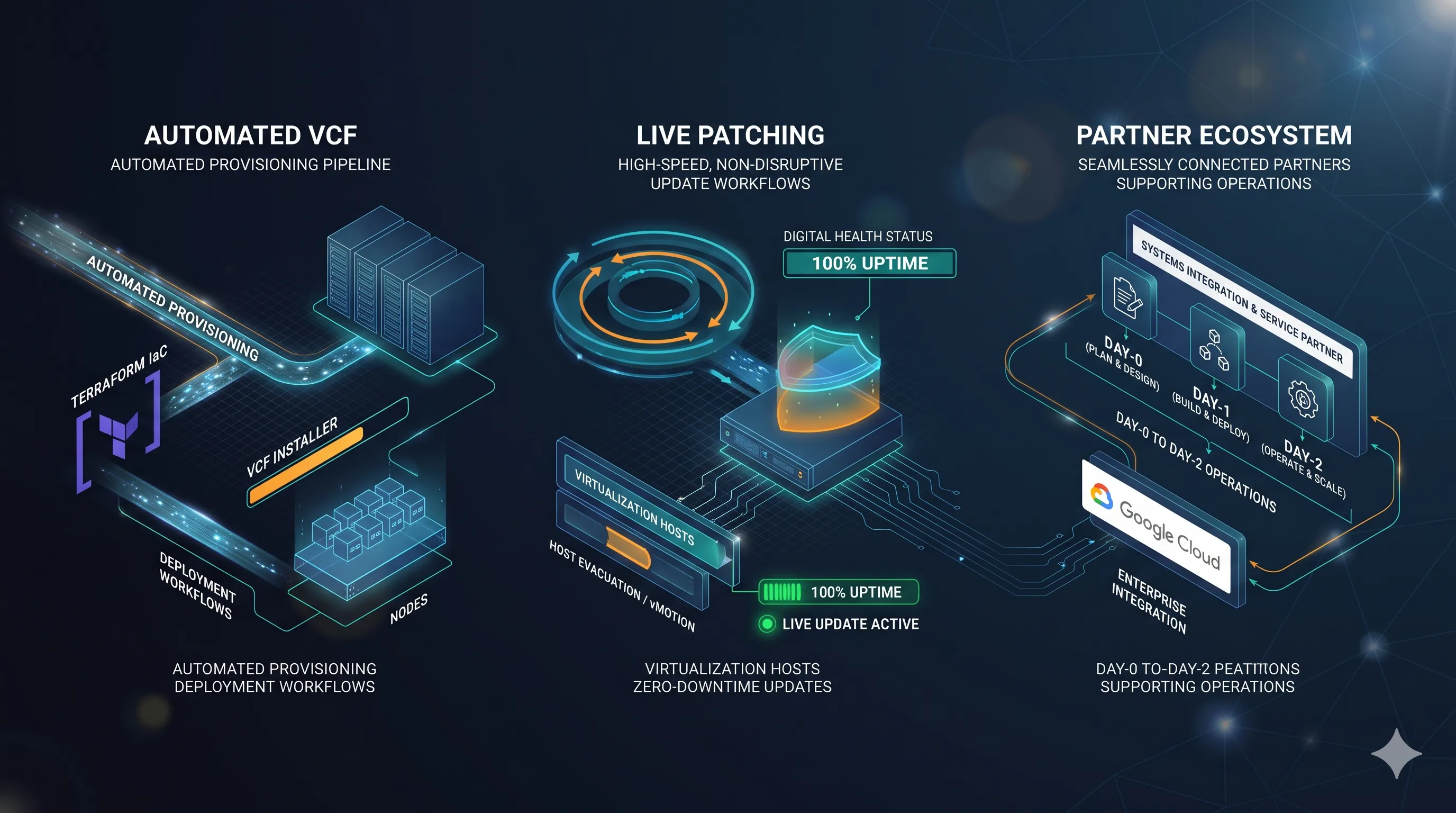
The initial standup of a bare-metal VMware environment on Google Cloud relies on automated provisioning rather than manual hypervisor installations.Deployment is orchestrated using a specialized VMware solution toolkit, which administrators can execute directly via the Google Cloud console or programmatically through Terraform.
Before triggering the toolkit, specific networking prerequisites must be pre-configured inside the Virtual Private Cloud (VPC) topology.
These prerequisites require pre-existing subnets dedicated to management, vSAN, vMotion, and two NSX network segments.
Once networking connectivity is established, the automated workflow initiates the provisioning sequence.
The automation engine deploys bare-metal ESXi hosts with spread placement across the infrastructure to eliminate single points of physical failure.
The workflow proceeds to automatically configure host VMkernel interfaces, establish integration with Cloud DNS, and boot the VCF Installer appliance directly on the target cluster.
This orchestrated pipeline minimizes manual configuration errors and ensures that the physical nodes, software-defined networking, and core storage fabrics adhere to baseline architecture requirements prior to domain initialization.
Live Patching Capabilities and Operational Overhead
Once the bare-metal environment is live, long-term operations shift to lifecycle maintenance, patch administration, and security hygiene.To minimize the impact on running workloads, the bare-metal solution supports up to 80% active live patching coverage for critical security updates without planned downtime.
This live patching capability allows administrators to remediate urgent vulnerabilities at the hypervisor tier while avoiding the disruption of evacuating hosts or taking production clusters offline.
However, the self-managed nature of the deployment model places direct operational responsibility on the customer.
Consultancy partner Xtravirt noted that full control over a VCF estate is only valuable if an organization is willing to assume patching and operational duties.
Unlike fully managed services where the cloud provider silently absorbs routine maintenance, running bare-metal VCF requires an engineering organization prepared to monitor, patch, and maintain the hypervisor, storage, and networking layers over time.
Regional Availability, Pricing Gaps, and the Partner Ecosystem
The delivery model for bare-metal VMware on Google Cloud combines broad physical availability with partner-driven operational support, though several commercial details were constrained at launch.The solution launched generally available across 22 Google Cloud regions.
Despite reaching general availability across 22 operational footprints, the initial announcement omitted the specific list identifying which 22 regions currently support the offering.
Furthermore, Google Cloud published no official pricing catalog or service level agreements (SLAs) at general availability, leaving commercial terms and uptime commitments reliant on enterprise contractual channels.
To bridge the operational gap inherent in running self-managed environments, Google identified 15 launch partners offering Day 0 to Day 2 managed operations.
These systems integrators provide partner-managed support across architectural planning, migration, and continuous maintenance.
The ecosystem includes:
- Accenture
- Cognizant
- Devoteam
- HCL
- IBM
- Infosys
- Insight
- LiverX
- ModernZ
- Pellera
- Quantiphi
- TCS
- Wipro
- Xtravirt
Related Posts

The 2026 Definitive Guide to Gemini 3 Deep Think: Reshaping the Future of Sciencefrom Gemini 3 Deep Think's Debut Specialized AI: Gemini 3 Deep Think is Google DeepMind's new,...

The 2026 Definitive Guide to AI-Powered Genetic ConservationAlphaFold 3 Transforms Conservation: The latest AlphaFold 3 prediction model dramatically...

Project Genie: The Definitive 2026 Guide to Building AI-Powered Interactive WorldsProject Genie introduces **Generative Interactive Environments (GIEs)**, creating fully playable...
Generative AI may have assisted with research or drafting for this article. Topic selection, fact-checking, final wording, and publication remain the responsibility of DragonStone74. AI use disclosure