
Inside Cloudflare's Web Search API: Real-Time Grounding for AI Agents
🚀 Key Takeaways
- Unified Web Search Layer: Delivers dynamic real-time grounding for AI agents directly through Cloudflare AI Gateway, removing the need for manual scraping pipelines or URL guesswork.
- Normalized Multi-Provider Schema: Standardizes query outputs across diverse search providers into a consistent structure, enabling provider switching without altering application parsing logic.
- Frictionless Developer Access: Offers immediate edge execution via Cloudflare Workers AI bindings alongside standard REST endpoints for external backend architectures.
- Consolidated Billing and Observability: Aggregates search requests, runtime latency, and provider costs into the same unified gateway dashboard alongside model inference logs.
- Publisher Transparency Standards: Enforces verified bot protocols, robots.txt compliance, and mandatory source attribution to maintain web indexing integrity.
- Enterprise Security & Data Privacy: Incorporates prompt injection defenses and supports Zero Data Retention compliance to protect proprietary workflows and sensitive user queries.
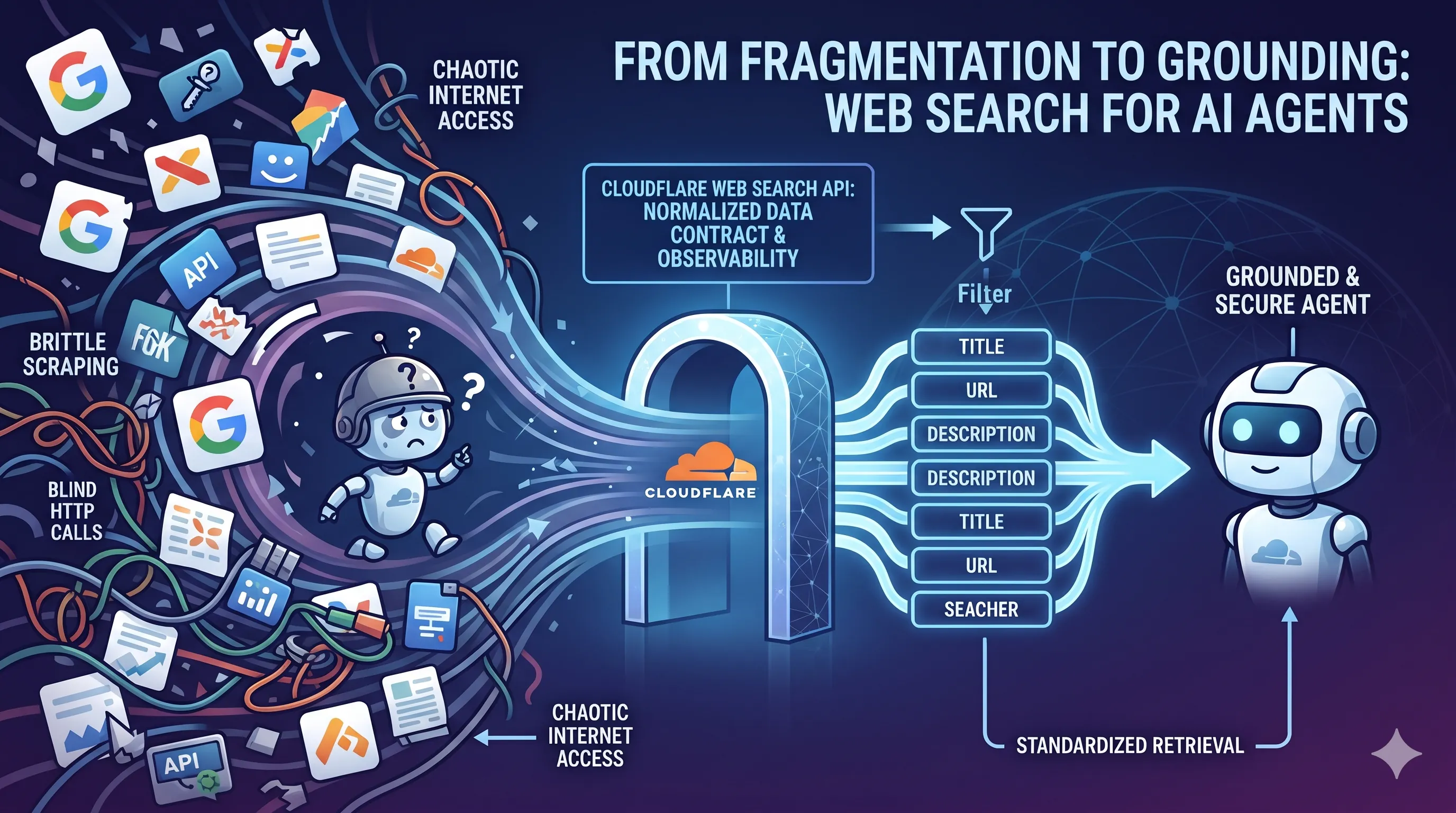
Autonomous AI agents frequently stumble when required to gather fresh, real-time knowledge from the open internet. Historically, engineering teams have had to juggle brittle custom scraping tools, blind HTTP calls, and fragmented search vendors—each demanding dedicated API keys, distinct data schemas, and isolated billing accounts. Cloudflare's Web Search API transforms this operational headache by treating live web discovery as a native, edge-level infrastructure primitive.
Operating directly within Cloudflare AI Gateway, the API abstracts external search providers behind a normalized data contract. Developers can query vast web indexes and receive clean, structured context designed specifically for model consumption, all while monitoring execution traces, rate boundaries, and inference telemetry from a single operational dashboard.
As AI applications transition from passive chat interfaces into autonomous systems handling untrusted web content, balancing retrieval speed with security has become paramount. Cloudflare tackles this challenge by coupling standardized search retrieval with automated guardrail protections and publisher-first crawling standards, establishing a hardened foundation for modern agentic workflows.
1. AI Gateway Architecture: Normalized Context, Observability, and BYOK Routing
To understand how Cloudflare's Web Search API works for AI, developers must examine its underlying placement within the Cloudflare AI Gateway ecosystem.Rather than operating as an isolated scraping tool, the Web Search API functions as an open-beta dynamic context layer integrated directly inside Cloudflare AI Gateway to streamline agentic information retrieval.
Addressing the traditional friction points of autonomous agents, Michelle Chen, Sam Else, and Gabriel Massadas observed: "When you use an agent and it needs to fetch a live web page, the agent usually just guesses the URL of the page and then makes a tool call to curl it... As you can imagine, it’s not super efficient to randomly guess URLs all the time."
By orchestrating web retrieval at the gateway tier, the architecture eliminates unstructured guessing in favor of structured context injection.
Normalized Schema and Gateway Observability
The Web Search API establishes a unified programmatic layer across multiple search providers by delivering a normalized response schema consisting of titles, URLs, and descriptions.This standardized format enables AI systems and pipelines to parse and ingest external web context uniformly, regardless of the underlying engine executing the retrieval.
However, this structural consistency introduces an architectural trade-off: the normalized schema abstracts away provider-specific advanced filtering capabilities in exchange for operational standardization across backends.
Alongside data normalization, the architecture provides deep operational visibility through unified observability.
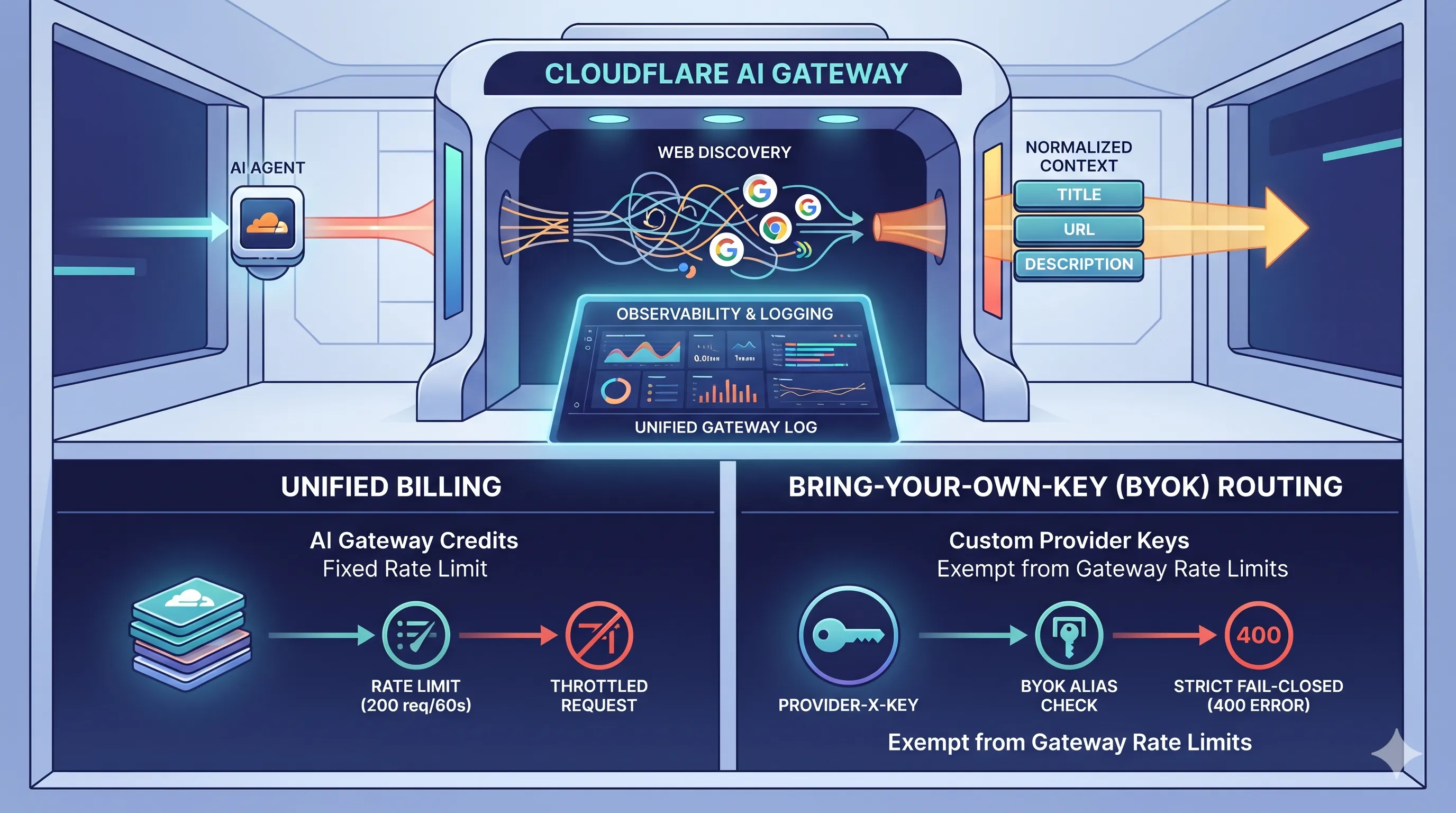
Cloudflare AI Gateway captures and consolidates search queries, provider metadata, duration metrics, and downstream model inference runs within the same unified gateway log.
This consolidation gives teams a single audit trace to evaluate end-to-end latency, observe context-gathering queries alongside subsequent completions, and monitor provider performance across live workloads.
Unified Billing vs. BYOK Credential Routing
Access and resource provisioning through the Web Search API are managed either through Cloudflare's Unified Billing or via Bring-Your-Own-Key (BYOK) credential routing.Under Unified Billing, usage is billed directly through AI Gateway credits at partner list API prices with zero markup.
To protect upstream service stability, Unified Billing enforces a fixed rate limit of 200 requests per 60 seconds per gateway.
For teams requiring custom upstream arrangements, the gateway allows developers to supply existing provider credentials via Bring-Your-Own-Key (BYOK) using key aliases.
Deploying BYOK credentials alters gateway governance in two critical ways: first, the 200 requests per 60 seconds rate limit enforced on Unified Billing does not apply to requests utilizing BYOK provider credentials.
Second, the routing logic implements a strict security posture: it fails closed with HTTP status 400 if a specified BYOK alias is missing, explicitly refusing to fall back silently to gateway credits.
| Architectural Dimension | Unified Billing | Bring-Your-Own-Key (BYOK) Routing |
|---|---|---|
| Credential Source | Managed Cloudflare AI Gateway credits | Existing provider credentials mapped via key aliases |
| Pricing Structure | Partner list API prices with zero markup | Direct commercial agreement with the underlying provider |
| Rate Limiting | Enforces a limit of 200 requests per 60 seconds per gateway | Exempt from Unified Billing per-minute rate limits |
| Failure Mode | Subject to standard rate limit throttles | Fails closed with HTTP status 400 on missing key alias (no credit fallback) |
Evaluating this structural shift, Maximilian Goisser noted: "I think Cloudflare is (for companies already using it) approaching the status of trusted main cloud supplier... via which the majority of cloud costs are billed."
By anchoring search retrieval, credential routing, and inference logging into a single control plane, the gateway architecture minimizes tooling fragmentation for production AI pipelines.
2. Provider Evaluation and Economics: Ceramic.ai, Exa, and Linkup
To understand how Cloudflare's Web Search API works for AI workflows, developers must evaluate the underlying engines powering its retrieval layer.Cloudflare's Web Search API launches with support for three search providers: Ceramic.ai, Exa, and Linkup.
While Cloudflare presents a standardized interface to client applications, each provider relies on fundamentally different indexing mechanisms, snippet extraction behaviors, and unit economics.
Index Depth and Provider Extraction Mechanics
The retrieval architecture differs significantly across the three supported backends, impacting how content reaches downstream language models.Ceramic.ai serves as the default search provider, built specifically around high-volume, low-cost search operations with extensive text descriptions.
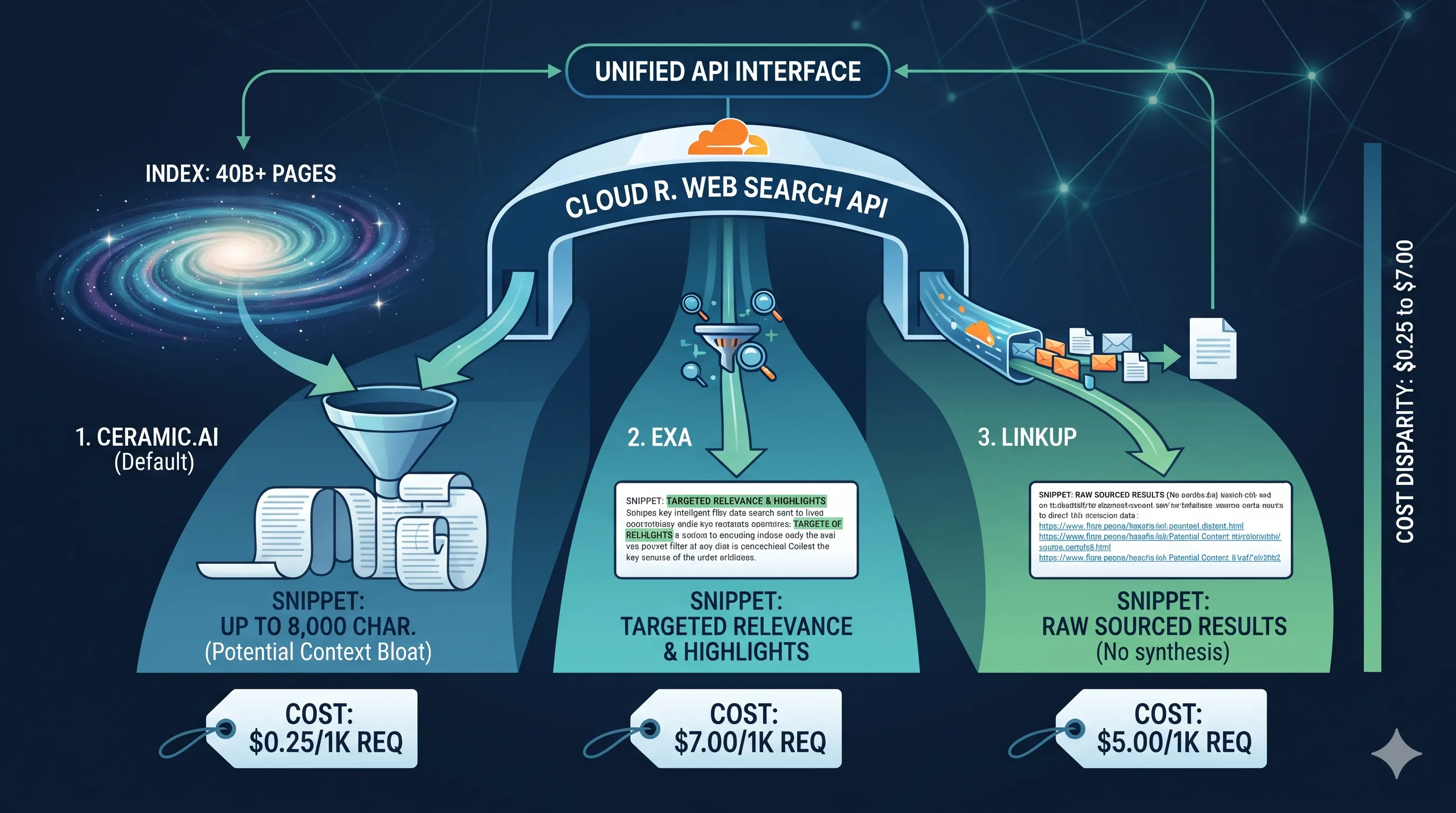
At its core, Ceramic.ai queries an independent index containing more than 40 billion pages, returning comprehensive description snippets measuring up to 8,000 characters.
This scale ensures vast web coverage without delegating crawler infrastructure to secondary aggregators.
Exa approaches page extraction through targeted relevance filtering.
When processing incoming queries via Cloudflare's API, Exa executes searches using its auto search type.
Instead of returning boilerplate page headers, this mechanism extracts relevant page highlights directly into the description field, isolating contextually salient phrases for the model.
Linkup operates with an emphasis on speed and raw retrieval fidelity.
Linkup executes a fast search depth configured to return raw sourced results.
Crucially, Linkup delivers these unadulterated web results without generating synthesized answers, passing direct source attribution upstream.
Despite these mechanical distinctions, integrating these engines into an AI agent does not require divergent response-handling routines.
Cloudflare normalizes the engine responses so that providers can be toggled using a single
provider parameter without altering application parsing logic.| Provider | Index Characteristics & Search Type | Snippet Extraction Limits & Format | Pricing Tier (per 1,000 Requests) |
|---|---|---|---|
| Ceramic.ai (Default) | Independent index containing more than 40 billion pages; high-volume search | Long text descriptions with snippets of up to 8,000 characters | $0.25 (billed via AI Gateway credits) |
| Exa | Auto search type | Extracts relevant page highlights into the description field | $7.00 |
| Linkup | Fast search depth returning raw sourced results without answer synthesis | Raw sourced text snippets without synthesized answers | $5.00 |
Context Window Consumption and Price Disparities
Selecting a provider requires balancing financial budgets against token allocation limits in model inference.Ceramic.ai offers an economical entry point, priced at $0.25 per 1,000 requests funded using AI Gateway credits.
However, Ceramic.ai's expansive descriptions introduce architectural challenges for agent prompt engineering.
Because Ceramic.ai outputs snippets extending up to 8,000 characters per result, unmanaged multi-result payloads can rapidly consume model context budgets.
Applications incorporating Ceramic descriptions must monitor token overhead to prevent context window bloat and premature context truncation during multi-turn agent execution.
In contrast, Exa and Linkup introduce substantial price variations compared to the baseline default.
Exa is positioned at $7.00 per 1,000 requests, representing the highest-tier cost structure among the launch partners.
Linkup sits between the two alternatives at $5.00 per 1,000 requests.
These financial differences—ranging from $0.25 to $7.00 per 1,000 requests—demonstrate that swapping the single provider parameter drastically alters operating expenses across large-scale inference workloads.
3. Developer Implementation: REST Endpoints, Cloudflare Workers, and Server Tools
Connecting external AI models and runtime agents to real-time information requires understanding how Cloudflare's Web Search API works for AI across both decoupled backends and edge architectures.Developer integration centers on standard web protocols, secured perimeter bindings, and runtime abstractions designed to feed search context directly into model pipelines.
API Scoping and Authentication Boundaries
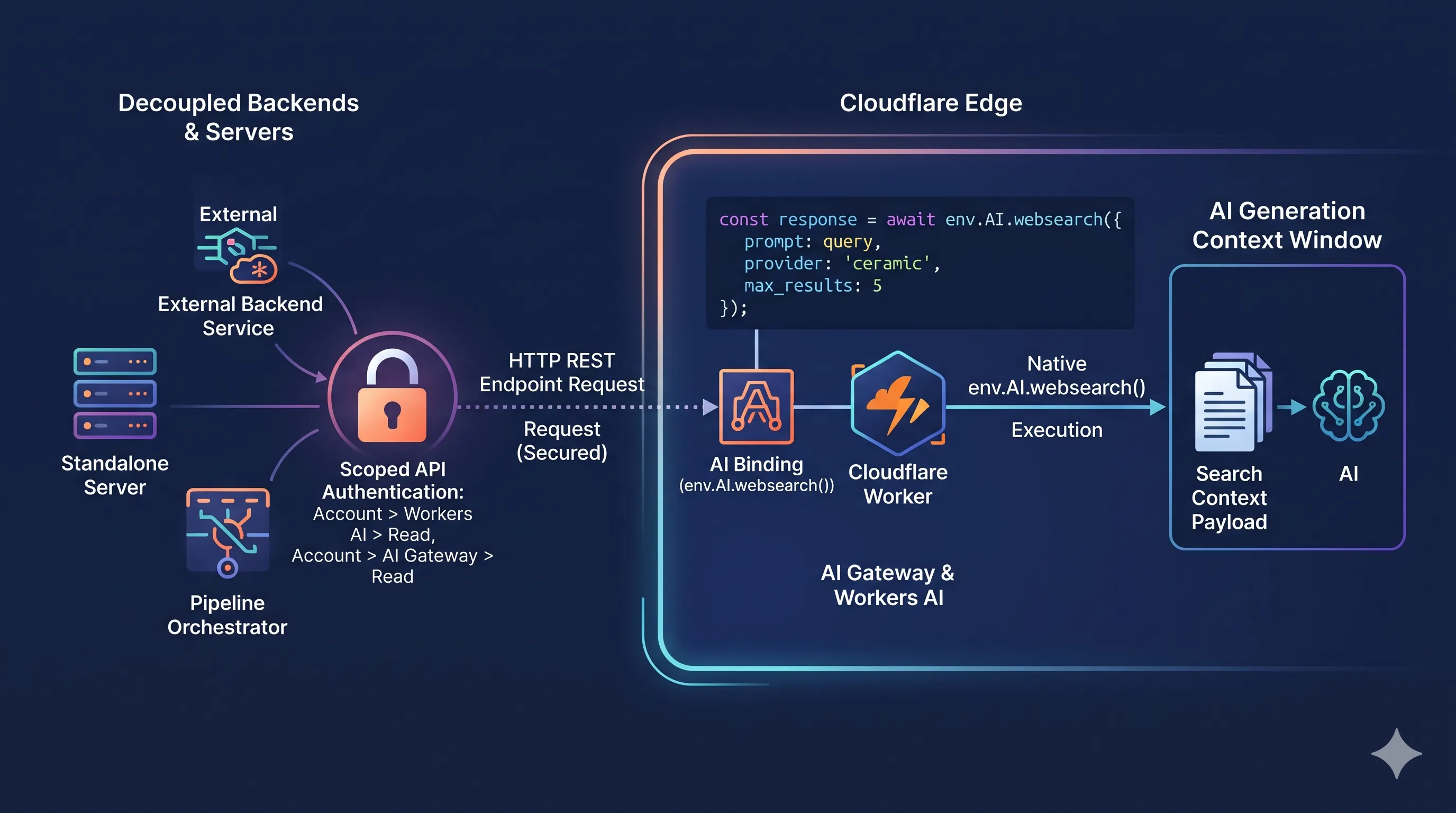
Cloudflare makes the search service accessible via standard HTTP REST endpoints from any external backend service.When orchestrating search queries from standalone servers, microservices, or external pipeline orchestrators, access control relies on scoped API authentication.
Specifically, calling the REST endpoint requires 2 scoped token permissions: Account > Workers AI > Read and Account > AI Gateway > Read.
These dual permissions grant the credentials necessary to pass requests through the routing and gateway infrastructure without granting broader administrative write privileges to the Cloudflare account.
Strict security boundaries must be maintained during implementation.
Account API tokens must not be exposed directly in browser or client-side applications.
Client-side clients should always query an intermediary backend or worker layer, shielding API secrets from public exposure.
Additionally, Cloudflare is developing native Server Tools directly inside AI Gateway to automate tool orchestration.
This feature allows the platform to streamline how models trigger external tools and search routines internally without requiring manual glue code.
Worker Bindings and env.AI.websearch() Execution
For serverless architectures hosted directly on Cloudflare, the search capability is integrated natively into Cloudflare Workers through the AI binding.Instead of formatting manual HTTP requests and managing API tokens within code, Workers leverage native configuration bindings to talk directly to Workers AI.
To configure the AI binding inside a Worker project configuration file to enable web search calls, declare the binding inside your project settings:
{
  "ai": {
    "binding": "AI"
  }
}Once bound, Workers execute search queries directly through the env.AI.websearch() method.
To call the web search service directly from a Cloudflare Worker using the AI binding, invoke the function with the relevant execution parameters:
const response = await env.AI.websearch({
  prompt: query,
  provider: 'ceramic',
  max_results: 5
});The resulting data payload is received natively within the Worker, ready to be formatted directly into prompt context windows for AI generation tasks.
4. Crawler Governance and Publisher Transparency: The Verified Bot Standard
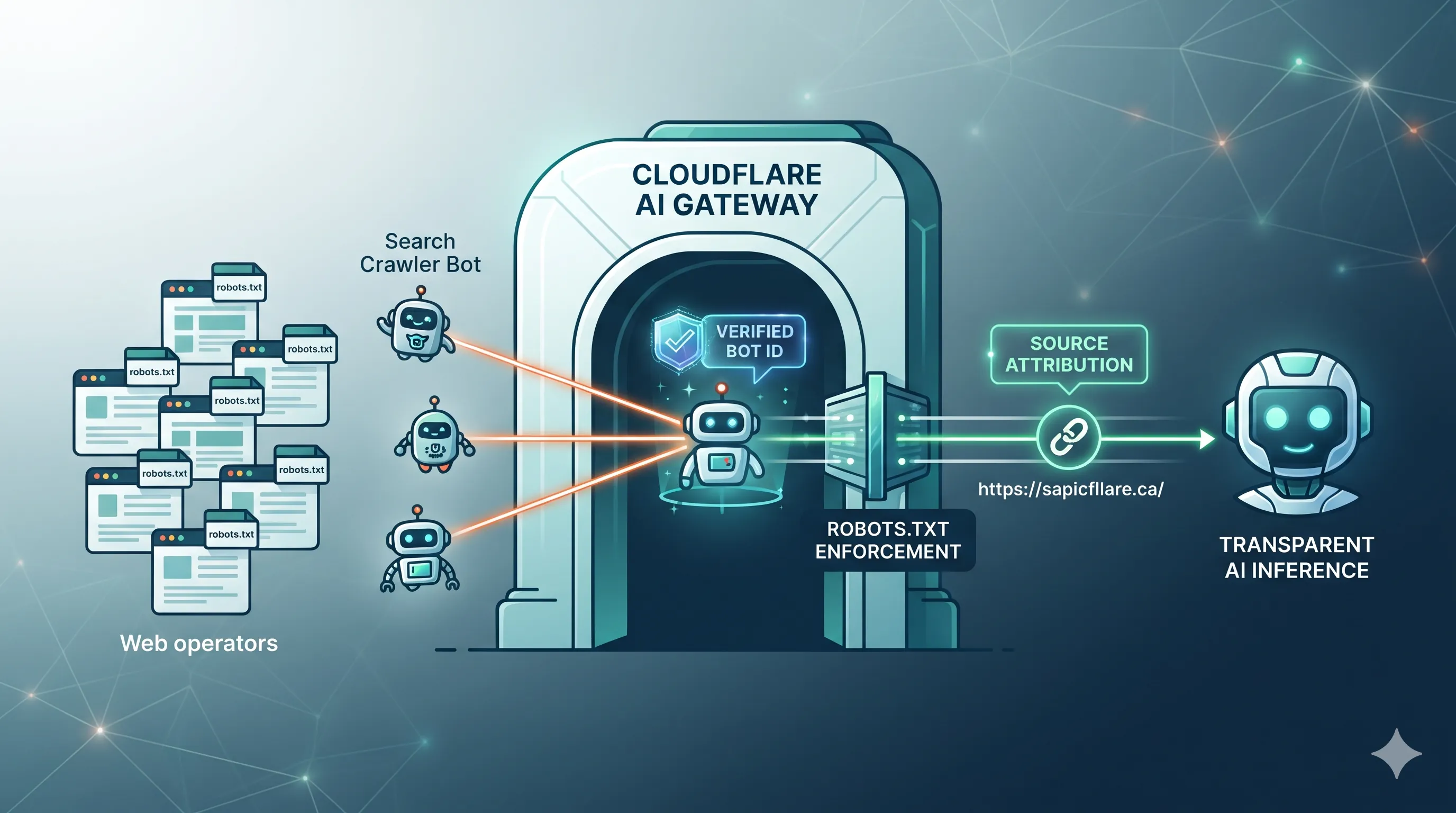
In delivering real-time retrieval capabilities for artificial intelligence models, Cloudflare's Web Search API couples search indexing with strict infrastructure governance.To balance AI retrieval demands with the rights of web operators, Cloudflare anchors its search provider integration around verified bot policies, robots.txt enforcement, and end-to-end attribution.
Verified Bot Compliance and robots.txt Directives
Search crawlers operating within Cloudflare's Web Search API framework cannot harvest data indiscriminately.Partner crawlers must strictly comply with Cloudflare's verified bot standards as defined in its official documentation.
As part of these requirements, search crawlers are required to explicitly identify themselves during request cycles and honor site-specific robots.txt directives.
This framework aims to give website publishers control over crawler indexing and complete transparency over how their content is accessed.
Web scrapers failing verified bot standards cannot participate in the integration ecosystem, barring unverified automated agents from supplying index data to the API.
Michelle Chen, Sam Else, and Gabriel Massadas underlined this contractual and architectural boundary, stating: "The crawler used by the web search provider must comply with Cloudflare’s publicly stated requirements for 'Verified bots' as defined in our developer documentation, and web search responses must include a link to the location of crawled content."
| Governance Area | Technical Requirement | Ecosystem Enforcement |
|---|---|---|
| Bot Verification | Partner crawlers must strictly comply with Cloudflare's verified bot standards and identify themselves. | Web scrapers failing verified bot standards cannot participate in the integration ecosystem. |
| Publisher Directives | Crawlers are required to strictly respect site robots.txt directives. | Gives website publishers verifiable control over crawler indexing. |
| Attribution | Search responses are required to provide direct source links to the original crawled URLs. | Guarantees transparency over content usage for publishers and AI end users. |
Mandatory Source Attribution for Crawled Content
Downstream consumption of retrieved web data introduces distinct challenges regarding intellectual property and provenance for AI applications.To resolve this, Cloudflare mandates that search responses provide direct source links to the original crawled URLs.
This requirement ensures that whenever an AI application queries the Web Search API, every returned result retains a direct pointer to the underlying publication.
By coupling identity enforcement at the edge with compulsory URL attribution in response payloads, the architecture ensures that publisher transparency remains unbroken from initial crawling to final AI inference.
5. Agent Security: Indirect Prompt Injection Defense and Citation Verification
Grounding autonomous agents with live search results using Cloudflare's Web Search API exposes model runtimes to untrusted data from across the public web.Because third-party web content can contain malicious instructions, building secure agent workflows requires combining automated guardrail classifiers with strict architectural capability separation and deterministic grounding verification.
Prompt Guard Defenses and Tool Decoupling
Applications consuming live web search results must treat all retrieved web snippets as untrusted external inputs.To catch adversarial inputs embedded in external content, AI Gateway Guardrails classifies prompt injection attempts as category P1 threats.
This automated detection layer runs the specialized @cf/meta/prompt-guard-2-86m model to identify injection attempts inside the prompt pipeline before models process malicious payloads.
However, guardrail classifiers serve as secondary detectors and cannot replace architectural capability separation.
To effectively mitigate indirect prompt injection, system architectures must separate reading components that ingest search results from execution-capable, action-taking tools.
Decoupling retrieval reading tasks from operational agents ensures that an ingested web page containing hidden jailbreaks or injection strings cannot directly invoke critical system actions.
| Security Layer | Implementation Mechanism | Operational Role | Architectural Limitation / Boundary |
|---|---|---|---|
| Injection Detection | @cf/meta/prompt-guard-2-86m in AI Gateway Guardrails | Classifies prompt injection as category P1 | Serves as a secondary detector; cannot replace capability separation |
| Tool Decoupling | Separating reading components from action-taking tools | Mitigates execution risks from indirect prompt injection | Requires applications to treat all retrieved web snippets as untrusted inputs |
| Evidence Normalization | Internal source ID assignment and deterministic validation | Prevents fabricated links and validates citations against evidence records | Requires strict application-level schema enforcement; does not guarantee factual truth of web content |
| Query Redaction | cf-aig-collect-log-payload: false request header |
Suppresses payload logging in AI Gateway | Protects sensitive queries during external search retrieval |
Deterministic Grounding and Payload Redaction
While grounding queries with search results provides concrete source attribution, retrieval alone does not guarantee the factual truth of web content.Furthermore, models can invent invalid citation identifiers without strict application-level schema enforcement.
To ensure output integrity, systems must enforce structured evidence normalization by assigning internal source IDs to each retrieved passage.
The runtime application then validates citations deterministically against the returned evidence records before rendering final answers to users, preventing fabricated links from reaching the client.
Finally, protecting enterprise data privacy during grounding requests is handled at the network edge.
AI Gateway allows payload logging suppression via headers such as
cf-aig-collect-log-payload: false, ensuring that sensitive search queries and retrieved raw text payloads are not logged in plain text.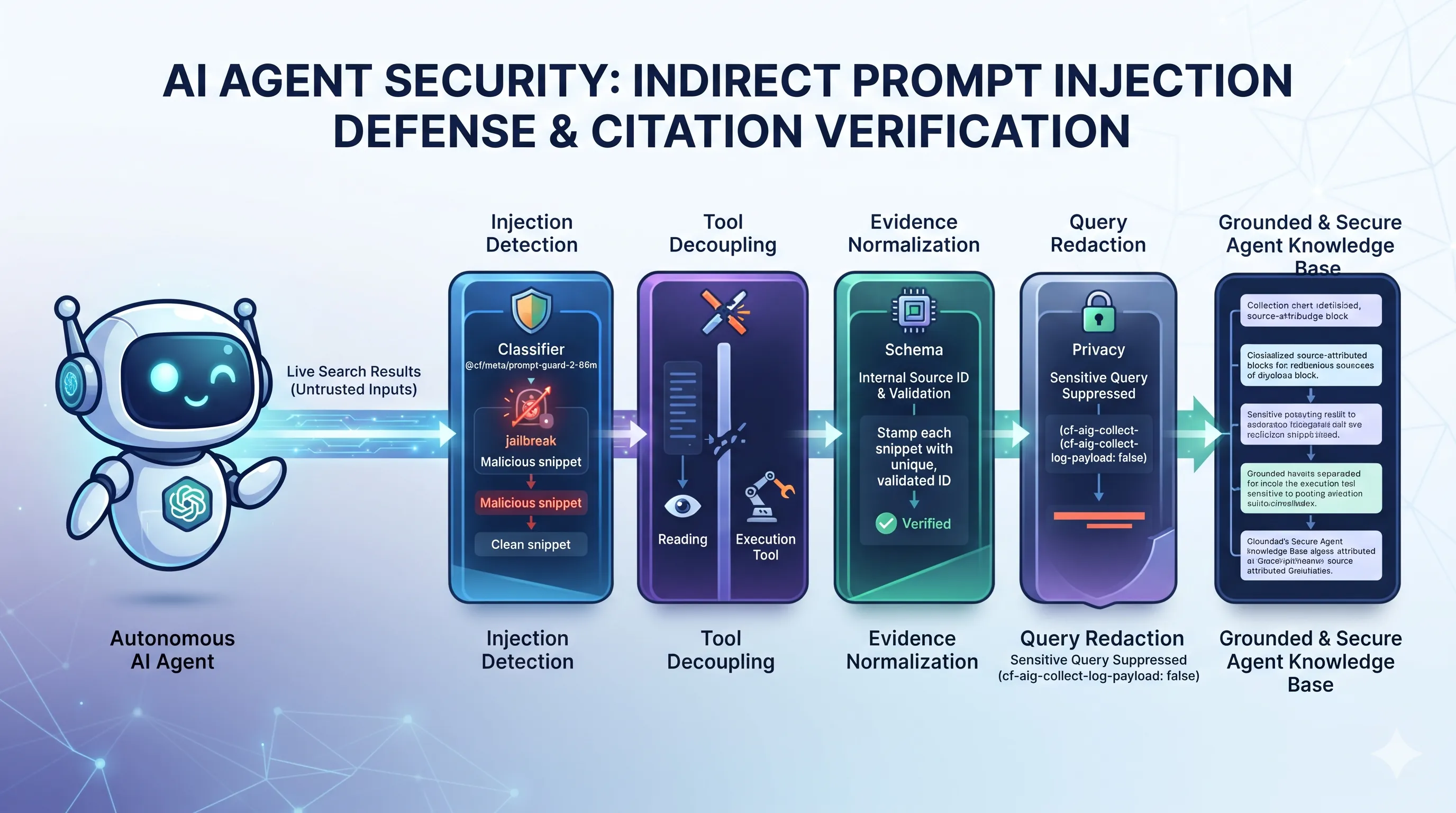
6. Data Governance: Zero Data Retention, Resyndication Rights, and Routing Overhead
Understanding data governance, downstream licensing constraints, and proxy routing overhead is critical when evaluating how Cloudflare's Web Search API works for AI workflows and autonomous agent architectures.While grounding language models in live web context improves operational accuracy, funneling programmatic queries through an intermediary ecosystem introduces distinct compliance and performance considerations that developers must navigate.
Zero Data Retention (ZDR) Standards and Compliance
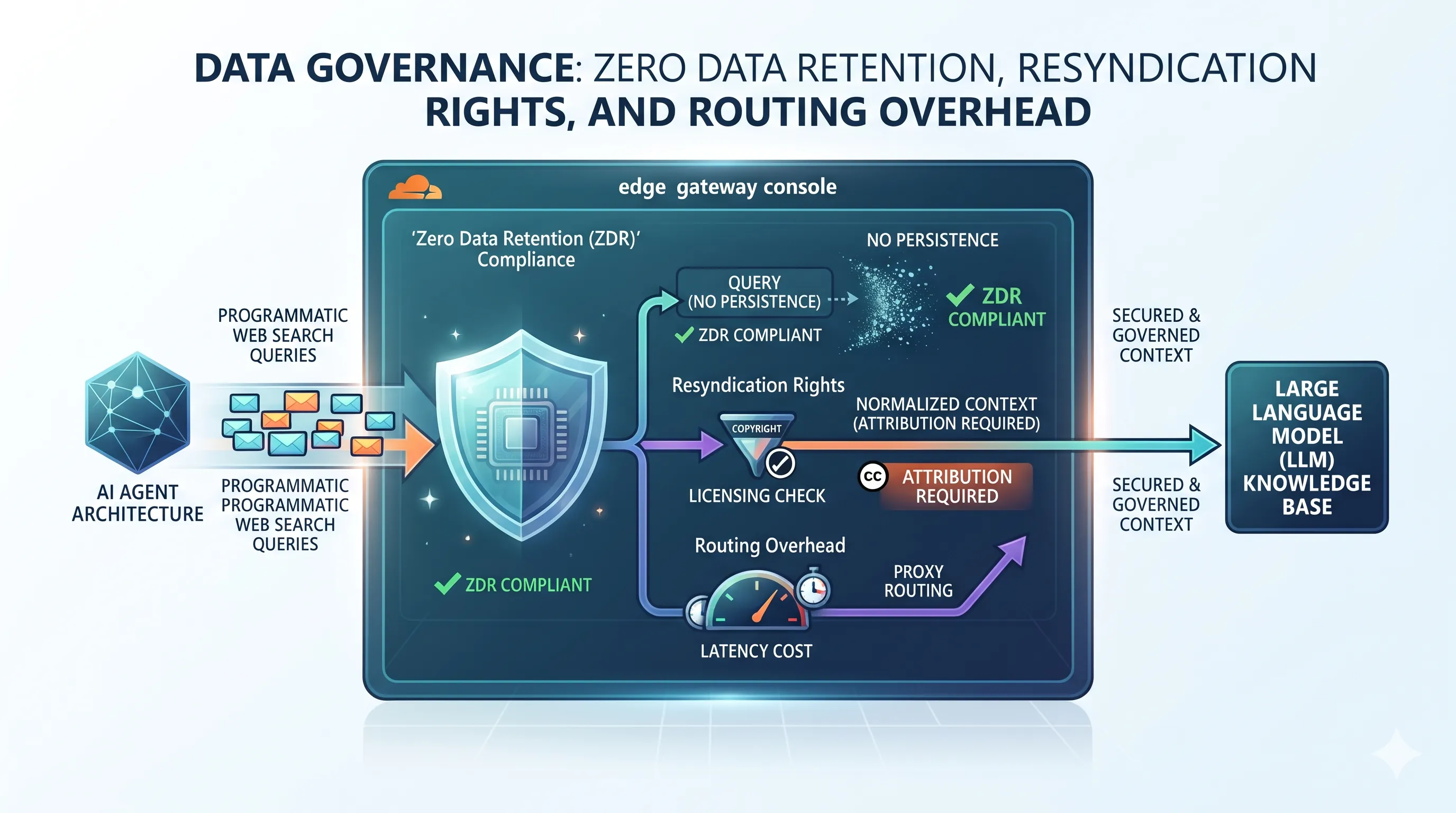
For enterprises deploying retrieval-augmented systems, data persistence guarantees represent a fundamental baseline.Launch search providers integrated into Cloudflare's Web Search API support Zero Data Retention (ZDR) for queries passed via the platform.
Under this framework, query payloads sent to execute web lookups are not retained or leveraged by underlying search systems for model training or persistent historical logging.
To provide operational clarity, Cloudflare marks and identifies providers that formally comply with Zero Data Retention directly within the interface and routing layer.
This clear attribution enables developers to selectively direct retrieval traffic exclusively to backend partners that meet strict organizational privacy and non-retention requirements.
Resyndication Limits, Data Leakage, and Proxy Latency
Related Posts


Generative AI may have assisted with research or drafting for this article. Topic selection, fact-checking, final wording, and publication remain the responsibility of DragonStone74. AI use disclosure