
How US Data Center Regulations Are Reshaping Grid and Water Oversight
🚀 Key Takeaways
- State and Municipal Moratoria: State legislatures and local zoning authorities are increasingly enacting construction pauses and statutory guardrails to insulate residential ratepayers from rising utility costs.
- Heightened Water and Resource Scrutiny: Intensifying regional water resource constraints have driven new state permitting frameworks, federal cooling standards, and mandatory consumption reporting laws.
- Federal Grid Interconnection Reforms: The Federal Energy Regulatory Commission is overhauling transmission queues and co-location tariffs to manage unprecedented industrial loads without destabilizing regional power grids.
- Air Quality and On-Site Power Oversight: Extended utility interconnection delays have led to expanded behind-the-meter gas and backup generation, triggering strict federal environmental enforcement under the Clean Air Act.
- Bipartisan Political and Community Pushback: Public concern regarding municipal nondisclosure agreements and infrastructure strain has transformed data center siting into a prominent bipartisan electoral issue.
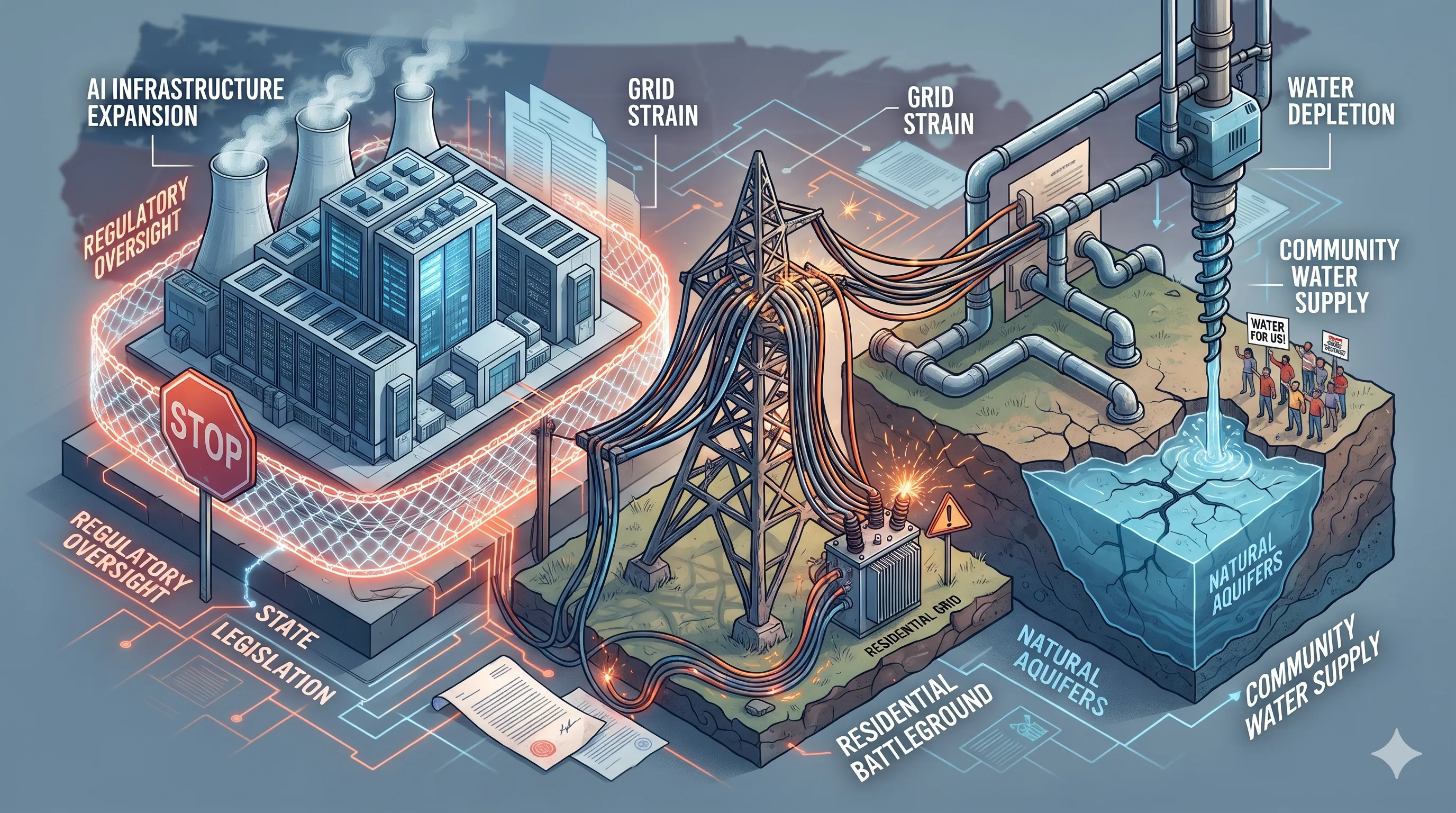
The rapid expansion of artificial intelligence infrastructure across the United States has collided directly with regional power grids, natural aquifers, and local communities.
What began as an unhindered national race to attract hyperscale compute facilities through lucrative tax packages has rapidly shifted toward statutory containment and comprehensive regulatory oversight.
Across the country, statehouses and federal agencies are establishing new ground rules for large-scale commercial electricity and water consumption.
Public utility commissions are intervening to shield ordinary households from surging system-upgrade expenditures, while federal energy regulators overhaul interconnection frameworks to untangle years-long transmission backlogs.
As massive computing campuses increasingly dictate regional infrastructure planning and local air quality baselines, routine municipal zoning decisions have evolved into contentious political battlegrounds.
Facility operators and policymakers alike must now navigate a fractured legal landscape that demands environmental transparency, strict ratepayer protections, and deeper community accountability.
1. State Legislative Interventions: Moratoriums, Zoning Controls, and Ratepayer Protections
Understanding how data centre regulations are evolving in the US requires a detailed examination of statehouses and town halls, where the balance between aggressive commercial expansion and local resource protection is being actively legislated.State-level interventions and local municipal actions now form the primary frontlines reshaping the legal and operational framework governing data center deployment nationwide.
State Statutory Moratoriums and Utility Cost-Shifting Legislation
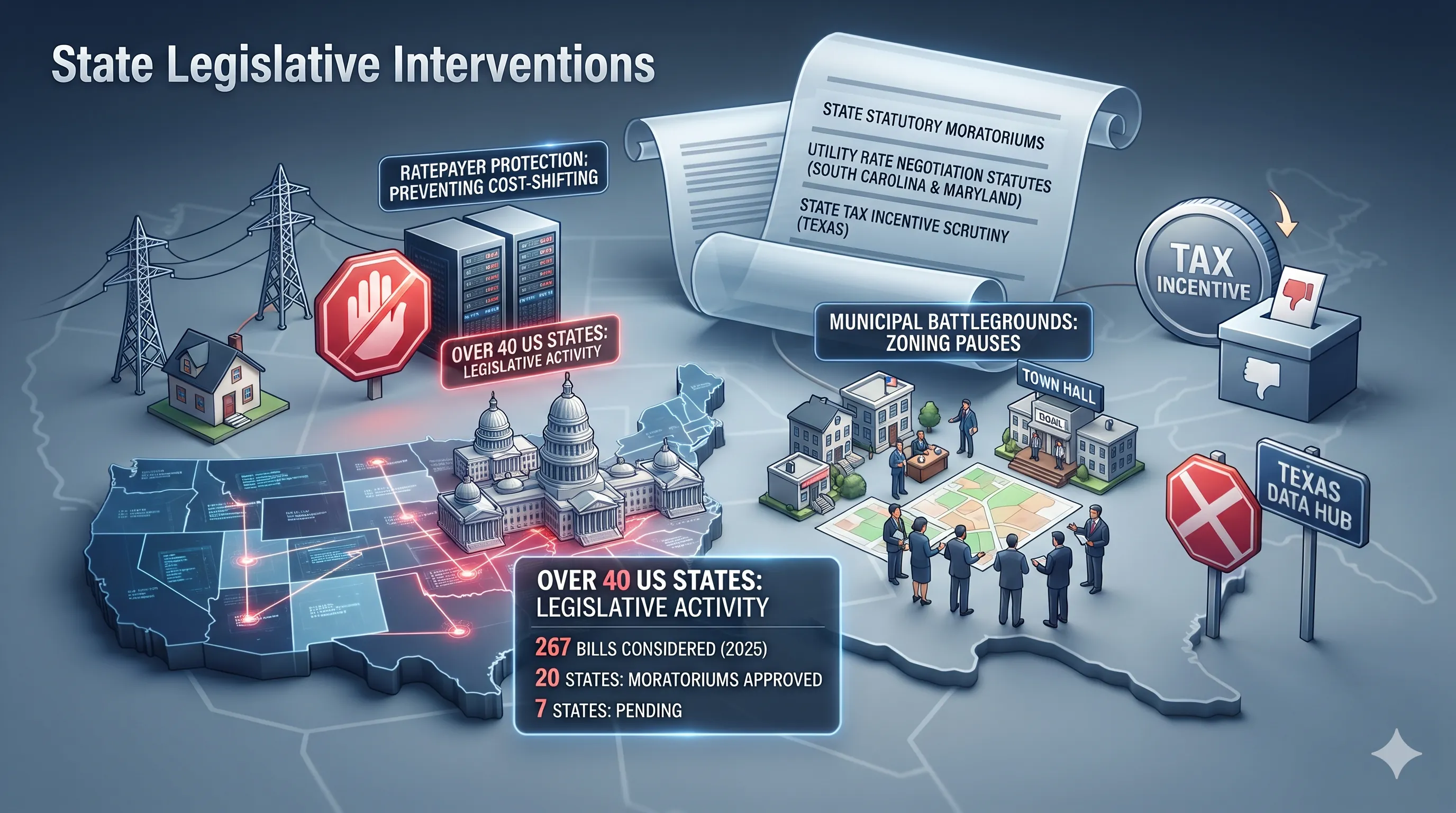
The sheer volume of legislative activity demonstrates how regulatory oversight has intensified.In 2025, over 40 US states considered 267 bills related to data center development.
This momentum carried directly into 2026, during which state-level moratorium bills were introduced across 11 states.
In total, 20 states approved statutory measures to pause or ban data center construction, with seven states having measures pending.
A crucial regulatory evolution centers on energy equity and ratepayer protection.
Rather than granting unfettered access to the power grid, South Carolina and Maryland enacted rate negotiation laws in 2025 designed to prevent commercial data centers from shifting energy costs onto residential utility customers.
However, statutory moratorium proposals have not moved forward uniformly.
State-level moratorium legislation has encountered legislative resistance in several capitols, underscoring the political friction between economic development objectives and grid preservation mandates.
| Jurisdiction / Governance Level | Regulatory Action or Policy Focus | Status and Legislative Scope |
|---|---|---|
| Over 40 US States | General data center development legislation | 267 bills considered in 2025 |
| 11 States | Statewide moratorium legislation | Moratorium bills introduced across 11 states in 2026 |
| 20 States | Construction pauses or facility bans | Statutory measures approved |
| 7 States | Construction pauses or facility bans | Statutory measures pending |
| South Carolina & Maryland | Utility rate negotiation statutes | Enacted in 2025 to shield residential customers from cost-shifting |
| Texas | Primary data hub expansion initiative | Policy push halted in response to changing voter sentiment |
| Dozens of Municipalities | Local construction moratoria and zoning oversight | Local pauses instituted, creating frontline municipal battlegrounds |
| Multiple State Legislatures | Statutory tax incentives | Formal legislative reviews initiated on previous development incentives |
Local Zoning Pauses and State Tax Incentive Scrutiny
While state-level moratorium legislation has encountered legislative resistance in several capitols, local jurisdictions have moved rapidly to fill the regulatory void.Dozens of municipalities across the country have instituted local construction pauses, establishing local zoning boards as key regulatory battlegrounds.
These municipal actions allow local boards to stall rapid facility expansion through land-use regulations even when state assemblies hesitate to impose blanket bans.
Concurrently, the financial terms that originally fostered data infrastructure development are facing significant legislative reassessment.
Multiple state legislatures have initiated reviews of statutory tax incentives previously offered to attract facility construction.
Public sentiment has directly driven state policy shifts, most notably in Texas.
Texas halted its planned policy push to become the primary hub for data facility growth in response to changing voter sentiment.
2. Water Depletion Mandates and Cooling Standards: Federal and State Constraints
As data centre regulations evolve across the United States, water resource management has emerged as an urgent regulatory frontier alongside electrical grid capacity.A single large-scale data center facility can consume up to 19 million liters of water per day for cooling systems.
This substantial hydrological footprint has shifted regulatory scrutiny from voluntary sustainability targets to enforceable federal standards and restrictive state permitting schemes.
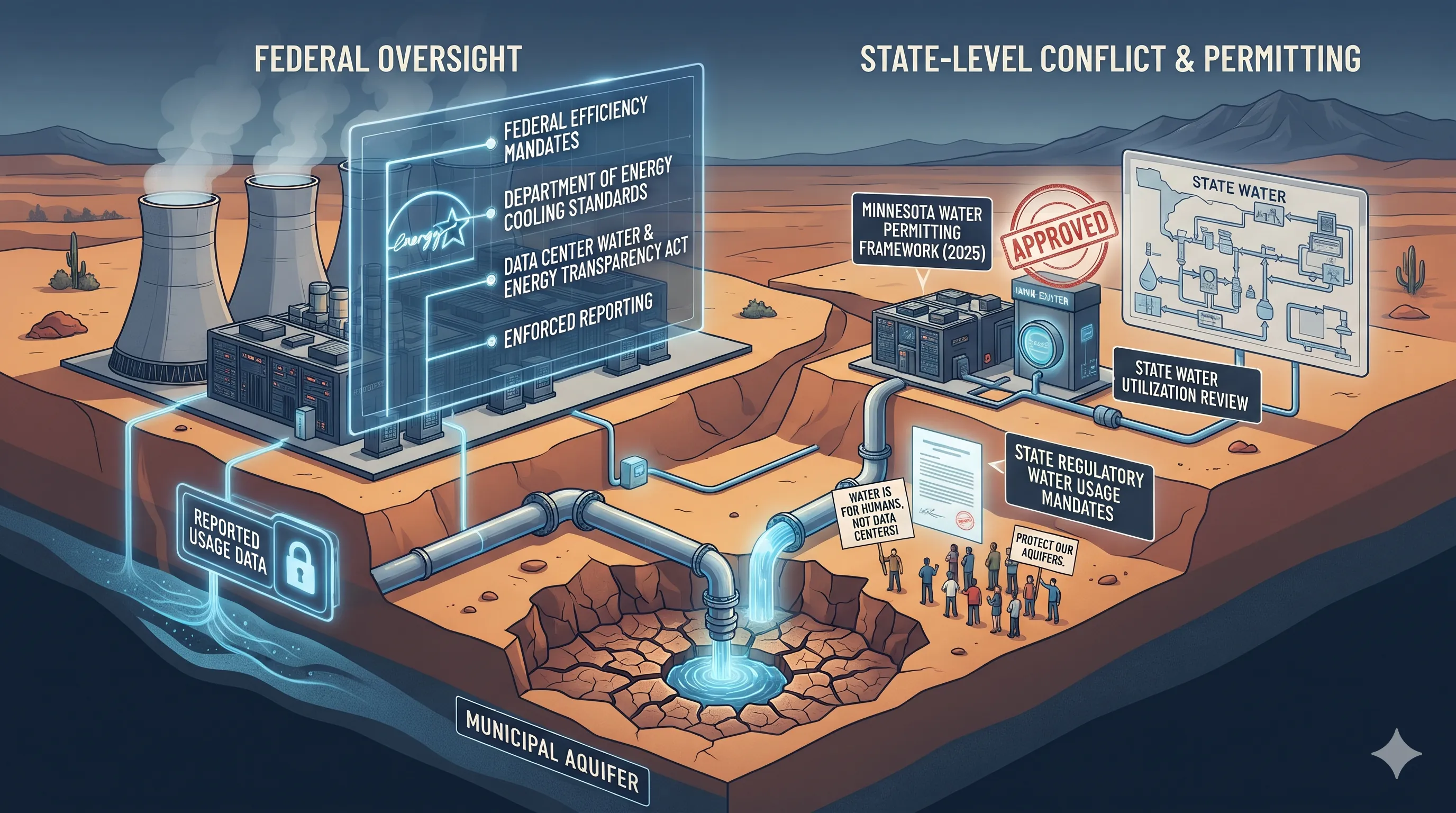
Federal Efficiency Mandates and the Data Center Water and Energy Transparency Act
At the federal level, regulatory bodies have targeted both the physical efficiency of cooling hardware and baseline operational transparency.The US Department of Energy finalized mandatory efficiency regulations targeting large-scale facility cooling equipment, establishing strict performance floors for cooling systems installed across industrial installations.
In parallel with executive regulatory standards, federal lawmakers introduced the Data Center Water and Energy Transparency Act to enforce nationwide reporting of industrial water and electrical draw.
This statutory framework targets data transparency deficits, requiring data center operators to systematically account for their utilities consumption before regulatory authorities.
| Regulatory Level | Policy / Framework | Mandated Focus |
|---|---|---|
| Federal Regulatory | Department of Energy Cooling Standards | Mandatory efficiency regulations targeting large-scale facility cooling equipment. |
| Federal Legislative | Data Center Water and Energy Transparency Act | Enforced nationwide reporting of industrial water and electrical draw. |
| State Permitting | Minnesota Water Permitting Framework (2025) | Distinct environmental water permitting framework specifically applied to data center operations. |
| State Compliance | State Regulatory Water Usage Mandates | Requirements for operators to measure, manage, and publicly disclose baseline water usage. |
State Water Permitting Frameworks and Western Aquifer Conflicts
Beyond federal intervention, state regulatory bodies are advancing compliance mandates that require operators to measure, manage, and publicly disclose baseline water usage.Setting an explicit regulatory precedent in 2025, Minnesota enacted a distinct environmental water permitting framework specifically applied to data center operations.
This dedicated regime subjects prospective facilities to targeted state water utilization reviews prior to approval.
Concurrently, the intense cooling resource requirements have provoked severe public disputes in arid western states such as New Mexico and Arizona over municipal aquifer supplies.
As water tables face increasing pressure from industrial cooling towers, local communities have mobilized against proposed projects.
In New Mexico, local opposition surfaced directly during project evaluations, where residents protested local site approvals with signs reading: "Water is for humans, not data centers!"
These regional disputes reflect how municipal resource availability and public pushback are directly driving mandatory state-level water disclosures and stricter permitting requirements.
3. Federal Grid Interconnection and FERC Regulatory Overhauls
The evolution of data centre regulations in the United States has expanded beyond municipal zoning into core federal energy policy, directly impacting how critical compute infrastructure interfaces with high-voltage power networks.FERC Directives on Regional Transmission Interconnection Queues
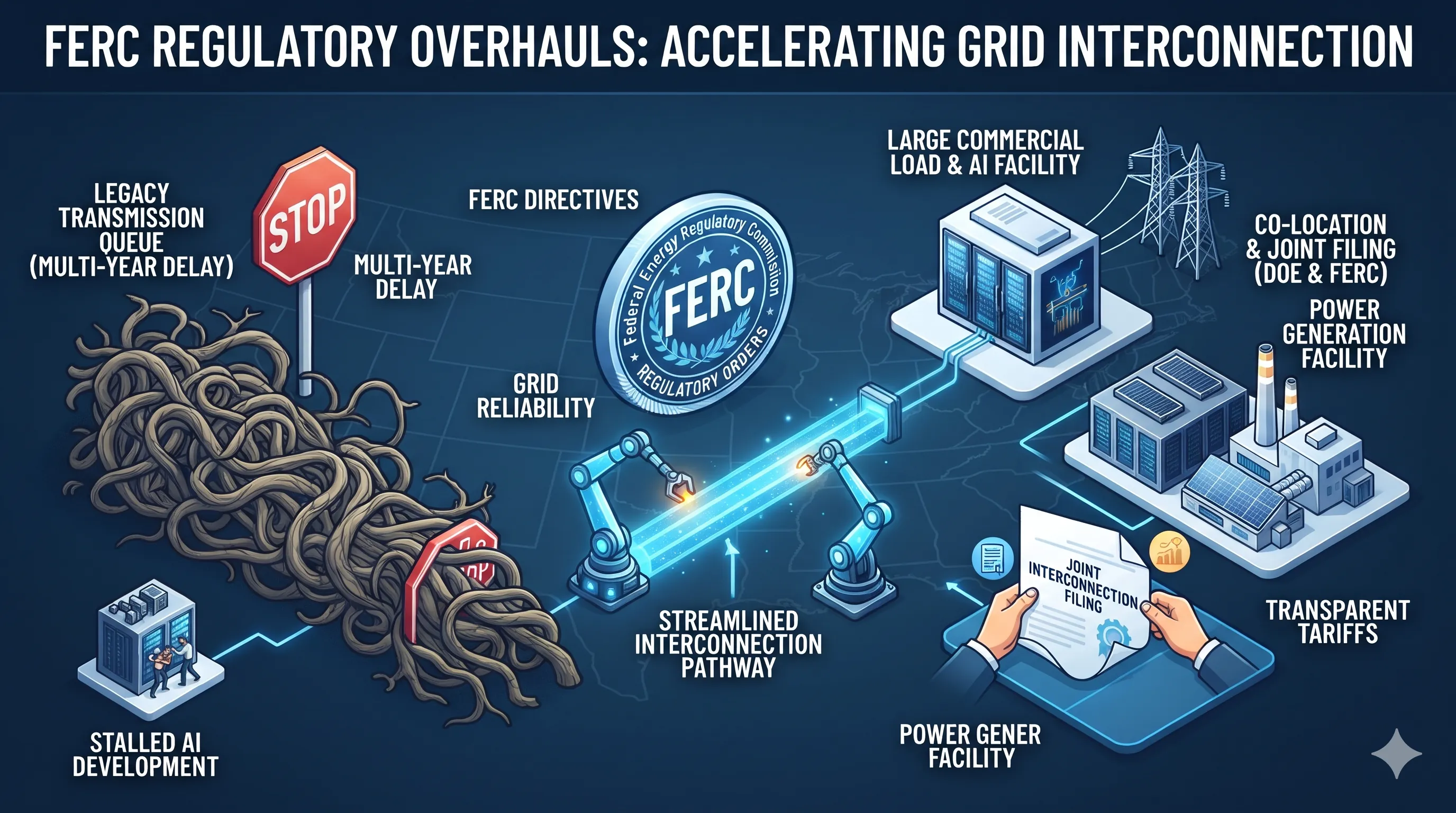
Traditional regional transmission queues and interconnection frameworks created multi-year project backlogs that prompted emergency federal rule revisions.The influx of high-density computational demands placed unprecedented strain on legacy interconnection studies, stalling vital regional development pipelines.
In response to this mounting bottleneck, the Federal Energy Regulatory Commission issued regulatory orders directing regional transmission organizations to accelerate grid interconnection procedures for large loads and AI facilities.
These federal mandates target the administrative and technical friction that historically delayed major electrical connections.
Demonstrating regional execution of these directives, FERC approved updated interconnection rules for the Southwest Power Pool region regarding large commercial and industrial load integration.
This decision formalizes expedited integration pathways across member states, establishing regulatory certainty for large-scale industrial and computational loads seeking timely grid access.
Co-Location Tariffs and Department of Energy Joint Interconnection Rules
As operators pursued alternatives to standard grid connection queues, the co-location of compute assets directly at generation facilities introduced novel regulatory challenges.To establish clear operating and commercial conditions, FERC instructed PJM Interconnection to draft transparent tariffs governing large commercial loads co-located directly with electrical power plants.
This mandate ensures that co-located configurations operate under standard, transparent market rules rather than ad hoc agreements, preserving grid reliability and transparent cost distribution.
Simultaneously, the Department of Energy submitted proposed rulemakings to FERC permitting joint interconnection filings for paired generation and compute facilities.
By standardizing single, unified filings for new power generation paired directly with dedicated compute infrastructure, this regulatory overhaul provides a streamlined pathway for integrated energy and digital infrastructure projects.
4. Air Quality Permitting and On-Site Fossil Generation Oversight
A central dimension of how data centre regulations are evolving in the US involves environmental oversight of behind-the-meter fossil generation.As grid utility tie-ins face severe delays, facilities increasingly rely on on-site fossil assets to power high-density computing loads, placing data infrastructure under federal and regional environmental scrutiny.
Clean Air Act Permitting for Islanded Power and Gas Turbines
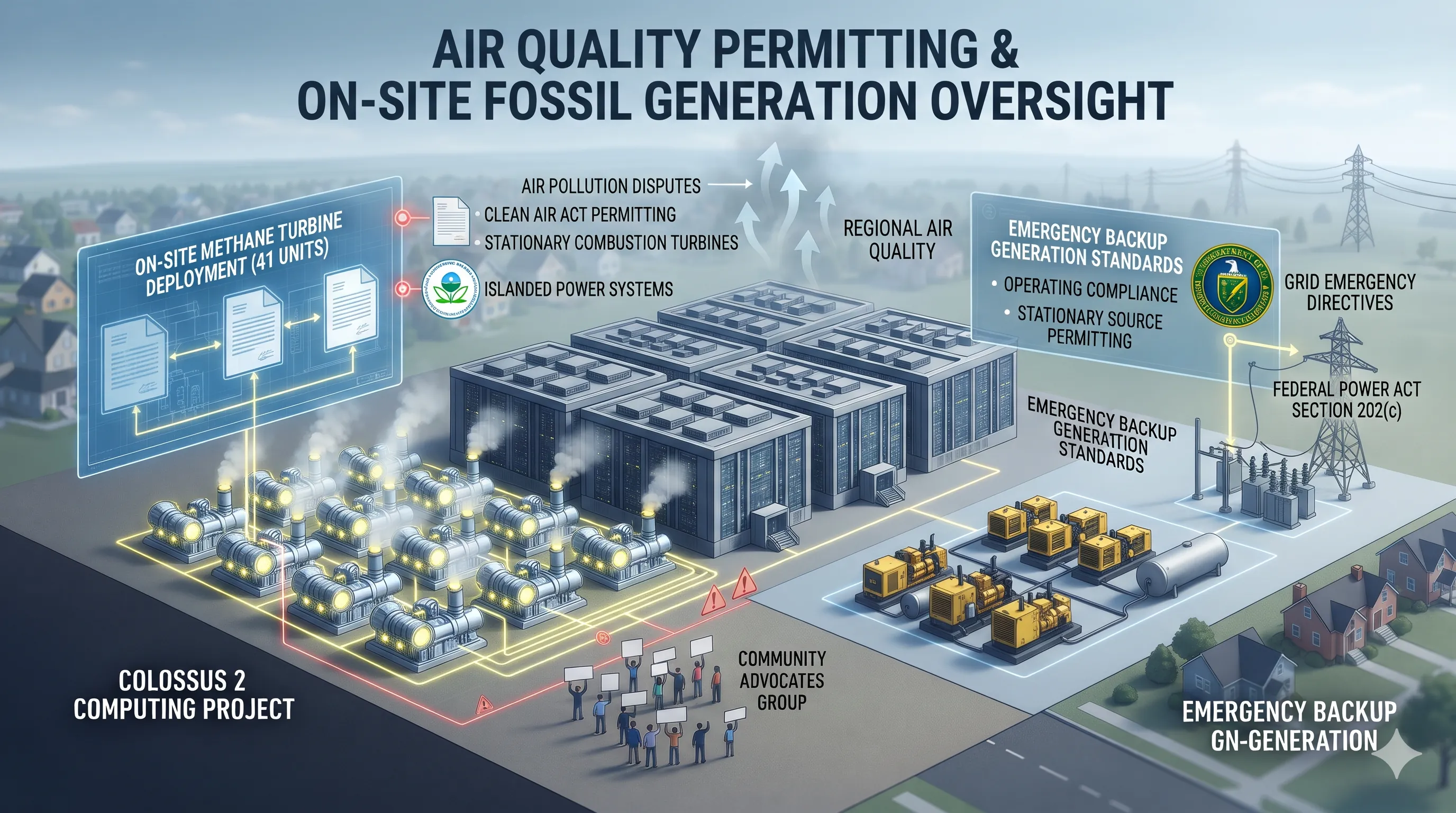
Data center reliance on behind-the-meter fossil generation where grid utility tie-ins are delayed has intensified local air pollution disputes across several jurisdictions.A prominent case is the Colossus 2 computing project in the US, which planned the deployment of 41 methane gas turbines to support on-site energy generation.
To address the rise of these self-contained energy installations, the Environmental Protection Agency published regulatory guidance clarifying Clean Air Act permitting requirements for stationary combustion turbines and islanded power systems.
These federal expectations directly confront operational setups designed to run independently from local utility grids.
However, friction between industrial operators and nearby communities continues to mount.
Community advocates contend that large clusters of gas turbines risk degrading regional air quality despite technically meeting baseline stationary source standards.
Emergency Backup Generation Standards and Federal Power Act Section 202(c)
Beyond primary generation via stationary gas turbines, backup capacity represents another focal point of federal regulatory intervention.The EPA clarified operating compliance standards and stationary source permitting for emergency diesel and gas backup generation units.
These measures delineate the boundaries under which backup units can run without triggering broader non-attainment or major source permitting reviews.
Concurrently, the Department of Energy invoked Federal Power Act section 202(c) emergency authorities to direct grid operations during periods of peak regional transmission stress.
This coordination highlights how federal energy directives intersect with air quality mandates when transmission corridors experience severe constraints.
| Regulatory / Operational Area | Governing Authority / Project Context | Scope and Clarification |
|---|---|---|
| Stationary Combustion Turbines | Environmental Protection Agency | Regulatory guidance clarifying Clean Air Act permitting for stationary turbines and islanded power systems. |
| On-Site Methane Turbine Deployment | Colossus 2 Computing Project | Planned deployment of 41 methane gas turbines for on-site energy generation amid utility tie-in delays. |
| Emergency Backup Generation | Environmental Protection Agency | Clarified operating compliance standards and stationary source permitting for emergency diesel and gas fleets. |
| Grid Emergency Directives | Department of Energy | Invocation of Federal Power Act section 202(c) emergency authorities to direct grid operations during peak transmission stress. |
5. Political Accountability, Midterm Campaign Clashes, and Community Transparency
The regulatory framework governing American data centers is undergoing rapid transformation, directly driven by escalating grassroots resistance and intense electoral scrutiny ahead of the 2026 midterms.As power grids strain and local landscapes shift, community accountability and zoning authority have evolved from municipal disputes into defining issues shaping statewide and federal utility policy.
Voter Sentiment, Polling Trends, and Electoral Campaign Spending
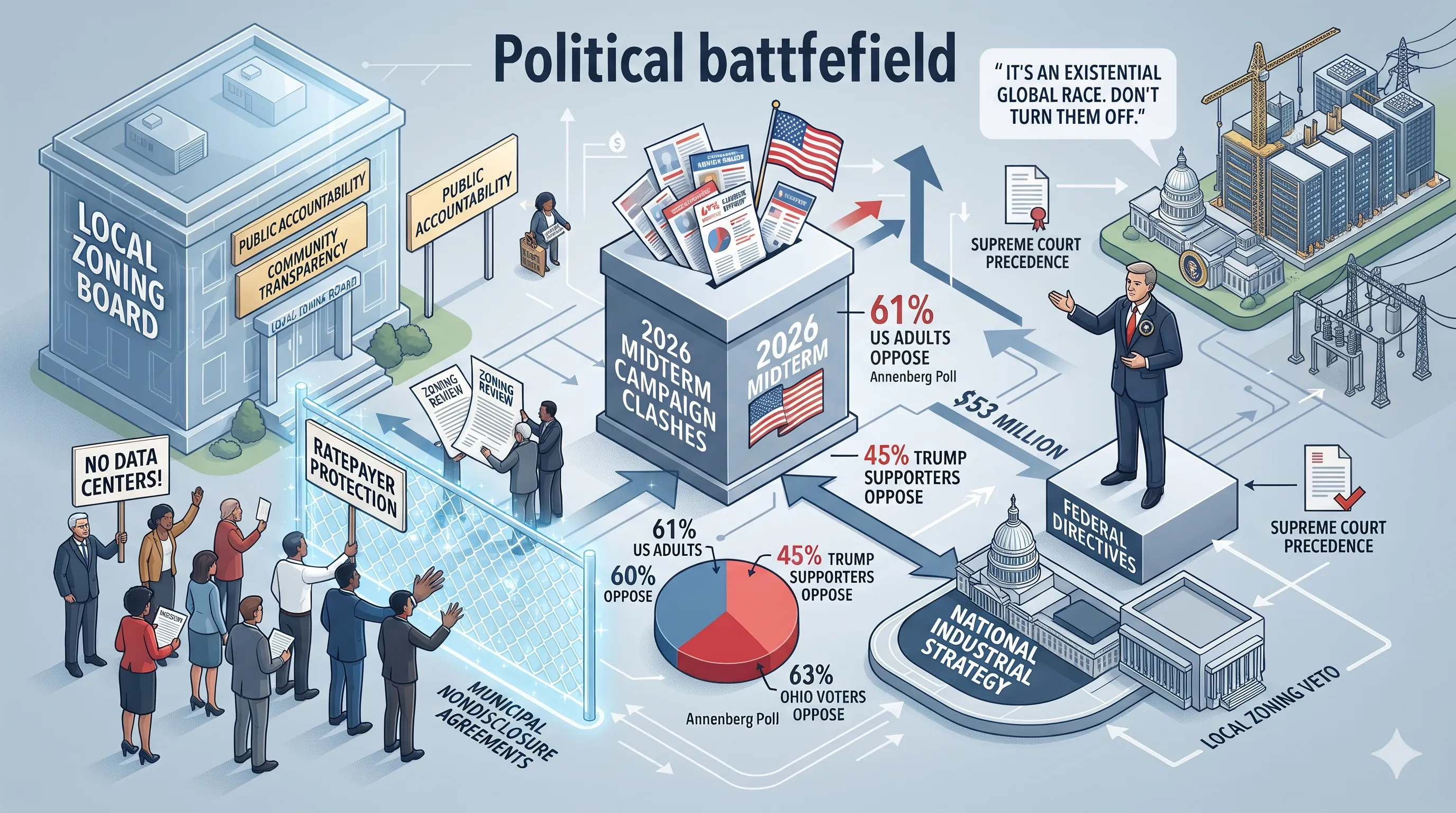
Voter resistance to hyperscale development has dismantled conventional party divides, establishing public opposition as a dominant political factor in key electoral races.An Annenberg Public Policy Center poll conducted in August 2026 revealed that 61% of US adults oppose neighborhood data center development, compared to only 14% who express support.
Notably, familiarity with the underlying technology does not diminish this pushback; among regular users of artificial intelligence tools, 60% oppose data center construction in their local areas.
This resistance crosses traditional ideological lines.
Polling by The Cook Report documented that 45% of staunch supporters of Donald Trump oppose data center expansion.
At the state level, localized concern is even more pronounced; in Ohio, 63% of registered voters expressed opposition to data center construction projects.
In response to this shifting electorate, political campaigns and outside political action groups have spent over $53 million on midterm election advertising addressing data center construction.
Bipartisan opposition has elevated municipal data center zoning and power impacts into a focal point in competitive Senate and congressional races.
Electoral candidates across both major parties have aligned their platforms against utility rate hikes attributed to infrastructure expansion, seeking to insulate residential ratepayers from industrial grid burdens.
Highlighting this populist pushback against unchecked technology expansion, Pennsylvania congressional candidate Rob Bresnahan criticized industry practices in campaign advertisements, stating: "To big data, we’re just land and dollar signs."
| Metric / Category | Electorate / Demographic Segment | Documented Value | Context / Scope |
|---|---|---|---|
| Public Opposition | All US Adults (National) | 61% Opposition (14% Support) | Annenberg Public Policy Center poll (August 2026) regarding neighborhood facility development. |
| User Pushback | Regular AI Users | 60% Opposition | Opposition to local area data center construction. |
| Partisan Alignment | Staunch Trump Supporters | 45% Opposition | The Cook Report polling regarding data center expansion. |
| State Voter Sentiment | Ohio Registered Voters | 63% Opposition | Registered voter opposition to state data center construction projects. |
| Campaign Spending | Midterm Campaigns & Outside PACs | Over $53 Million | Midterm election advertising addressing data center construction and utility impacts. |
Municipal Nondisclosure Agreements and Local-Federal Regulatory Friction
The regulatory fight over data center expansion has exposed severe friction between grassroots transparency demands and national industrial strategy.The sheer physical demand of the infrastructure is illustrated in Virginia, where data centers accounted for 40% of total statewide electricity demand in 2024 across approximately 600 facilities.
Such massive resource consumption has driven intense scrutiny of local administrative approvals.
Local residents and civic groups have targeted the routine use of municipal nondisclosure agreements that conceal technical utility requirements during zoning reviews.
These confidentiality pacts have historically prevented public oversight regarding expected water usage, substation installation, and power grid draw until approvals were finalized.
Challenging local supervisors directly over the secrecy surrounding these proceedings, Virginia resident Patricia Gallardo asked: "What actually was approved, and is that still the project? Our neighborhood deserves to know exactly what planned next door."
This mounting municipal pushback increasingly clashes with national policy objectives.
State and local efforts to pause facility construction face direct opposition from federal executive leadership prioritizing national compute scale over local zoning vetoes.
Framing high-density digital infrastructure as an existential global race, US President Donald Trump described public opposition to data center growth as a "sick conspiracy" and stated: "There’s so much money to be made for Ohio. You can’t just turn them off. They’ll go to China."
This widening divide between executive mandates for artificial intelligence dominance and municipal demands for ratepayer protection continues to redefine jurisdictional boundaries across US energy and land-use law.
Related Posts

Generative AI may have assisted with research or drafting for this article. Topic selection, fact-checking, final wording, and publication remain the responsibility of DragonStone74. AI use disclosure