
How DeepSeek and Huawei Co-Design Ascend AI Hardware and Kernels
🚀 Key Takeaways
- Symbiotic Hardware-Software Co-Design: Huawei provides silicon and baseline toolchains while DeepSeek develops tailored kernel infrastructure to maximize native Ascend performance.
- Open-Source Toolchain Expansion: DeepSeek introduced Ascend-optimized support across key infrastructure repositories, including TileLang, DeepGEMM, DeepEP, and custom FlashMLA kernels.
- Microarchitectural Adaptation: Algorithmic implementations adapt directly to Ascend's decoupled Vector and Cube pipelines, working around specialized buffer constraints and tailoring memory layouts.
- Interconnect and Supernode Scaling: High-bandwidth superpod topologies leverage unified communication primitives to overlap distributed expert routing directly with computational stages.
- Ecosystem and Architecture Friction: Toolchains remain heavily optimized for domestic ARM-based configurations, encountering software compatibility barriers when ported across standard x86 environments.
- Strategic Infrastructure Realities: Substantial accelerator deployments target massive inference facilities, even as frontier foundation training still balances ongoing gaps in raw hardware throughput.
The global landscape of artificial intelligence compute is witnessing an aggressive paradigm shift as Chinese tech pioneers strive for silicon sovereignty.
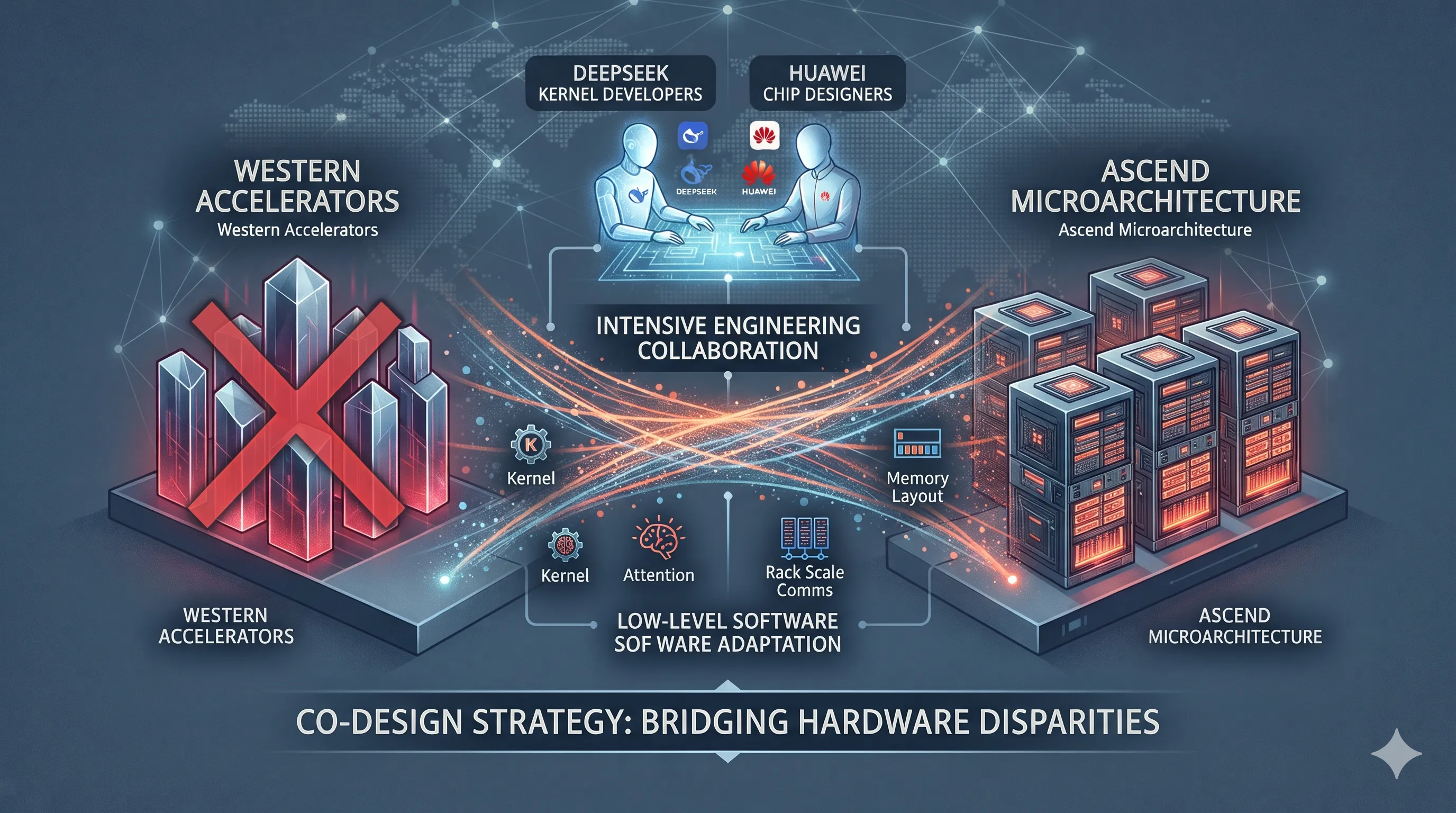
Rather than waiting for domestic hardware to organically achieve parity with Western accelerators, DeepSeek and Huawei have formed an intensive engineering collaboration. By embedding kernel developers directly alongside chip designers, the two organizations are systematically bridging hardware disparities through deep, low-level software adaptation.
This co-design strategy redefines model deployment by refactoring attention mechanisms, memory layouts, and rack-scale communications specifically for the Ascend microarchitecture. Examining this union illuminates how strategic software optimization can extract maximum efficiency from alternative hardware, providing a clear blueprint for the evolving multipolar semiconductor ecosystem.
1. DeepSeek Software Stack Support and Kernel Tooling on Ascend
This section directly examines how Huawei and DeepSeek combine hardware and model workloads through the co-development of a native kernel-authoring language and specialized communication runtimes.In this technical alignment, Huawei provides the underlying silicon and native software stack, while DeepSeek supplies production workloads and low-level kernel engineering to extract maximum performance from the hardware.
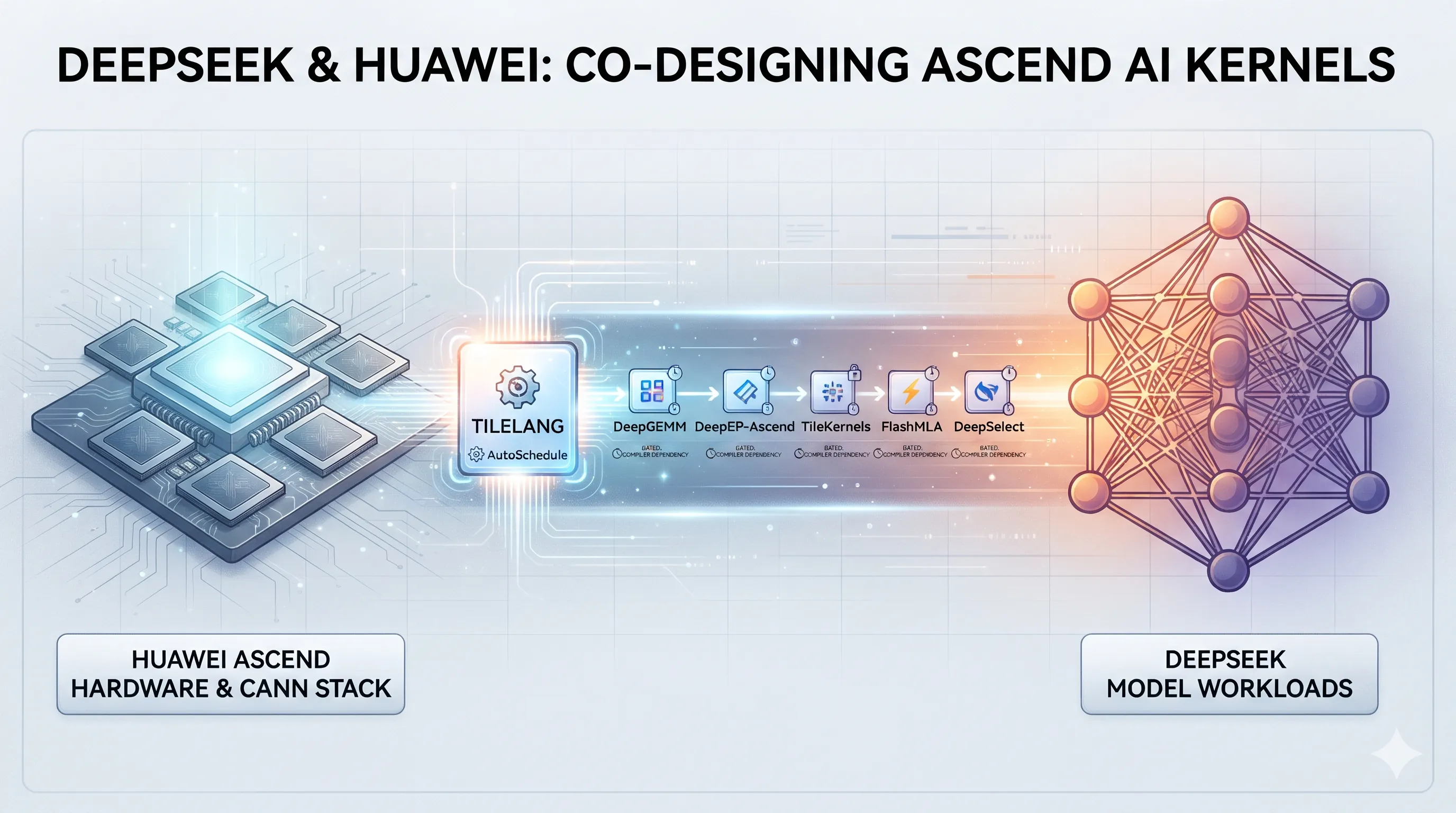
Right before China's National Day holidays on September 30, DeepSeek published Ascend support across six core repositories: TileLang, DeepGEMM, DeepEP, TileKernels, FlashMLA, and DeepSelect.
However, the rollout revealed immediate engineering constraints within the ecosystem tooling.
TileLang was the only repository usable at the time of writing because CANN 9.2.0 had not been released, and the stack requires a C++20 compiler that was not provided in the earlier CANN 9.2.0-beta.2 build.
The release schedule for the Ascend HDK was set for October 15, establishing the baseline driver support required to unlock the remaining components.
| Repository / Component | Ascend Ecosystem Implementation | Execution Dependency & Runtime Status |
|---|---|---|
| TileLang | Integrates native compilation, scheduling, synchronization, and runtime support for Ascend's execution model directly into the main repository. | Usable at release; implements an AutoSchedule system for overlapping operations. |
| DeepEP-Ascend | Direct port of DeepEP V2.5 maintaining identical Python API surfaces. | Executes operations over URMA and HCCL; distributed under DeepSeek's organization. |
| DeepGEMM, TileKernels, FlashMLA, DeepSelect | Ascend-targeted operator and kernel libraries released alongside the core stack. | Gated by compiler requirements requiring CANN 9.2.0 and a dedicated C++20 compiler environment. |
TileLang Architecture and Native Ascend Scheduling
The core operational pipeline between Huawei and DeepSeek centers on TileLang, a domain-specific kernel-authoring language.DeepSeek stated that TileLang is designed to offer a simpler programming approach than CUDA while maximizing hardware performance.
TileLang incorporates native compilation, scheduling, synchronization, and runtime support for the Ascend execution model directly within its primary repository.
To overcome pipeline stalls and exploit compute resources, TileLang includes an AutoSchedule engine.
AutoSchedule systematically plans overlapping operations by analyzing explicit data dependencies alongside estimated execution times across hardware units.
This automated overlap balances memory movement and matrix calculations without forcing model researchers to hand-craft low-level barrier synchronization.
The runtime usability of the wider tooling suite remained constrained by compiler toolchain maturity.
Because CANN 9.2.0-beta.2 lacked the required C++20 compiler toolchain, developer execution across DeepGEMM, TileKernels, FlashMLA, and DeepSelect remained blocked until the broader delivery of CANN 9.2.0 and the October 15 Ascend HDK.
DeepEP-Ascend Implementation and Day-0 Co-Development
The development history of the DeepEP communication framework illustrates the iterative collaboration between both organizations.In July 2025, Huawei's Ascend team proposed DeepEP-Ascend under the
deepseek-ai organization, but a maintainer declined the initial pull request.DeepEP-Ascend was subsequently published and distributed directly under DeepSeek's own organization.
DeepEP-Ascend serves as a functional port of DeepEP V2.5, maintaining the exact same Python API to preserve drop-in compatibility for distributed training and inference workloads.
Beneath that uniform API, DeepEP-Ascend routes traffic across URMA and HCCL communication primitives to drive Ascend cluster interconnects efficiently.
To ensure hardware efficiency at rollout, DeepSeek provided model weights directly to Huawei to enable Day-0 optimized releases for flagship architectures, including DeepSeek V4 and DeepSeek V4.1.
As SemiAnalysis observed regarding this symbiotic dependency: "Neither can do this alone... Each supplies exactly what the other lacks: Huawei provides the hardware and native software stack; DeepSeek brings the workloads and engineering needed to make that hardware useful for its models."
Despite these operational gains, low-level co-development imposes tangible organizational costs.
Building custom compilers, maintaining hardware-specific kernels, and debugging vendor-specific platform behavior temporarily competes with DeepSeek's core research and product development velocity.
2. Ascend 950PR Architecture, Microbenchmarks, and Kernel Execution
Understanding the underlying silicon behavior of the Ascend 950PR directly illuminates how Huawei and DeepSeek are combining hardware and model workloads, establishing an architectural profile where custom operator pipelines and tightly coupled scheduling compensate for raw compute variances.Microbenchmarking the Ascend 950PR_9579 accelerator reveals distinct design trade-offs across its execution stages, cache hierarchy, and auxiliary control subsystems.
Core Hierarchy, AICPU Scheduling, and Latency Profiles
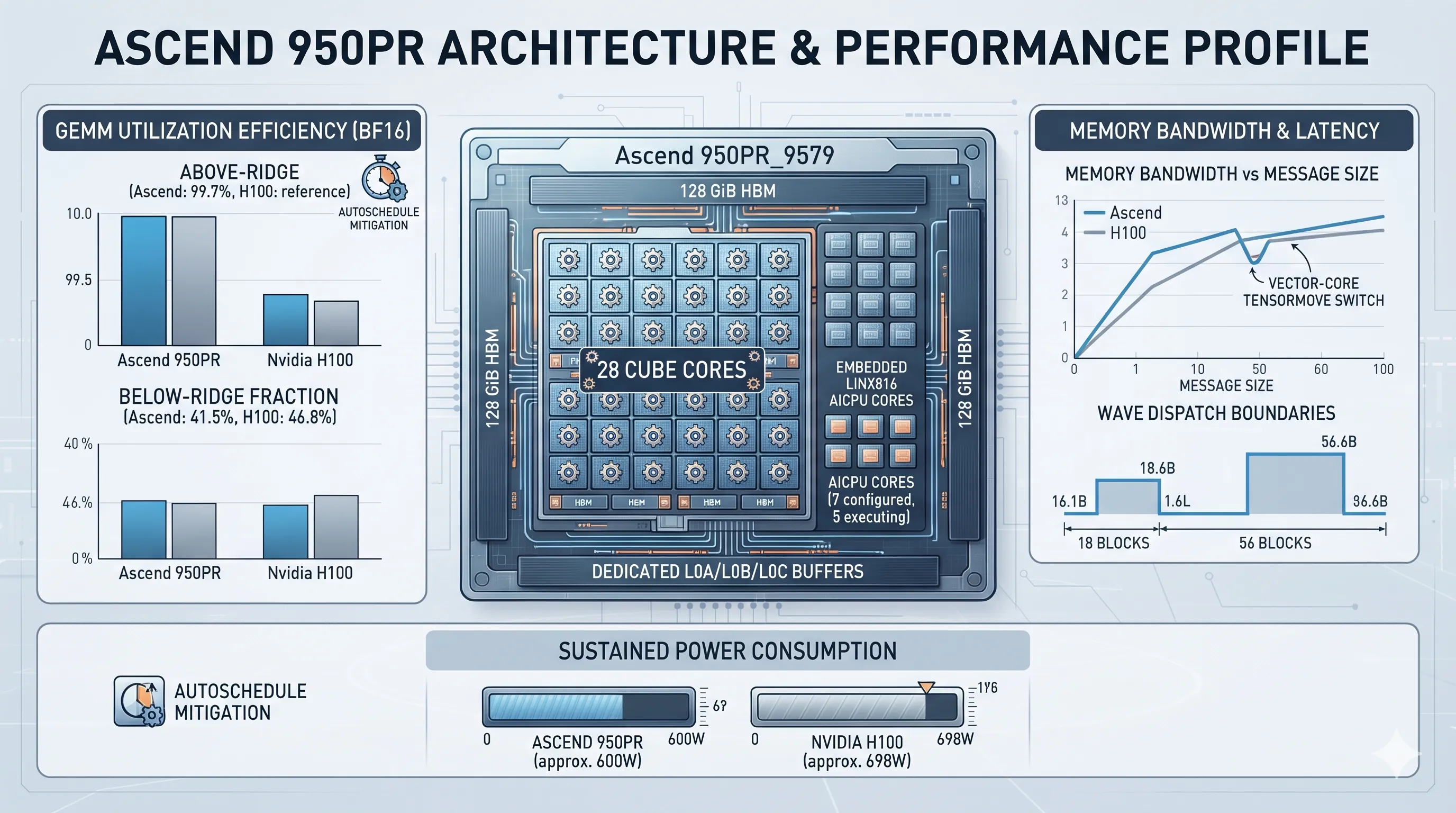
The evaluated Ascend 950PR_9579 hardware configuration features 28 cube cores paired with 128 GiB of High Bandwidth Memory (HBM).To maximize commercial fabrication viability against silicon defects, Huawei bins both compute and memory into multiple SKUs to pair weaker memory with weaker compute due to die and HBM stack yields.
Compute orchestration relies on dedicated on-chip memory buffers where Ascend stages matrix operands in dedicated L0A/L0B buffers and accumulators in L0C to overlap movement, computation, and result handling.
Pointer-chase microbenchmarks targeting memory traversal expose the wave dispatch boundary across the core array.
Running pointer chases reading 16 KiB integer payloads stays near 134 ns through 18 blocks, rises to 182 ns at 56, and jumps to 391 ns at 64.
This sharp latency progression is consistent with a second wave executing beyond 56 Vector cores.
Control operations are delegated away from the primary compute pipelines to embedded Linx816 processor units.
The evaluated 950PR SKU has 7 configured, 6 visible, and 5 executing Linx816 AArch64 ELF AICPU cores.
These AICPU cores handle short device-control tasks and CPU-operator support such as KV metadata where device-to-host transfer overhead dominates.
In production frameworks, DSA scheduling steps run directly on the AICPU where Cube/Vector cores compute INT8 indexer scores and select top 2,048 indices.
GEMM Utilization and Bandwidth Dynamics vs Nvidia H100
Kernel evaluation confirms high roofline utilization on standardized linear algebra workloads, even as structural architectural bottlenecks emerge under specific copy regimes.Across 1,055 BF16 GEMM shapes from open-source models, Huawei's best stock kernels hit 99.7% of the ceiling.
However, on shapes below Ascend's ridge point, its median achieved/attainable fraction is 41.5% compared to H100's 46.8%.
In terms of absolute compute performance values, the Ascend 950PR falls behind, sitting between Nvidia A100 and AMD MI300X.
To mitigate sub-ridge inefficiencies, compilation tooling plays a central role: AutoSchedule reduces single-operation execution time by up to 40% on 950PR for smaller sizes.
Memory pipeline behavior exhibits distinct scaling patterns against Nvidia H100 baselines.
Ascend 950PR effective memory bandwidth and bandwidth utilization surpass H100 at small message sizes per buffer and nearly match H100 at large sizes.
Nonetheless, memory bandwidth curves show a dip when Ascend switches copy methods to a Vector-core TensorMove kernel that incurs higher startup overhead.
Furthermore, high FLOPs and bandwidth utilization do not necessarily yield high Model FLOPs Utilization (MFU) or Model Bandwidth Utilization (MBU) during training due to FSDP collective, checkpointing, and movement bottlenecks.
Sustained power measurements show clear operational boundaries between the platforms.
Ascend approximated 599-600 W at 1500-1550 MHz against its 1650 MHz reference frequency.
In comparison, Nvidia H100 sampled median power around 690-698 W out of a 700 W limit at 1335-1470 MHz.
| Metric / Architectural Dimension | Ascend 950PR (SKU 9579) | Nvidia H100 |
|---|---|---|
| BF16 Stock Kernel Ceiling Attainment | Hits 99.7% across 1,055 BF16 shapes | Reference baseline |
| Sub-Ridge Achieved/Attainable Fraction | 41.5% median | 46.8% median |
| Relative Compute Positioning | Between Nvidia A100 and AMD MI300X | Higher absolute compute performance |
| Memory Bandwidth Utilization | Surpasses H100 at small message sizes per buffer; nearly matches at large sizes; exhibits dip during Vector-core TensorMove switch | Consistent scaling across standard buffer transfer sizes |
| Measured Power Consumption | 599-600 W (approximate) | 690-698 W median sampled (700 W limit) |
| Operating Core Clock Frequencies | 1500-1550 MHz (against 1650 MHz reference) | 1335-1470 MHz |
| Auxiliary Control Cores | 7 configured, 6 visible, 5 executing Linx816 AArch64 ELF AICPU cores | Host/driver-managed execution offload |
3. Hardware-Software Co-Design: Attention and KV-Cache Adaptation
The co-design dynamic between Huawei's hardware and DeepSeek's models is evident in how Ascend microarchitectural constraints directly shaped DeepSeek's low-level attention kernels.To maximize performance across these chips, algorithmic memory layouts and accumulation pipelines were restructured to accommodate the unique characteristics of Ascend compute blocks.
FlashMLA Layout Optimization for Memory Transfer Engines
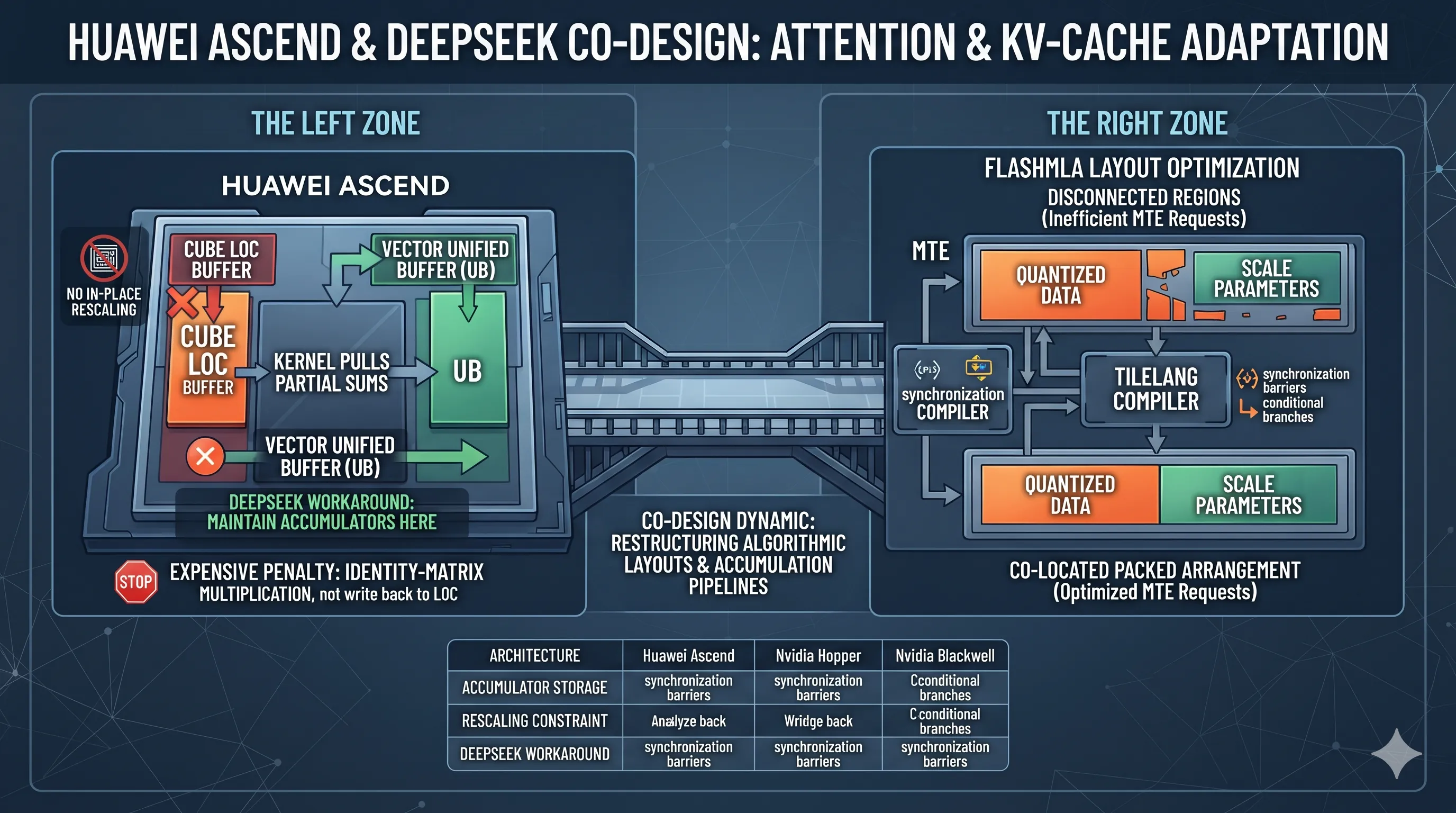
DeepSeek adapted its FlashMLA KV-cache memory layout specifically around the operational mechanics of Huawei's Memory Transfer Engine (MTE).Rather than storing quantized data and associated scale parameters in disconnected memory regions, the layout co-locates quantized values and scaling factors together.
This packed arrangement minimizes the total number of distinct MTE requests required during retrieval, reducing memory bus contention during decoding.
To coordinate these specialized operations across compute units, the TileLang compiler automatically inserts synchronization barriers.
TileLang also evaluates conditional branches across runtime execution paths to prevent incorrect operation completion assumptions across asynchronous hardware pipelines.
L0C Buffer Constraints and Unified Buffer Workarounds
The physical memory hierarchy of Ascend compute engines introduces explicit constraints during iterative attention operations.The Ascend Cube L0C buffers lack native support for in-place rescaling during fused attention computation.
To bypass this limitation, DeepSeek avoids keeping active accumulators inside L0C.
Instead, running output accumulators are maintained inside the Vector Unified Buffer (UB).
The kernel pulls partial sums out of L0C only when strictly necessary.
Attempting to return rescaled outputs directly into L0C would force the hardware to execute an expensive identity-matrix multiplication.
DeepSeek's Unified Buffer routing eliminates this penalty entirely.
This architectural challenge contrasts with accumulation mechanisms found on other accelerator architectures.
| Architecture | Accumulator Storage Mechanics | Rescaling & Buffer Constraints |
|---|---|---|
| Huawei Ascend | Running output accumulators maintained in Vector Unified Buffer (UB); partial sums pulled from Cube L0C only when needed. | L0C lacks in-place rescaling support; writing rescaled outputs directly back to L0C requires an expensive identity-matrix multiplication. |
| NVIDIA Hopper | Accumulators are kept directly in hardware registers. | Avoids Ascend's L0C buffer constraint through direct register-based accumulation. |
| NVIDIA Blackwell | Dedicated loads and stores operate between tensor memory and registers. | Avoids Ascend's L0C buffer constraint via bidirectional tensor memory and register movement. |
4. Rack-Scale Supernodes and Interconnect Optimization with DeepEP
Connecting directly to the broader exploration of how Huawei and DeepSeek are combining hardware and model workloads, rack-scale communication topologies represent the physical and architectural substrate required to scale Mixture-of-Experts (MoE) models across specialized accelerators.As DeepSeek models scale expert parallelism across vast accelerator pools, the co-design of multi-rack supernodes and tailored communication libraries governs aggregate throughput.
Superpod Interconnects and WideEP Scaling
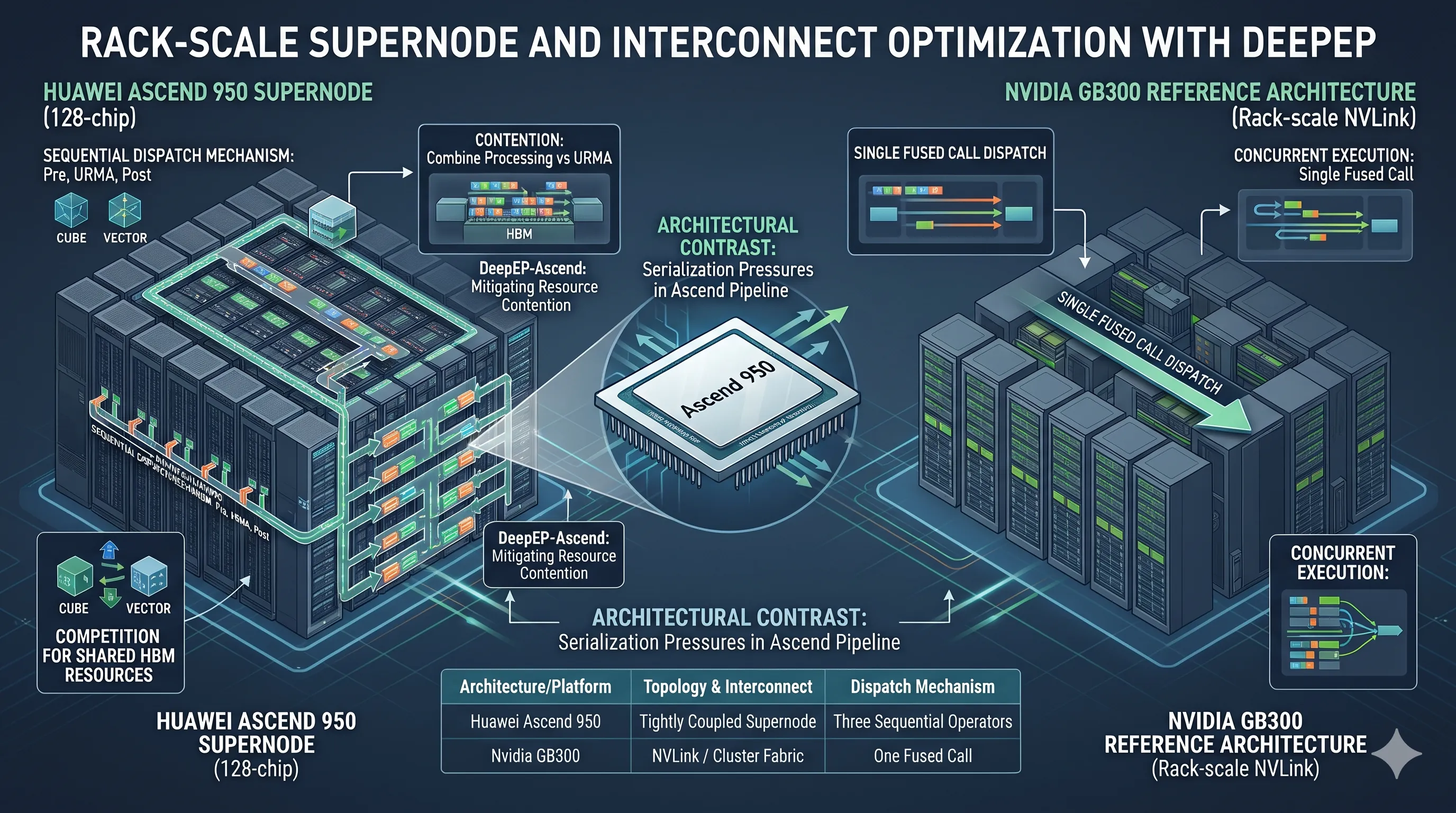
Ascend supernodes span multi-rack tightly coupled interconnects ranging from 910 CloudMatrix384 configurations to 950 SuperPod deployments to enable wideEP scale-out across distributed clusters.DeepSeek tested and pushed the performance limits of a supernode solution comprising 128 Ascend 950 chips, examining how large-scale hardware fabrics sustain extreme parallel workloads.
Huawei released EP16 dispatch and combine benchmarks running over URMA on the Ascend 950DT superpod, demonstrating the operational metrics of its high-speed transport layer under expert-routing conditions.
| Architecture / Platform | Topology & Interconnect Type | Dispatch Mechanism |
|---|---|---|
| Huawei Ascend 910 | CloudMatrix384 multi-rack tightly coupled interconnect | Sequential multi-stage dispatch |
| Huawei Ascend 950 / 950DT SuperPod | 128-chip supernode / 950DT superpod over URMA | Three sequential operators (pre, URMA, post) with receive completion and expert expansion |
| Nvidia GB300 | Rack-scale NVLink / cluster interconnect | One fused call |
Huawei's dispatch requires three sequential operators (pre, URMA, post) alongside receive completion and expert expansion, whereas the Nvidia GB300 executes dispatch as a single fused call.
This structural divergence places distinct serialization pressures on Huawei's execution pipelines during wideEP phases.
Mitigating URMA Communication and HBM Memory Contention
To support workload overlap, Ascend provides separate Cube and Vector execution paths designed to facilitate overlapping communication with computation.However, deep architectural bottlenecks emerge when scaling these operations simultaneously across the chip architecture.
Communication competes directly with expert computation for shared memory bandwidth and Vector core processing.
DeepEP-Ascend addresses resource contention between combine processing and URMA communication across HBM.
Combine processing and URMA transfers experience severe contention over shared HBM resources during operational overlap, establishing an architectural bottleneck that requires planned Huawei firmware improvements to optimize hardware-level scheduling and memory isolation.
5. DeepSeek-V4.1-Flash Execution Profiling on Ascend 950DT
An evaluation of the physical execution profile of DeepSeek-V4.1-Flash on Ascend 950DT hardware illustrates how Huawei and DeepSeek combine hardware architecture and model workloads.Profiling a single rank across a 32-chip Ascend 950DT deployment exposes how architectural streaming and fused kernel design resolve latency bottlenecks during steady-state inference.
Concurrent Drafter Streams and MC² Kernel Fusion
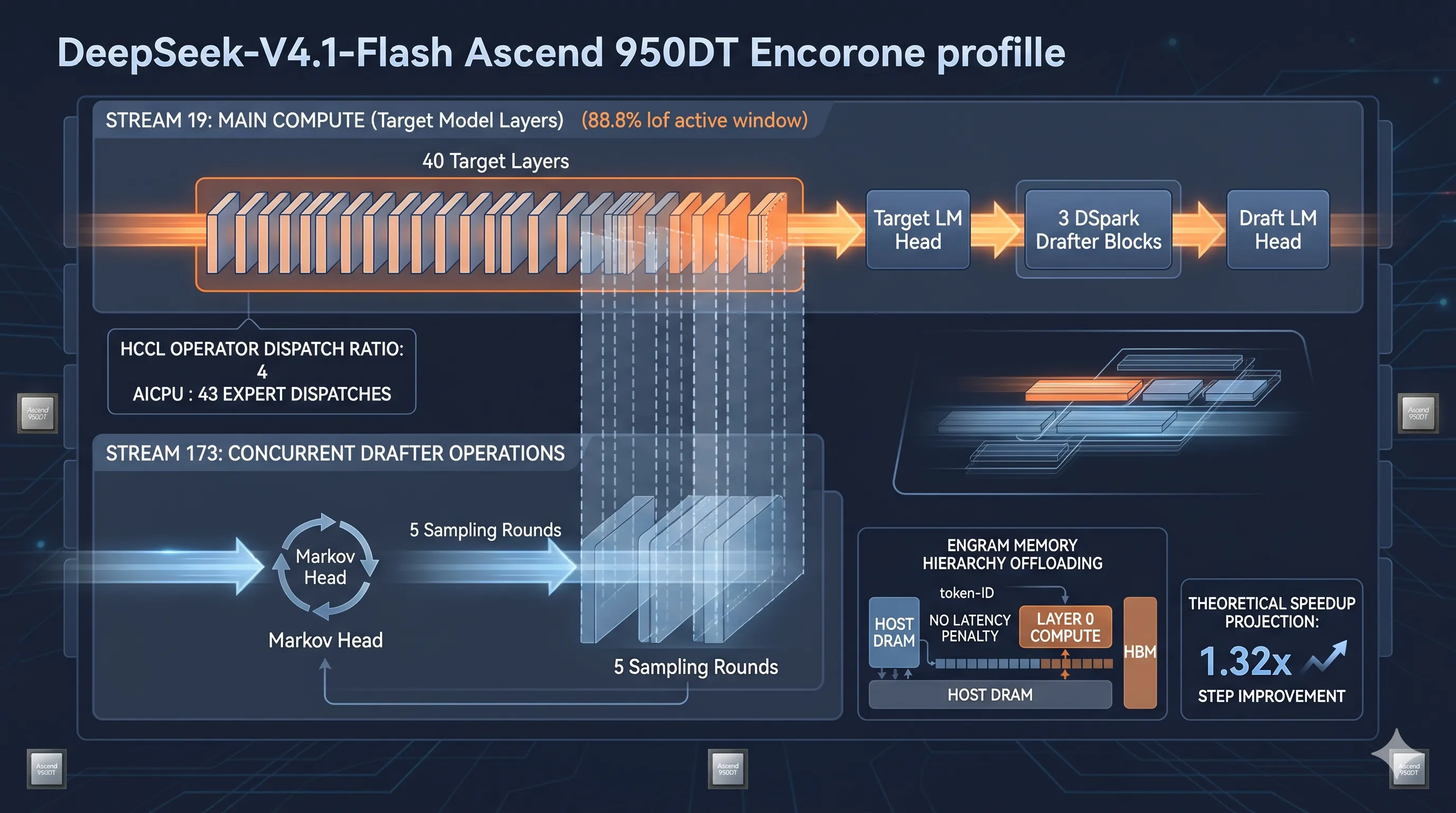
The end-to-end execution flow of DeepSeek-V4.1-Flash comprises 40 target-model layers, the target LM head, 3 DSpark drafter blocks, the draft LM head, and 5 sampling rounds.Rather than executing sequentially, main compute runs on Stream 19 while drafter operations execute concurrently on Stream 173.
During steady-state execution, Stream 19 remains occupied for 88.8% of the active window.
However, Stream 19 accounts for only 72.6% of total summed device time because compute on auxiliary streams overlaps with primary execution.
Kernel dispatch efficiency is sustained through V3 MC² fused computation and communication kernels.
Standard non-fused pipelines suffer from host-bound overheads when coordinating mixture-of-experts operations across accelerators.
Under the V3 MC² implementation, only 4 AICPU-launched HCCL operations appear per execution step against 43 expert dispatches.
Communication primitives are coordinated across heads: both the target and draft heads execute hcom_allGather and hcom_alltoallv to gather hidden states, execute LM-head GEMM operations, and exchange logits across chips.
Speculative drafting latency is minimized by the operational structure of the DSpark drafter blocks.
These drafter blocks generate base logits a single time.
A Markov head subsequently models token dependencies via sampling and embedding feedback loops without rerunning the core transformer blocks.
In a theoretical composition scenario where cube throughput is doubled while holding other device work and stream overlap constant, the architecture projects a 1.32x step improvement.
| Metric / Pipeline Parameter | Profile Measurement | Hardware Execution Context |
|---|---|---|
| Stream 19 Main Compute Occupancy | 88.8% window occupancy (72.6% summed device time) | Concurrently overlapped with DSpark drafter operations running on Stream 173. |
| HCCL Operator Dispatch Ratio | 4 AICPU-launched operations to 43 expert dispatches | Enabled by V3 MC² fused computation and communication kernels across 32 Ascend 950DT chips. |
| Pipeline Structure | 40 target layers, 3 DSpark blocks, 5 sampling rounds | Executes target LM head and draft LM head via hcom_allGather and hcom_alltoallv primitives. |
| Theoretical Speedup Projection | 1.32x step improvement | Modelled by doubling cube throughput while holding remaining device work and overlap constant. |
Engram Memory Hierarchy Offloading and Vector Processing Shares
Memory hierarchy management in DeepSeek-V4.1-Flash dictates how parameter retrieval avoids device stalls.The model uses Engram token-ID input fetching that is asynchronously overlapped with layer 0 compute operations.
This overlap allows Engram parameters to be offloaded directly to host DRAM without incurring latency penalties relative to high-bandwidth memory (HBM).
The memory tier chosen for parameter offloading remains performance-critical.
Offloading Engram parameters to PCIe 4.0 SSD degrades performance relative to DRAM or HBM configurations.
Furthermore, device execution balance must account for vector core utilization.
Vector core buckets carry large combined processing shares for both fused communication routines and un-fused quantization boundaries across the pipeline.
6. Ecosystem Disparity, Non-ARM Compatibility, and Hardware Roadmaps
To understand how Huawei and DeepSeek are combining hardware and model workloads, it is essential to examine the low-level architectural friction points and multi-generational hardware roadmaps governing their partnership.While co-design efforts aim to streamline DeepSeek's algorithmic breakthroughs onto Ascend silicon, bridging the hardware and software divergence between standard x86 infrastructure and Huawei's ARM-based ecosystem presents substantial operational trade-offs.
Data Center Deployments and x86 Architecture Friction
DeepSeek plans to deploy at least 160,000 Ascend 950DT chips at its data center currently under construction in Inner Mongolia.In the operational division of labor, DeepSeek still relies on Nvidia GPUs for model training, while Huawei chips are primarily deployed for inference tasks.
To facilitate this deep hardware-model convergence, Huawei engineers are stationed on-site at DeepSeek offices to integrate model computing feedback directly into future Ascend chip designs.
However, running DeepSeek's custom-optimized workloads across heterogeneous infrastructure exposes sharp software ecosystem disparities.
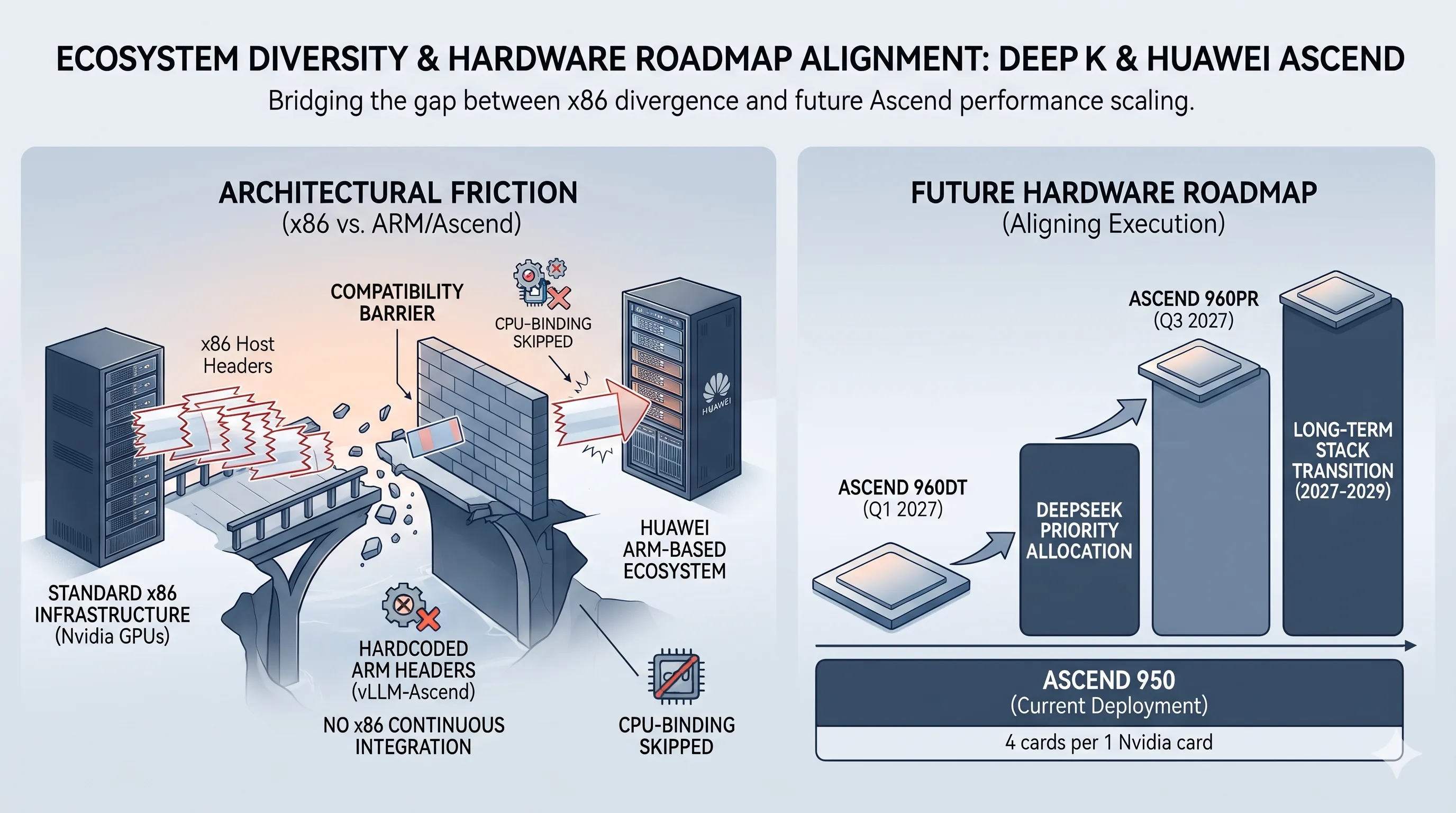
Optimizations developed specifically for Huawei supernodes do not transfer cleanly to standard x86 environments, notably lacking DeepGEMM support on x86 hosts.
Significant architectural roadblocks also appear inside standard serving frameworks.
As of vLLM-Ascend_0.26.0rc1, memfabric_hybrid contains hardcoded ARM headers that block startup on x86 machines.
Furthermore, CPU-binding is automatically skipped for non-ARM CPUs, and no NPU plus x86 continuous integration exists, forcing engineering teams to apply custom patches to maintain host-level compatibility.
Hardware Competitiveness Gaps and Future Ascend Roadmaps
The engineering push to adapt models to Huawei hardware takes place against an acknowledged performance disparity with state-of-the-art accelerators.According to an unverified May investor meeting transcript, DeepSeek founder Liang Wenfeng stated: "So, when it comes to the chip gap between China and the US, I think the software ecosystem gap will eventually disappear. But on the hardware side, we face two separate disadvantages: it takes four Huawei accelerator cards to match one NVIDIA card, and Huawei is also roughly two years behind in bringing its hardware to market."
Independent evaluations reflect a similar compute differential.
Research firm Epoch AI evaluated Nvidia B300 compute performance as approximately 7 times that of Ascend 950.
To overcome this hardware gap over time, Huawei is aligning its forward silicon execution with DeepSeek's scaling requirements.
| Hardware / Projection | Timeline | Performance and Allocation Details |
|---|---|---|
| Ascend 950 | Current Deployment | Evaluated by Epoch AI at approximately 1/7 the compute performance of the Nvidia B300; Liang Wenfeng cited a 4-to-1 card parity ratio against Nvidia. |
| Ascend 960DT | Q1 2027 | Huawei is prioritizing domestic supply allocations and plans to allocate the majority of early volume directly to DeepSeek. |
| Ascend 960PR | Q3 2027 | Next-phase accelerator release following the 960DT launch. |
| Long-Term Stack Transition | 2027–2029 | SemiAnalysis projected that DeepSeek will likely be primarily using Huawei's stack by 2027 or 2028, supported by additional Ascend hardware releases planned across 2028 and 2029. |
To secure DeepSeek's operational foundation on domestic silicon, Huawei is prioritizing domestic supply allocations and plans to allocate the majority of early Ascend 960DT volume to DeepSeek.
Supported by this supply alignment, SemiAnalysis projected that DeepSeek will likely be primarily using Huawei's stack by 2027 or 2028.
Related Posts

Anthropic Unleashes Claude: SpaceX's Colossus 1 Delivers Massive AI Compute, Doubled User Limits & Paves Way for Space-Based FutureThe partnership between Anthropic and SpaceXAI secures a massive compute boost for Claude ,...
How Nemotron 3.5 Parse Accelerates Vision-Language Document ExtractionDiscover how NVIDIA's Nemotron 3.5 Parse boosts inference speed and document extraction efficiency...
Microsoft Ignite 2026: Copilot Work OS and Agent 365 GovernanceDiscover how Microsoft Ignite 2026 redefines enterprise AI with Copilot as the Work OS, centralized...
Generative AI may have assisted with research or drafting for this article. Topic selection, fact-checking, final wording, and publication remain the responsibility of DragonStone74. AI use disclosure