
How Bumpy Modernizes Monorepo Versioning as a Changesets Alternative
🚀 Key Takeaways
- Modern File-Based Monorepo Versioning: Bumpy uses localized markdown bump files to declare release intent, bump levels, and changelogs directly inside standard pull request reviews.
- Native Workspace and Catalog Support: The engine resolves modern package manager protocols such as
catalog:andworkspace:across npm, pnpm, Yarn, and Bun without manual hacks. - Multi-Target Artifact Publishing: In addition to standard npm registries, teams can define custom publish lifecycles for non-npm artifacts such as Docker images, VS Code extensions, and JSR packages.
- Git-Clean Prerelease Channels: Ephemeral branch-based prerelease channels compute version strings dynamically at publish time, eliminating dirty commit states and painful git rollbacks.
- First-Class AI Agent Integration: Out-of-the-box agent skills enable LLMs and developer assistants to inspect workspace diffs, assign semver bump levels, and update release declarations automatically.
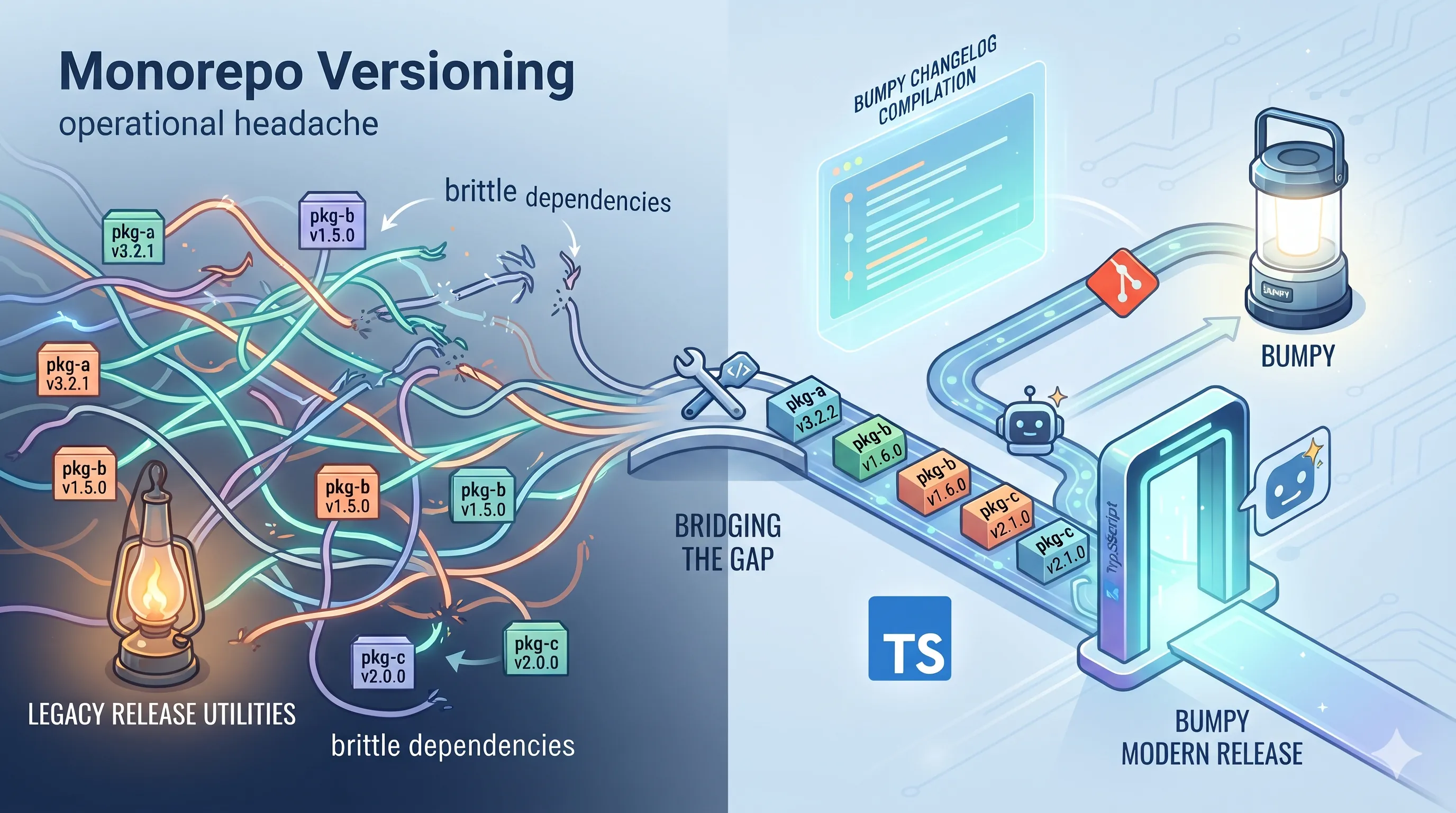
Coordinating package versions across large monorepos has long been an operational headache, often forcing teams to wrestle with tangled changelogs, stale lockfile states, and brittle dependency propagation scripts. While file-based intent systems historically helped decentralize release planning, modern web ecosystems have evolved dramatically—introducing centralized dependency catalogs, heterogeneous build targets, and automated development environments that strain older tooling.
Developed by Theo Ephraim and refined across the multi-package Varlock ecosystem, Bumpy emerged as a zero-runtime-dependency TypeScript tool designed to modernize versioning, changelog compilation, and distribution. Positioned as a lightweight, drop-in successor to legacy release utilities, the tool addresses long-standing limitations in dependency resolution and CI workflow friction while integrating seamlessly with everyday git reviews.
By coupling native support for emerging package manager protocols with embedded agent skills for autonomous AI assistants, Bumpy offers development teams a robust framework for managing complex release lifecycles. Its approach bridges the gap between predictable automated CI deployment pipelines and the practical realities of high-velocity monorepo maintenance.
1. Project Genesis: How Bumpy Emerged as a Lightweight Changesets Successor
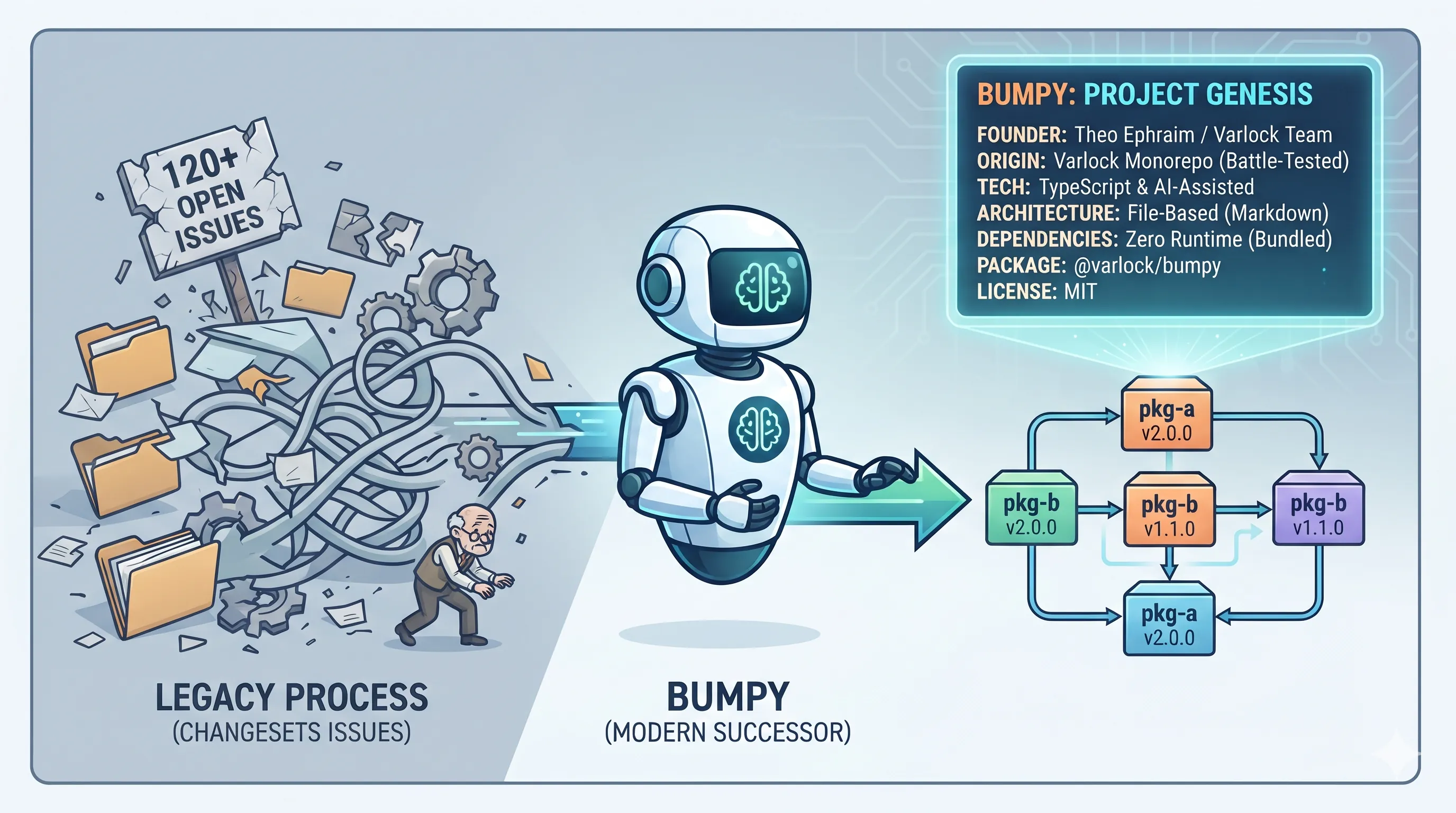
Managing multi-package repositories demands predictable release workflows, and the emergence of Bumpy establishes a direct evolution toward a streamlined, file-based approach for versioning in monorepos.Designed specifically as a package versioning, release, and changelog generation tool for monorepos, Bumpy positions itself as a modern, self-described successor and file-based alternative to Changesets.
Origins and Production Provenance in the Varlock Monorepo
Bumpy was first unveiled in April 2026 via a Show HN post by creator Theo Ephraim.Reporting by InfoQ attributes the project directly to creator Theo Ephraim and the engineering team behind Varlock.
Distributed under the permissive MIT license, the project is officially published in the npm registry under the package name @varlock/bumpy.
Rather than remaining an untested experiment, Bumpy underwent rigorous internal dogfooding and battle-testing in production.
Specifically, it was actively used to release Varlock alongside 25+ related libraries and plugins across its ecosystem.
Architecturally, Bumpy is built in TypeScript.
During its introduction, the Show HN thread highlighted that the project "was coded using AI, but carefully", reflecting a deliberate blend of modern AI-assisted implementation and strict software engineering standards.
Addressing the 120+ Issue Deficit with Zero Runtime Dependencies
A primary driver behind Bumpy's creation was the operational friction accumulated in older release management tooling.Bumpy explicitly claims to address more than 120 open issues from Changesets, targeting long-standing monorepo release pain points and workflow bottlenecks.
To maintain reliable execution across complex CI/CD monorepo pipelines, Bumpy ships with zero runtime dependencies.
All required dependencies are fully bundled at release time, preventing downstream package-manager drift, dependency conflicts, or version mismatches during the publishing cycle.
| Specification / Metric | Project Detail |
|---|---|
| npm Package Name | @varlock/bumpy |
| Creator & Attribution | Theo Ephraim / Team behind Varlock |
| Initial Public Unveiling | April 2026 (Show HN) |
| Software License | MIT License |
| Implementation Language | TypeScript |
| Changesets Issues Targeted | Claims to address more than 120 open issues |
| Runtime Dependencies | Zero runtime dependencies (bundled at release time) |
| Production Verification | Used to release Varlock and 25+ related libraries and plugins |
2. Inside the File-Based Architecture: Markdown Bump Files and Changelog Automation
To understand how Bumpy uses a file-based approach for versioning in monorepos, one must look at how changes are captured, inspected, and executed across repository lifecycles.By decentralizing version metadata into standalone files, Bumpy eliminates lock contention and anchors release intent directly to version control diffs.
Bump File Anatomy and Git Hook Enforcement
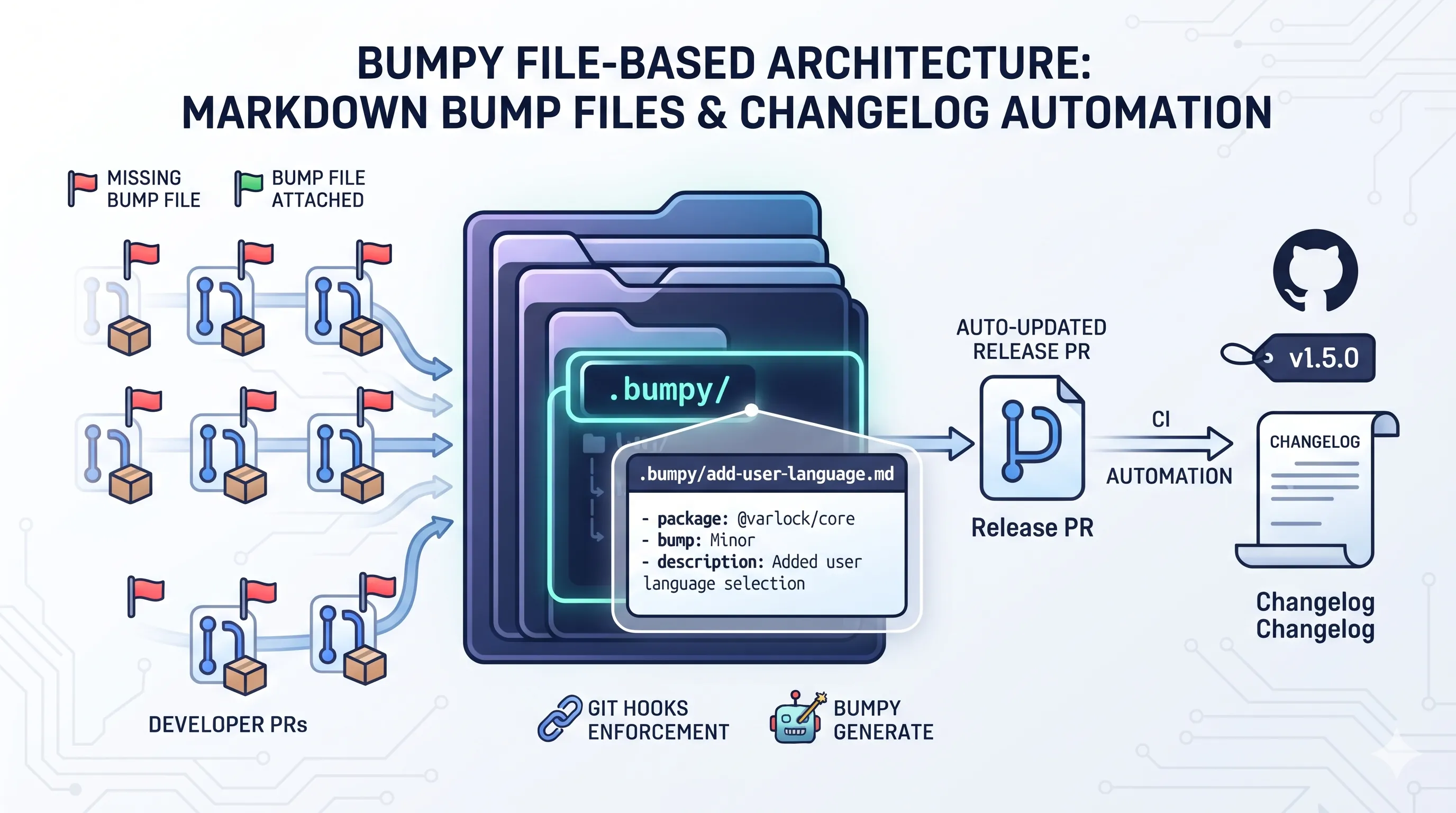
At the core of Bumpy's workflow are markdown "bump files" stored directly within the.bumpy/ directory.According to Bumpy documentation, these bump files "declare an intent to release packages with a bump level (patch/minor/major), and a description that ends up in changelogs".
Because each bump file is an independent markdown file tracked by git, developers and reviewers can inspect versioning decisions and release notes directly within pull request diffs.
To illustrate how release intent is codified, teams author bump files that isolate package impacts before merging code:
.bumpy/add-user-language.md.bumpy/ specifying package release intent and changelog text.To ensure consistency across multi-package workspaces, Bumpy can enforce the presence of bump files for changed packages using pre-commit or pre-push git hooks.
Teams transitioning from or favoring commit-based automation can bridge their workflow using the
bumpy generate command, which automatically creates bump files from branch commits, including conventional commits.Additionally, Bumpy provides support for non-interactive CLI operations tailored for CI/CD pipelines and AI-assisted workflows.
Automated Release PR Lifecycles and Pluggable Formatters
Once pull requests containing bump files are merged into the repository's base branch, Bumpy manages the deployment pipeline through CI automation.In CI, Bumpy maintains an actively updated "release PR" as individual pull requests continue to merge into the base branch.
When a maintainer merges the release PR, Bumpy executes the final release workflow: it consolidates changes, updates changelogs, deletes pending bump files, publishes the updated packages, and creates corresponding git tags and GitHub releases.
To control how release notes are styled across projects, Bumpy includes pluggable changelog formatters.
Teams can utilize built-in options, which include the "default" and "github" formatters, or implement custom formatters to match internal release documentation standards.
3. Bumpy vs. Changesets: Protocol Resolution, Prereleases, and Migration Friction
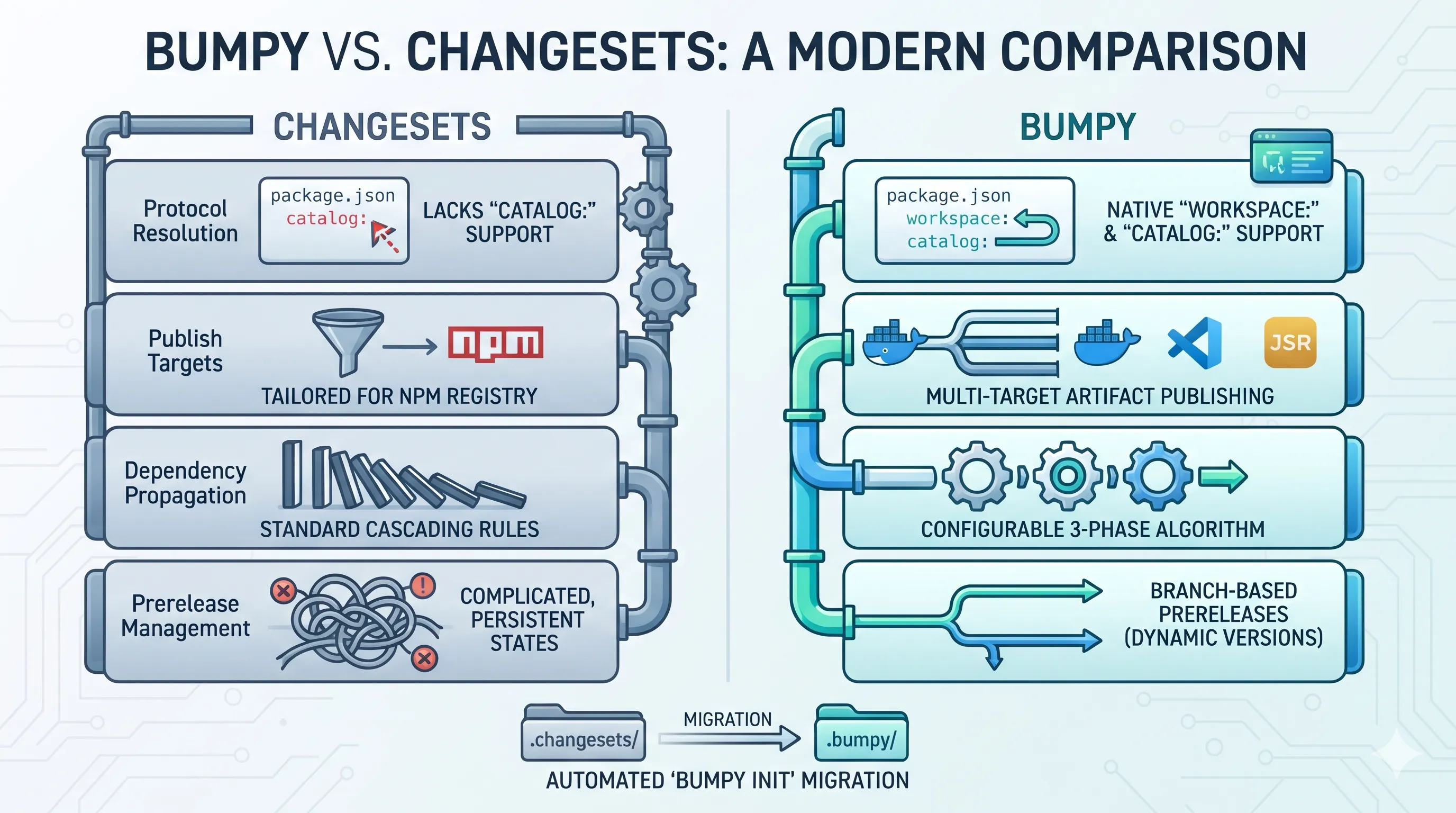
Evaluating Bumpy alongside Changesets clarifies how Bumpy's file-based approach reshapes versioning workflows across contemporary monorepos.While Changesets released v3 in August 2026 to modernize its ecosystem, teams dealing with modern package manager protocols and non-npm release pipelines frequently run into structural limits.
Bumpy refines the file-based model by directly addressing modern package management semantics, polyglot publishing targets, and Git workflow frictions.
| Dimension | Changesets | Bumpy |
|---|---|---|
| Protocol Resolution | Lacks support for the catalog: protocol. |
Provides native protocol resolution for both workspace: and catalog: protocols across npm, pnpm, Yarn, and Bun. |
| Publish Targets | Tailored primarily around npm registry artifact publishing. |
Supports per-package custom publish commands targeting non-npm artifacts, including Docker images, VS Code extensions, and JSR targets, alongside OIDC, provenance, and npm staged publishing. |
| Dependency Propagation | Applies standard workspace cascading rules. |
Implements a configurable three-phase dependency propagation algorithm that matches the triggering bump level by default. |
| Prerelease Management | Uses persistent prerelease states described by its own documentation as "very complicated" with states that are "very hard to fix". |
Features branch-based prerelease channels (introduced in v1.14) where prerelease versions are derived at publish time and never committed to Git. |
Modern Monorepo Protocols and Multi-Target Publishing
Monorepos increasingly adopt modern package manager features to unify dependency versions across workspaces.Bumpy delivers native protocol resolution for both
workspace: and catalog: protocols across npm, pnpm, Yarn, and Bun.Changesets does not support the
catalog: protocol, forcing teams relying on centralized catalog definitions to maintain workarounds.Beyond registry resolution, Bumpy addresses the realities of multi-artifact codebases by providing per-package custom publish commands.
Repositories are no longer constrained to standard npm package tarballs; engineers can orchestrate publishes for Docker images, VS Code extensions, and JSR targets directly within the same versioning workflow.
Security and verification standards are built into this pipeline, with native support for OpenID Connect (OIDC), package provenance generation, and npm staged publishing.
When package relationships change, Bumpy executes a configurable three-phase dependency propagation algorithm.
By default, this algorithm matches the triggering bump level across dependents, ensuring consistent version alignment throughout the workspace tree without manual intervention.
Branch-Based Prereleases and Automated 'bumpy init' Migration
Prerelease orchestration has long represented a notable operational hurdle in monorepo versioning systems.Changesets' own documentation describes its prerelease mode as "very complicated" with internal states that are "very hard to fix" once corrupted or misaligned in Git history.
Bumpy version 1.14 introduced branch-based prerelease channels to eliminate these persistent Git state pitfalls.
Under this design, prerelease version strings are derived dynamically at publish time and are never committed back to the Git tree.
Ephemeral branches produce valid prerelease packages during automated CI runs while keeping the primary Git history clean of disposable bump commits.
To assist teams shifting away from legacy workflows, Bumpy includes an automated migration path via the
bumpy init command.Running
bumpy init renames existing .changeset/ directories to .bumpy/, translates configuration files, preserves any pending changeset files already queued by contributors, and offers to uninstall @changesets/cli.Despite these migration automations, teams evaluating adoption have flagged edge cases.
Community issue reports note specific ongoing gaps, such as incomplete Yarn 4.10 catalog detection, which require validation before completing full repository cutovers.
4. Streamlined CI/CD: Native GitHub Actions Orchestration Without Custom Apps
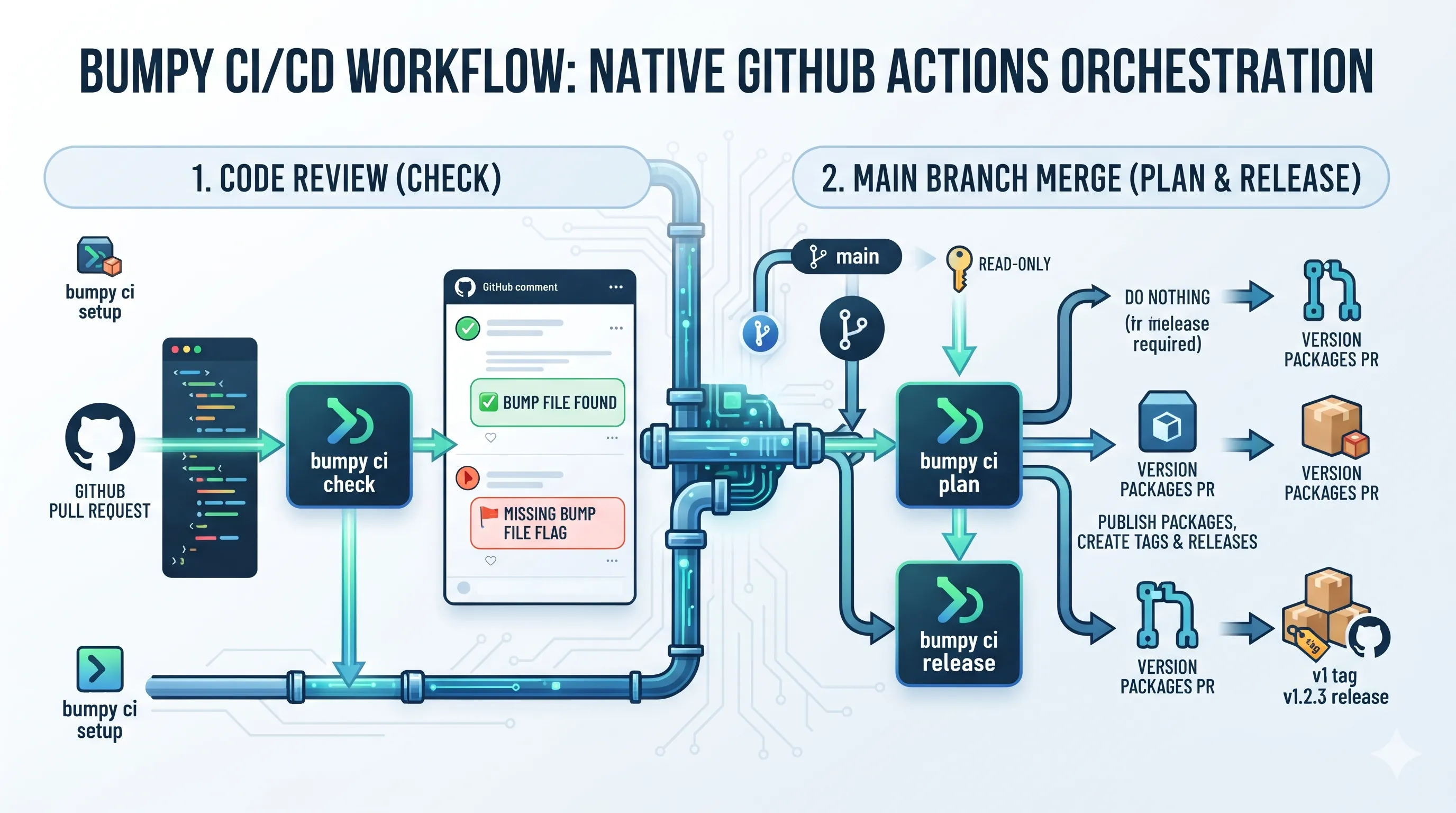
Bumpy’s file-based approach for versioning in monorepos extends seamlessly into release automation by operating directly on the bump files checked into version control.Rather than requiring teams to install specialized GitHub Apps or depend on separate external GitHub action repositories, Bumpy executes directly within standard GitHub Actions workflows.
It coordinates the entire release lifecycle across two workflows using three CLI commands, supported by an interactive setup command.
Two-Workflow Pipeline: Checking PRs and Planning Releases
Initial pipeline setup is streamlined through the bumpy ci setup command, which provides interactive configuration guidance.Once configured, Bumpy splits automation responsibilities across two distinct workflow phases to inspect incoming contributions and schedule versioning steps.
During code review workflows, the bumpy ci check command runs against incoming pull requests.
It automatically posts and updates pull request comments to detail projected release plans based on the file-based change manifests.
If a pull request modifies packages without including the necessary bump files, bumpy ci check flags the missing bump files directly in the comment thread.
When changes are merged into the default branch, the automation shifts to the push workflow.
In this phase, bumpy ci plan executes to inspect the repository state and determine the next action.
It categorizes the required progression into one of three distinct outcomes: opening or updating a version-pr, proceeding to publish, or executing nothing if no release is required.
Credential Isolation and Tag Publishing Automation
A key architectural advantage of splitting release decision-making from execution is credential isolation.The bumpy ci plan step safely evaluates the repository state and determines publishing intent without requiring write credentials in the planning environment.
Once the next action has been planned, the bumpy ci release command handles the corresponding write and publication tasks.
When new bump files exist, bumpy ci release opens or updates the dedicated "Version Packages" PR to prepare package version bumps and changelog updates.
When that "Version Packages" PR is merged into main, bumpy ci release publishes the packages and automatically creates the associated git tags and releases.
| CLI Command | Workflow Phase | Security and Operational Role |
|---|---|---|
| bumpy ci setup | Interactive Setup | Provides interactive configuration guidance for implementing GitHub Actions workflows. |
| bumpy ci check | Pull Request Workflow | Posts and updates PR comments detailing release plans and flags missing bump files. |
| bumpy ci plan | Main Branch Push Workflow | Determines next actions (version-pr, publish, or nothing) safely without write credentials. |
| bumpy ci release | Release / Main Branch Merge | Opens or updates the 'Version Packages' PR, publishes packages, and creates git tags/releases. |
5. Native AI Integration: Empowering LLM Coding Agents with Release Skills
As monorepos scale, maintaining manual changelog entries and semantic version increments introduces friction into automated workflows.Bumpy addresses this challenge by embedding first-class artificial intelligence agent capabilities directly into its file-based versioning architecture.
By coupling human-readable change metadata with machine-actionable instructions, Bumpy enables autonomous coding agents to participate directly in the monorepo release lifecycle.
Autonomous Bump Generation and In-Flight Branch Updates
Bumpy ships with an embedded agent skill specification packaged inside the published npm distribution atnode_modules/@varlock/bumpy/skills/add-change/SKILL.md.This bundled document explicitly instructs large language models (LLMs) on how to inspect git changes, identify affected packages across the repository, select appropriate semantic bump levels, and run the
bumpy add command.Rather than requiring developers to manually write bump metadata after completing code changes, LLM coding agents read the skill definition to execute this task programmatically.
Beyond initial file creation, the skill allows AI agents to update existing bump files dynamically as work continues on an active development branch.
When subsequent commits alter package boundaries or increase change severity, the agent can re-evaluate the git diff and modify the existing bump record in place.
Cross-Platform Agent Distribution and Skill Setup
To ensure broad developer adoption, Bumpy makes its agent skill installable across platforms using the Vercel Labs skills CLI, the GitHub CLI, or directly as a Claude Code plugin.To install the Bumpy agent skill for Claude Code, Cursor, OpenCode, and Codex via the skills CLI, run the following setup command:
npx skills add dmno-dev/bumpyFor teams utilizing GitHub CLI workflows, skill registration is supported through the official command-line extension ecosystem.
Note that GitHub CLI skill installation requires GitHub CLI version 2.90+.
To install the skill via the GitHub CLI, execute:
gh skill install dmno-dev/bumpy add-changeadd-change skill using the GitHub CLI, configuring the agent tooling to track and record version increments directly within GitHub-centered environments.Alternatively, Bumpy can be integrated natively into Claude Code workflows as an official extension.
To install Bumpy as a plugin for Claude Code, run:
claude plugin install @varlock/bumpy@varlock/bumpy plugin into Claude Code, equipping the assistant with runtime capabilities to execute release flows autonomously within the repository.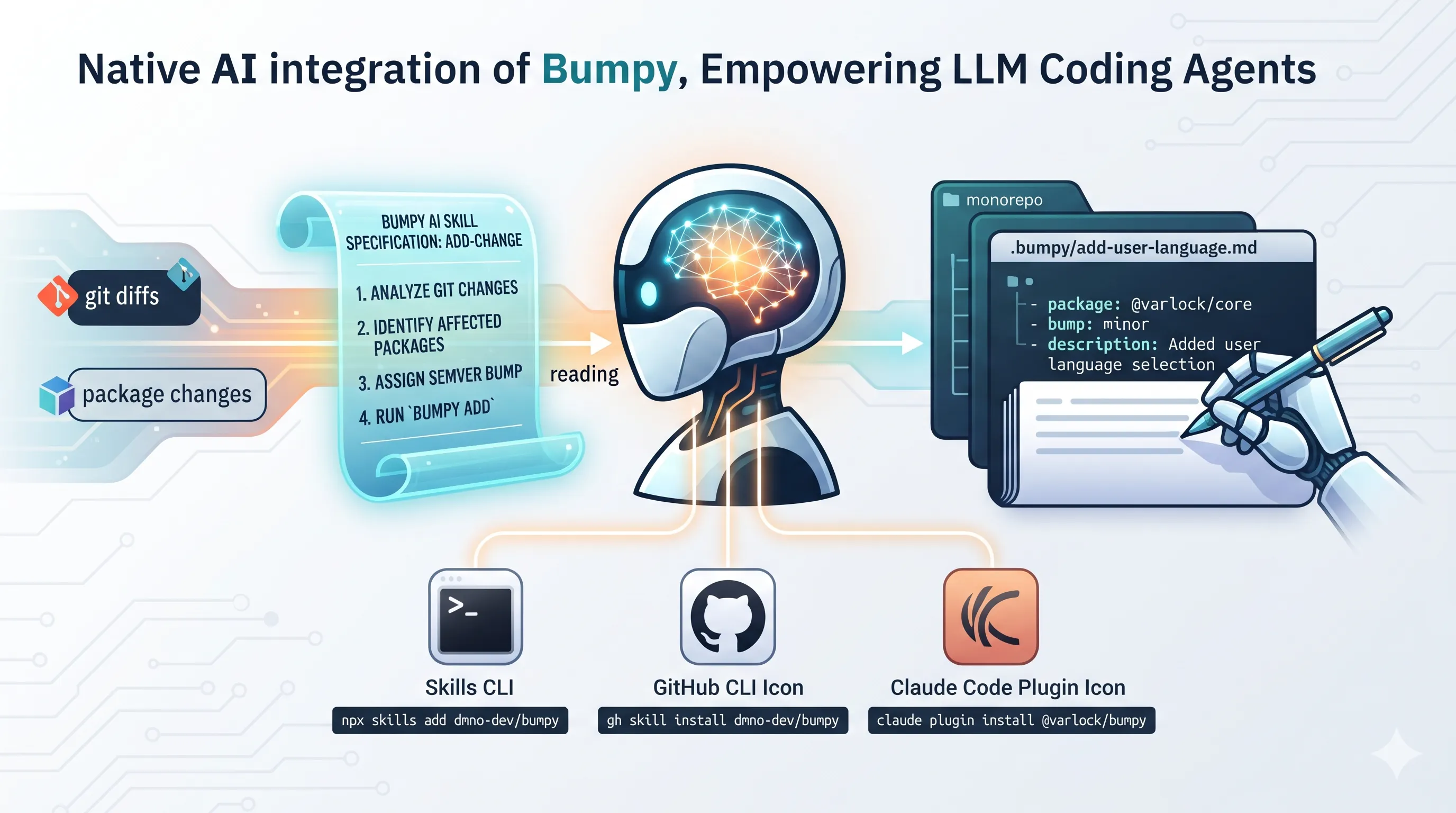
Related Posts

Generative AI may have assisted with research or drafting for this article. Topic selection, fact-checking, final wording, and publication remain the responsibility of DragonStone74. AI use disclosure