
End-to-End Pipeline for 3D Gaussian Splatting and Unreal Engine 5 Integration
🚀 Key Takeaways
- Automated Video-to-3DGS Conversion: Monocular video sequences can be transformed into dense volumetric radiance fields through streamlined Structure-from-Motion tracking and Gaussian point calibration.
- Robust Scene Optimization: Modern 3D Gaussian pipelines leverage spatial priors and exposure adaptation to synthesize clean, artifact-free environments from uncalibrated camera captures.
- Precise Trajectory Conditioning: Dedicated camera trajectory architectures parameterize viewpoint motion paths, establishing seamless coordination between physical footage and virtual cameras.
- Mesh-Free Dynamic Physics: Continuum mechanics applied directly to Gaussian primitives enable natural material deformation without relying on polygonal meshes or proxy cages.
- Interactive Unreal Engine 5 Integration: Specialized Niagara workflows and Sequencer tooling allow technical artists to light, animate, and composite multi-million splat scenes within real-time virtual production timelines.
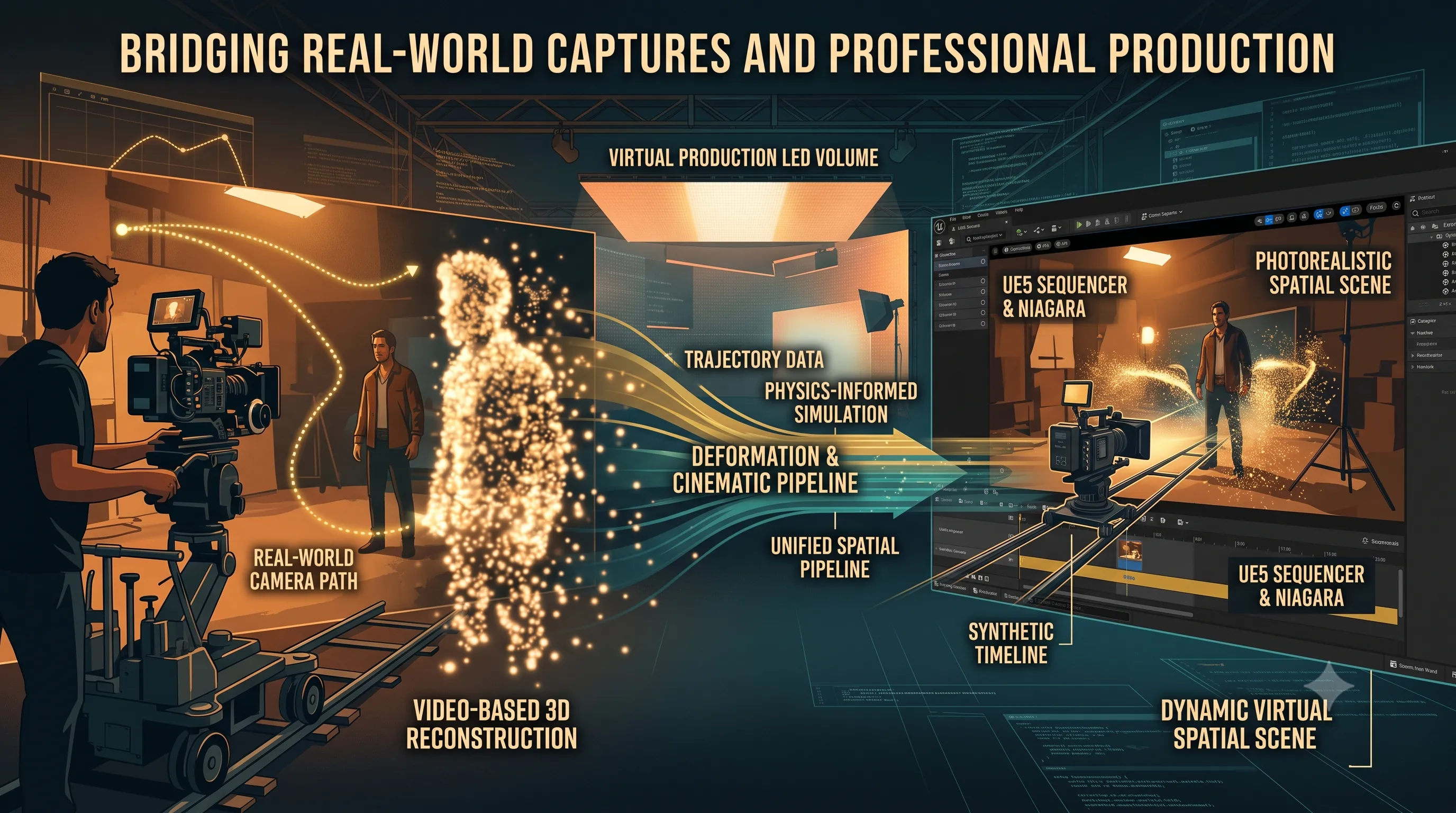
The rapid maturation of radiance field rendering has fundamentally transformed how digital environments are captured, reconstructed, and staged for real-time media. Where traditional visual effects workflows once demanded labor-intensive photogrammetry cleanup, manual retopology, and intricate proxy rigging, 3D Gaussian Splatting provides an immediate bridge from continuous video footage to photorealistic spatial scenes.
However, bridging the gap between raw spatial captures and professional production environments requires far more than static scene viewing. High-end virtual production and interactive game pipelines require deterministic camera choreography, dynamic physical responsiveness, and frictionless integration into native DCC tools. Synchronizing extracted real-world camera paths with synthetic timelines opens unprecedented creative possibilities for cinematographers and technical artists alike.
By coupling video-based reconstruction with physics-informed simulation and Unreal Engine 5's Sequencer and Niagara frameworks, developers can establish an end-to-end cinematic pipeline. This architectural breakdown explores the core methodology for processing dynamic video inputs, orchestrating trajectory data, and rendering performant Gaussian splat volumes natively inside modern interactive engines.
1. Video Clip Ingestion and Structure-from-Motion Scene Initialization
Establishing an accurate baseline from raw footage forms the indispensable preliminary phase for constructing dynamic camera trajectories and Niagara rendering pipelines within Unreal Engine 5.Without robust scene initialization, downstream 3D Gaussian Splatting (3DGS) workflows fail to align coordinate spaces or recover precise spatial geometry.
Frame Extraction Criteria and Motion Blur Constraints
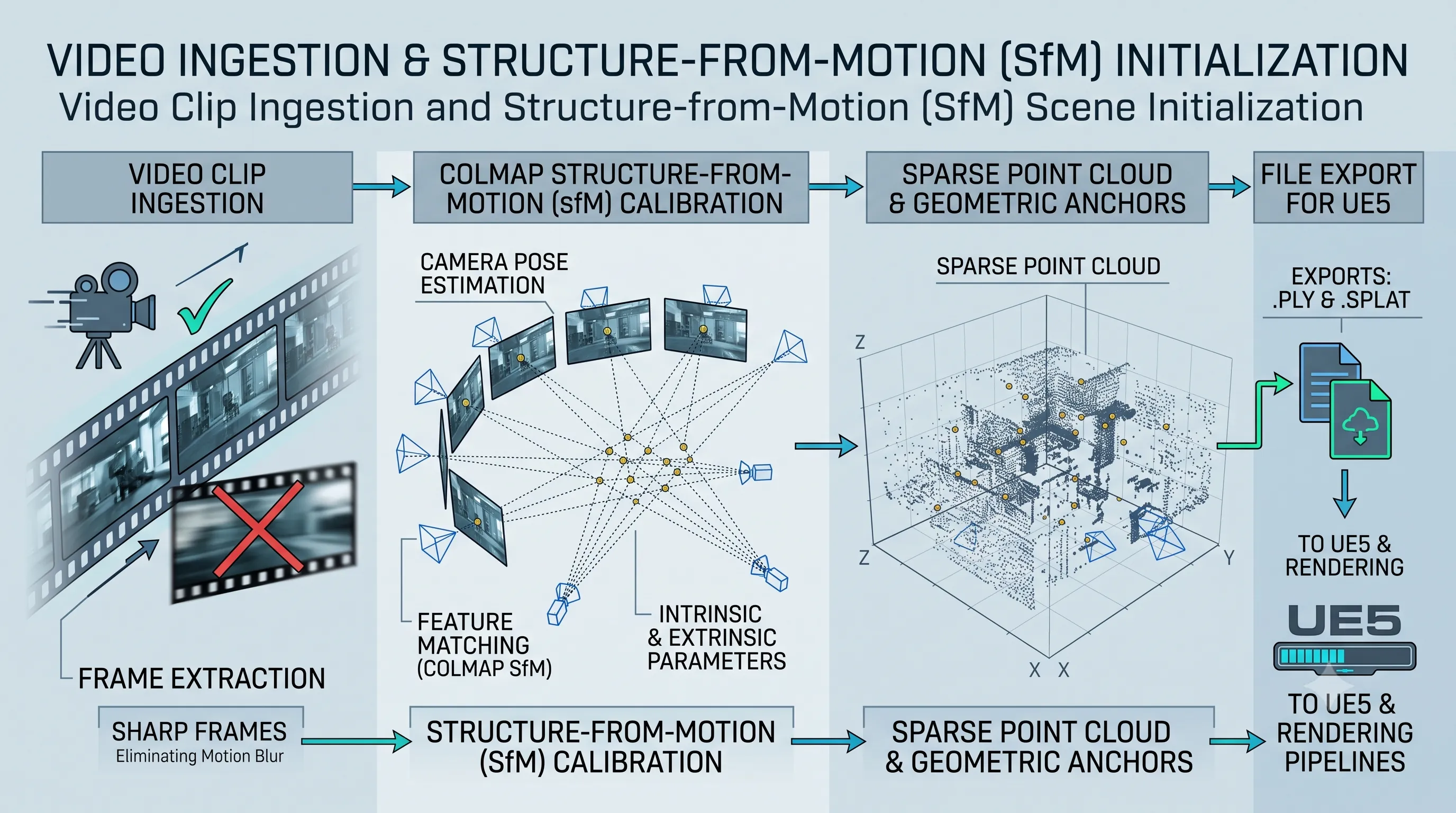
The transition from a raw video clip to a spatial 3D Gaussian representation begins with video frame extraction.Video frame extraction requires sharp frames without excessive motion blur for reliable Structure-from-Motion (SfM) feature matching.
When frames exhibit heavy motion blur from rapid camera pans or dynamic shutter discrepancies, point identification degrades significantly.
Ensuring frame sharpness guarantees that matching algorithms isolate distinct keypoints across overlapping perspectives without introducing tracking noise.
COLMAP Structure-from-Motion and Sparse Point Cloud Calibration
Extracted video frames are passed into Structure-from-Motion (COLMAP) to compute camera parameters and initial sparse point clouds.This SfM process determines intrinsic and extrinsic optical parameters while registering the camera path across the captured environment.
The resulting sparse point cloud establishes the initial spatial anchors required to initialize 3D Gaussian primitives.
Following SfM reconstruction and subsequent Gaussian optimization, output splat files (.ply or .splat) are converted for real-time visualization and downstream engine usage.
These exported .ply and .splat assets serve as the foundational geometric datasets feeding directly into real-time rendering environments and Unreal Engine camera sequencing workflows.
2. Core 3D Gaussian Splatting Optimization and Training Infrastructure
Constructing a high-fidelity scene for dynamic Unreal Engine 5 Sequencer trajectories and Niagara particle emission requires an accurate, artifact-free 3D Gaussian Splatting (3DGS) foundational radiance field reconstructed directly from source video frames.Understanding the mathematical optimization constraints, hardware limits, and convergence thresholds is vital before exporting Gaussian point data downstream into interactive engine viewports.
Hardware Prerequisites and Core Hyperparameter Profiles
The foundational 3D Gaussian Splatting framework developed by Bernhard Kerbl, Georgios Kopanas, Thomas Leimkühler, and George Drettakis (Inria/GRAPHDECO) operates on strict hardware baselines.Training to the full evaluation quality demonstrated in the original research requires a CUDA-ready GPU with Compute Capability 7.0+ and at least 24 GB of VRAM.
Executing the full evaluation schedule across reference benchmarks took approximately 7 hours on an NVIDIA RTX A6000 workstation.
Engineers must account for significant disk space overhead and heavy VRAM allocation throughout the volumetric optimization.
To prepare visual assets captured from raw footage, the included conversion utility extracts Structure from Motion (SfM) camera estimates and rectifies distortions.
python convert.py -s <location><location>/input into a structured COLMAP dataset directory containing undistorted and resized imagery.By default, the script automatically rescales any input images exceeding 1,600 pixels in width unless explicitly overridden.
Optimization runs for a baseline duration of 30,000 iterations.
Spatial positions, rotations, scales, opacities, and spherical harmonics (SH) features follow strictly staggered learning rate schedules.
Spatial 3D position learning rates begin at an initial value of 0.00016 and decay exponentially to a final value of 0.0000016.
Spherical harmonics coefficients optimize at a learning rate of 0.0025, opacity values update at 0.05, scaling parameters adjust at 0.005, and quaternions for rotation optimize at 0.001.
Total loss balances photometric L1 differences with structural similarity, where the influence of SSIM on total loss defaults to 0.2.
Densification begins at iteration 500 and terminates at iteration 15,000, evaluating candidate Gaussians every 100 iterations.
Gaussians exhibiting a 2D position gradient magnitude exceeding the threshold of 0.0002 are either split or cloned.
To prune degenerate primitives, the system executes an opacity reset every 3,000 iterations.
In multi-scale scenes—such as driving datasets with mixed close-up foregrounds and distant vistas—practitioners must implement custom reduced learning rates to prevent divergence.
Unconstrained optimization can produce excessively slender Gaussians, causing noticeable burr-like visual artifacts under geometric deformation.
| Optimization Parameter / Component | Default Value / Baseline Spec | Functional Operational Role |
|---|---|---|
| Compute Capability & VRAM | CUDA Compute 7.0+, 24 GB VRAM | Minimum hardware thresholds for paper-quality baseline optimization. |
| Total Iteration Budget | 30,000 iterations | Standard training duration for radiative and geometric convergence. |
| 3D Position Learning Rate | 0.00016 (Initial) → 0.0000016 (Final) | Controls spatial Gaussian coordinate translation and spatial annealing. |
| Spherical Harmonics Learning Rate | 0.0025 | Governs view-dependent directional radiance and color representation. |
| Opacity & Scale Learning Rates | 0.05 (Opacity) / 0.005 (Scale) | Regulates Gaussian spatial volume footprints and alpha blending weights. |
| Rotation Learning Rate | 0.001 | Optimizes orientation quaternions for anisotropic alignment. |
| Densification Schedule | Iterations 500 to 15,000 (every 100 steps) | Splits and clones Gaussians based on spatial gradient accumulation. |
| 2D Position Gradient Threshold | 0.0002 | Trigger boundary determining geometric densification eligibility. |
| Opacity Reset Period | Every 3,000 iterations | Forces transparency resets to prune floating or redundant primitives. |
| SSIM Loss Weight | 0.2 | Weighting coefficient balancing structural loss against L1 pixel loss. |
| Taming-3DGS Standard Optimizer | 1.6x training speedup | Accelerated training runtime over the baseline rasterizer pipeline. |
| Taming-3DGS Sparse Adam | 2.7x training speedup | Memory-efficient sparse gradient updates for accelerated optimization. |
Depth Regularization and Anti-Aliasing Optimization
The representation initializes from sparse point clouds generated by Structure from Motion (SfM) calibration to represent environments via 3D Gaussians.To resolve floating artifacts across untextured, homogeneous surfaces, the training pipeline supports depth regularization by integrating monocular depth maps as geometric optimization priors.
Uncalibrated input sequences with varying lighting conditions also benefit from per-frame affine transformation optimization, compensating directly for exposure variations across views.
For aliasing suppression during aggressive camera zoom or multi-scale inspection, the framework incorporates the Elliptical Weighted Average (EWA) filter from Mip-Splatting.
Real-time inspection and quality audits are conducted via SIBR remote and interactive viewers, supporting first-person shooter (FPS), orbit, and trackball navigation modes.
Generating monocular depth priors for geometric regularization requires running a high-capacity vision backbone followed by scale alignment.
python Depth-Anything-V2/run.py --encoder vitl --pred-only --grayscale --img-path <path to input images> --outdir <output path>
python utils/make_depth_scale.py --base_dir <path to colmap> --depths_dir <path to generated depths>Taming-3DGS Acceleration and Sparse Adam Implementations
Accelerating convergence without sacrificing geometric quality is critical when processing extensive video sequences for real-time engines.Integrating Taming-3DGS provides an immediate 1.6x training speedup when utilizing the default optimizer framework.
When paired with memory-efficient sparse Adam implementations, Taming-3DGS achieves a 2.7x speedup compared to standard baseline training passes.
To execute the accelerated training schedule using sparse parameter tracking, initialize the training script with the dedicated optimizer flag.
python train.py -s <path to COLMAP or NeRF synthetic dataset> --optimizer_type sparse_adam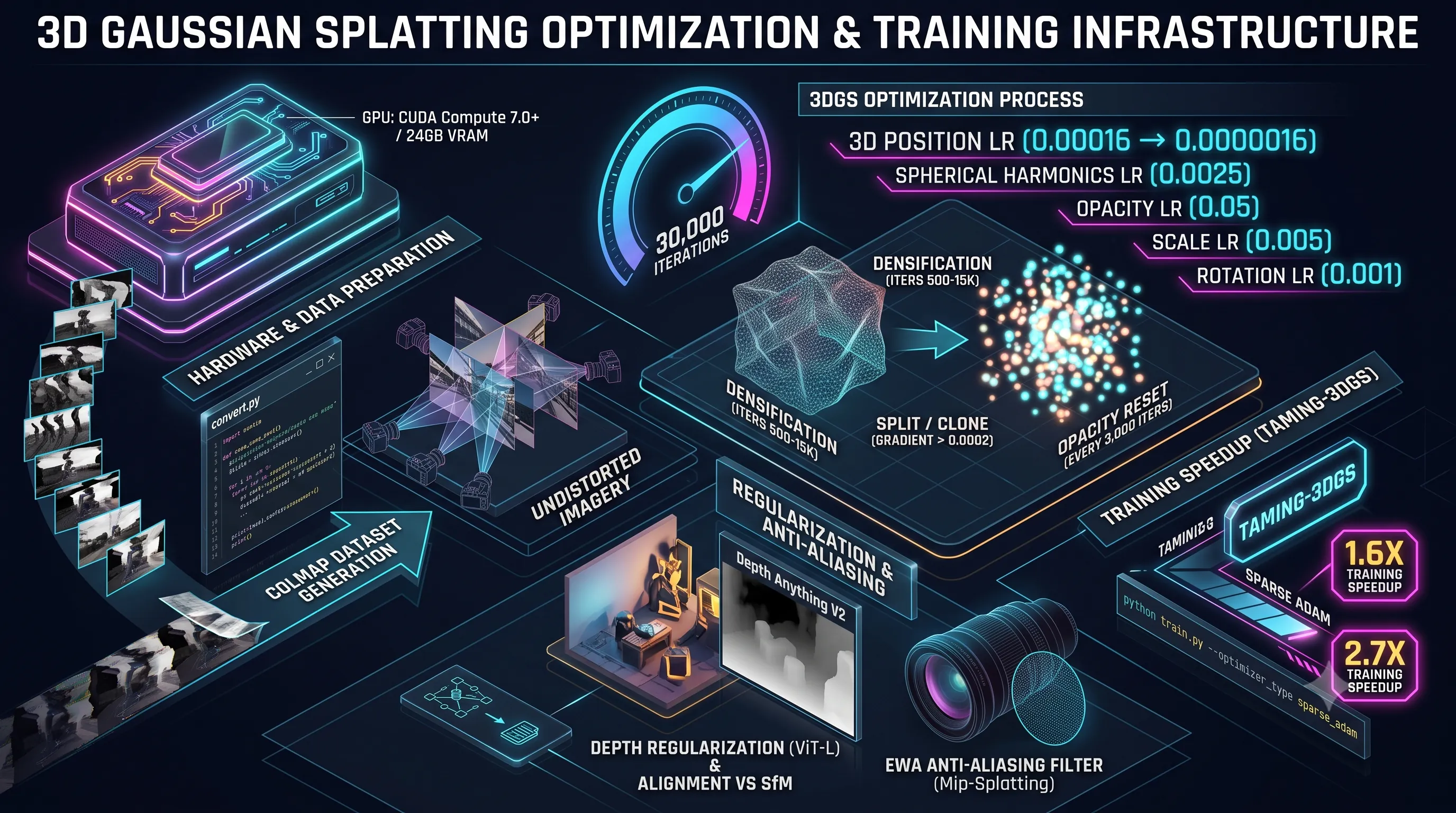
3. Precision Camera Trajectory Control and Extraction with CameraCtrl
Bridging dynamic video generation into an end-to-end pipeline—from video clips to 3D Gaussian Splatting (3DGS) spatial reconstruction, Unreal Engine 5 (UE5) Sequencer integration, and Niagara particle rendering—demands deterministic control over virtual viewpoint transformations.CameraCtrl establishes this foundation by injecting precise camera trajectory conditioning directly into generative video diffusion backbones.
Developed by Hao He, Yinghao Xu, Yuwei Guo, Gordon Wetzstein, Bo Dai, Hongsheng Li, and Ceyuan Yang, the architecture enables precise camera trajectory control for video diffusion models.
It is implemented on AnimateDiffV3 with support extending to Stable Video Diffusion (SVD).
The framework is released strictly for academic research use.
| Component / Parameter | Specification / Supported Standard |
|---|---|
| Python Runtime | 64-bit Python 3.10 |
| Deep Learning Framework | PyTorch 1.13.0 or higher |
| Hardware Compute Toolchain | CUDA 11.7 |
| Supported Diffusion Backbones | AnimateDiffV3, Stable Video Diffusion (SVD) |
| Pose Evaluation Dataset | RealEstate10K |
| Release Scope | Strictly for academic research use |
Camera Conditioning Architecture and LoRA Model Merging
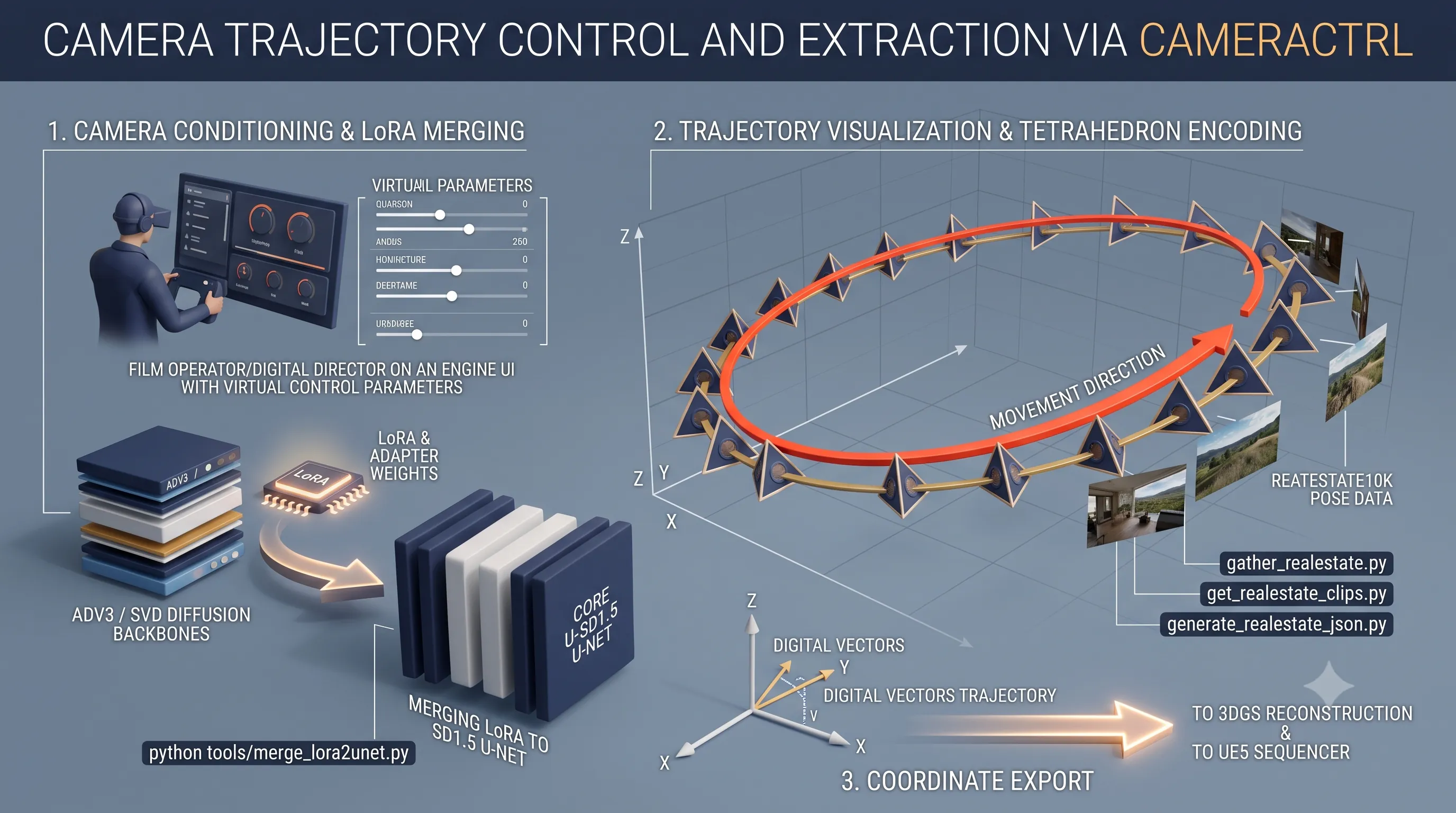
CameraCtrl conditions the diffusion process on explicit view parameters while remaining compatible with personalized styles.The framework supports image LoRAs and domain personalization models for customized dynamic generation.
To facilitate inference across custom models, the adapter weights must be consolidated directly into the core denoiser network.
To merge AnimateDiffV3 LoRA weights into the Stable Diffusion U-Net architecture, execute the following script:
python tools/merge_lora2unet.pyThis weight integration allows the U-Net to process camera condition representations without disrupting underlying style representations.
Tetrahedron-Based Trajectory Visualization and Vector Encoding
CameraCtrl evaluates camera poses using the RealEstate10K dataset.Preparing this data requires downloading sequences and extracting pose parameters into standard trajectory files.
To prepare video clips and trajectories from the RealEstate10K dataset, run the following sequential data tooling commands:
python tools/gather_realestate.py
python tools/get_realestate_clips.py
python tools/generate_realestate_json.pyDuring inspection and verification, CameraCtrl visualizes camera trajectories where each video frame is represented by a tetrahedron.
In trajectory visualization, tetrahedron vertices represent the camera position and bases represent the imaging plane.
Red arrows denote the movement direction of the camera trajectory.
This geometric configuration provides spatial verification of the camera path before exporting trajectories downstream into 3DGS reconstructors and UE5 Sequencer tracks.
4. Physics-Based Dynamic Simulation via PhysGaussian and MPM Kinematics
Connecting dynamic novel-view synthesis directly to high-fidelity animation pipelines—such as transitioning from raw video captures to dynamic camera sweeps in modern sequencers—requires shifting 3D Gaussian Splatting (3DGS) from static neural representations to mechanically responsive volumes.Bridging this gap relies on unifying visual primitives with physical continuum kinematics, ensuring that visual assets derived from capture sequences react convincingly to dynamic forces without requiring geometric re-meshing.
Continuum Mechanics and Incremental Covariance Evolution
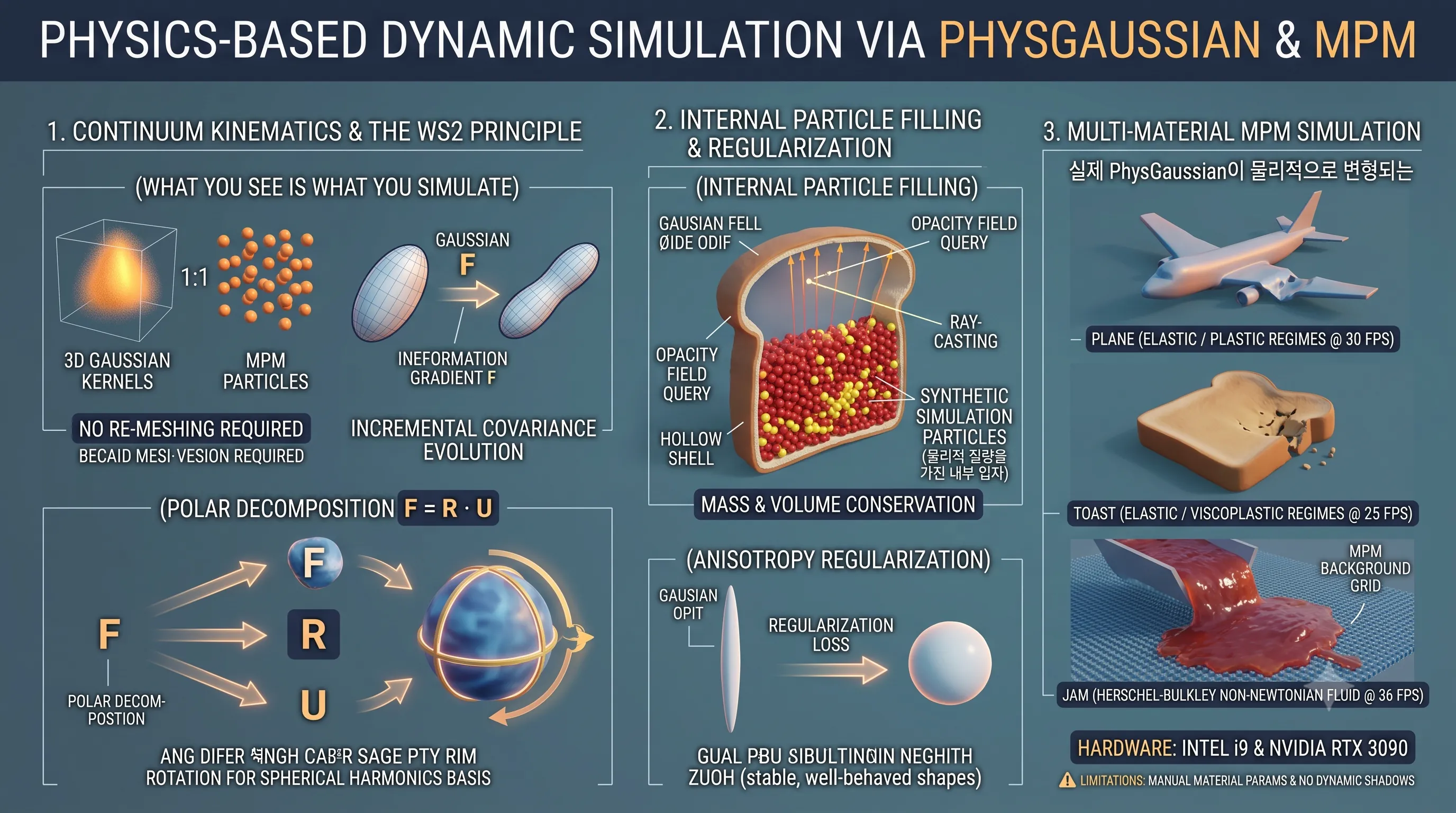
Introduced by researchers from UCLA, Zhejiang University, and collaborators, PhysGaussian establishes the "What You See Is What You Simulate" (WS2) principle.Under the WS2 paradigm, the identical 3D Gaussian kernels used for radiance field rendering serve directly as the discrete continuum particles within the Material Point Method (MPM).
This direct unification removes the traditional requirement for auxiliary intermediary structures, eliminating the need for triangle meshing, tetrahedral cages, marching cubes extraction, or proxy geometry embedding.
Physical motion is governed by continuum mechanics, where each Gaussian kernel deforms locally in response to the continuum deformation gradient F.
To track continuous volumetric transformations under Lagrangian continuum kinematics, PhysGaussian incorporates incremental rate-form covariance matrix updates.
These updates evolve each kernel's spatial covariance alongside the macroscopic strain rate and velocity gradients calculated across the MPM background grid.
Because view-dependent appearance in 3DGS is parameterized via spherical harmonics, unconstrained deformation of the spatial kernel risks distorting directional radiance.
To resolve this, the framework performs polar decomposition on the deformation gradient F to extract its pure rotational component.
This rotational transformation is applied directly to the spherical harmonics basis orientations, preserving physical appearance and directional radiance fidelity under arbitrary rotational motion.
Internal Particle Filling and Anisotropy Regularization
Standard 3DGS pipelines reconstruct geometry primarily as an empty surface shell, as photometric loss constraints only require kernels along visible lines of sight.When evaluating real-world captured datasets generated from 150 photos per scene, this surface concentration leaves object interiors vacant.
Subjecting hollow shells to MPM continuum equations inevitably causes structural instability, leading to hollow shell collapsing under gravity or contact stress.
PhysGaussian addresses this structural limitation by executing internal particle filling driven by discretized 3D opacity fields.
By querying the reconstructed opacity volume, the pipeline populates internal regions with synthetic simulation particles that maintain mechanical mass and volume conservation.
Furthermore, unconstrained radiance field optimization often yields severely elongated, needle-like Gaussians that destabilize continuum mechanics solvers.
To prevent extreme kernel eccentricity, the framework introduces an anisotropy regularization loss during the initial reconstruction phase.
This loss penalty explicitly restricts the elongation of Gaussian kernels, conditioning the kernels into well-behaved continuum primitives suitable for stable MPM time integration.
Real-Time MPM Performance and Multi-Material Constitutive Models
The mechanical solver supports diverse constitutive regimes, encompassing elastic objects, von Mises plastic metals, Drucker-Prager granular materials, and Herschel-Bulkley non-Newtonian fluids.Benchmarked on a workstation equipped with a 24-core 3.50GHz Intel i9-10920X CPU and an NVIDIA RTX 3090 GPU, the unified simulation-rendering framework achieves interactive to real-time framerates across distinct material interactions.
| Scene | Constitutive Material Model | Simulation Framerate (FPS) | Hardware Platform |
|---|---|---|---|
| Plane | Elastic / Plastic Regimes | 30 FPS | 24-core 3.50GHz Intel i9-10920X, NVIDIA RTX 3090 |
| Toast | Elastic / Viscoplastic Regimes | 25 FPS | 24-core 3.50GHz Intel i9-10920X, NVIDIA RTX 3090 |
| Jam | Herschel-Bulkley Non-Newtonian Fluid | 36 FPS | 24-core 3.50GHz Intel i9-10920X, NVIDIA RTX 3090 |
Material physical parameters cannot be extracted automatically from imagery and must be set manually by the user.
In addition, shadow evolution resulting from dynamic geometric deformation is not modeled by the static spherical harmonics framework.
Finally, authentic liquid simulation requires further development beyond granular and viscoplastic formulations, as high-velocity fluid splashing presents topological discontinuities that challenge coherent Gaussian kernel tracking.
5. Unreal Engine 5 Niagara Splat Rendering and Sequencer Trajectory Execution
Bridging the gap between raw video footage and real-time visualization requires translating reconstructed radiance fields into an interactive environment.In the overarching pipeline that maps video clips to camera trajectories, the Unreal Engine 5 integration stage serves as the final runtime target, turning exported 3D Gaussian Splatting assets into interactive, cinematic sequences.
PLY Import Workflow and Blueprint Texture Encoding
Deploying trained Gaussian representations begins with importing standardized point data into Unreal Engine.Documented plugin workflows support Unreal Engine versions 5.1, 5.2, 5.3, 5.4, and 5.5, ensuring broad compatibility across recent engine iterations.
Trained 3DGS models exported as PLY files from platforms such as Splatware are ingested directly into the engine environment.
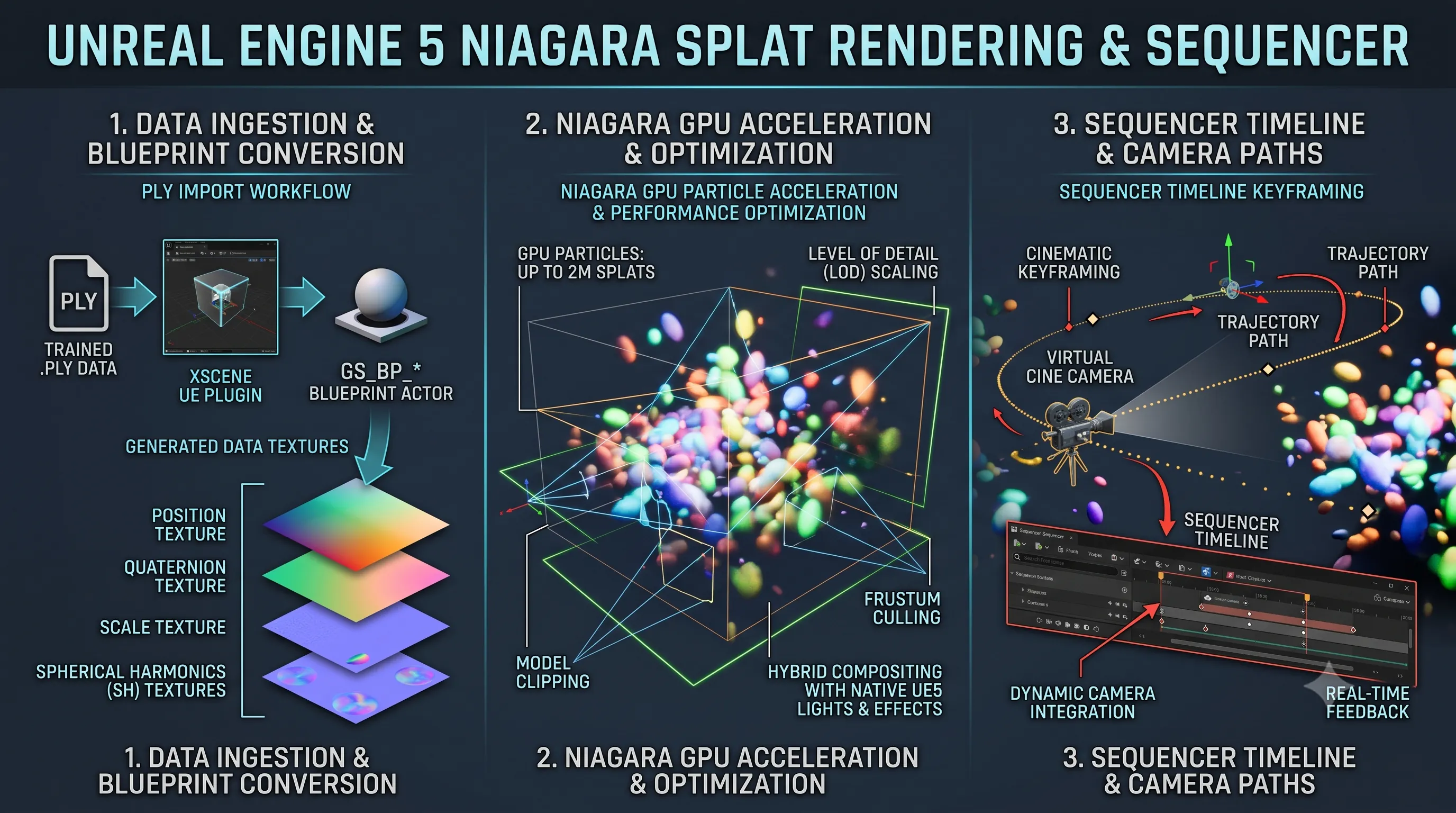
Upon PLY import, the XScene UE Plugin parses the raw point attributes and automatically generates a GS_BP_* Blueprint actor alongside decomposed data textures.
These generated data containers partition spatial and optical properties into dedicated runtime textures: a Position texture, a Quaternion texture, a Scale texture, and Spherical Harmonics (SH) textures.
This automated texture conversion eliminates manual parameter mapping, enabling a streamlined drag-and-drop workflow where developers place the generated GS_BP_* Blueprint directly into active UE5 levels.
| Generated Asset / Artifact | Generation Mechanism | Pipeline Role |
|---|---|---|
| GS_BP_* Blueprint Actor | Automatic generation via XScene UE Plugin | Enables drag-and-drop placement of splat assets directly into UE5 levels |
| Position Texture | PLY attribute parsing on import | Encodes 3D spatial coordinates for GPU particle sampling |
| Quaternion Texture | PLY attribute parsing on import | Stores rotational orientations for each individual Gaussian ellipsoid |
| Scale Texture | PLY attribute parsing on import | Stores directional scale vectors for splat geometry evaluation |
| SH Textures | PLY attribute parsing on import | Stores view-dependent color coefficients via spherical harmonics |
Niagara GPU Particle Acceleration and Performance Optimization
Real-time evaluation of Gaussian primitives relies heavily on Unreal Engine Niagara particle systems for GPU-accelerated splat rendering, dynamic transformations, and real-time particle effects.Using UnrealSplat Niagara pipelines, rendered scenes efficiently support up to 2 million splats on modern systems.
To preserve real-time frame budgets when handling dense point clouds, the pipeline provides native support for level of detail (LOD) scaling, frustum culling, and model clipping.
These optimizations allow the system to discard out-of-view primitives and downsample distant points while maintaining hybrid compositing alongside native UE5 lights and post-processing stacks.
However, performance thresholds require careful monitoring.
Large splat scenes demand high-end GPU hardware to sustain interactive frame rates.
Furthermore, applying heavy post-processing passes and rendering through an excessively wide camera field of view (FOV) can significantly degrade rendering throughput inside UE5.
Sequencer Timeline Keyframing and Dynamic Camera Integration
The terminal step of the reconstruction-to-engine pipeline connects spatial splat assets with narrative camera movements inside Unreal Engine Sequencer.The framework fully integrates Gaussian Splats into the Sequencer timeline, enabling precise cinematic keyframing, timeline animation, and dynamic camera control.
Creators can bind virtual cine cameras to dynamic trajectory paths, matching or expanding upon the original camera paths tracked from input video clips.
Because the splat primitives function as real-time GPU elements within the level hierarchy, camera tracks evaluate with immediate visual feedback inside the viewport.
This direct Sequencer workflow allows production teams to animate complex camera sweeps, manage exposure and depth-of-field transitions, and render high-fidelity cinematics directly out of the reconstructed Gaussian Splat volume.
Related Posts
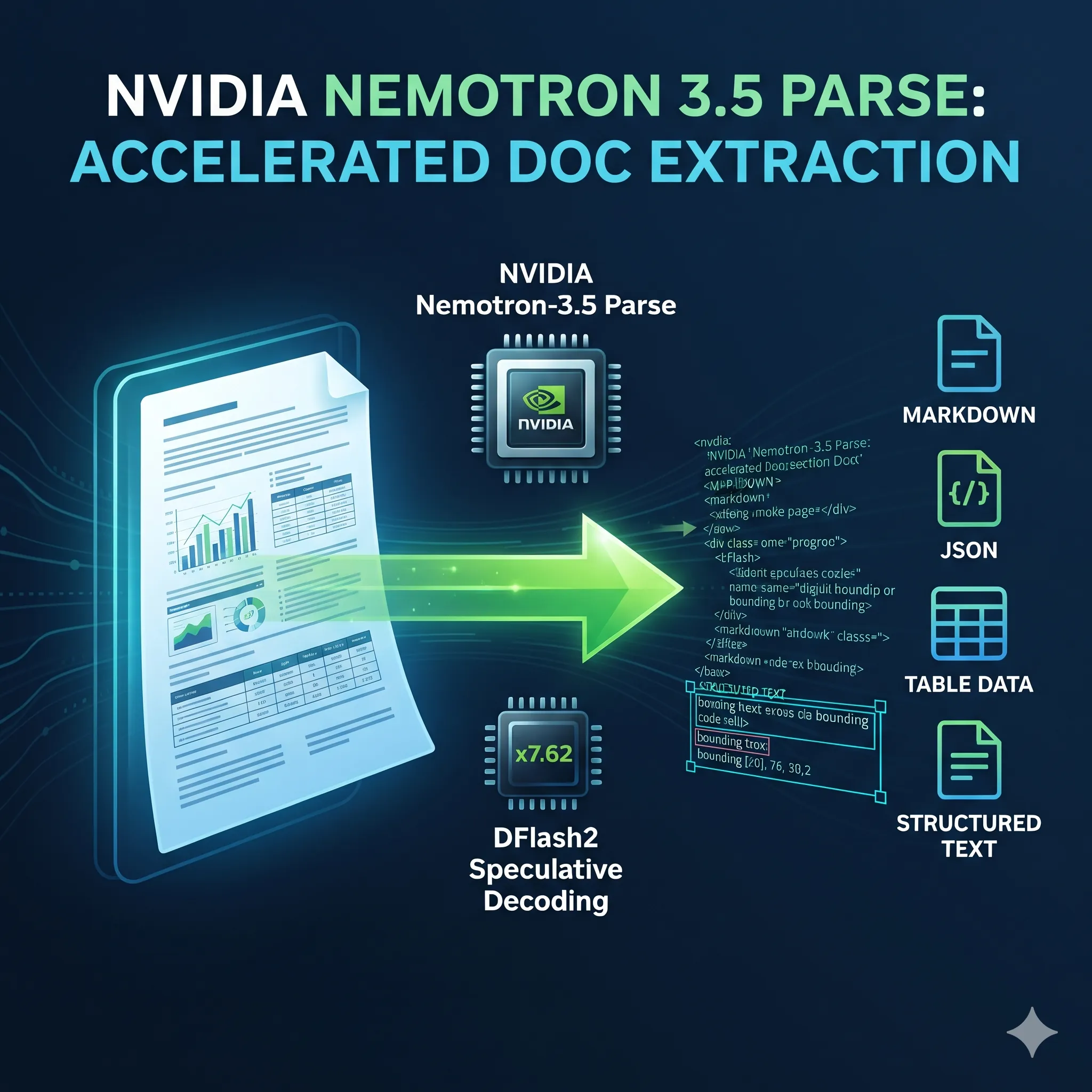
How Nemotron 3.5 Parse Accelerates Vision-Language Document ExtractionDiscover how NVIDIA's Nemotron 3.5 Parse boosts inference speed and document extraction efficiency...
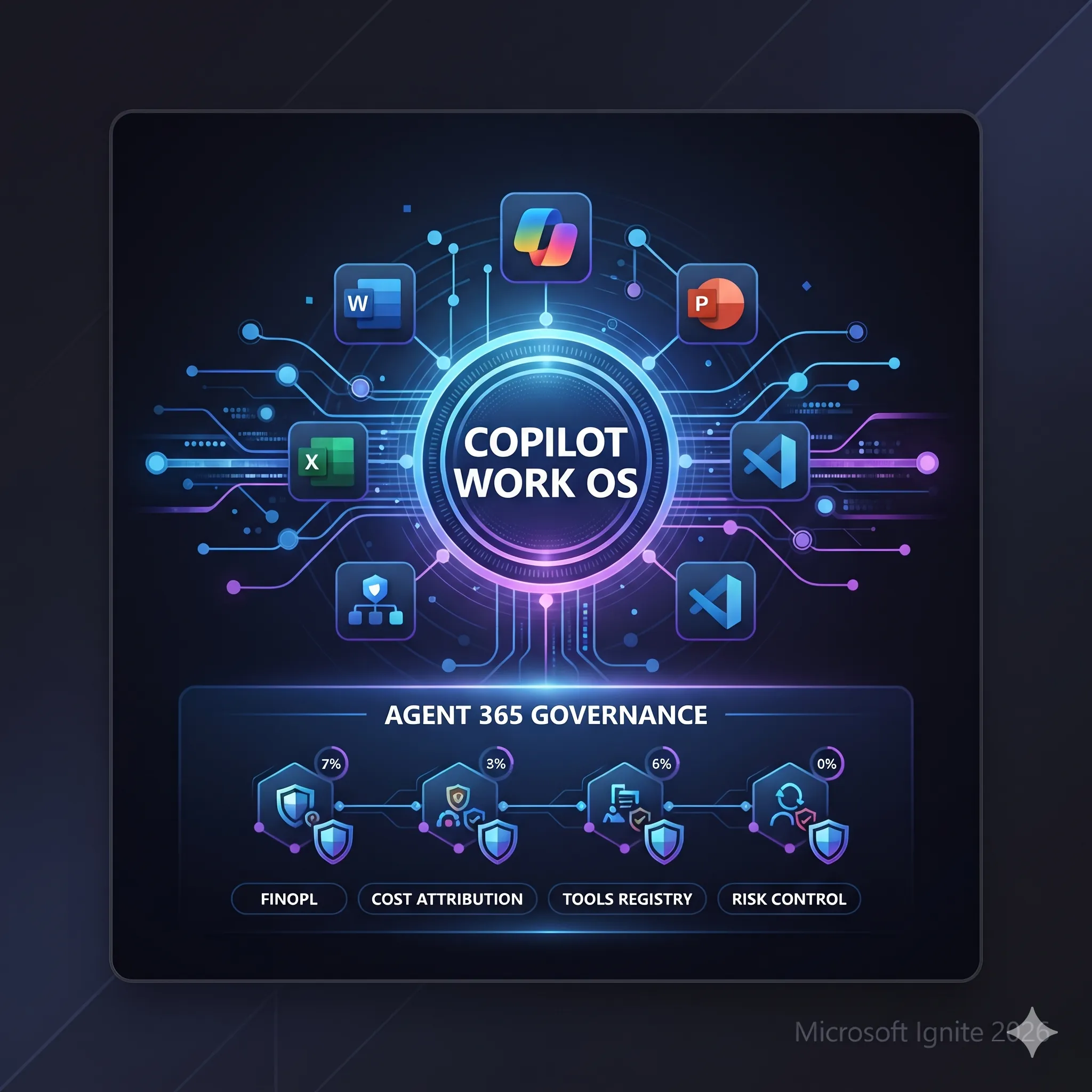
Microsoft Ignite 2026: Copilot Work OS and Agent 365 GovernanceDiscover how Microsoft Ignite 2026 redefines enterprise AI with Copilot as the Work OS, centralized...
Deploying NVIDIA Cosmos 3 Locally with Hugging Face DiffusersLearn how Hugging Face Diffusers enables local execution of the 16B NVIDIA Cosmos 3 model on...
Generative AI may have assisted with research or drafting for this article. Topic selection, fact-checking, final wording, and publication remain the responsibility of DragonStone74. AI use disclosure