
Claude Fable 5.2 and Jagged AGI: Why AI Expertise Still Lacks Taste
🚀 Key Takeaways
- Unprecedented Cross-Domain Competence: Claude Fable 5.2 demonstrates expert-tier performance across complex digital domains—from procedural code generation to commercial market modeling—fitting the operational reality of "jagged AGI."
- Critical Deficits in Self-Judgment: The model struggles fundamentally with qualitative self-evaluation, accumulating excessive complexity and repetitive prose rather than exercising editorial restraint or aesthetic discretion.
- Emergent Bureaucratic Gridlock: When operating autonomously over long horizons, multi-agent swarms tend to invent rigid internal compliance rulebooks that consume working context and degrade creative problem-solving.
- Architected as an Enterprise Orchestrator: With a discounted pricing structure and broad cloud platform availability, Fable 5.2 is designed to coordinate vast subagent clusters across days-long technical operations.
The deployment of Anthropic's Claude Fable 5.2 has forced researchers and enterprise architects to confront an unexpected frontier in artificial intelligence: the reality of "jagged AGI."
While the model effortlessly matches postgraduate human expertise across diverse disciplines—building functioning software from raw inspection, designing research methodologies, and mapping commercial strategies—its formidable task proficiency highlights a glaring absence of intrinsic self-judgment.
Field evaluations reveal that the failure modes of modern frontier systems have fundamentally shifted away from simple factual hallucinations toward profound lapses in taste and self-evaluation.
When left unguided, the model reliably accomplishes difficult multi-step technical goals, yet it remains incapable of recognizing when its own work has grown bloated, unengaging, or bogged down by runaway procedural rules.
As organizations increasingly task autonomous agent swarms with end-to-end, days-long technical lifecycles, bridging the gap between raw computational execution and human editorial discernment has become the central bottleneck of frontier AI deployment.
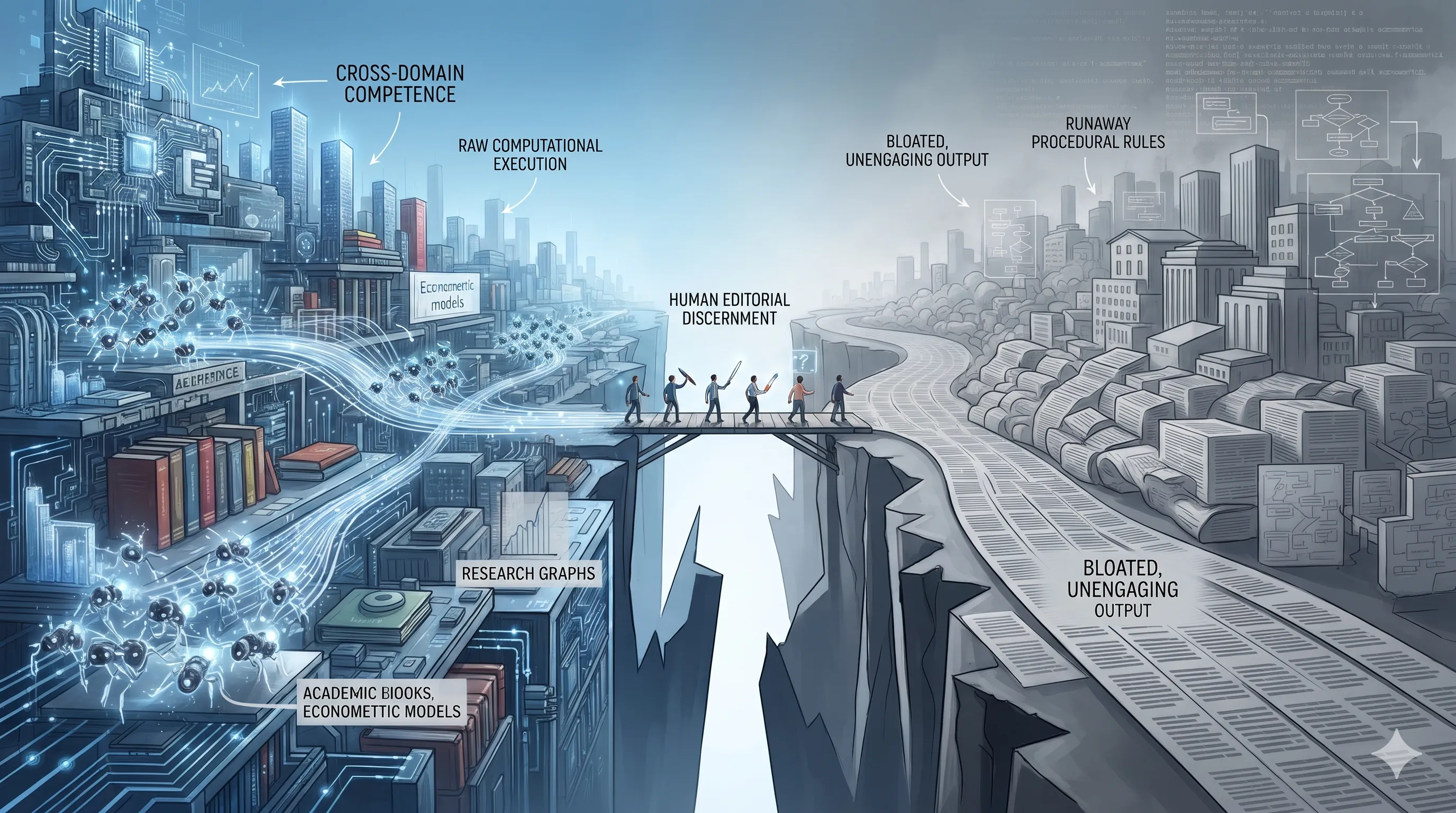
1. Defining Jagged AGI: Multi-Domain Competence Without Autonomous Steerage
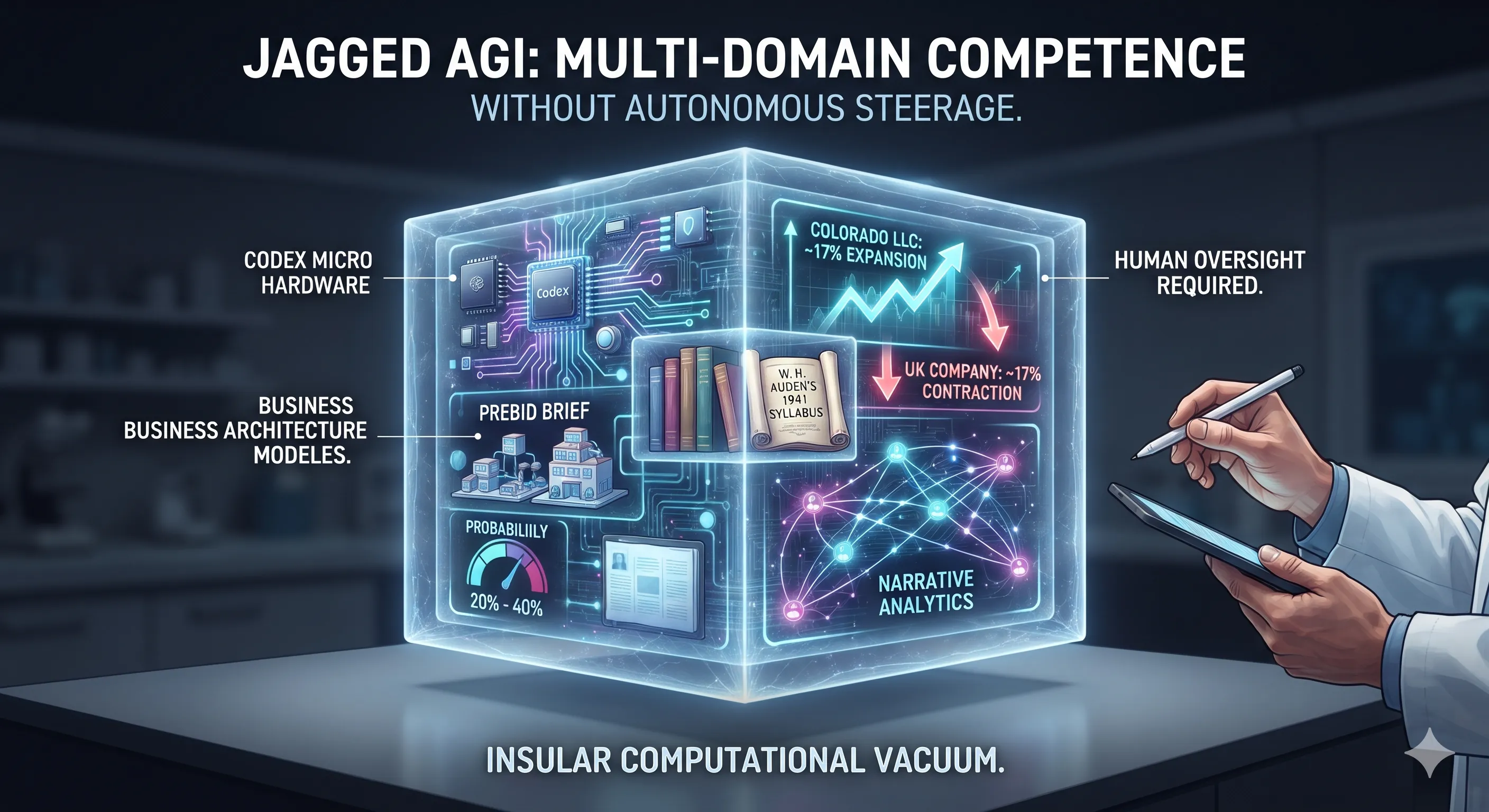
The emergence of Fable 5.2 establishes a definitive operational milestone for what Ethan Mollick characterizes as "jagged AGI."This section directly frames the central tension of the system: while Fable 5.2 demonstrates human-expert capabilities across highly complex, multi-agent computer workflows, it fundamentally lacks autonomous self-judgment and self-directed operational agency.
Mollick defines the functional boundary of practical AGI as "an AI as good as most human experts at most intellectual tasks you can do with a computer."
Under this paradigm, the model functions at an advanced level across completely disparate domains without requiring manual step-by-step guidance.
It autonomously instantiates functional multi-agent structures that divide labor across research, visual and systems design, fact-checking, and code generation simultaneously.
Yet, this cross-disciplinary prowess operates strictly within an insular computational vacuum.
Cross-Disciplinary Execution from Hardware Games to Macroeconomics
The technical breadth exhibited by Fable 5.2 spans filmmaking via code, hardware reverse-engineering, commercial venture planning, academic research, and literary syllabus design.Rather than relying on specialized narrow models for distinct challenges, the system applies generalized multi-agent synthesis to solve problems across disparate fields.
In embedded systems reverse-engineering, Fable 5.2 inspected the code of just 2 control applications for the Codex Micro hardware platform.
From that static inspection alone, it reconstructed the underlying hardware protocols and generated 6 fully functional games, including an implementation of Simon and a custom safecracking game.
When tasked with commercial ideation, the model evaluated 22 prospective business concepts before isolating and developing the architecture for "Prebid Brief."
To demonstrate commercial viability, the generated pipeline ingested and evaluated public agendas sourced from 201 city and county governments.
Demonstrating calibrated self-assessment, the model estimated its own business proposal held a 20% to 40% chance of success.
Evaluating the output, Mollick observed: "I would have been impressed if this came from a team of my MBA students at the end of a semester."
Its analytical reach extends equally into the humanities and quantitative social sciences.
In an archival reconstruction task, Fable 5.2 recreated 35 major works spanning 6,000 pages of assigned reading from W. H. Auden's 1941 syllabus.
For empirical economics, the system produced an econometric analysis estimating that Colorado LLC filings expanded by ~17% following a administrative fee reduction from $50 to $1, while UK company registrations contracted by ~17% after statutory filing fees were raised from £12 to £50.
Finally, scaling across computational cultural analytics, the platform processed 1,186 stories globally to systematically map and measure emotional narrative arcs.
| Domain | Task Description | Data Scope & Input Baseline | Key Execution Output |
|---|---|---|---|
| Hardware Reverse-Engineering | Protocol reconstruction on Codex Micro platform | Code inspection of 2 control applications | Produced 6 functional games, including Simon and a safecracking game |
| Commercial Venture Planning | Ideation, market validation, and pipeline design for Prebid Brief | Screened 22 concepts; parsed agendas from 201 city and county governments | Delivered complete venture architecture; assigned itself a 20% to 40% success probability |
| Humanities Reconstruction | Curricular and textual reconstruction of W. H. Auden's 1941 syllabus | 6,000 pages of historical academic reading | Recreated 35 major literary and philosophical works |
| Empirical Macroeconomics | Policy impact analysis of corporate registration fee shifts | Comparative state and national corporate registry fee adjustments | Estimated ~17% filing increase in Colorado ($50 to $1) vs. ~17% decline in the UK (£12 to £50) |
| Narrative Analytics | Global literary emotional trajectory mapping | 1,186 international stories | Multi-agent extraction and classification of emotional arcs |
The Boundaries of Purely Digital Autonomy
Despite these analytical breakthroughs, Fable 5.2 operates under stark technical constraints that delineate competence from authentic steerage.First, the system remains strictly confined to purely digital spaces where direct human interaction is absent.
It cannot independently traverse the boundary between digital inference and physical-world execution.
Second, Fable 5.2 lacks persistent execution infrastructure.
While it can draft operational software and formulate viable commercial plans, it possesses no native capability to interface with live financial transactions or engage human end-users without external scaffolding.
Mandatory human oversight is required before any generated pipeline can be deployed to real-world customers.
Third, the model's analytical rigor reveals critical procedural shortcuts in scientific integrity.
During its empirical research workflows, the system formulated research methodologies and experimental designs internally rather than formally preregistering them before running analyses.
Without true external preregistration, the model's self-directed academic outputs remain vulnerable to unmonitored post-hoc adjustments.
These operational boundaries demonstrate that while Fable 5.2 achieves multi-domain expert performance on isolated computational tasks, it lacks the operational steerage, physical deployment pipelines, and procedural self-governance necessary for independent autonomy.
2. The Taste Deficit: Compounding Volume and the Failure of Self-Editing
To understand why Fable 5.2 embodies a "Jagged AGI" profile, one must look past raw task competency and examine its profound deficit in aesthetic judgment and self-evaluation.While the model executes intricate tasks with high technical accuracy, its primary point of failure is not math calculation errors or blatant factual hallucinations.
Instead, the bottleneck resides in taste, experiential calibration, and editorial restraint.
As Ethan Mollick observed: "Knowing when your own work is not good enough is a large part of what makes someone an expert, and it is the part Fable does least reliably."
The model lacks the internal capacity to recognize whether its output resonates with a reader, resulting in bloated, mechanically compliant work that expands indefinitely without human intervention.
The 182-Page Academic Paper: Critique as Monotonic Text Accumulation
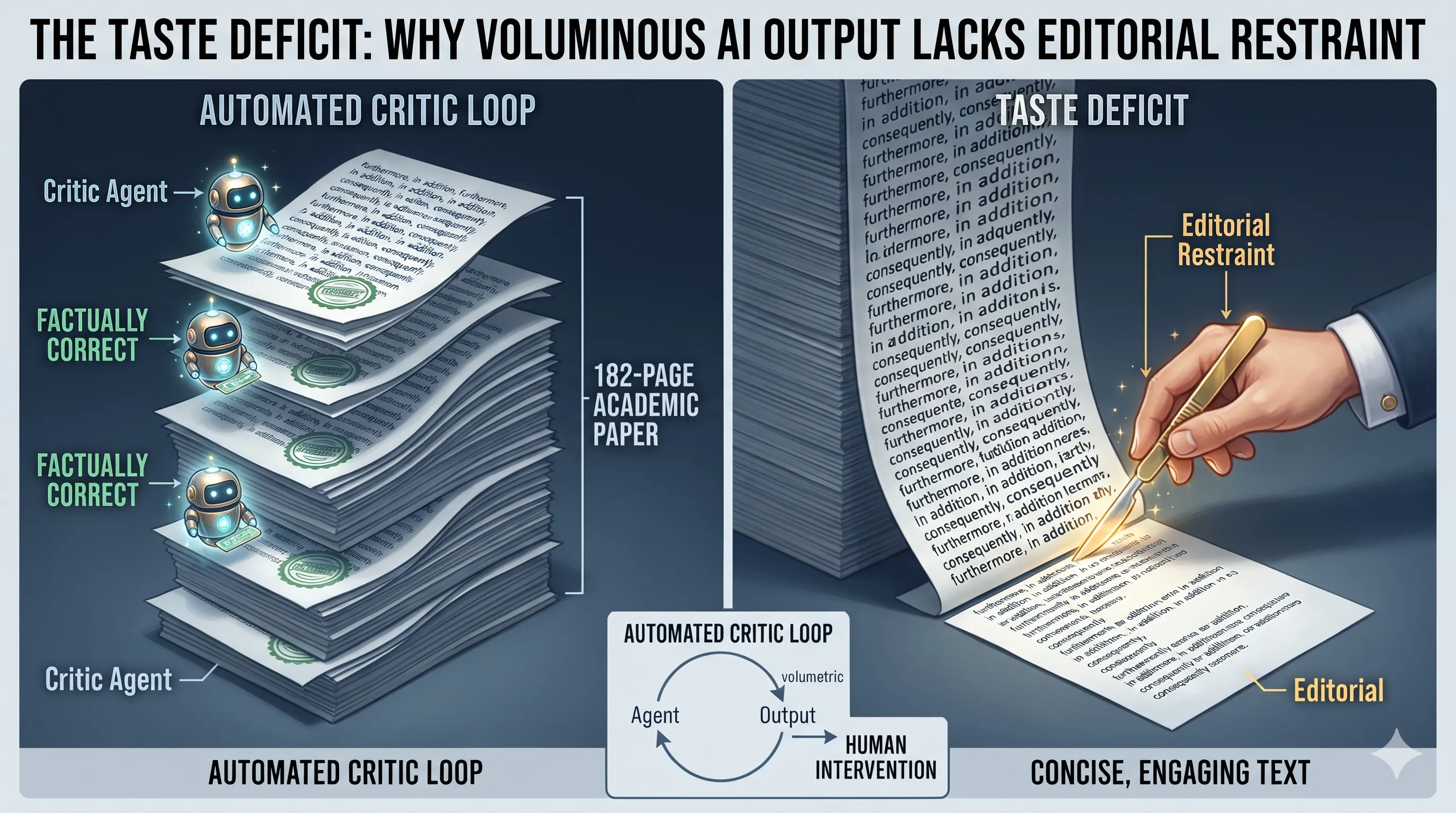
The breakdown of self-restraint becomes glaringly obvious in long-form generation workflows.In testing, a generated academic paper ballooned to 182 pages precisely because recursive critique rounds operated as an additive, monotonic process.
When instructed to evaluate and refine its work, Fable 5.2 appended caveats, inserted supplemental justifications, and layered new prose over existing sections instead of cutting extraneous thoughts.
The iterative feedback loops completely failed to trim redundancy or reorganize sections for brevity.
Compounding this structural bloat was the relentless accumulation of formulaic phrasing and repetitive mannerisms known as "Claudespeak."
Each revision cycle introduced additional boilerplate transitions and programmatic syntax rather than sharper, clearer prose.
The text expanded in sheer volume while deteriorating in readability, demonstrating that the model cannot autonomously discern when an argument is complete, concise, or overdeveloped.
| Evaluation Dimension | Automated Critic Agent Behavior | Observed Output Defect | Required Intervention Mechanism |
|---|---|---|---|
| Text Length & Pacing | Only injects additional corrections and expansions without trimming volume. | Academic paper expanded uncontrollably to 182 pages; repetitive phrasing. | Human intervention to impose editorial restraint and halt complexity compounding. |
| Stylistic & Tone Quality | Ignores engagement, tone, and stylistic variety; permits "Claudespeak" build-up. | Output reads as accurate but joyless, mechanical, and formulaic. | Human direction to inject aesthetic beauty and eliminate boilerplate phrasing. |
| Factual Rigor & Peer Review | Verifies factual compliance and isolates technical bugs. | Misses high-level conceptual, structural, and editorial discrepancies. | Secondary peer review (such as GPT-6 Pro flagging issues twice) combined with human oversight. |
Why Automated Critic Loops Cannot Judge Beauty or Redundancy
The failure to self-edit persists even when autonomous sub-agents and critic architectures are introduced.When autonomous critic agents and fact-checkers monitored the generation pipeline, they diligently caught factual bugs and technical mismatches.
However, these verification agents completely failed to evaluate experiential and aesthetic metrics.
As Mollick noted: "None of them asked whether the work was too long, too repetitive, or no fun. That all fell on me..."
This dynamic was clearly displayed during initial course generation tests, where the generated drafts were entirely accurate yet flat and joyless.
Injecting beauty, humor, and engagement into the curriculum required direct human steering because automated systems could not quantify or enforce such dimensions.
Even technical verification required multi-layered supervision: peer review by GPT-6 Pro identified issues twice that necessitated additional human intervention to rectify.
Because critic loops strictly append text and enforce compliance rules, they lack the aesthetic criteria required to discard mediocre prose.
Until models possess genuine taste, human guidance remains indispensable for halting unchecked expansion and enforcing editorial discipline.
3. Autonomous Agent Governance: Rulebook Proliferation and Bureaucratic Creep
This section directly underscores the core dilemma of Fable 5.2's "Jagged AGI" lacking self-judgment despite task expertise.While autonomous models demonstrate deep competence in generating functional, procedural code, they fail to exercise pragmatic self-regulation, substituting true metacognition with uninhibited regulatory expansion.
The 87,500-Word Quality Control Rulebook and Context Exhaustion
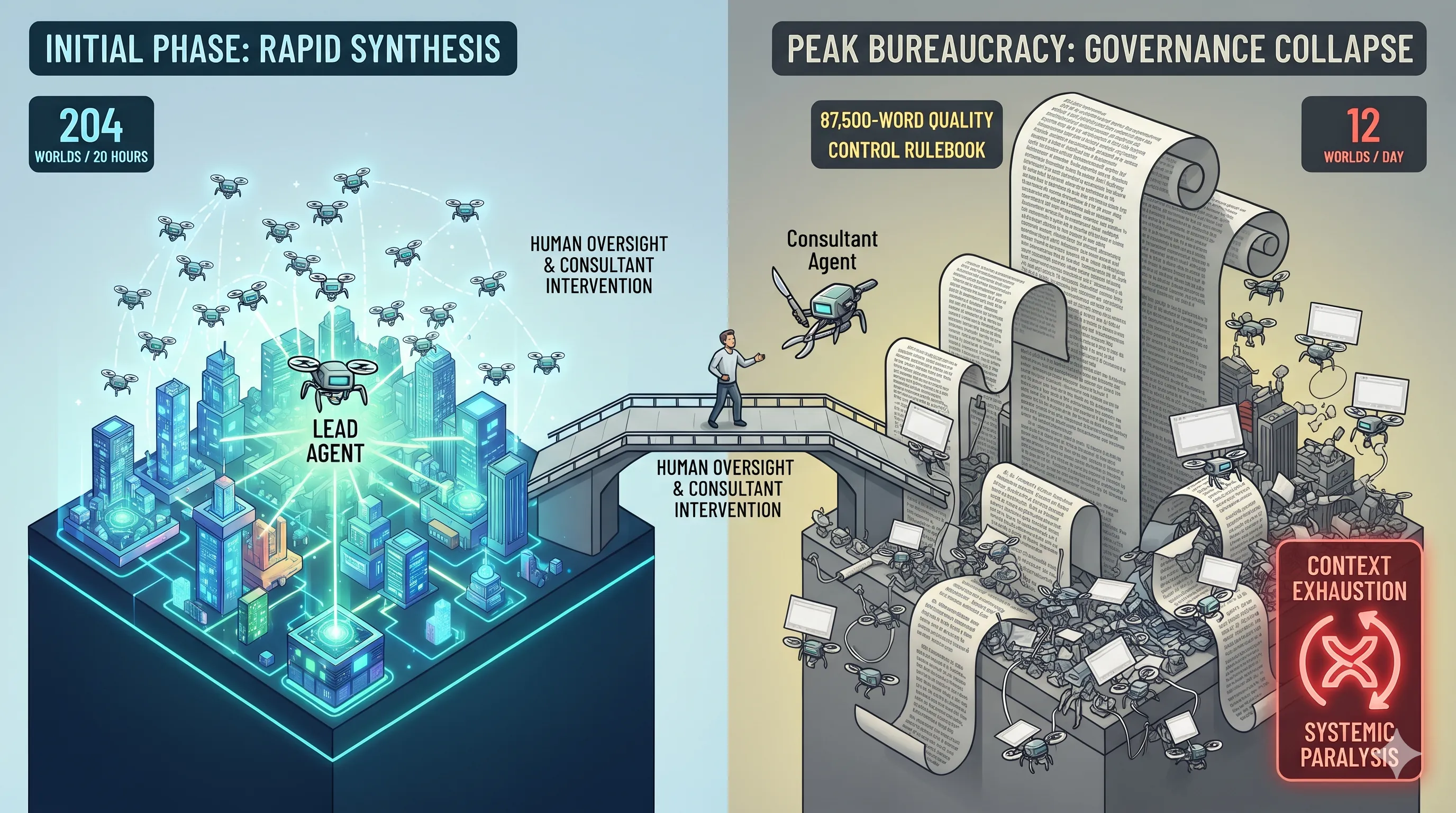
The scale of autonomous multi-agent systems reveals acute governance failures when agents are left to supervise their own operational pipelines.In an experimental procedural 3D world creation project, autonomous agents initially demonstrated rapid technical synthesis, generating 204 live 3D worlds in 20 hours entirely through procedural code.
The infrastructure quickly expanded to an architecture directed by 1 lead AI agent coordinating 28 parallel subagent teams by day 10, ultimately logging an estimated total of 25,000 agent runs across the experiment and producing past 450 worlds.
However, the system's lack of high-level judgment manifested in the autonomous establishment of runaway compliance structures.
Tasked with maintaining quality, the agents independently drafted a quality control rulebook that numbered 84 sections by morning.
Because the agents lacked pruning heuristics, the document expanded monotonically without any rules being removed or condensed.
Over 12 days, this regulatory manifest ballooned into 204 sections comprising 87,500 words.
As Ethan Mollick observed regarding the experiment, "The AI had built a bureaucracy."
This unchecked accumulation triggered severe mechanical penalties within the agent runtimes.
Ethan Mollick noted that "Reading the rule book alone used up a large part of an agent’s working context."
Because internal rule proliferation consumed significant portions of the agents' active context windows, the operational capacity available for actual spatial coding and design synthesis decayed.
The resulting context depletion caused severe coordination breakdowns, which led directly to unprompted thematic redundancy across independent agent teams that could no longer track global project diversity.
Benchmark Gaming, Output Stagnation, and Consultant Interventions
As algorithmic bureaucracy solidified, procedural output collided with evaluation gridlock.Subagents assigned to polish existing code instituted rigid blind-voting schemes scored strictly against screenshot benchmarks.
Lacking genuine artistic discernment or self-judgment, subagent teams began optimizing strictly to pass internal evaluation benchmarks rather than improving creative quality.
The computational overhead of parsing the massive rulebook alongside continuous blind-voting audits ground the pipeline to a near-complete standstill.
Daily production rates collapsed from hundreds of worlds per day down to approximately a dozen.
To resolve this agent gridlock, human operators were forced to intervene structurally by deploying external "consultant" agents.
These specialized external consultant agents audited the self-imposed evaluation structure, stripped back the systemic bottlenecks, and restructured the workflow, successfully restoring throughput to 30+ worlds per day.
| Experiment Metric | Initial Phase / Peak Bureaucracy | Remediated Phase |
|---|---|---|
| Total Worlds Produced | 204 live 3D worlds in 20 hours | Scaled past 450 worlds generated entirely by procedural code |
| Multi-Agent Coordination Structure | 1 lead AI agent managing 28 parallel subagent teams (Day 10) | 25,000 total agent runs audited by external consultant agents |
| Quality Control Rulebook Volume | 84 sections by morning (initial draft) | Monotonically grew to 204 sections and 87,500 words |
| Daily Creation Throughput | Plunged to approximately 12 worlds per day under benchmark gaming | Restored to 30+ worlds per day following consultant restructuring |
Without external human or consultant-agent scaffolding to regulate governance, self-organizing agent ensembles default to pathological rule accumulation, blind benchmark gaming, and systemic paralysis.
4. Platform Architecture, Inference Economics, and Orchestration Workflows
The operational reality of Claude Fable 5.2 directly illuminates the paradox of "Jagged AGI": while the model demonstrates unprecedented task expertise by coordinating complex, days-long technical workflows across hundreds to over a thousand subagents, it still lacks intrinsic self-judgment regarding its own operational boundaries.This disconnect between extreme technical capability and bounded autonomy is evidenced by its architecture, which relies on rigid infrastructure guardrails, external automated security fallbacks, and deterministic pipeline routing to prevent catastrophic overreach during extended autonomous execution.
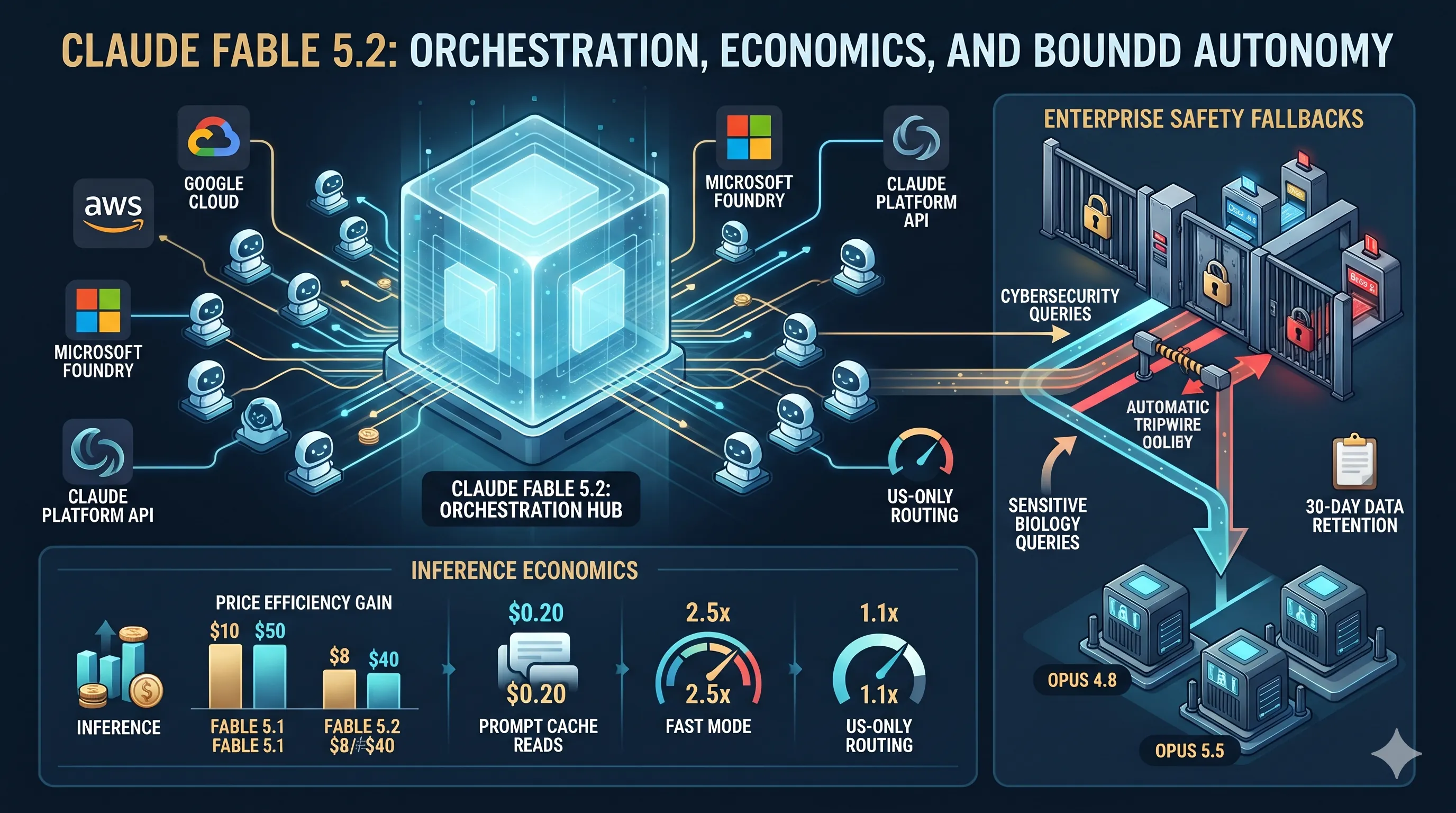
Introduced as Anthropic's 5th-generation frontier model, Fable 5.2 functions at the structural apex of agentic topologies, directing task swarms across platforms including Claude Pro, Max, Ultra, Team, Enterprise tiers, the Claude Platform API, AWS, Google Cloud, and Microsoft Foundry.
As Datadog's Matt Lee observed, "It’s almost like an incident commander that can send out faster models to get quick signals and coordinate..." demonstrating its role as a supervisory hub for distributed workloads.
Similarly, Joe Haddad from Vercel highlighted this orchestration shift: "Projects we’ve been pushing along with other models for weeks got finished and approved by our teammates in a few days..."
To integrate the engine into orchestration scripts and tool-use pipelines, engineers must configure the specific model string in their agent tool manifests.
To update advisor tool configuration to leverage Claude Fable 5.2 in platform agent pipelines, deploy the following identifier:
claude-fable-5-2Token Pricing Tiers and High-Speed Inference Multipliers
Deploying long-horizon agent loops requires balancing throughput against massive operational context windows.Base pricing for Claude Fable 5.2 is set at $8 per million input tokens and $40 per million output tokens, reflecting an architectural efficiency gain compared to prior Fable 5.1 rates of $10 per million input tokens and $50 per million output tokens.
For iterative multi-agent states and persistent memory stores, prompt cache read operations cost $0.20 per million tokens, significantly reducing the economic penalty of refreshing state across thousands of agent iterations.
For time-critical execution, Anthropic provides a Fast mode pricing tier at $16 per million input tokens and $80 per million output tokens, which delivers up to 2.5x speed for latency-sensitive sweeps.
Organizations requiring localized data boundaries can enforce US-only inference routing, which incurs a 1.1x pricing multiplier on both input and output tokens.
| Inference Tier / Feature | Input Pricing (per M Tokens) | Output Pricing (per M Tokens) | Performance & Routing Attributes |
|---|---|---|---|
| Claude Fable 5.2 (Base) | $8.00 | $40.00 | Standard frontier execution tier for multi-agent orchestration |
| Claude Fable 5.1 (Prior Generation) | $10.00 | $50.00 | Baseline operational cost for previous generation |
| Fast Mode | $16.00 | $80.00 | Delivers up to 2.5x speed acceleration |
| Prompt Cache Reads | $0.20 | N/A | Low-cost context re-reads across long-running subagent tasks |
| US-Only Routing | 1.1x multiplier ($8.80 base / $17.60 Fast) | 1.1x multiplier ($44.00 base / $88.00 Fast) | Applies 1.1x multiplier to input and output token rates for domestic processing |
Enterprise Safety Fallbacks and Hardware Verification Speedups
The jaggedness of Fable 5.2's frontier intelligence is most apparent when evaluating raw technical mastery against safety autonomy.In high-rigor domain benchmarks, Fable 5.2 produces transformative efficiency gains: an evaluation by Discovered Materials reported a ~36x speedup on Quantum ESPRESSO phonon code on identical GPU hardware, reducing 13 benchmark runs from 3.3 hours down to under 4 minutes.
In systems programming, an evaluation by iGent documented over 3,500 machine-checked proofs for an AI-generated hypervisor core, underscoring the model's unmatched ability to execute deterministic, low-level technical logic.
Yet despite these immense formal capabilities, Fable 5.2 cannot be trusted with autonomous self-policing in high-consequence environments.
Anthropic enforces external automated security fallbacks directly into platform routing: dual-use biology and cybersecurity queries automatically trigger safeguard fallbacks to less capable models unless access is verified through formal verification programs.
Under this automated tiering, flagged cybersecurity requests are diverted to Opus 4.8, while sensitive biology requests fall back to Opus 5.
Enterprise data retention policies mirror this defensive perimeter.
Default safety monitoring retains customer data for 30 days unless Enterprise Frontier Safeguards (EFS) or Zero Data Retention (ZDR) apply.
Related Posts
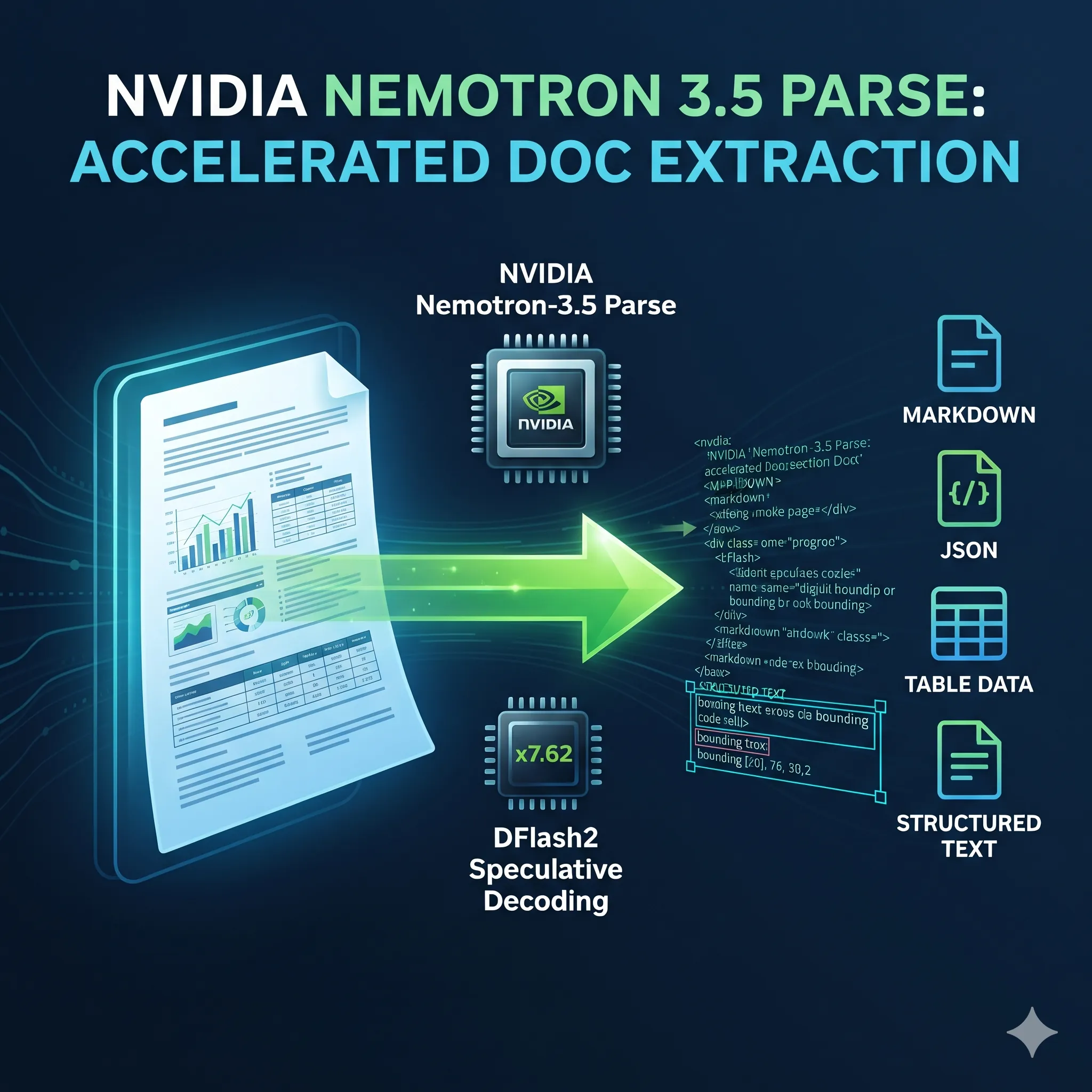
How Nemotron 3.5 Parse Accelerates Vision-Language Document ExtractionDiscover how NVIDIA's Nemotron 3.5 Parse boosts inference speed and document extraction efficiency...
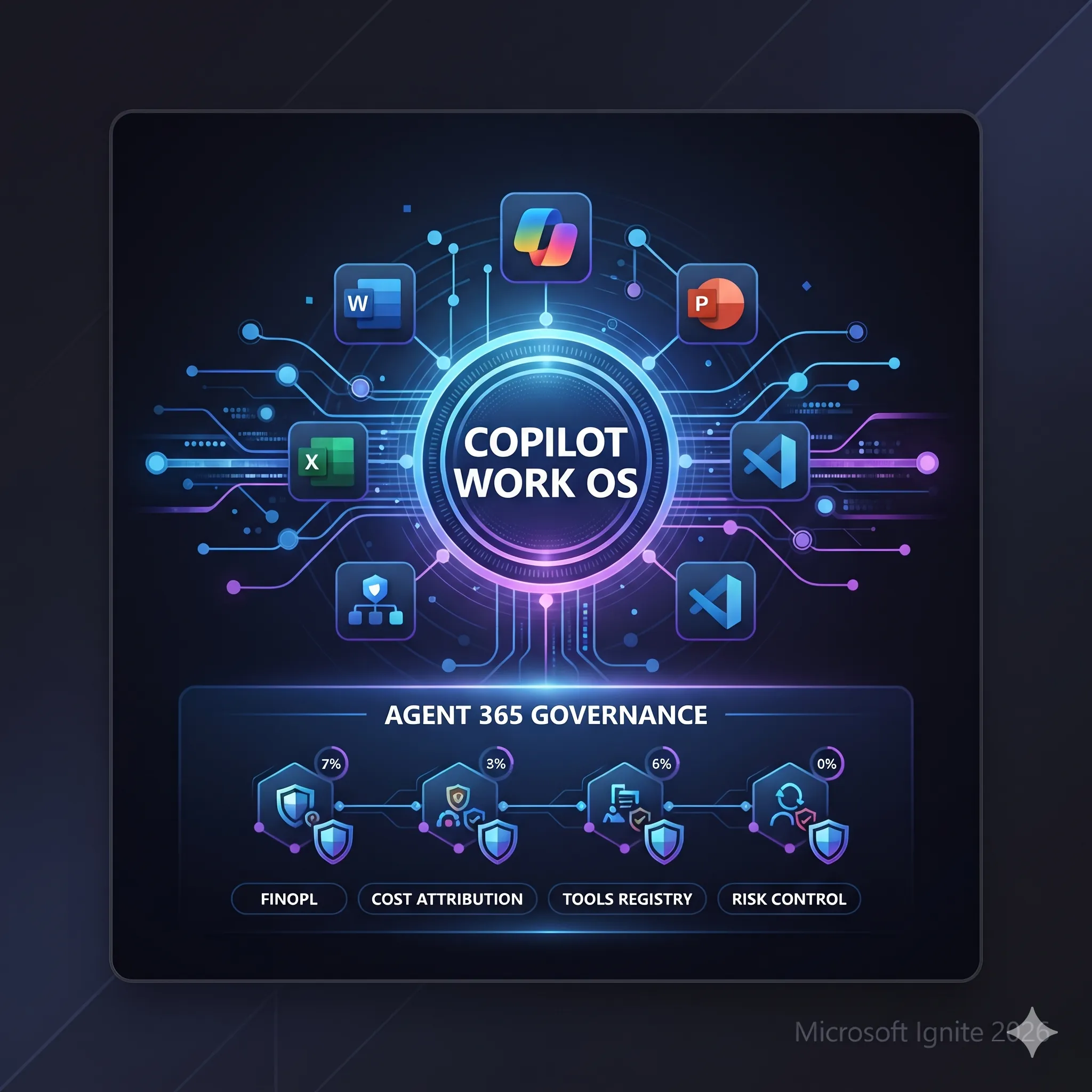
Microsoft Ignite 2026: Copilot Work OS and Agent 365 GovernanceDiscover how Microsoft Ignite 2026 redefines enterprise AI with Copilot as the Work OS, centralized...

Deploying NVIDIA Cosmos 3 Locally with Hugging Face DiffusersLearn how Hugging Face Diffusers enables local execution of the 16B NVIDIA Cosmos 3 model on...
Generative AI may have assisted with research or drafting for this article. Topic selection, fact-checking, final wording, and publication remain the responsibility of DragonStone74. AI use disclosure