Architectural Blueprints for Agentic AI: Tool Integration, Code-as-Action, and Modular Execution
🚀 Key Takeaways
- Self-Supervised Tool Integration: Frameworks like Toolformer prove that language models can teach themselves API invocation without extensive human annotation, preserving baseline language understanding.
- Modular Code-as-Action Paradigms: Architectures like Voyager establish persistent, verified code libraries that enable agents to execute compositional tasks and transfer skills zero-shot.
- Empowering Open-Source Models: Comprehensive tool-use pipelines like ToolBench demonstrate that compact 7B-parameter models can rival proprietary frontier LLMs through structured decision-tree fine-tuning.
- Automated Curriculum & Feedback Loops: Iterative self-refinement and dynamic task progression overcome the exploration bottlenecks inherent in traditional prompting techniques.
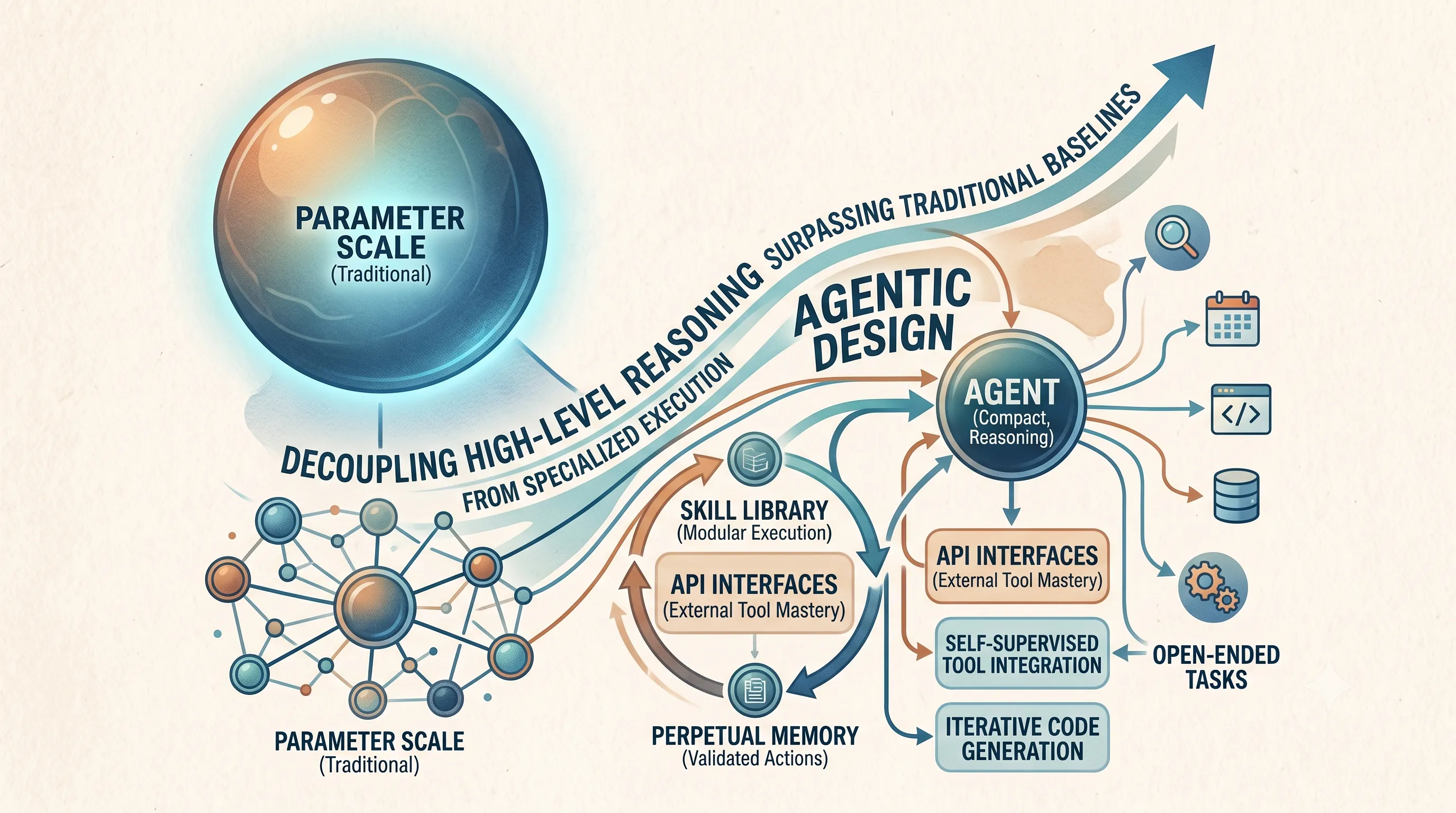
- Cost-Efficient Agentic Scaling: Strategic skill design delivers superior execution efficiency and operational speedups compared to simply scaling raw model parameter count.
By decoupling high-level reasoning from specialized execution, autonomous agents learn to interact with complex real-world software, maintain perpetual memory of validated actions, and navigate open-ended tasks with unprecedented autonomy. Exploring how self-supervised tool integration and iterative code generation function reveals the architectural blueprint for building nimble, highly capable AI agents capable of surpassing traditional parameter-heavy baselines.
1. Self-Supervised API Integration: Toolformer's Architecture for Autonomous Tool Calling
Within the broader paradigm of making smaller language models outperform raw parameter scaling through modular skill architectures, self-supervised tool acquisition represents a foundational leap.Rather than relying on massive human annotation efforts to teach models when and how to invoke external capabilities, the Toolformer architecture demonstrates how language models can teach themselves to call external tools via text-based API calls.
Developed by Timo Schick et al. from Meta AI Research and Universitat Pompeu Fabra, this approach proves that smaller models can autonomously augment their reasoning abilities with specialized skills.
In-Context API Candidate Sampling and Loss Filtering
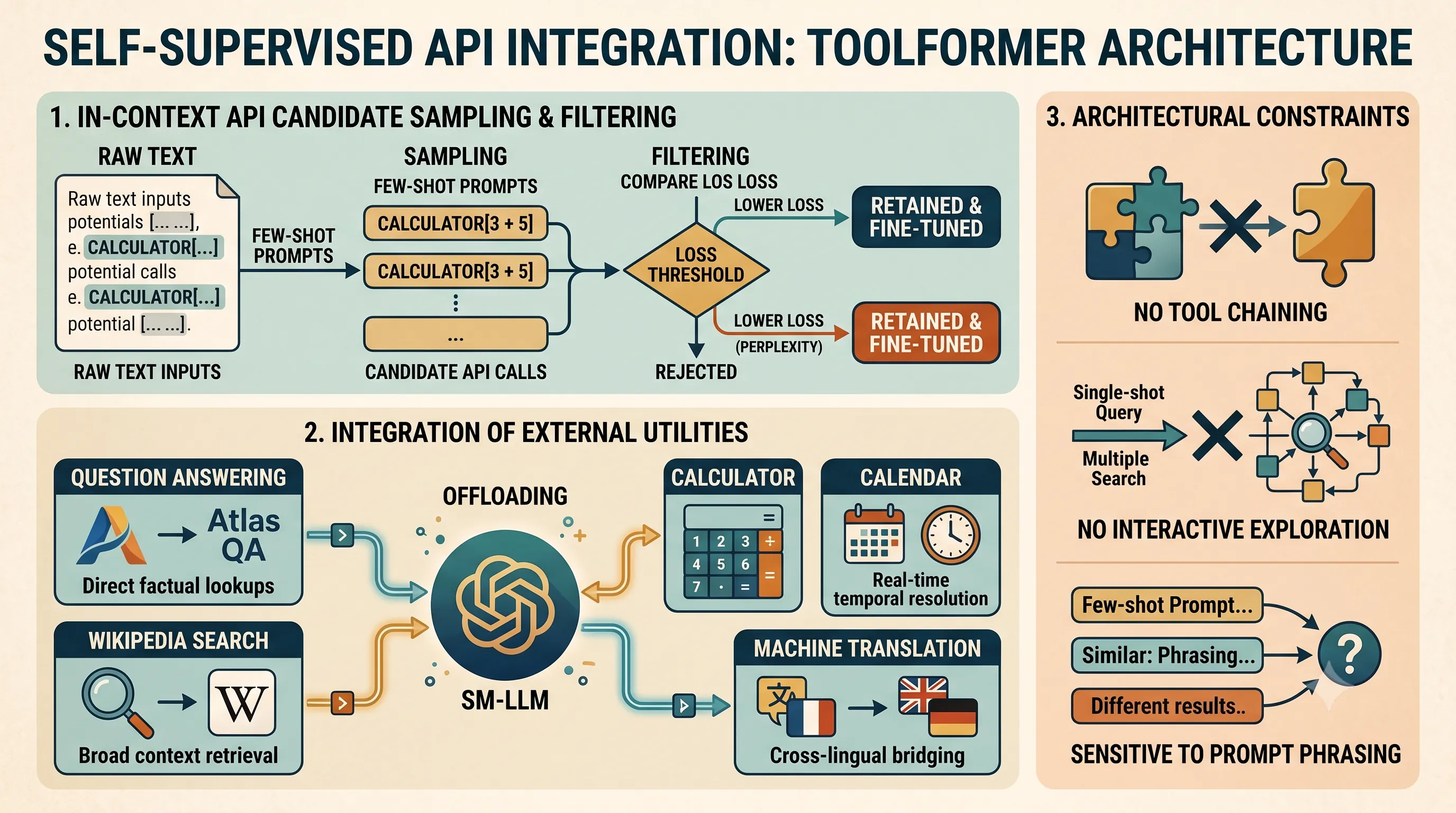
The core mechanism of Toolformer relies on self-supervised data generation that transforms raw text into tool-augmented training corpora.The model first samples potential API call candidates across standard text sequences using in-context few-shot prompts.
These generated candidate calls represent specific positions in the text where querying an external utility might provide relevant context or exact factual computation.
Once candidate API calls are executed, the framework applies a self-supervised filtering stage based on a weighted cross-entropy loss threshold.
The system evaluates whether inserting an API call and its resulting output reduces perplexity on predicting subsequent tokens compared to predicting tokens without tool access or with an empty API call.
Only API calls that actively lower prediction loss beyond the established threshold are retained.
The framework then interleaves these verified, successful API calls and results directly into the pretraining text format, providing a refined dataset for standard language model fine-tuning.
Integration of External APIs: Atlas QA and Mathematical Utilities
Toolformer evaluates the integration of five distinct external tools to offload knowledge retrieval, temporal tracking, and deterministic computation.These tools encompass Question Answering, Wikipedia Search, a Calculator, a Calendar, and Machine Translation.
For factual retrieval, Question Answering uses an Atlas model fine-tuned on Natural Questions to resolve targeted information lookups.
Through these modular skills, the base model offloads exact arithmetic to the Calculator and precise date arithmetic to the Calendar, ensuring that factual and mathematical precision does not require inflating model size.
| Tool Category | Underlying Utility / Implementation Details | Functional Integration Role |
|---|---|---|
| Question Answering | Atlas fine-tuned on Natural Questions | Direct factual lookups and targeted query answering |
| Wikipedia Search | Text-based Search API | Broad factual context retrieval |
| Calculator | Deterministic Mathematical Utility | Exact arithmetic and symbolic numerical execution |
| Calendar | Temporal API | Real-time date resolution and temporal tracking |
| Machine Translation | Translation Utility | Multilingual text translation and cross-lingual bridging |
Architectural Constraints: Chaining Limitations and Execution Costs
While Toolformer establishes an automated pipeline for learning text-based API calls, its architecture introduces several structural limitations.The framework is currently incapable of tool chaining, meaning it cannot take the output generated by one tool and pass it directly as an input parameter into a subsequent tool.
Additionally, the search execution lacks interactive exploration or iterative query refinement, executing queries as single-shot calls without conversational recovery or multi-step searching.
The sampling process also remains sensitive to exact input prompt phrasing during candidate generation.
Finally, the optimization objective focuses purely on future token loss reduction and does not account for computational execution costs incurred per tool call.
2. Zero-Degradation Execution: Retaining Core Language Perplexity During Tool Invocations
A critical challenge when equipping smaller language models with external skills and tool interfaces is the risk of catastrophic degradation in core generative capabilities.In designing agent architectures where smaller models rival larger counterparts, retaining fundamental language modeling fluency ensures that specialized tool calling does not compromise base reasoning.
Perplexity Preservation on Standard Benchmarks (WikiText and CCNet)
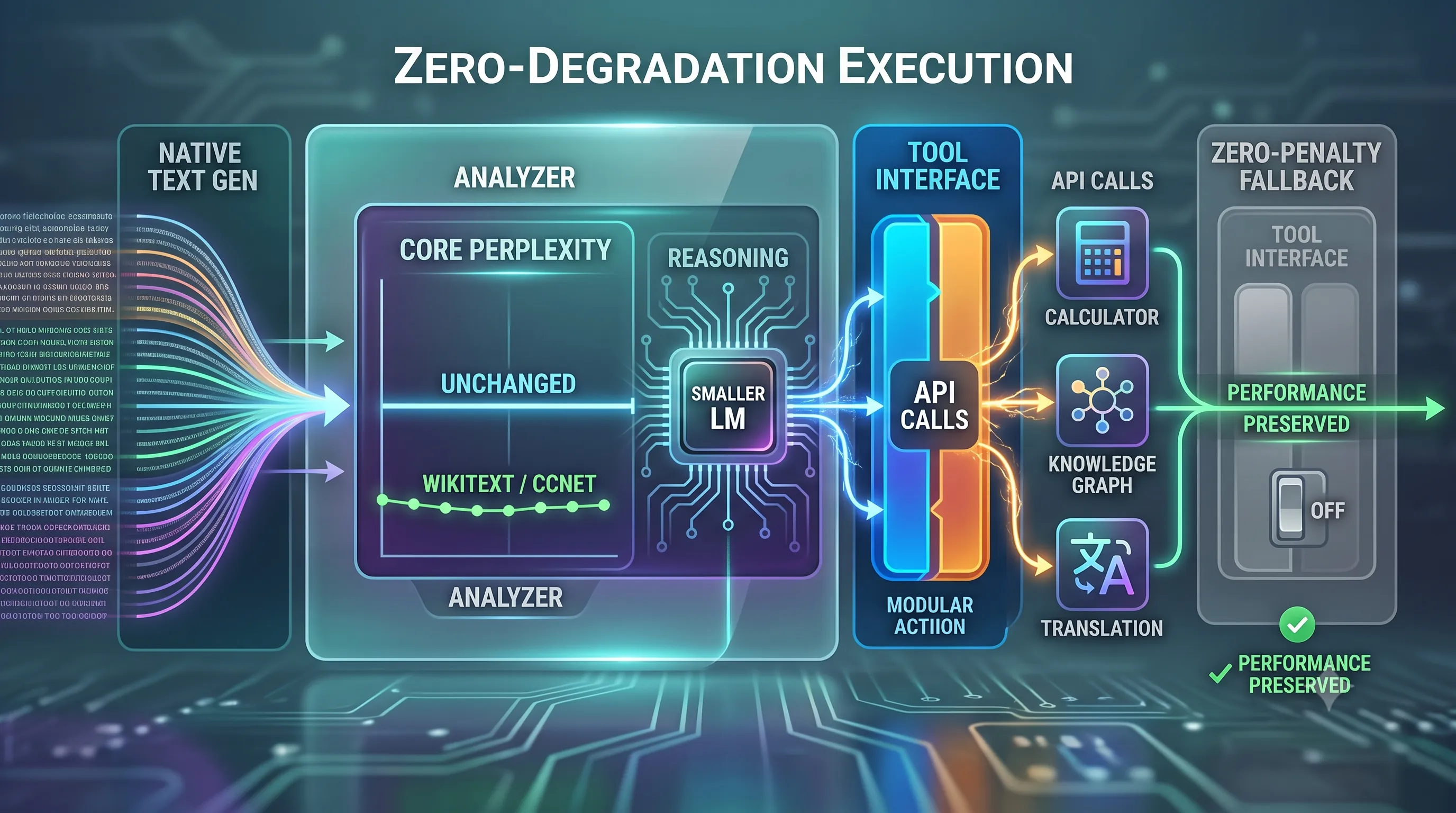
Toolformer demonstrates that integrating tool-use capabilities does not come at the expense of native language modeling performance.Evaluations across standard natural language corpora, including WikiText and CCNet, confirm that the model maintains baseline perplexity levels.
By learning to invoke external APIs without altering the core distribution of standard token generation, the architecture preserves baseline linguistic competence alongside acquired functional skills.
Zero-Penalty Fallback Mechanisms When Tools Are Inactive
The model exhibits zero degradation in language modeling perplexity when API calls are explicitly disabled.This confirms that external skill integration operates as a non-destructive, modular capability rather than an invasive modification to foundational text generation.
When tool execution is withheld or unavailable, the underlying architecture seamlessly processes standard text sequences without experiencing any fallback penalty or structural performance drop.
3. Code-as-Action Libraries: Voyager's Lifelong Skill Acquisition Architecture
To understand how structured skill design elevates agent capabilities beyond brute-force parameter scaling, the Voyager lifelong learning framework developed by Guanzhi Wang et al. (NVIDIA, Caltech, UT Austin, Stanford, UW Madison) serves as a foundational blueprint.Rather than relying on model weight fine-tuning or simple text-based primitive actions, Voyager treats executable JavaScript code as its action space to represent temporally extended and compositional actions.
This architecture demonstrates that managing a modular, externally stored skill library enables blackbox foundation models to continuously acquire, refine, and reuse complex behaviors in open-ended environments without parameter updates.
Executable Action Spaces and Vector-Indexed Skill Retrieval
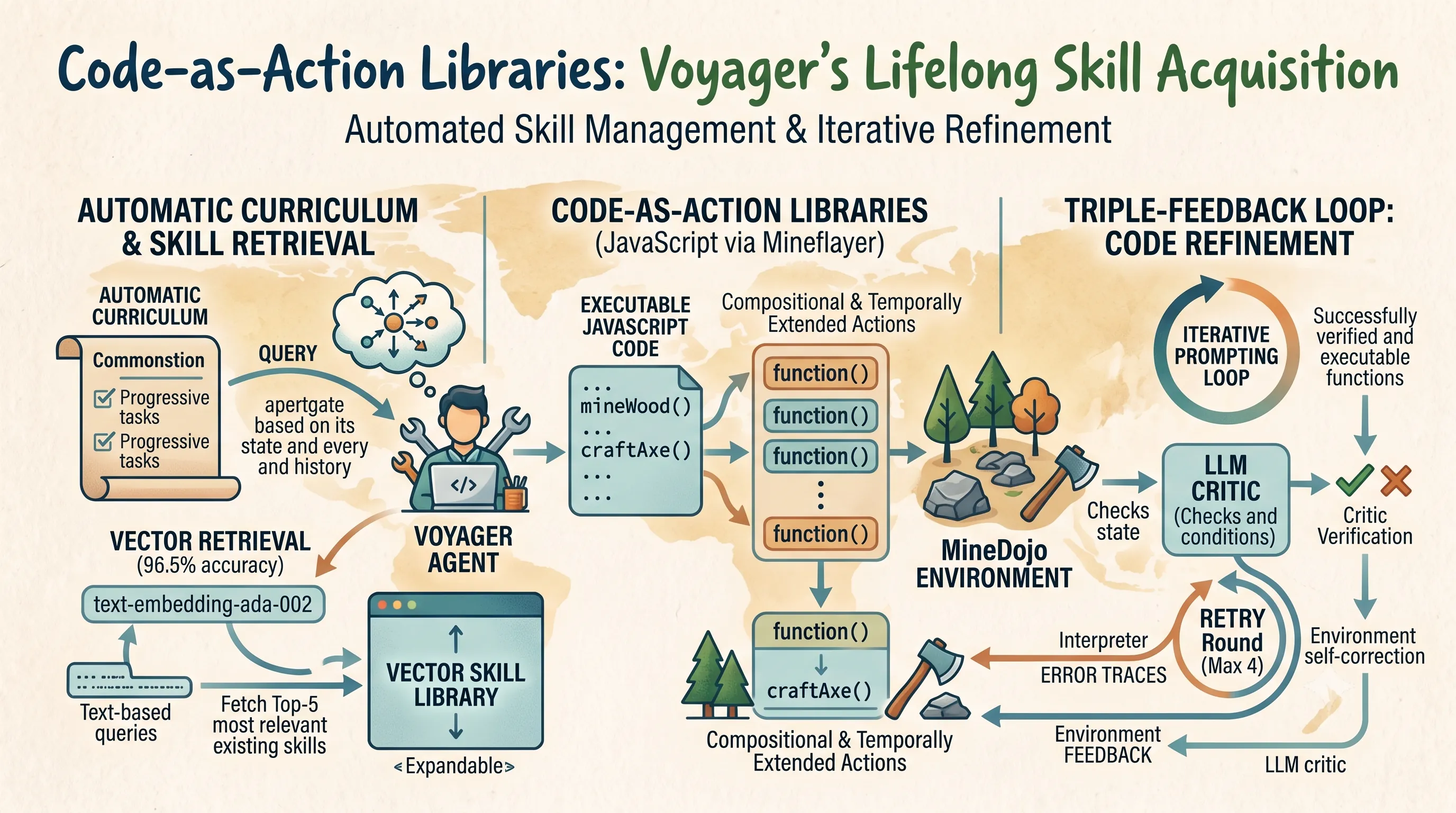
Voyager operates within the MineDojo environment using Mineflayer JavaScript APIs, transforming high-level goals into modular, executable functions.An automatic curriculum continuously generates progressive, open-ended tasks driven by the agent's current state and historical exploration progress.
As the agent successfully solves curriculum tasks, it maintains an ever-growing vector skill library that stores verified executable JavaScript functions.
When presented with a new objective, the system queries this library using text-embedding-ada-002 embeddings to retrieve the top-5 most relevant existing skills.
This vector retrieval mechanism achieves 96.5% top-5 accuracy across 309 evaluation samples, allowing the agent to compose previously mastered behaviors into sophisticated, multi-step subroutines.
| Architectural Module | Implementation Mechanism | Key Function & Benchmark Metric |
|---|---|---|
| Automatic Curriculum | State-aware task generator via blackbox LLM queries | Generates progressive, open-ended goals based on exploration history and agent inventory. |
| Action Space | Executable JavaScript code via Mineflayer APIs | Represents compositional and temporally extended actions without parameter updates. |
| Skill Library & Retrieval | Vector database indexed with text-embedding-ada-002 | Stores verified functions; achieves 96.5% top-5 retrieval accuracy across 309 evaluation samples. |
| Iterative Prompting Loop | Environment feedback, interpreter traces, LLM critic | Self-corrects code errors; capped at a maximum of 4 retry rounds per task. |
The Triple-Feedback Loop: Environment Feedback, Error Traces, and Critic Verification
To ensure that generated code is fully functional before being indexed into the library, Voyager implements an iterative prompting mechanism.This loop integrates three distinct feedback streams: real-time environment execution feedback, interpreter error traces, and an LLM critic self-verification module.
If a proposed code snippet throws an execution error or fails to satisfy the task condition, the interpreter's error trace and environmental state changes are fed directly back into the prompt.
The framework limits code generation retries to at most 4 rounds before proposing the next curriculum task, preventing infinite loops on intractable goals.
Once the critic confirms task completion, the newly synthesized program is validated and permanently indexed into the vector skill repository.
Operational Requirements and API Cost Trade-offs
Deploying the Voyager framework requires an environment configured with Python >= 3.9 and Node.js >= 16.13.0 running on the MineDojo platform.The architecture operates via blackbox queries across models such as GPT-4 (including gpt-4-0314 and gpt-4-0613) and GPT-3.5-turbo without gradient updates.
However, utilizing GPT-4 API calls incurs significantly higher computational and financial costs compared to GPT-3.5-turbo pipelines.
System constraints also include occasional task generation hallucinations, where the curriculum proposes nonexistent game items.
Furthermore, because the text-only LLM setup operates without direct human visual feedback, the agent exhibits limitations in fine-grained visual spatial perception.
4. Compounding Autonomous Capabilities: Empirical Validation and Zero-Shot Skill Transfer
The core principle of designing specialized skill libraries lies in transforming ephemeral LLM reasoning into durable, composable execution units.
Empirical benchmarks demonstrate that autonomous agents equipped with self-verifying, lifelong embodied skill accumulation vastly outperform conventional agent architectures across complex, long-horizon environments.
Milestone Acceleration Across the Minecraft Tech Tree
In open-ended lifelong embodied learning benchmarks, traditional agent baselines such as ReAct and Reflexion fail to make meaningful progress on tech tree exploration without explicit curriculum guidance.
In contrast, Voyager establishes a stark performance differential across open-ended exploration and item acquisition.
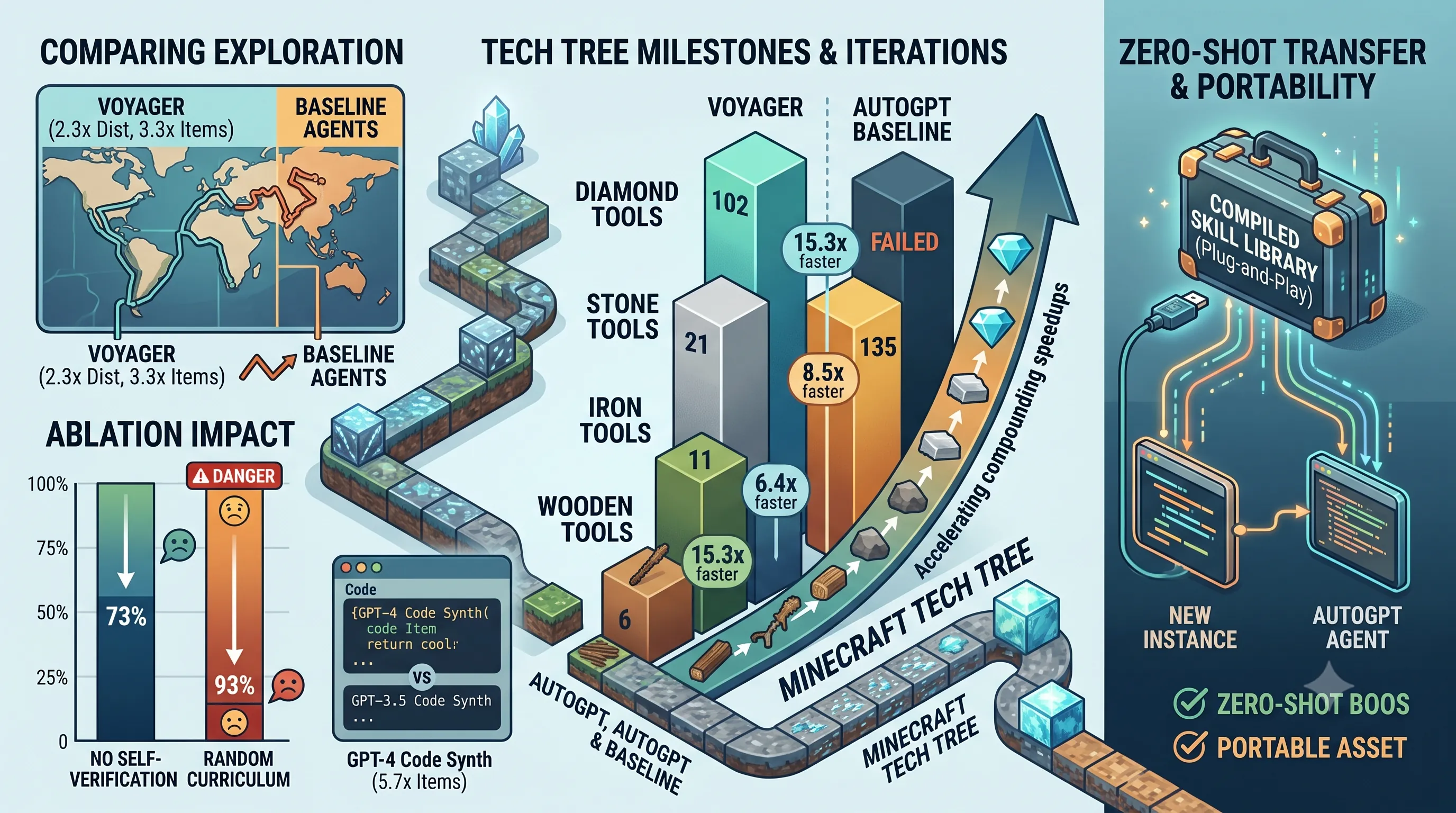
Voyager discovers 63 unique items within 160 prompting iterations, achieving 3.3x more novel items than baselines.
Furthermore, its embodied navigation capabilities allow it to traverse 2.3x longer distances across varied map terrains compared to baseline systems.
This architectural advantage is most visible in the compounding speedups observed across sequential tech tree milestones.
While unguided or monolithic frameworks experience severe degradation as task complexity scales, modular skill acquisition accelerates progression exponentially.
| Tech Tree Milestone | Voyager (Iterations) | AutoGPT Baseline (Iterations) | Speedup / Outcome |
|---|---|---|---|
| Wooden Tools | 6 | 92 | 15.3x faster |
| Stone Tools | 11 | 94 | 8.5x faster |
| Iron Tools | 21 | 135 | 6.4x faster |
| Diamond Tools | 102 | Failed / Unreached | Only evaluated method to successfully unlock |
Voyager unlocks the wooden tool tier 15.3x faster (requiring 6 iterations versus 92 iterations for AutoGPT), the stone tool tier 8.5x faster (11 iterations versus 94 iterations), and the iron tool tier 6.4x faster (21 iterations versus 135 iterations).
Crucially, Voyager represents the only evaluated method capable of reaching and unlocking the diamond tool milestone, doing so successfully at iteration 102.
Ablation Insights: The Critical Impact of Verification and Structured Curricula
Ablation experiments isolate the exact mechanisms driving this compounding efficiency.
Execution feedback without formal self-verification leads to rapid failure accumulation: removing self-verification drops the discovered item count by 73%.
Similarly, removing structured task sequencing severely impedes exploration: replacing the automatic curriculum with a random curriculum results in a catastrophic 93% drop in item discovery.
The choice of code generation engine also plays a decisive role in execution quality.
Utilizing GPT-4 for iterative code synthesis produces 5.7x more unique items compared to GPT-3.5, validating that high-precision code authoring is vital for generating robust, error-free primitive programs.
Zero-Shot Transfer of Pre-compiled Skill Libraries to External Agents
Because acquired skills are stored as modular, executable code snippets rather than internalized weights, the resulting skill repository functions as a standalone, portable asset.
Voyager leverages its accumulated skill library to solve novel tasks from scratch zero-shot in newly instantiated worlds without requiring retraining.
Moreover, this compiled skill library operates in a plug-and-play capacity across heterogeneous agent architectures.
When integrated into baseline frameworks like AutoGPT, the pre-compiled skill library directly boosts performance on previously unseen tasks, demonstrating that verified skill modularity is key to elevating autonomous agent capabilities.
5. Fine-Tuning Compact Models: ToolLLaMA and Multi-Tool Solution Path Optimization
Building high-performance AI agents does not strictly require scaling model parameters to hundreds of billions.By structuring specialized skill trajectories and tool invocation pipelines, compact open-source architectures can master intricate external interfaces.
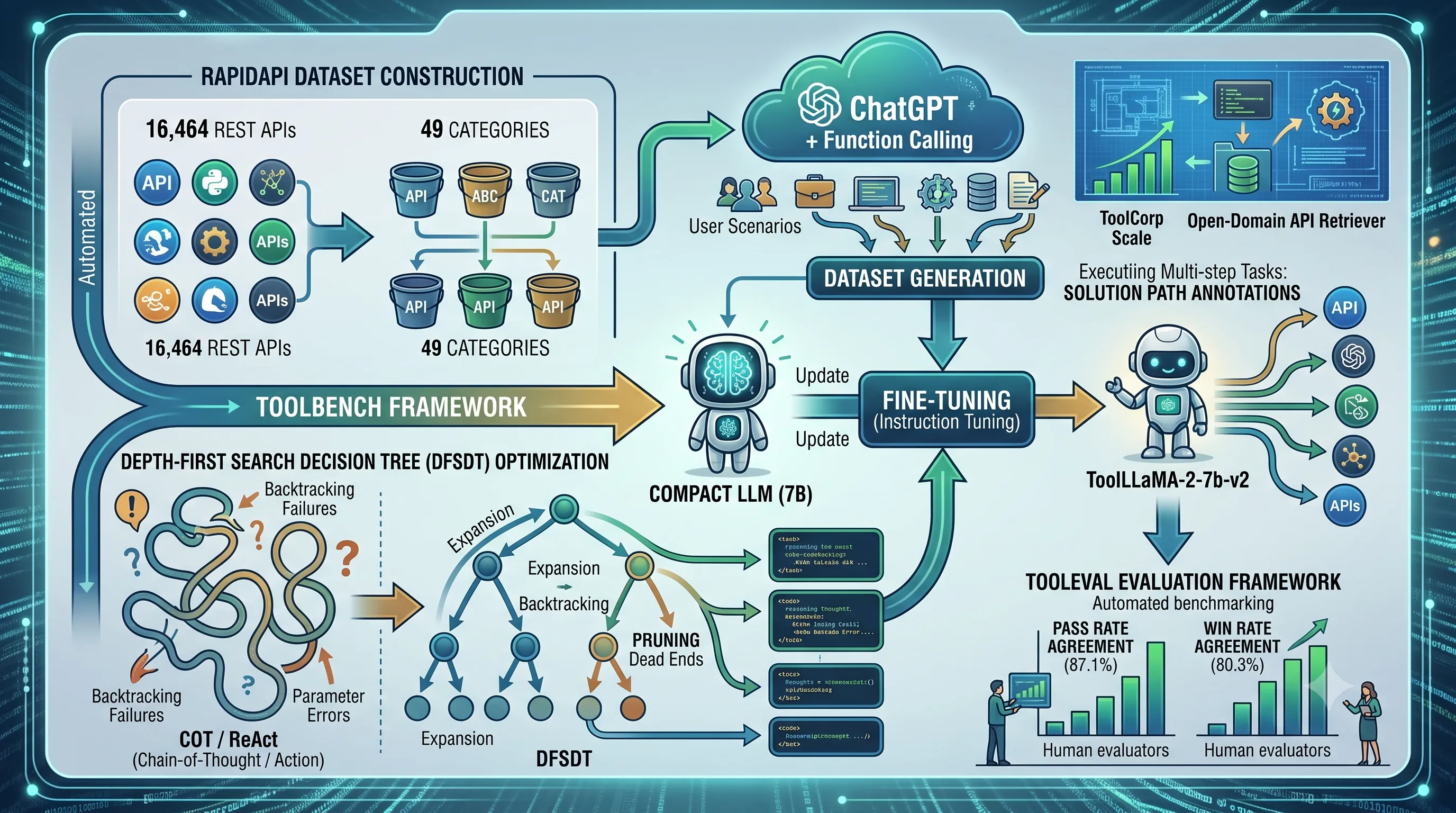
The ToolBench framework developed by the OpenBMB ToolBench Team exemplifies this paradigm, proving that targeted instruction tuning on multi-tool solution paths equips a 7B parameter base model with functional execution capabilities competitive with ChatGPT.
RapidAPI Dataset Construction and Open-Domain Retrieval
To ground language models in real-world software tooling, the ToolBench framework gathered 16,464 REST APIs from RapidAPI spanning 49 distinct categories.The creation of the instruction tuning dataset was automated by leveraging ChatGPT equipped with enhanced function calling to generate diverse user scenarios and interactions.
To facilitate execution in broad environments, the architecture integrates an open-domain API retriever that allows smaller models to search, filter, and select relevant tools dynamically rather than relying on hardcoded toolsets.
Managing operational dependencies across diverse endpoints requires handling simulated or live API keys, addressing early constraints where customized API execution was originally limited to closed-domain settings before full open-domain integration was achieved.
Depth-First Search Decision Tree (DFSDT) Multi-Tool Reasoning Paths
Conventional prompting and reasoning structures like Chain-of-Thought (CoT) and ReAct frequently fail when executing complex multi-tool sequences that involve interdependent parameters, ambiguous endpoints, or runtime errors.To overcome these execution bottlenecks, the OpenBMB ToolBench Team implemented a Depth-First Search Decision Tree (DFSDT) annotation pipeline.
DFSDT expands the decision space into a structured tree, evaluating potential tool trajectories and enabling pruning and backtracking whenever an API call encounters an invalid response or a dead end.
Through this search strategy, the pipeline generated over 120,000 solution path annotations enriched with intermediate reasoning thoughts, providing high-quality supervisory signals for multi-step agent planning.
ToolEval Evaluation Framework and 7B Model Competitiveness
By fine-tuning LLaMA-2-7B on these structured multi-task tool datasets, the framework constructs ToolLLaMA-2-7b-v2.The resulting 7B parameter open-source model demonstrates tool-use capabilities that rival proprietary, large-scale generalist baselines.
To quantify performance across diverse multi-step tool scenarios, the system is assessed using ToolEval, an automated evaluation framework measuring pass rate and win rate metrics.
Validation experiments show that ToolEval achieves high alignment with expert judgment, recording an 87.1% pass rate agreement and an 80.3% win rate agreement with human annotators.
| Architecture Dimension | Specification & Quantitative Detail | Operational Role / Metric Alignment |
|---|---|---|
| Tool Corpus Scale | 16,464 REST APIs across 49 categories | RapidAPI interface coverage for open-domain tool retrieval |
| Trajectory Dataset | Over 120,000 solution path annotations | DFSDT-generated multi-tool paths with reasoning thoughts |
| Fine-Tuned Model | ToolLLaMA-2-7b-v2 (LLaMA-2-7B base) | Compact 7B model achieving tool use competitive with ChatGPT |
| ToolEval Human Agreement | 87.1% pass rate agreement / 80.3% win rate agreement | Automated benchmarking alignment with human evaluators |
| Dependency Handling | Simulated or live API keys | Resolves authentication and parameter execution dependencies |
References
Related Posts