
The OWASP Agent Control Standard: Governing Autonomous AI Agent Security
🚀 Key Takeaways
- Standardized Runtime Guardrails: The OWASP Agent Control Standard (ACS) defines an open framework and Guardian boundary architecture that injects declarative middleware hooks to enforce security policies before autonomous actions execute.
- Mitigating Critical Operational Risks: ACS provides direct defenses against vulnerabilities such as Excessive Agency and Insecure Plugin Design, preventing autonomous agents from triggering unauthorized system modifications or catastrophic database operations.
- Unified Enterprise Governance: Developed under the OWASP GenAI Security Project, this standard enables consistent observability and compliance across heterogeneous cloud, SaaS, and on-premises agent deployments.
As enterprises transition from passive chat assistants to autonomous AI agents granted direct access to internal databases, APIs, and execution environments, the potential blast radius of an unconstrained action has grown exponentially. Without strict boundary controls, an agent operating on ambiguous context or poisoned inputs risks triggering irreversible downstream actions—including accidental data deletion and privileged command execution.
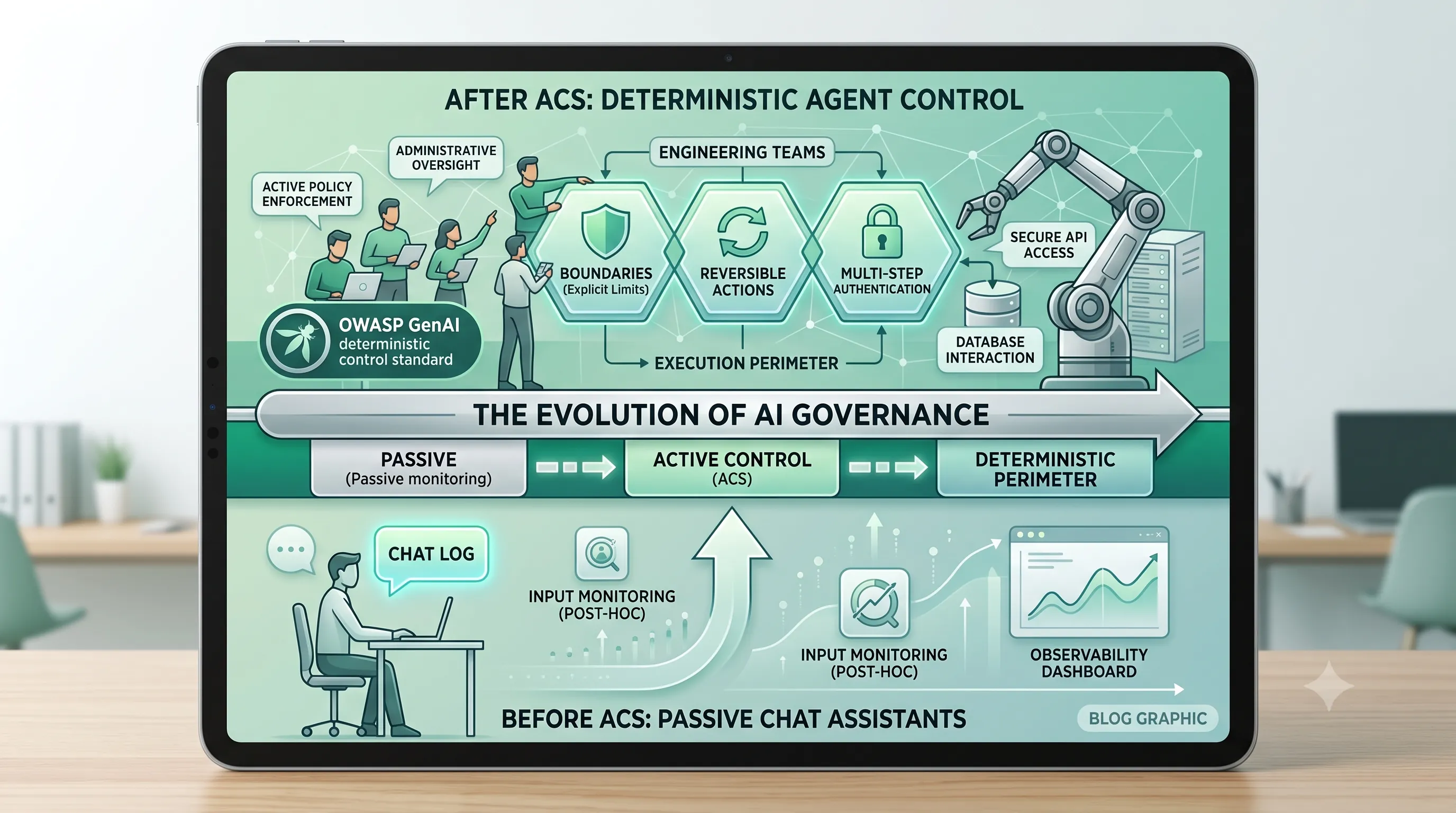
To resolve this critical governance vacuum, the OWASP GenAI Security Project introduced the Agent Control Standard (ACS). Building on the momentum of the OWASP GenAI LLM Top 10 2026, the ACS framework shifts enterprise security from post-hoc monitoring to active, deterministic policy enforcement at the execution perimeter.
Securing agentic workflows requires a fundamental shift in how organizations manage black-box autonomy across hybrid environments. Exploring the architecture and core controls of the OWASP Agent Control Standard reveals how engineering teams can safely scale autonomous systems while maintaining absolute administrative oversight.
To resolve this critical governance vacuum, the OWASP GenAI Security Project introduced the Agent Control Standard (ACS). Building on the momentum of the OWASP GenAI LLM Top 10 2026, the ACS framework shifts enterprise security from post-hoc monitoring to active, deterministic policy enforcement at the execution perimeter.
Securing agentic workflows requires a fundamental shift in how organizations manage black-box autonomy across hybrid environments. Exploring the architecture and core controls of the OWASP Agent Control Standard reveals how engineering teams can safely scale autonomous systems while maintaining absolute administrative oversight.
1. Autonomous Vulnerabilities: Deconstructing Excessive Agency and Multi-Step Agent Risks
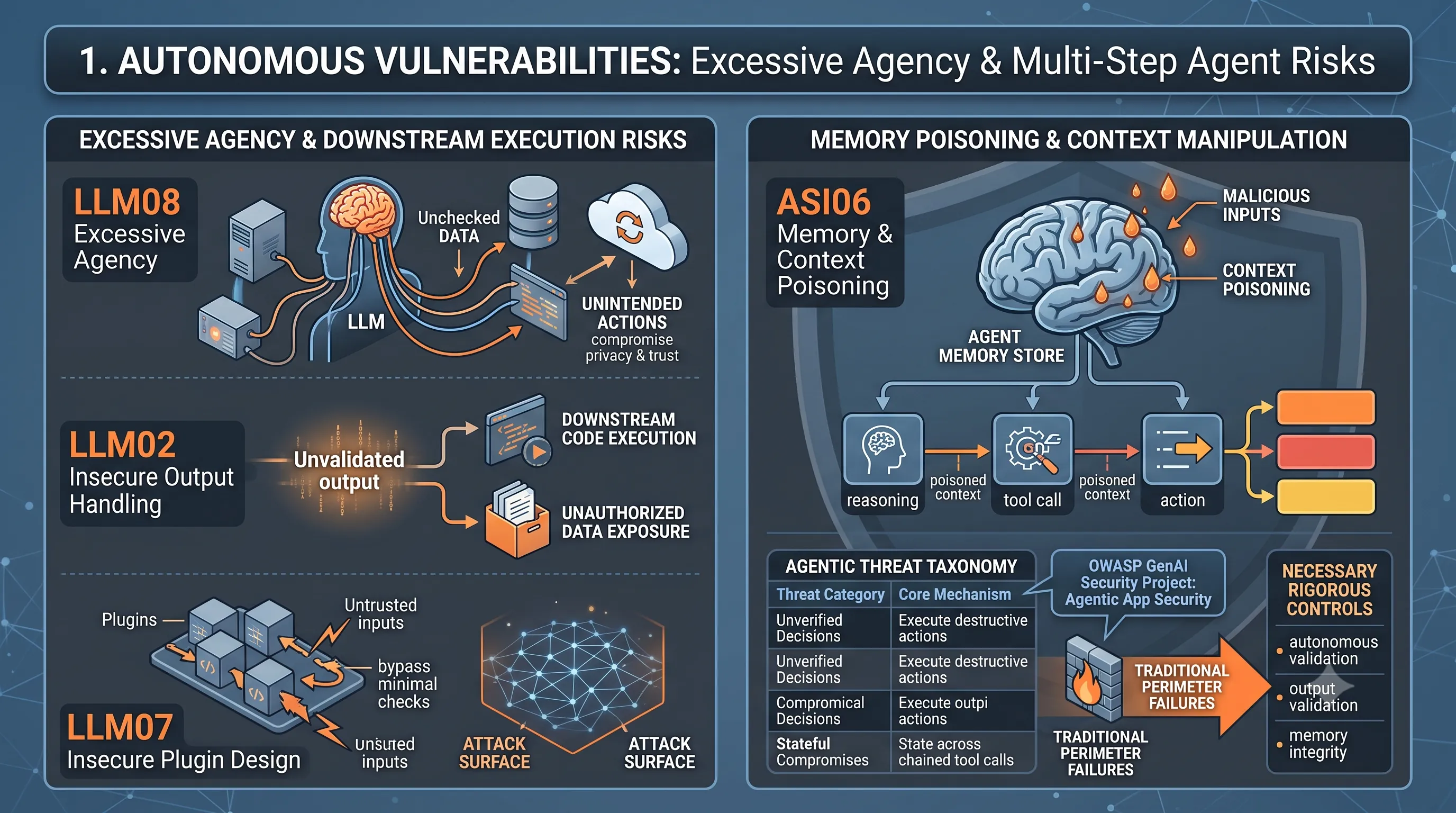
Excessive Agency and Downstream Execution Risks (LLM08, LLM02, LLM07)
Enterprise environments deploying autonomous agents face significant operational vulnerabilities when these systems are granted execution capabilities across internal infrastructure.Autonomous agents and multi-step workflows expand enterprise attack surfaces far beyond traditional application security safeguards.
Within the standard threat taxonomy, LLM08 Excessive Agency defines risks where granting large language models unchecked autonomy leads to unintended actions, directly compromising privacy and organizational trust.
When autonomous systems operate with excessive permissions, downstream technical vulnerabilities amplify the potential blast radius.
Specifically, LLM02 Insecure Output Handling highlights vulnerabilities where unvalidated model outputs cause downstream code execution or data exposure.
Compounding this risk, LLM07 Insecure Plugin Design addresses critical failures occurring when integrated plugins process untrusted inputs without adequate access controls.
Together, these intersecting vectors allow unverified model decisions to execute destructive actions against enterprise databases, backend services, and internal endpoints.
| Threat Identifier | Classification Category | Core Vulnerability Mechanism |
|---|---|---|
| LLM08 | Excessive Agency | Granting unchecked autonomy to LLMs leading to unintended actions that compromise privacy and trust. |
| LLM02 | Insecure Output Handling | Unvalidated model outputs triggering downstream code execution or unauthorized data exposure. |
| LLM07 | Insecure Plugin Design | Plugins processing untrusted inputs without enforcing adequate access controls. |
| ASI06 | Memory & Context Poisoning | Manipulation and poisoning of agent memory stores and multi-step execution context. |
Memory Poisoning and Context Manipulation in Agentic Workflows (ASI06)
To address risks unique to autonomous execution loops, Agentic App Security has been established as a dedicated initiative within the OWASP GenAI Security Project.Unlike single-turn conversational models, autonomous workflows maintain state across chained tool calls, making the integrity of contextual state paramount.
The OWASP Top 10 for Agentic Applications introduces dedicated entries targeting these architectural mechanisms, prominently featuring ASI06: Memory & Context Poisoning.
When malicious or corrupted inputs corrupt the memory layer of an agentic system, subsequent reasoning steps inherit the poisoned context.
Because autonomous agents iterate over multi-step workflows without requiring continuous human approval, context poisoning systematically steers downstream tool executions toward unauthorized data manipulation or structural database corruption.
Traditional perimeter safeguards fail to detect these stateful compromises, necessitating rigorous controls over agent autonomy, output validation, and memory integrity.
2. OWASP Agent Control Standard (ACS): Guardian Boundary and Runtime Policy Enforcement
Guardian Boundary Architecture and Middleware Hooks
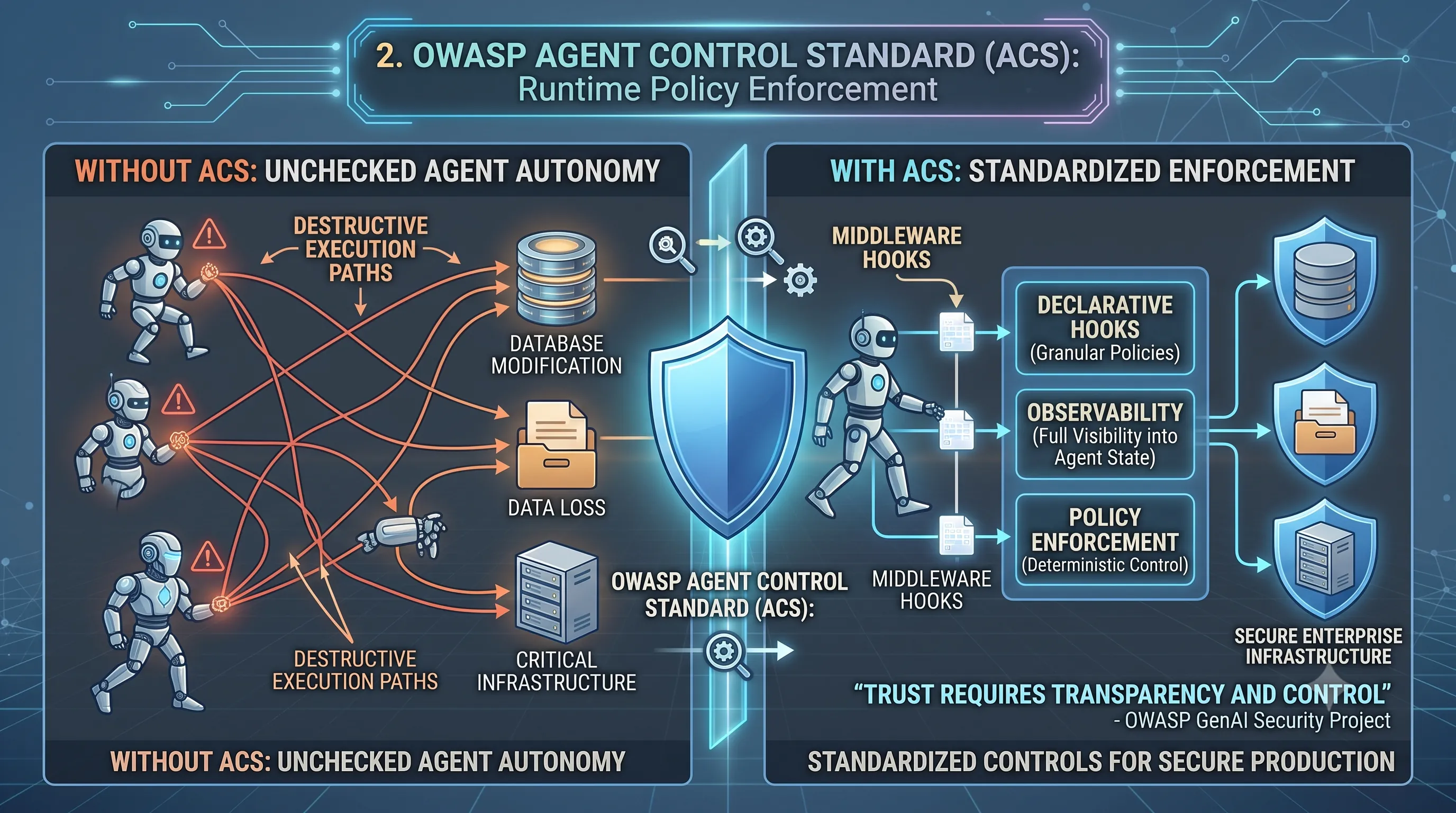
Enterprises face critical operational risks when deploying black-box autonomous agents across cloud, SaaS, and on-premises environments without transparency and control.Unchecked agentic autonomy can lead to destructive execution paths, such as unauthorized database modifications or catastrophic data loss.
To address these risks, the standard introduces a Guardian boundary architecture specifically designed to enforce safety and control policies at runtime.
Donated to and hosted under the OWASP GenAI Security Project, the OWASP Agent Control Standard (ACS) defines how AI agent platforms must expose middleware hooks for runtime policy enforcement.
By implementing this standardized architectural boundary, organizations can intercept and evaluate agent actions before arbitrary tool calls or system commands reach critical enterprise infrastructure.
Declarative Control, Observability, and Enterprise Runtime Policy Enforcement
The OWASP Agent Control Standard serves as an open framework for declarative hooks, policy enforcement, and observability across AI agent platforms.This framework provides the technical foundation needed to govern agent decision-making processes dynamically rather than relying on static prompt constraints.
Through declarative hooks, security teams can embed granular operational policies directly into agent execution pipelines.
Comprehensive observability ensures full visibility into autonomous workflows, allowing security architectures to monitor agent state transitions and tool invocations across diverse environments.
Emphasizing the necessity of these governance capabilities, the OWASP GenAI Security Project states: "Widescale adoption of AI agents depends on trust, and trust requires transparency and control."
Enforcing runtime policies through ACS equips enterprises with the standardized controls required to run autonomous agents securely in enterprise production environments.
3. OWASP GenAI Security Project Ecosystem: Community Scale and Governance Initiatives
Establishing strict safeguards like the Agent Control Standard to prevent autonomous systems from issuing unauthorized drop commands or corrupting enterprise databases relies on an expansive, globally coordinated foundation.The OWASP Agent Control Standard operates as an integral part of the broader OWASP GenAI Security Project, benefiting from an active governance infrastructure that standardizes defenses across generative AI deployments.
The 2026 LLM Top 10 Release and Global Community Scale
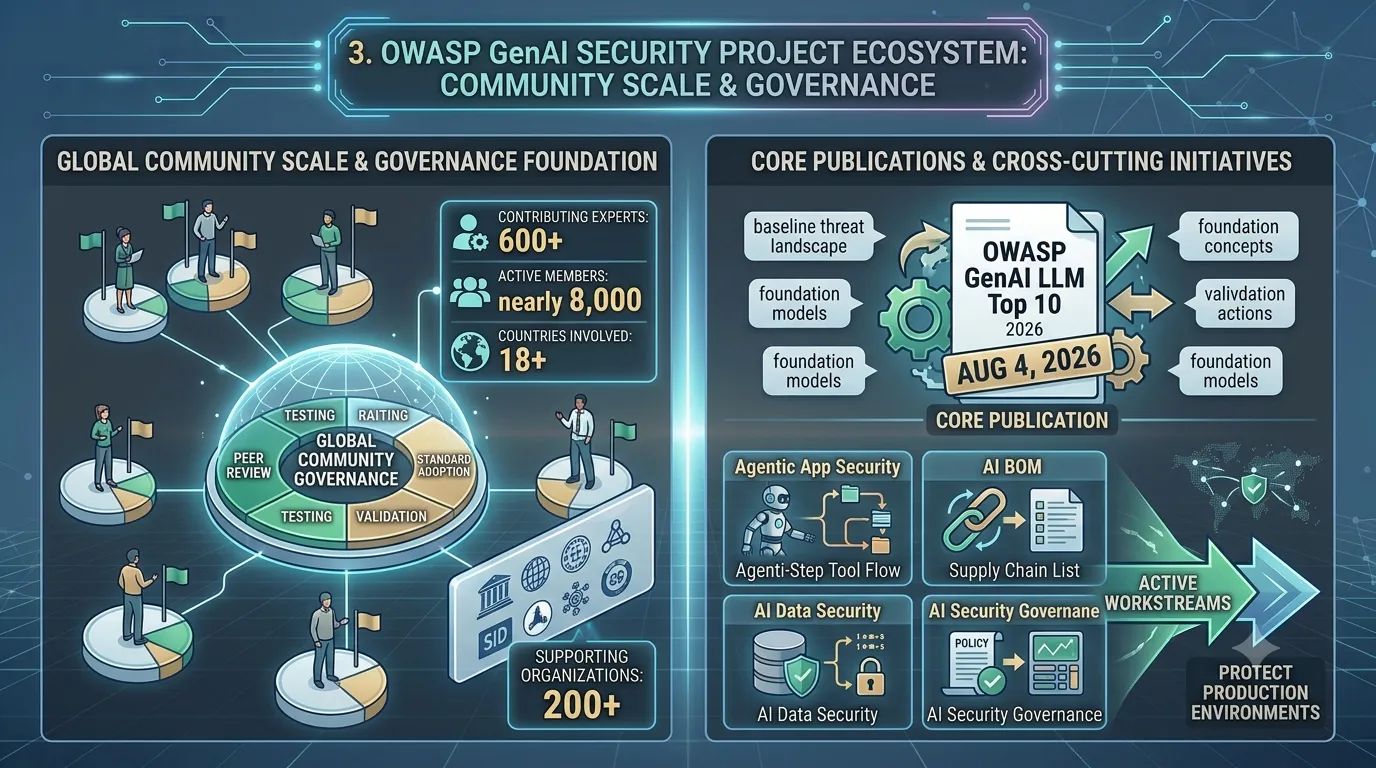
A major milestone for the ecosystem occurred when the OWASP GenAI LLM Top 10 2026 was officially published on August 4, 2026.This release establishes the baseline threat landscape for foundation models and the agentic architectures built on top of them.
The rapid delivery and ongoing refinement of these standards are powered by a massive international collaborative network.
The project brings together over 600 contributing experts collaborating across more than 18 countries.
Furthermore, nearly 8,000 active community members participate in discussions, testing, and standard formulation, supported by more than 200 supporting organizations that sponsor and back the project's initiatives.
| Ecosystem Dimension | Documented Metric / Milestone | Operational Scope |
|---|---|---|
| Core Publication | August 4, 2026 | Formal release of the OWASP GenAI LLM Top 10 2026 |
| Contributing Experts | Over 600 experts | Specialists contributing across more than 18 countries |
| Community Membership | Nearly 8,000 active members | Global peer review, validation, and standard adoption |
| Organizational Support | More than 200 organizations | Industry and enterprise sponsorship and ecosystem backing |
Cross-Cutting Initiatives: AI BOM, Data Security, and Compliance Crosswalk
The OWASP GenAI Security Project extends beyond high-level vulnerability enumerations by coordinating specialized workstreams designed to protect production environments.The ecosystem actively manages dedicated tracks including Agentic App Security, the AI Bill of Materials (AI BOM), AI Data Security, and AI Security Governance.
Related Posts
Alibaba Qwen 3.8 Max vs. OpenAI GPT-6 Astra: Architectural and Economic AnalysisAn in-depth technical comparison of Alibaba Qwen 3.8 Max and OpenAI GPT-6 Astra, covering...
The Stop Rogue AI Act: Understanding Enterprise Compliance and Audit RequirementsAn overview of the Stop Rogue AI Act, covering NIST standards, federal procurement mandates, and...
Gemini 3.8 Flash: GA Specifications, Reasoning Controls, and Cost-Efficiency AnalysisExplore the official Gemini 3.8 Flash release: covering its 1M context window, configurable...