
Adobe Enterprise Generative AI: IP Indemnification, C2PA Provenance, and Timeline Workflows
🚀 Key Takeaways
- Contractual IP Indemnification: Adobe absorbs legal liabilities by contractually defending enterprise customers against copyright, trademark, and privacy infringement claims on eligible Firefly outputs.
- Automated Compliance via Content Credentials: Built-in C2PA metadata transparently tracks AI provenance across all asset exports, satisfying advertising standards without manual logging.
- Native Creative Cloud Timeline Integration: Direct integration within Premiere Pro and After Effects accelerates video workflows, enabling instant B-roll generation directly on editing timelines.
- Brand-Safe Customization at Scale: Enterprises can train private Custom Brand Models on proprietary assets while preserving core IP protections and prompt-level governance.
- Commercial Viability Over Raw Novelty: While competing models focus heavily on unrestricted artistic generation, Adobe prioritizes the legal certainty and workflow cohesion required for corporate production.
While generative AI has unlocked unprecedented speed in conceptual design, corporate legal departments have long treated public generative models as an intellectual property minefield.
The fear of copyright infringement lawsuits and unverified training datasets has forced many Fortune 500 brands to restrict synthetic media to internal storyboards, preventing modern marketing teams from realizing the full return on investment promised by automated video pipelines.
Adobe altered this corporate calculus by turning legal liability into a core product feature.
By coupling commercially safe training datasets with explicit, contractual IP indemnification and verifiable digital provenance, Adobe has enabled enterprise marketing teams to deploy AI-generated assets into commercial broadcast and digital ad workflows with absolute legal confidence.

1. Contractual IP Indemnification: Shielding Enterprise Workflows from Legal Liabilities
Contractual Scope and Liability Absorption Terms
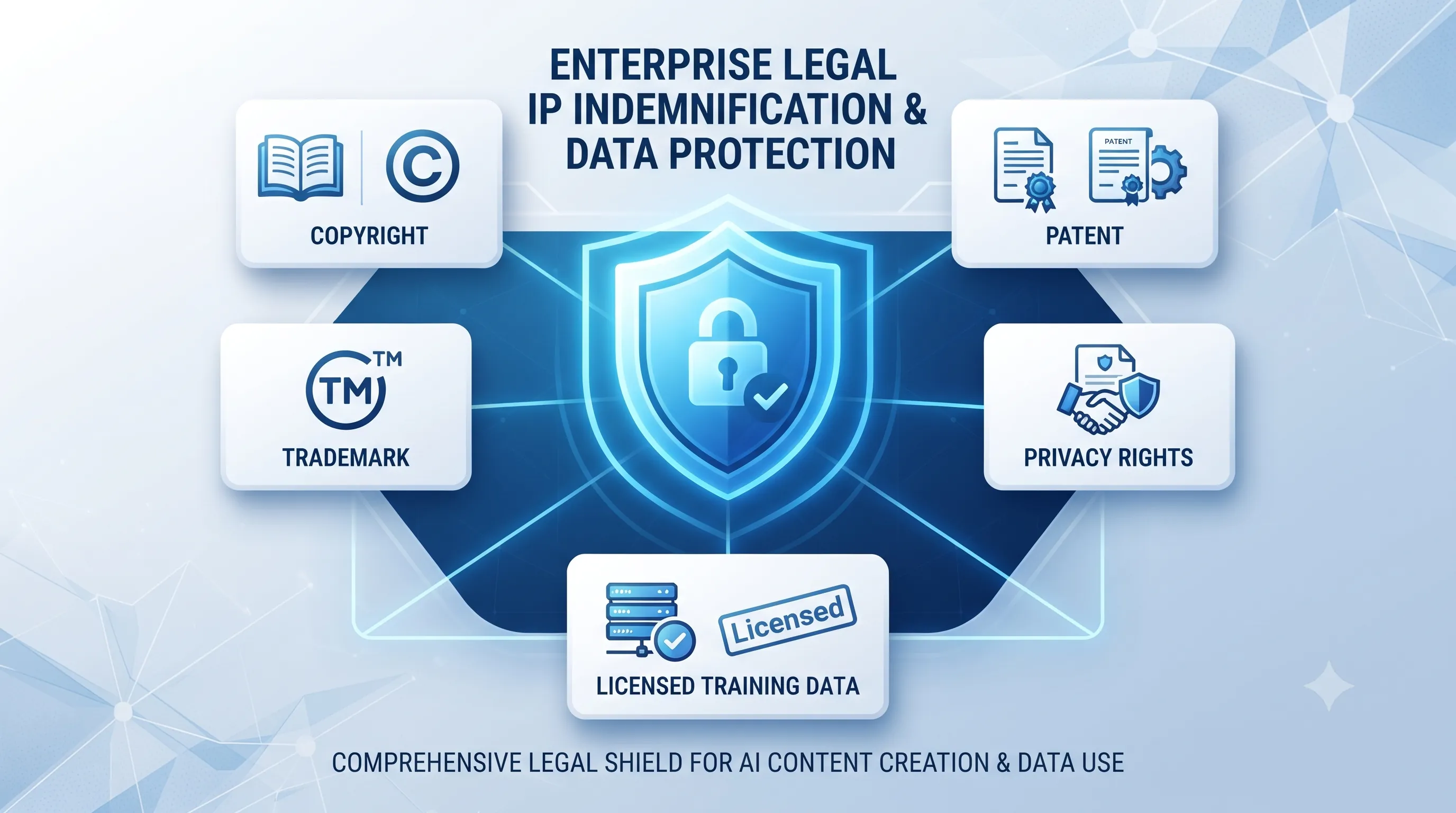
Enterprise adoption of generative media requires commercial security and absolute protection against intellectual property exposure.To resolve corporate risk around generated commercial assets, Adobe provides contractual intellectual property indemnification for enterprise customers using eligible Firefly-powered workflows.
Under these agreements, Adobe absorbs legal liability for copyright infringement claims arising directly from generated content.
This legal shield addresses five core legal dimensions rather than limiting coverage to standard asset disputes.
As formalized in contractual terms, "The Adobe indemnity will cover claims that allege that the Firefly output directly infringes or violates any third party's patent, copyright, trademark, publicity rights or privacy rights."
By assuming the burden of defense and liability across patent, copyright, trademark, publicity, and privacy challenges, the platform removes legal hesitation for enterprise scale.
Licensed Training Data Hygiene and Enterprise Data Exclusion
Adobe's contractual willingness to assume financial and legal liability stems directly from the curation of its underlying model.Training data consists exclusively of licensed Adobe Stock content, openly licensed material, and public domain assets.
This closed, auditable training ecosystem guarantees that foundational model weights are not trained on scraped or unverified third-party web content.
In tandem with clean data ingestion, customer corporate assets are strictly sequestered.
Adobe excludes enterprise customer content from general generative AI training datasets.
Proprietary assets, brand identity materials, and confidential workflows uploaded by enterprise users are entirely isolated and never repurposed to train shared models.
Qualifying Plan Constraints and Feature Limitations
Enterprise risk mitigation remains contingent upon strict operational adherence to governing commercial agreements.Indemnification protections apply specifically to eligible features, surfaces, and qualifying plans under contractual terms.
Legal shielding is not an unconstrained warranty across unauthorized workflows, unverified tiers, or experimental deployments.
To retain active indemnity enforcement, commercial organizations must operate strictly within the bounds of contracted surfaces and approved generative capabilities defined in their enterprise agreements.
2. Automated Content Credentials: C2PA Metadata Governance and Compliance Auditing
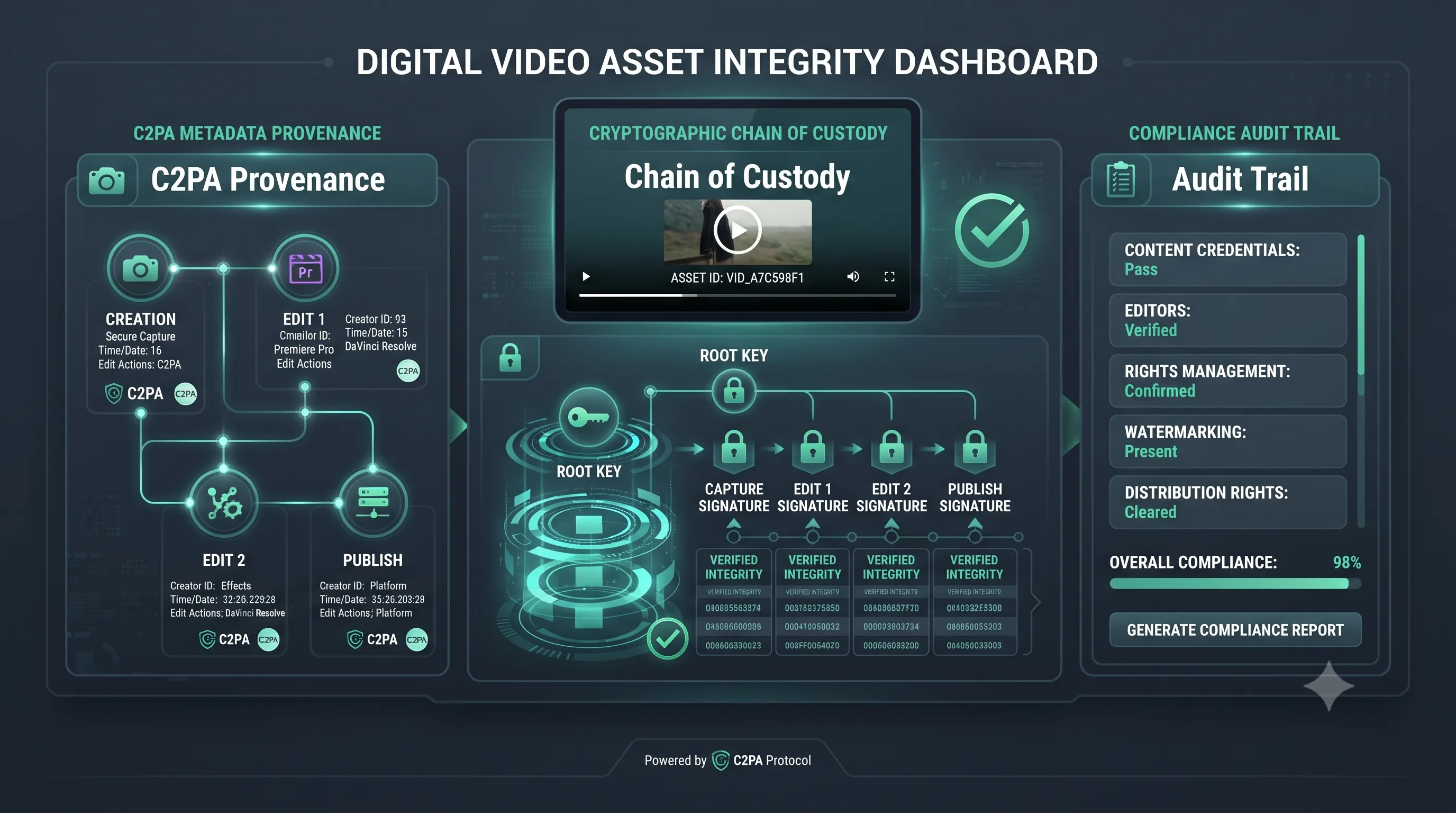
Directly supporting enterprise IP indemnification safeguards and high-volume video advertising ROI, automated metadata infrastructure establishes the cryptographic chain of custody required for complete commercial transparency.Automated C2PA Provenance Integration at Export
Verifiable Content Credentials digital provenance records are automatically embedded into Firefly-generated assets.Rather than introducing administrative friction into the creative production pipeline, C2PA metadata is automatically attached upon exporting or downloading qualifying Firefly assets.
This automated attachment permanently links cryptographic provenance details to the output file, establishing an unalterable history of the asset's creation directly at the point of origin.
Fulfilling Advertising Standards and Regulatory Audit Trails
Embedded metadata documents the use of AI in content generation to satisfy strict advertising standards and regulatory compliance.This continuous audit trail documentation eliminates manual metadata management for regulated corporate governance.
Enterprises operating across commercial publishing environments can reliably satisfy disclosure mandates, ensuring that generative visual assets adhere to transparency rules without imposing administrative workloads on creative staff.
Tooling Requirements for Downstream Verification
Despite the seamless generation of provenance records upon file export, platform dependencies remain a key consideration for audit workflows.Reading and verification require compatible software and platform tools capable of parsing C2PA metadata standards.
Downstream stakeholders and compliance auditors must maintain inspection environments with compatible viewing utilities to validate the authenticity and AI attribution markers embedded within the media.
3. Timeline-Native Video Workflows: Generative Media Tools in Premiere Pro and After Effects
Integrating generative AI directly into creative suites addresses critical bottlenecks in commercial video production, reinforcing enterprise IP protection while accelerating video advertising ROI.Rather than toggling between disconnected web interfaces, video editors require native tools embedded directly within their non-linear editing environments.
Generative Media Tool Execution in Premiere Pro and After Effects
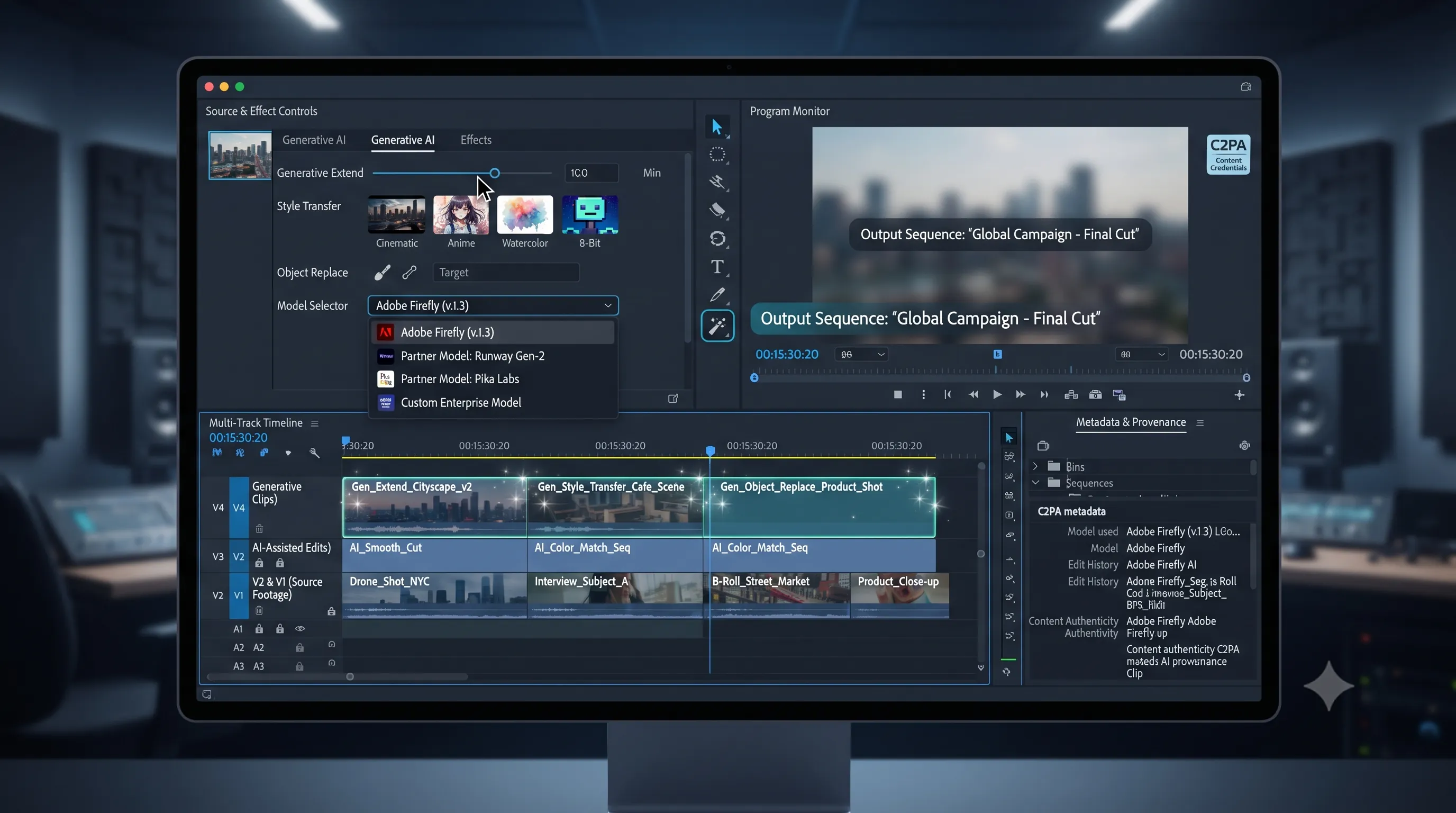
Adobe released the Generative Media Tool in Premiere Pro and After Effects in September 2026.This feature allows video editors to generate video clips, B-roll, and VFX frames directly inside Premiere Pro and After Effects timelines.
By eliminating the need to export footage across external platforms, creative teams can iterate on video ad variations directly on the timeline.
Generating timeline B-roll and VFX frames in place optimizes turnaround times and directly enhances commercial project velocity.
Mid-2026 On-Device Photoshop Acceleration and Local Privacy
Complementing video timeline capabilities, on-device AI model processing was introduced in Photoshop in mid-2026.This on-device processing allows generative tasks to execute locally without third-party cloud data transfer.
Photoshop incorporates native Generative Fill, Generative Expand, and AI selection tools maintaining commercial safety properties.
Enterprise teams handling sensitive pre-release marketing assets can apply generative edits without exposing source imagery to external networks.
Multi-Model Partner Orchestration vs. Native Indemnity Terms
Timeline integration supports native Firefly models alongside third-party partner models including Kling, Runway, Veo, and Luma.This multi-model support gives editors the flexibility to choose specific generative engines directly within Premiere Pro and After Effects.
However, enterprise legal safety remains bounded by governance distinctions.
Third-party partner models operate alongside Firefly but differ in base indemnification terms.
While native Firefly generation carries Adobe's complete commercial IP indemnification, partner models adhere to their respective terms, requiring enterprises to establish clear policy boundaries during video asset generation.
| Tool / Model Integration | Timeline & Workflow Features | Deployment Location | Indemnification & Commercial Safety Status |
|---|---|---|---|
| Native Firefly (Generative Media Tool) | Generates video clips, B-roll, and VFX frames directly inside Premiere Pro and After Effects timelines | Timeline-native integration | Covered under native Firefly commercial indemnification protections |
| Third-Party Partner Models (Kling, Runway, Veo, Luma) | Multi-model generation of video assets within the editing timeline alongside Firefly | Timeline-integrated partner models | Differs in base indemnification terms from native Firefly models |
| Photoshop Generative Tools | Native Generative Fill, Generative Expand, and AI selection tools | On-device local processing without third-party cloud data transfer | Maintains core commercial safety properties locally |
4. Custom Brand Models and GenStudio: Automated Scale for High-ROI Campaigns
Fine-Tuning Proprietary Styles with Inherited Legal Indemnity
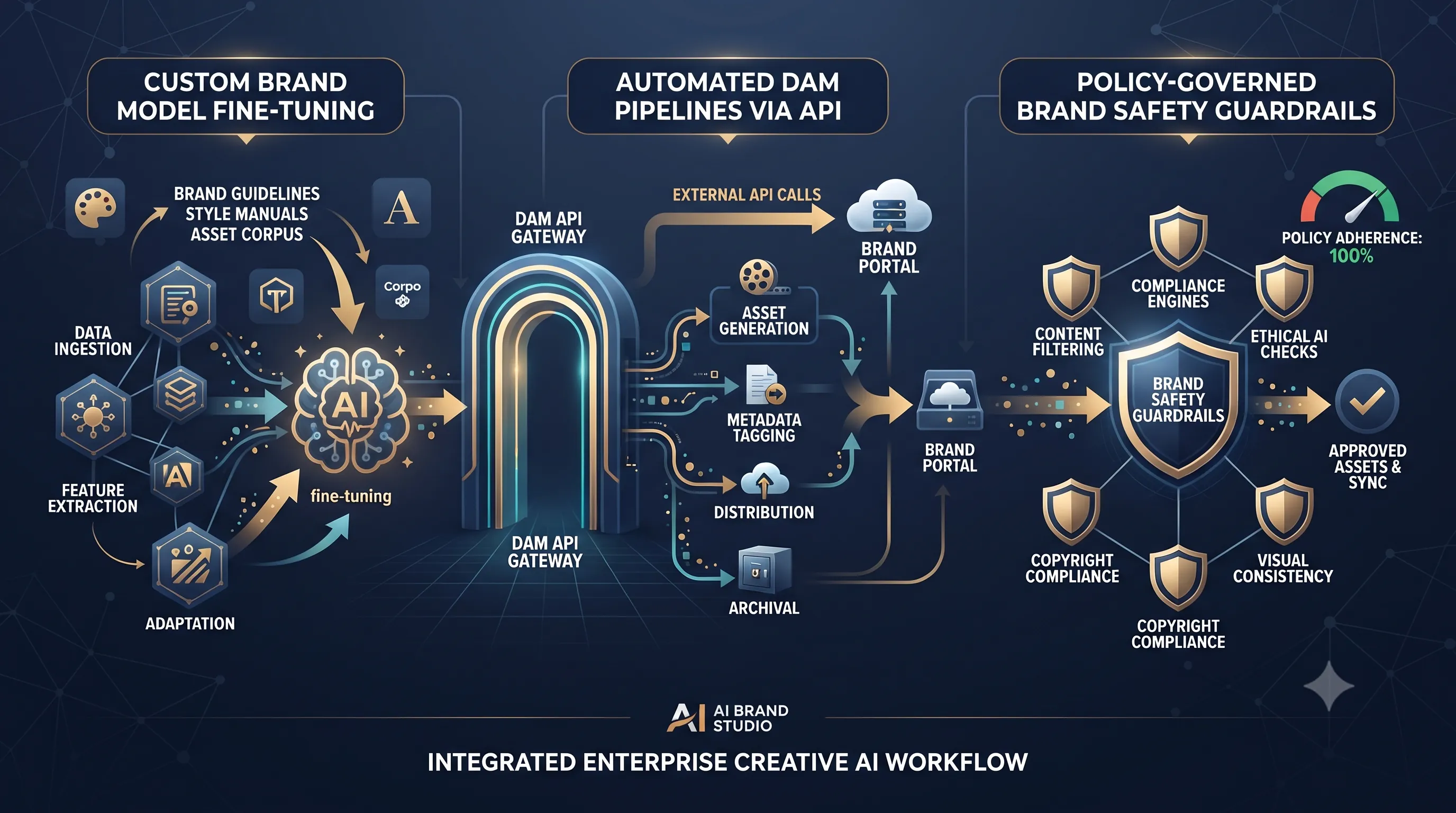
Enterprises can fine-tune private Custom Brand Models on proprietary brand photography, visual styles, and color palettes.Crucially, custom fine-tuning data is restricted solely to the customer providing the training assets, preventing confidential creative IP from being exposed or shared across accounts.
Even as these specialized models conform to distinct visual identities, Custom Brand Models retain base model IP indemnification and Content Credentials protections, providing complete legal shielding and provenance tracking for enterprise outputs.
Firefly Services API for Programmatic Asset Scaling and DAM Pipelines
Large-scale campaign deployment moves beyond manual interfaces through the Firefly Services API.The Firefly Services API supports automated batch generation, format adaptations, and localization pipelines integrated directly with digital asset management (DAM) platforms.
This automated connectivity enables organizations to produce localized and multi-format variants programmatically while pulling from and delivering directly back to centralized enterprise DAM repositories.
GenStudio Campaign Governance and Policy-Enforced Prompt Guardrails
Scaling campaign generation requires strict compliance controls alongside production speed.Adobe GenStudio links Firefly generation with content planning, approval tracking, and performance analytics into a centralized operational pipeline.
To maintain standard brand safety, policy-governed generation enforces brand guidelines and blocks non-compliant prompt inputs directly at the generation layer before rendering occurs.
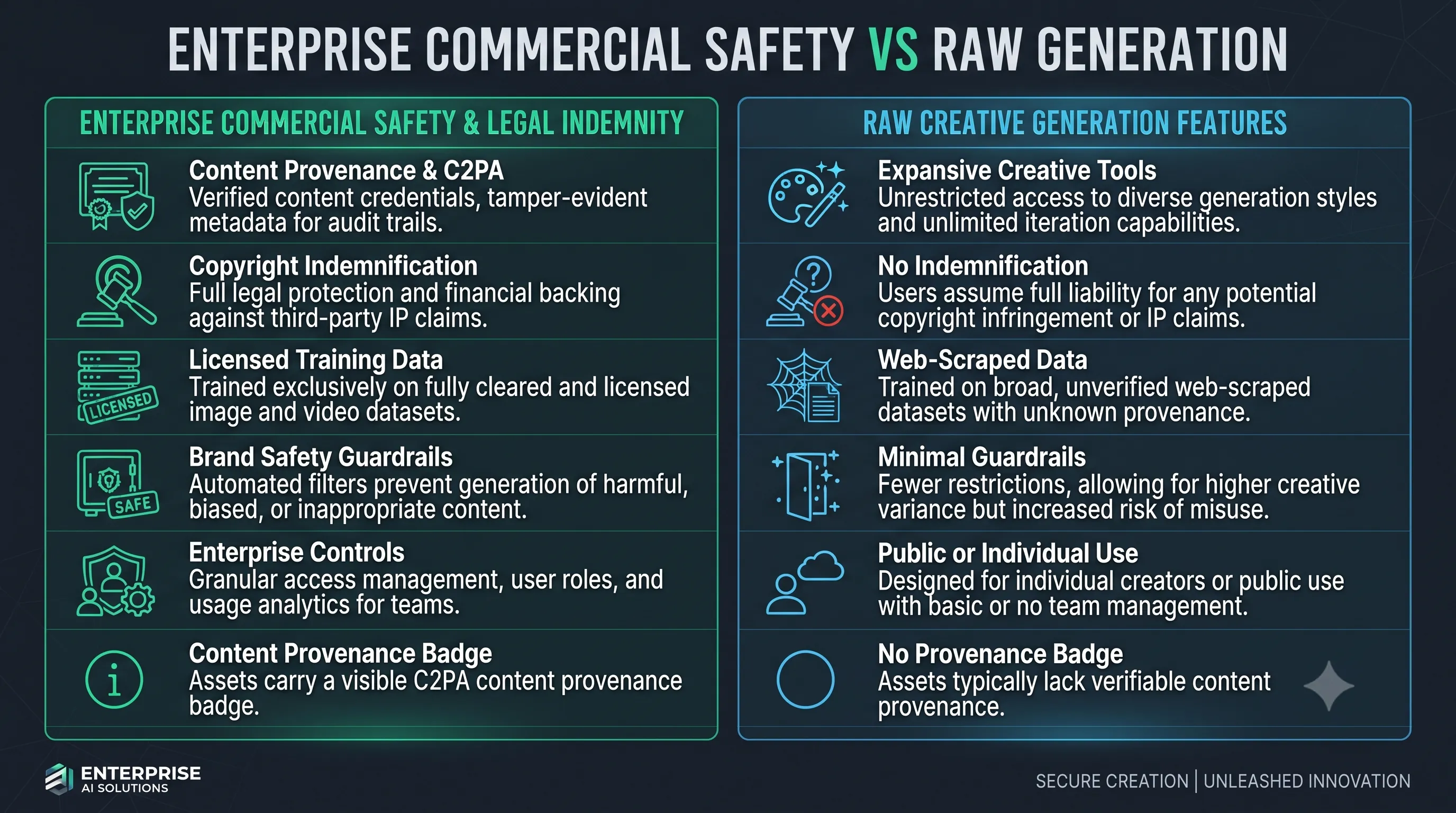
5. Enterprise Commercial Safety vs. Raw Generation in Production Ecosystems
This analysis evaluates how enterprise risk management dictates generative production pipelines, directly connecting to the overarching imperative of vendor-backed intellectual property indemnification and corporate legal protection.While competing frontier models push raw visual fidelity, commercial deployment hinges entirely on legal certainty and pipeline readiness.
Commercial Safety vs. Raw Aesthetic Quality
The current generative image landscape offers distinct artistic and computational trade-offs across market alternatives.Midjourney provides profound cinematic aesthetic depth.
Nano Banana Pro leads in technical photorealism and prompt adherence designed for commercial photography.
ChatGPT Images delivers conversational prompt iteration alongside advanced text rendering capabilities.
Stable Diffusion supports open-source custom model training and flexible local hosting architectures.
However, Adobe Firefly focuses on commercial safety and compliance rather than leading in raw artistic quality or competitive aesthetic benchmarks.
For corporate enterprises, unvetted training baselines present unquantified legal exposures that artistic rendering capabilities cannot offset.
Workflow Integration Deficits in External Models
Frontier visual quality frequently encounters operational roadblocks when deployed into established enterprise workflows.Midjourney lacks commercial IP indemnification and lacks native Creative Cloud workflow integration.
ChatGPT Images lacks enterprise IP indemnity and does not offer Content Credentials for digital provenance.
Stable Diffusion does not provide vendor IP indemnification despite its local hosting flexibility.
These external solutions operate outside the connected ecosystem, creating friction between asset generation and downstream production pipelines.
| Platform | Core Technical Strengths | Enterprise IP Indemnification | Creative Cloud Workflow Integration | Digital Provenance (Content Credentials) |
|---|---|---|---|---|
| Adobe Firefly | Commercial safety and compliance focus | Vendor-backed indemnification provided | Native Creative Cloud workflow integration | Content Credentials supported |
| Midjourney | Cinematic aesthetic depth | Lacks commercial IP indemnification | Lacks native integration | Not supported |
| Nano Banana Pro | Technical photorealism and prompt adherence for commercial photography | Lacks commercial IP indemnification | Lacks native integration | Not supported |
| ChatGPT Images | Conversational prompt iteration and text rendering | Lacks enterprise IP indemnity | Lacks native integration | Lacks Content Credentials |
| Stable Diffusion | Open-source custom model training and local hosting | Does not provide vendor IP indemnification | Lacks native integration | Not vendor-backed |
Risk Mitigation as the Key Enterprise Driver
Enterprise procurement decisions diverge sharply from consumer or freelance creative preferences.While Midjourney and Nano Banana Pro lead on raw creative quality, Firefly leads on the dimension that matters most for enterprise adoption: the confidence that generated content can be used commercially without legal exposure.
By prioritizing verifiable audit trails, integrated Content Credentials, and vendor-assumed liability over unconstrained generation, enterprise creative operations maintain predictable legal standing across production campaigns.
References
Related Posts

Adobe's Living PDF Revolution: AI-Powered Interactive Documents, Experience Sharing & Enhanced Security InsightsAdobe is transforming static PDFs into dynamic, AI-powered digital experience platforms , enabling...

Adobe's AI-Powered Editing Features: Redefining the Creative LandscapeAdobe's latest AI-powered features mark a pivotal shift from merely enhancing speed to cultivating...
How Nemotron 3.5 Parse Accelerates Vision-Language Document ExtractionDiscover how NVIDIA's Nemotron 3.5 Parse boosts inference speed and document extraction efficiency...
Generative AI may have assisted with research or drafting for this article. Topic selection, fact-checking, final wording, and publication remain the responsibility of DragonStone74. AI use disclosure