
South Korea's National AI Computing Center Breaks Ground in Haenam Solasido: Powering 2.5 Trillion Won Hyper-scale AI & Domestic Semiconductor Hub
🚀 Key Takeaways
- The National AI Computing Center, also known as the National AI Highway, has officially begun construction.
- This landmark project represents a major national initiative to build a hyper-scale AI data center.
- The center's groundbreaking ceremony was held on August 3, 2026, at Haenam Solasido Data Center Park.
- It aims to expand the foundation for hyper-scale AI development and foster the domestic AI semiconductor ecosystem.
- High-performance computing resources will be made accessible to startups, SMEs, universities, and research institutions.
- The center's construction and operation are managed by KOACC, a public-private joint venture.
- The project is led by the Samsung SDS consortium and is expected to transform Haenam Solasido into a national AI and renewable energy hub.
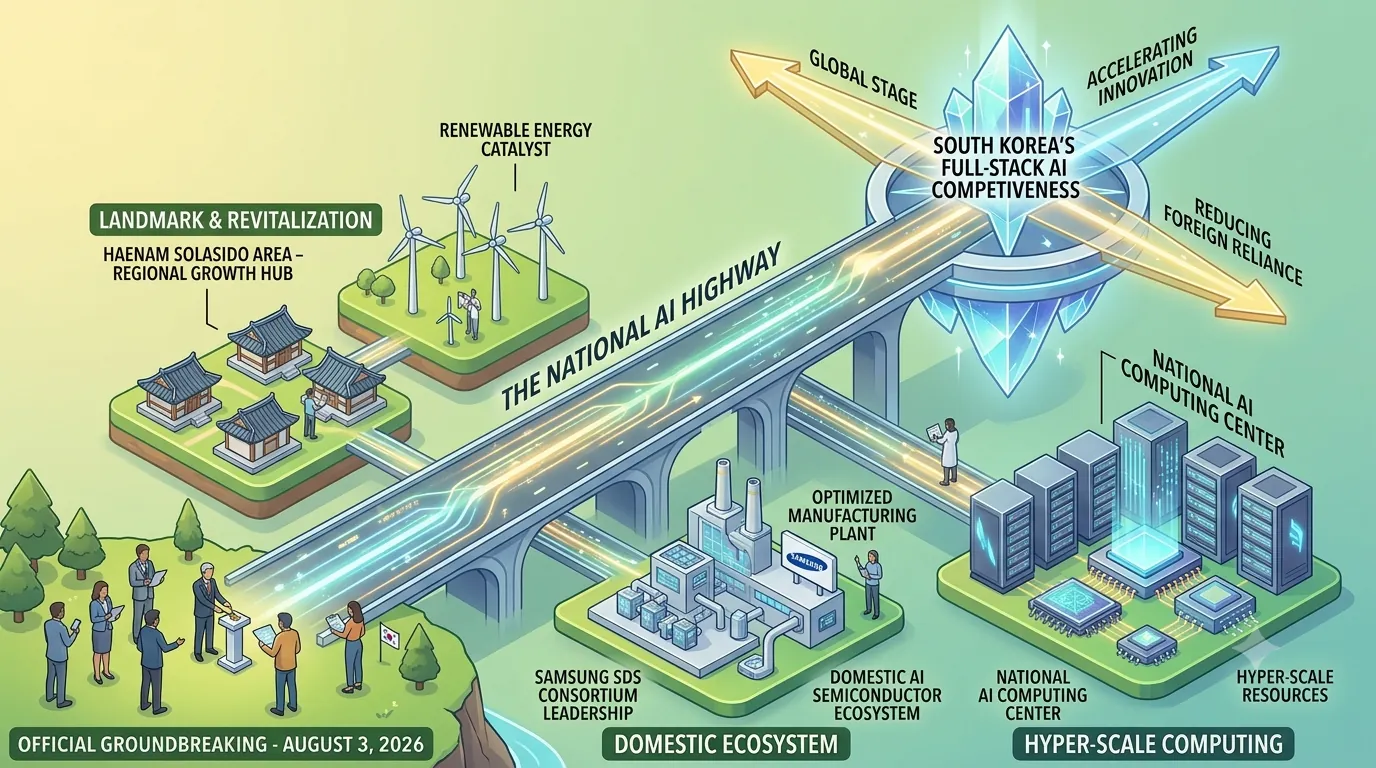
On August 3, 2026, South Korea marked a pivotal moment in its technological advancement with the official groundbreaking of the National AI Computing Center at Haenam Solasido Data Center Park.
This ambitious initiative, often dubbed the National AI Highway, is set to become a cornerstone of the nation's artificial intelligence infrastructure, aiming to catapult Korea's AI capabilities onto the global stage.
With a substantial investment and the leadership of a consortium headed by Samsung SDS, this center is designed to provide hyper-scale computing resources crucial for the next generation of AI development.
It underscores the government's commitment to fostering a robust domestic AI semiconductor ecosystem and ensuring widespread access to advanced computing for various sectors.
More than just a data center, the project is envisioned as a catalyst for regional growth, revitalizing the Haenam Solasido area into a key national hub for both AI and renewable energy.
Its successful establishment is expected to significantly bolster South Korea's full-stack AI competitiveness, reducing reliance on foreign technologies and accelerating innovation across industries.
This ambitious initiative, often dubbed the National AI Highway, is set to become a cornerstone of the nation's artificial intelligence infrastructure, aiming to catapult Korea's AI capabilities onto the global stage.
With a substantial investment and the leadership of a consortium headed by Samsung SDS, this center is designed to provide hyper-scale computing resources crucial for the next generation of AI development.
It underscores the government's commitment to fostering a robust domestic AI semiconductor ecosystem and ensuring widespread access to advanced computing for various sectors.
More than just a data center, the project is envisioned as a catalyst for regional growth, revitalizing the Haenam Solasido area into a key national hub for both AI and renewable energy.
Its successful establishment is expected to significantly bolster South Korea's full-stack AI competitiveness, reducing reliance on foreign technologies and accelerating innovation across industries.
1. National AI Computing Center: A Strategic Overview
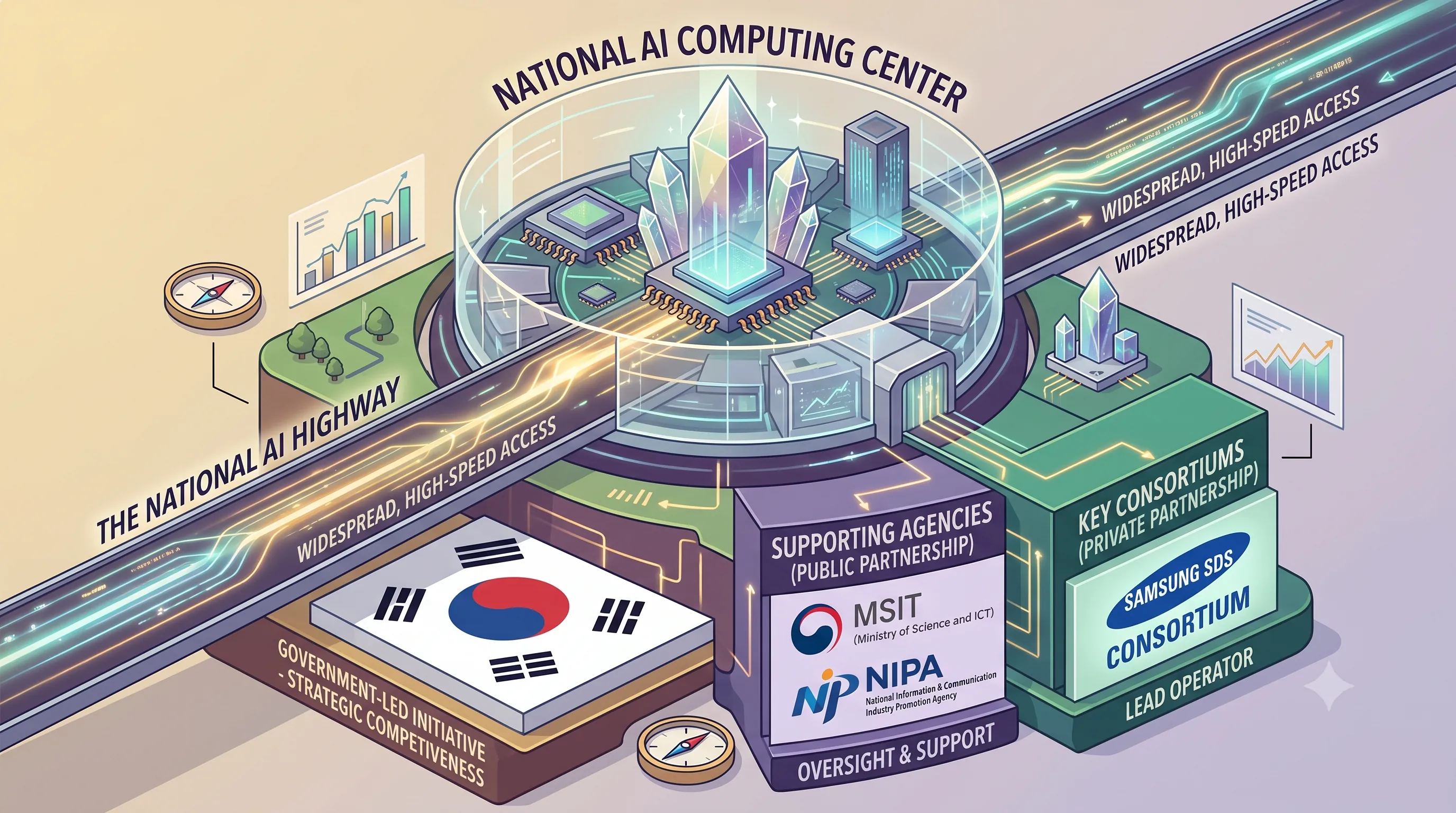
This section provides a foundational overview of the National AI Computing Center project, detailing its official identity, its role as a government-led initiative, and the key public and private entities driving its development, directly connecting to the recent groundbreaking in Haenam's Solasido complex.Defining the 'National AI Highway'
The formal identity of this landmark project is the 'National AI Computing Center'.Beyond its official name, the initiative is also widely referred to as the 'National AI Highway', a moniker that emphasizes its purpose of providing widespread, high-speed access to critical AI computational resources across the country.
Government's Vision for AI Infrastructure
The establishment of this center is not a standalone effort but a key component of a broader national strategy.It is officially designated as a key AI infrastructure initiative actively promoted by the South Korean government, signaling its strategic importance for national competitiveness in the global artificial intelligence landscape.
Key Consortiums and Supporting Agencies
The execution of this large-scale project is led by a private-sector entity, the Samsung SDS consortium, which serves as the lead operator for the initiative.This endeavor is a public-private partnership, advanced in close collaboration with key government bodies, including the Ministry of Science and ICT (MSIT) and the National Information and Communication Industry Promotion Agency (NIPA), which provide oversight and support.
2. Key Project Milestones: From Bid to Groundbreaking
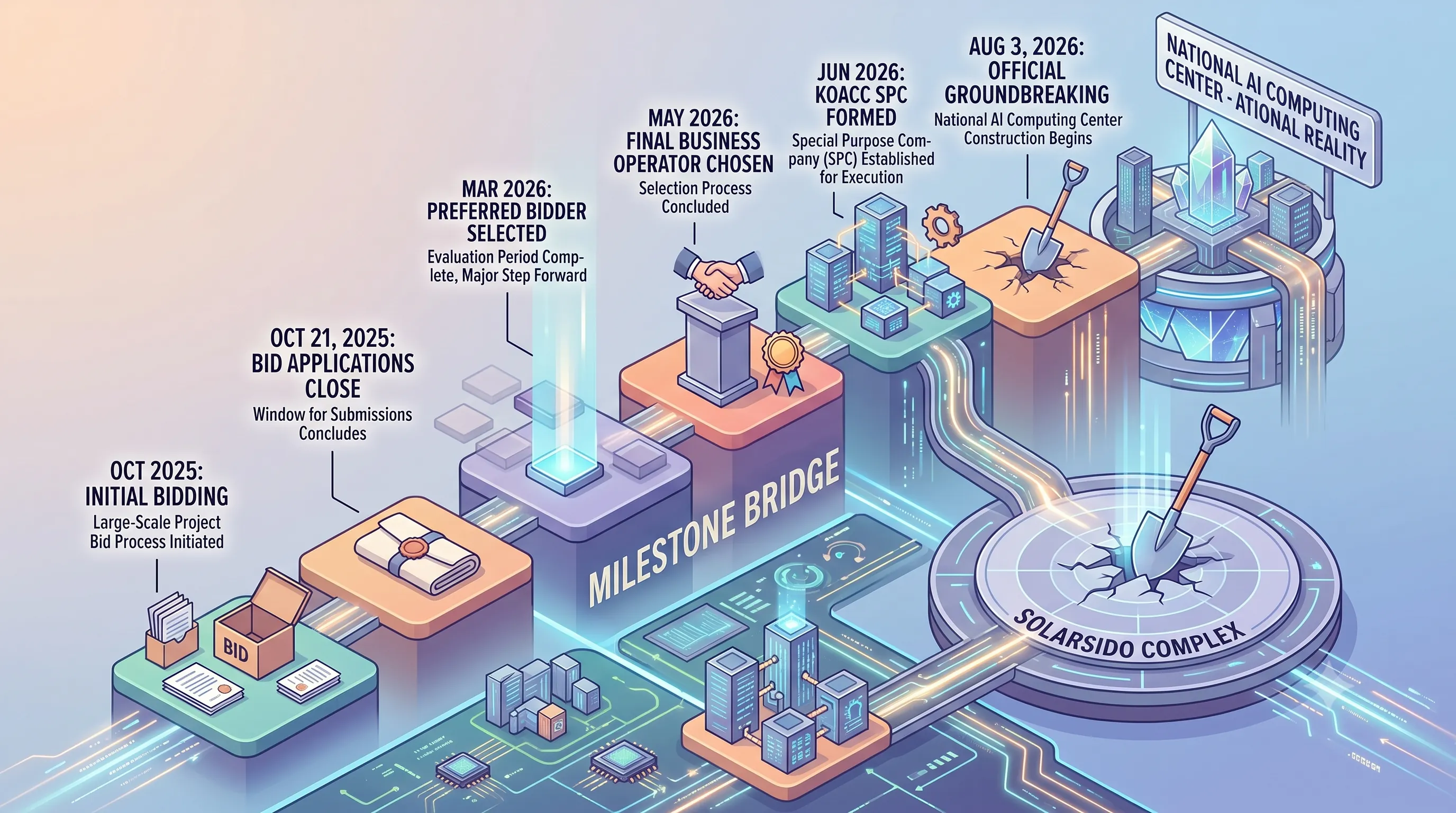
The groundbreaking ceremony for the 2.5 trillion won National AI Computing Center on August 3, 2026, marked the culmination of a nearly year-long process, transforming the ambitious project from a proposal into a tangible reality.This timeline charts the key stages, from the initial competitive bidding to the official commencement of construction.
Initial Bidding and Selection Phases
The journey to construction began in earnest during the latter half of 2025.The formal bid process for this large-scale national project was initiated in October 2025, drawing significant industry interest.
The window for submissions was brief, with bid applications officially closing on October 21, 2025.
Following a thorough evaluation period, a preferred bidder was selected in March 2026, signaling a major step forward in narrowing down the partnership for the center's development.
The selection process concluded two months later, with the final business operator being officially chosen in May 2026.
Formation of KOACC and Official Commencement
With the primary operator selected, the project moved into its corporate and physical establishment phases.In June 2026, the dedicated Special Purpose Company (SPC) named KOACC was formally established to manage and execute the project.
This organizational milestone paved the way for the project to break ground.
The official groundbreaking ceremony for the National AI Computing Center was held on August 3, 2026, in Haenam's Solarsido complex.
On that same day, construction on the state-of-the-art facility officially began, kicking off the next phase of this critical national infrastructure initiative.
3. Project Scale and Technical Specifications
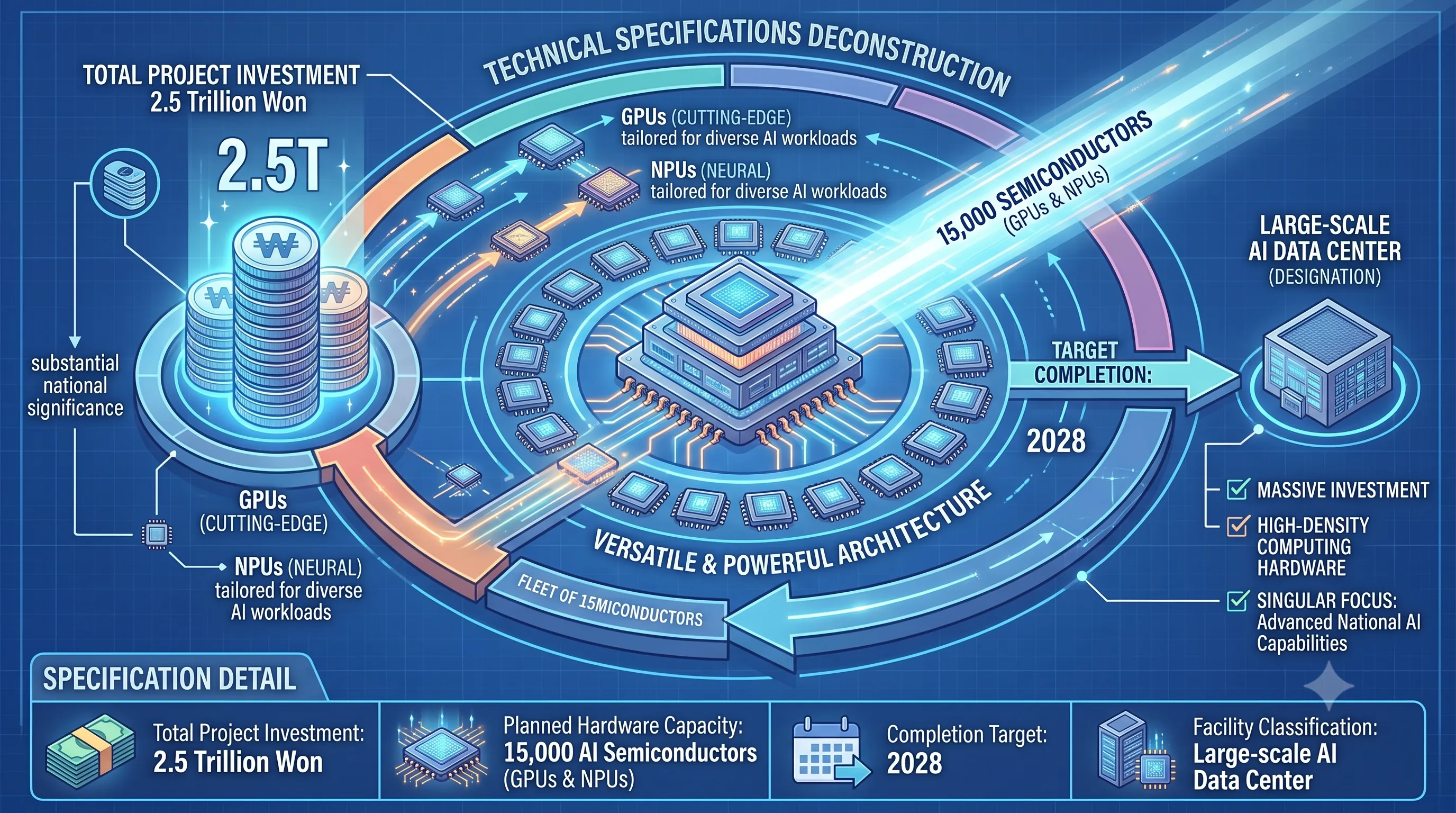
This section deconstructs the key figures and technical ambitions that define the National AI Computing Center project, providing a detailed look at the numbers behind the 2.5 trillion won groundbreaking announcement in Haenam Solasido.Investment and Hardware Capacity
The project is backed by a substantial total investment of 2.5 trillion won, a figure that underscores its national significance and the comprehensive infrastructure planned.At its core, the center's computational power will be driven by an impressive array of 15,000 AI semiconductors.
This hardware fleet is specified to include a mix of cutting-edge Graphics Processing Units (GPUs) and Neural Processing Units (NPUs), ensuring a versatile and powerful architecture tailored for diverse AI workloads.
| Specification | Detail |
|---|---|
| Total Project Investment | 2.5 trillion won |
| Planned Hardware Capacity | 15,000 AI semiconductors (including GPUs and NPUs) |
| Completion Target | 2028 |
| Facility Classification | Large-scale AI data center |
Target Completion and Overall Scale
The strategic timeline for this ambitious undertaking sets a target completion year of 2028.Upon its completion, the facility is classified as a large-scale AI data center, a designation justified by its massive investment, high-density computing hardware, and singular focus on advancing national artificial intelligence capabilities.
4. Financial Backing and Operational Structure: The KOACC Model
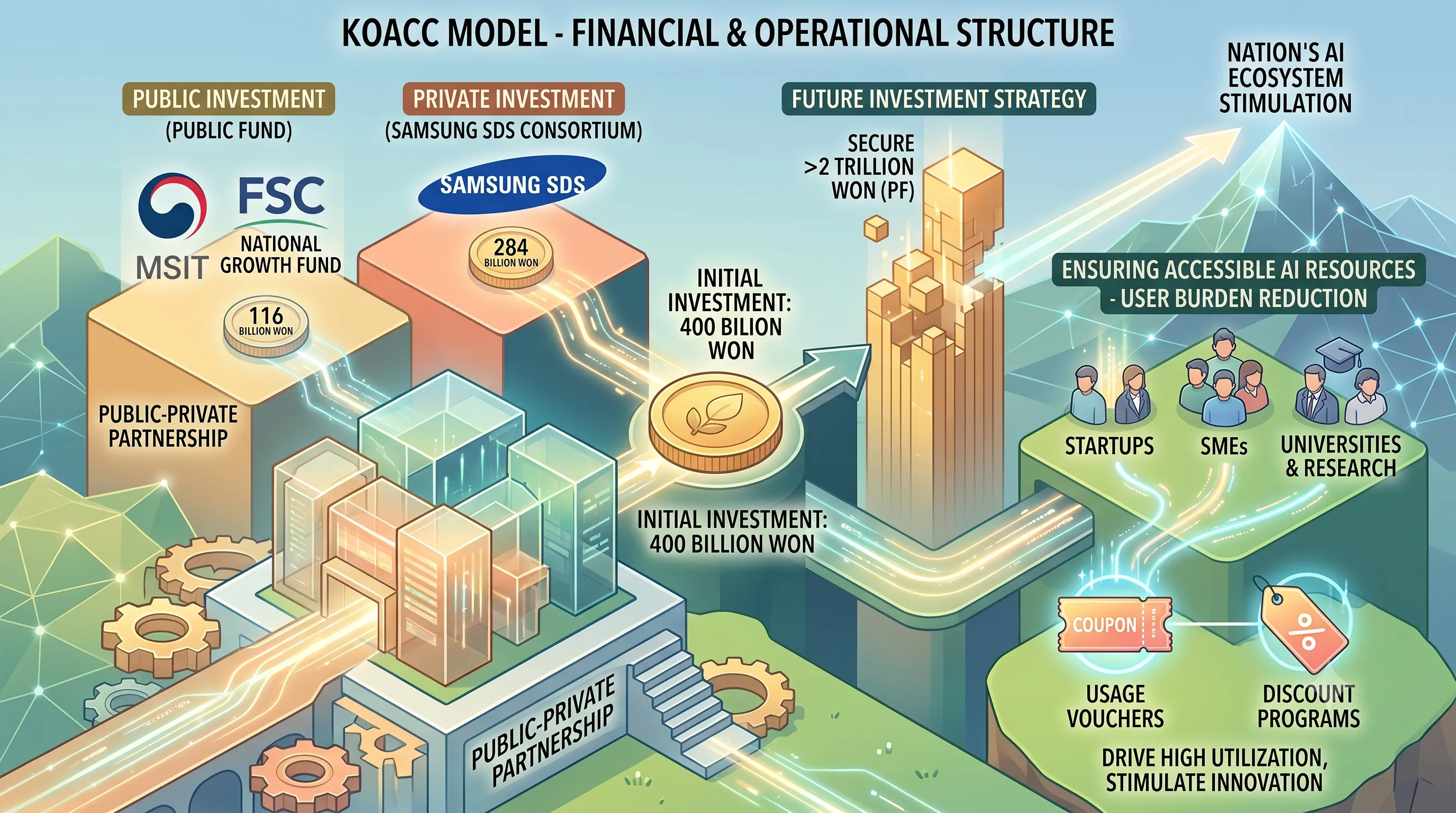
The groundbreaking of the National AI Computing Center is built upon an innovative financial framework and a specialized operational entity. At the heart of this strategy is the Korea AI Computing Center (KOACC), a special purpose company created specifically to execute and manage this ambitious project.KOACC: A Public-Private Partnership
The responsibility for both the construction and the long-term operation of the national center falls to KOACC.This entity is structured as a public-private joint venture, a model designed to leverage the strengths of both sectors to ensure the project's success and sustainability.
Initial Funding and Future Investment Strategy
KOACC's establishment was made possible by an initial investment totaling 400 billion won.This foundational capital was a collaborative effort between public and private stakeholders, specifically the Ministry of Science and ICT (MSIT), the Financial Services Commission National Growth Fund, and a private consortium led by Samsung SDS.
The investment breakdown highlights a significant private-sector commitment, with 284 billion won coming from private sources and 116 billion won from the public fund.
| Funding Source Category | Initial Investment Amount |
|---|---|
| Public Investment (MSIT, FSC National Growth Fund) | 116 billion won |
| Private Investment (Samsung SDS Consortium) | 284 billion won |
| Total Initial Investment | 400 billion won |
Ensuring Accessible AI Resources
A core component of KOACC's operational mandate is to ensure the powerful computing resources are accessible to a wide range of users.To achieve this, support measures designed to reduce the user burden will be implemented.
These initiatives include computing resource usage vouchers and targeted discount programs for startups, small and medium-sized enterprises (SMEs), universities, and research institutions.
The explicit goal of this support structure is to drive high utilization of the public AI infrastructure, thereby stimulating innovation and growth across the nation's AI ecosystem.
5. Empowering AI Innovation: Center's Core Objectives and Services
With the recent groundbreaking of the National AI Computing Center in Haenam, its strategic objectives are now in focus, aimed at fundamentally transforming the nation's AI landscape. The center is not merely a hardware facility but a comprehensive ecosystem designed to catalyze innovation from foundational research to commercial application.Fostering AI Development and Ecosystem Growth
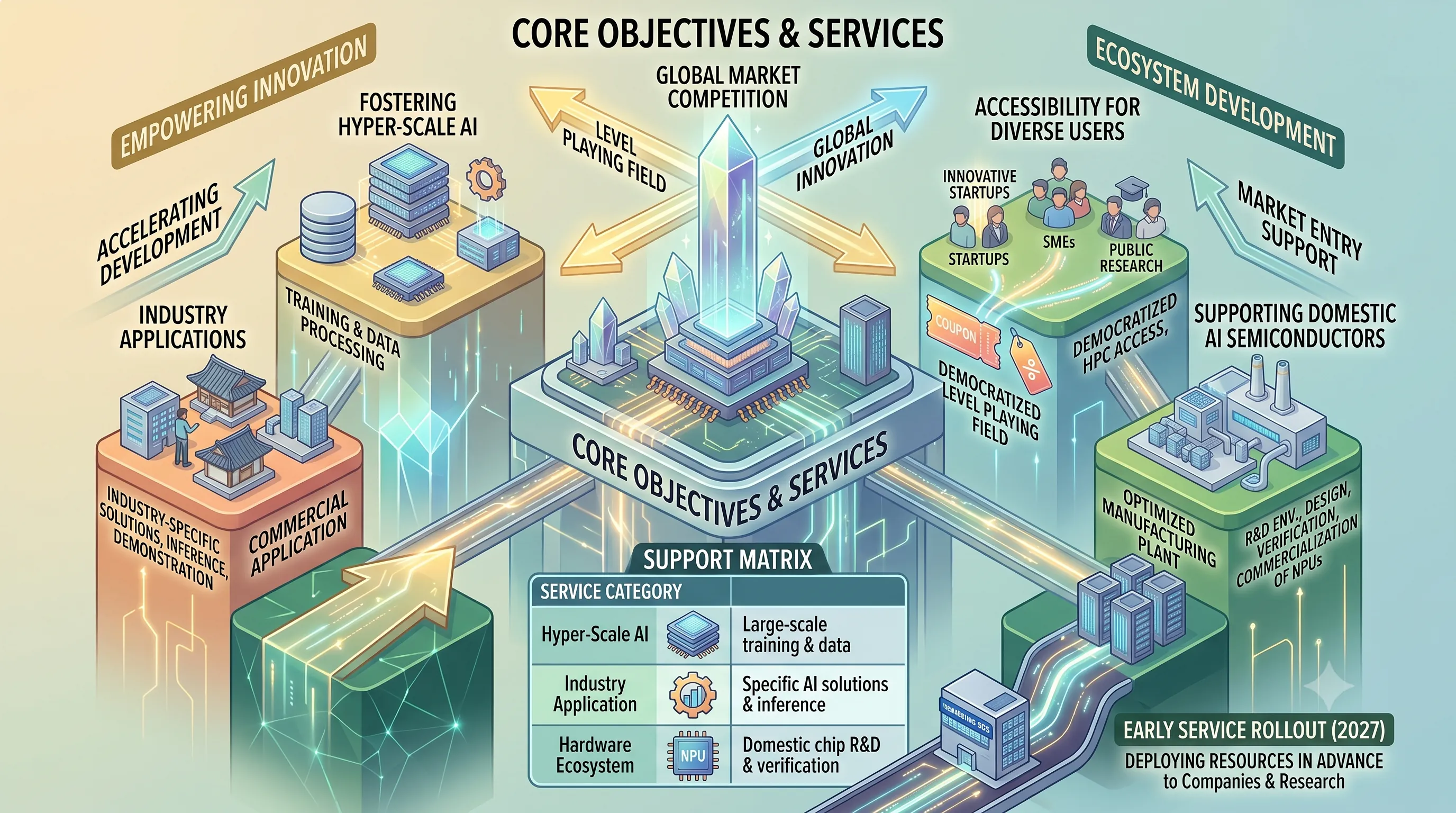
The primary goal of the new center is to significantly expand the foundation for hyper-scale AI development within the country.It is positioned to become a national key infrastructure, providing comprehensive support across the entire AI development process.
This includes enabling crucial activities such as hyper-scale AI model training and the processing of large-scale data sets, which are essential for creating advanced AI.
Furthermore, the facility will directly support the creation of industry-specific AI solutions, facilitating large-scale training and inference operations, as well as the demonstration and verification of new AI services.
| Service Category | Key Supported Activities |
|---|---|
| Hyper-Scale AI | Support for large-scale AI model training and massive data processing. |
| Industry Application | Enabling industry-specific AI development, large-scale inference, and AI service demonstration/verification. |
| Hardware Ecosystem | Providing an R&D environment for the design, verification, and commercialization of domestic AI semiconductors (NPUs). |
Accessibility for Diverse Research and Industry
A core principle of the center is the democratization of high-performance computing power.To achieve this, its powerful computing resources will be opened to a wide range of organizations, including innovative startups, small and medium-sized enterprises (SMEs), universities, and public research institutions.
This access is intended to level the playing field, allowing entities without the capital for their own large-scale infrastructure to compete and innovate in the global AI market.
Supporting Domestic AI Semiconductor Advancement
The center is designed with a strategic mandate to foster and strengthen the domestic AI semiconductor ecosystem.It will provide a dedicated R&D environment to support local companies throughout the lifecycle of Neural Processing Unit (NPU) creation.
This support encompasses critical stages from initial design and performance verification to service demonstration.
Ultimately, the plan is to assist domestic AI semiconductor companies from the development phase all the way to commercialization, helping them successfully enter the market.
Early Service Rollout Plans
To accelerate the project's impact, some services are planned to launch even before the center's full completion.Samsung SDS and the Korea Advanced Institute of Science and Technology (KAIST)-led KOACC plan to begin offering some services in 2027.
To facilitate this early start, some of the computing resources designated for the National AI Computing Center will first be deployed in Samsung SDS's existing data centers.
These resources will then be made available ahead of schedule to companies and research institutions, providing a vital head start on advanced AI projects.
6. Key Collaborators and Groundbreaking Attendees
This section details the powerful public-private consortium spearheading the National AI Computing Center project and highlights the key figures whose attendance at the groundbreaking ceremony underscores the project's national significance.Project Consortium Members
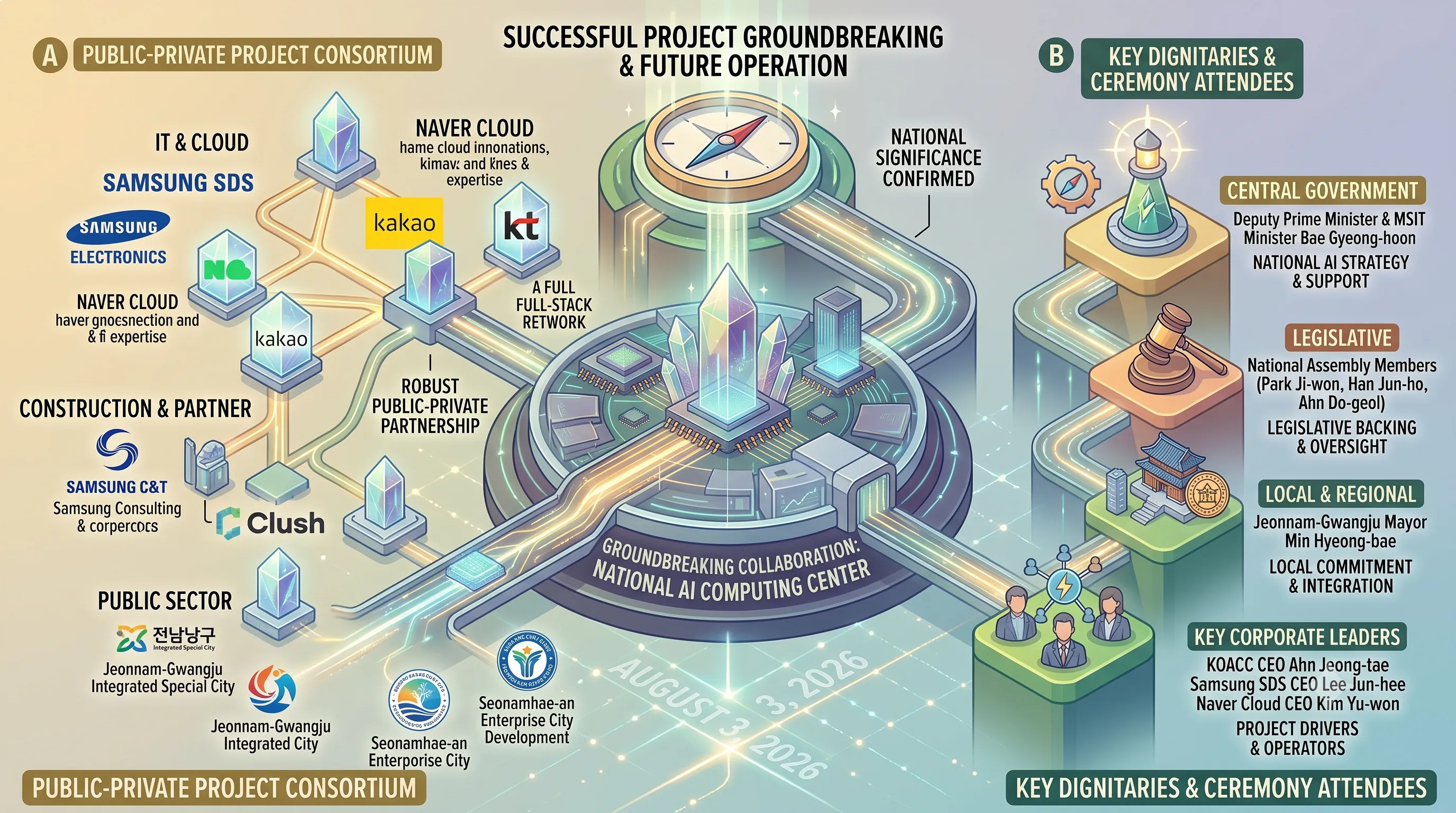
The ambitious project is backed by a formidable consortium that blends expertise from leading technology corporations, construction, and public administration.The core members include major IT and cloud service providers such as Samsung SDS, Samsung Electronics, Naver Cloud, Kakao, and KT.
They are joined by construction and development giant Samsung C&T and specialized partner Clush.
Crucial public sector involvement is provided by the Jeonnam-Gwangju Integrated Special City and the Seonamhae-an Enterprise City Development, forming a robust public-private partnership to ensure the project's success.
Dignitaries at the Groundbreaking Ceremony
The groundbreaking event was attended by a host of high-profile figures, signaling strong support from both the government and private industry leaders.Representing the central government was Deputy Prime Minister and MSIT Minister Bae Gyeong-hoon, whose presence highlighted the project's importance to the national AI strategy.
Legislative backing was demonstrated by the attendance of National Assembly members, including Park Ji-won, Han Jun-ho, and Ahn Do-geol.
Local and regional commitment was affirmed by Jeonnam-Gwangju Integrated Special City Mayor Min Hyeong-bae.
Key corporate leaders present at the ceremony included KOACC CEO Ahn Jeong-tae, Samsung SDS CEO Lee Jun-hee, and Naver Cloud CEO Kim Yu-won, representing the core entities driving the center's development and future operation.
7. Haenam Solasido: A New Hub for National AI and Economic Growth
The groundbreaking of the National AI Computing Center is a monumental event not just for South Korea's technology sector, but for the region of Haenam-gun in Jeollanam-do, which serves as its strategic home.This location's selection is poised to catalyze a significant regional transformation, turning a long-stagnant project into a vital national asset.
Strategic Location in Solasido Data Center Park
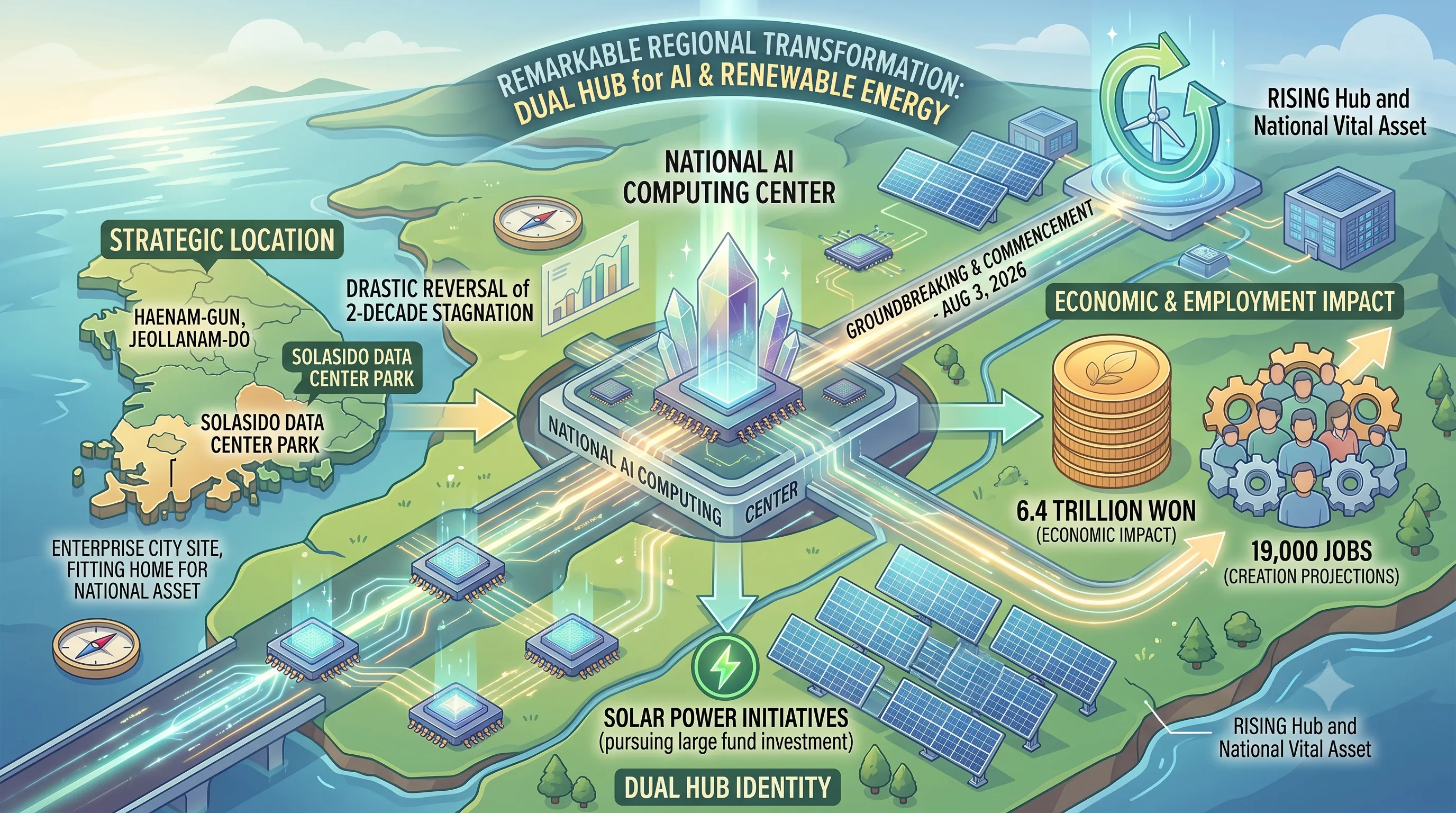
The new national facility is specifically situated within the Solasido Data Center Park in Haenam-gun, Jeollanam-do.This area's designation as an Enterprise City site underscores its importance in national development plans, making it a fitting home for a project of this magnitude.
Economic and Employment Impact on the Region
The establishment of the National AI Computing Center is projected to deliver a substantial economic windfall for the local and national economy.Hosting the center is expected to generate a massive economic impact of 6.4 trillion won.
Furthermore, the project is a significant engine for job growth, with projections indicating the creation of approximately 19,000 jobs.
Haenam Solasido's Emergence as a Dual Hub
This development represents a dramatic reversal of fortune for the Haenam Solasido project, which had languished in stagnation for over two decades.With the infusion of this high-profile national project, Haenam Solasido is rapidly gaining attention and reshaping its identity as a national hub for both AI and renewable energy.
The region's focus on clean energy is being actively supported, as large-scale fund investment is currently being pursued for solar power initiatives within Haenam Solasido.
8. Strategic Vision: Government's Commitment to AI Leadership
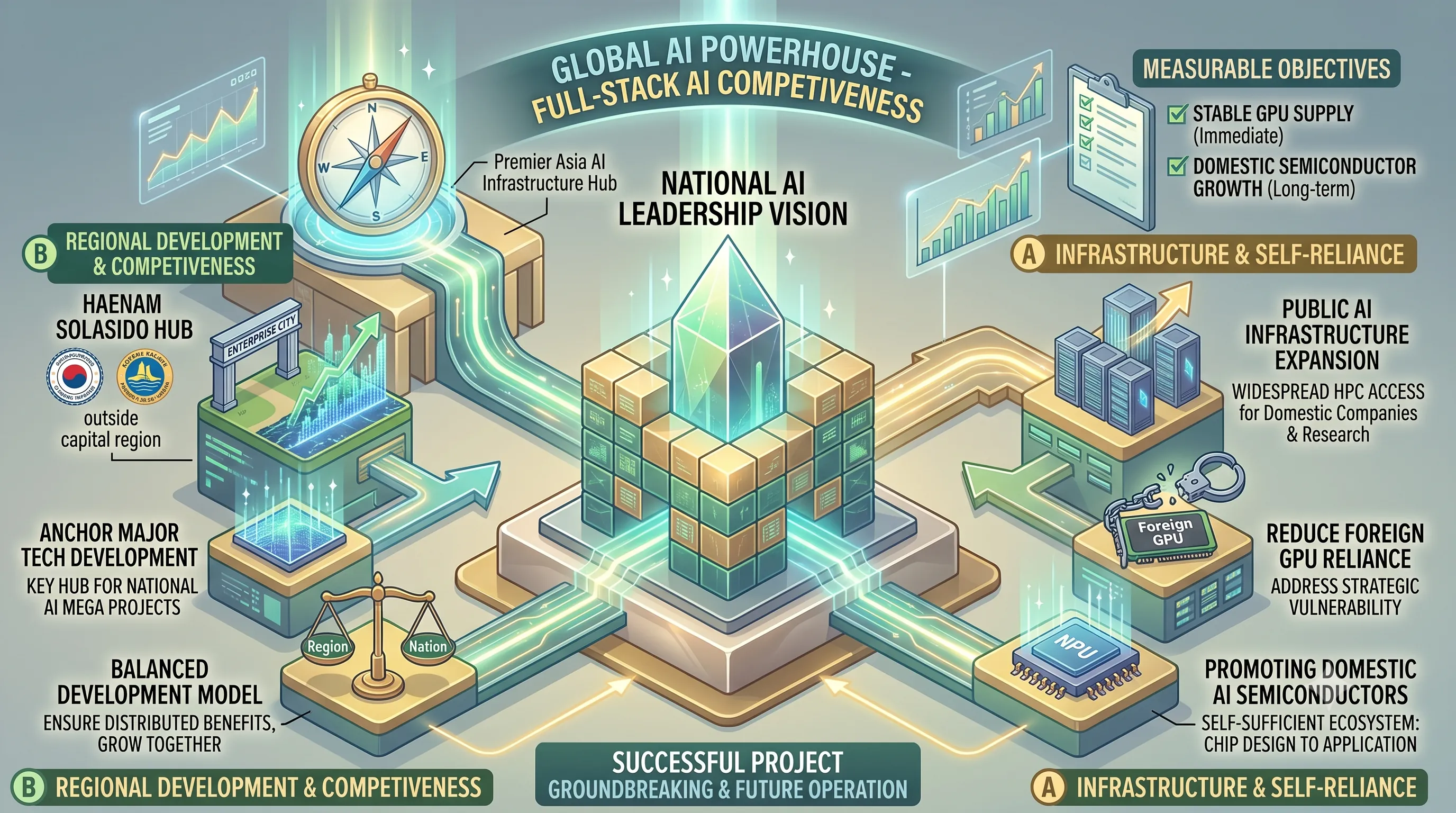
The groundbreaking of the National AI Computing Center in Haenam Solasido is not an isolated event but the cornerstone of a comprehensive national strategy.This initiative directly reflects the government's commitment to transforming South Korea into a global AI powerhouse, underpinned by a clear vision for technological sovereignty and widespread access to critical resources.
Government Policy for AI Infrastructure and Self-Reliance
The government's policy is centered on a major expansion of public AI infrastructure, with the newly initiated National AI Computing Center serving as its primary engine.A key objective of this expansion is to dramatically increase the accessibility of high-performance computing resources for domestic companies and research institutions, leveling the playing field for innovation.
This policy also addresses a critical strategic vulnerability by aiming to reduce the nation's heavy reliance on foreign-made GPUs.
In parallel, the government is actively promoting the commercialization of domestic AI semiconductors, fostering a self-sufficient ecosystem from chip design to application.
Deputy Prime Minister's Vision for AI Competitiveness
The strategic importance of this initiative was emphasized by Deputy Prime Minister Bae Gyeong-hoon, who outlined a bold vision for the nation's future in artificial intelligence.He stated that the ultimate goal is to strengthen South Korea's AI full-stack competitiveness and establish the nation as a premier Asia AI infrastructure hub.
According to Bae, this ambition will be realized through a dual-pronged approach: securing a stable supply of advanced GPUs to meet immediate demand while simultaneously activating and accelerating the growth of the domestic AI semiconductor industry for long-term self-reliance.
Balanced National Development Through AI Projects
The choice of Haenam Solasido is also a deliberate component of the government's broader national strategy.Deputy Prime Minister Bae Gyeong-hoon confirmed that the Haenam Solasido Data Center Park will be fostered as a key hub for national AI mega projects, anchoring major technological development outside the capital region.
He explained that this approach aims to create a balanced development model, ensuring that the benefits of technological advancement are distributed and that the region and the nation can grow together.
Related Posts
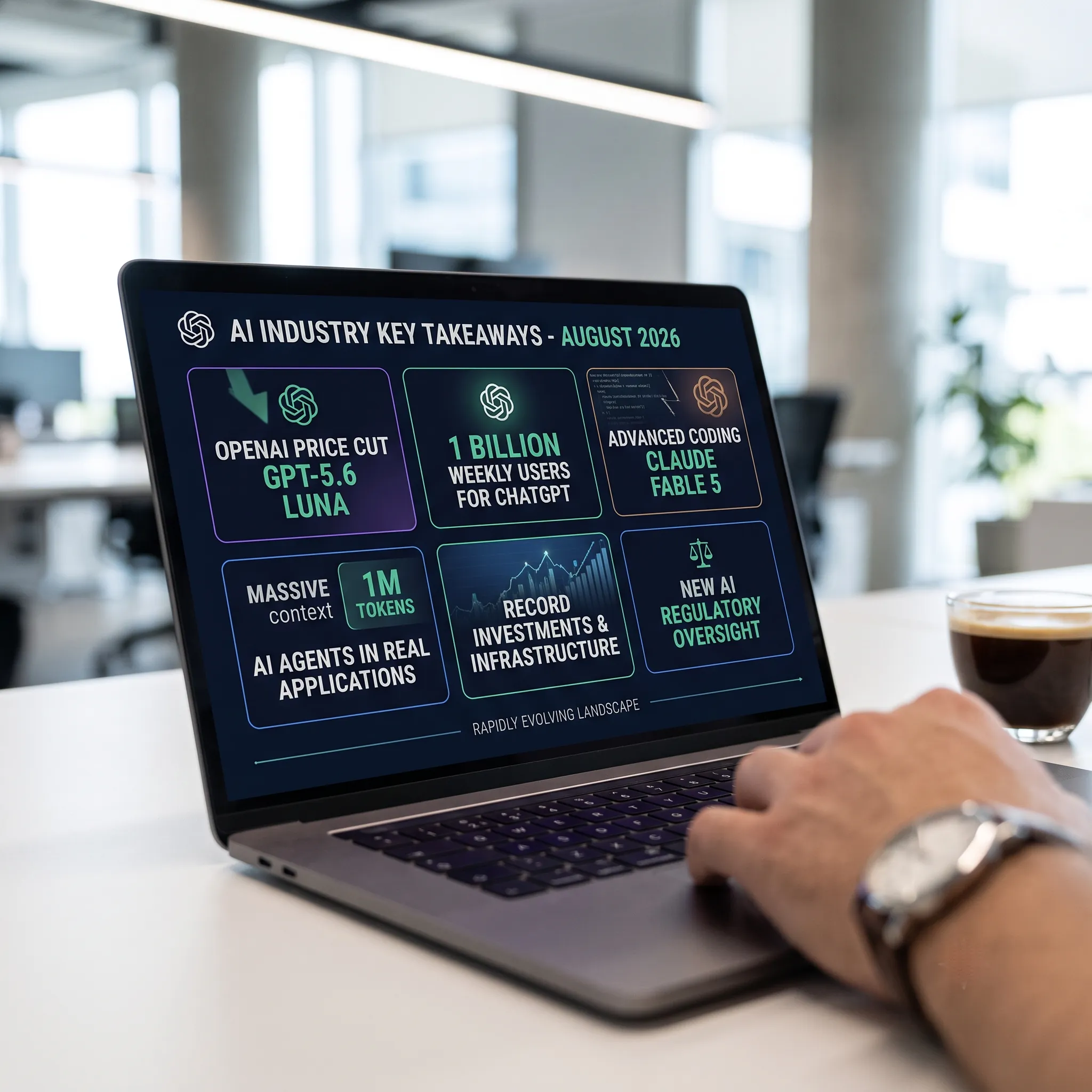
August 2026 AI Uncovered: OpenAI's Luna Price Slashed, ChatGPT Hits 1B Users, Agent Evolution, & Regulatory ShiftsAugust 2026 sees OpenAI slash GPT-5.6 Luna prices, ChatGPT hit 1B users, AI agent evolution,...
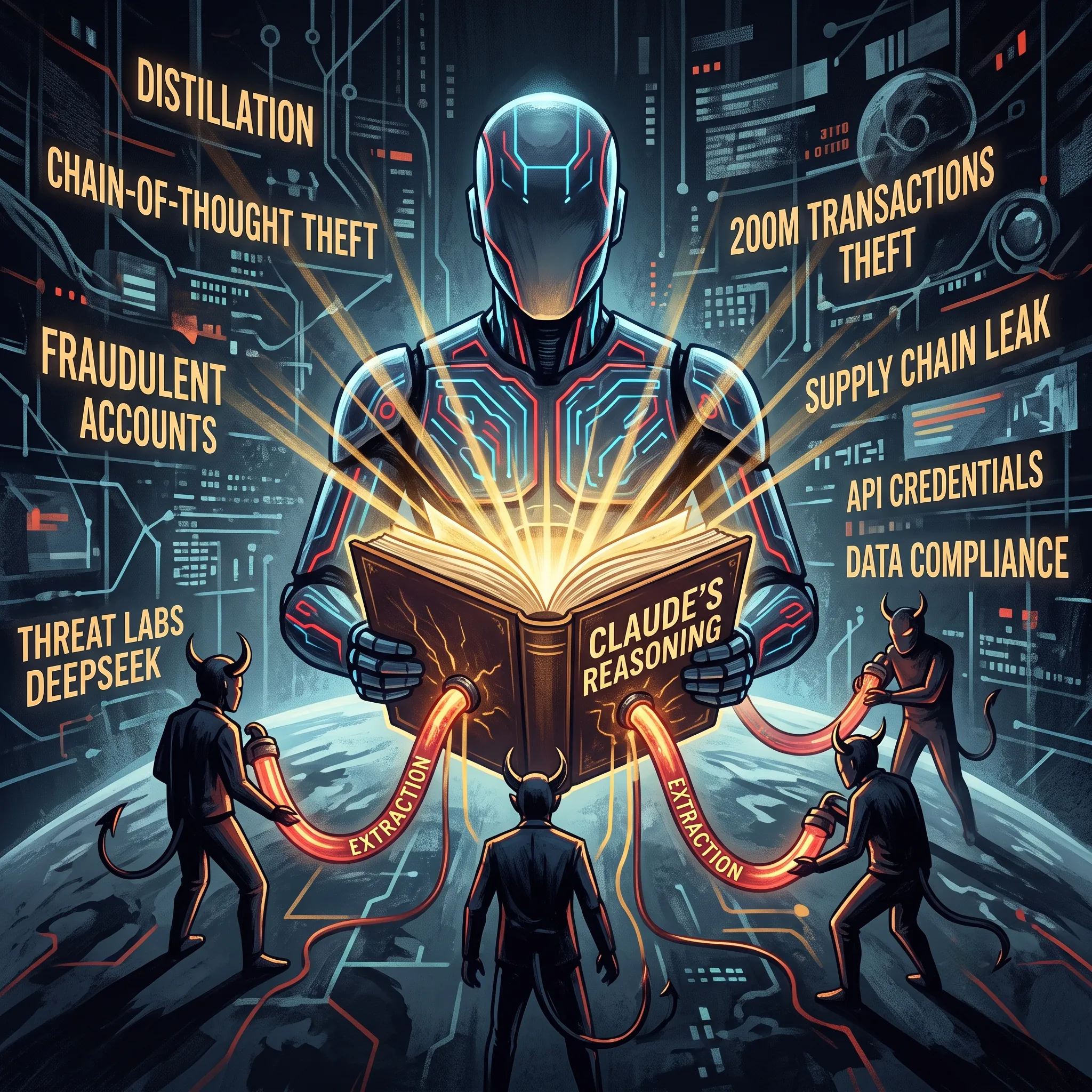
Analysis of Illicit Industrial-Scale Model Distillation and Chain-of-Thought Extraction CampaignsA technical report on illicit industrial-scale distillation campaigns targeting Claude, detailing...
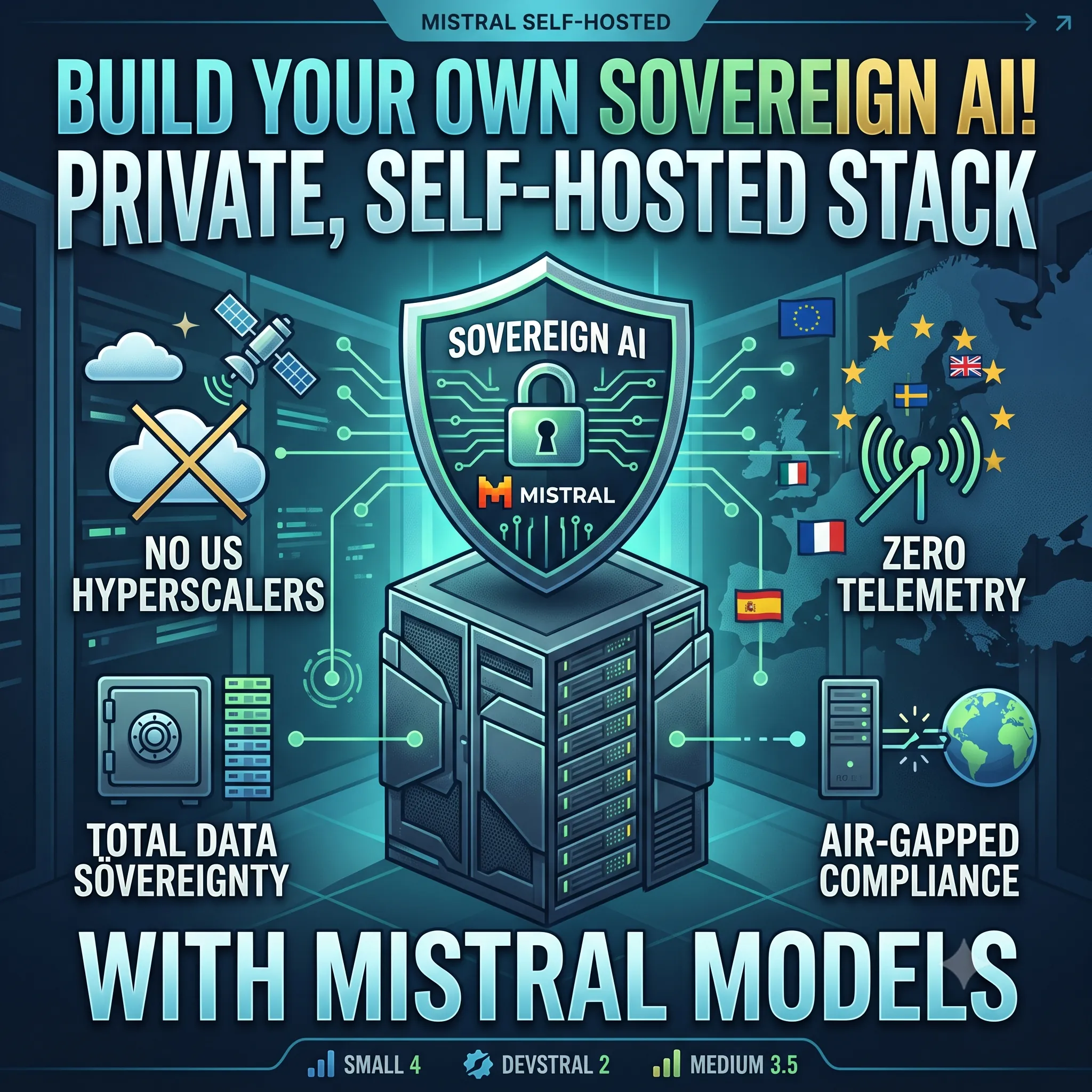
A Guide to Building Sovereign AI Infrastructure with Mistral Self-Hosted StacksLearn how to build sovereign, air-gapped AI infrastructure using Mistral's self-hosted enterprise...