
Rerankers in Retrieval Augmented Generation: Enhancing Relevance, Architectures, and Practical Implementation
🚀 Key Takeaways
- Rerankers are an essential evaluation layer in Retrieval Augmented Generation (RAG) pipelines that refine initial retrieval results to improve relevance.
- They significantly enhance the quality, precision, and recall of documents provided to large language models, leading to better answers and user experience.
- Key architectures include fast bi-encoders for initial retrieval and accurate cross-encoders for detailed reranking, each with distinct trade-offs.
- Reranking is crucial for RAG applications to optimize the context window for LLMs, reducing noise and the risk of hallucinations.
- A common and effective approach is the two-stage retrieval pipeline, combining broad retrieval with precise reranking.
- While powerful, rerankers introduce considerations around latency and computational cost, especially with large document sets.
- Careful evaluation and strategic model selection, including lightweight or domain-specific fine-tuned options, are vital for successful implementation.
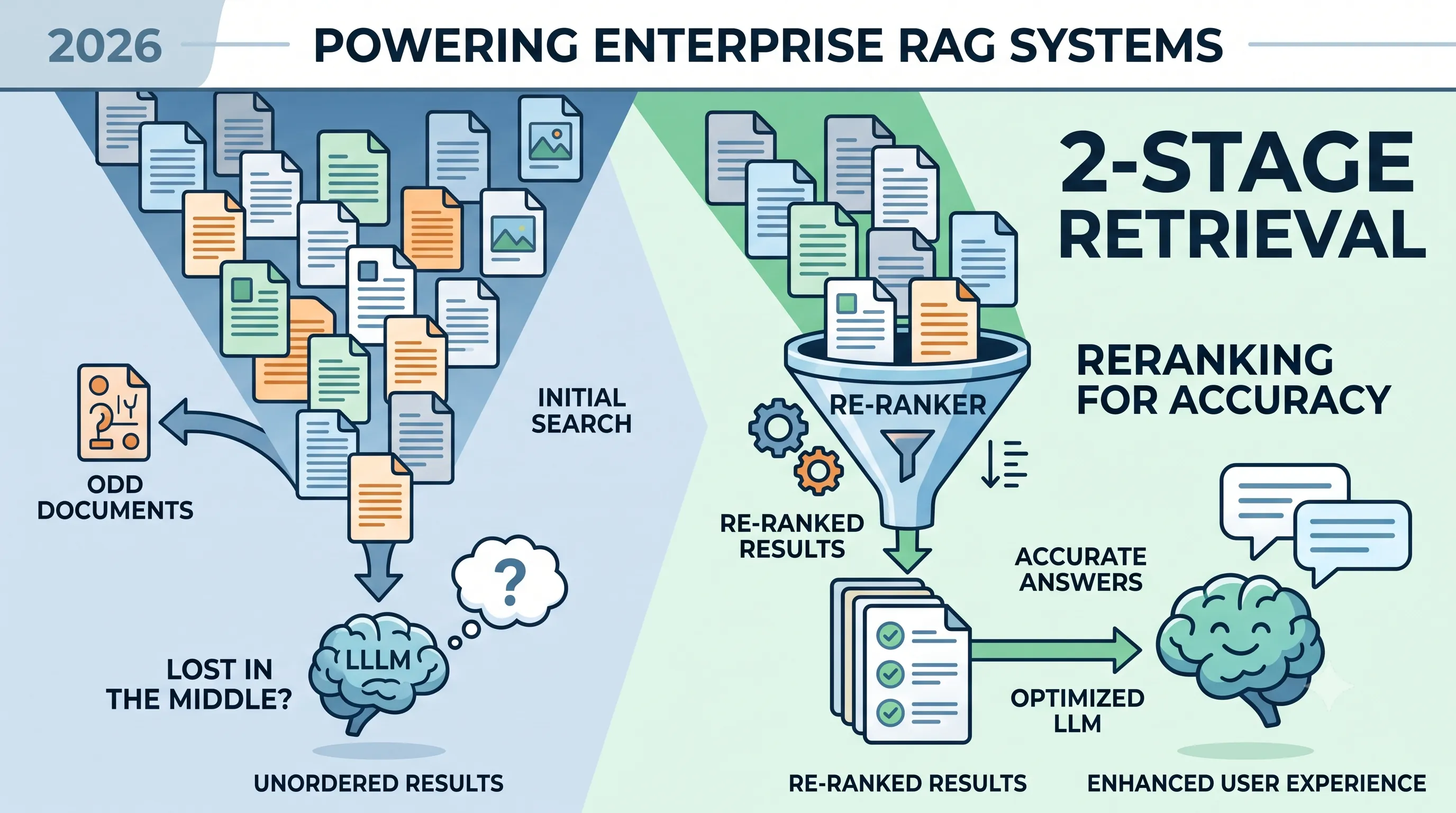
Imagine an internal chatbot designed to empower your team, but instead, it frequently pulls up irrelevant or "odd documents". This common frustration highlights a critical challenge in knowledge retrieval systems: how to ensure the information delivered is not just available, but precisely relevant. The effectiveness of modern AI-powered applications, especially those built on Retrieval Augmented Generation (RAG), hinges entirely on feeding the language model with the absolute best context.
As of late 2026, the demand for highly accurate and efficient RAG systems continues to accelerate, with organizations keen to leverage AI for everything from customer support to internal data navigation. However, initial document retrieval, even with advanced vector databases, often casts too wide a net. This can lead to the "lost in the middle" problem, where an LLM misses crucial information amidst a sea of less pertinent data, thereby compromising the quality and accuracy of its responses.
This is where a robust two-stage retrieval (Retrieval & Re-rank) pipeline becomes indispensable. By incorporating a dedicated reranking step, enterprises can drastically improve the relevance and precision of retrieved documents before they ever reach the generative model. This design not only elevates the user experience by delivering more accurate answers but also optimizes LLM performance and reduces operational costs by ensuring only the most critical information is processed.
As of late 2026, the demand for highly accurate and efficient RAG systems continues to accelerate, with organizations keen to leverage AI for everything from customer support to internal data navigation. However, initial document retrieval, even with advanced vector databases, often casts too wide a net. This can lead to the "lost in the middle" problem, where an LLM misses crucial information amidst a sea of less pertinent data, thereby compromising the quality and accuracy of its responses.
This is where a robust two-stage retrieval (Retrieval & Re-rank) pipeline becomes indispensable. By incorporating a dedicated reranking step, enterprises can drastically improve the relevance and precision of retrieved documents before they ever reach the generative model. This design not only elevates the user experience by delivering more accurate answers but also optimizes LLM performance and reduces operational costs by ensuring only the most critical information is processed.
1. Understanding Rerankers: Core Function and Purpose
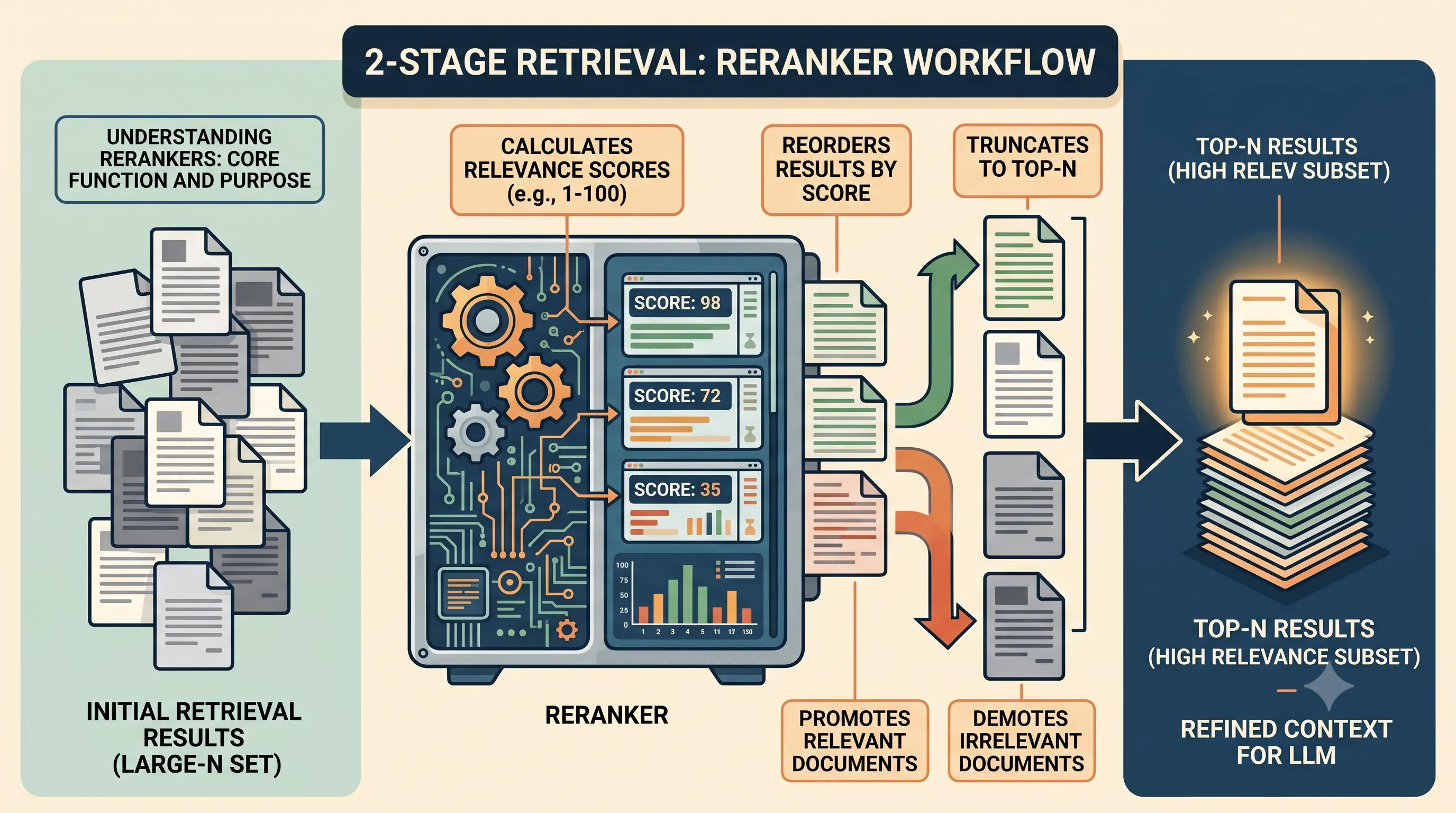
This section explains the "re-rank" stage of the 2-stage search pipeline, detailing the critical mechanism that elevates search quality beyond initial retrieval.By understanding how a reranker functions, we can see how it directly addresses the core problem of a chatbot fetching irrelevant documents, ensuring only the most pertinent information proceeds to the language model for answer generation.
Refining Initial Retrieval Results
A reranker's primary role is to act as a sophisticated filter and re-organizer for an initial set of search results, such as those from a vector database query.The process begins by accepting a larger-than-average number of documents from the first retrieval stage.
From there, the reranker meticulously calculates a relevance score for each individual document.
This score is not a generic metric; it is specifically based on how important and relevant each document is to satisfying the user's original query.
Using these newly calculated scores, the reranker then completely reorders the initial list of documents.
Documents with high relevance scores are promoted to the top, while less relevant ones are pushed down.
Finally, this refined and reordered list is truncated to return only the top-n results.
This crucial step effectively removes the "noise" from the initial, broader search, leaving a highly relevant subset of documents.
Ensuring Precise Context for LLMs
Within a Retrieval-Augmented Generation (RAG) system, reranking serves as a vital evaluation layer that sits between the initial document retrieval and the final context delivery to the language model (LLM).Its purpose is to guarantee that the context provided to the LLM is the precise information required to formulate a relevant and accurate answer.
By filtering out irrelevant or tangentially related documents, the reranking process ensures the LLM is not confused or led astray by noisy data.
This step is fundamental to improving the final output, as a clean, focused context allows the LLM to generate responses that directly and accurately address the user's inquiry.
2. Transforming RAG Performance: The Benefits of Reranking
This section delves into why a second-stage reranker is a critical addition to the retrieval pipeline, directly addressing the core problem of a chatbot fetching irrelevant documents by fundamentally enhancing the quality and utility of the information passed to the Large Language Model (LLM).Boosting Retrieval Quality and User Experience
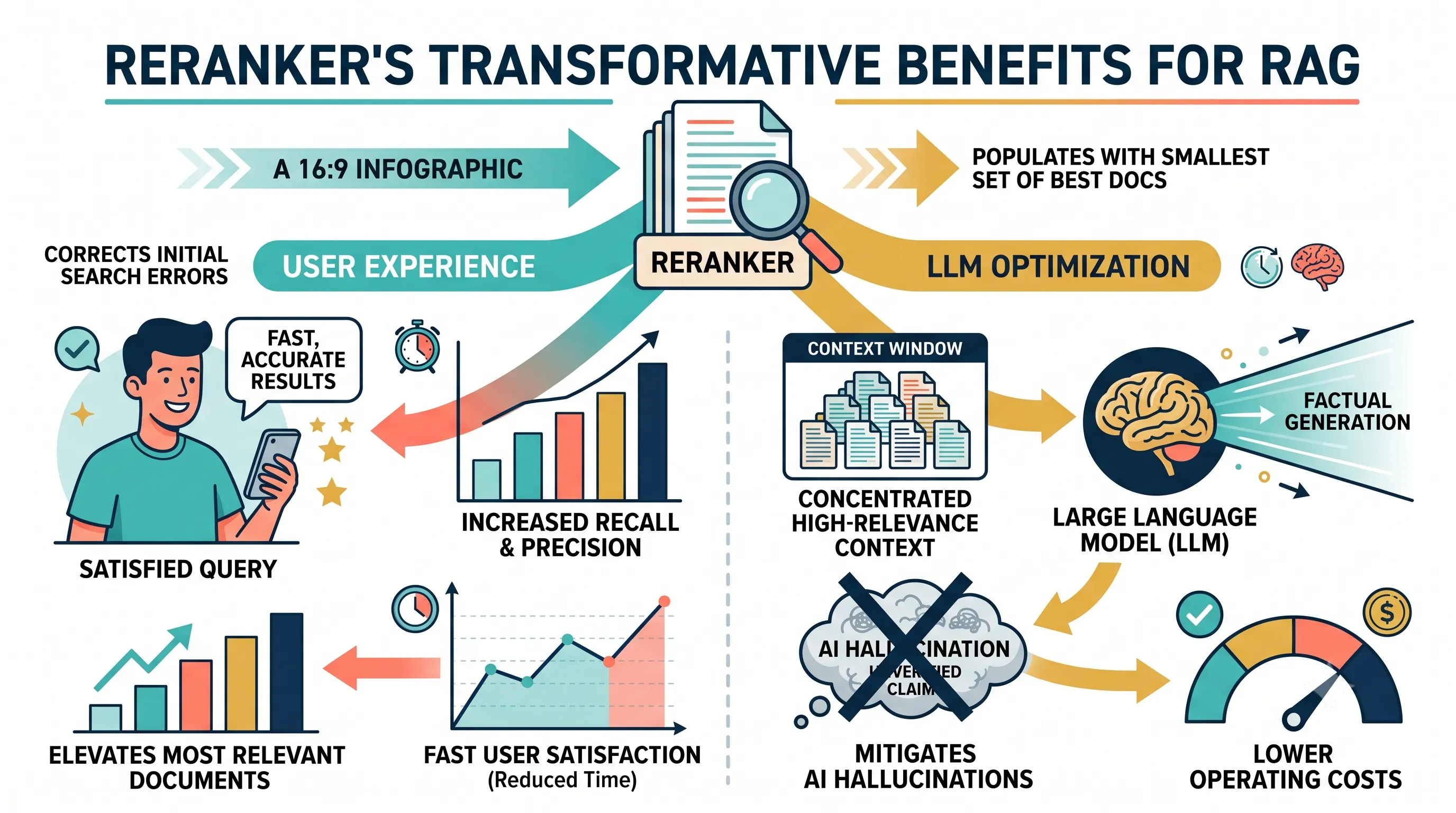
The primary function of a reranker is to significantly increase the quality of documents retrieved in a vector search or RAG pipeline.This enhancement is achieved by improving two key metrics: recall and precision.
Incorporating a reranker increases Recall, meaning the final set of results contains more relevant documents than what semantic search alone would provide for the same number of returned items.
Simultaneously, it boosts Precision by applying a more sophisticated relevance scoring mechanism at query time.
This process contextualizes both the user's query and the initial batch of documents, allowing the system to prioritize and elevate the most relevant results to the top.
This capability directly corrects for poor top-k retrieval from the initial search stage.
For instance, a highly useful document might be initially ranked low by the vector database, but the reranker can intelligently reshuffle the results to push that truly useful document to the top position.
Ultimately, this leads to a vastly improved User Experience.
Instead of sifting through a long list of potentially relevant items, the user is presented with a tractable number of highly relevant results.
This reduces the time it takes for users to benefit from the search, which is crucial because "every second counts for quickly satisfying user queries in domains such as e-commerce, customer support, and finance."
Optimizing LLM Context and Mitigating Hallucinations
Beyond the user-facing benefits, reranking is essential for optimizing the information fed to the LLM for response generation.A key challenge in RAG applications is finding the optimal contextual information required for a correct and coherent answer.
Reranking addresses this by ensuring the LLM's context window is populated with the smallest possible number of the most highly relevant documents.
This filtering of noise is especially important for LLMs with limited context windows, as it provides a precise and concentrated context, which in turn helps reduce overall LLM operating costs.
Most importantly, providing high-quality context is the most effective way to reduce AI hallucinations.
When the initial retrieval stage fails to provide the necessary facts, the LLM is more likely to generate incorrect or fabricated information.
By refining the retrieved documents to supply only the most pertinent information, reranking provides the necessary context to the LLM, significantly minimizing the risk of such errors and ensuring the final generated response is grounded in factual documentation.
3. Architectural Deep Dive: Bi-encoders vs. Cross-encoders
This section provides a technical examination of the two primary architectures used in the re-ranking stage of our 2-stage search pipeline.Understanding the fundamental differences between bi-encoders and cross-encoders is crucial for designing a system that balances the competing demands of speed, cost, and relevance accuracy when a chatbot retrieves documents.
Bi-encoders: Speed and Scalability Challenges
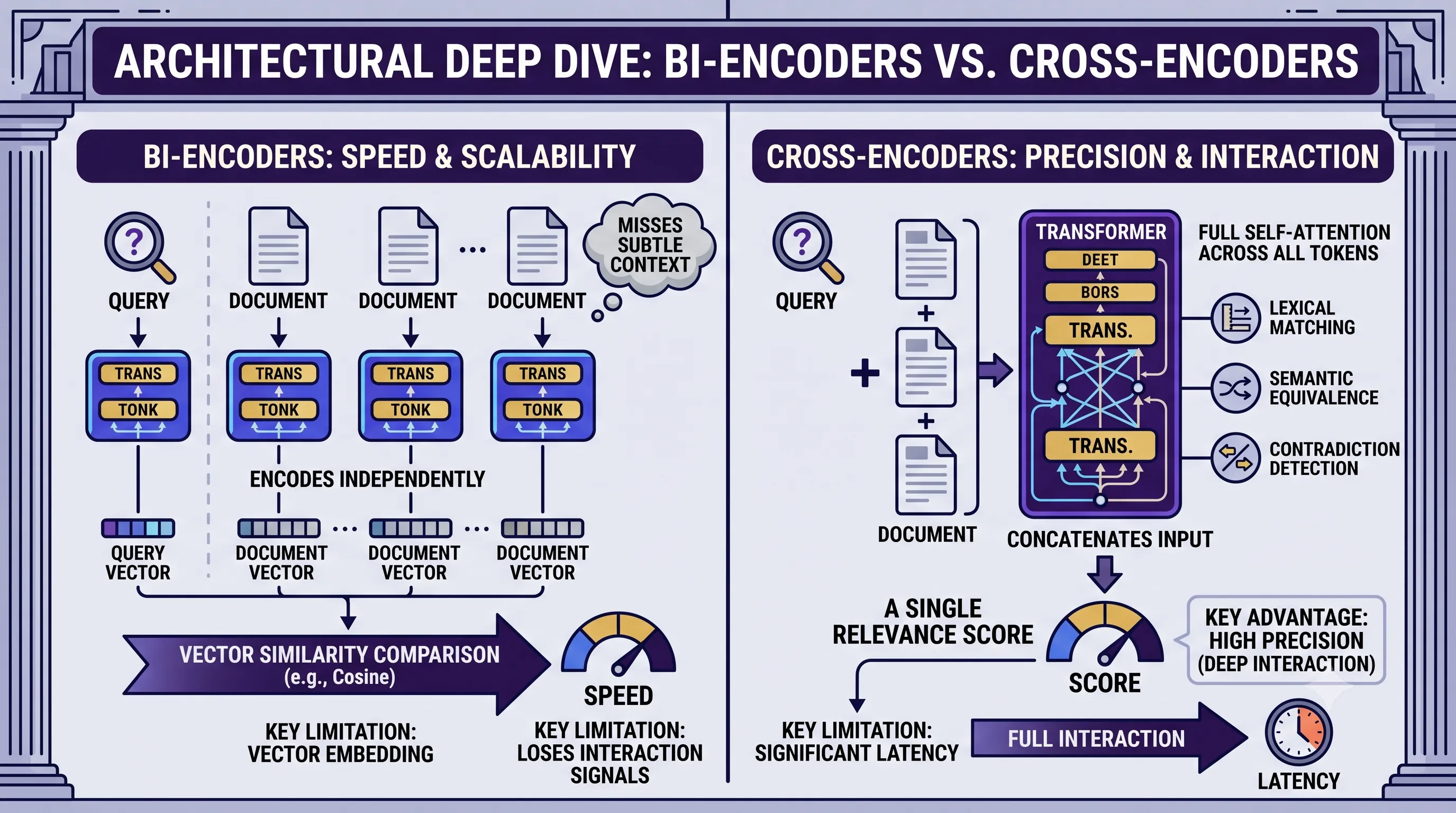
Most modern semantic search systems are built upon a bi-encoder architecture.The core principle of a bi-encoder is to process the query and the documents independently from one another.
The model encodes the query into a dense vector representation (an embedding) and does the same for each document, also creating a unique vector for it.
A key advantage of this approach is its efficiency and scalability; documents can be processed and encoded into vectors just once, then stored in a vector database for fast retrieval.
When a new query arrives, it is encoded, and the system finds the closest document matches by comparing the query vector to the pre-computed document vectors, typically using a fast similarity metric like cosine similarity.
However, this separation comes with a significant limitation.
By compressing all the rich semantic meaning of a query and a document into single, fixed-size vectors *before* they are ever compared, crucial interaction signals are discarded.
The bi-encoder model never gets to see the query and the document simultaneously during the comparison phase, which means it can miss subtle contextual nuances.
For example, a bi-encoder struggles to reason about the direct relationship between specific terms, such as whether a hotel document describing a price of '$500/night' is a good match for the query 'cheap hotel'.
This inability to perform fine-grained term-to-term analysis is the primary challenge that re-ranking aims to solve.
Cross-encoders: Precision Through Deep Interaction
A cross-encoder architecture takes a fundamentally different, more computationally intensive approach.Instead of encoding the query and document separately, it concatenates them into a single input sequence, often separated by a special token.
This combined sequence is then fed through a single transformer model.
The model’s power comes from its use of full self-attention across all tokens in this combined input.
This means that at every layer of the transformer, every token in the query can directly attend to every token in the document, and vice-versa.
This deep, layer-by-layer interaction allows the model to build complex and abstract relationships between the query and the document.
The multi-head attention mechanism within the transformer is particularly effective here, as it allows the model to learn different types of relationships simultaneously, such as simple lexical matching, deeper semantic equivalence, contradiction detection, or entity matching.
Unlike a bi-encoder, which outputs two vectors to be compared, the output of a cross-encoder is a single, directly produced relevance score, typically a value between 0 and 1.
While this method yields a much more accurate relevance judgment, it comes at a steep cost.
Evaluating every query-document pair individually is expensive and introduces significant latency, making cross-encoders impractical for searching over a large initial set of candidates.
Architectural Trade-offs and Interaction Signals
The choice between a bi-encoder and a cross-encoder for the re-ranking stage is a classic trade-off between performance and precision.The bi-encoder is built for speed, making it ideal for the initial retrieval phase where a large number of documents must be filtered quickly.
The cross-encoder is built for accuracy, making it the superior choice for the second-stage re-ranking of a small, pre-filtered candidate list.
| Characteristic | Bi-Encoder | Cross-Encoder |
|---|---|---|
| Input Processing | Encodes query and document independently. | Concatenates query and document into a single input. |
| Interaction Model | No interaction during encoding; comparison happens post-encoding via vector similarity (e.g., cosine). | Full self-attention across all query and document tokens at every layer. |
| Output | Separate vector embeddings for query and document. | A single, direct relevance score (e.g., 0 to 1). |
| Key Advantage | Fast and highly scalable; documents can be pre-processed and indexed. | High precision due to deep, token-level interaction analysis. |
| Key Limitation | Loses interaction signals and subtle context by compressing semantics into a vector before comparison. | Introduces significant latency; computationally expensive for large candidate pools. |
4. Integrating Reranking into RAG Workflows
This section delves into the 'Re-rank' phase of the two-stage pipeline discussed in our main article, 'When the Internal Chatbot Retrieves Odd Documents: Designing a 2-Stage Retrieval & Re-rank Pipeline'.It clarifies precisely where reranking fits within a modern Retrieval-Augmented Generation (RAG) system and explains why this step is critical for overcoming the inherent limitations of Large Language Models (LLMs) concerning context handling and cost efficiency.
Reranking's Role in the RAG Pipeline
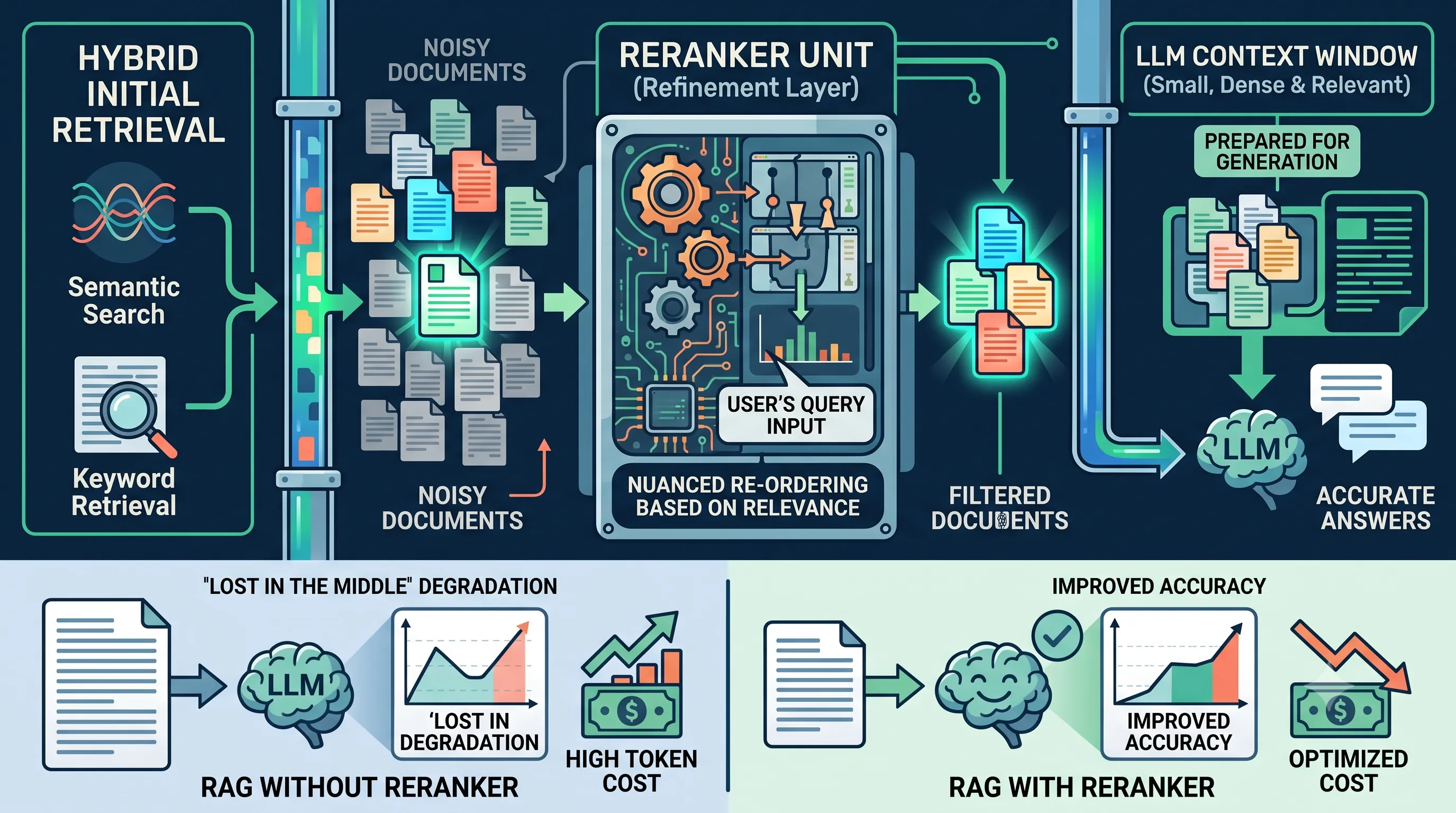
Reranking is a distinct post-retrieval step that significantly enhances the quality of information fed into a generation model.In most sophisticated RAG systems, the initial retrieval phase often employs a hybrid approach, combining semantic embedding search with traditional keyword retrieval to cast a wide net and capture a broad set of potentially relevant documents.
However, this initial result set from the vector database is often noisy or contains documents of varying relevance.
The reranker's function is to act as a crucial refinement layer.
It takes the documents from the initial retrieval and re-orders them based on a more nuanced understanding of their relevance to the user's query.
By doing this, reranking ensures that the final context window prepared for the LLM contains the smallest possible number of the most highly relevant documents, effectively filtering out the noise before the final generation step.
Addressing LLM Context Window Challenges
The need for a reranking stage is driven by fundamental challenges associated with LLM context windows.A common issue is that LLM performance can degrade when provided with too much information.
This degradation often manifests as the 'lost in the middle' problem, a phenomenon where the model effectively misses or ignores relevant documents that are situated near the middle of a long context window.
While the availability of long-context LLMs helps mitigate this issue to some extent, their performance is still ultimately capped by the quality and quantity of the documents passed to them.
Furthermore, there is a direct financial implication: processing more tokens at ingest for LLMs increases costs.
Reranking directly addresses both of these challenges by creating a smaller, denser, and more relevant context, which not only improves the accuracy of the final answer but also optimizes the cost of running the RAG pipeline.
5. Beyond the Basics: Advanced Reranker Types and Techniques
This section directly addresses the core theme of designing a "Retrieval & Re-rank" pipeline by moving beyond a simple first-pass retrieval.It details the sophisticated "Re-rank" stage, exploring the specific models and advanced techniques that refine the initial candidate documents to significantly improve the final answer's relevance, which is critical when a chatbot fetches irrelevant information.
Categorizing Reranker Models
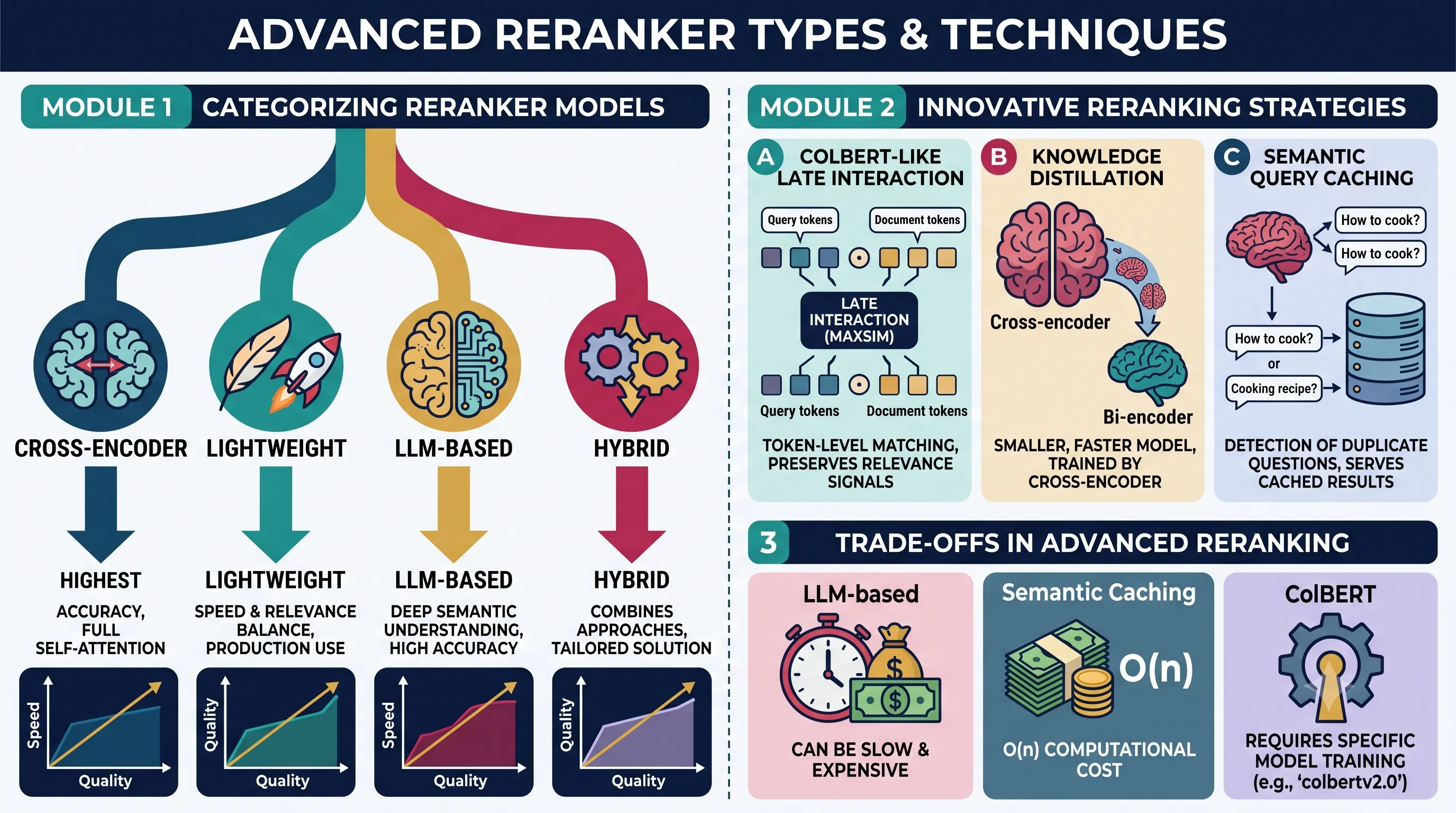
Once an initial set of documents is retrieved, the reranking stage applies more computationally intensive models to re-order them for maximum relevance.These models can be broadly categorized based on their architecture and performance characteristics.
Cross-encoder rerankers are generally considered the most accurate option available, as they process the query and a document simultaneously to produce a highly contextualized relevance score.
For production environments that require smaller and faster models, lightweight rerankers offer a practical solution; while not as precise as cross-encoders, they provide better performance than basic retrieval methods alone.
LLM-based rerankers leverage the power of large language models for the reranking task, also delivering high accuracy by understanding nuanced semantic relationships.
Finally, hybrid rerankers are designed to balance speed and quality by combining multiple approaches, offering a flexible solution tailored to specific needs.
| Reranker Type | Primary Characteristic | Common Use Case |
|---|---|---|
| Cross-encoder | Generally the most accurate option. | Applications where precision is the top priority. |
| Lightweight | Smaller and faster models. | Production environments requiring a balance of speed and improved relevance. |
| LLM-based | High accuracy via large language models. | Complex queries needing deep semantic understanding, but can be slow or costly. |
| Hybrid | Combines multiple approaches. | Custom pipelines aiming to balance speed and quality. |
Innovative Reranking Strategies
Beyond standard model types, several advanced techniques can further enhance reranking performance.ColBERT-like late interaction models offer a middle ground between the speed of bi-encoders and the accuracy of cross-encoders.
This approach works by creating contextualized token embeddings for both the query and the document separately, then applying a "late interaction" step using dot products.
The scoring is handled by the MaxSim scoring method, which finds the best-matching document token for each individual query token and then sums these maxima.
This token-level matching preserves fine-grained relevance signals that might otherwise be lost.
Another powerful technique is knowledge distillation.
This process effectively teaches a smaller, faster bi-encoder model to rank documents in the same way a larger, more accurate cross-encoder does by training it to reproduce the cross-encoder's scores.
For systems that handle repetitive user queries, semantic query caching is highly effective.
It uses a cross-encoder, often fine-tuned on duplicate question datasets like Quora, to detect semantically identical questions at query time, allowing the system to serve a cached result instead of re-computing.
Trade-offs in Advanced Reranking
While these advanced techniques offer significant benefits, they come with their own set of limitations.LLM-based rerankers, despite their accuracy, can sometimes be slow and expensive to operate, making them less suitable for applications with tight latency or budget constraints.
The performance of semantic query caching is also subject to trade-offs, as the cache comparison itself has an O(n) computational cost that scales linearly with the size of the cache.
Furthermore, implementing a method like ColBERT effectively requires specific tooling.
Real ColBERT deployments rely on models that were specifically trained for token-level late interaction retrieval, such as 'colbert-ir/colbertv2.0', and cannot be replicated by simply using general-purpose sentence transformers.
6. Practical Reranking: Tools and Implementations in the Ecosystem
This section moves from the theory of the two-stage retrieval and re-rank pipeline to practical application.It examines the specific tools, platforms, and frameworks available to implement the crucial second step—reranking—providing a guide to the technology ecosystem developers can leverage to enhance the accuracy of their RAG systems.
API-Based Rerankers and Managed Services
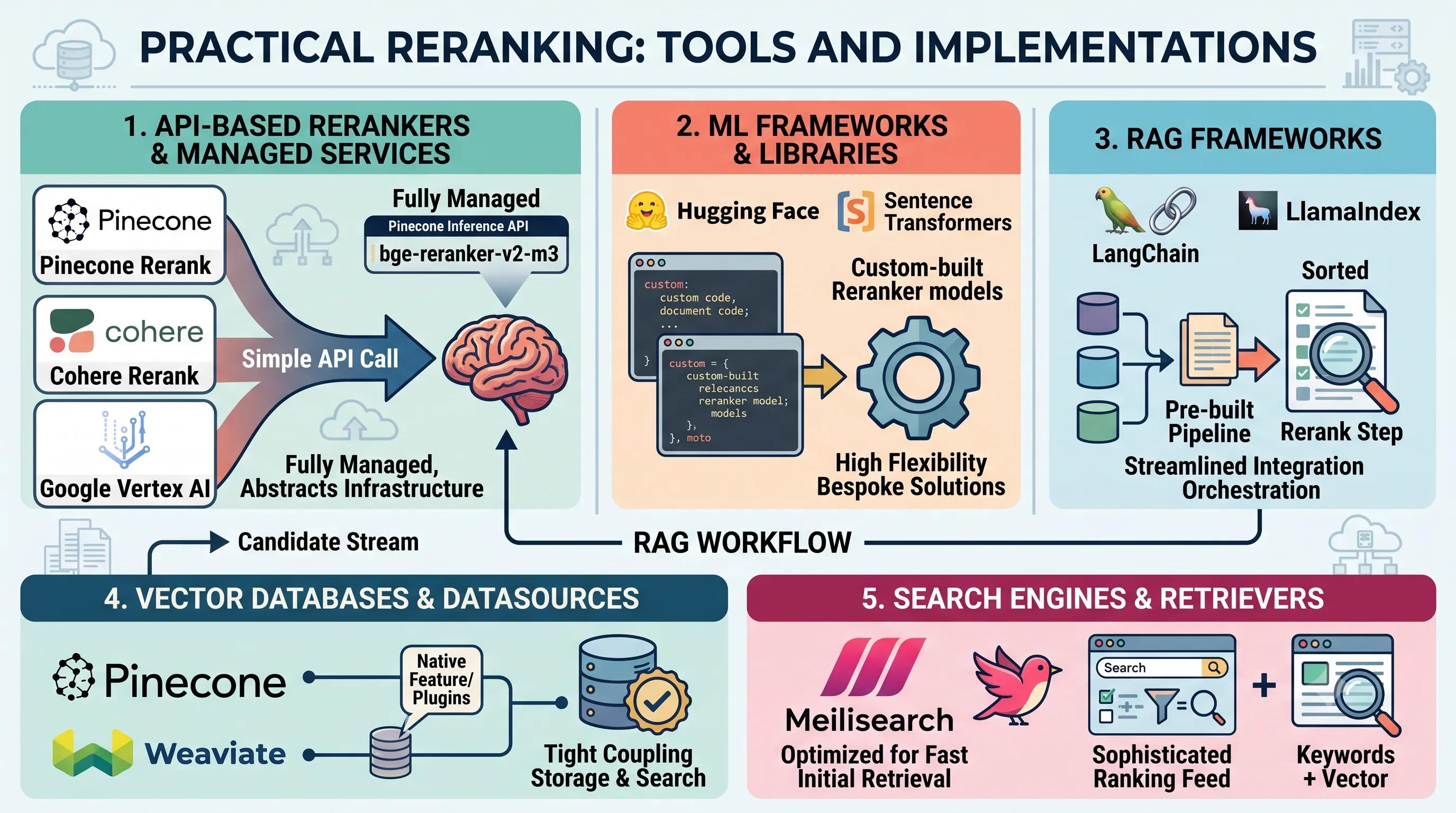
For teams seeking to implement sophisticated reranking without managing complex infrastructure, several platforms offer this capability as a managed service.These services, such as Cohere Rerank and Google Vertex AI, provide reranking functionality through a straightforward API call, abstracting away the underlying model hosting and preprocessing.
A prominent example is Pinecone Rerank, which is implemented as an API call through the Pinecone Inference API.
This service utilizes the 'bge-reranker-v2-m3' model, a lightweight, open-source, and multilingual reranker developed by the Beijing Academy of Artificial Intelligence (BAAI).
The BGE Reranker models were created by initializing an XLM-RoBERTa model and then fine-tuning it on extensive multilingual retrieval data.
A key advantage of the Pinecone Rerank endpoint is that it handles all the necessary backend processes, including tokenization, model hosting, preprocessing pipelines, and language-specific information, simplifying integration for developers.
Similarly, Cohere offers its Rerank capability as a standalone API, with models like 'rerank-v4.0-pro' serving as powerful options.
The concept of using advanced models for reranking is well-established; as far back as 2019, Google announced its use of BERT to re-rank search results by analyzing queries and document snippets together to better judge relevance.
Frameworks and Libraries for Custom Implementations
For organizations that require more control or wish to build bespoke solutions, machine learning frameworks and libraries offer the necessary components.Frameworks like Hugging Face provide access to a wide variety of pre-trained cross-encoder models that can be directly integrated into a custom RAG pipeline for the reranking stage.
For more specialized needs, the Sentence Transformers library is a powerful tool specifically designed for building and fine-tuning custom reranker models, allowing teams to train models on their own domain-specific data for maximum performance.
Integrated Search and Reranking Solutions
The importance of reranking is reflected in its growing integration into broader data retrieval and AI orchestration frameworks.Popular RAG frameworks such as LangChain and LlamaIndex now include built-in reranking steps, allowing developers to easily insert a reranker into their existing RAG pipelines.
Vector databases are also evolving to incorporate this functionality.
Databases like Pinecone and Weaviate support reranking, either through internal features or by providing seamless plug-ins to connect with external reranking models.
Modern search engines are another key part of this ecosystem, often excelling at the initial retrieval stage.
Meilisearch, for example, is designed to serve as a high-quality source that feeds initial candidates to a dedicated reranker.
It features a sophisticated, built-in ranking system that automatically sorts results based on where a query appears in documents and how closely it matches.
Furthermore, Meilisearch offers hybrid search capabilities—combining keyword precision with contextual vector understanding—and a powerful filtering system that narrows the search space before retrieval even begins.
While Meilisearch can support reranking through built-in plugins, its primary strength in a two-stage pipeline is providing a fast and highly relevant initial set of documents for the second-stage reranker to process.
| Category | Example Tool(s) | Implementation Method | Key Characteristic |
|---|---|---|---|
| Managed API Service | Pinecone Rerank, Cohere Rerank, Google Vertex AI | Simple API Call | Fully managed; abstracts away model hosting and infrastructure management. |
| ML Framework / Library | Hugging Face, Sentence Transformers | Custom code using cross-encoder models | High flexibility for building and fine-tuning bespoke reranking models. |
| RAG Framework | LangChain, LlamaIndex | Built-in pipeline components | Streamlined integration of reranking steps within existing RAG workflows. |
| Vector Database | Pinecone, Weaviate | Native feature or external model integration | Tightly couples the reranking process with vector search and data storage. |
| Search Engine | Meilisearch | Built-in ranking, plugins, or as a retriever | Optimized for fast and relevant initial retrieval to feed a second-stage reranker. |
7. Navigating the Hurdles: Challenges in Reranker Deployment
This section directly addresses the practical trade-offs of implementing the second stage—Re-ranking—in the proposed "Retrieval & Re-rank" pipeline. While reranking can significantly improve the relevance of documents passed to an LLM, its adoption is not a simple plug-and-play solution. Understanding the inherent challenges in latency, cost, and operational complexity is crucial for any team considering this architectural enhancement for their internal chatbot.Performance Bottlenecks and Latency
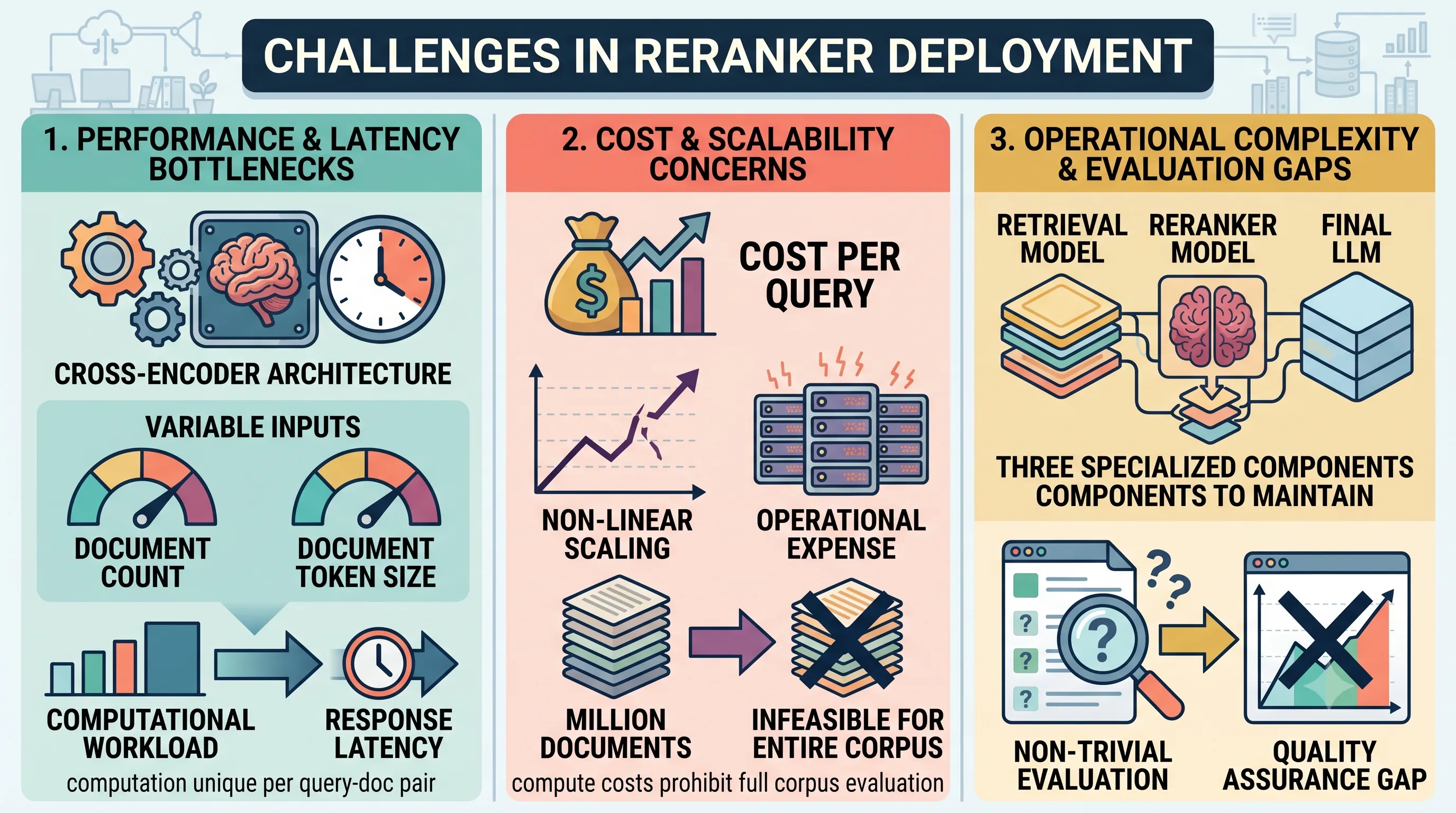
The most immediate challenge when introducing a reranker is the potential for significant latency.This delay is a direct consequence of the cross-encoder architecture commonly used by rerankers.
Unlike vector embeddings, which can be pre-calculated and stored for fast retrieval, a reranker must perform a new, intensive computation for every single query-document pair it evaluates.
This process cannot be easily saved or cached, as the relevance score is unique to the specific combination of the user's query and the candidate document.
The extent of this latency is directly affected by two key variables: the number of documents being reranked and the token size of each document.
As the quantity of documents or their length increases, the computational workload on the reranker grows, leading to longer response times for the end-user.
Cost and Scalability Concerns
Beyond performance, rerankers introduce substantial cost and scalability issues.Running a powerful reranker requires a considerable amount of computational power for every query processed, which translates directly into higher operational costs.
This problem is magnified at scale because rerankers are not inherently designed for horizontal scaling.
This architectural characteristic poses a significant challenge for engineering teams responsible for maintaining high-throughput systems, as simply adding more machines may not linearly improve performance.
The sheer computational demand makes using cross-encoders for an entire corpus infeasible; for example, attempting to rerank a corpus of one million documents would necessitate one million forward passes of the model for a single query.
Such an approach is a "non-starter" due to the prohibitive compute costs, underscoring why rerankers must be used on a small, pre-filtered subset of documents from an initial retrieval stage.
Operational Complexity and Evaluation Gaps
Integrating a reranker adds another layer of complexity to the system's infrastructure.A RAG pipeline with a reranker means the team must now manage and maintain three separate, specialized components: the initial retrieval model, the reranking model, and the final Large Language Model (LLM).
This increases the number of potential failure points and complicates monitoring and maintenance.
Furthermore, measuring the actual quality improvement from a reranker is a non-trivial task.
It requires careful, rigorous offline testing to validate that the new component is genuinely improving search relevance and not introducing unintended biases or errors.
A common issue is that organizations often lack the dedicated infrastructure and established processes needed to conduct this type of specialized evaluation, creating a gap between implementation and verifiable quality assurance.
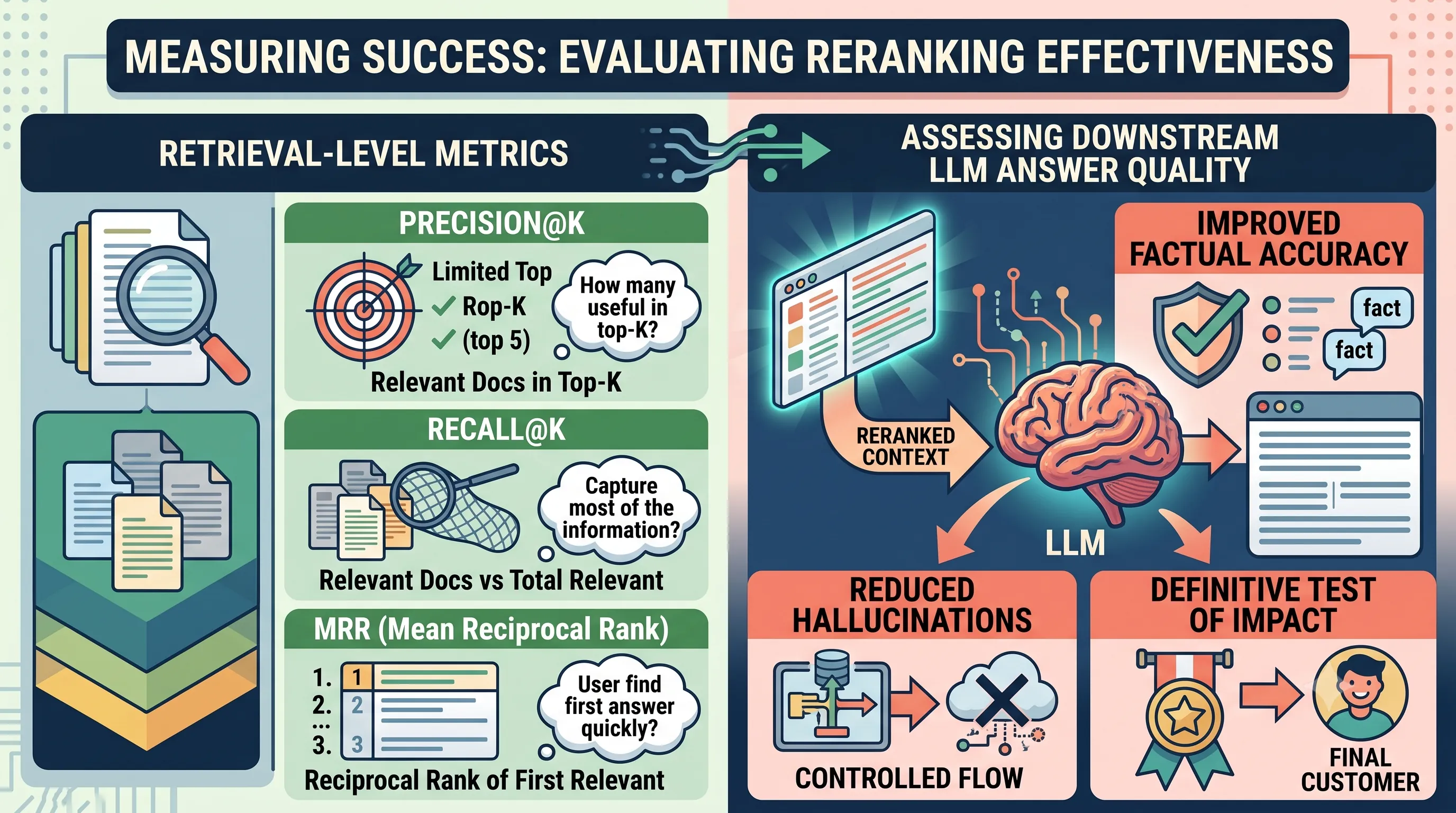
8. Measuring Success: Evaluating Reranking Effectiveness
Implementing a reranking stage is only effective if its impact can be measured.The core question to answer when evaluating a reranker is simple: Are the right documents ranking higher than before?
To answer this, evaluation must occur at two distinct levels: first, by analyzing the ranked list of documents directly, and second, by assessing the quality of the final answer generated by the Large Language Model (LLM).
Retrieval-Level Metrics for Ranked Lists
The first layer of evaluation focuses on the direct output of the reranker—the re-ordered list of documents.These retrieval-level metrics assess the quality of the search results before they are ever passed to the LLM as context, providing a clear, quantitative signal of the reranker's performance.
Key metrics include Precision@k, Recall@k, and Mean Reciprocal Rank (MRR), which together offer a comprehensive view of ranking quality.
| Metric | What It Measures | Key Question Answered |
|---|---|---|
| Precision@k | The number of relevant documents found within the top 'k' results. | Of the first few documents the system shows, how many are actually useful? |
| Recall@k | The number of relevant documents found in the top 'k' results out of the total number of relevant documents that exist in the entire dataset. | Did our top results capture most of the important information available? |
| MRR (Mean Reciprocal Rank) | The position of the single most relevant document in the ranked list. A higher score is better. | How quickly does the user find the first correct answer? |
Assessing Downstream LLM Answer Quality
While retrieval-level metrics are essential for tuning the search component, the ultimate measure of success is the quality of the final answer presented to the user.This requires a downstream evaluation where the newly reranked context is fed into the LLM to generate a response.
The quality of this output serves as the definitive test of the reranker's impact.
By reviewing the LLM's final answer, teams can determine the reranker's condition, specifically looking for improved accuracy and a reduction in hallucinations.
If the answers are more factual and less prone to invention, it is a strong indicator that the reranker is successfully prioritizing the most relevant and supportive context documents.
9. Strategic Reranking: Best Practices and Model Selection
This section delves into the practical implementation of the second stage in our search pipeline: reranking. While the initial retrieval stage casts a wide net, reranking is the crucial refinement step that ensures only the most contextually relevant documents reach the user or the language model. We will cover how to optimize this process, select the right model for your needs, and establish a framework for continuous improvement. This directly addresses our main topic by providing the technical strategy to fix the problem of a chatbot returning irrelevant documents retrieved in the first stage.Optimizing Retrieval and Reranking Parameters
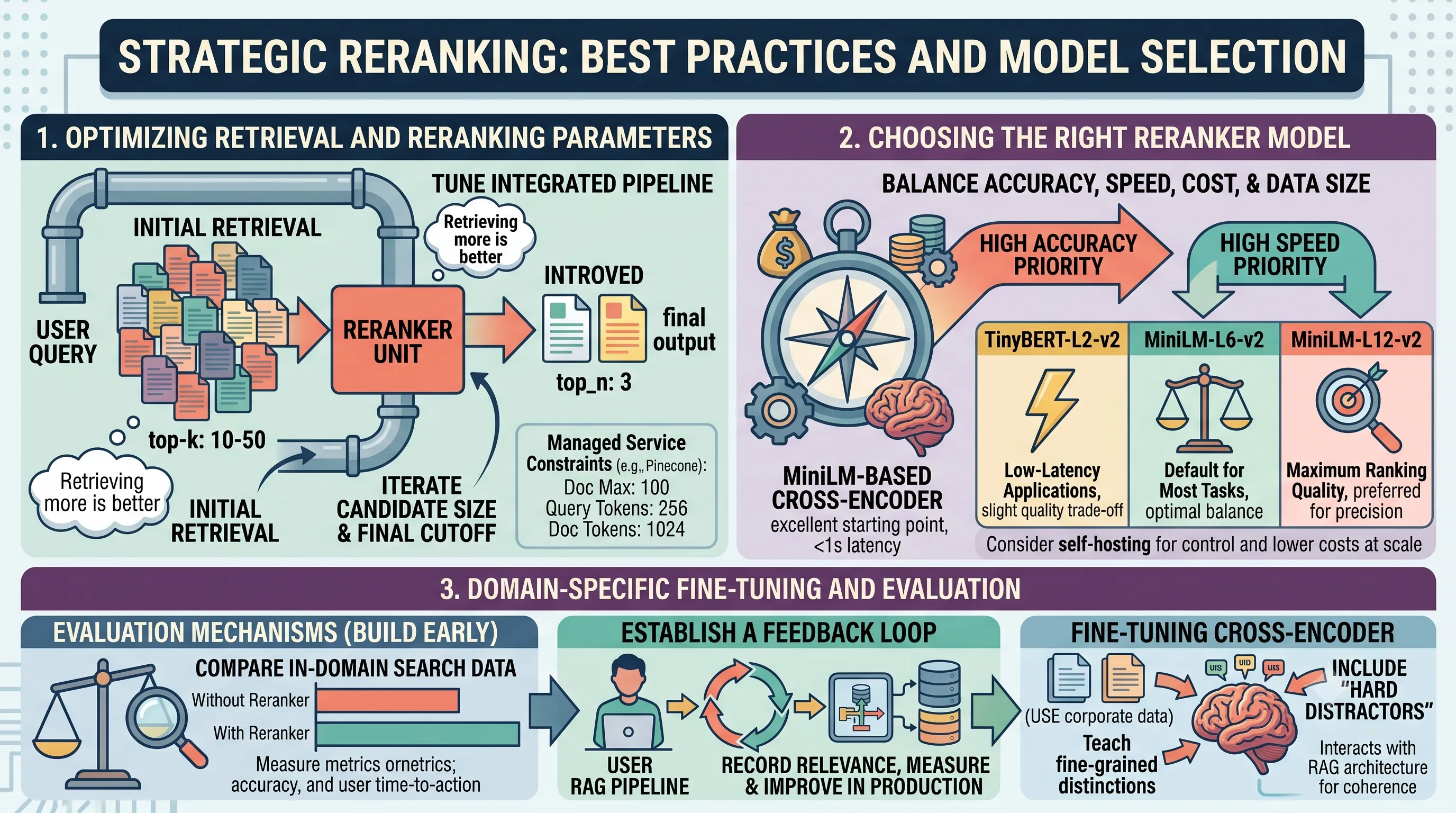
A reranker's effectiveness is fundamentally limited by the quality and quantity of documents it receives from the initial retrieval stage. Therefore, the first best practice is to retrieve more documents than you initially think is necessary. A reranker cannot find a relevant document if it was never retrieved in the first place.To facilitate this deeper relevance search, project teams should raise the number of retrieved `top-k` results from a standard of 3-5 to a more generous 10 or even 50. This provides the reranker with a richer pool of candidates to sift through. From this larger set, you can then experiment with different `top_n` values for the final output, often starting with small, practical values like a `top_k` of 10 and a `top_n` of 3. The key is to iterate on this candidate size and the final cutoff thresholds to discover the optimal configuration for your specific data and use case.
It is also vital to treat reranking as one integrated part of a larger system. The retrieval, reranking, and generation components must be tuned together as a cohesive pipeline for best results. When using managed services, be mindful of their specific limitations, as these will define your operational boundaries. For instance, the Pinecone Rerank endpoint imposes a maximum of 100 documents for reranking, with a maximum query token limit of 256 and a document token limit of 1024 per document.
Choosing the Right Reranker Model
Selecting the appropriate reranker model requires balancing accuracy, speed, cost, and data size. The choice should be driven by the specific application's requirements. For use cases where accuracy is the highest priority, a cross-encoder model is the standard choice. For applications demanding higher speed, a lighter model like MiniLM is a more suitable option.Several factors should guide your decision:
- Data Size: Operations with smaller, manageable datasets can afford the computational expense of heavier cross-encoder models. In contrast, larger companies processing vast amounts of data may need leaner options, such as bi-encoders or more lightweight cross-encoders, to maintain performance.
- Latency Budget: The application's required response time is a critical constraint. If your system needs to deliver answers in under a second, a MiniLM-based cross-encoder serves as an excellent starting point.
- Cost: Teams must weigh the cost implications of using a third-party API-based model versus a self-hosted one. While APIs offer convenience, self-hosting can provide more control and potentially lower costs at scale.
| Model Recommendation | Primary Use Case | Description |
|---|---|---|
| TinyBERT-L2-v2 | Low-Latency Applications | Recommended when speed is the most critical factor and a slight trade-off in quality is acceptable. |
| MiniLM-L6-v2 | Default for Most Tasks | Considered the best starting point, offering an optimal balance between ranking speed and quality. |
| MiniLM-L12-v2 | Maximum Ranking Quality | The preferred choice when maximizing the accuracy and relevance of the final ranked results is paramount. |
Domain-Specific Fine-tuning and Evaluation
To truly validate the impact of a reranker, it is essential to build evaluation mechanisms early in the development process, well before scaling the system. A robust evaluation framework allows you to quantify the benefits and justify the added complexity. A core practice is to re-evaluate a set of in-domain search data both with and without the reranker in place. This comparison should include metrics for accuracy, relevance, and, importantly, the time it takes for a user to act on the result, providing a clear picture of its real-world value.Furthermore, establishing a feedback loop is critical for long-term success. You should record the relevance of documents for downstream users and the RAG pipeline itself. This data is invaluable for tweaking the reranker and initial query calls, enabling you to measure and improve effectiveness in production continuously.
When general models perform poorly on your specialized corporate data, fine-tuning a cross-encoder on domain-specific data can significantly improve its performance. The key to successful fine-tuning is the quality of the training data. It is crucial to include "hard distractors"—documents from the same domain that are plausible but ultimately incorrect answers. These examples are vital for teaching the model to learn the fine-grained distinctions necessary for high-precision ranking in your specific context. Finally, it is important to understand how your reranking strategy interacts with different RAG architectures to ensure system-wide coherence.
10. When to Skip Reranking: Identifying Non-Essential Scenarios
While the main focus of this article is on designing a robust two-stage retrieval and reranking pipeline, it is equally important to understand when this complexity is unnecessary.Adding a reranking layer introduces computational overhead and maintenance costs, which may not be justifiable in every situation.
This section identifies specific scenarios where the initial retrieval stage alone is sufficient, allowing teams to build more efficient and cost-effective systems.
Simplicity and Data Characteristics
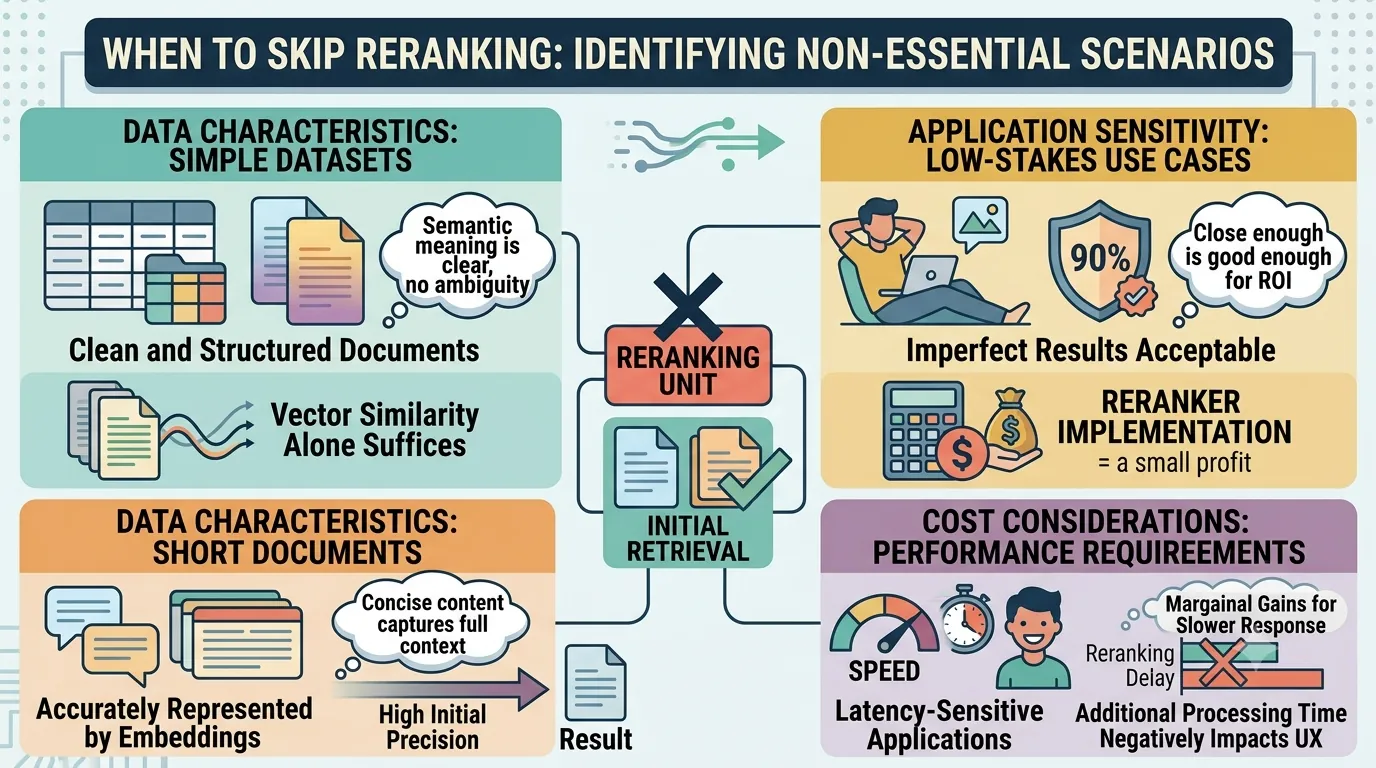
The nature of your data corpus is a primary factor in determining the need for a reranking model.For instance, reranking may not be needed with simple datasets where documents are clean and well-structured.
In such cases, the semantic meaning is clear, and vector similarity alone is often sufficient to identify the most relevant results without ambiguity.
This principle also applies to the length of the documents.
Reranking can be unnecessary for short documents that are accurately represented by vector embeddings.
When a document is concise, its embedding can effectively capture the entire semantic context, leading to a highly precise initial retrieval that a second-pass analysis is unlikely to improve upon.
Application Sensitivity and Cost Considerations
Beyond the data itself, the specific application and its operational constraints play a critical role in this decision.In low-stakes use cases, where slightly imperfect results are acceptable, reranking may be an expensive solution.
A common example is an internal knowledge base for non-critical information; if the initial search gets the user 90% of the way to the right answer, the cost of implementing a reranker to close that final 10% gap may not deliver a worthwhile return on investment.
Finally, performance requirements can make reranking impractical.
For latency-sensitive applications where retrieval quality is already acceptable, reranking might not be required.
The additional processing time introduced by the reranker could negatively impact the user experience by creating a noticeable delay, making the trade-off of marginal accuracy gains for slower response times an undesirable one.
11. Implementing the 2-Stage Retrieval Pipeline with Reranking
This section details the standard production architecture for solving the problem of irrelevant document retrieval outlined in our main topic, 'When the Internal Chatbot Retrieves Odd Documents: Designing a 2-Stage Retrieval & Re-rank Pipeline'.We will break down the two-stage retrieval and reranking pattern, which directly addresses how to refine search results before they are passed to a language model, ensuring higher accuracy and relevance.
The Architecture of Two-Stage Retrieval
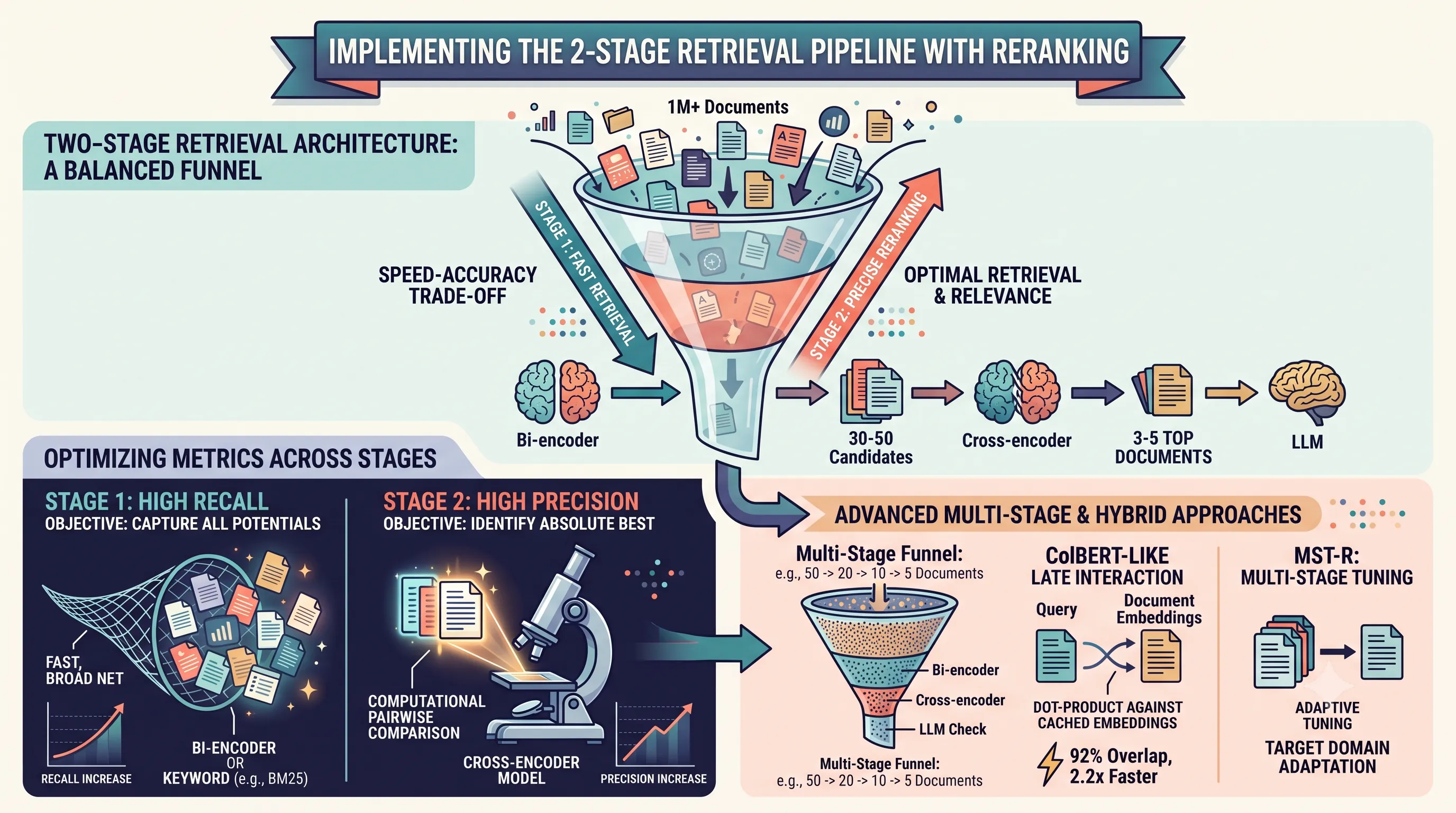
The most effective way to improve the quality of documents fed to a Large Language Model (LLM) is to adopt a two-stage retrieval pattern, a standard and proven approach in production environments.This architecture is designed to balance the trade-off between speed and accuracy by using different models for different tasks.
The core idea is that a combination of fast but less precise bi-encoders and slower but more accurate cross-encoders can achieve optimal retrieval and relevance performance.
This methodology is widely recognized in the industry; for instance, Pinecone describes its built-in reranking feature as “a two-stage vector retrieval process to improve the quality of results”.
The entire process functions as a funnel, where a large number of potential documents are quickly identified and then meticulously filtered down to the most relevant few.
Optimizing Recall and Precision in Stages
The two-stage pattern is explicitly divided to maximize two different metrics: recall in the first stage and precision in the second.Stage 1: Fast Retrieval for High Recall
The first stage acts as a broad net to capture all potentially relevant documents.
Its primary goal is high recall, meaning it prioritizes not missing any correct answers, even if it means including some irrelevant ones.
This is accomplished using fast, approximate retrieval methods like a bi-encoder, which independently creates embeddings for the query and documents, or a traditional keyword-based system like BM25.
In a typical production setup, this initial stage retrieves a candidate set of 30-50 documents.
Stage 2: Precise Reranking for High Precision
The second stage takes the candidate set from Stage 1 and focuses on high precision.
Its goal is to identify the absolute best matches from the initial pool.
This is achieved by using a more computationally intensive model, a cross-encoder, which runs a pairwise comparison by processing the query and each candidate document together.
This direct interaction allows the cross-encoder to generate a much more accurate relevance score.
After this precise reranking, the list is narrowed down to the top 3-5 documents, which are then passed to the LLM for generation.
Advanced Multi-Stage Funnels and Hybrid Approaches
The two-stage concept can be extended into a more granular multi-stage funnel, where each successive stage trades more computational time for higher precision as the candidate set shrinks.For example, a sophisticated pipeline could start with 50 documents retrieved via a fast method, which are then reduced to 20 by a bi-encoder, further refined to 10 by a cross-encoder, and finally narrowed to the top 5 by an LLM itself performing a final check.
More advanced techniques like ColBERT-like late interaction models offer a compelling balance between the speed of bi-encoders and the accuracy of cross-encoders.
This approach works by allowing documents to be pre-indexed and their embeddings cached offline.
At search time, only the user's query needs to be encoded (a single forward pass), after which fast dot-product operations are run against the cached document embeddings.
This method is highly efficient, achieving a 92% top-5 result overlap with the quality of a full cross-encoder while being 2.2 times faster per query.
Further advancing this field, systems like MST-R demonstrate how a multi-stage tuning strategy can be used to adapt a retriever's performance specifically to a target domain, ensuring the pipeline is optimized for the unique data it will encounter.
References
- https://www.pinecone.io/learn/refine-with-rerank/
- https://towardsdatascience.com/advanced-rag-retrieval-cross-encoders-reranking/
- https://www.meilisearch.com/blog/rag-reranking
- Hybrid Search and Re-ranking in Production RAG 2026: BM25, Dense, …
- From BM25 to Corrective RAG: Benchmarking Retrieval Strategies for …
- Dense vs. Sparse Retrieval: What They Are, Differences, and Best …
- Dense Retrieval vs Sparse Retrieval Explained for RAG
- MST-R: Multi-Stage Tuning for Retrieval Systems and Metric Evaluation
- MST-R: Multi-Stage Tuning for Retrieval Systems and Metric …
- Evaluation Metrics for Assessing the Effectiveness of Information …
- MST-R: Multi-Stage Tuning for Retrieval Systems and Metric …
Related Posts

MiniMax M3 Unleashed: Open-Weight AI Model with 1M Context, Multimodal, Coding, and Autonomous AI AgentsMiniMax has released M3 , an open-weight AI model integrating a 1-million-token context, native...

NVIDIA & Microsoft Launch RTX Spark: AI Agent PCs with 1 PFLOPS Local Power, Ultimate Privacy, and 128GB Memory for Creators & GamersNVIDIA and Microsoft are launching the RTX Spark platform, ushering in an era of 'AI Agent PCs'...

OpenAI's Real-time Voice AI Trio: GPT-5 Reasoning, 128K Context & Agent Shift with Global TranslationOpenAI has unveiled three new real-time voice AI models (GPT-Realtime-2, GPT-Realtime-Translate,...