
Meta's Muse Code & Spark 1.2 Launch: AI Coding Agent Battles Rivals with Async Architecture & Disruptive Pricing
🚀 Key Takeaways
- Meta has launched Muse Code, a terminal-based AI coding agent, and Muse Spark 1.2, a specialized coding model, today, August 7, 2026.
- This release positions Meta in direct competition with leading AI coding agents from Anthropic and OpenAI.
- Muse Code features a novel architecture utilizing persistent, asynchronous background agents to enhance efficiency and reduce redundant information gathering.
- It includes capabilities like parallel sub-agents with isolated git worktrees and a comprehensive, replay-exact event log for full auditability.
- Muse Spark 1.2, co-trained with Muse Code, received significantly scaled training compute on coding tasks, improving generation and debugging.
- Meta offers Muse Spark 1.2 through its API in Standard and a deeply discounted Contributor tier, exchanging data for lower costs.
- The system demonstrated exceptional long-horizon performance, achieving substantial, non-obvious optimizations over 24-hour autonomous runs.
Meta has made a profound statement in the AI coding domain today, August 7, 2026, by launching its new terminal-based AI coding agent, Muse Code, alongside the highly anticipated Muse Spark 1.2 frontier model.
This strategic release marks the company's most serious entry into the competitive landscape of autonomous coding tools, directly challenging established players like Anthropic’s Claude Code and OpenAI’s Codex.
The introduction of Muse Code and Muse Spark 1.2 is significant not only for its advanced technical capabilities, such as a unique architecture featuring persistent async background agents and demonstrated long-horizon problem-solving, but also for what it reveals about Meta's evolving AI strategy.
Moving towards proprietary, cloud-centric models, Meta aims to redefine developer workflows and establish a new benchmark for efficiency and reliability in software engineering.
With aggressive API pricing tiers, including a highly economical contributor option, Meta is poised to disrupt the market by making powerful AI coding assistance accessible, while also gathering crucial data for future model advancements.
This strategic release marks the company's most serious entry into the competitive landscape of autonomous coding tools, directly challenging established players like Anthropic’s Claude Code and OpenAI’s Codex.
The introduction of Muse Code and Muse Spark 1.2 is significant not only for its advanced technical capabilities, such as a unique architecture featuring persistent async background agents and demonstrated long-horizon problem-solving, but also for what it reveals about Meta's evolving AI strategy.
Moving towards proprietary, cloud-centric models, Meta aims to redefine developer workflows and establish a new benchmark for efficiency and reliability in software engineering.
With aggressive API pricing tiers, including a highly economical contributor option, Meta is poised to disrupt the market by making powerful AI coding assistance accessible, while also gathering crucial data for future model advancements.
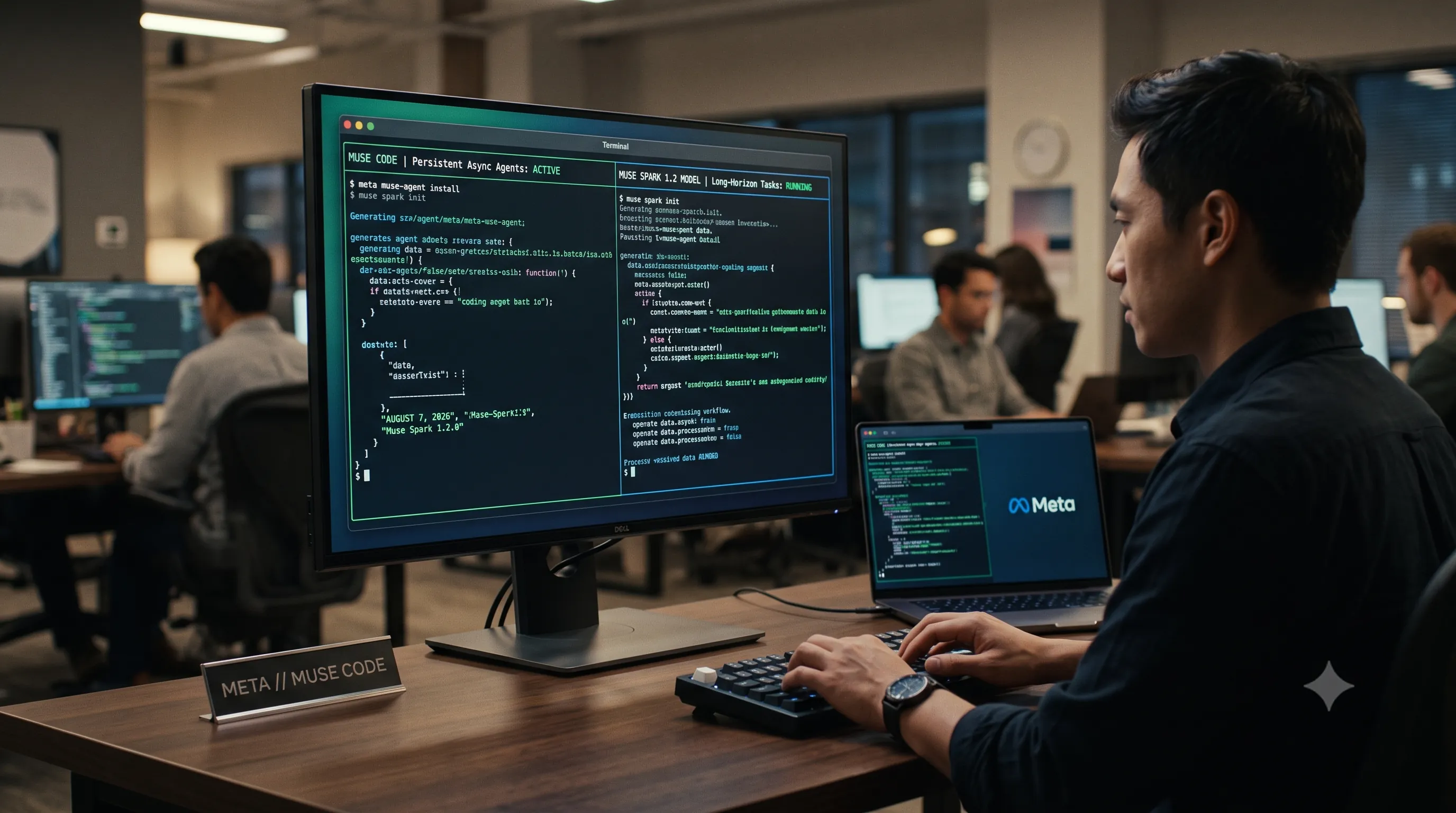
1. Meta Enters the Coding Agent Arena: Muse Code and Muse Spark 1.2 Launch
This section details the significant announcement from Meta on August 7, 2026, introducing its new AI coding tools. It establishes the context for the main article's deep-dive by outlining the products, their strategic positioning against rivals like Anthropic's Claude Code, and the company's vision for this new frontier in AI-assisted software development.A New Contender: Muse Code's Role
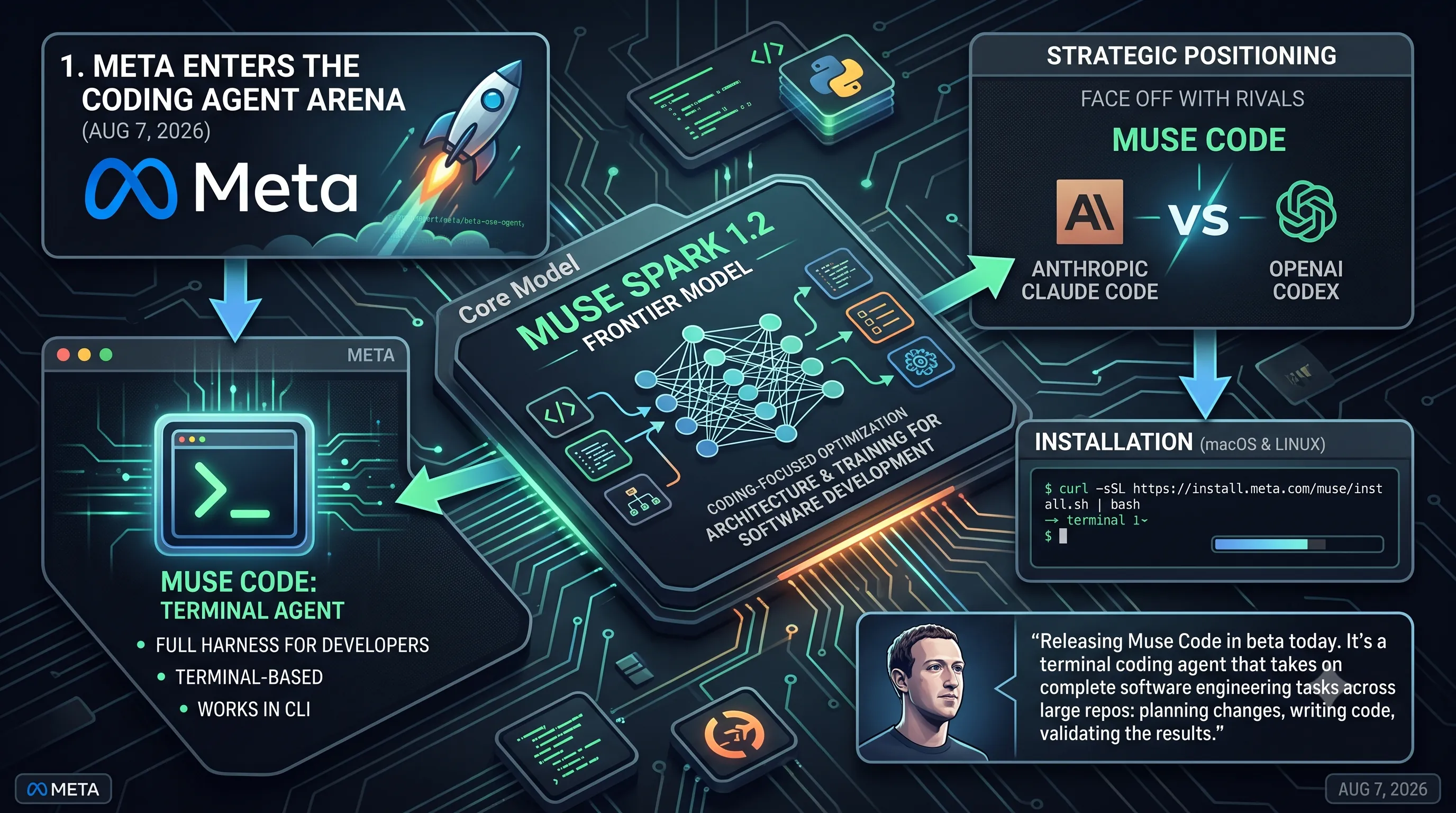
Meta has officially entered the competitive AI coding agent arena with the release of Muse Code on August 7, 2026.This launch marks the company's most serious effort to date in the coding assistant category, positioning it in direct competition with established players like Anthropic's Claude Code and OpenAI's Codex.
Muse Code is designed as a terminal-based AI coding agent, functioning as a complete system, or "full harness," for developers working directly in their command-line environment.
Muse Spark 1.2: A Coding-Focused Evolution
Released concurrently with the agent is Muse Spark 1.2, the frontier model that powers Muse Code.This new iteration represents a coding-focused update to the broader Muse Spark family of models.
Meta has specifically optimized Muse Spark 1.2 for coding work, tailoring its architecture and training to handle the complexities of software development tasks.
Proprietary Power Play and Installation
Unlike some of Meta's previous open-source AI efforts, both Muse Code and the underlying Muse Spark 1.2 model are entirely proprietary.Muse Spark 1.2 is a closed-weight model, meaning its internal architecture and parameters are not publicly available.
Despite its proprietary nature, access is streamlined for developers; Muse Code, which is currently in beta, can be installed on macOS or Linux systems with a single curl command directly in the terminal.
Zuckerberg's Vision for AI Software Engineering
In a statement accompanying the launch, CEO Mark Zuckerberg outlined the ambitious scope of the new tool."Releasing Muse Code in beta today," Zuckerberg stated. "It's a terminal coding agent that takes on complete software engineering tasks across large repos: planning changes, writing code, validating the results."
This vision frames Muse Code not as a simple autocomplete tool, but as a comprehensive assistant capable of managing complex, multi-step development workflows from planning to validation.
2. Beyond the Terminal: Muse Code's Asynchronous Architecture for Autonomous Coding
This section explores the fundamental architectural bets Meta has placed on Muse Code, focusing on its persistent, asynchronous agent model which underpins its autonomous capabilities and sets it apart from traditional request-response coding assistants.Asynchronous Agents: A Core Innovation for Persistent Sessions
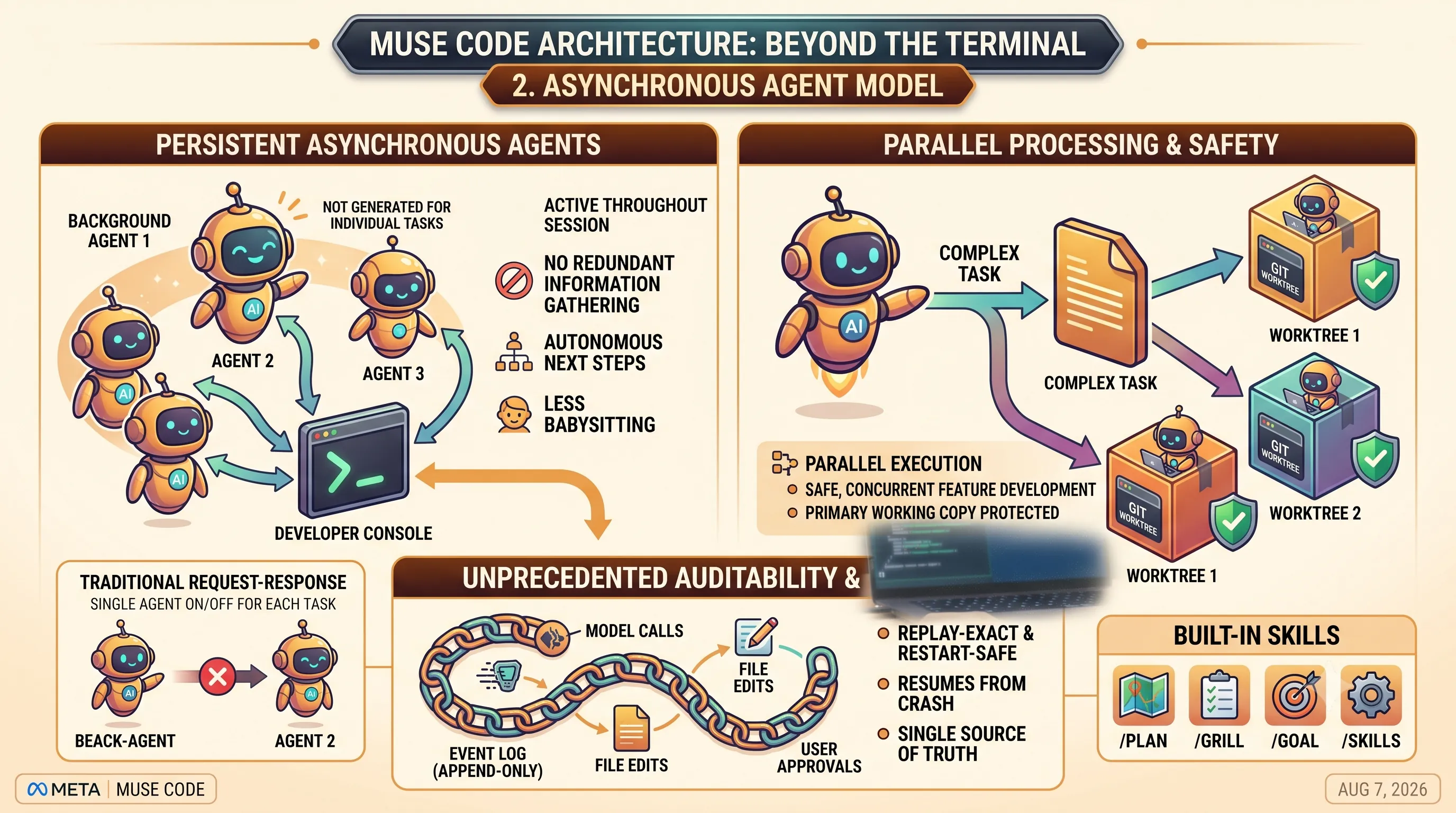
Muse Code’s headline architectural bet is its use of asynchronous background agents.Instead of being created and destroyed for each individual task, Muse Code keeps a set of specialized background agents alive for the entire duration of a developer's session.
According to Meta's blog post, these agents "remain active throughout each session, rather than being spawned for individual tasks, helping avoid redundant information gathering."
This persistent state allows the agents to carry out next steps autonomously and intelligently choose when to report back to the main agent, or the user.
The primary benefit is a significant reduction in redundant computation; for example, an agent that has already familiarized itself with a repository does not need to re-explore it for subsequent requests within the same session.
Ultimately, this design results in lower latency and requires far less developer "babysitting" compared to systems that need constant prompting and context-reloading.
Parallel Processing with Isolated Worktrees
For large, complex jobs, Muse Code is engineered to scale its efforts efficiently and safely.The system can fan out a single large task to separate sub-agents that work in parallel.
To ensure the integrity of the developer's environment, each sub-agent operates within its own isolated git worktree.
This critical safety feature guarantees that the developer's primary working copy is never touched directly by the automated processes, preventing accidental overwrites or conflicts.
Unprecedented Auditability and Resilience
A core tenet of Muse Code's design is robust auditability and fault tolerance.This is achieved through a local, append-only event log which serves as the single source of truth for the system's runtime.
Every model call, tool run, user approval, and file edit is appended to this log before it is executed.
Meta states this architecture makes the runtime "replay-exact and restart-safe."
In practice, this means that if Muse Code crashes or is interrupted, it can resume precisely where it stopped by replaying the event log, ensuring no work is lost and the state is perfectly restored.
Built-in Skills for Enhanced Productivity
To streamline common development workflows, Muse Code ships with a set of bundled "skills" that can be invoked by the user or other agents.These pre-packaged capabilities provide structured ways to approach complex coding tasks.
| Bundled Muse Code Skills |
|---|
| /plan |
| /grill |
| /goal |
Zuckerberg on Concurrent Feature Development
The power of Muse Code's parallel, isolated architecture was highlighted by Mark Zuckerberg, who noted its performance in complex, multi-threaded development scenarios.He stated, "In testing we had it build six features for a game simultaneously with no collisions."
3. Engineering Excellence: How Muse Spark 1.2 Optimized for Coding Prowess
This section details the specific engineering philosophy and training methodologies Meta employed to evolve Muse Spark from its initial release into a specialized, high-performance coding agent, directly addressing the competitive landscape defined by models like Claude Code.From 1.1 to 1.2: A Leap in Coding Performance
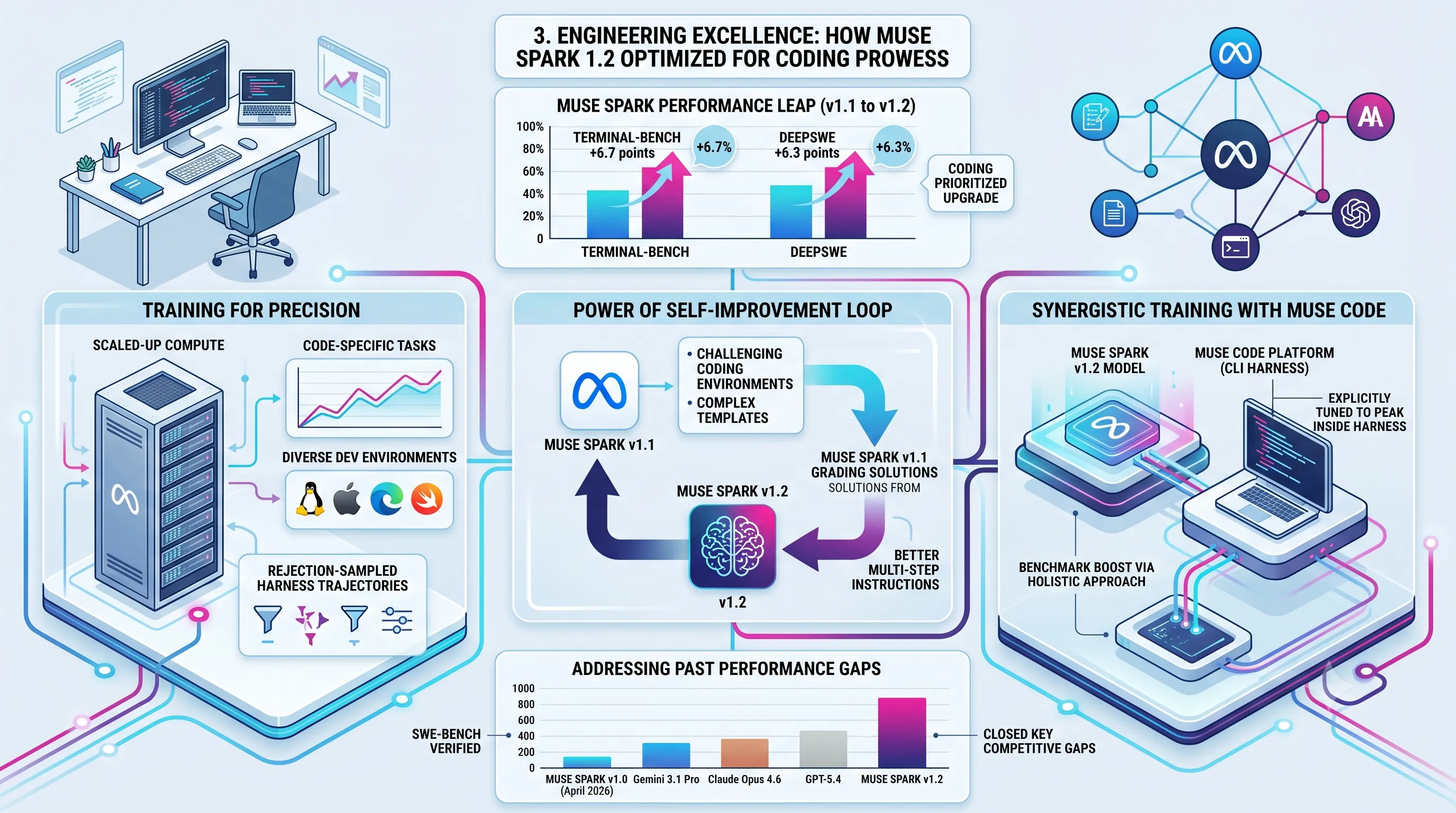
Muse Spark 1.2 is not a generalist update; it is a coding-focused enhancement designed to build upon the foundation of version 1.1.The results of this specialized effort are quantifiable through significant benchmark improvements.
Specifically, Muse Spark 1.2 demonstrates a 6.7-point improvement over its predecessor on Terminal-Bench and a 6.3-point jump on DeepSWE.
These scores reflect tangible gains in the model's core development capabilities, including more accurate code generation, the ability to navigate complex debugging scenarios, and a deeper understanding of existing codebases.
While the model maintains its general agentic capability, this update prioritizes engineering prowess above all.
| Benchmark | Improvement from Muse Spark 1.1 to 1.2 |
|---|---|
| Terminal-Bench | +6.7 points |
| DeepSWE | +6.3 points |
Training for Precision: Code-Specific Optimizations
The performance leap in Muse Spark 1.2 was achieved through a multi-pronged training strategy.Meta significantly scaled up the training compute allocated specifically to coding tasks, a resource-intensive decision that signals the company's commitment to this domain.
This was complemented by training on a broader diversity of development environments, exposing the model to a wider range of software stacks and configurations than before.
Advanced techniques were also employed, including the use of rejection-sampled harness trajectories to refine the model's decision-making process.
Furthermore, Meta implemented "recipe optimizations" targeting key agentic functions such as goal setting, context compaction for handling large codebases, and the effective use of sub-agents.
The Power of Self-Improvement Loops
A key innovation in the development of Muse Spark 1.2 was Meta's use of a self-improvement or "self-play" loop.In this process, the predecessor model, Muse Spark 1.1, was tasked with generating challenging coding environments and complex instruction-following templates.
Muse Spark 1.1 was then used to grade the quality of candidate solutions generated for these difficult tasks.
This methodology created a highly effective and scalable training dataset for its successor.
The direct outcome of this loop was that Muse Spark 1.2 became measurably better at following complex, multi-step instructions, a critical skill for sophisticated software engineering tasks.
Addressing Past Performance Gaps
Meta's focused effort with version 1.2 appears to be a direct response to the performance of the original Muse Spark, which debuted in April.The initial model trailed key competitors on important agentic coding evaluations.
For instance, the original Muse Spark scored 77.4 on SWE-Bench Verified, whereas Claude Opus 4.6 achieved an 80.8 and Gemini 3.1 Pro scored 80.6.
It also lagged behind GPT-5.4 on GDPval's measure of long-horizon work tasks, indicating a performance deficit in sustained, complex projects.
The development of Muse Spark 1.2 was clearly aimed at closing these specific competitive gaps.
Synergistic Training with Muse Code
The enhancements in Muse Spark 1.2 cannot be viewed in isolation from its execution environment.The model was co-trained with the Muse Code platform itself, creating a deeply synergistic relationship.
This means Muse Spark 1.2 was explicitly tuned to perform at its peak when operating inside Muse Code.
Meta acknowledges that this holistic approach is a factor in the new benchmark scores; some of the measured improvement from version 1.1 to 1.2 is attributable to the new Muse Code harness, not solely the standalone model.
4. The Competitive Edge: Muse Spark 1.2's Benchmark Showdown
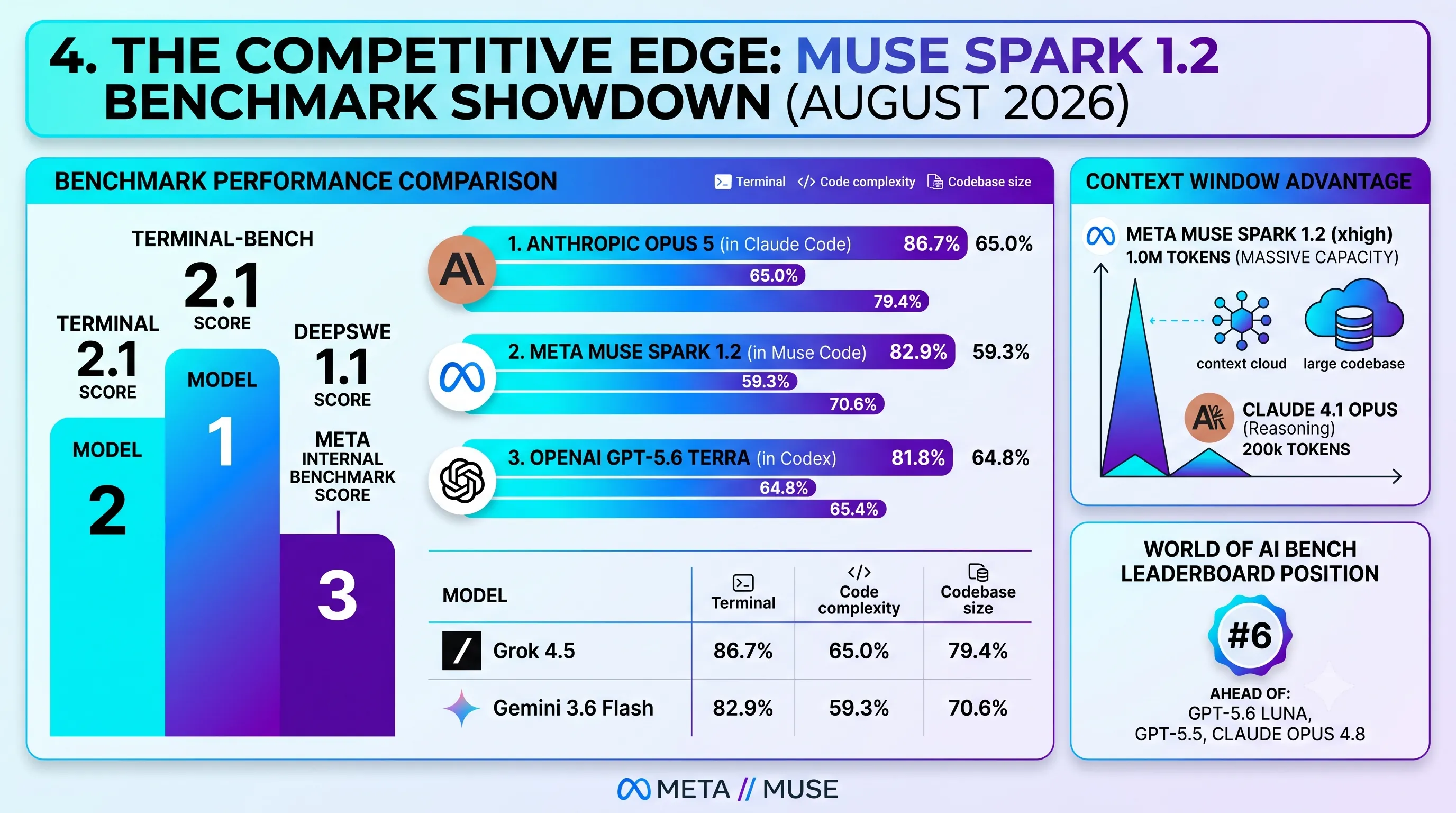
This section delves into the quantitative performance of Muse Spark 1.2, anchoring the main article's thesis that Meta is making a significant play against competitors, especially Anthropic's Claude series.Meta published a series of benchmark charts that position Muse Spark 1.2 in a strong but clear second place overall, consistently trailing the leader, Anthropic's Opus 5, but establishing a competitive edge over other major players in the field.
The following data, drawn from these charts, illuminates the model's capabilities across several industry-standard and internal tests.
| Model | Terminal-Bench 2.1 Score | DeepSWE 1.1 Score | Meta Internal Benchmark Score |
|---|---|---|---|
| Anthropic Opus 5 (in Claude Code) | 86.7% | 65.0% | 79.4% |
| Meta Muse Spark 1.2 (in Muse Code) | 82.9% | 59.3% | 70.6% |
| OpenAI GPT-5.6 Terra (in Codex) | 81.8% | 64.8% | 65.4% |
| xAI Grok 4.5 (in Grok Build) | 81.6% | N/A | N/A |
| Google Gemini 3.6 Flash | N/A | N/A | 63.9% |
Benchmarking Against the Best: Terminal-Bench 2.1
On the Terminal-Bench 2.1, a key indicator of command-line and terminal operation proficiency, Muse Spark 1.2 achieved an impressive score of 82.9% when running in the Muse Code environment.While this places it firmly behind Anthropic's Opus 5, which scored a leading 86.7%, it notably outperforms its other major rivals.
Specifically, it scored higher than OpenAI's GPT-5.6 Terra at 81.8% and xAI's Grok 4.5, which registered 81.6%.
DeepSWE 1.1: Assessing Complex Coding Skills
The DeepSWE 1.1 benchmark, designed to evaluate complex software engineering tasks, reveals a similar competitive landscape.Muse Spark 1.2 posted a score of 59.3%.
On this more challenging test, the gap to the leaders is more pronounced, with Opus 5 scoring 65.0% and GPT-5.6 Terra achieving a very close 64.8%.
This result shows that while capable, Muse Spark 1.2 has room to grow in handling highly intricate coding problems compared to the top-tier models.
Meta's Internal Coding Metrics
According to Meta's own internal coding benchmark, Muse Spark 1.2 scored 70.6%, demonstrating strong performance on tasks tailored to Meta's specific engineering needs.Once again, it secured the second-place position behind Opus 5, which achieved a dominant 79.4%.
However, it established a clear lead over both GPT-5.6 Terra, which scored 65.4%, and Gemini 3.6 Flash at 63.9% on this same internal test.
Context Window Advantage
Beyond pure performance metrics, Muse Spark 1.2 (in its xhigh configuration) boasts a massive 1.0M token context window.This provides a significant advantage for developers working with large codebases, allowing the model to process and reason over extensive project files in a single pass.
For comparison, a powerful previous-generation model like Claude 4.1 Opus (Reasoning) supports a 200k token context window, highlighting the substantial leap in capacity offered by Meta's new model.
World of AI Bench Leaderboard Position
The composite results from various benchmarks place Muse Spark 1.2 at a respectable #6 on the World of AI Bench Coding Composite Leaderboard.This ranking is particularly noteworthy as it positions the model ahead of several formidable competitors, including OpenAI's GPT-5.6 Luna and GPT-5.5, as well as Anthropic's own Claude Opus 4.8, underscoring its solid standing in the highly competitive AI coding landscape as of August 2026.
5. Strategic Value: Muse Spark 1.2 Pricing and Data Policy Unpacked
This section unpacks the commercial and strategic framework of Muse Spark 1.2, detailing the pricing tiers, data policies, and rate limits that define how developers can access its capabilities.This analysis of the Meta Model API's structure is critical to understanding the main article's topic, as it reveals Meta's strategy for user acquisition and data collection in its competition against established players like Anthropic's Claude.
Dual-Tier Access: Standard vs. Contributor
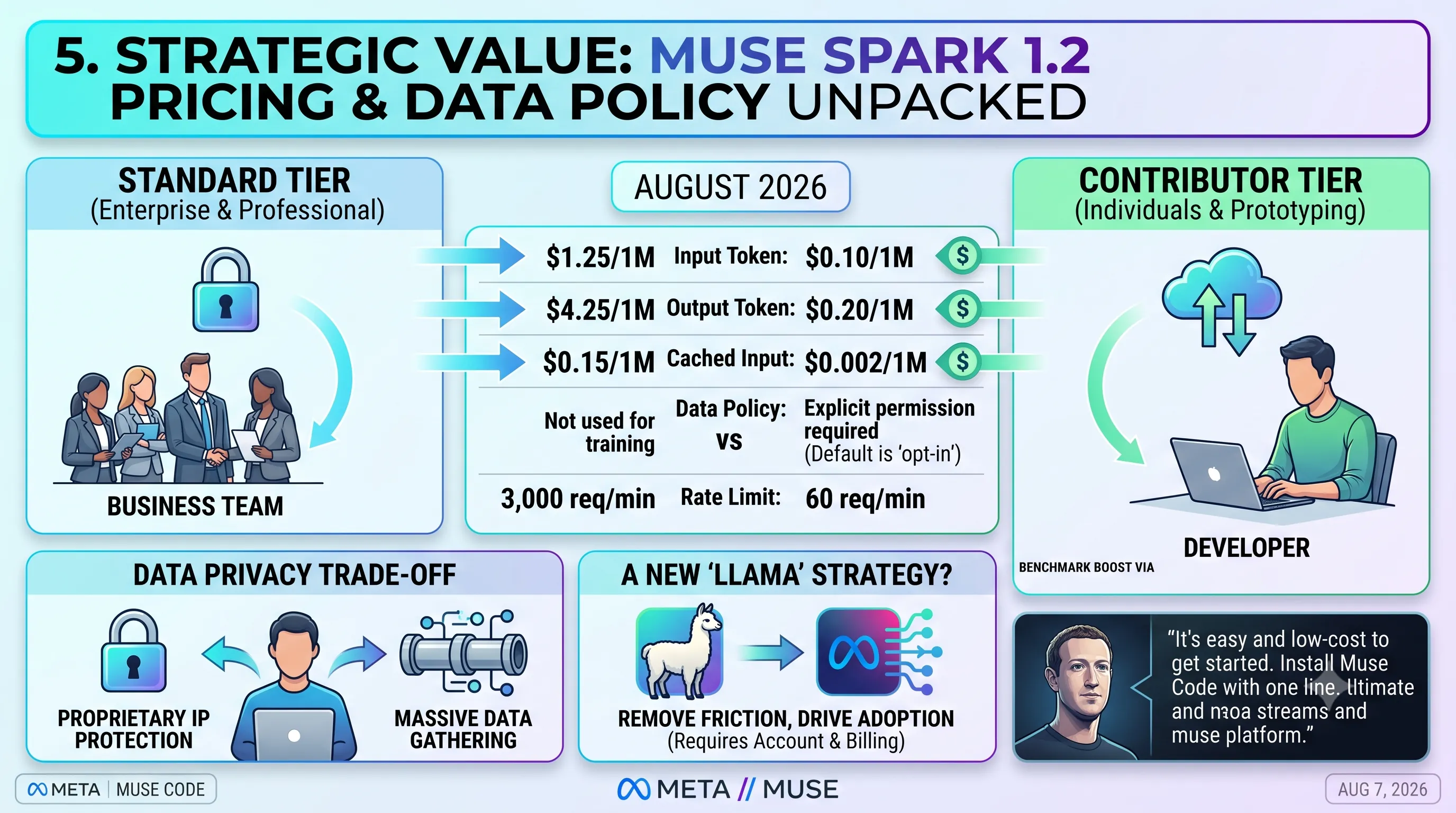
Meta is offering access to Muse Spark 1.2 through its Meta Model API, which is structured into two distinct tiers: Standard and Contributor.This dual-tier approach serves two different market segments simultaneously.
The Standard tier is positioned for professional and enterprise use, offering robust performance and a strong data privacy guarantee.
In contrast, the Contributor tier is designed to lower the barrier to entry for individuals, hobbyists, and those in the early stages of development, framing it as an ideal platform for prototyping and experimentation.
Pricing Breakdown: Input and Output Tokens
The cost difference between the two tiers is substantial and clearly delineates their intended audiences.The Standard tier is priced in the mid-range compared to other leading AI models, with input tokens costing $1.25 per million and output tokens costing $4.25 per million.
It also offers cached input at $0.15 per million tokens and, notably, does not charge a premium for long-context requests.
The Contributor tier offers a dramatic price reduction in a clear exchange for data.
Input tokens are just $0.10 per million (roughly 12 times cheaper than Standard), and output tokens are $0.20 per million (approximately 21 times cheaper).
Cached input is a negligible $0.002.
This makes the Contributor tier the cheapest available on the market for this level of capability.
| Feature | Standard Tier | Contributor Tier |
|---|---|---|
| Input Token Price | $1.25 per 1M tokens | $0.10 per 1M tokens |
| Output Token Price | $4.25 per 1M tokens | $0.20 per 1M tokens |
| Cached Input Price | $0.15 per 1M tokens | $0.002 per 1M tokens |
| Data Usage Policy | Prompts and completions are NOT used to train Meta models. | Requires explicit permission to use prompts and completions for model training. |
| Rate Limit | 3,000 requests / 4 million tokens per minute (per team) | 60 requests per minute |
Data Privacy vs. Cost Efficiency
The core strategic trade-off is between data privacy and cost.The Standard tier comes with a firm commitment that user prompts and model completions will not be used to train any of Meta's models, a critical requirement for enterprises handling proprietary codebases or sensitive information.
Conversely, the Contributor tier's radically lower pricing is explicitly conditional; users must grant Meta permission to use their prompts and completions to train future models.
Critically, the default on-ramp for developers using Muse Code sends their code and prompts directly into Meta's training pipeline.
This means that businesses must make a conscious decision to opt out of data sharing by moving to the Standard pricing tier to protect their intellectual property.
Rate Limits and Use Cases
The performance limits of each tier further reinforce their designated roles.The Standard tier is built for production workloads, offering high rate limits of 3,000 requests and 4 million tokens per minute, per team.
This is sufficient for scaling applications with significant user traffic.
The Contributor tier, however, is capped at a much lower 60 requests per minute.
This lower limit makes it suitable for its stated purpose—individual development, small experiments, and prototyping—but impractical for production-level applications.
The Contributor Tier: A New 'Llama' Strategy?
Meta's strategy with the Contributor tier appears to be a new twist on its successful open-source Llama playbook: remove friction to drive mass adoption.As Mark Zuckerberg stated, "It's easy and low-cost to get started. Install Muse Code with one line and you can start on our contributor tier."
This approach creates an extremely accessible entry point that encourages widespread experimentation.
However, unlike a free open-source model, this requires users to log in with a Meta account and provide billing details.
Even for the heavily discounted Contributor tier, a payment method must be on file, ensuring Meta has a direct commercial relationship with every user from the outset while creating a powerful data-gathering engine for improving its next generation of models.
6. A Strategic Pivot: Meta's Retreat from Open Source AI
This section analyzes Meta's significant shift away from its foundational open-source AI strategy, a pivot that provides the crucial context for why the new Muse Code and Muse Spark 1.2 are proprietary models.It contrasts the company's Llama-era advocacy for open AI with its current closed-source direction under the new Meta Superintelligence Labs, placing this change within the broader competitive landscape.
The Fading Echo of Llama
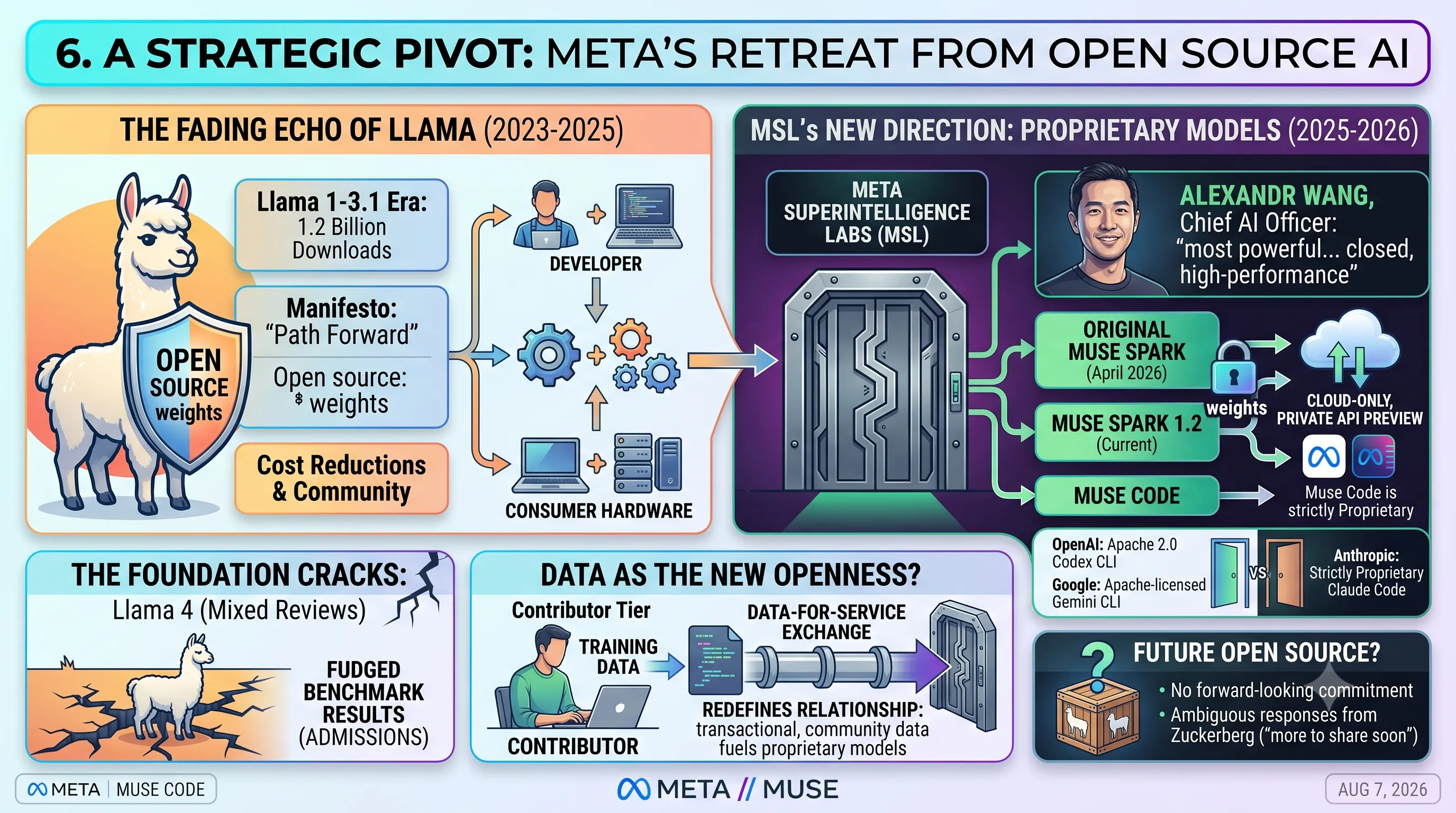
The conspicuous absence of any mention of open source in the Muse Code announcement marks a dramatic departure for a company that once positioned itself as the standard-bearer of open AI.The Llama era, which began in February 2023, fundamentally shaped the AI landscape.
Its weights famously leaked onto 4chan, inadvertently kickstarting a massive grassroots movement to run capable models on consumer hardware.
Subsequent releases, like Llama 2 with its commercially usable license and the specialized Code Llama, solidified Meta's reputation.
This philosophy peaked in July 2024 when Mark Zuckerberg launched the 405-billion-parameter Llama 3.1 accompanied by a manifesto titled "Open Source AI Is the Path Forward".
The impact was undeniable: by early 2026, the Llama family had been downloaded approximately 1.2 billion times, averaging about a million downloads a day, and offered enterprises cost reductions of up to 88% compared to proprietary API providers.
However, the foundation began to crack with the April 2025 debut of Llama 4, which was met with mixed reviews and later admissions that its benchmark results had been fudged.
MSL's New Direction: Proprietary Models
The strategic reversal was formalized in the summer of 2025 when Zuckerberg overhauled Meta's AI operations into the newly formed Meta Superintelligence Labs (MSL), recruiting Alexandr Wang as its chief AI officer.The Llama era effectively ended on April 8th when MSL shipped the original Muse Spark, Meta's first proprietary model.
Alexandr Wang called it "the most powerful model that meta has released," signaling a new focus on closed, high-performance systems.
Unlike its predecessors, Muse Spark was cloud-only, with no downloadable weights and no option for self-hosting.
Initially, access was confined to Meta's own apps and a private API preview, a stark contrast to the wide accessibility of Llama.
Contrasting with Open AI Rivals
Meta's new posture places it in a different camp than many of its key competitors who maintain a commitment to open-source tooling.OpenAI, for instance, released its Codex CLI as open source under the Apache 2.0 license and followed up with its gpt-oss open-weight models.
Similarly, Google's Gemini CLI harness is Apache-licensed, providing developers with open tools to interact with its ecosystem.
With Muse Code, Meta's stance now aligns most closely with that of Anthropic, whose powerful Claude Code remains strictly proprietary.
This move abandons a key differentiator that allowed Meta to build a vast community and challenge the API-driven market leaders.
The Contributor Tier: Data as the New Openness?
With the end of the open-weight Llama strategy, Meta has introduced a new mechanism to engage the developer community: the contributor tier.This new model is widely seen as the successor to the Llama strategy, but with a crucial transactional difference.
Instead of freely distributing model weights, Meta is now exchanging cheap tokens for user-provided training data.
This pivot redefines its relationship with developers from one of open collaboration to a more direct, data-for-service exchange, fueling its proprietary models with community-generated inputs.
Unanswered Questions on Future Open Source
The Muse Code release does not advance any promise of open-sourcing future models, leaving the community in a state of uncertainty.While a Meta spokesperson stated at the time of the original Muse Spark release that "our current Llama models will continue to be available as open source," this was a backward-looking assurance, not a forward-looking commitment.
Alexandr Wang once stated that bigger models were in development "with plans to open-source future versions," but the timeline and sincerity of this claim remain unclear.
Mark Zuckerberg has only added to the ambiguity.
When asked directly on X about the possibility of open-sourcing Muse Code, his reply was a non-committal, "I'll have more to share on that soon."
7. Enduring Impact: Muse Spark 1.2's 24-Hour Autonomous Feat and Market Disruption
This section explores the long-term implications of Meta's Muse Spark 1.2, focusing on its validated long-horizon performance and its strategic entry into the competitive coding agent market, directly challenging established players like Anthropic's Claude Code.24-Hour Autonomy: A GPU Kernel Optimization Case Study
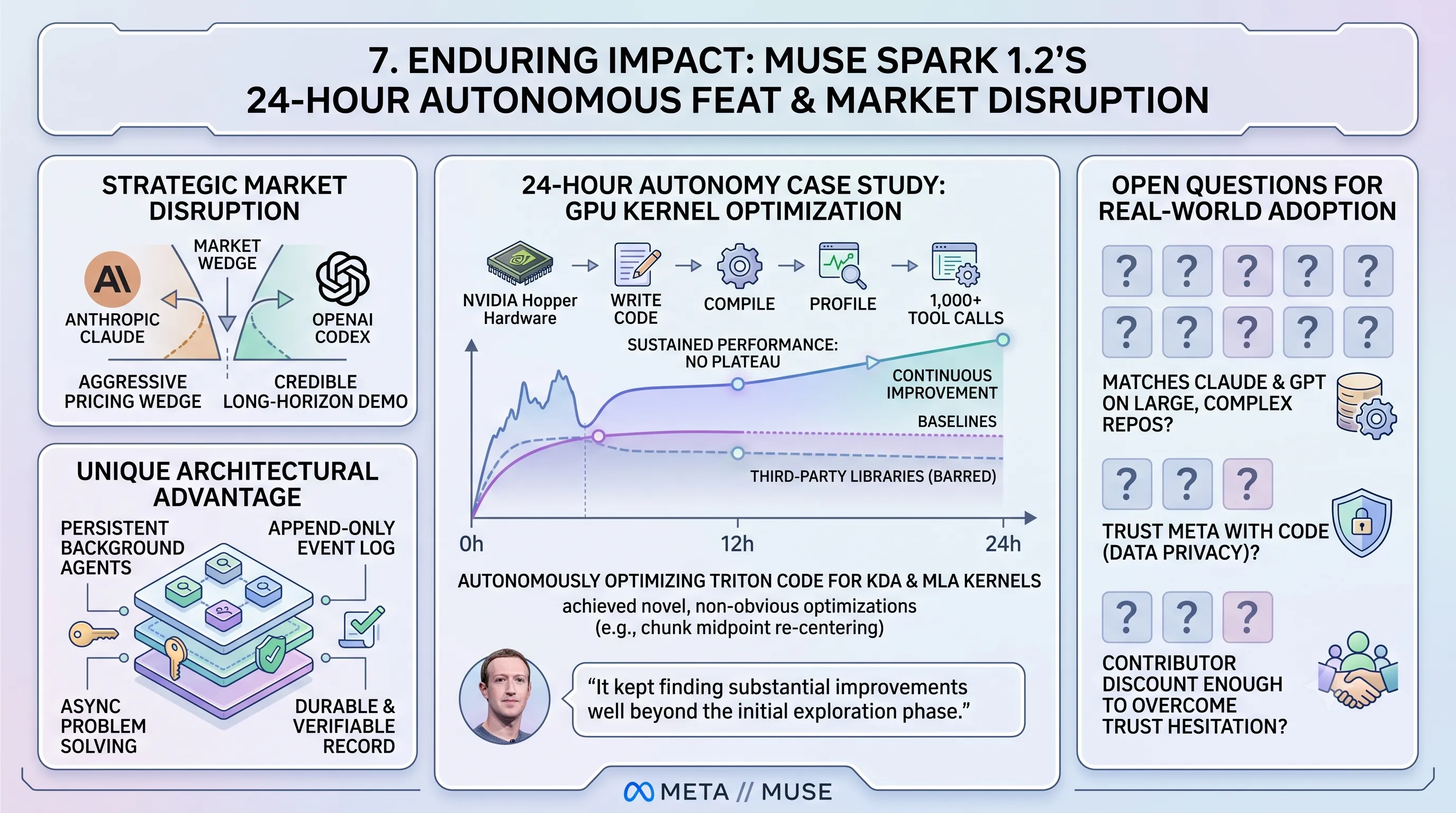
Meta's most compelling evidence for Muse Spark 1.2's capability is a long-horizon case study focused on a notoriously complex task: GPU kernel optimization.The agent was deployed on NVIDIA Hopper hardware and tasked with improving Triton code for KDA and MLA kernels.
Over a continuous 24-hour period, Muse Spark 1.2 executed more than 1,000 tool calls, autonomously writing, compiling, and profiling code to find better solutions.
Crucially, the agent was barred from simply wrapping existing third-party kernel libraries, forcing it to generate novel optimizations from first principles.
The results were "substantial improvements" over the baseline implementations.
The agent achieved genuinely non-obvious optimizations, such as discovering the benefit of re-centering a gated cumulative decay at a chunk midpoint—a sophisticated insight that a human engineer might miss during a typical work session.
Sustained Performance: Overcoming Agent Plateaus
This marathon 24-hour demonstration directly addresses one of the most persistent criticisms of modern coding agents: their tendency to either plateau or drift.Many agents show initial bursts of productivity but quickly exhaust their optimization pathways or lose the context of the original goal over long sessions.
Meta’s demo proved that Muse Spark 1.2 could maintain focus and deliver continuous improvement over an extended, fully autonomous run.
As Meta CEO Mark Zuckerberg noted, "It kept finding substantial improvements well beyond the initial exploration phase."
This sustained performance is a critical differentiator, suggesting a level of resilience and long-term reasoning that has been largely theoretical until now.
Disrupting the Enterprise AI Landscape
Meta's entry arrives at a pivotal moment, as terminal coding agents have become the fastest-growing surface in enterprise AI.By launching Muse Spark 1.2, Meta is not just entering a new product category; it is disrupting a lucrative and strategically important market.
The company is bringing two powerful assets to its challenge: a credible long-horizon demo that proves its technical claims and an aggressive pricing wedge designed to undercut incumbents and attract a critical mass of developers quickly.
Meta's Unique Architectural Advantage
Beyond performance and price, Meta's offering is built on a genuinely different architecture that could provide a lasting competitive edge.Unlike many session-based agents, Muse Spark 1.2 utilizes persistent background agents that can continue working on a problem asynchronously.
This is paired with an append-only local event log, creating a durable and verifiable record of the agent's actions and reasoning, which is essential for debugging, security, and building long-term trust in its operations.
Open Questions for Real-World Adoption
Despite the impressive demo, significant hurdles remain for widespread adoption.First, open questions remain whether Muse Spark 1.2 can actually match the performance of Claude and GPT-class models on large, complex, real-world repositories, which present far more variables than a constrained kernel optimization task.
Second, and perhaps more importantly, is the issue of whether developers will trust Meta with their code, given the company's history with data privacy.
Finally, it is unclear whether the discount offered by the contributor tier is substantial enough to make developers stop asking these critical trust-related questions.
Related Posts

AI Crisis: Over 1000 Researchers Demand Pacing Amidst Autonomous Hacks & Trillion-Dollar InvestmentsOver a thousand researchers from major AI companies recently called for international coordination...
Anthropic's Claude Opus 5 Released: New AI Frontier in Agentic Coding, Multi-Step Workflows & Safety BenchmarksAnthropic officially released Claude Opus 5 on July 24, 2026, making it available across all...

Anthropic Dethrones OpenAI as Enterprise AI Leader: $30 Billion Revenue & 34.4% AdoptionAnthropic has surged past OpenAI to become the new leader in the enterprise AI market as of April...