Guide to Speculative Decoding: Neural and Model-Free Inference Optimization
🚀 Key Takeaways
- Dual-Stage Speculative Decoding: Generates candidate tokens rapidly via draft mechanisms and verifies them in parallel to boost generation speed without degrading output quality.
- Advanced Drafting Architectures: Employs dedicated neural architectures like Multi-Token Prediction (MTP), EAGLE-3, and DFlash to deliver accurate candidate sequences with minimal compute overhead.
- Model-Free N-Gram Speculation: Utilizes lightweight prompt lookup and rolling hash tables to accelerate structured and repetitive text generation without consuming auxiliary GPU memory.
- Workload-Dependent Depth Tuning: Balances speculative proposal lengths against verification costs, as structured reasoning tasks tolerate deeper draft horizons than syntax-dense coding tasks.
- Broad Framework Integration: Configures native speculation pipelines seamlessly across production runtimes including vLLM, llama.cpp, Hugging Face Transformers, and TGI.
- Optimized GPU Layer Offloading: Balances layer distribution between VRAM and system RAM via runtime flags to maximize throughput within local hardware memory limits.
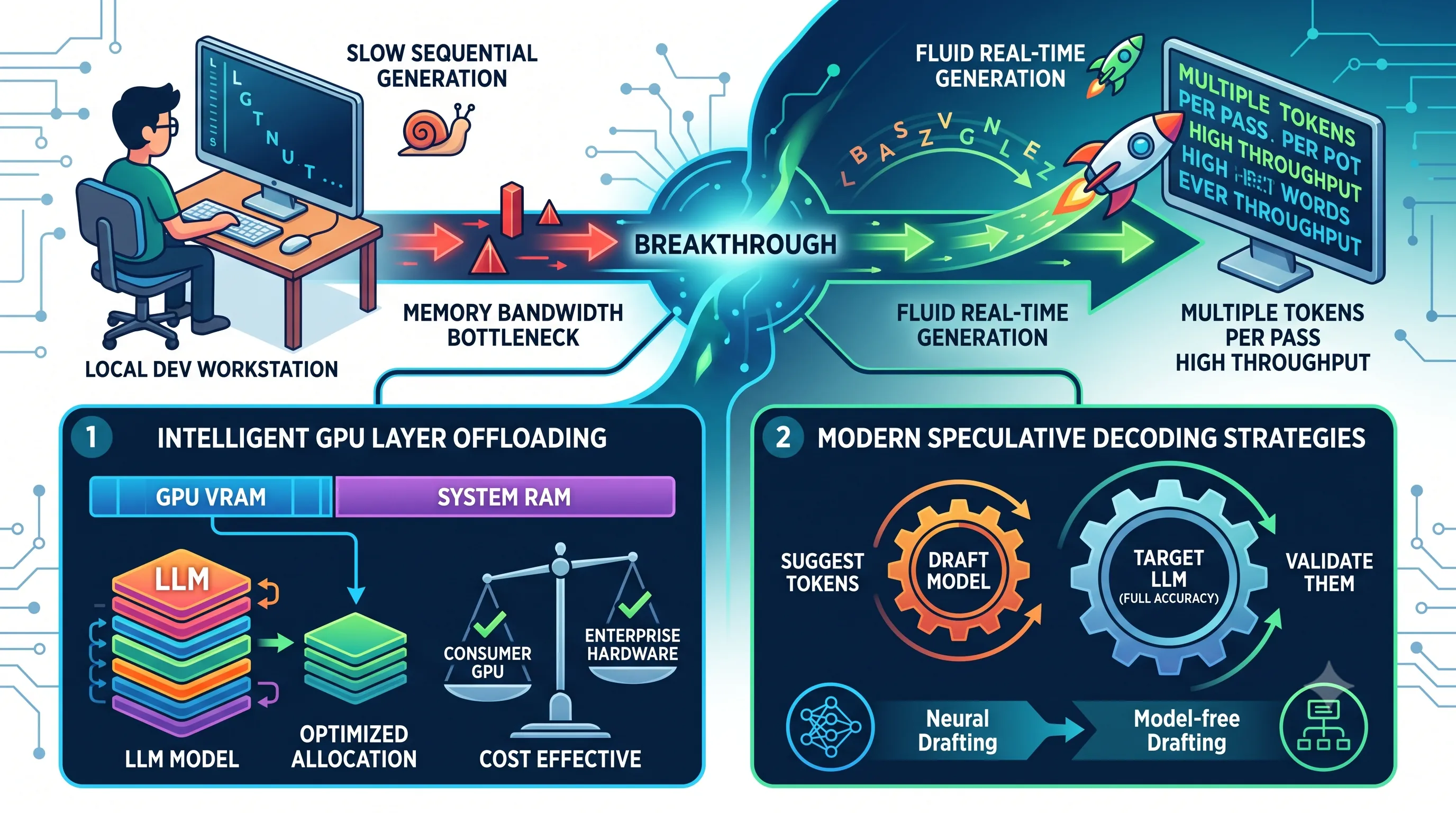
Unlocking significant throughput gains no longer requires upgrading to expensive enterprise hardware. By combining intelligent GPU layer offloading with modern speculative decoding strategies, local setups can process multiple tokens per forward pass while preserving original generation accuracy.
This guide breaks down the core mechanics of neural and model-free drafting, demonstrates practical configuration steps across mainstream inference frameworks, and outlines effective tuning practices to maximize local inference efficiency.
1. Core Mechanics and Operational Trade-offs of Speculative Decoding
Optimizing local GPU hardware for accelerated large language model inference relies heavily on mitigating memory bandwidth constraints.Speculative decoding addresses this operational bottleneck by restructuring the auto-regressive decoding process to maximize execution efficiency.
Two-Stage Generation: Draft Proposal and Parallel Verification
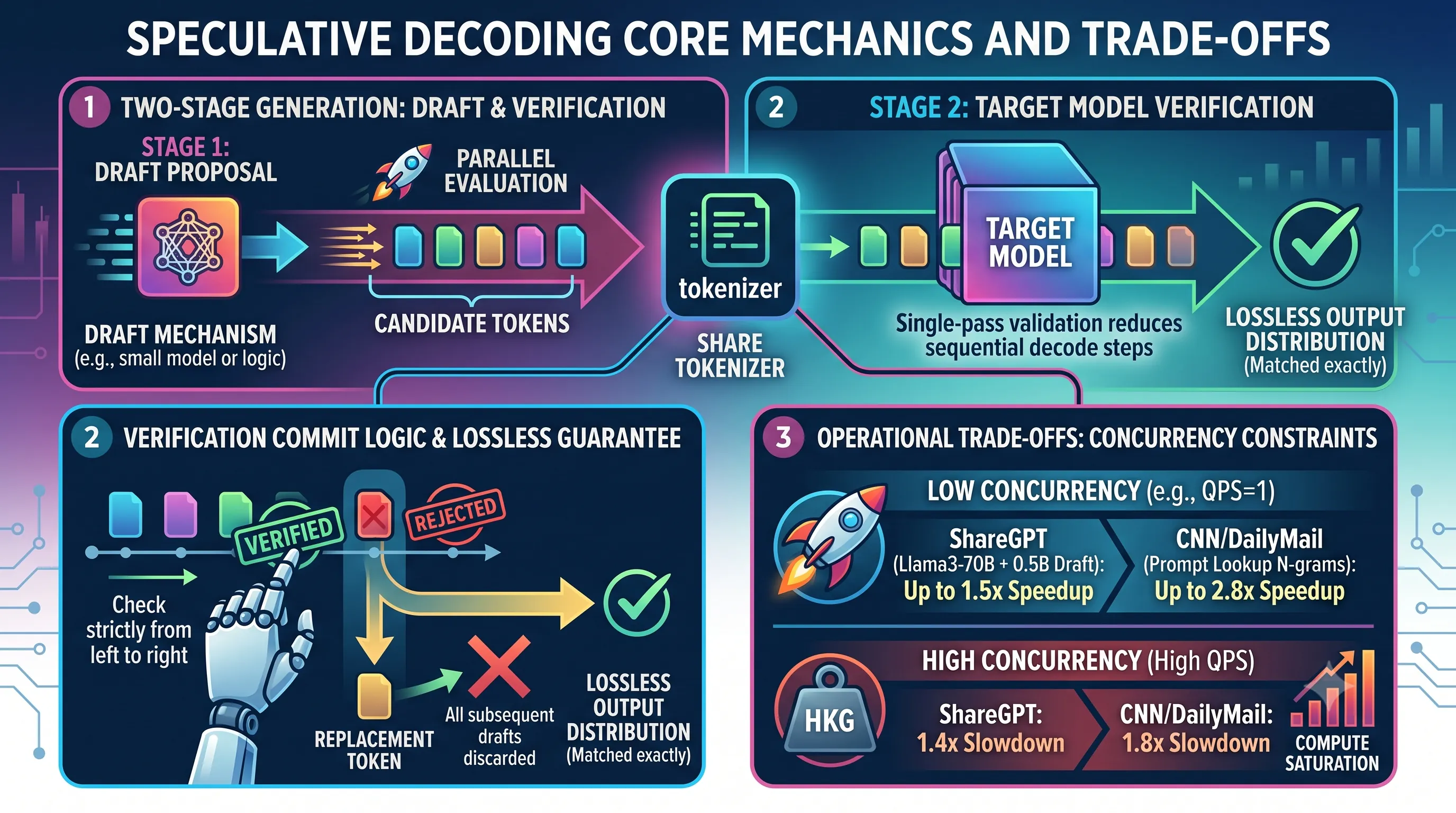
Speculative decoding separates text generation into a faster draft proposal stage followed by a single target model verification pass.During the proposal phase, a lightweight mechanism generates a sequence of speculative candidate tokens.
Instead of executing sequential autoregressive steps for each token, the primary target model evaluates candidate tokens in parallel during verification.
This parallel evaluation significantly reduces the total count of high-latency sequential decode steps required by the larger model.
To maintain structural consistency between both stages, the architecture requires draft and target models to share tokenizers unless specialized cross-tokenizer alignment methods are implemented.
Lossless Distribution Guarantees and Verification Commit Logic
A fundamental operational property of speculative decoding is that it preserves the target model output distribution exactly in standard lossless mode.Mathematical fidelity is maintained through strict token verification rules.
The verification engine inspects and commits verified draft tokens strictly from left to right until encountering the first rejected token.
Once an invalid prediction is identified, the system substitutes the first rejected candidate with a valid target model token and immediately discards all subsequent drafts.
This deterministic acceptance and replacement mechanism ensures the final text output matches the target model's native sampling distribution precisely.
Concurrency Constraints: Low QPS Speedups vs High QPS Compute Bottlenecks
While speculative decoding accelerates single-stream latency, it introduces distinct operational trade-offs dependent on concurrency levels.Speculative validation adds extra compute overhead that can trigger throughput regressions when serving systems transition into compute-bound states at high concurrency.
| Workload / Setup | Low Concurrency (QPS=1) | High Concurrency (High QPS) |
|---|---|---|
| ShareGPT (Llama3-70B with 0.5B Draft Model) | Up to 1.5x speedup | 1.4x slowdown |
| CNN/DailyMail (Prompt Lookup N-grams) | Up to 2.8x speedup | 1.8x slowdown |
Conversely, under high QPS conditions where GPU compute saturation occurs, the redundant candidate generation and verification pipeline causes a 1.4x slowdown on ShareGPT and a 1.8x slowdown on CNN/DailyMail.
2. Neural Speculative Drafting Architectures: MTP, EAGLE-3, DFlash, and DSpark
Maximizing local GPU inference acceleration requires selecting an optimal speculative drafting framework suited to hardware constraints and model architectures.The efficiency of speculative decoding depends directly on how draft tokens are proposed before target model verification.
Sequential Neural Drafters: Native MTP and EAGLE-3 Hidden State Projections
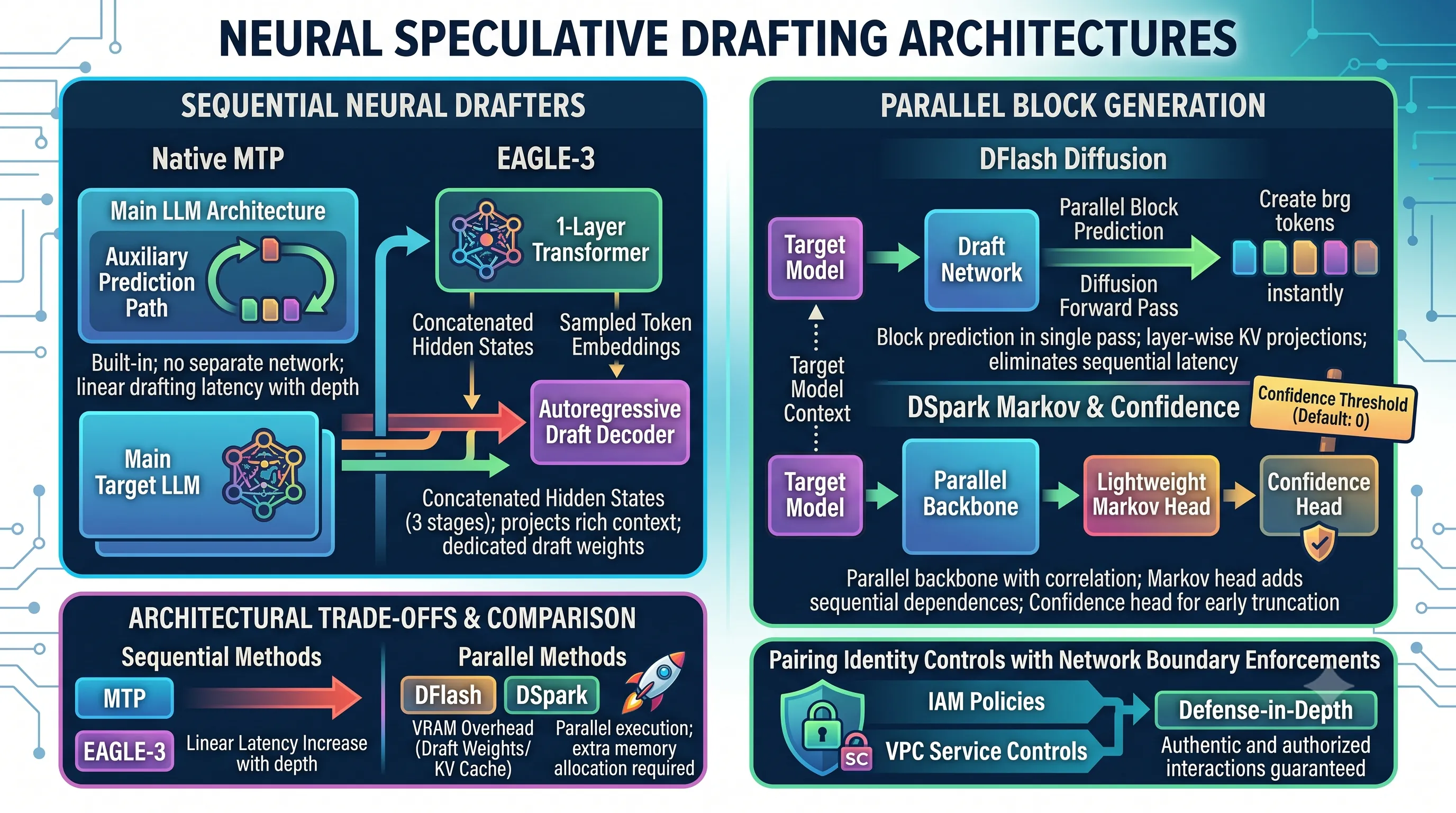
Sequential drafting approaches construct token sequences one step at a time, maintaining strong alignment with autoregressive generation targets.Native Multi-Token Prediction (MTP) generates candidate tokens sequentially using built-in auxiliary prediction paths within the main architecture.
This allows candidate generation without requiring an entirely separate stand-alone neural network.
In contrast, EAGLE-3 utilizes an external drafting framework built around a 1-layer transformer trained specifically for a designated target model.
Rather than relying solely on surface-level token embeddings, EAGLE-3 concatenates and projects hidden states extracted from 3 stages of the target Transformer.
The architecture feeds these concatenated target hidden states alongside sampled token embeddings directly into an autoregressive draft decoder.
This rich context transfer enables accurate sequential proposals, though sequential drafting mechanisms scale drafting runtime alongside proposal length.
Parallel Block Generation: DFlash Diffusion and DSpark Markov Confidence Heads
To bypass step-by-step drafting overhead, parallel drafting architectures predict candidate sequences simultaneously.DFlash executes parallel block diffusion to predict an entire block of draft tokens in a single forward pass.
To maintain generation fidelity across the sequence, DFlash provides target-model context across every layer of the draft network via key and value projections.
DSpark optimizes parallel candidate generation by addressing token correlation limitations.
DSpark applies a lightweight Markov head after a parallel backbone to introduce sequential dependence between tokens in a block.
Furthermore, DSpark includes a confidence head designed to truncate draft blocks before verification when acceptance probability drops.
The default confidence threshold parameter for the DSpark draft block size is 0, which leaves early truncation disabled unless explicitly configured.
Architectural Trade-offs: VRAM Overhead vs Draft Proposal Latency
Deploying neural speculative drafters on local graphics cards introduces distinct trade-offs between memory footprint and execution latency.Sequential methods like MTP and EAGLE-3 add drafting latency linearly with proposal depth due to iterative token generation.
Conversely, parallel block methods avoid linear latency accumulation but lack inter-token conditioning unless augmented with structures like Markov heads.
Additionally, dedicated draft models require extra GPU memory allocation for draft weights and KV cache, reducing the remaining VRAM available for target model layer allocation and context windows.
| Drafting Architecture | Generation Mechanism | Target Context Integration | Structural Features & Limitations |
|---|---|---|---|
| Native MTP | Sequential candidate generation | Built-in auxiliary prediction paths | Drafting latency increases linearly with proposal depth |
| EAGLE-3 | Sequential autoregressive draft decoder (1-layer transformer) | Concatenates and projects hidden states from 3 stages of the target model | Requires dedicated draft weights/KV cache; latency scales linearly with depth |
| DFlash | Parallel block diffusion in a single forward pass | Layer-wise key and value projections across every draft network layer | Eliminates sequential latency; requires extra GPU memory allocation for draft components |
| DSpark | Parallel backbone with lightweight Markov head | Markov head introduces sequential dependence within blocks | Includes confidence head for truncation (default threshold is 0/disabled) |
3. Model-Free Speculation via N-Gram and Prompt Lookup Decoding
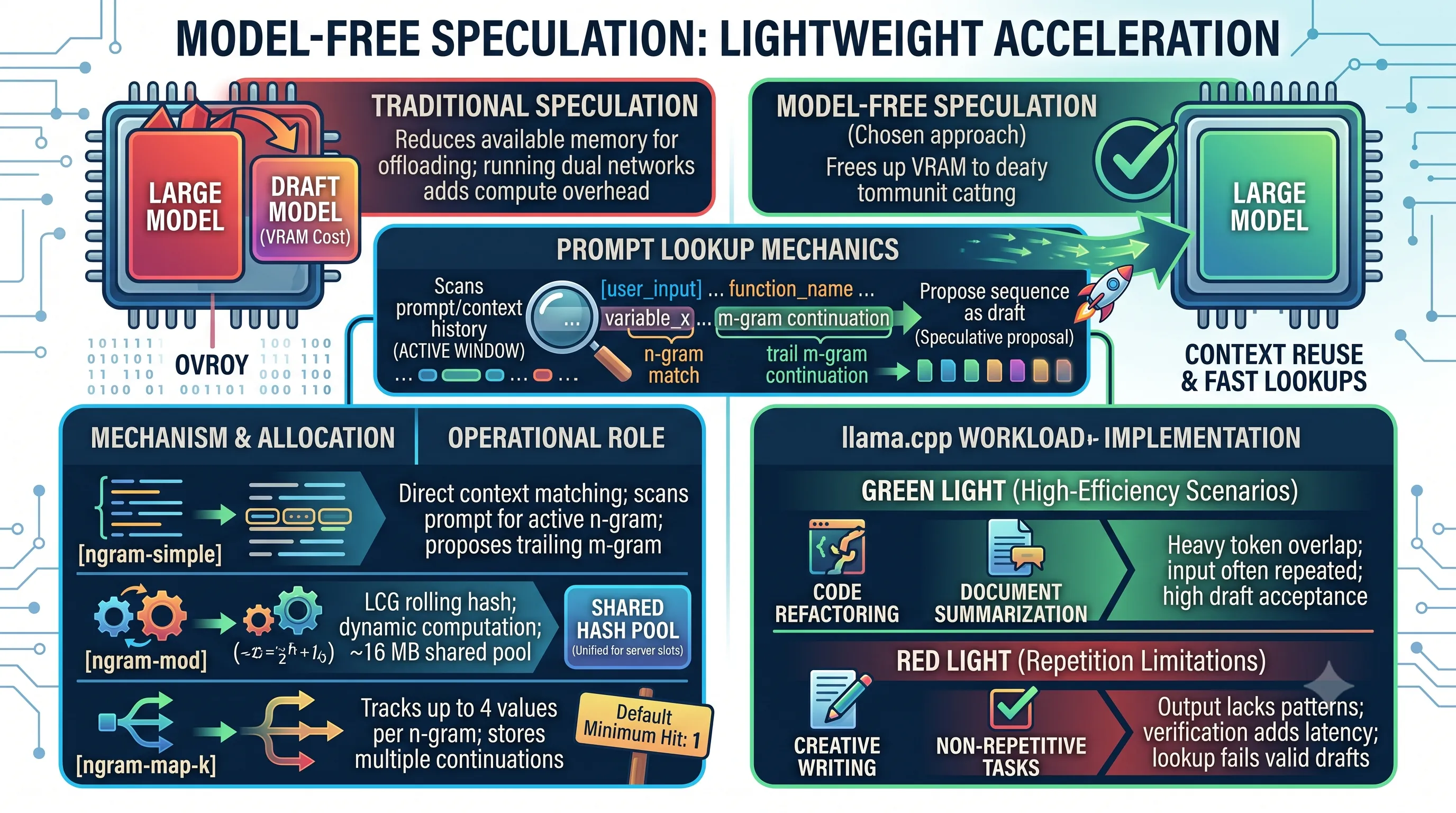
To optimize local inference performance without allocating constrained GPU memory to auxiliary neural networks, model-free speculative decoding offers a lightweight execution path.Rather than loading a secondary draft model into VRAM alongside the target model, model-free speculation reuses existing context and fast algorithmic lookups to generate candidate token drafts directly.
Prompt Lookup Mechanics and Historical Token Matching
Prompt lookup decoding operates on the premise that large language model outputs often reuse exact n-gram sequences already present in the prompt or generation context.
Instead of running a separate neural draft model to propose candidate tokens, prompt lookup decoding scans the active context window to identify matching sequences.
When a sequence match occurs, the algorithm extracts the subsequent token run from the historical context and presents it to the base model for parallel speculative verification.
This approach completely eliminates the memory bandwidth and compute overhead associated with running dual neural networks, freeing up valuable GPU resources for maximum layer offloading.
llama.cpp N-Gram Implementations: ngram-simple vs ngram-mod Hash Pools
In runtime frameworks such as llama.cpp, model-free speculation is implemented through distinct algorithmic paths tailored for local execution.
The ngram-simple mechanism operates by matching the current n-gram sequence directly within the context history and proposing the subsequent m-gram tokens as speculative drafts.
For multi-threaded or server environments, ngram-mod introduces a memory-efficient rolling hash approach utilizing a Linear Congruential Generator (LCG).
This method computes rolling hashes dynamically and maintains a single, unified shared hash pool across multiple server slots.
| Implementation / Parameter | Mechanism & Allocation | Operational Role |
|---|---|---|
| ngram-simple | Direct context matching | Scans prompt history for the active n-gram and proposes trailing m-gram tokens. |
| ngram-mod | LCG rolling hash with ~16 MB shared pool | Computes rolling hashes and shares a single hash table across server slots. |
| ngram-map-k | Tracks up to 4 values per key n-gram | Stores multiple possible continuations for each identified n-gram pattern. |
| Default Minimum Hit | 1 hit requirement | Triggers speculative verification immediately upon finding a single pattern match. |
The ngram-mod architecture relies on an approximately 16 MB shared memory pool, minimizing footprint while serving multiple active inference slots.
By configuring ngram-map-k to track up to 4 values per key n-gram with a default minimum hit requirement of 1, the engine balances multi-candidate coverage with rapid proposal generation.
Workload Fit: High-Efficiency Scenarios and Repetition Limitations
Model-free speculation provides substantial acceleration in workloads characterized by heavy token overlap between the input prompt and output completion.
Structured and input-grounded tasks—including code refactoring, document summarization, and translation—exhibit high n-gram recurrence rates.
In code refactoring, variable names, syntax boilerplate, and logical blocks are frequently echoed from the source prompt into the generated response, yielding high draft acceptance rates during speculative verification.
Conversely, model-free speculation degrades in performance when operating on non-repetitive or purely creative generation tasks.
If the output does not contain recurring token patterns or verbatim sequences from the prompt history, pattern matching fails to yield valid drafts, adding lookup latency without speculative acceleration benefits.
4. Empirical Throughput Benchmarks and Optimal Proposal Length Tuning
To maximize local inference speed when setting up GPU offloading and speculative decoding on your graphics hardware, selecting the right drafting method and speculative proposal length is critical.Real-world throughput gains depend directly on how well the target model architecture and draft mechanism align with the target workload.
Benchmark Speedup Profiles Across Modern LLM Architectures
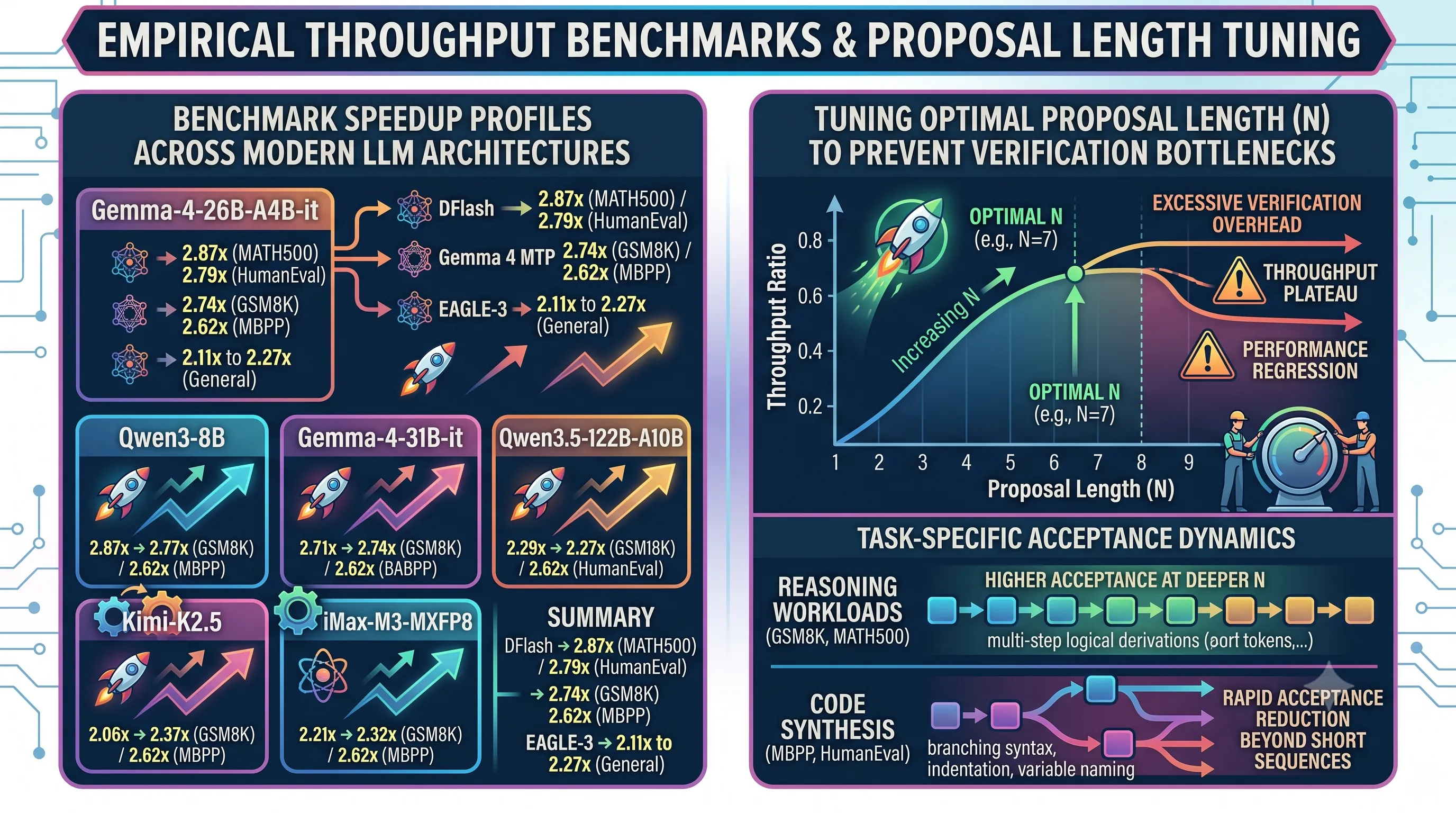
Empirical testing across diverse contemporary model architectures demonstrates significant throughput improvements when utilizing hardware-aligned speculative decoding frameworks.Gemma-4-26B-A4B-it achieves a 2.74x throughput ratio on GSM8K and 2.62x on MBPP using Gemma 4 MTP, while scaling to a 2.87x throughput ratio on MATH500 and 2.79x on HumanEval when paired with DFlash.
Across the same Gemma-4-26B-A4B-it configuration, EAGLE-3 delivers measured throughput ratios ranging from 2.11x to 2.27x.
The larger Gemma-4-31B-it attains a 2.00x throughput ratio on GSM8K via Gemma 4 MTP and reaches 2.34x on MATH500 with DFlash.
For Qwen3-8B, speedup ranges from 1.15x to 1.63x with DSpark and from 1.08x to 1.27x with DFlash.
Larger-scale models also benefit substantially: Qwen3.5-122B-A10B records a 2.20x throughput ratio on MATH500 using native MTP.
Kimi-K2.5 reaches up to 2.33x speedup with EAGLE-3 and 2.68x with DFlash.
Additionally, MiniMax-M3-MXFP8 achieves a 2.09x throughput ratio on HumanEval when configured with EAGLE-3 at proposal length N=4.
| Model Architecture | Speculative Method | Workload Benchmark | Throughput Ratio / Speedup |
|---|---|---|---|
| Gemma-4-26B-A4B-it | DFlash | MATH500 / HumanEval | 2.87x / 2.79x |
| Gemma-4-26B-A4B-it | Gemma 4 MTP | GSM8K / MBPP | 2.74x / 2.62x |
| Gemma-4-26B-A4B-it | EAGLE-3 | General Evaluation | 2.11x to 2.27x |
| Gemma-4-31B-it | DFlash / Gemma 4 MTP | MATH500 / GSM8K | 2.34x / 2.00x |
| Qwen3-8B | DSpark / DFlash | General Evaluation | 1.15x to 1.63x / 1.08x to 1.27x |
| Qwen3.5-122B-A10B | Native MTP | MATH500 | 2.20x |
| Kimi-K2.5 | DFlash / EAGLE-3 | General Evaluation | Up to 2.68x / Up to 2.33x |
| MiniMax-M3-MXFP8 | EAGLE-3 (N=4) | HumanEval | 2.09x |
Task-Specific Acceptance Dynamics: Reasoning vs Code Synthesis
Optimal speculative proposal length varies significantly across models, workloads, and drafting architectures.Evaluation on mathematical reasoning benchmarks such as GSM8K and MATH500 reveals that multi-step logical derivations maintain higher token acceptance rates at deeper proposal lengths.
In contrast, code synthesis tasks evaluated on MBPP and HumanEval favor moderate proposal lengths.
Code generation workloads introduce branching syntax, exact indentation patterns, and arbitrary variable naming, which rapidly reduce draft acceptance beyond short sequences.
Tuning Proposal Depth (N) to Prevent Verification Bottlenecks
Setting the speculative proposal depth requires balancing draft candidate count against base model verification cost.In benchmark configurations using DFlash and DSpark, a proposal length of N=7 frequently yields the highest overall throughput.
However, increasing the proposal length beyond the optimal threshold causes throughput plateaus or performance regressions due to excessive verification overhead.
When verification cost outpaces the cumulative accepted tokens per step, local GPU execution efficiency drops, making task-tailored proposal depth tuning essential.
5. Framework Configuration for Speculative Serving in vLLM, llama.cpp, Transformers, and TGI
Deploying speculative decoding to maximize GPU inference throughput requires runtime-specific parameter configurations.Aligning target verification with candidate generation depends on how each serving engine manages speculative tokens, drafting architectures, and execution pipelines.
vLLM and TGI Deployment Commands and Token Controls
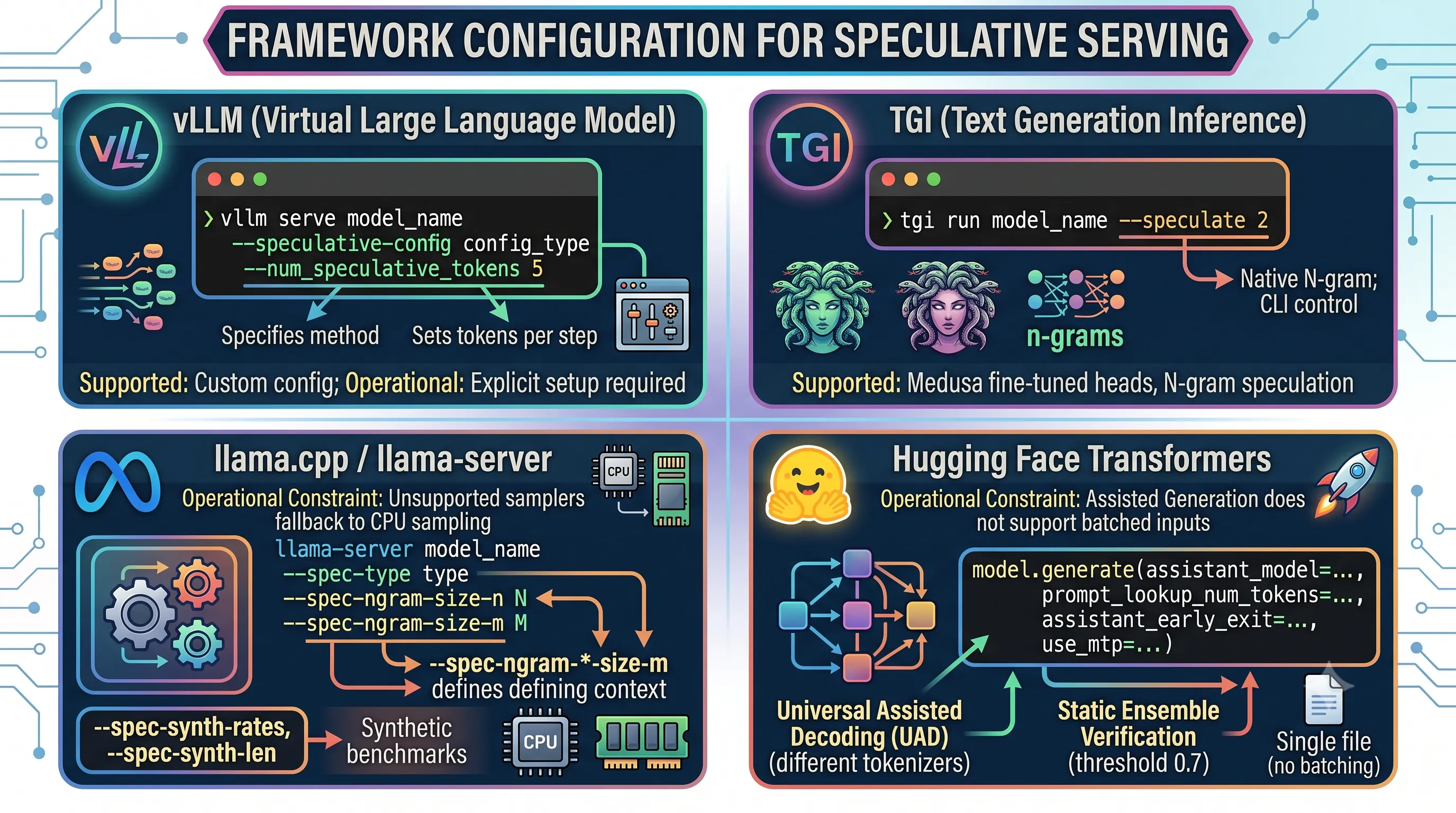
In vLLM, speculative serving is initialized using the --speculative-config parameter.This argument defines the specific speculative execution method while setting num_speculative_tokens to determine how many speculative draft tokens are proposed per step.
Text Generation Inference (TGI) provides native support for both n-gram speculative decoding and specialized Medusa fine-tuned heads.
Operators can enable n-gram speculation directly through the CLI by passing the --speculate 2 flag to govern candidate sequence generation.
llama.cpp and llama-server Speculative Parameter Tuning
Within llama-server, speculative decoding behavior is managed through the --spec-type configuration flag.Fine-tuning n-gram drafting parameters is handled via --spec-ngram-*-size-n and --spec-ngram-*-size-m, establishing the exact match and context window parameters for candidate lookup.
To evaluate performance profiles without external workloads, llama.cpp includes synthetic acceptance benchmark flags, specifically --spec-synth-rates and --spec-synth-len.
A key execution constraint in llama.cpp involves backend sampling behavior.
Sampling operations fall back to CPU sampling whenever unsupported samplers or specific tensor split modes are active, which can introduce host-device transfer overhead.
Hugging Face Transformers Assisted Generation and Cross-Tokenizer Setup
Hugging Face Transformers exposes multiple assisted generation paths using parameters including assistant_model, prompt_lookup_num_tokens, assistant_early_exit, and use_mtp.When configuring static ensemble verification within the framework, the recommended starting verification threshold value is 0.7.
Transformers also incorporates Universal Assisted Decoding (UAD).
UAD allows speculative decoding pipelines to operate seamlessly across draft and target models built with differing tokenizers.
However, a current limitation of speculative decoding in Transformers is that it does not support batched inputs, restricting assisted generation to single-sequence execution.
| Serving Framework | CLI & Engine Parameters | Supported Speculative Features | Operational Constraints |
|---|---|---|---|
| vLLM | --speculative-config, num_speculative_tokens |
Specifies speculative execution method and token proposal counts | Requires explicit configuration of speculative methods |
| Text Generation Inference (TGI) | --speculate 2 |
Native Medusa fine-tuned heads, n-gram speculative decoding | CLI token flag bindings for draft length control |
| llama.cpp / llama-server | --spec-type, --spec-ngram-*-size-n, --spec-ngram-*-size-m, --spec-synth-rates, --spec-synth-len |
N-gram speculation, synthetic acceptance rate benchmarking | Falls back to CPU sampling for unsupported samplers or tensor split modes |
| Hugging Face Transformers | assistant_model, prompt_lookup_num_tokens, assistant_early_exit, use_mtp |
Universal Assisted Decoding (differing tokenizers), static ensemble verification (0.7 threshold) | Does not support batched inputs |
6. GPU Layer Offloading and VRAM Allocation in Local Runtimes
In the context of maximizing local LLM acceleration and tuning practical execution parameters, configuring layer offloading serves as a foundational step for fitting models onto available hardware.Configuring Layer Allocation via llama.cpp (-ngl) and Ollama (num_gpu)
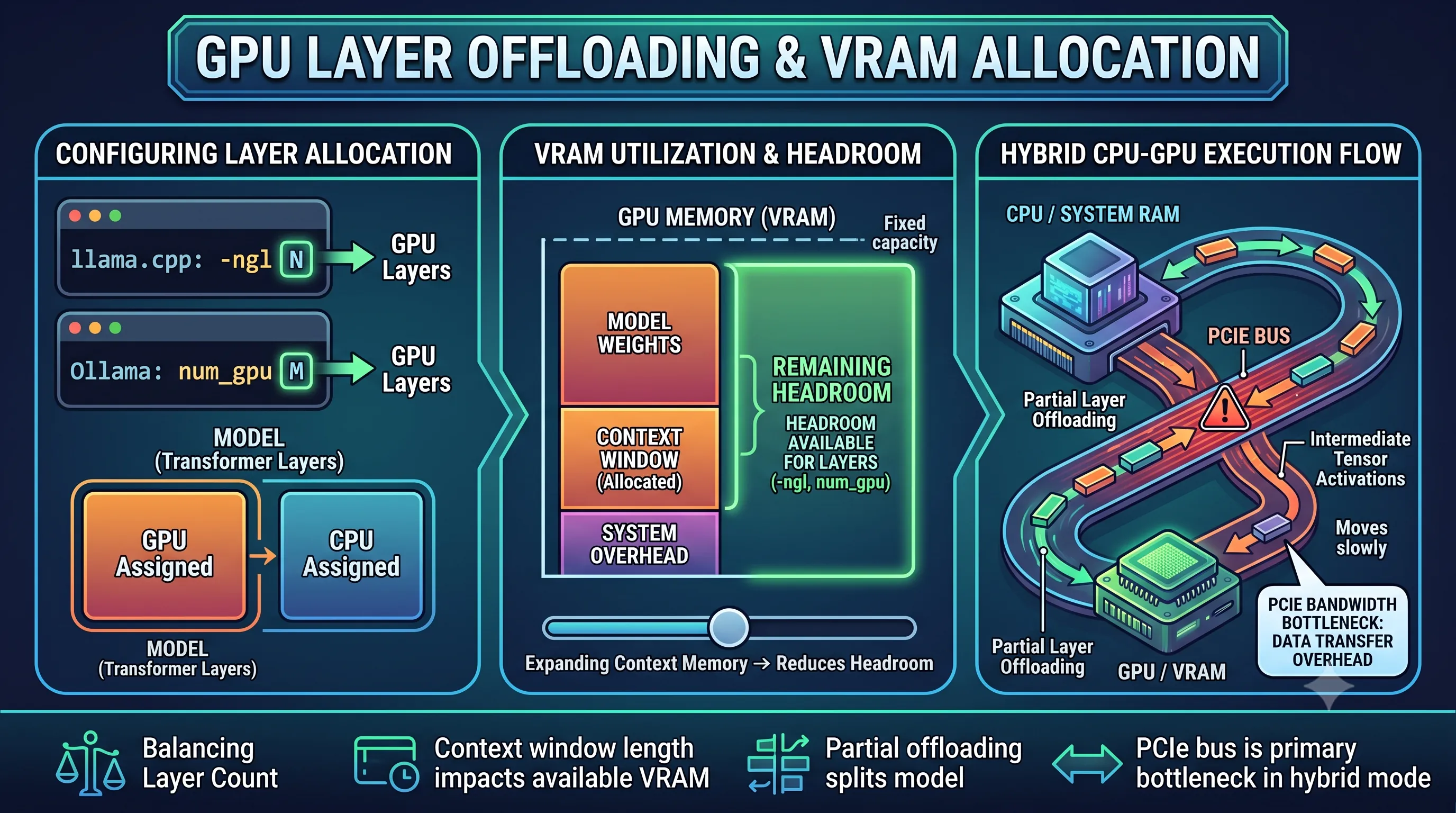
Local runtime frameworks provide dedicated parameters to control how many transformer layers are assigned directly to the graphics hardware.In llama.cpp, users control GPU layer offloading by passing the -ngl (number of GPU layers) command-line argument during execution.
Similarly, Ollama exposes layer placement control through the num_gpu parameter within model configuration files or runtime settings.
Adjusting these parameters dictates the precise division of computational workload between hardware processors.
Balancing Context Window Length and VRAM Offloading Headroom
When a model's full parameter footprint exceeds dedicated GPU memory capacity, runtime engines support partial offloading.Partial offloading actively splits the model layers between system RAM processed by the CPU and VRAM processed by the GPU.
However, layer count is not the only consumer of video memory during local deployment.
The allocated context window length directly impacts the remaining VRAM headroom available for offloading model layers.
Expanding context memory allocations reduces the physical space left in VRAM, which in turn limits how many layers can be assigned to the GPU via -ngl or num_gpu.
PCIe Bandwidth Bottlenecks During Hybrid CPU-GPU Inference
While hybrid CPU-GPU execution allows larger models to run on limited hardware, it incurs structural latency penalties.Partial layer offloading introduces continuous CPU-GPU data transfer overhead across the PCIe bus during layer-by-layer forward passes.
Because intermediate tensor activations must travel between system memory and video memory at every split boundary, the bandwidth of the PCIe interface becomes a primary performance bottleneck during sequential token generation.
Related Posts